1. Introduction
Depth estimation plays a vital role in a wide range of applications, including autonomous driving, 3D reconstruction [
1], augmented reality, robotics, and medical imaging. Accurate depth perception enables the understanding of spatial scene structures, object positioning, and metric distances, which are foundational for tasks such as semantic segmentation, autonomous navigation, robotic surgery assistance, and human pose estimation.
Traditional depth sensing systems, such as radars, LiDARs, or stereo cameras, often produce sparse depth representations and are constrained by cost, power consumption, and hardware complexity. Depth cameras using stereo disparity, structured light, or time-of-flight methods provide denser outputs, but they suffer from photometric sensitivity, limited range, and motion blur. These limitations hinder performance in dynamic environments and long-range scenes, prompting the development of monocular depth estimation methods.
Monocular depth estimation based on supervised learning, particularly when utilizing convolutional neural networks (CNNs), attains superior results when trained with high-quality annotated depth data [
2,
3,
4]. However, the scarcity and high cost of dense annotations present practical implementation challenges. Consequently, self-supervised methods have emerged as a promising alternative by exploiting geometric constraints from stereo image pairs or monocular video sequences [
5,
6,
7,
8].
Self-supervised monocular depth estimation can be broadly categorized into two primary paradigms:
stereo-based approaches [
5] and
video-based frameworks [
6,
8,
9]. Stereo-based techniques estimate depth by analyzing geometric disparities between synchronized rectified image pairs. While these methods eliminate the need for explicit camera motion estimation, their dependency on dual-camera systems imposes stringent calibration requirements and synchronization constraints, thereby restricting their scalability in real-world deployments. By contrast, video-based methodologies leverage sequential frames captured by a monocular camera in motion, necessitating integration with pose estimation networks to infer camera motion trajectories [
6,
9,
10,
11]. Despite this added complexity, monocular video systems demonstrate enhanced deployment flexibility as they circumvent hardware limitations associated with stereo configurations, rendering them particularly advantageous for edge computing applications on resource-constrained mobile platforms or embedded systems.
Recent progress in video-based paradigms has addressed key challenges through multi-faceted optimization strategies: generative adversarial networks (GANs) [
12] mitigate occlusion artifacts and dynamic scene complexities, semantic supervision modules [
13,
14] enhance depth consistency, and advanced loss formulations [
6] improve prediction accuracy. Concurrently, hybrid architectures integrating convolutional neural networks (CNNs) with vision transformers (ViTs) [
15] have attracted significant interest due to their complementary strengths—CNNs excel at hierarchical feature aggregation through spatially-localized receptive fields, while ViTs capture global dependencies via self-attention mechanisms. However, existing hybrid models still face unresolved bottlenecks that impede their practical deployment and performance.
Specifically, three core limitations persist in current state-of-the-art methods. First, in terms of computational complexity, ViTs exhibit quadratic computational complexity relative to input resolution, making them infeasible for high-resolution depth estimation in low-power, resource-constrained environments. Second, regarding feature representation, most lightweight depth estimation models (e.g., R-MSFM [
11,
16], Lite-Mono [
10]) focus predominantly on low-order cues (e.g., edges and textures) or high-order semantics (e.g., global context), lacking explicit mechanisms to model mid-order features (e.g., object parts, contours, and intermediate spatial structures). This oversight leads to oversmoothed depth maps and compromised structural fidelity. Third, in terms of deployment adaptability, a critical trade-off exists between accuracy, computational efficiency, and deployment flexibility—existing lightweight models often sacrifice depth estimation accuracy to reduce complexity, failing to meet the requirements of real-time embedded applications.
To address these limitations, we propose a lightweight and efficient depth estimation model with a hybrid CNN and Mamba architecture, which constitutes an innovative amalgamation for enhancing the accuracy of depth prediction while maintaining computational efficiency. Specifically, inspired by EfficientViM [
17], we design the
MambaSync module to replace the computationally expensive self-attention mechanism with a structured state-space model (SSM). This SSM achieves linear computational complexity in both time and space, significantly reducing memory usage and enabling scalability to high-resolution feature maps. Unlike conventional attention mechanisms that process all token pairs indiscriminately, Mamba leverages a parameter-efficient and sequence-aware formulation that captures long-range dependencies with greater efficiency, while supporting parallel sequence processing and exhibiting strong inductive biases for spatial and temporal continuity—traits particularly advantageous for dense prediction tasks where both global coherence and local detail are critical. Complementing this, the
CMOGA module enhances spatial and semantic representation through hierarchical fusion of low-, mid-, and high-order features, explicitly addressing the gap in mid-order feature modeling. Together, these two components enable
MogaDepth to accomplish accurate and consistent depth predictions while maintaining computational efficiency suitable for real-time and resource-constrained applications.
Our main contributions can be summarized as follows:
We propose a lightweight, end-to-end self-supervised depth estimation architecture that achieves strong performance while minimizing parameters and floating-point operations (FLOPs).
Our model achieves highly competitive results on the KITTI benchmark [
18] and generalizes well to the Make3D dataset [
19], demonstrating strong cross-domain robustness.
We validate MogaDepth’s efficiency and real-time performance on NVIDIA RTX 3090 and Jetson Xavier, demonstrating its practical deployability.
3. Methodology
Although Lite-Mono [
10] provides a strong lightweight baseline by combining CNNs and Transformers, its encoder still faces challenges in preserving fine-grained details and achieving efficient global modeling. To address these issues, we mainly focus on improving the encoder. Specifically, we replace the CDC module with the proposed CMOGA, which enhances mid-order and boundary-aware representations, and substitute the LGFI module with MambaSync, a scalable state-space model that efficiently captures long-range dependencies. These modifications build on the strengths of Lite-Mono while further improving detail preservation and computational efficiency.
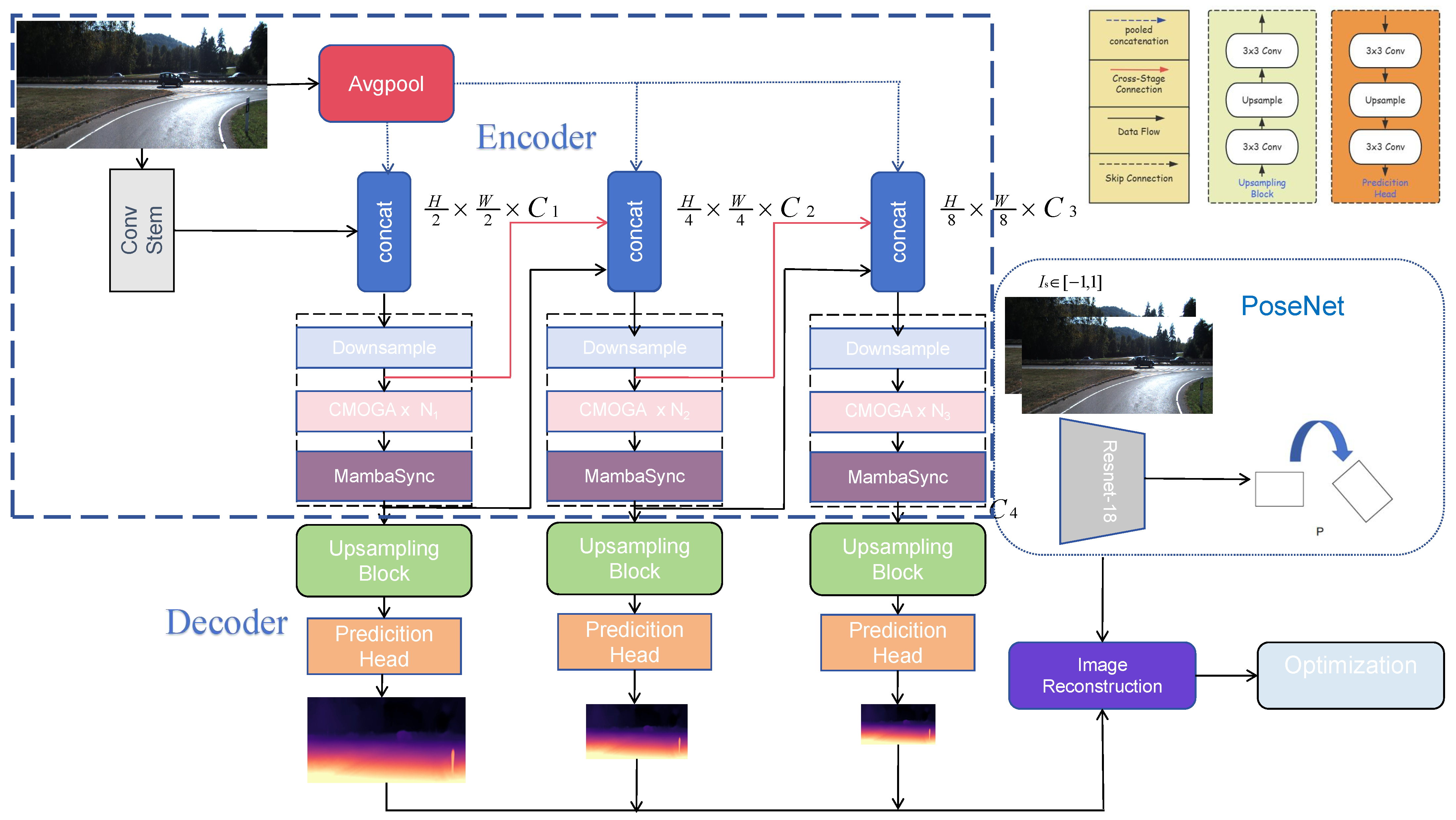
The overall architecture of the proposed MogaDepth is presented in
Figure 1.
3.1. MogaDepth Encoder
As shown in the blue box of
Figure 1, the proposed MogaDepth Encoder adopts a four-level multi-scale feature aggregation architecture, which is theoretically motivated by the inherent demand of dense monocular depth estimation for both fine-grained spatial details and high-level semantic context. This architecture realizes efficient representation learning through progressive downsampling and cross-stage feature fusion, striking a balance between feature richness and computational efficiency for resource-constrained scenarios. An input RGB image with dimensions
first passes through an initial convolutional backbone composed of two groups of
convolutional layers (stride = 1). This backbone is designed to suppress high-frequency noise while extracting primary edge and texture features, generating the first-stage feature map with dimensions
. For the second stage, to mitigate spatial information loss caused by direct downsampling, we concatenate the first-stage features with resolution-matched input images (obtained via average pooling)—a strategy inspired by ESPNetv2 [
33] that is proven to preserve low-level spatial cues critical for depth boundary prediction. The concatenated feature map is then downsampled to
via a
convolution with stride = 2.
Cross-stage feature correlations are established by cascading features from previous downsampling layers (similar to ResNet’s residual connections), which theoretically ensures unobstructed gradient flow during deep network training and avoids the vanishing gradient problem. For subsequent third and fourth stages, we integrate CMOGA modules and MambaSync modules in a cascaded manner—this integration is not arbitrary but a targeted solution to two core limitations of existing CNN-based encoders: (1) insufficient modeling of mid-order feature interactions (e.g., object contours and part structures) that bridge low-level details and high-level semantics; (2) inefficient global context modeling with prohibitive computational complexity. Following the same downsampling principle, the encoder generates high-order semantic features with dimensions and , ultimately forming a multi-scale feature pyramid that balances fine-grained information preservation and deep semantic extraction.
Three distinct depth encoder variants have been systematically designed via modular architecture differentiation, with each variant featuring unique channel configurations and CMOGA block parameterization strategies. The technical specifications of these design paradigms are comprehensively documented in
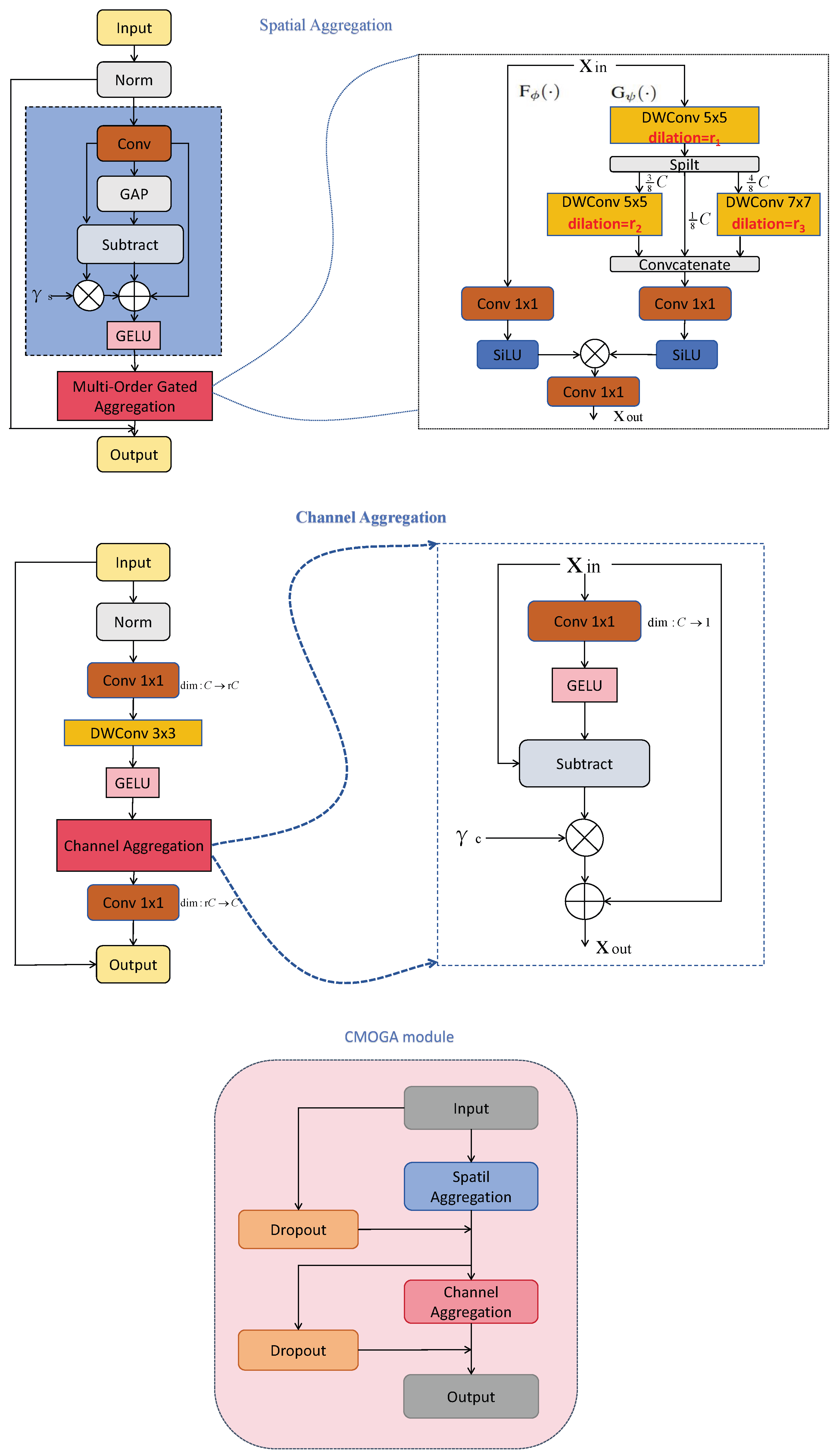
Table 1. Meanwhile, the architectural frameworks for the multi-order aggregation mechanism in the CMOGA module and the details of the MambaSync modules are visually analyzed in
Figure 2.
3.1.1. Continuous Multi-Order Gated Aggregation (CMOGA)
The CMOGA module is theoretically designed to address the mid-order feature modeling gap in existing lightweight monocular depth estimation models. Prior works predominantly focus on fusing low-order texture features or high-order semantic features, while ignoring mid-order features (e.g., object contours, part relationships) that are essential for accurate depth structure prediction. Conceptually inspired by MogaNet [
34], the CMOGA module retains the core design of complementary
spatial aggregation (SA) and
channel aggregation (CA) branches, but tailors hyperparameters (dilation rates, number of repeated blocks) specifically for dense prediction tasks. This targeted adjustment effectively strengthens mid-order feature interaction without altering the fundamental architecture, achieving a balance between performance improvement and computational cost control.
Overall Architecture of CMOGA Module
The CMOGA module follows a residual learning framework to enhance multi-order feature interaction for dense depth prediction, which is proven to facilitate feature fusion by preserving original input information while adding enhanced representations. Given an input feature tensor
(where
H,
W, and
C denote the height, width, and channel number of the feature map, respectively), the module generates the enhanced feature tensor
through sequential computation, formally defined as:
where
and
encapsulate the core operations of the Spatial Aggregation (SA) and Channel Aggregation (CA) branches (detailed in subsequent paragraphs). Notably, the residual connection
ensures the preservation of original fine-grained features while fusing multi-order semantic representations, which is crucial for retaining depth boundary accuracy in dense estimation tasks.
Spatial Aggregation (SA) Branch
The SA branch captures multi-scale spatial context through a Feature Decomposition (FD) module followed by a Multi-Order Gated Aggregation (MOGA) block, a design that aligns with the human visual system’s hierarchical perception of spatial structures. The FD module suppresses redundant activations and highlights discriminative local features by modeling deviations between local responses and global averages, formulated as:
where
is a learnable channel-wise scale parameter, and
denotes global average pooling.
The output
is further processed by parallel depthwise convolutions with dilation rates
—this multi-dilation design enables the branch to capture local textures (
), mid-range contours (
), and large-scale object structures (
) without increasing computational complexity. These multi-scale features are concatenated along the channel dimension and modulated with a SiLU-based gating mechanism to adaptively weight informative mid-order features:
where
correspond to outputs from dilation branches with
(channel number is split equally to match the concatenation operation). By tuning the dilation rates and block repetition times, this branch effectively reinforces mid-level spatial feature interactions that are critical for dense depth prediction.
Channel Aggregation (CA) Branch
The CA branch complements the SA branch by modeling inter-channel semantic dependencies, adopting a lightweight design to avoid excessive computational overhead. It consists of a sequence of normalization, point-wise, and depthwise convolutions, followed by a channel interaction mechanism, formulated as:
The channel interaction operation is defined as:
where
is a learnable channel-wise adjustment parameter, and
denotes a channel reduction mapping (with
as the channel compression ratio in our experiments). The careful selection of hyperparameters ensures effective aggregation of mid-level semantic channels, improving cross-scale feature integration while maintaining lightweight properties.
While CMOGA leverages MogaNet’s foundational structure, its core innovation lies in the tailored modifications of hyperparameters and repetition strategies. These changes are specifically aimed at boosting mid-level feature interaction and multi-scale fusion—vital for single-image depth prediction. By enhancing feature representation density without compromising computational efficiency, our model achieves superior performance. The effectiveness of these hyperparameter settings is quantitatively validated through ablation studies in Secion
4.5.2, confirming their ability to improve multi-order feature fusion with negligible computational overhead increase.
3.1.2. MambaSync Module
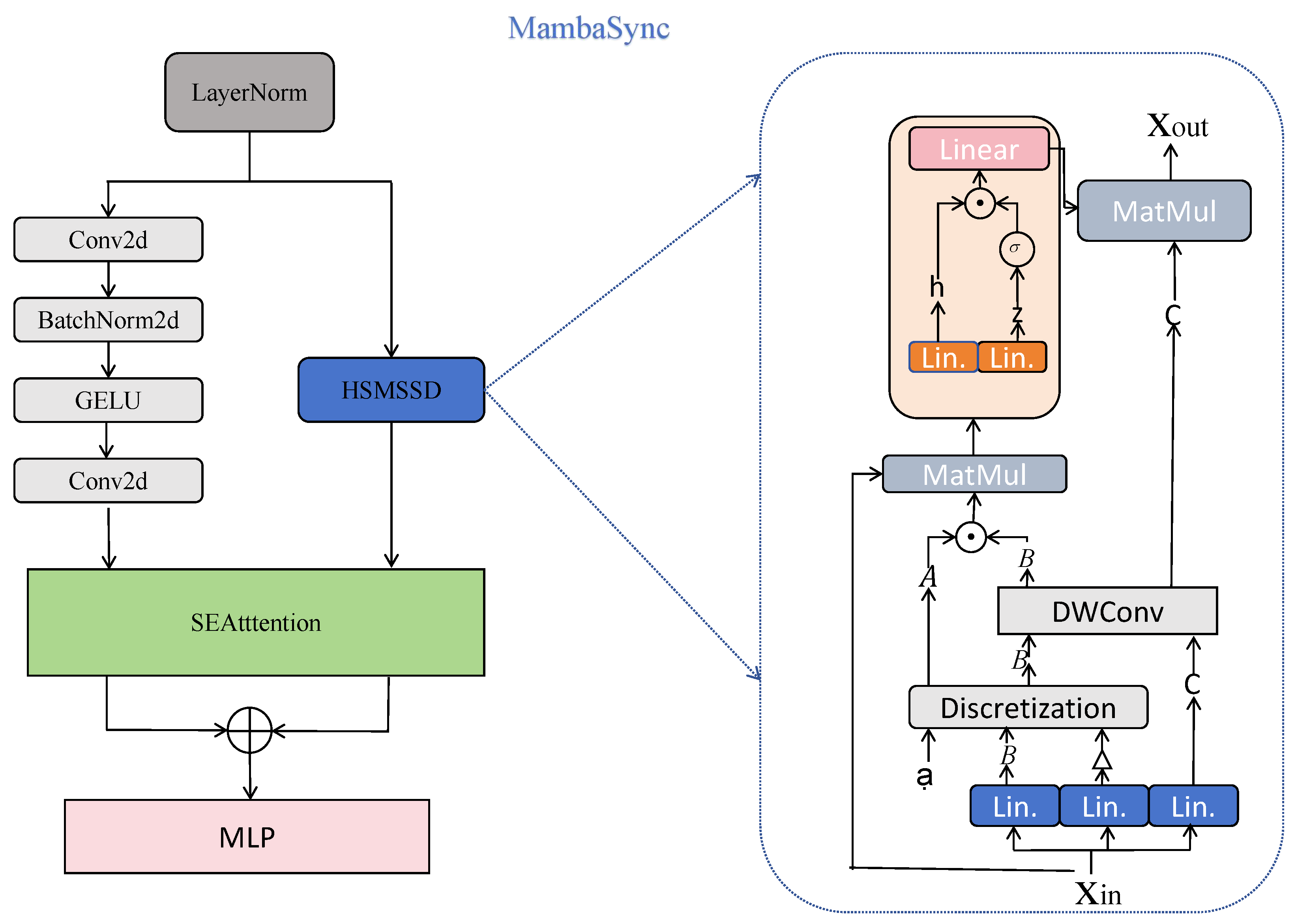
This module is theoretically designed to resolve the computational complexity bottleneck of global context modeling in existing Transformer-based depth estimation models. As shown in
Figure 3, it employs two complementary branches to jointly capture local and global representations: a depthwise convolution (DWConv) branch for extracting fine-grained spatial features, and a
Hidden State Mixer based State Space Duality (HSMSSD) [
17] branch for hierarchical global context aggregation. To enhance feature fusion, a squeeze-and-excitation (SE) block is integrated to dynamically recalibrate channel-wise responses, facilitating adaptive balancing between local and global semantic cues.
The overall mechanism of MambaSync follows a dual-branch fusion framework, formally formulated as:
where
and
are the output feature tensors from the DWConv and HSMSSD branches, respectively (
C,
H,
W denote channel number, height, and width of feature maps). The SE block adaptively fuses local and global features by applying dynamic channel-wise weighting, ensuring that informative features are emphasized in the final representation.
3.2. Depth Decoder
Our decoder design follows Lite-Mono [
10]. It progressively upsamples encoder features using bilinear interpolation combined with lightweight convolutional layers, while incorporating skip connections from three intermediate encoder stages. To enable multi-scale supervision, three prediction heads generate inverse depth maps at full, half, and quarter resolutions. This design achieves a favorable balance between accuracy and efficiency, ensuring the decoder remains lightweight and directly comparable across methods.
3.3. PoseNet
For relative pose estimation, we also adopt the design of LiteMono [
10] to ensure a fair comparison. A ResNet18 backbone extracts features from image pairs, and a lightweight convolutional decoder estimates the 6-DoF camera transformation between consecutive frames. Since previous studies [
13,
35] report only marginal gains from more complex pose networks, we retain this efficient design in order to isolate and evaluate the contributions of our encoder.
3.4. Self-Supervised Learning
Following Lite-Mono [
11], we adopt a self-supervised learning strategy based on image reconstruction, incorporating photometric consistency, edge-aware smoothness, and multi-scale supervision to train depth and pose networks without ground-truth labels.
Dual-Network Joint Modeling To decouple scene geometry from camera motion, we adopt a dual-network architecture:
A convolutional encoder-decoder network that predicts inverse depth maps from a single target frame . A sigmoid activation followed by linear scaling is used to constrain the depth range. Multi-scale outputs help capture both global structure and fine-grained details.
A lightweight CNN that estimates the 6-DoF relative camera pose from adjacent frame pairs ( or ), decomposed into rotation R and translation t.
Differentiable View Synthesis Given the predicted depth and pose, the target frame is reconstructed by warping source images using a differentiable projection model. Let
denote the camera intrinsic matrix (calibrated using KITTI’s average focal length as detailed in
Section 4.1.1),
and
denote pixel coordinates in the source and target frames, respectively, and
,
denote the depth tensors at the corresponding pixels. The projection relation is formulated as:
Photometric Reconstruction Loss To guide learning, we employ a photometric loss that combines structural similarity (SSIM) and L1 pixel-wise error. Let
denote the balance coefficient between the two terms:
where
is an auto-masking flag that filters dynamic objects or occluded regions (set to 1 if the source frame reconstruction error is larger than the target frame self-reconstruction error, and 0 otherwise).
Edge-Aware Depth Smoothness To encourage smooth depth predictions while preserving object boundaries, we incorporate an edge-aware regularization term. Let
denote the set of all pixel coordinates in the image:
Multi-Scale Supervision Depth maps are predicted at three resolutions: full (
), half (
), and quarter (
). The overall training loss is computed as, where
is the weight of the smoothness term:
5. Conclusions
In this paper, we have presented MogaDepth, a lightweight and efficient architecture for self-supervised monocular depth estimation. By integrating convolutional backbones with Mamba-based components, and introducing the CMOGA and MambaSync modules, MogaDepth effectively captures mid-order feature interactions and long-range global dependencies. Extensive experiments on KITTI and Make3D demonstrate that MogaDepth achieves highly competitive performance while maintaining a compact model size and strong generalization to unseen domains. Importantly, MogaDepth also offers significant improvements in inference speed on edge devices, achieving up to 13% faster processing without sacrificing accuracy, highlighting its suitability for real-time applications in resource-constrained environments. Ablation studies further validate the contribution of both CMOGA and MambaSync to improved depth accuracy and feature representation.
Future work will focus on further enhancing mid-order feature modeling, integrating multi-modal information, and optimizing performance for resource-constrained platforms, with the goal of improving depth estimation under challenging scenarios such as extreme lighting conditions and dynamic environments.