Article

SeADL: Self-Adaptive Deep Learning for Real-Time Marine Visibility Forecasting Using Multi-Source Sensor Data

1
Computer and Information Science Department, University of Massachusetts Dartmouth, Dartmouth, MA 02747, USA
2
Mathematics Department, University of Massachusetts Dartmouth, Dartmouth, MA 02747, USA
*
Author to whom correspondence should be addressed.
Sensors 2026, 26(2), 676; https://doi.org/10.3390/s26020676
Submission received: 20 December 2025 / Revised: 18 January 2026 / Accepted: 19 January 2026 / Published: 20 January 2026

Abstract

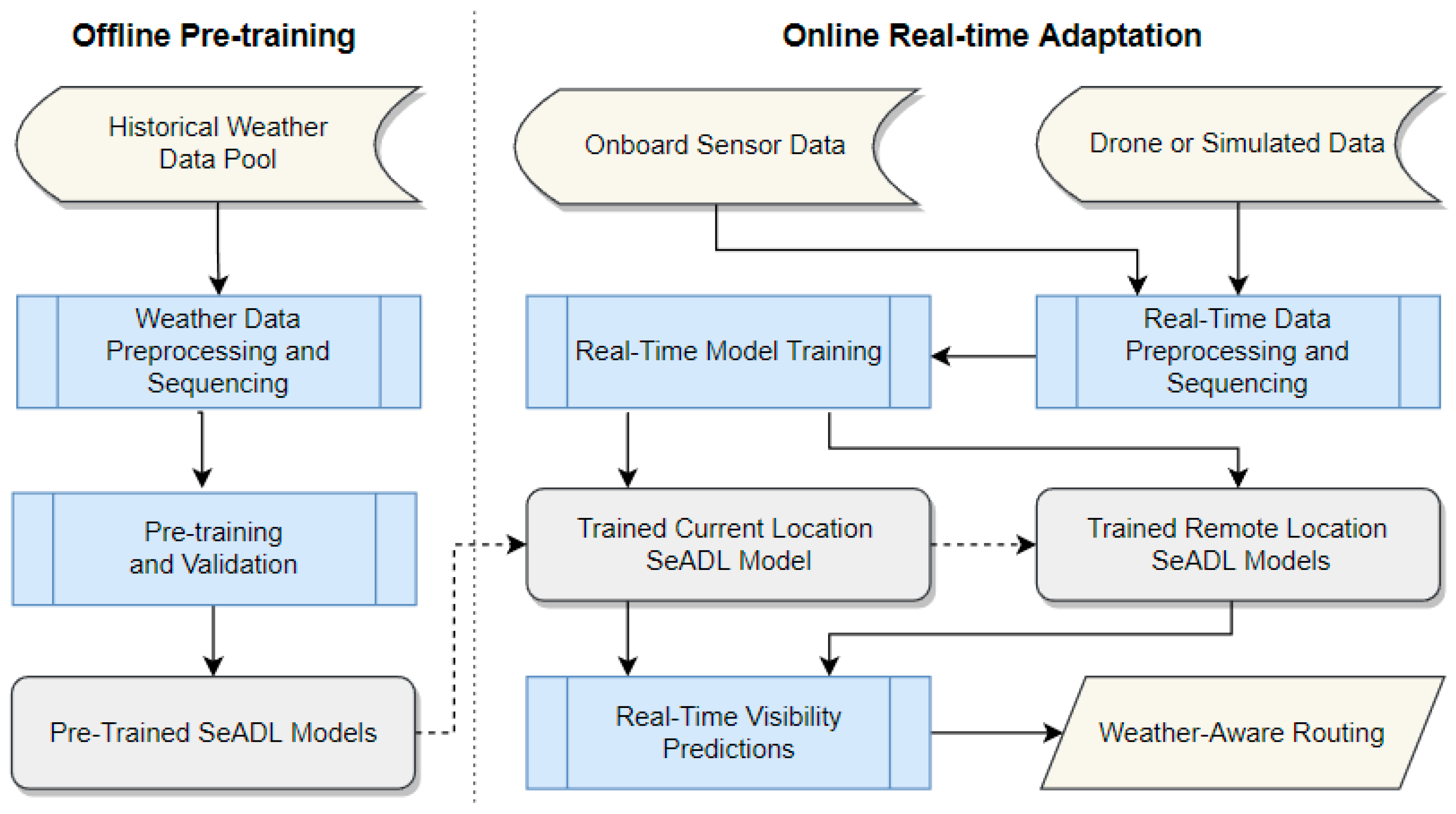
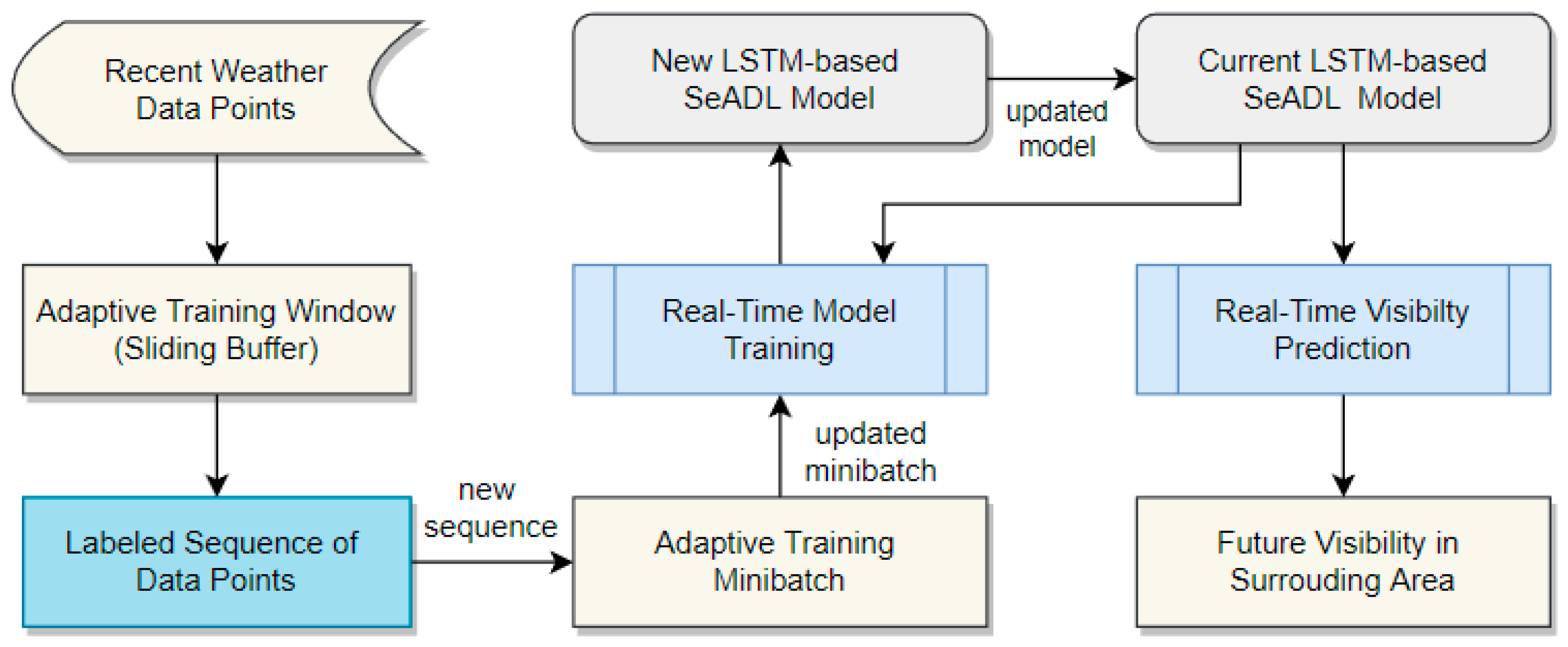
Accurate prediction of marine visibility is critical for ensuring safe and efficient maritime operations, particularly in dynamic and data-sparse ocean environments. Although visibility reduction is a natural and unavoidable atmospheric phenomenon, improved short-term prediction can substantially enhance navigational safety and operational planning. While deep learning methods have demonstrated strong performance in land-based visibility prediction, their effectiveness in marine environments remains constrained by the lack of fixed observation stations, rapidly changing meteorological conditions, and pronounced spatiotemporal variability. This paper introduces SeADL, a self-adaptive deep learning framework for real-time marine visibility forecasting using multi-source time-series data from onboard sensors and drone-borne atmospheric measurements. SeADL incorporates a continuous online learning mechanism that updates model parameters in real time, enabling robust adaptation to both short-term weather fluctuations and long-term environmental trends. Case studies, including a realistic storm simulation, demonstrate that SeADL achieves high prediction accuracy and maintains robust performance under diverse and extreme conditions. These results highlight the potential of combining self-adaptive deep learning with real-time sensor streams to enhance marine situational awareness and improve operational safety in dynamic ocean environments.
Keywords: marine visibility forecasting; self-adaptive deep learning; real-time training; time-series sensor data; online learning; maritime safety marine visibility forecasting; self-adaptive deep learning; real-time training; time-series sensor data; online learning; maritime safety