1. Introduction
In the context of deepening commitment to carbon peaking and carbon neutrality in China, scrap steel, as the only green resource capable of large-scale substitution for iron ore, has experienced a marked increase in demand. Evaluation, grading, and sorting of scrap have therefore become critical to enabling scalable industrial development. The national standard ‘Recycling iron-steel materials’ [
1], promulgated in late 2020, stipulates that dimensional assessment of scrap remains predominantly based on manual visual inspection, with physical measurements employing tools such as measuring tapes or calipers reserved for exceptional cases. This approach is not only labor-intensive but also prone to subjectivity, resulting in outcomes of limited reliability.
Advances in computer vision have facilitated the development of research initiatives and commercial systems [
2,
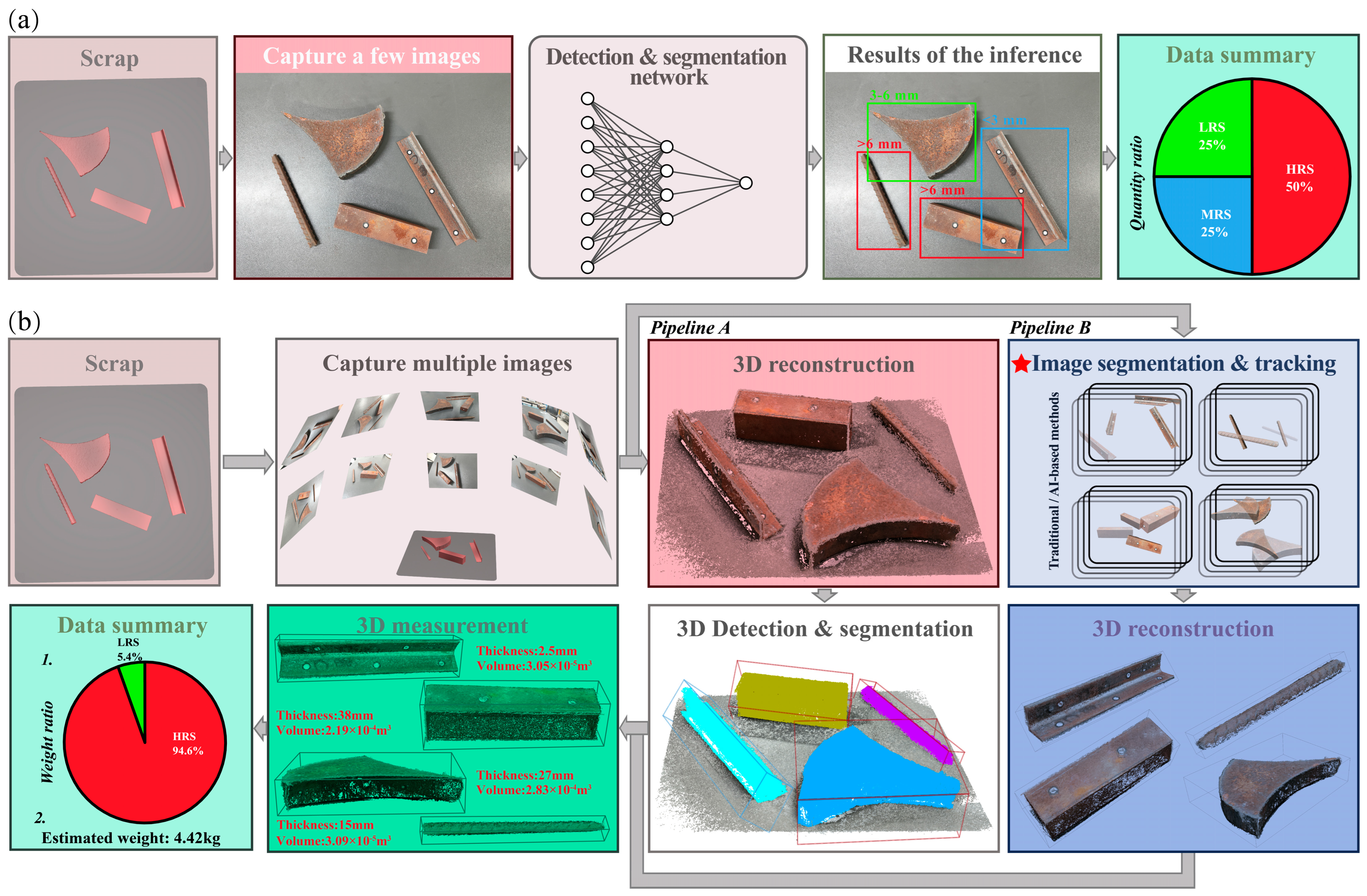
3] for scrap classification and grading using deep learning. The 2D pipeline depicted in
Figure 1a initially processes scrap images through a recognition network, subsequently conducting statistical analysis of the output to support grading decisions derived from relative proportions of distinct scrap categories. However, 2D-based approaches suffer from several inherent limitations. (i) The 2D deep learning approach primarily relies on texture and shape cues for object recognition [
4]. However, scrap thickness shows no consistent correlation with these visual features; scraps of different shapes and textures may have randomly varying thicknesses. (ii) Furthermore, scrap thickness is typically several orders of magnitude smaller than its length and width, and the limited information visible in 2D images is often insufficient for algorithms to learn this dimension reliably. (iii) The system employs single-view detection, which is inherently prone to error and lacks robustness. When the same batch of scrap tumbles or slides naturally, its orientation changes; in many cases, the thickness direction is not visible, leading to significant discrepancies between repeated detections of identical material. (iv) Additionally, value assessment based solely on the quantity ratio of scrap categories often yields inaccurate results because it ignores differences in weight. Thus, the field is increasingly shifting toward 3D approaches, as exemplified by the 3D solution architecture depicted in
Figure 1b. This architecture incorporates two distinct processing pipelines, differentiated primarily by the sequence of reconstruction and recognition procedures:
Pipeline A processes reconstructed point cloud data directly, performing point cloud feature extraction and spatial pattern matching for 3D recognition of scrap. Conversely,
Pipeline B first performs 2D recognition on multi-view images of scrap, followed by feature aggregation and reconstruction based on the 2D recognition results to reconstruct 3D features of the scrap. This study focuses on the 2D segmentation task in
Pipeline B, which presents notable practical advantages over the 3D object detection in
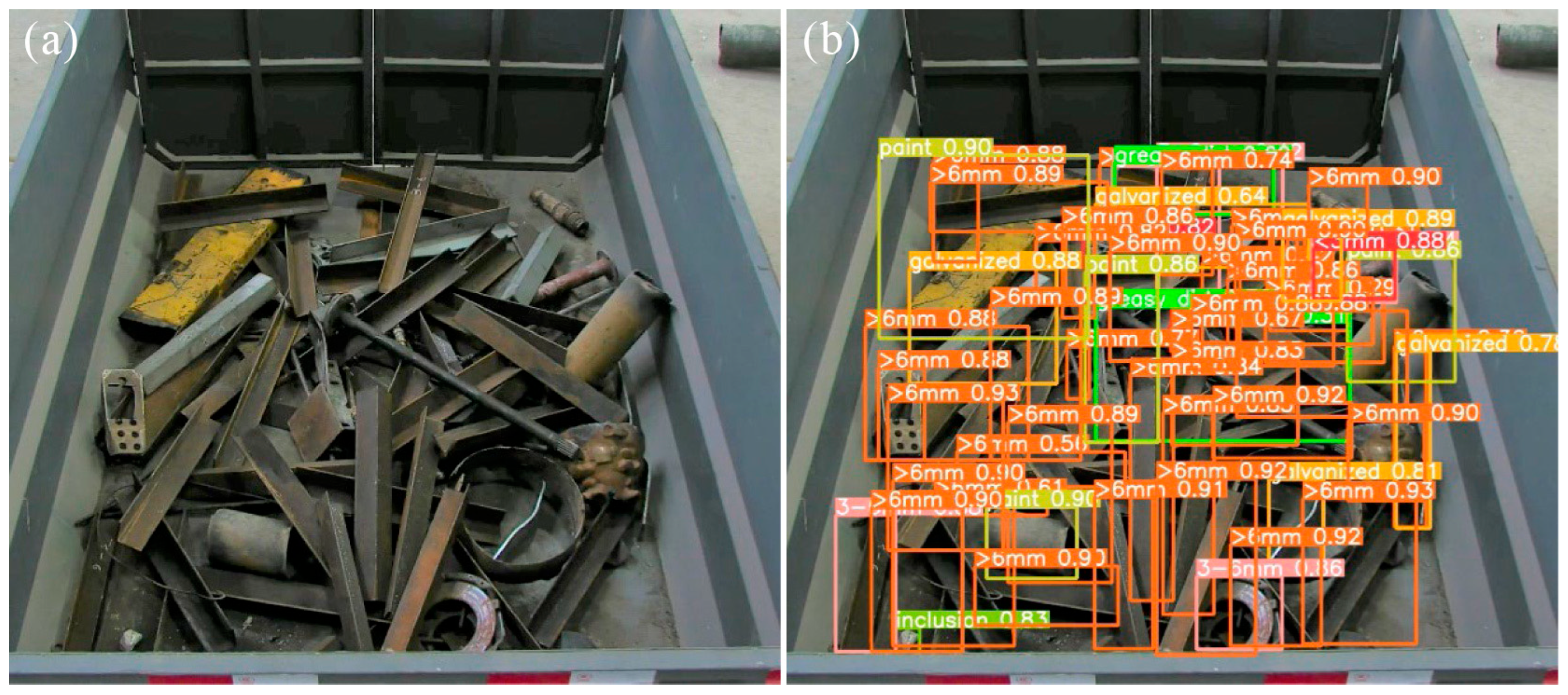
Pipeline A, chiefly owing to the latter’s substantial computational cost, more complex data processing requirements, and intricate model architectures. A critical distinction of our method from existing pipelines for 2D scrap recognition lies in the treatment of size categories. Current approaches employ fine-grained categorization (for example, 0–3 mm, 3–6 mm [
2,
3]), a premise that is questionable for inferring absolute 3D dimensions from 2D imagery [
5], as shown in
Figure 2. Our approach, by contrast, classifies scrap instances solely based on characteristic geometric shapes, thereby reducing the complexity of subsequent automated 3D dimensional analysis.
In tasks involving fixed categories under simple scenarios, closed-set detection methods are both highly efficient and reliable and thus widely adopted [
6,
7]. Qiu [
8] and Duan [
9] employed the Yolov3 algorithm to achieve target detection in scrap images, implementing modifications of the Yolo network structure to enhance the detection accuracy. By proposing a variety of deep learning algorithms that integrate different attention mechanisms, Xiao [
2,
3] has established a notable advantage in accuracy when compared to traditional manual quality assessment methods. Yet, the real-world scrap environment is characterized by an open-world setting, featuring diverse morphologies, varied origins, and significant regional disparities in imagery. This scenario poses a severe challenge to the generalization capabilities of such methods. Iron and steel, as the most widely used and important materials in human history, are extensively covered in existing datasets, and their shape recognition constitutes a relatively straightforward task. The large models trained on such data, leveraging robust zero-shot and few-shot generalization capabilities, are well-suited for visual perception in scrap analysis. Within computer vision, the SAM [
10,
11,
12], built upon the ViT [
13] architecture, has been trained on ultra-large-scale datasets and demonstrates exceptional zero-shot segmentation capabilities on unseen data, exhibiting superior generalization compared to traditional segmentation methods [
14,
15]. SAM supports multiple interactive prompt modalities, including points and bounding boxes, enabling precise specification of target locations and regions while exhibiting high generalizability. However, SAM lacks categorical information, precluding direct application in semantic or instance segmentation tasks for scrap. In comparison, the CLIP [
16] model employs natural language supervision and contrastive learning to map visual and linguistic representations into a shared semantic space, thereby overcoming the limitations of traditional closed-set classification. By assembling the foundational models SAM and CLIP, we develop SSC to tackle semantic comprehension in open-world scenarios and meet fine-grained segmentation demands. This paper presents the SSC large model, which innovatively leverages strong generalization capabilities to address the diversity of scrap steel shape features, overcoming limitations of traditional recognition models that heavily rely on training data distributions and exhibit weak domain adaptability. Through lightweight fine-tuning, the model achieves robust performance with minimal annotated data, significantly reducing annotation costs while maintaining adaptability to unseen morphological variations in scrap steel.
This study fine-tunes the SSC model on a scrap dataset, employing comprehensive quantitative and qualitative experimental analyses to evaluate its capabilities in scrap perception, thereby demonstrating the potential of large-scale models for application in scrap grading and sorting.
2. Materials and Methods
2.1. SSC Model
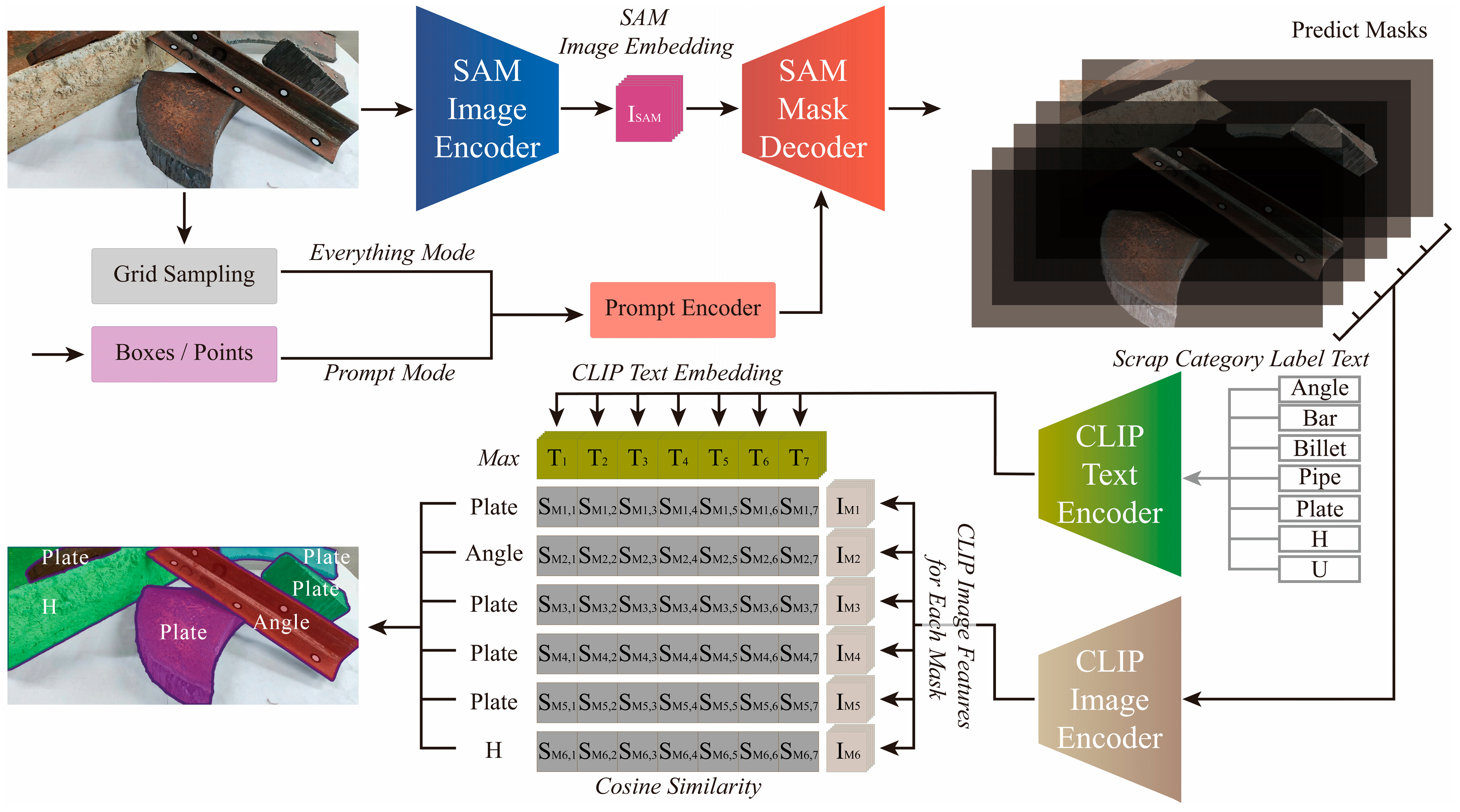
As presented in
Figure 3, SSC is a large-scale model assembled from SAM and CLIP. Unlike Visual ChatGPT [
17], which employ a LLM as a controller, this approach is specifically optimized for single-task scrap recognition, resulting in a lightweight architecture, flexible workflow, and enhanced computational efficiency.
The segmentation module of the SSC architecture comprises three core components: an image encoder, a versatile prompt encoder, and an efficient mask decoder. The image encoder employs a Transformer architecture rather than a CNN, ensuring strong performance on large-scale datasets. It incorporates an advanced unsupervised pre-training method, the MAE [
18], which effectively filters redundant high-level semantic information and extracts the most salient visual features, thereby significantly enhancing generalization capability. The prompt encoder converts various prompt inputs into embedding representations. Point prompts are directly embedded using positional encoding, with a learnable token distinguishing foreground from background. Bounding box prompts are represented through positional encoding derived from top-left and bottom-right coordinates. The mask decoder efficiently maps image embeddings, prompt embeddings, and an output token to the corresponding mask. Its core mechanism updates all embedding representations via prompt self-attention and bidirectional cross-attention, modeling bidirectional interactions between prompts and image embeddings. Following processing by these modules, image embeddings undergo upsampling. A multilayer perceptron then maps the output token to a dynamic linear classifier, which computes foreground probability for each image location.
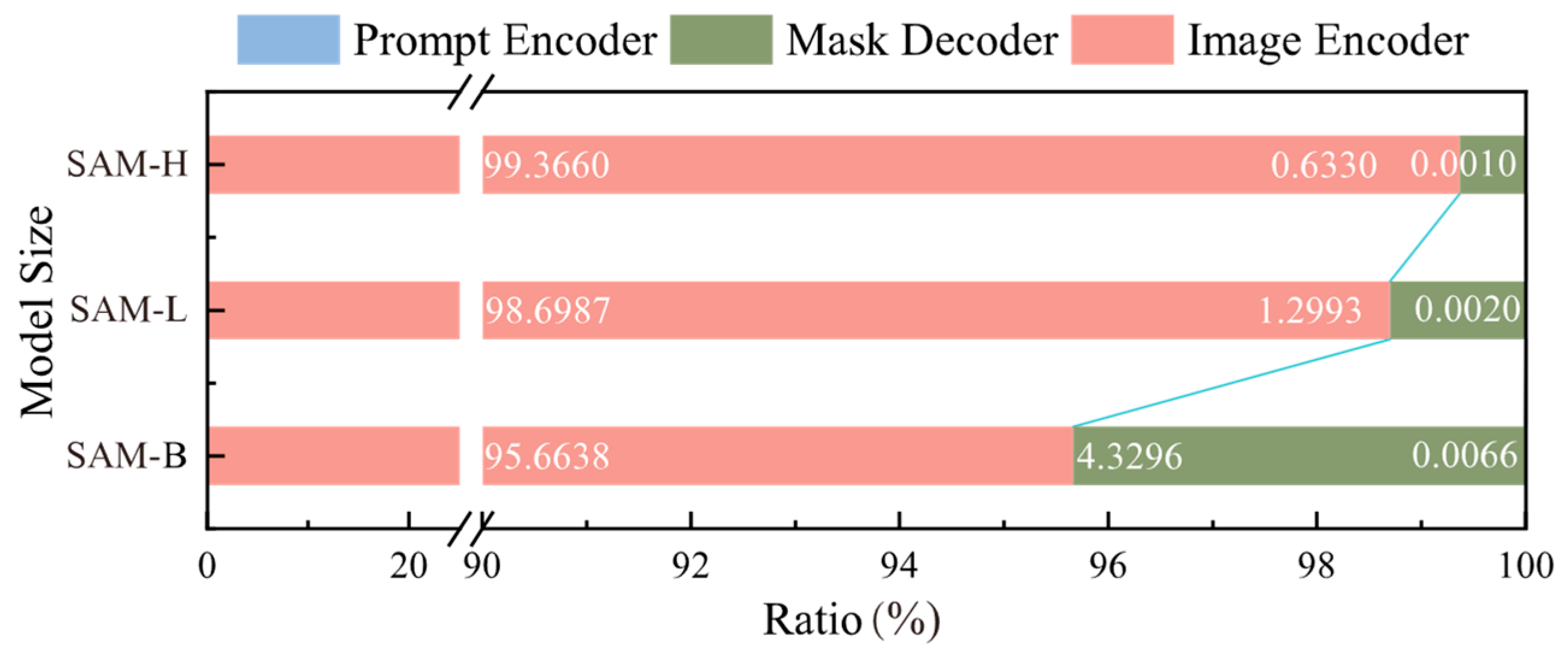
Both the prompt encoder and mask decoder are designed to be highly lightweight. As illustrated in
Figure 4, in the three SAMs of varying scales, these components constitute a minimal proportion of parameters, with the primary computational costs concentrated in the image encoder. To extend the applicability of SAM across diverse domains, subsequent research has developed domain-adapted variants. For enhanced accuracy, HQ-SAM [
19] incorporates an additional HQ-Token into the decoder alongside the original image embeddings and prompt tokens, fusing mask decoder features from SAM with both shallow and deep features from the ViT encoder to jointly exploit global semantic context and local detail information. A high-precision mask dataset (HQSeg-44K) is constructed for training, significantly enhancing segmentation accuracy. For efficiency, MobileSAM [
20] employs decoupled distillation to compress the ViT-H-based image encoder into a lightweight variant, reducing image encoding time to 8 milliseconds without compromising segmentation performance. By contrast, EdgeSAM [
21] distills the ViT-based image encoder into a pure CNN architecture, incorporating both the prompt encoder and mask decoder during distillation. A lightweight module is additionally incorporated to mitigate data bias from point prompt distillation, achieving a 37× speedup relative to the original SAM.
The classification module of SSC, implemented based on the CLIP model, employs the Text Encoder and Image Encoder to separately extract textual and visual features. It utilizes contrastive learning to establish correspondence between text and image representations, thereby overcoming the conventional paradigm of fixed class labels in supervised learning. Trained on a large-scale dataset encompassing diverse natural scenes, the model demonstrates exceptional generalization capabilities. CN-CLIP [
22] achieves SOTA performance across multiple Chinese benchmarks through the incorporation of Chinese linguistic semantics on the text side and a two-stage training strategy. This strategy consists of an initial locked-image tuning stage followed by a contrastive tuning stage, thereby fully leveraging the inherent generalization capacity of the original CLIP framework. This study focuses on the development of an intelligent scrap identification system tailored for the domestic market. Hence, CN-CLIP, which is better suited for localized tasks, was selected as the foundational model for classification. In practice, this necessitates the conversion of English category labels into Chinese textual expressions. For the scrap segmentation results, both the category labels and the corresponding mask images are processed through text and image encoders to extract features. The optimal match between labels and masks is then determined using cosine similarity.
2.2. Datasets
Current mainstream 2D detection approaches address fine-grained challenges particularly evident during data preparation as illustrated in
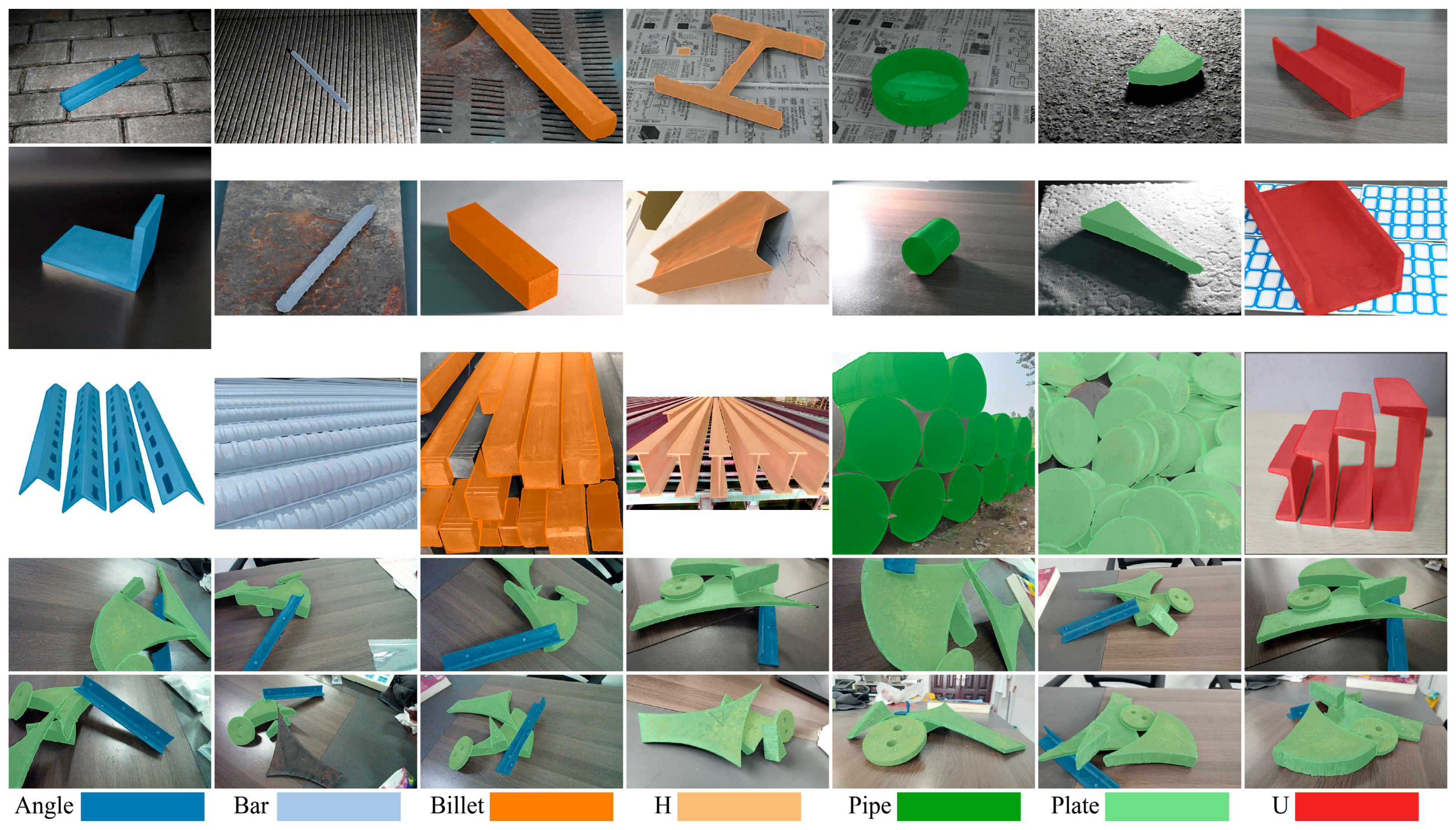
Figure 2, requiring manual on-site thickness measurements of scrap using measuring tapes alongside bounding box and instance mask annotations for each object, resulting in substantial annotation complexity and high operational costs. In contrast, the 2D detection process is exclusively concerned with the canonical shapes of scrap, which are categorized into seven classes: ‘Angle’, ‘Bar’, ‘Billet’, ‘H’, ‘Pipe’, ‘Plate’ and ‘U’, as illustrated in
Figure 5. This approach significantly reduces annotation costs and enables dataset expansion through the utilization of existing online scrap images. The dataset comprises 5293 images sourced from web-based imagery, steel plant, and laboratory capture, partitioned into 85% training and 15% testing subsets, totaling 17,537 annotated scrap instances.
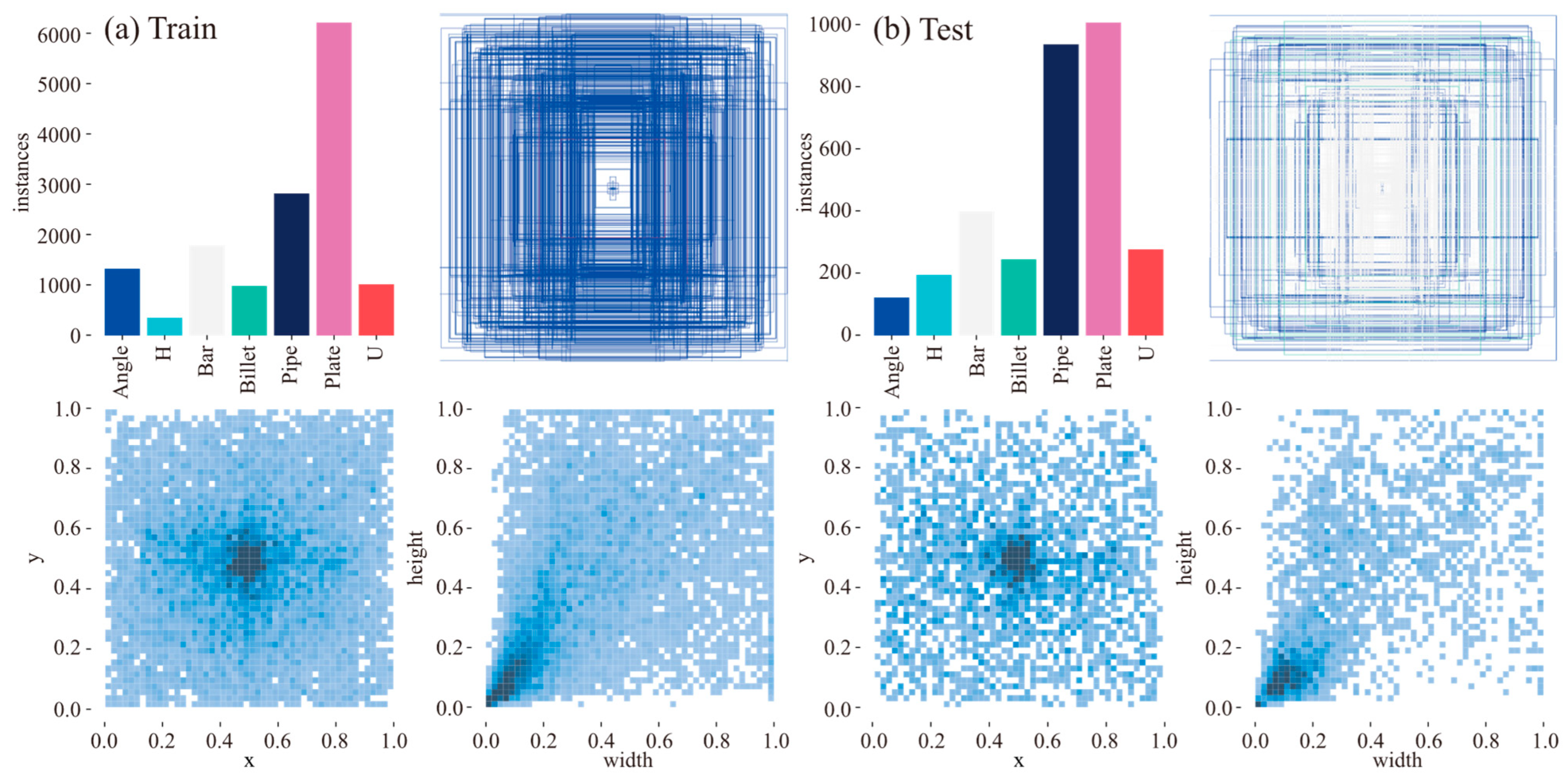
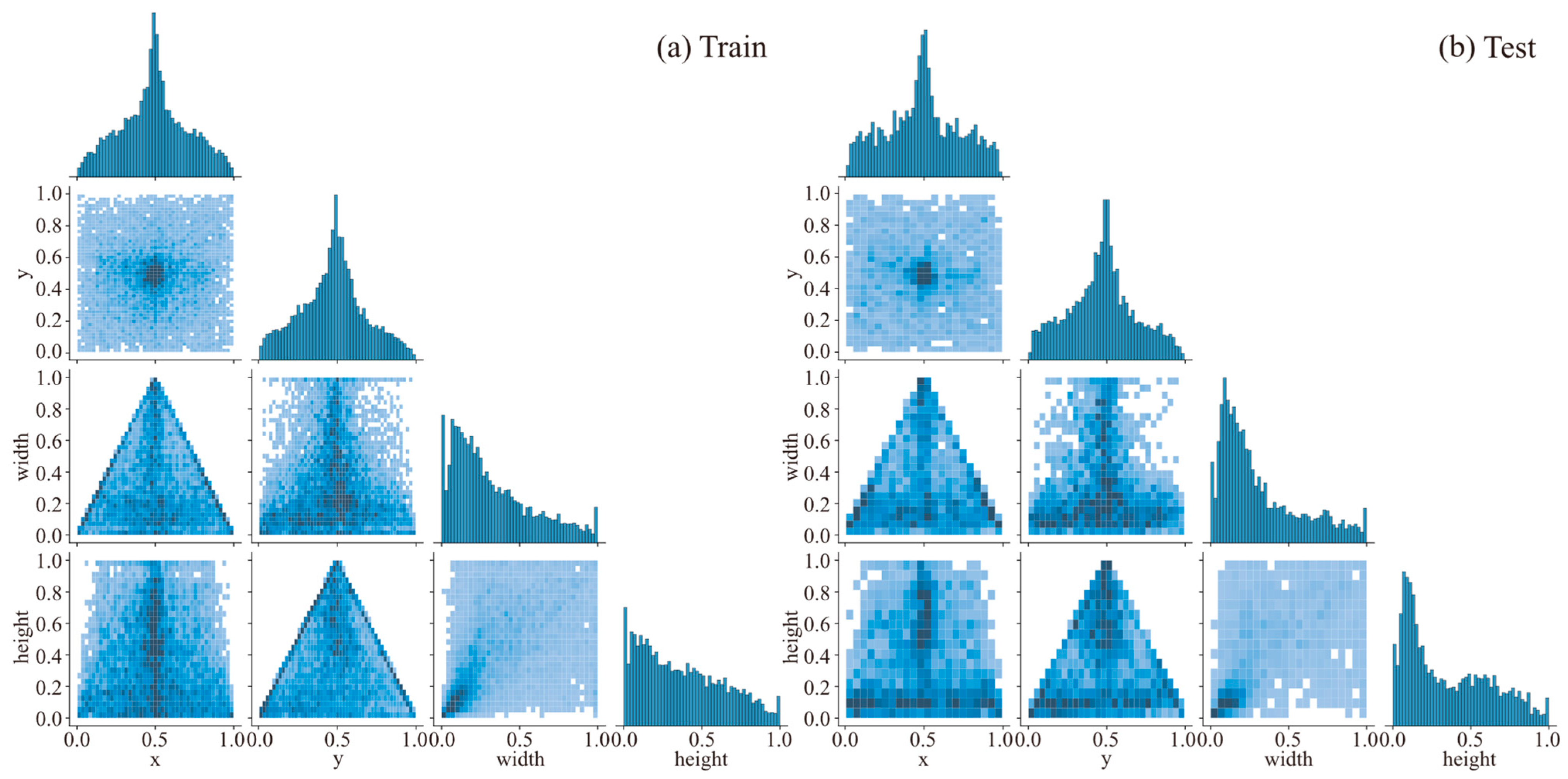
Figure 6 and
Figure 7 provide a comprehensive analysis of the training and test set properties. Results indicate strong consistency and balance in category distribution, spatial location, and geometric characteristics between the two sets, establishing a reliable foundation for model training and evaluation. Furthermore, the scatter plot of instance width versus height reveals a distribution clustered in the lower left quadrant, indicating a high prevalence of small objects that poses a significant challenge to the segmentation capability of the SSC model. Based on the segmentation dataset, individual scrap instances were extracted to establish a classification dataset for evaluating the classification performance of the SSC model. To ensure data quality, instances with excessively small mask areas were filtered out, and images with indistinct features were manually excluded. The final classification dataset comprises 5626 scrap images, partitioned into training and testing subsets at an 85:15 ratio.
3. Results
All experiments were conducted on two NVIDIA RTX 4060Ti GPUs with 16 GB of VRAM each. The proposed SSC framework was implemented in Python (version 3.10.13) using PyTorch (version 2.1.2) and torchvision (version 0.16.2). For fair comparison, other classification networks were implemented using either the TIMM library (version 0.4.12) and torchvision.
3.1. Finetune of SSC Model
The SSC architecture is a fully decoupled model in which the SAM and CLIP modules are independently fine-tuned. This strategy ensures that each submodule maintains optimal performance on its respective tasks while reducing the complexity inherent in training a unified model.
Owing to the widespread use of steel materials, which are thus well-represented in large-scale datasets such as SA-1B, their visual features have been effectively learned during pre-training. Furthermore, considering the large parameter count of the SAM image encoder and the significant computational cost of fine-tuning, this study fine-tunes only the mask decoder with all other parameters frozen. Prompt types include point prompts and box prompts. Point prompts are generated by randomly sampling foreground and background points from the annotation mask at a 2:1 ratio, while box prompts derive from the minimum bounding rectangle of the mask. To improve model generalization across both prompt types, a stochastic omission strategy is employed during training, randomly excluding either prompt type with a 50% probability. The loss function combines BCE [
23] loss and DICE [
24] loss to jointly optimize pixel-level classification accuracy and segmentation overlap. The AdamW [
25] optimizer is used with a CosineAnnealingLR [
26] scheduler, an initial learning rate of 1 × 10
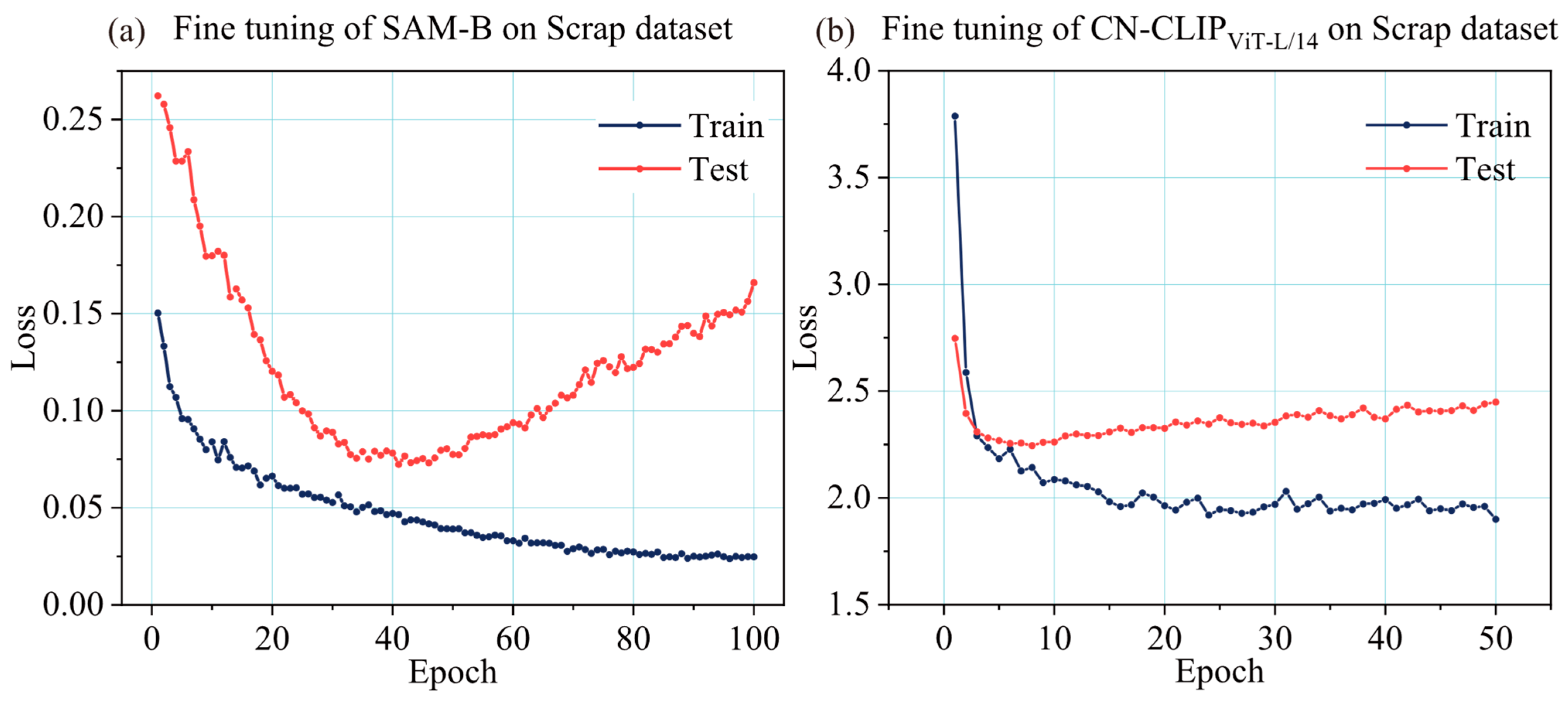
−4, and a batch size of 1. The SAM-B model undergoes 100 epochs of fine-tuning. Training error convergence curves in
Figure 8a demonstrate consistent convergence, leading to the selection of weights from the 41st epoch as the final model.
The SSC classification module is implemented based on chinese-clip-vit-large-patch14-224px. On the image encoding side, it employs the same ViT-L architecture as CLIP, while on the text encoding side, it utilizes RoBERTa [
27] rather than GPT-2 [
28]. This design yields enhanced performance in long-text comprehension and classification tasks, and demonstrates particularly improved effectiveness in processing Chinese semantic information. During fine-tuning, we followed the official recommendations for hyperparameters: batch size of 48, initial learning rate of 1 × 10
−6, AdamW optimizer, and a cosine learning rate scheduler. The model was initially configured to train for 500 epochs. As overfitting became evident around epoch 50, early stopping was applied. The training was halted, and the model from the first 50 epochs was saved for further use. The training error curve is presented in
Figure 8b, and the weights from the 9th epoch were selected as the final fine-tuned model.
3.2. Evaluation of SSC Segmentation Performance
3.2.1. Evaluation Criteria and Strategies for Segmentation
To evaluate the segmentation performance of the SSC model, this study employs three metrics: the DICE, the Jaccard Similarity Coefficient (JAC, also called IOU [
29]), and the Hausdorff Distance (HD [
30]). DICE and JAC both measure the similarity between two binary masks, with values ranging from 0 to 1, where higher values indicate greater agreement. For binary masks
A and
B, these metrics are defined as follows:
where
denotes the number of pixels in the intersection of masks
A and
B,
and
represent the total number of pixels in each mask, respectively, and
indicates the number of pixels in the union of the two masks.
HD measures the maximum distance between two pointsets, typically used to quantify the discrepancy between segmentation boundaries. For two pointsets
X and
Y, the one-sided HD from
X to
Y is defined as:
Correspondingly, the one-sided HD from
Y to
X is defined as:
The bidirectional HD between these two sets is then:
The above calculations are based on Euclidean distance to measure between point pairs.
Additionally, as SAM may generate multiple binary masks for a single input image, not all of which correspond to the target object, we employed the mask matching mechanism described in [
11] to evaluate the segmentation performance under each test mode. For a given object in an image, DICE scores are computed between each predicted binary mask
Pn and the ground truth mask
G. The predicted mask with the highest DICE score is selected as the matched mask
P∗ for subsequent segmentation evaluation. This matching process is formalized in Equation (6).
SAM and its improved variants support both a fully automatic segmentation mode and a manual prompt mode. We adopted six evaluation strategies (S1–S6) based on the methodology in [
11], defined as follows:
S1: automatic everything mode;
S2: one positive point;
S3: five positive points;
S4: five positive and five negative points;
S5: one box;
S6: one box and one positive point.
3.2.2. Segmentation Capability Under Different SAMs
This section compares the segmentation performance of various SAM-based models on the scrap dataset.
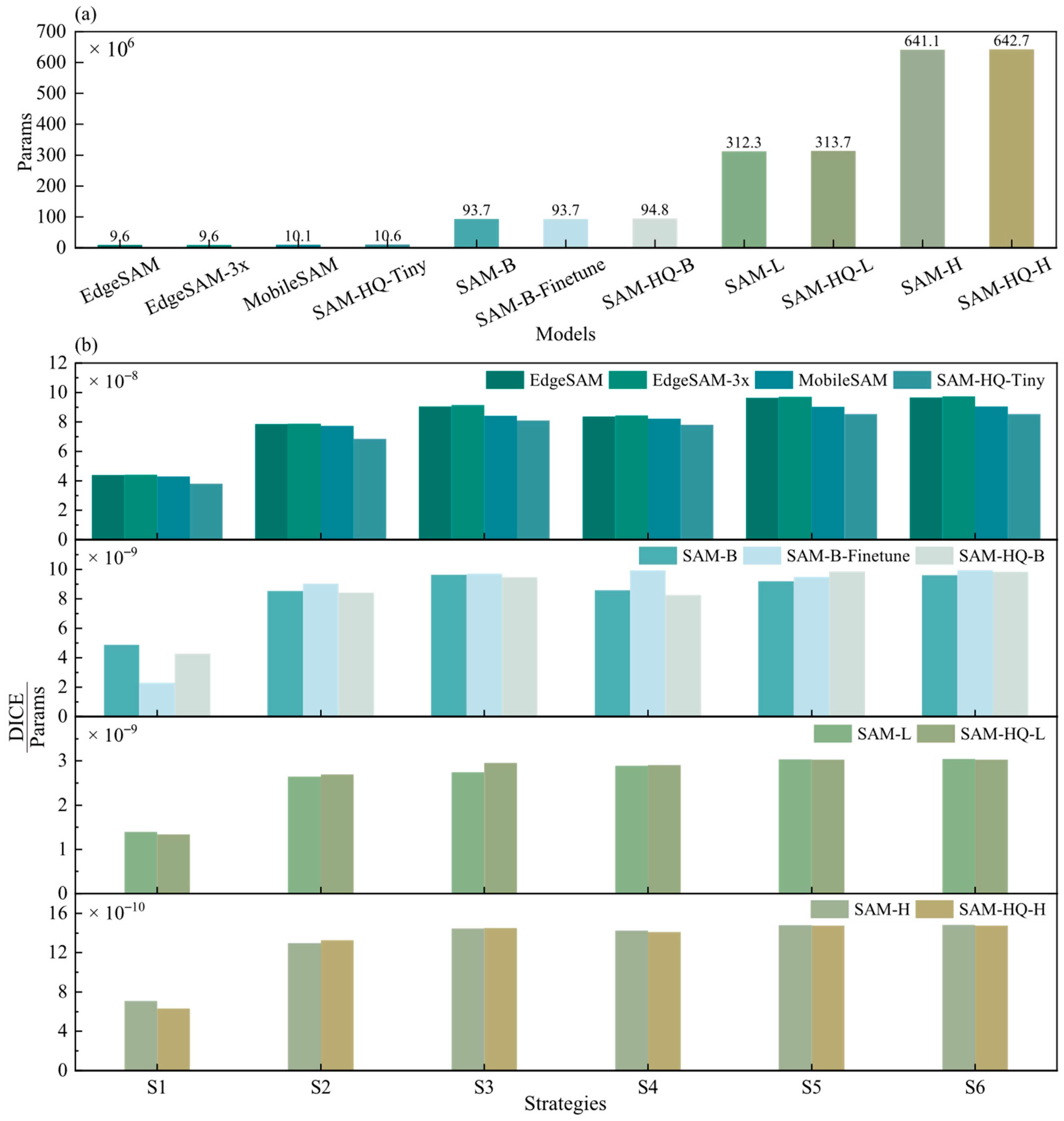
Figure 9 presents the efficiency metrics (DICE/Params) of different SAM variants, which are categorized into four groups: Tiny (EdgeSAM, EdgeSAM3x, MobileSAM, and SAM-HQ-Tiny), Small (SAM-B, SAM-B-Finetune, and SAM-HQ-B), Medium (SAM-L and SAM-HQ-L), and Large (SAM-H and SAM-HQ-H). Results in
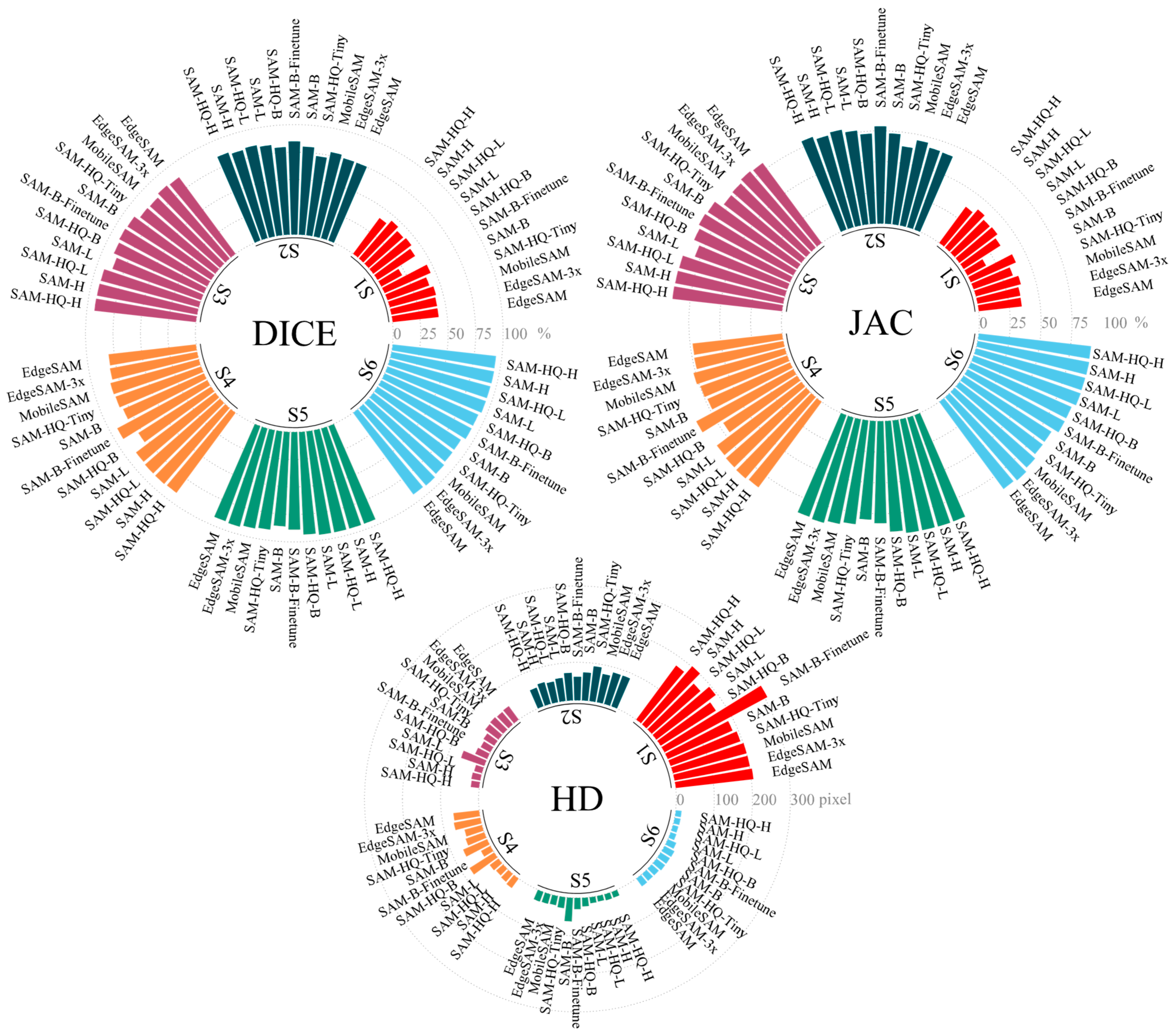
Figure 10 indicate that within the Tiny model group, EdgeSAM3x achieves superior efficiency and significantly enhanced segmentation accuracy under strong prompt conditions. On the other hand, MobileSAM demonstrates superior performance in weak prompt scenarios (S1: DICE 1.24%↑; S2: DICE 2.75%↑). In the Small model group, fine-tuning substantially improved model accuracy, with DICE score improvements ranging from 0.7% under strategy S1 to 12.53% under S4. A significant performance degradation was observed in the no-prompt mode after fine-tuning (S1: DICE 24.2%↓). This decline may originate from suboptimal hyperparameter settings, such as non-maximum suppression parameters and confidence thresholds, which still require further optimization. Furthermore, SAM-B demonstrates higher efficiency under weak prompt conditions, whereas SAM-HQ-B is better suited for strong prompt scenarios. In the Medium and Large model groups, the SAM-HQ series exhibits moderate improvements in point-prompt settings but shows reduced accuracy in no-prompt mode (SAM-HQ-L S1: DICE 1.48%↓; SAM-HQ-H S1: DICE 4.82%↓). Models in the Medium and Large groups demonstrate comparable performance, with larger parameter counts yielding no significant improvements. This stems from marginal gains in feature extraction capability beyond a certain model scale for scrap recognition tasks, whereas prompt quality critically determines SAM performance as a prompt-based model. For tasks prioritizing optimal performance, models in the Medium group suffice.
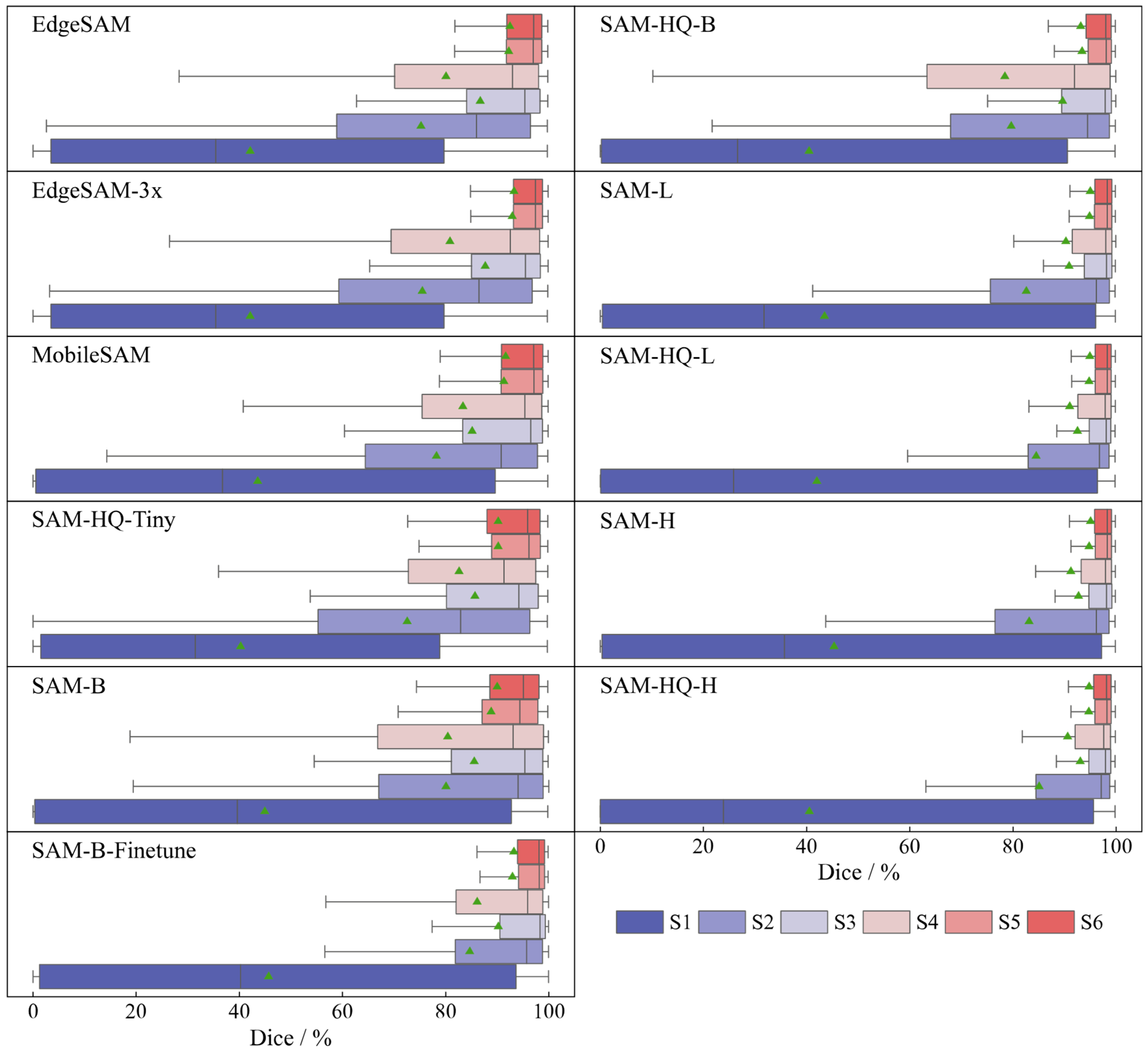
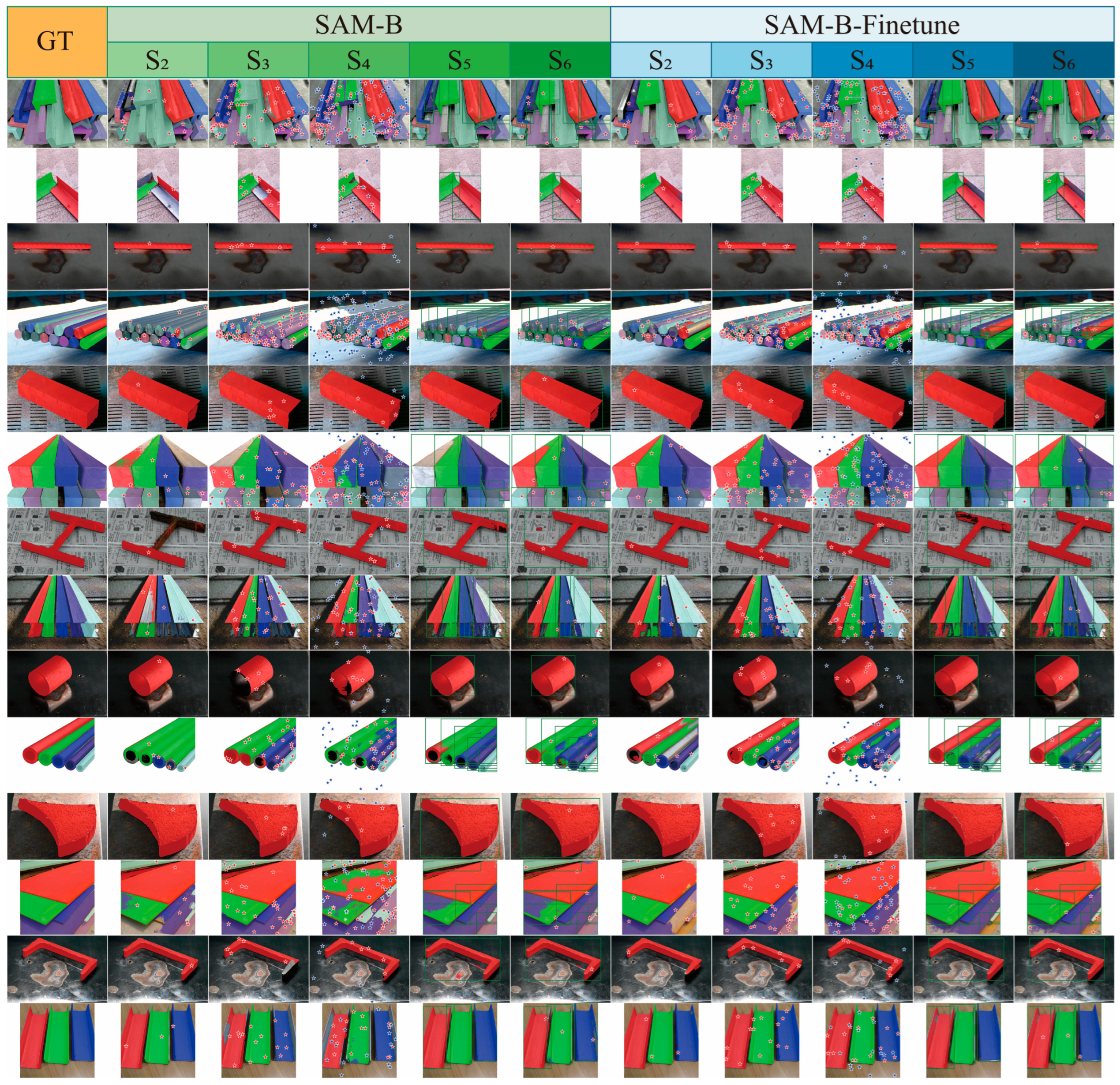
Figure 11 displays the distribution of DICE across different models using box plots. Among Tiny models, MobileSAM shows greater stability and lower variance under weak prompt conditions, whereas EdgeSAM3x achieves superior stability with strong prompts. The SAM-HQ variants exhibit improved stability relative to the original SAM under point-based prompting conditions. The fine-tuning procedure further enhances model robustness, with SAM-B-Finetune demonstrating a more compact distribution of Dice scores across all prompting modes, as illustrated in
Figure 12.
3.2.3. Segmentation Capability Under Different Testing Modes
This section compares the segmentation performance of various SAM variants under different evaluation strategies. Performance trends documented in
Figure 10 show consistent patterns across all SAM variants throughout various testing strategies. The no-prompt mode consistently yields the lowest performance across all models. Among point-based prompt strategies (S2–S4), S3, employing one positive and one negative point, achieves the highest segmentation accuracy for SAMs. Adding more points fails to improve performance and instead degrades both accuracy and stability. This tendency likely arises from a propensity of the model to generate overly localized predictions when provided with excessive point prompts. This tendency likely arises from a propensity of the model to generate overly localized predictions when provided with excessive point prompts. For scrap with complex textures and shapes, this frequently causes the model to emphasize local features over the entire object, reducing segmentation accuracy (SAM-H S3→S4: DICE 1.52%↓; SAM-B S3 → S4: DICE 9.75%↓). Additionally, S3 exhibits a tighter distribution of DICE, reflecting enhanced stability compared to S4.
The fine-tuned model, however, exhibited the opposite trend (SAM-B-Finetune S3 → S4: DICE 2.09%↑). This enhancement demonstrates that fine-tuning facilitated a clearer perceptual understanding of scrap features within the mask decoder, resulting in more balanced learning of localized and holistic attributes. As a result, additional point prompts no longer caused the model to overemphasize localized details. The box prompt mode yielded superior accuracy and model stability. Moreover, adding an extra point prompt did not substantially enhance performance. Box prompts deliver more explicit information by defining the precise spatial location of the scrap, thereby emphasizing features within a confined region. In contrast to other methods, point prompts only indicate local features without explicit spatial constraints, which can introduce ambiguity and lead to misinterpretation.
3.2.4. Inference Time Analysis of SAM
Inference time constitutes a critical metric for model performance evaluation. As presented in
Table 1, we report average computational time for embedding generation, prompt encoding, and mask decoding on the scrap segmentation dataset. The results indicate that computational load during SAM inference is predominantly concentrated in the encoding phase, consistent with analysis of parameter distribution. Models within the same variant exhibit virtually identical latencies for both prompt encoding and mask decoding. While variations exist across different variants, attributable to disparities in their network architectures, all variants maintain a high level of computational efficiency. The S1 strategy demands substantial computational resources for real-time prompt encoding and mask decoding due to processing hundreds of points across the entire image and computationally intensive post-processing steps such as NMS. The decoder in SAM-HQ introduces additional computational overhead through its global-local feature fusion mechanism, leading to a moderate increase in inference time. Among lightweight models, MobileSAM achieves the shortest inference time, demonstrating viability for real-time segmentation applications.
3.2.5. Evaluating the Robustness of SAM Architectures to Noisy Prompt Variations
In prior experiments, a fixed box and point selection strategy was employed to ensure experimental reproducibility. The theoretical optimal performance of SAM was evaluated through selection of mass centers and tight bounding boxes, as these are hypothesized to capture the most representative target features. In practical applications, prompts typically originate from manual input or detectors, where the provided points or bounding boxes often deviate from precise object centers or exact boundaries. Accordingly, varying degrees of positional randomness were introduced to simulate real-world implementation errors. Specifically, boxes and points were randomly shifted or expanded within pixel ranges of 0–10, 10–20, and 20–30 [
11,
31]. As detailed in
Table 2, randomized experiments were repeated five times, with average DICE score degradation relative to baseline configurations reported. The DICE drop metric quantifies the average performance decline compared to non-perturbed reference cases.
For prompt modes,
Table 2 demonstrates that increasing point prompt count from S2 to S4 reduces performance degradation and enhances model robustness. Under box prompt mode, incorporating an additional point preserves accuracy when prompts contain errors. Analysis of
Figure 10 and
Figure 11 indicates comparable segmentation accuracy between modes S5 and S6. Supplementary positional information improves robustness, particularly when prompts exhibit imprecision. Accordingly, for real-world applications involving automatic prompt-based detection, adopting mode S6 yields optimal segmentation performance.
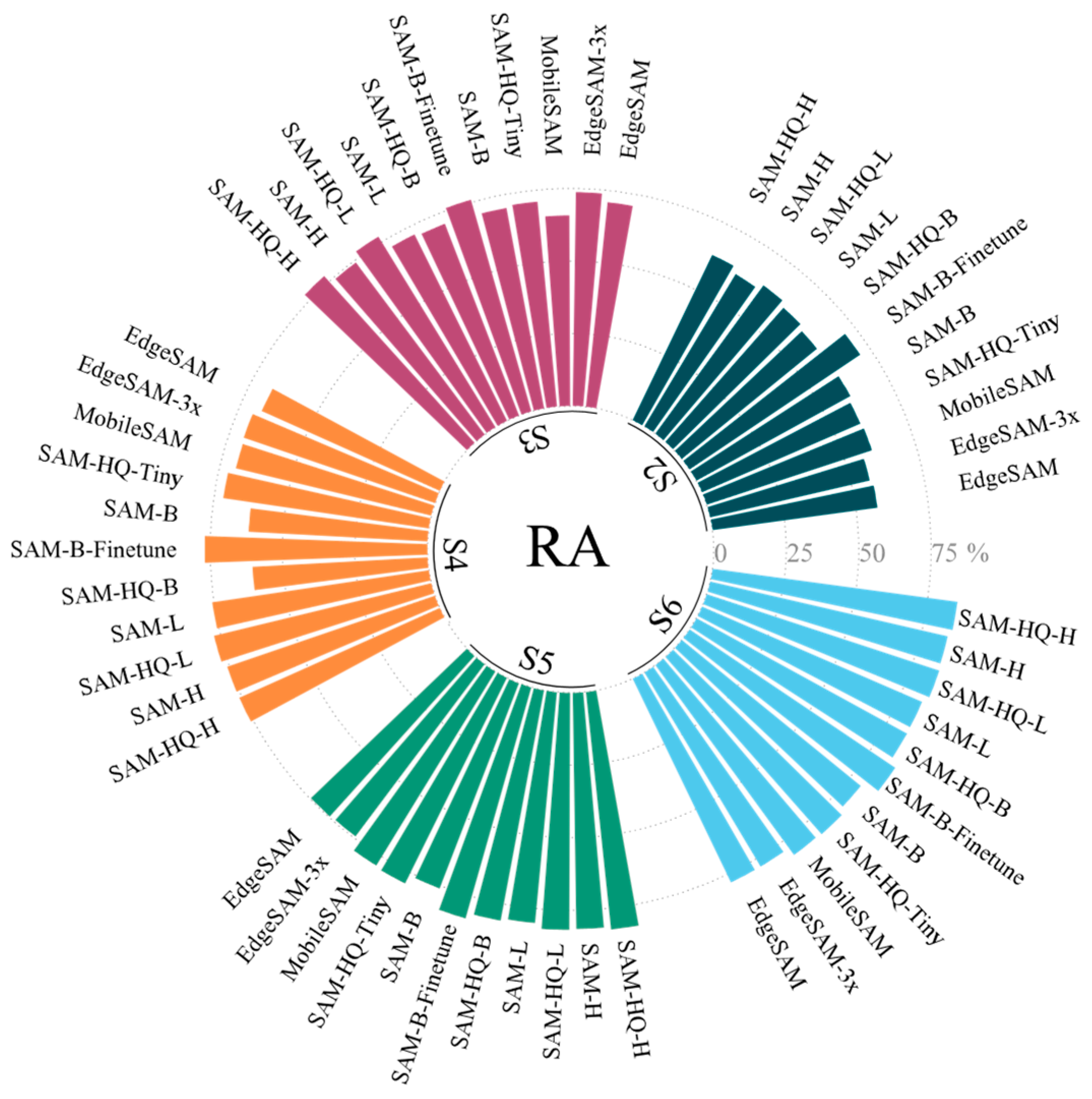
Given that baseline accuracy varies across models, comparing robustness solely based on DICE reduction offers limited insight. We therefore introduce the robust accuracy (RA) metric for a comprehensive performance evaluation, defined as:
where DICE represents the mean segmentation accuracy, and
denotes the average reduction in DICE measured over five experimental trials following the introduction of random prompt offsets within the ranges of 0–10, 10–20, and 20–30 pixels, respectively.
Furthermore,
Figure 13 presents the RA results for all models under diverse prompting strategies. The data demonstrate that SAM-HQ consistently attains the highest RA scores across nearly all prompt modes relative to models of equivalent scale, as evidenced by its superior overall accuracy. Among Tiny-scale architectures, MobileSAM and SAM-HQ-Tiny exhibit comparable RA performance. Moreover, fine-tuning significantly enhances model performance, enabling the fine-tuned SAM-B to match or surpass larger-scale SAM-HQ models while demonstrating particularly notable improvements under imprecise prompts, with a minimum 5.55% RA increase under the S3 strategy and a maximum 15.00% increase under the S4 strategy.
3.3. Evaluation of SSC Classification Performance
To rigorously assess the generalization capability of the SSC classification module compared to conventional classification models, comparative experiments were conducted. SOTA network architectures, including ConvNeXt_base [
32] and Swin Transformer V2_base [
33], were evaluated under two distinct training protocols: training from scratch and fine-tuning using pre-trained models. Following CN-CLIP, we use a 224 × 224-pixel input resolution wherever possible. Otherwise, the nearest compatible resolution is adopted. We employed the cross-entropy loss for optimization. The Adam optimizer was chosen because preliminary experiments showed that it achieves more stable convergence of the training loss compared to AdamW and SGD. For VGG19, which did not converge within 500 epochs when trained with Adam, we used SGD instead. An initial learning rate of 0.004 was used with a step learning rate scheduler that decayed the rate by a factor of 0.5 every 50 epochs over a total of 500 training epochs.
3.3.1. Evaluation Criteria for Classification
Classification performance was assessed using four standard metrics: Accuracy, Precision, Recall, and F1 Score [
34]. Accuracy quantifies the overall proportion of correctly classified instances. Precision quantifies the ability of a model to achieve correct identification of positive cases and to minimize false positive predictions. Recall measures the fraction of actual positives that are correctly detected. The F1 Score represents the harmonic mean of Precision and Recall, offering a balanced measure especially useful under class imbalance. Collectively, these metrics provide a comprehensive evaluation of the performance, reliability, and robustness of the model, enabling detailed analysis of its applicability across diverse scenarios [
35]. The mathematical expressions of these metrics are provided in Equations (8)–(11):
where
TP,
TN,
FP, and
FN represent the true positives, true negatives, false positives, and false negatives, respectively.
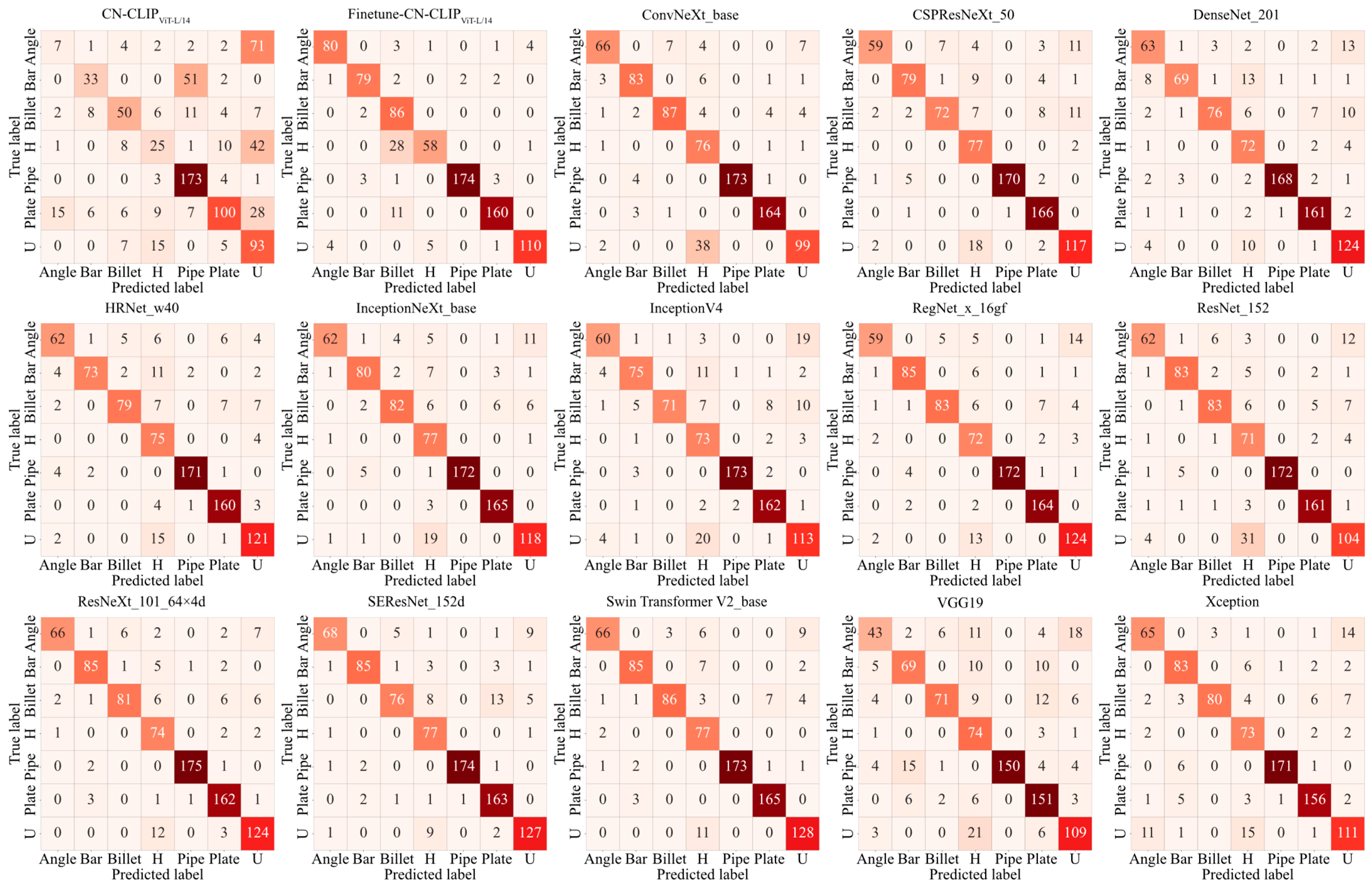
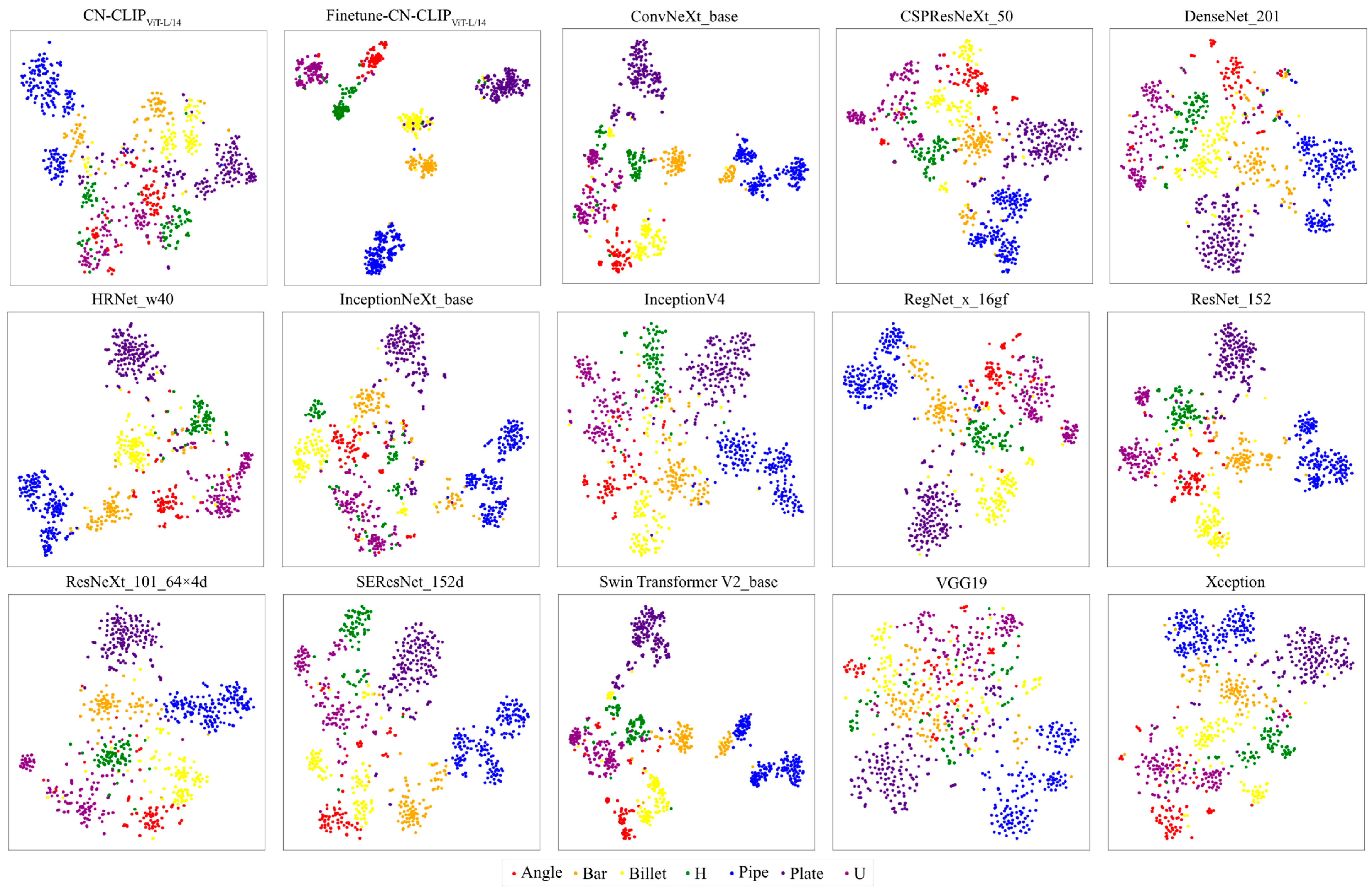
In addition to quantitative metrics, qualitative visualization techniques provide critical insights into model behavior. Confusion matrices offer a detailed breakdown of classification results, systematically identifying patterns of misclassification. Furthermore, methods such as t-SNE [
36] enable the projection of high-dimensional features into a lower-dimensional space for cluster analysis. These visualizations directly corroborate the quantitative metrics: effective classification is indicated by high values concentrated along the diagonal of the confusion matrix and by well-separated clusters in the t-SNE projection, both of which typically correspond to superior quantitative performance scores.
3.3.2. Quantitative Comparison of SSC Against SOTA Models in Scrap Classification Performance
As shown in
Table 3, the SSC classification module achieved Accuracy, Precision, and Recall values 2.8%, 2.7%, and 2.4% higher, respectively, than the second-best results (Swin Transformer V2_base). CN-CLIP demonstrated exceptional zero-shot classification performance, exhibiting only a 13.6% lower accuracy compared to the supervised VGG19 model. This result further underscores the necessity of fine-tuning foundation models for scrap recognition scenarios. Furthermore, traditional classification models exhibit substantially better performance when fine-tuned from pre-trained weights compared to training from scratch, with accuracy improvements ranging from 2.9% for DenseNet_201 to 15.3% for Swin Transformer V2_base. CLIP typically employs backbone architectures that are less advanced than those of newly emerging SOTAmodels, such as Swin Transformer and ConvNeXt. However, CLIP achieves superior performance, primarily because CN-CLIP is trained on a dataset significantly larger than those used for traditional SOTA classification models like ImageNet. Through the contrastive learning paradigm, it acquires strong generalization capability, delivering considerable zero-shot classification accuracy even without fine-tuning. Building on this high baseline, further fine-tuning enables CLIP to achieve its best performance.
3.3.3. Visual Analysis of SSC and SOTA Models
Figure 14 illustrates that the native CN-CLIP model demonstrates moderate classification performance for only four categories (‘Billet’, ‘Pipe’, ‘Plate’ and ‘U’), while exhibiting suboptimal accuracy for remaining categories. This limitation is attributable to the absence of corresponding labels and semantic information in the pre-training dataset. Notably, following model adaptation, classification accuracy improves significantly across all categories. Several specialized vision models misclassify ‘U’ as ‘H’ and certain ‘Angle’ instances as ‘U’, a phenomenon attributable to localized structural similarities under occlusion, which poses a significant challenge for differentiation. In comparison, the SSC framework exhibits superior performance, potentially benefiting from the robust feature extraction capabilities of the pre-trained CN-CLIP architecture.
Figure 15 presents t-SNE visualizations of features extracted by various scrap classification models on the test set, with analysis conducted exclusively on visual features for both CN-CLIP and SSC. The SSC framework demonstrates superior clustering effectiveness in the feature space, exhibiting the most distinct inter-class separation boundaries. In contrast, VGG19 shows nearly indiscernible cluster boundaries, consistent with its poor classification performance observed in previous evaluations. Better-performing conventional models display clearer cluster separation with fewer outliers, aligning with their classification accuracy. Collectively, the t-SNE visualization results strongly validate the superior performance of Finetune-CN-CLIP in scrap image classification.
4. Discussion
Based on experimental results, the SSC large model shows strong performance in recognizing typical scrap steel shapes. For segmentation, the integrated SAM achieves a DICE score of 90% with strong prompts and improves further after fine-tuning, demonstrating powerful zero-shot capability. For classification, CN-CLIP reaches 61.6% zero-shot accuracy, which increases to 95.3% after fine-tuning, surpassing traditional state-of-the-art models. These results highlight the high generalization ability, efficiency, and cost-effectiveness of the SSC approach for handling diverse and multi-source scrap steel.
However, the segmentation model of SSC performs well with strong prompts but shows suboptimal results in the “everything” mode, which operates without prompts. In this mode, segmentation relies on uniform grid point sampling, followed by non-maximum suppression for filtering and merging. This exhaustive approach increases inference time and often causes the model to overemphasize local details, leading to excessive responses on cluttered backgrounds and incomplete masks for large objects. A similar issue appears in medical image segmentation, but the scrap steel scenario is more challenging due to frequent occlusions and object overlaps. Future work may enhance the prompt-free “everything” mode by integrating techniques such as keypoint detection or superpixel segmentation. Furthermore, extreme conditions such as occlusions and noise remain major challenges to robustness and will be addressed by building targeted datasets for quantitative evaluation.
The inference time of SSC is comparable to that of traditional models. Its assembly-based design provides good scalability and avoids using an LLM for control, eliminating significant overhead. In segmentation, original SAM and SAM-SQ are too heavy for real-time use, but lightweight variants optimized through backbone redesign, distillation, and pruning achieve similar efficiency to conventional models. The mask decoder and prompt encoder add negligible computational cost, as shown in
Figure 4. For classification, SSC uses CN-CLIP with standard image encoders such as ViT-L/14 or ResNet50. The text encoder introduces a minor extra cost, which can be precomputed and cached offline for scrap steel shape recognition, making its runtime impact negligible. Therefore, the computational cost of the SSC classification module is comparable to that of traditional classification models. However, due to the modular design, image features are encoded separately for both segmentation and classification. While sharing the encoder from the segmentation stage could nearly reduce computational cost by half, this would demand significant engineering efforts in model redesign and fine-tuning, with no guarantee that the shared SAM encoder would retain high classification performance and generalization capabilities.
5. Conclusions
The automation and refinement of scrap classification and grading constitute a significant constraint on the green transformation of the steel industry in China. To overcome the limitations in interpretability and robustness inherent in conventional 2D scrap identification, this study proposes a novel 3D analytical framework. To avoid the unreliable fine-grained dimensional inference inherent in direct 2D image analysis, the framework integrates 2D/3D recognition with 3D reconstruction methodologies to recover precise 3D data from multi-view images, which enables accurate classification and grading. This paper investigates instance segmentation for canonical scrap shapes and proposes the SSC model, which leverages the strong generalization capability of foundation models to address the challenges of complex scrap sources and significant shape variations. Through lightweight fine-tuning, SSC achieves higher efficiency and lower computational cost compared to traditional recognition approaches.
The SSC framework utilizes an assembled architecture wherein the SAM and CLIP modules are independently fine-tuned. This design maintains specialized task performance while avoiding end-to-end optimization complexity. The segmentation module employs selective decoder fine-tuning and multi-prompt training, while the classification module uses a Chinese-optimized text encoder. Both components showed stable convergence, with optimal weights selected at epochs 41 and 9, respectively, confirming the efficacy of the decoupled training approach.
In segmentation tasks, EdgeSAM-3X performs best with precise prompts, MobileSAM offers faster inference speeds, and SAM-HQ-Tiny delivers greater robustness. Models at the L and H scales perform similarly. Box prompts achieve higher segmentation accuracy than point prompts, while the addition of an extra point prompt provides the best robustness. SAM-HQ incorporates additional parameters, yielding marginally slower inference yet improved accuracy and robustness while maintaining computational efficiency. Fine-tuning the mask decoder of SAM-B substantially improves accuracy and robustness, especially under noisy prompt conditions, with performance gains of 5% to 15% (min S3: 5.55%↑; max S4: 15.00%↑).
For the classification task, fine-tuning CN-CLIP resulted in substantial performance improvements, with the tuned model significantly outperforming all specialized vision models. It achieved a leading accuracy margin of 2.9% over the second-best model, Swin Transformer V2_base. Visual analysis further confirmed the enhanced feature extraction capability of the SSC model, as evidenced by more distinct and better separated clustering boundaries in the t-SNE projection.
Overall, the proposed SSC model achieves high accuracy and robustness in instance segmentation of typical scrap shapes through assembling and fine-tuning of the base models SAM and CLIP, thereby enhancing the pipeline for 3D scrap recognition and providing effective automatic and semi-automatic annotation tools. Compared to purely 2D inference approaches, the proposed method improves the robustness and interpretability of scrap grading and classification, thus accelerating the automation of the entire scrap steel industry chain and supporting China’s transition toward short-process steelmaking.
6. Future Work
Within the SSC framework, the segmentation stability of the automated ‘everything’ mode would benefit from enhancement, as its practical application remains heavily reliant on accurate prompt information. Therefore, future work should explore high-quality detection models, potentially by adapting the methodology presented in this study to leverage foundation models for scrap detection tasks, thereby improving overall recognition performance.
Furthermore, the designed Pipeline B for 3D scrap recognition relies on effective cross-view instance tracking to achieve accurate multi-view matching and provide reliable data for 3D reconstruction. While segmentation or classification errors can indeed affect reconstruction accuracy, the redundancy present in multi-view data provides a degree of robustness. Such inaccuracies can be mitigated through subsequent steps such as instance tracking, image retrieval (e.g., VLAD, BOW techniques), and image matching. By integrating methods like voting, clustering, or even graph neural networks, it is possible to filter out images or instance data with excessive errors. Given the data redundancy across multiple views, trading off a portion of the data for enhanced robustness is a worthwhile strategy.
The current 3D processing pipeline consists of multiple stages, including at least two key steps: 3D reconstruction and recognition. For the complex, high-dimensional task of extracting 3D scrap dimensions, exploring an end-to-end model may offer greater potential. However, such an end-to-end approach also faces several challenges, including but not limited to reliance on large-scale, high-quality annotated data; the complexity of model design and training; and the effective integration of multi-view geometric constraints with semantic understanding.
Author Contributions
Conceptualization, G.B. and T.W.; methodology, G.B.; software, G.B.; validation, G.B., W.X. and H.W.; formal analysis, G.B.; investigation, G.B.; resources, Z.L.; data curation, G.B.; writing—original draft preparation, G.B.; writing—review and editing, T.W.; visualization, G.B.; supervision, Y.Z.; project administration, H.W.; funding acquisition, Y.Z. All authors have read and agreed to the published version of the manuscript.
Funding
This research was funded by the National Natural Science Foundation of China, grant number 52504348.
Institutional Review Board Statement
Not applicable.
Informed Consent Statement
Not applicable.
Data Availability Statement
The data presented in this study are available on request from the corresponding author. The data are not publicly available due to ongoing study.
Conflicts of Interest
The authors declare no conflicts of interest.
Abbreviations
The following abbreviations are used in this manuscript:
| t-SNE | t-distributed stochastic neighbor embedding |
| ChatGPT | Chat generative pre-trained transformer |
| ViT | Vision transformer |
| LLM | Large language model |
| SGD | Stochastic gradient descent |
| CNN | Convolutional neural network |
| MAE | Masked autoencoder |
| SOTA | State-of-the-art |
| VRAM | Video random access memory |
| BCE | Binary cross-entropy |
| DICE | Dice coefficient |
| AdamW | Adaptive moment estimation with weight decay |
| CosineAnnealingLR | Cosine annealing learning rate |
| NMS | Non-maximum suppression |
| VLAD | Vector of local aggregated descriptors |
| BOW | Bag of words |
References
- GB/T 39733-2024; Recycling Iron-Steel Materials. SAC: Beijing, China, 2024.
- Xu, W.; Xiao, P.; Zhu, L.; Zhang, Y.; Chang, J.; Zhu, R.; Xu, Y. Classification and rating of steel scrap using deep learning. Eng. Appl. Artif. Intell. 2023, 123, 106241. [Google Scholar] [CrossRef]
- Xu, W.; Xiao, P.; Zhu, L.; Wei, G.; Zhu, R. An efficient treatment method of scrap intelligent rating based on machine vision. Appl. Intell. 2024, 54, 10912–10928. [Google Scholar] [CrossRef]
- Geirhos, R.; Rubisch, P.; Michaelis, C.; Bethge, M.; Wichmann, F.A.; Brendel, W. ImageNet-trained CNNs are biased towards texture; increasing shape bias improves accuracy and robustness. arXiv 2018, arXiv:1811.12231. [Google Scholar] [CrossRef]
- Imtiaz, S.M.; Kwon, K.-C.; Hossain, M.B.; Alam, M.S.; Jeon, S.-H.; Kim, N. Depth Estimation for Integral Imaging Microscopy Using a 3D–2D CNN with a Weighted Median Filter. Sensors 2022, 22, 5288. [Google Scholar] [CrossRef]
- Geng, C.; Huang, S.J.; Chen, S. Recent Advances in Open Set Recognition: A Survey. IEEE Trans. Pattern Anal. Mach. Intell. 2021, 43, 3614–3631. [Google Scholar] [CrossRef]
- Wilmet, V.; Verma, S.; Redl, T.; Sandaker, H.; Li, Z. A comparison of supervised and unsupervised deep learning methods for anomaly detection in images. arXiv 2021, arXiv:2107.09204. [Google Scholar] [CrossRef]
- Qiu, Z. Smart Rating System of Steel Scrap Based on Improved YOLOv3 Algorithm. Master’s Thesis, Anhui University of Technology, Ma’anshan, China, 2020. [Google Scholar] [CrossRef]
- Duan, S. Classification and Statistics of Scrap Steel Based on an Optical Image YOLO Algorithm. Master’s Thesis, Dalian University of Technology, Dalian, China, 2021. [Google Scholar] [CrossRef]
- Kirillov, A.; Mintun, E.; Ravi, N.; Mao, H.; Rolland, C.; Gustafson, L.; Xiao, T.; Whitehead, S.; Berg, A.C.; Lo, W.-Y. Segment Anything. In Proceedings of the IEEE/CVF International Conference on Computer Vision, Paris, France, 1–6 October 2023; pp. 3992–4003. [Google Scholar] [CrossRef]
- Huang, Y.; Yang, X.; Liu, L.; Zhou, H.; Chang, A.; Zhou, X.; Chen, R.; Yu, J.; Chen, J.; Chen, C. Segment anything model for medical images? Med. Image Anal. 2024, 92, 103061. [Google Scholar] [CrossRef] [PubMed]
- Ma, J.; He, Y.; Li, F.; Han, L.; You, C.; Wang, B. Segment anything in medical images. Nat. Commun. 2024, 15, 654. [Google Scholar] [CrossRef]
- Dosovitskiy, A.; Beyer, L.; Kolesnikov, A.; Weissenborn, D.; Zhai, X.; Unterthiner, T.; Dehghani, M.; Minderer, M.; Heigold, G.; Gelly, S. An image is worth 16x16 words: Transformers for image recognition at scale. arXiv 2020, arXiv:2010.11929. [Google Scholar] [CrossRef]
- Zunair, H.; Ben Hamza, A. Sharp U-Net: Depthwise convolutional network for biomedical image segmentation. Comput. Biol. Med. 2021, 136, 104699. [Google Scholar] [CrossRef]
- Zunair, H.; Hamza, A.B. Masked Supervised Learning for Semantic Segmentation. In Proceedings of the British Machine Vision Conference, London, UK, 21–24 November 2022. [Google Scholar] [CrossRef]
- Radford, A.; Kim, J.W.; Hallacy, C.; Ramesh, A.; Goh, G.; Agarwal, S.; Sastry, G.; Askell, A.; Mishkin, P.; Clark, J. Learning transferable visual models from natural language supervision. In Proceedings of the International Conference on Machine Learning, Virtual, 18–24 July 2021; pp. 8748–8763. [Google Scholar] [CrossRef]
- Wu, C.; Yin, S.; Qi, W.; Wang, X.; Tang, Z.; Duan, N. Visual chatgpt: Talking, drawing and editing with visual foundation models. arXiv 2023, arXiv:2303.04671. [Google Scholar] [CrossRef]
- He, K.; Chen, X.; Xie, S.; Li, Y.; Dollár, P.; Girshick, R. Masked autoencoders are scalable vision learners. In Proceedings of the the IEEE/CVF Conference on Computer Vision and Pattern Recognition, New Orleans, LA, USA, 18–24 June 2022; pp. 15979–15988. [Google Scholar] [CrossRef]
- Ke, L.; Ye, M.; Danelljan, M.; Tai, Y.-W.; Tang, C.-K.; Yu, F. Segment anything in high quality. Adv. Neural Inf. Process. Syst. 2023, 36, 29914–29934. [Google Scholar] [CrossRef]
- Zhang, C.; Han, D.; Qiao, Y.; Kim, J.U.; Bae, S.-H.; Lee, S.; Hong, C.S. Faster segment anything: Towards lightweight sam for mobile applications. arXiv 2023, arXiv:2306.14289. [Google Scholar] [CrossRef]
- Zhou, C.; Li, X.; Loy, C.C.; Dai, B. Edgesam: Prompt-in-the-loop distillation for on-device deployment of sam. arXiv 2023, arXiv:2312.06660. [Google Scholar] [CrossRef]
- Yang, A.; Pan, J.; Lin, J.; Men, R.; Zhang, Y.; Zhou, J.; Zhou, C. Chinese CLIP: Contrastive Vision-Language Pretraining in Chinese. arXiv 2022, arXiv:2211.01335. [Google Scholar] [CrossRef]
- Ruby, U.; Yendapalli, V. Binary cross entropy with deep learning technique for image classification. Int. J. Adv. Trends Comput. Sci. Eng. 2020, 9, 5393–5397. [Google Scholar] [CrossRef]
- Bilic, P.; Christ, P.; Li, H.B.; Vorontsov, E.; Ben-Cohen, A.; Kaissis, G.; Szeskin, A.; Jacobs, C.; Mamani, G.E.H.; Chartrand, G. The liver tumor segmentation benchmark (lits). Med. Image Anal. 2023, 84, 102680. [Google Scholar] [CrossRef]
- Loshchilov, I.; Hutter, F. Decoupled weight decay regularization. arXiv 2017, arXiv:1711.05101. [Google Scholar] [CrossRef]
- Kim, C.; Kim, S.; Kim, J.; Lee, D.; Kim, S. Automated learning rate scheduler for large-batch training. arXiv 2021, arXiv:2107.05855. [Google Scholar] [CrossRef]
- Liu, Y.; Ott, M.; Goyal, N.; Du, J.; Joshi, M.; Chen, D.; Levy, O.; Lewis, M.; Zettlemoyer, L.; Stoyanov, V. Roberta: A robustly optimized bert pretraining approach. arXiv 2019, arXiv:1907.11692. [Google Scholar] [CrossRef]
- Ethayarajh, K. How contextual are contextualized word representations? Comparing the geometry of BERT, ELMo, and GPT-2 embeddings. arXiv 2019, arXiv:1909.00512. [Google Scholar] [CrossRef]
- Qian, J.; Li, R.; Yang, X.; Huang, Y.; Luo, M.; Lin, Z.; Hong, W.; Huang, R.; Fan, H.; Ni, D. Hasa: Hybrid architecture search with aggregation strategy for echinococcosis classification and ovary segmentation in ultrasound images. Expert Syst. Appl. 2022, 202, 117242. [Google Scholar] [CrossRef]
- Crum, W.R.; Camara, O.; Hill, D.L. Generalized overlap measures for evaluation and validation in medical image analysis. IEEE Trans. Med. Imaging 2006, 25, 1451–1461. [Google Scholar] [CrossRef]
- Huang, Y.; Yang, X.; Zou, Y.; Chen, C.; Wang, J.; Dou, H.; Ravikumar, N.; Frangi, A.F.; Zhou, J.; Ni, D. Flip Learning: Erase to Segment. In Medical Image Computing and Computer Assisted Intervention—MICCAI 2021, Strasbourg, France, 27 September–1 October 2021; Springer: Cham, Switzerland, 2021; pp. 493–502. [Google Scholar] [CrossRef]
- Liu, Z.; Mao, H.; Wu, C.-Y.; Feichtenhofer, C.; Darrell, T.; Xie, S. A convnet for the 2020s. In Proceedings of the IEEE/CVF Conference on Computer Vision and Pattern Recognition, New Orleans, LA, USA, 18–24 June 2022; pp. 11976–11986. [Google Scholar] [CrossRef]
- Liu, Z.; Hu, H.; Lin, Y.; Yao, Z.; Xie, Z.; Wei, Y.; Ning, J.; Cao, Y.; Zhang, Z.; Dong, L. Swin transformer v2: Scaling up capacity and resolution. In Proceedings of the IEEE/CVF Conference on Computer Vision and Pattern Recognition, New Orleans, LA, USA, 18–24 June 2022; pp. 12009–12019. [Google Scholar] [CrossRef]
- Sokolova, M.; Lapalme, G. A systematic analysis of performance measures for classification tasks. Inf. Process. Manag. 2009, 45, 427–437. [Google Scholar] [CrossRef]
- Powers, D.M. Evaluation: From precision, recall and F-measure to ROC, informedness, markedness and correlation. arXiv 2020, arXiv:2010.16061. [Google Scholar] [CrossRef]
- Tang, J.; Liu, J.; Zhang, M.; Mei, Q. Visualizing large-scale and high-dimensional data. In Proceedings of the 25th International Conference on World Wide Web, Montréal, QC, Canada, 11–15 April 2016; pp. 287–297. [Google Scholar] [CrossRef]
- Wightman, R.; Touvron, H.; Jégou, H. Resnet strikes back: An improved training procedure in timm. arXiv 2021, arXiv:2110.00476. [Google Scholar] [CrossRef]
- Huang, G.; Liu, Z.; Van Der Maaten, L.; Weinberger, K.Q. Densely connected convolutional networks. In Proceedings of the IEEE Conference on Computer Vision and Pattern Recognition, Honolulu, HI, USA, 21–26 July 2017; pp. 2261–2269. [Google Scholar] [CrossRef]
- Wang, J.; Sun, K.; Cheng, T.; Jiang, B.; Deng, C.; Zhao, Y.; Liu, D.; Mu, Y.; Tan, M.; Wang, X. Deep high-resolution representation learning for visual recognition. IEEE Trans. Pattern Anal. Mach. Intell. 2020, 43, 3349–3364. [Google Scholar] [CrossRef]
- Yu, W.; Zhou, P.; Yan, S.; Wang, X. Inceptionnext: When inception meets convnext. In Proceedings of the IEEE/CVF Conference on Computer Vision and Pattern Recognition, Seattle, WA, USA, 16–22 June 2024; pp. 5672–5682. [Google Scholar] [CrossRef]
- Szegedy, C.; Ioffe, S.; Vanhoucke, V.; Alemi, A. Inception-v4, inception-resnet and the impact of residual connections on learning. In Proceedings of the AAAI Conference on Artificial Intelligence, San Francisco, CA, USA, 4–9 February 2017; pp. 4278–4284. [Google Scholar] [CrossRef]
- Radosavovic, I.; Kosaraju, R.P.; Girshick, R.; He, K.; Dollár, P. Designing network design spaces. In Proceedings of the IEEE/CVF Conference on Computer Vision and Pattern Recognition, Seattle, WA, USA, 13–19 June 2020; pp. 10428–10436. [Google Scholar] [CrossRef]
- He, K.; Zhang, X.; Ren, S.; Sun, J. Deep residual learning for image recognition. In Proceedings of the IEEE Conference on Computer Vision and Pattern Recognition, Las Vegas, NV, USA, 27–30 June 2016; pp. 770–778. [Google Scholar] [CrossRef]
- Yalniz, I.Z.; Jégou, H.; Chen, K.; Paluri, M.; Mahajan, D. Billion-scale semi-supervised learning for image classification. arXiv 2019, arXiv:1905.00546. [Google Scholar] [CrossRef]
- Hu, J.; Shen, L.; Sun, G. Squeeze-and-excitation networks. In Proceedings of the IEEE Conference on Computer Vision and Pattern Recognition, Salt Lake City, UT, USA, 18–23 June 2018; pp. 7132–7141. [Google Scholar] [CrossRef]
- Simonyan, K.; Zisserman, A. Very deep convolutional networks for large-scale image recognition. arXiv 2014, arXiv:1409.1556. [Google Scholar] [CrossRef]
- Chollet, F. Xception: Deep learning with depthwise separable convolutions. In Proceedings of the IEEE Conference on Computer Vision and Pattern Recognition, Honolulu, HI, USA, 21–26 July 2017; pp. 1251–1258. [Google Scholar] [CrossRef]
Figure 1.
Architectural comparison of the scrap recognition frameworks. (a) Mainstream 2D workflow; (b) Proposed 3D workflow.
Figure 1.
Architectural comparison of the scrap recognition frameworks. (a) Mainstream 2D workflow; (b) Proposed 3D workflow.
Figure 2.
Representative dataset samples employed in conventional 2D scrap recognition frameworks. (a) Raw input images. (b) Visualized annotation masks.
Figure 2.
Representative dataset samples employed in conventional 2D scrap recognition frameworks. (a) Raw input images. (b) Visualized annotation masks.
Figure 3.
Overview of SSC.
Figure 3.
Overview of SSC.
Figure 4.
Parameter distribution across components in SAM. The parameter count of the Promote Encoder is extremely low, constituting less than 0.005% of the total, making it visually indistinct in the figure.
Figure 4.
Parameter distribution across components in SAM. The parameter count of the Promote Encoder is extremely low, constituting less than 0.005% of the total, making it visually indistinct in the figure.
Figure 5.
The segmentation dataset featuring representative 3D scrap shapes.
Figure 5.
The segmentation dataset featuring representative 3D scrap shapes.
Figure 6.
Categories, dimensions, and spatial distribution of the training (a) and test (b) datasets.
Figure 6.
Categories, dimensions, and spatial distribution of the training (a) and test (b) datasets.
Figure 7.
Correlation analysis of geometric attributes in the training (a) and test (b) datasets.
Figure 7.
Correlation analysis of geometric attributes in the training (a) and test (b) datasets.
Figure 8.
Fine-tuning loss curves of the SSC model on the scrap dataset. (a) Segmentation module (SAM-B). (b) Classification module (CN-CLIPViT-L/14).
Figure 8.
Fine-tuning loss curves of the SSC model on the scrap dataset. (a) Segmentation module (SAM-B). (b) Classification module (CN-CLIPViT-L/14).
Figure 9.
Model scale (a) and parameter efficiency (b) of SAM variants across different strategies.
Figure 9.
Model scale (a) and parameter efficiency (b) of SAM variants across different strategies.
Figure 10.
Comparison of the average performance of SAM variants under different strategies.
Figure 10.
Comparison of the average performance of SAM variants under different strategies.
Figure 11.
DICE performance of SAM variants on scrap under different strategies. The box plots illustrate the distribution of DICE scores, with triangles indicating the mean values.
Figure 11.
DICE performance of SAM variants on scrap under different strategies. The box plots illustrate the distribution of DICE scores, with triangles indicating the mean values.
Figure 12.
Visualization of SAM variants under different strategies on typical scrap datasets. Red and blue stars rep-resent positive and negative point prompts, respectively. The green box indicates the box prompt.
Figure 12.
Visualization of SAM variants under different strategies on typical scrap datasets. Red and blue stars rep-resent positive and negative point prompts, respectively. The green box indicates the box prompt.
Figure 13.
Comparison of the robust accuracy of SAM variants under different strategies.
Figure 13.
Comparison of the robust accuracy of SAM variants under different strategies.
Figure 14.
Confusion matrices of different models on the scrap classification dataset.
Figure 14.
Confusion matrices of different models on the scrap classification dataset.
Figure 15.
t-SNE visualization of feature representations from different models on the scrap classification dataset.
Figure 15.
t-SNE visualization of feature representations from different models on the scrap classification dataset.
Table 1.
Inference time comparison across different SAM variants (micro seconds).
Table 1.
Inference time comparison across different SAM variants (micro seconds).
| Model | Embedding | Prompt Encoding + Mask Decoding |
|---|
| S1 | S2 | S3 | S4 | S5 | S6 |
|---|
| EdgeSAM | 41.278 | 3260.929 | 9.140 | 9.162 | 9.135 | 8.806 | 9.632 |
| EdgeSAM-3x | 41.446 | 3262.015 | 9.210 | 9.157 | 9.146 | 8.726 | 9.728 |
| MobileSAM | 37.263 | 3006.242 | 8.867 | 8.575 | 8.354 | 8.475 | 8.663 |
| SAM-B | 104.503 | 3155.644 | 9.016 | 9.020 | 9.038 | 8.574 | 9.449 |
| SAM-B-Finetune | 105.083 | 3154.891 | 9.113 | 9.132 | 8.945 | 8.633 | 9.520 |
| SAM-L | 211.181 | 3156.017 | 8.956 | 9.042 | 8.966 | 8.496 | 9.321 |
| SAM-H | 302.221 | 3155.332 | 9.048 | 9.118 | 9.096 | 8.566 | 9.394 |
| SAM-HQ-Tiny | 40.115 | 4731.128 | 11.024 | 11.029 | 10.952 | 10.497 | 11.226 |
| SAM-HQ-B | 94.646 | 4732.951 | 11.164 | 11.109 | 10.672 | 10.777 | 11.012 |
| SAM-HQ-L | 194.204 | 4730.579 | 10.947 | 10.875 | 11.023 | 10.032 | 10.964 |
| SAM-HQ-H | 297.400 | 4729.687 | 11.053 | 11.098 | 10.897 | 10.566 | 11.846 |
Table 2.
Comparative analysis of DICE drop across SAM variants under different prompt shifting levels and testing strategies.
Table 2.
Comparative analysis of DICE drop across SAM variants under different prompt shifting levels and testing strategies.
| Model | Shift (Pixel) | DICE Drop (%) |
|---|
| S2 | S3 | S4 | S5 | S6 |
|---|
| EdgeSAM | 0–10 | 5.6 | 3.5 | 3.2 | 3.4 | 2.7 |
| 10–20 | 19.1 | 16.4 | 13.7 | 18.1 | 14.3 |
| 20–30 | 29.1 | 27.6 | 21.4 | 31.6 | 26.3 |
| EdgeSAM-3x | 0–10 | 6.4 | 2.9 | 2.8 | 3.6 | 2.9 |
| 10–20 | 20.2 | 14.2 | 11.6 | 19.2 | 15.1 |
| 20–30 | 30.6 | 25.0 | 19.1 | 33.3 | 27.7 |
| MobileSAM | 0–10 | 5.8 | 4.7 | 3.8 | 1.2 | 1.2 |
| 10–20 | 19.4 | 20.9 | 14.9 | 11.6 | 9.3 |
| 20–30 | 29.5 | 32.9 | 23.2 | 25.5 | 21.2 |
| SAM-HQ-Tiny | 0–10 | 0.8 | 2.1 | 0.6 | 0.0 | −0.1 |
| 10–20 | 14.2 | 15.5 | 11.6 | 10.0 | 7.5 |
| 20–30 | 24.2 | 26.7 | 20.6 | 23.5 | 18.8 |
| SAM-B | 0–10 | 6.8 | 7.5 | 11.8 | 2.1 | 2.9 |
| 10–20 | 20.6 | 20.7 | 18.9 | 9.2 | 9.5 |
| 20–30 | 31.1 | 31.4 | 25.2 | 19.2 | 18.6 |
| SAM-B-Finetune | 0–10 | 3.2 | 7.3 | 8.8 | −4.7 | −0.3 |
| 10–20 | 14.2 | 14.9 | 15.9 | 4.7 | 6.6 |
| 20–30 | 23.9 | 22.9 | 23.9 | 17.9 | 16.9 |
| SAM-HQ-B | 0–10 | 7.4 | 6.8 | 10.3 | 2.5 | 2.9 |
| 10–20 | 20.7 | 20.1 | 18.8 | 11.5 | 9.5 |
| 20–30 | 30.6 | 29.4 | 24.8 | 23.8 | 18.6 |
| SAM-L | 0–10 | 6.8 | -0.4 | 4.2 | 1.2 | 1.1 |
| 10–20 | 22.5 | 15.0 | 15.2 | 13.6 | 11.1 |
| 20–30 | 33.9 | 27.0 | 24.8 | 30.0 | 24.8 |
| SAM-HQ-L | 0–10 | 7.2 | 3.6 | 3.6 | 0.9 | 0.9 |
| 10–20 | 22.7 | 15.9 | 14.4 | 11.6 | 9.3 |
| 20–30 | 34.1 | 26.7 | 23.7 | 26.7 | 21.1 |
| SAM-H | 0–10 | 7.9 | 3.9 | 3.9 | 1.0 | 1.0 |
| 10–20 | 23.4 | 19.6 | 16.3 | 12.0 | 9.5 |
| 20–30 | 34.6 | 32.5 | 26.0 | 27.0 | 22.6 |
| SAM-HQ-H | 0–10 | 7.4 | 3.0 | 3.3 | 0.9 | 0.8 |
| 10–20 | 23.4 | 16.2 | 15.7 | 11.0 | 8.1 |
| 20–30 | 34.7 | 27.5 | 25.5 | 25.4 | 19.7 |
Table 3.
Performance benchmarking of SSC against SOTA models on the scrap dataset.
Table 3.
Performance benchmarking of SSC against SOTA models on the scrap dataset.
| Model | Publication | Pre-Training | Accuracy | Precision | Recall | F1Score |
|---|
| CN-CLIPViT-L/14 | arXiv2023 | 200 million image-text pairs (zero-shot) | 61.6 | 60.7 | 53.4 | 52.8 |
| SSC | - | 200 million image-text pairs | 95.3 * | 94.6 * | 93.6 * | 93.8 * |
| ConvNeXt_base | CVPR 2022 | ImageNet 1k | 88.6 | 88.0 | 87.8 | 87.0 |
| From scratch | 75.5 | 75.5 | 73.7 | 74.4 |
| CSPResNeXt_50 [37] | CVPR 2020 | ImageNet 1k | 87.7 | 87.4 | 85.8 | 85.8 |
| From scratch | 82.7 | 82.1 | 80.8 | 81.3 |
| DenseNet_201 [38] | CVPR 2017 | ImageNet 1k | 86.8 | 86.1 | 84.8 | 84.8 |
| From scratch | 83.9 | 83.2 | 82.2 | 82.6 |
| HRNet_w40 [39] | TPAMI 2021 | ImageNet 1k | 87.8 | 87.3 | 86.0 | 85.9 |
| From scratch | 84.8 | 84.3 | 82.6 | 83.3 |
| InceptionNeXt_base [40] | CVPR 2024 | ImageNet 1k | 89.6 | 89.2 | 88.1 | 87.9 |
| From scratch | 78.8 | 77.6 | 77.2 | 77.4 |
| InceptionV4 [41] | AAAI 2017 | ImageNet 1k | 86.1 | 85.9 | 84.0 | 84.1 |
| From scratch | 80.5 | 80.3 | 79.1 | 79.6 |
| RegNet_x_16gf [42] | CVPR 2020 | ImageNet 1k | 89.9 | 89.2 | 88.1 | 88.1 |
| From scratch | 82.4 | 82.0 | 80.5 | 81.0 |
| ResNet_152 [43] | CVPR 2016 | ImageNet 1k | 87.2 | 86.3 | 85.8 | 85.5 |
| From scratch | 80.4 | 80.8 | 78.5 | 79.1 |
| ResNeXt_101_64×4d [44] | CVPR 2017 | ImageNet 1k | 90.9 | 90.4 | 89.4 | 89.5 |
| From scratch | 86.6 | 86.4 | 85.2 | 85.7 |
| SEResNet_152d [45] | CVPR 2018 | ImageNet 1k | 91.2 | 90.9 | 89.9 | 90.0 |
| From scratch | 82.2 | 81.5 | 80.7 | 80.9 |
| Swin Transformer V2_base | CVPR 2022 | ImageNet 1k | 92.4 | 91.8 | 91.2 | 91.1 |
| From scratch | 77.1 | 76.9 | 74.6 | 75.5 |
| VGG19 [46] | ICLR 2015 | ImageNet 1k | 79.0 | 78.4 | 77.2 | 76.6 |
| From scratch | 75.2 | 74.9 | 73.9 | 74.3 |
| Xception [47] | CVPR 2017 | ImageNet 1k | 87.6 | 86.4 | 86.5 | 86.1 |
| From scratch | 83.2 | 83.3 | 81.4 | 82.2 |
| Disclaimer/Publisher’s Note: The statements, opinions and data contained in all publications are solely those of the individual author(s) and contributor(s) and not of MDPI and/or the editor(s). MDPI and/or the editor(s) disclaim responsibility for any injury to people or property resulting from any ideas, methods, instructions or products referred to in the content. |