Research on Seafloor 3D Reconstruction Method Based on Sparse Measurement Points

Abstract
1. Introduction
2. Experimental Method
2.1. Design of the Terrain Deformation 3D Reconstruction Model
2.2. Fractal Algorithm
2.3. Gaussian Process Model
3. Simulation of Seafloor for Algorithm Validation
3.1. Comparison of Fractal Algorithm and the Method of Dividing the Rod into Equal Segments
- (1)
- Dividing the rod into equal segments at both ends and calculating the coordinates of the intermediate points
- (2)
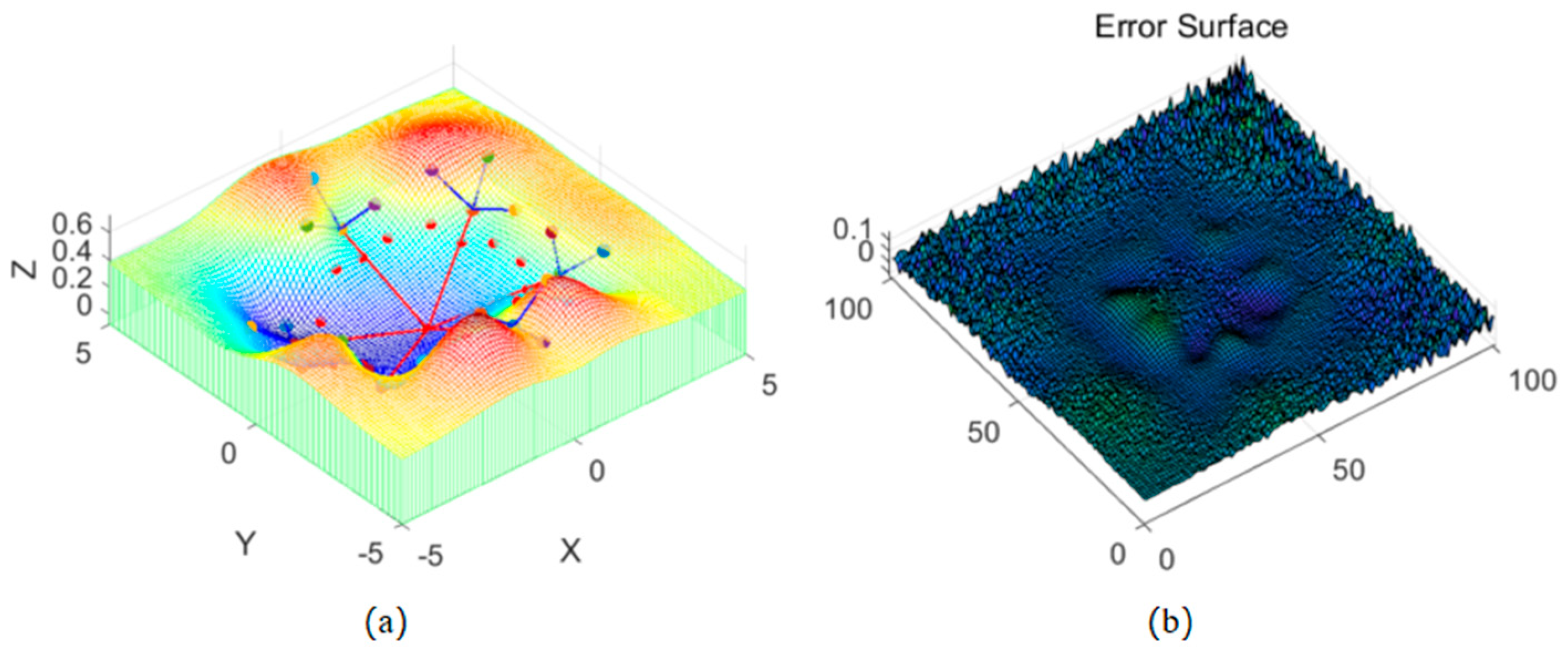
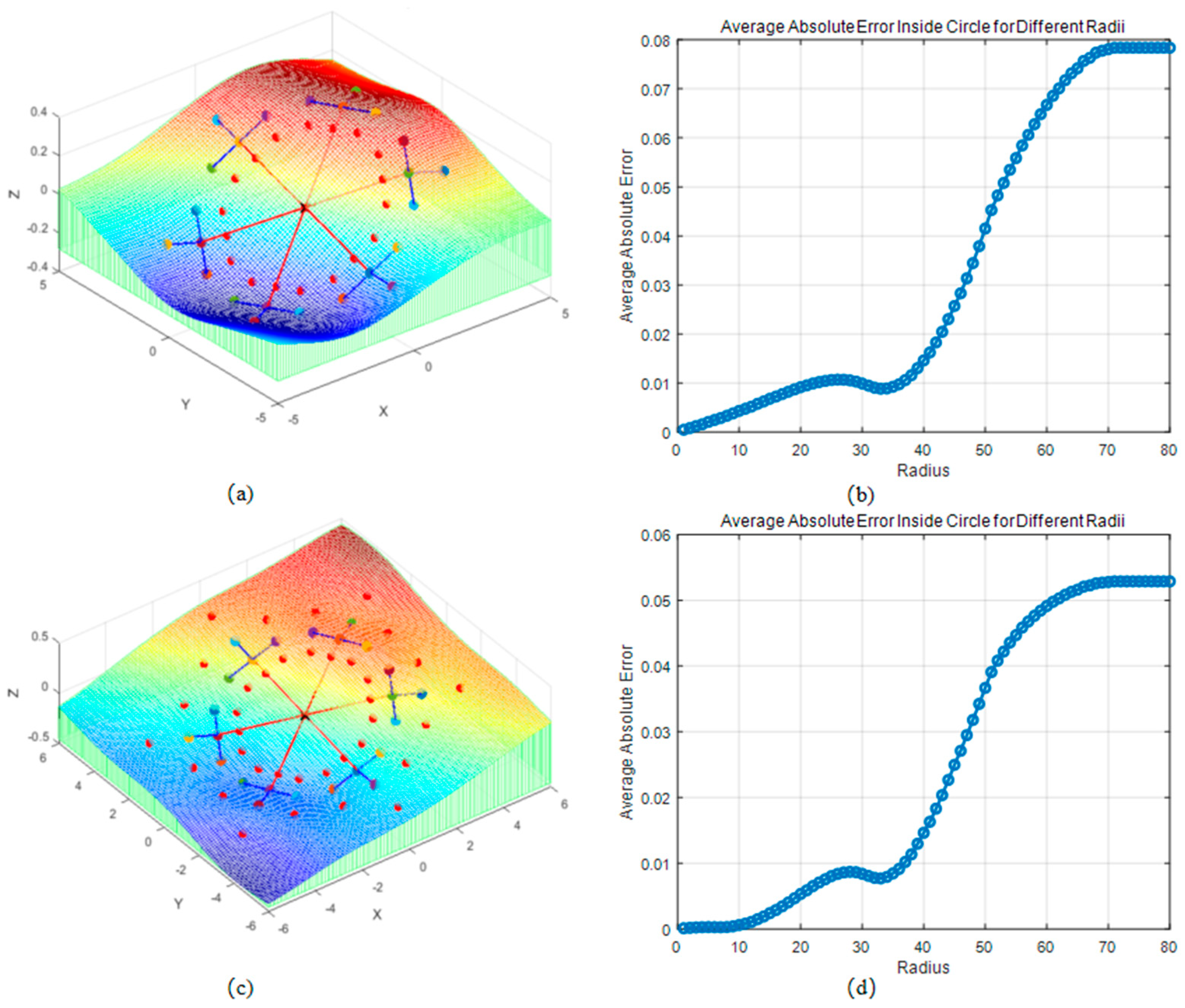
- The fractal interpolation method can simulate the transitional part between the rod and the surrounding terrain, especially in cases where the terrain changes significantly or is complex. Based on the position and shape of the rod, combined with the features of the terrain, and using the existing points, such as the endpoints of the rod and nearby terrain points, the fractal interpolation algorithm is applied to generate additional points, expanding the detailed position between the rod and the surrounding area.
- Mean Error: Fractal interpolation method: 0.0866; Equal division point coordinate method: 0.0974. The fractal interpolation method has a smaller mean error, indicating a more precise fit to the data overall.
- Mean Squared Error: Fractal interpolation method: 0.0130; Equal division point coordinate method: 0.0225. The mean squared error of the fractal interpolation method is significantly lower, suggesting that it not only has a smaller error magnitude but also smaller squared errors, showing a better fitting performance.
- Coefficient of Determination: Fractal interpolation method: 0.9558; Equal division point coordinate method: 0.9275. This indicates that the fractal interpolation method can better capture the variation trends of the data and has a higher model fitting degree.
- Cross-validation Error: Fractal interpolation method: 0.01831; Equal division point coordinate method: 0.05444. The lower cross-validation error indicates stronger generalization ability, meaning the model can adapt to more diverse datasets. The fractal interpolation method has a significantly lower cross-validation error, showing better stability across different datasets.
3.2. Simulation Experiments of Different Terrain
3.2.1. Setup and Process of Supplementary Verification Experiments
3.2.2. Experimental Results
3.3. Optimizing the Generation of Seafloor Morphology Simulation
4. Discussion
5. Conclusions
Author Contributions
Funding
Institutional Review Board Statement
Informed Consent Statement
Data Availability Statement
Acknowledgments
Conflicts of Interest
References
- Li, X.; Sun, B.; Li, H.; Liu, H.; Cai, D.; Wang, X.; Li, X. Simulation of gas production and seafloor subsidence during the development of natural gas hydrates in the south china sea. Energy Fuels 2024, 38, 8674–8687. [Google Scholar] [CrossRef]
- Sun, K.; Cui, W.; Chen, C. Review of underwater sensing technologies and applications. Sensors 2021, 21, 7849. [Google Scholar] [CrossRef]
- Shimizu, T.; Yamashita, S.; Hatanaka, T.; Uto, K.; Mammarella, M.; Dabbene, F. Angle-aware coverage control for 3-D map reconstruction with drone networks. IEEE Control. Syst. Lett. 2021, 6, 1831–1836. [Google Scholar] [CrossRef]
- Zhang, L.; Zhang, G.; Liu, Y.; Fan, Z. Deep learning for 3-D inversion of gravity data. IEEE Trans. Geosci. Remote Sens. 2021, 60, 1–18. [Google Scholar] [CrossRef]
- Wang, J.; Zhao, M.; Jiang, L.; Yang, C.-C.; Huang, X.-L.; Xu, Y.; Lu, J. A new strategy combined HASM and classical interpolation methods for DEM construction in areas without sufficient terrain data. J. Mt. Sci. 2021, 18, 2761–2775. [Google Scholar] [CrossRef]
- Suba, N.S.; Bydłosz, J.; Sturza, A.A.; Dragomir, E.I. Interpolation Method Consistency Analysis in the Creation of Digital Terrain Models. J. Appl. Eng. Sci. 2024, 14, 161–166. [Google Scholar] [CrossRef]
- Emmendorfer, L.R.; Emmendorfer, I.B.; de Almeida, L.P.M.; Alves, D.C.L.; Neto, J.A. A self-interpolation method for digital terrain model generation. In Computational Science and Its Applications–ICCSA 2021, Proceedings of the 21st International Conference, Cagliari, Italy, 13–16 September 2021; Proceedings, Part I 21; Springer International Publishing: Berlin/Heidelberg, Germany, 2021; pp. 352–363. [Google Scholar]
- Sainio, N. Terrain Generation Algorithms. Master’s Thesis, Faculty of Information Technology and Communication Sciences, Tampere, Finland, 2023. [Google Scholar]
- Habib, M. Evaluation of DEM interpolation techniques for characterizing terrain roughness. Catena 2021, 198, 105072. [Google Scholar] [CrossRef]
- Maleika, W. Local Polynomial Interpolation Method Optimization in the Process of Digital Terrain Model Creation Based on Data Collected From a Multibeam Echosounder. IEEE J. Ocean. Eng. 2024, 49, 920–932. [Google Scholar] [CrossRef]
- Miky, Y.; Kamel, A.; Alshouny, A. A combined contour lines iteration algorithm and Delaunay triangulation for terrain modeling enhancement. Geo-Spat. Inf. Sci. 2023, 26, 558–576. [Google Scholar] [CrossRef]
- Bui, L.K.; Glennie, C.L.; Hartzell, P.J. Rigorous propagation of LiDAR point cloud uncertainties to spatially regular grids by a TIN linear interpolation. IEEE Geosci. Remote Sens. Lett. 2021, 19, 7003105. [Google Scholar] [CrossRef]
- Zhang, R.; Zhai, G.; Bian, S.; Li, H.; Ji, B. Analytical method for high-precision seabed surface modelling combining B-spline functions and Fourier series. Mar. Geod. 2022, 45, 519–556. [Google Scholar] [CrossRef]
- Abdelazeem, M.; Elamin, A.; Afifi, A.; El-Rabbany, A. Multi-sensor point cloud data fusion for precise 3D map. Egypt. J. Remote Sens. Space Sci. 2021, 24, 835–844. [Google Scholar]
- Khayyal, H.K.; Zeidan, Z.M.; Beshr, A.A. Creation and spatial analysis of 3D city modeling based on GIS data. Civ. Eng. J. 2022, 8, 105–123. [Google Scholar] [CrossRef]
- Zhang, S. Applications of marine Geographic Information Systems (GIS) in ocean surveying. J. Environ. Build. Eng. 2024, 1. [Google Scholar] [CrossRef]
- Su, S.; Xu, W.; Tang, H.; Qin, B.; Wang, X. Edge-protected IDW-based DEM detail enhancement and 3D terrain visualization. Comput. Graph. 2024, 122, 103968. [Google Scholar] [CrossRef]
- MacKie, E.J.; Schroeder, D.M.; Zuo, C.; Yin, Z.; Caers, J. Stochastic modeling of subglacial topography exposes uncertainty in water routing at Jakobshavn Glacier. J. Glaciol. 2021, 67, 75–83. [Google Scholar] [CrossRef]
- Gervais, V.; Granjeon, D.; Bouquet, S. An automatic workflow for risk analysis on spatial output properties using kriging-based surrogate models—Application to stratigraphic forward modelling. Basin Res. 2023, 35, 1933–1960. [Google Scholar] [CrossRef]
- Gao, Y.; Zhu, Y.; Chen, C.; Hu, Z.; Hu, B. A weighted radial basis function interpolation method for high accuracy DEM Modeling. Geomat. Inf. Sci. Wuhan Univ. 2023, 48, 1373–1379. [Google Scholar]
- Maiti, P.; Mitra, D. Ordinary kriging interpolation for indoor 3D REM. J. Ambient Intell. Humaniz. Comput. 2023, 14, 13285–13299. [Google Scholar] [CrossRef]
- Yanto; Apriyono, A.; Santoso, P.B.; Sumiyanto. Landslide susceptible areas identification using IDW and Ordinary Kriging interpolation techniques from hard soil depth at middle western Central Java, Indonesia. Nat. Hazards 2022, 110, 1405–1416. [Google Scholar] [CrossRef]
- Zhao, C.; Gong, W.; Li, T.; Juang, C.H.; Tang, H.; Wang, H. Probabilistic characterization of subsurface stratigraphic configuration with modified random field approach. Eng. Geol. 2021, 288, 106138. [Google Scholar] [CrossRef]
- ElSahabi, M.; Hossen, H. Performance evaluation of GIS interpolation techniques to generate 3D bed surfaces profiles of lake nubia. Aswan Univ. J. Environ. Stud. 2023, 4, 139–152. [Google Scholar]
- Jiang, Y.; Xiong, L.; Huang, X.; Li, S.; Shen, W. Super-resolution for terrain modeling using deep learning in high mountain Asia. Int. J. Appl. Earth Obs. Geoinf. 2023, 118, 103296. [Google Scholar] [CrossRef]
- Ashphaq, M.; Srivastava, P.K.; Mitra, D. Satellite-derived bathymetry in dynamic coastal geomorphological environments through machine learning algorithms. Earth Space Sci. 2024, 11, e2024EA003554. [Google Scholar] [CrossRef]
- Supajaidee, N.; Chutsagulprom, N.; Moonchai, S. An adaptive moving window kriging based on k-means clustering for spatial interpolation. Algorithms 2024, 17, 57. [Google Scholar] [CrossRef]
- Bore, N.; Folkesson, J. Modeling and simulation of sidescan using conditional generative adversarial network. IEEE J. Ocean. Eng. 2020, 46, 195–205. [Google Scholar] [CrossRef]
- Kirkwood, C.; Economou, T.; Pugeault, N.; Odbert, H. Bayesian deep learning for spatial interpolation in the presence of auxiliary information. Math. Geosci. 2022, 54, 507–531. [Google Scholar] [CrossRef]
- Basak, S.; Petit, S.; Bect, J.; Vazquez, E. Numerical issues in maximum likelihood parameter estimation for Gaussian process interpolation. In International Conference on Machine Learning, Optimization, and Data Science, Proceedings of the 7th International Conference, LOD 2021, Grasmere, UK, 4–8 October 2021; Springer International Publishing: Cham, Switzerland, 2021; pp. 116–131. [Google Scholar]
- Cui, T.; Pagendam, D.; Gilfedder, M. Gaussian process machine learning and Kriging for groundwater salinity interpolation. Environ. Model. Softw. 2021, 144, 105170. [Google Scholar] [CrossRef]
- Krasnosky, K.E.; Roman, C. A massively parallel implementation of Gaussian process regression for real time bathymetric modeling and simultaneous localization and map. Field Robot. 2022, 2, 940–970. [Google Scholar] [CrossRef]
- Liu, X.; Li, D.; He, Y. Multiresolution representations for large-scale terrain with local Gaussian process regression. In Proceedings of the 2021 IEEE International Conference on Robotics and Automation (ICRA), Xi’an, China, 30 May–5 June 2021; IEEE: Piscataway, NJ, USA, 2021; pp. 5497–5503. [Google Scholar]
- Zhu, L.; Hou, G.; Song, X.; Wei, Y.; Wang, Y. A spatial interpolation using clustering adaptive inverse distance weighting algorithm with linear regression. In International Conference on Knowledge Science, Engineering and Management, Proceedings of the 15th International Conference, KSEM, Singapore, 6–8 August 2022; Springer International Publishing: Cham, Switzerland, 2022; pp. 261–272. [Google Scholar]
- Shangina, E.I. Geometric Modeling of a Topographic Surface Based on a Fractal Coordinate System. In ICGG 2020-Proceedings of the 19th International Conference on Geometry and Graphics, Proceedings of the 19th International Conference on Geometry and Graphics (ICGG 2020), São Paulo, Brazil, 9–13 August 2020; Springer International Publishing: Cham, Switzerland, 2021; pp. 297–307. [Google Scholar]
- Juraev, D.A.; Mammadzada, N.M.; Agarwal, P.; Jain, S. On the approximate solution of the Cauchy problem for the Helmholtz equation on the plane. Comput. Algorithms Numer. Dimens. 2024, 3, 187–200. [Google Scholar]
- Xia, Z.G.; Clarke, K.C. Approaches to scaling of geo-spatial data. In Scale in Remote Sensing and GIS; Routledge: London, UK, 2023; pp. 309–360. [Google Scholar]
- Jain, A.; Sharma, A.; Rajan. Adaptive & multi-resolution procedural infinite terrain generation with diffusion models and Perlin noise. In Proceedings of the Thirteenth Indian Conference on Computer Vision, Graphics and Image Processing, Gandhinagar, India, 8–10 December 2022; pp. 1–9. [Google Scholar]




Disclaimer/Publisher’s Note: The statements, opinions and data contained in all publications are solely those of the individual author(s) and contributor(s) and not of MDPI and/or the editor(s). MDPI and/or the editor(s) disclaim responsibility for any injury to people or property resulting from any ideas, methods, instructions or products referred to in the content. |
© 2026 by the authors. Licensee MDPI, Basel, Switzerland. This article is an open access article distributed under the terms and conditions of the Creative Commons Attribution (CC BY) license.
Share and Cite
Xiao, E.; Qin, L.; Chi, Z.; Gu, H.; Hua, Y.; Yang, H.; Li, R. Research on Seafloor 3D Reconstruction Method Based on Sparse Measurement Points. Sensors 2026, 26, 639. https://doi.org/10.3390/s26020639
Xiao E, Qin L, Chi Z, Gu H, Hua Y, Yang H, Li R. Research on Seafloor 3D Reconstruction Method Based on Sparse Measurement Points. Sensors. 2026; 26(2):639. https://doi.org/10.3390/s26020639
Chicago/Turabian StyleXiao, Erliang, Lang Qin, Zhipeng Chi, Haiqing Gu, Yunsong Hua, Hui Yang, and Ran Li. 2026. "Research on Seafloor 3D Reconstruction Method Based on Sparse Measurement Points" Sensors 26, no. 2: 639. https://doi.org/10.3390/s26020639
APA StyleXiao, E., Qin, L., Chi, Z., Gu, H., Hua, Y., Yang, H., & Li, R. (2026). Research on Seafloor 3D Reconstruction Method Based on Sparse Measurement Points. Sensors, 26(2), 639. https://doi.org/10.3390/s26020639