Article

Atten-LTC-Enhanced MoE Model for Agent Trajectory Prediction in Autonomous Driving


1
School of Automotive and Traffic Engineering, Jiangsu University, Zhenjiang 212013, China
2
Automotive Engineering Research Institute, Jiangsu University, Zhenjiang 212013, China
*
Author to whom correspondence should be addressed.
Sensors 2026, 26(2), 479; https://doi.org/10.3390/s26020479
Submission received: 7 November 2025 / Revised: 31 December 2025 / Accepted: 9 January 2026 / Published: 11 January 2026
(This article belongs to the Section Vehicular Sensing)

Abstract

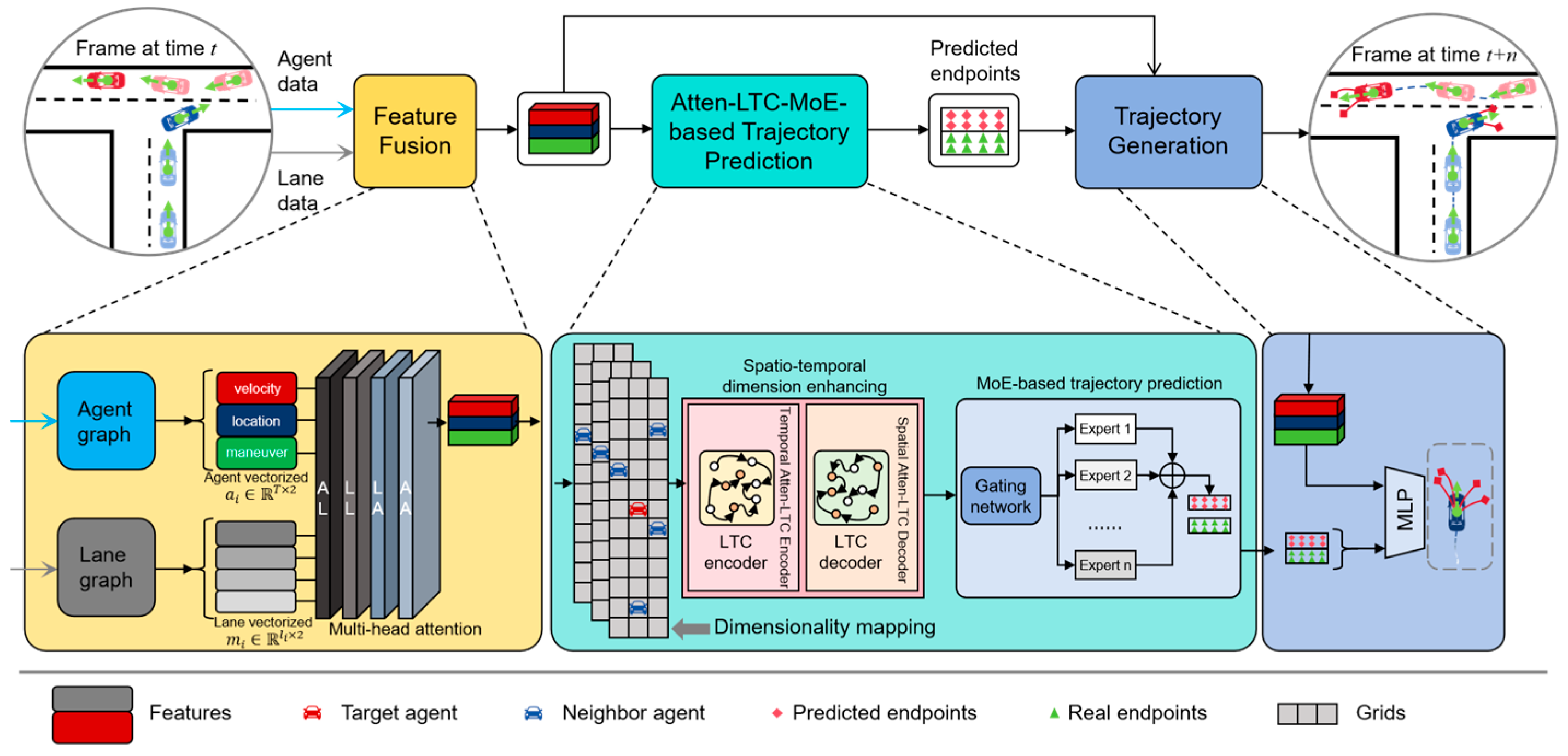
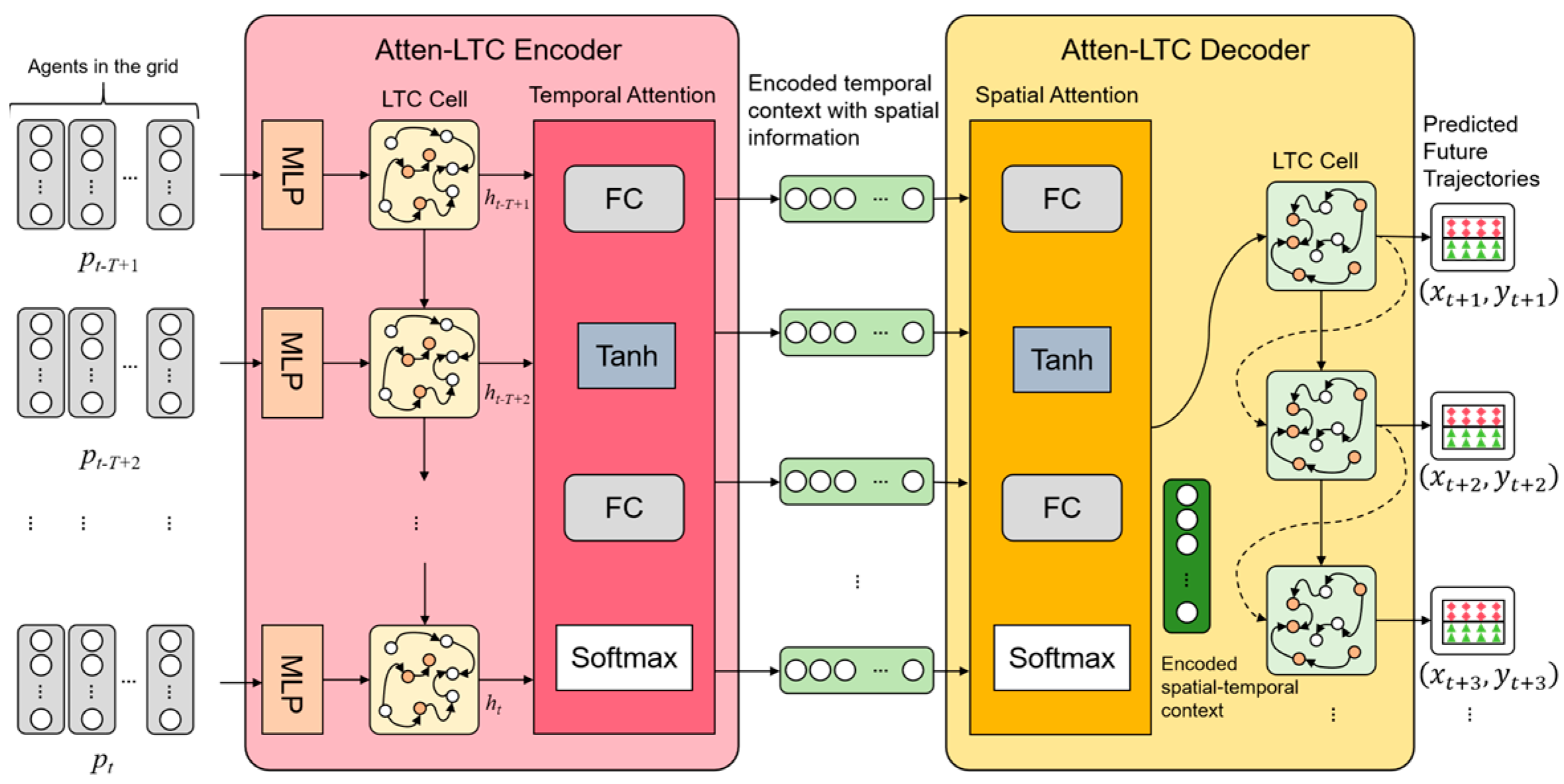
The development of sensor technology and deep learning has significantly improved the reliability and practicality of automatic driving technology. In an autonomous driving system, agent trajectory prediction is a complex challenge, which includes the understanding of different and unpredictable behavior patterns of various entities, including vehicles, pedestrians, and other traffic participants, among the data collected by sensors. In this paper, we deeply study two kinds of problems: Single-Agent Trajectory Prediction (SATP) and Multi-Agent Trajectory Prediction (MATP). We propose an innovative model, which combines the attention mechanism and integrates the Liquid Time-Constant (LTC) network with spatio-temporal features and the Mixture of Experts (MoE) framework, termed the Atten-LTC-MoE model. The model is general and extensible to support SATP and MATP problems in different autonomous driving environments. In order to improve computational efficiency and prediction accuracy, lane and agent vectorization, spatio-temporal features, agent data fusion, and trajectory endpoint generation technologies are studied. The effectiveness of our method is verified by comprehensive experiments on Argoverse and Interaction datasets. Our proposed model has been superior to the state-of-the-art models in terms of minADE6 and minFDE6 metrics and has shown significant advantages in the accuracy of agent trajectory prediction and computational performance.
Keywords: agent trajectory prediction; attention mechanism; liquid time-constant networks; mixture of experts; autonomous driving; sensor data agent trajectory prediction; attention mechanism; liquid time-constant networks; mixture of experts; autonomous driving; sensor data