



Complementary Design of Two Types of Signals for Avionic Phased-MIMO Weather Radar


Abstract
1. Introduction
2. Complementary Design of Two Types of Time–Frequency-Multiplexed Signals
2.1. Type I Signal Design and Receive Processing
2.1.1. FM Waveform Design for Wide Main Beam
2.1.2. PC Waveform Design for Narrow Main Beam
2.1.3. FAPC
2.2. Context-Driven Type II Signal Generation and Receive Processing
2.2.1. Wide Main Beam Based on FM
2.2.2. Narrow Main Beam Based on PC
3. Dual-Pol Weather Radar Basics
4. Experimental Results
4.1. Performance Improvement Brought About by Dual-Pol Configuration and Multibeam Scan
4.2. Performance Improvement Brought About by Time–Frequency Multiplexing
4.3. Performance Improvement Brought About by Pulse Compression and FAPC
4.4. Performance Improvement Brought About by Sidelobe Control
4.5. Limitations and Future Works
5. Conclusions
Author Contributions
Funding
Institutional Review Board Statement
Informed Consent Statement
Data Availability Statement
Conflicts of Interest
References
- Honeywell Aerospace. IntuVue (RDR-4000) Weather Radar—White Paper; Honeywell International Inc.: Phoenix, AZ, USA, 2016; Volume 9, pp. 1–19. Available online: https://prod-edam.honeywell.com/content/dam/honeywell-edam/aero/en-us/products/cabin-and-cockpit/weather-radar/intuvue-rdr-4000-3d-weather-radar-system/documents/hon-aero-c61-1573-000-000-intuvue-rdr4000-3d-weather-radar-systems-wp-en.pdf (accessed on 1 August 2025).
- Cho, J.Y.N.; Kurdzo, J.M.; Bennett, B.J.; Weber, M.E.; Dellicarpini, J.W.; Loconto, A.; Frank, H. Impact of WSR-88D Intra-Volume Low-Level Scans on Severe Weather Warning Performance. Weather Forecast. 2022, 37, 1169–1189. [Google Scholar] [CrossRef]
- Chrisman, J.N. Automated Volume Scan Evaluation and Termination (AVSET)—A simple technique to achieve faster volume scan updates. In Proceedings of the 34th Conference on Radar Meteorology, Williamsburg, VA, USA, 5–9 October 2009. [Google Scholar]
- Kingfield, D.M.; French, M.M. The Influence of WSR-88D Intra-Volume Scanning Strategies on Thunderstorm Observations and Warnings in the Dual-Polarization Radar Era: 2011–20. Weather Forecast. 2022, 37, 283–301. [Google Scholar] [CrossRef]
- Ivić, I.R. Effects of phase coding on doppler spectra in PPAR weather radar. IEEE Trans. Geosci. Remote Sens. 2018, 56, 2043–2065. [Google Scholar] [CrossRef]
- Palmer, R.D.; Yeary, M.B.; Schvartzman, D.; Salazar-Cerreno, J.L.; Fulton, C.; McCord, M.; Cheong, B.; Bodine, D.; Kirstetter, P.; Sigmarsson, H.H.; et al. Horus—A fully digital polarimetric phased array radar for next-generation weather observations. IEEE Trans. Radar Syst. 2023, 1, 96–117. [Google Scholar] [CrossRef]
- Hassanien, A.; Vorobyov, S.A. Phased-MIMO radar: A tradeoff between phased-array and MIMO radars. IEEE Trans. Signal Process. 2010, 58, 3137–3151. [Google Scholar] [CrossRef]
- Geng, Z.; Deng, H.; Himed, B. Interference mitigation for airborne MIMO radar. In Proceedings of the International Conference on Radar Systems (Radar 2017), Belfast, UK, 23–26 October 2017; pp. 1–6. [Google Scholar] [CrossRef]
- Hassanien, A.; Amin, M.G.; Zhang, Y.D.; Ahmad, F. Dual-function radar-communications: Information embedding using sidelobe control and waveform diversity. IEEE Trans. Signal Process. 2016, 64, 2168–2181. [Google Scholar] [CrossRef]
- Geng, Z.; Xu, R.; Deng, H.; Himed, B. Fusion of radar sensing and wireless communications by embedding communication signals into the radar transmit waveform. IET Radar Sonar Navig. 2018, 12, 632–640. [Google Scholar] [CrossRef]
- Liu, R.; Yu, X.; Wei, W.; Cui, G.; Teh, K.C. Simultaneous Multibeam Application for Sparse Phased-MIMO Radar System. IEEE Trans. Veh. Technol. 2024, 73, 18584–18592. [Google Scholar] [CrossRef]
- Leifer, M.C. Digital Beamforming of Subarrays of Unequal Size. In Proceedings of the 2024 IEEE Radar Conference (RadarConf24), Denver, CO, USA, 6–10 May 2024; pp. 1–7. [Google Scholar] [CrossRef]
- Kowalski, E.; Conway, D.; Morris, A.; Parry, C. Multifunction Phased Array Radar Advanced Technology Demonstrator (MPAR ATD) nearfield testing and fielding. In Proceedings of the 2019 IEEE Radar Conference (RadarConf), Boston, MA, USA, 22–26 April 2019; pp. 1–4. [Google Scholar] [CrossRef]
- Rockwell Collins Inc. Radar System and Method for Detecting Hazards Associated with Particles or Bodies. U.S. Patent 11,402,498 B1, 2 August 2022. [Google Scholar]
- Rockwell Collins Inc. Weather Radar System and Method for Detecting a High Altitude Crystal Condition Using Two Ormore Types of Radar Signals. U.S. Patent 9,720,082 B1, 1 August 2017. [Google Scholar]
- Shrestha, Y.; Zhang, Y.; McFarquhar, G.M.; Blake, W.A.; Starzec, M.; Harrah, S.D. Development of simulation models supporting next-generation airborne weather radar for high ice water content monitoring. IEEE J. Sel. Top. Appl. Earth Obs. Remote Sens. 2023, 16, 493–507. [Google Scholar] [CrossRef]
- Nepal, R.; Zhang, Y.; Blake, W. Sense and avoid airborne radar implementations on a low-cost weather radar platform. Aerospace 2017, 4, 11. [Google Scholar] [CrossRef]
- Nepal, R.; Zhang, Y.R.; Zhang, G.; Ryzhkov, A.; Blake, W. Data quality analysis and enhancement of an airborne weather radar for scientific and multi-mission operations. Proc. SPIE 2018, 10633, 1063308. [Google Scholar]
- Blunt, S.D.; Gerlach, K. Adaptive pulse compression via MMSE estimation. IEEE Trans. Aerosp. Electron. Syst. 2006, 42, 572–584. [Google Scholar] [CrossRef]
- Gerlach, K.; Blunt, S.D. Radar pulse compression repair. IEEE Trans. Aerosp. Electron. Syst. 2007, 43, 1188–1195. [Google Scholar] [CrossRef]
- Shrestha, Y.; Zhang, Y.; Fusselman, J.; McFarquhar, G.M.; Blake, W.A.; Harrah, S.D. Potential application of PARADOX (Polarimetric Airborne Radar Operating at X-band) to High Ice Water Content (HIWC) monitoring. In Proceedings of the 2022 IEEE Radar Conference (RadarConf22), New York City, NY, USA, 21–25 March 2022; pp. 1–6. [Google Scholar]
- Li, H.; Xiong, Y.; Chen, Y. Simulation of Complex Meteorological Target Echoes for Airborne Dual-Polarization Weather Radar Based on Invariant Imbedding T-Matrix. IEEE Trans. Geosci. Remote Sens. 2024, 62, 1–17. [Google Scholar] [CrossRef]
- Chandrasekar, V.; Yoshikawa, E. Assessment of Dual-Polarization Measurements by Phased Array Weather Radar for Airborne Applications. In Proceedings of the 2025 22nd European Radar Conference (EuRAD), Utrecht, The Netherlands, 24–26 September 2025; pp. 161–164. [Google Scholar] [CrossRef]
- Cheong, B.L.; Kelley, R.; Palmer, R.D.; Zhang, Y.; Yeary, M.; Yu, T. PX-1000: A solid-state polarimetric X-band weather radar and time-frequency multiplexed waveform for blind range mitigation. IEEE Trans. Instrum. Meas. 2013, 62, 3064–3072. [Google Scholar] [CrossRef]
- Kurdzo, J.M.; Cheong, B.L.; Palmer, R.D.; Zhang, G.; Meier, J.B. A pulse compression waveform for improved-sensitivity weather radar observations. J. Atmos. Ocean. Technol. 2014, 31, 2713–2731. [Google Scholar] [CrossRef]
- Kurdzo, J.M.; Cheong, B.L.; Palmer, R.D.; Zhang, G. Optimized NLFM pulse compression waveforms for high-sensitivity radar observations. In Proceedings of the 2014 International Radar Conference, Lille, France, 13–17 October 2014; pp. 1–6. [Google Scholar]
- Yang, J.; Li, Z.; Liu, Z. An Airborne Weather Radar Waveform Pulse Compression Method and Radar Equipment. CN202411371247.4. 3 December 2024. [Google Scholar]
- Haykin, S. Cognitive radar a way of the future. IEEE Signal Process. Mag. 2006, 23, 30–40. [Google Scholar] [CrossRef]
- Kurdzo, J.M. Pulse Compression Waveforms and Applications for Weather Radar. Ph.D. Thesis, University of Oklahoma, Norman, OK, USA, 2015. [Google Scholar]
- Blunt, S.D.; Gerlach, K. A novel pulse compression scheme based on minimum mean-square error reiteration [radar signal processing]. In Proceedings of the International Conference on Radar (IEEE Cat. No.03EX695), Adelaide, SA, Australia, 3–5 September 2003; pp. 349–353. [Google Scholar]
- Blunt, S.D.; Gerlach, K. Adaptive pulse compression. In Proceedings of the 2004 IEEE Radar Conference (IEEE Cat. No.04CH37509), Philadelphia, PA, USA, 29 April 2004; pp. 271–276. [Google Scholar]
- Blunt, S.; Gerlach, K. Adaptive radar pulse compression. NRL Rev. 2005, 215–217. Available online: https://www.nrl.navy.mil/News-Media/Publications/nrl-review/simulation-computing-modeling (accessed on 1 January 2026).
- Shackelford, A.K.; de Graaf, J.; Talapatra, S.; Blunt, S.D.; Gerlach, K. Adaptive pulse compression: Preliminary experimental measurements. In Proceedings of the 2007 IEEE Radar Conference, Waltham, MA, USA, 17–20 April 2007; pp. 234–237. [Google Scholar]
- Blunt, S.D.; Higgins, T. Achieving real-time efficiency for adaptive radar pulse compression. In Proceedings of the 2007 IEEE Radar Conference, Waltham, MA, USA, 17–20 April 2007; pp. 116–121. [Google Scholar]
- Blunt, S.D.; Higgins, T. Dimensionality reduction techniques for efficient adaptive pulse compression. IEEE Trans. Aerosp. Electron. Syst. 2010, 46, 349–362. [Google Scholar] [CrossRef]
- Gabele, M.; Sikaneta, I. A new method to create a virtual third antenna from a two-channel SAR-GMTI system. In Proceedings of the 2007 International Waveform Diversity and Design Conference, Pisa, Italy, 4–8 June 2007; pp. 433–437. [Google Scholar] [CrossRef]
- Kim, J.H.; Younis, M.; Prats-Iraola, P.; Gabele, M.; Krieger, G. First spaceborne demonstration of digital beamforming for azimuth ambiguity suppression. IEEE Trans. Geosci. Remote Sens. 2013, 51, 579–590. [Google Scholar] [CrossRef]
- Yang, J.; Qiu, X.; Zhong, L.; Shang, M.; Ding, C. A simultaneous imaging scheme of stationary clutter and moving targets for maritime scenarios with the first chinese dual-channel spaceborne SAR sensor. Remote Sens. 2019, 11, 2275. [Google Scholar] [CrossRef]
- Smith, J.A.; Baeck, M.L.; Su, Y.; Liu, M.; Vecchi, G.A. Strange Storms: Rainfall Extremes From the Remnants of Hurricane Ida (2021) in the Northeastern US. Water Resour. Res. 2023, 59, e2022WR033934. [Google Scholar] [CrossRef]
- Zhang, G. Weather Radar Polarimetry; CRC Press: Boca Raton, FL, USA, 2016. [Google Scholar]
- Barcaroli, E.; Lupidi, A.; Facheris, L.; Cuccoli, F.; Chen, H.; Chandra, C.V. A validation procedure for a polarimetric weather radar signal simulator. IEEE Trans. Geosci. Remote Sens. 2019, 57, 609–622. [Google Scholar] [CrossRef]
- Dixon, M.; Romatschke, U. Three-dimensional convective-stratiform echo-type classification and convectivity retrieval from radar reflectivity. J. Atmos. Ocean. Technol. 2022, 39, 1685–1704. [Google Scholar] [CrossRef]
- Li, Z.; Zhang, Y.; Borowska, L.; Ivić, I.R.; Mirkovic, D.; Perera, S.; Zhang, G.; Zrnic, D. Polarimetric phased array weather radar data quality evaluation through combined analysis, simulation, and measurements. IEEE Geosci. Remote Sens. Lett. 2020, 18, 1029–1033. [Google Scholar] [CrossRef]
- Berizzi, F.; Cuccoli, F.; Coccia, A.; Milani, F.; D’Amico, M.; Baldini, L.; Lupidi, A.; Lischi, S.; Manzoni, A. The X-WALD project: First measurements in Europe with an avionic polarimetric weather radar. In Proceedings of the 2017 IEEE Radar Conference (RadarConf), Seattle, WA, USA, 8–12 May 2017; pp. 0487–0491. [Google Scholar]
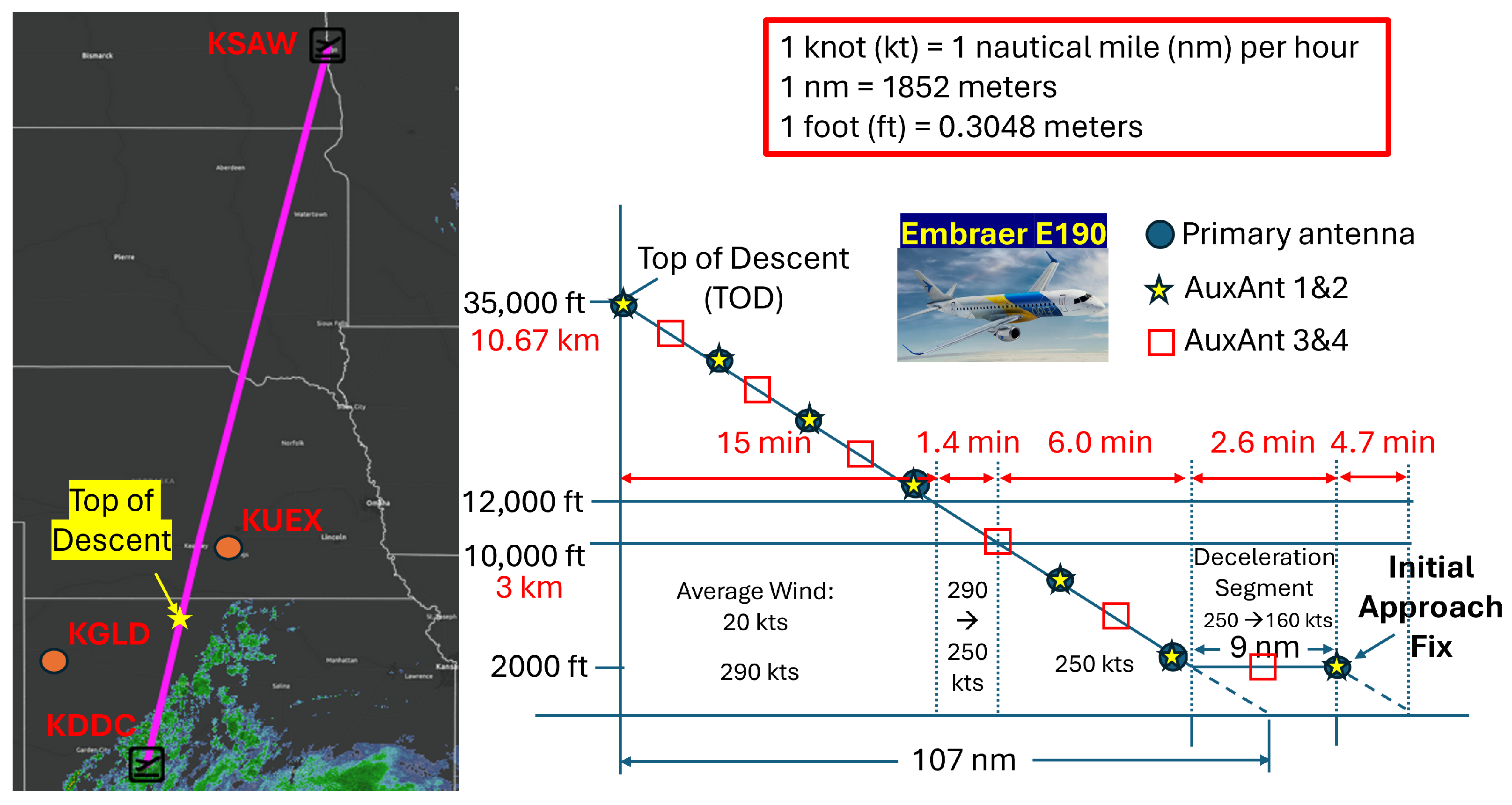

| Time | KDDC | KGLD | KUEX | ||||
|---|---|---|---|---|---|---|---|
| Sweep 0 (Start) | Sweep (tilt = 3.1°) | Distance (km) | Tilt (°) | Distance (km) | Tilt (°) | Distance (km) | Tilt (°) |
| 22:00:00 | 22:03:01 | 209.7 | 1.75 | 201.4 | 1.81 | 114.8 | 4.51 |
| 22:00:03 | 22:02:36 | 209.7 | 1.75 | 201.4 | 1.81 | 114.8 | 4.51 |
| 22:02:49 | 22:05:15 | 186.7 | 1.78 | 197.7 | 1.50 | 133.6 | 3.15 |
| 22:04:30 | 22:07:38 | 171.9 | 1.81 | 194.0 | 1.33 | 147.4 | 2.43 |
| 22:04:48 | 22:07:21 | 169.5 | 1.81 | 194.2 | 1.28 | 149.3 | 2.32 |
| 22:07:23 | 22:09:57 | 146.6 | 1.85 | 191.8 | 0.96 | 170.8 | 1.44 |
| 22:09:21 | 22:12:29 | 128.5 | 1.87 | 191.9 | 0.68 | 188.0 | 0.88 |
| 22:09:35 | 22:12:08 | 126.4 | 1.87 | 191.6 | 0.65 | 190.1 | 0.82 |
| 22:12:04 | 22:14:25 | 104.1 | 1.85 | 192.1 | 0.30 | 212.0 | 0.24 |
| 22:14:20 | 22:16:53 | 84.0 | 1.77 | 198.6 | −0.07 | 230.9 | −0.21 |
| 22:16:00 | 22:19:08 | 37.4 | 3.50 | 214.8 | −0.41 | 276.7 | −0.71 |
| 22:16:33 | 22:18:55 | 36.8 | 3.32 | 214.7 | −0.45 | 277.3 | −0.75 |
| 22:19:06 | 22:21:38 | 30.2 | 2.00 | 217.2 | −0.76 | 283.8 | −1.01 |
| Index Number | Present Time | Observation Position | Future Time of Interest | Location of Interest | ||||
|---|---|---|---|---|---|---|---|---|
| Lat. (°) | Long. (°) | Height (m) | Lat. (°) | Long. (°) | Height (m) | |||
| 1 | 22:00:03 | 39.589 | −99.382 | 10,671 | 22:07:23 ± 40 s | 39.032 | −99.525 | 7219 |
| 2 | 22:04:30 | 39.254 | −99.459 | 8567 | 22:12:04 ± 40 s | 38.668 | −99.673 | 5030 |
| 3 | 22:09:21 | 38.874 | −99.575 | 6300 | 22:16:00 ± 40 s | 38.084 | −99.853 | 3201 |
| Index Number | Weather Ground Truth | Performance Comparison | ||||
|---|---|---|---|---|---|---|
| Baseline | Proposed | |||||
| Reflect. Z (dBz) | Weather | Meas. Z (dBz) | Weather Pred. | Meas. Z (dBz) | Weather Pred. | |
| 1 | 30 | Medium + Mixed | 16 | Drizzle | 26 | Light + Mixed |
| 2 | 40 | Heavy + Mixed | 31 | Medium | 41 | Heavy + Mixed |
| 3 | 35 | Medium + Mixed | 28 | Light | 37 | Medium + Mixed |
| Time | 2013 | 2012 | 2015 | 2025 |
|---|---|---|---|---|
| Radar | MultiScan version 2.0 | IntuVue RDR-4000 | PX1000 (2015) | Proposed Type I signal |
| Transmitter Power | 150 watts nominal | 917 watts (effective) | 200 watts ×2 | 917 watts (effective) ×2 |
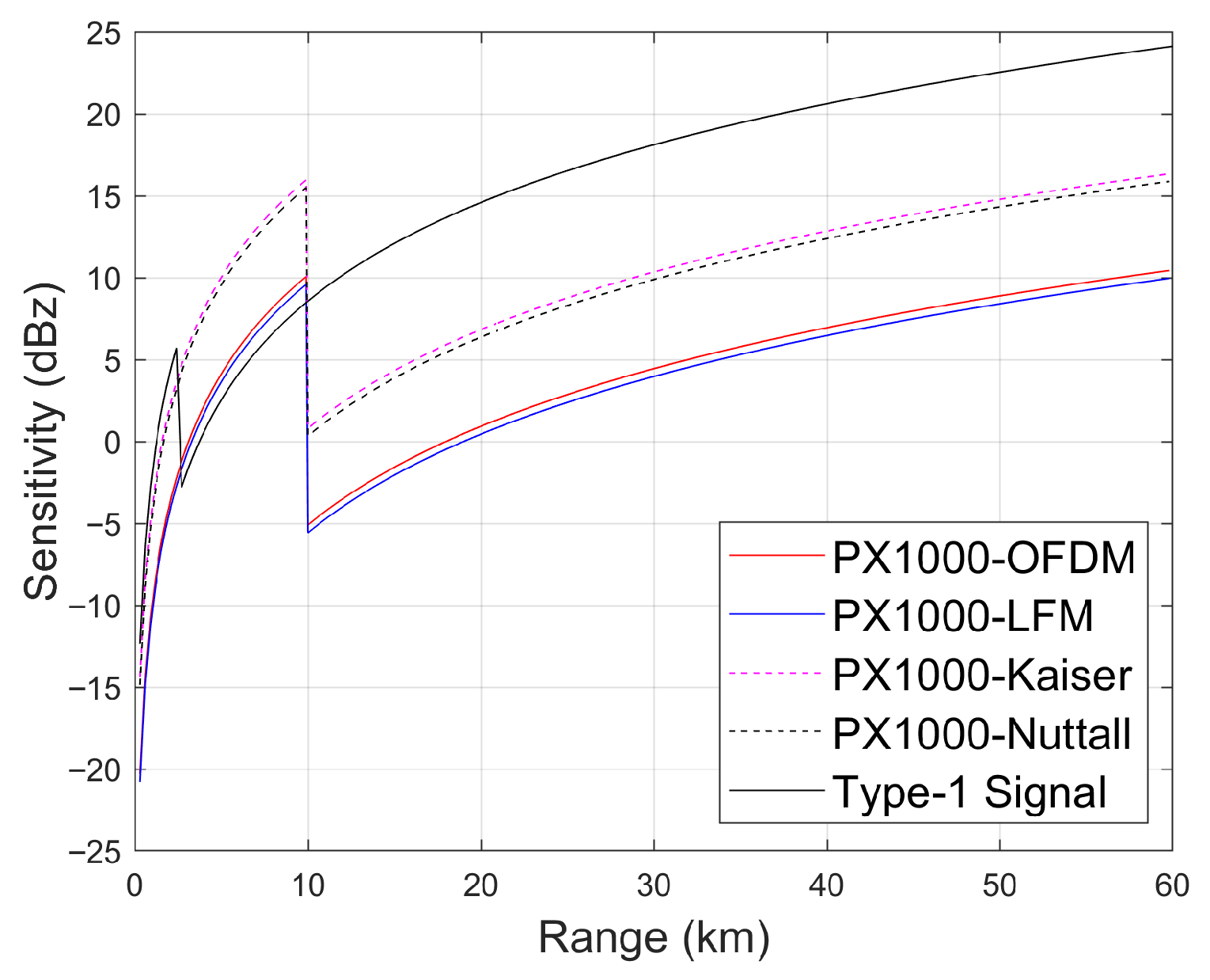
| Radar Sensitivity | 20 dBz at 9 km (5 nm) | 20 dBz at 28 km (15 nm) | 20 dBz at 60 km | 20 dBz at 56 km (30 nm) |
| Transmitter Frequency | 9.330 GHz | 9.375 GHz | 9.550 GHz | 9.330 GHz |
| Pulse Width | Radar modes: 6 and 20 µs (interlaced) Windshear mode: 2 µs | 12 µs (effective) | 1–69 µs | 2 and 18 µs (interlaced) |
| Pulse Compression | N/A | LFM | OFM | LFM |
| Beamwidth (Antenna Size) | 3.5° (28-inch) | 3° (30-inch) 4.2° (24-inch) 5.6°(18-inch) | 1.8 °(47-inch) | 3° (30-inch) |
| Color Code | Intensity of Returns | Reflectivity (dBz) | Rainfall Rate (mm/h) | Rainfall Rate (in/h) |
|---|---|---|---|---|
| Black | Very light | 20 | 0.76 | 0.03 |
| Green | Light | 20–30 | 0.76–3.81 | 0.03–0.15 |
| Yellow | Medium | 30–40 | 3.81–12.7 | 0.15–0.5 |
| Red | Strong | ≥40 | 12.7 | 0.5 |
| Purple | Turbulence | N/A | N/A | N/A |
Disclaimer/Publisher’s Note: The statements, opinions and data contained in all publications are solely those of the individual author(s) and contributor(s) and not of MDPI and/or the editor(s). MDPI and/or the editor(s) disclaim responsibility for any injury to people or property resulting from any ideas, methods, instructions or products referred to in the content. |
© 2026 by the authors. Licensee MDPI, Basel, Switzerland. This article is an open access article distributed under the terms and conditions of the Creative Commons Attribution (CC BY) license.
Share and Cite
Geng, Z.; Wang, L.; Meng, F.; Wu, D.; Zhu, D. Complementary Design of Two Types of Signals for Avionic Phased-MIMO Weather Radar. Sensors 2026, 26, 423. https://doi.org/10.3390/s26020423
Geng Z, Wang L, Meng F, Wu D, Zhu D. Complementary Design of Two Types of Signals for Avionic Phased-MIMO Weather Radar. Sensors. 2026; 26(2):423. https://doi.org/10.3390/s26020423
Chicago/Turabian StyleGeng, Zhe, Ling Wang, Fanwang Meng, Di Wu, and Daiyin Zhu. 2026. "Complementary Design of Two Types of Signals for Avionic Phased-MIMO Weather Radar" Sensors 26, no. 2: 423. https://doi.org/10.3390/s26020423
APA StyleGeng, Z., Wang, L., Meng, F., Wu, D., & Zhu, D. (2026). Complementary Design of Two Types of Signals for Avionic Phased-MIMO Weather Radar. Sensors, 26(2), 423. https://doi.org/10.3390/s26020423

