Simulation-Based Multi-Factor Noise-Aware Adaptive Pure Pursuit with Causal EKF-SG Pose Preprocessing for Tracked Agricultural Robots


Abstract
1. Introduction
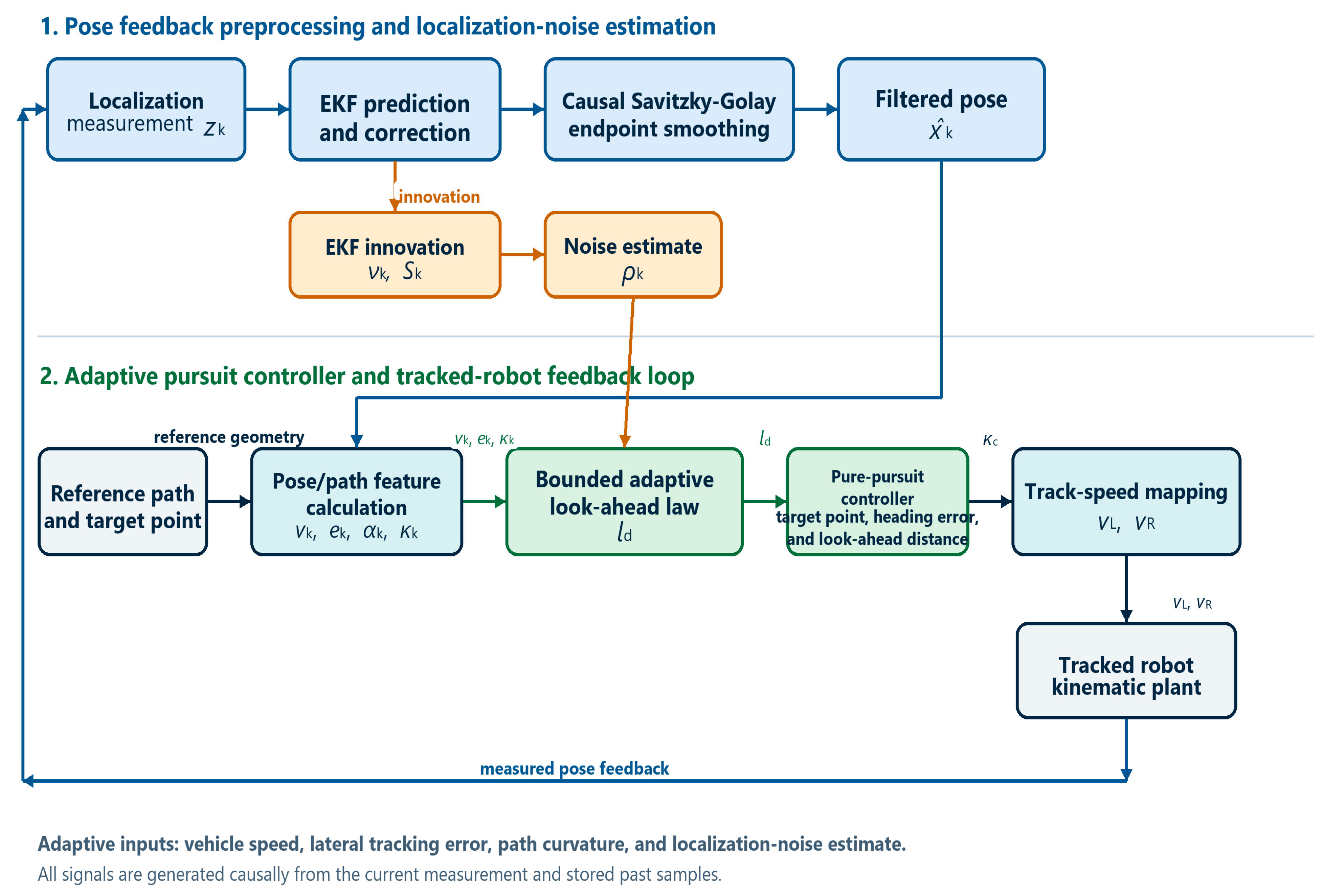
- A pose-feedback preprocessing strategy combining EKF estimation and causal Savitzky–Golay endpoint smoothing is introduced to improve the continuity of localization feedback before it enters the path-tracking controller.
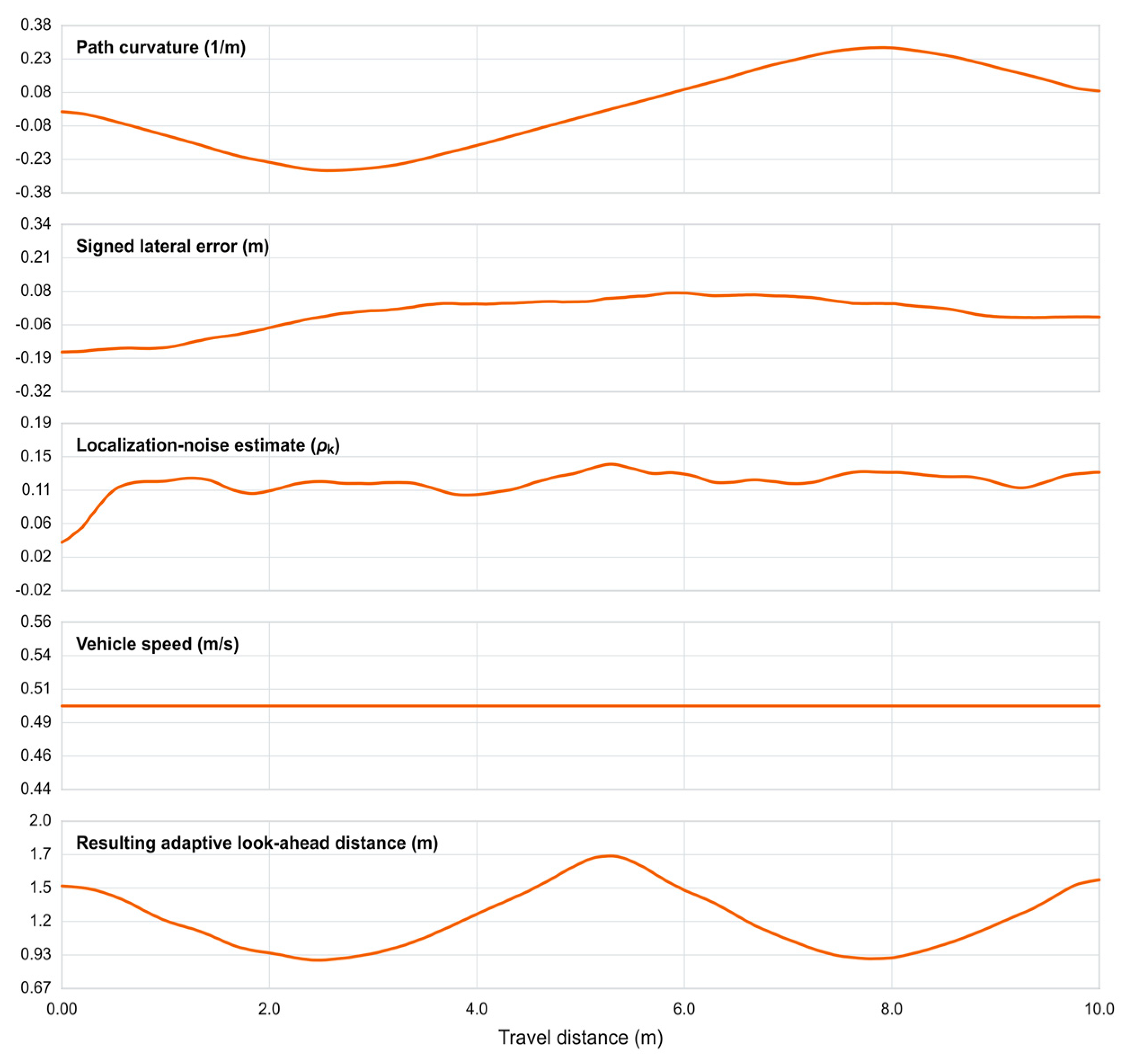
- A bounded noise-aware adaptive look-ahead distance law is developed by jointly considering vehicle speed, lateral error, path curvature, and localization-noise level, which distinguishes the proposed method from adaptive pure-pursuit methods mainly based on speed or curvature.
- A Lyapunov-based stability analysis is provided for the kinematic tracking controller under stated assumptions, offering a theoretical basis for the controller design.
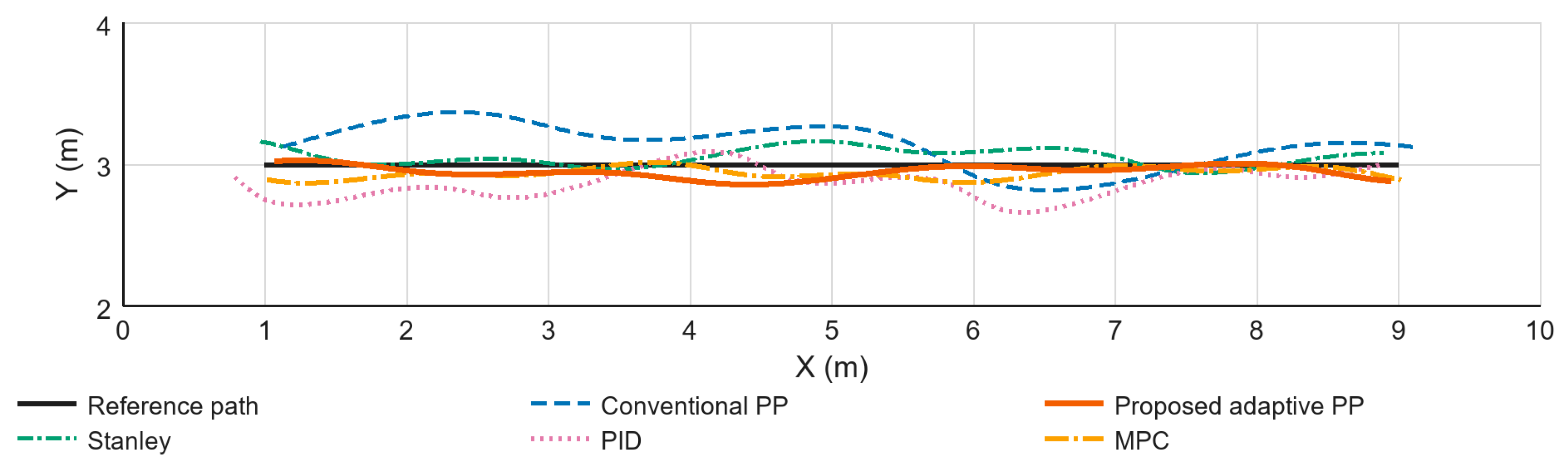
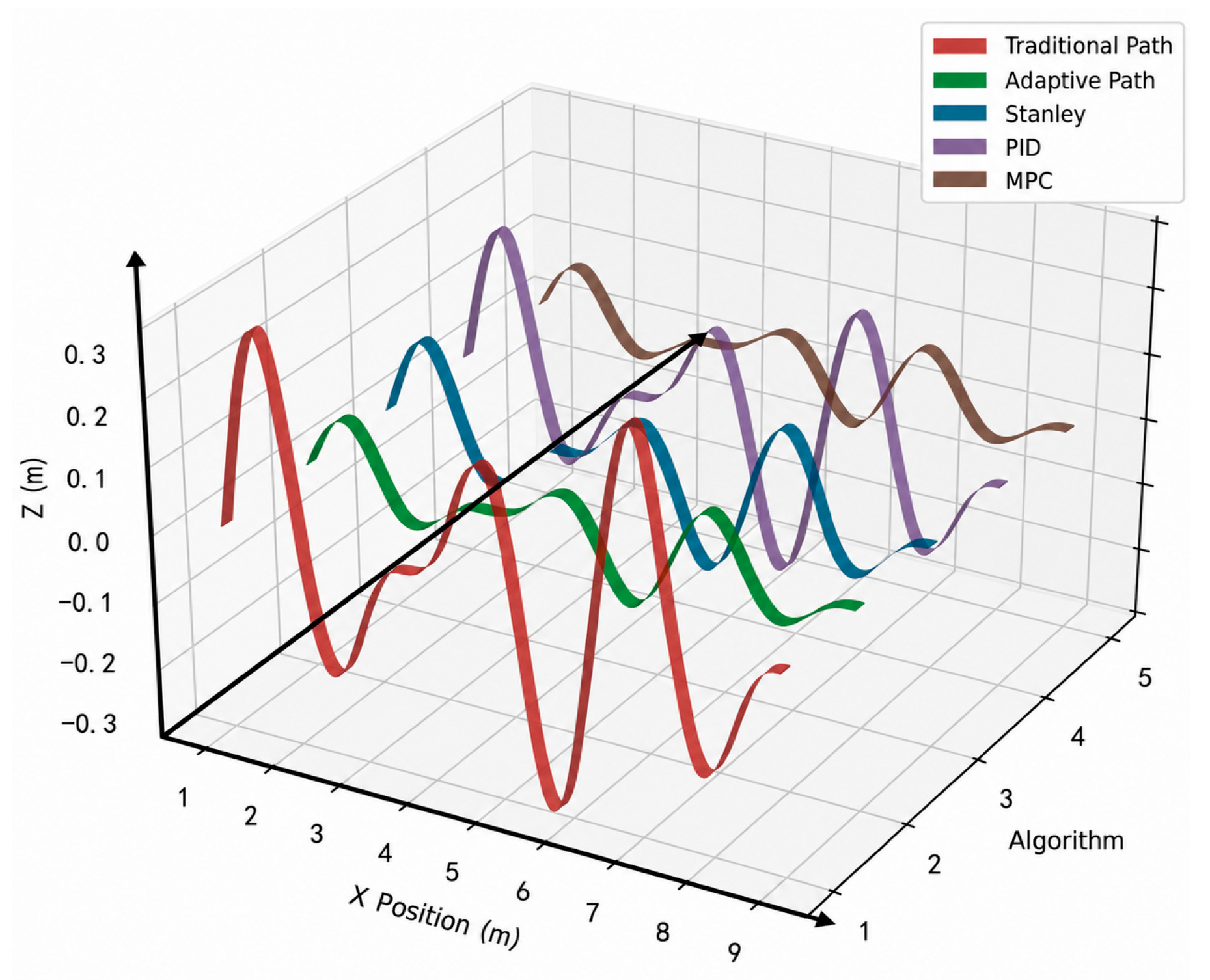
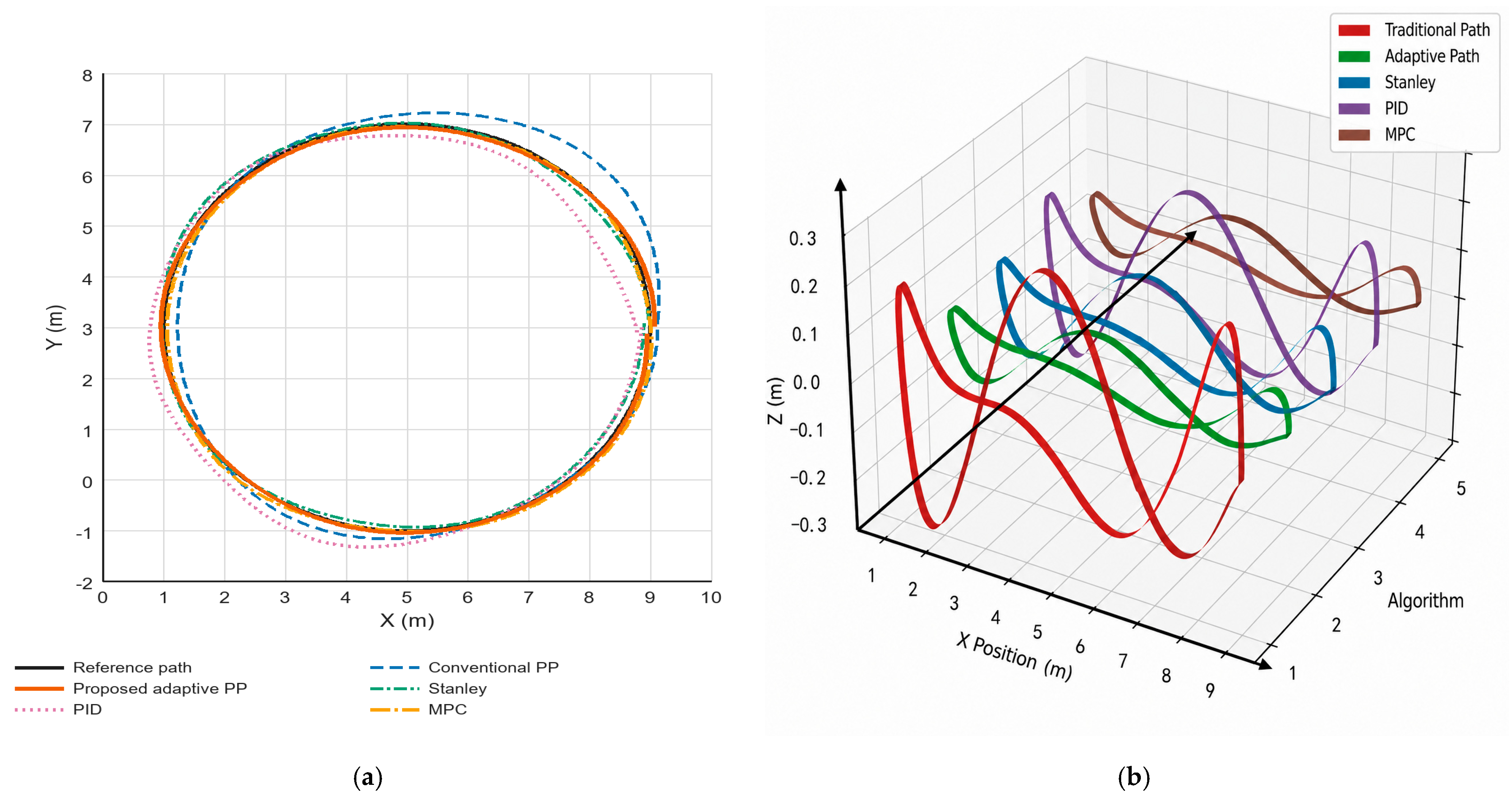
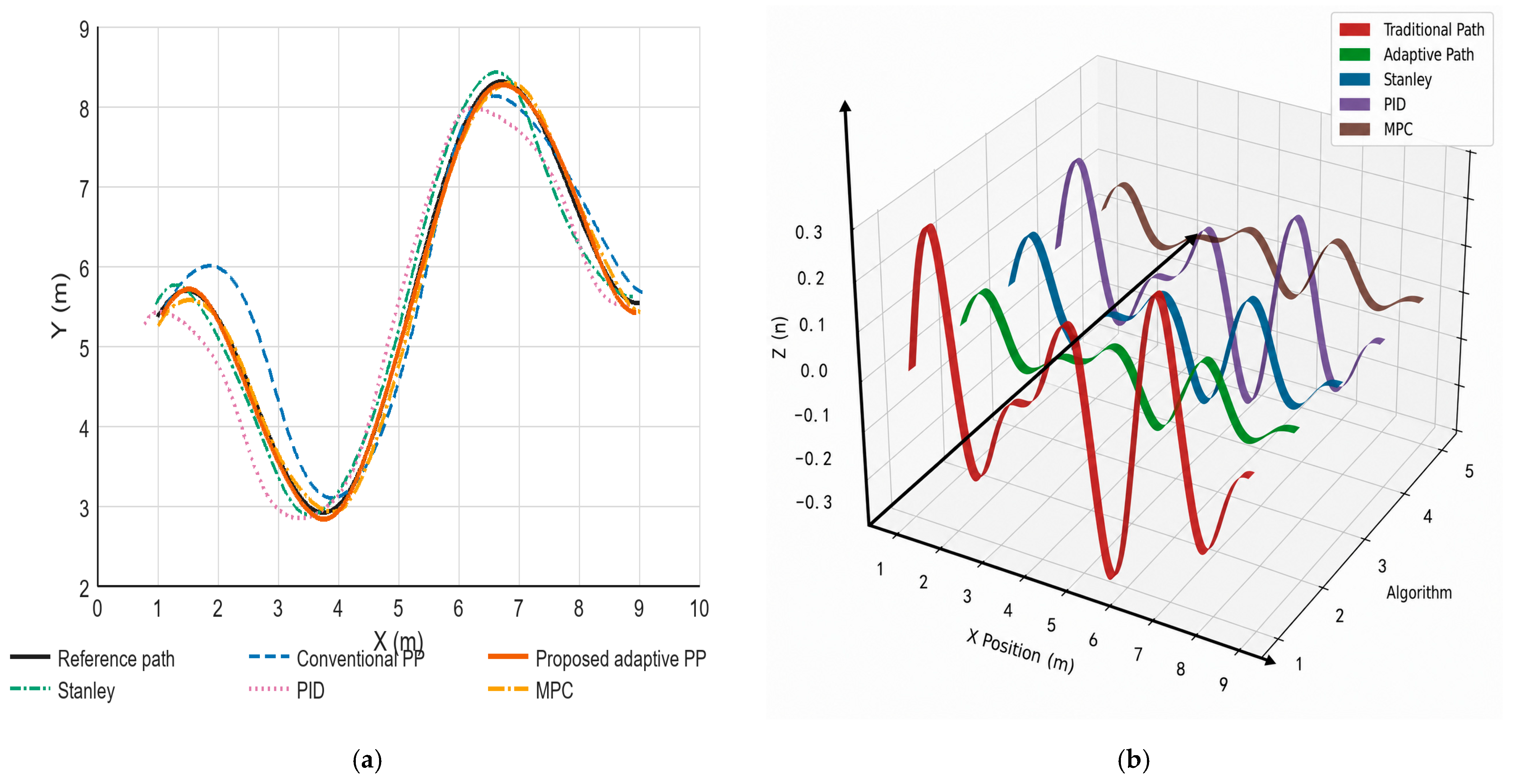
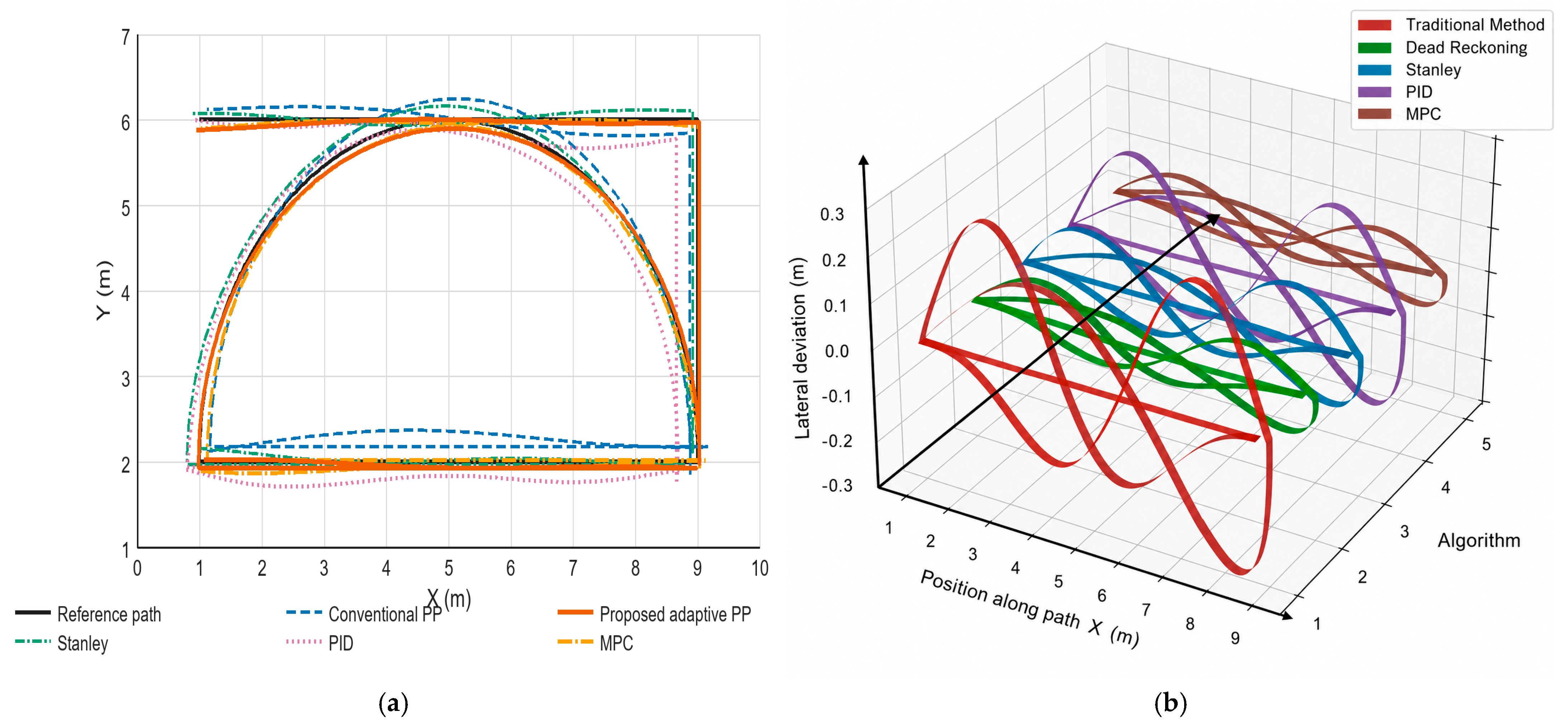
- Numerical simulations are conducted on straight, circular, S-shaped, and U-shaped greenhouse-like reference paths under prescribed localization disturbances, and the proposed method is compared with PID, Stanley, MPC, and conventional fixed-look-ahead pure pursuit in terms of tracking accuracy, angular-velocity smoothness, and computational cost.
2. Method
2.1. Localization Signal Source and Noise Characterization
2.2. Noise-Robust Pose Estimation Framework
2.3. Multi-Factor Dynamic Adaptive Look-Ahead Distance Design
2.4. Adaptive Pure-Pursuit Control Law and Stability Analysis
3. Simulation Experiments and Results
3.1. Simulation Platform and Parameter Settings
3.2. Typical Path-Tracking Results
4. Performance Evaluation and Robustness Validation
4.1. Comparison of Tracking Performance
4.2. Robustness Against Localization Noise
4.3. Dynamic Characteristics of Look-Ahead Distance
4.4. Ablation Study on Adaptive Control Modules
5. Conclusions
- Under the prescribed numerical localization-disturbance conditions, the EKF–SG pose-processing pipeline provides smoother pose feedback and reduces the influence of the modeled random and intermittent measurement disturbances on the subsequent control input. This result demonstrates the behavior of the proposed preprocessing scheme in the simulation model and does not constitute validation with measured greenhouse localization data.
- The multi-factor adaptive look-ahead mechanism adjusts the look-ahead distance according to the simulated vehicle state, path geometry, tracking error, and localization-noise indicator. Under the retained 0.5 m positional-noise condition, the proposed method reports an RMSE of 0.087 m and an angular-velocity RMS of , compared with 0.112 m and for conventional fixed-look-ahead pure pursuit. In the retained sensitivity analysis, the relative RMSE increase from 0.1 m to 0.8 m is for the proposed method and for conventional pure pursuit. These values indicate lower sensitivity under the specified numerical disturbance conditions, but they are single-run descriptive results rather than statistically validated estimates.
- The recorded computation times indicate that the proposed controller maintains a lower computational burden than the MPC comparator under the stated simulation implementation. Thus, the method retains the structural simplicity of pure pursuit and shows potential for real-time greenhouse navigation. Its suitability for practical deployment, however, requires further validation on an actual tracked robot.
- Several limitations should be acknowledged. First, no real greenhouse field experiment or measured greenhouse localization dataset was available. The straight, circular, S-shaped, and U-shaped paths are idealized numerical reference trajectories, and the 0.1, 0.3, 0.5, and 0.8 m positional-noise levels are prescribed sensitivity-analysis conditions rather than measured greenhouse error distributions. Second, the robot is represented by a simplified differential-drive tracked-vehicle kinematic model; detailed track-slip, terrain interaction, actuator dynamics, and chassis vibration are not modeled. Third, the causal SG filter may introduce processing delay, and the controller performance may depend on the selected normalization values, weighting coefficients, look-ahead bounds, and comparator parameters. Finally, the available results are based on individual simulation records and do not provide repeated-trial uncertainty intervals or statistical significance tests. Future work should include measured greenhouse localization data, hardware experiments, detailed track-slip and dynamic modeling, parameter-sensitivity analysis, and repeated-trial statistical evaluation.
Author Contributions
Funding
Institutional Review Board Statement
Informed Consent Statement
Data Availability Statement
Conflicts of Interest
Abbreviations
| AGV | Automated Guided Vehicle |
| EKF | Extended Kalman Filter |
| MPC | Model Predictive Control |
| NLOS | Non-Line-of-Sight |
| PID | Proportional–Integral–Derivative |
| RMS | Root Mean Square |
| RMSE | Root Mean Square Error |
| SG | Savitzky–Golay |
References
- Brena, R.F.; García-Vázquez, J.P.; Galván-Tejada, C.E.; Muñoz-Rodriguez, D.; Vargas-Rosales, C.; Fangmeyer, J. Evolution of Indoor Positioning Technologies: A Survey. J. Sens. 2017, 1–21. [Google Scholar] [CrossRef] [Scilit]
- Qi, L.; Liu, Y.; Yu, Y.; Chen, L.; Chen, R. Current Status and Future Trends of Meter-Level Indoor Positioning Technology: A Review. Remote Sens. 2024, 16, 398. [Google Scholar] [CrossRef] [Scilit]
- Cheng, B.; He, X.; Li, X.; Zhang, N.; Song, W.; Wu, H. Research on Positioning and Navigation System of Greenhouse Mobile Robot Based on Multi-Sensor Fusion. Sensors 2024, 24, 4998. [Google Scholar] [CrossRef] [Scilit] [PubMed]
- Yang, J.; Wan, L.; Qian, J.; Li, Z.; Mao, Z.; Zhang, X.; Lei, J. An Innovative Indoor Localization Method for Agricultural Robots Based on the NLOS Base Station Identification and IBKA-BP Integration. Agriculture 2025, 15, 901. [Google Scholar] [CrossRef] [Scilit]
- Jiang, L.; Xu, B.; Husnain, N.; Wang, Q. Overview of Agricultural Machinery Automation Technology for Sustainable Agriculture. Agronomy 2025, 15, 1471. [Google Scholar] [CrossRef] [Scilit]
- Campion, G.; Bastin, G.; D’Andrea-Novel, B. Structural Properties and Classification of Kinematic and Dynamic Models of Wheeled Mobile Robots. IEEE Trans. Robot. Autom. 1996, 12, 47–62. [Google Scholar] [CrossRef] [Scilit]
- Molaei, F.; Ghatrehsamani, S. Kinematic-Based Multi-Objective Design Optimization of a Grapevine Pruning Robotic Manipulator. AgriEngineering 2022, 4, 606–625. [Google Scholar] [CrossRef] [Scilit]
- Hu, C.; Ru, Y.; Li, X.; Fang, S.; Zhou, H.; Yan, X.; Liu, M.; Xie, R. Path Tracking Control for Brake-Steering Tracked Vehicles Based on an Improved Pure Pursuit Algorithm. Biosyst. Eng. 2024, 242, 1–15. [Google Scholar] [CrossRef] [Scilit]
- Wen, J.; Yao, L.; Zhou, J.; Yang, Z.; Xu, L.; Yao, L. Path Tracking Control of Agricultural Automatic Navigation Vehicles Based on an Improved Sparrow Search-Pure Pursuit Algorithm. Agriculture 2025, 15, 1215. [Google Scholar] [CrossRef] [Scilit]
- Macenski, S.; Singh, S.; Martín, F.; Ginés, J. Regulated Pure Pursuit for Robot Path Tracking. Auton. Robot. 2023, 47, 685–694. [Google Scholar] [CrossRef] [Scilit]
- Ahn, J.; Shin, S.; Kim, M.; Park, J. Accurate Path Tracking by Adjusting Look-Ahead Point in Pure Pursuit Method. Int. J. Automot. Technol. 2021, 22, 119–129. [Google Scholar] [CrossRef] [Scilit]
- Thrun, S.; Montemerlo, M.; Dahlkamp, H.; Stavens, D.; Aron, A.; Diebel, J.; Fong, P.; Gale, J.; Halpenny, M.; Hoffmann, G.; et al. Stanley: The Robot That Won the DARPA Grand Challenge. J. Field Robot. 2006, 23, 661–692. [Google Scholar] [CrossRef] [Scilit]
- Wang, A.; Ji, X.; Song, Q.; Wei, X.; Chen, W.; Wang, K. Path Tracking Controller and System Design for Agricultural Tractors Based on Improved Stanley and Sliding Mode Algorithms Considering Sideslip Compensation. Agronomy 2025, 15, 2329. [Google Scholar] [CrossRef] [Scilit]
- Wang, L.; Zhai, Z.; Zhu, Z.; Mao, E. Path Tracking Control of an Autonomous Tractor Using Improved Stanley Controller Optimized with Multiple-Population Genetic Algorithm. Actuators 2022, 11, 22. [Google Scholar] [CrossRef] [Scilit]
- Hailu, G.L.; Yatayew, T.T. Intelligent Trajectory Tracking in Autonomous Plantation Robots Using PSO-Tuned Nonlinear Fuzzy PID, Fuzzy PID, and Conventional PID Controllers. Sci. Rep. 2025, 15, 45357. [Google Scholar] [CrossRef] [Scilit] [PubMed]
- Liu, J.; Wu, X.; Quan, L.; Xu, H.; Hua, Y. Fuzzy Adaptive PID Control for Path Tracking of Field Intelligent Weeding Machine. AIP Adv. 2024, 14, 035045. [Google Scholar] [CrossRef] [Scilit]
- Xu, J.; Lai, J.; Guo, R.; Lu, X.; Xu, L. Efficiency-Oriented MPC Algorithm for Path Tracking in Autonomous Agricultural Machinery. Agronomy 2022, 12, 1662. [Google Scholar] [CrossRef] [Scilit]
- Wang, M.; Niu, C.; Wang, Z.; Jiang, Y.; Jian, J.; Tang, X. Model and Parameter Adaptive MPC Path Tracking Control Study of Rear-Wheel-Steering Agricultural Machinery. Agriculture 2024, 14, 823. [Google Scholar] [CrossRef] [Scilit]
- Zhou, B.; Su, X.; Yu, H.; Guo, W.; Zhang, Q. Research on Path Tracking of Articulated Steering Tractor Based on Modified Model Predictive Control. Agriculture 2023, 13, 871. [Google Scholar] [CrossRef] [Scilit]
- Soitinaho, R.; Oksanen, T. Local Navigation and Obstacle Avoidance for an Agricultural Tractor with Nonlinear Model Predictive Control. IEEE Trans. Control Syst. Technol. 2023, 31, 2043–2054. [Google Scholar] [CrossRef] [Scilit]
- Çiloğlu, Ç.; Kutluay, E. Performance Improvement of Pure Pursuit Algorithm via Online Slip Estimation for Off-Road Tracked Vehicle. Sensors 2025, 25, 4242. [Google Scholar] [CrossRef] [Scilit] [PubMed]
- Cao, Y.; Ni, K.; Kawaguchi, T.; Hashimoto, S. Path Following for Autonomous Mobile Robots with Deep Reinforcement Learning. Sensors 2024, 24, 561. [Google Scholar] [CrossRef] [Scilit] [PubMed]
- Yang, C.; Zheng, D.; Chen, S.; Mansurova, M.; Belgibaev, B.; Zhao, B. AgriPath: A Robust Multi-Objective Path Planning Framework for Agricultural Robots in Dynamic Field Environments. Front. Plant Sci. 2025, 16, 1687747. [Google Scholar] [CrossRef] [Scilit] [PubMed]
- Zhou, J.; Wen, J.; Yao, L.; Yang, Z.; Xu, L.; Yao, L. Agricultural Machinery Path Tracking with Varying Curvatures Based on an Improved Pure-Pursuit Method. Agriculture 2025, 15, 266. [Google Scholar] [CrossRef] [Scilit]
- Savitzky, A.; Golay, M.J. Smoothing and Differentiation of Data by Simplified Least Squares Procedures. Anal. Chem. 1964, 36, 1627–1639. [Google Scholar] [CrossRef] [Scilit]
- Bai, G.; Meng, Y.; Liu, L.; Luo, W.; Gu, Q.; Liu, L. Review and Comparison of Path Tracking Based on Model Predictive Control. Electronics 2019, 8, 1077. [Google Scholar] [CrossRef] [Scilit]
- Manocha, N.; Babovic, V. Real Options, Multi-Objective Optimization and the Development of Dynamically Robust Adaptive Pathways. Environ. Sci. Policy 2018, 90, 11–18. [Google Scholar] [CrossRef] [Scilit]
- Hu, Y.; Xian, J.; Xiao, M.; Cheng, Q.; Chen, T.; Zhu, Y.; Geng, G. Design and Experiment of a Greenhouse Autonomous Following Robot Based on LQR–Pure Pursuit. Agriculture 2025, 15, 1615. [Google Scholar] [CrossRef] [Scilit]
- Sun, C.; Sun, J.; Ding, S.; Li, Q.; Ma, L. Path Tracking Control in Autonomous Agricultural Vehicles: A Systematic Survey of Models, Methods, and Challenges. Agriculture 2025, 15, 2522. [Google Scholar] [CrossRef] [Scilit]



| Method | RMSE (m) | Maximum Lateral Error (m) | Angular Velocity RMS (rad/s) | Angular Velocity Rate RMS (rad/s2) | Average Computation Time (ms) |
|---|---|---|---|---|---|
| PID | 0.156 | 0.381 | 0.46 | 2.13 | 0.11 |
| Stanley | 0.129 | 0.314 | 0.39 | 1.82 | 0.17 |
| MPC | 0.094 | 0.221 | 0.31 | 1.16 | 0.74 |
| Pure Pursuit | 0.112 | 0.267 | 0.36 | 1.54 | 0.09 |
| Proposed | 0.087 | 0.198 | 0.28 | 0.91 | 0.21 |
| Noise Std. (m) | PID | Stanley | MPC | Pure Pursuit | Proposed |
|---|---|---|---|---|---|
| 0.1 | 0.112 | 0.097 | 0.081 | 0.089 | 0.074 |
| 0.3 | 0.131 | 0.108 | 0.087 | 0.101 | 0.081 |
| 0.5 | 0.156 | 0.129 | 0.094 | 0.112 | 0.087 |
| 0.8 | 0.189 | 0.158 | 0.118 | 0.181 | 0.101 |
| Model | RMSE (m) | Angular Velocity RMS (rad/s) |
|---|---|---|
| Complete model | 0.087 | 0.28 |
| Without speed term | 0.102 | 0.35 |
| Without error term | 0.109 | 0.32 |
| Without curvature term | 0.118 | 0.34 |
| Without noise term | 0.096 | 0.39 |
Disclaimer/Publisher’s Note: The statements, opinions and data contained in all publications are solely those of the individual author(s) and contributor(s) and not of MDPI and/or the editor(s). MDPI and/or the editor(s) disclaim responsibility for any injury to people or property resulting from any ideas, methods, instructions or products referred to in the content. |
© 2026 by the authors. Licensee MDPI, Basel, Switzerland. This article is an open access article distributed under the terms and conditions of the Creative Commons Attribution (CC BY) license.
Share and Cite
Liu, F.; Wu, L.; Wu, Z.; Cai, G.; Wang, M.; He, S. Simulation-Based Multi-Factor Noise-Aware Adaptive Pure Pursuit with Causal EKF-SG Pose Preprocessing for Tracked Agricultural Robots. Sensors 2026, 26, 5673. https://doi.org/10.3390/s26175673
Liu F, Wu L, Wu Z, Cai G, Wang M, He S. Simulation-Based Multi-Factor Noise-Aware Adaptive Pure Pursuit with Causal EKF-SG Pose Preprocessing for Tracked Agricultural Robots. Sensors. 2026; 26(17):5673. https://doi.org/10.3390/s26175673
Chicago/Turabian StyleLiu, Fengguo, Liguang Wu, Zhongjun Wu, Gaoshen Cai, Meibao Wang, and Shan He. 2026. "Simulation-Based Multi-Factor Noise-Aware Adaptive Pure Pursuit with Causal EKF-SG Pose Preprocessing for Tracked Agricultural Robots" Sensors 26, no. 17: 5673. https://doi.org/10.3390/s26175673
APA StyleLiu, F., Wu, L., Wu, Z., Cai, G., Wang, M., & He, S. (2026). Simulation-Based Multi-Factor Noise-Aware Adaptive Pure Pursuit with Causal EKF-SG Pose Preprocessing for Tracked Agricultural Robots. Sensors, 26(17), 5673. https://doi.org/10.3390/s26175673