1. Introduction
With the rapid advancements in scalable language modeling, cloud-based LLM services offer an increasing number of utilities for human assistance [
1,
2]. The interactivity offered by these models allows a high degree of freedom in human–AI interaction, permitting users to share diverse forms of information with the model, including private and sensitive data [
3,
4]. For high-stakes information, such as legal, healthcare, and financial content, this level of utility may pose serious risks to privacy and data protection [
5]. Sensitive data transmitted as semantic queries during inference can potentially be extracted by adversaries through model inversion, query exploitation, or server-side data leakage, making it vulnerable to misuse [
6]. Moreover, the obscure data handling practices of cloud-based services limit users’ ability to verify how their information is stored, processed, or retained over time [
7,
8]. Together, these concerns expose a fundamental trade-off between usability and privacy in cloud-assisted semantic inference systems.
Studies in privacy-preserving computation have developed over the last few decades. Conventional methods are dominated by cryptographic mechanisms, such as homomorphic encryption (HE) and secure multi-party computation (MPC) [
9,
10]. Despite being theoretically strong, these methods involve a high computation cost that makes them infeasible for scalable implementation on LLMs [
11]. In resource-constrained edge environments, the substantial computational and communication overhead of heavyweight cryptographic protocols may limit their applicability to latency-sensitive LLM inference [
12]. Besides the cryptographic method, text sanitization is often implemented in contemporary privacy-preserving attempts [
13]. This method identifies sensitive entities from the user prompt and replaces those with a non-sensitive term with similar semantic meaning. Despite its simplicity and effectiveness, text sanitization causes the obfuscated prompt to lose its true contextual meaning. This harms the LLM’s understanding and thus forces the model to produce a generic answer instead of a tailored one for a user’s specific case. Moreover, this simple replacement strategy is highly vulnerable to re-identification attacks based on background knowledge [
14].
Protecting user privacy at the semantic level therefore requires regulating how intent is represented and conveyed during interaction with cloud intelligence services [
15,
16]. LLM-based multi-agent systems enable the decomposition of complex reasoning into specialized components, allowing agents to collaborate and perform diverse tasks in parallel [
17]. This modular structure supports flexible adaptation to different contexts and fine-grained control over processing steps, which reduces potential information leakage. Recent work applies this approach to privacy-sensitive tasks, including semantic-level query obfuscation [
18] and encrypted inference configuration [
19], showing that collaborative agents protect sensitive information without substantially degrading task performance.
Motivated by this observation, we propose a privacy protection method that shifts from content hiding to intent hiding. Inspired by Rivest’s classic “Chaffing and Winnowing” theory [
20], we conjecture that in the absence of strong encryption, the best way to protect privacy is to obfuscate real sensitive query with the presence of noisy yet semantically plausible queries. However, migrating this bit-level theory to semantic-level applications involving communication-mediated query representations faces significant challenges. Particularly, attackers can easily eliminate generated forged queries through statistical analysis if these queries are not natural enough in terms of syntax, logic, or domain distribution.
Considering these challenges, we propose generative semantic chaffing (GS-Chaff), a training-free privacy-preserving inference framework implemented as a lightweight SLM-based multi-agent system inspired by chaffing and winnowing theory. Instead of performing black-box encryption on cloud LLMs, GS-Chaff deploys two cooperative SLM-based agents to construct a semantic-space defense layer over heterogeneous textual query realizations during transmission, leveraging their instruction-following capability and computational efficiency. The use of SLMs enables efficient client-side processing of abstraction-aware text queries prior to cloud inference while keeping the preprocessing pipeline lightweight. Specifically, GS-Chaff consists of a privacy policy agent and a generative semantic chaffing agent. The privacy policy agent dynamically determines an appropriate level of abstraction (
) and chaffing factor (
) according to query sensitivity and task requirements, seeking a balance among semantic abstraction, query obfuscation, and inference utility. The generative semantic chaffing agent produces semantically plausible chaff queries that align with the protected query in granularity and stylistic distribution. Through coordinated agent collaboration, GS-Chaff enables the cloud LLM to perform blind inference over mixed textual queries, making it difficult for adversaries to statistically identify the user’s true intent.
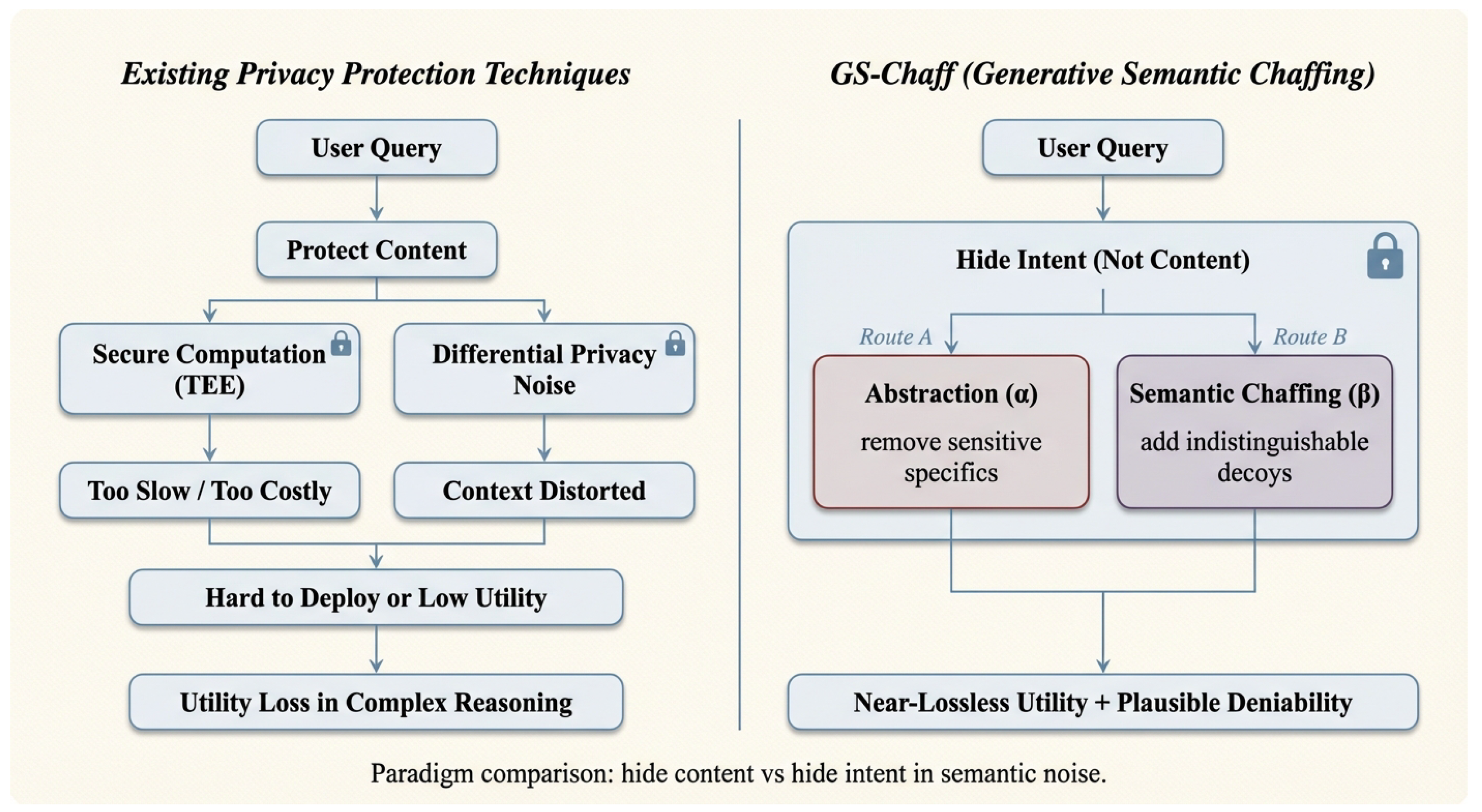
Figure 1 illustrates the conceptual comparison between GS-Chaff and existing approaches to privacy-preserving LLM inference.
We summarize our contributions as follows:
We are among the first to formulate privacy-preserving LLM inference as an intent-hiding problem in text-query transmission and to implement this idea through an SLM-based multi-agent architecture rather than explicit content masking.
We propose GS-Chaff, an efficient and training-free privacy protection mechanism inspired by chaffing and winnowing theory, which balances privacy and utility by concealing user intent through the generation of semantically plausible textual chaff queries.
Through extensive experiments on text-based benchmarks, we demonstrate that GS-Chaff reduces the adversarial identification rate to 22.5%, close to the random-guessing level, while maintaining task utility on the benchmarks. In addition, GS-Chaff achieves a reduction in local preprocessing time compared to the fixed chaffing configuration.
3. Method
3.1. Problem Definition
We consider confidential LLM inference as a safe interaction between a user and a cloud-based server. On the local side, sensitive queries are initiated through SLM-driven agents that mediate private interaction. This query is passed to the powerful LLM in the server side to obtain high-quality inference results while maximizing privacy protection at low computational cost. The LLM at the server side naturally will record all input information, which includes user’s true intent, identity, and sensitive attributes. This typical behavior makes the interaction prone to threat from attackers, which we assume to include the following:
re-identification attack based on semantic distribution, where the attacker attempts to identify a real user’s intent by analyzing semantic fine-grainedness, entity distribution, and contextual consistency of the queries;
discriminative attack based on the consistency of the language model, where the attacker evaluates the naturalness, realness, and rationality of the queries by leveraging language models;
multi-agent consensus attack, where the attacker deploys multiple LLM agents to perform parallel analysis on the same query batch and improve the discrimination confidence level through voting.
3.2. Threat Model
We consider an honest-but-curious cloud LLM service provider as the primary adversary. The provider follows the inference protocol and returns responses for all submitted queries. The provider observes the complete plaintext query batch, the shuffled order, and the corresponding responses. The provider knows the GS-Chaff procedure, the local SLM configuration, the prompt templates, and the ranges of and . Available attack tools include language models, semantic features, classifiers, and multiple cooperating agents. The provider has no access to the locally stored real-query index or other client-side state that is not transmitted to the cloud.
GS-Chaff does not conceal query plaintext from the cloud provider because the cloud LLM processes every query in the batch. The protected asset is the association between the user and the query representing the user’s actual intent. The privacy objective is therefore real-query identification resistance, intent hiding, and plausible deniability rather than complete query confidentiality or user anonymity.
The threat model distinguishes adversary identities, attack strategies, and attack scopes. An external observer observes communication metadata, while encrypted transport prevents access to plaintext queries. An adaptive semantic classifier trains a dedicated classifier or ranker using labeled GS-Chaff samples. A multi-agent attacker aggregates the predictions of multiple LLM agents analyzing the same shuffled query batch. A side-channel attacker uses non-semantic features to infer the real query position. A cross-session profiler correlates multiple query batches using identity, session, historical, entity, and temporal information. Our experiments focus on single-batch multi-agent identification and side-channel classification using token length and end-to-end request latency.
The experiments focus on single-batch real-query identification under the multi-agent and limited side-channel settings described above. Across these settings, the attack objective and success criterion are defined consistently. Given the
i-th shuffled query batch containing
queries, the attacker outputs a predicted real-query index
. An attack succeeds when
equals the locally stored real-query index
. We use Top-1 Real-Query Identification Accuracy as the primary attack-oriented privacy metric. A lower identification accuracy indicates stronger privacy protection. We additionally report the Privacy Protection Rate (PPR), defined as
where
denotes the Top-1 Real-Query Identification Accuracy. Accordingly, a higher
indicates stronger privacy protection. When reported as percentages, the corresponding relation is
.
GS-Chaff assigns a sample-specific chaffing factor
. Therefore, the random-guessing baseline for Top-1 Real-Query Identification Accuracy over
N samples is calculated as
3.3. Technical Framework
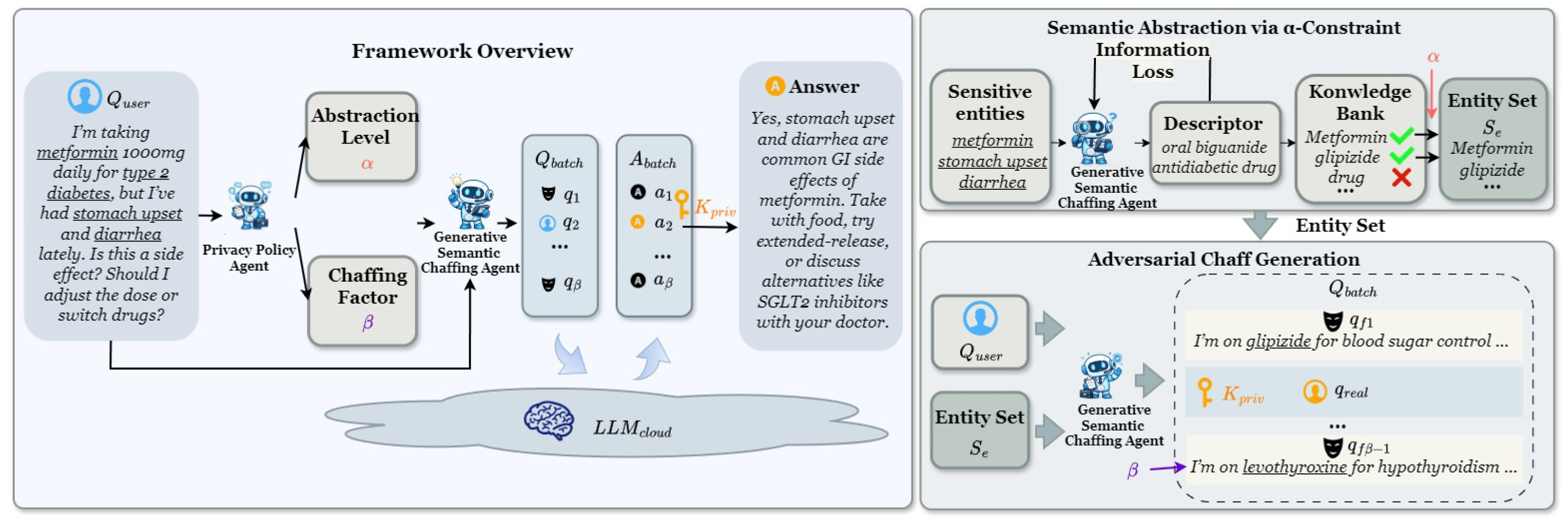
To address the above threat challenges, we propose GS-Chaff, a lightweight multi-agent framework that provides privacy protection for natural-language text queries transmitted to cloud-based LLMs. Inspired by Rivest’s “screening and chaffing” theory [
20], GS-Chaff extends conventional bit-level chaffing to the semantic space. The framework is composed of three stages: adaptive privacy policy, generative semantic chaffing, and oblivious inference with winnowing.
Figure 2 illustrates the overall design.
3.3.1. Privacy Policy Agent
Conventional privacy protection methods generally adopt static protection strategies that may lead to a privacy–utility imbalance. In contrast, we apply a dynamic protection strategy by leveraging an SLM-based policy agent driven by specialized prompts to determine query-specific privacy parameters. The policy agent selects these parameters through instruction-guided inference.
Specifically, given an input query
q, the SLM outputs a decision vector
as follows:
where
. The parameters
and
define the dynamic privacy policy as follows:
refers to the abstraction level that must be covered by the descriptor. A larger corresponds to a more generalized semantic description, thereby reducing reliance on fine-grained information.
refers to the chaffing factor, representing the total number of queries sent to the server. These queries consist of one protected real query and chaff queries. Increasing increases the uncertainty of the real query within the transmitted batch, while introducing additional computational and communication overhead.
We apply the following prompt to the SLM to obtain the decision vector.
The policy agent directly selects and through instruction-guided SLM inference according to query sensitivity, domain characteristics, and reasoning requirements. The parameters are not obtained through explicit numerical optimization, exhaustive search, or random sampling. The resulting query-adaptive policy provides an empirical trade-off among privacy protection, task utility, and inference overhead.
The policy output is parsed as a single parameter pair
. A valid output must contain two integers within the range
. Invalid, incomplete, or out-of-range outputs trigger a format-correction retry. If the regenerated output remains invalid, the predefined fallback policy
is used. This instruction-guided decision process is implemented using the prompt template shown in Listing 1, while the complete policy selection and validation procedure is summarized in Algorithm 1.
| Algorithm 1 Privacy Policy Selection |
Require: Query q
Ensure: Policy parameters
- 1:
- 2:
- 3:
if then - 4:
Regenerate y using a format-correction instruction - 5:
- 6:
end if - 7:
if then - 8:
- 9:
end if - 10:
return
|
| Listing 1. Prompt template used by the privacy policy agent |
 |
3.3.2. Generative Semantic Chaffing Agent
We leverage another SLM as a generative semantic chaffing agent, driven by dedicated prompts, to translate the decision vector from the policy agent into semantic payloads. The agent produces semantically plausible noisy queries guided by the privacy policy agent’s . Each textual query is represented as a high-dimensional semantic embedding, capturing its abstract semantic content. The generated noisy queries occupy the same semantic space and act as alternative textual realizations, making the real query difficult to distinguish from the other queries in the transmitted batch. Specifically, SLM performs semantic abstraction and chaff generation.
Semantic Abstraction. To prevent the server from inferring user identities through specific entities, the SLM performs semantic abstraction on sensitive entity e in the query q. Specifically, given the abstraction parameter determined by the privacy policy agent, the SLM generates a descriptor D that generalizes the sensitive entity while preserving task-relevant semantic information. The parameter serves as a prompt-level semantic abstraction target: a larger instructs the SLM to generate a broader descriptor compatible with more semantically reasonable candidate entities, whereas a smaller retains more fine-grained information about the original entity. The abstraction is performed through prompt-guided SLM generation rather than explicit enumeration over a knowledge base or formal entailment and semantic-distance verification.
Adversarial Generation. To further conceal underlying user intention, especially when is small, SLM generates adversarial chaff queries. We are motivated by semantic granularity alignment, where, according to encryption theory, attackers can easily eliminate fake data if the distribution of fake data does not match that of real data. Thus, fake query must strictly adhere to the same semantic constraints as the abstracted real query . SLM generates a set of fake queries , which must satisfy the following constraints:
plausibility, , where the probability distribution of the language model is similar for both real and fake queries,
fake entity in the fake query must also be a descriptor that has undergone -abstraction.
Therefore, we formalize the chaff generation as follows.
where T, S, and C refer to template, style, and constraint. This mechanism aims to reduce differences among the
transmitted queries in semantic granularity, terminology, and stylistic form, rather than providing a formal guarantee that all queries belong to an identical embedding cluster.
3.3.3. Oblivious Inference and Winnowing
This module performs parallel server-based inference and local extraction of the real result using a locally retained selection index. This mechanism is conducted through two stages: local selection index generation and shuffling, and server execution with local winnowing. Unlike Rivest’s original MAC-based chaffing-and-winnowing construction, GS-Chaff uses the locally retained real-query index only for response selection and does not provide MAC-based authentication or integrity guarantees.
Local Selection Index and Shuffling. Before transferring to the server, the local system performs an obfuscation operation. Specifically, we perform a random permutation on the query set consisting of the abstracted real query
and the set of fake queries
:
The local selection index is defined as the position of the protected real query in the shuffled batch:
Only this small integer index needs to be retained locally for subsequent response selection, without maintaining additional cryptographic state.
Server Execution and Local Winnowing. The server-side model
performs inference over all queries in the shuffled batch, producing
After receiving
, the client uses the locally retained selection index
to extract the response corresponding to the protected real query:
3.4. Theoretical Analysis
Plausible Deniability. Under an idealized setting in which the protected query and the
chaff queries are indistinguishable to the attacker and have equal prior probability, the probability of identifying the protected query by random selection is
In practice, the protected and chaff queries are not guaranteed to be exchangeable or identically distributed, and lexical, semantic, or contextual differences may provide additional information to an attacker. Therefore, is used as an idealized random-guessing reference rather than a formal posterior bound, and the actual identification risk is evaluated empirically.
Utility Considerations. Unlike conventional naïve replacement methods, GS-Chaff uses the abstraction parameter to control the degree of semantic generalization. A smaller preserves more query-specific information and is therefore expected to incur less utility degradation, whereas a larger provides stronger abstraction at a potential utility cost. This relationship is treated as a design intuition rather than a formal utility guarantee and is evaluated empirically in our experiments.
4. Results
This section elaborates on the evaluation of our GS-Chaff method. To test the effectiveness of our method, we leverage Llama-3.2-1B as the SLM. We utilize a diverse set of LLMs to perform inference, ranging from open-sourced to proprietary models as follows:
Local inference: Llama2-7B, Vicuna-13B
Cloud inference: GPT-3.5-Turbo, GPT-4-Turbo, and GPT-4o
Note that we set the temperature of policy SLM to zero to ensure the stability of output results under the same input. For experiments reported over three independent runs, we use random seeds 2024, 2025, and 2026. For proprietary cloud APIs, decoding parameters not explicitly specified in the corresponding experiments are left at the provider-default settings. Baseline methods are implemented following the methodological descriptions in their corresponding references; when official implementations or complete configurations are unavailable, we follow the descriptions provided in the cited works and evaluate them under the same benchmark and cloud-model settings.
4.1. Main Results
We compare our method against several strong baselines, such as no privacy protection, local differential privacy (i.e., Text2Text [
47] and Paraphraser [
48]), and ConfusionPrompt [
49]. We evaluate GS-Chaff on both general reasoning (i.e., StrategyQA [
50] and MuSiQue [
51]) and domain-specific benchmarks (i.e., MedQA [
52] and LegalBench [
53]). We utilize the following metrics for evaluation: accuracy for StrategyQA, MedQA, and LegalBench; F1, ROUGE-L, and exact match (EM) for MuSiQue; and AUC for StrategyQA.
Table 2 demonstrates that GS-Chaff consistently outperforms other privacy-preserving methods across all cloud models, achieving utility scores nearly identical to the non-private baselines (e.g., 0.865 on MedQA with GPT-4o).
Adversarial Detection. We evaluate query identification under a multi-agent consensus attack. Two GPT-4-Turbo attacker agents receive the same shuffled query batch and independently predict the index of the query that represents the user’s actual intent. The attacker agents know that the batch contains one real query and multiple GS-Chaff-generated queries. Their predictions and explanations are submitted to an arbitration agent, which produces the final predicted index. When the attacker agents disagree, the arbitration agent determines the final prediction based on their analyses. An attack succeeds when the final predicted index equals the locally stored real-query index. We report the real-query identification rate over three independent runs on LegalBench.
Table 3 shows that GS-Chaff achieves a real-query identification rate of 22.5 ± 1.8%, which is close to the empirical random guess baseline (21.2 ± 1.5%), indicating strong resistance under the evaluated multi-agent consensus attack setting across multiple trials.
4.2. Ablation Studies
Component Contribution. We conduct ablation to measure the effectiveness of components in our framework. For this experiment, we evaluate the following conditions, static protection with and (static), static , static , replacing -guided semantic abstraction with random token masking (w/o ), and removing chaff queries (w/o ).
We measure answer accuracy (Acc.) and Privacy Protection Rate (PPR), where a higher PPR indicates stronger privacy protection.
Table 4 shows that setting the value dynamically for both
and
is essential for our framework to yield the best performance on privacy protection. Further, we also demonstrate that GS-Chaff maintains consistent performance across the two SLM backbones included in this ablation, Qwen2.5-1.5B and Llama-3.2-1B.
Dynamics of Policy. To evaluate the behavior of dynamic privacy policy, we calculate the empirical joint distribution of
output by the policy SLM for samples on the LegalBench dataset.
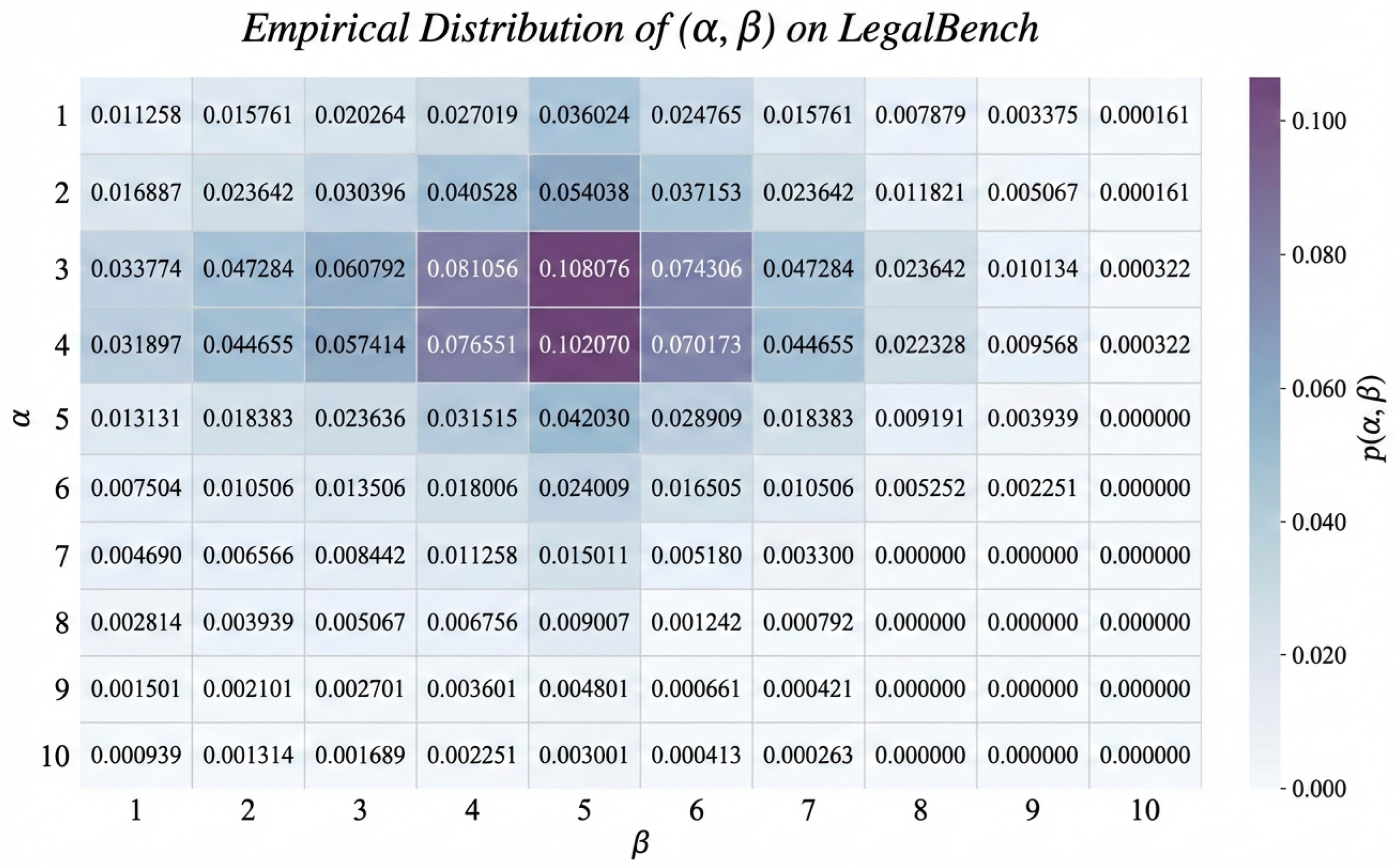
Figure 3 presents the joint distribution of privacy policy
, normalized, with the sum of all cells equal to 1. We observe that the probability mass of
is mainly concentrated in the range of 3–4, while
appears most frequently around 5. This indicates that the policy agent tends to select moderate semantic abstraction levels to balance privacy protection and reasoning utility. Meanwhile, a relatively higher
is chosen to introduce sufficient chaff queries, increasing uncertainty about the real user intent without imposing excessive computational overhead. Furthermore, the combination of high
and
hardly ever occurs. The results illustrate the empirical trade-off between abstraction strength and obfuscation strength, supporting the use of a dynamic policy rather than a fixed parameter configuration. This self-adaptive behavior is consistent with the adversarial results approaching random guessing in
Table 3.
Side-Channel Attack. We evaluate a limited side-channel attacker that uses only per-query token length, end-to-end request latency, or their combination to predict the real-query position. To verify the effectiveness of our intent-hiding objective for privacy-preserving inference, we perform experiment on side-channel attack. We measure the success rate of real query identification in query batch through side-channel signals. Specifically, the attacker observes per-query token length and end-to-end request latency to predict the index of real query. We perform the experiment on LegalBench with 500 samples. For each query, GS-Chaff generates queries with a batch size of
. We train a lightweight classifier to predict the index of real query in the batch. We report Top-1 identification accuracy (Top-1 acc.) and mean reciprocal rank (MRR).
Table 5 shows that combined side-channel attack, with both token length and latency signals, achieve identification accuracy only marginally better (3.5-point) than random guess. The result indicates that GS-Chaff does not rely on hiding superficial properties such as query length and execution time. Its effectiveness stems from semantic-level intent obfuscation.
4.3. Additional Evaluation
Human Evaluation. We perform a manual evaluation on 100 samples from the LegalBench benchmark with the assistance of two PhD candidates with legal training as domain experts. We measure privacy risk using the average reconstruction score of the adversary model (GPT-4o) when inferring specific legal entities from obfuscated queries. The score ranges from 0 to 2, where 0 indicates no identifiable privacy leakage and 2 indicates substantial privacy leakage. Further, we measure utility validity as the percentage of obfuscated queries judged by the experts to remain legally sound and applicable after semantic abstraction, with particular attention to whether sufficient task-relevant legal information is retained for the intended legal reasoning. GS-Chaff achieves an average reconstruction risk of 0.56 out of 2 and a utility validity of 96.0%, indicating that, in most evaluated cases, semantic abstraction reduces entity-level exposure without removing sufficient legal context to make the resulting queries unsound or inapplicable. A detailed case study illustrating the semantic stealthiness of GS-Chaff and the behavior of the
-guided abstraction mechanism is provided in
Appendix A.
4.4. Agent Architecture Comparison
We compare GS-Chaff with four alternative implementations: a single-agent two-stage implementation, a single joint-prompt implementation, a deterministic heuristic policy, and a non-LLM entity abstraction method. The single-agent variant uses the same number of SLM calls as GS-Chaff, while the joint-prompt variant predicts
,
, and the generated queries in a single prompt.
Table 6 reports task accuracy, Privacy Protection Rate (PPR), token overhead, and latency.
Compared with the single-agent implementation using the same number of SLM calls, GS-Chaff improves MedQA and LegalBench accuracy by 1.22 and 1.24 percentage points, respectively, and improves PPR by 4.45 and 4.82 percentage points, with only 14 additional tokens and 0.08 s of latency per sample. GS-Chaff also achieves higher accuracy and PPR than the joint-prompt, deterministic heuristic, and non-LLM abstraction variants, while the joint-prompt and non-LLM variants have lower computational overhead. These results support the separation of privacy policy selection and semantic query generation with moderate additional cost.
Computational Cost. To verify the applicability of our framework, we measure the computational cost needed for implementation. We calculate average token consumption (Avg. Token) and average Time consumption (Avg. Time) per sample to compare computational overhead against fixed baselines. The reported time measures the local processing overhead associated with GS-Chaff rather than complete end-to-end cloud inference latency. We evaluate against a fixed baseline (the standard method without additional sampling) and a fixed
cases.
Table 7 demonstrates that GS-Chaff achieves competitive efficiency compared to the fixed prior.
Table 7.
Average local computational overhead per sample.
Table 7.
Average local computational overhead per sample.
| Method | Avg. Token | Avg. Time (s) |
|---|
| GS-Chaff (Ours) | 324 | 2.6 |
| Fixed (no sampling) | 142 | 0 |
| Fixed () | 785 | 4.8 |
SLM Backbone Comparison. To evaluate the influence of the local SLM backbone, we further compare Llama-3.2-1B, Qwen2.5-1.5B, Gemma-2-2B [
54], and Phi-3-mini [
55] under the same experimental configuration. We report task utility across four benchmarks, together with Top-1 real-query identification accuracy and local deployment overhead. The attack advantage (Adv.) is calculated relative to the random-guessing reference of 21.2%, with lower Top-1 identification accuracy and attack advantage indicating stronger privacy protection.
As shown in
Table 8, GS-Chaff maintains consistent utility and privacy performance across the four evaluated SLM backbones. The differences on StrategyQA and MuSiQue are relatively small, while MedQA accuracy increases from 84.51% with Llama-3.2-1B to 86.50% with Phi-3-mini, and LegalBench accuracy increases from 81.25% to 84.45%. Meanwhile, the Top-1 real-query identification accuracy decreases from 23.85% to 21.28%, approaching the 21.2% random-guessing reference. The improved performance of larger SLMs is accompanied by higher local deployment overhead. Peak memory increases from 2.43 GB for Llama-3.2-1B to 7.81 GB for Phi-3-mini, while local inference time increases from 1.24 s to 3.76 s. Qwen2.5-1.5B and Gemma-2-2B provide intermediate trade-offs between model capability and local resource consumption, indicating that the SLM backbone can be selected according to the resource constraints of the client device.
5. Discussion
Although GS-Chaff demonstrates effectiveness under the single-session attack settings evaluated in this study, several stronger threat settings remain to be addressed. These include the following scenarios:
Cross-session or long-term user profiling, where an attacker links queries from multiple sessions to construct a long-term user behavior profile;
Broader side-channel analysis, where an attacker infers the user’s real intent from request frequency, network traffic patterns, server logs, or other metadata beyond the token-length and end-to-end latency features evaluated in this study;
Local client compromise or real-query index leakage, where an attacker obtains the locally stored index used to retrieve the response corresponding to the real query;
Broader adaptive semantic attacks, where attackers exploit learned semantic or representation-level cues to distinguish the real query under different domains and policy configurations.
In GS-Chaff, privacy protection is provided through the coordinated actions of two SLM-driven agents: the privacy policy agent adaptively determines the abstraction and chaffing parameters, while the generative semantic chaffing agent produces semantically consistent chaff queries to conceal the real query. This design supports privacy-preserving inference over natural-language text queries from different application domains, without requiring modification of the cloud-based LLM. In the current study, GS-Chaff is evaluated in the context of privacy-preserving inference over natural-language text queries. Extending the framework to sensor-derived inputs and multimodal settings will require additional mechanisms for semantic conversion, cross-modal alignment, and deployment on resource-constrained edge platforms, which we leave for future work.