Practical Analysis of IEEE 802.11n 2.4 GHz Communication Quality in the Context of IoT Devices Operating in an Area Shared with Modern Wi-Fi 6 and Wi-Fi 7 Networks

Abstract
1. Introduction
2. Related Work
- For Wi-Fi 7 (IEEE 802.11be), the available publications remain predominantly of a review, conceptual, or preliminary assessment nature; to the best of the author’s knowledge, no direct experimental measurement of the impact of 802.11be networks on the MQTT communication quality of legacy 802.11n IoT devices has been reported in the literature.
3. Materials and Methods
3.1. Structure of the Test Environment
3.2. Research Methodology
- scenario—the name of the tested scenario (used, among others, in the charts);
- id—the identifier of the IoT_DUT module (e.g., esp32_1);
- seq—the sequential number of the message sent by the IoT_DUT (incremented with each transmission);
- t_tx_ms—The timestamp of the message transmission (Unix epoch);
- t_rx_ms—The timestamp of the message reception (Unix epoch);
- raw_ms—The difference between the reception and transmission times of the message;
- offset_ms—The correction of the differences between the receiver and transmitter clocks (determined during the calibration phase, described in Section 3.4);
- owd_ms—The determined one-way delay;
- lost—A true/false value indicating the absence of an expected message;
- goodput_kbps—The average transmission rate determined over a 60 s window;
- drift_ms_per_s—The change (drift) of the one-way delay (owd) determined over a 1 s window.
- OWD delay: with the appropriate correction (Section 3.4);
- Application-layer jitter (Equation (2));
- Application goodput: the number of payload bits correctly delivered per unit of time;
- PDR (packet delivery ratio): PDR = Nd/N;
- OWD (one-way delay): the primary metric for latency in IoT applications; defined and standardized in IETF RFC 7679 [36]; directly reflects the time between a sensor event and its receipt by the application.
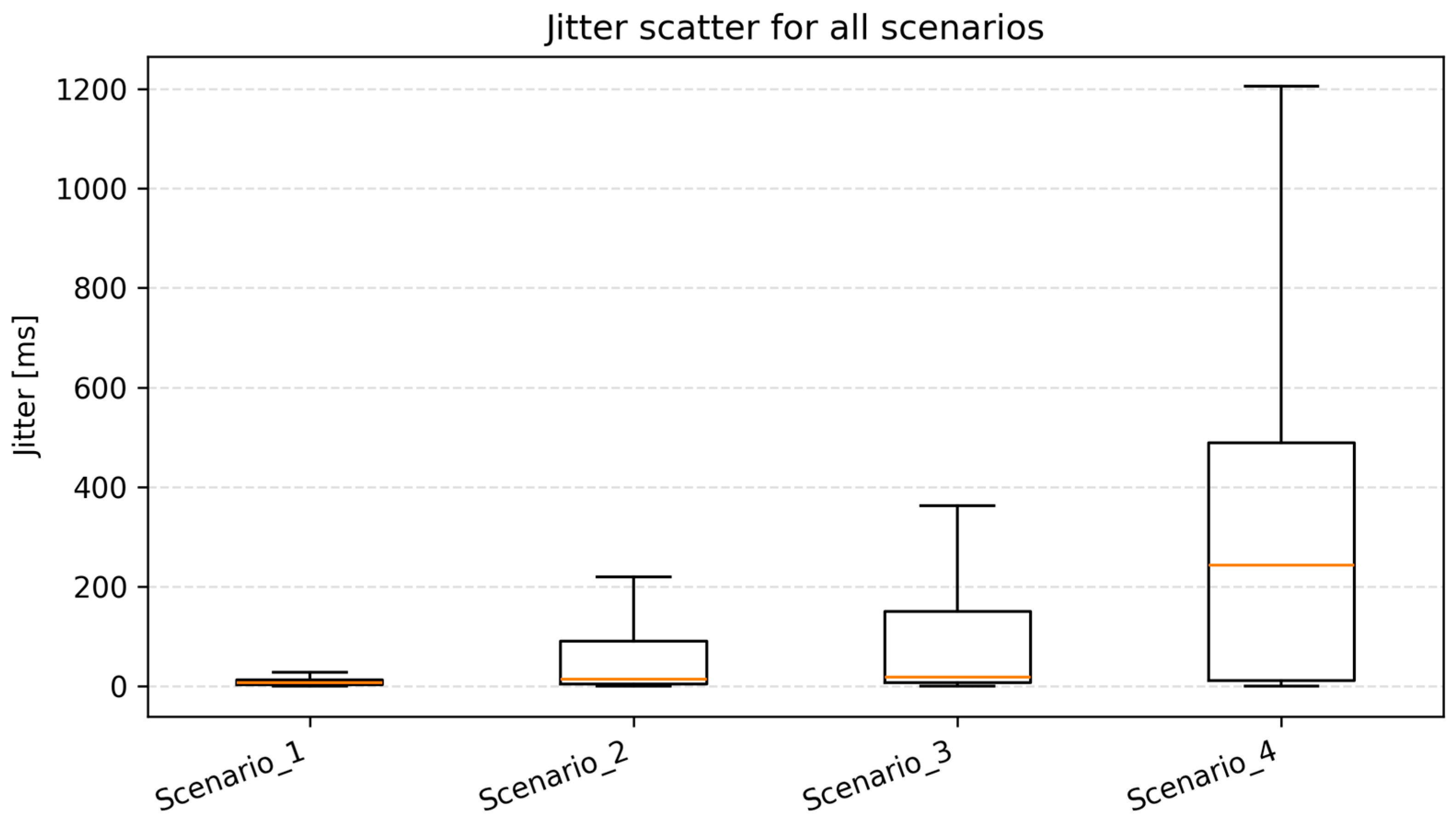
- Jitter (inter-message delay variation): critical for applications requiring temporal regularity (control loops, data fusion, and time-synchronized sampling); a high PDR with high jitter indicates unreliable temporal behavior.
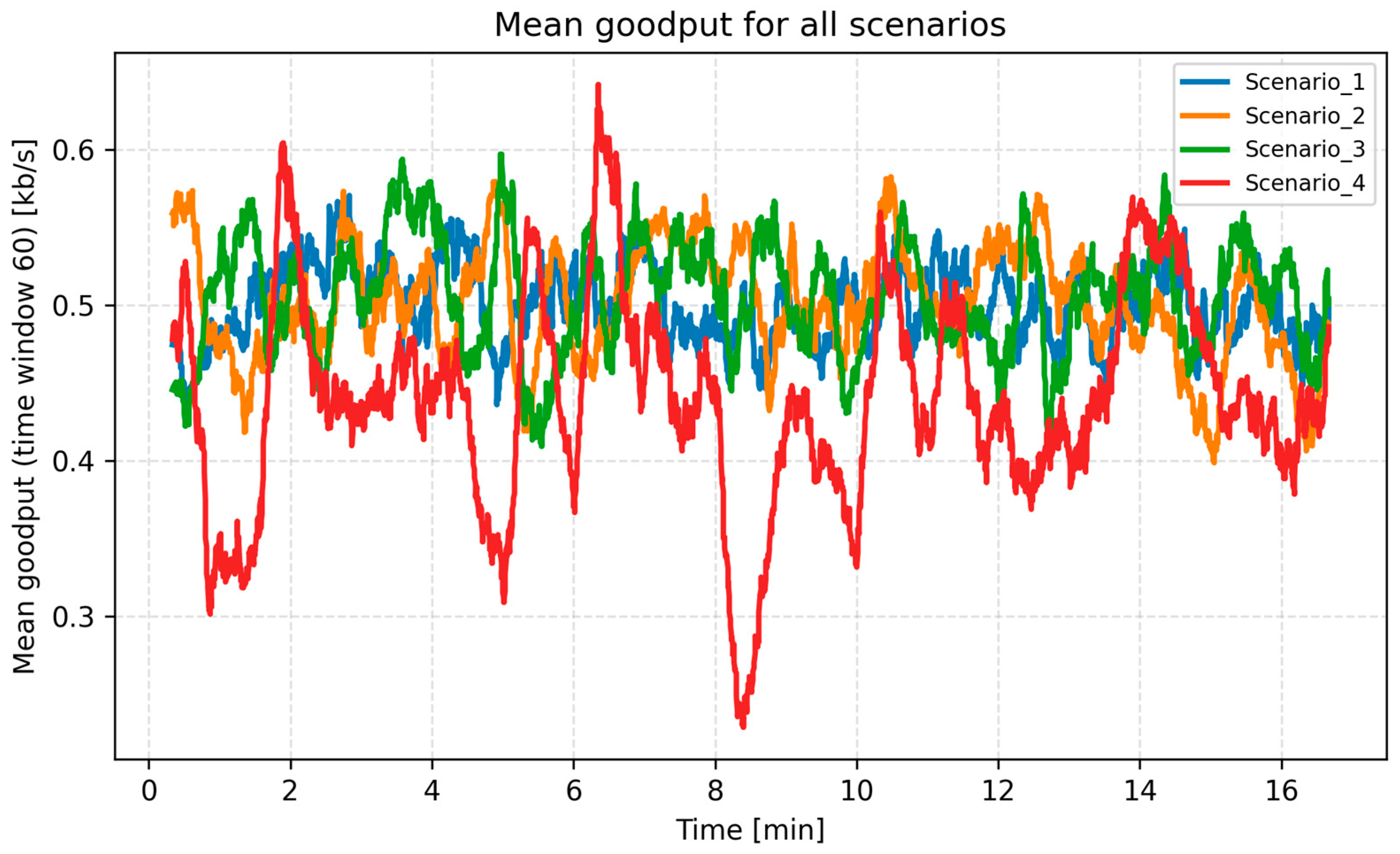
- Goodput: the application-level throughput, capturing both the PDR and delay effects on the effective information transfer rate; reveals throughput instability not visible in average metrics.
3.3. Research Scenarios
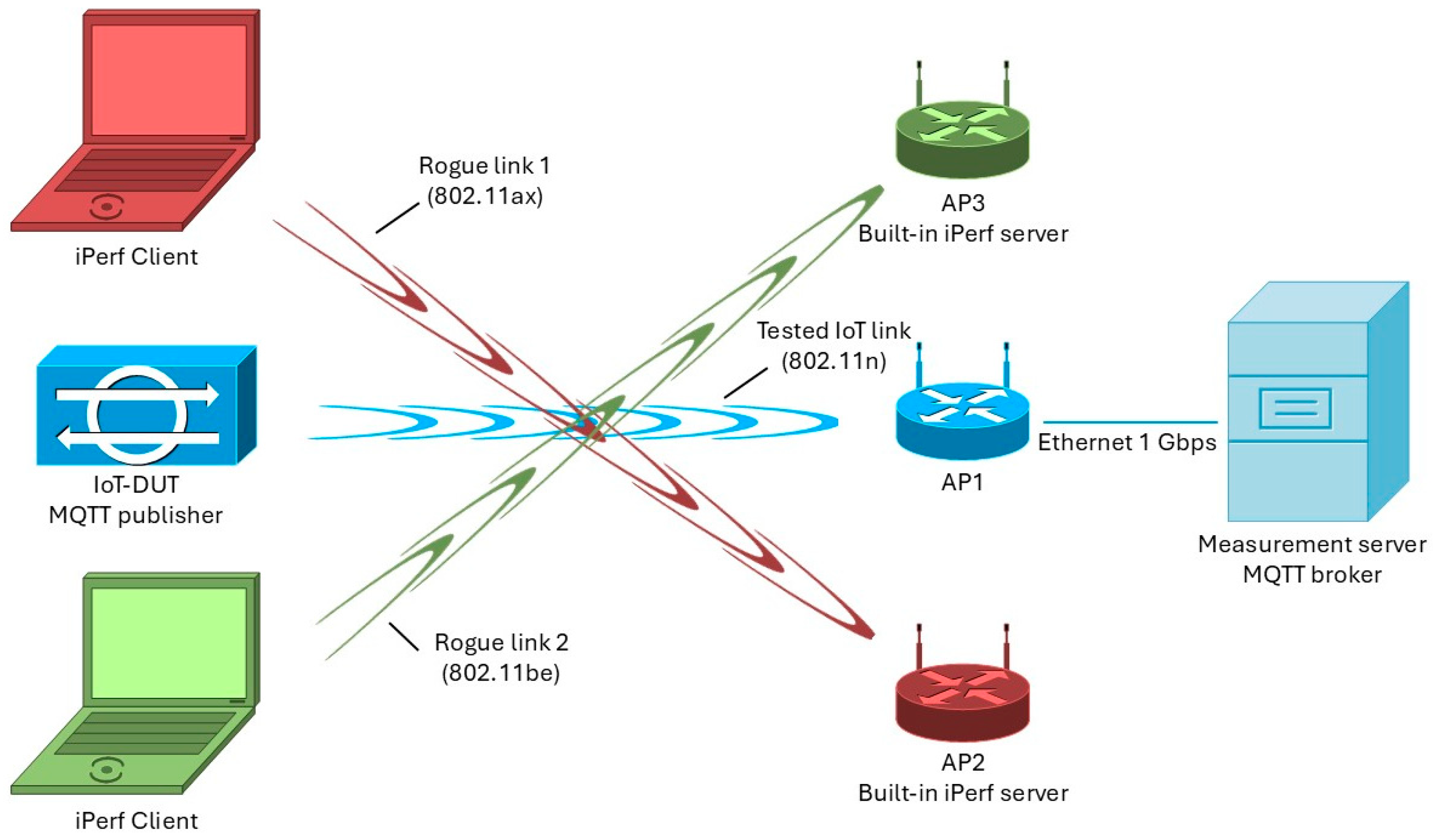
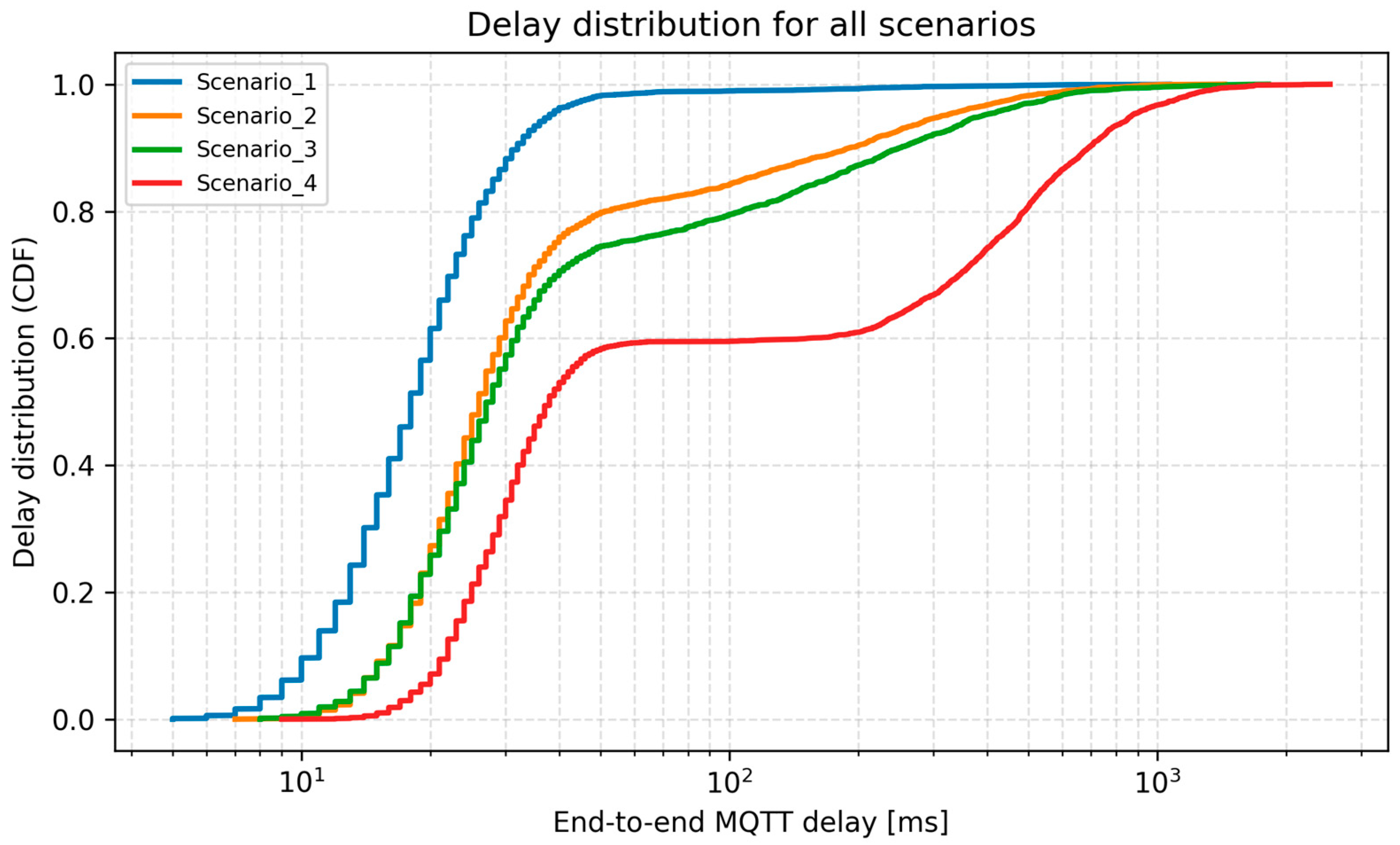
- Scenario_1 (no interference): establishes the baseline communication quality of the 802.11n IoT device without coexistence effects; corresponds to a legacy Wi-Fi deployment or to an environment where IoT devices operate on a dedicated SSID/AP.
- Scenario_2 (802.11ax interference): represents the most common current deployment scenario: a single modern Wi-Fi 6 access point sharing the 2.4 GHz band with an existing IoT device; allows direct quantification of the isolated effect of Wi-Fi 6.
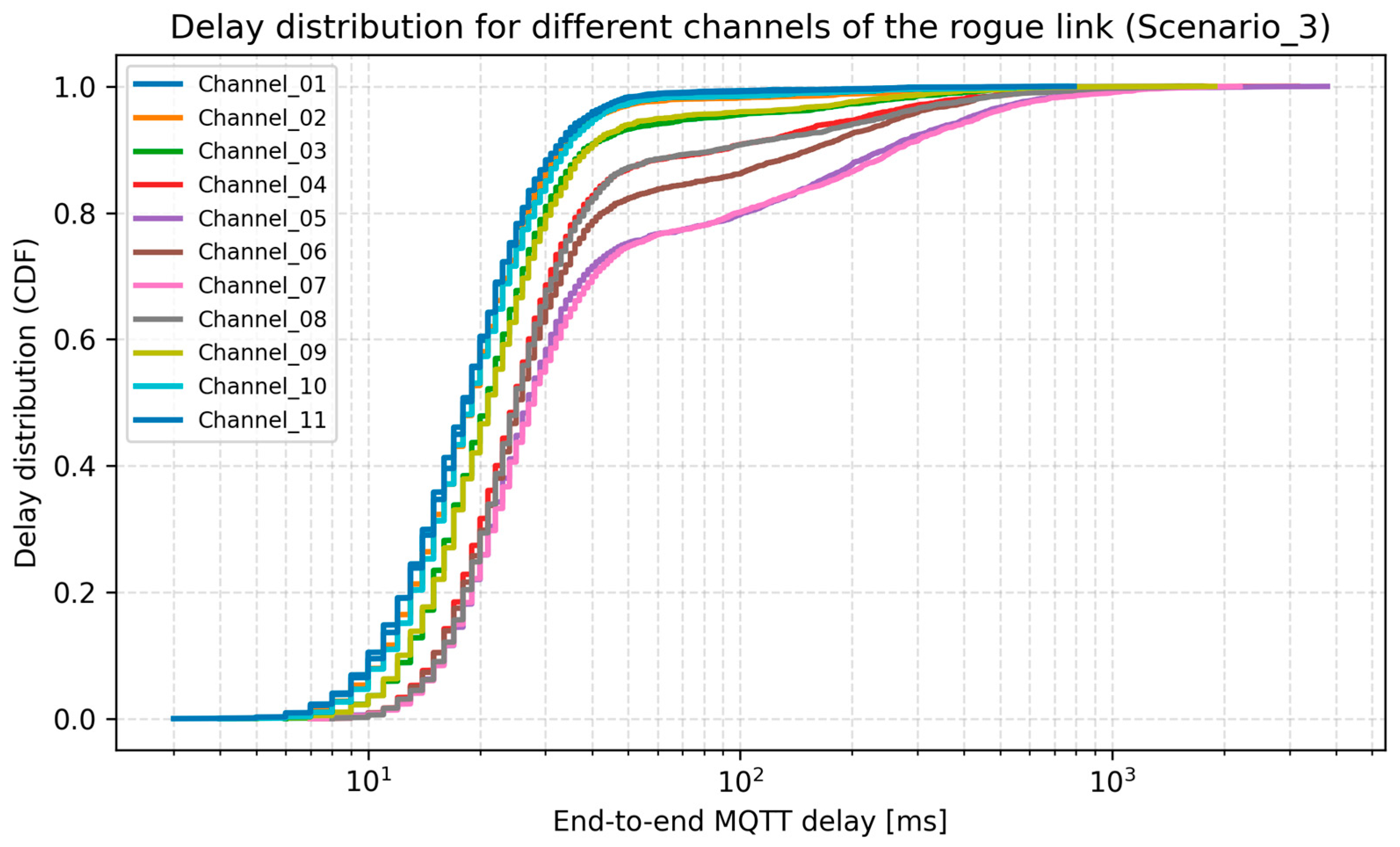
- Scenario_3 (802.11be interference): represents the increasingly common scenario as Wi-Fi 7 equipment enters the market; the isolated effect of Wi-Fi 7 can be directly compared with Wi-Fi 6 (Scenario_2).
- Scenario_4 (simultaneous 802.11ax + 802.11be interference): represents a dense heterogeneous environment (e.g., modern office, industrial building, residential block) where multiple HE networks co-exist; constitutes the worst-case practically relevant scenario.
3.4. The Issue of Time Synchronization Between the Transmitter and the Receiver
4. Results
- -
- The cumulative distribution function (CDF) of the message delivery delay;
- -
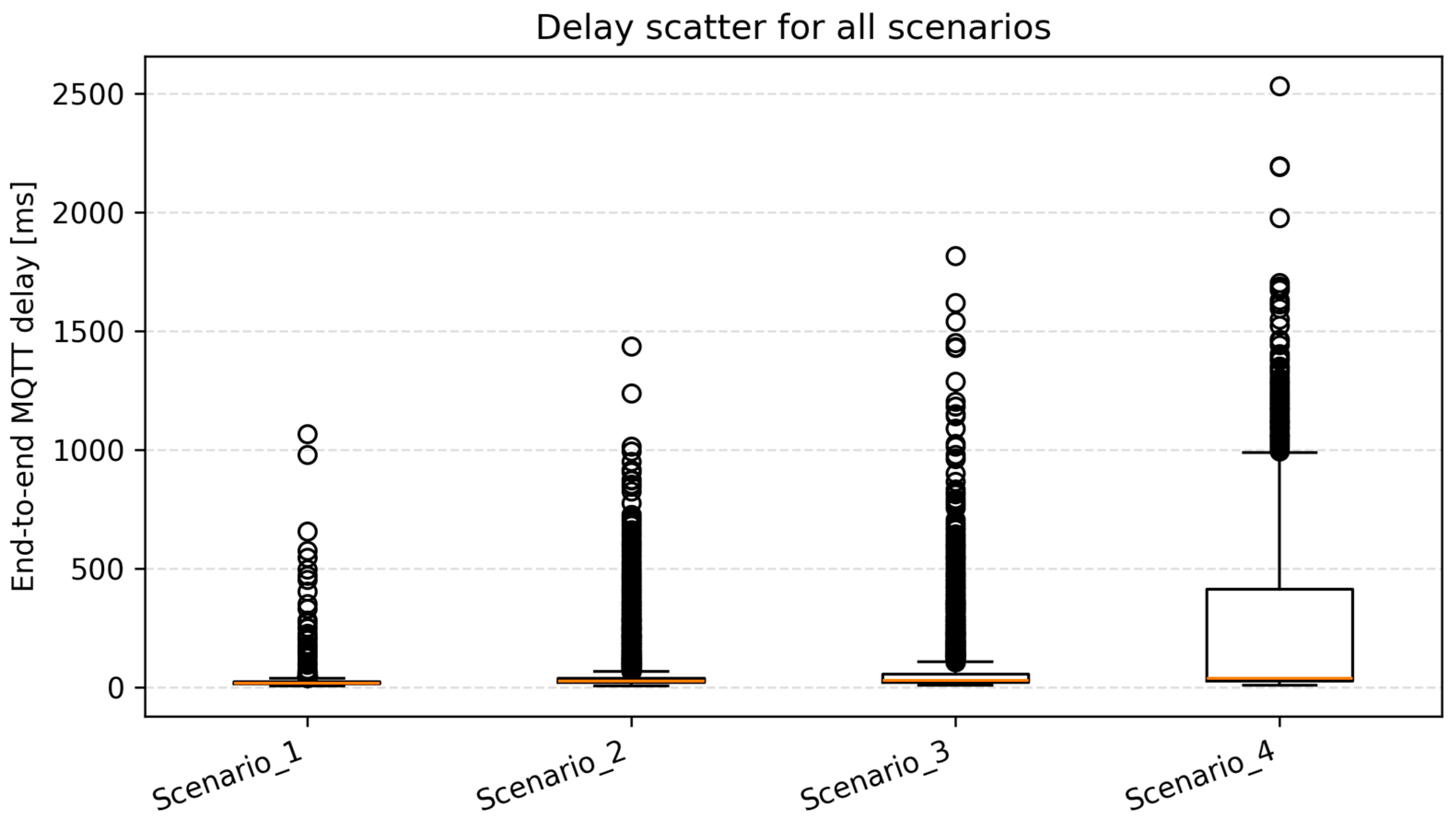
- Jitter—the dispersion of the delay values;
- -
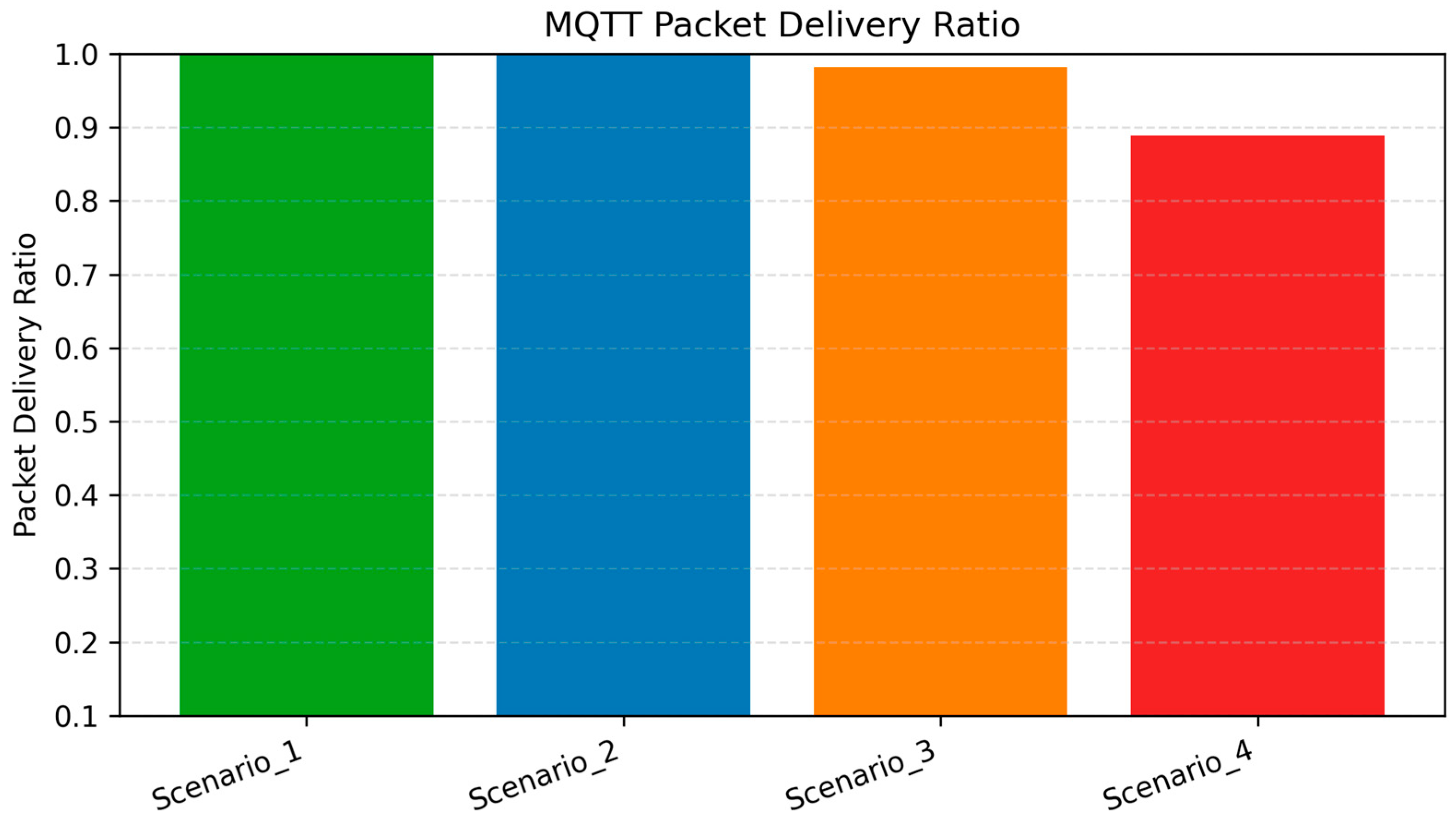
- The message delivery effectiveness (PDR—packet delivery ratio);
- -
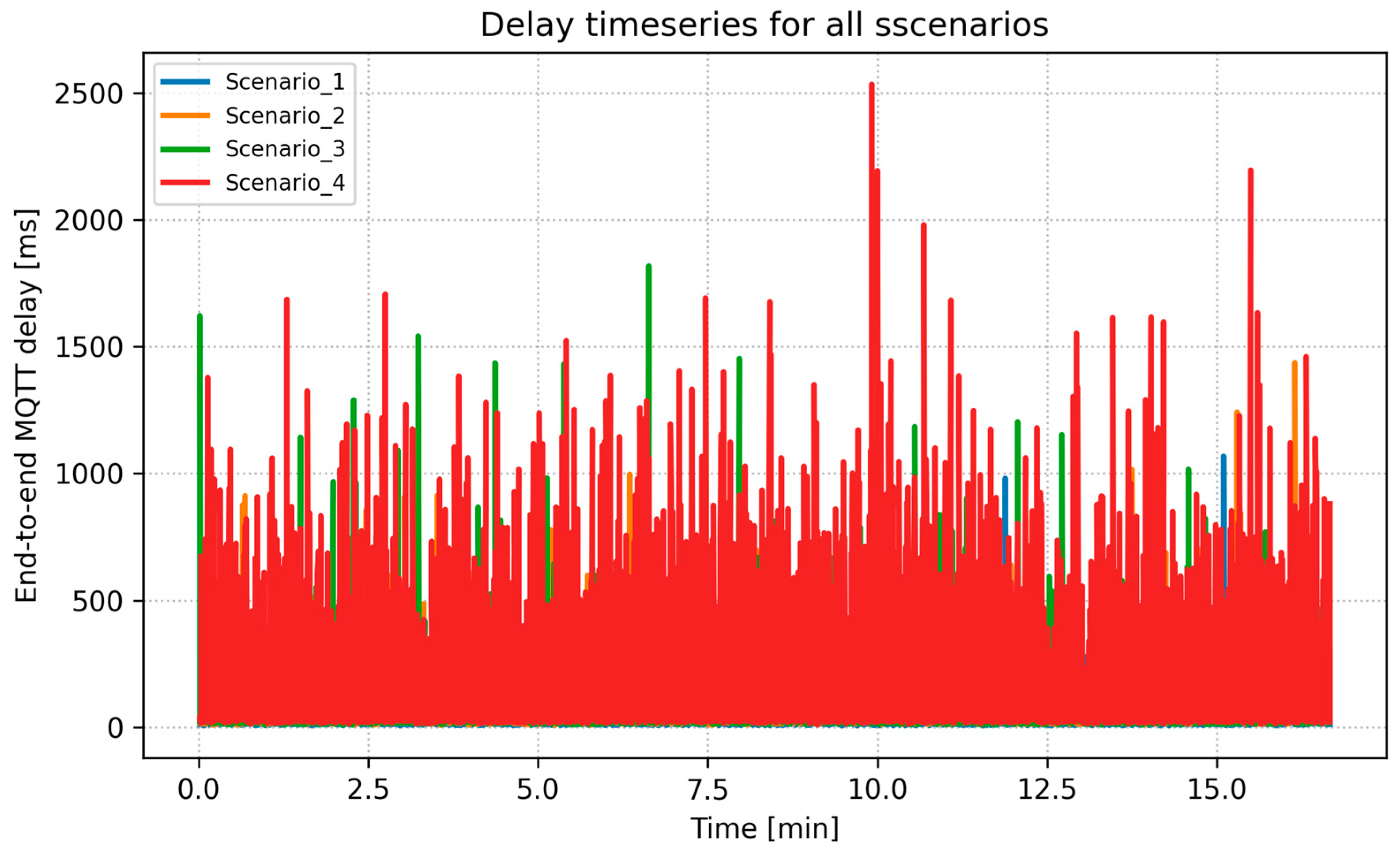
- The stability of the message stream: goodput over time (moving average).
- OWD and jitter: median and percentiles (non-parametric bootstrap CI). Bootstrap 95% confidence intervals (10,000 resamples, BCa method) were computed for the median, P95, and P99 of the OWD and jitter distributions for each scenario;
- PDR: Wilson score 95% confidence interval. For the PDR (a proportion), the Wilson score interval is used, which is valid for all sample sizes and does not require the normal approximation;
- Goodput: bootstrap CI for the mean. A bootstrap 95% confidence interval (10,000 resamples) for the mean goodput was computed for each scenario.
5. Discussion
5.1. Coexistence Effects of Wi-Fi Networks Operating in Different Generations of the IEEE 802.11 Standard
5.1.1. A Paradigm Shift in Access to the Radio Medium
5.1.2. Asymmetry of Medium Access in a Mixed Environment
5.1.3. Extreme Delays and the Determinism of IoT Communication
- Industrial automation and SCADA: control-loop periods of 10–100 ms are typical in process automation; episodic delays exceeding this threshold can cause false timeout alarms and may trigger unnecessary emergency shutdown procedures [32].
- Distributed sensor fusion and data acquisition: irregular message delivery times disrupt the temporal alignment of measurements from multiple sensors, degrading the accuracy of fused data products and event-detection algorithms [33].
- Medical IoT (remote patient monitoring): unpredictable delivery latency may compromise the reliability of automated clinical alerts, where regulatory frameworks impose strict maximum latency requirements.
5.1.4. Packet Delivery Ratio vs. Quality Stability
- An increase in one-way delay;
- An increase in temporal variability (jitter);
- A temporary blocking of the application-layer callback.
5.1.5. Summary of the Legacy vs. High-Efficiency Wi-Fi Discussion
5.2. Implications for Standards and Engineering Practice
5.2.1. Conclusions for the Design and Evolution of the IEEE 802.11 Standards
- Mechanisms for cross-generation fairness of channel access, ensuring that legacy CSMA/CA devices are not systematically disadvantaged during periods of high HE load;
- Explicit differentiation and protection of low-throughput and time-critical traffic (typical of IoT and telemetry applications);
- Improved reporting and control of the impact of OFDMA scheduling and Trigger frame mechanisms on legacy station performance.
5.2.2. Recommendations for IoT System Designers
- Evaluating not only the PDR but also the jitter and the delay percentiles (E). The classical reliability indicators (PDR) may mask significant temporal quality problems, as demonstrated by the simultaneous occurrence of a high PDR and substantially lengthened tails of OWD distribution in Scenarios_2 and _3. Analysis of the P95/P99 OWD percentiles and median jitter should be regarded as standard practice in the validation and acceptance testing of IoT systems.
- Avoiding the congested 2.4 GHz band in modern WLAN environments and taking into account the limitations of adaptive RF band mechanisms for legacy IoT devices (L/I).
- Low-cost IoT microcontrollers (including the ESP32 DevkitC-32E used in this study) are typically single-band 2.4 GHz devices, physically incapable of band switching regardless of interference level; band steering (802.11v) is therefore ineffective for this device class.
- IEEE 802.11k/v client-side support is absent from most lightweight IoT Wi-Fi firmware stacks, which prioritize minimizing RAM/ROM footprint over full IEEE 802.11 feature compliance.
- In practice, the channel of the IoT access point is typically statically configured by the network administrator to ensure predictable, stable connectivity; dynamic AP channel reassignment would disrupt ongoing MQTT/TCP sessions and trigger reconnection sequences.
- 3.
- Considering segmentation of the radio and logical network structure (I).
- 4.
- Plan for technological migration rather than treating it as a future option (I).
- To newer Wi-Fi standards;
- To the less congested 5 GHz or 6 GHz band;
- To alternative technologies (Ethernet, sub-GHz, and LPWAN) if temporal determinism is critical.
5.2.3. Significance for Audits and Acceptance Tests of IoT Systems
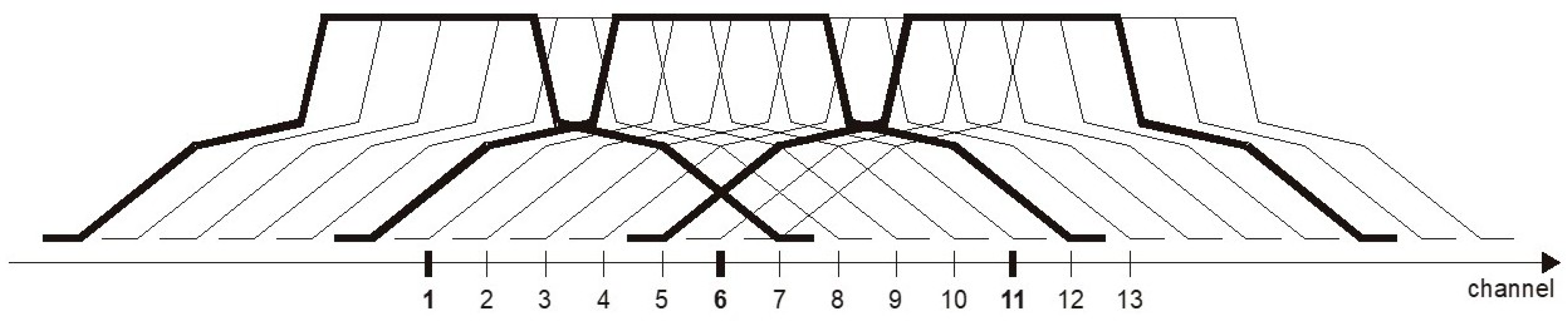
- Tests performed in the presence of HE (802.11ax/be) networks operating on the same channel and on the minimum-separation adjacent channels (±1 channel);
- Long-term measurements of OWD, jitter and especially extreme delays;
- Analysis of the stability of application-layer protocols (MQTT and CoAP) with respect to keep-alive timeouts and session reconnection frequency under representative coexistence conditions.
6. Conclusions
- The presence of modern IEEE 802.11ax and 802.11be networks in the 2.4 GHz band degrades the temporal parameters of MQTT transmissions carried out by 802.11n devices.
- The greatest impact is observed in the area of
- -
- Jitter—the median jitter increases from 7 ms in Scenario_1 to 247 ms in Scenario_4;
- -
- Extreme delay values: P95 OWD increases from 38 ms in Scenario_1 to 839 ms in Scenario_4.
- The decrease in message delivery effectiveness (PDR) becomes significant only at a high density of networks (the PDR is practically 100% in Scenarios_1–3 and decreases to 89% in Scenario_4).
- Even when a high PDR is maintained, the stability of the data stream may be limited.
- The 2.4 GHz band ceases to be a “safe choice” for legacy devices, especially in environments with a high density of modern Wi-Fi networks;
- Backward compatibility does not imply an equivalent quality of service—802.11n devices formally operate correctly but experience a degradation of their temporal parameters;
- Radio planning becomes critical: the choice of channel, limiting the channel widths in HE networks, and the segmentation of the radio space of the infrastructure (dedicated SSIDs/VLANs and channel planning) can partially mitigate the negative effects;
- For IoT applications requiring temporal predictability, the following may be necessary: migration to less congested bands (5 GHz/6 GHz), improved channel planning, reduction in co-channel interference, or the use of alternative technologies (e.g., wired, sub-GHz, LPWAN) depending on the requirements.
- The measurements were conducted in a single controlled indoor laboratory environment (LOS, ~70 m2);
- Only one IoT device model (ESP32 DevkitC-32E) and one access-point model (MikroTik hAP ac2) were used in the IoT link;
- A single MQTT traffic profile was tested (1 Hz publication rate, QoS 0, 256 B payload);
- MAC-layer statistics (per-frame retransmission counts, RSSI, MCS index) were not collected;
- The interfering networks operated at maximum load (full iPerf3 saturation), representing a worst-case interference scenario.
- A comparison of the 2.4 GHz, 5 GHz, and 6 GHz bands for the same class of IoT devices;
- An analysis of the influence of MQTT application-layer parameters (QoS 0/1/2, payload size, publication frequency, and TLS protection) on delays and stability;
- Investigation of scenarios with a larger number of simultaneously active IoT devices and interferers;
- Extending the measurements with PHY/MAC metrics (MCS, number of retransmissions, channel utilization, and channel width) and their correlation with application-layer metrics in Windows and Linux systems;
- Studies in an environment with controlled interference (different load levels generated by HE stations);
- Tests with a real Wi-Fi signal in the background;
- Influence of IoT link to goodputs of Wi-Fi 6 and Wi-Fi 7 networks;
- An analysis of the influence of Wi-Fi 7 mechanisms (e.g., MLO, MU-MIMO) on the fairness of access for legacy IoT devices.
Supplementary Materials
Funding
Institutional Review Board Statement
Informed Consent Statement
Data Availability Statement
Acknowledgments
Conflicts of Interest
References
- Ziegler, S.; Radócz, R.; Rodriguez, A.Q.; Garcia, S.N.M. (Eds.) Springer Handbook of Internet of Things; Springer International Publishing: Cham, Switzerland, 2024. [Google Scholar] [CrossRef] [Scilit]
- Saleem, A.; Shah, S.; Iftikhar, H.; Zywiołek, J.; Albalawi, O. A Comprehensive Systematic Survey of IoT Protocols: Implications for Data Quality and Performance. IEEE Access 2025, 13, 196206–196235. [Google Scholar] [CrossRef] [Scilit]
- Van Bloem, J.-W.; Schiphorst, R.; Kluwer, T.; Slump, C.H. Spectrum Utilization and Congestion of IEEE 802.11 Networks in the 2.4 GHz ISM Band. J. Green Eng. 2012, 2, 401–430. [Google Scholar]
- Chiasserini, C.-F.; Rao, R.R. Coexistence Mechanisms for Interference Mitigation in the 2.4-GHz ISM Band. IEEE Trans. Wirel. Commun. 2003, 2, 964–975. [Google Scholar] [CrossRef]
- IEEE Std 802.11n-2009; IEEE Standard for Information Technology—Local and Metropolitan Area Networks—Specific Requirements—Part 11: Wireless LAN Medium Access Control (MAC)and Physical Layer (PHY) Specifications Amendment 5: Enhancements for Higher Throughput. IEEE: New York, NY, USA, 2009. [CrossRef] [Scilit]
- IEEE Std 802.11ax-2021; IEEE Standard for Information Technology—Telecommunications and Information Exchange Between Systems Local and Metropolitan Area Networks—Specific Requirements Part 11: Wireless LAN Medium Access Control (MAC) and Physical Layer (PHY) Specifications Amendment 1: Enhancements for High-Efficiency WLAN. IEEE: New York, NY, USA, 2021. [CrossRef] [Scilit]
- IEEE Std 802.11be-2024; IEEE Standard for Information Technology—Telecommunications and Information Exchange Between Systems Local and Metropolitan Area Networks—Specific Requirements—Part 11: Wireless LAN Medium Access Control (MAC) and Physical Layer (PHY) Specifications Amendment 2: Enhancements for Extremely High Throughput (EHT). IEEE: New York, NY, USA, 2025. [CrossRef] [Scilit]
- Mozaffariahrar, E.; Theoleyre, F.; Menth, M. A Survey of Wi-Fi 6: Technologies, Advances, and Challenges. Future Internet 2022, 14, 293. [Google Scholar] [CrossRef] [Scilit]
- Rathor, R.G.; Joshi, R.D. Performance Analysis of IEEE802.11ax (Wi-Fi 6) Technology using Multi-user MIMO and Up-Link OFDMA for Dense Environment. In Proceedings of the IEEE 2nd International Conference on Applied Electromagnetics, Signal Processing, & Communication (AESPC), Bhubaneswar, India, 26–28 November 2021; pp. 1–7. [Google Scholar] [CrossRef] [Scilit]
- Wi-Fi Alliance. Wi-Fi CERTIFIED 7™ Technology Overview, February 2026. Available online: https://www.wi-fi.org/file/wi-fi-certified-7-technology-overview (accessed on 31 July 2026).
- Liu, X.; Dong, Y.; Li, Y.; Lin, Y.; Gan, M. IEEE 802.11be Wi-Fi 7: Feature Summary and Performance Evaluation. IEEE Commun. Stand. Mag. 2026, 10, 226–232. [Google Scholar] [CrossRef] [Scilit]
- Jung, S.; Choi, S.; Kim, H.; Yoon, Y.; Son, H.-K. Modeling the Coexistence Performance between Wi-Fi 7 and legacy Wi-Fi. In Proceedings of the 2024 IEEE Network Operations and Management Symposium, Seoul, Republic of Korea, 6–10 May 2024; pp. 1–4. [Google Scholar] [CrossRef] [Scilit]
- Natkaniec, M.; Bieryt, N. An Analysis of the Mixed IEEE 802.11ax Wireless Networks in the 5 GHz Band. Sensors 2023, 23, 4964. [Google Scholar] [CrossRef] [Scilit]
- Frommel, F.; Capdehourat, G.; Rodríguez, B. Performance Analysis of Wi-Fi Networks based on IEEE 802.11ax and the Coexistence with Legacy IEEE 802.11n Standard. In Proceedings of the 2021 IEEE URUCON, Montevideo, Uruguay, 24–26 November 2021; pp. 492–495. [Google Scholar] [CrossRef] [Scilit]
- OASIS Standard, MQTT Version 5.0, 7 March 2019. Available online: https://docs.oasis-open.org/mqtt/mqtt/v5.0/mqtt-v5.0.html (accessed on 3 July 2026).
- Mishra, B.; Kertesz, A. The Use of MQTT in M2M and IoT Systems: A Survey. IEEE Access 2020, 8, 201071–201086. [Google Scholar] [CrossRef] [Scilit]
- Tseng, Y.; Wang, C.; Wei, Y.; Chiang, Y. Cloud-edge MQTT messaging for latency mitigation and broker memory footprint reduction. PeerJ Comput. Sci. 2025, 11, e2741. [Google Scholar] [CrossRef] [Scilit]
- Handosa, M.; Gračanin, D.; Elmongui, H.G. Performance evaluation of MQTT-based internet of things systems. In Proceedings of the 2017 Winter Simulation Conference (WSC), Las Vegas, NV, USA, 3–6 December 2017; pp. 4544–4545. [Google Scholar] [CrossRef] [Scilit]
- Borsatti, D.; Cerroni, W.; Tonini, F.; Raffaelli, C. From IoT to Cloud: Applications and Performance of the MQTT Protocol. In Proceedings of the 22nd International Conference on Transparent Optical Networks (ICTON), Bari, Italy, 19–23 July 2020; pp. 1–4. [Google Scholar] [CrossRef] [Scilit]
- Dizdarević, J.; Michalke, M.; Jukan, A.; Masip-Bruin, X.; D’Andria, F. Benchmarking Performance of Various MQTT Broker Implementations in a Compute Continuum. In Proceedings of the 24th International Symposium on Cluster, Cloud and Internet Computing (CCGrid), Philadelphia, PA, USA, 6–9 May 2024; pp. 357–366. [Google Scholar] [CrossRef] [Scilit]
- Ito, A.; Yokotani, A.; Ishibasi, K.; Yokotani, T. Analysis of Performance on MQTT Over Wireless Transmission Link. IEICE Commun. Express 2025, 14, 453–456. [Google Scholar] [CrossRef] [Scilit]
- Pawar, S.; Panigrahi, N.; Jyothi, A.P.; Lokhande, M.; Godse, D.; Jadhav, D.B. Evaluation of Delay Parameter of MQTT Protocol. Int. J. Eng. Trends Technol. 2023, 71, 227–235. [Google Scholar] [CrossRef] [Scilit]
- Shelby, Z.; Hartke, K.; Bormann, C. RFC 7252: The Constrained Application Protocol (CoAP). Available online: https://datatracker.ietf.org/doc/html/rfc7252 (accessed on 31 July 2026).
- Open Platform Communications Unified Architecture (PC UA) Official Website. Available online: https://opcfoundation.org/about/opc-technologies/opc-ua/ (accessed on 31 July 2026).
- Silva, D.; Carvalho, L.I.; Soares, J.; Sofia, R.C. A Performance Analysis of Internet of Things Networking Protocols: Evaluating MQTT, CoAP, OPC UA. Appl. Sci. 2021, 11, 4879. [Google Scholar] [CrossRef] [Scilit]
- Debnath, M.; Modak, S.; Sarkar, D. Performance Evaluation of Application Layer IoT Protocols: MQTT and CoAP. In Proceedings of the 4th International Conference on Computer, Communication, Control & Information Technology (C3IT), Hooghly, India, 28–29 September 2024; pp. 1–6. [Google Scholar] [CrossRef] [Scilit]
- Al Enany, M.O.; Harb, H.M.; Attiya, G. A Comparative analysis of MQTT and IoT application protocols. In Proceedings of the 2021 International Conference on Electronic Engineering (ICEEM), Menouf, Egypt, 3–4 July 2021; pp. 1–6. [Google Scholar] [CrossRef] [Scilit]
- Ebadinezhad, S.; Abdillahi, A.Y.; Fareed, G.S.; Tuama, Y.A.; Maombe, J.; Igwe, I.H. Developing and Comparing Protocols for Low-Latency IoT Networking. In Proceedings of the 2025 International Conference on Machine Learning and Autonomous Systems (ICMLAS), Prawet, Thailand, 10–12 March 2025; pp. 1815–1821. [Google Scholar] [CrossRef] [Scilit]
- Kashyap, M.; Sharma, V. A comparative analysis and implementation of CoAP and MQTT protocol for IoT communication. Life Cycle Reliab. Saf. Eng. 2025, 14, 715–730. [Google Scholar] [CrossRef] [Scilit]
- Pawar, S.; Jadhav, D.B.; Lokhande, M.; Raskar, P.; Patil, M. Evaluation of quality of service parameters for MQTT communication in IoT application by using deep neural network. Int. J. Inf. Technol. 2024, 16, 1123–1136. [Google Scholar] [CrossRef] [Scilit]
- Al-Masri, E.; Kalyanam, K.R.; Batts, J.; Kim, J.; Singh, S.; Vo, T.; Yan, C. Investigating Messaging Protocols for the Internet of Things (IoT). IEEE Access 2020, 8, 94880–94911. [Google Scholar] [CrossRef] [Scilit]
- Maslouhi, I.; Ar–reyouchi, E.M.; Ghoumid, K.; Baibai, K. Analysis of End-to-End Packet Delay for Internet of Things in Wireless Communications. Int. J. Adv. Comput. Sci. Appl. (IJACSA) 2018, 9, 338–343. [Google Scholar] [CrossRef] [Scilit]
- Kilius, Š.; Gailius, D.; Knyva, M.; Balčiūnas, G.; Meškuotienė, A.; Dobilienė, J.; Joneliūnas, S.; Kuzas, P. Time Delay Characterization in Wireless Sensor Networks for Distributed Measurement Applications. J. Sens. Actuator Netw. 2024, 13, 31. [Google Scholar] [CrossRef] [Scilit]
- Iperf3 Official Website. Available online: https://software.es.net/iperf/ (accessed on 7 July 2026).
- Mosquitto Official Website. Available online: https://mosquitto.org/ (accessed on 7 July 2026).
- Almes, G.; Kalidindi, S.; Zekauskas, M.; Morton, A. A One-Way Delay Metric for IP Performance Metrics (IPPM), IETF RFC 7679; RFC: Wilmington, DE, USA, 2016. [Google Scholar]
- Sungkwan, Y.; Eui-Jik, K. Latency and Jitter Analysis for IEEE 802.11e Wireless LANs. J. Appl. Math. 2013, 2013, 792529. [Google Scholar] [CrossRef] [Scilit]
- Paxson, V. End-to-end Internet packet dynamics. ACM SIGCOMM Comput. Commun. Rev. 1997, 27, 139–152. [Google Scholar] [CrossRef] [Scilit]





| Parameter | Value/Details |
|---|---|
| IoT_DUT module | Espressif ESP32 DevkitC-32E |
| IoT_DUT Wi-Fi standard | IEEE 802.11n, 2.4 GHz, 20 MHz, STA mode |
| AP1 (DUT access point) | MikroTik hAP ac2, RouterOS 7.22.1 |
| AP1 Wi-Fi standard | IEEE 802.11n, 2.4 GHz, ch. 6, 20 MHz, AP mode |
| AP2 (Rogue link 1) | MikroTik hAP ax3, RouterOS 7.22.1 |
| AP2 Wi-Fi standard | IEEE 802.11ax, 2.4 GHz, 20 MHz |
| AP3 (Rogue link 2) | Ubiquiti U7 Pro Wall |
| AP3 Wi-Fi standard | IEEE 802.11be, 2.4 GHz, 20 MHz |
| AP3 firmware | UniFi firmware 8.5.21 |
| MQTT broker | Eclipse Mosquitto 2.1.2 |
| iPerf version | iPerf3 3.21 |
| Room conditions | ~70 m2, LOS conditions for all devices Links distances ~8 m |
| Scenario_1 | Networks | Standard (s) | DUT Channel | Interferer Channel(s) | Variants | Samples Per Variant | Total Samples |
|---|---|---|---|---|---|---|---|
| Scenario_1 | IoT_DUT only | 802.11n | 6 | --- | 1 | 1800 | 1800 |
| Scenario-2 | IoT_DUT + 1 interferer | 802.11n + 802.11ax | 6 | 1–11 | 11 | 1800 | 19,800 |
| Scenario_3 | IoT_DUT + 1 interferer | 802.11n + 802.11be | 6 | 1–11 | 11 | 1800 | 19,800 |
| Scenario_4 | IoT_DUT + 2 interferers | 802.11n + 802.11ax + 802.11be | 6 | 26 channel pairs (see text) | 26 | 1800 | 46,800 |
| Metric | Scenario_1 (No Foreign Networks) | Scenario_2 (Wi-Fi 6) | Scenario_3 (Wi-Fi 7) | Scenario_4 (Wi-Fi 6 and Wi-Fi 7) |
|---|---|---|---|---|
| OWD Median [ms] | 18 [18, 18] | 26 [25, 25] | 28 [27, 28] | 38 [36, 38] |
| OWD P95 [ms] | 38 [36, 38] | 312 [286, 349] | 390 [360, 429] | 869 [842, 921] |
| OWD P99 [ms] | 103 [64, 213] | 618 [575, 711] | 697 [640, 839] | 1287 [1226, 1414] |
| OWD Max [ms] | 1067 | 1436 | 1817 | 2532 |
| Jitter Median [ms] | 7 [7, 7] | 14 [12, 14] | 19 [16, 19] | 247 [227, 266] |
| Jitter P95 [ms] | 29 [26, 31] | 410 [385, 439] | 461 [440, 501] | 931 [887, 987] |
| PDR [%] | 99.77 [99.52, 99.89] | 100.00 [99.87, 100.00] | 99.70 [99.43, 99.84] | 88.90 [87.73, 89.98] |
| Mean Goodput [kbps] | 0.500 [0.493, 0.509] | 0.502 [0.495, 0.509] | 0.505 [0.497, 0.513] | 0.443 [0.434, 0.453] |
| Area/Mechanism | Legacy Wi-Fi (IEEE 802.11n) | High-Efficiency Wi-Fi (IEEE 802.11ax/802.11be) | System-Level Consequences (Mixed Environment) | Experimental Observations (MQTT, 802.11n) | Evidential Basis |
|---|---|---|---|---|---|
| Medium-access model | Random CSMA/CA access | Scheduled access (OFDMA, trigger frames) | Uneven channel access for legacy stations | Increase in jitter and randomness of delays | (E) + (L) [5,6,7] |
| Transmission scheduling | No central coordination | Central scheduling by the access point | Preference for HE stations during periods of high load | Heavy-tailed OWD distribution | (I) + (L) [6,13,14] |
| Response to network densification | Decrease in efficiency with a larger number of stations | Maintenance of high system efficiency | System efficiency at the expense of legacy devices | Isolated delays in the order of hundreds of ms | (E) + (L) [8,13,14] |
| Frame aggregation | Limited (A-MPDU) | Strong aggregation and time scheduling | Longer occupation of the medium by HE frames | Momentary “starvation” of IoT transmissions | (I) + (L) [5,6] |
| Access fairness | Relative equality among stations of the same generation | Global rather than cross-generational optimization | No fairness guarantee for legacy stations | Decrease in temporal predictability | (I) + (L) [13,14] |
| Support for low-throughput devices | Naturally well-suited | Secondary to high-throughput traffic | Mismatch with the IoT traffic profile | Goodput fluctuations despite low load | (E) + (I) [8,12] |
| Feedback transmission mechanisms | Classic ACK, backoff | Block ACK, uplink scheduling | Feedback delays for legacy stations | Increase in RTT and MQTT timeouts | |
| System scaling | Limited | Very good | Scalability not transferable to legacy stations | Quality degradation as density increases | |
| Temporal determinism | Limited | Better for HE stations | No cross-generation determinism | Jitter is the key problem | (E) + (L) [5,6] |
| Perceived quality of service | Acceptable in homogeneous networks | High in HE networks | QoS/QoE divergence between device classes | High PDR, but reduced QoE | (E) + (I) |
Disclaimer/Publisher’s Note: The statements, opinions and data contained in all publications are solely those of the individual author(s) and contributor(s) and not of MDPI and/or the editor(s). MDPI and/or the editor(s) disclaim responsibility for any injury to people or property resulting from any ideas, methods, instructions or products referred to in the content. |
© 2026 by the author. Licensee MDPI, Basel, Switzerland. This article is an open access article distributed under the terms and conditions of the Creative Commons Attribution (CC BY) license.
Share and Cite
Zankiewicz, A. Practical Analysis of IEEE 802.11n 2.4 GHz Communication Quality in the Context of IoT Devices Operating in an Area Shared with Modern Wi-Fi 6 and Wi-Fi 7 Networks. Sensors 2026, 26, 5352. https://doi.org/10.3390/s26175352
Zankiewicz A. Practical Analysis of IEEE 802.11n 2.4 GHz Communication Quality in the Context of IoT Devices Operating in an Area Shared with Modern Wi-Fi 6 and Wi-Fi 7 Networks. Sensors. 2026; 26(17):5352. https://doi.org/10.3390/s26175352
Chicago/Turabian StyleZankiewicz, Andrzej. 2026. "Practical Analysis of IEEE 802.11n 2.4 GHz Communication Quality in the Context of IoT Devices Operating in an Area Shared with Modern Wi-Fi 6 and Wi-Fi 7 Networks" Sensors 26, no. 17: 5352. https://doi.org/10.3390/s26175352
APA StyleZankiewicz, A. (2026). Practical Analysis of IEEE 802.11n 2.4 GHz Communication Quality in the Context of IoT Devices Operating in an Area Shared with Modern Wi-Fi 6 and Wi-Fi 7 Networks. Sensors, 26(17), 5352. https://doi.org/10.3390/s26175352