An Action-Centric Zero Trust Maturity Model for Agentic AI Environments


Abstract
1. Introduction
2. Background and Related Work
2.1. Zero Trust Maturity Models
2.2. Security Characteristics of Agentic AI
2.3. Threat Landscape and Zero Trust Guidance for AI Agents
2.4. Academic Approaches to Agent Security and Risk Assessment
2.5. Research Gap
3. Research Methodology
3.1. Research Design and Scope
3.2. Literature Selection
3.3. Requirement Extraction and Codebook Development
3.4. Expert Review
4. Proposed AI Zero Trust Maturity Model
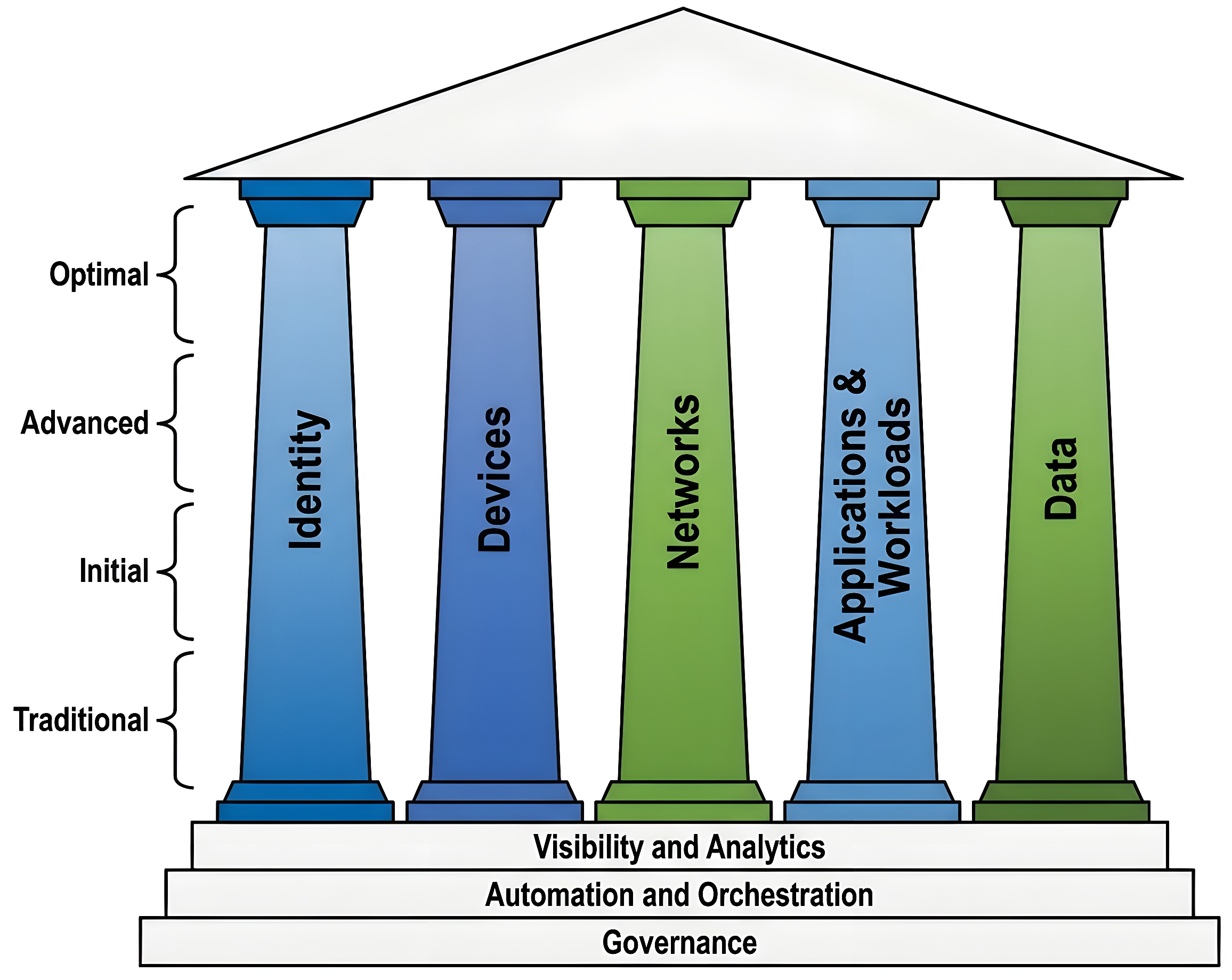
4.1. Overview of AI-ZTMM
4.2. Design Principles
4.3. Evaluation Structure and Requirement Integration
4.3.1. Threat Classification
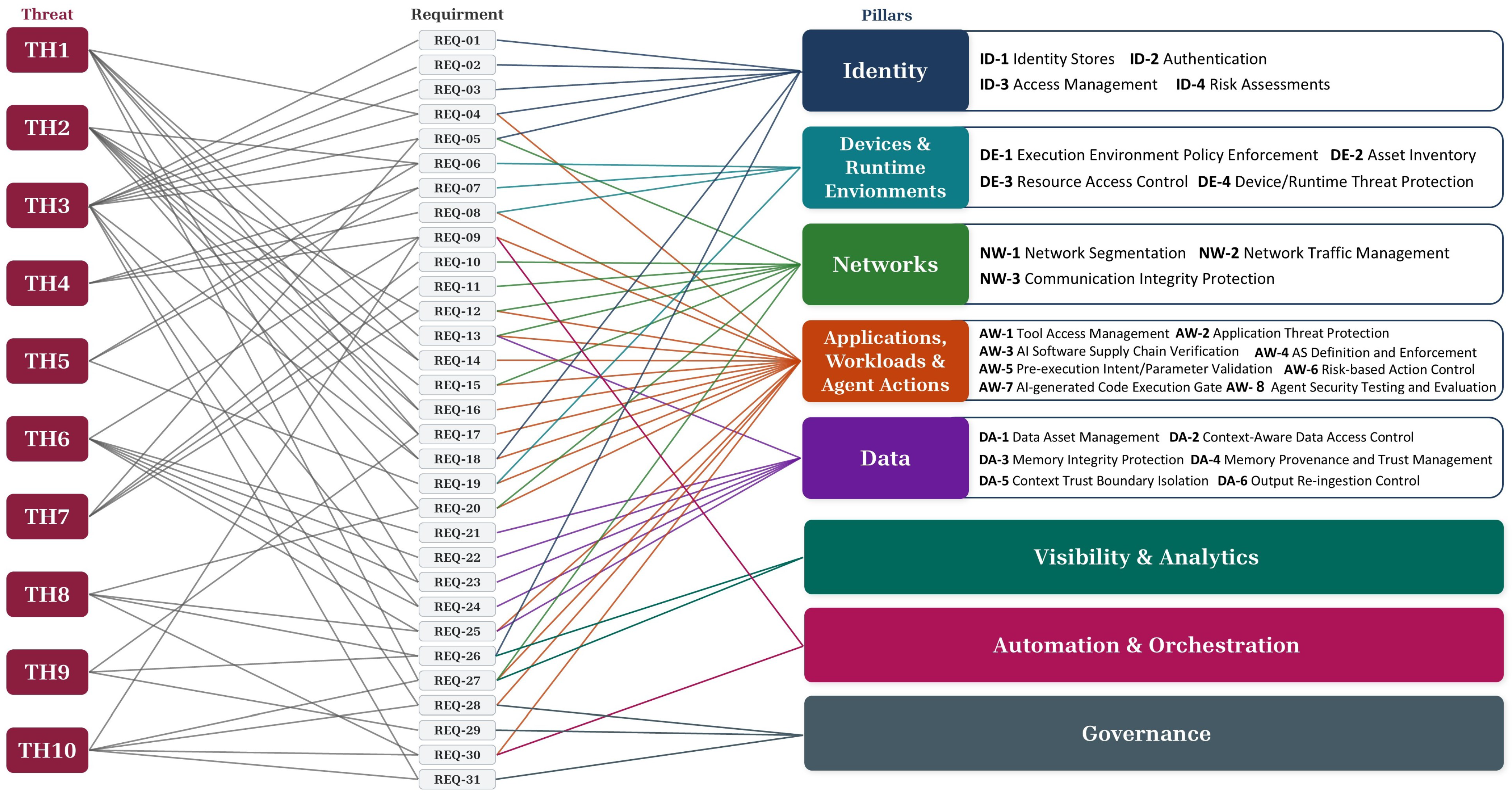
4.3.2. Derivation of Security Requirements
4.3.3. Evaluation Structure
4.4. Action Space and Action Risk Factors
4.4.1. Action Space
- Permitted actions: Low-risk actions that can be performed without prior approval
- Conditional actions: Actions that can be performed only under specific conditions or approval
- Prohibited actions: Actions that an agent must not perform
4.4.2. Action Risk Factors
4.4.3. High-Risk Action Determination
- An irreversible action combined with administrative privilege, such as account deletion or modification of a privilege policy
- Sensitive data combined with transmission to an uncontrolled external destination, such as sending customer records outside the organization
- Autonomous execution combined with an immediate external effect, such as automated deployment or payment approval
- Administrative privilege combined with an unrecoverable system change, such as executing shell commands derived from retrieved documents
- Broad impact scope combined with external communication or autonomous execution, such as mass email distribution
- An irreversible action combined with an immediate physical effect, such as issuing actuator commands or transmitting industrial control commands
4.5. Pillar-Specific Evaluation Criteria
4.5.1. Identity
4.5.2. Devices and Runtime Environments
4.5.3. Networks
4.5.4. Applications, Workloads and Agent Actions
4.5.5. Data
4.5.6. Cross-Cutting Capabilities
4.6. Application to Sensor-Driven Cyber-Physical Agentic Systems
5. Analytical Model Evaluation
5.1. Derivation Traceability
5.2. External Scenario-Based Coverage Assessment
5.2.1. Coverage Across the ATLAS Case Base
5.2.2. Case 1: Amazon Q Developer Extension Supply Chain Compromise
5.2.3. Case 2: Data Exfiltration Through the Postmark-Mcp Malicious MCP Server
5.2.4. Case 3: SesameOp Command-and-Control Abuse of an External AI Service
6. Discussion
6.1. Limitations
6.2. Future Work
7. Conclusions
Supplementary Materials
Author Contributions
Funding
Institutional Review Board Statement
Informed Consent Statement
Data Availability Statement
Conflicts of Interest
Appendix A. Definitions of Security Requirements

| REQ ID | Requirement Definition |
|---|---|
| REQ-01 | Issuance of unique agent identity. Register each AI agent as a unique non-human identity (NHI), separate from human and shared service accounts, and manage its credentials, privileges, purpose, and execution history. |
| REQ-02 | Agent credential lifecycle management. Issue short-lived, task-scoped credentials, revoke them after use, and continuously re-authenticate long-lived sessions. |
| REQ-03 | Delegation boundary verification and privilege ceiling. Verify that delegated privileges remain within the original intent and do not exceed those of the delegating human or agent. |
| REQ-04 | Action–intent binding. Cryptographically bind tool invocations and actions to user intent and the current workflow stage to prevent intent drift across delegation chains. |
| REQ-05 | Mutual authentication between agents. Require mutual authentication for agent-to-agent interactions and block unapproved cross-agent privilege delegation. |
| REQ-06 | Agent execution environment isolation. Run agents, tools, and code in isolated sandboxes, and separate or reset session states to prevent privilege escalation and cross-session leakage. |
| REQ-07 | Runtime environment integrity & compliance monitoring. Continuously verify runtime compliance, including image signatures, non-root execution, and network restrictions, and isolate agents operating in compromised environments. |
| REQ-08 | AI software supply chain verification. Verify the provenance of models, tools, prompts, agent descriptors, and MCP servers using signatures and attestations such as SBOM/AIBOM, and reject unverified components. |
| REQ-09 | Emergency invalidation and isolation response. Provide mechanisms such as kill switches to disable and isolate compromised agents, credentials, models, tools, runtimes, and memory/RAG sources, and re-verify their integrity at runtime. |
| REQ-10 | Protection of agent communication integrity. Digitally sign inter-agent messages and verify their payloads and context to detect tampering and hidden command injection. |
| REQ-11 | Protocol version and schema verification. Enforce approved MCP and A2A protocol versions and typed schemas, and reject downgrade attempts and unrecognized messages. |
| REQ-12 | External entity trust verification. Verify the identity, integrity, and authorized scope of external APIs, MCP servers, and external agents, and restrict egress through destination allowlists. |
| REQ-13 | Isolated processing of untrusted external data. Treat external sources, including web pages, emails, and documents, as untrusted inputs and apply validation and prompt-injection defenses. |
| REQ-14 | Explicit definition of Action Space. Define each agent’s permitted, conditional, and prohibited actions, and require policy enforcement points (PEPs) to block out-of-scope actions before execution. |
| REQ-15 | Tool-specific least-privilege profiles. Define tool-specific profiles for access scope, invocation frequency, and egress, and restrict each tool to the approved privileges and data scope. |
| REQ-16 | Pre-execution intent verification. Use an Intent Gate to verify that tool invocations match the current task context and to validate arguments, schemas, and parameters before execution. |
| REQ-17 | Action risk-based differentiated approval. Classify actions by reversibility, real-time impact, data sensitivity, external transfer, privilege, and autonomy, and apply human approval or enhanced verification to high-risk actions. |
| REQ-18 | Just-in-time privilege granting. Grant tool privileges only when required, revoke them after use, and restrict execution according to current risk. |
| REQ-19 | AI-generated code execution control. Separate code generation from execution, apply verification such as static analysis and taint tracking, and restrict execution to approved environments. |
| REQ-20 | Action rate and frequency limiting. Limit API calls and high-cost operations, and detect abnormal execution rates or tool chaining to prevent overload and cascading execution. |
| REQ-21 | Validation of memory write content. Inspect writes to long-term memory and RAG stores for malicious or anomalous content, and separate memory across sessions to prevent unauthorized knowledge transfer. |
| REQ-22 | Memory provenance and trust management. Record the provenance of memory updates, assign trust scores to entries, and expire or decay unverified memory to limit persistent contamination. |
| REQ-23 | Context integrity and information flow tracking. Track data flows from context loading through model and tool invocation to output generation, and detect unauthorized movement of sensitive data. |
| REQ-24 | Context-aware data access control. Determine access scope from identity, privilege, classification, task purpose, and execution context, and block excessive, unauthorized, or out-of-purpose access. |
| REQ-25 | Prevention of reinjection of self-generated outputs. Prevent unverified agent outputs from being reintroduced into trusted memory or context to limit self-reinforcing poisoning and cascading hallucinations. |
| REQ-26 | Cryptographic audit logs. Preserve agent actions, tool invocations, and memory access in signed, tamper-resistant logs, and link delegation chains through a common trace ID. |
| REQ-27 | Agent behavioral baseline and anomaly detection. Establish behavioral baselines, detect goal drift, abnormal tool use, privilege escalation, and cross-agent anomalies, and trigger isolation or kill-switch responses when necessary. |
| REQ-28 | Autonomy level management and deployment approval. Require security review, approval of the Autonomy Level, and assignment of an accountable owner before deployment, and adjust autonomy according to trust and operational history. |
| REQ-29 | HITL optimization and approval fatigue prevention. Prioritize human review by risk, automate low-risk tasks, and focus oversight on high-risk actions to reduce approval fatigue and automation bias. |
| REQ-30 | Multi-agent pipeline trust management. Monitor each agent’s actions and trust state, and suspend the pipeline or isolate an agent when anomalous behavior or trust degradation is detected. |
| REQ-31 | Agent lifecycle governance. Govern agent creation, deployment, operation, and retirement, conduct periodic reviews, and verify the deletion of identities, credentials, memory, and delegation relationships at retirement. |
Appendix B. Maturity Criteria for Security Functions by Pillar
Appendix B.1. Identity
| Level | Assessment Criteria |
|---|---|
| ID-1 Identity stores | |
| Traditional | Agents use human or shared service accounts, without separate identities or an agent inventory. |
| Initial | Unique identifiers are manually issued to some agents, but registration is inconsistent and ownership, privilege scope, and purpose are not centrally managed. |
| Advanced | All agents are registered as unique non-human identities (NHIs), with ownership, privilege scope, purpose, and execution history centrally managed. Unauthorized agents are detected. |
| Optimal | Identity stores are synchronized with execution environments in real time. Agent registration and deprovisioning are automated, and unauthorized or ghost agents are blocked. |
| ID-2 Authentication | |
| Traditional | Agents are not separate authentication subjects and rely on static API keys or shared secrets. Agent-to-agent authentication is absent. |
| Initial | Agents receive individual credentials, but credentials remain static and long-lived. External federation is manual or absent. |
| Advanced | Agent identity is verified for access to resources, tools, and other agents. Mutual authentication, federation, and credential lifecycle controls are enforced. |
| Optimal | Authentication strength adapts to risk and context, while inter-agent and cross-organizational trust are automatically governed by policy. |
| ID-3 Access management | |
| Traditional | Agents receive broad, static privileges that remain active without timely review or revocation. |
| Initial | Role-based restrictions are introduced, but privileges remain pre-granted and persistent, without delegation privilege ceilings. |
| Advanced | Privileges are granted through just-in-time (JIT) access and revoked after use. Delegated privileges cannot exceed those of the delegating principal. |
| Optimal | Privilege, token, and session scopes are dynamically adjusted based on real-time risk and automatically reduced or revoked upon anomalies. |
| ID-4 Risk assessment | |
| Traditional | Access decisions rely on static rules without considering agent behavior or state. |
| Initial | Risk assessment uses limited login factors, but excludes execution context and behavioral history. |
| Advanced | Risk scores combine behavioral trajectory, task context, credential state, session metadata, and execution environment state for authorization decisions. |
| Optimal | Risk is continuously recalculated, privileges are adjusted during sessions, and the risk model is refined using incidents, anomalies, and audit feedback. |
| ID-5 Delegation chain control | |
| Traditional | Agent delegation is not separately controlled, with no limits on boundaries, re-delegation, or chain depth. |
| Initial | Delegation relationships are recorded, but boundaries, re-delegation, and validity periods are not enforced. |
| Advanced | Delegation boundaries, re-delegation permissions, chain depth, and validity periods are enforced by policy. |
| Optimal | Delegation chains are verified in real time using a common trace ID. Anomalous delegation is blocked, and privileges expire when tasks complete. |
| ID-6 Visibility & Analytics | |
| Traditional | Agent identity, authentication, and privilege events are mixed with human account logs and cannot be attributed to individual agents. |
| Initial | Agent authentication and access logs are collected, but delegation is not tracked and analysis remains retrospective and manual. |
| Advanced | Identity use, authentication, privilege exercise, and delegation are recorded and correlated through a common trace ID. Identity and privilege anomalies are analyzed. |
| Optimal | Identity and privilege anomalies are correlated in real time, and behavioral baselines are continuously updated to detect unknown patterns. |
| ID-7 Automation & Orchestration | |
| Traditional | Credential theft and anomalous authentication are handled manually, resulting in delayed response. |
| Initial | Limited actions, such as account locking, are automated without agent-wide orchestration. |
| Advanced | Credential invalidation, privilege revocation, and agent isolation are automatically orchestrated when identity or delegation anomalies are detected. |
| Optimal | Detection and response operate as a real-time closed loop, delegation chains are blocked end-to-end, and playbooks are refined using incident history. |
| ID-8 Governance | |
| Traditional | Human identity policies are applied to agents without agent-specific credential policies or accountable ownership. |
| Initial | Agent identity issuance criteria are documented, but credential rotation, retirement, and review processes remain inconsistent. |
| Advanced | Policies for identity issuance, ownership, credential lifecycle, and retirement are established and regularly reviewed. |
| Optimal | Identity governance covers the full agent lifecycle, policy violations are automatically detected and corrected, and audit findings inform policy updates. |
Appendix B.2. Devices and Runtime Environments
| Level | Assessment Criteria |
|---|---|
| DE-1 Execution foundation policy enforcement | |
| Traditional | Physical devices and servers are checked for compliance, but agent runtime integrity is not separately verified. |
| Initial | Integrity checks are applied to some runtime environments, but remain manual and irregular, without automated response. |
| Advanced | Runtime environments and physical execution devices are verified for integrity, and degraded foundations are restricted or isolated. |
| Optimal | Integrity is continuously verified at execution time, and compromised foundations trigger real-time blocking or workload relocation. |
| DE-2 Asset inventory | |
| Traditional | Physical devices and servers are inventoried, but agent containers, VMs, and serverless environments are not separately tracked. |
| Initial | Some runtime environments are inventoried, but dynamic environments and their owning agents are not consistently tracked. |
| Advanced | Hosts, devices, and runtime environments have unique identifiers, and dynamic environments are linked to their agents and dependencies. |
| Optimal | Inventories synchronize with orchestration platforms in real time. Registration and deprovisioning are automated, and ghost environments are detected. |
| DE-3 Resource access control | |
| Traditional | Device-level controls exist, but agent, tool, and code execution lack isolation and session separation. |
| Initial | Some execution is isolated, but session state separation is incomplete and resource limits remain static. |
| Advanced | Resource access is policy-restricted, execution is isolated, and state is separated and reset between sessions. |
| Optimal | Isolation and resource access adapt to action risk and context, while cross-session leakage is automatically detected and blocked. |
| DE-4 Device and runtime environment threat protection | |
| Traditional | Endpoint protection exists, but runtime threats such as sandbox escape and unauthorized system calls are not specifically addressed. |
| Initial | Runtime threat detection is introduced but remains signature-based, reactive, and limited in detecting constraint bypass. |
| Advanced | Sandbox escape, unauthorized system calls, runtime constraint bypass, and execution-device compromise are detected and blocked. |
| Optimal | Behavior-based detection operates in real time, compromised environments are automatically isolated, and detection rules are continuously refined. |
| DE-5 Visibility & Analytics | |
| Traditional | Device and server logs are collected, but runtime state and configuration changes are not separately identifiable. |
| Initial | Runtime logs are collected, but analysis remains manual and retrospective, without anomaly detection. |
| Advanced | Runtime state, configuration changes, and anomalous execution are recorded and analyzed. |
| Optimal | Runtime anomalies are detected and correlated in real time, and normal-state baselines are continuously updated. |
| DE-6 Automation & Orchestration | |
| Traditional | Responses to execution foundation compromise are fully manual. |
| Initial | Limited actions, such as restart, are automated without environment-wide orchestration. |
| Advanced | Integrity degradation or compromise triggers automated isolation, regeneration, and blocking of agent execution. |
| Optimal | Detection and response form a real-time closed loop; compromised environments are automatically regenerated; and playbooks are continuously refined. |
| DE-7 Governance | |
| Traditional | Device and server policies exist, but agent runtime approval, image, and isolation policies are absent. |
| Initial | Runtime approval criteria are documented, but image and isolation policies are inconsistently enforced. |
| Advanced | Runtime approval criteria, permitted images, and isolation policies are established and regularly reviewed. |
| Optimal | Governance is integrated with deployment pipelines, non-compliant deployments are automatically blocked, and audit findings inform policy updates. |
Appendix B.3. Networks
| Level | Assessment Criteria |
|---|---|
| NW-1 Network segmentation | |
| Traditional | Network segments exist, but agent communication is not separated by business function or trust level. |
| Initial | Agent traffic is partially separated using static rules that do not consider identity or task purpose. |
| Advanced | Communication paths are segmented by function and trust level, with access controlled by agent identity, task purpose, and execution context. |
| Optimal | Segmentation dynamically adapts to trust state and context, and anomalous communication paths are automatically blocked. |
| NW-2 Network traffic management | |
| Traditional | Traffic filtering exists, but agent communications with external APIs, MCP servers, and external agents lack dedicated egress controls and rate limits. |
| Initial | Static egress allowlists and rate limits are partially applied, while external entity verification remains manual. |
| Advanced | External entities are verified, egress allowlists are enforced, and external or high-cost communications are rate-limited. |
| Optimal | Egress controls and rate limits adapt to action risk and context, blocking unauthorized communication and resource exhaustion attempts. |
| NW-3 Communication integrity protection | |
| Traditional | Transport encryption is used, but agent protocols such as MCP and A2A lack message-level integrity verification. |
| Initial | Message signing is partially introduced, but schema and protocol version verification remain incomplete. |
| Advanced | Messages are signed and verified for controlled agent protocols. Tampering, schema manipulation, downgrade attempts, and unauthorized injection are blocked, and approved versions are enforced. |
| Optimal | End-to-end protocol integrity is verified in real time, anomalous messages are automatically blocked, and protocol policies are continuously updated. |
| NW-4 Visibility & Analytics | |
| Traditional | Network logs are collected, but agent external communication and egress activity are not separately identifiable. |
| Initial | Agent communication logs are collected, but analysis remains manual and retrospective, without anomalous destination detection. |
| Advanced | External communication, egress activity, and protocol usage are recorded and analyzed for anomalous destinations and communication patterns. |
| Optimal | Communication anomalies are detected and correlated in real time, and normal communication baselines are continuously updated. |
| NW-5 Automation & Orchestration | |
| Traditional | Unauthorized communication is handled entirely through manual response. |
| Initial | Limited blocking is automated, but responses are not orchestrated across agent communication paths. |
| Advanced | Unauthorized egress or anomalous communication triggers automated connection blocking and isolation. |
| Optimal | Detection and blocking operate as a real-time closed loop, and response policies are continuously refined. |
| NW-6 Governance | |
| Traditional | General network policies exist, but agent-specific destination and protocol policies are absent. |
| Initial | Agent communication policies are documented, but enforcement and review are inconsistent. |
| Advanced | Policies for permitted destinations, protocols, and segmentation are established and regularly reviewed. |
| Optimal | Communication policies are automatically enforced and audited, with violations automatically detected and corrected. |
Appendix B.4. Applications, Workloads and Agent Actions
| Level | Assessment Criteria |
|---|---|
| AW-1 Tool access management | |
| Traditional | Application access controls exist, but agent tools lack allowlists and least-privilege profiles. |
| Initial | Major tools are allowlisted, but privilege, invocation frequency, and egress scope are not granularly defined. |
| Advanced | Tools are allowlisted with least-privilege profiles for access, invocation frequency, and egress. Unauthorized invocations are blocked. |
| Optimal | Tool privileges dynamically adapt to task context and risk, and anomalous use is automatically blocked. |
| AW-2 Application threat protection | |
| Traditional | General application protection exists, but agent-specific threats such as prompt injection and untrusted inputs are not addressed. |
| Initial | External input validation and prompt injection detection are partially applied using static rules. |
| Advanced | Untrusted external data is validated and isolated, while prompt injection, instruction tampering, jailbreaks, and adversarial inputs are detected and blocked. |
| Optimal | Detection is behavior-based and adaptive, with controls refined using new attacks, incidents, and audit findings. |
| AW-3 AI software supply chain verification | |
| Traditional | Deployment pipelines exist, but the provenance of models, tools, MCP components, and plugins is not verified. |
| Initial | Some component provenance is manually checked, but signatures, attestations, and AIBOM use are not systematic. |
| Advanced | Models, tools, MCP components, plugins, and workflows are verified through signatures and attestations. Unverified components are rejected. |
| Optimal | Supply chain verification is enforced during deployment and runtime, and compromised components are immediately invalidated. |
| AW-4 Agent security testing and evaluation | |
| Traditional | Application testing exists, but agent-specific adversarial testing is not performed. |
| Initial | Limited manual testing occurs before deployment, but it is irregular and unsystematic. |
| Advanced | Prompt injection, intent drift, tool misuse, and code execution risks are regularly tested before and after deployment, with results used for approval. |
| Optimal | Adversarial testing is continuously integrated into CI/CD and informs control and policy updates. |
| AW-5 Action scope definition and enforcement | |
| Traditional | Agent action scope is undefined, allowing any action within granted privileges. |
| Initial | Some prohibited actions are listed, but Action Space is not systematically structured or fully enforced before execution. |
| Advanced | Actions are classified as permitted, conditional, or prohibited across defined action types, and PEPs block out-of-scope actions before execution. |
| Optimal | Action Space dynamically adapts to context and risk, and violations are blocked and incorporated into policy updates. |
| AW-6 Pre-execution intent verification | |
| Traditional | Planner outputs and tool invocations are executed without prior verification. |
| Initial | Parameters are partially validated, but invocation intent is not checked against task context. |
| Advanced | Planner outputs are treated as untrusted, and invocation intent, arguments, schemas, and parameters are verified before execution. |
| Optimal | Intent is verified in real time, and detected intent drift is reflected in policy updates. |
| AW-7 Differentiated action-risk control | |
| Traditional | All agent actions receive the same controls regardless of risk. |
| Initial | Some high-risk actions require approval, but risk criteria remain static and incomplete. |
| Advanced | Actions are assessed using reversibility, immediacy, data sensitivity, external transmission, privilege, autonomy, and impact scope. High-risk actions require HITL or enhanced verification. |
| Optimal | Action risk is assessed in real time, and control strength dynamically adapts to context and agent trust state. |
| AW-8 AI-generated code execution gate | |
| Traditional | Agent-generated code is executed without verification or separation between generation and execution. |
| Initial | Some code runs in isolated environments, but no systematic execution gate exists. |
| Advanced | Generation and execution are separated, and code runs only in restricted environments after checks for risky commands, external calls, and privilege escalation. |
| Optimal | Static and dynamic analysis are integrated into the gate, with execution automatically allowed or blocked according to real-time risk. |
| AW-9 Visibility & Analytics | |
| Traditional | Application logs exist, but agent actions, tool invocations, and outcomes are not separately recorded. |
| Initial | Agent action logs are collected, but behavioral baselines and anomaly analysis are absent. |
| Advanced | Agent actions, tool invocations, and outcomes are recorded and analyzed for deviations such as goal drift and rogue-agent behavior. |
| Optimal | Action anomalies are detected and correlated in real time, and behavioral baselines are continuously updated. |
| AW-10 Automation & Orchestration | |
| Traditional | Responses to anomalous agent behavior are entirely manual. |
| Initial | Limited blocking is automated, but multi-agent pipeline responses are not orchestrated. |
| Advanced | Anomalies or compromise trigger automated action blocking, agent isolation, and emergency invalidation. Multi-agent pipelines are suspended or isolated to prevent cascading failures. |
| Optimal | Detection and response operate as a real-time closed loop, with automated cascading containment and continuously refined playbooks. |
| AW-11 Governance | |
| Traditional | Application policies exist, but agent Action Space and autonomy levels are not governed. |
| Initial | Action Space and autonomy approval procedures are introduced, but reassessment and HITL policies remain inconsistent. |
| Advanced | Policies cover Action Space approval, Autonomy Level assignment and reassessment, HITL prioritization, and approval-fatigue prevention. |
| Optimal | Governance incorporates operational history and trust state, dynamically adjusts autonomy, and automatically corrects policy violations. |
Appendix B.5. Data
| Level | Assessment Criteria |
|---|---|
| DA-1 Data asset management | |
| Traditional | Data inventories exist, but agent memory, RAG, and context data are not separately tracked. |
| Initial | Some agent data sources are inventoried, but memory, RAG assets, and information flows remain incomplete. |
| Advanced | Agent-accessed, generated, and stored data are inventoried and classified, and data flows across context loading, model and tool invocation, and output generation are tracked. |
| Optimal | Data inventories and flows are tracked in real time, and unauthorized sensitive-data paths are automatically blocked. |
| DA-2 Context-aware data access | |
| Traditional | Data access controls do not consider agent task purpose or execution context. |
| Initial | Role-based access is applied, but task context and trust state do not dynamically affect access. |
| Advanced | Access is restricted according to task purpose, execution context, and agent trust level. |
| Optimal | Access scope dynamically adapts to real-time context and risk, blocking excessive queries and unauthorized data combinations. |
| DA-3 Memory integrity protection | |
| Traditional | Agent memory and RAG stores lack write-integrity checks and session isolation. |
| Initial | Some memory writes are inspected, but controls are static and cross-session separation is incomplete. |
| Advanced | Memory, RAG, and model-output writes are inspected for poisoning, and memory is isolated across sessions. |
| Optimal | Writes are verified in real time using policy and context, and suspected poisoning is automatically isolated or blocked. |
| DA-4 Memory provenance and trust management | |
| Traditional | Memory provenance and trust are not managed, and all entries are treated equally. |
| Initial | Provenance is recorded for some entries, but trust weighting and expiration are absent. |
| Advanced | Memory updates require provenance, entries are trust-weighted, and unverified memory expires or decays. |
| Optimal | Trust is continuously reassessed, and low-trust or poisoned memory is automatically isolated and discarded. |
| DA-5 Context trust boundary isolation | |
| Traditional | Trusted and untrusted context data are mixed without explicit boundaries. |
| Initial | Some external data is labeled, but trust-boundary isolation remains incomplete. |
| Advanced | Trusted and untrusted context data are separated, and unverified data cannot influence decisions or actions. |
| Optimal | Context trust boundaries are enforced in real time, and malicious influence from untrusted data is automatically blocked. |
| DA-6 Output re-ingestion control | |
| Traditional | Agent outputs may be re-ingested into trusted memory or context without verification. |
| Initial | Re-ingestion is partially restricted, but provenance separation and verification remain incomplete. |
| Advanced | Agent outputs require verification before entering trusted memory or context, limiting self-reinforcing poisoning and cascading hallucinations. |
| Optimal | Re-ingestion is controlled in real time using provenance, and self-reinforcing poisoning patterns are automatically blocked. |
| DA-7 Visibility & Analytics | |
| Traditional | Data access logs exist, but memory writes and RAG references are not separately recorded. |
| Initial | Agent data access is logged, but poisoning indicators are not analyzed. |
| Advanced | Data access, memory writes, and RAG references are recorded and analyzed for anomalous access and poisoning. |
| Optimal | Data anomalies are correlated in real time, and detection rules are refined using incidents and audit findings. |
| DA-8 Automation & Orchestration | |
| Traditional | Responses to data poisoning are entirely manual. |
| Initial | Limited isolation is automated, but poisoned-content removal and session termination are not orchestrated. |
| Advanced | Poisoning or anomalous access triggers automated source isolation, session termination, content removal, and access blocking. |
| Optimal | Detection and response operate as a real-time closed loop, automatically containing poisoning spread and refining playbooks. |
| DA-9 Governance | |
| Traditional | General data policies exist, but agent access, memory retention, and RAG sources lack specific governance. |
| Initial | Agent data and RAG source policies are documented, but enforcement and review are inconsistent. |
| Advanced | Policies for agent data access, memory retention, and RAG source approval are established and regularly reviewed. |
| Optimal | Data policies are automatically enforced and audited, with violations automatically detected and corrected. |
References
- OWASP GenAI Security Project. OWASP Top 10 for Agentic Applications 2026; OWASP: Wilmington, DE, USA, 2025. [Google Scholar]
- Anthropic. Zero Trust for AI Agents: A Security Framework for Deploying Autonomous AI Agents in the Enterprise; Anthropic: San Francisco, DC, USA, 2026. [Google Scholar]
- Chhabra, A.; Datta, S.; Nahin, S.K.; Mohapatra, P. Agentic AI Security: Threats, Defenses, Evaluation, and Open Challenges. IEEE Access 2026, 14, 49455–49482. [Google Scholar] [CrossRef] [Scilit]
- Dehghantanha, A.; Homayoun, S. SoK: The Attack Surface of Agentic AI—Tools, and Autonomy. arXiv 2026, arXiv:2603.22928. [Google Scholar]
- Cybersecurity and Infrastructure Security Agency (CISA). Zero Trust Maturity Model Version 2.0; CISA: Washington, DC, USA, 2023.
- Huang, K.; Narajala, V.S.; Yeoh, J.; Ross, J.; Lambe, M.; Raskar, R.; Harkati, Y.; Huang, J.; Habler, I.; Hughes, C. A Novel Zero-Trust Identity Framework for Agentic AI: Decentralized Authentication and Fine-Grained Access Control. In Proceedings of the 2026 International Conference on AI x Data and Knowledge Engineering (AIxDKE), Laguna Hills, CA, USA, 2–4 February 2026; pp. 98–101. [Google Scholar] [CrossRef] [Scilit]
- Liu, Y.; Zhang, R.; Luo, H.; Lin, Y.; Sun, G.; Niyato, D.; Du, H.; Xiong, Z.; Wen, Y.; Jamalipour, A.; et al. Secure Multi-LLM Agentic AI and Agentification for Edge General Intelligence by Zero-Trust: A Survey. arXiv 2025, arXiv:2508.19870. [Google Scholar]
- Kushnerov, O.; Sokol, V.; Akhiiezer, O.; Cherniavskyi, A.; Nadtochyi, M.; Balagura, D. Zero-Trust Conceptual Architecture for Secure Integration of Large Language Models and Autonomous AI Agents. In Proceedings of the 2026 8th International Congress on Human-Computer Interaction, Optimization and Robotic Applications (ICHORA), Ankara, Türkiye, 21–23 May 2026; pp. 1–13. [Google Scholar] [CrossRef] [Scilit]
- Raza, S.; Sapkota, R.; Karkee, M.; Emmanouilidis, C. TRiSM for Agentic AI: A Review of Trust, Risk, and Security Management in LLM-Based Agentic Multi-Agent Systems. AI Open 2026, 7, 71–95. [Google Scholar] [CrossRef] [Scilit]
- Wang, Y.; Pan, Y.; Guo, S.; Su, Z. Security of Internet of Agents: Attacks and Countermeasures. IEEE Open J. Comput. Soc. 2025, 6, 1611–1624. [Google Scholar] [CrossRef] [Scilit]
- Narajala, V.S.; Narayan, O. Securing Agentic AI: A Comprehensive Threat Model and Mitigation Framework for Generative AI Agents. In Proceedings of the 2025 8th International Conference on Algorithms, Computing and Artificial Intelligence (ACAI), Nanjing, China, 26–28 December 2025; pp. 1–6. [Google Scholar] [CrossRef] [Scilit]
- Deng, Z.; Gui, J.; Zhang, W. From Secure Agentic AI to Secure Agentic Web: Challenges, Threats, and Future Directions. arXiv 2026, arXiv:2603.01564. [Google Scholar]
- Cybersecurity and Infrastructure Security Agency; National Security Agency; Australian Signals Directorate’s Australian Cyber Security Centre; Canadian Centre for Cyber Security; New Zealand National Cyber Security Centre; United Kingdom National Cyber Security Centre. Careful Adoption of Agentic AI Services; Cybersecurity and Infrastructure Security Agency: Washington, DC, USA, 2026.
- Woodruff, J. The Agentic Trust Framework: Zero Trust Governance for AI Agents. Cloud Security Alliance Blog. 2 February 2026. Available online: https://cloudsecurityalliance.org/blog/2026/02/02/the-agentic-trust-framework-zero-trust-governance-for-ai-agents (accessed on 13 August 2026).
- Kindervag, J. No More Chewy Centers: Introducing the Zero Trust Model of Information Security; Forrester Research: Cambridge, MA, USA, 2010. [Google Scholar]
- Rose, S.; Borchert, O.; Mitchell, S.; Connelly, S. Zero Trust Architecture; NIST Special Publication 800-207; National Institute of Standards and Technology: Gaithersburg, MD, USA, 2020. [Google Scholar]
- El Helou, M.; Ryder, B.; Troiani, C.; Diaconu, J.; Muyal, H.; Yannuzzi, M. Hybrid Inspection and Task-Based Access Control in Zero-Trust Agentic AI. arXiv 2026, arXiv:2605.02682. [Google Scholar]
- Goswami, A. Agentic JWT: A Secure Delegation Protocol for Autonomous AI Agents. arXiv 2025, arXiv:2509.13597. [Google Scholar]
- Schroeder de Witt, C. Open Challenges in Multi-Agent Security: Towards Secure Systems of Interacting AI Agents. arXiv 2025, arXiv:2505.02077. [Google Scholar]
- Zhou, X.; Ustiugov, D.; Shang, H.; Lin, K. MemTrust: A Zero-Trust Architecture for Unified AI Memory System. arXiv 2026, arXiv:2601.07004. [Google Scholar]
- Christodorescu, M.; Fernandes, E.; Hooda, A.; Jha, S.; Rehberger, J.; Chaudhuri, K.; Fu, X.; Shams, K.; Amir, G.; Choi, J.; et al. Agent Security Is a Systems Problem. arXiv 2026, arXiv:2605.18991. [Google Scholar]
- OWASP Agentic Security Initiative. Agentic AI—Threats and Mitigations, Version 1.1; OWASP Top 10 for LLM Applications and Generative AI Project; OWASP Foundation: Wilmington, DE, USA, 2025.
- OWASP GenAI Security Project. OWASP Top 10 for LLM Applications 2025; OWASP: Wilmington, DE, USA, 2024. [Google Scholar]
- Nashwan, S.; Jebreen, I.; Al-Qerem, A.; Almomani, A.; Saleh, M.; Aldweesh, A. Autonomous Agents in a Zero-Trust World: Architecting Secure, Auditable AI Workflows. In Proceedings of the 2025 10th International Conference on Information Technology Trends (ITT), Dubai, United Arab Emirates, 6–7 November 2025; pp. 259–264. [Google Scholar] [CrossRef] [Scilit]
- Narajala, V.S.; Huang, K.; Habler, I. Securing GenAI Multi-Agent Systems Against Tool Squatting: A Zero Trust Registry-Based Approach. In Proceedings of the 2026 International Conference on AI x Data and Knowledge Engineering (AIxDKE), Laguna Hills, CA, USA, 2–4 February 2026; pp. 91–93. [Google Scholar] [CrossRef] [Scilit]
- Peyrano, I. From CRUD to Autonomous Agents: Formal Validation and Zero-Trust Security for Semantic Gateways in AI-Native Enterprise Systems. arXiv 2026, arXiv:2604.25555. [Google Scholar]
- Rajagopalan, M.; Rao, S. Authenticated Workflows: A Systems Approach to Protecting Agentic AI. arXiv 2026, arXiv:2602.10465. [Google Scholar]
- Huang, K.; Mehmood, Y.; Atta, H.; Huang, J.; Baig, M.Z.; Balija, S.B. Fortifying the Agentic Web: A Unified Zero-Trust Architecture Against Logic-Layer Threats. arXiv 2025, arXiv:2508.12259. [Google Scholar]
- Maiti, S. Caging the Agents: A Zero Trust Security Architecture for Autonomous AI in Healthcare. arXiv 2026, arXiv:2603.17419. [Google Scholar]
- Valente, J.; Zalewski, M. Beyond Zero: Enterprise Security for the AI Era. ACM Queue 2026, 24. [Google Scholar] [CrossRef] [Scilit]
- Leo, M.; Tan, F.; Miao, T.; Anand, G. From Threat to Trust: Assessing Security Risks of Agentic AI Systems. Int. J. Inf. Secur. 2026, 25, 23. [Google Scholar] [CrossRef] [Scilit]
- Li, X.; Gao, X. A First Look at the Security Issues in the Model Context Protocol Ecosystem. In Proceedings of the 2026 56th Annual IEEE International Conference on Dependable Systems and Networks (DSN), Charlotte, NC, USA, 22–25 June 2026; pp. 379–392. [Google Scholar] [CrossRef] [Scilit]
- Huang, C.; Huang, X.; Tran, N.P.; Milani Fard, A. Model Context Protocol Threat Modeling and Analysis of Vulnerabilities to Prompt Injection with Tool Poisoning. J. Cybersecur. Priv. 2026, 6, 84. [Google Scholar] [CrossRef] [Scilit]
- Xu, D.; Gondal, I.; Yi, X.; Sušnjak, T.; Watters, P.; McIntosh, T.R. The Erosion of Cybersecurity Zero-Trust Principles Through Generative AI: A Survey on the Challenges and Future Directions. J. Cybersecur. Priv. 2025, 5, 87. [Google Scholar] [CrossRef] [Scilit]
- Tremblay, M.C.; Hevner, A.R.; Berndt, D.J. Focus Groups for Artifact Refinement and Evaluation in Design Research. Commun. Assoc. Inf. Syst. 2010, 26, 599–618. [Google Scholar] [CrossRef] [Scilit]
- Yu, X.; Torbunov, D.; Mandal, S.; Ren, Y. AutoSizer: Automatic Sizing of Analog and Mixed-Signal Circuits via Large Language Model (LLM) Agents. arXiv 2026, arXiv:2602.02849. [Google Scholar]
- Zang, Z.; Song, Y.; Wang, A.; Ling, B.W.-K.; Sun, Q.; Lei, Z.; Yang, F.; Zhuo, C.; Luo, J. The Dawn of Agentic EDA: A Survey of Autonomous Digital Chip Design. arXiv 2026, arXiv:2512.23189. [Google Scholar]
- Chaudhuri, J.; Chaudhuri, A.; Chakrabarty, K. LATENT: LLM-Augmented Trojan Insertion and Evaluation Framework for Analog Netlist Topologies. In Proceedings of the 2025 IEEE International Conference on LLM-Aided Design (ICLAD), Stanford, CA, USA, 26–27 June 2025; pp. 133–140. [Google Scholar] [CrossRef] [Scilit]
- Mankali, L.L.; Bhandari, J.; Alam, M.; Karri, R.; Maniatakos, M.; Sinanoglu, O.; Knechtel, J. RTL-Breaker: Assessing the Security of LLMs against Backdoor Attacks on HDL Code Generation. In Proceedings of the 2025 Design, Automation & Test in Europe Conference (DATE), Lyon, France, 31 March–2 April 2025; pp. 1–7. [Google Scholar] [CrossRef] [Scilit]
- Hatami, M.; Pham, V.T.; Lakadawala, H.; Chen, Y. Securing AI Agents in Cyber-Physical Systems: A Survey of Environmental Interactions, Deepfake Threats, and Defenses. arXiv 2026, arXiv:2601.20184. [Google Scholar]
- MITRE. MITRE ATLAS: Adversarial Threat Landscape for Artificial-Intelligence Systems. Available online: https://atlas.mitre.org/ (accessed on 30 June 2026).
- Cybersecurity and Infrastructure Security Agency. JCDC AI Cybersecurity Collaboration Playbook; Cybersecurity and Infrastructure Security Agency: Washington, DC, USA, 2025.
- U.S. Department of Homeland Security, Science and Technology Directorate. Risks and Mitigation Strategies for Adversarial Artificial Intelligence; U.S. Department of Homeland Security: Washington, DC, USA, 2023.
- Landis, J.R.; Koch, G.G. The Measurement of Observer Agreement for Categorical Data. Biometrics 1977, 33, 159–174. [Google Scholar] [CrossRef] [Scilit]


| Approach | Continuity with CISA Five Pillars | Agent Action-Level Assessment | Organizational Self-Assessment | Maturity Levels |
|---|---|---|---|---|
| CISA ZTMM [5] | ◯ | × | ◯ | ◯ |
| Studies on individual controls and techniques [6,17,18,20,25] | × | ∆ | × | × |
| Agentic ZT architecture proposals [8,24,26,27,28,29,30] | × | ∆ | × | × |
| Agent trust-stage frameworks [2,14] | × | ◯ | ∆ | ◯ |
| Studies on Agentic AI risk assessment [31] | × | ◯ | ∆ | × |
| This Paper (AI-ZTMM) | ◯ | ◯ | ◯ | ◯ |
| Expert | Position | Affiliation Type |
|---|---|---|
| 1 | Associate Professor | Academia |
| 2 | Associate Professor | Academia |
| 3 | Assistant Professor | Academia |
| 4 | Principal Researcher | Government-funded Research Institute |
| 5 | Principal Researcher | Government-funded Research Institute |
| 6 | Chief Executive Officer | Private Sector (AI Security Solutions) |
| 7 | Executive Director | Quasi-governmental Agency |
| 8 | Executive Director | Quasi-governmental Agency |
| 9 | Team Lead | Quasi-governmental Agency |
| 10 | Senior Researcher | Quasi-governmental Agency |
| 11 | Researcher | Quasi-governmental Agency |
| Threat Area | OWASP ASI [1] | OWASP T&M [22] | CISA Risk Category [13] |
|---|---|---|---|
| Agent Goal Hijack | ASI-1 | T6, T7 | Behavioral |
| Tool misuse & Exploitation | ASI-2 | T2, T4, T16 | Design & Configuration/Behavioral |
| Identity & Privilege Abuse | ASI-3 | T3 | Privilege |
| Agentic Supply Chain Vulnerabilities | ASI-4 | T17, T2, T11, T12, T13, T16 | Structural |
| Unexpected Code Execution | ASI-5 | T11 | Behavioral |
| Memory & Context Poisoning | ASI-6 | T1, T4, T6, T12 | Structural/Behavioral |
| Insecure Inter-Agent Communication | ASI-7 | T12, T16 | Structural |
| Cascading Failures | ASI-8 | T5, T8 | Structural |
| Human-Agent Trust Exploitation | ASI-9 | T7, T8, T10 | Behavioral/Accountability |
| Rogue Agent | ASI-10 | T13, T14, T15 | Behavioral/Accountability |
| REQ ID | Requirement Name | Source | Threat |
|---|---|---|---|
| REQ-01 | Issuance of unique agent identity | [1,2,6] | ASI-3 |
| REQ-02 | Agent credential lifecycle management | [1,6,22] | ASI-3 |
| REQ-03 | Delegation boundary verification and privilege ceiling | [2,18,22] | ASI-3 |
| REQ-04 | Action–intent binding | [1,18,22] | ASI-1, 3 |
| REQ-05 | Mutual authentication between agents | [1,22,27] | ASI-3, 7 |
| REQ-06 | Agent execution environment isolation | [1,22,29] | ASI-2, 3, 5 |
| REQ-07 | Runtime environment integrity & compliance monitoring | [2,22,29] | ASI-4, 5 |
| REQ-08 | AI software supply chain verification | [1,22,25] | ASI-4 |
| REQ-09 | Emergency invalidation and isolation response | [1,14,22] | ASI-4, 6, 10 |
| REQ-10 | Protection of agent communication integrity | [1,22,28] | ASI-7 |
| REQ-11 | Protocol version and schema verification | [1,22] | ASI-7 |
| REQ-12 | External entity trust verification | [1,10,22] | ASI-2, 7 |
| REQ-13 | Isolated processing of untrusted external data | [1,22] | ASI-1 |
| REQ-14 | Explicit definition of Action Space | [1,13,21,30] | ASI-1, 2 |
| REQ-15 | Tool-specific least-privilege profiles | [1,17,22] | ASI-2 |
| REQ-16 | Pre-execution intent verification | [1,17,22,26] | ASI-1, 2 |
| REQ-17 | Action risk-based differentiated approval | [13,22] | ASI-1, 2, 9 |
| REQ-18 | Just-in-time privilege granting | [1,22,28] | ASI-2, 3 |
| REQ-19 | AI-generated code execution control | [1,4,22] | ASI-5 |
| REQ-20 | Action rate and frequency limiting | [1,22] | ASI-2, 8 |
| REQ-21 | Validation of memory write content | [1,20,22] | ASI-6 |
| REQ-22 | Memory provenance and trust management | [1,20,22] | ASI-6 |
| REQ-23 | Context integrity and information flow tracking | [1,13,20,22] | ASI-1, 6 |
| REQ-24 | Context-aware data access control | [7,13,20,22] | ASI-3, 6 |
| REQ-25 | Prevention of reinjection of self-generated outputs | [1,22] | ASI-6, 8 |
| REQ-26 | Cryptographic audit logs | [1,13,22] | ASI-8, 9 |
| REQ-27 | Agent behavioral baseline and anomaly detection | [1,4,19,22] | ASI-1, 10 |
| REQ-28 | Autonomy level management and deployment approval | [1,2,13,14] | ASI-3, 10 |
| REQ-29 | HITL optimization and approval fatigue prevention | [1,22] | ASI-9 |
| REQ-30 | Multi-agent pipeline trust management | [1,9,14,19] | ASI-8, 10 |
| REQ-31 | Agent lifecycle governance | [2,13,14] | ASI-3, 10 |
| Pillar | Assessment Target from the Agentic AI Perspective |
|---|---|
| Identity | Agent ID, NHI credentials, delegation chain, session binding, action accountability |
| Devices & Runtime Environments | Agent runtime, containers, sandboxes, code execution environments, execution environment integrity |
| Networks | External APIs, MCP servers, inter-agent communication, external integration boundaries, egress control |
| Applications, Workloads & Agent Actions | Action Space, tool invocation, intent verification, parameter validation, workflow control |
| Data | Memory, RAG, context, data provenance, sensitive information protection, output control |
| Visibility & Analytics | Agent action logs, delegation tracing, communication tracing, anomalous behavior detection |
| Automation & Orchestration | Automated policy enforcement, trust-state update, automated isolation and response |
| Governance | Agent deployment approval, autonomy level management, lifecycle management, HITL policy |
| Level | Meaning from the Agentic AI Perspective |
|---|---|
| Traditional | No separate control framework exists for agents, or agent controls are absorbed into existing account and workload controls. Shared service accounts are used, and no separate audit mechanism exists for agent actions. |
| Initial | Agents are recognized as separate management targets, and basic controls are introduced. Agent-specific identifiers are assigned, and allowlists for major tools are managed. |
| Advanced | Agent actions are dynamically controlled based on policy. Multiple PEPs, action risk classification, and delegation chain controls are implemented. |
| Optimal | Trust-based controls are applied across the entire agent lifecycle. Rogue agent detection, feedback loops, and continuous improvement are operated. |
| Risk Factor | Definition | Evaluation Question | Levels (Contribution to Risk) |
|---|---|---|---|
| Reversibility | Whether the action can be undone or causes permanent consequences | Can the outcome of the action be canceled or restored afterward? | H: cannot be undone. M: recoverable through a defined procedure. L: reversible by a routine operation. |
| Real-time Impact | Whether the outcome of the action immediately affects external entities or systems | How quickly does the outcome of the action change the state of an external entity or system? | H: external state changes at execution or within seconds. M: state changes after a delay, queue, or staged rollout. L: does not directly change external state. |
| Data Sensitivity | The sensitivity level of the data handled by the action | Does the action process or transmit sensitive or confidential data? | H: personal, credential, or regulated data. M: internal business data. L: public or non-sensitive data. |
| External Communication | Whether the action transmits data or commands outside the trust boundary | Are data or commands transmitted outside the organization’s trust boundary? | H: leaves the trust boundary to an uncontrolled destination. M: leaves to an allowlisted external party. L: remains inside the trust boundary. |
| Privilege Level | The scope of privileges required by the action | Does the action involve high-privilege or administrative operations? | H: administrative or policy-changing privilege. M: write access within a bounded scope. L: read-only. |
| Autonomy Level | Whether the action requires human approval or is executed autonomously | Does the agent execute the action independently without human intervention? | H: executed without human confirmation. M: executed with post-hoc notification or sampling review. L: requires explicit approval before execution. |
| Impact Scope | The scale of the target affected by the action | Does the action affect a single target, or does it affect the organization, customers, or critical systems as a whole? | H: organization, customers, or critical systems. M: a team, service, or dataset. L: a single record or resource. |
| Function ID | Function Name | Type | Description | Related REQ |
|---|---|---|---|---|
| ID-1 | Identity stores | Extended | Register AI agents as unique NHIs, manage their privilege scope, purpose, and owner, and block unauthorized agents. | REQ-01 |
| ID-2 | Authentication | Extended | Verify agent identities for access to resources, tools, and other agents, and enforce mutual, federated, and credential lifecycle controls. | REQ-02, REQ-05 |
| ID-3 | Access management | Extended | Grant JIT tool access, adjust privileges and token scopes by risk, and prevent delegated privileges from exceeding the delegating principal. | REQ-03, REQ-18 |
| ID-4 | Risk assessment | Extended | Assess agent risk using behavior, goal alignment, execution context, credentials, and runtime state as inputs for real-time authorization. | REQ-18 |
| ID-5 | Delegation chain control | New | Verify delegation boundaries and enforce limits on re-delegation, chain depth, and validity period to prevent privilege propagation. | REQ-03 |
| Function ID | Function Name | Type | Description | Related REQ |
|---|---|---|---|---|
| DE-1 | Execution foundation policy enforcement | Extended | Verify the integrity of agent execution foundations and restrict or isolate execution on compromised or low-trust foundations. | REQ-07 |
| DE-2 | Asset inventory | Extended | Inventory agent hosts, physical devices, and runtime environments with unique identifiers, track their lifecycle and owning agents, and verify dependency provenance. | REQ-06, REQ-07 |
| DE-3 | Resource access control | Extended | Restrict resources accessible to the execution foundation, isolate agents, tools, and code execution, and reset session state to prevent privilege escalation and data leakage. | REQ-06 |
| DE-4 | Threat protection | Extended | Detect and block runtime threats such as sandbox escape, unauthorized system calls, runtime constraint bypass, and device-level compromise. | REQ-07 |
| Function ID | Function Name | Type | Description | Related REQ |
|---|---|---|---|---|
| NW-1 | Network segmentation | Extended | Segment agent communication paths by business function and trust level, and control access based on agent identity and execution context. | REQ-12 |
| NW-2 | Network traffic management | Extended | Verify external communication targets, enforce egress allowlists, and limit call rates to prevent unauthorized access and resource exhaustion. | REQ-12, REQ-20 |
| NW-3 | Communication integrity protection | Extended | Sign and verify agent messages, detect protocol-level tampering and injection, and enforce approved protocol versions. | REQ-10, REQ-11 |
| Function ID | Function Name | Type | Description | Related REQ |
|---|---|---|---|---|
| AW-1 | Tool access management | Extended | Manage invocable tools through allowlists and tool-specific least-privilege profiles, and block unauthorized invocations. | REQ-15 |
| AW-2 | Application threat protection | Extended | Treat external data as untrusted input and block prompt injection, instruction tampering, and jailbreaks before they affect agent actions. | REQ-13 |
| AW-3 | AI software supply chain verification | Extended | Verify the provenance and integrity of models, tools, MCP descriptors, and plugins using signatures, attestations, and AIBOMs, and reject unverified components. | REQ-08 |
| AW-4 | Agent security testing and evaluation | Extended | Test prompt injection robustness, intent drift, and tool misuse before and after deployment, and use the results to support deployment decisions. | REQ-28 |
| AW-5 | Action scope definition and enforcement | New | Classify the agent’s Action Space into Permitted, Conditional, and Prohibited actions, and block out-of-scope actions before execution. | REQ-14 |
| AW-6 | Pre-execution intent verification | New | Verify that each tool invocation is consistent with the task context and validate its arguments and parameters before execution. | REQ-16, REQ-04 |
| AW-7 | Differentiated action-risk control including autonomy | New | Classify actions by reversibility, data sensitivity, external communication, privilege, impact scope, and autonomy, and apply HITL and enhanced verification to high-risk actions | REQ-17 |
| AW-8 | AI-generated code execution gate | New | Separate code generation from execution, block unverified code, and permit execution only after approval and under restricted-runtime requirements. | REQ-19 |
| Function ID | Function Name | Type | Description | Related REQ |
|---|---|---|---|---|
| DA-1 | Data asset management | Extended | Inventory and classify agent-accessible data, including memory, RAG corpora, and context, and track data flows to identify unauthorized leakage paths. | REQ-23 |
| DA-2 | Context-aware data access | Extended | Control data access based on task purpose, execution context, and agent trust level, and block access unnecessary for the current task. | REQ-24 |
| DA-3 | Memory integrity protection | New | Inspect writes to long-term memory and RAG stores to block poisoned content, and isolate memory across sessions to prevent unauthorized knowledge transfer. | REQ-21 |
| DA-4 | Memory provenance and trust management | New | Record the provenance of memory updates, assign trust levels to entries, and expire or decay unverified memory to limit persistent poisoning. | REQ-22 |
| DA-5 | Context trust boundary isolation | New | Separate trusted and untrusted contextual data and require verification before untrusted data can influence agent decisions or actions. | REQ-23 |
| DA-6 | Output re-ingestion control | New | Prevent unverified agent outputs from being re-ingested into trusted memory or context to mitigate self-reinforcing poisoning and cascading hallucinations. | REQ-25 |
| Capability | Control Objective Within Each Pillar | Related REQ |
|---|---|---|
| Visibility & Analytics | Record and analyze the objects governed by each Pillar—identity and delegation, execution environments, external communication, agent actions, tool invocations, and data and memory access—to detect anomalies against established baselines. | REQ-26 REQ-27 |
| Automation & Orchestration | Automatically coordinate Pillar-specific responses to anomalies or compromise, such as credential invalidation, runtime isolation, connection or action blocking, kill switches, and removal of poisoned content. | REQ-09 REQ-30 |
| Governance | Establish and review policies for the agent-specific objects governed by each Pillar. For Applications, Workloads and Agent Actions, this also includes Action Space approval, Autonomy Level management, and HITL policy. | REQ-31 REQ-28 REQ-29 |
| Stage | Characteristic Risk | Corresponding Functions |
|---|---|---|
| Sensor acquisition and delivery | Compromised or manipulated sensors, signal spoofing and jamming, tampering with telemetry | DE-1, DE-2, DE-4 verify the integrity of the device and its execution foundation; NW-1 and NW-3 segment and protect the delivery path; DA-4 manages the provenance of the measurements |
| Context and memory loading | Trust in manipulated telemetry and persistence of contamination across sessions | DA-3, DA-4, DA-5 |
| Interpretation and action selection | Inappropriate control decisions arising from goal drift or misinterpretation | AW-2, AW-6 |
| Control command issuance | Irreversible physical effect and consequences for operational safety | AW-5, AW-7, AW-10 |
| Risk Factor | Property | Rating | Basis for the Rating |
|---|---|---|---|
| Reversibility | Outcome recovery limited | High | The valve can be reopened, but thermal damage after the threshold duration cannot be undone |
| Real-time Impact | Immediate | High | The process state changes as the command is issued |
| Data Sensitivity | Internal | Moderate | Process telemetry and maintenance records are used |
| External Communication | None | Low | The command remains inside the OT trust boundary |
| Privilege Level | Bounded write access | Moderate | Only the setpoints of one pre-approved unit are changed |
| Autonomy Level | Fully autonomous | High | Executed without operator confirmation |
| Impact Scope | Beyond the unit | High | Affects downstream units and plant safety |
| Pillar | Extended | New | Total |
|---|---|---|---|
| Identity | 7 | 1 | 8 |
| Devices and Runtime Environments | 7 | 0 | 7 |
| Networks | 6 | 0 | 6 |
| Applications, Workloads and Agent Actions | 7 | 4 | 11 |
| Data | 5 | 4 | 9 |
| Total | 32 | 9 | 41 |
| Band | Description | Stages | Share |
|---|---|---|---|
| A | Attacker-side preparation, occurring outside the assessed organization | 81 | 24.85% |
| B | Stages describing the outcome or effect of an action already performed rather than an independent attack action | 34 | 10.43% |
| C | Attack execution and follow-on activity, coded for relevance to an organization-side control model | 211 | 64.72% |
| Total | 326 | 100.00% |
| Step | Basis of Assessment | Denom. | Addressed | Partially Addressed | Not Addressed |
|---|---|---|---|---|---|
| Baseline | CISA ZTMM over all Band C stages | 211 | 78 (37.0%) | 7 (3.3%) | 126 (59.7%) |
| Extension | AI-ZTMM over the stages the CISA ZTMM does not address | 126 | 95 (75.4%) | 5 (4.0%) | 26 (20.6%) |
| Combined | CISA ZTMM and AI-ZTMM over all Band C stages | 211 | 178 (84.4%) | 7 (3.3%) | 26 (12.3%) |
| Attack Stage | ATLAS Technique/Tactic | CISA ZTMM | Corresponding AI-ZTMM Evaluation Components |
|---|---|---|---|
| Acquisition of an improperly scoped GitHub token | Unsecured Credentials (AML.T0055, Credential Access) | ◯ | Delegated to the CISA baseline: abuse of a repository credential is a conventional mechanism that Section 4.5 does not list as a separate AI-ZTMM Function |
| Inclusion of malicious code in the extension release | AI Supply Chain Compromise (AML.T0010) | ◯ | AW-3: provenance verification of AI software, including extensions and plugins DE-1: integrity of execution and build foundations |
| Prompt injection inducing the AI agent to perform destructive actions | LLM Prompt Injection (AML.T0051) | × | AW-2: prompt threat detection AW-6: pre-execution intent verification and intent binding DA-5: context trust boundary isolation |
| Autonomous execution in non-interactive full-tool-trust mode | Autonomy and HITL bypass | × | AW-11: Autonomy Level policy AW-7: differentiated action-risk control based on autonomy level |
| Attempted deletion of files and cloud resources | Impact tactic (resource destruction) | × | AW-7: differentiated action control based on reversibility and impact scope AW-9: action auditing AW-10: automated blocking and kill switch |
| Attack Stage | ATLAS Technique/Tactic | CISA ZTMM | Corresponding AI-ZTMM Evaluation Components |
|---|---|---|---|
| Copying the legitimate package name and publishing under the same name on npm | Impersonation (AML.T0073, Defense Evasion) | ◯ | AW-3: provenance verification of Tools and MCP servers ID-2: authentication of identities associated with Tool access |
| Adding a backdoor after trust accumulation (rug pull) | AI Supply Chain Rug Pull (AML.T0109, Defense Evasion) | ◯ | AW-3: integrity verification of MCP descriptors and Tool definitions, and re-verification upon version changes |
| External BCC exfiltration of all emails | Exfiltration via AI Agent Tool Invocation (AML.T0086, Exfiltration) | ∆ | DA-1: data asset and information flow management. NW-2: external communication (egress) control and blocking of unauthorized destinations |
| Bypassing traditional controls through legitimate infrastructure | Defense Evasion | ∆ | AW-9: behavior-based anomaly detection, including anomalous recipients and external transmission patterns NW-4: communication-based anomaly detection and egress monitoring |
| MCP server operating with broad privileges | Excessive privilege | ∆ | ID-3: limitation of privilege and token scope AW-1: Tool-specific least-privilege control) |
| Attack Stage | ATLAS Technique/Tactic | CISA ZTMM | Corresponding AI-ZTMM Evaluation Components |
|---|---|---|---|
| Initial access and persistence through a web shell and compromised Visual Studio utility | Initial Access and Persistence tactics | ◯ | Out of scope: traditional endpoint and development-tool compromise, not an operational agent evaluated by this model |
| OpenAI Assistants API abuse for C2 commands and encrypted result exfiltration | AI Service API (AML.T0096, Command and Control) | ◯ | NW-2: supporting egress control for external AI-service communication |
| Anomalous communication patterns such as repeated Assistants API calls | C2 communication | ∆ | NW-4: supporting anomaly detection for abnormal external communication patterns AW-9: supporting behavioral monitoring of anomalous actions and communication patterns |
| Trace removal through deletion of Assistants and Messages | Defense Evasion tactic | × | Out of scope: logging and control domain of the external AI service provider |
Disclaimer/Publisher’s Note: The statements, opinions and data contained in all publications are solely those of the individual author(s) and contributor(s) and not of MDPI and/or the editor(s). MDPI and/or the editor(s) disclaim responsibility for any injury to people or property resulting from any ideas, methods, instructions or products referred to in the content. |
© 2026 by the authors. Licensee MDPI, Basel, Switzerland. This article is an open access article distributed under the terms and conditions of the Creative Commons Attribution (CC BY) license.
Share and Cite
Mok, J.-H.; Jo, H.; Lee, S. An Action-Centric Zero Trust Maturity Model for Agentic AI Environments. Sensors 2026, 26, 5205. https://doi.org/10.3390/s26165205
Mok J-H, Jo H, Lee S. An Action-Centric Zero Trust Maturity Model for Agentic AI Environments. Sensors. 2026; 26(16):5205. https://doi.org/10.3390/s26165205
Chicago/Turabian StyleMok, Jung-Hyun, Hyun Jo, and Sokjoon Lee. 2026. "An Action-Centric Zero Trust Maturity Model for Agentic AI Environments" Sensors 26, no. 16: 5205. https://doi.org/10.3390/s26165205
APA StyleMok, J.-H., Jo, H., & Lee, S. (2026). An Action-Centric Zero Trust Maturity Model for Agentic AI Environments. Sensors, 26(16), 5205. https://doi.org/10.3390/s26165205