Vibration Error Compensation of LiDAR Imaging with the Aiding of INS for Precise Navigation

Abstract
1. Introduction
2. Vibration Error Modell of LiDAR Imaging with INS Position and Attitude Feedback
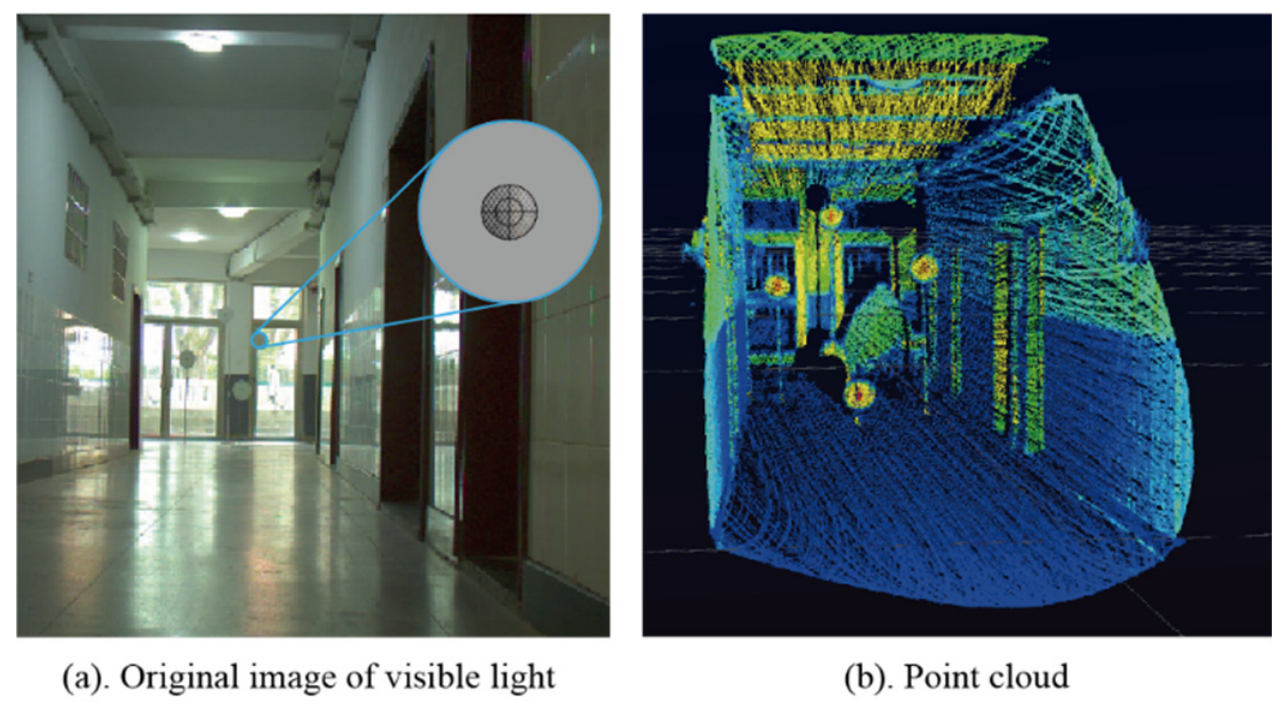
2.1. LiDAR Positioning Approach Based on Imaging and Recognition
- (a)
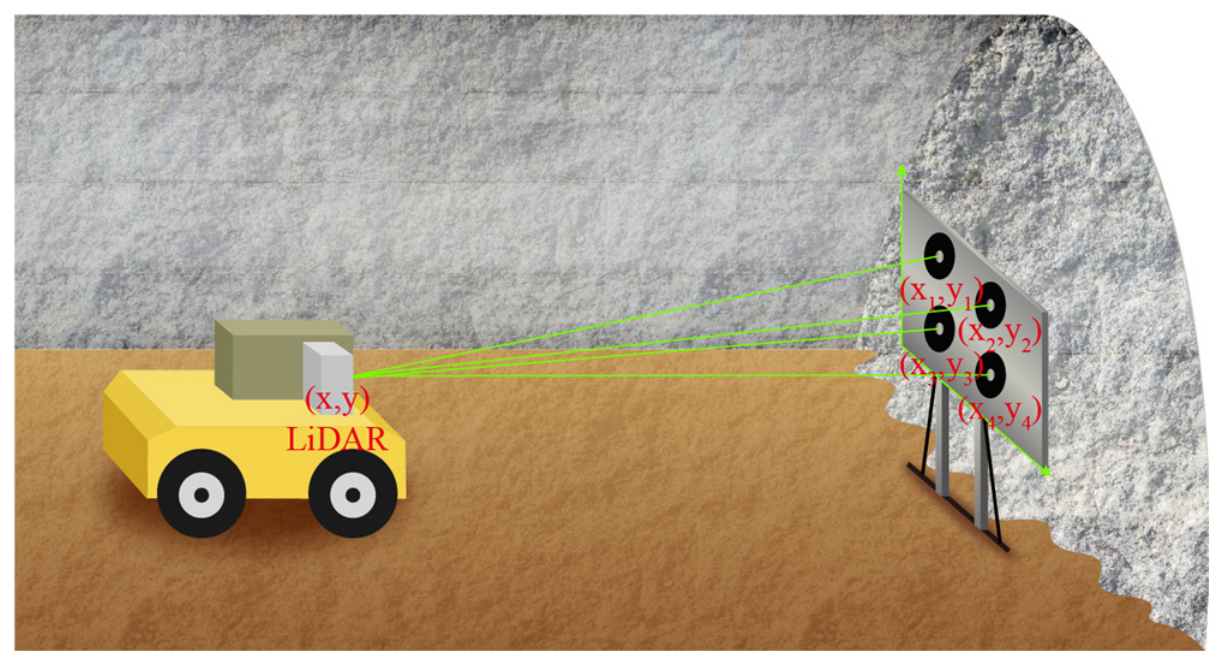
- The high-reflectivity point cluster associated with each retroreflective target is extracted using the intensity threshold described above. A local target plane is estimated from the 3D cluster, and the points are orthogonally projected onto this plane. The resulting two-dimensional coordinates are denoted by , where is the number of points retained for ellipse fitting.
- (b)
- The projected target boundary is represented by the general conic equation:
- (c)
- The ellipse parameters are estimated using the constrained direct least-squares method:
- (d)
- After has been obtained, the ellipse center in the local target plane is calculated independently of the semi-axis lengths as follows:
- (e)
- The constrained least-squares ellipse fitting was evaluated over 2000 LiDAR frames on a computer equipped with an Intel Core i7-12700H processor. The mean fitting time was 0.83ms per target, and the maximum fitting time was 2.71 ms. Depending on the target range and incidence angle, the number (N) of retained points used for each ellipse fit ranged from 58 to 246. These results indicate that the fixed-size generalized eigenvalue problem can be solved within the LiDAR frame period.
2.2. LiDAR Vibration Compensation Based on INS Attitude Feedback
2.2.1. Impact Analysis of Vibration on LiDAR Precision Positioning
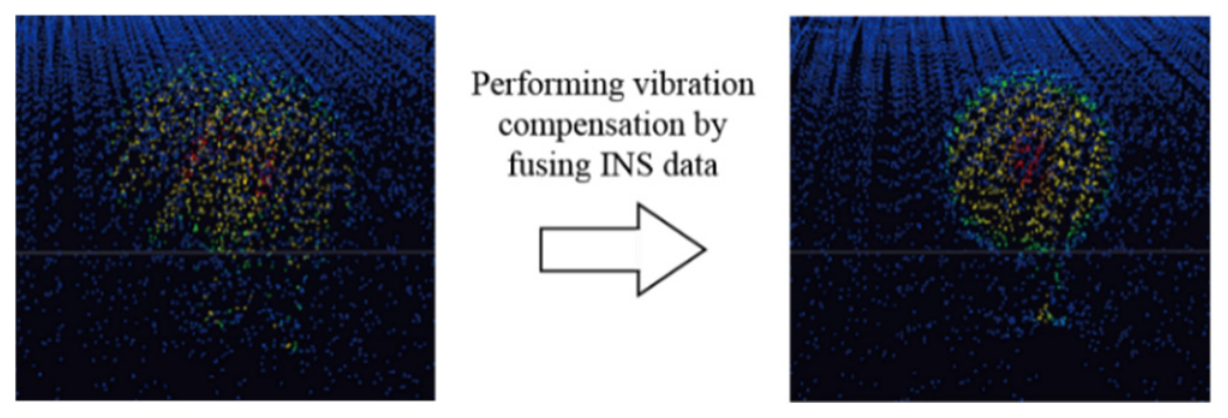
2.2.2. LiDAR Vibration Error Compensation Method
3. Optimal Fusion Approach of INS and LiDAR for Precise Tunnel Navigation
3.1. Overall Scheme
- I.
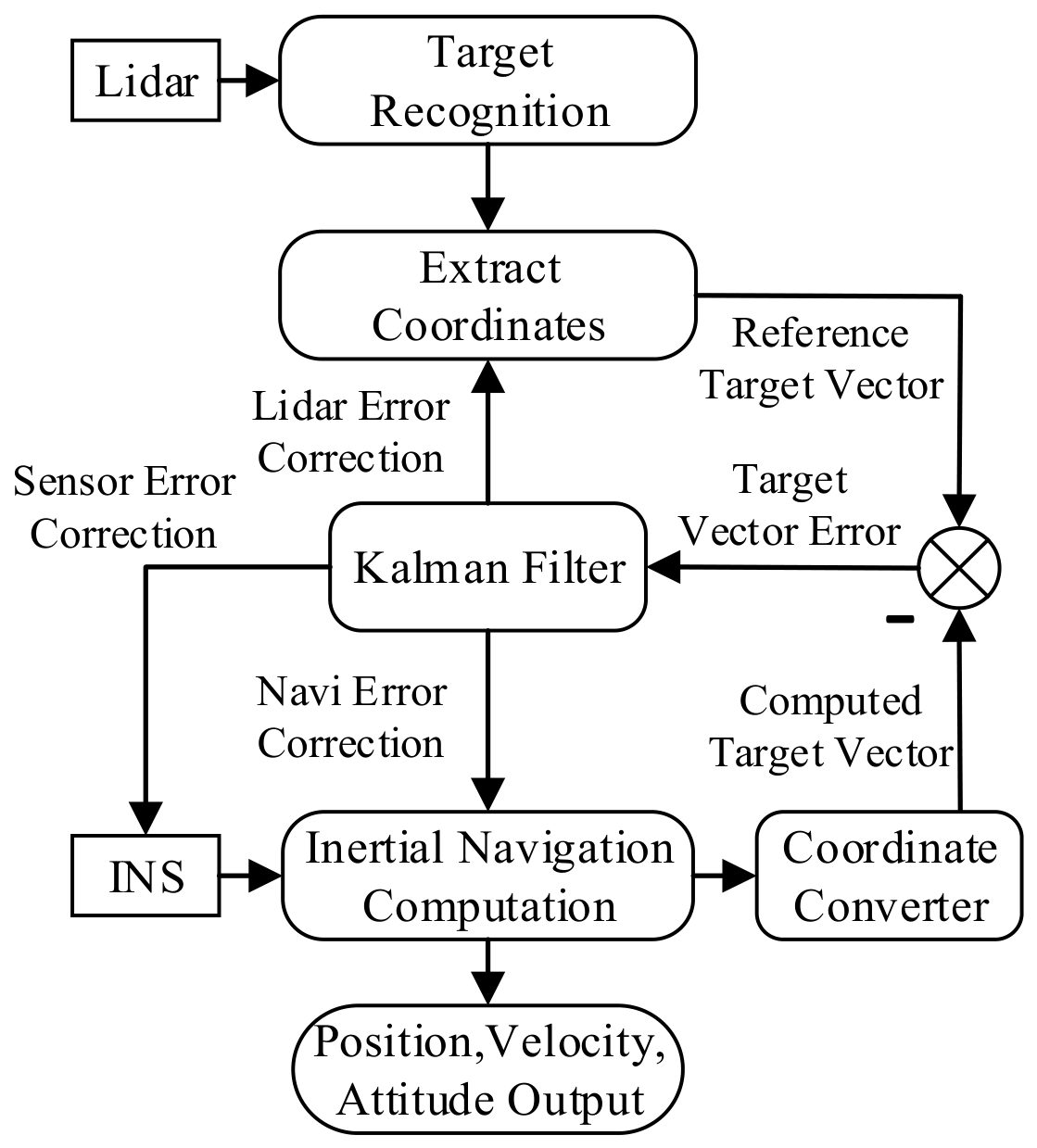
- Observation error acquisition: During LiDAR-INS data fusion, the position vector of fiducial markers is obtained either directly via LiDAR measurement or computationally through INS using reference coordinates. The position vector discrepancy is derived from the difference between these two calculation methods.
- II.
- Data fusion filtering: Estimated INS and LiDAR errors are corrected through filtering. High-frequency INS outputs subsequently compensate LiDAR observations, yielding the final fused navigation solution.
3.2. Dynamics for Optimal Estimation
3.3. Measurements for Optimal Estimation
3.3.1. The Landmark Positions Measured by the LiDAR
3.3.2. The Landmark Position Calculated by the INS
3.3.3. Measurement Equations
4. Experimental Tests
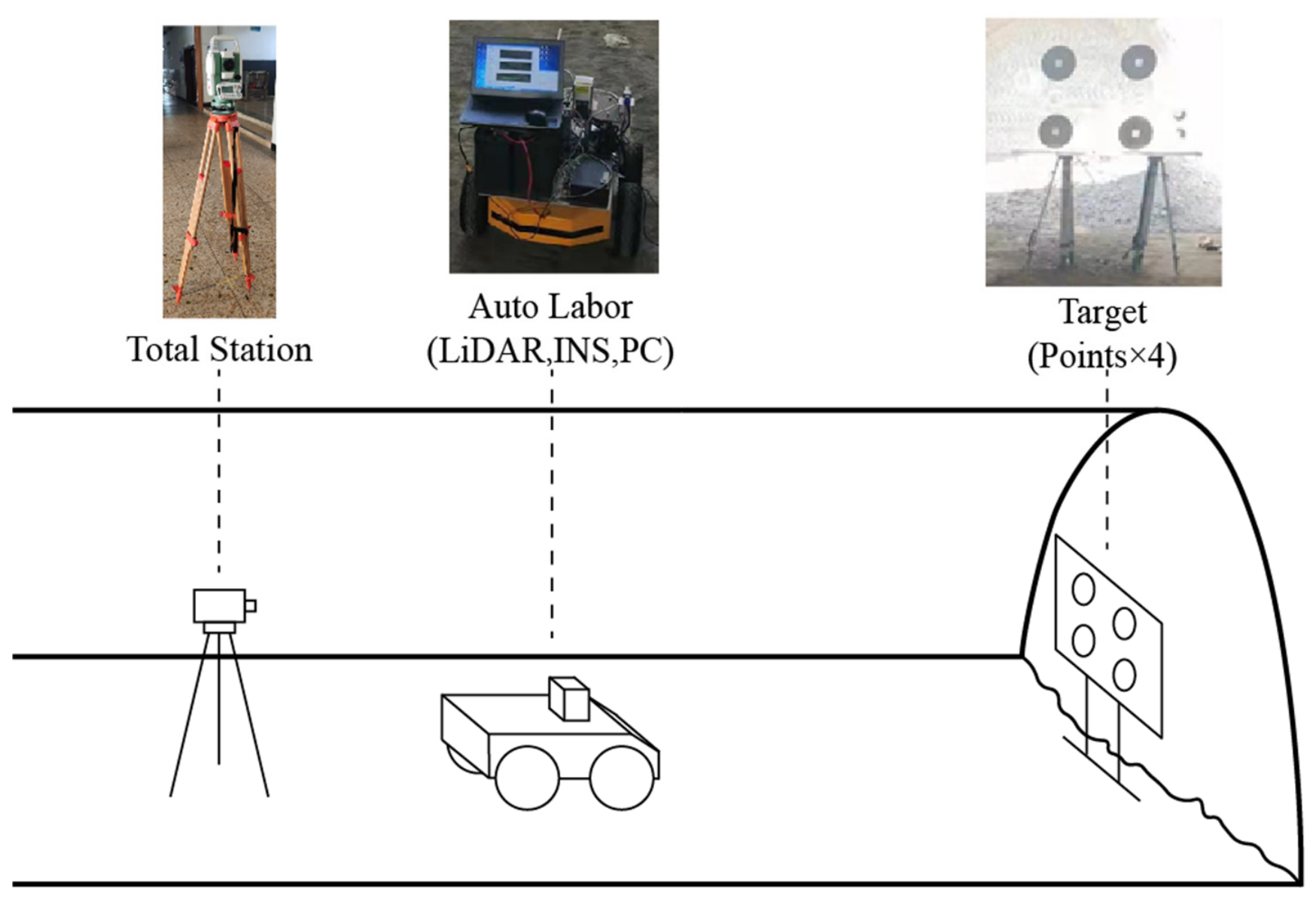
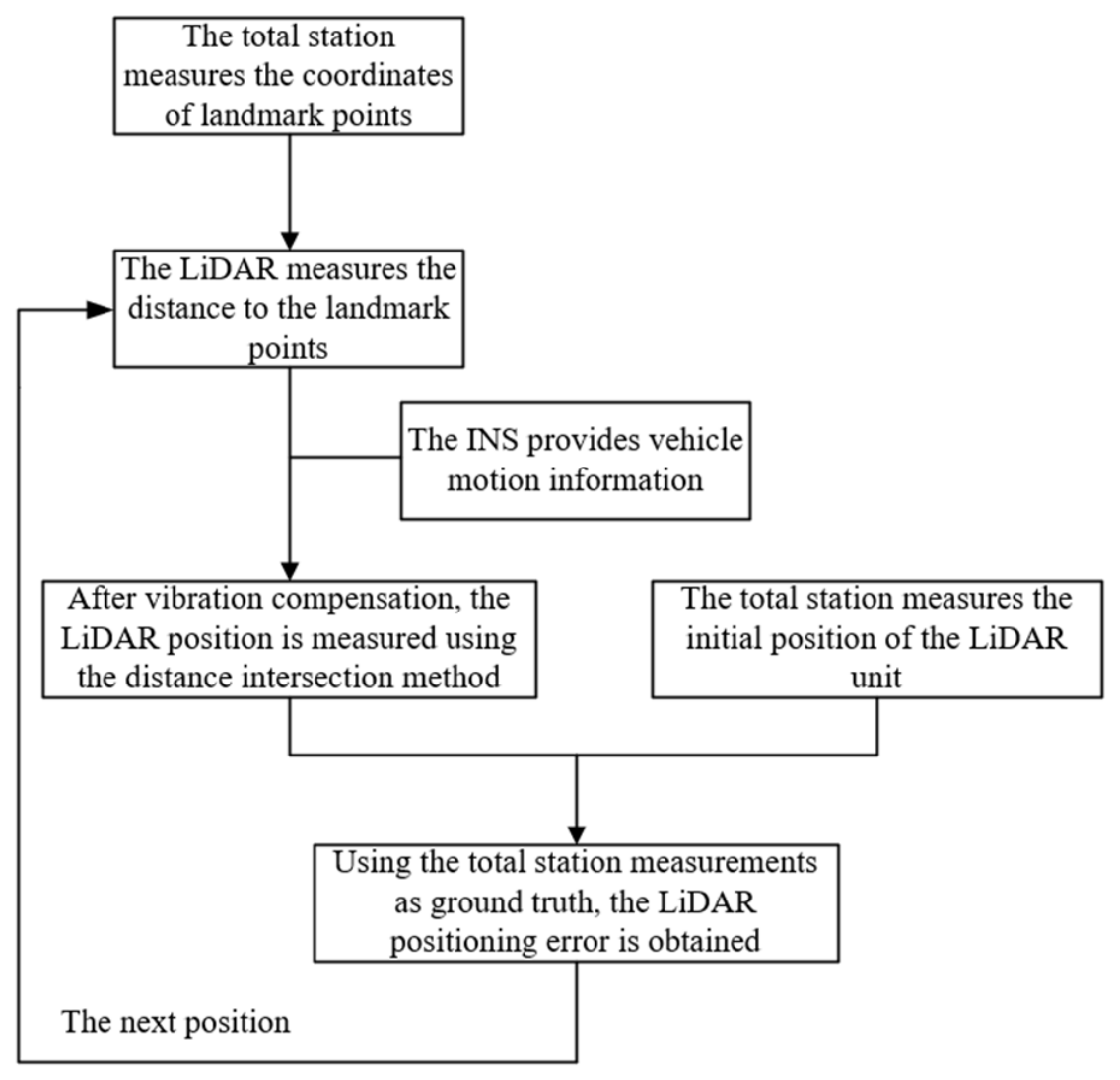
4.1. Experimental Setup, Calibration, and Reference Frames
4.2. Laboratory Tests
4.3. Field Tests
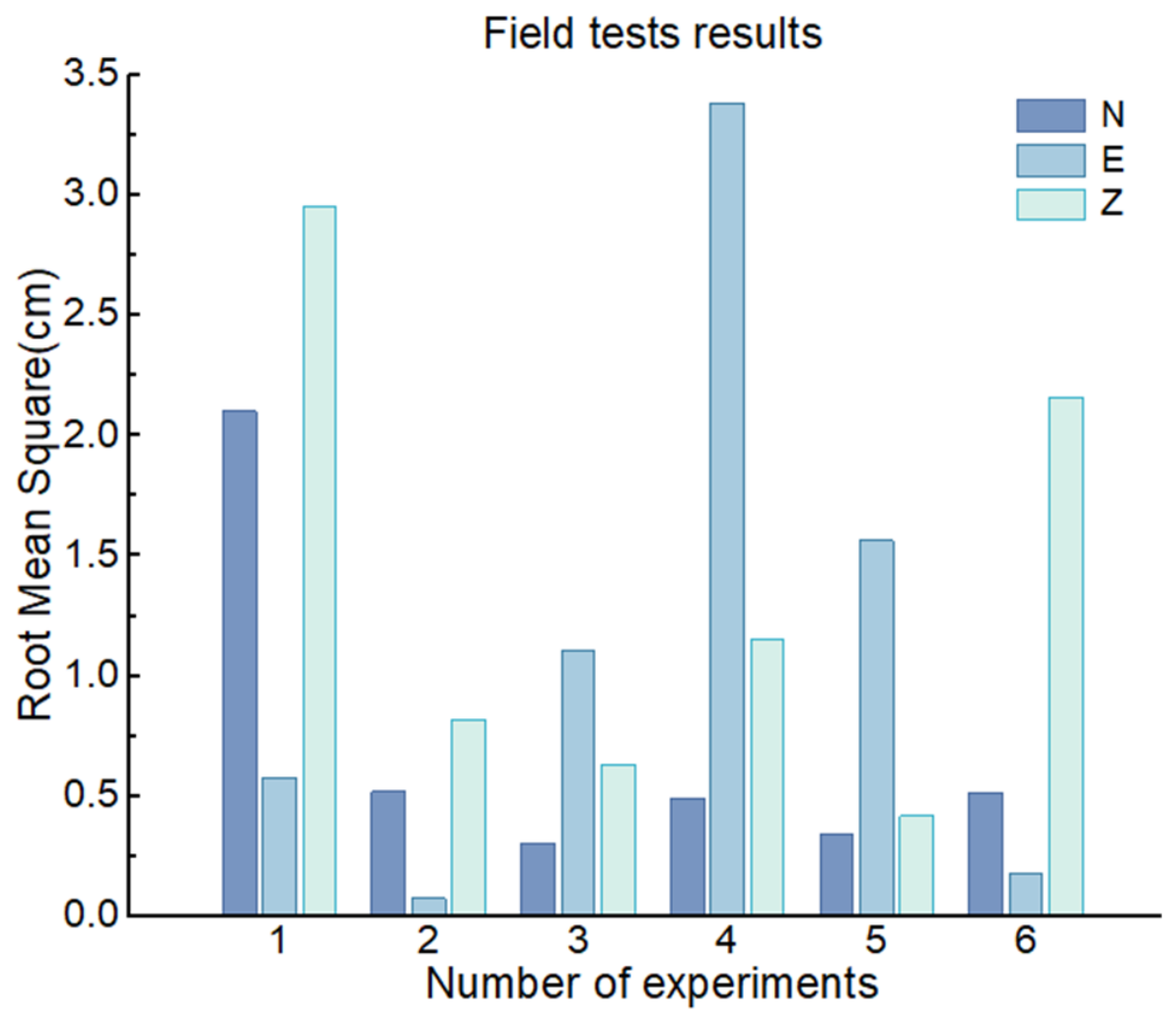
- North direction: Peak RMS error of 2.10 cm with average error below 1 cm.
- East direction: Peak RMS error of 3.38 cm with average error below 2 cm.
- Down direction: Peak RMS error of 2.95 cm with average error below 2 cm.
4.4. Ablation and Baseline Comparisons
- LiDAR only: marker-based positioning using the raw LiDAR observations without INS fusion or point-wise deskewing;
- INS only: inertial navigation without LiDAR measurement updates;
- LiDAR–INS without deskewing: LiDAR–INS fusion using the original, uncompensated LiDAR frames;
- Rotation-only deskewing: point-wise compensation using only the interpolated INS attitude;
- Rotation-and-translation deskewing: point-wise compensation using both the interpolated INS attitude and position;
- Complete proposed method: rotation-and-translation deskewing combined with the offline LiDAR angular-bias calibration, LiDAR–INS temporal alignment, and error-state Kalman-filter fusion.
4.5. Illumination Robustness Evaluation
5. Conclusions
Author Contributions
Funding
Institutional Review Board Statement
Informed Consent Statement
Data Availability Statement
Conflicts of Interest
References
- Hinton, E.H. Requirements for Positioning of Underground Hard Rock Mining Equipment and Experimentation with a Position Estimating System; Laurentian University: Sudbury, ON, Canada, 2000; p. 147. [Google Scholar]
- Hancke, G.P.; Silva, B.J. Wireless Positioning in Underground Mines: Challenges and Recent Advances. IEEE Ind. Electron. Mag. 2021, 15, 39–48. [Google Scholar] [CrossRef]
- Bartoszek, S.; Stankiewicz, K.; Kost, G.; Ćwikła, G.; Dyczko, A. Research on Ultrasonic Transducers to Accurately Determine Distances in a Coal Mine Conditions. Energies 2021, 14, 2532. [Google Scholar] [CrossRef]
- Barua, B.; Kandil, N.; Hakem, N. On performance study of TWR UWB ranging in underground mine. In 2018 Sixth International Conference on Digital Information, Networking, and Wireless Communications (DINWC); IEEE: NewYork, NY, USA, 2018. [Google Scholar]
- Chaloupka, Z. Technology and standardization gaps for high accuracy positioning in 5G. IEEE Commun. Stand. Mag. 2017, 1, 59–65. [Google Scholar] [CrossRef]
- Angelis, G.D.; Moschitta, A.; Carbone, P. Positioning Techniques in Indoor Environments Based on Stochastic Modeling of UWB Round-Trip-Time Measurements. IEEE Trans. Intell. Transp. Syst. 2016, 17, 2272–2281. [Google Scholar] [CrossRef]
- Kumar, O.P.; Kumar, P.; Ali, T.; Kumar, P.; Vincent, S. Ultrawideband Antennas: Growth and Evolution. Micromachines 2021, 13, 60. [Google Scholar] [CrossRef] [PubMed]
- Lin, X.; Gan, J.; Jiang, C.; Xue, S.; Liang, Y. Wi-Fi-Based Indoor Localization and Navigation: A Robot-Aided Hybrid Deep Learning Approach. Sensors 2023, 23, 6320. [Google Scholar] [CrossRef] [PubMed]
- Cheng, C.-H.; Syu, S.-J. Improving area positioning in ZigBee sensor networks using neural network algorithm. Microsyst. Technol. 2019, 27, 1419–1428. [Google Scholar] [CrossRef]
- Kachurka, V.; Rault, B.; Munoz, F.I.I.; Roussel, D.; Bonardi, F.; Didier, J.-Y.; Hadj-Abdelkader, H.; Bouchafa, S.; Alliez, P.; Robin, M. WeCo-SLAM: Wearable Cooperative SLAM System for Real-Time Indoor Localization Under Challenging Conditions. IEEE Sens. J. 2022, 22, 5122–5132. [Google Scholar] [CrossRef]
- Wicaksono, M.; Shin, S.Y. GO-SLAM: GPS-Aided Visual-Inertial SLAM for Adaptive UAV Navigation in Outdoor-Indoor Environments. IEEE Trans. Instrum. Meas. 2025, 74, 1–8. [Google Scholar] [CrossRef]
- Coulin, J.; Guillemard, R.; Gay-Bellile, V.; Joly, C.; de La Fortelle, A. Tightly-Coupled Magneto-Visual-Inertial Fusion for Long Term Localization in Indoor Environment. IEEE Robot. Autom. Lett. 2022, 7, 952–959. [Google Scholar] [CrossRef]
- Wang, R.R.; Liu, H.; Wang, B.; Jia, T.; Gao, C. Two-Stage Time-Varying Vibration Compensation for Coherent LiDAR Based on the Adaptive Differential Evolution Method. IEEE Trans. Geosci. Remote Sens. 2023, 61, 5701211. [Google Scholar] [CrossRef]
- Hu, H.; Jiang, Y.; Dai, Z.; Hao, R.; Fan, W.; Zhang, L.; Ge, X.; Xu, B.; Zhu, Q. Online calibration of LiDAR-camera extrinsic parameters of tunnel mapping system with depth-constrained vibration compensation. Int. J. Appl. Earth Obs. Geoinf. 2025, 139, 104556. [Google Scholar] [CrossRef]
- Qiang, C.; Haibo, C.; Lihua, Z. Lidar motion distortion compensation algorithm based on NDT regis-tration and wheel odometer. High Technol. Commun. 2019, 34, 83–91. [Google Scholar] [CrossRef]
- Zhang, H.; Wang, L.; Song, T.; Li, K. Error analysis and compensation for dual-axis inertial navigation system with horizontal rotation modulation. Proc. Inst. Mech. Eng. Part C J. Mech. Eng. Sci. 2018, 233, 313–322. [Google Scholar] [CrossRef]
- Veremeenko, K.K.; Savel’ev, V.M. In-flight alignment of a strapdown inertial navigation system of an unmanned aerial vehicle. J. Comput. Syst. Sci. Int. 2013, 52, 106–116. [Google Scholar] [CrossRef]
- Guang, X.; Gao, Y.; Leung, H.; Liu, P.; Li, G. An Autonomous Vehicle Navigation System Based on Inertial and Visual Sensors. Sensors 2018, 18, 2952. [Google Scholar] [CrossRef] [PubMed]
- Prokhortsov, A.V.; Smirnov, V.A.; Soloviev, A.E.; Chukova, O.V. Initial Alignment of Inertial Navigation Systems for Underground Mine Surveying. Proc. Tula States Univ.-Sci. Earth 2021, 2, 232–239. [Google Scholar]
- Wang, N. Satellite/Inertial Navigation Integrated Navigation Method Based on Improved Kalman Filtering Algorithm. Mob. Inf. Syst. 2022, 2022, 4627111. [Google Scholar] [CrossRef]
- Brazeal, R.G.; Wilkinson, B.E.; Hochmair, H.H. A Rigorous Observation Model for the Risley Prism-Based Livox Mid-40 Lidar Sensor. Sensors 2021, 21, 4722. [Google Scholar] [CrossRef] [PubMed]
- Groves, P.D. Principles of GNSS, Inertial, and Multisensor Integrated Navigation Systems, 2nd ed.; Artech House: Boston, MA, USA, 2013. [Google Scholar]
- Goshen-Meskin, D.; Bar-Itzhack, I.Y. Unified approach to inertial navigation system error modeling. J. Guid. Control. Dyn. 1992, 15, 648–653. [Google Scholar] [CrossRef]
- Xiao, H.; Han, Y.; Zhao, J.; Cui, J.; Xiong, L.; Yu, Z. LIO-Vehicle: A Tightly-Coupled Vehicle Dynamics Extension of LiDAR Inertial Odometry. IEEE Robot. Autom. Lett. 2022, 7, 446–453. [Google Scholar] [CrossRef]



| Value Used in Experiments | Meaning/Determination Method | Quantity |
|---|---|---|
| From gyroscope angular-random-walk specification or Allan-deviation fitting | : gyro white noise | |
| From velocity-random-walk specification or Allan-deviation fitting | : accelerometer white noise | |
| From bias-instability/bias-correlation analysis | : gyro-bias driving noise | |
| From bias-instability/bias-correlation analysis | : accelerometer-bias driving noise | |
| INS: 400 Hz, LiDAR: 10 Hz | INS propagation rate/LiDAR measurement-update rate | Filter rates |
| Sensors | Parameters | Value |
|---|---|---|
| FOG | Bias Stability | 0.01°/h, 1 |
| Bias Repeatability | ||
| Angular Random Walk | ||
| Quartz Accelerometer | Bias Stability | |
| Bias Repeatability | ||
| Scale Factor Stability | ||
| Velocity Random Walk | ||
| LiDAR | Detection Range | (20% reflectivity) |
| FoV | 38.4° (circular) | |
| Range Precision | 2 cm (nominal, 1 σ under specified conditions) | |
| Angular Accuracy | <0.1° |
| Quantity | Test Condition/Determination | Value Used |
|---|---|---|
| Range bias | Known target distances; mean measured-minus-reference range | Original: 1.2 cm, After calibration: ≤±0.6 cm |
| Elevation bias | Surveyed target direction; mean angular residual | Original: 0.28°, After calibration: ≤±0.05° |
| Azimuth bias | Surveyed target direction; mean angular residual | Original: 0.24°, After calibration: ≤±0.03° |
| Target-center repeatability | Standard deviation of repeated static center estimates | 0.3–1.2 cm |
| Time/Frame (ms) | Max. Error (cm) | 3D RMSE (cm) | N/E/D RMSE (cm) | Target-Fit RMSE (cm) | Configuration |
|---|---|---|---|---|---|
| 12.8 | 17.5 | 12.52 | 5.3/6.2/9.5 | 3.65 | LiDAR only |
| 0.8 | 44.9 | 24.60 | 13.8/16.3/12.2 | N/A | INS only |
| 22.4 | 15.2 | 9.05 | 4.6/5.2/5.8 | 3.64 | LiDAR-INS, no point-wise deskewing |
| 28.4 | 11.7 | 6.51 | 3.4/4.6/3.1 | 2.47 | Rotation-only deskewing |
| 36.9 | 9.3 | 5.32 | 2.4/3.6/3.1 | 1.80 | Rotation + translation deskewing |
| 43.8 | 8.4 | 4.96 | 2.10/3.38/2.95 | 1.31 | Complete proposed method |
| Condition | Illuminance (lx) | Valid-Point Ratio (%) | Detection Success (%) | Range Standard Deviation (cm) | Target-Fit RMSE (cm) | 3D Positioning RMSE (cm) |
|---|---|---|---|---|---|---|
| Dark/lights off | 0.3 | 98.4 | 99.3 | 1.02 | 1.27 | 5.02 |
| Normal tunnel lighting | 156 | 97.8 | 99.1 | 1.16 | 1.31 | 4.96 |
| Strong artificial background light | 3650 | 89.6 | 94.8 | 1.78 | 1.74 | 6.18 |
Disclaimer/Publisher’s Note: The statements, opinions and data contained in all publications are solely those of the individual author(s) and contributor(s) and not of MDPI and/or the editor(s). MDPI and/or the editor(s) disclaim responsibility for any injury to people or property resulting from any ideas, methods, instructions or products referred to in the content. |
© 2026 by the authors. Licensee MDPI, Basel, Switzerland. This article is an open access article distributed under the terms and conditions of the Creative Commons Attribution (CC BY) license.
Share and Cite
Han, S.; Chen, T.; Dong, J.; Yu, X.; Liu, X. Vibration Error Compensation of LiDAR Imaging with the Aiding of INS for Precise Navigation. Sensors 2026, 26, 4277. https://doi.org/10.3390/s26134277
Han S, Chen T, Dong J, Yu X, Liu X. Vibration Error Compensation of LiDAR Imaging with the Aiding of INS for Precise Navigation. Sensors. 2026; 26(13):4277. https://doi.org/10.3390/s26134277
Chicago/Turabian StyleHan, Songlai, Tanjie Chen, Jing Dong, Xudong Yu, and Xuesong Liu. 2026. "Vibration Error Compensation of LiDAR Imaging with the Aiding of INS for Precise Navigation" Sensors 26, no. 13: 4277. https://doi.org/10.3390/s26134277
APA StyleHan, S., Chen, T., Dong, J., Yu, X., & Liu, X. (2026). Vibration Error Compensation of LiDAR Imaging with the Aiding of INS for Precise Navigation. Sensors, 26(13), 4277. https://doi.org/10.3390/s26134277