3.1. Acquisition Platform for Partial Discharge Carbon Trace
To address scarce training data for detection tasks, this study established an experimental platform to reproduce intense normal electric fields across oil-paper insulation systems. Through systematic observation of carbon deposition dynamics and defect morphology replication, a comprehensive carbon trace database was constructed.
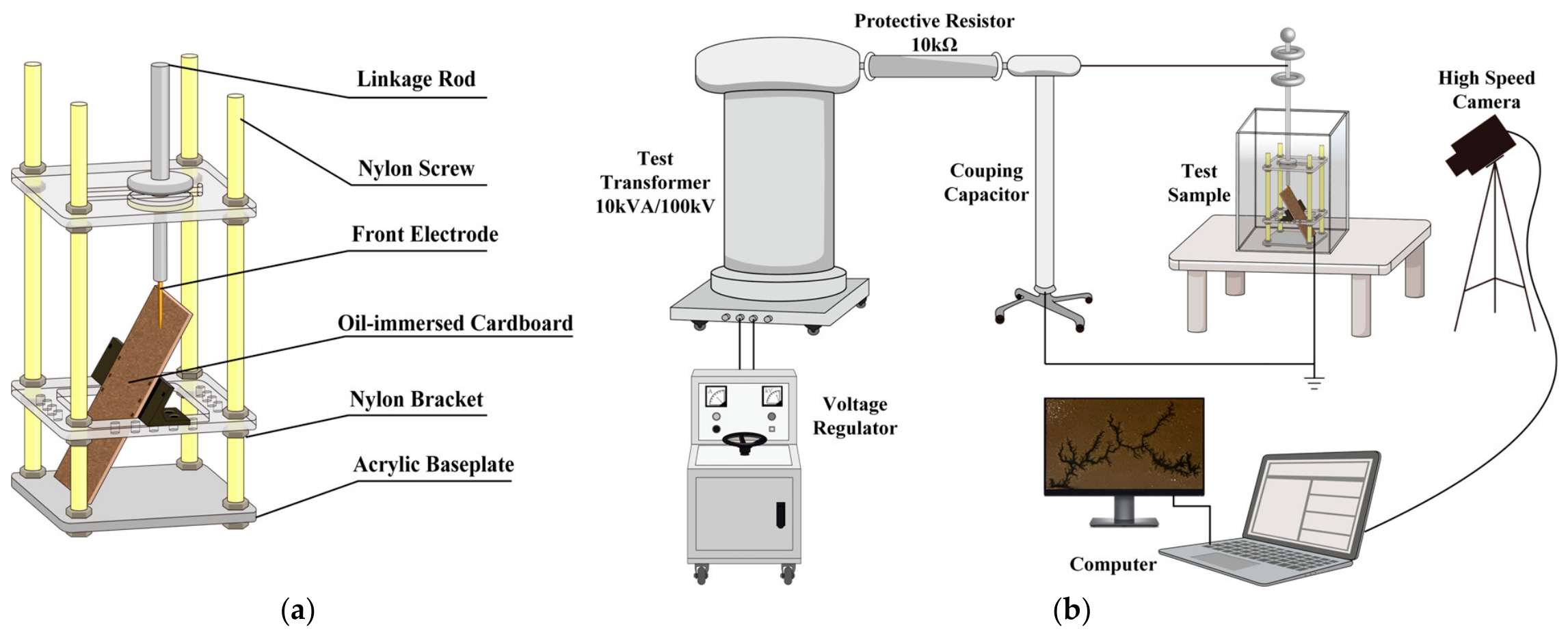
As shown in
Figure 3, the platform comprises two main components: an oil-paper insulation needle-plate discharge subsystem and a carbon trace capture subsystem. As shown in
Figure 3a, the needle-plate electrode configuration features a tungsten needle with a 0.2 mm curvature radius secured by brass front-end fixtures, paired with a standard transformer pressboard measuring 25 cm × 15 cm mounted by adjustable polyamide supports on an acrylic baseplate. Auxiliary structures include nylon adjustment screws, a grading ring, and a linkage rod. As shown in
Figure 3b, the discharge subsystem is put into a transparent acrylic test chamber, which is filled with Karamay #25 transformer oil. Powered by an SB-10 KVA/100 KV AC testing transformer, the imaging subsystem employs a high-speed camera (HTSUA134GC/M, 1.3 million pixels, 211 FPS) to transmit carbon trace images via an HDMI interface. This platform enables systematic investigation of carbon trace morphology under different operational states through adjusting operational parameters including dielectric tilt angle, electrode gap distance, and discharge characteristics.
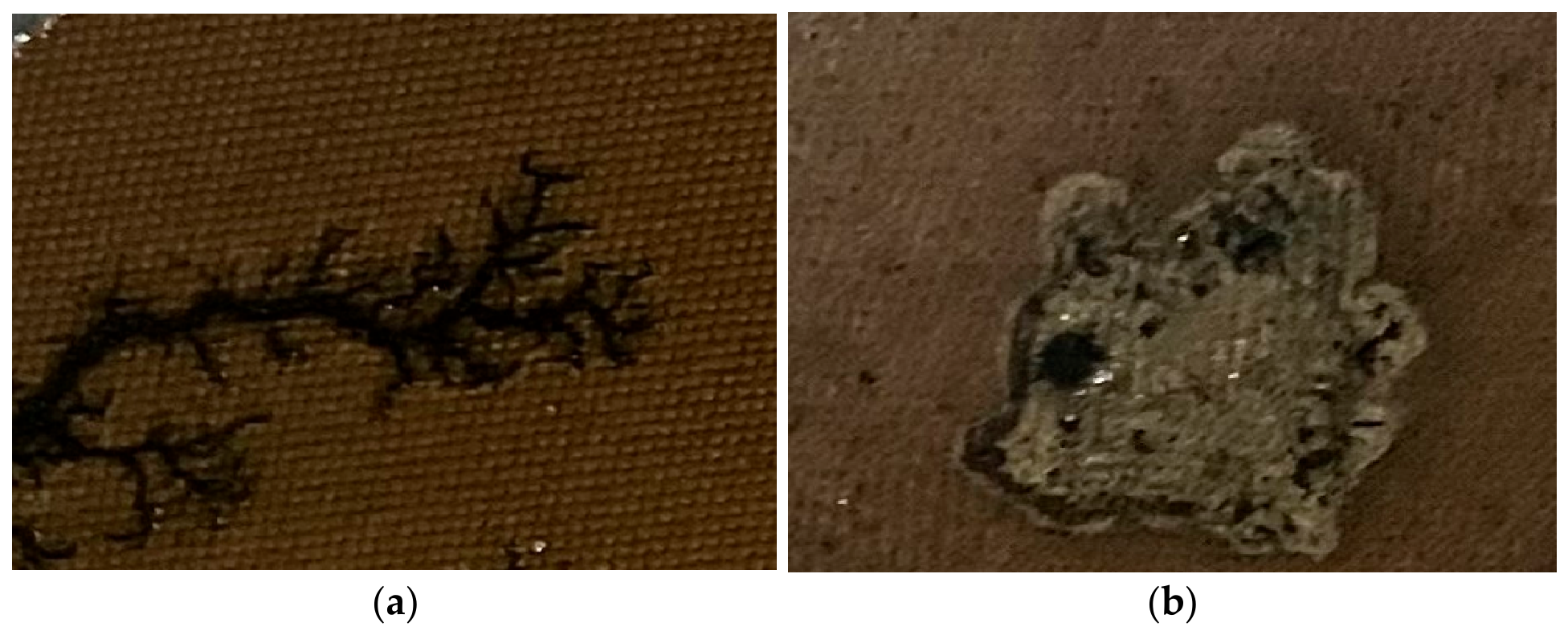
Two typical categories of discharge carbon trace images, namely dendritic and clumpy carbon traces, were finally obtained, as shown in
Figure 4. Due to the difficult formation of carbon traces, the amount of carbon trace samples collected in simulation experiments was still insufficient for deep learning model training. To expand the sample amount, the original samples generated by discharge experiments were first divided into training, validation, and test sets. Data augmentation was then performed independently only within each dataset, ensuring that similar samples come from the same original discharge experiment and their augmented images would not appear in different datasets.
During dataset construction, a more rigorous splitting strategy was adopted. The 654 original images were obtained from different discharge experiments, and 206 images (116 dendritic and 90 clumpy) were selected as the test set. The remaining images were split at an 8:2 ratio into a training set (359 images) and a validation set (89 images). After LabelImg annotation and illumination adjustment, random rotation, mirroring, and stretching were applied to the remaining carbon trace images in the training and validation sets for data augmentation. A complete training set containing 3658 images (2329 dendritic and 1329 clumpy images) was finally constructed, providing reliable data support for model training and evaluation.
3.2. Retinex with Superimposed Illumination Estimation for Transformer Image Enhancement
Image acquisition inside sealed, oil-filled transformers is challenging. The lack of natural illumination requires fill-light illumination. And insulating oil absorbs and scatters light, causing color distortion, blurred details, low contrast, and uneven brightness [
33,
34]. In addition, slight differences in the robot’s hovering position affect the spatial relationship between the lens and the carbon traces. The complex internal structure of the transformer may also block the fill light, producing shadows on inspected surfaces or obscuring detection targets. These problems will reduce the quality of carbon trace images and impair the reliability of insulation defect diagnosis. Therefore, this study investigates imaging enhancement algorithms inside the transformer oil.
Researchers have investigated low-light image enhancement mainly through two technical routes: traditional methods and deep learning methods. Traditional methods rely on physical models or image statistical properties. They improve image color, brightness, and contrast by inverting degradation processes or adjusting pixel values. However, such methods have difficulty for uneven illumination correct and noise suppression in complex scenes [
35]. In recent years, because of stronger modeling capability and multi-scale feature representation, deep-learning-based image enhancement methods have become a research focus. Supervised methods establish nonlinear mappings between low-quality and high-quality images, thereby reducing problems such as inaccurate illumination estimation, artifact generation, and noise amplification. However, supervised methods rely on paired normally illuminated images, limiting their application scenarios and increasing engineering difficulty [
36]. Unsupervised methods eliminate dataset construction barriers, but they lack explicit supervision and often ignore physical characteristics such as the application scenario and degradation mechanism. Therefore, their enhancement results may be random and may not accurately match human-specified task objectives [
37]. In addition, diffusion-model-based enhancement methods mainly learn uncertain mapping between low-light and normally exposed images and consider more complex degradation modeling and detail reconstruction [
38,
39], but they usually cannot meet the real-time requirements of industrial visual detection.
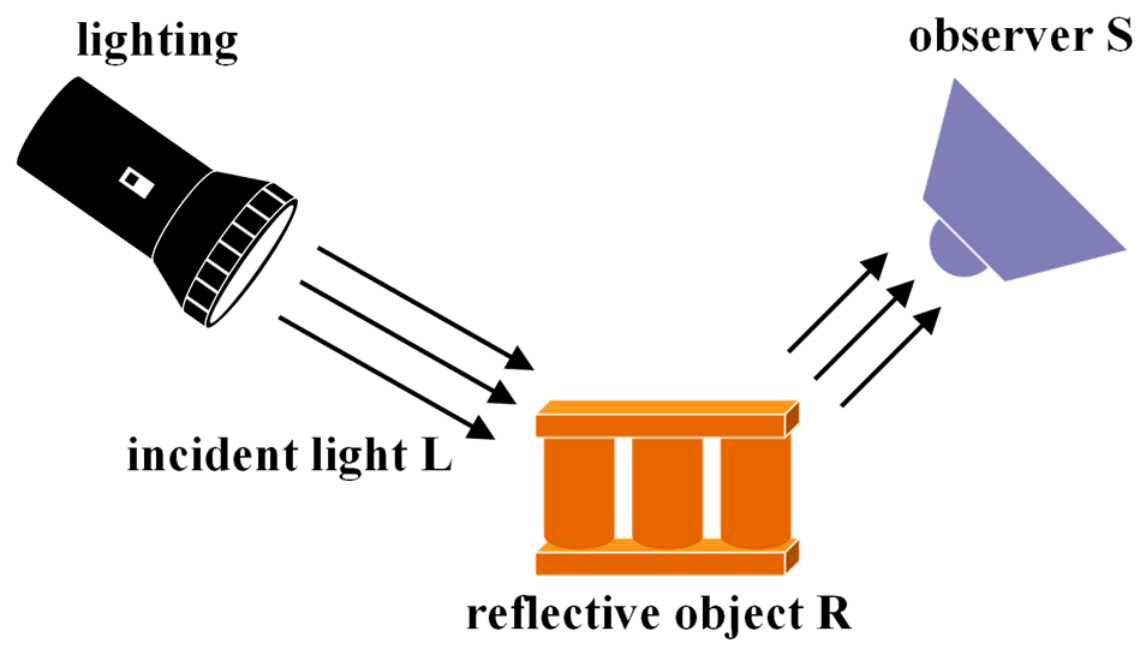
To process submerged carbon trace images, we designed a low-light image enhancement algorithm based on the Retinex theory. This approach draws upon color constancy theory to achieve more natural-looking image enhancements. A schematic overview of its operational principle is provided in
Figure 5.
This theory assumes that an impaired original image
results from the synthesis of two components: an illuminance component
induced by a light source and an object-specific reflection component
, expressed as follows.
As human perception of surface color characteristics in visible objects primarily relies on reflected information from object surfaces, the MSRCR algorithm has been proposed [
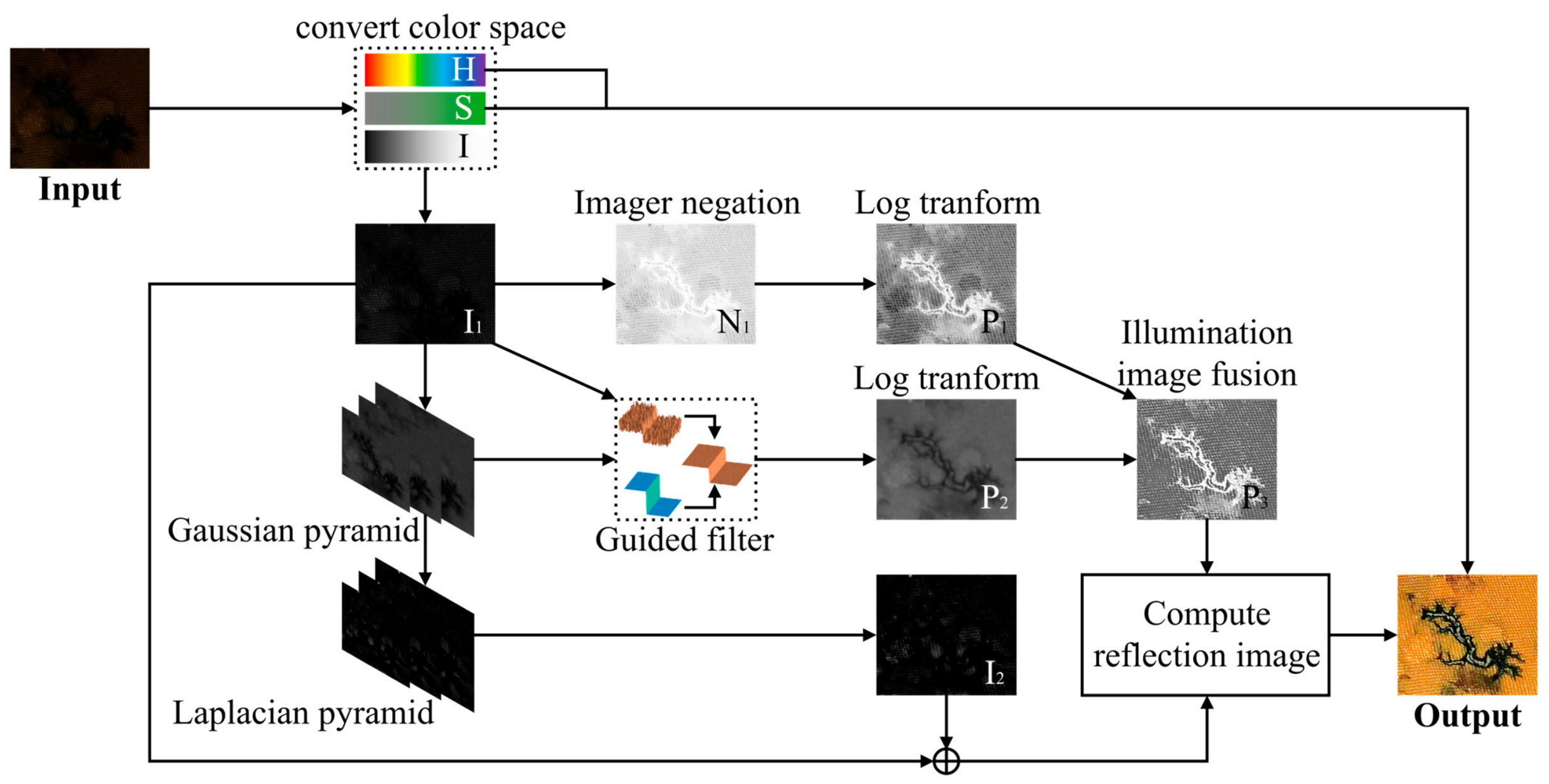
40]. However, while enhancing overall brightness, the MSRCR algorithm excessively intensifies dark-region details, causing the intricate edges blurred and color deviation with respect to carbon traces. To address this limitation, we proposed the improved Retinex algorithm integrated with superimposed illumination estimation for image enhancement, as shown in
Figure 6. By integrating negative images with multi-scale illumination maps into composite estimates, it suppresses over-enhancement in extremely dark regions, preserving vital carbon trace characteristics.
Initially, the input image is transformed from RGB color space to HSI color space to achieve decoupling of intensity and chrominance. The conversion process from R, G, B channels to H, S, I channels is expressed as follows:
In the final stage of the algorithm, to prevent color shifts and distortions arising from applying image enhancement directly to the original RGB channels, the corrected intensity channels with preserved hue and saturation components are recombined. Furthermore, selectively enhancing the intensity component significantly reduces computational complexity while accelerating image processing speed.
The proposed method employs a Laplacian pyramid to enhance high-frequency image information. It first applies Gaussian filters
interatively to downsample the original image to construct a Gaussian pyramid, where the level
-th image is denoted as
, expressed as follows:
The Laplacian pyramid decomposes the high-frequency details into multiple distinct frequency bands. Let
denote the level
in the Laplacian pyramid, which is constructed using Formula (6):
As each level of the Laplacian pyramid is constructed by subtracting the upsampled level of the Gaussian pyramid from its level counterpart, it retains multi-scale high-frequency details at the corresponding position in the original image, thereby enabling effective extraction of carbon trace characteristics.
In the brightness enhancement section, a guided filtering method was adopted to refine multi-scale illumination estimations. First, each layer of the Gaussian pyramid is converted into an illumination estimation
with uniform dimensions. Subsequently, guided filtering is applied to produce edge-preserving and more accurate illumination estimation. As a linear shift-invariant filtering process, the proposed algorithm utilizes the original image’s intensity channel
as the guidance image, while upsampling each Gaussian pyramid layer to match the resolution of the source image as input
. For any pixel
in the output image L, its value is computed according to:
where
represents the value of pixel
in the output image,
represents the local window encompassing pixel
;
and
are linear coefficients within this local window, determined by an objective function expressed as:
As image dark regions contain richer target information, processing negative images provides more advantages for carbon trace identification. A negative image is created by inverting the brightness values of the input image, mathematically expressed as:
Performing illumination fusion on the weighted multi-scale illumination estimation
and negative images
, while incorporating two weight factors
and
to regulate the synthesis ratio, the final illumination estimation
is yielded, expressed as:
is calculated as the enhanced image expression according to Retinex theory as follows:
where
is introduced to globally control the magnitude of image brightness elevation. Through multiple adjustment tests, it was found that
achieved an ideal balance between visual enhancement and defect-detail preservation. It is suitable for transformer internal carbon trace image enhancement.
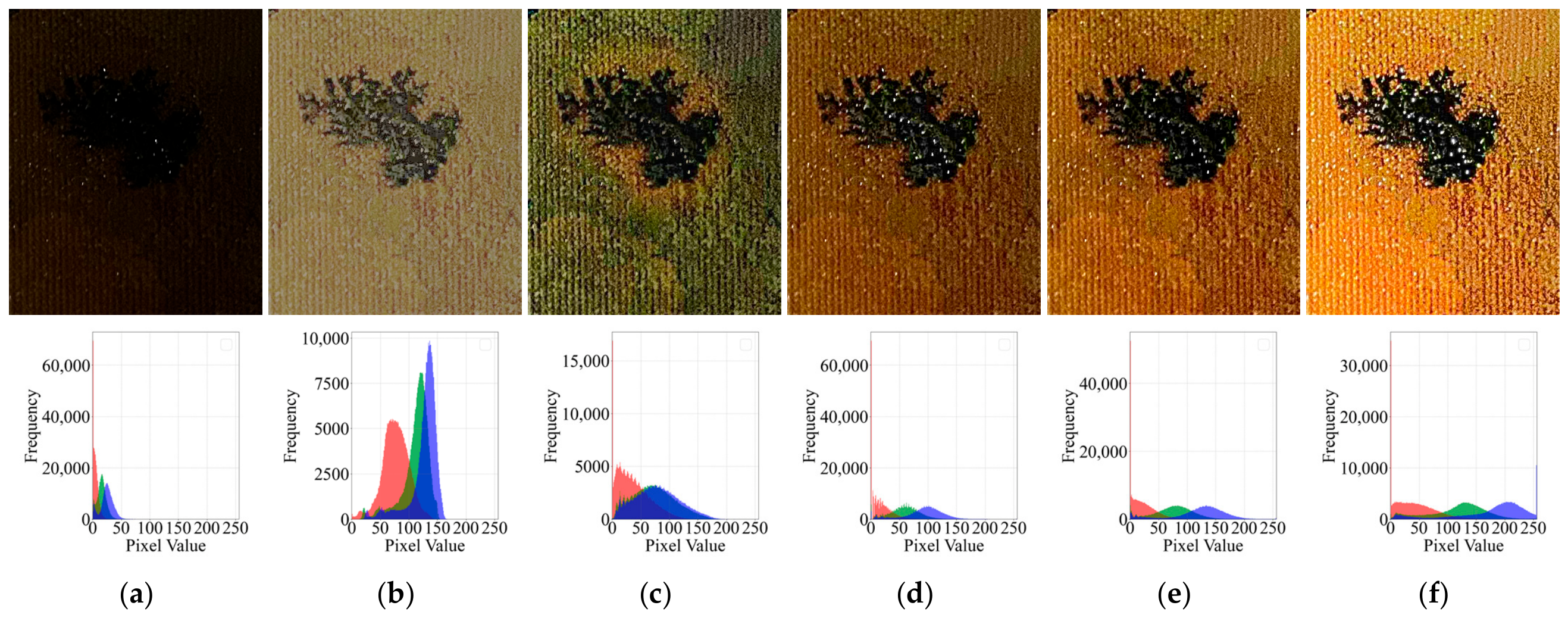
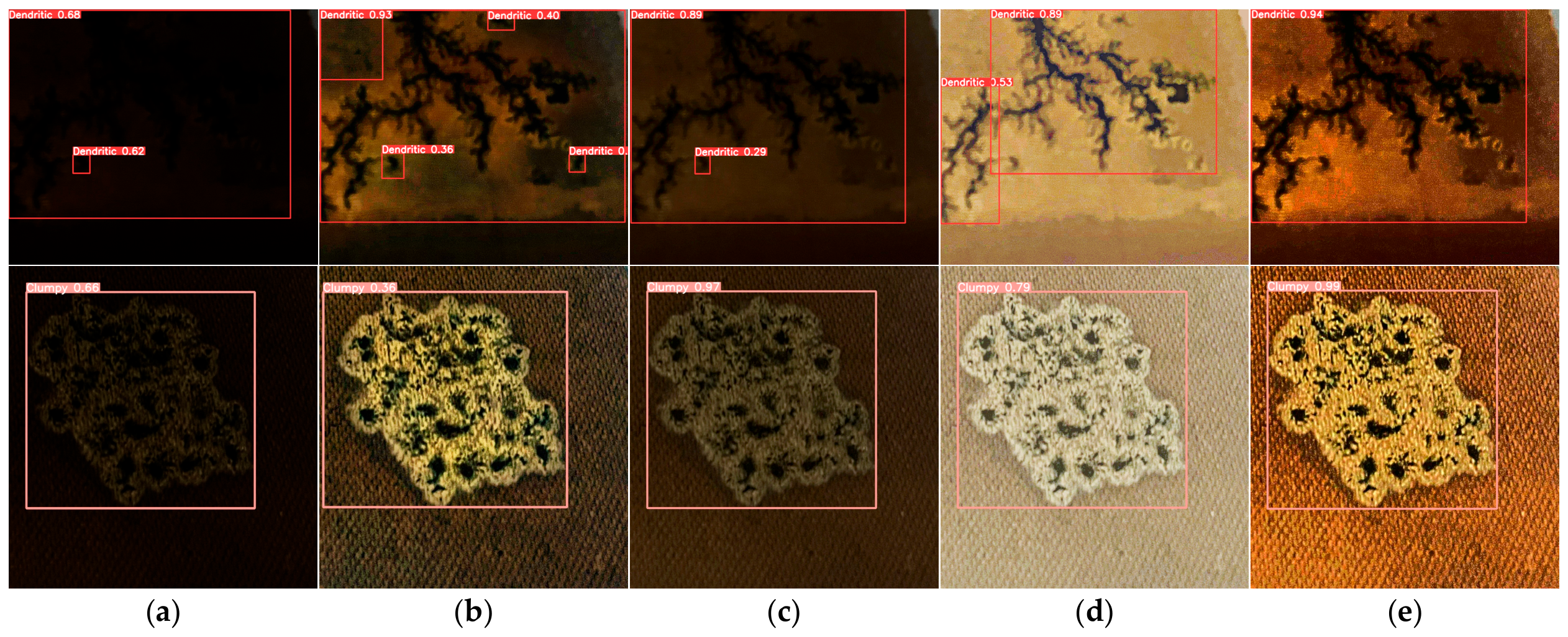
To validate the suitability of the proposed Retinex with superimposed illumination estimation for carbon trace image enhancement, this study conducts comparative experiments using multiple distinct enhancement algorithms. The visual comparison results against primary methods including MSRCR, SRIE and DCP algorithms are shown in
Figure 7.
As shown in
Figure 7, the original image has low overall brightness, making carbon traces difficult to distinguish from the background. After MSRCR processing, the sample’s brightness and contrast are improved, but obvious color distortion is observed, and carbon trace details are blurred with considerable feature loss. After CLAHE processing, brightness and contrast are further improved, which helps to preserve carbon trace features, but the output image shows severe color cast and noise amplification. The SRIE algorithm moderately improves the sample’s brightness while preserving color, improving the natural visual appearance. The DCP algorithm also improves brightness and contrast while maintaining color restoration, but local dark-region carbon trace details are blurred and lost. The proposed algorithm controls pixel stretching in extremely dark regions while expanding the pixel distribution range, improving overall brightness, reducing color distortion, and strengthening carbon trace details. It facilitates subsequent target feature learning by the carbon trace recognition network.
The innovation of the proposed Retinex-based image enhancement algorithm with superimposed illumination estimation is mainly reflected in the following aspects. First, considering the color contrast characteristics of typical carbon traces, this study combines Retinex-based illumination estimation with HSI channel separation. This transformation simplifies illumination correction and reduces subsequent processing complexity, while improving image brightness and preserving the color relationship between carbon traces and the oil background as much as possible. Thus, it could reduce color distortion in common methods such as MSRCR.
Second, for the complex fine-branch morphology of carbon traces, a Laplacian pyramid is used to efficiently extract high-frequency texture information from typical carbon trace images. The image is decomposed into detail information at different resolution levels, so that carbon trace contours and tiny local carbon trace textures maintain good structural continuity.
Third, a guided filtering method is used to correct multi-scale illumination estimation, giving the illumination component edge-preserving property and reducing boundary blur caused by traditional smoothing filters.
Fourth, a negative-image superimposed illumination estimation is introduced. By fusing dark-region information, it enhances dark-detail features of carbon traces and suppresses noise amplification and pseudo-texture problems caused by excessive stretch of extremely dark regions.
Fifth, the proposed method has strong interpretability and low algorithmic complexity, making it suitable to embed in the image acquisition and defect detection workflow of transformer internal inspection robots. It does not require construction of a large-scale paired low-light training dataset and avoids the domain generalization risk of deep enhancement networks in industrial small-sample scenarios. The proposed low-light enhancement algorithm for carbon trace images provides high-quality input data for subsequent carbon trace defect detection training and inference, thereby improving insulation defect detection accuracy.