1. Introduction
The progressive initiation, propagation, and coalescence of microcracks are widely recognized as the fundamental mechanisms governing macroscopic rock failure, posing a direct threat to the long-term structural integrity of underground openings, tunnels, and deep excavations [
1,
2]. In many geological environments, the presence of water—particularly when accompanied by cyclic acid-base alterations—accelerates microcrack development, induces coupled chemical and physical deterioration, reduces the mechanical strength of rock, and may ultimately lead to catastrophic failure. Elucidating microcrack evolution is therefore essential for predicting macroscopic instability and preventing engineering disasters [
3,
4,
5]. However, direct observation and quantitative characterization of these microscale cracks remain extremely challenging owing to their extremely small scale and highly heterogeneous distribution [
6,
7]. Moreover, the relationship between internal fracture progression and ultimate macroscopic failure modes under complex environmental conditions is still poorly understood, highlighting the urgent need for effective monitoring and identification methodologies.
Acoustic emission (AE) technology offers a promising non-destructive testing approach for capturing, in real time, the elastic waves released during crack initiation and propagation, thus serving as a powerful proxy for monitoring internal damage evolution in rock [
8,
9,
10]. Through analysis of AE parameters such as counts, energy, amplitude, and frequency characteristics, researchers have attempted to correlate AE signal features with different fracture modes and damage stages [
11,
12]. For instance, tensile and shear cracks have been shown to generate distinctly different AE spectral signatures, enabling preliminary discrimination of failure mechanisms [
13,
14]. Concurrently, several studies have investigated the strength variations of rock subjected to cyclic wet–dry or acid-base pretreatment [
15,
16]. Despite these advancements, traditional AE analysis methods still mainly rely on manually selected parameters (or statistical indicators), which have problems such as limited sample size and subjective threshold selection, making it difficult to systematically process large amounts of continuous waveform data [
17,
18,
19]. These limitations result in low classification accuracy and inefficient identification of rock failure stages, a problem that becomes particularly pronounced when rapid, automated processing of large quantities of AE spectrograms is required [
20,
21]. Consequently, there is an urgent need to develop more intelligent and robust classification models capable of learning discriminative features directly from AE spectrogram images.
Recent advances in deep learning have revolutionized image and spectral pattern recognition, with convolutional neural network (CNN) achieving state-of-the-art performance in numerous classification tasks [
22,
23]. This success has spurred the application of CNN-based models in geotechnical engineering [
24]. In the field of AE monitoring, some researchers have transformed raw AE waveforms into spectrogram images via time-frequency analysis and subsequently employed CNN architectures to classify these images according to damage stages or fracture types [
25]. For example, Zhang et al. [
26] proposed a method that integrates AE signals with an information-fusion CNN for the semi-quantitative identification of pore characteristics in sandstone from the Yungang Grottoes. Song et al. [
27] converted AE waveforms of rock fracturing under various loading conditions into time-frequency images and employed five CNN models to classify the AE signals, achieving high recognition accuracy. Among the available CNN architectures, VGG16 (Visual Geometry Group) stands out owing to its uniform 3 × 3 convolutional kernels and deep architecture, which enable the extraction of rich hierarchical features and deliver excellent performance in generic image recognition tasks [
28,
29,
30]. The application of VGG16 has been extended to structural health monitoring and fault diagnosis, showing promising results in spectrogram pattern classification. For instance, Sun et al. [
31] regarded rock fracturing AE signals as a type of speech signal and constructed six intelligent real-time recognition models based on VGG16 and AlexNet, providing a new approach for real-time intelligent identification of critical AE signals during rock failure. Ren et al. [
32] used AE data from Brazilian splitting and direct shear tests on red sandstone, employed three CNN networks including VGG19 to classify waveform images and spectrograms for distinguishing tensile and shear signals, and found that CNNs significantly outperformed traditional decision tree methods, recommending the combination of VGG19 with waveform images as an effective means to discriminate tensile-shear fracture AE signals. However, directly applying VGG16 to the classification of rock AE spectrograms presents significant challenges. First, the high dimensionality of input spectrograms leads to excessive computational cost and long training times, limiting the model’s suitability for practical large-scale monitoring tasks. Second, redundant or noisy frequency components present in AE spectrograms can easily cause overfitting and degrade generalization capability. Furthermore, the fully connected layers of VGG16 contain an enormous number of parameters that require meticulous tuning, further increasing training complexity. As a result, when dealing with the inherently complex and variable AE signals of rock subjected to different chemical environments, the direct use of VGG16 often yields suboptimal accuracy and poor time efficiency. Enhancing the VGG16 architecture to achieve high-accuracy classification while reducing the computational burden is therefore an urgent research need.
To address the above challenges, this study proposes a novel cascaded learning framework (PCA-VGG16) that structurally integrates an upstream linear feature purification operator with a downstream topologically optimized deep network. In this architecture, the PCA-based component is presented as a PCA-based convolution encoder that serves as a foundational preprocessing layer of the entire framework before feedforwarding into VGG16. Rather than acting as an isolated preprocessing routine, this upstream convolution encoder is strictly constrained by a cumulative variance contribution rate (≥95%) to filter out global linear background noise, equipment baseline drifts, and mechanical friction correlations from the acoustic emission (AE) spectrograms. This streamlined, highly purified representation is subsequently mapped into a specialized VGG16 architecture for deep localized feature extraction and classification, thereby establishing an optimal Pareto trade-off between top-tier identification accuracy and ultra-low training latency by eliminating structural capacity surplus and redundant computations.
Limestone was selected as the study object because this rock type is widely distributed in underground engineering areas such as tunnels, mines, hydraulic complexes, and urban deep excavations. Its mineral composition is dominated by calcite, which exhibits extremely high chemical reactivity with acidic aqueous solutions. Under complex hydrochemical environments—such as acid rain, acidic groundwater, or chemical grouting leakage—cyclic acid-base attack and wet–dry alternation significantly accelerate the dissolution of carbonate minerals, microstructural loosening, and mechanical strength degradation, thereby seriously threatening the long-term reliability of engineering structures. Systematically investigating the fracture evolution characteristics and AE response of limestone subjected to acid-base and wet–dry cycles is therefore of clear engineering value and scientific significance. Subsequently, triaxial compression tests were conducted on limestone specimens subjected to cyclic acid-base exposure and wet–dry cycles, during which AE signals were continuously recorded. The captured AE waveforms were converted into 2D spectrogram images corresponding to different failure stages, and the proposed PCA-VGG16 model was used to classify these spectrograms. To establish the methodology’s engineering proficiency and methodological originality, the encoded representation and overall classification performance were rigorously benchmarked against both traditional networks (CNN and standard VGG16) and advanced alternative frameworks, including deep residual topologies (ResNet18), non-linear unsupervised compression schemes (Autoencoder-VGG16), and the dedicated PCA-FC ablation baseline.
2. PCA-VGG16 Acoustic Spectrum Recognition Model
2.1. Model Principle
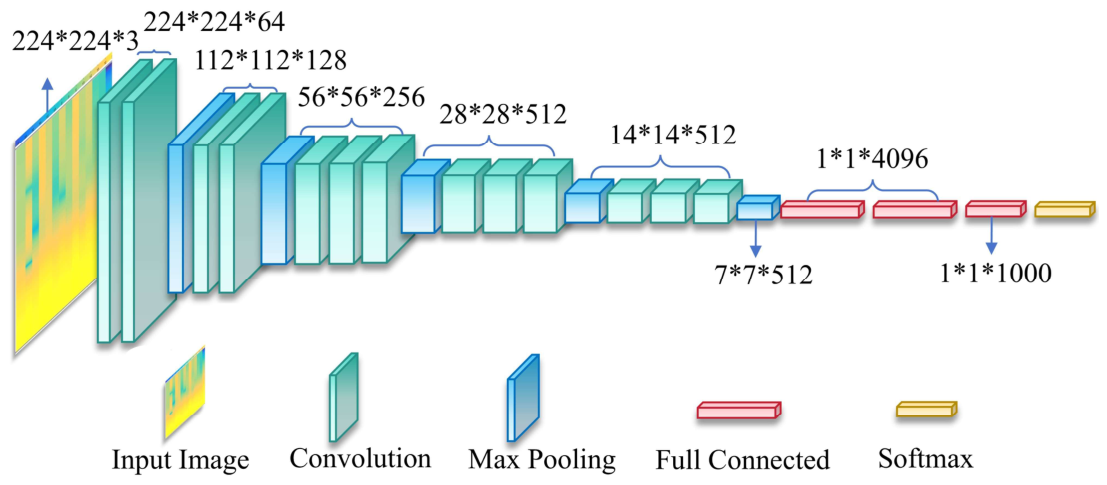
The VGG16 model is an optimized version of the traditional CNN, established on the deep learning framework TensorFlow [
33,
34]. It comprises 13 convolutional layers, 3 fully connected layers, 5 pooling layers, and 1 regression layer (Softmax), as illustrated in
Figure 1. However, due to the numerous convolutional and fully connected layers in VGG16, processing RGB three-channel images with this model results in extended training times and challenging parameter adjustments. To reduce the model’s time consuming operations and enhance classification accuracy, dimensionality reduction is employed during the VGG16 model classification [
35,
36]. Principal Component Analysis (PCA) is a non-parametric technique used for this purpose. The PCA can linearly transform a multivariate dataset with correlated components into an uncorrelated component dataset. The objective of PCA is to minimize the loss of feature information while retaining a significant portion of the original variables’ information. The PCA finds extensive applications in various fields, such as data compression and image enhancement [
37,
38].
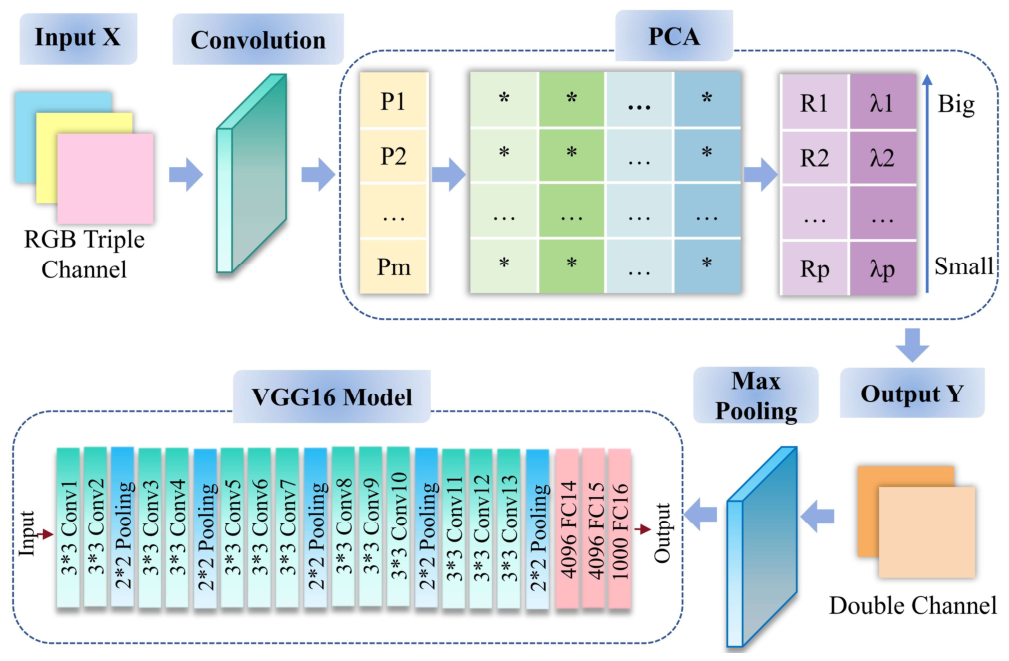
The PCA-VGG16 model aims to reduce the dimensions of the RGB three-channel image in the VGG16 model’s convolutional and pooling layers while preserving image features to the maximum extent. The process is illustrated in
Figure 2. By employing PCA for dimensionality reduction of the image data, the training data becomes significantly simplified. This simplification reduces the size of the output parameters of the final fully connected layer in the model, leading to reduced parameter adjustment complexity and improved model efficiency. In this study, extensive parameter tuning is performed to identify the optimal model parameters, resulting in the highest classification accuracy. A comparison is made between the classification accuracy of the original VGG16 model (without dimensionality reduction) and the proposed PCA-VGG16 framework—which integrates PCA for feature purification and dimensionality reduction—to assess the effectiveness of PCA in enhancing the performance and computational efficiency of the VGG16 model.
It is worth noting that while PCA is a linear dimensionality reduction method, it may have limitations in capturing high-order nonlinear manifold features compared to nonlinear techniques such as Autoencoders or t-SNE. However, PCA offers distinct advantages in terms of extremely low computational complexity, independence from hyperparameter tuning, and clear physical interpretability. Given the stringent real-time requirements for geological disaster warning systems, PCA was selected in this study to achieve an optimal trade-off between feature representation capability and computational workload. Future research will explore the integration of nonlinear dimensionality reduction techniques with deep learning architectures to continuously optimize model performance.
In terms of feature preservation, this study maintained a high cumulative variance contribution rate (over 95%) during PCA implementation. This strategy ensures that while redundant high-frequency noise and hardware interference are filtered out—effectively functioning as a ‘feature purification’ process—the core energy-carrying structural textures essential for identifying rock fracture stages are rigorously preserved. Furthermore, while PCA is a linear transformation, the deep convolutional architecture of the subsequent VGG16 model is highly capable of learning hierarchical spatial features from the retained principal components. This deep learning capability effectively compensates for the potential loss of minor nonlinear details, thereby ensuring the robustness and high precision of the classification performance.
2.2. Model Development
The PCA-VGG16 model is an integrated framework synthesized through the collaborative coupling of a PCA-based convolution encoder and a topologically optimized Visual Geometry Group 16 (VGG16) deep neural network. The systemic architectural construction of this model progresses through the following sequential phases.
First, the PCA-based convolution encoder is seamlessly integrated into the network as the foundational preprocessing layer of the overall architecture before feedforwarding into VGG16, serving as the core operator for linear feature purification and structural encoding. Transcending the scope of conventional data preprocessing, this encoder layer executes an eigen-decomposition on the empirical covariance matrix of the acoustic emission (AE) signals, thereby mapping the high-dimensional manifolds of the raw AE spectrograms into a lower-dimensional orthogonal feature space. To rigorously suppress the redundant high-frequency noises induced by the hardware acquisition environment and mechanical friction of the loading system, while concurrently maintaining the integrity of the primary energy-carrying structural textures essential for characterizing rock fracture evolution, a stringent cumulative variance contribution rate threshold (≥95%) is established to dynamically filter the principal components. By functioning as an upstream linear encoder, this methodology substantially curtails the dimensionality of the input vectors, thereby alleviating the computational overhead and spatial complexity for the subsequent deep convolutional operations.
Subsequently, the purified low-dimensional principal component vectors encoded by this preprocessing layer are channeled into a modified VGG16 architecture characterized by localized topological streamlining and parametric de-redundancy. Given that the standard VGG16 network was originally engineered for the ImageNet dataset involving 1000 densely categorized classes, its terminal fully-connected segment exhibits severe parametric redundancy, traditionally comprising two massive dense layers with 4096 hidden units each. Direct transfer of such an unpruned configuration to our small-sample rock AE multi-stage classification task inevitably triggers the curse of dimensionality and catastrophic structural overfitting. To rectify this, a profound model-level optimization is applied to this computationally intensive block: the original dual 4096-node sequences are reconfigured into a cascading, lightweight dense architecture with 512 and 128 units, respectively, followed by a customized Softmax classification layer tailored explicitly to the rock failure stages. This architectural refinement shrinks the trainable parameter scale of the classifier by over 85%, significantly minimizing spatial complexity and safeguarding the network against generalization degradation induced by structural capacity surplus.
To establish robust optimization constraints under the small-sample regime inherent to empirical rock non-linear failure datasets, a multidimensional synergistic regularization and adaptive generalization control mechanism is embedded within the restructured classifier. Specifically, a Dropout mechanism with a predefined dropout rate of p = 0.5 is interleaved between the sparse dense layers to disrupt inter-neuronal co-adaptation. Concurrently, an L2 weight regularization penalty (with a weight decay coefficient optimized at 0.001) is integrated into the formulation of the empirical loss function, enforcing a bounded constraint on the parameter magnitudes to suppress weight explosion during backpropagation. For the optimization trajectory, the Adam algorithm is utilized alongside a categorical cross-entropy objective function, tightly coupled with an adaptive learning rate scheduler initialized at 0.001.
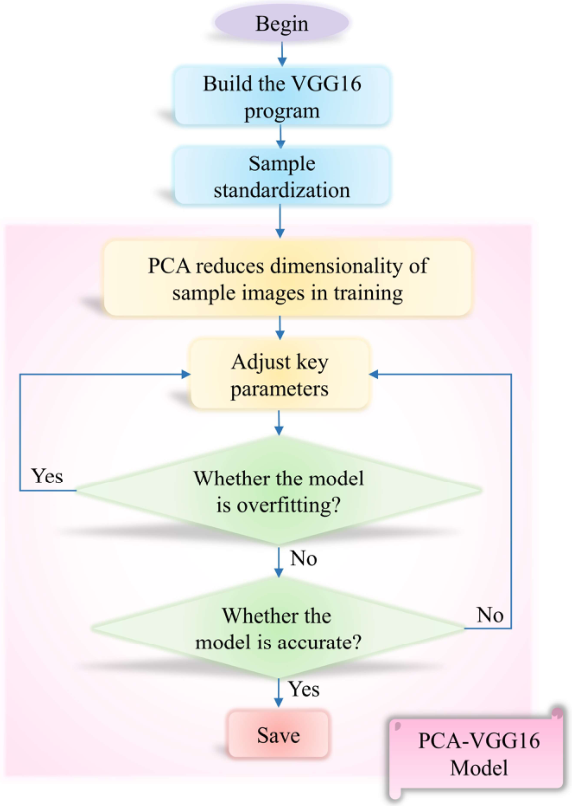
To quantitatively monitor the network evolution status and optimize hyperparameter configurations, an adaptive closed-loop control mechanism is implemented within the execution flow, as illustrated in
Figure 3. First, regarding key parameter tuning, this study co-optimizes the maximum number of training epochs and the batch size, wherein the batch size is adaptively calibrated between 16 and 128 based on the data scale and physical sample complexity. Secondly, the system adopts the dual-track accuracy gap as the quantitative criterion for evaluating whether the model is overfitting: the training and test accuracies are extracted synchronously at the end of each epoch; if the generalization gap between them widens significantly (i.e., the training accuracy approaches 100% while the independent test accuracy stagnates or degrades), the model is diagnosed as entering an overfitted state, which immediately triggers the active termination path shown in
Figure 3. Concurrently, the convergence trajectory of the test loss is monitored in real time to execute the early stopping strategy, where the termination patience is strictly restricted to 5 epochs; if the test loss fails to decrease monotonically for 5 consecutive periods, training is actively terminated, and the restore best weights mechanism automatically discards the overfitted terminal parameters, restoring and preserving the global optimal weights achieved at the absolute nadir of the test loss curve. Finally, the system leverages the independent test accuracy as the definitive scale for final convergence evaluation. The finalized network is validated as accurate and generalization-reliable and subsequently exported only when its test accuracy stably surpasses a predefined high-recognition engineering threshold (≥90%) upon early stopping activation, hereby achieving the closed-loop evaluation cycle of
Figure 3 and ensuring that the network efficiently converges toward the global optimum across the complex, non-linear rock fracture manifolds.
2.3. Accuracy Evaluation Index
In verifying neural network models, image classification is commonly used to assess the quality of classification and recognition. The effectiveness of model classification and recognition is evaluated by analyzing the accuracy of image classification and recognition. In this study, two indicators, namely classification accuracy and loss rate, are employed to assess the performance of various rock classification models. Classification accuracy refers to the ratio of correctly classified samples to the total number of training or test samples within the training set or test set, respectively. A higher classification accuracy indicates a better classification effect of the model. The specific formula for calculating the Classification Accuracy (
CA) is as follows:
where
AS represents the number of accurately classified samples (Accuracy Samples) in the training set (or test set), and
TS represents the total number of samples (Total Samples) in the training set (or test set).
The loss rate (Loss Rate, LR) refers to the convergence value of the loss function. In this study, the chosen loss function is the cross-entropy loss function. The specific calculation formula for the loss rate of the training set (or test set) is as follows:
In the formula, Lloss denotes the cross-entropy loss value, yi represents the true label of the image, and k represents the dimension. When the i class in the image is 1, it indicates that the image belongs to the i class, and the other positions are all 0, representing the probability of the predicted class.
4. Case Application
4.1. Experimental Procedure
The stability of underground engineering in karst regions is significantly challenged by chemical-mechanical (C-M) coupling effects. Limestone, primarily composed of CaCO3, is highly sensitive to acidic environments such as acid rain, industrial wastewater seepage, or mineralized groundwater. This chemical erosion leads to mineral dissolution and structural degradation, which fundamentally compromises the macro-mechanical reliability of engineering structures like tunnels and dam foundations. Therefore, this study utilizes limestone specimens to undergo various acidic dry–wet cycles to simulate the long-term deterioration process in real-world geological environments.
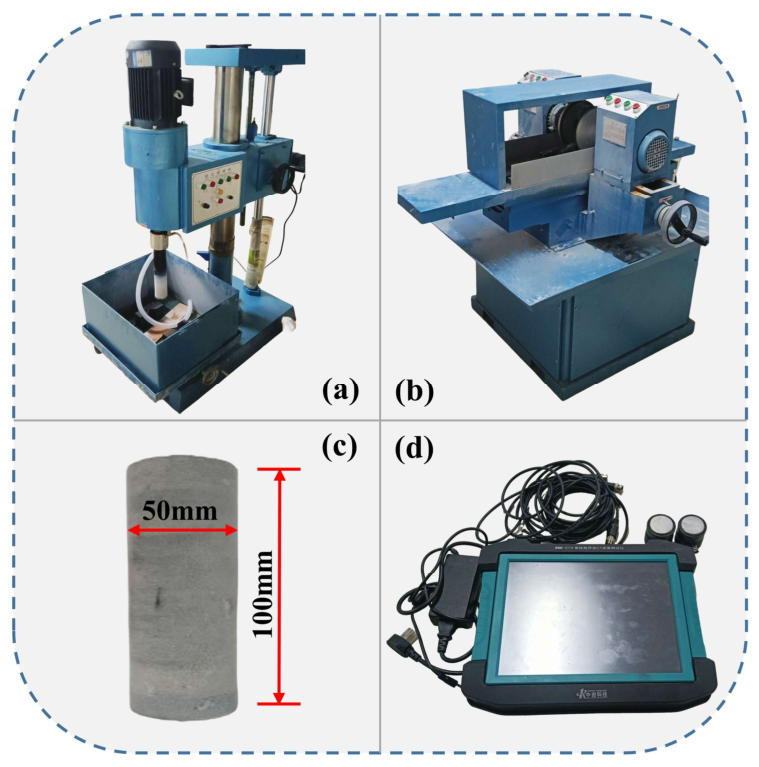
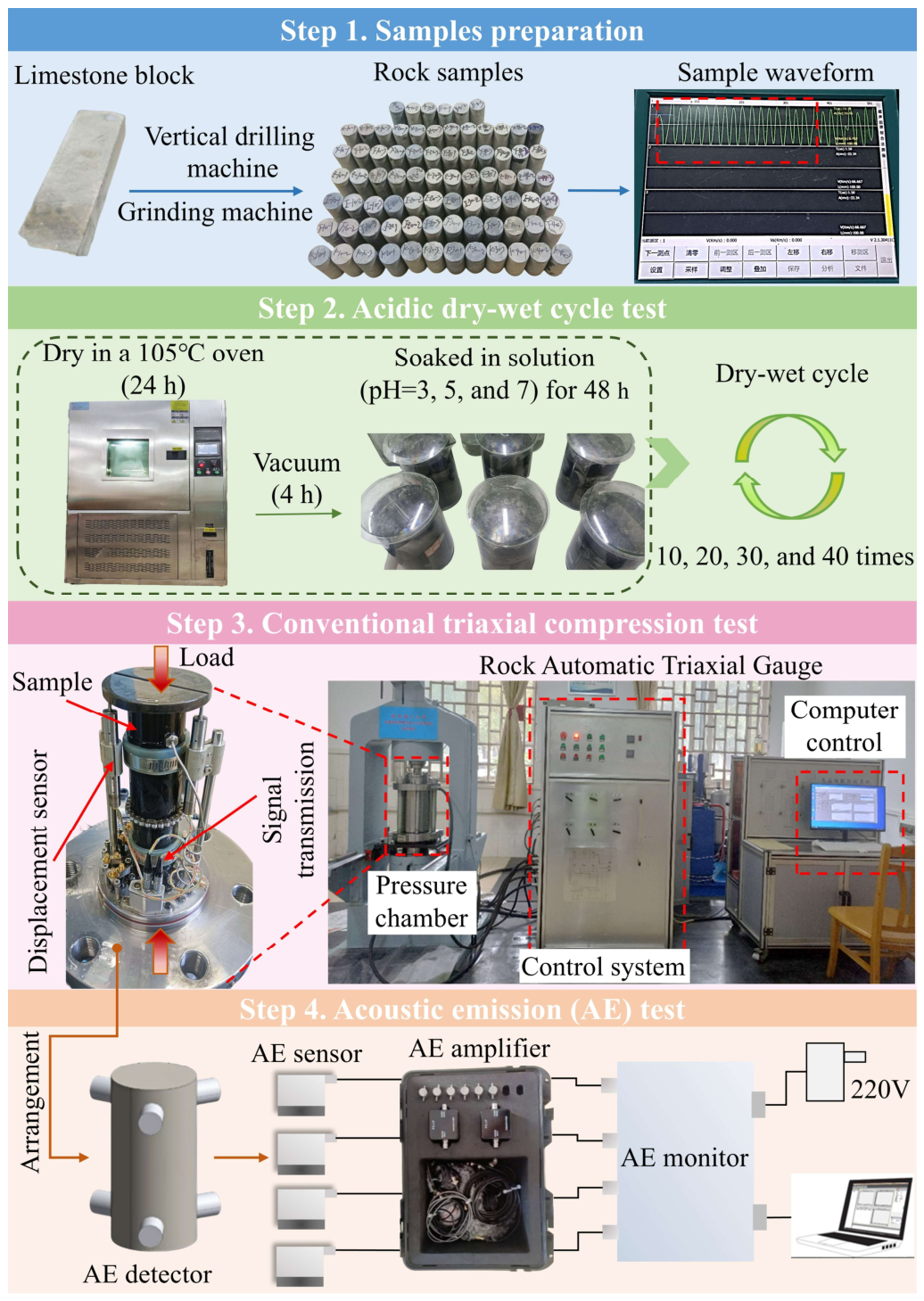
Standard cylindrical limestone specimens, with a diameter of 50 mm and a height of 100 mm, were prepared using vertical drilling (YANKUANG Crop., Jinan, China) and grinding machines (YANKUANG Crop., Jinan, China) (
Figure 6a,b). To ensure specimen quality, ultrasonic non-destructive testing was conducted, with the longitudinal waveforms confirming a high integrity coefficient and the absence of significant internal defects (SINOROCK Crop., Wuhan, China) (
Figure 6d).
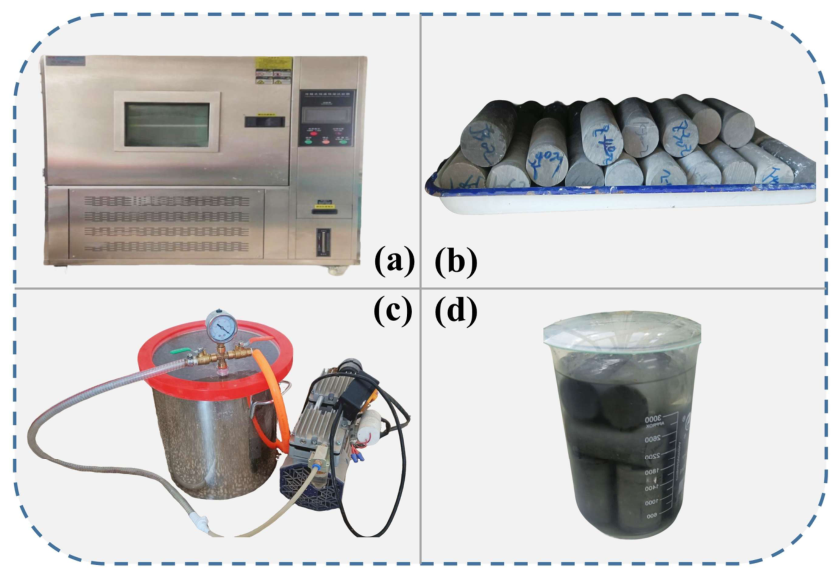
To simulate chemical weathering, the specimens underwent acidic dry–wet cycles (
Figure 7). The selection of pH values (3, 5, and 7) corresponds to extreme acidic contamination, typical acid rain conditions, and neutral groundwater, respectively. Furthermore, the multiple cycle counts (10 to 40) are designed to represent the cumulative damage effect resulting from long-term environmental exposure. Each 72-h cycle consisted of drying at 105 °C for 24 h, followed by vacuum saturation at −0.1 MPa for 4 h, and immersion in solutions with pH values of 3, 5, or 7 for 48 h. The specimens were subjected to 10, 20, 30, and 40 cycles, respectively.
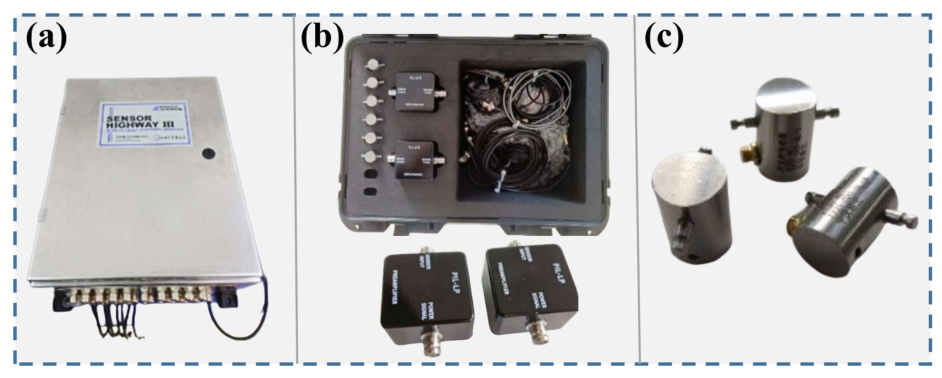
Conventional triaxial compression tests were performed at a 3 MPa confining pressure and a displacement rate of 0.1 mm/min. Simultaneously, acoustic emission (AE) signals were monitored using the Sensor Highway III system (ANALYSIS Crop., Hong Kong, China) (
Figure 8). The AE equipment was configured with a 40 dB detection threshold, a 26 dB preamplifier gain, and a filter range of 100–400 kHz. Six symmetrically mounted sensors ensured accurate source localization throughout the loading process. An overview of the entire experimental instruments and procedure is provided in
Figure 9.
4.2. Data Analysis
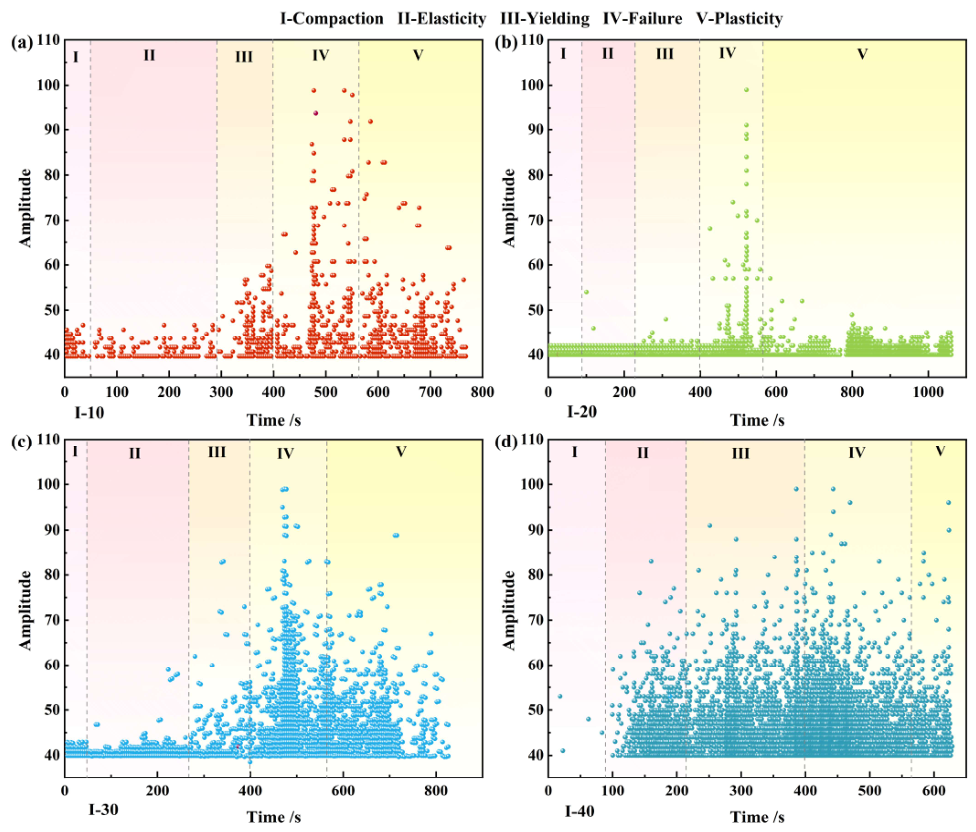
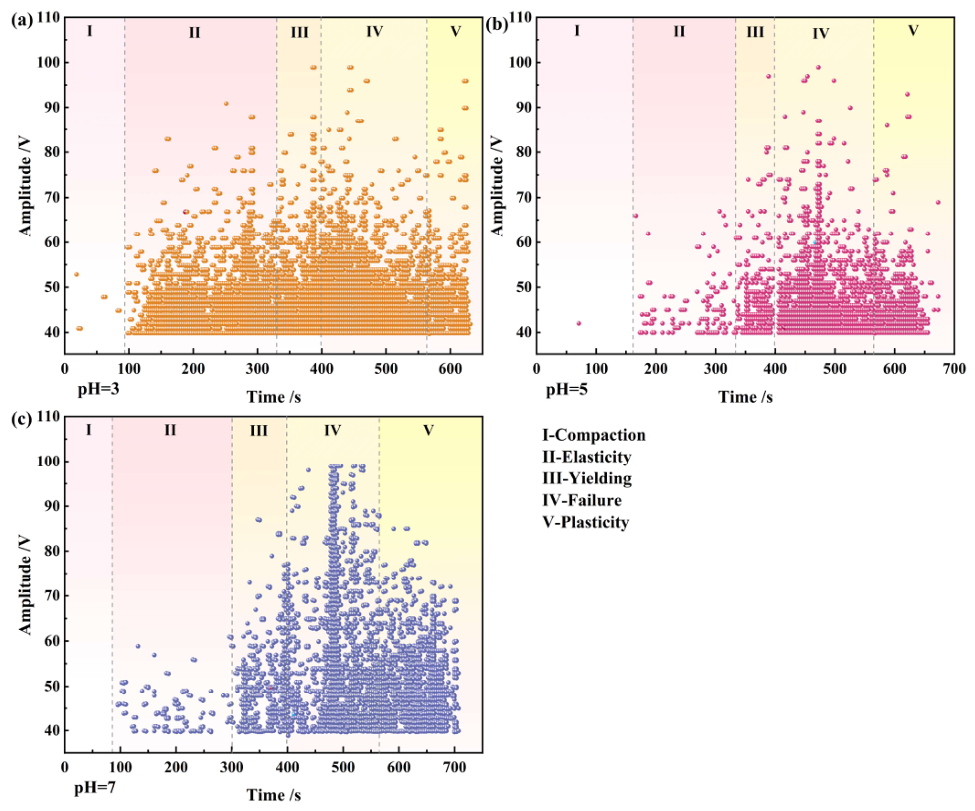
The AE amplitude reflects the five deformation stages of limestone: compaction, elasticity, yielding, failure, and plasticity. AE data from the fracture stages (approximately 400 s to 560 s) were extracted and synchronized with the stress-strain curves. The time-amplitude relationship diagrams across different cycles and pH environments are presented in
Figure 10 and
Figure 11, where the horizontal and vertical axes represent loading time and amplitude, respectively.
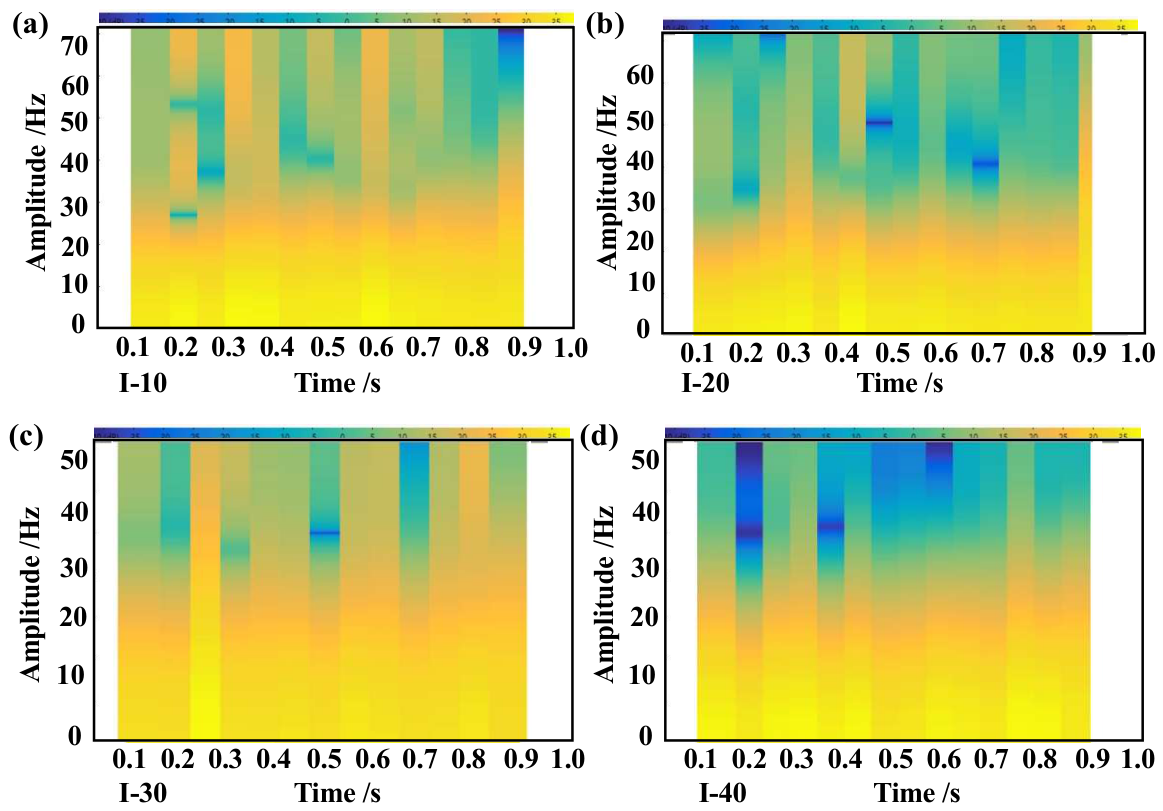
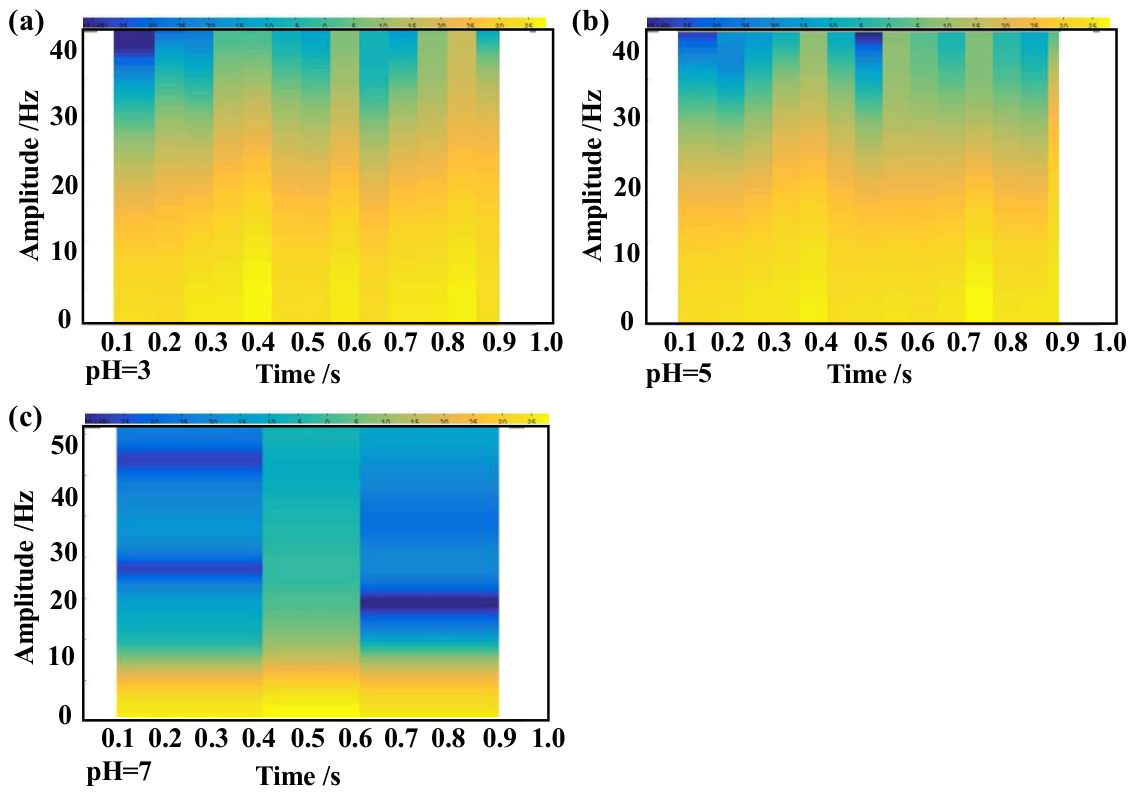
To optimize data for deep learning, environmental noise was filtered, and signals were segmented into frames with a length of 0.8 s and a frameshift of 0.1 s. These segments were converted into acoustic spectrograms (
Figure 12 and
Figure 13). In these spectrograms, color intensity signifies the magnitude of energy release: high-amplitude regions (yellow) represent dominant frequency components, while lower-amplitude regions (blue) represent background noise or weaker components. For instance, the pH 3 environment caused significant structural dissolution, resulting in higher amplitude peaks compared to the stable response in pH 7. These spectrograms enable the PCA-VGG16 model to identify and classify rock fracture stages from an image classification perspective.
4.3. PCA-VGG16 Model Analysis of Limestone Failure Stages for the Different Numbers of Acid–Alkali Pretreatment Cycles
Regarding the acidic environment with a pH of 3, 125 spectrograms of the limestone fracture stages are generated for each of the acid–alkali pretreatment cycle numbers (10, 20, 30, and 40), resulting in a total of 500 sample images. To maintain a ratio of approximately 4:1 between training and testing samples, 400 images are selected for the training dataset, while the remaining 100 images are allocated for the testing dataset. The specific sampling details are presented in
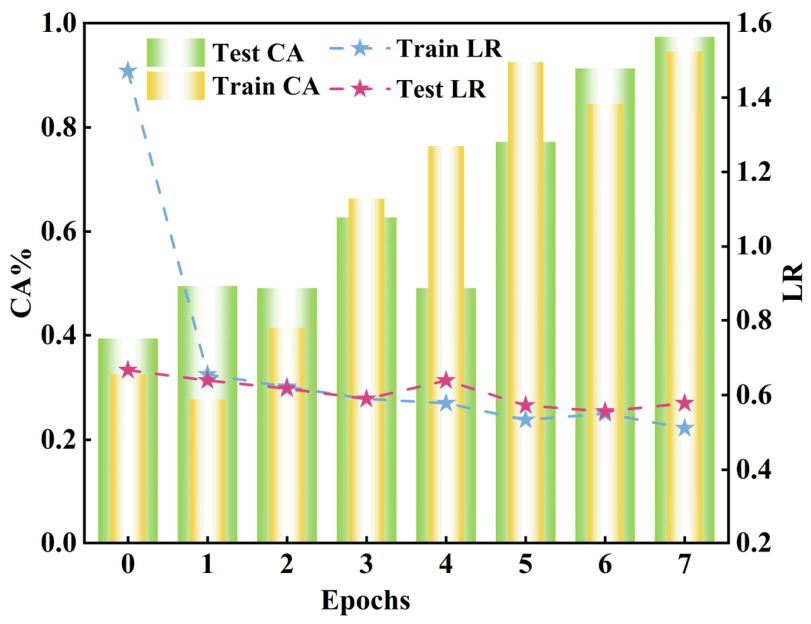
Table 3. The generated spectrogram images are then utilized to train the PCA-VGG16 model. The training results of the PCA-VGG16 model for different acid–alkali pretreatment cycle numbers under the same acidic environment can be found in
Table 4. Visual representations of the results are shown in
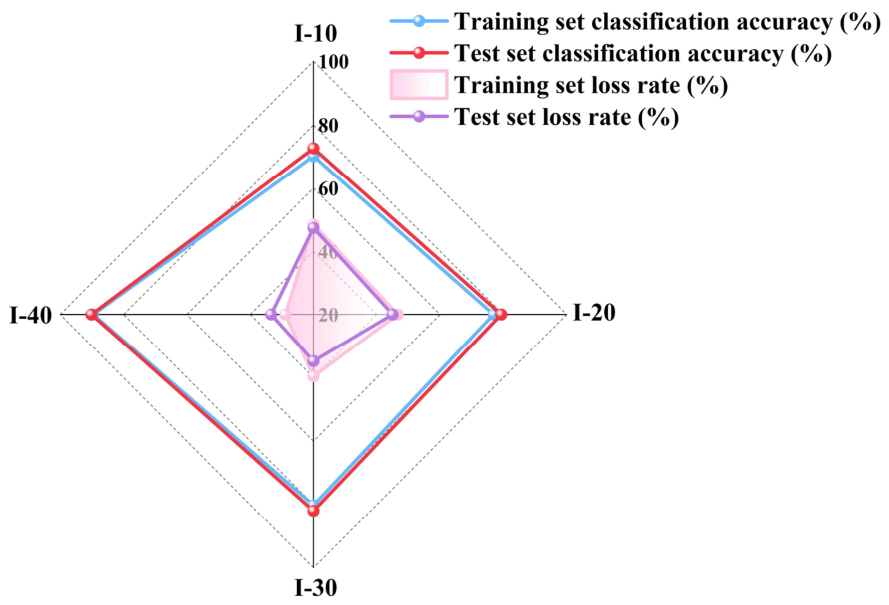
Figure 14.
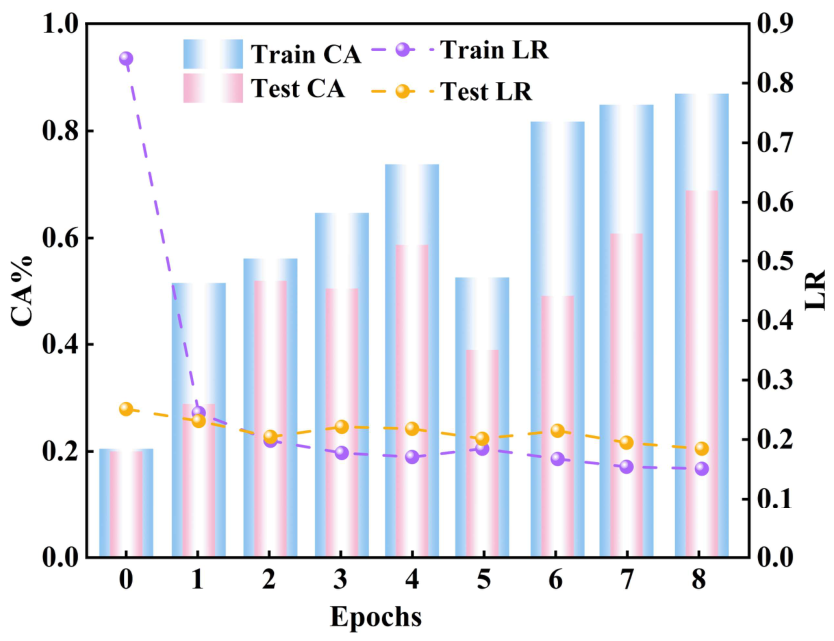
Figure 14 illustrates that as the number of acid–alkali pretreatment cycles increases to 40, the degree of rock dissolution intensifies, leading to more pronounced characteristics of the failure stage. The PCA-VGG16 model achieves the highest classification accuracy rates of 89.61% and 90.13% for the training and test sets, respectively, with minimum loss rates of 0.289 and 0.334, respectively. The detailed training results are displayed in
Figure 15. Conversely, when the cycle number is 10, compared to 20, 30, and 40 cycles, the degree of dissolution is smaller, resulting in less prominent characteristics of the rock failure stages. The classification accuracy of the training and test sets is lower, reaching only 70.12% and 72.59%, respectively. This indicates that under the same acidic environment, a greater number of dry–wet cycles leads to more evident characteristics of the rock dissolution stage and fracture stage, consequently resulting in higher classification accuracy.
4.4. PCA-VGG16 Model Analysis of Limestone Failure Stages for the Acid–Alkali Pretreatments Considering Different pH Values
Regarding the experiments with 40 acid–alkali pretreatment cycles, 125 acoustic spectrogram images of limestone failure stages are generated for each case of pH = 3, 5 and 7. From these images, 300 are selected as the training dataset, while the remaining 75 images were assigned to the test dataset. The training dataset were then used to train the PCA-VGG16 model. The training results are presented in
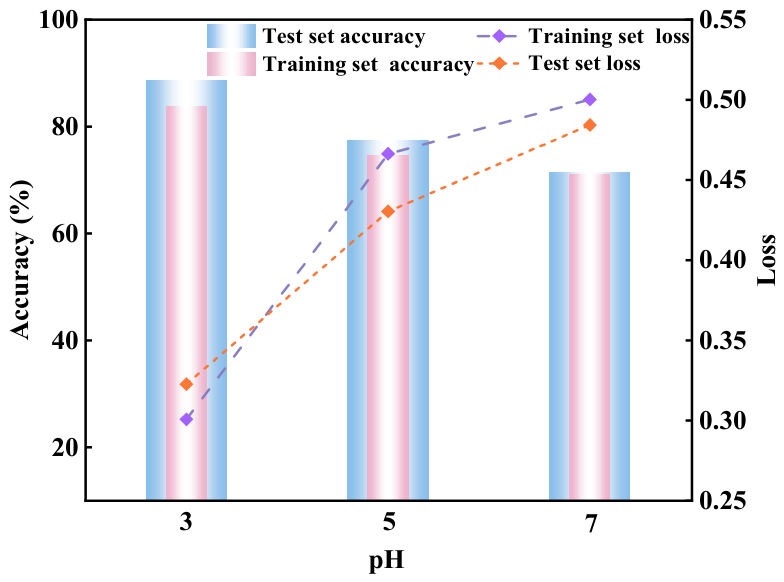
Table 5, and the specific details can also be observed in
Figure 16.
Based on
Table 5 and
Figure 16, it is evident that, the high acidity when pH = 3 leads to more severe rock dissolution, resulting in clearer characteristics of rock failure under stress. Consequently, the program extracts rock image features more effectively. As the number of iterations increases, the accuracy gradually improves, and the loss rate decreases. When both indicators reach a stable state, the model training is optimized. At this point, the classification accuracy of the training and testing sets reaches the highest values of 83.59% and 88.59%, respectively, with the lowest loss rates of 0.3 and 0.322. The specific training details are illustrated in
Figure 17.
This phenomenon can be theoretically elucidated through the competitive mechanism between intra-class variability and inter-class separability. While intensive chemical dissolution at pH = 3 inevitably increases the complexity of rock fracture and the stochasticity of AE signals (manifested as increased intra-class variability), the concomitant structural degradation significantly accentuates the mechanical divergence between distinct failure stages. This amplification of mechanical contrast serves as a ‘feature enhancer’ in the latent space, effectively expanding the inter-class distance between different stages. Quantitative evidence from the model’s convergence profile supports this interpretation: despite the increased signal complexity, the pH = 3 group exhibits the lowest test loss (0.322) and the highest classification accuracy (88.59%). According to pattern recognition theory, the superior convergence efficiency and minimized empirical risk (lower loss) collectively demonstrate that the enhancement of diagnostic features compensates for the increased signal entropy. Consequently, the high-acidity environment facilitates the formation of high-contrast feature manifolds, which the PCA-VGG16 architecture can more effectively partition.
On the other hand, when pH = 7, corresponding to a neutral environment, the degree of rock dissolution is minimal, and the characteristics of rock failure under stress are not distinct. As a result, the classification accuracy of the training and testing sets is at its lowest, with values of 70.99% and 71.33%, respectively, while the maximum loss rates are 0.5 and 0.484. This result indicates that under the same number of acid–alkali pretreatment cycles, rocks with higher acidity exhibit more distinct characteristics during rock fracture stages under the same stress conditions, resulting in higher classification accuracy.
4.5. Comparison of the Proposed PCA-VGG16 Model with Other Models
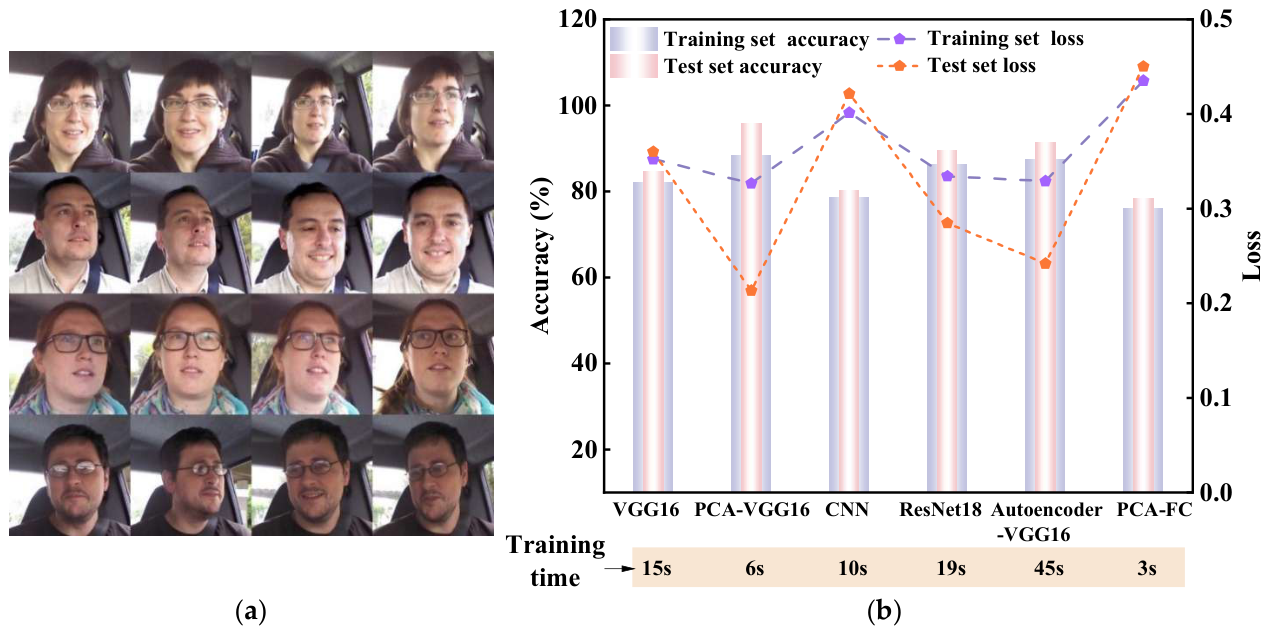
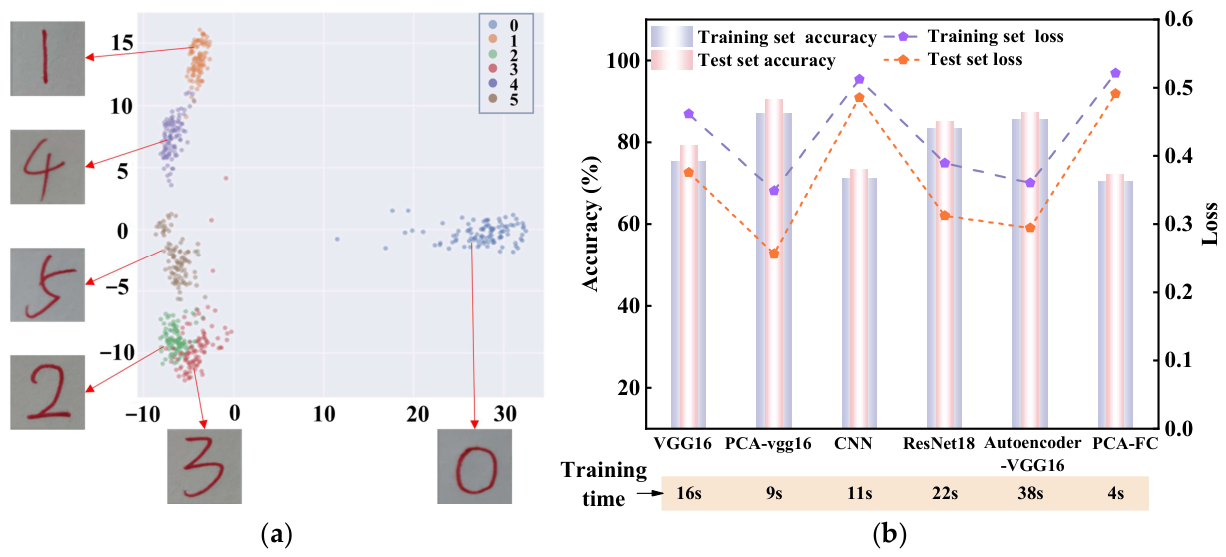
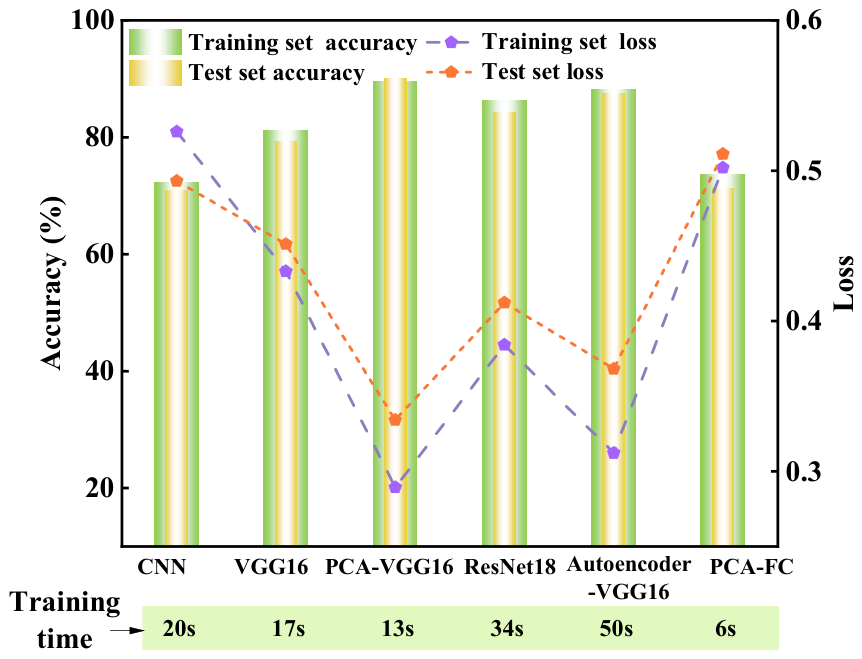
To systematically evaluate the recognition accuracy, structural configuration, and computational efficiency of the proposed framework, a rigorous comparative analysis of rock failure stage classification is conducted. The proposed PCA-VGG16 model is comprehensively benchmarked against four alternative architectures (traditional CNN, standard VGG16, ResNet18, and Autoencoder-VGG16) and the previously defined ablation baseline (PCA-FC). Under identical parameter configurations, all models are evaluated utilizing the exact same training and test datasets derived from acoustic emission (AE) experiments across varying numbers of acid–alkali pretreatment cycles. The quantitative results are summarized in
Table 6 and
Figure 18.
The comparative indicators in
Table 6 demonstrate that the proposed PCA-VGG16 model significantly outperforms both the classical networks and advanced baseline structures across all evaluation metrics. Notably, the PCA-VGG16 model exhibits superior generalization proficiency, achieving a test set accuracy of 90.13%, which exceeds that of the traditional CNN and standard VGG16 by 19.19% and 10.77%, respectively. More importantly, the proposed heterogeneous topology provides a substantial advantage in computational efficiency, curtailing the training latency to merely 13 seconds, which represents a runtime reduction of 35.00% and 23.53% compared to the CNN and VGG16 models.
The empirical data further elucidates the processing efficacy of different dimensionality reduction and feature extraction mechanisms on high-dimensional AE signals. As evidenced by
Table 6, although the Autoencoder-VGG16 model, utilizing non-linear feature extraction, can capture higher-order manifold structures to achieve a test accuracy of 87.42%, its total training time escalates drastically to 50 s. This substantial expansion in computational latency stems from the heavy optimization overhead inherent in the dense encoder-decoder network, alongside its strict reliance on complex hyperparameter fine-tuning, thereby restricting its deployment in low-latency and real-time monitoring tasks. Concurrently, while ResNet18 effectively mitigates deep network degradation via its residual topology to achieve a test accuracy of 84.15%, its high architectural capacity inadvertently exacerbates the risk of overfitting on lightweight time-frequency textures under the small-sample constraints typical of rock fracture experiments, requiring a protracted training duration of 34 s. Crucially, the indispensable role of the downstream deep network is further validated by the rock failure AE dataset. As shown in
Table 6, when switching to the simple classification head (the PCA-FC model), the test set accuracy drops to 71.22%. This significant performance deficit confirms that merely relying on the upstream linear feature purification is insufficient for complex rock engineering data. The downstream VGG16 framework is mathematically vital to capture the intricate, non-linear time-frequency localized textures that are directly correlated with multi-stage rock fracture evolution.
In contrast, the proposed PCA-VGG16 model achieves the optimal Pareto-optimal trade-off between identification accuracy and computational efficiency. By enforcing a cumulative variance contribution rate (≥95%), the upstream PCA module functions as a parameter-free linear feature purification operator, filtering out global redundant correlations, equipment baseline drifts, and high-frequency mechanical friction noises without requiring hyperparameter tuning or additional training computational budgets. This upstream purification enables the downstream topologically optimized VGG16 to escape the interference of high-dimensional data, focusing exclusively on extracting localized texture features coupled with micro-fracture development and rock damage evolution. These findings demonstrate that the cascaded design of “upstream linear feature purification + downstream non-linear manifold mapping” successfully reduces computational dependence and enhances anti-overfitting capacity, providing an efficient, physics-guided methodology for the precise and real-time identification of rock failure stages in underground engineering disaster warning systems.