An Interpretable Evolutionary-Fuzzy Framework for EEG Feature Extraction: Application to Chemosensory Task Classification

Abstract
1. Introduction
2. Related Work
2.1. Interpretable Machine Learning for EEG
2.2. EEG-Based Taste and Olfactory Research
3. Methodology
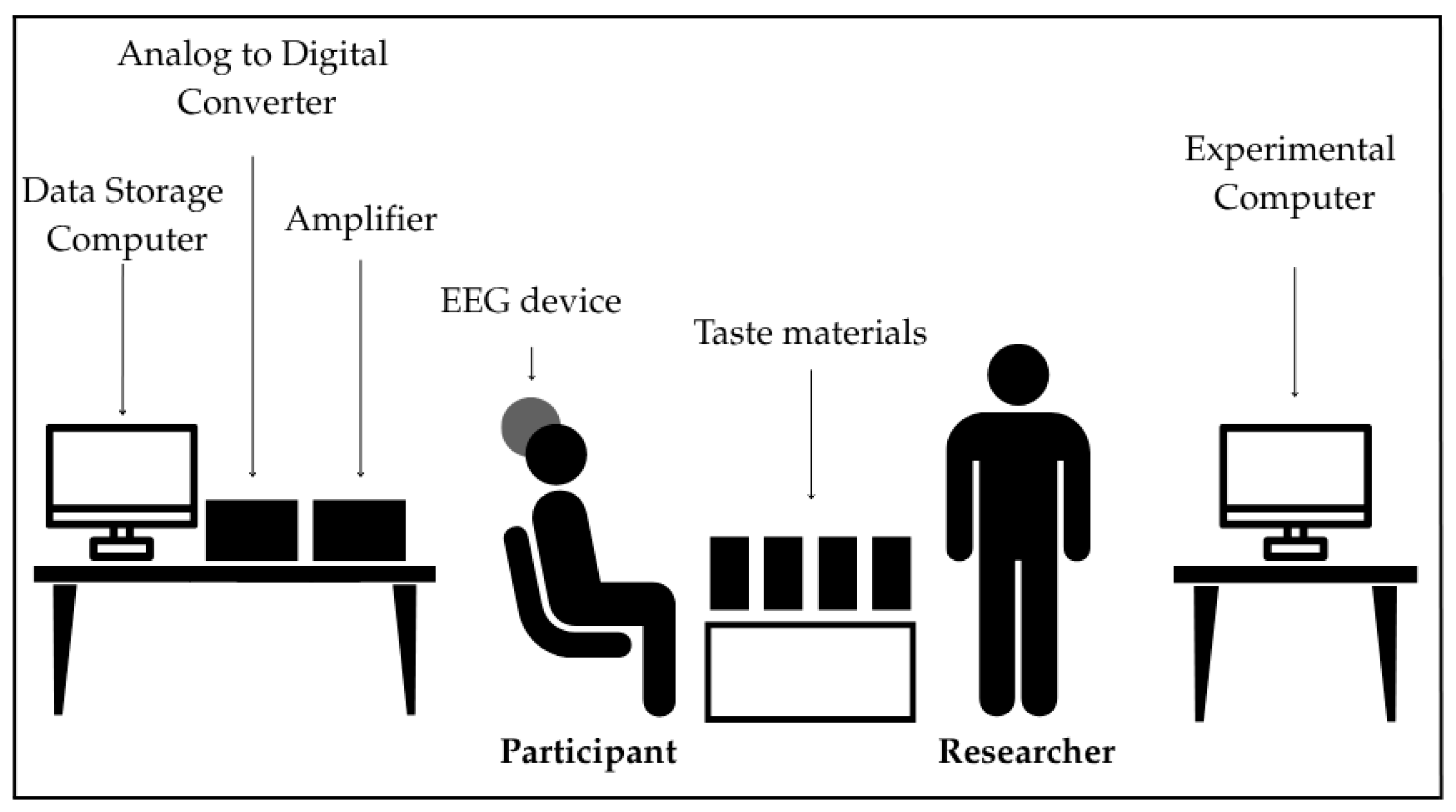
3.1. Dataset Description and Experimental Setup
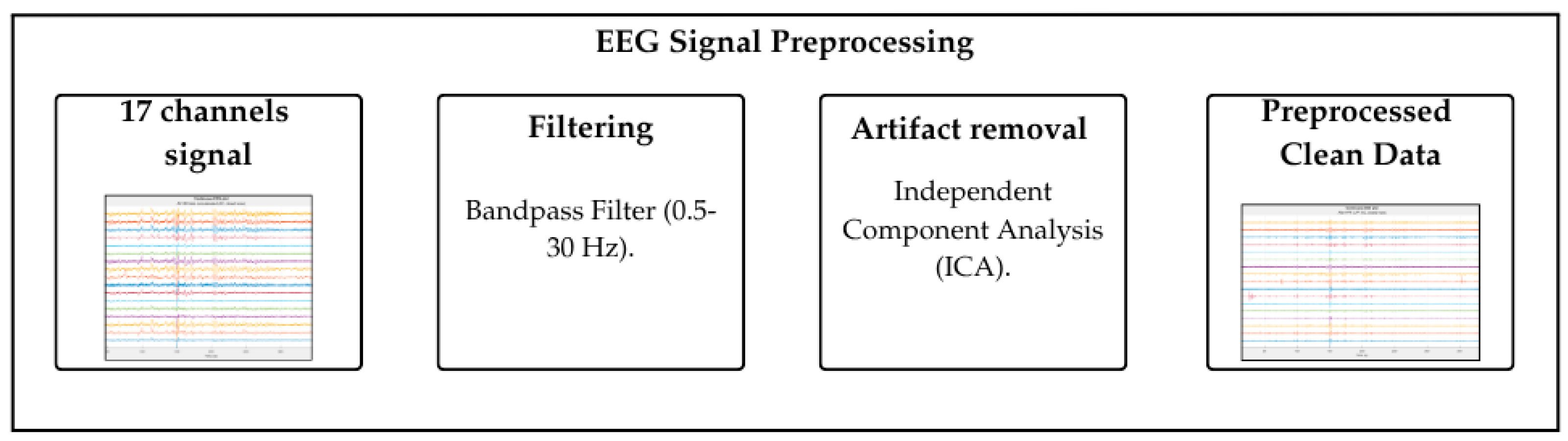
3.2. Data Preprocessing Pipeline
3.3. Raw Feature Extraction
3.4. Evolutionary-Fuzzy Feature Extraction Framework
| Algorithm 1: Evolutionary-Fuzzy Feature Extraction and Selection |
| Input: Training Data (X_train, Y_train), Population P, Generations G Output: Optimal Features (X_selected), Interpretable Fuzzy Rules 1: Initialize P chromosomes randomly in [−1, 1] 2: FOR g = 1 to G DO 3: FOR each chromosome c in P DO 4: // Step 1: Fuzzy Transformation 5: Apply weights and fuzzy parameters from c to X_train 6: Generate extracted fuzzy features → X_extracted 7: // Step 2: Feature Selection 8: Apply CFS on X_extracted → X_selected 9: // Step 3: Fitness Evaluation 10: Evaluate F1-score using X_selected 11: Fitness(c) = F1_score − Complexity_Penalty 12: END FOR 13: // Step 4: Population Update 14: Apply selection, recombination, and mutation for next generation 15: END FOR 16: Extract human-readable Fuzzy Rules from the Best Chromosome 17: RETURN X_selected, Fuzzy Rules |
3.5. Data Partitioning and Classification
3.6. Validation Strategy
4. Results
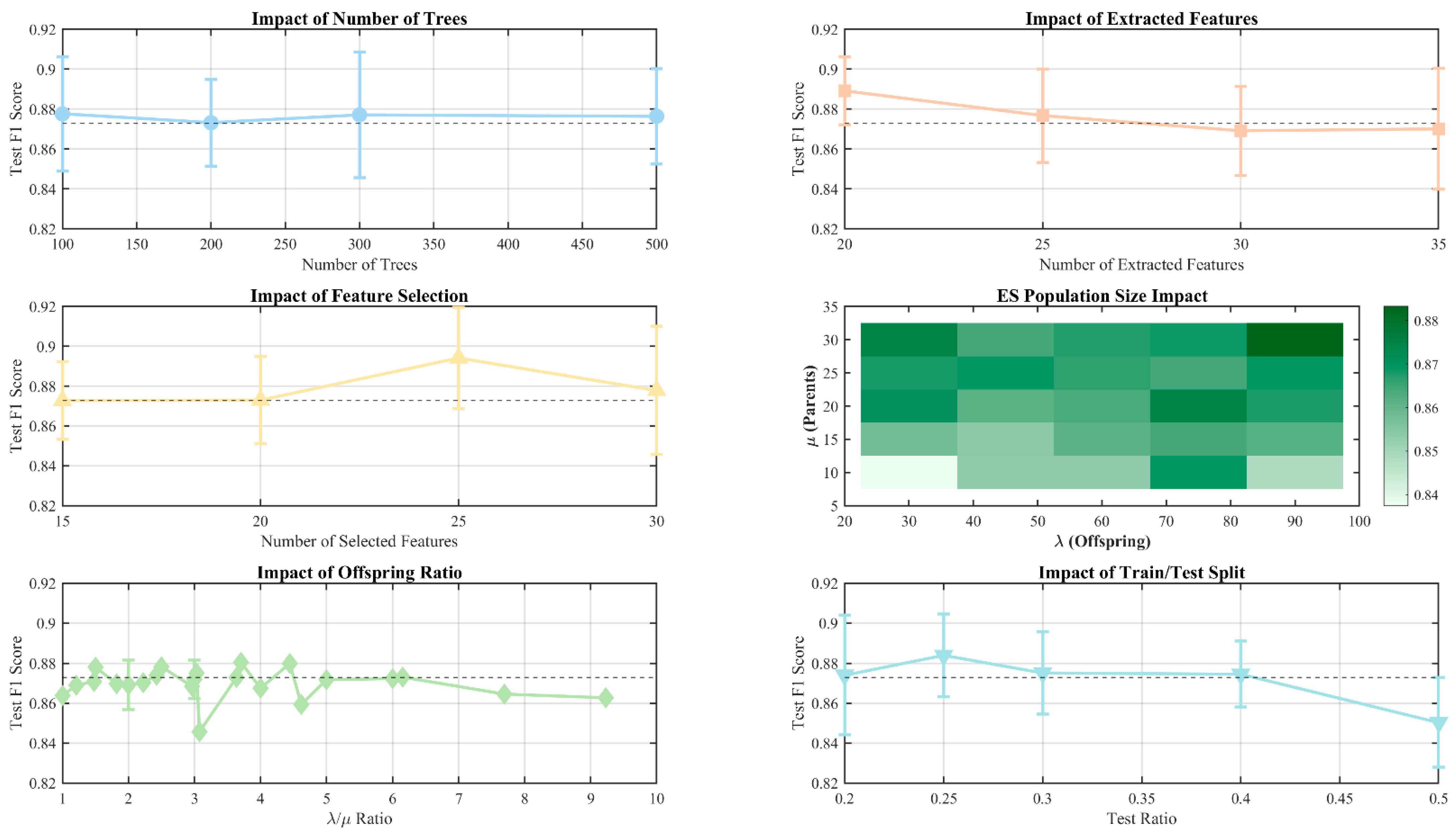
4.1. Hyperparameter Optimization
- -
- Number of trees: Ntrees ∈ {100, 200, 300, 500};
- -
- Number of extracted features: Nextracted ∈ {20, 25, 30, 35};
- -
- Number of selected features: Nselected ∈ {15, 20, 25, 30};
- -
- ES parent population size: μ ∈ {10, 15, 20, 25, 30};
- -
- ES offspring size: λ ∈ {30, 45, 60, 75, 90, 120};
- -
- Train/test split ratio: ∈ {0.20, 0.25, 0.30, 0.40, 0.50}.
4.2. Classification Performance: Stratified Split
4.3. Feature Interpretability Analysis
4.4. Noise Robustness
4.5. Between-Subjects Generalization
5. Discussion
5.1. The Proposed Method as a Feature Extraction Framework
5.2. Hyperparameter Insights and Optimization Landscape
5.3. Feature Interpretability
5.4. Between-Subjects Design Limitations
5.5. Interpretation of Noise Introduction and Future Directions
6. Conclusions
Author Contributions
Funding
Data Availability Statement
Conflicts of Interest
References
- Naser, A.; Aydemir, Ö. Enhancing EEG signal classification with a novel random subset channel selection approach: Applications in taste, odor, and motor imagery analysis. IEEE Access 2024, 12, 145608–145618. [Google Scholar] [CrossRef]
- Ergün, E.; Aydemir, Ö.; Korkmaz, O.E. Investigating the informative brain region in multiclass electroencephalography and near infrared spectroscopy based BCI system using band power based features. Comput. Methods Biomech. Biomed. Eng. 2025, 28, 1655–1670. [Google Scholar] [CrossRef]
- Swiegers, J.H.; Chambers, P.J.; Pretorius, I.S. Olfaction and taste: Human perception, physiology and genetics. Aust. J. Grape Wine Res. 2005, 11, 109–113. [Google Scholar] [CrossRef]
- Lipton, Z.C. The mythos of model interpretability. Queue 2018, 16, 31–57. [Google Scholar] [CrossRef]
- Rudin, C. Stop explaining black box machine learning models for high stakes decisions and use interpretable models instead. Nat. Mach. Intell. 2019, 1, 206–215. [Google Scholar] [CrossRef]
- Arrieta, A.B.; Díaz-Rodríguez, N.; Del Ser, J.; Bennetot, A.; Tabik, S.; Barbado, A.; Garcia, S.; Gil-Lopez, S.; Molina, D.; Benjamins, R.; et al. Explainable Artificial Intelligence (XAI): Concepts, taxonomies, opportunities and challenges toward responsible AI. Inf. Fusion 2020, 58, 82–115. [Google Scholar] [CrossRef]
- Yarlagadda, V.K. Harnessing biomedical signals: A modern fusion of hadoop infrastructure, AI, and fuzzy logic in healthcare. Malays. J. Med. Biol. Res. 2021, 8, 85–92. [Google Scholar]
- Mollo, E.; Boero, F.; Peñuelas, J.; Fontana, A.; Garson, M.J.; Roussis, V.; Cerrano, C.; Polese, G.; Cattaneo, A.M.; Mudianta, I.W.; et al. Taste and smell: A unifying chemosensory theory. Q. Rev. Biol. 2022, 97, 69–94. [Google Scholar] [CrossRef]
- Kato, M.; Okumura, T.; Touhara, K.; Okamoto, M. Behavioral relevance of early neural coding of low-level odor features in humans. J. Neurosci. 2025, 45, e0203252025. [Google Scholar] [CrossRef]
- Prescott, J. Chemosensory learning and flavour: Perception, preference and intake. Physiol. Behav. 2012, 107, 553–559. [Google Scholar] [CrossRef] [PubMed]
- Chen, Y.P.; Ding, Z.; Yu, Y.; He, P.; Zhou, Y.; Liu, Y.; Feng, X. Recent advances in investigating odor-taste interactions: Psychophysics, neuroscience, and microfluidic techniques. Trends Food Sci. Technol. 2023, 138, 500–510. [Google Scholar] [CrossRef]
- Morozova, M.; Bikbavova, A.; Bulanov, V.; Lebedev, M.A. An olfactory-based brain-computer interface: Electroencephalography changes during odor perception and discrimination. Front. Behav. Neurosci. 2023, 17, 1122849. [Google Scholar] [CrossRef] [PubMed]
- Pereira, D.R.; Pereira, H.R.; Silva, M.L.; Pereira, P.; Ferreira, H.A. Impact of five basic tastes perception on neurophysiological response: Results from brain activity. Food Qual. Prefer. 2025, 131, 105572. [Google Scholar] [CrossRef]
- Andersen, C.A.; Kring, M.L.; Andersen, R.H.; Larsen, O.N.; Kjær, T.W.; Kidmose, U.; Møller, S.; Kidmose, P. EEG discrimination of perceptually similar tastes. J. Neurosci. Res. 2019, 97, 241–252. [Google Scholar] [CrossRef]
- Wang, Z.; Chang, X.; Zhang, C.; Lan, H.; Huang, M.; Zhou, B.; Sun, B. Beyond aromas: Exploring the development and potential applications of electroencephalography in olfactory research. Annu. Rev. Food Sci. Technol. 2025, 16, 147–170. [Google Scholar] [CrossRef]
- Wu, W.; Xu, C.; Liang, Q.; Zheng, X.; Xiao, Q.; Zhong, H.; Chen, N.; Lan, Y.; Huang, X.; Xie, Q. Olfactory response is a potential sign of consciousness: Electroencephalogram findings. Front. Neurosci. 2023, 17, 1187471. [Google Scholar] [CrossRef] [PubMed]
- Maeda, S.; Yoshimura, H. Enhancement of electroencephalogram activity in the theta-band range during unmatched olfactory-taste stimulation. J. Physiol. Sci. 2019, 69, 613–621. [Google Scholar] [CrossRef]
- De, S.; Mukherjee, P.; Roy, A.H. TasteNet: A novel deep learning approach for EEG-based basic taste perception recognition using CEEMDAN domain entropy features. J. Neurosci. Methods 2025, 419, 110463. [Google Scholar] [CrossRef]
- Cybenko, G. Approximation by superpositions of a sigmoidal function. Math. Control Signals Syst. 1989, 2, 303–314. [Google Scholar] [CrossRef]
- Box, G.E.P.; Cox, D.R. An analysis of transformations. J. R. Stat. Soc. Ser. B 1964, 26, 211–252. [Google Scholar] [CrossRef]
- Small, D.M.; Prescott, J. Odor/taste integration and the perception of flavor. Exp. Brain Res. 2005, 166, 345–357. [Google Scholar] [CrossRef] [PubMed]
- Simon, S.A.; de Araujo, I.E.; Gutierrez, R.; Nicolelis, M.A. The neural mechanisms of gustation: A distributed processing code. Nat. Rev. Neurosci. 2006, 7, 890–901. [Google Scholar] [CrossRef]
- Aydemir, O. A new performance evaluation metric for classifiers: Polygon area metric. J. Classif. 2021, 38, 16–26. [Google Scholar] [CrossRef]



| Rank | Ntrees | Nextracted | Nselected | (%) | |
|---|---|---|---|---|---|
| 1 | 300 | 25 | 25 | 40/120 | 89.41 ± 2.54 |
| 2 | 300 | 20 | 20 | 40/120 | 88.91 ± 1.71 |
| 3 | 300 | 25 | 20 | 30/90 | 88.32 ± 2.24 |
| 4 | 300 | 25 | 20 | 27/100 | 88.04 ± 1.89 |
| 5 | 300 | 25 | 20 | 40/60 | 87.81 ± 2.47 |
| Method | Train F1 (%) | Test F1 (%) | Gap (%) | Polygon Area |
|---|---|---|---|---|
| SVM-Linear (612 feat.) | 100.00 ± 0.00 | 97.87 ± 0.65 | +2.13 | 0.9512 ± 0.0147 |
| SVM-RBF (612 feat.) | 99.85 ± 0.05 | 98.49 ± 0.52 | +1.36 | 0.9654 ± 0.0117 |
| RF-612 (612 feat.) | 100.00 ± 0.00 | 98.91 ± 0.51 | +1.09 | 0.9748 ± 0.0117 |
| k-NN (612 feat.) | 98.08 ± 0.28 | 96.17 ± 0.69 | +1.90 | 0.9132 ± 0.0150 |
| RF-CFS-25 (fair control) | 100.00 ± 0.00 | 93.57 ± 1.14 | +6.43 | 0.8587 ± 0.0236 |
| Proposed (Evo-Fuzzy + RF) | 90.50 ± 1.66 | 88.31 ± 2.43 | +2.20 | 0.7759 ± 0.0491 |
| Rank | Feature Index | Domain | Channel | Metric |
|---|---|---|---|---|
| 1 | 9 | Time Domain | Ch1 | ZCR |
| 2 | 11 | Time Domain | Ch1 | AccRMS |
| 3 | 53 | Time Domain | Ch5 | ZCR |
| 4 | 54 | Time Domain | Ch5 | VelRMS |
| 5 | 132 | Time Domain | Ch12 | AccRMS |
| 6 | 143 | Time Domain | Ch13 | AccRMS |
| 7 | 154 | Time Domain | Ch14 | AccRMS |
| 8 | 191 | Frequency Domain | Ch1 | Beta |
| 9 | 194 | Frequency Domain | Ch1 | SpecCentroid |
| 10 | 195 | Frequency Domain | Ch1 | SpecSpread |
| Rule | Antecedent (IF…) | Consequent (THEN…) |
|---|---|---|
| 1 | (Ch1-ZCR is LOW) AND (Ch1-SpecCentroid is MEDIUM) | Nose-Opened |
| 2 | (Ch5-AccRMS is HIGH) AND (Ch12-AccRMS is HIGH) | Nose-Closed |
| 3 | (Ch1-Beta is HIGH) AND (Ch5-ZCR is LOW) | Nose-Opened |
| 4 | (Ch13-AccRMS is HIGH) AND (Ch1-ZCR is MEDIUM) | Nose-Closed |
| 5 | (Ch1-SpecSpread is LOW) AND (Ch5-VelRMS is MEDIUM) | Nose-Opened |
| Method | 0% Noise | 10% Noise | 20% Noise | 30% Noise | Δ |
|---|---|---|---|---|---|
| RF-612 | 98.91 ± 0.51 | 98.67 ± 0.56 | 98.31 ± 0.66 | 97.26 ± 0.80 | −1.65 |
| RF-CFS-25 | 93.57 ± 1.14 | 93.06 ± 1.37 | 92.19 ± 1.39 | 90.63 ± 1.56 | −2.94 |
| Proposed | 88.31 ± 2.43 | 79.26 ± 3.50 | 73.33 ± 3.74 | 68.70 ± 4.36 | −19.6 |
Disclaimer/Publisher’s Note: The statements, opinions and data contained in all publications are solely those of the individual author(s) and contributor(s) and not of MDPI and/or the editor(s). MDPI and/or the editor(s) disclaim responsibility for any injury to people or property resulting from any ideas, methods, instructions or products referred to in the content. |
© 2026 by the authors. Licensee MDPI, Basel, Switzerland. This article is an open access article distributed under the terms and conditions of the Creative Commons Attribution (CC BY) license.
Share and Cite
Seweryńska, Z.; Aydemir, Ö. An Interpretable Evolutionary-Fuzzy Framework for EEG Feature Extraction: Application to Chemosensory Task Classification. Sensors 2026, 26, 4133. https://doi.org/10.3390/s26134133
Seweryńska Z, Aydemir Ö. An Interpretable Evolutionary-Fuzzy Framework for EEG Feature Extraction: Application to Chemosensory Task Classification. Sensors. 2026; 26(13):4133. https://doi.org/10.3390/s26134133
Chicago/Turabian StyleSeweryńska, Zofia, and Önder Aydemir. 2026. "An Interpretable Evolutionary-Fuzzy Framework for EEG Feature Extraction: Application to Chemosensory Task Classification" Sensors 26, no. 13: 4133. https://doi.org/10.3390/s26134133
APA StyleSeweryńska, Z., & Aydemir, Ö. (2026). An Interpretable Evolutionary-Fuzzy Framework for EEG Feature Extraction: Application to Chemosensory Task Classification. Sensors, 26(13), 4133. https://doi.org/10.3390/s26134133