An Oil Slick Detection Method Based on Advanced Spectral DNA Encoding Strategy by Chinese Zhuhai-1 Satellite Imagery
Abstract
1. Introduction
2. Materials and Methods
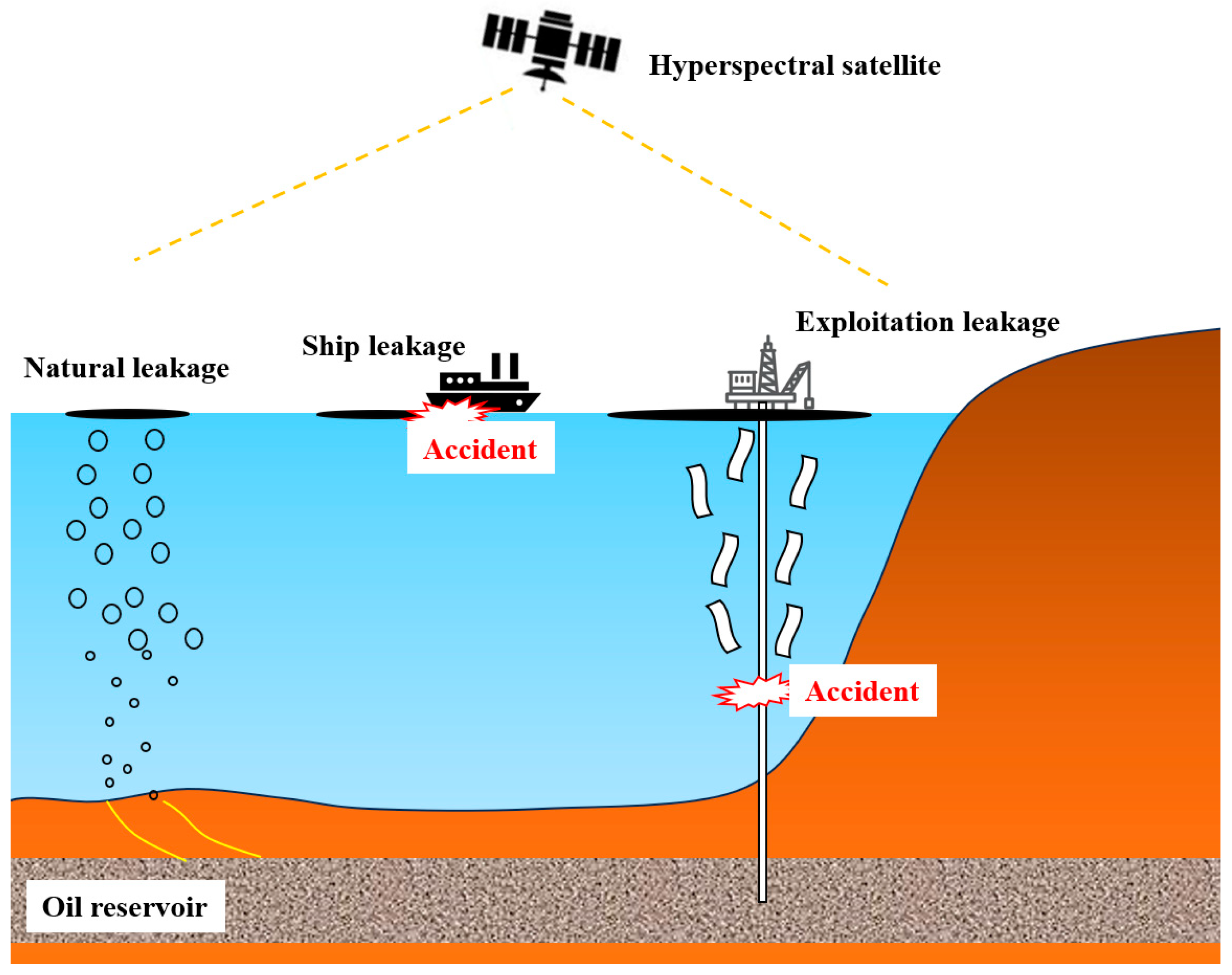
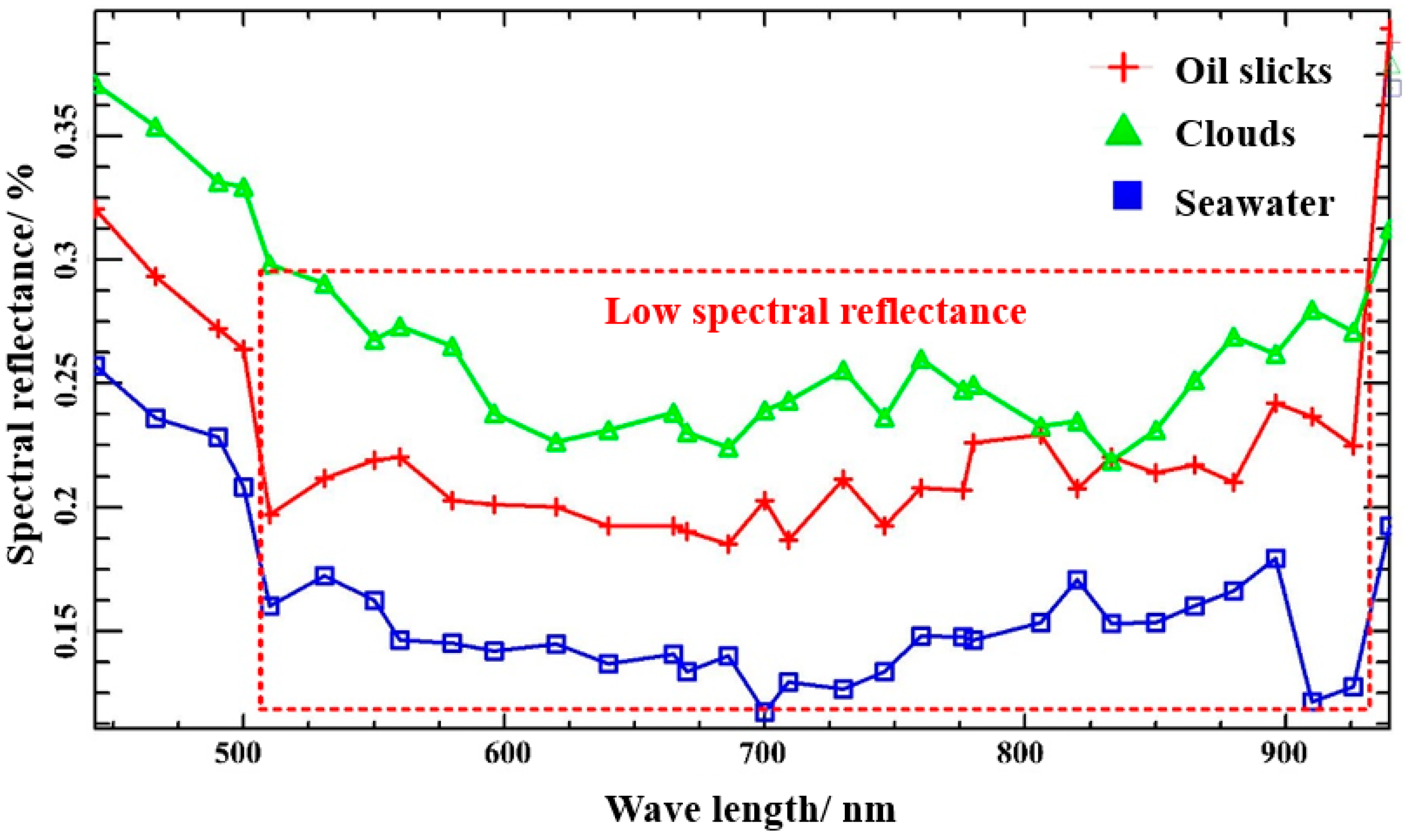
2.1. Marine Oil Spill Detection Theory in Hyperspectral Data
2.2. Detecting Marine Oil Spills by ASDE Method
- (1)
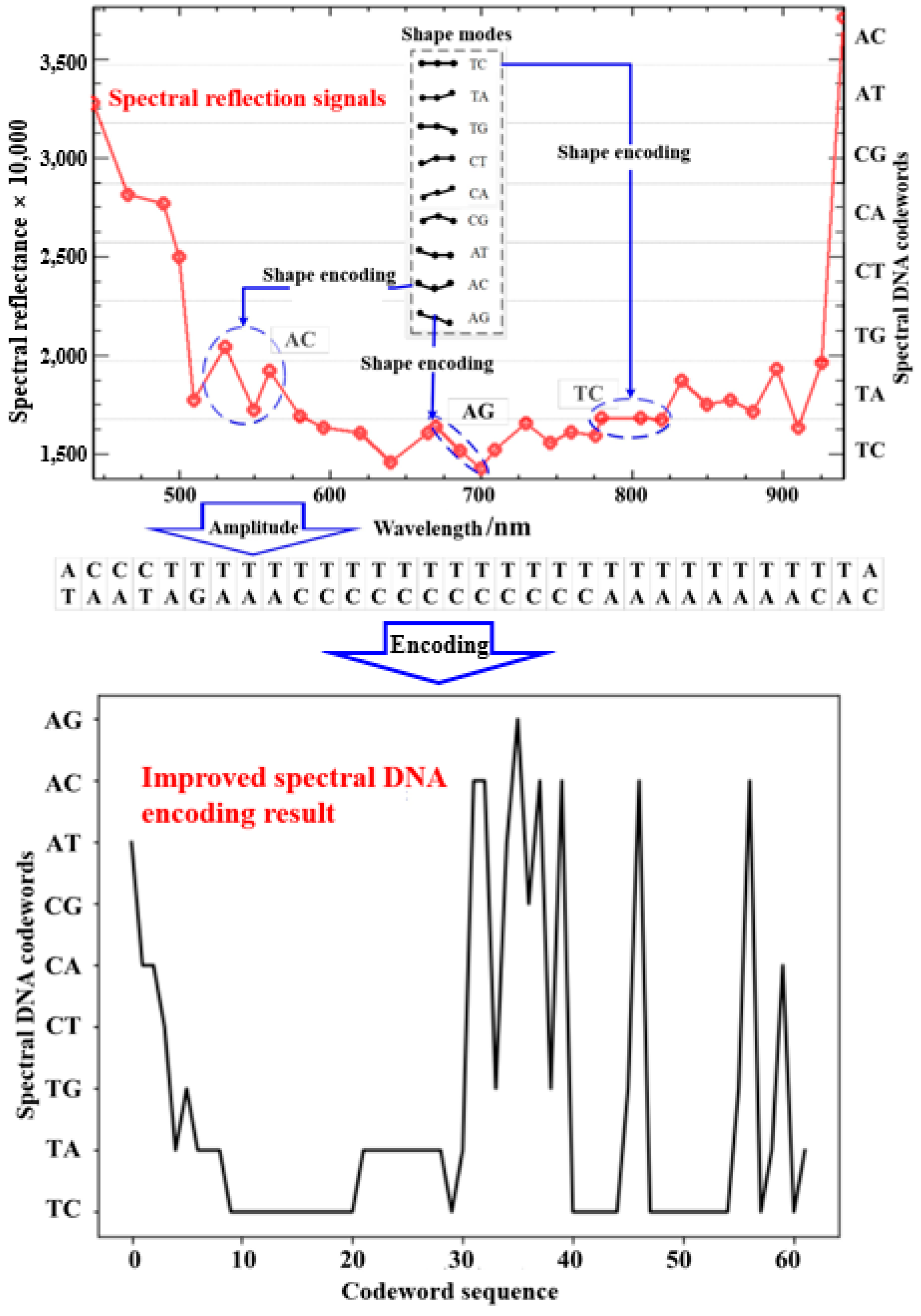
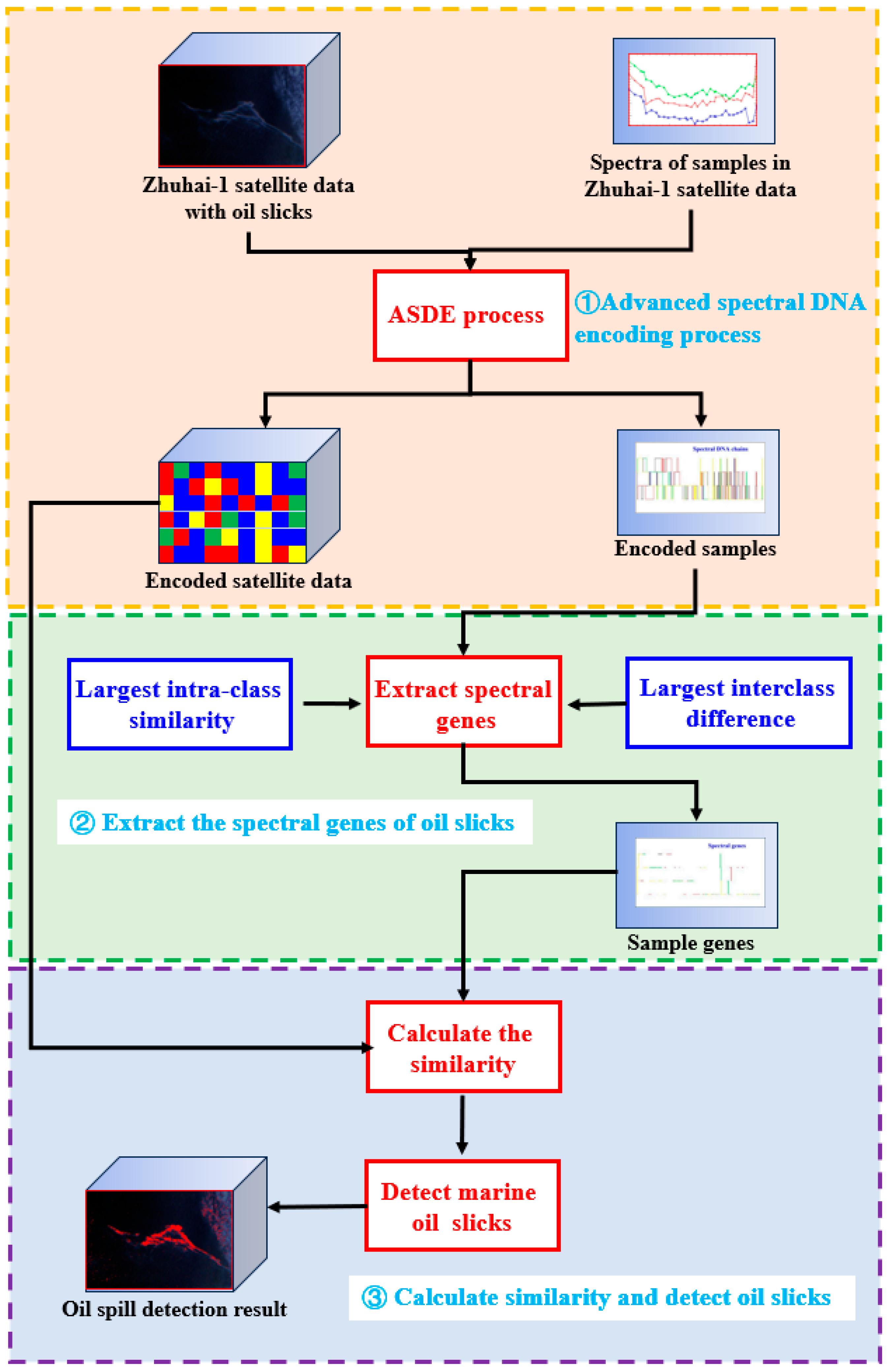
- Divide the amplitude and waveform information of hyperspectral satellite data into 9 modes (Formulas (1)–(6)). Use a pair of DNA codewords to describe the modes of spectral signals (Figure 2).
- (2)
- Use fuzzy clustering algorithm to extract the spectral genetic fragments of the sea-surface oil slicks (Formulas (7) and (8)).
- (3)
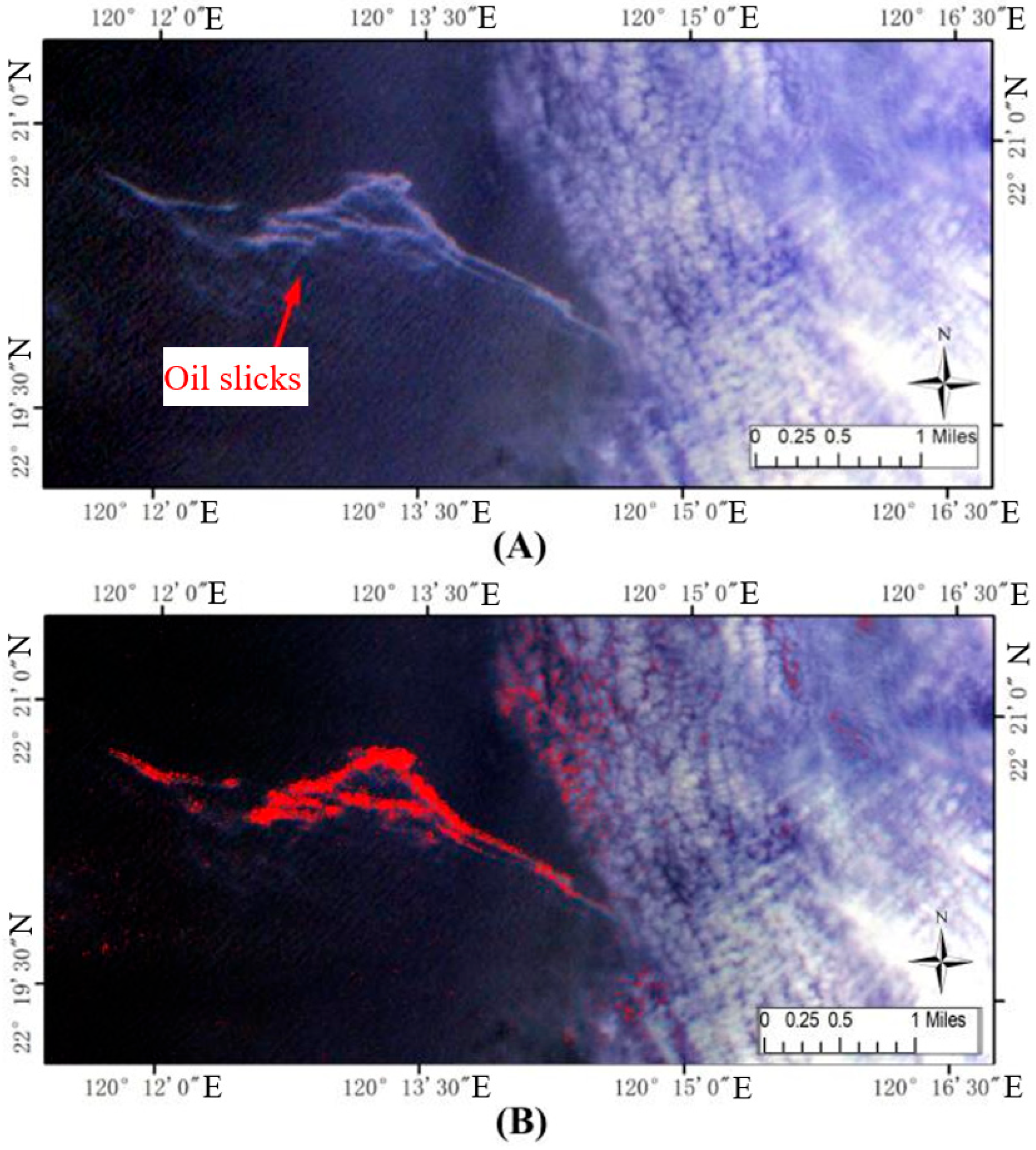
- Calculate the similarity between spectral genes and encoded pixels. Extract oil slick objects in the Zhuhai-1 satellite imagery based on the calculation results.
3. Results
4. Discussion
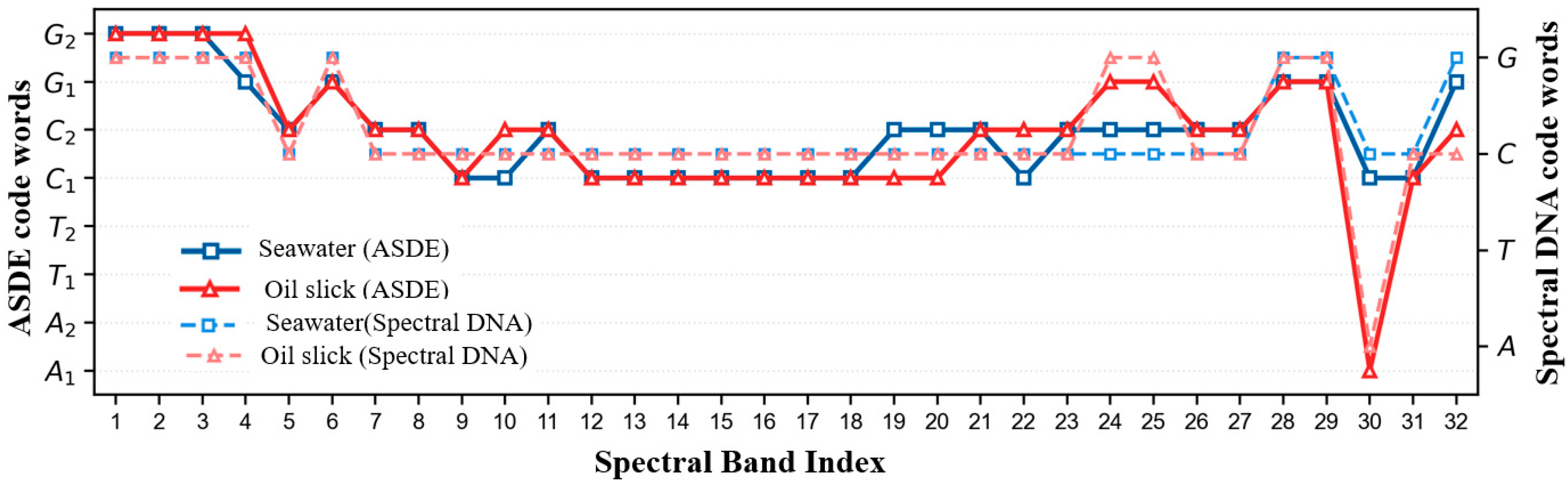
4.1. Discussion on Spectral Gene Extraction Strategy
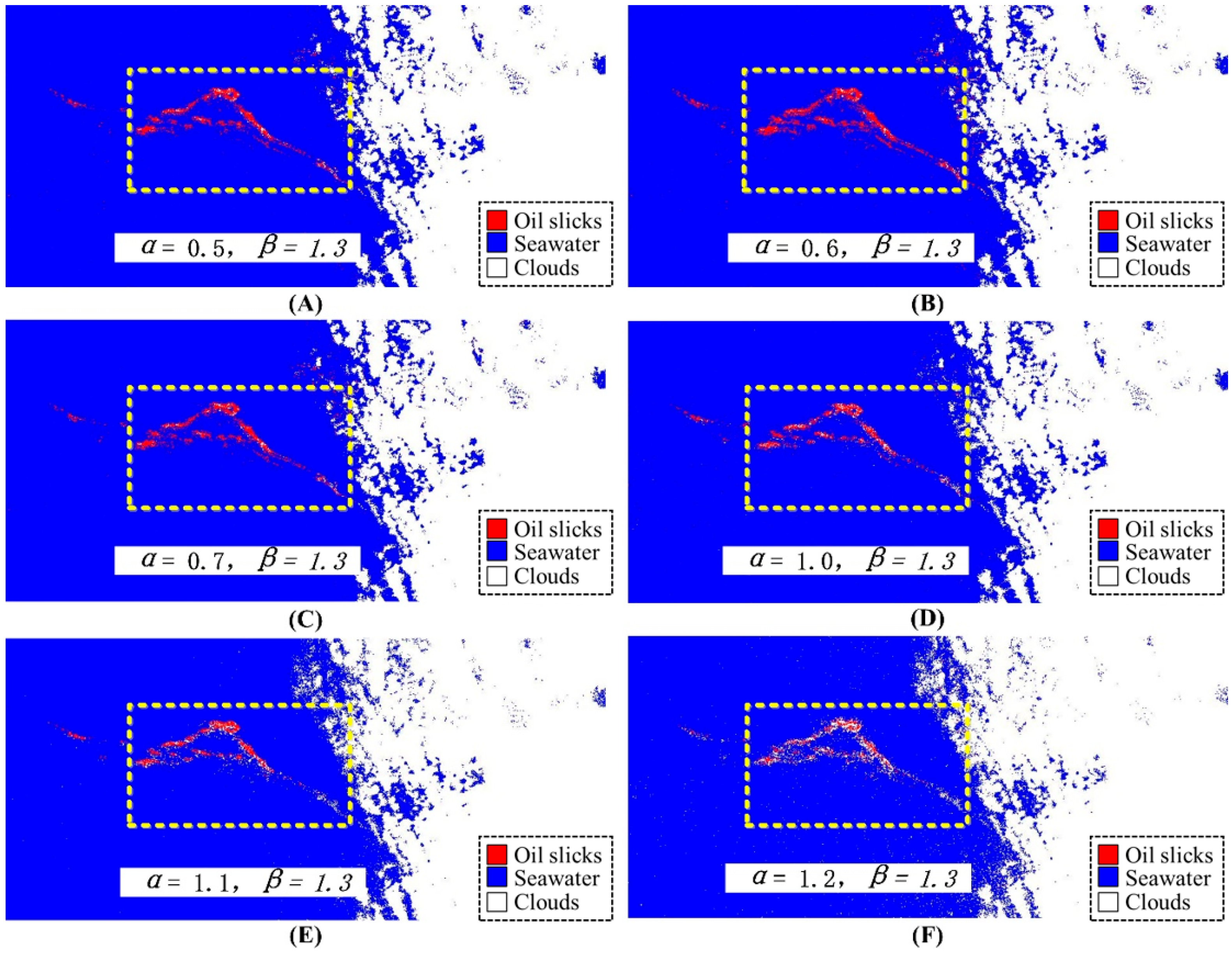
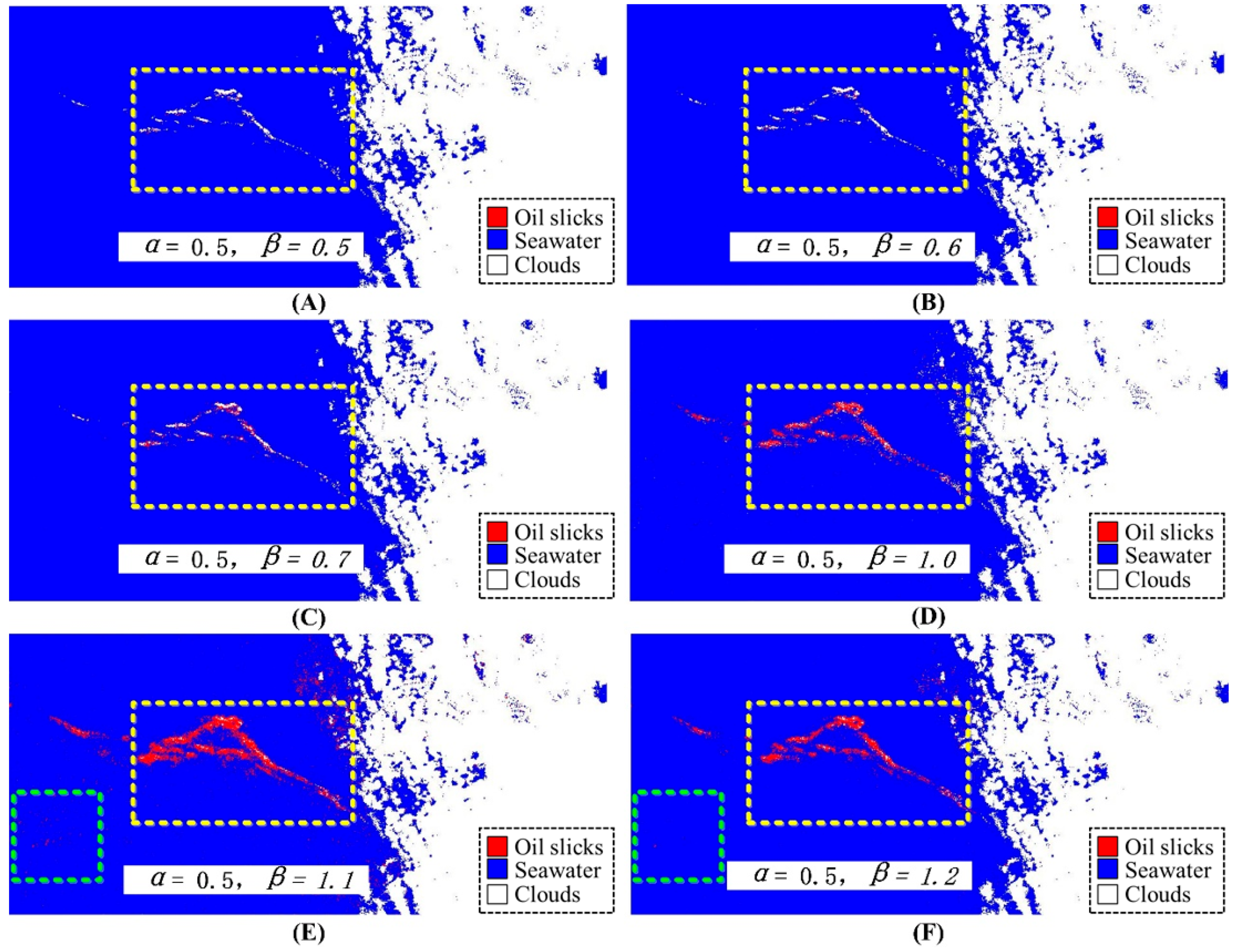
4.2. Discussion on Spectral Encoding Parameters
4.3. Discussion on Accuracy and Superiority
4.4. Shortcomings and Future Work
5. Conclusions
Author Contributions
Funding
Institutional Review Board Statement
Informed Consent Statement
Data Availability Statement
Acknowledgments
Conflicts of Interest
References
- Huang, X. Geo-Analysis of Some Aspects of Chemical Exploration in Application of Remote Sensing Techniques to Oil-Gas Detecting. Remote Sens. Environ. 1994, 9, 122–128. [Google Scholar]
- Lu, Y.; Hu, C.; Sun, S. Overview of Optical Remote Sensing of Marine Oil Spills and Hydrocarbon Seepage. J. Remote Sens. 2016, 20, 1259–1269. [Google Scholar] [CrossRef]
- Liu, X.; Guo, M.; Wang, Y. Assessing pollution-related effects of oil spills from ships in the Chinese Bohai Sea. Mar. Pollut. Bull. 2016, 110, 194–202. [Google Scholar] [CrossRef] [PubMed]
- Bu, Z.; Zhou, K.; Huang, J. Spectral Extraction and Analysis of Oil Polluted Water from Airborne Hyperspectral Data Using Image Characteristics. Period. Ocean. Univ. China 2005, 35, 687–690. [Google Scholar] [CrossRef]
- Wang, Y.; Yu, W.; Fan, Z. Multiple Kernel-Based SVM Classification of Hyperspectral Images by Combining Spectral, Spatial, and Semantic Information. Remote Sens. 2020, 12, 120. [Google Scholar] [CrossRef]
- Fingas, M.; Brown, C. Review of oil spill remote sensing. Mar. Pollut. Bull. 2014, 83, 9–23. [Google Scholar] [CrossRef] [PubMed]
- Lu, Y.; Tian, Q.; Wang, X. Determining oil slick thickness using hyperspectral remote sensing in the Bohai Sea of China. Int. J. Digit. Earth 2013, 6, 76–93. [Google Scholar] [CrossRef]
- Chen, S.; Hu, C. In search of oil seeps in the Cariaco basin using MODIS and MERIS medium-resolution data. Remote Sens. Lett. 2014, 5, 442–450. [Google Scholar] [CrossRef]
- Hu, C.; Li, X.; Pichel, W.G. Detection of natural oil slicks in the NW Gulf of Mexico using MODIS imagery. Geophys. Res. Lett. 2009, 36, 1–5. [Google Scholar] [CrossRef]
- Sun, S.; Hu, C. Sun glint requirement for the remote detection of surface oil films. Geophys. Res. Lett. 2016, 43, 309–316. [Google Scholar] [CrossRef]
- Guan, R.; Li, Z.; Li, T. Classification of Heterogeneous Mining Areas Based on ResCapsNet and Gaofen-5 Imagery. Remote Sens. 2022, 14, 3216. [Google Scholar] [CrossRef]
- Zhao, D.; Tan, B. Multi-scale Encoding (MSE) method with Spectral Shape Information (SSI) for Detecting Marine Oil-Gas Leakages. Remote Sens. 2023, 15, 2184. [Google Scholar] [CrossRef]
- Qin, H.; Wang, W.; Yao, Y. First Experience with Zhuhai-1 Hyperspectral Data for Urban Dominant Tree Species Classification in Shenzhen, China. Remote Sens. 2023, 15, 3179. [Google Scholar] [CrossRef]
- Wang, H.; Zhou, W.; Guan, Y. Monitoring the ecological restoration effect of land reclamation in open-pit coal mining areas: An exploration of a fusion method based on ZhuHai-1 and Landsat 8 data. Sci. Total Environ. 2003, 904, 166324. [Google Scholar] [CrossRef]
- Brown, C.; Fingas, M. Development of airborne oil thickness measurements. Mar. Pollut. Bull. 2003, 47, 485–492. [Google Scholar] [CrossRef] [PubMed]
- Lu, Y.; Chen, J.; Bao, Y. Using HJ-1 CCD Data for Remote Sensing Analysis and Information Extraction in Oil Spill Scenarios. Sci. China Inf. Sci. 2011, 41, 198–206. [Google Scholar]
- Loos, E.; Brown, L.; Borstad, G.; Mudge, T.; Alvarez, M. Characterization of oil slicks at sea using remote sensing techniques. In Proceedings of the Oceans, Hampton Roads, VA, USA, 14–19 October 2012; IEEE: New York, NY, USA, 2012. [Google Scholar] [CrossRef]
- Li, Y.; Lan, G.; Liu, B. Oil spill information extraction combined with texture features from HJ-CCD Sensors-A case study in PL19-3 oil spill incident. China Environ. Sci. 2012, 32, 1514–1520. [Google Scholar]
- Sun, P.; Song, M.; An, J. Study of Prediction Models for Oil Thickness Based on Spectral Curve. Spectrosc. Spectr. Anal. 2013, 33, 1881–1885. [Google Scholar] [CrossRef]
- Rajendran, S.; Sadooni, F.; Al-Kuwari, H. Monitoring oil spill in Norilsk, Russia using satellite data. Sci. Rep. 2021, 11, 3817. [Google Scholar] [CrossRef] [PubMed]
- Jiao, H.; Zhong, Y.; Zhang, L. An Unsupervised Spectral Matching Classifier Based on Artificial DNA Computing for Hyperspectral Remote Sensing Imagery. IEEE Trans. Geosci. Remote Sens. 2014, 52, 4524–4538. [Google Scholar] [CrossRef]
- Wu, K.; Zhao, D.; Zhong, Y.; Du, Q. Multi-probe based artificial DNA encoding and matching classifier for hyperspectral remote sensing imagery. Remote Sens. 2016, 8, 645–663. [Google Scholar] [CrossRef]



| Oil Slicks | Thickness/μm | Bonn Code | Characteristics |
|---|---|---|---|
| Silvery oil slicks | 0.04~0.3 | Code 1 | Silvery oil slicks are silver. Rainbow oil slicks are iridescent. Metallic oil slicks exhibit metallic shine. They are collectively called sheens. Sheens slightly change the colour of the background seawater and is distributed around the thick oil film. Sheens have little spectral difference from the seawater. |
| Rainbow oil slicks | 0.3~5.0 | Code 2 | |
| Metallic oil slicks | 5.0~50 | Code 3 | |
| Discontinuous true-colour oil slicks | 50~200 | Code 4 | Discontinuous true-colour oil slicks are thicker than sheens. They are orange-yellow and distributed in sheets on the sea surface. Their infrared reflection signal is slightly higher than that of seawater. |
| Continuous true-colour oil slicks | 200~500 | Code 5 | The thickness of continuous true-colour oil slicks is larger than the discontinuous true-colour oil slicks. They distribute in short strips and cannot exist on the sea surface in a large area. They look dark grey or black. Their infrared reflection signal is significantly higher than that of seawater. |
| Emulsified oil slicks | 500~ | - | They are weathered oil slicks with huge thickness differences. They look orange-red in colour. They are band-like distributions up to several km in length. They have strong infrared reflection signals. |
| Zhuhai-1 Satellite Data NO. | Shooting Date | Area | Oil Spill Type |
|---|---|---|---|
| HEM1_20210418142028_0008_L1B_CMOS2 | 17 April 2021 | Tainan Basin | Natural oil spill |
| HCW2_20200722124480_0025_L1B_CMOS3 | 21 July 2020 | Yinggehai Basin | Exploitation accident |
| HAM1_20210820212223_0018_L1B_CMOS1 | 19 August 2021 | Yinggehai Basin | Exploitation accident |
| Methods | OA | Recall | F1 | IoU |
|---|---|---|---|---|
| FCN | 0.87 | 0.47 | 0.10 | 0.05 |
| SVM | 0.85 | 0.56 | 0.10 | 0.05 |
| ASDE | 0.98 | 0.54 | 0.43 | 0.27 |
Disclaimer/Publisher’s Note: The statements, opinions and data contained in all publications are solely those of the individual author(s) and contributor(s) and not of MDPI and/or the editor(s). MDPI and/or the editor(s) disclaim responsibility for any injury to people or property resulting from any ideas, methods, instructions or products referred to in the content. |
© 2026 by the authors. Licensee MDPI, Basel, Switzerland. This article is an open access article distributed under the terms and conditions of the Creative Commons Attribution (CC BY) license.
Share and Cite
Zhao, D.; Bi, L.; Feng, J.; Gao, G.; Qu, C. An Oil Slick Detection Method Based on Advanced Spectral DNA Encoding Strategy by Chinese Zhuhai-1 Satellite Imagery. Sensors 2026, 26, 3954. https://doi.org/10.3390/s26123954
Zhao D, Bi L, Feng J, Gao G, Qu C. An Oil Slick Detection Method Based on Advanced Spectral DNA Encoding Strategy by Chinese Zhuhai-1 Satellite Imagery. Sensors. 2026; 26(12):3954. https://doi.org/10.3390/s26123954
Chicago/Turabian StyleZhao, Dong, Lihui Bi, Jianqiao Feng, Guoxiang Gao, and Chuang Qu. 2026. "An Oil Slick Detection Method Based on Advanced Spectral DNA Encoding Strategy by Chinese Zhuhai-1 Satellite Imagery" Sensors 26, no. 12: 3954. https://doi.org/10.3390/s26123954
APA StyleZhao, D., Bi, L., Feng, J., Gao, G., & Qu, C. (2026). An Oil Slick Detection Method Based on Advanced Spectral DNA Encoding Strategy by Chinese Zhuhai-1 Satellite Imagery. Sensors, 26(12), 3954. https://doi.org/10.3390/s26123954