DHA-eGCN: Differential Hyperedge Attention-Enhanced Graph Convolution Network for Skeleton-Based Human Action Recognition


Abstract
1. Introduction
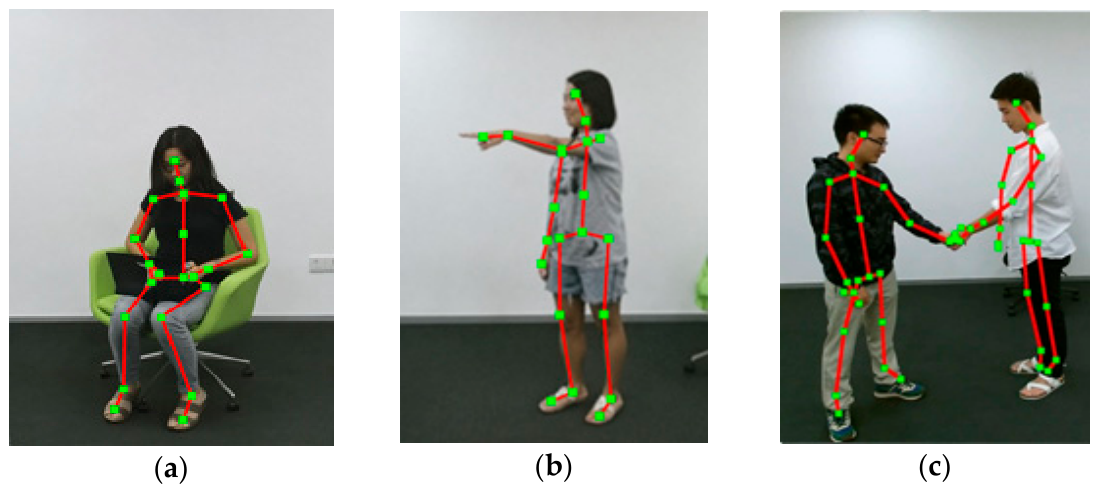
- We propose DHA-eGCN, a framework for skeleton-based action recognition that combines topology-guided hyperedge attention with differential attention to suppress shared noisy correlations under missing/jittery joint observations.
- We introduce two spatial graph modeling variants, MGCN and MAGCN, combining masked topology priors with optional sample-dependent adaptive adjacency for action-conditioned relation refinement, and evaluate both partial-GCN and full-GCN placement strategies.
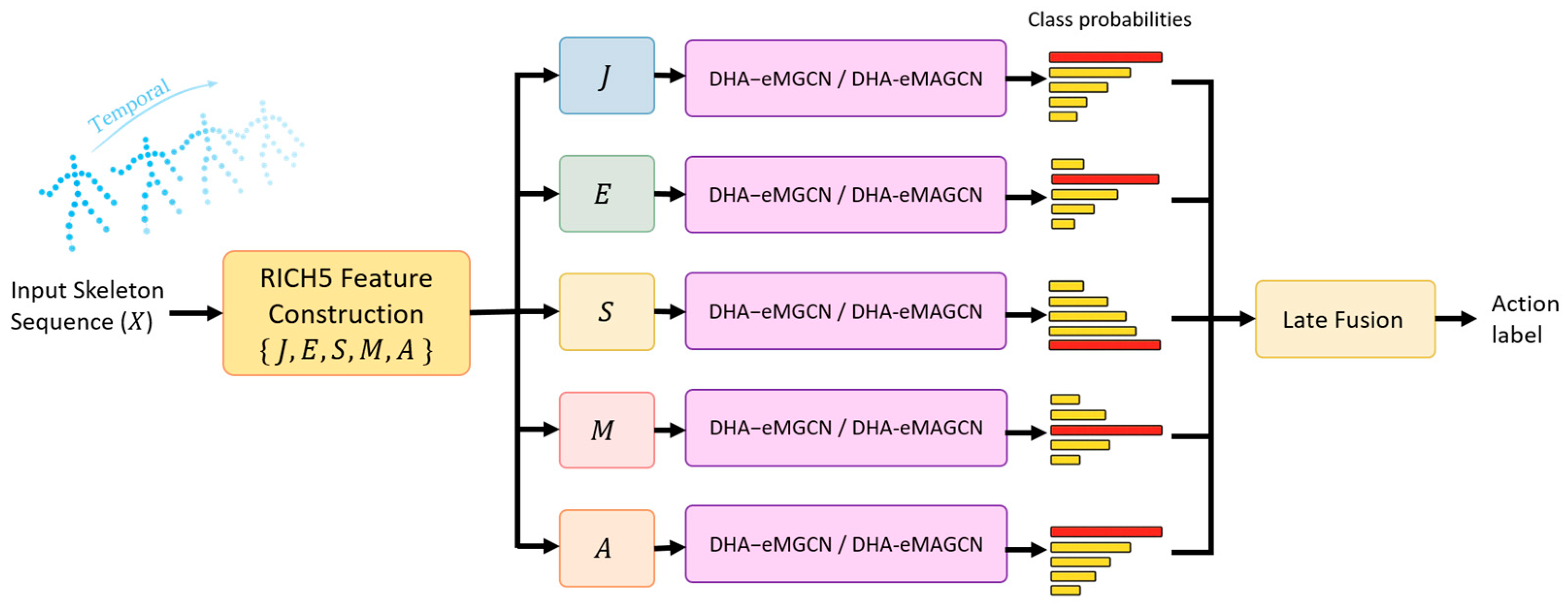
- We study a five-stream implementation of DHA-eGCN with enriched skeletal feature inputs and confirm that our per-stream model selection strategy improves the performance of multi-stream ensemble learning with late fusion.
- On the NTU RGB+D 60, NTU RGB+D 120, and Northwestern-UCLA datasets, DHA-eGCN achieves competitive or superior Top-1 accuracy compared with recent state-of-the-art (SOTA) methods, reaching 93.7%/97.0% on NTU RGB+D 60 X-Sub/X-View, 90.9%/91.9% on NTU RGB+D 120 X-Sub/X-Set, and 97.6% on Northwestern-UCLA.
2. Related Work
2.1. GCN-Based Architectures
2.2. Transformer-Based Architectures
2.3. Hybrid GCN–Transformer Architectures
2.4. Multi-Stream Ensemble Representations and Fusion
2.5. Gap and Motivation
3. Proposed Method
3.1. Problem Statement
3.2. Input Normalization and Data Layout
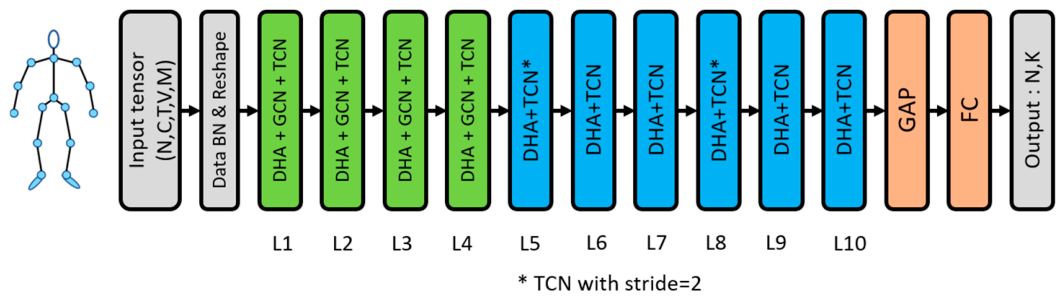
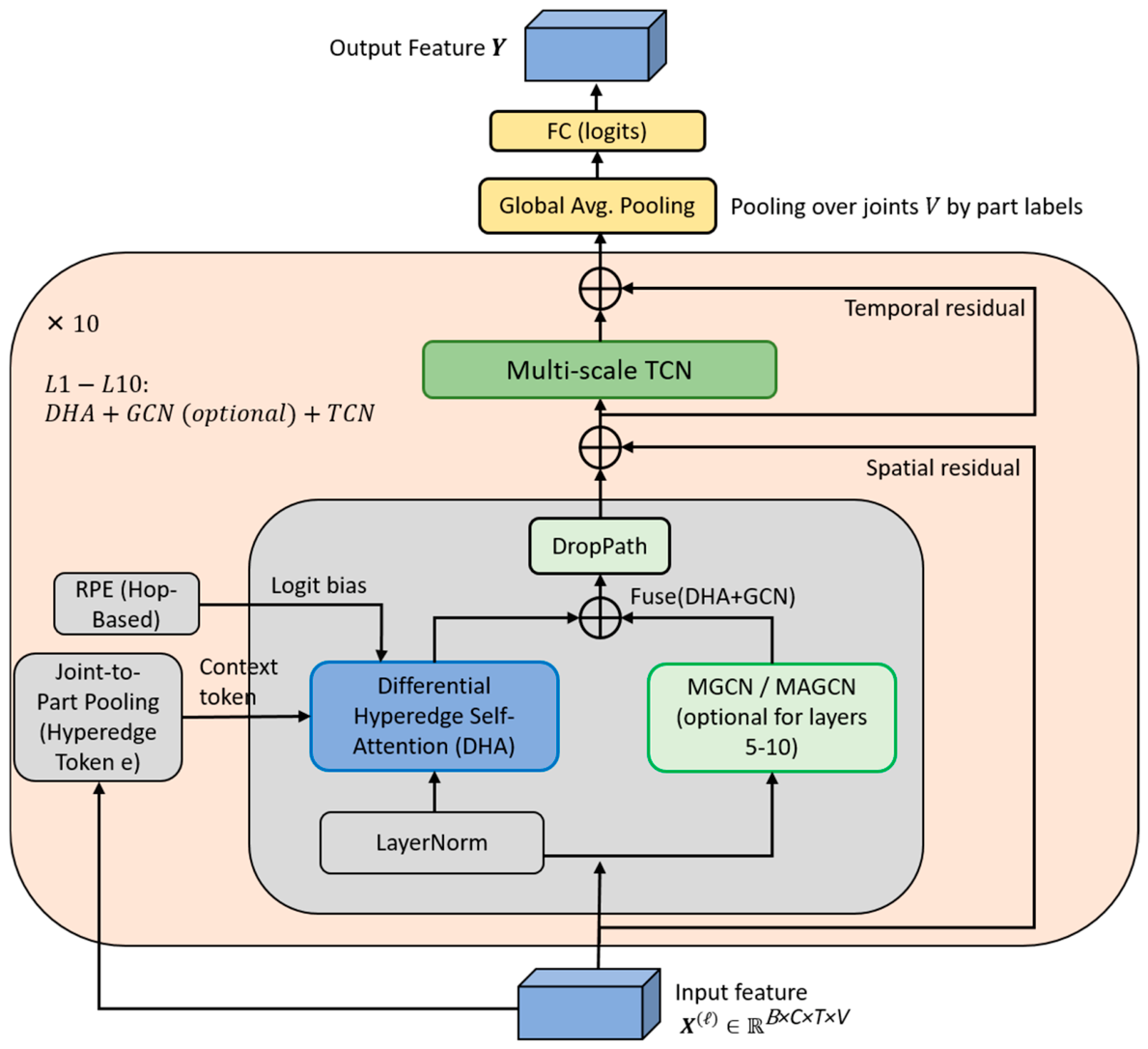
3.3. DHA-eGCN Block
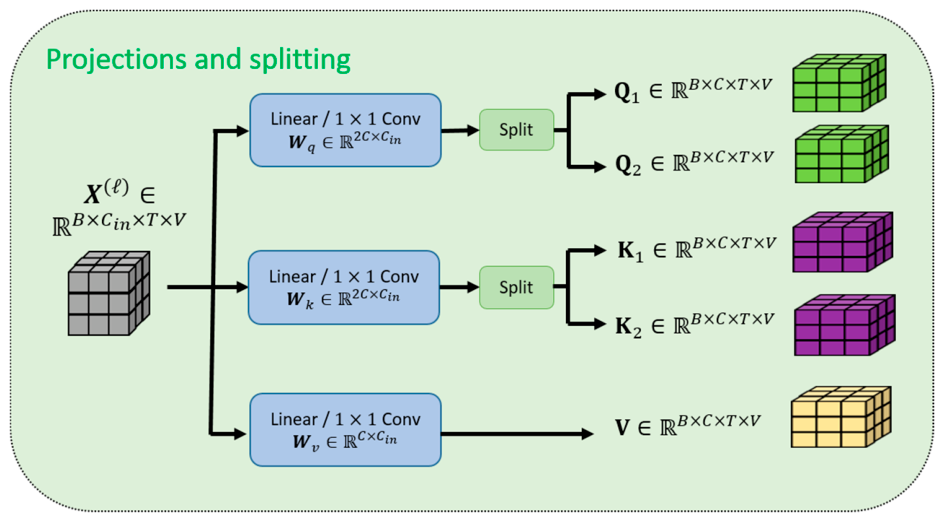
3.4. Spatial Module with Differential Hyperedge Attention (DHA)
3.4.1. Structure-Aware Attention with Hop-Based RPE
3.4.2. Hyperedge Tokens via Joint-to-Part Pooling
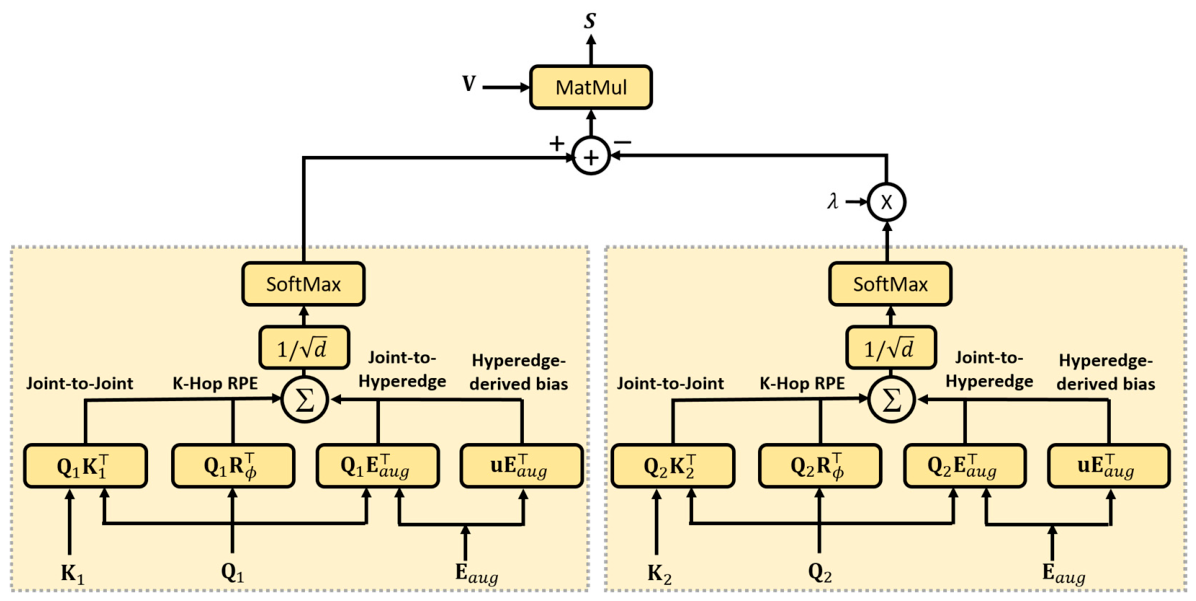
3.4.3. Differential Hyperedge Attention Mechanism for Noise Suppression
3.5. Graph Branch Placement
- MGCN: a masked GCN branch that learns edge-importance weights on top of a fixed partitioned adjacency (masked topology prior).
3.5.1. Masked GCN Branch (MGCN)
3.5.2. Masked and Adaptive GCN Branch (MAGCN)
3.6. Fusion of Global Attention and Local Graph Features
3.7. Multi-Scale Temporal Convolution Module
3.8. Output Head and Person Aggregation
3.9. Multi-Stream and Late Fusion
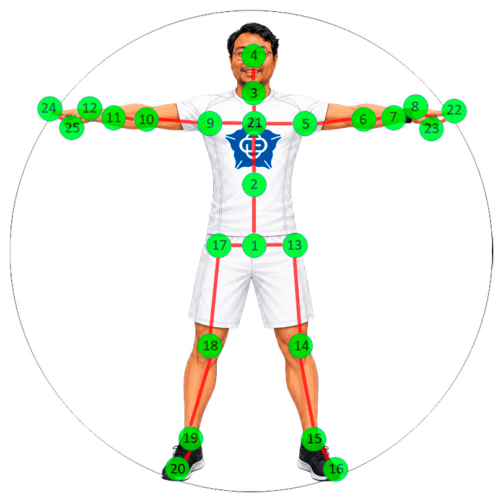
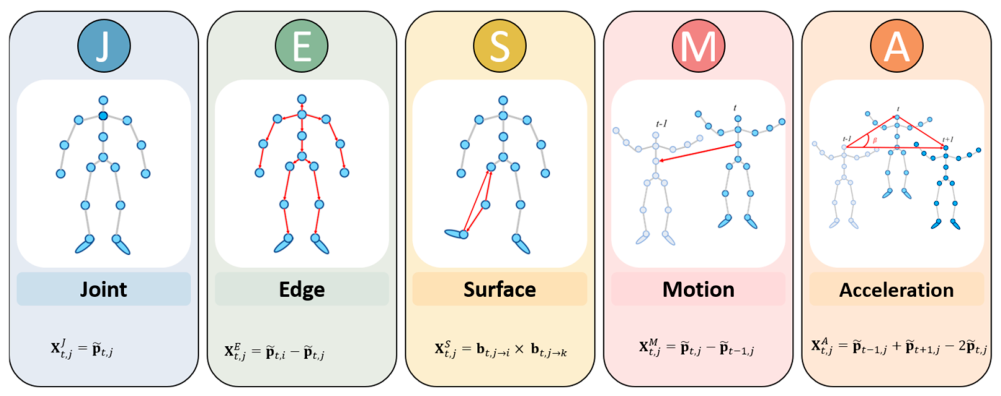
3.9.1. Vector-Based Joint Features (J/E/S/M/A) for Ensemble Learning
- (1)
- Joint stream J (1st-order spatial feature).
- (2)
- Edge stream E (2nd-order spatial feature).
- (3)
- Surface stream S (3rd-order spatial feature).
- (4)
- Motion stream M (2nd-order temporal feature).
- (5)
- Acceleration stream A (3rd-order temporal feature).
3.9.2. Late Fusion and Cross-Stream Model Selection
4. Experiments
4.1. Experimental Settings

| Architecture | Method | Number of Streams | NTU RGB+D 60 | NTU RGB+D 120 | NW-UCLA | ||
|---|---|---|---|---|---|---|---|
| X-Sub (%) | X-View (%) | X-Sub (%) | X-Set (%) | ||||
| Graph Convolution | ST-GCN [7] | 1 | 81.5 | 88.3 | - | - | - |
| 2S-AGCN [8] | 2 | 88.5 | 95.1 | - | - | - | |
| SelfGCN [16] | 4 | 93.1 | 96.6 | 89.4 | 91.0 | 96.8 | |
| Shift-GCN [12] | 4 | 90.7 | 96.5 | 85.9 | 87.6 | 94.6 | |
| SGN [44] | 1 | 89.0 | 94.5 | 72.9 | 81.5 | - | |
| TFC-GCN [24] | 1 | 87.9 | 91.5 | 83.0 | 81.6 | - | |
| CTR-GCN [23] | 4 | 92.4 | 96.8 | 88.9 | 90.6 | 96.5 | |
| Info-GCN [43] | 4 | 93.0 | 97.1 | 89.8 | 91.2 | 97.0 | |
| HLP-GCN [45] | 4 | 92.7 | 96.9 | 89.0 | 90.8 | 96.8 | |
| HD-GCN [46] | 6 | 93.4 | 97.2 | 90.1 | 91.6 | 97.2 | |
| BlockGCN [47] | 4 | 93.1 | 97.0 | 90.3 | 91.5 | 96.9 | |
| Transformer | ST-TR [48] | 2 | 87.1 | 91.8 | - | - | - |
| DSTA [49] | 4 | 91.5 | 96.4 | 86.6 | 89.0 | - | |
| Hyperformer [19] | 4 | 92.9 | 96.5 | 89.9 | 91.3 | 96.7 | |
| SkateFormer [50] | 4 | 93.5 | 97.8 | 89.8 | 91.4 | 98.3 | |
| Hybrid Model (GCN + Att) | Dynamic GCN [51] | 4 | 91.5 | 96.0 | 87.3 | 88.6 | - |
| EfficientGCN-B4 [52] | 3 | 92.1 | 96.1 | 88.7 | 88.9 | - | |
| FCSA-GCN [53] | 4 | 93.6 | 97.5 | 90.5 | 91.3 | 97.2 | |
| DHA-eGCN (ours, RICH4, full-GCN) | 4 | 93.7 | 97.0 | 90.9 | 91.9 | 97.6 | |
| Backbone Architecture | Partial/Full-GCN | Multi-Stream Ensembles | GCN Model | Top-1 X-Sub (%) | Top-1 X-View (%) |
|---|---|---|---|---|---|
| Hyperformer [19] | N/A | STD4 | N/A | 92.8 | 96.5 |
| DHA-eMGCN | Partial | STD4 | MGCN | 93.1 | 96.8 |
| DHA-eMAGCN | Partial | STD4 | MAGCN | 93.2 | 96.7 |
| DHA-eMGCN | Full | STD4 | MGCN | 93.4 | 96.8 |
| DHA-eMAGCN | Full | STD4 | MAGCN | 93.4 | 96.8 |
| DHA-eMGCN | Partial | RICH4 | MGCN | 93.0 | 96.7 |
| DHA-eMAGCN | Partial | RICH4 | MAGCN | 93.3 | 96.6 |
| DHA-eMGCN | Full | RICH4 | MGCN | 93.4 | 96.8 |
| DHA-eMAGCN | Full | RICH4 | MAGCN | 93.5 | 96.9 |
| DHA-eMGCN | Partial | RICH5 | MGCN | 93.1 | 96.7 |
| DHA-eMAGCN | Partial | RICH5 | MAGCN | 93.4 | 96.9 |
| DHA-eMGCN | Full | RICH5 | MGCN | 93.4 | 96.8 |
| DHA-eMAGCN | Full | RICH5 | MAGCN | 93.6 | 96.9 |
| DHA-eGCN with multi-model ensemble selection (*) | Partial | RICH4 | Selection (J, E, S, M): (MA, M, M, MA) | 93.4 | 96.7 |
| DHA-eGCN with multi-model ensemble selection (*) | Partial | RICH5 | Selection (J, E, S, M, A): (MA, M, MA, MA, MA) | 93.4 | 96.7 |
| DHA-eGCN with multi-model ensemble selection (*) | Full | RICH4 | Selection (J, E, S, M): (MA, M, M, MA) | 93.7 | 97.0 |
| DHA-eGCN with multi-model ensemble selection (*) | Full | RICH5 | Selection (J, E, S, M, A): (MA, M, MA, MA, MA) | 93.7 | 97.0 |
4.2. Comparison with State-of-the-Art (SOTA) Approaches
4.3. Ablation Study
4.4. Computational Complexity Analysis
4.5. Analysis of the Learned Differential Coefficient λ
4.6. Missing-Joint Robustness Analysis
4.7. Discussion
5. Conclusions
Author Contributions
Funding
Institutional Review Board Statement
Informed Consent Statement
Data Availability Statement
Acknowledgments
Conflicts of Interest
References
- Fincato, M.; Vezzani, R. DualPose: Dual-Block Transformer Decoder with Contrastive Denoising for Multi-Person Pose Estimation. Sensors 2025, 25, 2997. [Google Scholar] [CrossRef] [PubMed]
- Lie, W.N.; Vann, V. Estimating a 3D Human Skeleton from a Single RGB Image by Fusing Predicted Depths from Multiple Virtual Viewpoints. Sensors 2024, 24, 8017. [Google Scholar] [CrossRef] [PubMed]
- Iadarola, G.; Mengarelli, A.; Iarlori, S.; Monteriù, A.; Spinsante, S. RGB-D Cameras and Brain-Computer Interfaces for Human Activity Recognition: An Overview. Sensors 2025, 25, 6286. [Google Scholar] [CrossRef] [PubMed]
- Liu, M.; Liu, H.; Hu, Q.; Ren, B.; Yuan, J.; Lin, J.; Wen, J. 3D skeleton-based action recognition: A review. arXiv 2025, arXiv:2506.00915. [Google Scholar]
- Liu, Y.; Liu, R.; Hu, Y.; Wu, M.; Xin, W.; Miao, Q.; Wu, S.; Li, L. A Systematic Review of Skeleton-Based Action Recognition: Methods, Challenges, and Future Directions. IEEE Trans. Neural Netw. Learn. Syst. 2025, 37, 2046–2065. [Google Scholar] [CrossRef] [PubMed]
- Liu, R.; Liu, Y.; Xin, W.; Miao, Q.; Li, L. Action jitter killer: Joint noise optimization cascade for skeleton-based action recognition. IEEE Trans. Instrum. Meas. 2024, 73, 1–4. [Google Scholar] [CrossRef]
- Yan, S.; Xiong, Y.; Lin, D. Spatial temporal graph convolutional networks for skeleton-based action recognition. In Proceedings of the AAAI Conference on Artificial Intelligence, New Orleans, LA, USA, 2–7 February 2018; Volume 32. [Google Scholar] [CrossRef]
- Shi, L.; Zhang, Y.; Cheng, J.; Lu, H. Two-stream adaptive graph convolutional networks for skeleton-based action recognition. In Proceedings of the IEEE/CVF Conference on Computer Vision and Pattern Recognition, Long Beach, CA, USA, 16–20 June 2019; pp. 12026–12035. [Google Scholar] [CrossRef]
- Song, Y.F.; Zhang, Z.; Shan, C.; Wang, L. Richly activated graph convolutional network for robust skeleton-based action recognition. IEEE Trans. Circuits Syst. Video Technol. 2020, 31, 1915–1925. [Google Scholar] [CrossRef]
- Shi, L.; Zhang, Y.; Cheng, J.; Lu, H. Non-local graph convolutional networks for skeleton-based action recognition. arXiv 2018, arXiv:1805.07694. [Google Scholar]
- Wu, C.; Wu, X.J.; Kittler, J. Spatial residual layer and dense connection block enhanced spatial temporal graph convolutional network for skeleton-based action recognition. In Proceedings of the IEEE/CVF International Conference on Computer Vision Workshops, Seoul, Republic of Korea, 27–28 October 2019. [Google Scholar] [CrossRef]
- Cheng, K.; Zhang, Y.; He, X.; Chen, W.; Cheng, J.; Lu, H. Skeleton-based action recognition with shift graph convolutional network. In Proceedings of the IEEE/CVF Conference on Computer Vision and Pattern Recognition, Seattle, WA, USA, 13–19 June 2020; pp. 183–192. [Google Scholar] [CrossRef]
- Hu, H.; Fang, Y.; Han, M.; Qi, X. Multi-scale adaptive graph convolution network for skeleton-based action recognition. IEEE Access 2024, 12, 16868–16880. [Google Scholar] [CrossRef]
- Ren, H.; Luo, Z.; Fan, H.; Yuan, X.; Wang, G.; Zhang, L. G3 CN: Gaussian Topology Refinement Gated Graph Convolutional Network for Skeleton-Based Action Recognition. In Proceedings of the IEEE/RSJ International Conference on Intelligent Robots and Systems, Hangzhou, China, 19–25 October 2025; pp. 9661–9668. [Google Scholar] [CrossRef]
- Chung, J.L.; Ong, L.Y.; Leow, M.C. A systematic literature review of optimization methods in skeleton-based human action recognition. IEEE Access 2025, 13, 116713–116728. [Google Scholar] [CrossRef]
- Wu, Z.; Sun, P.; Chen, X.; Tang, K.; Xu, T.; Zou, L.; Wang, X.; Tan, M.; Cheng, F.; Weise, T. SelfGCN: Graph convolution network with self-attention for skeleton-based action recognition. IEEE Trans. Image Process. 2024, 33, 4391–4403. [Google Scholar] [CrossRef] [PubMed]
- Ye, T.; Dong, L.; Xia, Y.; Sun, Y.; Zhu, Y.; Huang, G.; Wei, F. Differential transformer. arXiv 2024, arXiv:2410.05258. [Google Scholar]
- Ray, A.; Raj, A.; Kolekar, M.H. Autoregressive adaptive hypergraph transformer for skeleton-based activity recognition. In Proceedings of the IEEE/CVF Winter Conference on Applications of Computer Vision, Tucson, AZ, USA, 28 February–4 March 2025; pp. 9690–9699. [Google Scholar] [CrossRef]
- Zhou, Y.; Cheng, Z.Q.; Li, C.; Fang, Y.; Geng, Y.; Xie, X.; Keuper, M. Hypergraph transformer for skeleton-based action recognition. arXiv 2022, arXiv:2211.09590. [Google Scholar]
- Song, Y.F.; Zhang, Z.; Shan, C.; Wang, L. Stronger, faster and more explainable: A graph convolutional baseline for skeleton-based action recognition. In Proceedings of the 28th ACM International Conference on Multimedia, Seattle, WA, USA, 12–16 October 2020; pp. 1625–1633. [Google Scholar] [CrossRef]
- Myung, W.; Su, N.; Xue, J.H.; Wang, G. DeGCN: Deformable graph convolutional networks for skeleton-based action recognition. IEEE Trans. Image Process. 2024, 33, 2477–2490. [Google Scholar] [CrossRef] [PubMed]
- Lie, W.N.; Nugroho, O.I.A. Improving Graph-Convolution-Network-Based Action Recognition Through Enhanced Skeletal Joint Features. In Proceedings of the International Conference on Consumer Electronics-Taiwan, Taichung, Taiwan, 9–11 July 2024; pp. 381–382. [Google Scholar] [CrossRef]
- Chen, Y.; Zhang, Z.; Yuan, C.; Li, B.; Deng, Y.; Hu, W. Channel-wise topology refinement graph convolution for skeleton-based action recognition. In Proceedings of the IEEE/CVF International Conference on Computer Vision, Montreal, BC, Canada, 10–17 October 2021; pp. 13359–13368. [Google Scholar] [CrossRef]
- Wang, K.; Deng, H. TFC-GCN: Lightweight temporal feature cross-extraction graph convolutional network for skeleton-based action recognition. Sensors 2023, 23, 5593. [Google Scholar] [CrossRef] [PubMed]
- Hu, H.; Cao, Y.; Fang, Y.; Meng, Z. Semantics-assisted training graph convolution network for skeleton-based action recognition. Sensors 2025, 25, 1841. [Google Scholar] [CrossRef] [PubMed]
- Lie, W.N.; Lin, Y.Y.; Chiang, J.C. Imputation and Action Recognition of Incomplete Human Skeletons Based on Graph Convolutional Neural Network. In Proceedings of the 10th IEEE International Conference on Communications and Electronics (IEEE ICCE), Da Nang, Vietnam, 31 July–2 August 2024. [Google Scholar]
- Lie, W.N.; Le, K.T.; Vann, V.; Chiang, J.C.; Bui, N.D. Skeleton-Sequence-Based Early Action Recognition by Using Graph Convolutional Neural Networks and Knowledge Distillation Techniques. In Proceedings of the Asia Pacific Signal and Information Processing Association Annual Summit and Conference, Singapore, 22–24 October 2025; pp. 1279–1284. [Google Scholar] [CrossRef]
- Yan, T.; Zeng, W.; Xiao, Y.; Tong, X.; Tan, B.; Fang, Z.; Cao, Z.; Zhou, J.T. Crossglg: Llm guides one-shot skeleton-based 3D action recognition in a cross-level manner. In Proceedings of the European Conference on Computer Vision, Milan, Italy, 29 September–4 October 2024; pp. 113–131. [Google Scholar] [CrossRef]
- Šajina, R.; Oreški, G.; Ivašić-Kos, M. GCN-Transformer: Graph Convolutional Network and Transformer for Multi-Person Pose Forecasting Using Sensor-Based Motion Data. Sensors 2025, 25, 3136. [Google Scholar] [CrossRef] [PubMed]
- Wen, Y.; Liu, M.; Wu, S.; Ding, B. CHASE: Learning convex hull adaptive shift for skeleton-based multi-entity action recognition. Adv. Neural Inf. Process. Syst. 2024, 37, 9388–9420. [Google Scholar] [CrossRef]
- Wei, Y.; Peng, K.; Roitberg, A.; Zhang, J.; Zheng, J.; Liu, R.; Chen, Y.; Yang, K.; Stiefelhagen, R. Elevating skeleton-based action recognition with efficient multi-modality self-supervision. In Proceedings of the IEEE International Conference on Acoustics, Speech and Signal Processing, Seoul, Republic of Korea, 14–19 April 2024; pp. 6040–6044. [Google Scholar] [CrossRef]
- Wu, S.; Lu, G.; Han, Z.; Chen, L. A robust two-stage framework for human skeleton action recognition with GAIN and masked autoencoder. Neurocomputing 2025, 623, 129433. [Google Scholar] [CrossRef]
- Li, X.; Chen, Z.; Gao, G.; Qi, L.; Ye, Q.; Zhao, M. SequentialPointNet++: A Reinforced-Hyperpoint Network through Pose and Motion-chain Fusion for 3D Action Recognition. Inf. Fusion 2026, 132, 104245. [Google Scholar] [CrossRef]
- Li, X.; Gao, G.; Chen, Z.; Li, X.; Huang, Q. MD-PCSN: Meta-Motion Decoupling Point Cloud Sequence Network for Privacy-Preserving Human Action Recognition in AI Machines. IEEE Trans. Netw. Serv. Manag. 2026, 23, 3180–3190. [Google Scholar] [CrossRef]
- Yang, Y.; Zhang, J.; Zhang, J.; Du, B.; Tu, Z. Expressive Keypoints for Skeleton-Based Action Recognition via Progressive Skeleton Evolution. IEEE Trans. Image Process. 2025, 34, 7585–7599. [Google Scholar] [CrossRef] [PubMed]
- Huang, G.; Sun, Y.; Liu, Z.; Sedra, D.; Weinberger, K.Q. Deep networks with stochastic depth. In Proceedings of the European Conference on Computer Vision, Amsterdam, The Netherlands, 11–14 October 2016; pp. 646–661. [Google Scholar] [CrossRef]
- Zhou, Y.; Xu, T.; Wu, C.; Wu, X.; Kittler, J. Adaptive hyper-graph convolution network for skeleton-based human action recognition with virtual connections. In Proceedings of the IEEE/CVF International Conference on Computer Vision, Honolulu, HI, USA, 19–23 October 2025; pp. 12648–12658. [Google Scholar]
- Shi, L.; Zhang, Y.; Cheng, J.; Lu, H. Skeleton-based action recognition with multi-stream adaptive graph convolutional networks. IEEE Trans. Image Process. 2020, 29, 9532–9545. [Google Scholar] [CrossRef] [PubMed]
- Shahroudy, A.; Liu, J.; Ng, T.T.; Wang, G. NTU RGB+D: A Large Scale Dataset for 3D Human Activity Analysis. In Proceedings of the IEEE Conference on Computer Vision and Pattern Recognition, Las Vegas, NV, USA, 26 June–1 July 2016; pp. 1010–1019. [Google Scholar] [CrossRef]
- Liu, J.; Shahroudy, A.; Perez, M.; Wang, G.; Duan, L.-Y.; Kot, A.C. NTU RGB+D 120: A Large-Scale Benchmark for 3D Human Activity Understanding. IEEE Trans. Pattern Anal. Mach. Intell. 2020, 42, 2684–2701. [Google Scholar] [CrossRef] [PubMed]
- Wang, J.; Nie, X.; Xia, Y.; Wu, Y.; Zhu, S.-C. Cross-view Action Modeling, Learning and Recognition. In Proceedings of the IEEE Conference on Computer Vision and Pattern Recognition (CVPR), Columbus, OH, USA, 23–28 June 2014; pp. 2649–2656. [Google Scholar] [CrossRef]
- Paszke, A.; Gross, S.; Massa, F.; Lerer, A.; Bradbury, J.; Chanan, G.; Killeen, T.; Lin, Z.; Gimelshein, N.; Antiga, L.; et al. Pytorch: An imperative style, high-performance deep learning library. In Proceedings of the Advances in Neural Information Processing Systems, Vancouver, BC, Canada, 8–14 December 2019; Volume 32. [Google Scholar]
- Chi, H.G.; Ha, M.H.; Chi, S.; Lee, S.W.; Huang, Q.; Ramani, K. Infogcn: Representation learning for human skeleton-based action recognition. In Proceedings of the IEEE/CVF Conference on Computer Vision and Pattern Recognition, New Orleans, LA, USA, 19–24 June 2022; pp. 20186–20196. [Google Scholar] [CrossRef]
- Zhang, P.; Lan, C.; Zeng, W.; Xing, J.; Xue, J.; Zheng, N. Semantics-guided neural networks for efficient skeleton-based human action recognition. In Proceedings of the IEEE/CVF Conference on Computer Vision and Pattern Recognition, Seattle, WA, USA, 13–19 June 2020; pp. 1112–1121. [Google Scholar] [CrossRef]
- Wei, C.; Deng, Z. Accommodating self-attentional heterophily topology into high-and low-pass graph convolutional network for skeleton-based action recognition. In Proceedings of the International Joint Conference on Neural Networks, Gold Coast, Australia, 18–23 June 2023; pp. 1–8. [Google Scholar] [CrossRef]
- Lee, J.; Lee, M.; Lee, D.; Lee, S. Hierarchically decomposed graph convolutional networks for skeleton-based action recognition. In Proceedings of the IEEE/CVF International Conference on Computer Vision, Paris, France, 2–6 October 2023; pp. 10444–10453. [Google Scholar] [CrossRef]
- Zhou, Y.; Yan, X.; Cheng, Z.-Q.; Yan, Y.; Dai, Q.; Hua, X.-S. BlockGCN: Redefine Topology Awareness for Skeleton-Based Action Recognition. In Proceedings of the IEEE/CVF Conference on Computer Vision and Pattern Recognition (CVPR), Seattle, WA, USA, 16–22 June 2024. [Google Scholar] [CrossRef]
- Plizzari, C.; Cannici, M.; Matteucci, M. Spatial temporal transformer network for skeleton-based action recognition. In Proceedings of the International Conference on Pattern Recognition, Milan, Italy, 10–15 January 2021; pp. 694–701. [Google Scholar] [CrossRef]
- Shi, L.; Zhang, Y.; Cheng, J.; Lu, H. Decoupled spatial-temporal attention network for skeleton-based action-gesture recognition. In Proceedings of the Asian Conference on Computer Vision, Kyoto, Japan, 30 November–4 December 2020. [Google Scholar] [CrossRef]
- Do, J.; Lee, M.; Lee, D.; Lee, S. SkateFormer: Skeletal-Temporal Transformer for Human Action Recognition. In Proceedings of the European Conference on Computer Vision (ECCV), Milan, Italy, 29 September–4 October 2024. [Google Scholar] [CrossRef]
- Ye, F.; Pu, S.; Zhong, Q.; Li, C.; Xie, D.; Tang, H. Dynamic GCN: Context-enriched topology learning for skeleton-based action recognition. In Proceedings of the 28th ACM International Conference on Multimedia, Seattle, WA, USA, 12–16 October 2020; pp. 55–63. [Google Scholar] [CrossRef]
- Song, Y.F.; Zhang, Z.; Shan, C.; Wang, L. Constructing stronger and faster baselines for skeleton-based action recognition. IEEE Trans. Pattern Anal. Mach. Intell. 2023, 45, 1474–1488. [Google Scholar] [CrossRef] [PubMed]
- Kilic, U.; Oztimur Karadag, O.; Tumuklu Ozyer, G. Fine-to-Coarse Self-Attention Graph Convolutional Network for Skeleton-Based Action Recognition. Appl. Soft Comput. 2026, 186, 114268. [Google Scholar] [CrossRef]


| Method | Stream | Params (M) | GFLOPs | Inference Time (ms/Sample) | Top-1 | |
|---|---|---|---|---|---|---|
| X-Sub (%) | X-View (%) | |||||
| DHA-eMGCN partial | Joint | 9.58 | 17.81 | 9.06 | 91.5 | 95.4 |
| DHA-eMAGCN partial | Joint | 9.73 | 17.82 | 9.34 | 91.6 | 95.5 |
| DHA-eMGCN full-GCN | Joint | 11.48 | 20.84 | 10.17 | 91.9 | 95.6 |
| DHA-eMAGCN full-GCN | Joint | 11.96 | 20.86 | 10.94 | 92.0 | 95.6 |
| DHA-eGCN (ours, RICH4, full-GCN) | 4 | 46.88 | 83.40 | 42.22 | 93.7 | 97.0 |
| Model | Clean | Drop 10% | Drop 20% | Drop 30% |
|---|---|---|---|---|
| Hyperformer [19] | 90.7 | 85.7 | 81.5 | 72.6 |
| DHA-eMAGCN full-GCN | 92 | 88 | 84.6 | 77.4 |
Disclaimer/Publisher’s Note: The statements, opinions and data contained in all publications are solely those of the individual author(s) and contributor(s) and not of MDPI and/or the editor(s). MDPI and/or the editor(s) disclaim responsibility for any injury to people or property resulting from any ideas, methods, instructions or products referred to in the content. |
© 2026 by the authors. Licensee MDPI, Basel, Switzerland. This article is an open access article distributed under the terms and conditions of the Creative Commons Attribution (CC BY) license.
Share and Cite
Nugroho, O.I.A.; Lie, W.-N. DHA-eGCN: Differential Hyperedge Attention-Enhanced Graph Convolution Network for Skeleton-Based Human Action Recognition. Sensors 2026, 26, 3932. https://doi.org/10.3390/s26123932
Nugroho OIA, Lie W-N. DHA-eGCN: Differential Hyperedge Attention-Enhanced Graph Convolution Network for Skeleton-Based Human Action Recognition. Sensors. 2026; 26(12):3932. https://doi.org/10.3390/s26123932
Chicago/Turabian StyleNugroho, Oskar Ika Adi, and Wen-Nung Lie. 2026. "DHA-eGCN: Differential Hyperedge Attention-Enhanced Graph Convolution Network for Skeleton-Based Human Action Recognition" Sensors 26, no. 12: 3932. https://doi.org/10.3390/s26123932
APA StyleNugroho, O. I. A., & Lie, W.-N. (2026). DHA-eGCN: Differential Hyperedge Attention-Enhanced Graph Convolution Network for Skeleton-Based Human Action Recognition. Sensors, 26(12), 3932. https://doi.org/10.3390/s26123932