
Design and Optimization of SAR Signal Array Receiving Based on MOEA/D-HPSO
Abstract
1. Introduction
- Traditional MOEA/D uses only a single aggregation function; the proposed method sequentially adopts a two-stage aggregation strategy (weighted sum followed by Tchebycheff) to handle the non-convex Pareto front, balancing global exploration and precise convergence.
- Standard PSO relies on a single population for global search, whereas this paper embeds HPSO into the MOEA/D framework, equipping each subproblem with an independent PSO swarm, thereby enhancing targeted search for each subproblem.
- Conventional decomposition-based algorithms (e.g., MOEA/D and MOPSO/D) only replace individual solutions among subproblems; this paper extends genetic algorithm operators to information exchange between neighboring subproblems, performing crossover and mutation to improve population diversity.
2. Problem Formulation
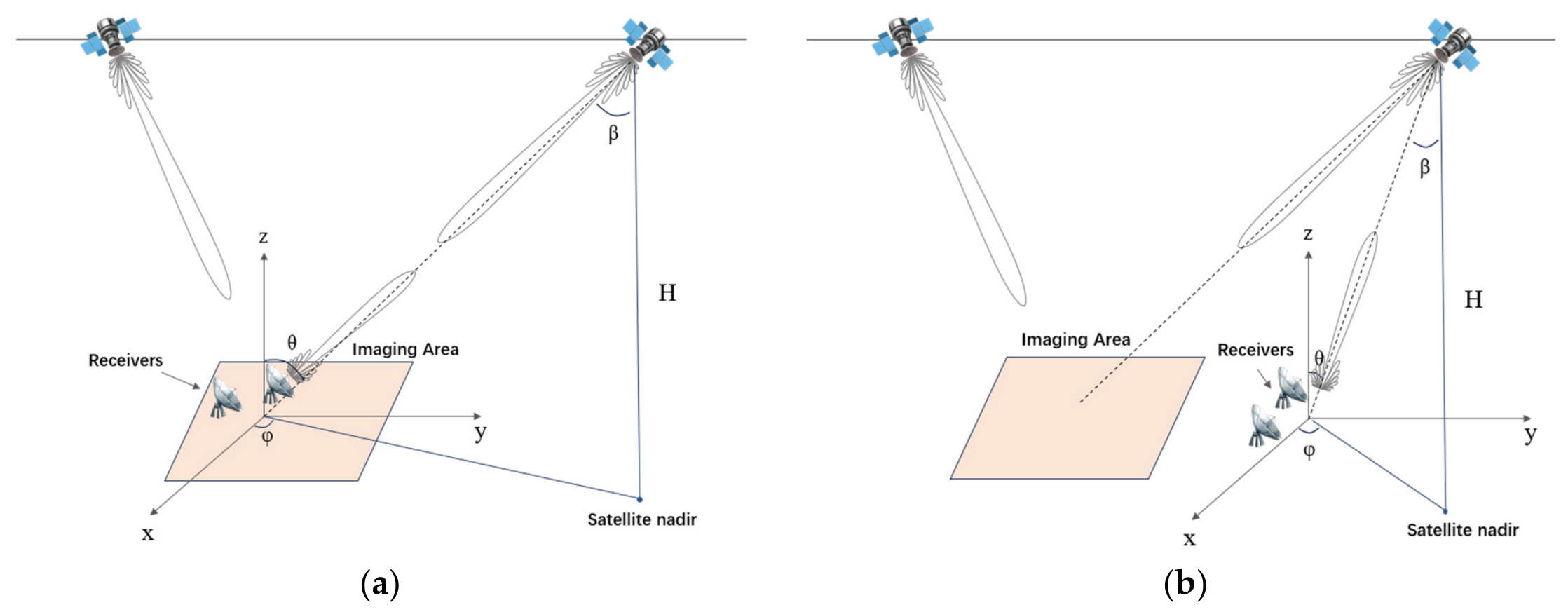
2.1. Receiving Model and Analysis
2.2. Multi-Objective Optimization Model for Receiver Array
2.3. Optimization Performance Indicators of Receiver Array
3. Design and Optimization of Receiver Array
3.1. Array Initialization
3.2. Receiver Array Multi-Objective Optimization Based on MOEA/D-HPSO
3.2.1. MOEA/D Decomposition Framework
3.2.2. Hybrid Genetic Particle Swarm Optimization (HPSO)-Based Array Solving Method
3.3. Algorithm Implementation Details
| Algorithm 1 MOEA/D-HPSO for planar receiving array optimization |
| Input: number of elements , aperture size , number of subproblems , neighborhood size K, maximum generations , population size per subproblem M. |
| Output: Pareto front P, HV history |
| 1: weights ← Generate Uniform Weights (, 3); // 3 objectives decision vector: with |
| 2: Compute distance matrix among weights; |
| 3: for each subproblem j, set neighbor list as the K closest weight vectors; |
| 4: ; // initialize ideal point |
| 5: ; // generation to switch to Tchebycheff aggregation |
| 6: for each subproblem j do: |
| 7: InitializePopulation (M); // each individual generated with Taylor + noise |
| 8: Define fitness function using current aggregation: weighted sum (if gen < ) else Tchebycheff (if gen ≥ ), plus position penalty; |
| 9: Initialize a PSO instance for subproblem j with and ; |
| 10: Store best solution and its objectives; |
| 11: end for |
| 12: Initialize an empty list ; //store the HV history obtained in each generation |
| 13: for gen = 0 to do: |
| 14: for each subproblem j in parallel do: |
| 15: Perform one PSO generation: update velocity, position, personal best and global best (best solution among all subproblems in ); |
| 16: end for |
| 17: if gen % 10 == 0 and gen > 0: |
| 18: for each subproblem k do: |
| 19: k ← random neighbor from ; |
| 20: Apply SBX crossover and polynomial mutation to and ; |
| 21: Replace the worst individual in subproblem j’s swarm with the better child (evaluated by ); |
| 22: end for |
| 23: end if |
| 24: Update ideal point z using best objectives of all subproblems; |
| 25: if gen % 5 == 0 or gen == : |
| 26: Compute hypervolume HV from current non-dominated solutions; |
| 27: Append HV to ; |
| 28: end if |
| 29: end for |
| 30: Collect all subproblem best solutions and their raw objectives; |
| 31: Perform non-dominated sorting on [MSL, -G, BW] to extract Pareto front P; |
| 32: Return P and ; |
4. Experimental Results and Analysis
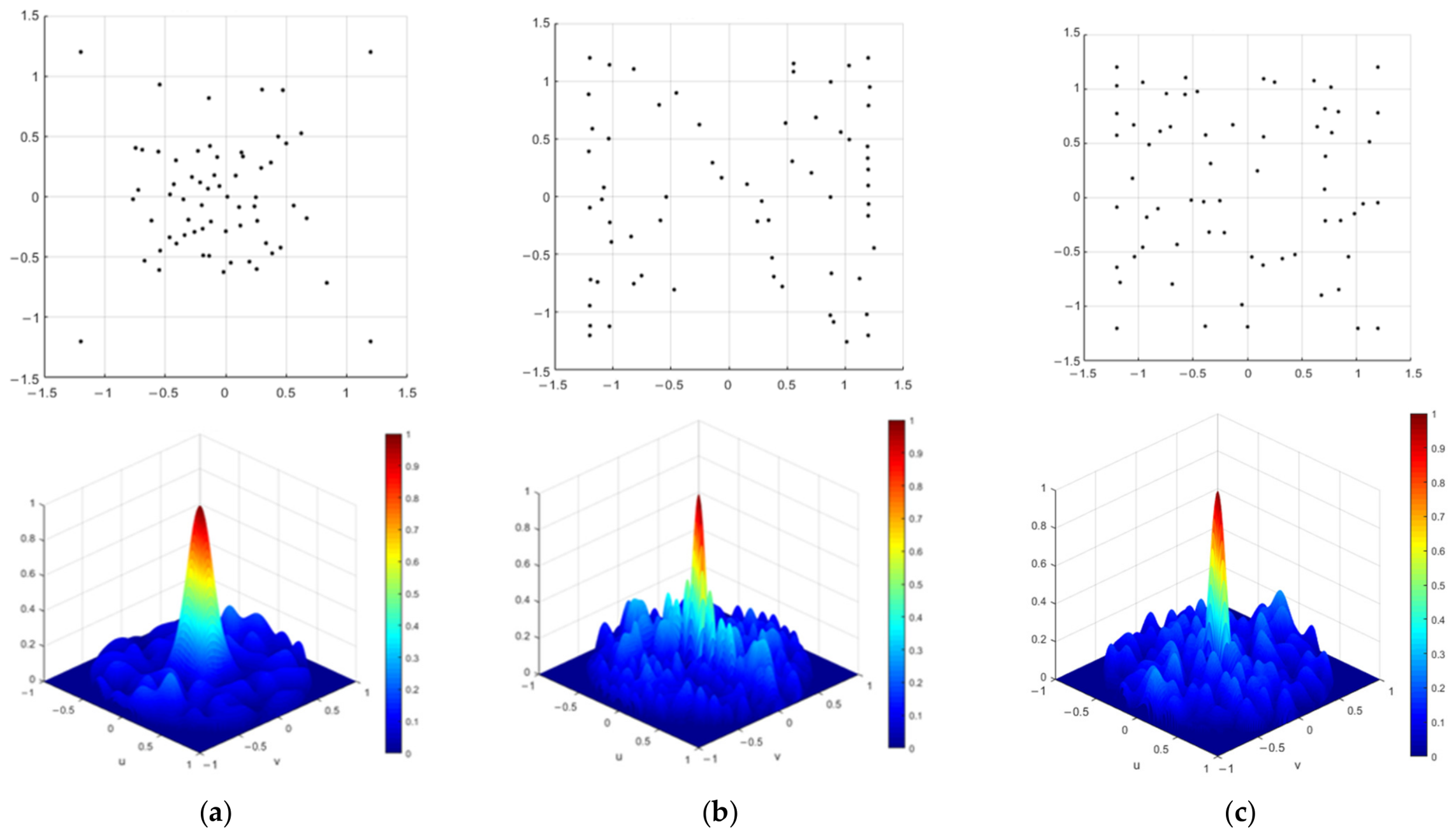
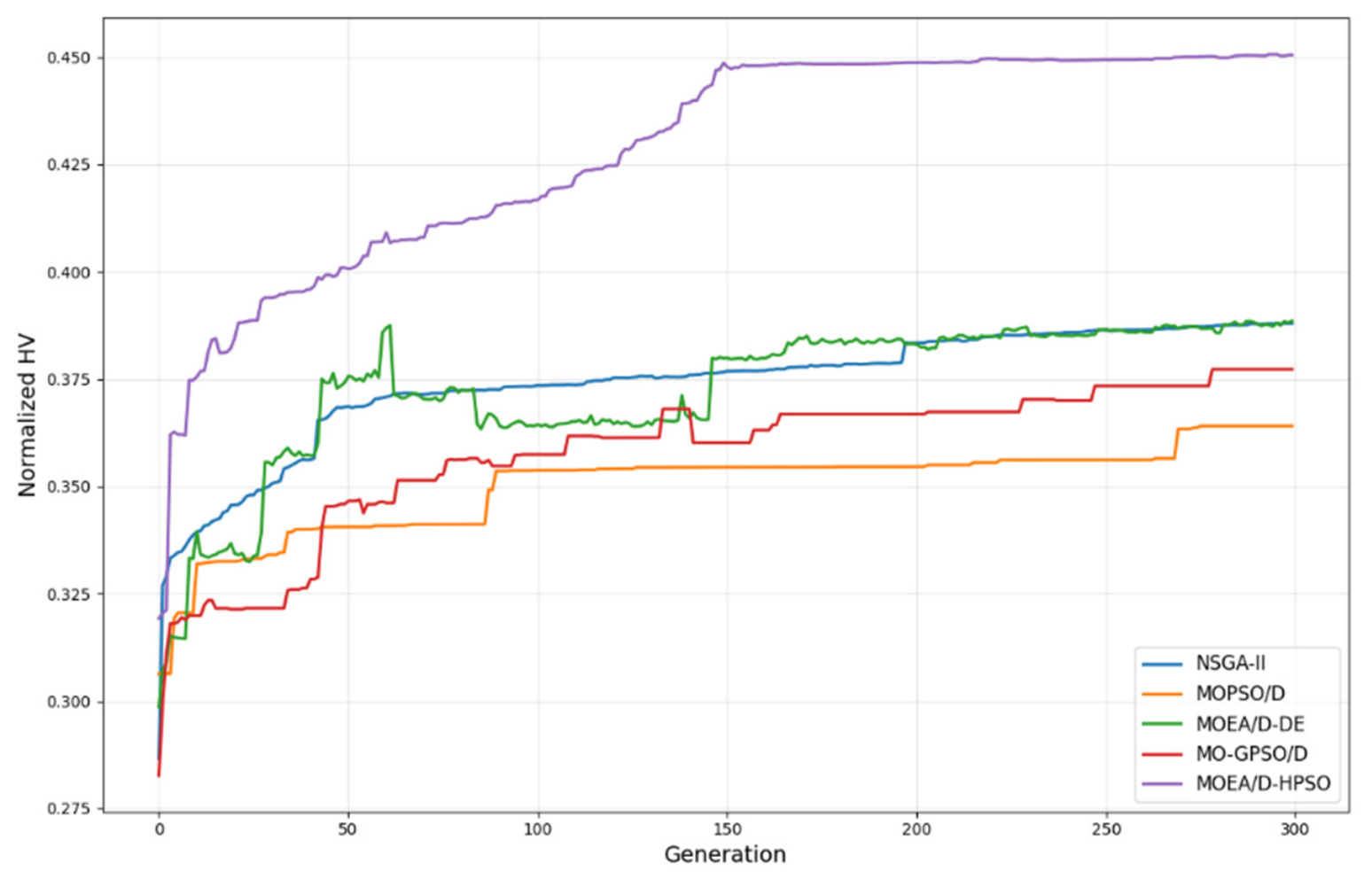
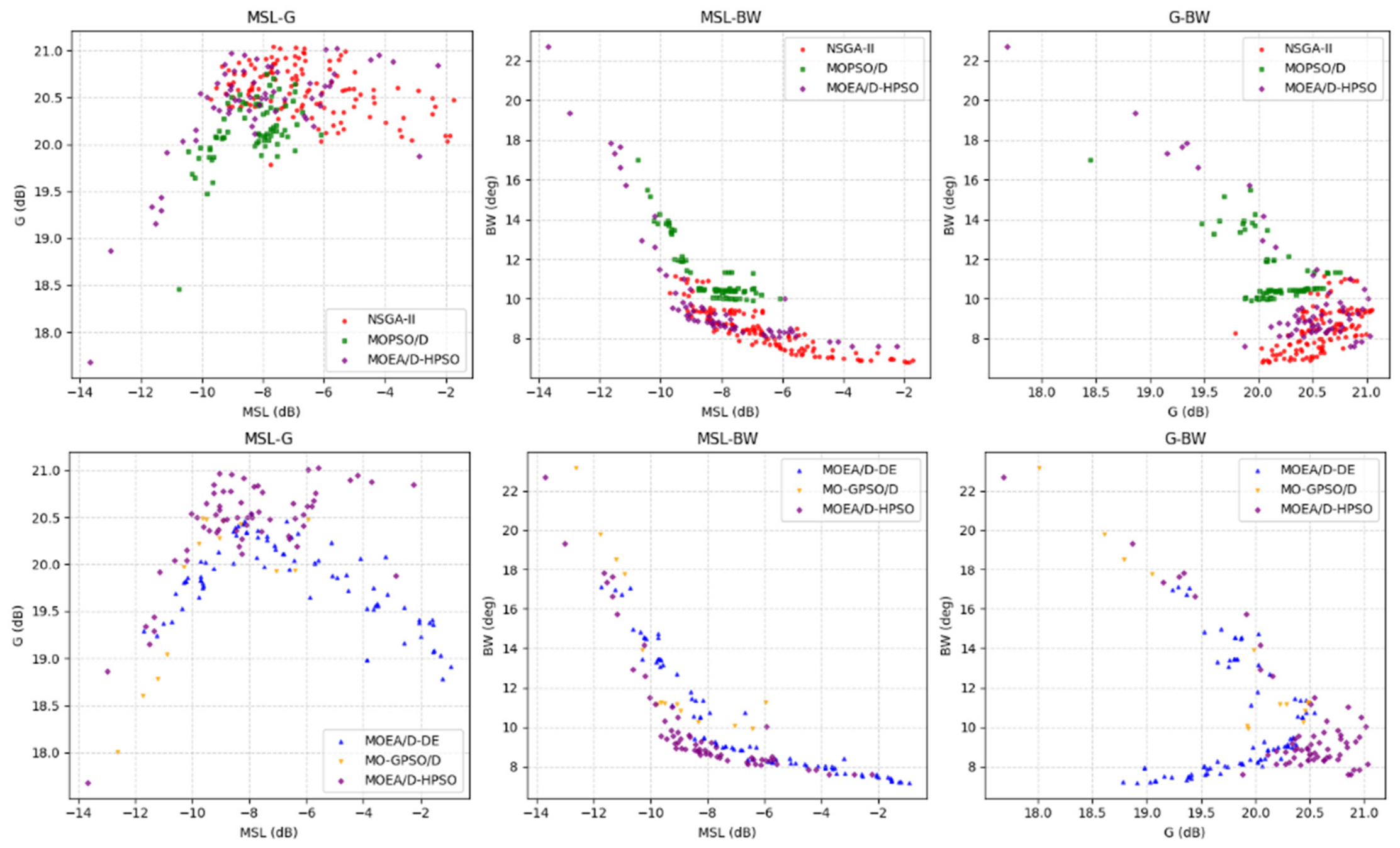
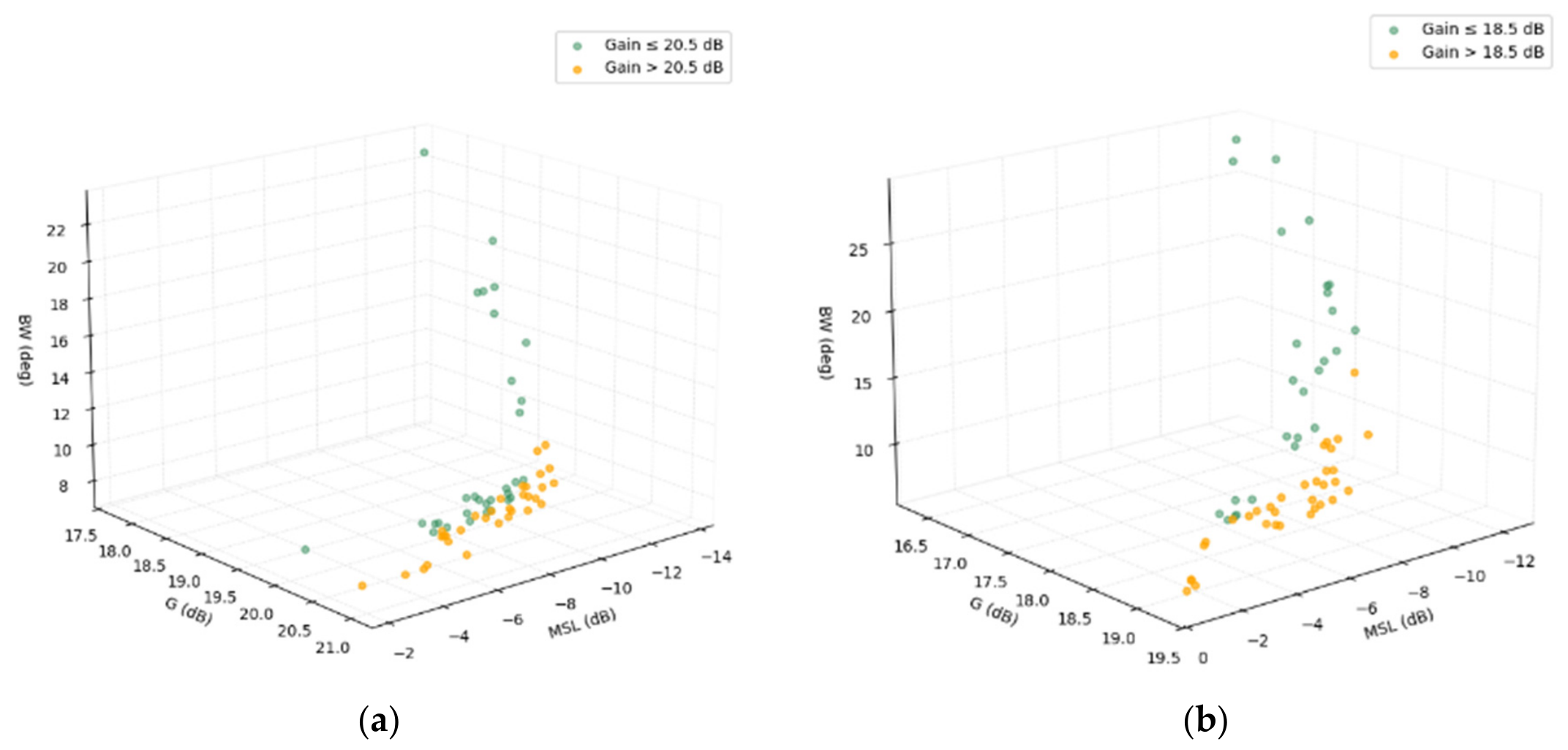
4.1. Pareto Front Analysis and Comparison
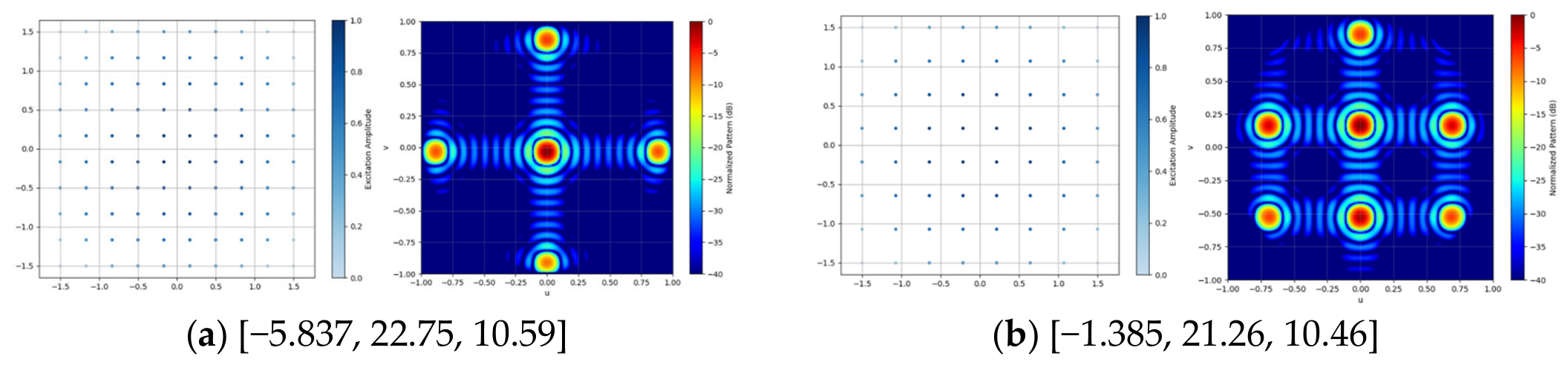
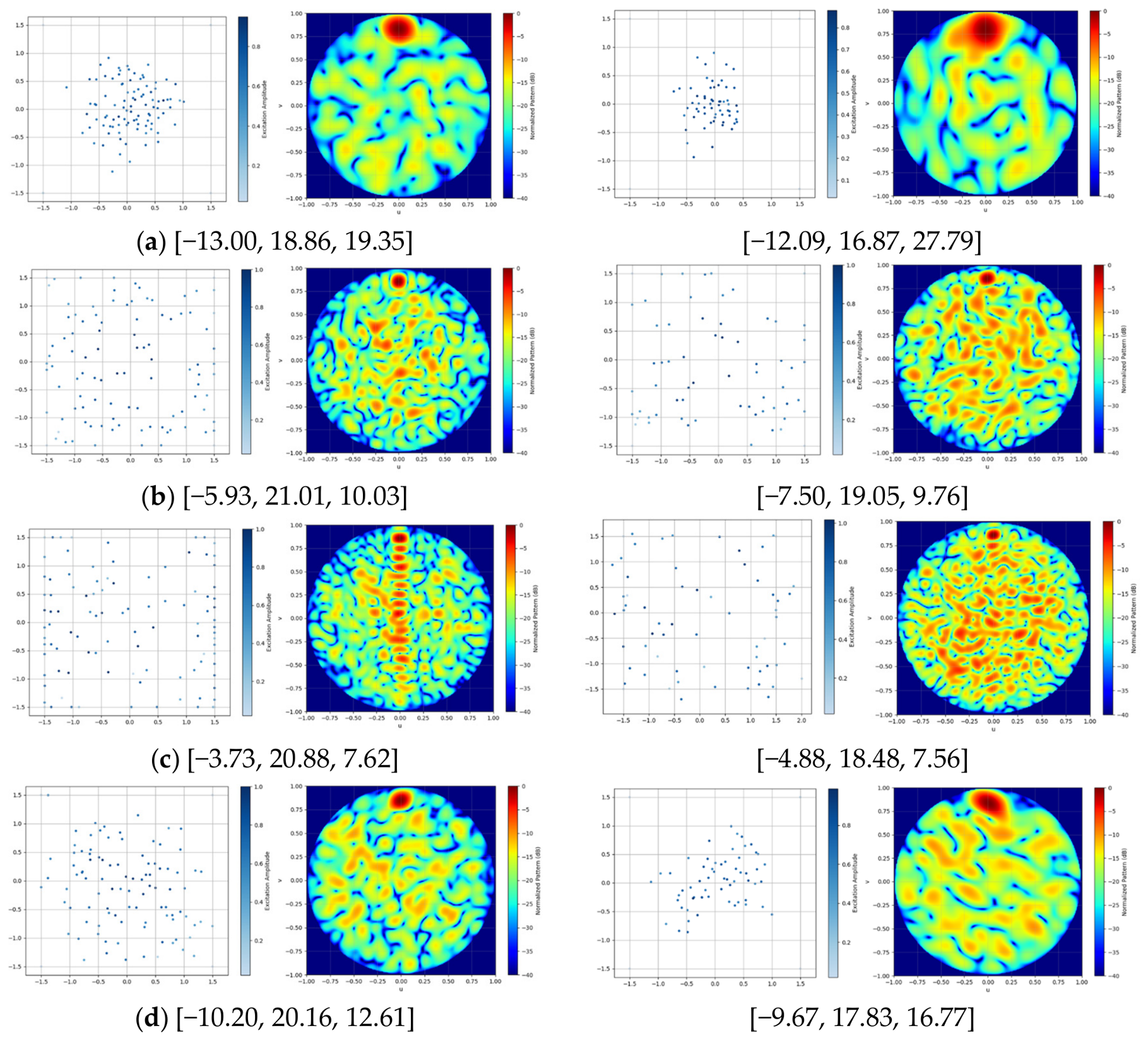
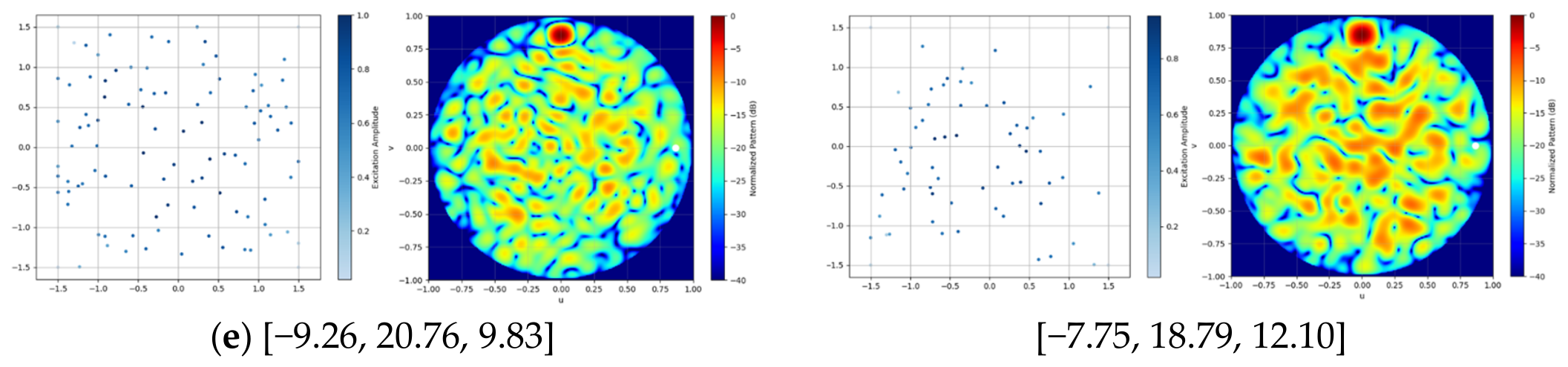
4.2. Array Design Results Under Different Receiving Conditions
5. Conclusions
Author Contributions
Funding
Institutional Review Board Statement
Data Availability Statement
Conflicts of Interest
References
- Li, C.S.; Xu, H.P.; Zhang, J.W.; Sun, B.; You, Y.N.; Liu, H. Advancements in the research of spaceborne synthetic aperture radar. J. Image Graph. 2025, 30, 2257–2274. [Google Scholar] [CrossRef]
- Guan, G.Q.; Yong, L.; Nie, J.W.; Wang, F.X. A two-stage anti-jamming and multipath mitigation method in GNSS receivers using antenna array. J. Natl. Univ. Def. Technol. 2015, 37, 15–20. [Google Scholar]
- Zhuang, Y.J.; Zhang, X.J.; He, Z.S. Synthesis of sparse planar arrays with multiple patterns: An automatic coordinate pairing approach. Signal Process. 2023, 212, 109161. [Google Scholar] [CrossRef]
- Miao, K.; Zhang, Y.; Wang, S.; Yao, C.; Zhao, G.; Sun, H. Synthesis of sparse planar antenna arrays using a matrix constraints method. IEEE Trans. Antennas Propag. 2024, 72, 4618–4623. [Google Scholar] [CrossRef]
- Yang, H.; Chen, P.; Zhou, H.M.; Tan, J.Y. An efficient position optimization method based on improved genetic algorithm and machine learning for sparse array. AEU Int. J. Electron. Commun. 2024, 179, 155312. [Google Scholar] [CrossRef]
- Xu, H.Z.; Gu, P.F.; Wen, H.; Meng, Y.K.; Chen, S.Y.; He, Z.; Fan, Z.H.; Ding, D.Z. An Efficient Synthesis Method for Ultrawideband Planar Arrays with Constraints on Minimum Spacing. In Proceedings of the 2025 International Conference on Microwave and Millimeter Wave Technology (ICMMT), Xi’an, China, 19–22 May 2025. [Google Scholar]
- Rosado-Sanz, J.; Jarabo-Amores, M.-P.; Dauvignac, J.-Y.; Mata-Moya, D.; Lanteri, J.; Migliaccio, C. Design and Validation of a Reflectarray Antenna with Optimized Beam for Ground Target Monitoring with a DVB-S-Based Passive Radar. Sensors 2021, 21, 5263. [Google Scholar] [CrossRef] [PubMed]
- Fuchs, B.; Skrivervik, A.; Mosig, J.R. Synthesis of Uniform Amplitude Focused Beam Arrays. IEEE Antennas Wirel. Propag. Lett. 2012, 11, 1178–1181. [Google Scholar] [CrossRef]
- Huan, M.; Liang, J.; Ma, Y.; Liu, W.; Wu, Y.; Zeng, Y. Optimization of high-resolution and ambiguity-free sparse planar array geometry for automotive MIMO radar. IEEE Trans. Signal Process. 2024, 72, 4332–4348. [Google Scholar] [CrossRef]
- Huan, M.; Liang, J.; Wu, Y.; Li, Y.; Liu, W. SASA: Super-resolution and ambiguity-free sparse array geometry optimization with aperture size constraints for MIMO radar. IEEE Trans. Antennas Propag. 2023, 71, 4941–4954. [Google Scholar] [CrossRef]
- Gupta, A.; Madhow, U.; Arbabian, A.; Sadri, A. Design of Large Effective Apertures for Millimeter Wave Systems Using a Sparse Array of Subarrays. IEEE Trans. Signal Process. 2019, 67, 6483–6497. [Google Scholar] [CrossRef]
- Li, J.; Han, C.; Ye, N.; Pan, J.; Yang, K.; An, J. Instant positioning by single satellite: Delay-Doppler analysis method enhanced by beam-hopping. IEEE Trans. Veh. Technol. 2025, 74, 14418–14431. [Google Scholar] [CrossRef]
- Zhao, Z.; Chen, M.; Wu, Q.; Chi, X.; Lin, W.; Zhang, B.; Wang, J. An Improved RNA Genetic Algorithm Without Mutation Operation in the Later Stage. In Proceedings of the 2022 China Automation Congress (CAC), Xiamen, China, 25–27 November 2022. [Google Scholar]
- Liu, Y.; Wang, X.K.; Wen, Q.; Yang, J. Optimization of Sparse Linear Arrays Based on the Algorithm of Multiple Objective Particle Swarm Optimization of Sparse Linear Arrays Based on the Algorithm of Multiple Objective Particle Swarm. Mod. Radar, 2025; in press.
- Guo, J.; Xue, P.; Zhang, C. Optimal Design of Linear and Circular Antenna Arrays Using Hybrid GWO-PSO Algorithm. In Proceedings of the 2021 3rd International Academic Exchange Conference on Science and Technology Innovation (IAECST), Guangzhou, China, 10–12 December 2021. [Google Scholar]
- Kipkirui, F.; Maina, R.; Kiambi, S. Optimising uniform rectangular array performance for SNR, SLL and speed using proposed hybrid PSO-HBA. Digit. Twins Appl. 2025, 2, e70005. [Google Scholar] [CrossRef]
- Aslan, Y.; Puskely, J.; Roederer, A.; Yarovoy, A. Multiple Beam Synthesis of Passively Cooled 5G Planar Arrays Using Convex Optimization. IEEE Trans. Antennas Propag. 2020, 68, 3557–3566. [Google Scholar] [CrossRef]
- Khan, A.A.; Brown, A.K. Sidelobe Level Reduction and Radio Frequency Interference Rejection in Large Sub-arrayed Antenna Arrays. In Proceedings of the 2012 Loughborough Antennas & Propagation Conference (LAPC), Loughborough, UK, 12–13 November 2012. [Google Scholar]
- Ollila, E. Greedy Capon Beamformer. IEEE Signal Process. Lett. 2024, 31, 2775–2779. [Google Scholar] [CrossRef]
- Xiang, H.; Yang, Y.; Xia, R.; Mo, L.; Wan, X.; Liu, B.; Luo, J. Wideband Array Receiving System Based on Multi-Beam Network. Radar Sci. Technol. 2018, 16, 578–582. [Google Scholar]
- Lee, J.; Nam, S. Effective Area of a Receiving Antenna in a Lossy Medium. IEEE Trans. Antennas Propag. 2009, 57, 1843–1845. [Google Scholar] [CrossRef]
- Wu, S.; Liu, Y.; Xu, J.; He, Y.; Du, B.; Yang, S. An Accurate and Efficient Gain Pattern Analysis Method for Transmitarray Antennas. IEEE Antennas Wirel. Propag. Lett. 2024, 23, 4458–4462. [Google Scholar] [CrossRef]
- Zhang, Q.; Li, H. MOEA/D: A Multiobjective Evolutionary Algorithm Based on Decomposition. IEEE Trans. Evol. Comput. 2007, 11, 712–731. [Google Scholar] [CrossRef]
- Xu, Q.; Xu, Z.; Ma, T. A Survey of Multiobjective Evolutionary Algorithms Based on Decomposition: Variants, Challenges and Future Directions. IEEE Access 2020, 8, 41588–41614. [Google Scholar] [CrossRef]
- Zheng, W.; Tan, Y.; Meng, L.; Zhang, H. An improved MOEA/D design for many-objective optimization problems. Appl. Intell. 2018, 48, 3839–3861. [Google Scholar] [CrossRef]
- Chen, X.; Wang, H.; Chu, J.; Hai, B.; Wang, Z. Hybrid neighborhood and global replacement strategies for multi objective evolutionary algorithm based on decomposition. Evol. Intell. 2022, 15, 1715–1728. [Google Scholar]
- Mashwani, W.K.; Salhi, A. Multiobjective memetic algorithm based on decomposition. Appl. Soft Comput. 2014, 21, 221–243. [Google Scholar] [CrossRef]
- Peng, W.; Zhang, Q. A Decomposition-Based Multi-Objective Particle Swarm Optimization Algorithm for Continuous Optimization Problems. In Proceedings of the 2008 IEEE International Conference on Granular Computing, Hangzhou, China, 26–28 August 2008. [Google Scholar]
- Zapotecas-Martinez, S.; Moraglio, A.; Aguirre, H.E.; Tanaka, K. Geometric Particle Swarm Optimization for Multi-objective Optimization Using Decomposition. In Proceedings of the Genetic and Evolutionary Computation Conference 2016 (GECCO ’16), Denver, CO, USA, 20–24 July 2016. [Google Scholar]


Disclaimer/Publisher’s Note: The statements, opinions and data contained in all publications are solely those of the individual author(s) and contributor(s) and not of MDPI and/or the editor(s). MDPI and/or the editor(s) disclaim responsibility for any injury to people or property resulting from any ideas, methods, instructions or products referred to in the content. |
© 2026 by the authors. Licensee MDPI, Basel, Switzerland. This article is an open access article distributed under the terms and conditions of the Creative Commons Attribution (CC BY) license.
Share and Cite
Zhang, Z.; Xing, H.; Yu, X.; Tang, X. Design and Optimization of SAR Signal Array Receiving Based on MOEA/D-HPSO. Sensors 2026, 26, 3879. https://doi.org/10.3390/s26123879
Zhang Z, Xing H, Yu X, Tang X. Design and Optimization of SAR Signal Array Receiving Based on MOEA/D-HPSO. Sensors. 2026; 26(12):3879. https://doi.org/10.3390/s26123879
Chicago/Turabian StyleZhang, Zhiyang, Hongji Xing, Ximing Yu, and Xiaogang Tang. 2026. "Design and Optimization of SAR Signal Array Receiving Based on MOEA/D-HPSO" Sensors 26, no. 12: 3879. https://doi.org/10.3390/s26123879
APA StyleZhang, Z., Xing, H., Yu, X., & Tang, X. (2026). Design and Optimization of SAR Signal Array Receiving Based on MOEA/D-HPSO. Sensors, 26(12), 3879. https://doi.org/10.3390/s26123879