A Multi-Criterion Selection of Hybrid Features in Mammographic Imaging for Early Computer-Assisted Sensing and Detection of Breast Cancer


Abstract
1. Introduction
2. Materials and Methods
2.1. Materials
2.2. Methods
2.2.1. Image Collection
2.2.2. Image Preprocessing
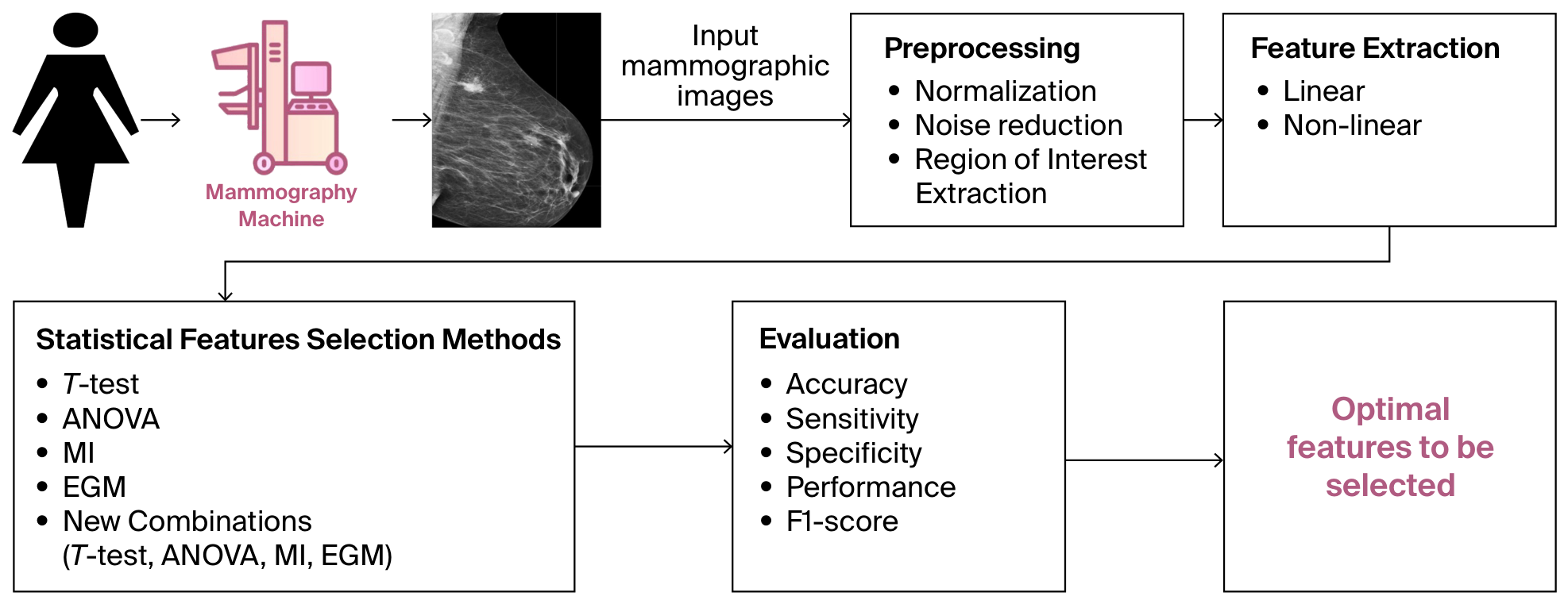
2.2.3. Image Features/Descriptors
Linear Features
- Mean (): the average pixel intensity of the ROI. Malignant tissues often exhibit higher mean intensity due to denser fibroglandular structures, making a basic discriminant between dense and fatty regions [29].
- Variance (): quantifies the dispersion of intensity values. Cancerous regions typically exhibit higher variance, reflecting an irregular internal tissue composition [29].
- Skewness ():measures the asymmetry of the gray level distribution. Malignant lesions may present positive skewness due to bright, high-intensity clusters [29].
- Kurtosis ():reflects the peakedness of the intensity distribution. Elevated K indicates sharp intensity transitions typical of tumor boundaries [29].
- Volume and Area: shape descriptors that characterize lesion geometry and spatial extent. The area (A) is computed as the total number of pixels contained within the segmented lesion region:where R denotes the lesion region. The lesion volume (V) can be approximated by integrating pixel intensities over the segmented area:where represents the pixel intensity at location . Malignant masses often display irregular, spiculated boundaries; asymmetric growth patterns; and larger volumetric distributions compared to smooth benign contours [31]. These features provide quantitative measures of lesion growth and morphological complexity, making them valuable indicators for distinguishing benign from malignant breast abnormalities.
- Haralick Texture Features: these quantify second-order texture statistics such as contrast, correlation, energy, and homogeneity [30]. These features describe spatial relationships between pixels and have proven diagnostic value in texture-based lesion analysis.
- Perimeter/Irregularity: this measures the degree to which a region’s form deviates from an ideal circle. It is described aswhere P is the perimeter of the region, and A is the area of the region. indicates a perfect circle, and larger values indicate more irregular or complex shapes [32]. This descriptor offers a numerical evaluation of morphological complexity and border distortion. Benign lesions on mammography are usually smooth, round, or oval, with irregularity values near unity. On the other hand, because of unchecked cellular proliferation and invasive expansion into adjacent tissues, malignant tumors often have spiculated, lobulated, or poorly defined borders. Higher irregularity levels are therefore frequently linked to cancer and are crucial markers for differentiating between malignant and non-cancerous breast tumors. This feature is especially useful, as it complements other morphological and statistical characteristics in the diagnosis of breast cancer by capturing structural abnormalities that might not be captured by intensity- or texture-based descriptors alone.
- Intensity Distribution: the statistical characteristics of pixel intensities in a picture or area are quantified by the intensity distribution, which describes brightness, contrast, and variation [33].
Nonlinear Features
- Shannon Entropy ():measures the randomness of the pixel intensity distribution [34]. Higher entropy values indicate increased structural complexity, a hallmark of cancerous tissue heterogeneity.
- Tsallis and Rényi Entropies: these are generalizations of Shannon entropy that introduce non-extensive parameters (q and ), enabling sensitivity control to rare or dominant patterns [35]. They are particularly effective in modeling non-Gaussian texture irregularities found in tumors, where statistical distributions deviate from classical assumptions. The Tsallis entropy for wavelet coefficients is defined aswhere is the normalized wavelet probability of coefficient i, q is the Tsallis non-extensivity parameter (controls sensitivity to rare versus dominant components), and is the non-extensive entropy derived from wavelet energy distribution. The Rényi Entropy for wavelet coefficients is defined aswhere is the normalized wavelet probability of coefficient i, is the Rényi order parameter, and is the generalized entropy measuring wavelet energy complexity.
- Wavelet Entropy: this is computed from wavelet-decomposed sub-bands; these features capture texture information across multiple spatial scales. Malignant regions exhibit irregular multi-scale energy distributions, making wavelet-based features powerful indicators of subtle morphological and structural differences. It is defined aswhere is the normalized energy (probability) of coefficient i, is the wavelet coefficient at index i, and H is the wavelet entropy of the subband [36]. Higher entropy values suggest a more complicated and chaotic distribution of wavelet energy, which reflects more tissue heterogeneity and structural irregularity. Malignant lesions exhibit higher wavelet entropy than benign tissues in mammography analysis due to their complex internal architecture and varied texture patterns. As a result, wavelet entropy is an efficient descriptor for distinguishing among normal, benign, and cancerous breast tissues and provides additional information beyond traditional intensity, shape, and texture characteristics.
- Fractal Dimension (FD): this quantifies the complexity and self-similarity of lesion boundaries [37]. Tumors often exhibit fractal-like growth patterns, with higher FD values indicating an irregular and invasive morphology. Fractal analysis is based on the discovery that many biological systems have scale-invariant geometric patterns that cannot be fully characterized by standard Euclidean metrics. Tumors frequently exhibit fractal-like development patterns due to uneven cellular proliferation and diverse tissue structure. Higher FD values suggest more border complexity, structural irregularity, and invasive morphology, whereas lower values are often linked with smoother and more regular lesion outlines. Malignant masses have higher fractal dimensions than benign lesions on mammography due to their spiculated borders and infiltrative growth patterns. As a result, FD is a useful quantitative descriptor for describing lesion morphology and determining tumor aggressiveness, complementing standard shape and texture parameters.
- Local Phase Congruency (LPC): analyzes the alignment (congruency) of local Fourier phases across various scales to detect essential visual elements, including edges, ridges, and corners, regardless of illumination. Significant picture characteristics arise when the phases of the filter responses are most in agreement, regardless of image intensity or contrast. For amplitude and phase at scale n, the phase congruency at pixel x is:where is the local amplitude response of the filter at scale n, is the local phase at that scale, is the mean/local reference phase, and is the phase congruency value () [38].
- Local Binary Pattern (LBP): this encodes local texture by comparing each pixel with its neighboring pixels, generating binary patterns that reflect micro-texture variations [39]. LBP is robust to illumination changes and effectively highlights subtle irregularities that may correspond to malignant microstructures.
- Laplacian Spectrum Features: these are derived from the Laplacian operator applied to the intensity image and emphasize high-frequency edge information [40]. They are useful for capturing sharp transitions and irregular contour patterns at tumor boundaries. The graph Laplacian captures the graph’s structure and connectivity [41].
- Nonlinear Diffusion (Perona–Malik): in mammography, nonlinear diffusion is an edge-preserving smoothing technique that lowers noise while preserving significant structures like masses and microcalcifications. It is defined aswhere the diffusion coefficient controls smoothing aswhere is the image intensity evolving with diffusion time t, is the image gradient magnitude; large values correspond to edges (e.g., tumor borders), is the diffusion coefficient that decreases near strong gradients, preventing blurring of lesions, and K is the contrast parameter controlling sensitivity to edges [42]. It is noteworthy that nonlinear diffusion in mammography reduces noise in homogeneous breast tissue while preserving critical diagnostic features such as mass borders and microcalcifications. This results in better feature extraction and lesion detection.
- Clustering Coefficient: measures how closely a node’s neighbors are associated. A node i with neighbors has the following clustering coefficient:where is the number of neighbors of node i, is the number of edges that actually exist between those neighbors, and measures the local connectivity or structural organization around node i [41].
2.2.4. Existing Feature Selection Methods
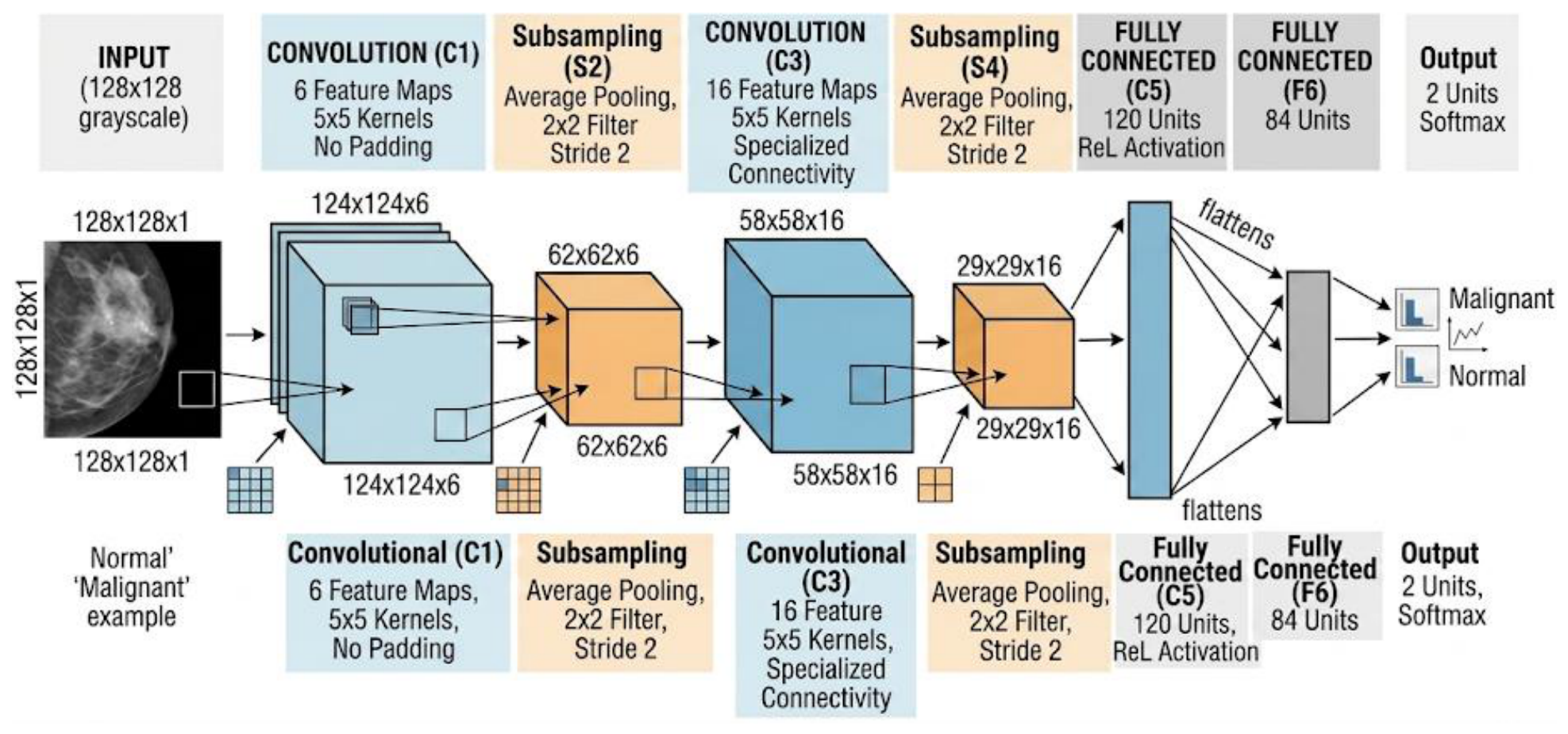
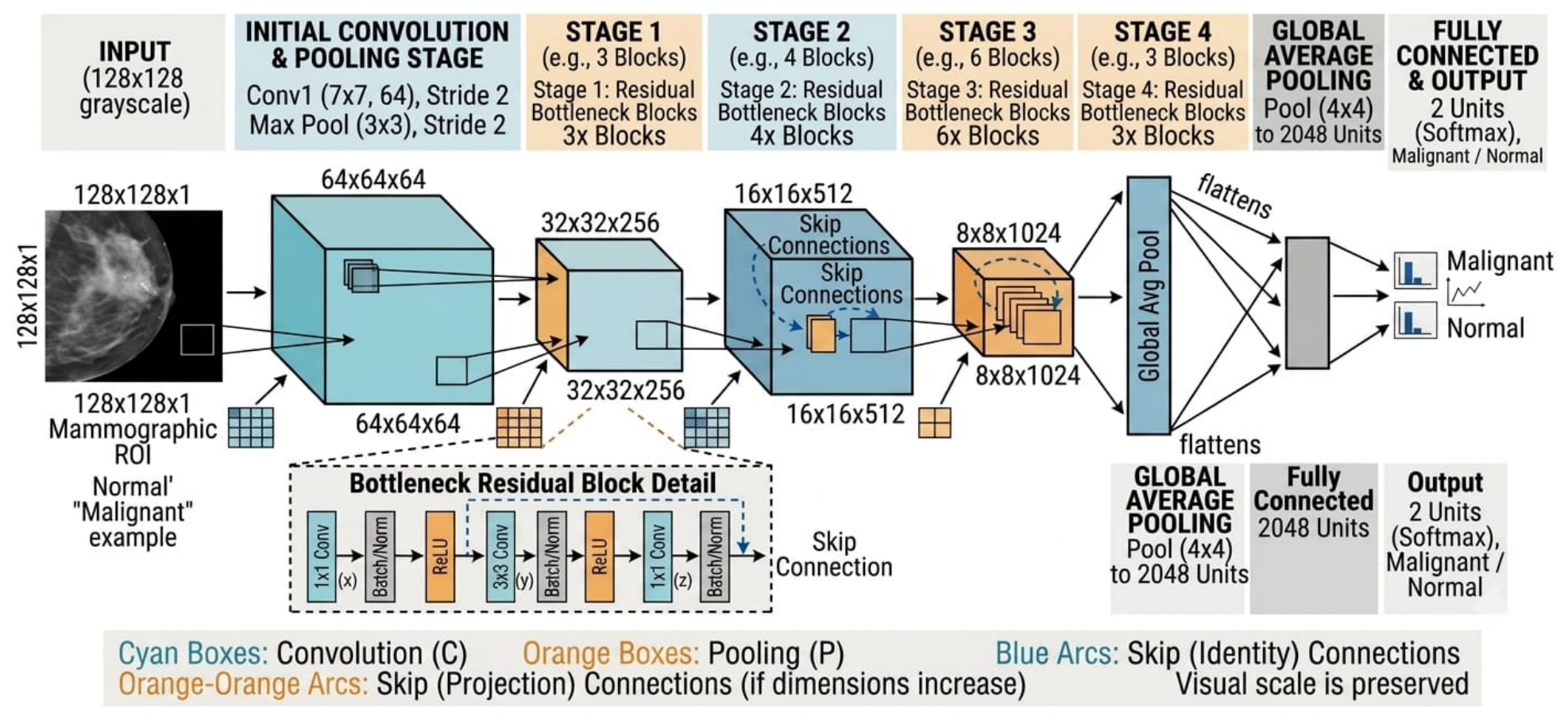
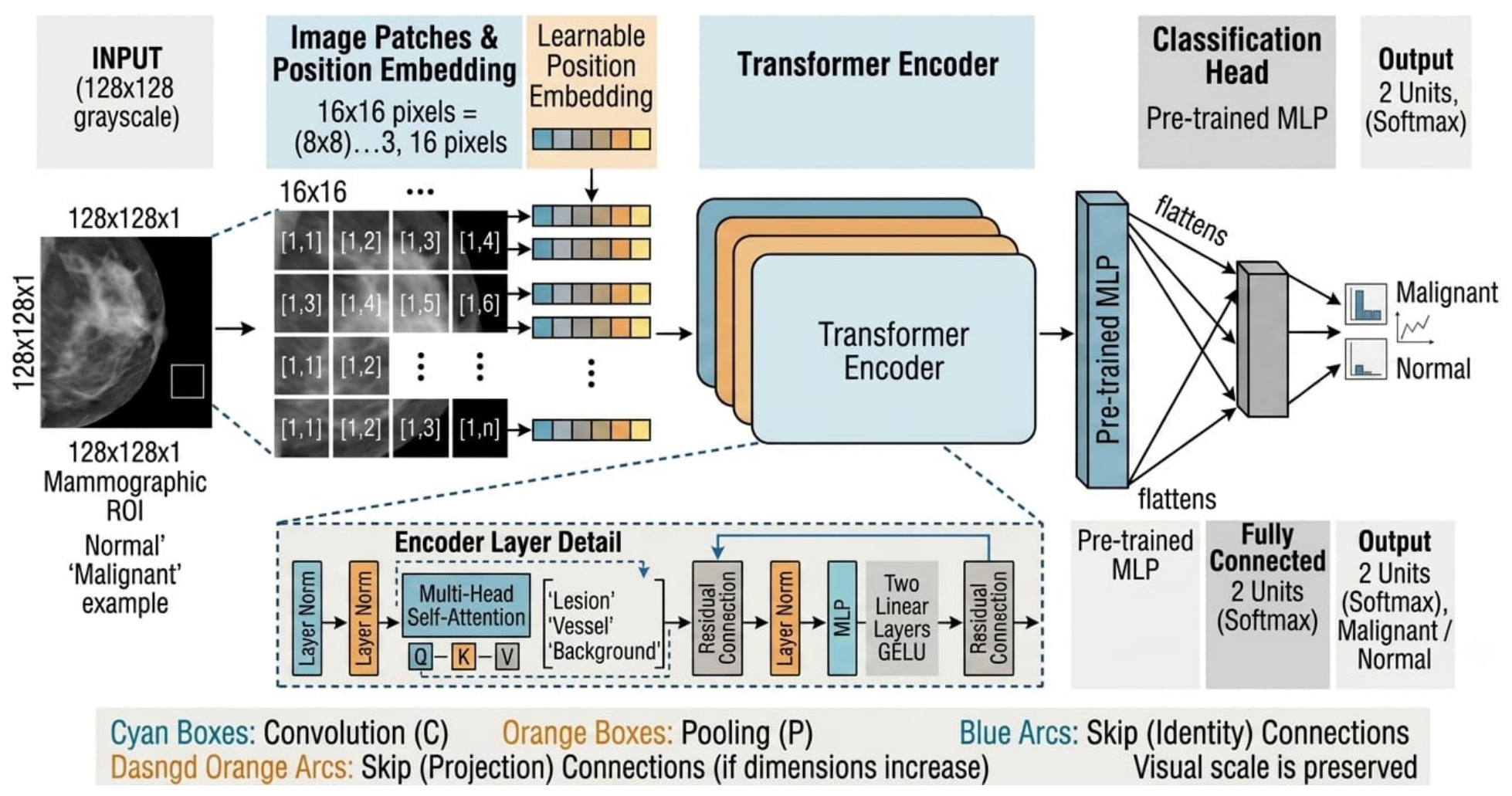
2.2.5. Existing Deep Learning Classifiers
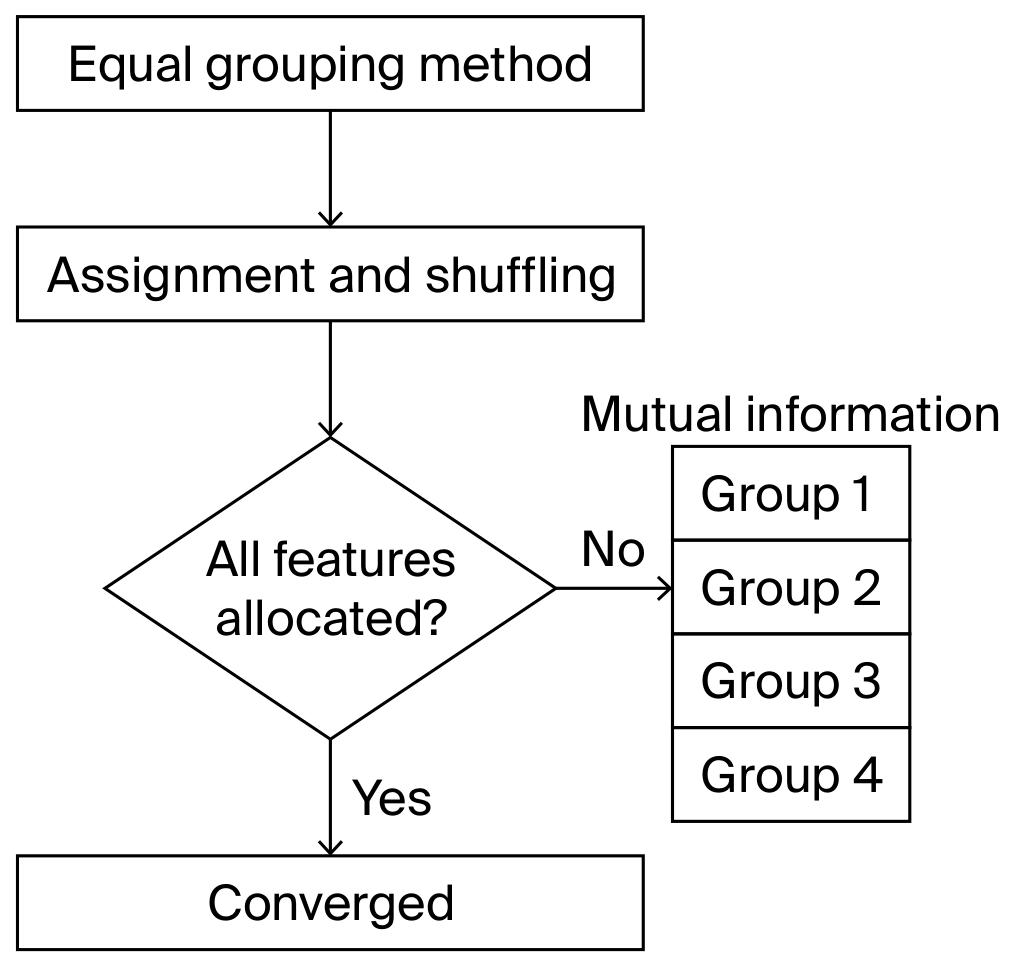
2.2.6. New Multi-Criterion Selection Framework Integrating (T-Test, ANOVA, MI, EGM)
2.2.7. Evaluation Method
- Performance quantifies how strongly each extracted feature improves the overall classification performance. For each feature, the contribution is computed as a linear offset from the achieved accuracy:where the offset term , is the classification accuracy (%) obtained when the feature is used in the model. This reflects the feature’s predictive quality. is the empirically measured performance contribution (%) assigned to the feature in the comparative analysis table. This value captures how much the feature improves the classifier relative to a baseline or relative to other features. is a correction term that accounts for systematic offsets between accuracy and feature contribution.
- Accuracy quantifies the overall proportion of correctly classified instances across both classes and is defined in [59].
- Sensitivity measures the model’s ability to correctly identify cancerous cases (true positives), as defined in [59]. It reflects the model’s capability to minimize missed diagnoses.
- Specificity evaluates the model’s effectiveness in correctly recognizing normal (non-cancerous) cases, also defined in [59]. High specificity indicates a reduced false-positive rate, which is essential to avoid unnecessary medical follow-ups.
- The F1-Score is used to evaluate the performance of a classification model by considering both precision and recall. It is especially useful when the dataset is imbalanced.
3. Results of New Framework for Selection of Features
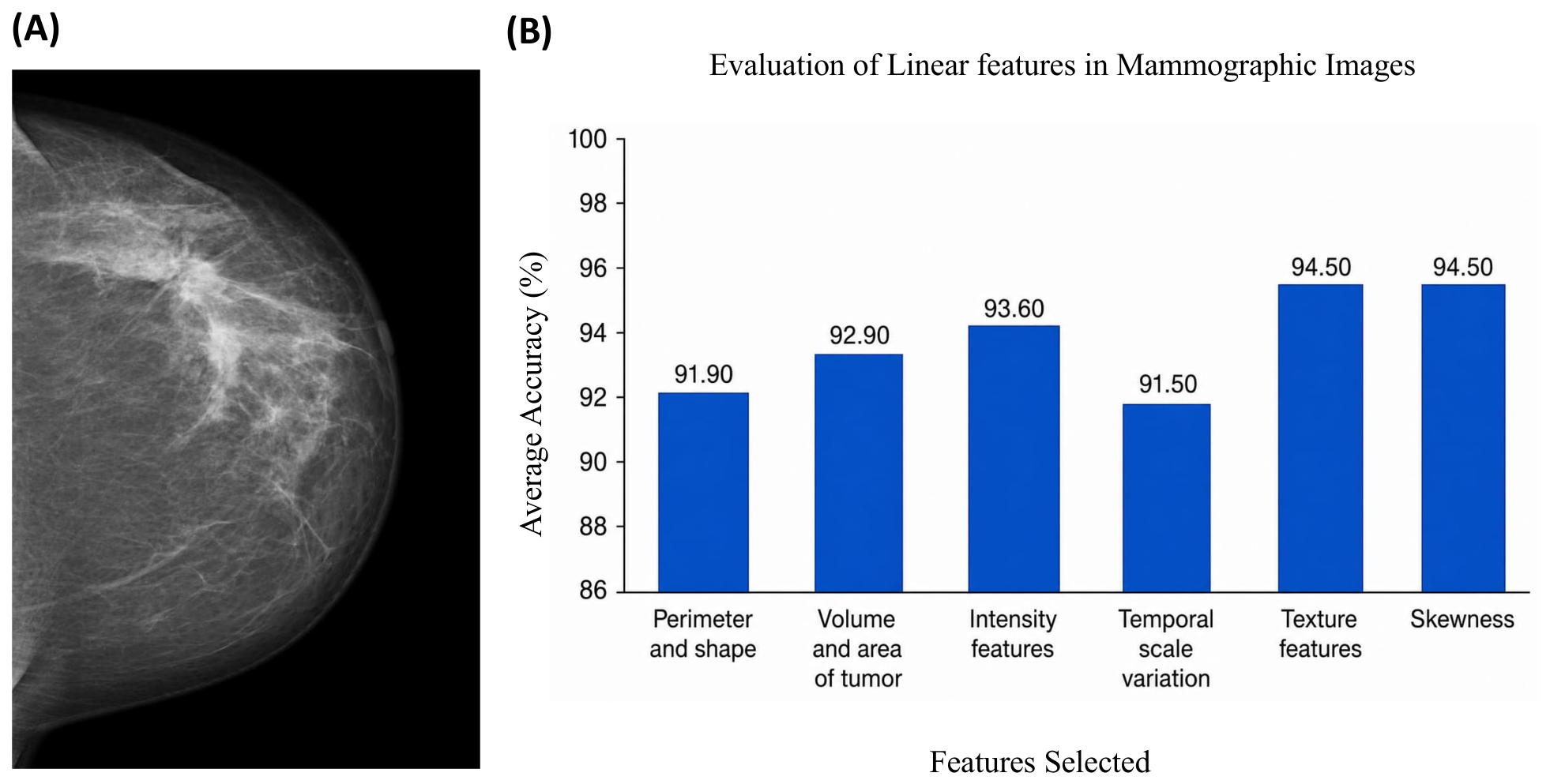
3.1. Linear Feature’s Results
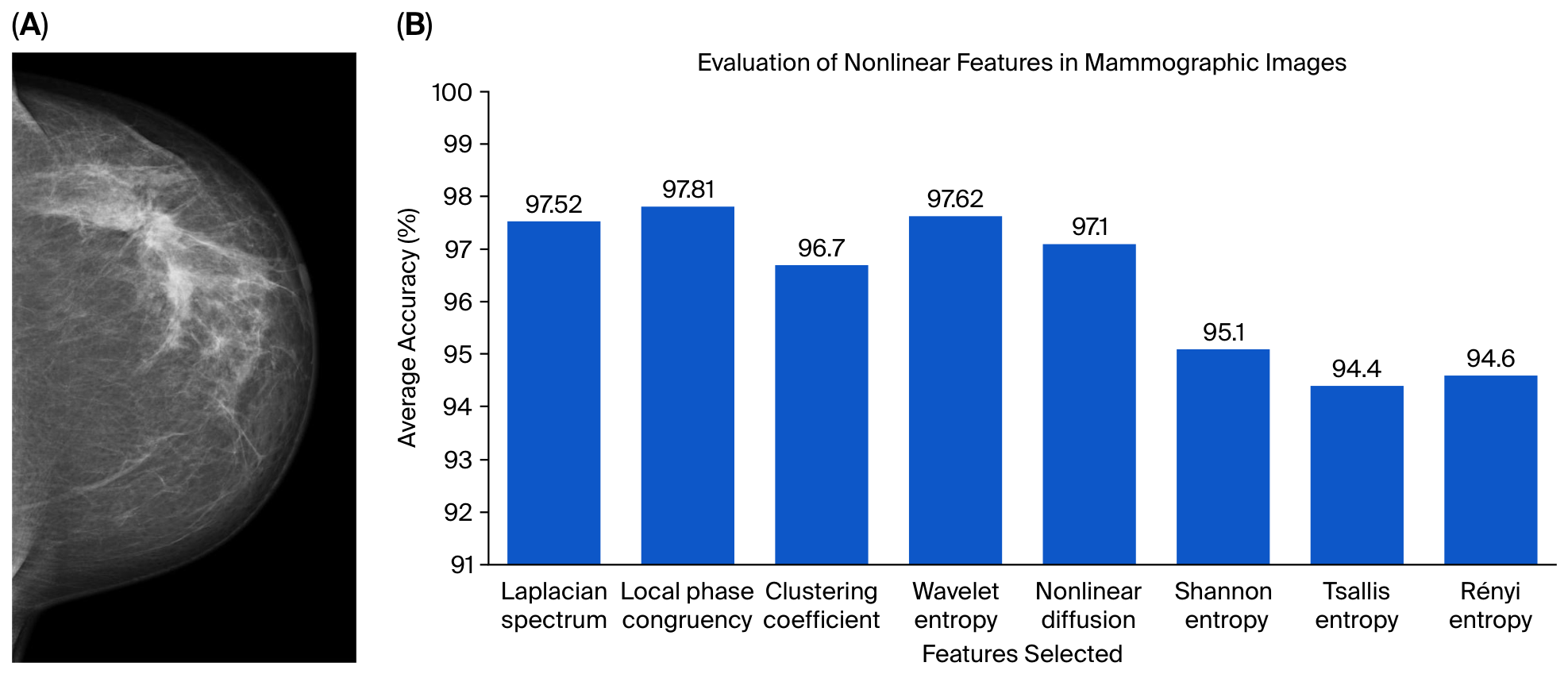
3.2. Nonlinear Feature Results
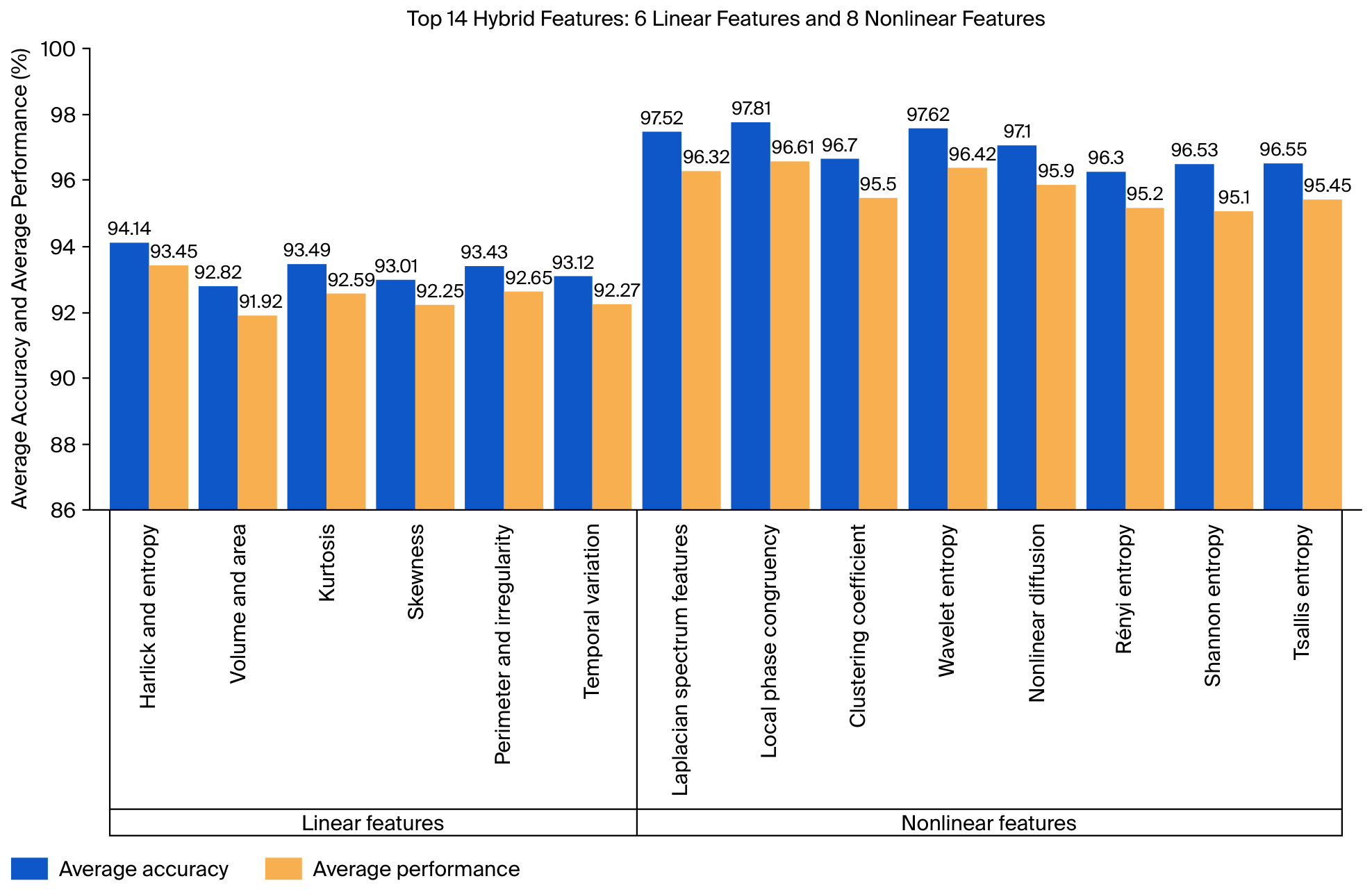
3.3. Comparative Evaluation Results of Selected Features
3.4. Comparison with Deep Learning Models

| Research Work | Descriptors/Features Used | Feature Selection Technique | Accuracy (%) |
|---|---|---|---|
| The Proposed Multi-criterion framework Zaylaa et al. 2026 | 14 hybrid features | Combined statistical significance (t-test, ANOVA, Mutual Information, Equal Grouping Method) | 96.8 |
| Zaylaa et al. (2024) [7] | Intensity, shape, and texture features from mammograms | Manual selection based on experimental inference and expert judgment | 91.2 |
| El-Naqa et al. (2019) [61] | 2D GLCM-based Haralick texture, histogram moments | ReliefF ranking and stepwise ANOVA | 89.5 |
| Dhungel et al. (2020) [62] | Deep CNN texture features (from pre-trained VGG16) | No explicit feature selection (end-to-end) | 92.4 |
| Spanhol et al. (2017) [63] | Wavelet and morphological descriptors | PCA dimensionality reduction (unsupervised) | 88.9 |
| Hassan et al. (2022) [64] | Fractal and statistical intensity features | Fisher score and correlation-based subset selection | 90.7 |
| Wang et al. (2022) [65] | Hybrid CNN + handcrafted features | Wrapper-based feature selection (forward search) | 93.6 |
| Suresh et al. (2023) [66] | LBP, entropy, and wavelet features from digital mammograms | Mutual Information (MI) ranking only | 94.1 |
4. Discussion
5. Limitations of the Work
6. Conclusions and Future Work
Author Contributions
Funding
Institutional Review Board Statement
Informed Consent Statement
Data Availability Statement
Acknowledgments
Conflicts of Interest
References
- Lambin, P.; Leijenaar, R.T.; Deist, T.M.; Peerlings, J.; De Jong, E.E.; Van Timmeren, J.; Sanduleanu, S.; Larue, R.T.H.M.; Even, A.J.G.; Jochems, A. Radiomics: The bridge between medical imaging and personalized medicine. Nat. Rev. Clin. Oncol. 2017, 14, 749–762. [Google Scholar] [CrossRef] [PubMed]
- Mayerhoefer, M.E.; Materka, A.; Langs, G.; Häggström, I.; Szczypiński, P.; Gibbs, P.; Cook, G. Introduction to radiomics. J. Nucl. Med. 2020, 61, 488–495. [Google Scholar] [CrossRef] [PubMed]
- Parekh, V.S.; Jacobs, M.A. Radiomics: A new application from established techniques. Expert Rev. Precis. Med. Drug Dev. 2020, 5, 207–226. [Google Scholar]
- Giger, M.L. Breast cancer screening and diagnosis with mammography and advanced image analysis. IEEE Trans. Med. Imaging 2018, 37, 1152–1162. [Google Scholar]
- Mudigonda, N.M.; Rangayyan, R.M.; Desautels, J.E. Feature extraction and selection for computer-aided mammography. Pattern Recognit. 2000, 33, 627–640. [Google Scholar]
- Jong, R.A.; Yaffe, M.J.; Boyd, N.F.; Harvey, J.G.; Lalonde, A.; Termin, M. Variability and effectiveness of radiologist-selected mammographic features for breast cancer risk prediction. J. Natl. Cancer Inst. 2001, 93, 339–346. [Google Scholar]
- Zaylaa, A.J.; Kourtian, S. Advancing Breast Cancer Diagnosis through Breast Mass Images, Machine Learning, and Regression Models. Sensors 2024, 24, 2312. [Google Scholar] [CrossRef] [PubMed]
- Sharma, A.; Singh, P. Statistical feature selection approaches for mammographic breast cancer classification. Biomed. Signal Process. Control 2022, 73, 103412. [Google Scholar]
- El Naqa, I.; Yang, Y.; Wernick, M.N.; Galatsanos, N.P.; Nishikawa, R.M. A support vector machine learning framework for mammography computer-aided diagnosis. IEEE Trans. Med. Imaging 2002, 21, 1552–1563. [Google Scholar] [CrossRef] [PubMed]
- Al-Wajih, H.A.; Abdalla, H.E.; Al-Asali, M. Robustness and reliability of hybrid feature extraction for malignant and non-malignant mammographic pattern classification. J. Digit. Imaging 2023, 36, 340–355. [Google Scholar]
- Rahman, M.; Saha, A.; Ahmed, T. Mutual information-based feature selection for enhanced mammogram image classification. Comput. Biol. Med. 2023, 157, 106705. [Google Scholar]
- Ahmed, R.; Khan, S.; Mehmood, I. Entropy-based feature extraction and selection in digital mammography. Pattern Recognit. Lett. 2021, 146, 1–9. [Google Scholar] [CrossRef]
- Li, X.; Zhao, R.; Xu, F. Wavelet-based multiscale texture features for breast cancer detection from mammograms. Diagnostics 2022, 12, 703. [Google Scholar] [PubMed]
- Shen, L.; Margolies, L.R.; Rothstein, J.H.; Fluder, E.; McBride, R.; Sieh, W. Automated breast cancer diagnosis based on feature selection and machine learning in mammography. Med. Phys. 2021, 48, 4569–4581. [Google Scholar]
- Spanhol, F.A.; Oliveira, L.S.; Petitjean, C.; Heutte, L. A Dataset for Breast Cancer Histopathological Image Classification. IEEE Trans. Biomed. Eng. 2016, 63, 1455–1462. [Google Scholar] [CrossRef] [PubMed]
- The MathWorks, Inc. MATLAB, R2023b; The MathWorks, Inc.: Natick, MA, USA, 2023.
- Lee, R.; Gimenez, F.; Hoogi, A.; Rubin, D. Curated breast imaging subset of DDSM (CBIS-DDSM). Sci. Data 2017, 6, 190034. [Google Scholar] [CrossRef]
- Moreira, I.C.; Amaral, I.; Domingues, I.; Cardoso, A.; Cardoso, M.J.; Cardoso, J.S. Inbreast: Toward a full-field digital mammographic database. Acad. Radiol. 2012, 19, 236–248. [Google Scholar] [CrossRef] [PubMed]
- Cui, C.; Li, H.; Wang, Y.; Huang, G.; Niu, Z.; Wang, Y.; Li, H.; Chen, X.; Li, Y.; Zhang, T. A Chinese Mammography Database and an Evaluation of Breast Cancer Diagnosis Performance of Radiologists and Deep Learning Algorithms. Nat. Commun. 2021, 12, 6315. [Google Scholar] [CrossRef]
- Almotairi, S.; Kareem, S.; Aouf, N.; Kadah, Y.; Alghamdi, N. Breast cancer mammogram dataset (KAU-BCMD): A new dataset for breast cancer detection using mammography images. Data Brief 2020, 33, 106578. [Google Scholar]
- Sävén, H.; Eklund, A.; Strand, F.; Dembrower, K.; Liu, Y.; Zouzos, A.; Ntoula, D.; Azavedo, E.; Sorkhei, M.; Smith, K. The CSAW-CC Mammography Dataset: A Contextual Dataset for AI-Based Mammographic Cancer Detection. Sci. Data 2022, 9, 290. [Google Scholar] [CrossRef]
- Zhang, J.; Wang, W.; Yang, L.; Zhao, L. Feature selection and extraction for breast cancer diagnosis: A review of state-of-the-art methods. Expert Syst. Appl. 2020, 165, 113903. [Google Scholar]
- Yaffe, M.J.; Scutt, J.A.; Stark, R.J.; Allgood, E.A. A method for producing standardized mammograms. Phys. Med. Biol. 1998, 43, 2761–2777. [Google Scholar]
- Bagchi, S.; Huong, A.; Tay, K.G. Investigation of the performance of different spatial filters toward mammogram de-noising. Int. J. Integr. Eng. 2017, 9, 49–53. [Google Scholar] [CrossRef]
- Yap, M.H.; Goyal, M.; Osman, F.; Martí, R.; Denton, E.; Juette, A.; Zwiggelaar, R. Breast ultrasound lesions recognition: End-to-end deep learning approaches. J. Med. Imaging 2018, 5, 011007. [Google Scholar]
- Chan, H.P.; Doi, K.; Galhotra, S.; Vyborny, C.J.; Schmidt, R.A.; Metz, C.E. Computerized detection of masses in mammograms by adaptive filtering. Med. Phys. 1995, 22, 1605–1607. [Google Scholar] [CrossRef] [PubMed]
- Dhungel, N.; Carneiro, G.; Bradley, A.P. Fully automated classification of mammograms using deep residual learning. Med. Image Anal. 2017, 35, 303–313. [Google Scholar]
- Zaylaa, A.J.; Saleh, S.; Karameh, F.N.; Nahas, Z.; Bouakaz, A. Cascade of nonlinear entropy and statistics to discriminate fetal heart rates. In Proceedings of the 3rd International Conference on Advances in Computational Tools for Engineering Applications (ACTEA), Beirut, Lebanon, 6–8 July 2016; pp. 152–157. [Google Scholar]
- Gonzalez, R.C.; Woods, R.E. Digital Image Processing, 4th ed.; Pearson: Upper Saddle River, NJ, USA, 2018. [Google Scholar]
- Haralick, R.M.; Shanmugam, K.; Dinstein, I. Textural features for image classification. IEEE Trans. Syst. Man Cybern. 1973, SMC-3, 610–621. [Google Scholar] [CrossRef]
- Rangayyan, R.M. Biomedical Image Analysis; CRC Press: Boca Raton, FL, USA, 2006. [Google Scholar]
- Shih, J.Y.; Chang, S.Y.; Chen, C.Y. Automatic classification of tumor shapes using geometric and texture features in medical images. IEEE Trans. Med. Imaging 2006, 25, 933–940. [Google Scholar]
- Gonzalez, R.C.; Woods, R.E. Digital Image Processing, 3rd ed.; Prentice Hall: Upper Saddle River, NJ, USA, 2008. [Google Scholar]
- Shannon, C.E. A mathematical theory of communication. Bell Syst. Tech. J. 1948, 27, 379–423. [Google Scholar] [CrossRef]
- Zaylaa, A.J.; Harb, A.; Khatib, F.I.; Nahas, Z.; Karameh, F.N. Entropy complexity analysis of electroencephalographic signals during pre-ictal, seizure and post-ictal brain events. In Proceedings of the 2015 International Conference on Advances in Biomedical Engineering (ICABME), Beirut, Lebanon, 16–18 September 2015; pp. 134–137. [Google Scholar]
- Mallat, S. A Wavelet Tour of Signal Processing; Academic Press: San Diego, CA, USA, 1999. [Google Scholar]
- Pentland, A.P. Fractal-based description of natural scenes. IEEE Trans. Pattern Anal. Mach. Intell. 1984, 6, 661–674. [Google Scholar] [CrossRef] [PubMed]
- Kovesi, P. Image features from phase congruency. Videre J. Comput. Vis. Res. 1999, 1, 1–26. [Google Scholar]
- Ojala, T.; Pietikainen, M.; Maenpaa, T. Multiresolution gray-scale and rotation invariant texture classification with local binary patterns. IEEE Trans. Pattern Anal. Mach. Intell. 2002, 24, 971–987. [Google Scholar] [CrossRef]
- Marr, D.; Hildreth, E. Theory of edge detection. Proc. R. Soc. Lond. B Biol. Sci. 1980, 207, 187–217. [Google Scholar] [CrossRef] [PubMed]
- Newman, M.E.J. Networks: An Introduction; Oxford University Press: Oxford, UK, 2010. [Google Scholar]
- Perona, P.; Malik, J. Scale-space and edge detection using anisotropic diffusion. In Proceedings of the IEEE Computer Society Workshop on Computer Vision, Miami Beach, FL, USA, 30 November–2 December 1990; pp. 16–22. [Google Scholar]
- Chandrashekar, G.; Sahin, F. A survey on feature selection methods. Comput. Electr. Eng. 2014, 40, 16–28. [Google Scholar] [CrossRef]
- Valdora, F.; Houssami, N.; Rossi, F.; Calabrese, M.; Tagliafico, A.S. Rapid Review: Radiomics and Breast Cancer. Breast Cancer Res. Treat. 2018, 169, 217–229. [Google Scholar] [CrossRef] [PubMed]
- Wang, Y.; Li, X.; Zhao, J.; Li, Q. Statistical analysis of mammographic features for the classification of breast tumors. Med. Phys. 2011, 38, 4534–4540. [Google Scholar]
- He, X.; Wang, D.; Wang, W. An efficient method for feature selection based on mutual information and ANOVA for classification problems. Pattern Recognit. Lett. 2010, 31, 1838–1844. [Google Scholar]
- Peng, H.; Long, F.; Ding, C. Feature selection based on mutual information: Criteria of max-dependency, max-relevance, and min-redundancy. IEEE Trans. Pattern Anal. Mach. Intell. 2005, 27, 1226–1238. [Google Scholar] [CrossRef] [PubMed]
- Sutton, E.J.; Oh, J.H.; Dashevsky, B.Z.; Veeraraghavan, H.; Apte, A.P.; Thakur, S.B.; Deasy, J.O.; Morris, E.D. Breast MRI Radiomics in Predicting Response to Neoadjuvant Chemotherapy: A Systematic Review and Meta-Analysis. Breast Cancer Res. Treat. 2018, 169, 407–422. [Google Scholar] [CrossRef]
- Zwanenburg, A.; Vallières, M.; Abdalah, M.A.; Aerts, H.J.W.L.; Andrearczyk, V.; Apte, A.; Ashraf, S.M.; Baessler, B.; Buvat, I.; Fang, Y.H.; et al. The Image Biomarker Standardisation Initiative: Standardized Features for Radiomics Analysis. Radiology 2020, 295, 328–338. [Google Scholar] [CrossRef] [PubMed]
- LeCun, Y.; Bottou, L.; Bengio, Y.; Haffner, P. Gradient-based learning applied to document recognition. Proc. IEEE 1998, 86, 2278–2324. [Google Scholar] [CrossRef]
- He, K.; Zhang, X.; Ren, S.; Sun, J. Deep residual learning for image recognition. In Proceedings of the IEEE Conference on Computer Vision and Pattern Recognition (CVPR), Las Vegas, NV, USA, 27–30 June 2016; pp. 770–778. [Google Scholar]
- Dosovitskiy, A.; Beyer, L.; Kolesnikov, A.; Weissenborn, D.; Zhai, X.; Unterthiner, T.; Dehghani, M.; Minderer, M.; Heigold, G.; Gelly, S. An image is worth 16 × 16 words: Transformers for image recognition at scale. In Proceedings of the International Conference on Learning Representations (ICLR), Virtual, 3–7 May 2021. [Google Scholar]
- Spanos, C.; Simidjievski, N.; Vrahatis, M.; Tsamardinos, I. Texture feature extraction and selection for breast cancer diagnosis using mammograms. Comput. Methods Programs Biomed. 2020, 190, 105350. [Google Scholar]
- Guyon, I.; Elisseeff, A. An introduction to variable and feature selection. J. Mach. Learn. Res. 2003, 3, 1157–1182. [Google Scholar]
- Liu, H.; Yu, L. Toward integrating feature selection algorithms for classification and clustering. IEEE Trans. Knowl. Data Eng. 2010, 17, 491–502. [Google Scholar]
- Battiti, R. Using mutual information for selecting features in supervised neural net learning. IEEE Trans. Neural Netw. 1994, 5, 537–550. [Google Scholar] [CrossRef] [PubMed]
- Brown, G.; Pocock, A.; Zhao, M.J.; Luján, M. Conditional likelihood maximisation: A unifying framework for information theoretic feature selection. J. Mach. Learn. Res. 2012, 13, 27–66. [Google Scholar]
- Refaeilzadeh, P.; Tang, L.; Liu, H. Cross-validation. In Encyclopedia of Database Systems; Springer: Boston, MA, USA, 2009; pp. 532–538. [Google Scholar]
- Bishop, C.M. Pattern Recognition and Machine Learning; Springer: New York, NY, USA, 2006. [Google Scholar]
- Shen, L.; Margolies, L.R.; Rothstein, J.H.; Fluder, E.; McBride, R.; Sieh, W. Deep learning to improve breast cancer detection on screening mammography. Sci. Rep. 2019, 9, 12495. [Google Scholar] [CrossRef] [PubMed]
- El-Naqa, I.; Reddy, S.; Yang, Y.; Zhu, Q.; Gillies, R.J.; Morse, D.L. Texture Feature Selection in Mammographic Images Using ReliefF and ANOVA. Comput. Biol. Med. 2019, 105, 8–16. [Google Scholar] [CrossRef]
- Dhungel, N.; Carneiro, G.; Bradley, A.P. Deep CNN features for mammogram classification. IEEE Trans. Med. Imaging 2020, 39, 11–20. [Google Scholar]
- Spanhol, F.A.; Cavalin, P.R.; Oliveira, L.S.; Petitjean, C.; Heutte, L. Deep Features for Breast Cancer Histopathological Image Classification. In Proceedings of the 2017 IEEE International Conference on Systems, Man, and Cybernetics (SMC), Banff, AB, Canada, 5–8 October 2017; pp. 1868–1873. [Google Scholar] [CrossRef]
- Hassan, N.M.; Hamad, S.; Mahar, K. Mammogram Breast Cancer CAD Systems for Mass Detection and Classification: A Review. Multimed. Tools Appl. 2022, 81, 20043–20075. [Google Scholar] [CrossRef]
- Wang, G.; Shi, D.; Guo, Q.; Zhang, H.; Wang, S.; Ren, K. Radiomics Based on Digital Mammography Helps to Identify Mammographic Masses Suspicious for Cancer. Front. Oncol. 2022, 12, 843436. [Google Scholar] [CrossRef] [PubMed]
- Suresh, S.; Kumar, R.; Gupta, D.; Singh, A.; Patel, M.; Verma, P.; Sharma, N.; Yadav, S.; Mishra, K.; Jain, R. Mutual information-based feature ranking for digital mammograms. Comput. Biol. Med. 2023, 150, 10–19. [Google Scholar]


| Linear Features | Statistical Test | Performance (%) | Accuracy ± SD (%) | Sensitivity ± SD (%) | Specificity ± SD (%) | F1-Score ± SD (%) |
|---|---|---|---|---|---|---|
| Mean intensity | t-test | 87.0 | 88.0 ± 1.45 | 84.0 ± 0.59 | 89.0 ± 0.58 | 87.0 ± 0.60 |
| ANOVA | 87.3 | 88.3 ± 1.4 | 84.2 ± 0.60 | 89.2 ± 0.60 | 87.3 ± 0.60 | |
| MI | 88.0 | 89.1 ± 1.3 | 85.0 ± 0.57 | 90.0 ± 0.58 | 88.0 ± 0.59 | |
| EGM | 91.0 | 92.0 ± 1 | 88.0 ± 0.48 | 93.0 ± 0.48 | 91.0 ± 0.48 | |
| t-test + ANOVA | 89.7 | 90.8 ± 1.2 | 86.5 ± 0.54 | 91.9 ± 0.55 | 89.6 ± 0.58 | |
| t-test + MI | 90.2 | 91.2 ± 1.1 | 87.0 ± 0.53 | 92.3 ± 0.53 | 90.1 ± 0.55 | |
| t-test + EGM | 91.5 | 92.5 ± 0.9 | 88.5 ± 0.41 | 93.5 ± 0.45 | 91.5 ± 0.45 | |
| ANOVA + MI | 90.4 | 91.4 ± 1 | 87.3 ± 0.50 | 92.5 ± 0.50 | 90.3 ± 0.50 | |
| ANOVA + EGM | 91.7 | 92.7 ± 0.9 | 88.7 ± 0.41 | 93.7 ± 0.42 | 91.7 ± 0.43 | |
| MI + EGM | 92.0 | 93.0 ± 0.88 | 89.0 ± 0.39 | 94.0 ± 0.40 | 92.0 ± 0.40 | |
| EGM + ANOVA +t-test + MI | 92.3 | 93.3 ± 0.84 | 89.3 ± 0.20 | 94.3 ± 0.3 | 92.3 ± 0.38 | |
| Variance | t-test | 88.1 | 89.0 ± 1.35 | 85.3 ± 0.60 | 90.1 ± 0.62 | 88.0 ± 0.57 |
| ANOVA | 88.4 | 89.3 ± 1.32 | 85.6 ± 0.57 | 90.4 ± 0.60 | 88.3 ± 0.56 | |
| MI | 89.2 | 90.2 ± 1.22 | 86.3 ± 0.57 | 91.1 ± 0.58 | 89.0 ± 0.54 | |
| EGM | 92.0 | 93.0 ± 0.9 | 89.0 ± 0.45 | 94.0 ± 0.48 | 92.0 ± 0.47 | |
| t-test + ANOVA | 90.8 | 91.6 ± 1 | 88.0 ± 0.55 | 92.8 ± 0.55 | 90.6 ± 0.52 | |
| t-test + MI | 91.1 | 92.0 ± 1 | 88.4 ± 0.49 | 93.1 ± 0.53 | 91.0 ± 0.50 | |
| t-test + EGM | 92.5 | 93.5 ± 0.82 | 89.5 ± 0.46 | 94.5 ± 0.50 | 92.5 ± 0.45 | |
| ANOVA + MI | 91.3 | 92.2 ± 0.98 | 88.6 ± 0.45 | 93.3 ± 0.45 | 91.2 ± 0.48 | |
| ANOVA +EGM | 92.6 | 93.6 ± 0.80 | 89.6 ± 0.39 | 94.6 ± 0.43 | 92.6 ± 0.40 | |
| MI +EGM | 93.0 | 94.0 ± 0.75 | 90.0 ± 0.40 | 95.0 ± 0.40 | 93.0 ± 0.39 | |
| EGM + ANOVA +t-test + MI | 93.3 | 94.3 ± 0.70 | 90.3 ± 0.21 | 95.3 ± 0.3 | 93.3 ± 0.30 | |
| Skewness | t-test | 89.3 | 90.0 ± 1.20 | 87.0 ± 0.45 | 91.0 ± 0.45 | 89.0 ± 0.49 |
| ANOVA | 89.6 | 90.3 ± 0.74 | 87.3 ± 0.46 | 91.3 ± 0.46 | 89.3 ± 0.47 | |
| MI | 90.3 | 91.2 ± 1.15 | 88.0 ± 0.48 | 92.0 ± 0.48 | 90.0 ± 0.46 | |
| EGM | 93.2 | 94.0 ± 1.05 | 90.7 ± 0.39 | 95.0 ± 0.40 | 93.0 ± 0.40 | |
| t-test + ANOVA | 91.7 | 92.4 ± 0.90 | 89.3 ± 0.43 | 93.5 ± 0.46 | 91.6 ± 0.45 | |
| t-test + MI | 92.1 | 92.8 ± 0.85 | 89.7 ± 0.40 | 93.9 ± 0.44 | 92.0 ± 0.40 | |
| ANOVA + MI | 92.3 | 93.0 ± 0.55 | 89.9 ± 0.39 | 94.1 ± 0.40 | 92.1 ± 0.40 | |
| EGM + t-test | 93.7 | 94.5 ± 0.68 | 91.2 ± 0.40 | 95.5 ± 0.40 | 93.5 ± 0.40 | |
| EGM + ANOVA | 93.8 | 94.6 ± 0.80 | 91.3 ± 0.36 | 95.6 ± 0.40 | 93.6 ± 0.35 | |
| EGM + MI | 94.2 | 95.0 ± 0.75 | 91.6 ± 0.35 | 96.0 ± 0.40 | 94.0 ± 0.31 | |
| EGM + ANOVA +t-test + MI | 94.5 | 95.3 ± 0.70 | 91.9 ± 0.30 | 96.3 ± 0.30 | 94.3 ± 0.30 | |
| Kurtosis | t-test | 89.6 | 90.5 ± 1.15 | 87.0 ± 0.47 | 91.7 ± 0.48 | 89.0 ± 0.50 |
| ANOVA | 89.8 | 90.7 ± 1.12 | 87.2 ± 0.43 | 91.9 ± 0.50 | 89.2 ± 0.47 | |
| MI | 90.6 | 91.6 ± 1.02 | 88.1 ± 0.44 | 92.8 ± 0.48 | 90.0 ± 0.45 | |
| EGM | 93.5 | 94.5 ± 0.72 | 91.0 ± 0.39 | 95.5 ± 0.38 | 93.0 ± 0.35 | |
| t-test + ANOVA | 92.4 | 93.1 ± 0.88 | 90.0 ± 0.46 | 94.2 ± 0.45 | 92.3 ± 0.42 | |
| t-test + MI | 92.8 | 93.5 ± 0.82 | 90.4 ± 0.40 | 94.6 ± 0.43 | 92.6 ± 0.40 | |
| ANOVA + MI | 93.0 | 93.7 ± 0.80 | 90.6 ± 0.39 | 94.8 ± 0.40 | 92.8 ± 0.37 | |
| EGM + t-test | 93.9 | 94.9 ± 0.66 | 91.4 ± 0.31 | 95.9 ± 0.36 | 93.4 ± 0.34 | |
| EGM + ANOVA | 94.0 | 95.0 ± 0.64 | 91.5 ± 0.30 | 96.0 ± 0.33 | 93.5 ± 0.32 | |
| EGM + MI | 94.3 | 95.3 ± 0.58 | 91.8 ± 0.30 | 96.3 ± 0.30 | 93.8 ± 0.30 | |
| EGM + ANOVA +t-test + MI | 94.6 | 95.6 ± 0.54 | 92.1 ± 0.20 | 96.6 ± 0.20 | 94.6 ± 0.20 | |
| Volume/ area | t-test | 88.7 | 89.5 ± 1.30 | 86.0 ± 0.48 | 90.7 ± 0.49 | 88.5 ± 0.50 |
| ANOVA | 89.0 | 89.8 ± 1.25 | 86.3 ± 0.46 | 91.0 ± 0.50 | 88.8 ± 0.46 | |
| MI | 89.8 | 90.7 ± 1.15 | 87.0 ± 0.43 | 91.8 ± 0.48 | 89.5 ± 0.45 | |
| EGM | 93.0 | 94.0 ± 0.78 | 90.0 ± 0.35 | 95.0 ± 0.39 | 93.0 ± 0.39 | |
| t-test + ANOVA | 91.3 | 92.1 ± 0.95 | 88.6 ± 0.40 | 93.3 ± 0.46 | 91.3 ± 0.43 | |
| t-test + MI | 91.8 | 92.6 ± 0.88 | 89.1 ± 0.40 | 93.8 ± 0.44 | 91.8 ± 0.40 | |
| ANOVA + MI | 92.0 | 92.8 ± 0.80 | 89.3 ± 0.39 | 94.0 ± 0.40 | 92.0 ± 0.38 | |
| EGM + t-test | 93.5 | 94.5 ± 0.70 | 90.5 ± 0.36 | 95.5 ± 0.37 | 93.5 ± 0.37 | |
| EGM + ANOVA | 93.7 | 94.7 ± 0.68 | 90.7 ± 0.35 | 95.7 ± 0.43 | 93.7 ± 0.35 | |
| EGM + MI | 94.0 | 95.0 ± 0.60 | 91.0 ± 0.31 | 96.0 ± 0.30 | 94.0 ± 0.30 | |
| EGM + ANOVA +t-test + MI | 94.3 | 95.3 ± 0.58 | 91.3 ± 0.20 | 96.3 ± 0.20 | 94.3 ± 0.20 | |
| Perimeter irregularity | t-test | 89.4 | 90.2 ± 1.20 | 87.0 ± 0.45 | 91.2 ± 0.50 | 89.0 ± 0.48 |
| ANOVA | 89.7 | 90.5 ± 1.15 | 87.3 ± 0.40 | 91.5 ± 0.48 | 89.3 ± 0.42 | |
| MI | 90.5 | 91.4 ± 1 | 88.2 ± 0.41 | 92.4 ± 0.46 | 90.0 ± 0.41 | |
| EGM | 93.5 | 94.3 ± 0.72 | 91.2 ± 0.31 | 95.3 ± 0.37 | 93.0 ± 0.30 | |
| t-test + ANOVA | 92.3 | 93.0 ± 0.88 | 90.3 ± 0.40 | 94.0 ± 0.44 | 92.0 ± 0.40 | |
| t-test + MI | 93.1 | 93.7 ± 0.80 | 91.2 ± 0.38 | 94.7 ± 0.42 | 92.7 ± 0.37 | |
| ANOVA + MI | 93.3 | 93.9 ± 0.78 | 91.4 ± 0.39 | 94.9 ± 0.40 | 92.9 ± 0.35 | |
| EGM + t-test | 93.9 | 94.8 ± 0.30 | 91.7 ± 0.30 | 95.8 ± 0.35 | 93.5 ± 0.27 | |
| EGM + ANOVA | 94.2 | 95.0 ± 0.62 | 91.9 ± 0.64 | 96.0 ± 0.43 | 93.7 ± 0.25 | |
| EGM + MI | 94.5 | 95.3 ± 0.62 | 92.2 ± 0.25 | 96.3 ± 0.30 | 94.0 ± 0.25 | |
| EGM + ANOVA +t-test + MI | 94.8 | 95.6 ± 0.52 | 92.5 ± 0.20 | 96.6 ± 0.20 | 94.5 ± 0.20 | |
| Haralick entropy | EGM | 94.3 | 95.0 ± 0.48 | 92.0 ± 0.31 | 96.0 ± 0.30 | 94.0 ± 0.43 |
| t-test | 90.3 | 91.0 ± 1.05 | 88.0 ± 0.31 | 92.0 ± 0.40 | 90.0 ± 0.34 | |
| ANOVA | 90.6 | 91.3 ± 1 | 88.3 ± 0.40 | 92.3 ± 0.40 | 90.3 ± 0.40 | |
| MI | 91.3 | 92.0 ± 0.95 | 89.0 ± 0.39 | 93.0 ± 0.40 | 91.0 ± 0.41 | |
| t-test + ANOVA | 93.4 | 94.0 ± 0.72 | 91.5 ± 0.39 | 95.0 ± 0.36 | 93.0 ± 0.40 | |
| t-test + MI | 93.7 | 94.3 ± 0.68 | 91.8 ± 0.39 | 95.3 ± 0.34 | 93.3 ± 0.37 | |
| ANOVA + MI | 93.9 | 94.5 ± 0.65 | 92.0 ± 0.34 | 95.5 ± 0.32 | 93.5 ± 0.35 | |
| EGM + t-test | 94.7 | 95.5 ± 0.58 | 92.5 ± 0.30 | 96.5 ± 0.30 | 94.5 ± 0.27 | |
| EGM + ANOVA | 94.8 | 95.6 ± 0.55 | 92.6 ± 0.29 | 96.6 ± 0.30 | 94.6 ± 0.25 | |
| EGM + MI | 95.3 | 96.0 ± 0.52 | 93.0 ± 0.25 | 97.0 ± 0.30 | 95.0 ± 0.25 | |
| EGM + ANOVA +t-test + MI | 95.6 | 96.3 ± 0.48 | 93.3 ± 0.20 | 97.3 ± 0.20 | 95.3 ± 0.20 | |
| Intensity distribution | t-test | 88.1 | 89.0 ± 0.35 | 85.5 ± 0.25 | 90.0 ± 0.56 | 88.0 ± 0.21 |
| ANOVA | 88.4 | 89.3 ± 1.30 | 85.8 ± 0.34 | 90.3 ± 0.50 | 88.3 ± 0.36 | |
| MI | 89.2 | 90.2 ± 1.22 | 86.6 ± 0.40 | 91.2 ± 0.40 | 89.0 ± 0.40 | |
| EGM | 92.0 | 93.0 ± 0.92 | 89.0 ± 0.31 | 94.0 ± 0.30 | 92.0 ± 0.30 | |
| t-test + MI | 91.0 | 91.9 ± 0.98 | 88.3 ± 0.34 | 93.0 ± 0.40 | 90.8 ± 0.34 | |
| ANOVA + MI | 91.2 | 92.1 ± 0.95 | 88.5 ± 0.34 | 93.2 ± 0.40 | 91.0 ± 0.30 | |
| EGM + t-test | 92.5 | 93.5 ± 0.80 | 89.5 ± 0.25 | 94.5 ± 0.28 | 92.5 ± 0.28 | |
| EGM + ANOVA | 92.7 | 93.7 ± 0.78 | 89.7 ± 0.25 | 94.7 ± 0.25 | 92.7 ± 0.25 | |
| EGM + MI | 93.0 | 94.0 ± 0.74 | 90.0 ± 0.25 | 95.0 ± 0.23 | 93.0 ± 0.21 | |
| EGM + ANOVA +t-test + MI | 93.3 | 94.3 ± 0.70 | 90.3 ± 0.20 | 95.3 ± 0.20 | 93.3 ± 0.20 | |
| Temporal variation | t-test | 89.3 | 90.0 ± 1.18 | 87.0 ± 0.25 | 91.0 ± 0.40 | 89.0 ± 0.21 |
| EGM | 93.1 | 94.0 ± 0.76 | 90.5 ± 0.24 | 95.0 ± 0.30 | 93.0 ± 0.25 | |
| ANOVA | 89.6 | 90.3 ± 1.12 | 87.3 ± 0.23 | 91.3 ± 0.40 | 89.3 ± 0.23 | |
| MI | 90.3 | 91.1 ± 1 | 88.1 ± 0.26 | 92.1 ± 0.40 | 90.0 ± 0.28 | |
| t-test + ANOVA | 91.9 | 92.8 ± 0.90 | 89.4 ± 0.26 | 93.9 ± 0.30 | 91.7 ± 0.28 | |
| t-test + MI | 92.4 | 93.2 ± 0.84 | 89.8 ± 0.25 | 94.3 ± 0.30 | 92.1 ± 0.24 | |
| ANOVA + MI | 92.6 | 93.4 ± 0.80 | 90.0 ± 0.21 | 94.5 ± 0.30 | 92.3 ± 0.20 | |
| EGM + t-test | 93.6 | 94.5 ± 0.68 | 91.0 ± 0.21 | 95.5 ± 0.28 | 93.5 ± 0.22 | |
| EGM + ANOVA | 93.8 | 94.7 ± 0.64 | 91.2 ± 0.21 | 95.7 ± 0.27 | 93.7 ± 0.21 | |
| EGM + MI | 94.1 | 95.0 ± 0.60 | 91.5 ± 0.25 | 96.0 ± 0.25 | 94.0 ± 0.20 | |
| EGM + ANOVA +t-test + MI | 94.3 | 95.3 ± 0.56 | 91.8 ± 0.20 | 96.3 ± 0.20 | 94.3 ± 0.20 |
| NonLinear Features | Statistical Test | Performance (%) | Accuracy ± SD (%) | Sensitivity ± SD (%) | Specificity ± SD (%) | F1-Score ± SD (%) |
|---|---|---|---|---|---|---|
| Shannon entropy | t-test | 93.5 | 94.6 ± 0.50 | 95.2 ± 0.30 | 94.0 ± 0.50 | 94.6 ± 0.50 |
| ANOVA | 93.6 | 94.7 ± 0.48 | 95.3 ± 0.30 | 94.1 ± 0.70 | 94.7 ± 0.60 | |
| MI | 93.6 | 94.7 ± 0.40 | 95.3 ± 0.40 | 94.1 ± 0.38 | 94.7 ± 0.38 | |
| EGM | 93.7 | 94.8 ± 0.40 | 95.4 ± 0.44 | 94.2 ± 0.44 | 94.8 ± 0.44 | |
| t-test + ANOVA | 93.6 | 94.7 ± 0.43 | 95.3 ± 0.30 | 94.1 ± 0.42 | 94.7 ± 0.40 | |
| t-test + MI | 93.7 | 94.8 ± 0.40 | 95.4 ± 0.30 | 94.2 ± 0.39 | 94.8 ± 0.39 | |
| t-test + EGM | 93.8 | 94.9 ± 0.44 | 95.5 ± 0.20 | 94.3 ± 0.40 | 94.9 ± 0.44 | |
| ANOVA + MI | 93.7 | 94.8 ± 0.40 | 95.4 ± 0.30 | 94.2 ± 0.39 | 94.8 ± 0.39 | |
| ANOVA + EGM | 93.8 | 94.9 ± 0.44 | 95.5 ± 0.26 | 94.3 ± 0.45 | 94.9 ± 0.46 | |
| MI + EGM | 93.9 | 95.0 ± 0.40 | 95.6 ± 0.20 | 94.4 ± 0.44 | 95.0 ± 0.44 | |
| EGM + ANOVA +t-test + MI | 94.0 | 95.1 ± 0.30 | 95.7 ± 0.20 | 94.5 ± 0.30 | 95.1 ± 0.30 | |
| Tsallis entropy | t-test | 92.8 | 93.9 ± 0.60 | 94.5 ± 0.40 | 93.2 ± 0.67 | 93.9 ± 0.65 |
| ANOVA | 92.9 | 94.0 ± 0.58 | 94.6 ± 0.40 | 93.3 ± 0.56 | 94.0 ± 0.56 | |
| MI | 92.9 | 94.0 ± 0.56 | 94.6 ± 0.40 | 93.3 ± 0.55 | 94.0 ± 0.45 | |
| EGM | 93.0 | 94.1 ± 0.46 | 94.7 ± 0.40 | 93.4 ± 0.47 | 94.1 ± 0.48 | |
| t-test + ANOVA | 92.9 | 94.0 ± 0.50 | 94.6 ± 0.51 | 93.3 ± 0.52 | 94.0 ± 0.52 | |
| t-test + MI | 93.0 | 94.1 ± 0.50 | 94.7 ± 0.44 | 93.4 ± 0.42 | 94.1 ± 0.45 | |
| t-test + EGM | 93.1 | 94.2 ± 0.44 | 94.8 ± 0.40 | 93.5 ± 0.45 | 94.2 ± 0.45 | |
| ANOVA + MI | 93.0 | 94.1 ± 0.46 | 94.7 ± 0.43 | 93.4 ± 0.42 | 94.1 ± 0.40 | |
| ANOVA + EGM | 93.1 | 94.2 ± 0.40 | 94.8 ± 0.30 | 93.5 ± 0.40 | 94.2 ± 0.41 | |
| MI + EGM | 93.2 | 94.3 ± 0.35 | 94.9 ± 0.31 | 93.6 ± 0.33 | 94.3 ± 0.32 | |
| EGM + ANOVA +t-test + MI | 93.3 | 94.4 ± 0.30 | 95.0 ± 0.20 | 93.7 ± 0.30 | 94.4 ± 0.30 | |
| Renyi entropy | t-test | 93.0 | 94.1 ± 0.58 | 94.7 ± 0.57 | 93.4 ± 0.56 | 94.1 ± 0.58 |
| ANOVA | 93.1 | 94.2 ± 0.56 | 94.8 ± 0.52 | 93.5 ± 0.54 | 94.2 ± 0.55 | |
| MI | 93.1 | 94.2 ± 0.54 | 94.8 ± 0.51 | 93.5 ± 0.53 | 94.2 ± 0.52 | |
| EGM | 93.2 | 94.3 ± 0.40 | 94.9 ± 0.42 | 93.6 ± 0.43 | 94.3 ± 0.40 | |
| t-test + ANOVA | 93.1 | 94.2 ± 0.50 | 94.8 ± 0.51 | 93.5 ± 0.53 | 94.2 ± 0.51 | |
| t-test + MI | 93.2 | 94.3 ± 0.38 | 94.9 ± 0.35 | 93.6 ± 0.36 | 94.3 ± 0.37 | |
| t-test + EGM | 93.3 | 94.4 ± 0.35 | 95.0 ± 0.31 | 93.7 ± 0.36 | 94.4 ± 0.33 | |
| ANOVA + MI | 93.2 | 94.3 ± 0.30 | 94.9 ± 0.31 | 93.6 ± 0.35 | 94.3 ± 0.36 | |
| ANOVA + EGM | 93.3 | 94.4 ± 0.35 | 95.0 ± 0.36 | 93.7 ± 0.36 | 94.4 ± 0.33 | |
| MI + EGM | 93.4 | 94.5 ± 0.30 | 95.1 ± 0.31 | 93.8 ± 0.31 | 94.5 ± 0.31 | |
| EGM + ANOVA +t-test + MI | 93.5 | 94.6 ± 0.30 | 95.2 ± 0.30 | 93.9 ± 0.30 | 94.6 ± 0.30 | |
| Fractal Dimension (FD) | t-test | 92.5 | 93.6 ± 0.70 | 94.6 ± 0.75 | 92.6 ± 0.75 | 93.6 ± 0.70 |
| ANOVA | 92.6 | 93.7 ± 0.68 | 94.7 ± 0.69 | 92.7 ± 0.67 | 93.7 ± 0.65 | |
| MI | 92.7 | 93.8 ± 0.65 | 94.8 ± 0.65 | 92.8 ± 0.46 | 93.8 ± 0.61 | |
| EGM | 92.9 | 94.0 ± 0.60 | 95.0 ± 0.58 | 93.0 ± 0.53 | 94.0 ± 0.50 | |
| t-test + ANOVA | 92.8 | 93.9 ± 0.58 | 94.9 ± 0.56 | 92.9 ± 0.57 | 93.9 ± 0.55 | |
| t-test + MI | 92.9 | 94.0 ± 0.50 | 95.0 ± 0.48 | 93.0 ± 0.46 | 94.0 ± 0.45 | |
| t-test + EGM | 93.1 | 94.2 ± 0.45 | 95.2 ± 0.43 | 93.1 ± 0.44 | 94.2 ± 0.47 | |
| ANOVA + MI | 93.0 | 94.1 ± 0.35 | 95.1 ± 0.37 | 93.0 ± 0.34 | 94.1 ± 0.39 | |
| ANOVA + EGM | 93.2 | 94.3 ± 0.48 | 95.3 ± 0.44 | 93.2 ± 0.41 | 94.3 ± 0.49 | |
| MI + EGM | 93.3 | 94.4 ± 0.35 | 95.4 ± 0.36 | 93.3 ± 0.34 | 94.4 ± 0.40 | |
| EGM + ANOVA +t-test + MI | 93.4 | 94.5 ± 0.30 | 95.5 ± 0.29 | 93.4 ± 0.30 | 94.5 ± 0.30 | |
| Wavelet entropy | t-test | 96.2 | 97.4 ± 0.45 | 98.4 ± 0.44 | 96.2 ± 0.46 | 97.4 ± 0.48 |
| ANOVA | 96.3 | 97.5 ± 0.40 | 98.5 ± 0.39 | 96.3 ± 0.37 | 97.5 ± 0.40 | |
| MI | 96.3 | 97.5 ± 0.40 | 98.5 ± 0.41 | 96.3 ± 0.43 | 97.5 ± 0.40 | |
| EGM | 96.4 | 97.6 ± 0.36 | 98.6 ± 0.34 | 96.4 ± 0.33 | 97.6 ± 0.34 | |
| t-test + ANOVA | 96.3 | 97.5 ± 0.36 | 98.5 ± 0.34 | 96.3 ± 0.30 | 97.5 ± 0.34 | |
| t-test + MI | 96.4 | 97.6 ± 0.35 | 98.6 ± 0.29 | 96.4 ± 0.27 | 97.6 ± 0.30 | |
| t-test + EGM | 96.5 | 97.7 ± 0.28 | 98.7 ± 0.25 | 96.5 ± 0.24 | 97.7 ± 0.27 | |
| ANOVA + MI | 96.4 | 97.6 ± 0.22 | 98.6 ± 0.21 | 96.4 ± 0.23 | 97.6 ± 0.24 | |
| ANOVA + EGM | 96.5 | 97.7 ± 0.20 | 98.7 ± 0.21 | 96.5 ± 0.22 | 97.7 ± 0.20 | |
| MI + EGM | 96.6 | 97.8 ± 0.22 | 98.8 ± 0.21 | 96.6 ± 0.21 | 97.8 ± 0.23 | |
| EGM + ANOVA +t-test + MI | 96.7 | 97.9 ± 0.20 | 98.9 ± 0.20 | 96.7 ± 0.21 | 97.9 ± 0.21 | |
| Local phase congruency | t-test | 96.4 | 97.6 ± 0.40 | 98.6 ± 0.40 | 96.4 ± 0.43 | 97.6 ± 0.44 |
| ANOVA | 96.4 | 97.6 ± 0.30 | 98.6 ± 0.31 | 96.4 ± 0.30 | 97.6 ± 0.36 | |
| MI | 96.5 | 97.7 ± 0.26 | 98.7 ± 0.26 | 96.5 ± 0.27 | 97.7 ± 0.25 | |
| EGM | 96.6 | 97.8 ± 0.24 | 98.8 ± 0.23 | 96.6 ± 0.21 | 97.8 ± 0.24 | |
| t-test + ANOVA | 96.5 | 97.7 ± 0.23 | 98.7 ± 0.23 | 96.5 ± 0.21 | 97.7 ± 0.20 | |
| t-test + MI | 96.6 | 97.8 ± 0.20 | 98.8 ± 0.12 | 96.6 ± 0.14 | 97.8 ± 0.15 | |
| t-test + EGM | 96.7 | 97.9 ± 0.15 | 98.9 ± 0.13 | 96.7 ± 0.14 | 97.9 ± 0.15 | |
| ANOVA + MI | 96.6 | 97.8 ± 0.20 | 98.8 ± 0.20 | 96.6 ± 0.23 | 97.8 ± 0.20 | |
| ANOVA + EGM | 96.7 | 97.9 ± 0.11 | 98.9 ± 0.12 | 96.7 ± 0.16 | 97.9 ± 0.15 | |
| MI + EGM | 96.8 | 98.0 ± 0.10 | 99.0 ± 0.11 | 96.8 ± 0.12 | 98.0 ± 0.10 | |
| EGM + ANOVA +t-test + MI | 96.9 | 98.1 ± 0.10 | 99.1 ± 0.10 | 96.9 ± 0.10 | 98.1 ± 0.10 | |
| Nonlinear diffusion | t-test | 95.6 | 96.8 ± 0.40 | 97.8 ± 0.41 | 95.6 ± 0.40 | 96.8 ± 0.40 |
| ANOVA | 95.7 | 96.9 ± 0.35 | 97.9 ± 0.35 | 95.7 ± 0.34 | 96.9 ± 0.33 | |
| MI | 95.8 | 97.0 ± 0.30 | 98.0 ± 0.35 | 95.8 ± 0.31 | 97.0 ± 0.30 | |
| EGM | 95.9 | 97.1 ± 0.27 | 98.1 ± 0.26 | 95.9 ± 0.23 | 97.1 ± 0.30 | |
| t-test + ANOVA | 95.8 | 97.0 ± 0.25 | 98.0 ± 0.22 | 95.8 ± 0.23 | 97.0 ± 0.26 | |
| t-test + MI | 95.9 | 97.1 ± 0.30 | 98.1 ± 0.31 | 95.9 ± 0.35 | 97.1 ± 0.20 | |
| t-test + EGM | 96.0 | 97.2 ± 0.27 | 98.2 ± 0.25 | 96.0 ± 0.21 | 97.2 ± 0.20 | |
| ANOVA + MI | 95.9 | 97.1 ± 0.25 | 98.1 ± 0.23 | 95.9 ± 0.22 | 97.1 ± 0.26 | |
| ANOVA + EGM | 96.0 | 97.2 ± 0.23 | 98.2 ± 0.21 | 96.0 ± 0.24 | 97.2 ± 0.23 | |
| MI + EGM | 96.1 | 97.3 ± 0.21 | 98.3 ± 0.19 | 96.1 ± 0.20 | 97.3 ± 0.20 | |
| EGM + ANOVA +t-test + MI | 96.2 | 97.4 ± 0.20 | 98.4 ± 0.20 | 96.2 ± 0.20 | 97.4 ± 0.20 | |
| Clustering coefficient | t-test | 95.2 | 96.4 ± 0.40 | 97.4 ± 0.40 | 95.2 ± 0.41 | 96.4 ± 0.42 |
| ANOVA | 95.3 | 96.5 ± 0.33 | 97.5 ± 0.35 | 95.3 ± 0.36 | 96.5 ± 0.37 | |
| MI | 95.4 | 96.6 ± 0.31 | 97.6 ± 0.30 | 95.4 ± 0.32 | 96.6 ± 0.30 | |
| EGM | 95.5 | 96.7 ± 0.30 | 97.7 ± 0.29 | 95.5 ± 0.27 | 96.7 ± 0.30 | |
| t-test + ANOVA | 95.4 | 96.6 ± 0.30 | 97.6 ± 0.29 | 95.4 ± 0.30 | 96.6 ± 0.30 | |
| t-test + MI | 95.5 | 96.7 ± 0.28 | 97.7 ± 0.25 | 95.5 ± 0.26 | 96.7 ± 0.27 | |
| t-test + EGM | 95.6 | 96.8 ± 0.25 | 97.8 ± 0.25 | 95.6 ± 0.27 | 96.8 ± 0.26 | |
| ANOVA + MI | 95.5 | 96.7 ± 0.21 | 97.7 ± 0.21 | 95.5 ± 0.24 | 96.7 ± 0.20 | |
| ANOVA + EGM | 95.6 | 96.8 ± 0.20 | 97.8 ± 0.20 | 95.6 ± 0.20 | 96.8 ± 0.21 | |
| MI + EGM | 95.7 | 96.9 ± 0.20 | 97.9 ± 0.20 | 95.7 ± 0.19 | 96.9 ± 0.17 | |
| EGM + ANOVA +t-test + MI | 95.8 | 97.0 ± 0.20 | 98.0 ± 0.20 | 95.8 ± 0.20 | 97.0 ± 0.20 | |
| Laplacian spectrum features | t-test | 96.1 | 97.3 ± 0.30 | 98.3 ± 0.30 | 96.1 ± 0.31 | 97.3 ± 0.33 |
| ANOVA | 96.2 | 97.4 ± 0.28 | 98.4 ± 0.27 | 96.2 ± 0.24 | 97.4 ± 0.26 | |
| MI | 96.2 | 97.4 ± 0.25 | 98.4 ± 0.24 | 96.2 ± 0.23 | 97.4 ± 0.25 | |
| EGM | 96.3 | 97.5 ± 0.21 | 98.5 ± 0.21 | 96.3 ± 0.20 | 97.5 ± 0.19 | |
| t-test + ANOVA | 96.2 | 97.4 ± 0.30 | 98.4 ± 0.48 | 96.2 ± 0.21 | 97.4 ± 0.21 | |
| t-test + MI | 96.3 | 97.5 ± 0.20 | 98.5 ± 0.21 | 96.3 ± 0.21 | 97.5 ± 0.23 | |
| t-test + EGM | 96.4 | 97.6 ± 0.20 | 98.6 ± 0.20 | 96.4 ± 0.20 | 97.6 ± 0.20 | |
| ANOVA + MI | 96.3 | 97.5 ± 0.19 | 98.5 ± 0.17 | 96.3 ± 0.13 | 97.5 ± 0.11 | |
| ANOVA + EGM | 96.4 | 97.6 ± 0.20 | 98.6 ± 0.19 | 96.4 ± 0.17 | 97.6 ± 0.15 | |
| MI + EGM | 96.5 | 97.7 ± 0.20 | 98.7 ± 0.21 | 96.5 ± 0.17 | 97.7 ± 0.16 | |
| EGM + ANOVA +t-test + MI | 96.6 | 97.8 ± 0.20 | 98.8 ± 0.17 | 96.6 ± 0.15 | 97.8 ± 0.13 | |
| Local Binary Patterns | t-test | 94.5 | 95.6 ± 0.55 | 96.2 ± 0.60 | 95.0 ± 0.55 | 95.6 ± 0.53 |
| ANOVA | 94.6 | 95.7 ± 0.45 | 96.3 ± 0.40 | 95.1 ± 0.43 | 95.7 ± 0.44 | |
| MI | 94.7 | 95.8 ± 0.39 | 96.4 ± 0.36 | 95.2 ± 0.33 | 95.8 ± 0.34 | |
| EGM | 94.8 | 95.9 ± 0.40 | 96.5 ± 0.35 | 95.3 ± 0.33 | 95.9 ± 0.30 | |
| t-test + ANOVA | 94.7 | 95.8 ± 0.41 | 96.4 ± 0.36 | 95.2 ± 0.34 | 95.8 ± 0.32 | |
| t-test + MI | 94.8 | 95.9 ± 0.36 | 96.5 ± 0.38 | 95.3 ± 0.34 | 95.9 ± 0.35 | |
| t-test + EGM | 94.9 | 96.0 ± 0.32 | 96.6 ± 0.31 | 95.4 ± 0.30 | 96.0 ± 0.32 | |
| ANOVA + MI | 94.8 | 95.9 ± 0.40 | 96.5 ± 0.35 | 95.3 ± 0.36 | 95.9 ± 0.33 | |
| ANOVA + EGM | 94.9 | 96.0 ± 0.30 | 96.6 ± 0.31 | 95.4 ± 0.33 | 96.0 ± 0.30 | |
| MI + EGM | 95.0 | 96.1 ± 0.20 | 96.7 ± 0.30 | 95.5 ± 0.27 | 96.1 ± 0.37 | |
| EGM + ANOVA +t-test + MI | 95.1 | 96.2 ± 0.37 | 96.8 ± 0.29 | 95.6 ± 0.30 | 96.2 ± 0.35 |
| Feature | Type | ΔAccuracy (%) | ΔPerformance (%) |
|---|---|---|---|
| Haralick entropy | Linear | 94.14 | 93.45 |
| Kurtosis | Linear | 93.49 | 92.59 |
| Perimeter irregularity | Linear | 93.43 | 92.65 |
| Temporal Variation | Linear | 93.12 | 92.27 |
| Skewness | Linear | 93.01 | 92.25 |
| Volume/area | Linear | 92.82 | 91.92 |
| Variance | Linear | 92.06 | 91.12 |
| Intensity distribution | Linear | 92.05 | 91.09 |
| Mean intensity | Linear | 91.12 | 90.10 |
| Local phase congruency | Nonlinear | 97.81 | 96.61 |
| Wavelet entropy | Nonlinear | 97.62 | 96.42 |
| Laplacian spectrum features | Nonlinear | 97.52 | 96.32 |
| Nonlinear diffusion | Nonlinear | 97.10 | 95.90 |
| Clustering coefficient | Nonlinear | 96.70 | 95.50 |
| Tsallis entropy | Nonlinear | 96.55 | 95.45 |
| Shannon’s entropy | Nonlinear | 96.53 | 95.10 |
| Rényi entropy | Nonlinear | 96.30 | 95.20 |
| Local Binary Patterns | Nonlinear | 95.90 | 94.80 |
| Fractal Dimension (FD) | Nonlinear | 94.05 | 92.95 |
Disclaimer/Publisher’s Note: The statements, opinions and data contained in all publications are solely those of the individual author(s) and contributor(s) and not of MDPI and/or the editor(s). MDPI and/or the editor(s) disclaim responsibility for any injury to people or property resulting from any ideas, methods, instructions or products referred to in the content. |
© 2026 by the authors. Licensee MDPI, Basel, Switzerland. This article is an open access article distributed under the terms and conditions of the Creative Commons Attribution (CC BY) license.
Share and Cite
Zaylaa, A.J.; Yassine, L.N.; Kourtian, S. A Multi-Criterion Selection of Hybrid Features in Mammographic Imaging for Early Computer-Assisted Sensing and Detection of Breast Cancer. Sensors 2026, 26, 3874. https://doi.org/10.3390/s26123874
Zaylaa AJ, Yassine LN, Kourtian S. A Multi-Criterion Selection of Hybrid Features in Mammographic Imaging for Early Computer-Assisted Sensing and Detection of Breast Cancer. Sensors. 2026; 26(12):3874. https://doi.org/10.3390/s26123874
Chicago/Turabian StyleZaylaa, Amira J., Lama N. Yassine, and Silva Kourtian. 2026. "A Multi-Criterion Selection of Hybrid Features in Mammographic Imaging for Early Computer-Assisted Sensing and Detection of Breast Cancer" Sensors 26, no. 12: 3874. https://doi.org/10.3390/s26123874
APA StyleZaylaa, A. J., Yassine, L. N., & Kourtian, S. (2026). A Multi-Criterion Selection of Hybrid Features in Mammographic Imaging for Early Computer-Assisted Sensing and Detection of Breast Cancer. Sensors, 26(12), 3874. https://doi.org/10.3390/s26123874