1. Introduction
In steel truss bridges, thermal strains from ambient temperature variations can conceal strain changes caused by structural damage in measurements. Even in the absence of operational loads, thermal expansion and contraction of members generate significant structural responses that can mask damage signals and lead to false or missed detections [
1,
2,
3]. The structure is subjected to complex temperature variations due to solar radiation, shading, etc. These differences are magnified by daily or seasonal changes [
4]. As a result, temperature-induced strain signals are superimposed on the strain changes due to damage and load, interfering with the accuracy of identification models.
Researchers recognize that accounting for temperature is crucial for reliable damage identification. Zhu et al. [
5] used long-term monitoring data to show that temperature variations significantly affect steel truss bridge performance. Then, Zhu et al. [
6] further demonstrated that temperature-induced responses are highly sensitive to bridge properties, especially bearing performance in long-span arch bridges. Zhang et al. [
7] noted that complex cross-sections and increased spans can generate non-uniform temperature fields and localized thermal effects, leading to excessive thermal stresses and potential damage. Zhou et al. [
8] studied the static temperature response of long-span steel box girder suspension bridges using simulations and field measurements, revealing that main cables and the bridge deck exert the most significant temperature influence.
Some studies treat temperature as an influencing factor and conduct damage identification [
9,
10,
11]. Dinh et al. [
9] employed the Chaos Game Optimization (CGO) algorithm under incomplete, noisy, and temperature variation conditions. An objective function combining modal assurance criteria and flexibility residuals transformed damage identification into an optimization problem. Numerical examples demonstrate effective location and quantification of damage in steel and aluminum structures. Kourehli et al. [
10] proposed a damage detection method under varying temperature conditions by integrating modal data with the Marine Predator Algorithm. Its effectiveness was validated under scenarios involving independent damage, temperature-coupled damage, and modal data containing noise. Gu et al. [
11] proposed a two-step method combining a multilayer neural network with novelty detection, which uses natural frequencies and temperature measurements to distinguish damage-induced changes from temperature effects.
The present study focuses on the joint damage–temperature identification and, more specifically, on methods that treat both temperature and damage as unknowns. For instance, Meruane and Heylen [
12] distinguished temperature effects from actual damage using modal parameters and employed a parallel genetic algorithm to solve the inverse problem for updating both temperature and damage parameters. Huang et al. [
13,
14,
15] established temperature-dependent elastic modulus relationships and constructed objective functions integrating natural frequencies, mode shapes, and modal strain energy. The studies addressed the joint identification of damage and temperature variations using optimization-based approaches.
Overall, for large-scale structures, damage identification under temperature variations requires further study. Damage identification approaches can be categorized into physics-based [
16,
17,
18,
19] and data-driven methods [
20,
21,
22,
23]. This study is physics-based and adopts the static-based approach for damage identification. Static responses are sensitive to local stiffness changes and have a direct physical relationship with the structural stiffness matrix. The challenges in identifying damage in large-scale structures primarily manifest in the following aspects: the high dimensionality of the system, the multitude of unknown parameters, and the masking effect of environmental variations, especially temperature. The stiffness separation method [
24,
25,
26,
27] addresses this by structuring the model into substructures and analyzing each separately. This decomposition reduces computational complexity and decreases the number of simultaneous unknown parameters.
In summary, to address the challenge of applying joint damage–temperature identification to large-scale structures, this study introduces a method that couples the joint damage–temperature identification approach with the stiffness separation method. The proposed method directly extracts the substructural stiffness submatrix from the global system, enabling independent parameter identification for each substructure under temperature variation. By decomposing the global problem into substructures, the proposed method reduces computational complexity and offers a solution for scenarios where temperature sensors are scarce, or temperature measurement errors are significant.
2. Damage Identification Under Temperature Variations
This section presents the method for joint identification of damage and temperature variations. To address the challenge of decoupling thermal effects from structural damage, the damage identification under temperature variations is studied. This method treats temperature variations as unknown parameters and identifies them jointly with the damage parameters through an optimization process. The foundation of this approach lies in establishing the structural stiffness equation that incorporates both temperature impacts and damage-induced stiffness reduction. The derivation begins with the elemental stiffness matrix.
The member stiffness matrix
in global coordinates is given by:
where
and
are the displacement transformation matrix and its transpose, respectively, and
is the member stiffness matrix in local coordinates. The global force–displacement relationship under temperature changes is expressed as:
where
is global forces and
is global displacements of the structure.
denotes the initial fixed-end forces for the entire truss, caused by temperature variations in the members. Partitioning the global forces and displacements in Equation (2) into known and unknown quantities leads to Equation (3):
In this study, damage is simulated by reducing the cross-sectional area of the members, which represents a reduction in their stiffness. The damaged areas are represented by the vector
, and the temperature variations are represented by the vector
. Both are treated as unknown parameters to be identified. Thus, the structural response depends on both the damaged areas
and the temperature variations
. Consequently, the nodal displacements
are functions of
and
, as detailed in Equation (4).
The analytical strain is derived from the nodal displacements of its two ends. Thus, the objective function is constructed from the discrepancy between measured strain
and analytical strain
:
In Equation (5),
denotes the
-th measurement point and
is the total number of the measurement points. Optimal parameters are identified through minimization of the objective function. In this study, the pattern search algorithm [
28,
29,
30] is employed to solve this optimization problem. When the objective function approaches zero, the identified
and
yield analytical strains that match the measured strains and can therefore be regarded as estimates of the damaged and thermal state.
To assess the precision of the damage identification, the mean relative error (MRE) is employed.
where
represents the number of the damaged members.
and
represent the actual damaged and identified cross-sectional area, respectively.
3. Truss Structure Damage Identification
To validate the effectiveness of the joint damage–temperature identification method presented in
Section 2, a case study, referred to as Case A, is conducted using a Howe-style truss. Different damage scenarios and temperature variation conditions are designed to evaluate the accuracy and robustness of the proposed method in simultaneously identifying damage and temperature parameters.
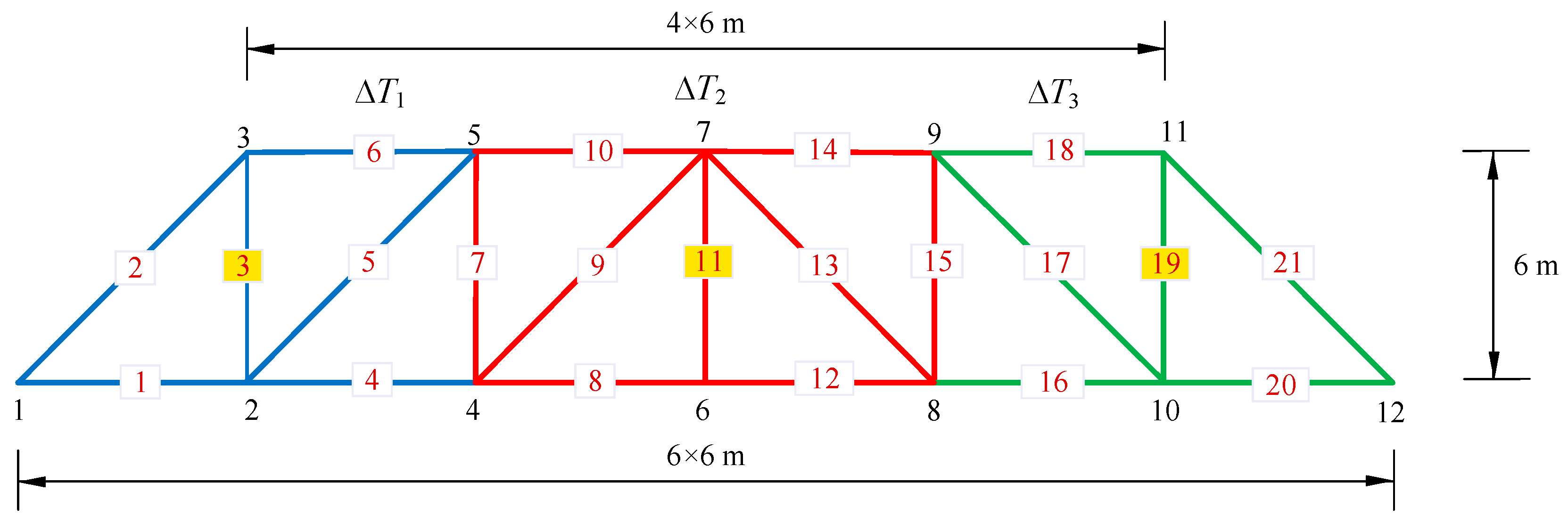
The truss model, shown in
Figure 1, comprises 12 nodes and 21 members, with a total length of 36 m and a height of 6 m. The numbers adjacent to the joints indicate node labels, and the numbers placed along members indicate member labels. The members are grouped into three temperature zones, distinguished by three colors. The structure has pin supports at node 1 and roller supports at node 12. The temperature zones are defined as follows: members 1–6 belong to Zone 1 with a temperature change in
; members 7–15 form Zone 2 with a temperature change in
; and members 16–21 constitute Zone 3 with a temperature change in
.
The material elastic modulus is 210 GPa, and the thermal expansion coefficient α = 1.17 × 10⁻⁵/°C. Each member has the same cross-sectional area, and the initial cross-sectional area is 0.02 m2. A static load of 100 kN is applied vertically downward at node 6. In this study, a reference temperature of 20 °C is set as the baseline for all temperature variation scenarios.
Three damage scenarios, Cases A-1 to A-3, are investigated, with the corresponding reductions in cross-sectional area and the prescribed temperature variations listed in
Table 1 and
Table 2, respectively. With damage present at multiple locations and across three distinct temperature zones, a total of six parameters, three damage-related and three temperature parameters, require identification. The strain measurements used in this study are derived from simulated damage scenarios and taken on the damaged members in each case. Additionally, in this study, to account for the introduction of temperature as an unknown parameter, extra strain gauges are placed within each temperature variation zone. Specifically, strain gauges are placed on members 3, 11, and 19, which correspond to the three distinct temperature zones. The locations of these additional sensors are highlighted in yellow in the structural diagram.
In this study, for the optimization process, the initial values of the cross-sectional areas are set to their undamaged values, and the initial temperature variations are set to 0 °C. Additionally, the cross-sectional area of damaged members is constrained between 0 and its initial value. The temperature variation is given a wide range of −60 °C to +60 °C to avoid relying on restrictive prior bounds.
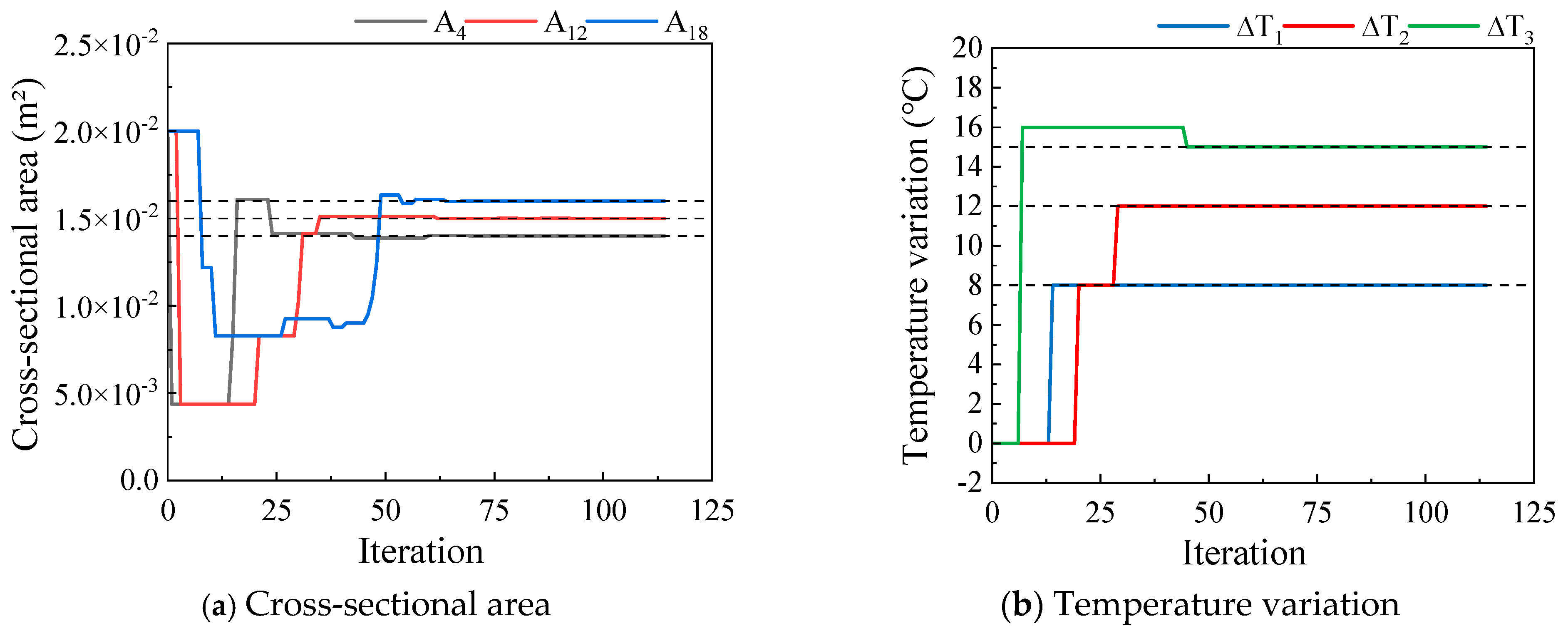
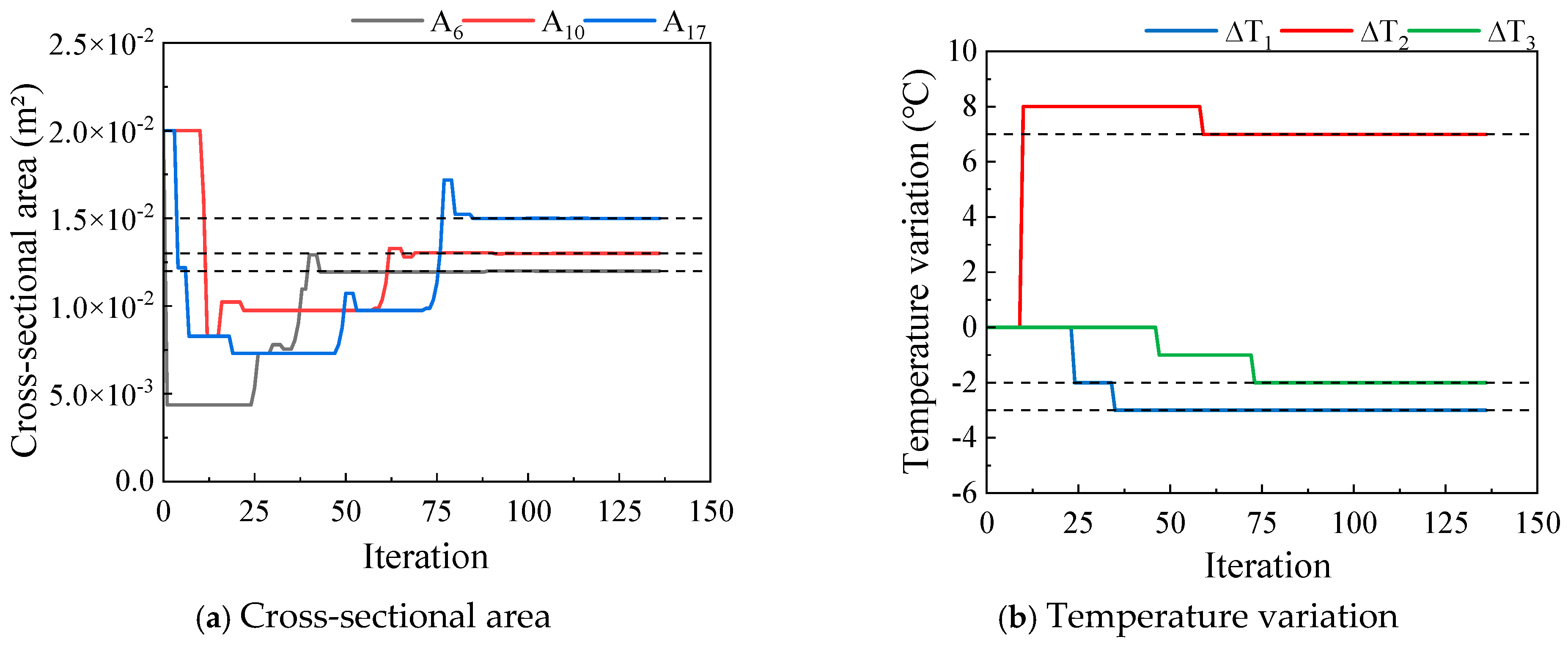
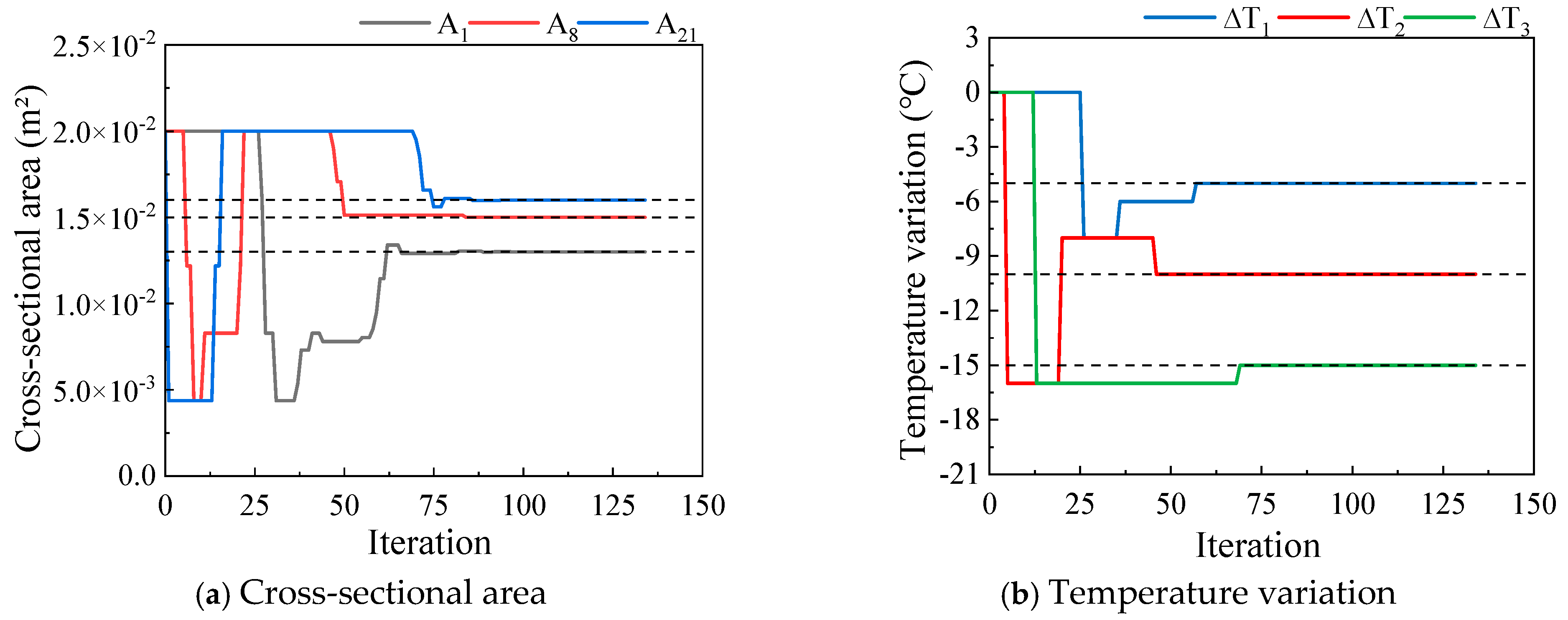
Figure 2,
Figure 3 and
Figure 4 illustrate the identification results for Case A-1, A-2, and A-3, respectively. The dashed lines represent the true values of the parameters. When temperature is incorporated as an unknown parameter,
Figure 2a,
Figure 3a and
Figure 4a show the cross-sectional area parameters converge to the true values. Simultaneously,
Figure 2b,
Figure 3b and
Figure 4b show that the three temperature variation parameters also converge to their preset values. Both the damage and thermal states are accurately identified.
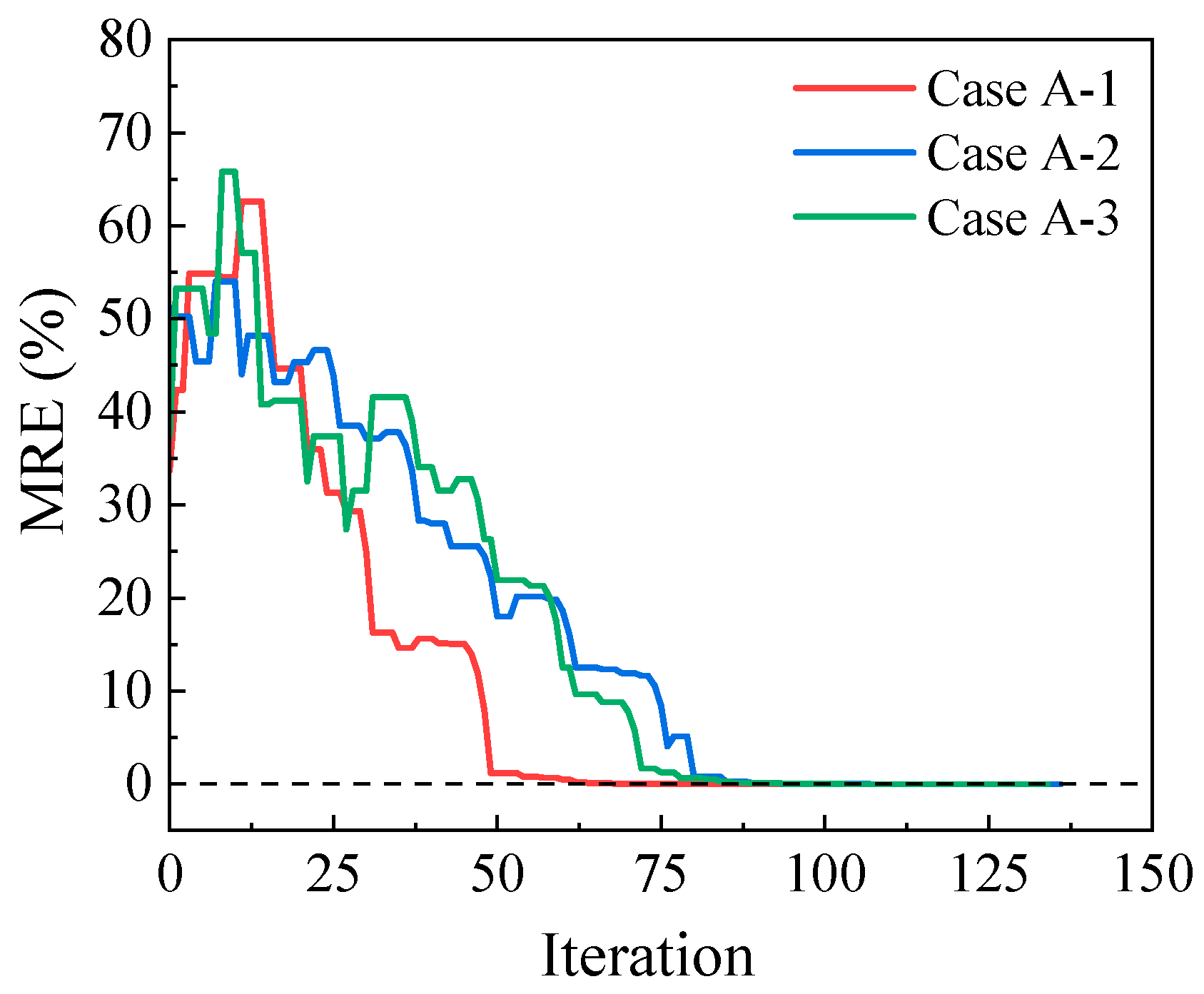
Figure 5 shows the MRE results for the three cases, as defined in Equation (6). All cases’ MRE values approach zero, indicating that the identified cross-sectional areas closely match the actual damaged values. This demonstrates that the joint identification method can accurately identify damage parameters while simultaneously estimating unknown temperature variations, effectively decoupling the thermal effects from structural damage. The results observed across different damage and temperature scenarios confirm that the proposed method enables accurate damage identification under varying temperature conditions without requiring independent temperature measurements.
4. Stiffness Separation Method
To extend the parameter identification method presented in
Section 2 to large-scale structures, the stiffness separation method [
24,
25,
26,
27] is employed to reduce computational complexity. This section details the mathematical formulation of this method. The core idea involves decomposing the global structure into manageable substructures. The force–displacement relation for each substructure is derived from the global system by extracting the degrees of freedom (DOFs) that are relevant to the substructure.
First, the structural nodes together with their associated DOFs are numbered. The global stiffness matrix is formulated as in
Section 2. Assuming the structure has
DOFs, these quantities are expressed as:
For a substructure, let
be the number of unknown displacements and
be the number of non-zero displacements. Define the vectors
and
as the DOFs of unknown and non-zero displacements, respectively. The substructure matrices and vectors, including
,
,
, and
are extracted from the global matrices and vectors of the structural system according to
and
:
The substructure force–displacement relation is then given by:
denotes the sub-stiffness matrix containing unknown damage parameters, and includes unknown temperature variations. Solving Equation (9) yields analytical displacements containing the unknown parameters, enabling the construction of an objective function for parameter identification through optimization. Compared with global identification, this substructuring approach can reduce the number of unknown parameters in the objective function. Moreover, each substructural stiffness matrix has a lower dimension than the global stiffness matrix.
5. Damage Identification Based on the Stiffness Separation Method
To demonstrate the applicability of the stiffness separation method in conjunction with joint damage–temperature identification, this section presents a case study on a steel truss bridge—the Benniu Bridge. The method is implemented using two distinct substructuring strategies: vertical separation and V-shaped separation, which are referred to as Case B and Case C, respectively. Each case is further evaluated under different temperature variation scenarios to assess the accuracy of the proposed approach in handling large-scale structures under temperature variations.
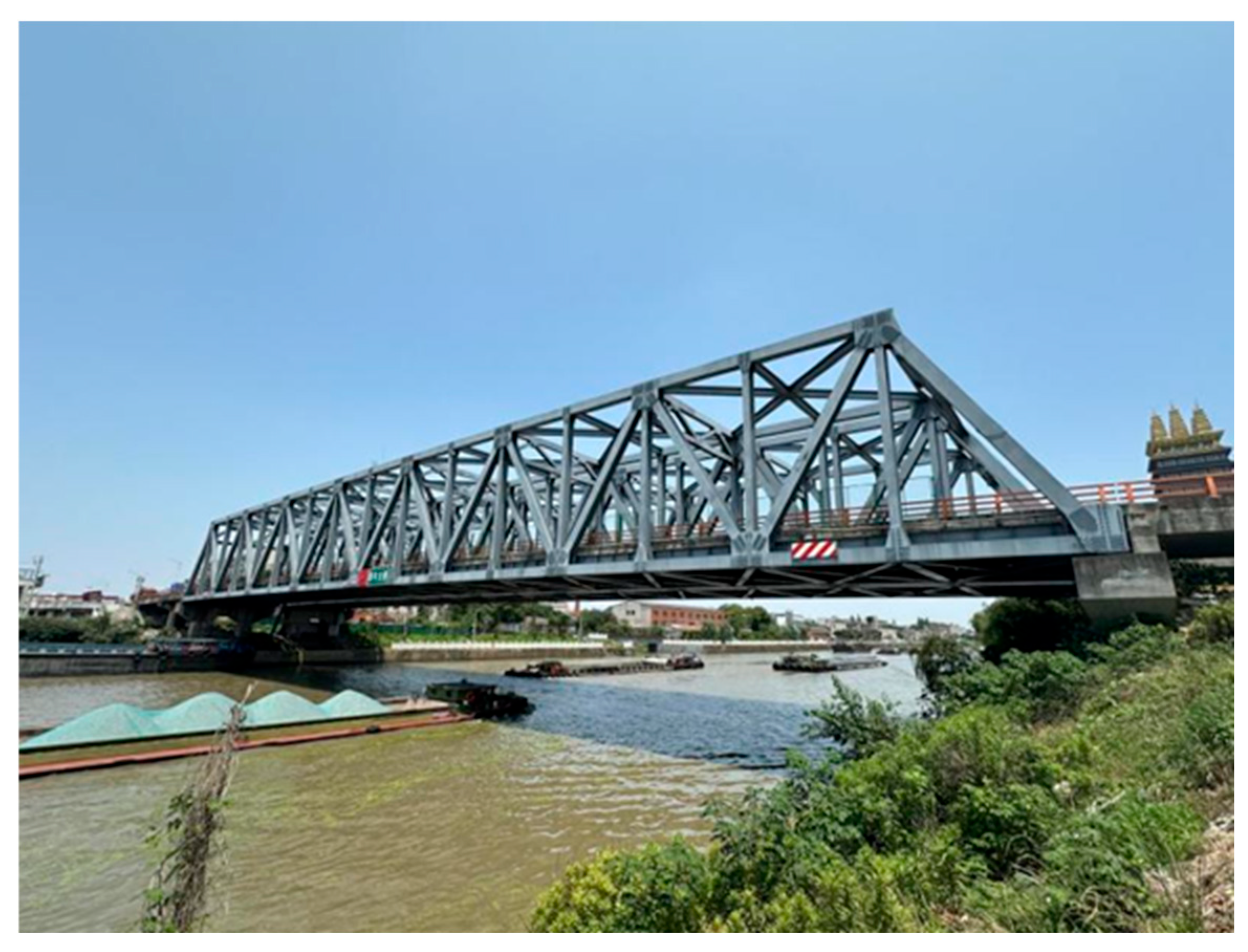
The Benniu Bridge is a 108-m single-span steel truss bridge with a Warren-type main truss, shown in
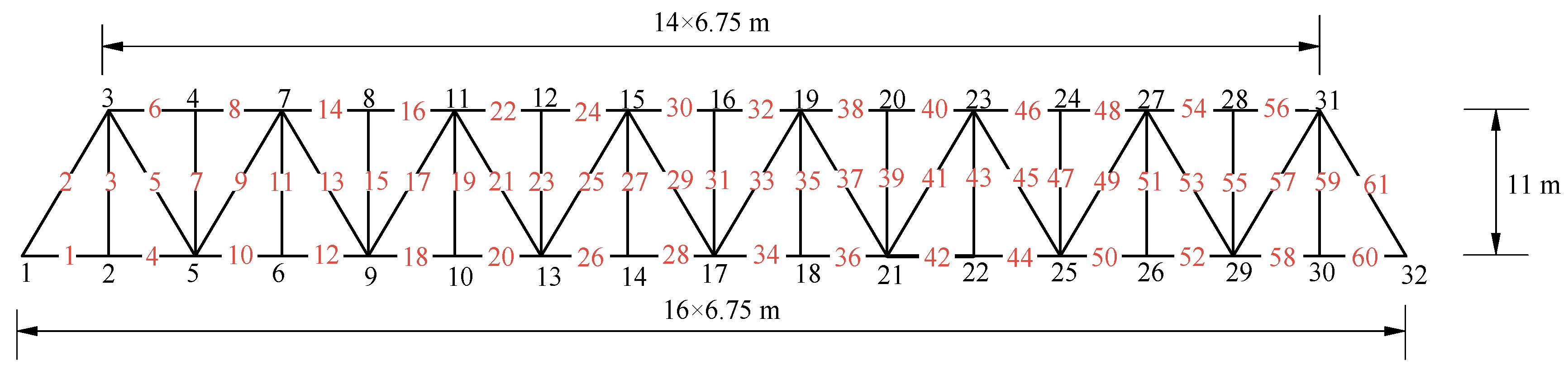
Figure 6. A simplified model of the main truss is developed for analysis (
Figure 7). The model comprises 32 nodes and 61 elements, with pin and roller supports at nodes 1 and 32, respectively. Material properties are set as: the elasticity modulus is 210 GPa and thermal expansion coefficient α = 1.17 × 10
−5/°C. To excite the structure, a set of seven concentrated forces, each with a magnitude of 100 kN, is applied vertically downward at the lower chord nodes 5, 6, 14, 17, 18, 26, and 29.
5.1. Vertical Separation Substructuring
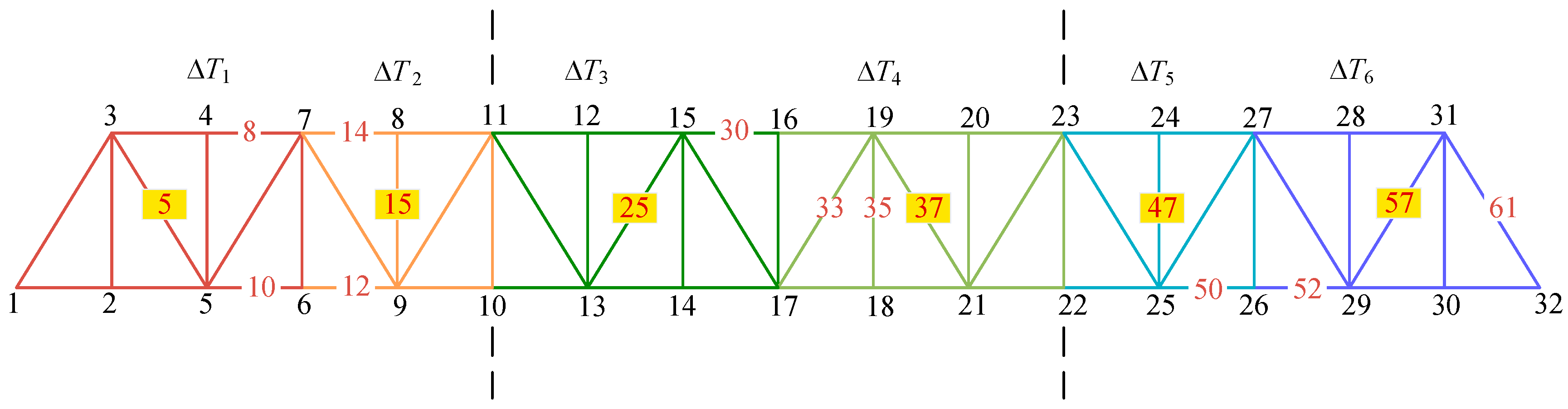
For the vertical separation strategy, referred to as Case B, the overall structure was divided into three substructures, with separation locations indicated by black dashed lines in
Figure 8. The structure is divided into six longitudinal temperature zones, labeled ΔT
1 to ΔT
6 in
Figure 8. Two temperature scenarios are considered. In Case B-1, the temperature change increases by 2 °C per zone, from ΔT
1 = +5 °C to ΔT
6 = +15 °C relative to the baseline. In Case B-2, the temperature change decreases by 3 °C per zone, from ΔT
1 = +10 °C to ΔT
6 = −5 °C. The damaged members for Cases B are summarized in
Table 3. Strain measurements are taken at the damaged members. In addition, other strain measurements are located at each temperature zone, with the measurement points marked in yellow, as shown in
Figure 8.
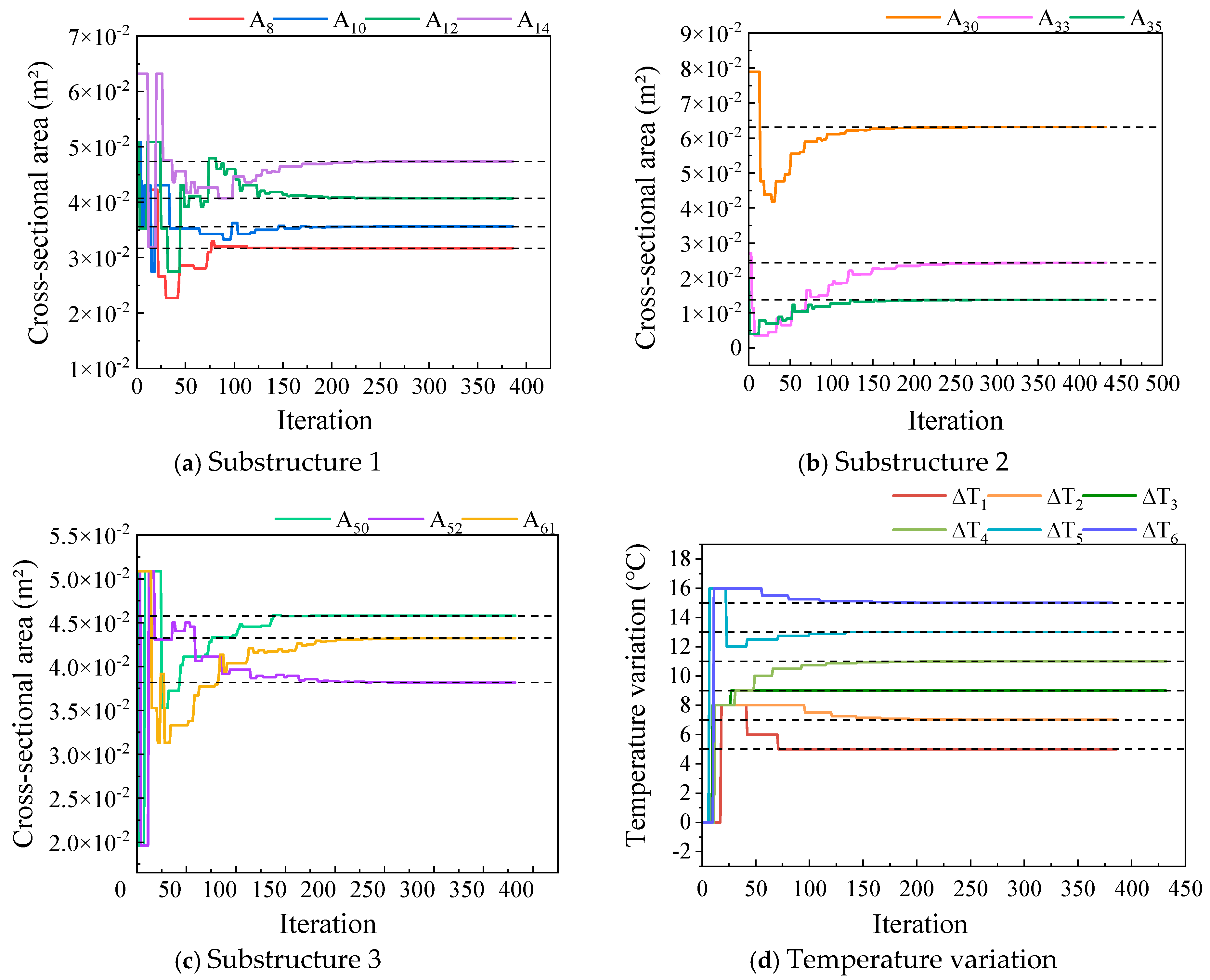
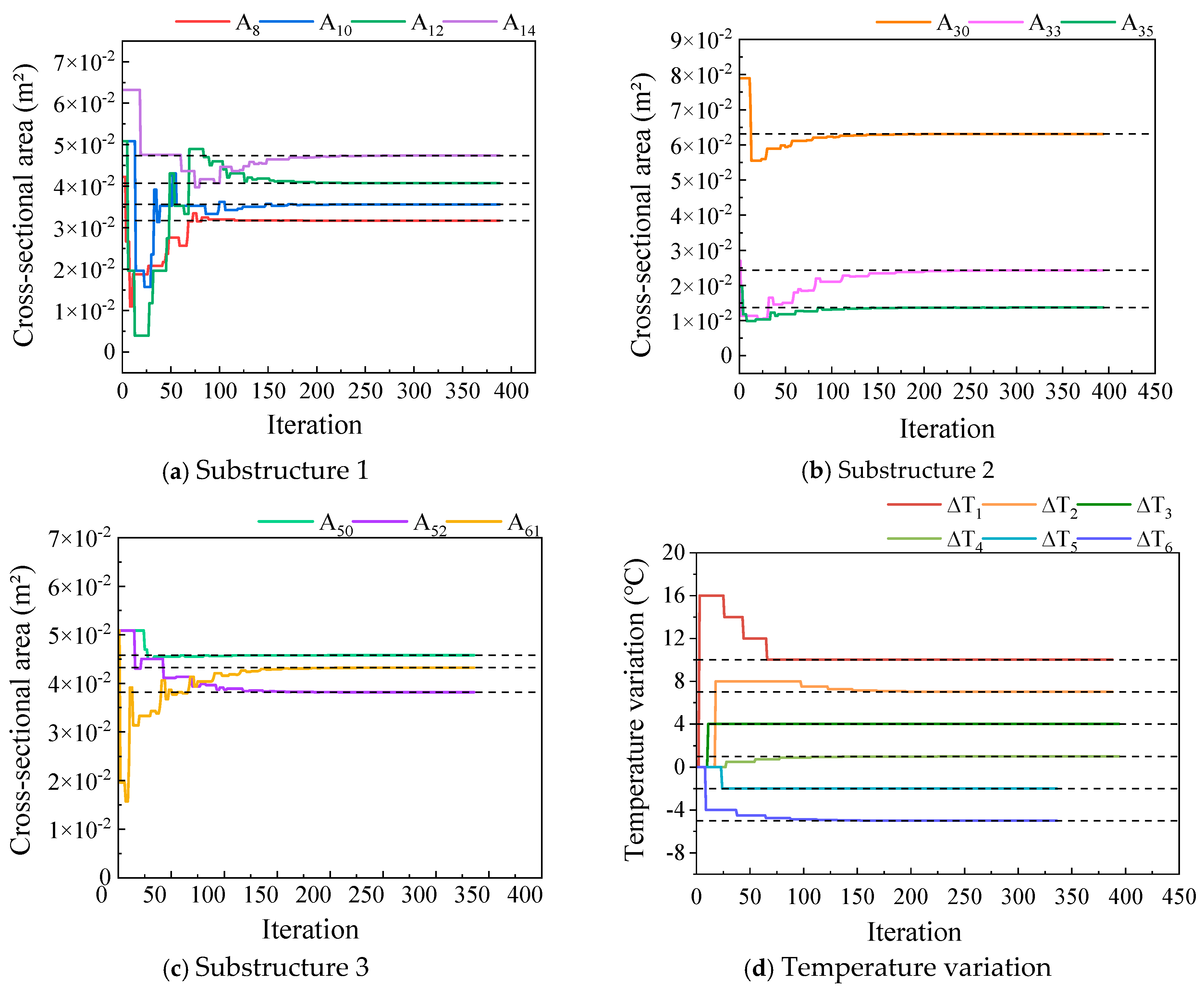
For each temperature scenario, the cross-sectional areas of the damaged members and the temperature variations were identified simultaneously within each substructure. In Case B-1, the objective functions for Substructures 1, 2, and 3 all converged through the optimization process. The final identification results for each substructure are shown in
Figure 9.
Figure 9a–c present the iteration process of the damage parameters within Substructures 1, 2, and 3, respectively.
Figure 9d shows the iteration process of the temperature parameters merged from the three substructures. Case B-2′s corresponding results are presented in
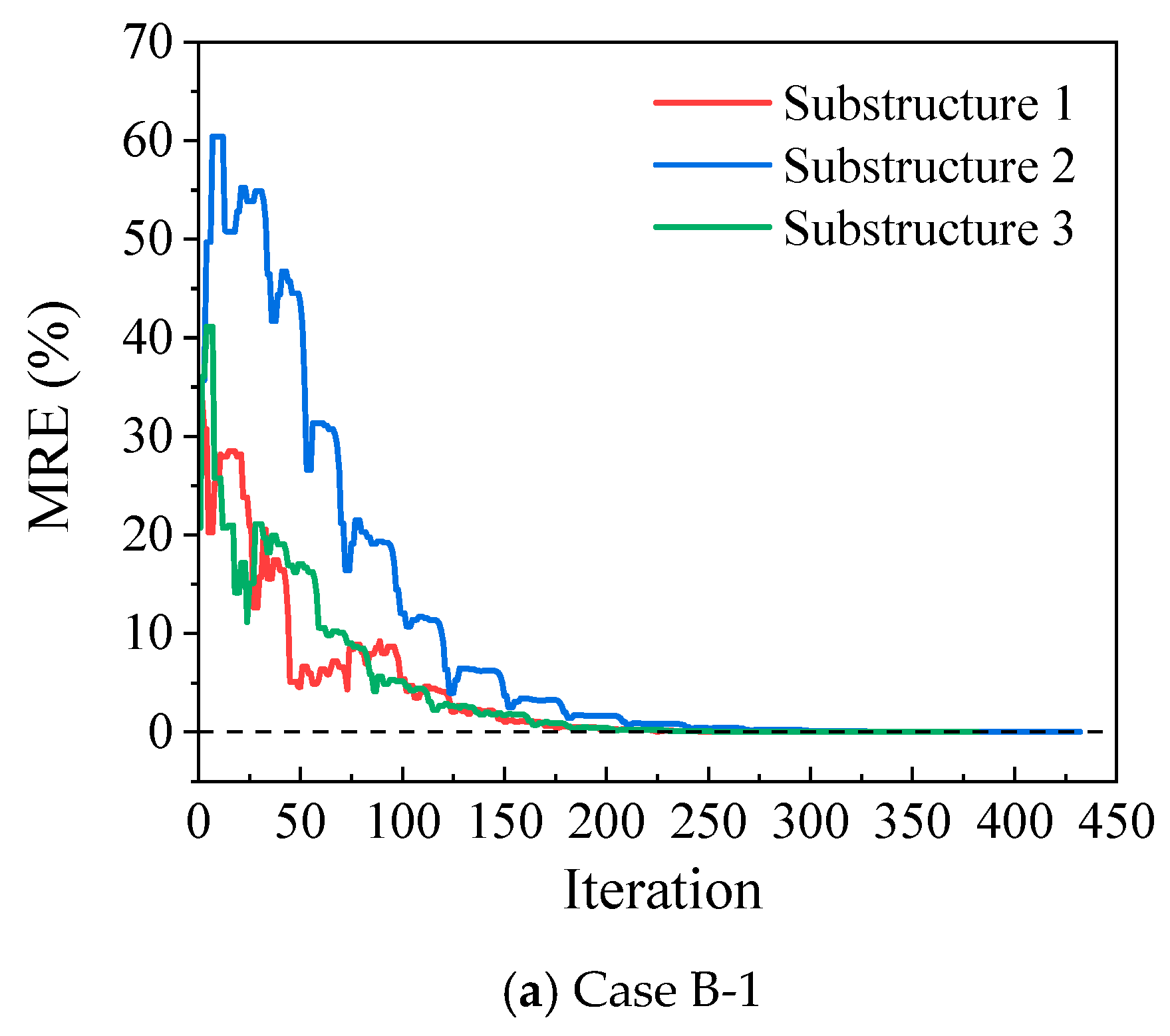
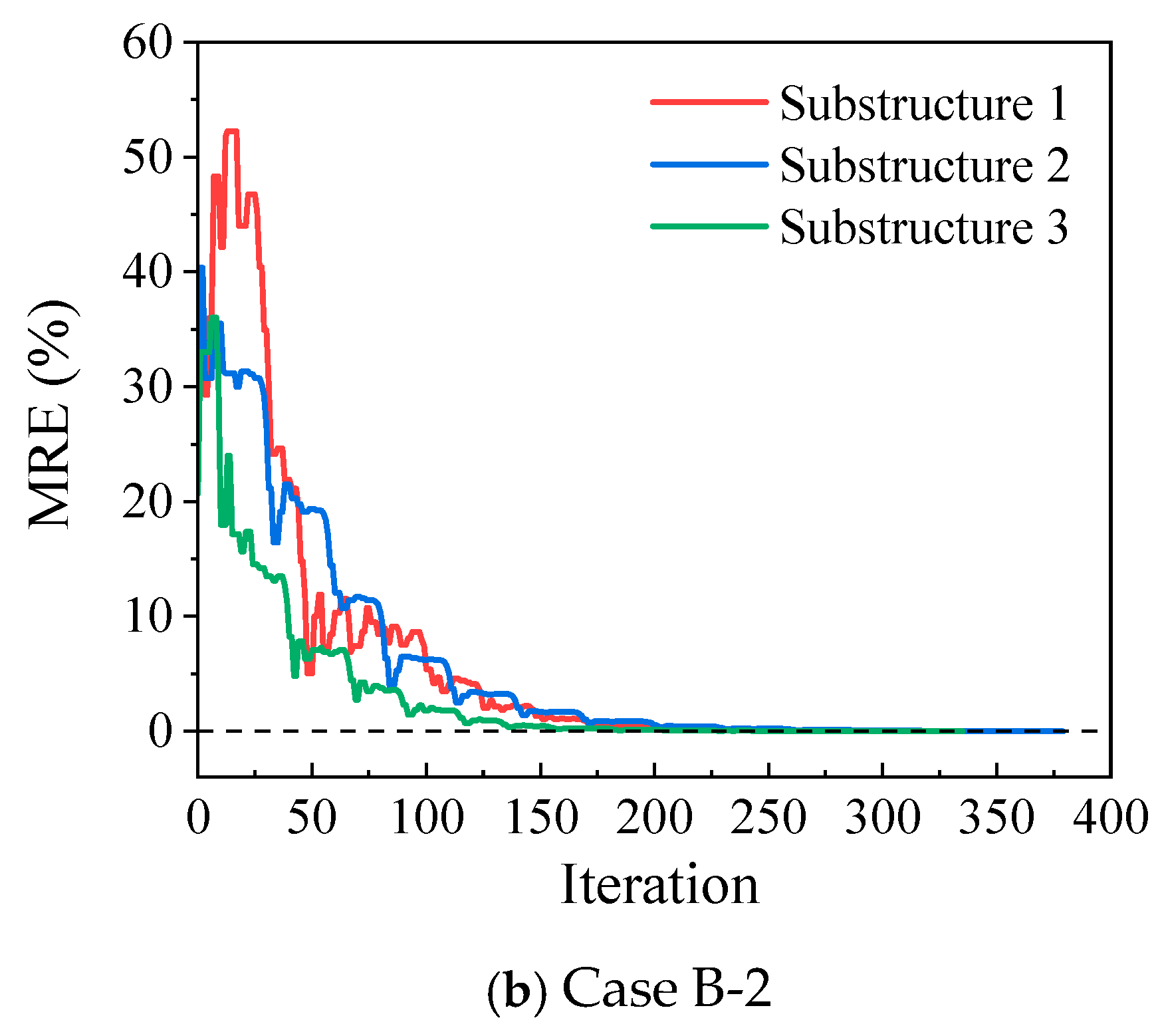
Figure 10. The variation in the MRE with iteration steps during the identification process for both cases is illustrated in
Figure 11. These results verify that the proposed method effectively identifies all parameters under combined structural damage and temperature variations.
5.2. V-Shaped Separation Substructuring
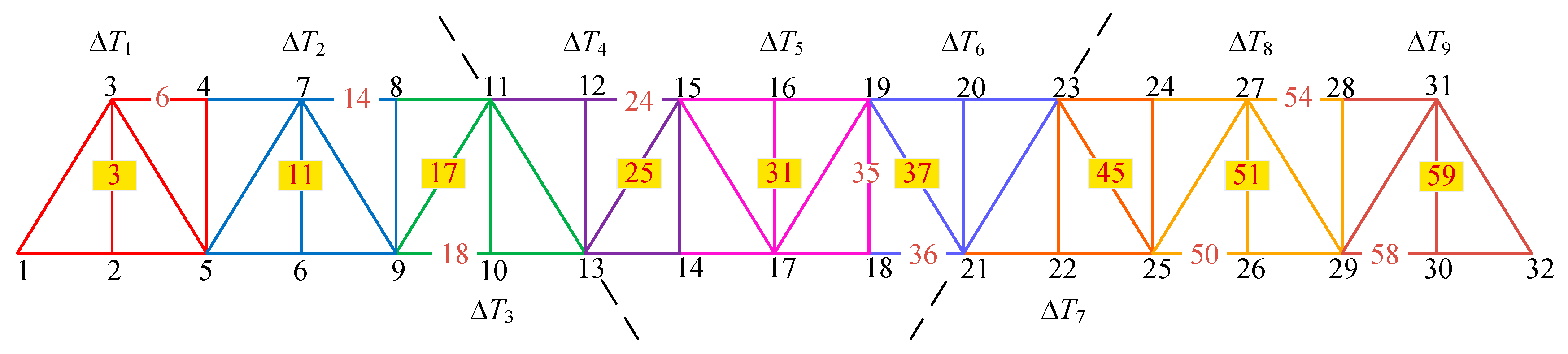
In Case C, the whole structure is divided into three substructures via V-shaped separation, as shown in
Figure 12. Correspondingly, nine longitudinal temperature zones are defined, labeled ΔT
1 to ΔT
9 in
Figure 12. Two temperature scenarios are studied. In Case C-1, the temperature change increases by 2 °C per zone from ΔT
1 = −10 °C to ΔT
9 = +6 °C. In Case C-2, a symmetric temperature distribution is applied: the temperature change peaks at the central zone ΔT
5 = +18 °C and decreases by 3 °C per zone towards both ends, reaching +6 °C at ΔT
1 and ΔT
9. The damaged members of Case C are presented in
Table 4. In this case, strain measurements are also taken at the damaged members. Additionally, the strain measurement points at each temperature zone are marked in yellow in
Figure 12.
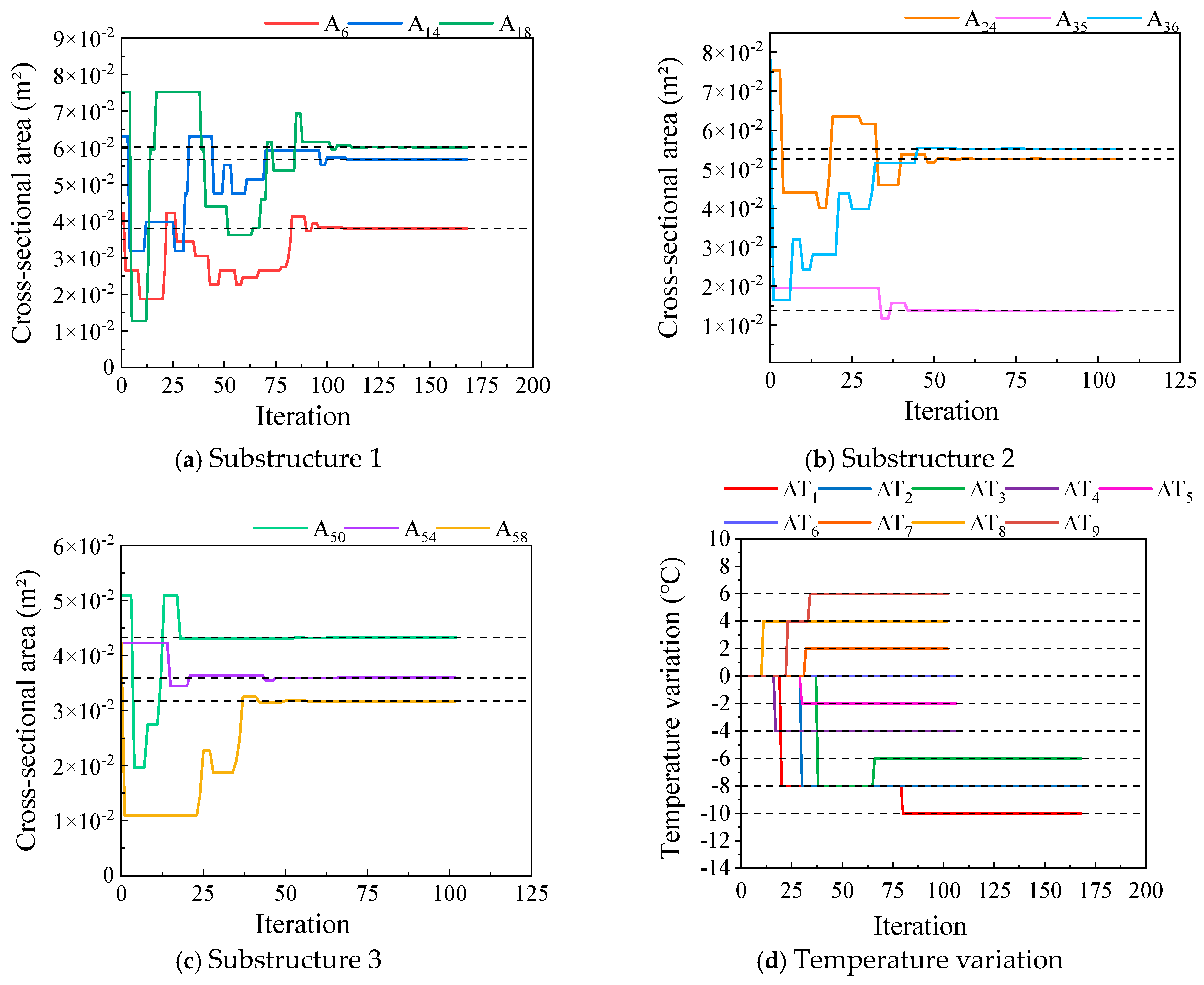
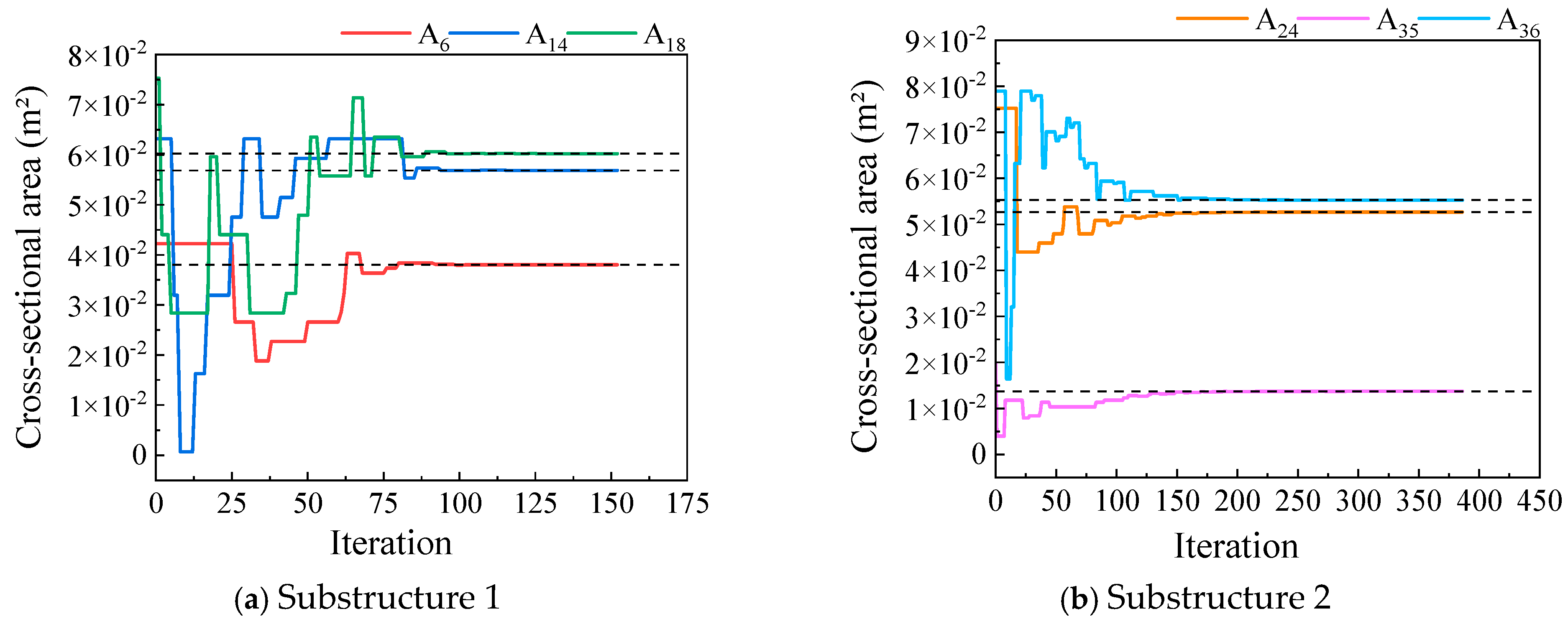
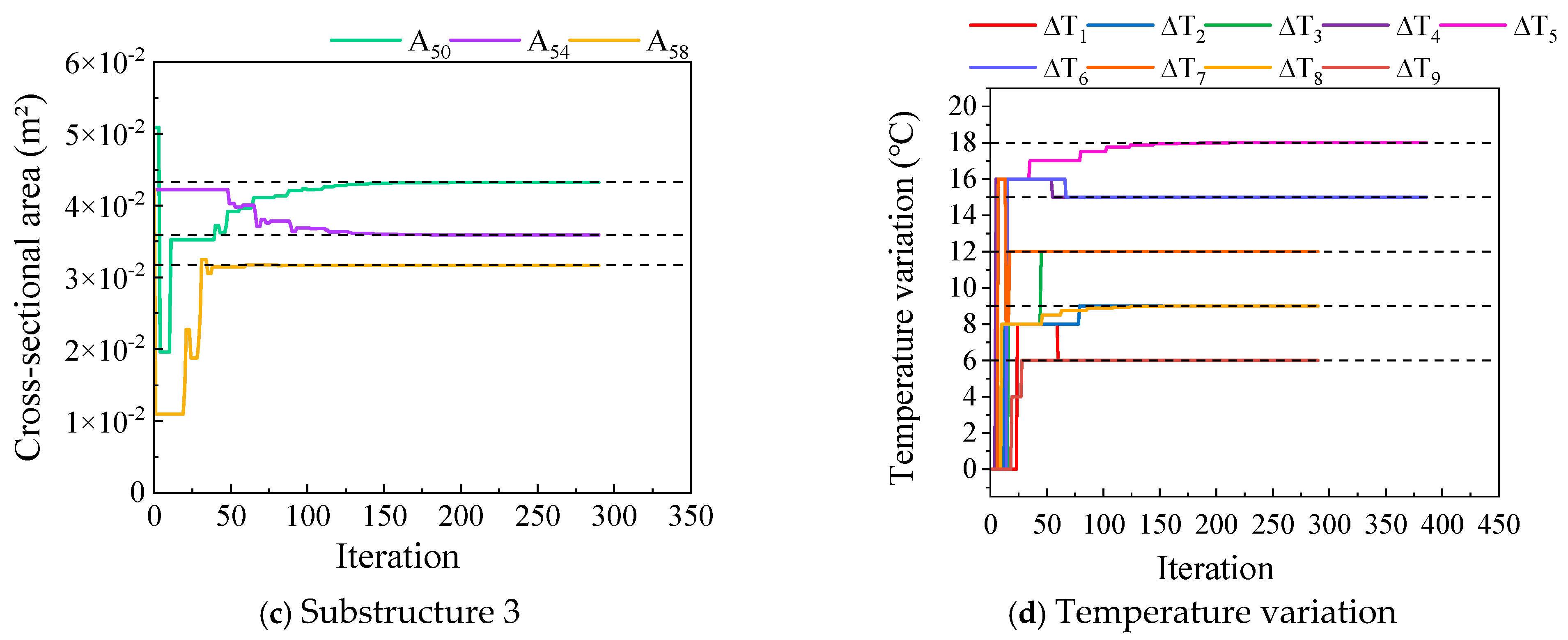
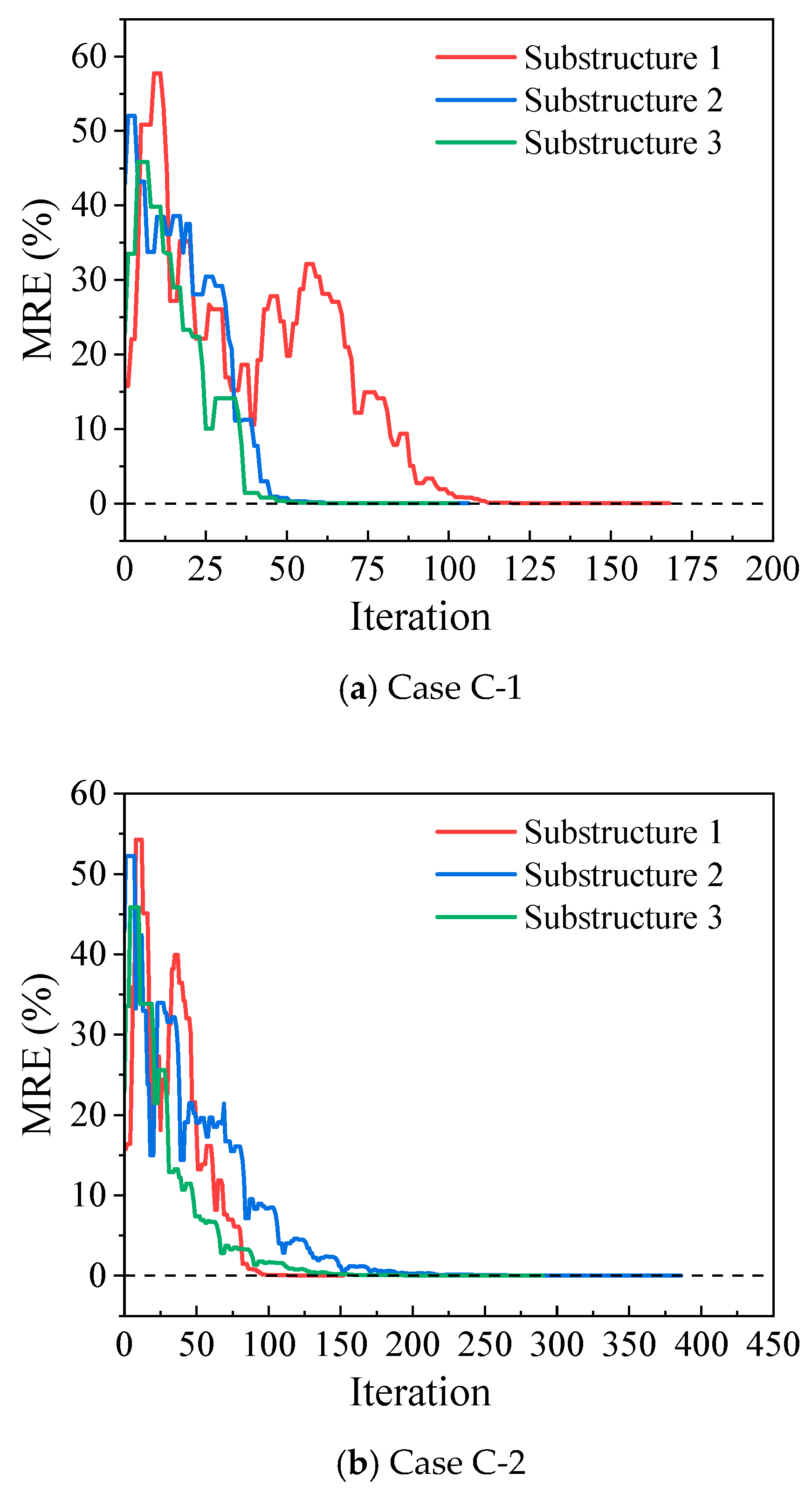
The optimized identification results for Cases C-1 and C-2 are shown in
Figure 13 and
Figure 14, respectively.
Figure 15 presents the MRE convergence of the identification process. These results further demonstrate the effectiveness of the proposed method.