Author Contributions
Conceptualization, Y.X. (Yuntao Xue); methodology, H.Z. and F.Z.; software, H.Z. and F.Z.; validation, H.Z. and F.Z.; formal analysis, H.Z.; investigation, H.Z.; resources, Y.X. (Yuntao Xue); data curation, F.Z.; writing—original draft preparation, H.Z.; writing—review and editing, H.Z.; visualization, H.Z.; supervision, Y.X. (Yunze Xue); project administration, Y.X. (Yunze Xue). All authors have read and agreed to the published version of the manuscript.
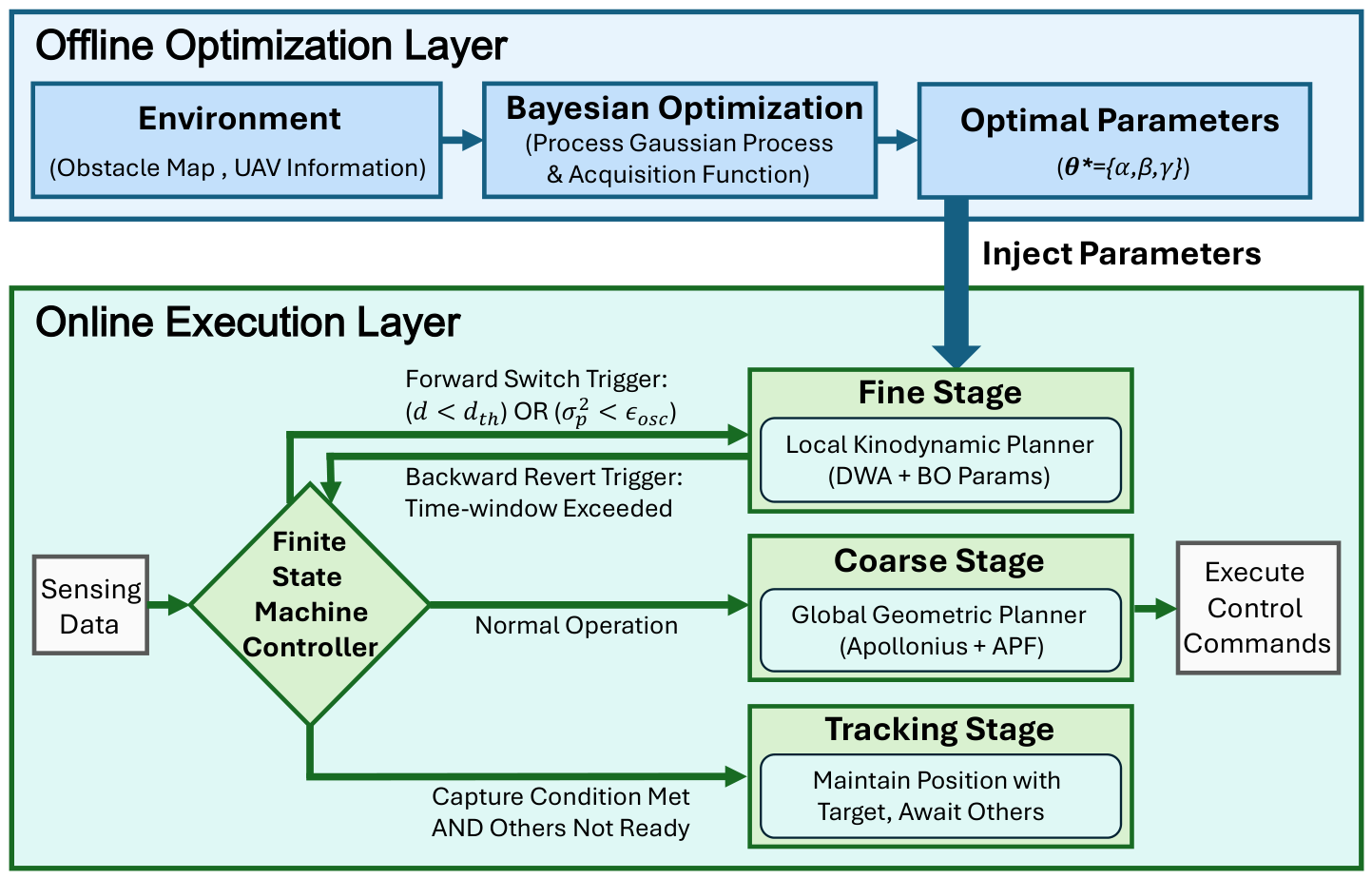
Figure 1.
Overall framework of the proposed AC2F strategy.
Figure 1.
Overall framework of the proposed AC2F strategy.
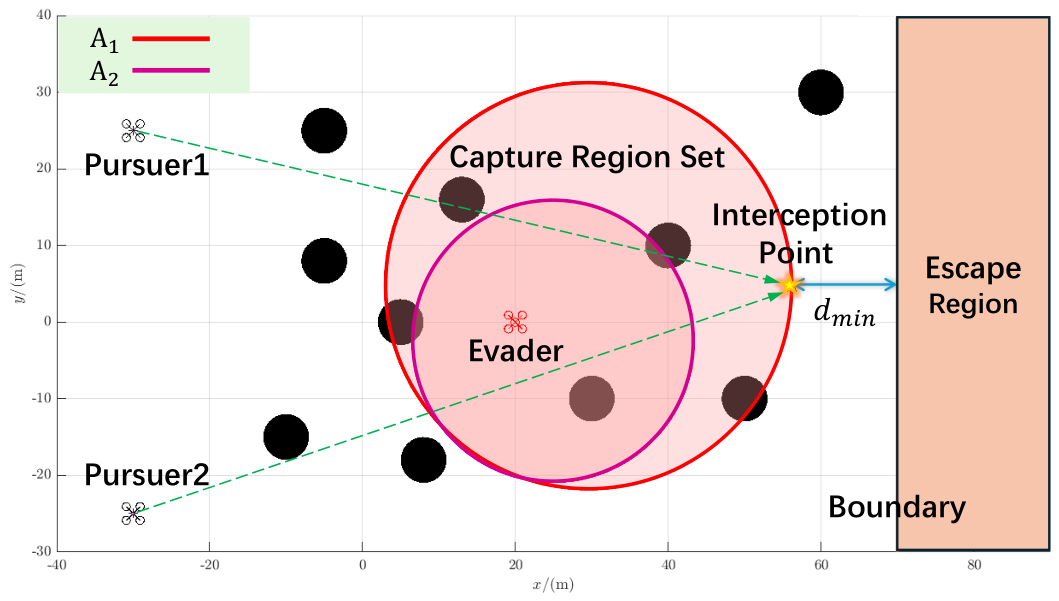
Figure 2.
Diagram of the Apollonius Circle-Based Geometric Collaborative Guidance.
Figure 2.
Diagram of the Apollonius Circle-Based Geometric Collaborative Guidance.
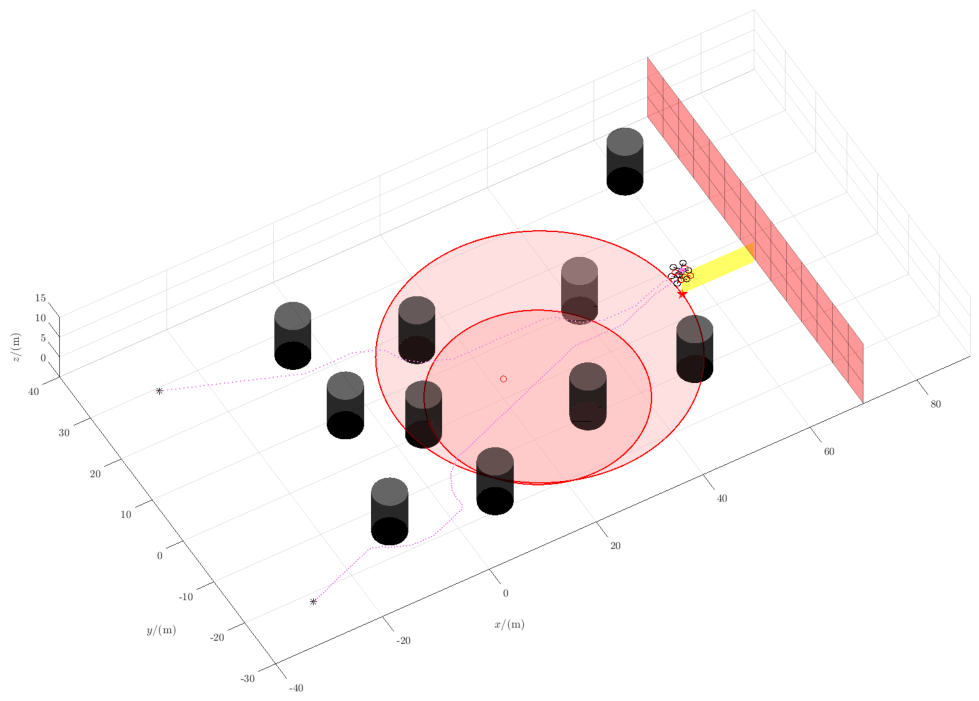
Figure 3.
Pure APF baseline test demonstrating obstacle avoidance characteristics. The magenta dotted curves show the pursuer trajectories, the black cylinders denote obstacles, the red circles indicate the cooperative capture regions, the five-pointed star marks the predicted interception point, and the shaded box denotes the escape region.
Figure 3.
Pure APF baseline test demonstrating obstacle avoidance characteristics. The magenta dotted curves show the pursuer trajectories, the black cylinders denote obstacles, the red circles indicate the cooperative capture regions, the five-pointed star marks the predicted interception point, and the shaded box denotes the escape region.
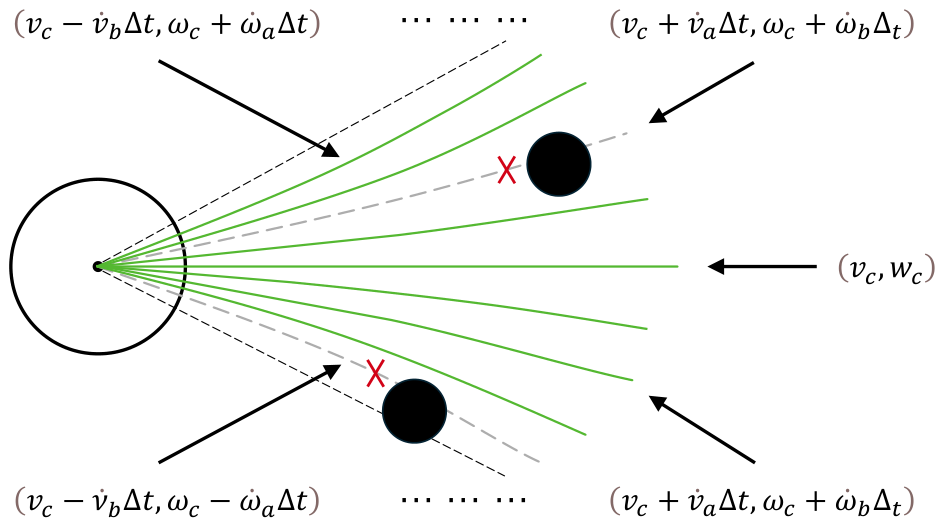
Figure 4.
Trajectory evaluation function in DWA. Green curves denote collision-free candidate trajectories, gray dashed curves denote rejected trajectories, red crosses mark predicted collision points, black disks denote obstacles, and black dashed lines bound the sampled dynamic window.
Figure 4.
Trajectory evaluation function in DWA. Green curves denote collision-free candidate trajectories, gray dashed curves denote rejected trajectories, red crosses mark predicted collision points, black disks denote obstacles, and black dashed lines bound the sampled dynamic window.
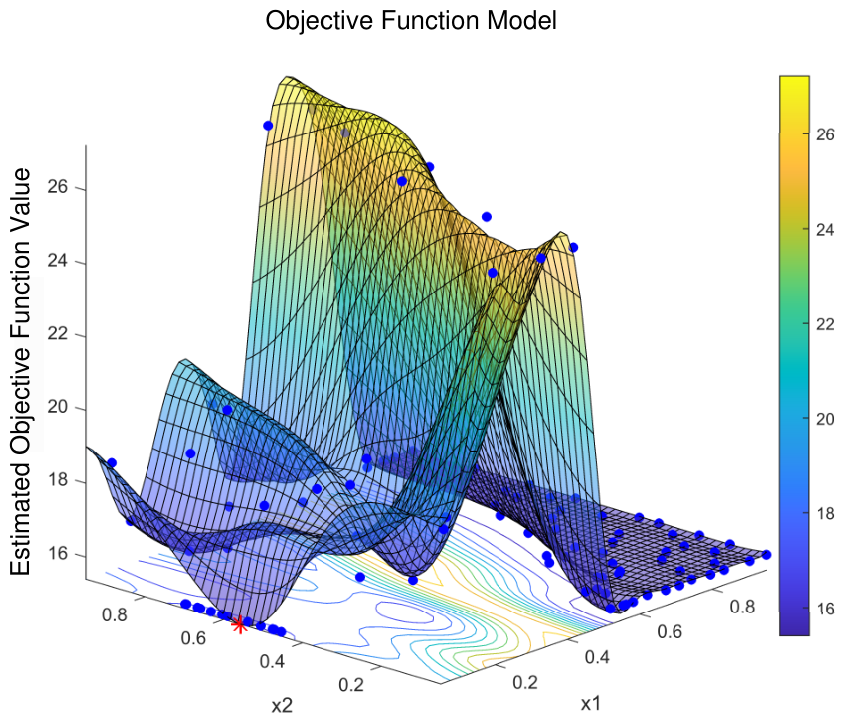
Figure 5.
3D Response Surface of the objective function in the U-shaped trap scenario. Blue circles denote evaluated parameter samples, and the red asterisk marks the optimum identified by Bayesian optimization.
Figure 5.
3D Response Surface of the objective function in the U-shaped trap scenario. Blue circles denote evaluated parameter samples, and the red asterisk marks the optimum identified by Bayesian optimization.
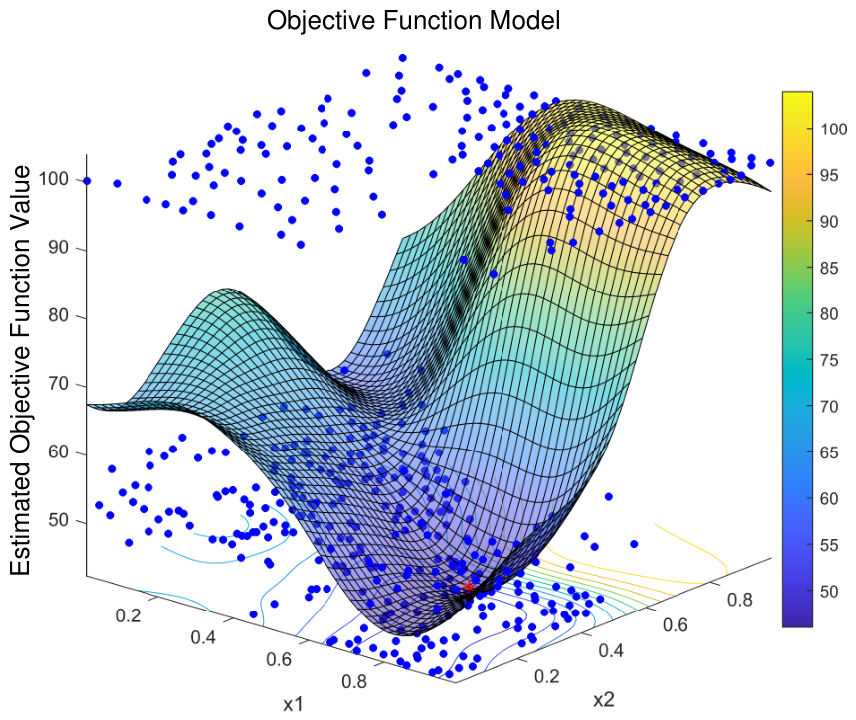
Figure 6.
3D Response surface of the objective function in the dense obstacle scenario. Blue circles denote evaluated parameter samples, and the red asterisk marks the optimum identified by Bayesian optimization.
Figure 6.
3D Response surface of the objective function in the dense obstacle scenario. Blue circles denote evaluated parameter samples, and the red asterisk marks the optimum identified by Bayesian optimization.
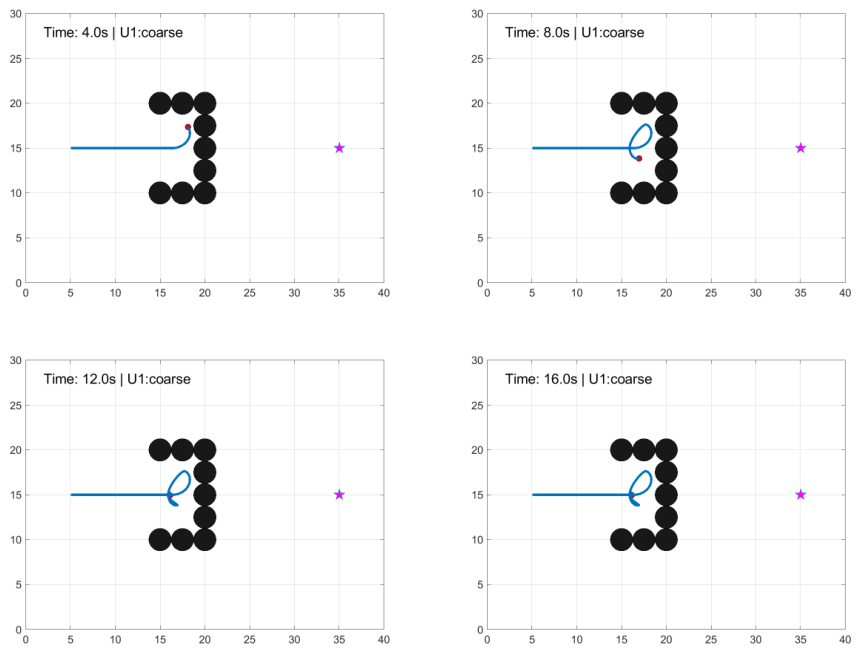
Figure 7.
Trajectory of APF trapped in a deadlock. The blue curve shows the pursuer trajectory, the red circle marks its current position, the five-pointed star denotes the target, and the black circles represent obstacles.
Figure 7.
Trajectory of APF trapped in a deadlock. The blue curve shows the pursuer trajectory, the red circle marks its current position, the five-pointed star denotes the target, and the black circles represent obstacles.
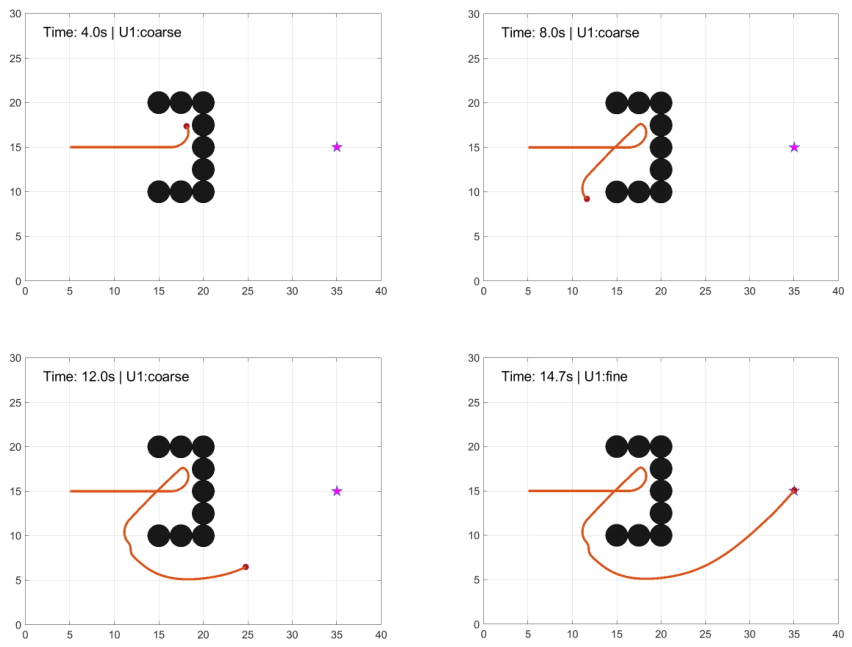
Figure 8.
Trajectory of AC2F successfully escaping the U-shaped trap. The orange curve shows the pursuer trajectory, the red circle marks its current position, the five-pointed star denotes the target, and the black circles represent obstacles.
Figure 8.
Trajectory of AC2F successfully escaping the U-shaped trap. The orange curve shows the pursuer trajectory, the red circle marks its current position, the five-pointed star denotes the target, and the black circles represent obstacles.
Figure 9.
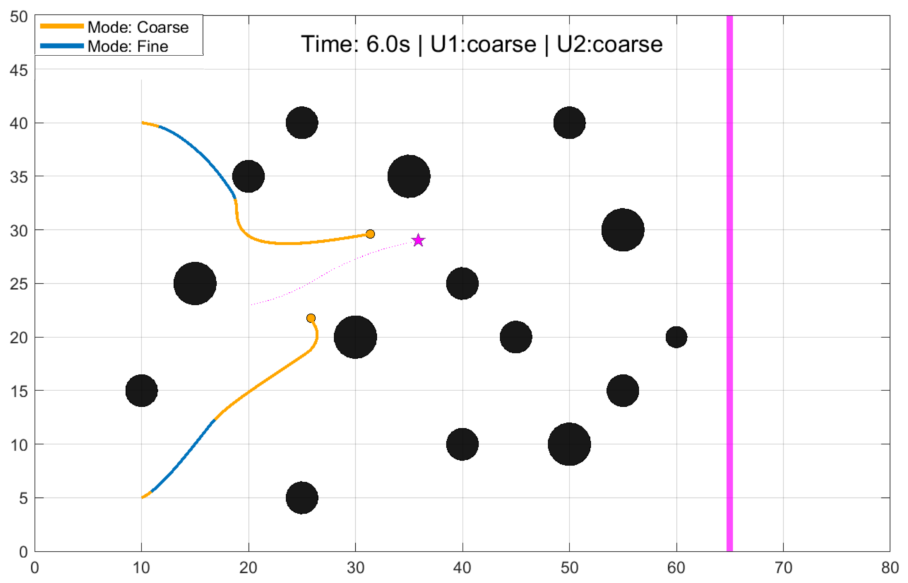
Single detailed simulation trajectory of the AC2F algorithm (6 s). Orange and blue trajectory segments denote the coarse and fine modes, respectively; no tracking-mode segment is present at this time. The magenta dotted line shows the evader trajectory, the five-pointed star marks the current evader position, the magenta vertical line denotes the escape boundary, and black circles of different sizes represent obstacles with different radii.
Figure 9.
Single detailed simulation trajectory of the AC2F algorithm (6 s). Orange and blue trajectory segments denote the coarse and fine modes, respectively; no tracking-mode segment is present at this time. The magenta dotted line shows the evader trajectory, the five-pointed star marks the current evader position, the magenta vertical line denotes the escape boundary, and black circles of different sizes represent obstacles with different radii.
Figure 10.
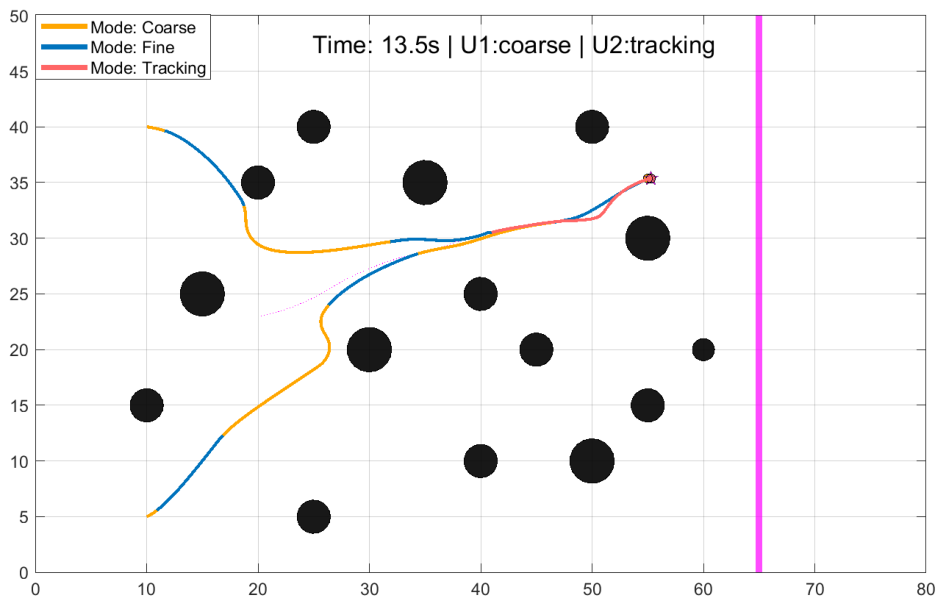
Single detailed simulation trajectory of the AC2F algorithm (13.5 s). Orange, blue, and red trajectory segments denote the coarse, fine, and tracking modes, respectively. The magenta dotted line shows the evader trajectory, the five-pointed star marks the current evader position, the magenta vertical line denotes the escape boundary, and black circles of different sizes represent obstacles with different radii.
Figure 10.
Single detailed simulation trajectory of the AC2F algorithm (13.5 s). Orange, blue, and red trajectory segments denote the coarse, fine, and tracking modes, respectively. The magenta dotted line shows the evader trajectory, the five-pointed star marks the current evader position, the magenta vertical line denotes the escape boundary, and black circles of different sizes represent obstacles with different radii.
Figure 11.
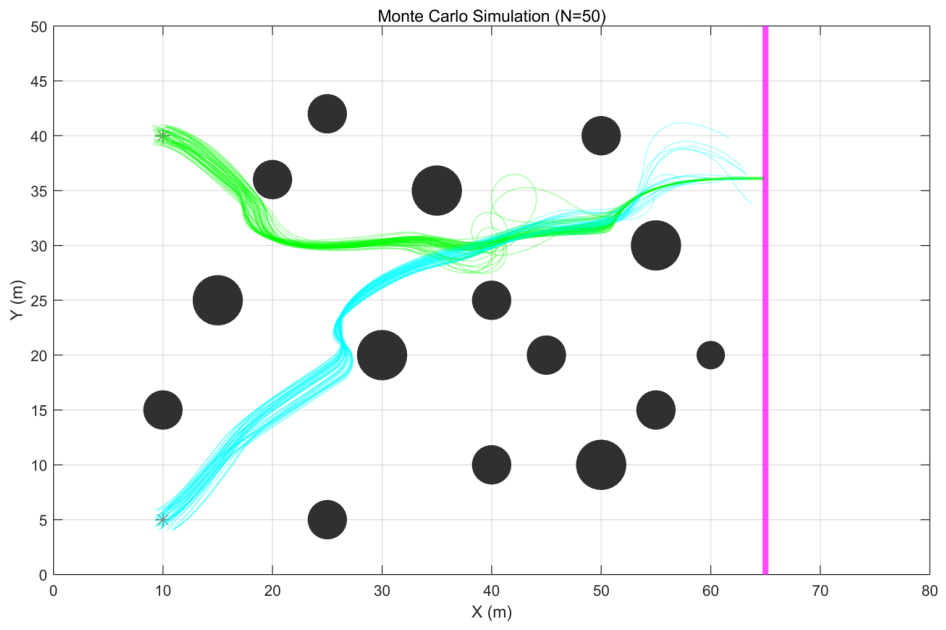
Path superposition of 50 Monte Carlo simulations. Cyan and green curves show the trajectories of the two pursuers, asterisks mark their initial positions, black circles of different sizes represent obstacles with different radii, and the magenta vertical line denotes the escape boundary.
Figure 11.
Path superposition of 50 Monte Carlo simulations. Cyan and green curves show the trajectories of the two pursuers, asterisks mark their initial positions, black circles of different sizes represent obstacles with different radii, and the magenta vertical line denotes the escape boundary.
Figure 12.
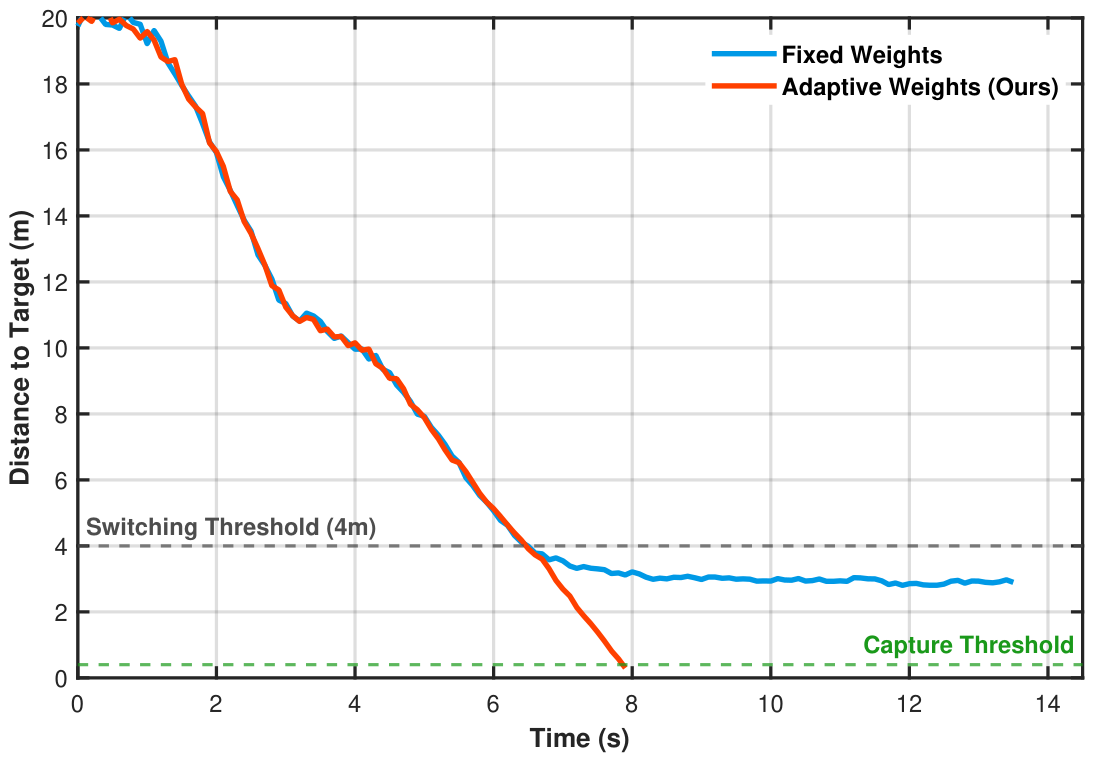
Distance convergence comparison between fixed and adaptive weight strategies.
Figure 12.
Distance convergence comparison between fixed and adaptive weight strategies.
Figure 13.
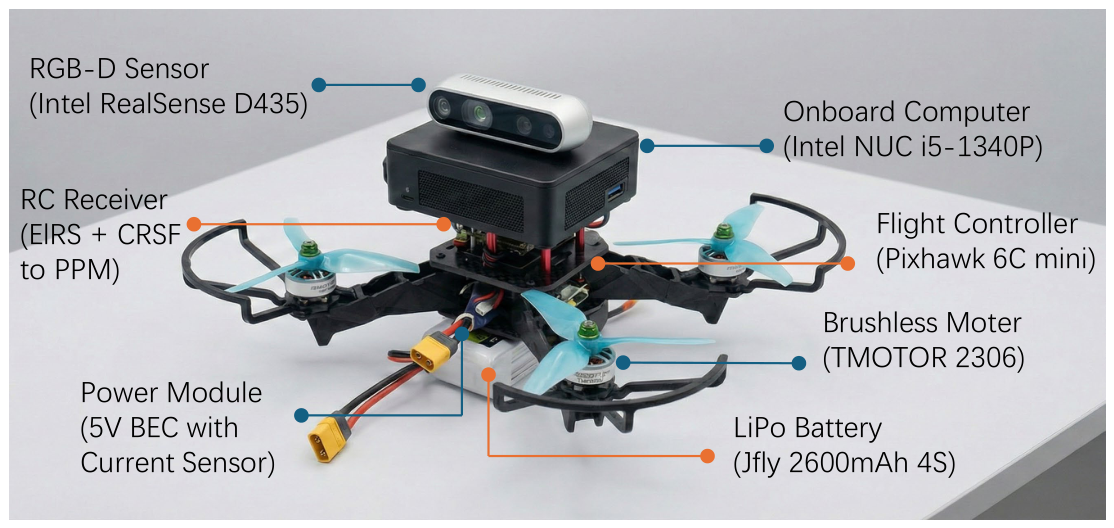
Micro-UAV hardware architecture. The system decouples high-level AC2F decision-making from low-level flight control.
Figure 13.
Micro-UAV hardware architecture. The system decouples high-level AC2F decision-making from low-level flight control.
Figure 14.
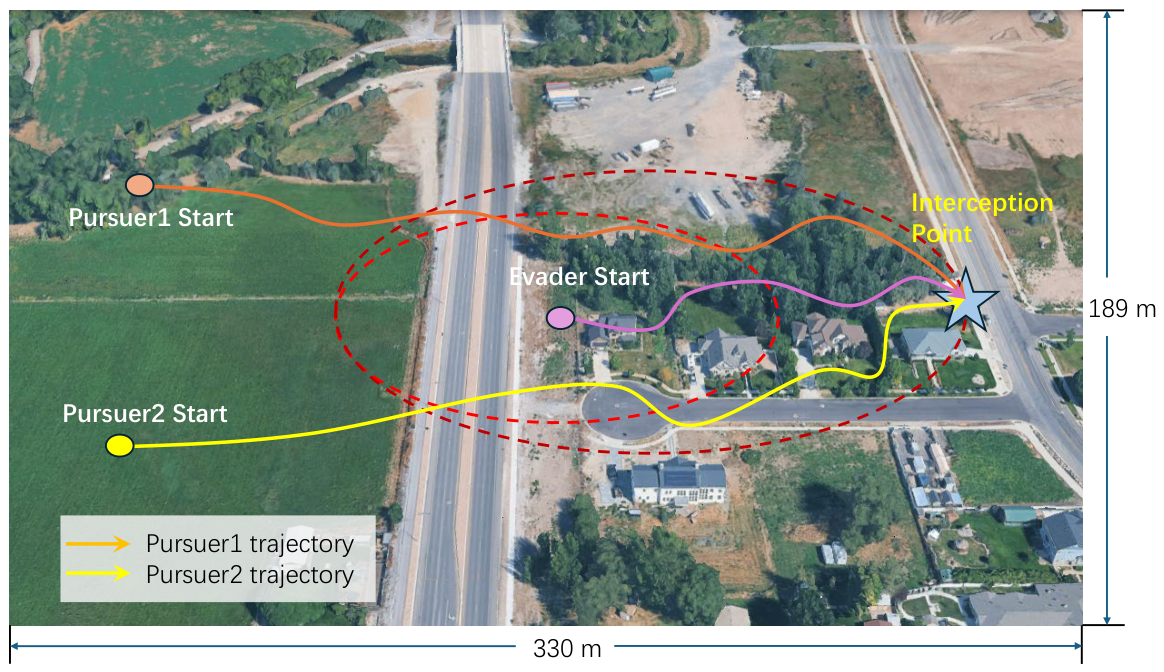
Suburban pursuit case study (330 m × 189 m). Red dashed lines denote Apollonius capture sets, showing the transition from global guidance to fine kinodynamic avoidance.
Figure 14.
Suburban pursuit case study (330 m × 189 m). Red dashed lines denote Apollonius capture sets, showing the transition from global guidance to fine kinodynamic avoidance.
Table 1.
Implementation parameters of the AC2F planner.
Table 1.
Implementation parameters of the AC2F planner.
| Parameter | Symbol | Value | Role |
|---|
| Fine-stage distance trigger | | 4.0 m | Enters terminal kinodynamic planning near the evader. |
| Oscillation window | | 2.0 s | Sliding window for local-minimum detection. |
| Oscillation variance threshold | | 0.08 m2 | Activates DWA when recent motion is confined. |
| Fine-stage maximum duration | | 3.0 s | Forces return to coarse guidance after local escape. |
| DWA control period | | 0.1 s | Online replanning interval. |
| Prediction horizon, approach mode | | 1.0 s | Longer look-ahead for stable tracking. |
| Prediction horizon, terminal mode | | 0.2 s | Shorter look-ahead for close-range capture. |
| Safety saturation distance | | 2.0 m | Upper bound for clearance reward. |
| Collision rejection radius | | 0.5 m | Hard safety radius for infeasible trajectories. |
| History length for memory penalty | | 30 samples | Recent positions used to penalize looping trajectories. |
| BO initialization/evaluation budget | – | 20/200–500 | Random initial samples and scenario-dependent BO iterations. |
Table 2.
Finite-state switching logic of AC2F.
Table 2.
Finite-state switching logic of AC2F.
| State | Condition and Action | Next State |
|---|
| Coarse | Compute from Apollonius guidance and apply lightweight APF avoidance. If or over , activate DWA. | Fine |
| Fine | Sample admissible , reject collisions, evaluate with the memory penalty, and execute the best command. If capture is satisfied but teammates are not ready, hold relative position. | Tracking |
| Fine | If expires before capture, return to geometric guidance to restore global pursuit intent. | Coarse |
| Tracking | Maintain relative position until cooperative encirclement is completed or the evader leaves the capture zone. | Coarse/Fine |
Table 3.
Bayesian optimization configuration.
Table 3.
Bayesian optimization configuration.
| Item | Configuration |
|---|
| Search variables | , mapped to normalized . |
| Surrogate model | Gaussian Process with a squared-exponential covariance kernel. |
| Acquisition function | Expected Improvement (EI). |
| Initial samples | 20 Latin-hypercube random samples. |
| Evaluation budget | 200 iterations for the U-shaped scenario and 500 iterations for dense obstacles. |
| Failure handling | Collision or no capture within the time limit receives . |
| Output | Scenario-specific baseline weights used by the onboard DWA planner. |
Table 4.
Performance Comparison Before and After Optimization in Scenario 1.
Table 4.
Performance Comparison Before and After Optimization in Scenario 1.
| Parameter Configuration | (Heading) | (Clearance) | (Velocity) | Cost | Result Analysis |
|---|
| Initial Random Set | 0.2234 | 0.7091 | 0.0675 | 18.56 | pursuit is slow. |
| Typical Deadlock Set | 0.3440 | 0.4032 | 0.2528 | Fail | trapped at the bottom |
| Bayesian Optimal Set | 0.0502 | 0.6263 | 0.3235 | 15.52 | Optimal solution |
Table 5.
Performance Comparison Before and After Optimization in Scenario 2.
Table 5.
Performance Comparison Before and After Optimization in Scenario 2.
| Parameter Configuration | (Heading) | (Clearance) | (Velocity) | Cost | Result Analysis |
|---|
| Safety-Biased Set | 0.4829 | 0.5019 | 0.0152 | Fail | Target lost |
| Balanced Weight Set | 0.2123 | 0.0551 | 0.7326 | 59.20 | poor directional focus |
| Bayesian Optimal Set | 0.6392 | 0.0490 | 0.3118 | 42.36 | Optimal solution |
Table 6.
Key statistical metrics under different planning strategies in 50 numerical simulations.
Table 6.
Key statistical metrics under different planning strategies in 50 numerical simulations.
| Evaluation Metric | Geo + APF (Control) | AC2F (Proposed) | Improvement |
|---|
| Success Rate (95% CI) | 64% [50.1, 75.9] | 86% [73.8, 93.0] | +22 points; |
| Average Capture Time | 13.65 s | 13.04 s | 4.47% |
| Path Smoothness (Avg. Jerk) | | | 21.36% |
| Avg. Distance to Safe Boundary () | 7.32 m | 9.07 m | 23.9% |
Table 7.
Module-wise ablation of AC2F components.
Table 7.
Module-wise ablation of AC2F components.
| Variant | Coarse | Switch | Adapt. | Observed Effect |
|---|
| Geo + APF | Yes | No | No | Low computation, but frequent deadlock in U-shaped and concave obstacles. |
| Fixed DWA only | No | No | No | Smooth local motion, but weak global pursuit intent and longer detours. |
| AC2F without memory | Yes | Yes | Yes | Can enter fine mode, but may revisit historical positions in traps. |
| AC2F without terminal adaptation | Yes | Yes | No | Escapes obstacles, but shows close-range trailing error. |
| Full AC2F | Yes | Yes | Yes | Balances global interception, local escape, and terminal capture. |
Table 8.
Onboard computational-cost summary for the AC2F implementation.
Table 8.
Onboard computational-cost summary for the AC2F implementation.
| Metric | Coarse Stage | Fine Stage | Interpretation |
|---|
| Decision frequency | 10 Hz | 10 Hz | Same controller interface for both stages. |
| Planning-latency budget | 100 ms | 100 ms | Upper bound imposed by the control period. |
| Measured planning latency | ms | ms | DWA remains below the real-time budget on the Intel NUC i5-1340P. |
| Accelerator requirement | No | No | CPU-only execution; no GPU/NPU inference is required. |
| Dominant computation | Apollonius geometry | Velocity sampling and trajectory scoring | Heavy BO search is performed offline. |
Table 9.
Quantitative comparison of pursuit performance in suburban scenarios.
Table 9.
Quantitative comparison of pursuit performance in suburban scenarios.
| Method | Success Rate (%) | Avg. Time (s) | Avg. Path (m) |
|---|
| Traditional APF | 64.2 | 142.5 | 512.3 |
| Fixed-weight DWA | 71.8 | 128.4 | 485.6 |
| AC2F (Ours) | 86.4 | 105.2 | 432.8 |