4.1. Optimization Analysis of Water Depth Models Using Chlorophyll a and Water Optical Indices
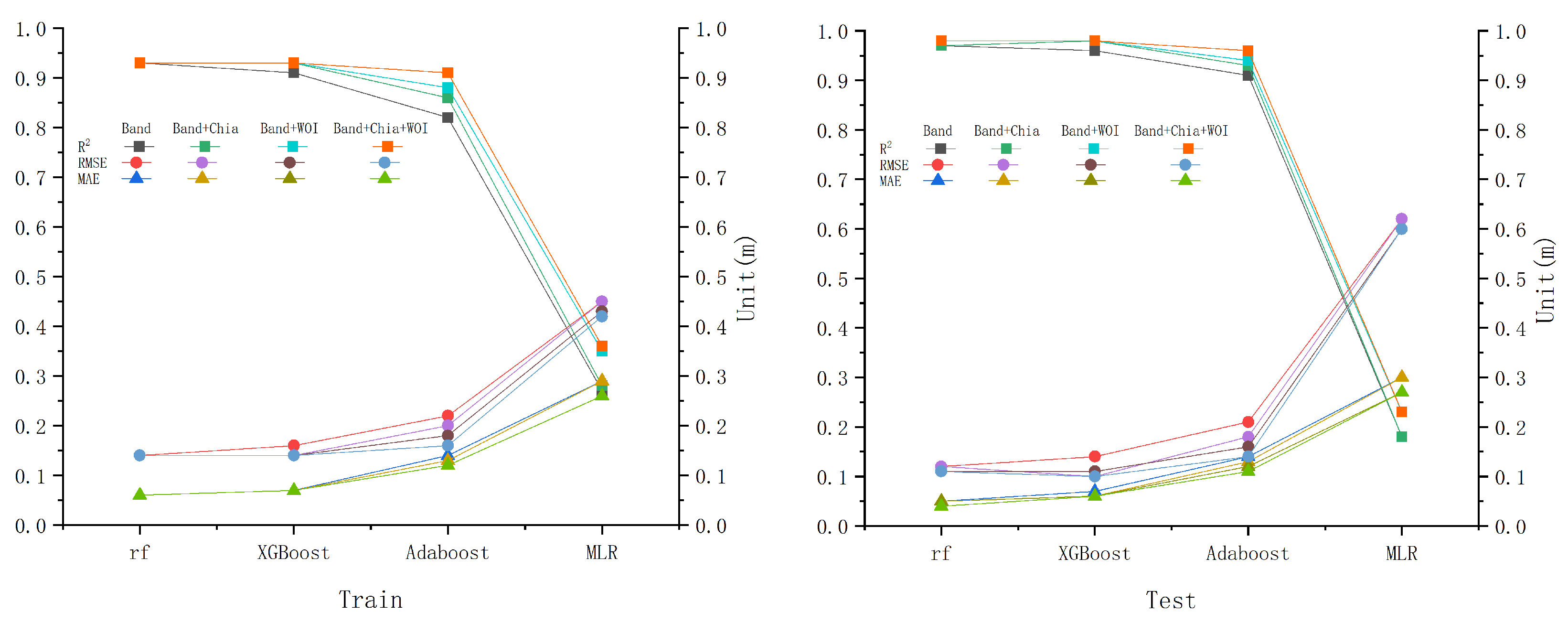
This study further evaluated the effects of Chl-a concentration and Water Optical Indices (WOIs) on bathymetric retrieval performance. As shown in
Table 5 and
Figure 3, the traditional multiband logarithmic ratio model exhibited relatively low accuracy across all input combinations, with test-set
values ranging from 0.27 to 0.36 and RMSE values ranging from 0.42 to 0.45 m. In contrast, the machine learning models showed greater responsiveness to the incorporation of Chl-a concentration and WOIs. Among them, the AdaBoost model exhibited the most pronounced improvement, with the test-set
increasing from 0.82 to 0.91 and the RMSE decreasing from 0.22 m to 0.16 m. The XGBoost model also benefited from the additional features, maintaining a high level of accuracy with
and
m. The Random Forest model achieved the best overall performance and robustness, consistently yielding a test-set
of 0.93 and an RMSE of 0.14 m. Overall, the integration of Chl-a concentration and WOIs contributed to improved retrieval accuracy and enhanced the ability of the models to characterize optically complex inland waters, demonstrating the value of combining water-quality information with optical features for bathymetric retrieval.
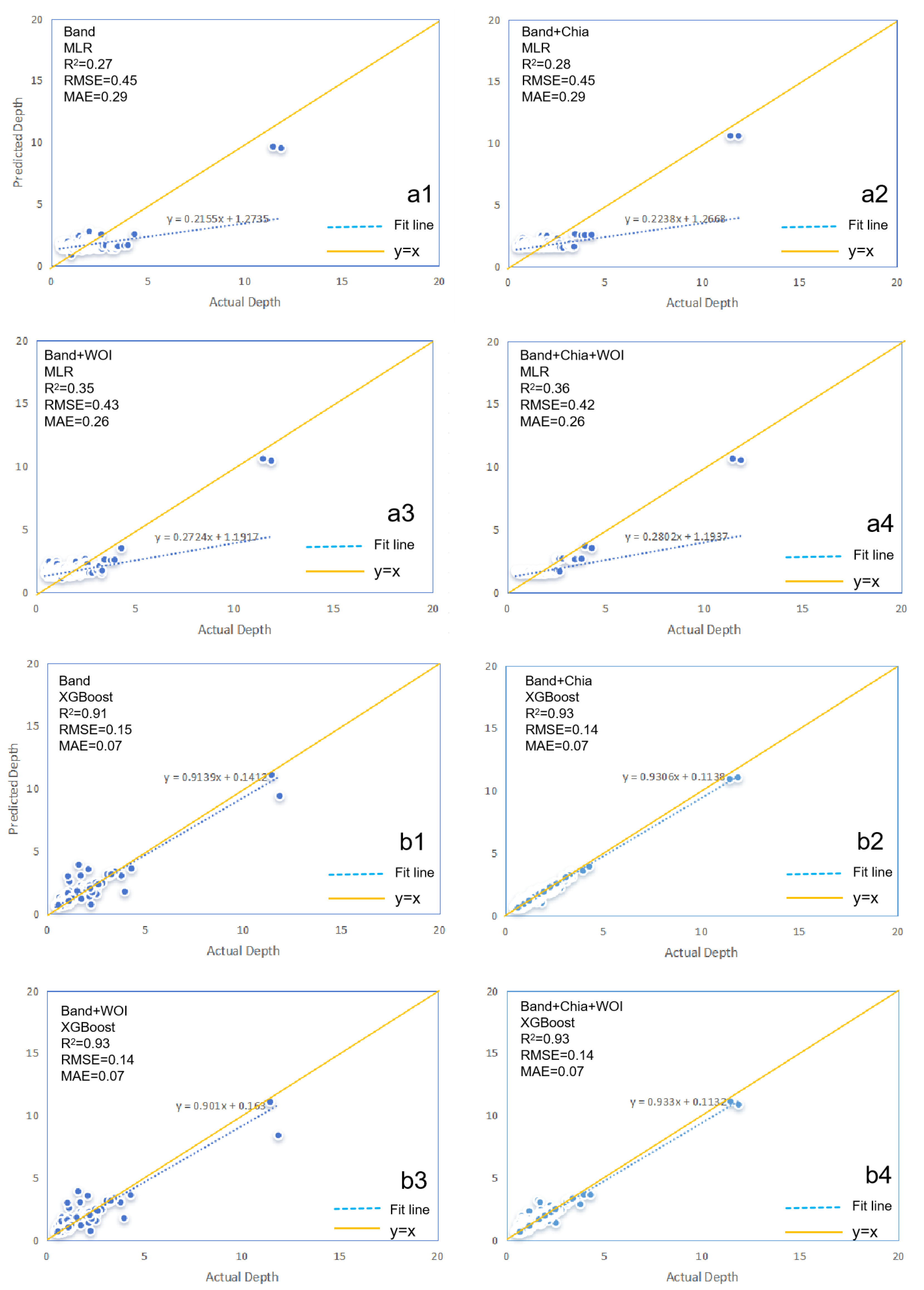
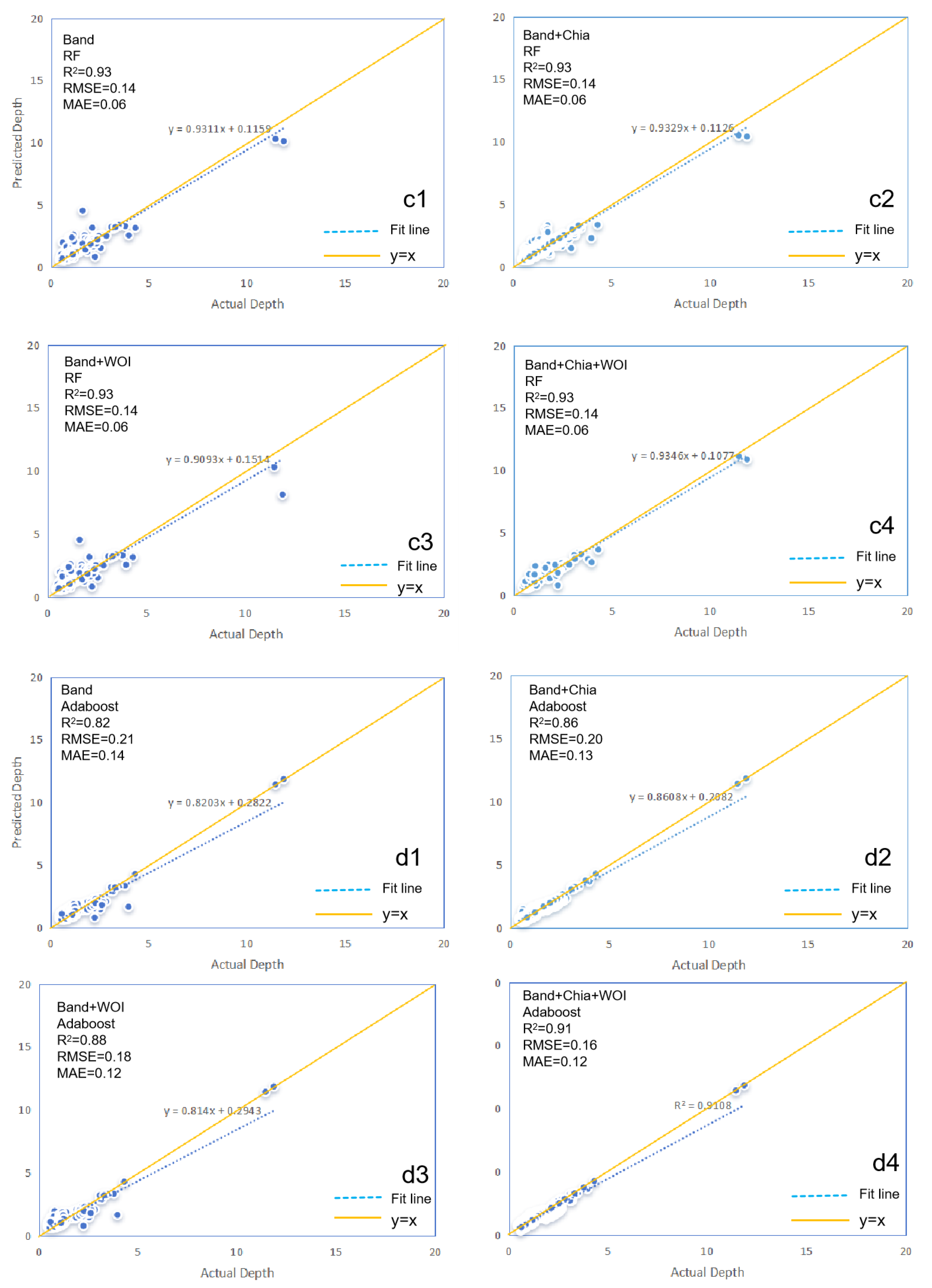
To further evaluate the effects of feature optimization on model performance, scatter plots comparing predicted and observed water depths for the test set were generated for each model (
Figure 4).
Figure 4(a1–a4) correspond to the multiband logarithmic ratio model using the Band, Band + Chl-a, Band + WOI, and Band + Chl-a + WOI input schemes, respectively. The same arrangement is adopted for the AdaBoost and XGBoost models shown in panels (b) and (c).
As shown in
Figure 4, the multiband logarithmic ratio model exhibited relatively poor performance under all input combinations, with test-set
values ranging from 0.27 to 0.36. The fitted regression lines deviated substantially from the
line, indicating limited capability to capture the nonlinear relationships between spectral information and water depth in optically complex inland waters. In contrast, the machine learning models achieved considerably higher accuracy and showed different responses to feature enhancement. Using only spectral bands as inputs, AdaBoost achieved a test-set
of 0.82, although noticeable deviations from the
line remained, particularly in shallow-water areas. The incorporation of Chl-a increased the test-set
to 0.86 and reduced the discrepancy between predicted and observed values. Further inclusion of WOIs improved the test-set
to 0.91 and reduced the RMSE to 0.16 m, suggesting that Chl-a and WOIs effectively enhance the model’s ability to characterize water-depth variability across different depth ranges. XGBoost achieved high accuracy even when using only spectral bands (
). After incorporating Chl-a and WOIs, the model maintained a test-set
of 0.93 while exhibiting a more concentrated distribution of prediction points, particularly in deeper-water regions, indicating improved representation of bathymetric variability. Among all models, Random Forest demonstrated the highest stability, consistently maintaining a test-set
of 0.93 across all input combinations. The inclusion of Chl-a and WOIs further reduced prediction errors, improved the agreement between the fitted regression line and the
line, and resulted in a more uniform distribution of predictions within the 0–5 m depth range.
Overall, all three machine learning models exhibited systematic prediction bias in shallow-water areas, characterized by underestimation at greater depths and slight overestimation in very shallow regions. The incorporation of Chl-a and WOIs effectively reduced these biases and improved model robustness. In terms of overall performance, XGBoost achieved the highest predictive accuracy, particularly in deeper-water areas, whereas Random Forest exhibited the greatest stability across different feature combinations. These results highlight the advantages of integrating water-quality and optical features into machine learning frameworks and demonstrate the suitability of Random Forest and XGBoost for bathymetric retrieval in optically complex inland lakes.
4.2. Bathymetric Inversion Results of Yuehai Lake
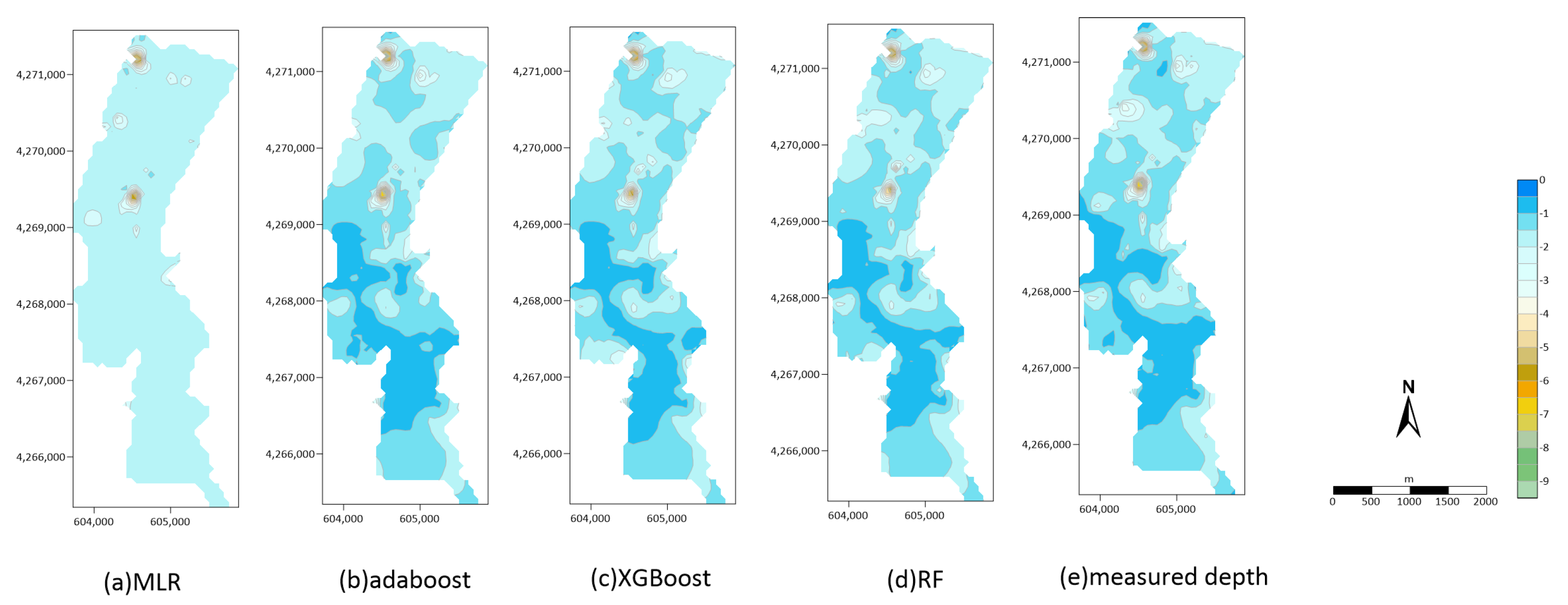
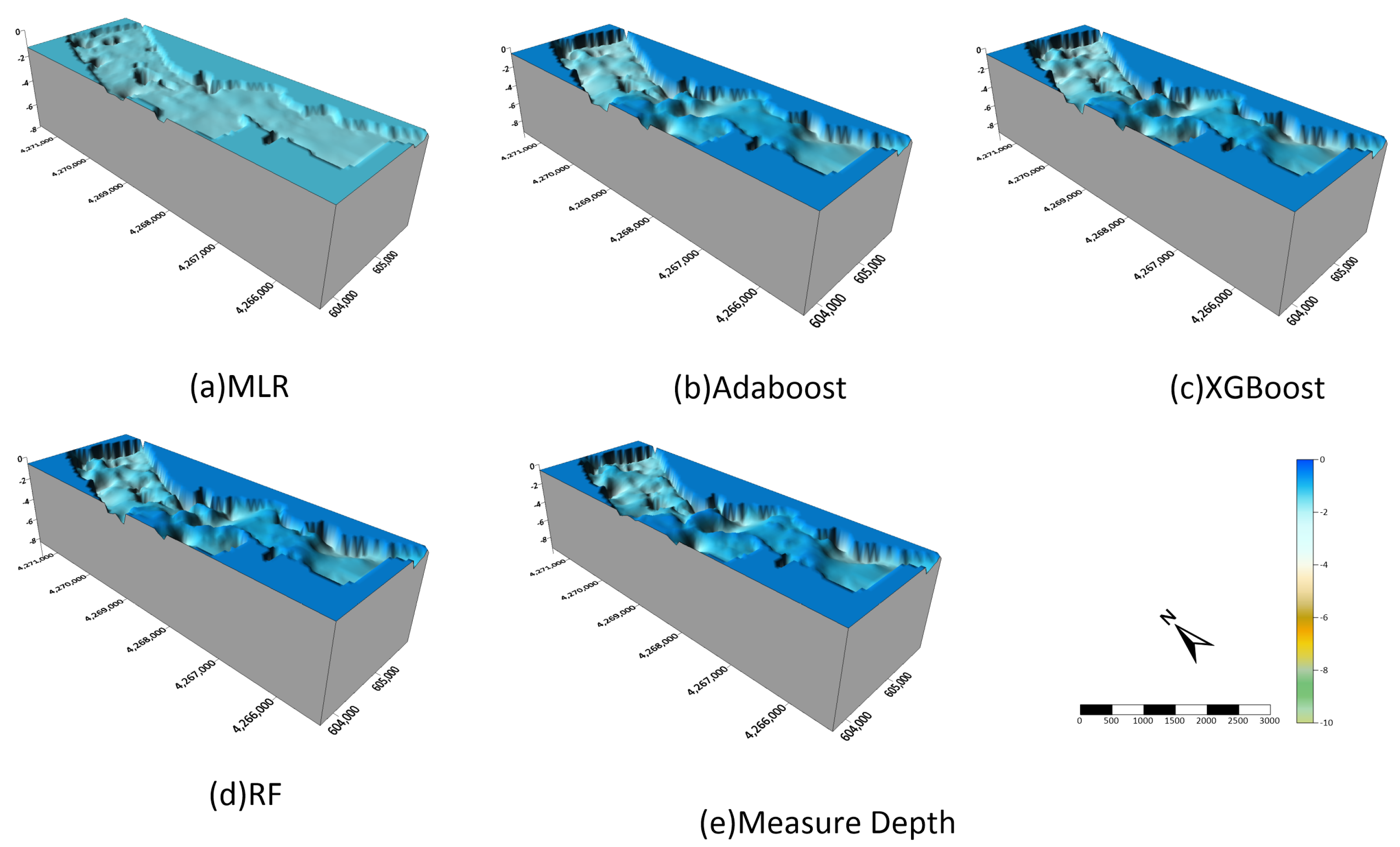
A 2D bathymetric map of Yuehai Lake with a spatial resolution of 30 m was generated using the Band+WOI+Chl-a retrieval framework (
Figure 5) and visualized using a gradient color scheme. Water depth was classified into eight continuous intervals with 0.5 m increments, ranging from light blue (0–1 m) to dark blue (>5 m), while contour lines at 0.5 m intervals were superimposed to enhance the representation of underwater topographic features. The resulting bathymetric map reveals a distinct spatial pattern characterized by deeper central regions and relatively shallow northern and southern zones. The central deep-water area (water depth > 5 m) is represented by dense, closed contour lines, indicating pronounced depth gradients, whereas the northern shallow-water region (water depth < 2 m) occupies approximately 40% of the lake area and exhibits relatively uniform depth distribution with widely spaced contours, reflecting a gently varying underwater terrain.
At the local scale, the bathymetric map successfully captures several representative geomorphological features, including multiple isolated deep depressions in the central lake area, a ridge-like topographic structure extending in a northwest–southeast direction in the northern region, and several small depressions distributed throughout the eastern section of the lake. These features demonstrate the ability of the proposed retrieval framework to characterize spatial heterogeneity in underwater topography. Furthermore, the spatial distribution of water depth exhibits a clear correspondence with the retrieved Chl-a patterns. Areas with greater water depth generally coincide with relatively low Chl-a concentrations, whereas shallower regions tend to correspond to comparatively higher Chl-a concentrations. This spatial consistency suggests that incorporating Chl-a information contributes to improved characterization of optically complex water environments and supports the effectiveness of the synergistic retrieval framework.
Although a certain degree of terrain smoothing remains evident in areas with abrupt depth variations, and uncertainties associated with aquatic vegetation may affect retrieval accuracy in some shallow-water regions, the overall bathymetric map shows good agreement with field measurements. Combined with the achieved retrieval accuracy ( m), the results demonstrate that the proposed framework can provide reliable bathymetric information for lake hydrological analysis, underwater terrain characterization, and water resource assessment.