Intra-Rater and Test–Retest Reliability of Kinovea for the Kinematic Analysis of Squatting in Healthy Active Women

 , , , ,
  ,
,
Abstract
1. Introduction
2. Materials and Methods
2.1. Study Type and Methods
2.2. Participants
2.3. Sample Size Calculation
2.4. Outcome Variables and Instrumentation
- Position 1 (P1): the subjects’ position with the bar behind the neck (upper trapezius), immediately before beginning the knee flexion.
- Position 2 (P2): position of maximum knee flexion for each subject (“maximum squat”), without pain and without lifting the heels off the ground.
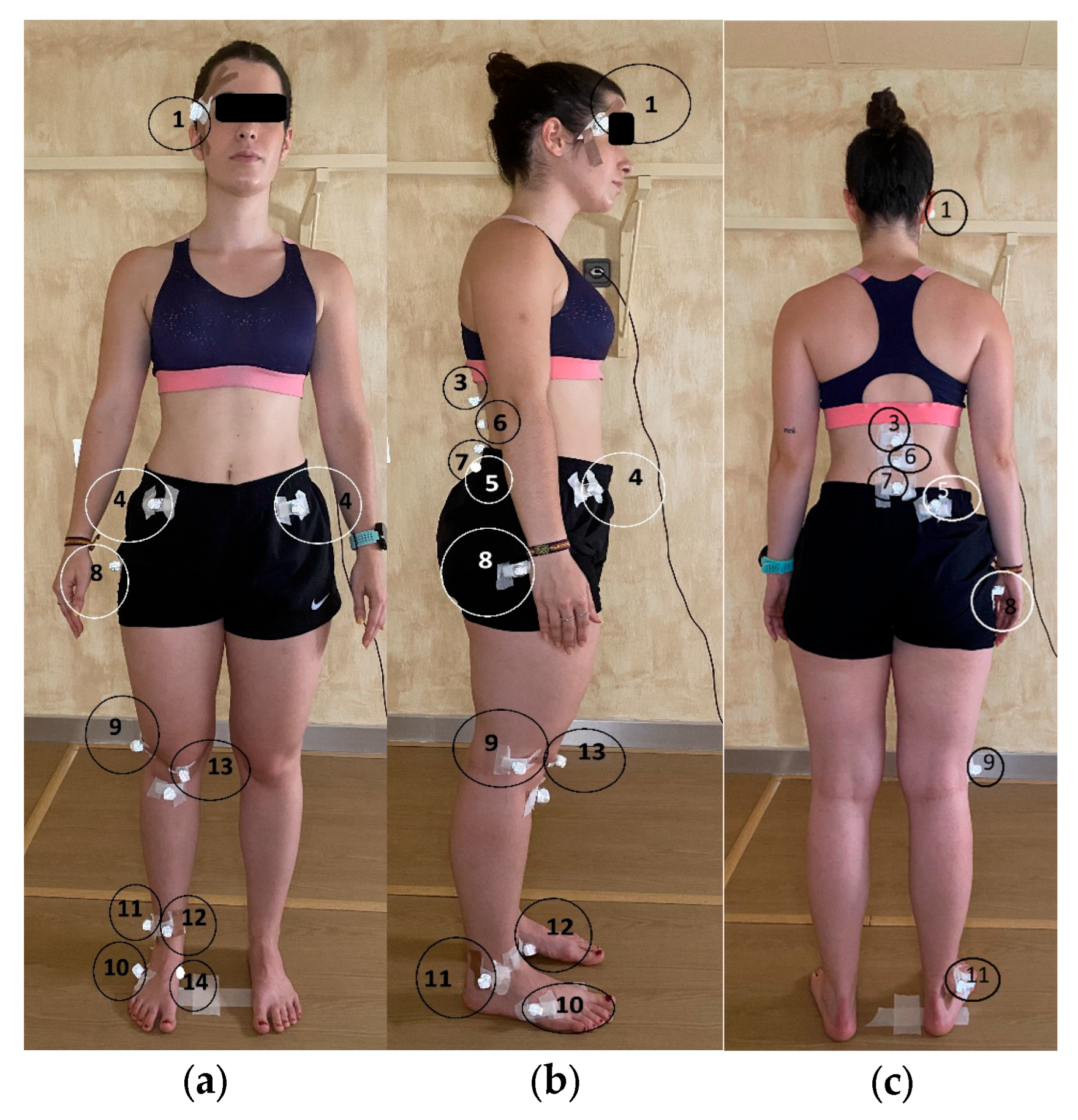
- Lateral aspect of the temple (extension of the right orbital line) (1);
- Visible end of the squat bar (2);
- Tip of the spinous process of T12 (3);
- On clothing, over the left and right anterior superior iliac spines (ASIS) (4);
- On clothing, over the right posterior superior iliac spine (PSIS) (5);
- Tip of the spinous process of L3 (6);
- Tip of the spinous process of S1 (7);
- On the clothing at the level of the greater trochanter of the right femur (8);
- On the lateral epicondyle of the right femur (9);
- On the styloid process of the fifth metatarsal of the right foot (10);
- At the anatomical center of the lateral malleolus of the right ankle (11);
- Midpoint between the tibial and fibular malleoli of the right leg (12);
- At the anatomical center of the right patella (13);
- On the tubercle of the scaphoid bone of the right foot (14).
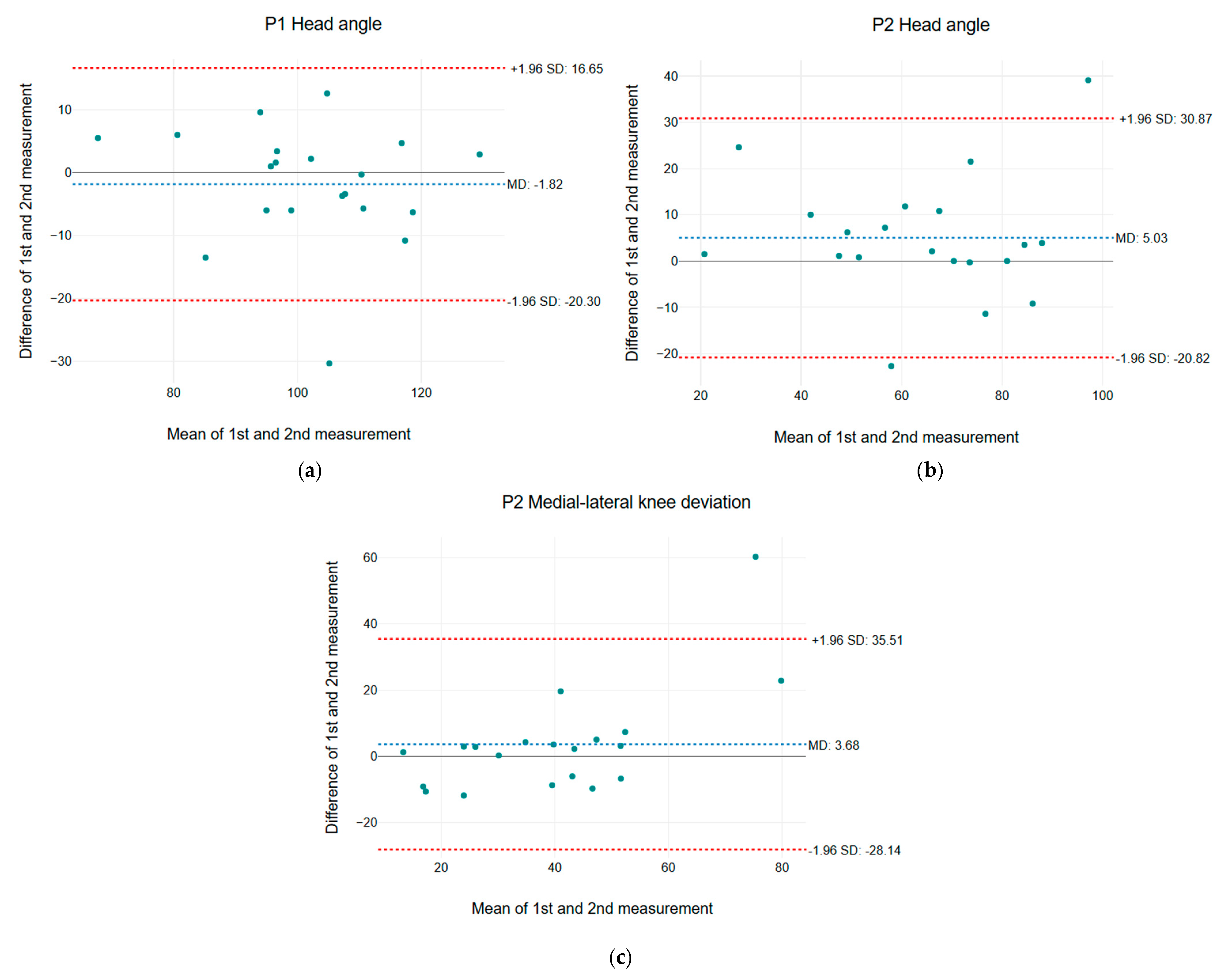
- Head angle: this measurement was used to observe the behavior of the head and cervical spine. The angle was formed between a vertical line originating from marker 2 (the end of the squat bar viewed from a sagittal plane) and a line connecting to marker 1 (placed on the extension of the eye on the side being examined) [29]. If the angle increased compared to the initial measurement, the subject had altered their cervical position towards flexion, whereas if the angle decreased, the change in the position of the cervical spine was towards extension.
- Lumbar lordosis: this angle measured any change in the curvature of the lumbar spine during the squat. For this measurement, the angle obtained between the line of the T12-L3 markers (markers 3 and 6) and the L3-S1 line (markers 6 and 7) was calculated, with L3 (marker 6) as the vertex of the angle. If the angle of the lumbar spine increased, the subject performed a spinal flexion; whereas, if it decreased, the subject had extended the lumbar spine [36].
- Horizontal pelvic alignment from a sagittal plane: this was measured using the pelvic horizontal alignment (PHA) parameter, the angle formed between the line joining the anterior superior iliac spine (ASIS—marker 4) (vertex of the angle) and the posterior superior iliac spine (PSIS—marker 5) and a horizontal line parallel to the floor [37,38]. An increase in this value compared to the baseline measurement indicated that the pelvis had shifted towards anteversion, whilst a decrease indicated pelvic retroversion [37].
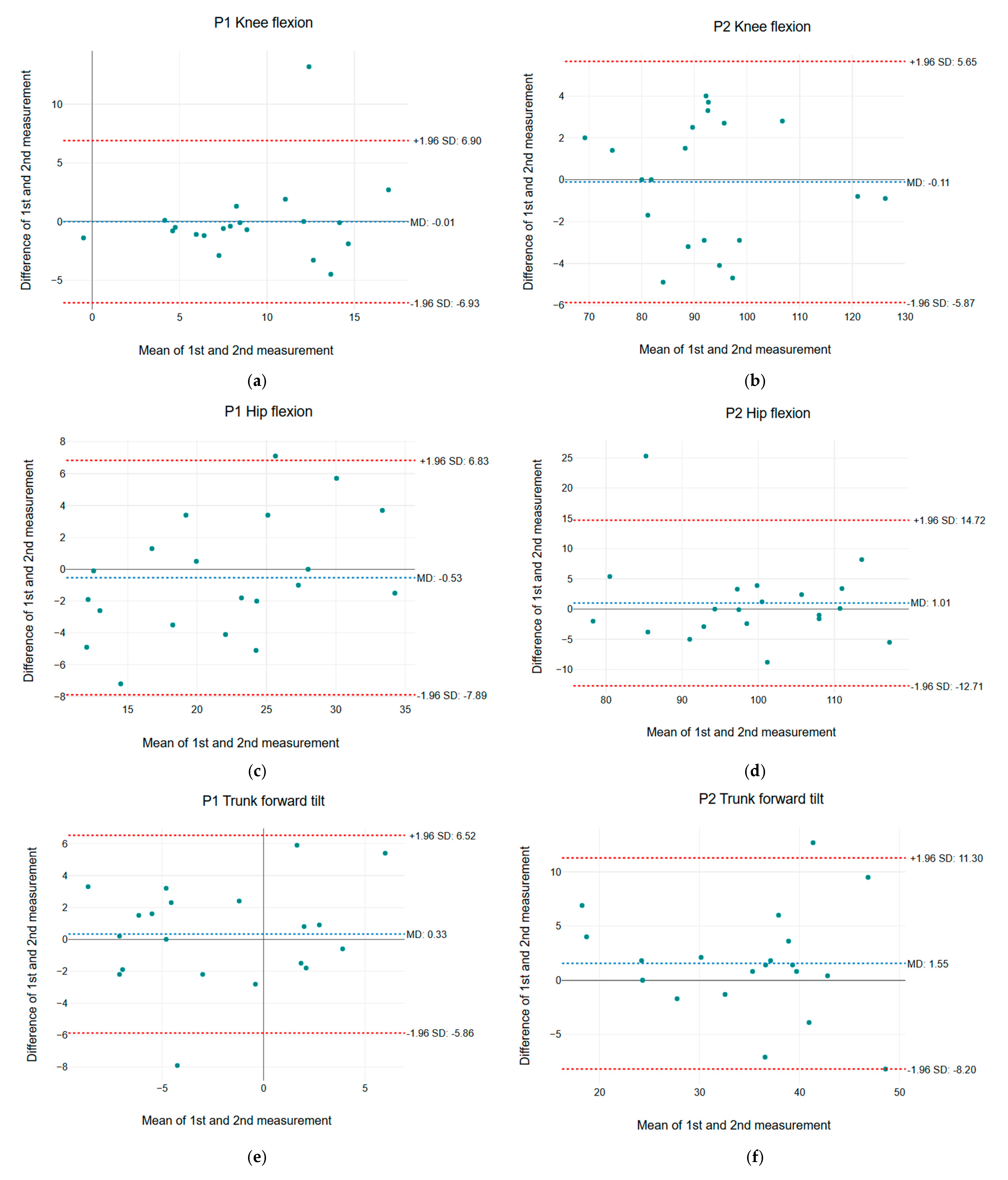
- Trunk forward tilt: this measurement was used to quantify the degree of forward trunk tilt for each subject relative to a line perpendicular to the ceiling. This was measured using marker 8, positioned on the greater trochanter of the femur, which acts as the vertex of the angle, marker 2, at the end of the squat bar, and a vertical line to the ceiling. If the angle increased compared to the initial measurement, this indicated that the subject had produced a trunk flexion [18,29]. Negative values at P1 indicate a slight posterior trunk lean relative to the vertical.
- Hip flexion relative to the ASIS: this value quantified the amount of hip flexion produced during the squat. The angle formed between a perpendicular line (angle in green in Table 1) passing through the line connecting the ASIS (marker 4) and the PSIS (marker 5) and the line passing through the greater trochanter (marker 8) and the lateral epicondyle of the femur (marker 9) (angle shown in yellow in Table 1). Each of the markers was positioned at these anatomical landmarks [39].
- Knee flexion: this value indicated the joint position of the knee during the squat in a sagittal view. The angle was measured between the extension of a line originating from marker 9, placed on the lateral epicondyle of the femur (vertex of the angle) and passing through marker 8 on the greater trochanter of the femur, and another line originating from the marker placed at the vertex and passing through marker 12 on the lateral malleolus of the ankle [29,39]. The measurement of this angle was key to establishing P2 during video analysis.
- Ankle flexion: this value indicated the angular change produced during the squat at the ankle. The measurement was taken as the angle formed between the lines connecting marker 9, located at the lateral epicondyle of the knee, and marker 12 on the lateral malleolus of the ankle, and marker 10 on the styloid process of the fifth metatarsal and marker 12 on the lateral malleolus of the ankle [18]. The smaller this angle, the greater the ankle dorsiflexion.
- Medial-lateral knee deviation: the angle was measured formed by the intersection of the line between ASIS (marker 4) and marker 13 at the center of the patella (vertex of the angle) and the line between marker 13 at the center of the patella and marker 12 at the midpoint between the two malleoli of the ankle. If the value of this angle was negative, knee valgus was observed, whereas if the angle was positive, the knee had shifted towards varus [40,41].
- Horizontal alignment of the pelvis from a frontal plane: this measurement indicated whether the subject was able to maintain symmetry in the frontal plane between both hemipelvis. A line parallel to the floor was drawn from marker 4 located on the right ASIS, and from there another line connecting the left ASIS. The angle between these two lines was taken as an absolute value, regardless of whether it was positive or negative in the image, as it was not possible to distinguish whether the asymmetry originated from one hemipelvis or the other. The greater the angular value, the greater the pelvic asymmetry in the frontal plane.
- Foot pronosupination: To quantify this variable, a test known as the navicular drop was used [42]. This involves measuring the distance from marker 14 on the tubercle of the scaphoid to the ground [43]. If the distance from the marker to the ground decreased during movement, this indicated a drop in the plantar arch and, consequently, foot pronation. If there had been an increase in this distance, the foot had shifted into supination.
2.5. Procedures
2.6. Statistical Analysis
3. Results
4. Discussion
Study Limitations
5. Conclusions
Author Contributions
Funding
Institutional Review Board Statement
Informed Consent Statement
Data Availability Statement
Acknowledgments
Conflicts of Interest
Abbreviations
| P1 | Position 1 |
| P2 | Position 2 |
| ICC | Intraclass Correlation Coefficient |
| IC | Confidence interval |
| SEM | Standard error of measurement |
| MDC | Minimal Detectable Change |
| LoA | Limits of Agreement |
| BMI | Body Mass Index |
| PHA | Horizontal Pelvic Alignment |
| ASIS | Anterior Superior Iliac Spine |
| PSIS | Posterior Superior Iliac Spine |
| ND | Navicular Drop |
| SD | Standard Deviation |
References
- Escamilla, R.F.; Krzyzewski, M.W. Knee Biomechanics of the Dynamic Squat Exercise. Med. Sci. Sports Exerc. 2001, 33, 127–141. [Google Scholar] [CrossRef] [PubMed]
- Myer, G.D.; Kushner, A.M.; Brent, J.L.; Schoenfeld, B.J.; Hugentobler, J.; Lloyd, R.S.; Vermeil, A.; Chu, D.A.; Harbin, J.; McGill, S.M. The Back Squat: A Proposed Assessment of Functional Deficits and Technical Factors That Limit Performance. Strength Cond. J. 2014, 36, 4–27. [Google Scholar] [CrossRef]
- Simão, A.P.; Avelar, N.C.; Tossige-Gomes, R.; Neves, C.D.; Mendonça, V.A.; Miranda, A.S.; Teixeira, M.M.; Teixeira, A.L.; Andrade, A.P.; Coimbra, C.C.; et al. Functional Performance and Inflammatory Cytokines after Squat Exercises and Whole-Body Vibration in Elderly Individuals with Knee Osteoarthritis. Arch. Phys. Med. Rehabil. 2012, 93, 1692–1700. [Google Scholar] [CrossRef]
- McKean, M.R.; Dunn, P.K.; Burkett, B.J. Quantifying the Movement and the Influence of Load in the Back Squat Exercise. J. Strength Cond. Res. 2010, 24, 1671–1679. [Google Scholar] [CrossRef] [PubMed]
- Yanagisawa, O.; Oshikawa, T.; Adachi, G.; Matsunaga, N.; Kaneoka, K. Acute Effects of Varying Squat Depths on Lumbar Intervertebral Disks during High-Load Barbell Back Squat Exercise. Scand. J. Med. Sci. Sports 2021, 31, 350–357. [Google Scholar] [CrossRef]
- Pangan, A.M.; Leineweber, M. Footwear and Elevated Heel Influence on Barbell Back Squat: A Review. J. Biomech. Eng. 2021, 143, 090801. [Google Scholar] [CrossRef] [PubMed]
- Osorio Ciro, J.A.; Clavijo Rodriguez, M.P.; Arango, E.; Patiño Giraldo, S.; Gallego Ching, I.C. Lesiones Deportivas. Iatreia 2007, 20, 167–177. [Google Scholar] [CrossRef]
- Schoenfeld, B.J. Squatting Kinematics and Kinetics and Their Application to Exercise Performance. J. Strength Cond. Res. 2010, 24, 3497–3506. [Google Scholar] [CrossRef]
- Glassbrook, D.J.; Helms, E.R.; Brown, S.R.; Storey, A.G. A Review of the Biomechanical Differences Between the High-Bar and Low-Bar Back-Squat. J. Strength Cond. Res. 2017, 31, 2618–2634. [Google Scholar] [CrossRef]
- Dionisio, V.C.; Almeida, G.L.; Duarte, M.; Hirata, R.P. Kinematic, Kinetic and EMG Patterns during Downward Squatting. J. Electromyogr. Kinesiol. 2008, 18, 134–143. [Google Scholar] [CrossRef]
- Maudrich, T.; Tapper, P.; Clauß, M.; Falz, R.; Lässing, J.; Kenville, R. Motor Control Strategies Differ between Monoarticular and Biarticular Quadriceps Muscles during Bipedal Squats. Scand. J. Med. Sci. Sports 2022, 32, 1569–1580. [Google Scholar] [CrossRef]
- Kenville, R.; Maudrich, T.; Vidaurre, C.; Maudrich, D.; Villringer, A.; Nikulin, V.V.; Ragert, P. Corticomuscular Interactions during Different Movement Periods in a Multi-Joint Compound Movement. Sci. Rep. 2020, 10, 5021. [Google Scholar] [CrossRef]
- Zawadka, M.; Smolka, J.; Skublewska-Paszkowska, M.; Lukasik, E.; Bys, A.; Zielinski, G.; Gawda, P. Sex-Dependent Differences in Single-Leg Squat Kinematics and Their Relationship to Squat Depth in Physically Active Individuals. Sci. Rep. 2020, 10, 19601. [Google Scholar] [CrossRef]
- Buchman-Pearle, J.M.; Kingston, D.C.; Acker, S.M. Lower Limb Movement Pattern Differences Between Males and Females in Squatting and Kneeling. J. Appl. Biomech. 2021, 37, 204–221. [Google Scholar] [CrossRef] [PubMed]
- Graci, V.; Van Dillen, L.R.; Salsich, G.B. Gender Differences in Trunk, Pelvis and Lower Limb Kinematics during a Single Leg Squat. Gait Posture 2012, 36, 461–466. [Google Scholar] [CrossRef] [PubMed]
- Barrett, K.B.; Sievert, Z.A.; Bennett, H.J. A Comparison of Squat Depth and Sex on Knee Kinematics and Muscle Activation. J. Biomech. Eng. 2023, 145, 071010. [Google Scholar] [CrossRef]
- Zawadka, M.; Smolka, J.; Skublewska-Paszkowska, M.; Lukasik, E.; Gawda, P. Effect of Limited Ankle Dorsiflexion on Lower Limbs and Trunk Kinematics During Squatting. J. Manip. Physiol. Ther. 2025, 48, 395–403. [Google Scholar] [CrossRef]
- Fuglsang, E.I.; Telling, A.S.; Sørensen, H. Effect of Ankle Mobility and Segment Ratios on Trunk Lean in the Barbell Back Squat. J. Strength Cond. Res. 2017, 31, 3024–3033. [Google Scholar] [CrossRef]
- Maruyama, S.; Sekine, C.; Shagawa, M.; Yokota, H.; Hirabayashi, R.; Togashi, R.; Yamada, Y.; Hamano, R.; Ito, A.; Sato, D.; et al. Menstrual Cycle Changes Joint Laxity in Females-Differences between Eumenorrhea and Oligomenorrhea. J. Clin. Med. 2022, 11, 3222. [Google Scholar] [CrossRef]
- Shagawa, M.; Maruyama, S.; Sekine, C.; Yokota, H.; Hirabayashi, R.; Hirata, A.; Yokoyama, M.; Edama, M. Comparison of Anterior Knee Laxity, Stiffness, Genu Recurvatum, and General Joint Laxity in the Late Follicular Phase and the Ovulatory Phase of the Menstrual Cycle. BMC Musculoskelet. Disord. 2021, 22, 886. [Google Scholar] [CrossRef] [PubMed]
- van den Tillaar, R.; Fredriksen, A.B.; Gundersen, A.H.; Falch, H.N. Sex Differences in Intra-Set Kinematics and Electromyography during Different Maximum Repetition Sets in the Barbell Back Squat? PLoS ONE 2024, 19, e0308344. [Google Scholar] [CrossRef]
- Elliott-Sale, K.J.; Minahan, C.L.; de Jonge, X.A.K.J.; Ackerman, K.E.; Sipilä, S.; Constantini, N.W.; Lebrun, C.M.; Hackney, A.C. Methodological Considerations for Studies in Sport and Exercise Science with Women as Participants: A Working Guide for Standards of Practice for Research on Women. Sports Med. 2021, 51, 843–861. [Google Scholar] [CrossRef]
- Flores, V.; Becker, J.; Burkhardt, E.; Cotter, J. Knee Kinetics During Squats of Varying Loads and Depths in Recreationally Trained Women. J. Strength Cond. Res. 2020, 34, 1945–1952. [Google Scholar] [CrossRef]
- Goodman, W.; Flores, V.; Cotter, J.A.; Graham, D.; Becker, J. Support Moment Distribution during the Back Squat at Different Depths and Loads in Recreationally Trained Females. J. Sci. Med. Sport 2024, 27, 119–124. [Google Scholar] [CrossRef] [PubMed]
- Goodman, W.W.; Helms, E.; Graham, D.F. Individual Muscle Contributions to the Acceleration of the Center of Mass During the Barbell Back Squat in Trained Female Subjects. J. Strength Cond. Res. 2023, 37, 1947–1954. [Google Scholar] [CrossRef] [PubMed]
- Wei, W.; Zhu, J.X.; Ren, S.; Jan, Y.K.; Zhang, W.L.; Su, R.; He, L. Effects of Progressive Body-Weight versus Barbell Back Squat Training on Strength, Hypertrophy and Body Fat among Sedentary Young Women. Sci. Rep. 2023, 13, 13505. [Google Scholar] [CrossRef] [PubMed]
- Zavala, L.; Flores, V.; Cotter, J.A.; Becker, J. Patellofemoral Joint Kinetics in Females When Using Different Depths and Loads during the Barbell Back Squat. Eur. J. Sport Sci. 2021, 21, 976–984. [Google Scholar] [CrossRef]
- Schurr, S.A.; Marshall, A.N.; Resch, J.E.; Saliba, S.A. Two-dimensional video analysis is comparable to 3d motion capture in lower extremity movement assessment. Int. J. Sports Phys. Ther. 2017, 12, 163. [Google Scholar]
- Donnelly, D.V.; Berg, W.P.; Fiske, D.M. The Effect of the Direction of Gaze on the Kinematics of the Squat Exercise. J. Strength Cond. Res. 2006, 20, 145–150. [Google Scholar] [CrossRef]
- Walter, S.D.; Eliasziw, M.; Donner, A. Sample Size and Optimal Designs for Reliability Studies. Stat. Med. 1998, 17, 101–110. [Google Scholar] [CrossRef]
- Vicente-Pina, L.; Sánchez-Rodríguez, R.; Ferrández-Laliena, L.; Heredia-Jimenez, J.; Müller-Thyssen-Uriarte, J.; Monti-Ballano, S.; Hidalgo-García, C.; Tricás-Moreno, J.M.; Lucha-López, M.O. Validity and Reliability of Kinovea® for Pelvic Kinematic Measurement in Standing Position and in Sitting Position with 45° of Hip Flexion. Sensors 2025, 25, 250. [Google Scholar] [CrossRef]
- Fernández-González, P.; Koutsou, A.; Cuesta-Gómez, A.; Carratalá-Tejada, M.; Miangolarra-Page, J.C.; Molina-Rueda, F. Reliability of Kinovea® Software and Agreement with a Three-Dimensional Motion System for Gait Analysis in Healthy Subjects. Sensors 2020, 20, 3154. [Google Scholar] [CrossRef]
- Weir, C.B.; Jan, A. BMI Classification Percentile and Cut Off Points; StatPearls Publishing: Treasure Island, FL, USA, 2019; p. NBK541070. [Google Scholar]
- Needham, L.; Evans, M.; Cosker, D.P.; Wade, L.; McGuigan, P.M.; Bilzon, J.L.; Colyer, S.L. The Accuracy of Several Pose Estimation Methods for 3D Joint Centre Localisation. Sci. Rep. 2021, 11, 20673. [Google Scholar] [CrossRef]
- List, R.; Gülay, T.; Stoop, M.; Lorenzetti, S. Kinematics of the Trunk and the Lower Extremities during Restricted and Unrestricted Squats. J. Strength Cond. Res. 2013, 27, 1529–1538. [Google Scholar] [CrossRef] [PubMed]
- Oshikawa, T.; Morimoto, Y.; Kaneoka, K. Lumbar Lordosis Angle and Trunk and Lower-Limb Electromyographic Activity Comparison in Hip Neutral Position and External Rotation during Back Squats. J. Phys. Ther. Sci. 2018, 30, 434–438. [Google Scholar] [CrossRef] [PubMed][Green Version]
- Krawczky, B.; Pacheco, A.G.; Mainenti, M.R.M. A Systematic Review of the Angular Values Obtained by Computerized Photogrammetry in Sagittal Plane: A Proposal for Reference Values. J. Manip. Physiol. Ther. 2014, 37, 269–275. [Google Scholar] [CrossRef]
- Christie, H.J.; Kumar, S.; Warren, S.A. Postural Aberrations in Low Back Pain. Arch. Phys. Med. Rehabil. 1995, 76, 218–224. [Google Scholar] [CrossRef]
- Endo, Y.; Miura, M.; Sakamoto, M. The Relationship between the Deep Squat Movement and the Hip, Knee and Ankle Range of Motion and Muscle Strength. J. Phys. Ther. Sci. 2020, 32, 391–394. [Google Scholar] [CrossRef]
- Coelho, B.A.L.; das Neves Rodrigues, H.L.; Almeida, G.P.L.; João, S.M.A. Immediate Effect of Ankle Mobilization on Range of Motion, Dynamic Knee Valgus, and Knee Pain in Women with Patellofemoral Pain and Ankle Dorsiflexion Restriction: A Randomized Controlled Trial with 48-Hour Follow-Up. J. Sport Rehabil. 2021, 30, 697–706. [Google Scholar] [CrossRef] [PubMed]
- Kingston, B.; Murray, A.; Norte, G.E.; Glaviano, N.R. Validity and Reliability of 2-Dimensional Trunk, Hip, and Knee Frontal Plane Kinematics during Single-Leg Squat, Drop Jump, and Single-Leg Hop in Females with Patellofemoral Pain. Phys. Ther. Sport 2020, 45, 172–179. [Google Scholar] [CrossRef]
- Brody, D.M. Techniques in the Evaluation and Treatment of the Injured Runner. Orthop. Clin. N. Am. 1982, 13, 541–558. [Google Scholar] [CrossRef]
- Fukumoto, Y.; Asai, T.; Ichikawa, M.; Kusumi, H.; Kubo, H.; Oka, T.; Kasuya, A. Navicular Drop Is Negatively Associated with Flexor Hallucis Brevis Thickness in Community-Dwelling Older Adults. Gait Posture 2020, 78, 30–34. [Google Scholar] [CrossRef]
- Mehta, S.; Bastero-Caballero, R.F.; Sun, Y.; Zhu, R.; Murphy, D.K.; Hardas, B.; Koch, G. Performance of Intraclass Correlation Coefficient (ICC) as a Reliability Index under Various Distributions in Scale Reliability Studies. Stat. Med. 2018, 37, 2734–2752. [Google Scholar] [CrossRef] [PubMed]
- Koo, T.K.; Li, M.Y. A Guideline of Selecting and Reporting Intraclass Correlation Coefficients for Reliability Research. J. Chiropr. Med. Correction in J. Chiropr. Med. 2017, 16, 346. https://doi.org/10.1016/j.jcm.2017.10.001. 2016, 15, 155–163. [Google Scholar] [CrossRef] [PubMed]
- Mier, C.M.; Shapiro, B.S. Reliability of a Computer Software Angle Tool for Measuring Spine and Pelvic Flexibility during the Sit-and-Reach Test. J. Strength Cond. Res. 2013, 27, 501–506. [Google Scholar] [CrossRef]
- Yodchaisarn, W.; Rungruangbaiyok, S.; de Lourdes Pereira, M.; Rungruangbaiyok, C. Inter-Rater and Test-Retest Reliabilities of Lumbar Stiffness Measurement in the Postero-Anterior Direction Using a Portable Algometer and the Kinovea Program. PeerJ 2023, 11, e16148. [Google Scholar] [CrossRef]
- Puig-Diví, A.; Escalona-Marfil, C.; Padullés-Riu, J.M.; Busquets, A.; Padullés-Chando, X.; Marcos-Ruiz, D. Validity and Reliability of the Kinovea Program in Obtaining Angles and Distances Using Coordinates in 4 Perspectives. PLoS ONE 2019, 14, e0216448. [Google Scholar] [CrossRef]
- Buchman-Pearle, J.M.; Acker, S.M. Estimating Soft Tissue Artifact of the Thigh in High Knee Flexion Tasks Using Optical Motion Capture: Implications for Marker Cluster Placement. J. Biomech. 2021, 127, 110659. [Google Scholar] [CrossRef]
- Hara, R.; Sangeux, M.; Baker, R.; McGinley, J. Quantification of Pelvic Soft Tissue Artifact in Multiple Static Positions. Gait Posture 2014, 39, 712–717. [Google Scholar] [CrossRef]
- Prushansky, T.; Ezra, N.; Kurse, N.; Man, L.; Schneiderman, Y. Reproducibility of Sagittal Pelvic Tilt Measurements in Normal Subjects Using Digital Inclinometry. Gait Posture 2008, 28, 513–516. [Google Scholar] [CrossRef]
- Devecchi, V.; Saunders, M.; Galaiya, S.; Shaw, M.; Gallina, A. Remote Assessment of Pelvic Kinematics during Single Leg Squat Using Smartphone Sensors: Between-Day Reliability and Identification of Acute Changes in Motor Performance. PLoS ONE 2023, 18, e0288760. [Google Scholar] [CrossRef]
- Buganè, F.; Benedetti, M.G.; D’Angeli, V.; Leardini, A. Estimation of Pelvis Kinematics in Level Walking Based on a Single Inertial Sensor Positioned Close to the Sacrum: Validation on Healthy Subjects with Stereophotogrammetric System. Biomed. Eng. Online 2014, 13, 146. [Google Scholar] [CrossRef]
- Bolink, S.A.A.N.; Naisas, H.; Senden, R.; Essers, H.; Heyligers, I.C.; Meijer, K.; Grimm, B. Validity of an Inertial Measurement Unit to Assess Pelvic Orientation Angles during Gait, Sit-Stand Transfers and Step-up Transfers: Comparison with an Optoelectronic Motion Capture System. Med. Eng. Phys. 2016, 38, 225–231. [Google Scholar] [CrossRef]
- Lim, J.; Hamill, J.; Busa, M.A.; van Emmerik, R.E.A. Changes in Coordination and Variability during Running as a Function of Head Stability Demands. Hum. Mov. Sci. 2020, 73, 102673. [Google Scholar] [CrossRef]
- Sklavos, S.; Anastasopoulos, D.; Bronstein, A. Kinematic Redundancy and Variance of Eye, Head and Trunk Displacements during Large Horizontal Gaze Reorientations in Standing Humans. Exp. Brain Res. 2010, 202, 879–890. [Google Scholar] [CrossRef]
- Shishov, N.; Elabd, K.; Komisar, V.; Chong, H.; Robinovitch, S.N. Accuracy of Kinovea Software in Estimating Body Segment Movements during Falls Captured on Standard Video: Effects of Fall Direction, Camera Perspective and Video Calibration Technique. PLoS ONE 2021, 16, e0258923. [Google Scholar] [CrossRef]
- Soylu, C.; Acar, G.; Uzumcu, B.; Demir, P.; Seyhan, S.; Biyikli, T. Test-Retest Reliability and Validity of TecnoBody D-Wall to Assess the Range of Motion During Overhead Squat in Healthy Individuals. Life 2025, 15, 80. [Google Scholar] [CrossRef]
- Lopes, T.J.A.; Ferrari, D.; Ioannidis, J.; Simic, M.; De Azevedo, F.M.; Pappas, E. Reliability and Validity of Frontal Plane Kinematics of the Trunk and Lower Extremity Measured with 2-Dimensional Cameras During Athletic Tasks: A Systematic Review with Meta-Analysis. J. Orthop. Sports Phys. Ther. 2018, 48, 812–822. [Google Scholar] [CrossRef]
- de Ruiter, C.J.; Wilmes, E.; Brouwers, S.A.J.; Jagers, E.C.; van Dieën, J.H. Concurrent Validity of an Easy-to-Use Inertial Measurement Unit-System to Evaluate Sagittal Plane Segment Kinematics during Overground Sprinting at Different Speeds. Sports Biomech. 2024, 23, 2757–2770. [Google Scholar] [CrossRef]
- Teufl, W.; Miezal, M.; Taetz, B.; Frohlichi, M.; Bleser, G. Validity of Inertial Sensor Based 3D Joint Kinematics of Static and Dynamic Sport and Physiotherapy Specific Movements. PLoS ONE 2019, 14, e0213064. [Google Scholar] [CrossRef]
- Kim, A.R.; Park, J.H.; Kim, S.H.; Kim, K.B.; Park, K.N. The Validity of Wireless Earbud-Type Wearable Sensors for Head Angle Estimation and the Relationships of Head with Trunk, Pelvis, Hip, and Knee during Workouts. Sensors 2022, 22, 597. [Google Scholar] [CrossRef]
- Takeda, Y.; Furukawa, K. Clinical Reliability and Usability of Smartphone Goniometers for Hip Range of Motion Measurement. J. Phys. Ther. Sci. 2022, 34, 433–439. [Google Scholar] [CrossRef]




| Variable | Variable | ||||
|---|---|---|---|---|---|
| Head angle |  |  | Knee flexion |  |  |
| Lumbar lordosis |  |  | Ankle flexion | 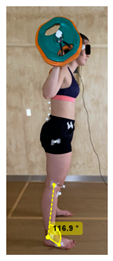 |  |
| Horizontal pelvic alignment from a sagittal plane |  |  | Medial-lateral knee deviation |  |  |
| Trunk forward tilt |  | 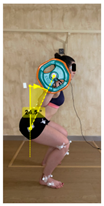 | Horizontal alignment of the pelvis from a frontal plane |  |  |
| Hip flexion relative to the ASIS |  |  | Foot pronosupination |  |  |
| Variable | Position | 1st Measurement (±SD) | 2nd Measurement (±SD) | ICC± (95% CI) | SEM (°, cm) (95% CI) | MDC (°, cm) (95% CI) |
|---|---|---|---|---|---|---|
| Ankle flexion (°) | P1 | 122.76° ± 5.90° | 121.39° ± 5.80° | 0.95 (0.88–0.98) | 1.32° (0.83–2.03°) | 3.66° (2.30–5.62°) |
| P2 | 101.60° ± 9.04° | 101° ± 8.85° | 0.95 (0.87–0.98) | 1.98° (1.27– 3.23°) | 5.48° (3.52–8.95°) | |
| Knee flexion (°) | P1 | 9.05° ± 4.98° | 9.29° ± 4.68° | 0.96 (0.90–0.99) | 0.94° (0.48–1.53°) | 2.60° (1.33–4.24°) |
| P2 | 92.39° ± 13.98° | 90.84° ± 13.42° | 0.98 (0.95–0.99) | 1.90° (1.37–3.06°) | 5.26° (3.79–8.48°) | |
| Hip flexion relative to ASIS (°) | P1 | 22.06° ± 6.33° | 22.76° ± 6.85° | 0.94 (0.85–0.98) | 1.55° (0.93–2.55°) | 4.29° (2.58–7.06°) |
| P2 | 98.35° ± 12.15° | 98.15° ± 12.70° | 0.91 (0.79–0.97) | 3.65° (2.15–5.69°) | 10.11° (5.96–15.76°) | |
| Horizontal pelvic alignment from a sagittal plane (°) | P1 | 19.83° ± 4.93° | 19.71° ± 5.06° | 0.95 (0.89–0.99) | 1.10° (0.50–1.66°) | 3.05° (1.39–4.60°) |
| P2 | 44.67° ± 8.56° | 45.1° ± 9.69° | 0.82 (0.6–0.93) | 3.63° (2.26–4.79) | 10.06° (6.28–13.28) | |
| Trunk forward tilt (°) | P1 | −2.05° ± 4.89° | −2.19° ± 4.80° | 0.99 (0.99–0.99) | 0.49° (0.15–0.49°) | 1.36° (0.42–1.36°) |
| P2 | 35.66° ± 8.64° | 34.54° ± 8.43° | 0.97 (0.94–0.99) | 1.46° (0.85–2.09°) | 4.04° (2.35–5.79°) | |
| Lumbar lordosis (°) | P1 | 158.22° ± 8.73° | 158.42° ± 9.06° | 0.94 (0.85–0.98) | 2.14° (1.26–3.45°) | 5.93° (3.49–9.56°) |
| P2 | 166.69° ± 8.65° | 165.65° ± 7.88° | 0.89 (0.74–0.96) | 2.61° (1.65–4.21°) | 7.23° (4.57–11.66°) | |
| Head angle (°) | P1 | 101.13° ± 14.25° | 104.36° ± 15.09° | 0.87 (0.70–0.94) | 5.14° (3.59–8.04°) | 14.24° (9.94–22.27°) |
| P2 | 66.43° ± 21.32° | 64.49° ± 24.16° | 0.95 (0.86–0.98) | 4.77° (3.02–7.98°) | 13.21° (8.36–22.11°) | |
| Medial-lateral knee deviation (°) | P1 | −7.54° ± 4.44° | −7.2° ± 4.03° | 0.97 (0.92–0.99) | 0.70° (0.42–1.20°) | 1.94° (1.16–3.32°) |
| P2 | 41.76° ± 24.5° | 42.66° ± 23.46° | 0.99 (0.98–0.99) | 2.35° (1.31–3.39°) | 6.51° (3.63–9.39°) | |
| Standing pronosupination movement (cm) | P1 | 4.01 cm ± 0.82 cm | 3.91 cm ± 0.79 cm | 0.96 (0.88–0.99) | 0.16 cm (0.08 cm–0.28 cm) | 0.44 cm (0.22 cm–0.78 cm) |
| P2 | 3.52 cm ± 0.81 cm | 3.53 cm ± 0.89 cm | 0.91 (0.78–0.97) | 0.24 cm (0.15 cm–0.40 cm) | 0.66 cm (0.42 cm–1.11 cm) | |
| Horizontal pelvic alignment from a frontal plane (°) | P1 | 2.58° ± 2.07° | 2.37° ± 1.75° | 0.94 (0.83–0.98) | 0.43° (0.27–0.79°) | 1.19° (0.75–2.19°) |
| P2 | 1.38° ± 1.43° | 2.01° ± 1.57° | 0.75 (0.5–0.90) | 0.71° (0.47–1.06°) | 1.97° (1.30–2.94°) |
| Variable | Position | 1st Measurement (±SD) | 2nd Measurement (±SD) | ICC ± (95% CI) | SEM (°, cm) | MDC (°, cm) |
|---|---|---|---|---|---|---|
| Ankle flexion (°) | P1 | 122.76° ± 5.90° | 122.58° ± 5.80° | 0.65 (0.30–0.85) | 3.49° (2.28–4.94°) | 9.67° (6.33–13.68°) |
| P2 | 101.60° ± 9.04° | 102.38° ± 10.43° | 0.88 (0.70–0.94) | 3.13° (2.38–5.33°) | 8.67° (6.59–14.76°) | |
| Knee flexion (°) | P1 | 9.05° ± 4.98° | 9.06° ± 4.35° | 0.72 (0.40–0.88) | 2.64° (1.73–3.86°) | 7.31° (4.78–10.69°) |
| P2 | 92.39° ± 13.98° | 92.28° ± 13.73° | 0.98 (0.95–0.99) | 1.98° (1.40–3.13°) | 5.48° (3.87–8.66°) | |
| Hip flexion relative to ASIS (°) | P1 | 22.06° ± 6.33° | 21.53° ± 7.98° | 0.86 (0.70–0.95) | 2.37° (1.60–3.92°) | 6.56° (4.43–10.86°) |
| P2 | 98.35° ± 12.15° | 99.34° ± 10.97° | 0.82 (0.60–0.92) | 5.15° (3.44–7.68°) | 14.28° (9.52–21.30°) | |
| Horizontal pelvic alignment from a sagittal plane (°) | P1 | 19.83° ± 4.93° | 19.17° ± 4.65° | 0.81 (0.59–0.92) | 2.15° (1.39–3.16°) | 5.96° (3.87–8.75°) |
| P2 | 44.67° ± 8.56° | 43.95° ± 7.82° | 0.89 (0.74–0.96) | 2.84° (1.71–4.36°) | 7.87° (4.74–12.10°) | |
| Trunk forward tilt (°) | P1 | −2.05° ± 4.89° | −2.37° ± 4.38° | 0.77 (0.50–0.91) | 2.35° (1.47–3.46°) | 6.51° (4.07–9.58°) |
| P2 | 35.66° ± 8.64° | 34.11° ± 9.19° | 0.85 (0.65–0.94) | 3.35° (2.18–5.27°) | 9.28° (6.04–14.60°) | |
| Lumbar lordosis (°) | P1 | 158.22° ± 8.73° | 157.10° ± 9.58° | 0.75 (0.49–0.90) | 4.37° (2.89–6.54°) | 12.10° (8.01–18.12°) |
| P2 | 166.69° ± 8.65° | 167.43° ± 9.70° | 0.91 (0.78–0.96) | 2.60° (1.84–4.30°) | 7.20° (5.10–11.91°) | |
| Head angle (°) | P1 | 101.13° ± 14.25° | 102.95° ± 15.69° | 0.80 (0.60–0.92) | 6.37° (4.23–9.47°) | 17.65° (11.72–26.23°) |
| P2 | 66.43° ± 21.32° | 61.41° ± 21.04° | 0.80 (0.58–0.92) | 9.53° (6.03–13.80°) | 26.43° (16.71–38.25°) | |
| Medial-lateral knee deviation (°) | P1 | −7.54° ± 4.44° | −7.52° ± 3.97° | 0.86 (0.68–0.95) | 1.66° (0.99–2.51°) | 4.61° (2.75–6.97°) |
| P2 | 41.76° ± 24.50° | 38.07° ± 14.23° | 0.66 (0.30–0.85) | 14.29° (9.49–20.50°) | 39.61° (26.30–56.82°) | |
| Standing pronosupination movement (cm) | P1 | 4.01 cm ± 0.82 cm | 4.03 cm ± 0.67 cm | 0.81 (0.60–0.92) | 0.36 cm (0.23 cm–0.52 cm) | 0.99 cm (0.64 cm–1.43 cm) |
| P2 | 3.52 cm ± 0.81 cm | 3.70 cm ± 0.86 cm | 0.71 (0.4–0.88) | 0.44 cm (0.29 cm–0.65 cm) | 1.21 cm (0.80 cm–1.80 cm) | |
| Horizontal pelvic alignment from a frontal plane (°) | P1 | 2.58° ± 2.07° | 2.45° ± 2.26° | 0.90 (0.76–0.96) | 0.65° (0.43–1.06°) | 1.81° (1.19–2.94°) |
| P2 | 1.38° ± 1.43° | 1.92° ± 1.56° | 0.64 (0.25–0.84) | 0.86° (0.60–1.29°) | 2.38° (1.66–3.57°) |
Disclaimer/Publisher’s Note: The statements, opinions and data contained in all publications are solely those of the individual author(s) and contributor(s) and not of MDPI and/or the editor(s). MDPI and/or the editor(s) disclaim responsibility for any injury to people or property resulting from any ideas, methods, instructions or products referred to in the content. |
© 2026 by the authors. Licensee MDPI, Basel, Switzerland. This article is an open access article distributed under the terms and conditions of the Creative Commons Attribution (CC BY) license.
Share and Cite
Vicente-Loren, C.; Lucha-López, M.O.; Monti-Ballano, S.; Hijazo-Larrosa, S.; Vicente-Pina, L.; Ferrández-Laliena, L.; Tricás-Moreno, J.M.; Hidalgo-García, C. Intra-Rater and Test–Retest Reliability of Kinovea for the Kinematic Analysis of Squatting in Healthy Active Women. Sensors 2026, 26, 3749. https://doi.org/10.3390/s26123749
Vicente-Loren C, Lucha-López MO, Monti-Ballano S, Hijazo-Larrosa S, Vicente-Pina L, Ferrández-Laliena L, Tricás-Moreno JM, Hidalgo-García C. Intra-Rater and Test–Retest Reliability of Kinovea for the Kinematic Analysis of Squatting in Healthy Active Women. Sensors. 2026; 26(12):3749. https://doi.org/10.3390/s26123749
Chicago/Turabian StyleVicente-Loren, Concepción, María Orosia Lucha-López, Sofía Monti-Ballano, Sergio Hijazo-Larrosa, Lucía Vicente-Pina, Loreto Ferrández-Laliena, José Miguel Tricás-Moreno, and César Hidalgo-García. 2026. "Intra-Rater and Test–Retest Reliability of Kinovea for the Kinematic Analysis of Squatting in Healthy Active Women" Sensors 26, no. 12: 3749. https://doi.org/10.3390/s26123749
APA StyleVicente-Loren, C., Lucha-López, M. O., Monti-Ballano, S., Hijazo-Larrosa, S., Vicente-Pina, L., Ferrández-Laliena, L., Tricás-Moreno, J. M., & Hidalgo-García, C. (2026). Intra-Rater and Test–Retest Reliability of Kinovea for the Kinematic Analysis of Squatting in Healthy Active Women. Sensors, 26(12), 3749. https://doi.org/10.3390/s26123749