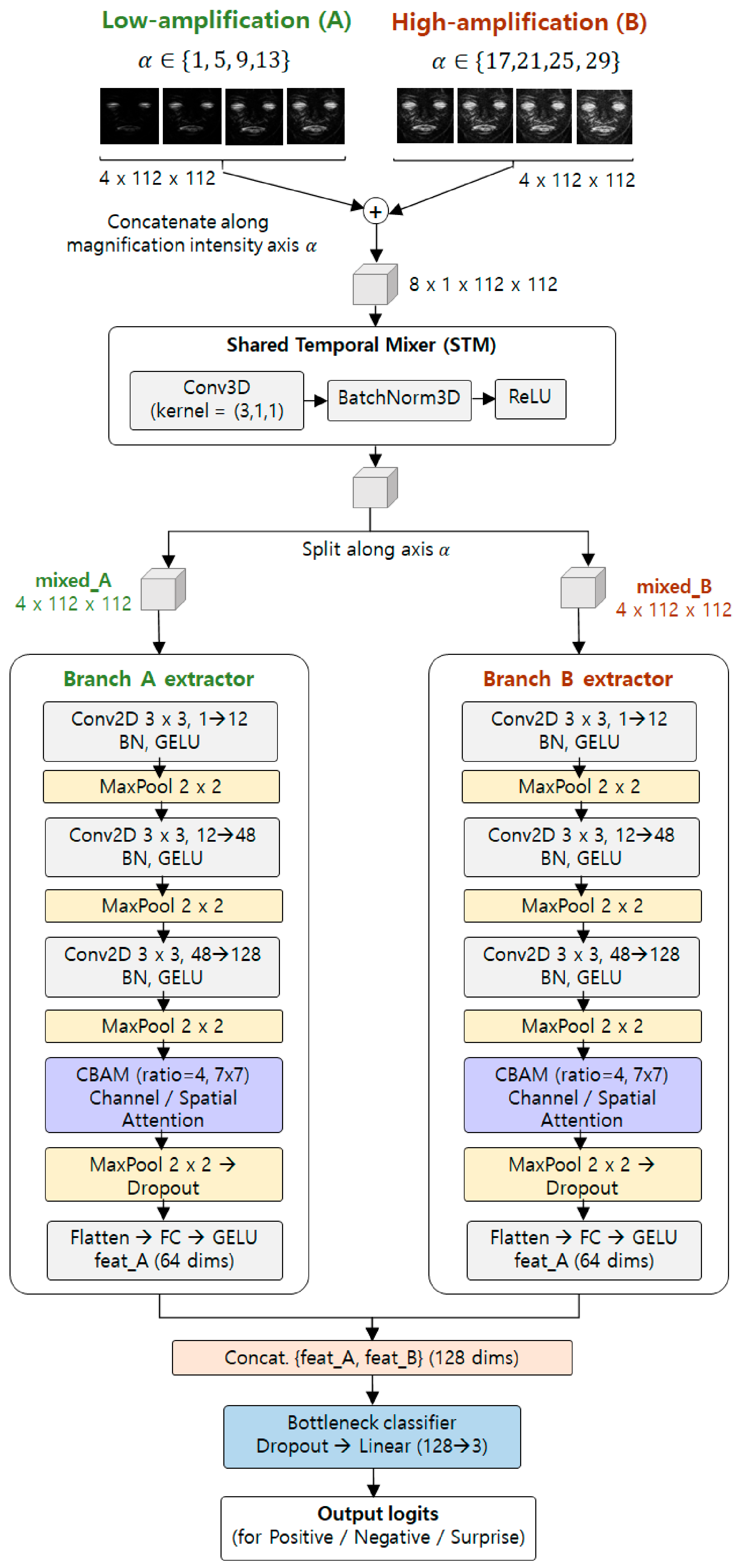
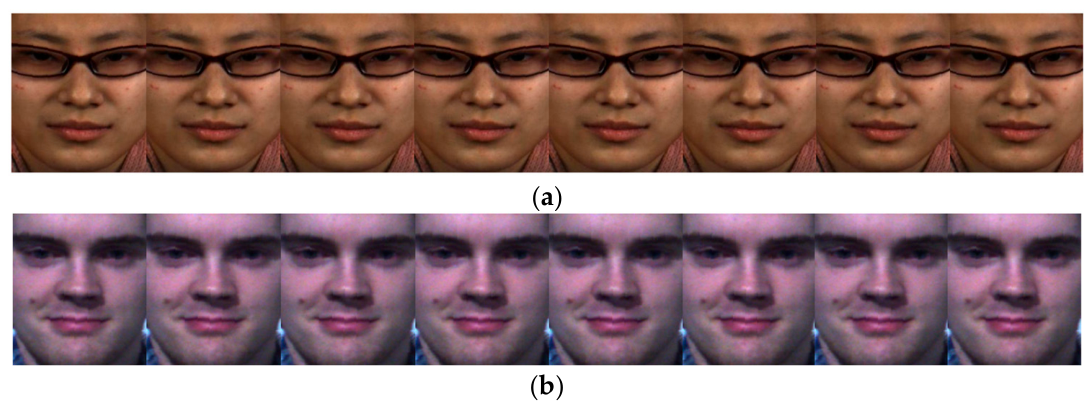
Lightweight Representation of Motion-Magnified Facial Dynamics for Micro Expression Sensing

Abstract
1. Introduction
2. Related Works
- (1)
- Multi-Stream Architectures: Multi-stream frameworks have been widely investigated to capture complementary facial dynamics. Khor et al. [13] have introduced a shallow dual-stream network designed to efficiently capture micro facial motion. Moving beyond single-task frameworks, Nie et al. [14] proposed GEME, a dual-stream multi-task learning network that incorporates auxiliary gender-based feature learning to enhance recognition accuracy. More recently, to address the computational burden of dual-stream systems, Liu et al. [15] have developed a lightweight dual-stream network enhanced by an adaptive strategy for efficient inference.
- (2)
- Attention Mechanisms and Structural Learning: To focus on regional facial micro-movements, advanced attention and graph architectures have been deployed. Zhou et al. [16] have proposed Dual-ATME, a dual-branch attention network that integrates hand-crafted and automated attention region selection for MER. The Hand-crafted Attention Region Selection (HARS) branch explicitly crops the eyebrow and mouth regions as regions of interest (ROIs) based on AU statistical prior knowledge, while the Automated Attention Region Selection (AARS) branch employs an attention mechanism on the full-face input to automatically localize micro-expression-salient regions in a data-driven manner. Zhang et al. [17] have introduced a novel approach that achieves recognition based on the direct learning of graph structures, capturing topological facial relationships.
- (3)
- Data Augmentation and 3D Reconstruction: To overcome the inherent data scarcity in MER, alternative structural modeling and augmentation paradigms have emerged. Zhou et al. [18] tackle cross-dataset variations by introducing a regularization learning framework coupled with Action Unit (AU)-[28,35] guided data augmentation. Furthermore, expanding MER into the 3D domain, Sun et al. [19] have explored fine-grained 3D facial reconstruction to capture deep geometric representations of subtle expressions.
3. Proposed Method
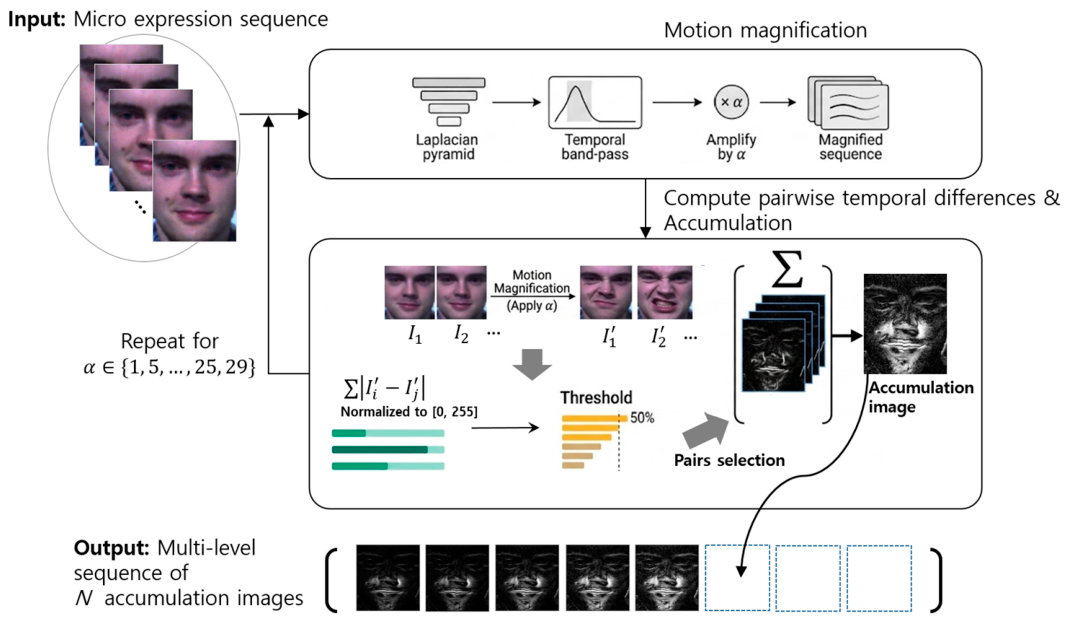
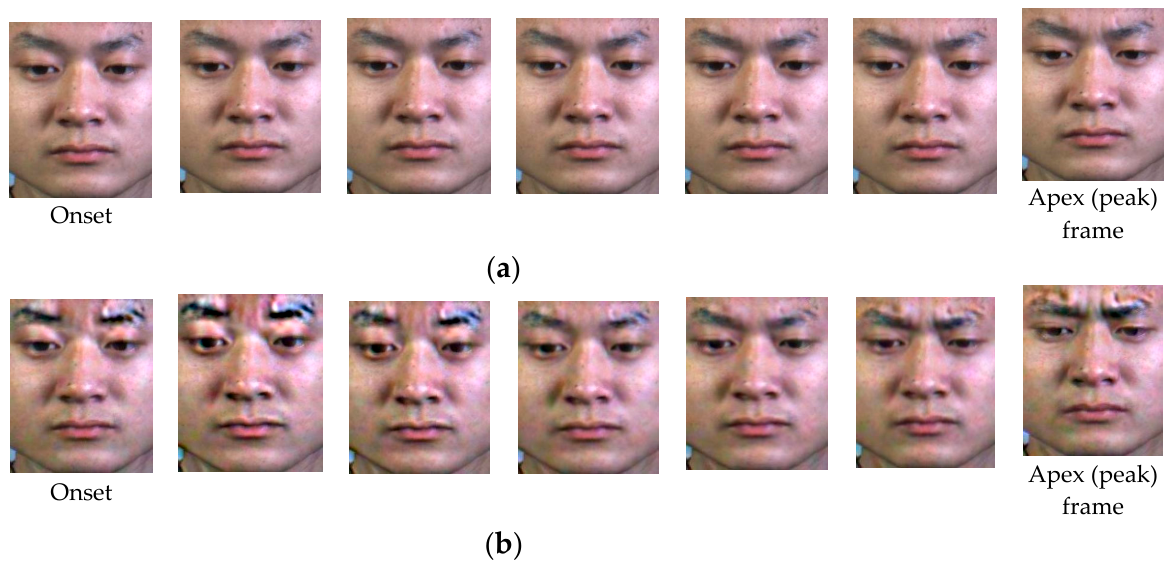
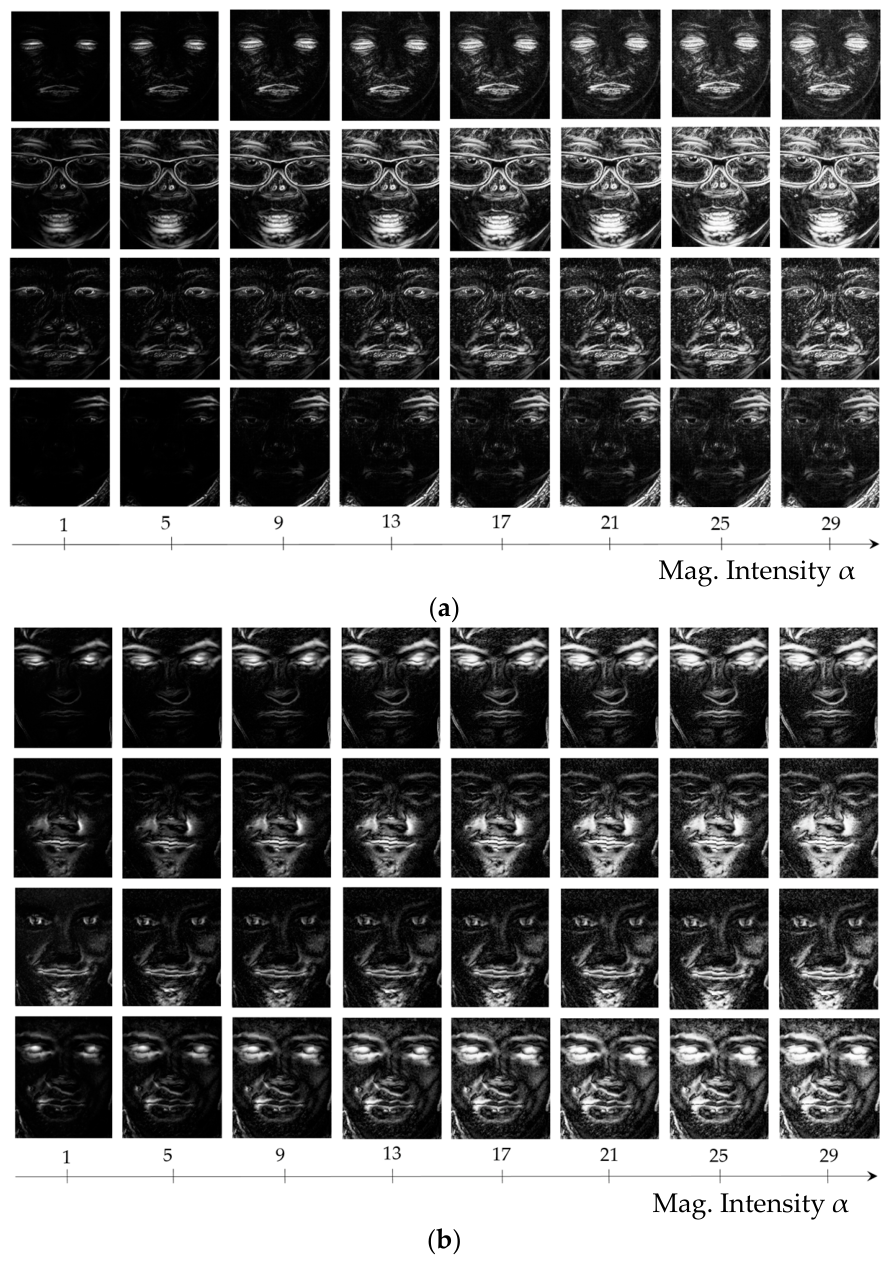
3.1. Generation of Accumulation Image Sequence Along the Magnification Intensity Axis
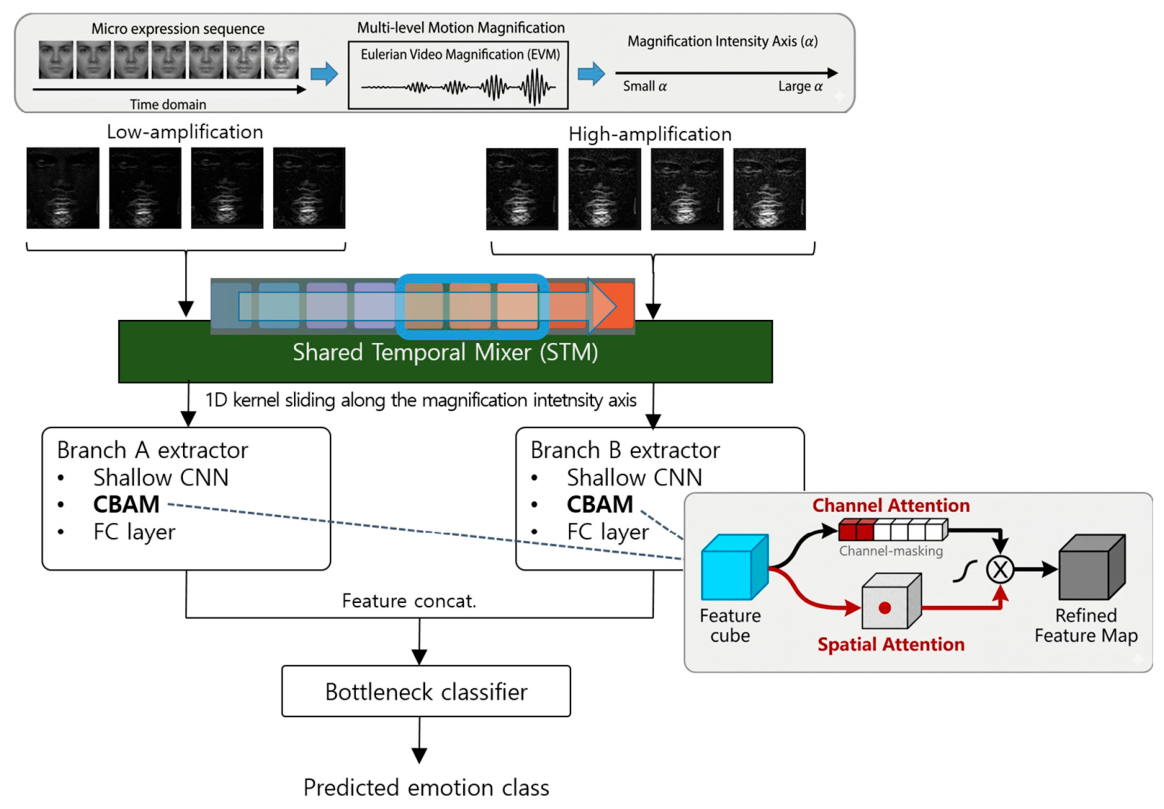
3.2. Multi-Level Representation Based Classification Using a Lightweight Spatiotemporal Network
4. Experimental Results
- (1)
- CASME II: developed by the Chinese Academy of Sciences, this dataset contained spontaneous micro expressions captured at 200 fps with a high spatial resolution (approx. 280 × 340 pixels for the facial region). It comprised 255 sequences from 26 subjects, featuring detailed annotations for emotion categories, AUs, and onset-apex-offset frames.
- (2)
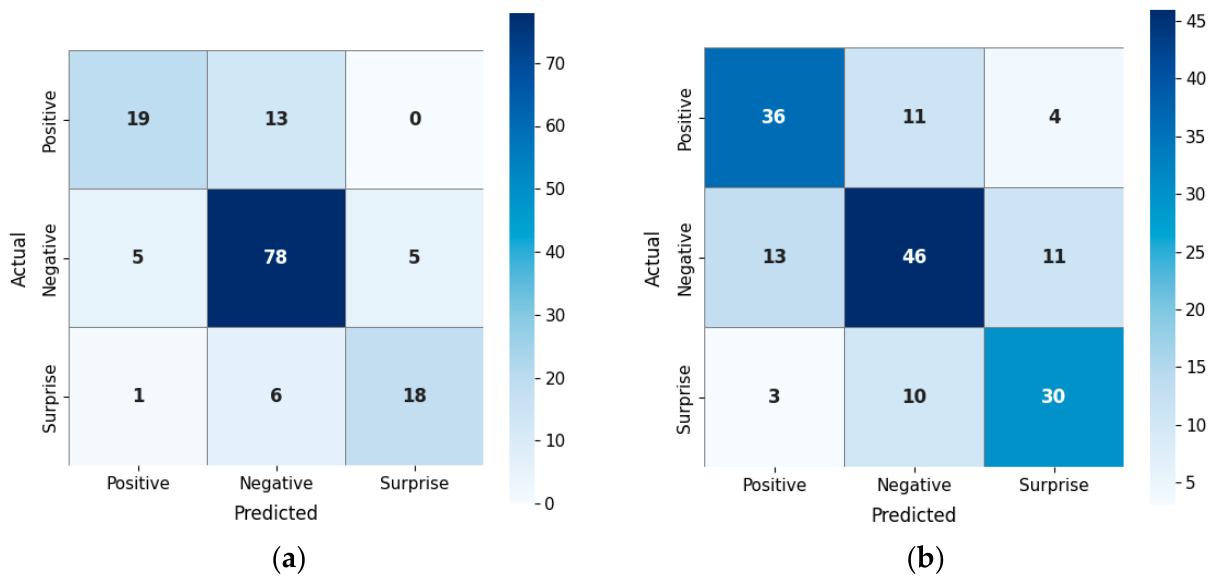
- SMIC: this dataset provides samples elicited from 16 participants. We specifically utilized the SMIC-HS (High-Speed) subset, recorded at 100 fps, which contained 164 clips. These samples were categorized into three broader emotion classes: Positive (51 samples (=sequences)), Negative (70), and Surprise (43) [12,40].
4.1. Comparative Evaluation on Recognition Accuracy

| (a) | ||||
| Category | Method | CASME II | ||
| Acc. | UAR | UF1 | ||
| Hand-crafted | LBP-TOP (2011) [8] | - | 54.29 | 50.26 |
| LBP-SIP (2014) [31] | - | 52.81 | 53.69 | |
| Spatiotemporal analysis/ 3D CNN | CBAMNet (2020) [40] | 69.92 | - | - |
| ELRCN (2018) [34] | - | 43.96 | 50.00 | |
| Vis. Trans. | DeiT (2021) [11] | - | 68.14 | 69.94 |
| Light ViT (2022) [12] | - | 69.97 | 72.51 | |
| Light ViT without transfer learning (2022) [12] | - | 63.48 | 65.24 | |
| Dual-stream | DSTNet (2025) [15] | 73.98 | - | 74.24 |
| Dual-ATME (2023) [16] | 81.70 | 75.10 | 76.50 | |
| Advanced geometric & semantic approaches | Vision-GNN (2025) [17] | - | 71.95 | 71.29 |
| AU-guided data augmentation (2026) [18] | 73.60 | 68.90 | - | |
| Fine-grained 3D facial reconstruction (2026) [19] | 53.75 | - | - | |
| Proposed | 79.31 | 73.44 | 75.33 | |
| (b) | ||||
| Category | Method | SMIC | ||
| Acc. | UAR | UF1 | ||
| Hand-crafted | LBP-TOP (2011) [8] | - | 52.80 | 20.00 |
| LBP-SIP (2014) [31] | - | 51.42 | 44.52 | |
| Spatiotemporal analysis/ 3D CNN | CBAMNet (2020) [40] | 54.84 | - | - |
| 3D CNN (2019) [42] | 55.49 | - | - | |
| Vis. Trans. | DeiT (2021) [11] | - | 68.81 | 69.7 |
| Light ViT (2022) [12] | - | 73.56 | 71.41 | |
| Light ViT without transfer learning (2022) [12] | - | 60.18 | 62.15 | |
| Dual-stream | DSSN (2019) [13] | 63.41 | - | 64.62 |
| GEME (2020) [14] | 64.63 | 60.23 | 61.58 | |
| DSTNet (2025) [15] | 71.34 | - | 72.45 | |
| Dual-ATME (2023) [16] | 64.60 | 65.80 | 64.60 | |
| Advanced geometric & semantic approaches | Vision-GNN (2025) [17] | - | 64.00 | 64.35 |
| AU-guided data augmentation (2026) [18] | 51.20 | 46.60 | - | |
| Proposed | 68.29 | 68.69 | 68.41 | |
4.2. Further Analysis on Model Complexity
5. Conclusions
Author Contributions
Funding
Data Availability Statement
Conflicts of Interest
References
- Oh, Y.-H.; See, J.; Le Ngo, A.C.; Phan, R.C.W.; Baskaran, V.M. A Survey of Automatic Facial Micro-Expression Analysis: Databases, Methods, and Challenges. Front. Psychol. 2018, 9, 1128. [Google Scholar] [CrossRef]
- Li, Y.; Wei, J.; Liu, Y.; Kauttonen, J.; Zhao, G. Deep Learning for Micro-Expression Recognition: A Survey. IEEE Trans. Affect. Comput. 2022, 13, 2028–2046. [Google Scholar] [CrossRef]
- Wang, Y.; See, J.; Oh, Y.-H.; Phan, R.C.W.; Rahulamathavan, Y.; Ling, H.-C.; Tan, S.-W.; Li, X. Effective Recognition of Facial Micro-Expressions with Video Motion Magnification. Multimed. Tools Appl. 2017, 76, 21665–21690. [Google Scholar] [CrossRef]
- Le Ngo, A.C.; Oh, Y.H.; Phan, R.C.W.; See, J. Eulerian emotion magnification for subtle expression recognition. In Proceedings of the 2016 IEEE International Conference on Acoustics, Speech and Signal Processing (ICASSP), Shanghai, China, 20–25 March 2016; pp. 1244–1248. [Google Scholar]
- Goh, K.M.; Ng, C.H.; Lim, L.L.; Sheikh, U.U. Micro-Expression Recognition: An Updated Review of Current Trends, Challenges and Solutions. Vis. Comput. 2020, 36, 445–468. [Google Scholar] [CrossRef]
- Ben, X.; Ren, Y.; Zhang, J.; Wang, S.-J.; Kpalma, K.; Meng, W.; Liu, Y.-J. Video-Based Facial Micro-Expression Analysis: A Survey of Datasets, Features and Algorithms. IEEE Trans. Pattern Anal. Mach. Intell. 2022, 44, 5826–5846. [Google Scholar] [CrossRef]
- Li, X.; Pfister, T.; Huang, X.; Zhao, G.; Pietikainen, M. A Spontaneous Micro-Expression Database: Inducement, Collection and Baseline. In Proceedings of the 2013 10th IEEE International Conference and Workshops on Automatic Face and Gesture Recognition (FG), Shanghai, China, 22–26 April 2013; IEEE: Piscataway, NJ, USA, 2013; pp. 1–6. [Google Scholar] [CrossRef]
- Pfister, T.; Li, X.; Zhao, G.; Pietikainen, M. Recognising Spontaneous Facial Micro-Expressions. In Proceedings of the 2011 IEEE International Conference on Computer Vision (ICCV), Barcelona, Spain, 6–13 November 2011; IEEE: Piscataway, NJ, USA, 2011; pp. 1449–1456. [Google Scholar] [CrossRef]
- Liu, Y.-J.; Zhang, J.-K.; Yan, W.-J.; Wang, S.-J.; Zhao, G.; Fu, X. A Main Directional Mean Optical Flow Feature for Spontaneous Micro-Expression Recognition. IEEE Trans. Affect. Comput. 2016, 7, 299–310. [Google Scholar] [CrossRef]
- Peng, M.; Wang, C.; Chen, T.; Liu, G.; Fu, X. Dual Temporal Scale Convolutional Neural Network for Micro-Expression Recognition. Front. Psychol. 2017, 8, 1745. [Google Scholar] [CrossRef] [PubMed]
- Touvron, H.; Cord, M.; Douze, M.; Massa, F.; Sablayrolles, A.; Jégou, H. Training Data-Efficient Image Transformers & Distillation Through Attention. In Proceedings of the International Conference on Machine Learning (ICML), Virtual, 18–24 July 2021; PMLR: Cambridge, MA, USA, 2021; pp. 10347–10357. [Google Scholar]
- Liu, Y.; Li, Y.; Yi, X.; Hu, Z.; Zhang, H.; Liu, Y. Lightweight ViT Model for Micro-Expression Recognition Enhanced by Transfer Learning. Front. Neurorobot. 2022, 16, 922761. [Google Scholar] [CrossRef] [PubMed]
- Khor, H.-Q.; See, J.; Liong, S.-T.; Phan, R.C.W.; Lin, W. Dual-Stream Shallow Networks for Facial Micro-Expression Recognition. In Proceedings of the 2019 IEEE International Conference on Image Processing (ICIP), Taipei, Taiwan, 22–25 September 2019; pp. 36–40. [Google Scholar] [CrossRef]
- Nie, X.; Takalkar, M.A.; Duan, M.; Zhang, H.; Xu, M. GEME: Dual-Stream Multi-Task GEnder-Based Micro-Expression Recognition. Neurocomputing 2021, 427, 13–28. [Google Scholar] [CrossRef]
- Liu, X.; Zhou, J.; Chen, F.; Li, S.; Wang, H.; Jia, Y.; Shan, Y. A Lightweight Dual-Stream Network with an Adaptive Strategy for Efficient Micro-Expression Recognition. Sensors 2025, 25, 2866. [Google Scholar] [CrossRef] [PubMed]
- Zhou, H.; Huang, S.; Li, J.; Wang, S.-J. Dual-ATME: Dual-Branch Attention Network for Micro-Expression Recognition. Entropy 2023, 25, 460. [Google Scholar] [CrossRef] [PubMed]
- Zhang, L.; Zhang, Y.; Sun, X.; Tang, W.; Wang, X.; Li, Z. Micro-Expression Recognition Based on Direct Learning of Graph Structure. Neurocomputing 2025, 619, 129135. [Google Scholar] [CrossRef]
- Zhou, J.; Liu, X.; Wang, L.; Wang, T.; Xia, H. Cross-Dataset Facial Micro-Expression Recognition with Regularization Learning and Action Unit-Guided Data Augmentation. Entropy 2026, 28, 150. [Google Scholar] [CrossRef]
- Sun, C.; Zhang, X.; Gao, R.; Chen, X.; Wu, Y.; Jia, Y. Fine-Grained 3D Facial Reconstruction for Micro-Expressions. arXiv 2026, arXiv:2603.07043. [Google Scholar] [CrossRef]
- Wu, H.-Y.; Rubinstein, M.; Shih, E.; Guttag, J.; Durand, F.; Freeman, W. Eulerian Video Magnification for Revealing Subtle Changes in the World. ACM Trans. Graph. 2012, 31, 65. [Google Scholar] [CrossRef]
- Oh, Y.-H.; See, J.; Phan, R.C.W.; Wong, K.; Tan, J.X. Monogenic-Based Video Magnification for Micro-Expression Recognition. In Proceedings of the 2018 25th IEEE International Conference on Image Processing (ICIP), Athens, Greece, 7–10 October 2018; IEEE: Piscataway, NJ, USA, 2018. [Google Scholar]
- Li, Y.; Huang, X.; Zhao, G. Joint Local and Global Information Learning with Single Apex Frame Detection for Micro-Expression Recognition. IEEE Trans. Image Process. 2021, 30, 249–263. [Google Scholar] [CrossRef]
- Simonyan, K.; Zisserman, A. Very Deep Convolutional Networks for Large-Scale Image Recognition. In Proceedings of the International Conference on Learning Representations (ICLR), San Diego, CA, USA, 7–9 May 2015. [Google Scholar] [CrossRef]
- He, K.; Zhang, X.; Ren, S.; Sun, J. Deep Residual Learning for Image Recognition. In Proceedings of the IEEE/CVF Conference on Computer Vision and Pattern Recognition (CVPR), Las Vegas, NV, USA, 27–30 June 2016; pp. 770–778. [Google Scholar] [CrossRef]
- Lin, J.; Gan, C.; Han, S. TSM: Temporal Shift Module for Efficient Video Understanding. In Proceedings of the IEEE/CVF International Conference on Computer Vision (ICCV 2019), Seoul, Republic of Korea, 27 October–2 November 2019; pp. 7082–7092. [Google Scholar] [CrossRef]
- Woo, S.; Park, J.; Lee, J.; Kweon, I.S. CBAM: Convolutional Block Attention Module. In Proceedings of the European Conference on Computer Vision (ECCV 2018), Munich, Germany, 8–14 September 2018; pp. 3–19. [Google Scholar] [CrossRef]
- Yan, W.-J.; Li, X.; Wang, S.-J.; Zhao, G.; Liu, Y.-J.; Chen, Y.-H.; Fu, X. CASME II: An Improved Spontaneous Micro-Expression Database and the Baseline Evaluation. PLoS ONE 2014, 9, e86041. [Google Scholar] [CrossRef]
- Ekman, P.; Friesen, W.V. Facial Action Coding System: A Technique for the Measurement of Facial Movement; Consulting Psychologists Press: Palo Alto, CA, USA, 1978. [Google Scholar]
- Guo, Z.; Zhang, L.; Zhang, D. A Completed Modeling of Local Binary Pattern Operator for Texture Classification. IEEE Trans. Image Process. 2010, 19, 1657–1663. [Google Scholar] [CrossRef]
- Feng, X.; Pietikainen, M.; Hadid, A. Facial Expression Recognition with Local Binary Patterns and Linear Programming. Pattern Recognit. Image Anal. 2005, 15, 546–548. [Google Scholar]
- Wang, Y.; See, J.; Phan, R.C.W.; Oh, Y.-H. LBP with Six Intersection Points: Reducing Redundant Information in LBP-TOP for Micro-Expression Recognition. In Proceedings of the Asian Conference on Computer Vision (ACCV), Singapore, 1–5 November 2014; Springer: Cham, Switzerland, 2015; pp. 525–537. [Google Scholar] [CrossRef]
- Huang, X.; Zhao, G.; Hong, X.; Zheng, W.; Pietikainen, M. Spontaneous Facial Micro-Expression Analysis Using Spatiotemporal Completed Local Quantized Patterns. Neurocomputing 2016, 175, 564–578. [Google Scholar] [CrossRef]
- Kim, D.H.; Baddar, W.J.; Ro, Y.M. Micro-Expression Recognition with Expression-State Constrained Spatio-Temporal Feature Representations. In Proceedings of the 24th ACM International Conference on Multimedia (MM ‘16), Amsterdam, The Netherlands, 15–19 October 2016; ACM: New York, NY, USA, 2016; pp. 382–386. [Google Scholar] [CrossRef]
- Khor, H.-Q.; See, J.; Phan, R.C.W.; Lin, W. Micro-Expression Recognition Based on 3D Flow Convolutional Convolutional Network for Facial Micro-Expression Recognition. In Proceedings of the 13th IEEE International Conference on Automatic Face & Gesture Recognition (FG 2018), Xi’an, China, 15–19 May 2018; IEEE: Piscataway, NJ, USA, 2018; pp. 667–674. [Google Scholar] [CrossRef]
- Lee, S.H.; Ro, Y.M. Partial Matching of Facial Expression Sequence Using Over-Complete Transition Dictionary for Emotion Recognition. IEEE Trans. Affect. Comput. 2016, 7, 389–408. [Google Scholar] [CrossRef]
- Ioffe, S.; Szegedy, C. Batch Normalization: Accelerating Deep Network Training by Reducing Internal Covariate Shift. In Proceedings of the 32nd International Conference on Machine Learning (ICML 2015), Lille, France, 6–11 July 2015; pp. 448–456. [Google Scholar]
- Nair, V.; Hinton, G.E. Rectified Linear Units Improve Restricted Boltzmann Machines. In Proceedings of the 27th International Conference on Machine Learning (ICML 2010), Haifa, Israel, 21–24 June 2010; pp. 807–814. [Google Scholar]
- Hendrycks, D.; Gimpel, K. Gaussian Error Linear Units (GELUs). arXiv 2016, arXiv:1606.08415. [Google Scholar] [CrossRef]
- Srivastava, N.; Hinton, G.; Krizhevsky, A.; Sutskever, I.; Salakhutdinov, R. Dropout: A Simple Way to Prevent Neural Networks from Overfitting. J. Mach. Learn. Res. 2014, 15, 1929–1958. [Google Scholar]
- Chen, B.; Zhang, Z.; Liu, N.; Tan, Y.; Liu, X.; Chen, T. Spatiotemporal Convolutional Neural Network with Convolutional Block Attention Module for Micro-Expression Recognition. Information 2020, 11, 380. [Google Scholar] [CrossRef]
- Liu, Y.; Du, H.; Chen, S.; Shi, H. A Convolutional Neural Network for Compound Micro-Expression Recognition. Sensors 2019, 19, 5553. [Google Scholar] [CrossRef] [PubMed]
- Li, J.; Wang, Y.; See, J.; Liu, W. Micro-Expression Recognition Based on 3D Flow Convolutional Neural Network. Pattern Anal. Appl. 2019, 22, 1331–1339. [Google Scholar] [CrossRef]
- Selvaraju, R.R.; Cogswell, M.; Das, A.; Vedantam, R.; Parikh, D.; Batra, D. Grad-CAM: Visual Explanations from Deep Networks via Gradient-Based Localization. In Proceedings of the IEEE International Conference on Computer Vision (ICCV), Venice, Italy, 22–29 October 2017; pp. 618–626. [Google Scholar] [CrossRef]
- Wu, Y.; Kirillov, A.; Massa, F.; Lo, W.-Y.; Girshick, R. fvcore. GitHub. 2019. Available online: https://github.com/facebookresearch/fvcore (accessed on 9 May 2026).
- Wu, Y.; Goyal, A.; Fang, W.; Kumar, A.; Xu, H.; Gkioxari, G.; Dollár, P.; Girshick, R.; He, K. Detectron2. GitHub. 2019. Available online: https://github.com/facebookresearch/detectron2 (accessed on 9 May 2026).
- Fan, H.; Li, Y.; Xiong, B.; Lo, W.-Y.; Feichtenhofer, C. PyTorchVideo: A Deep Learning Library for Video Understanding. In Proceedings of the 29th ACM International Conference on Multimedia (ACM MM), Virtual, 20–24 October 2021; ACM: New York, NY, USA, 2021. [Google Scholar]
- Sandler, M.; Howard, A.; Zhu, M.; Zhmoginov, A.; Chen, L.-C. MobileNetV2: Inverted Residuals and Linear Bottlenecks. In Proceedings of the IEEE/CVF Conference on Computer Vision and Pattern Recognition (CVPR), Salt Lake City, UT, USA, 18–22 June 2018; pp. 4510–4520. [Google Scholar] [CrossRef]


| Datasets | CASME II | SMIC | |
|---|---|---|---|
| Attribute | |||
| Number of subjects | 24 | 16 | |
| Frame Rate (fps) | 200 | 100 | |
| Average duration (frames) | 66 | 37 | |
| Sample Distribution | Positive | 32 | 51 |
| Negative | 88 | 70 | |
| Surprise | 25 | 43 | |
| Combination of Magnification Intensities | CASME II | SMIC | ||||
|---|---|---|---|---|---|---|
| Acc. | UAR | UF1 | Acc. | UAR | UF1 | |
| [1, 5, 9, 13] | 66.21 | 61.95 | 61.96 | 60.37 | 61.01 | 60.61 |
| [17, 21, 25, 29] | 64.14 | 58.75 | 58.43 | 61.59 | 62.85 | 62.55 |
| [5, 13, 21, 29] | 66.21 | 61.95 | 62.13 | 63.41 | 65.00 | 63.85 |
| [1, 5, 9, 13, 17, 21, 25, 29] | 69.66 | 59.66 | 63.01 | 64.02 | 65.30 | 64.62 |
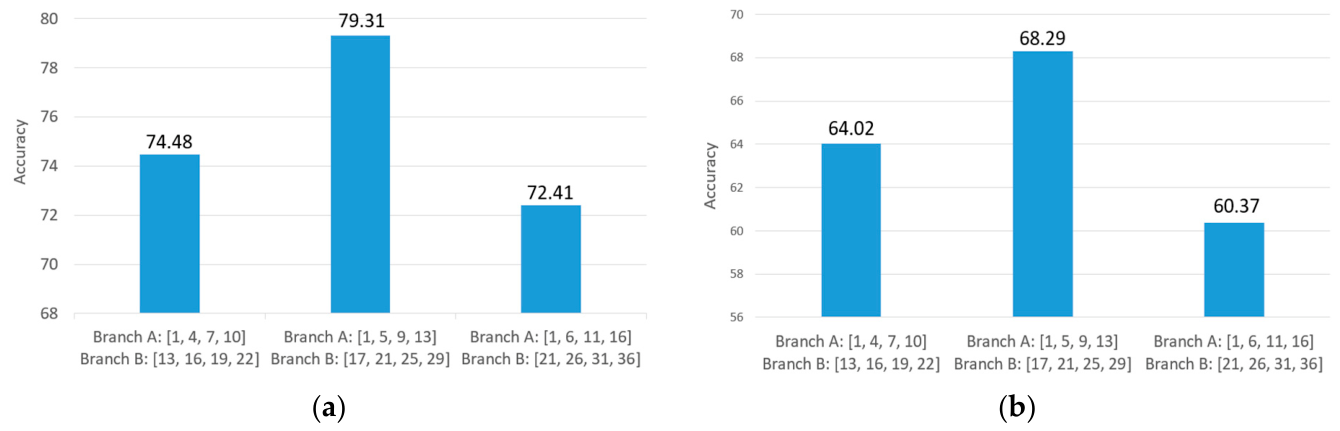
| Branch A: [1, 5, 9, 13] Branch B: [17, 21, 25, 29] | 79.31 | 73.44 | 75.33 | 68.29 | 68.69 | 68.41 |
| Types of Modules Applied to the Shallow CNN | CASME II | SMIC | ||||
|---|---|---|---|---|---|---|
| Acc. | UAR | UF1 | Acc. | UAR | UF1 | |
| without STM and CBAM | 62.07 | 58.14 | 58.07 | 48.17 | 51.67 | 47.95 |
| with STM only | 63.45 | 62.72 | 61.16 | 62.80 | 65.29 | 63.08 |
| with CBAM only | 66.90 | 63.95 | 63.69 | 55.49 | 56.36 | 55.43 |
| with STM and CBAM | 79.31 | 73.44 | 75.33 | 68.29 | 68.69 | 68.41 |
| Module | Sub-Module | Output Shape | No. Parameters | MACs |
|---|---|---|---|---|
| STM | Conv3D (1 → 1, k = (3, 1, 1)) | (1, 8, 112, 112) | 3 | 301,056 |
| BatchNorm3D + ReLU + Residual | (1, 8, 112, 112) | 2 | 0 | |
| Branch A | Conv2D (4 → 12, 3 × 3) + BN + GELU + MaxPool | (12, 56, 56) | 468 | 5,419,008 |
| Conv2D (12 → 48, 3 × 3) + BN + GELU + MaxPool | (48, 28, 28) | 5328 | 16,257,024 | |
| Conv2D (48 → 128, 3 × 3) + BN + GELU + MaxPool | (128, 14, 14) | 55,680 | 43,352,064 | |
| CBAM (ratio = 4, k = 7) + MaxPool + Dropout | (128, 7, 7) | 8241 | 17,796 | |
| Flatten + Linear (6272 → 64) + GELU | (64,) | 401,472 | 401,408 | |
| Subtotal | 471,189 | 65,447,300 | ||
| Branch B | (Identical topology to Branch A) | (64,) | 471,189 | 65,447,300 |
| Classifier | Dropout + Linear (128 → 3) | (3,) | 387 | 384 |
| Total | 942,770 (≈0.94 M) | 131,196,040 (≈0.131 G) | ||
| Total FLOPs | (1 MAC = 2 FLOPs) | 262 M |
| Method | No. Parameters |
|---|---|
| ResNet18 | 11.7 M |
| VGG16 | 138.3 M |
| AlexNet | 61.1 M |
| MobileNet V2 | 3.5 M |
| CNN-LSTM (2016) [33] | 4.62 M * |
| ELRCN (2018) [34] | 219 M * |
| DSSN (2019) [13] | 0.97 M |
| DeiT (2021) [11] | 55.0 M |
| Light ViT (2022) [12] | 5.6 M |
| Dual-ATME (2023) [16] | 4.8 M + |
| DSTNet (2025) [15] | >3.15 M |
| Vision-GNN (2025) [17] | 7.1 M |
| Proposed | 0.94 M (942.770) |
Disclaimer/Publisher’s Note: The statements, opinions and data contained in all publications are solely those of the individual author(s) and contributor(s) and not of MDPI and/or the editor(s). MDPI and/or the editor(s) disclaim responsibility for any injury to people or property resulting from any ideas, methods, instructions or products referred to in the content. |
© 2026 by the authors. Licensee MDPI, Basel, Switzerland. This article is an open access article distributed under the terms and conditions of the Creative Commons Attribution (CC BY) license.
Share and Cite
Lee, S.; Lee, S. Lightweight Representation of Motion-Magnified Facial Dynamics for Micro Expression Sensing. Sensors 2026, 26, 3727. https://doi.org/10.3390/s26123727
Lee S, Lee S. Lightweight Representation of Motion-Magnified Facial Dynamics for Micro Expression Sensing. Sensors. 2026; 26(12):3727. https://doi.org/10.3390/s26123727
Chicago/Turabian StyleLee, Seungho, and Sangkon Lee. 2026. "Lightweight Representation of Motion-Magnified Facial Dynamics for Micro Expression Sensing" Sensors 26, no. 12: 3727. https://doi.org/10.3390/s26123727
APA StyleLee, S., & Lee, S. (2026). Lightweight Representation of Motion-Magnified Facial Dynamics for Micro Expression Sensing. Sensors, 26(12), 3727. https://doi.org/10.3390/s26123727