A Simple Minimum-Setup Pipeline for Using Leg-Worn Inertial Sensors to Track Knee Flexion: Validation on 10 Movements


Highlights
- We established a simple pipeline with minimum experimental requirements for leg-worn inertial measurement unit (IMU) sensors to estimate the knee flexion angle;
- IMU-estimated knee flexion demonstrated good agreements with optical motion capture (both marker-based and markerless) during most daily living activities.
- Our validated simple pipeline makes IMU-based knee motion tracking more practical and compatible with clinical research;
- Future research should seek best practices on sensor wearing to secure valid continuous data in clinically relevant environments.
Abstract
1. Introduction
2. Materials and Methods
2.1. Study Participant Characteristics
2.2. Experimental Procedure and Optical Motion Capture
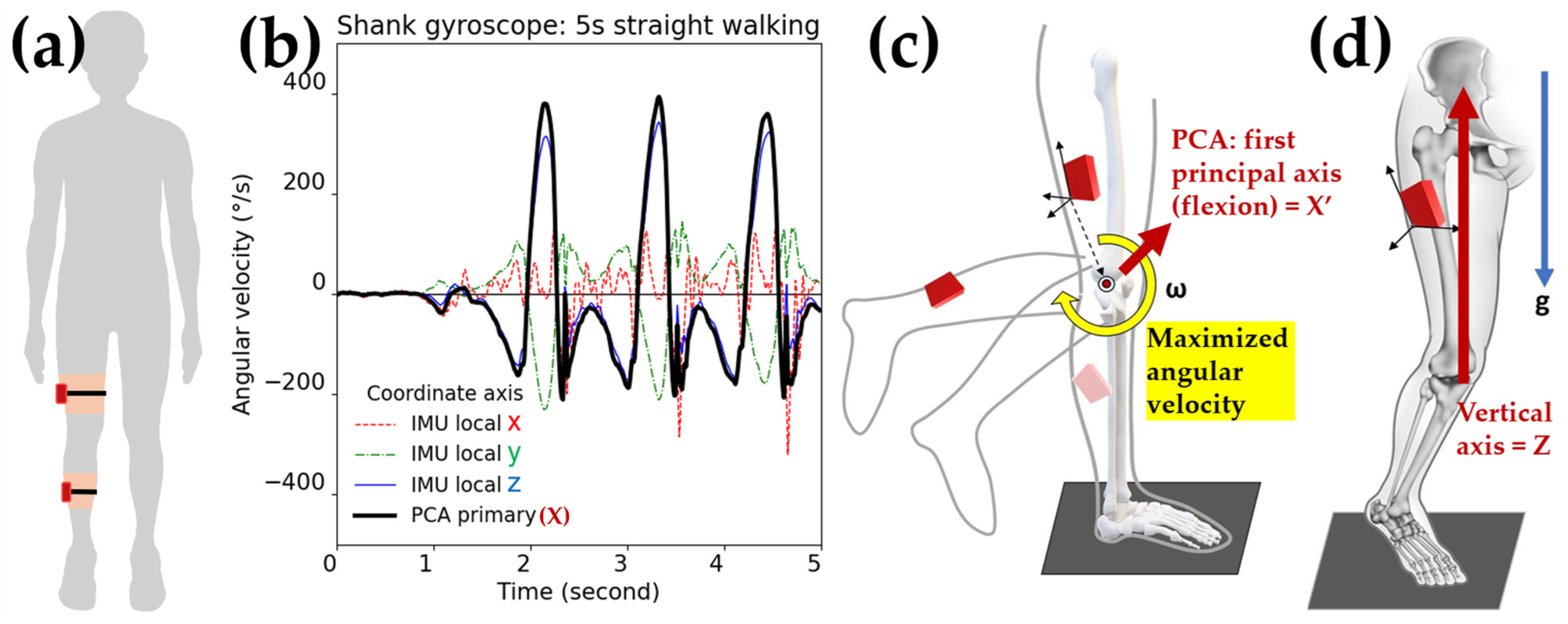
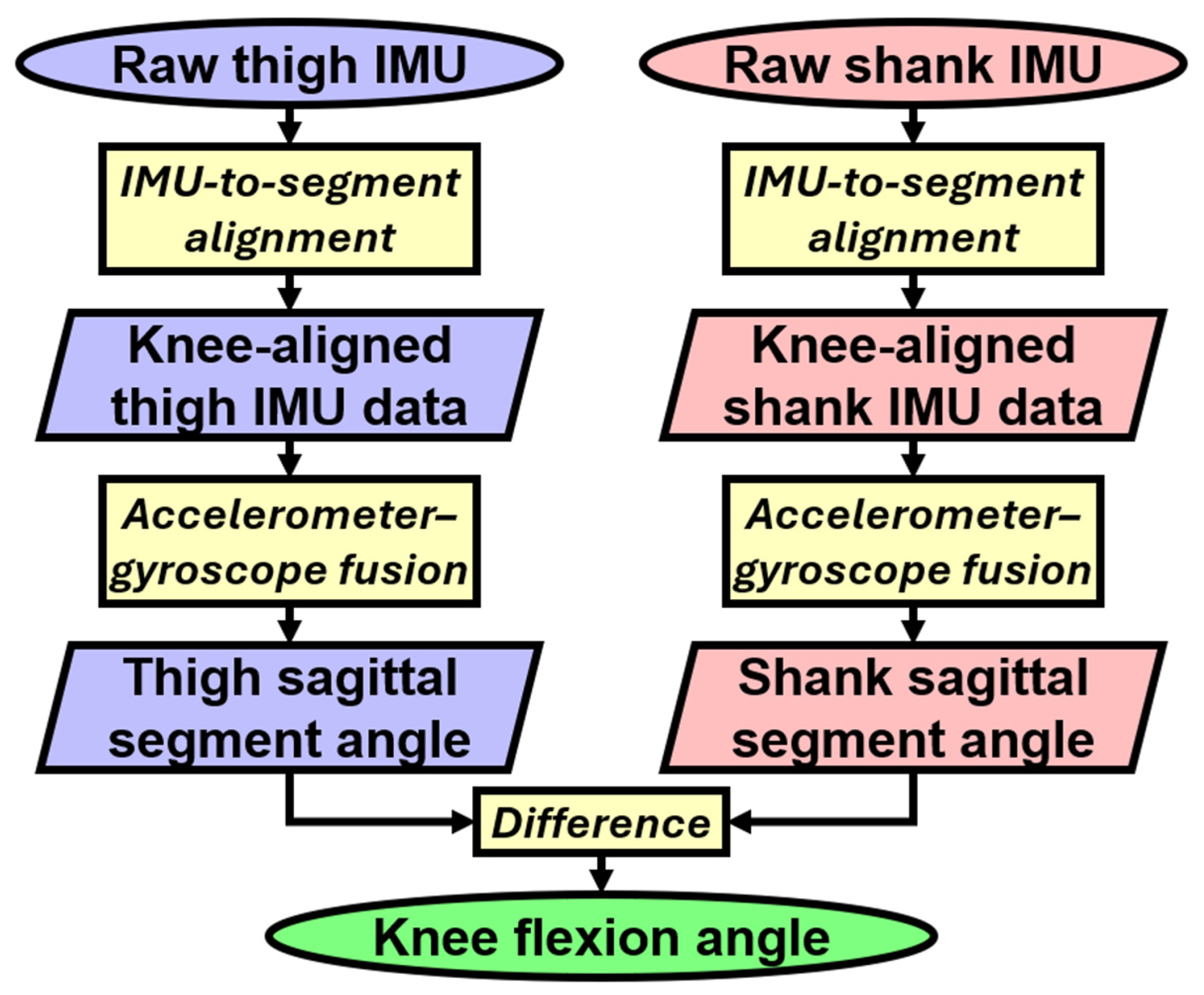
2.3. Knee Flexion Angle Estimation Using Shank and Thigh-Worn IMUs
2.4. Data Analysis and Statistics
3. Results
3.1. IMU Tracking Versus Marker-Based Motion Capture
3.2. IMU Tracking Versus Markerless Optical Motion Capture
4. Discussion
5. Conclusions
Supplementary Materials
Author Contributions
Funding
Institutional Review Board Statement
Informed Consent Statement
Data Availability Statement
Acknowledgments
Conflicts of Interest
Abbreviations
| IMU | Inertial measurement unit |
| RMSD | Root-mean-square difference |
| PCA | Principal component analysis |
Appendix A. 36 Movement Trials Listed in the Order of Experimental Data Collection

| Module 1 | Module 2 | Module 3 | Module 4 |
|---|---|---|---|
| Exercise 1–11 | Exercise 12–21 | Exercise 22–29 | Exercise 30–36 |
| Heel raises | Running | 1-leg squat (60-degree) | 1-leg drop landing |
| Walking | 2-leg squat (60-degree) | 1-leg squat (full depth) | 1-leg drop vertical hop |
| Low step up (10 cm) | 2-leg squat (full depth) “2-Leg Full Squat” | Bulgarian squat | 1-leg repeat forward hops |
| Low step down (10 cm) | 1-leg decline squat | 1-leg countermovement hop | 1-leg fast forward hops |
| High step up (20 cm) | Sumo squat | 2-leg repeat forward jumps “Repetitive Jumps” | 1-leg repeat lateral hops |
| High step down (20 cm) | 1 s Spanish squat | 2-leg fast forward jumps | 1-leg fast lateral hops |
| Lunge “Forward Lunge” | Run-and-cut | 2-leg repeat lateral jumps | Alternating split jumps |
| 2-leg countermovement jump “Vertical Jump” | 1-leg maximal forward hop | 2-leg fast lateral jumps | |
| 2-leg drop landing | Run-and-stop | ||
| 2-leg drop vertical jump | Sports movement jump | ||
| 2-leg maximal forward jump “Forward Jump” |
References
- Baliunas, A.J.; Hurwitz, D.E.; Ryals, A.B.; Karrar, A.; Case, J.P.; Block, J.A.; Andriacchi, T.P. Increased knee joint loads during walking are present in subjects with knee osteoarthritis. Osteoarthr. Cartil. 2002, 10, 573–579. [Google Scholar] [CrossRef]
- Astephen, J.L.; Deluzio, K.J.; Caldwell, G.E.; Dunbar, M.J. Biomechanical changes at the hip, knee, and ankle joints during gait are associated with knee osteoarthritis severity. J. Orthop. Res. 2008, 26, 332–341. [Google Scholar] [CrossRef]
- Rosen, A.B.; Ko, J.; Simpson, K.J.; Kim, S.H.; Brown, C.N. Lower extremity kinematics during a drop jump in individuals with patellar tendinopathy. Orthop. J. Sports Med. 2015, 3, 2325967115576100. [Google Scholar] [CrossRef]
- Powers, C.M.; Heino, J.G.; Rao, S.; Perry, J. The influence of patellofemoral pain on lower limb loading during gait. Clin. Biomech. 1999, 14, 722–728. [Google Scholar] [CrossRef] [PubMed]
- Amiri, P.; Davis, E.M.; Outerleys, J.; Miller, R.H.; Brandon, S.; Astephen Wilson, J.L. High tibiofemoral contact and muscle forces during gait are associated with radiographic knee OA progression over 3 years. Knee 2023, 41, 245–256. [Google Scholar] [CrossRef]
- Kanko, R.M.; Laende, E.K.; Davis, E.M.; Selbie, W.S.; Deluzio, K.J. Concurrent assessment of gait kinematics using marker-based and markerless motion capture. J. Biomech. 2021, 127, 110665. [Google Scholar] [CrossRef] [PubMed]
- Kanko, R.M.; Laende, E.; Selbie, W.S.; Deluzio, K.J. Inter-session repeatability of markerless motion capture gait kinematics. J. Biomech. 2021, 121, 110422. [Google Scholar] [CrossRef]
- Uhlrich, S.D.; Falisse, A.; Kidziński, Ł.; Muccini, J.; Ko, M.; Chaudhari, A.S.; Hicks, J.L.; Delp, S.L. OpenCap: Human movement dynamics from smartphone videos. PLoS Comput. Biol. 2023, 19, e1011462. [Google Scholar] [CrossRef]
- Edwards, N.A.; Caccese, J.B.; Tracy, R.E.; Hagen, J.; Quatman-Yates, C.C.; Oñate, J. The validity and usability of markerless motion capture and inertial measurement units for quantifying dynamic movements. Med. Sci. Sports Exerc. 2025, 57, 641–655. [Google Scholar] [CrossRef]
- Song, K.; Scattone Silva, R.; Hullfish, T.J.; Silbernagel, K.G.; Baxter, J.R. Patellofemoral joint loading progression across 35 weightbearing rehabilitation exercises and activities of daily living. Am. J. Sports Med. 2023, 51, 2110–2119. [Google Scholar] [CrossRef] [PubMed]
- Cereatti, A.; Gurchiek, R.; Mündermann, A.; Fantozzi, S.; Horak, F.; Delp, S.; Aminian, K. ISB recommendations on the definition, estimation, and reporting of joint kinematics in human motion analysis applications using wearable inertial measurement technology. J. Biomech. 2024, 173, 112225. [Google Scholar] [CrossRef]
- Hafer, J.F.; Vitali, R.; Gurchiek, R.; Curtze, C.; Shull, P.; Cain, S.M. Challenges and advances in the use of wearable sensors for lower extremity biomechanics. J. Biomech. 2023, 157, 111714. [Google Scholar] [CrossRef]
- Seel, T.; Raisch, J.; Schauer, T. IMU-based joint angle measurement for gait analysis. Sensors 2014, 14, 6891–6909. [Google Scholar] [CrossRef]
- Madgwick, S.O.; Harrison, A.J.; Vaidyanathan, A. Estimation of IMU and MARG orientation using a gradient descent algorithm. In Proceedings of the 2011 IEEE International Conference on Rehabilitation Robotics, Zurich, Switzerland, 29 June–1 July 2011; Volume 2011, p. 5975346. [Google Scholar] [CrossRef]
- Kobsar, D.; Charlton, J.M.; Tse, C.T.F.; Esculier, J.F.; Graffos, A.; Krowchuk, N.M.; Thatcher, D.; Hunt, M.A. Validity and reliability of wearable inertial sensors in healthy adult walking: A systematic review and meta-analysis. J. Neuroeng. Rehabil. 2020, 17, 62. [Google Scholar] [CrossRef]
- Cooper, G.; Sheret, I.; McMillan, L.; Siliverdis, K.; Sha, N.; Hodgins, D.; Kenney, L.; Howard, D. Inertial sensor-based knee flexion/extension angle estimation. J. Biomech. 2009, 42, 2678–2685. [Google Scholar] [CrossRef]
- McGrath, T.; Stirling, L. Body-worn IMU-based human hip and knee kinematics estimation during treadmill walking. Sensors 2022, 22, 2544. [Google Scholar] [CrossRef]
- Vitali, R.V.; Cain, S.M.; McGinnis, R.S.; Zaferiou, A.M.; Ojeda, L.V.; Davidson, S.P.; Perkins, N.C. Method for estimating three-dimensional knee rotations using two inertial measurement units: Validation with a coordinate measurement machine. Sensors 2017, 17, 1970. [Google Scholar] [CrossRef]
- Fennema, M.C.; Bloomfield, R.A.; Lanting, B.A.; Birmingham, T.B.; Teeter, M.G. Repeatability of measuring knee flexion angles with wearable inertial sensors. Knee 2019, 26, 97–105. [Google Scholar] [CrossRef] [PubMed]
- Cain, S.M.; Morrow, M.M.B. Quantifying shoulder motion in the free-living environment using wearable inertial measurement units: Challenges and recommendations. J. Biomech. 2025, 182, 112589. [Google Scholar] [CrossRef] [PubMed]
- Cho, S.Y.; Dibble, L.E.; Fino, P.C. Capacity versus performance of volitional head turns after mild traumatic brain injury. J. Head Trauma Rehabil. 2026, in press. [Google Scholar] [CrossRef] [PubMed]
- Song, K.; Hullfish, T.J.; Scattone Silva, R.; Silbernagel, K.G.; Baxter, J.R. Markerless motion capture estimates of lower extremity kinematics and kinetics are comparable to marker-based across 8 movements. J. Biomech. 2023, 157, 111751. [Google Scholar] [CrossRef]
- Slater, A.A.; Hullfish, T.J.; Baxter, J.R. The impact of thigh and shank marker quantity on lower extremity kinematics using a constrained model. BMC Musculoskelet. Disord. 2018, 19, 399. [Google Scholar] [CrossRef]
- Robertson, D.G.E.; Caldwell, G.E.; Hamill, J.; Kamen, G.; Whittlesey, S. (Eds.) Research Methods in Biomechanics, 2nd ed.; Human Kinetics: Champaign, IL, USA, 2013. [Google Scholar]
- Hafer, J.F.; Provenzano, S.G.; Kern, K.L.; Agresta, C.E.; Grant, J.A.; Zernicke, R.F. Measuring markers of aging and knee osteoarthritis gait using inertial measurement units. J. Biomech. 2020, 99, 109567. [Google Scholar] [CrossRef]
- Schober, P.; Boer, C.; Schwarte, L.A. Correlation coefficients: Appropriate use and interpretation. Anesth. Analg. 2018, 126, 1763–1768. [Google Scholar] [CrossRef]
- Leardini, A.; Chiari, L.; Della Croce, U.; Cappozzo, A. Human movement analysis using stereophotogrammetry. Part 3. Soft tissue artifact assessment and compensation. Gait Posture 2005, 21, 212–225. [Google Scholar] [CrossRef]
- Akbarshahi, M.; Schache, A.G.; Fernandez, J.W.; Baker, R.; Banks, S.; Pandy, M.G. Non-invasive assessment of soft-tissue artifact and its effect on knee joint kinematics during functional activity. J. Biomech. 2010, 43, 1292–1301. [Google Scholar] [CrossRef] [PubMed]
- Outerleys, J.; Mihic, A.; Keller, V.; Laende, E.; Deluzio, K. Markerless motion capture provides repeatable gait outcomes in patients with knee osteoarthritis. J. Biomech. 2024, 168, 112115. [Google Scholar] [CrossRef]
- Rhudy, M.B.; Mahoney, J.M.; Altman-Singles, A.R. Knee angle estimation with dynamic calibration using inertial measurement units for running. Sensors 2024, 24, 695. [Google Scholar] [CrossRef]
- Silva, M.D.C.; Woodward, A.P.; Fearon, A.M.; Perriman, D.M.; Spencer, T.J.; Couldrick, J.M.; Scarvell, J.M. Minimal clinically important change of knee flexion in people with knee osteoarthritis after non-surgical interventions using a meta-analytical approach. Syst. Rev. 2024, 13, 50. [Google Scholar] [CrossRef] [PubMed]
- Fan, B.; Xia, H.; Xu, J.; Li, Q.; Shull, P.B. IMU-based knee flexion, abduction and internal rotation estimation during drop landing and cutting tasks. J. Biomech. 2021, 124, 110549. [Google Scholar] [CrossRef] [PubMed]


| IMU vs. Marker-Based: Rxy and RMSD in Knee Flexion (Based on Per-Subject Average), n = 10 | ||||||
| Movement | Pearson Correlation Coefficient, Rxy | Root-Mean-Square Difference, RMSD | ||||
| Mean 1 | SD | IQR | Mean 1 | SD | IQR | |
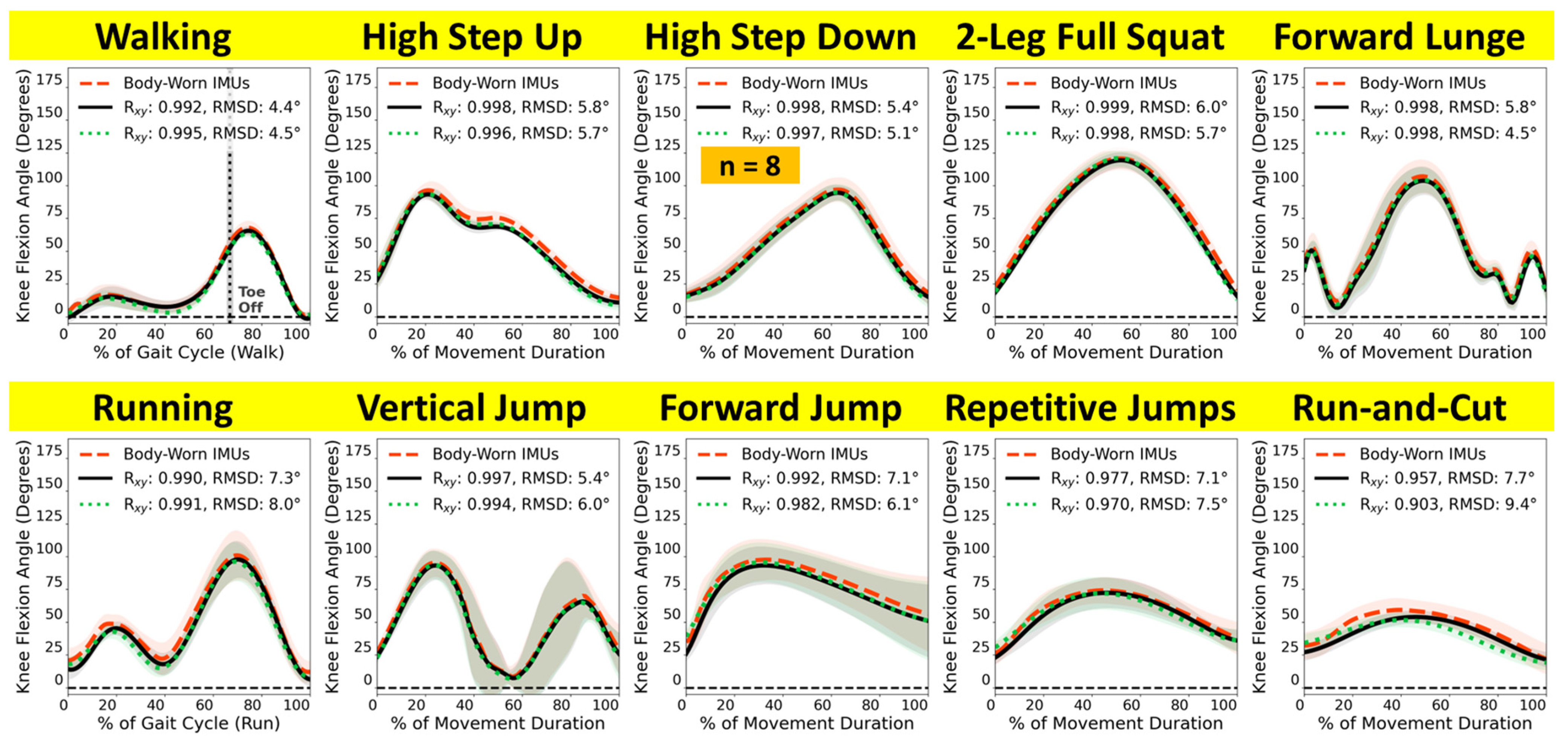
| Walking | 0.992 | 0.004 | 0.003 | 4.4° | 2.0° | 1.9° |
| High Step Up | 0.998 | 0.001 | 0.002 | 5.8° | 3.7° | 4.7° |
| High Step Down * | 0.998 | 0.001 | 0.002 | 5.4° | 3.2° | 3.6° |
| 2-Leg Full Squat | 0.999 | 0.001 | 0.001 | 6.0° | 2.7° | 3.7° |
| Forward Lunge | 0.998 | 0.001 | 0.001 | 5.8° | 2.9° | 3.8° |
| Running | 0.990 | 0.007 | 0.009 | 7.3° | 3.7° | 5.1° |
| Vertical Jump | 0.997 | 0.002 | 0.002 | 5.4° | 2.2° | 1.2° |
| Forward Jump | 0.992 | 0.006 | 0.007 | 7.1° | 3.1° | 5.0° |
| Repetitive Jumps | 0.977 | 0.030 | 0.011 | 7.1° | 3.6° | 4.8° |
| Run-and-Cut | 0.957 | 0.018 | 0.029 | 7.7° | 5.7° | 4.2° |
| IMU vs. Markerless Optical: Rxy and RMSD in Knee Flexion (Based on Per-Subject Average), n = 10 | ||||||
| Movement | Pearson Correlation Coefficient, Rxy | Root-Mean-Square Difference, RMSD | ||||
| Mean 2 | SD | IQR | Mean 2 | SD | IQR | |
| Walking | 0.995 | 0.003 | 0.004 | 4.5° | 2.9° | 5.4° |
| High Step Up | 0.996 | 0.003 | 0.002 | 5.7° | 3.0° | 4.1° |
| High Step Down * | 0.997 | 0.002 | 0.002 | 5.1° | 3.3° | 6.3° |
| 2-Leg Full Squat | 0.998 | 0.002 | 0.002 | 5.7° | 2.2° | 2.2° |
| Forward Lunge | 0.998 | 0.001 | 0.000 | 4.5° | 2.8° | 4.9° |
| Running | 0.991 | 0.007 | 0.006 | 8.0° | 3.7° | 6.8° |
| Vertical Jump | 0.994 | 0.002 | 0.002 | 6.0° | 1.9° | 3.3° |
| Forward Jump | 0.982 | 0.015 | 0.019 | 6.1° | 2.7° | 2.4° |
| Repetitive Jumps | 0.970 | 0.014 | 0.013 | 7.5° | 3.4° | 3.3° |
| Run-and-Cut | 0.903 | 0.079 | 0.081 | 9.4° | 4.9° | 4.7° |
Disclaimer/Publisher’s Note: The statements, opinions and data contained in all publications are solely those of the individual author(s) and contributor(s) and not of MDPI and/or the editor(s). MDPI and/or the editor(s) disclaim responsibility for any injury to people or property resulting from any ideas, methods, instructions or products referred to in the content. |
© 2026 by the authors. Licensee MDPI, Basel, Switzerland. This article is an open access article distributed under the terms and conditions of the Creative Commons Attribution (CC BY) license.
Share and Cite
Song, K.; Baxter, J.R. A Simple Minimum-Setup Pipeline for Using Leg-Worn Inertial Sensors to Track Knee Flexion: Validation on 10 Movements. Sensors 2026, 26, 3704. https://doi.org/10.3390/s26123704
Song K, Baxter JR. A Simple Minimum-Setup Pipeline for Using Leg-Worn Inertial Sensors to Track Knee Flexion: Validation on 10 Movements. Sensors. 2026; 26(12):3704. https://doi.org/10.3390/s26123704
Chicago/Turabian StyleSong, Ke, and Josh R. Baxter. 2026. "A Simple Minimum-Setup Pipeline for Using Leg-Worn Inertial Sensors to Track Knee Flexion: Validation on 10 Movements" Sensors 26, no. 12: 3704. https://doi.org/10.3390/s26123704
APA StyleSong, K., & Baxter, J. R. (2026). A Simple Minimum-Setup Pipeline for Using Leg-Worn Inertial Sensors to Track Knee Flexion: Validation on 10 Movements. Sensors, 26(12), 3704. https://doi.org/10.3390/s26123704