1. Introduction
Underground mining remains one of the most hazardous human occupations worldwide despite its global importance. In the United States alone, the Mine Improvement and New Emergency Response (MINER) Act of 2006 was enacted following a series of tragedies including the West Virginia Sago Mine explosion that killed 12 miners in 2006 [
1]. This incident exposed fatal gaps in underground emergency communication and tracking infrastructure. A central mandate of the Act requires mine operators to deploy robust wireless communication systems capable of sustaining situational awareness even when conventional infrastructure is physically destroyed by roof collapses, explosions, or flooding [
2]. Despite nearly two decades of regulatory pressure, the communication challenge during underground emergencies remains largely unsolved. Trapped miners attempting simultaneous transmission generate severe concurrent interference that existing protocols, such as TDMA and ALOHA, designed for orderly, low-density IoT traffic cannot resolve [
3].
Long Range (LoRa) modulation, with its chirp spread spectrum (CSS) physical layer, extraordinary receiver sensitivity, approaching −148 dBm, and configurable spreading factors (SF7–SF12), represents the most promising low power wireless area network (LPWAN) candidate for underground emergency mesh networking [
4]. Recent deployments have demonstrated LoRa connectivity at distances exceeding 180 m under diffused line-of-sight conditions in underground roadways [
5], and field trials in operational mines have confirmed feasibility for environmental monitoring and personnel tracking [
6,
7]. However, existing LoRa deployments in underground environments adopt the standard LoRaWAN star-of-stars architecture, in which all nodes communicate directly with a gateway following Pure ALOHA channel access. This architecture collapses under emergency burst traffic, where network capacity falls to approximately 5% of theoretical maximum when more than 10 nodes attempt concurrent transmission [
8].
Concurrent transmission (CT) protocols address LoRa collision management by deliberately allowing simultaneous transmissions and exploiting two physical-layer properties for successful decoding: the capture effect, whereby a receiver decodes the strongest packet when the signal-to-interference ratio exceeds approximately 6 dB, and imperfect inter-spreading factor (SF), orthogonality, whereby transmissions on different spreading factors overlap in time with limited mutual interference. Despite the growing CT literature, all existing protocols have been designed and validated for surface environments where node topology is arbitrary. None address the structured, deterministic topology of underground mine tunnel networks.
Underground mine propagation is fundamentally different from surface environments in ways that profoundly affect CT protocol design. Straight tunnel galleries act as rectangular waveguides, confining and guiding RF energy with path loss exponents 1.5–2.2× significantly lower than free-space [
9]. This waveguide effect is spatially structured. It operates along tunnel corridors but terminates sharply at junctions and bends, where signals experience an additional 8–12 dB scattering loss [
10]. Forooshani et al. [
11], provided a comprehensive survey establishing that underground mine propagation is best characterized by a hybrid model combining free-space near the transmitter, ray-tracing in the intermediate region, and waveguide behaviour in the far-field, a tripartite structure that differs fundamentally from the single-exponent models used in surface CT protocol design. The consequence for CT is significant. Nodes in the same tunnel segment experience correlated channel conditions and tend to independently adapt toward the same SF, creating SF convergence clusters that eliminate the diversity advantage CT depends on. This SF collapse phenomenon has not been addressed in any prior CT protocol.
A second fundamental gap in existing CT protocols is the contender estimation problem. The timing offset scheduler, the mechanism by which CT protocols stagger transmissions to set up capture conditions, requires each node to know the number of simultaneously contending neighbours
at its hop. Existing protocols either hardcode
based on network-wide parameters [
12,
13], assume
is provided by a coordinator [
14], or estimate it through global gossip mechanisms that require sustained multi-hop communication [
15]. None of these approaches are viable in underground mine emergencies, where the network topology changes rapidly as nodes fail, tunnels collapse, and miners move. A distributed, infrastructure-free
estimation mechanism that is both accurate and fast-converging under dynamic underground conditions does not yet exist in the literature.
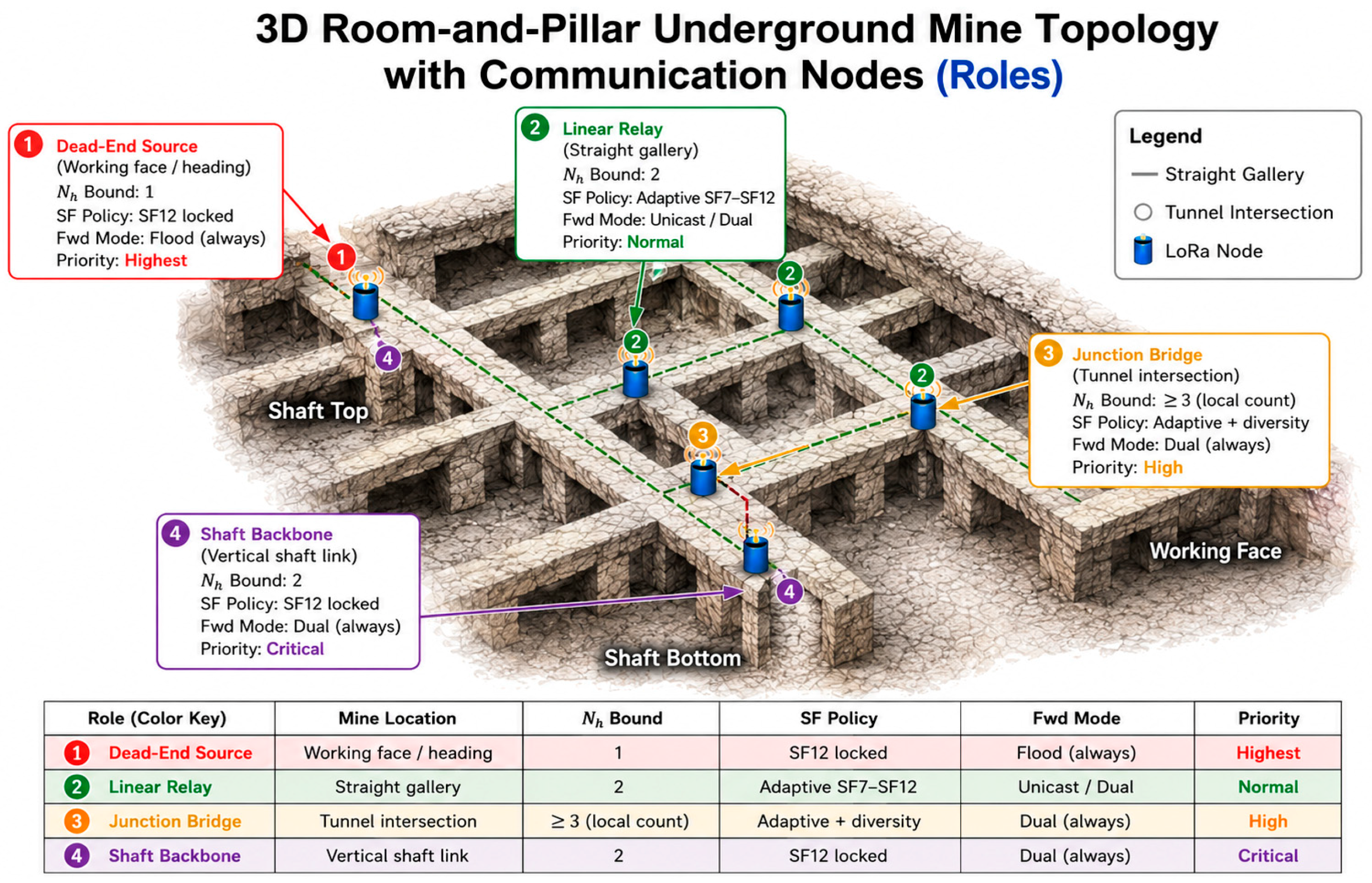
This paper is motivated by a key observation that has not been exploited in any prior work: the structured topology of underground mines consisting of straight galleries, junctions, shaft links, and dead-end headings maps directly onto bounded contender sets. A node in a straight gallery has at most two directional neighbour groups. A node at a junction has three or more. A dead-end node at a working face has only one. These topological roles, once identified, provide tight and provably correct bounds without any network-wide coordination. The challenge is that nodes must infer their topological role from locally observable information, since they have no access to mine maps, GPS positioning, or external coordination.
We present TACL, a Topology-Aware Concurrent LoRa mesh protocol that resolves both the contender estimation problem and the SF diversity collapse through distributed topology inference requiring no additional hardware or network infrastructure. Each node autonomously classifies its structural role into (i) dead-end source, (ii) linear relay, (iii) junction bridge, or (iv) shaft backbone from local RF observations and packet header fields alone, without GPS, pre-loaded mine maps, or central coordination. The inferred role directly determines , the timing offset, the SF diversity assignment, and the forwarding mode, eliminating all hardcoded parameters and central coordination dependencies. The specific contributions of this paper are:
A distributed topology inference algorithm that classifies underground mine node roles using time-to-live (TTL)-based directional neighbour labelling, achieving greater than 92% classification accuracy within 45 s of deployment without GPS, pre-loaded maps, or central coordination. The TTL mechanism requires only standard packet header fields, operates on the RP2040 microcontroller within per-event complexity, and is resilient to asymmetric node placement and irregular tunnel geometry.
A topology-driven contender estimation mechanism that derives provably bounded estimates from inferred node roles, replacing the open-loop assumptions of existing CT protocols with locally derivable, topology-grounded values. Dead-end and linear relay estimates are exact; junction estimates are pessimistically bounded, guaranteeing no slot under-allocation.
A role-constrained SF diversity assignment policy that prevents the SF convergence collapse in homogeneous tunnel channel conditions, preserving the capture effect advantage that CT protocols depend on. Conflict detection and even/odd resolution guarantee that two conflicting neighbours always shift to distinct SFs in a single adaptation step.
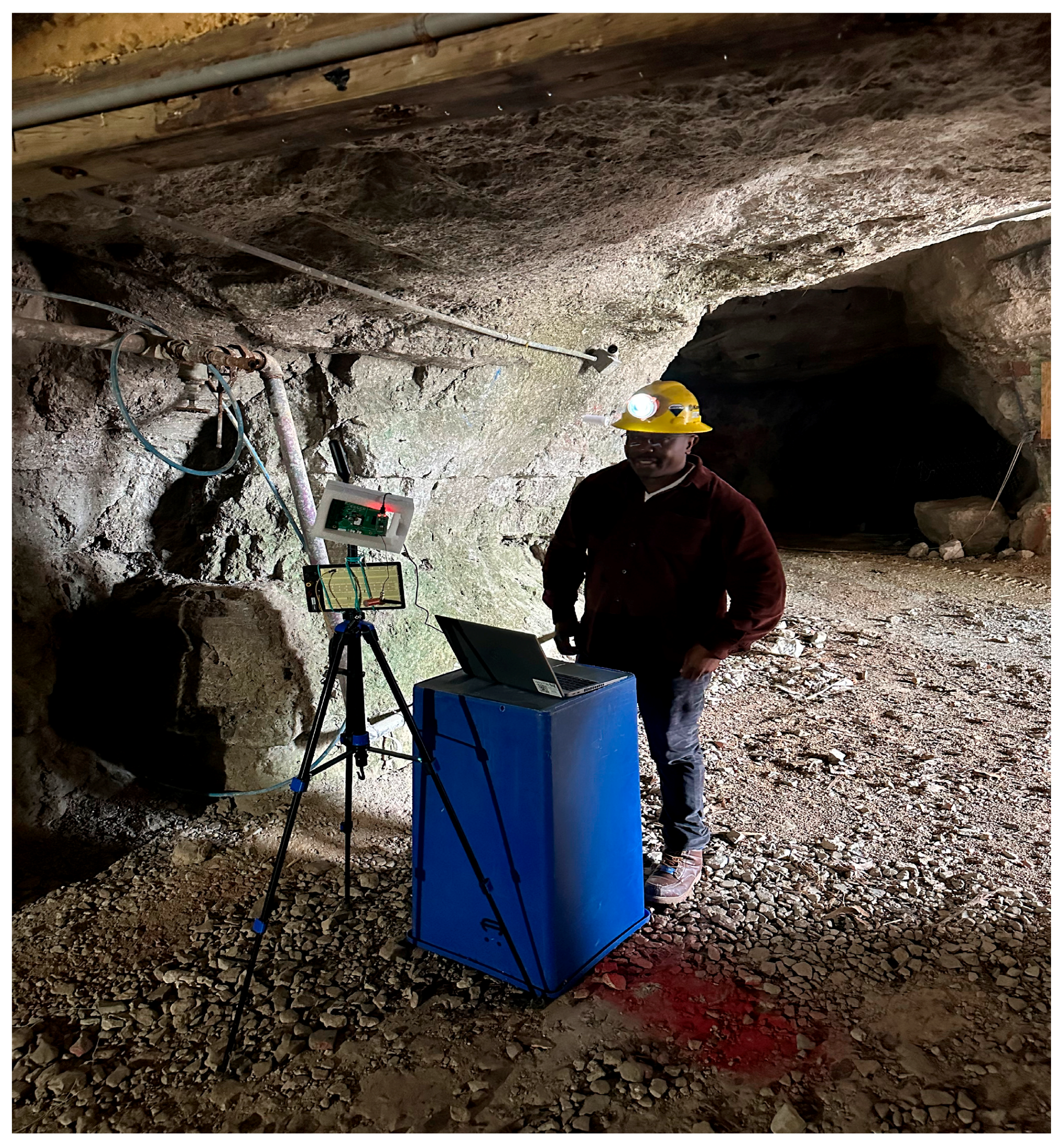
Hardware validation at the Missouri S&T Experimental Mine facility using 14-node deployments of the Waveshare Pico-LoRa-SX1262 platform with LiPo battery. An end-to-end hardware results are benchmarked against simulation across packet error rate, latency, and energy metrics.
The remainder of this paper is organized as follows.
Section 2 reviews related work on LoRa concurrent transmission, underground mine propagation modelling, and self-organizing mesh protocols.
Section 3 presents the system model and underground mine topology characterization.
Section 4 details the TACL protocol design including the TTL-based topology inference engine, role-constrained
estimation, SF diversity controller, and timing offset scheduler.
Section 5 describes experimental methodology covering both the Monte Carlo simulation framework and the Missouri S&T Experimental Mine hardware testbed, as well as a performance evaluation comparing TACL against ALOHA, Slotted ALOHA, and topology-agnostic CT baselines.
Section 6 concludes the paper.
2. Related Works
Wireless communications in underground mines face fundamentally different propagation conditions from above-ground deployments. Forooshani et al. [
11], provide the canonical survey, cataloguing the waveguide effect in straight tunnels (exponent n ≈ 1.8–2.2), severe diffraction losses at junctions (8–12 dB), and the hybrid free-space-to-waveguide transition with increasing distance. Hrovat et al. [
16], confirm these findings across 400 MHz to 5.8 GHz, and Zhang [
9] provides the tractable tunnel path loss model adopted in
Section 3.3. Branch presents empirical 915 MHz LoRa measurements in an underground gold mine, confirming a two-slope path loss model consistent with the waveguide transition, but coverage is limited to a single straight tunnel without junction or dead-end characterization. Kumar et al. [
5] and Ray Chowdhury et al. [
17] demonstrate LoRa feasibility for mine environmental monitoring and personnel tracking but treat the network as a single-hop star topology, which collapses under emergency burst traffic. None of these works address the protocol design problem for self-organizing multi-hop emergency mesh operation after infrastructure failure.
Wong et al. [
18] survey 80+ multi-hop LoRa proposals, concluding that concurrent access methods yield inconsistent results across environments and that no existing protocol addresses underground mine topology. Ebi et al. [
19] deploy a synchronous LoRa mesh for underground drainage monitoring using TDMA-based forwarding but rely on GPS-disciplined synchronization unavailable in deep mine emergency scenarios. Branch [
20] builds a LoRa linear sensor network for mine personnel tracking in a single straight gallery, and refence [
7] extends this to medieval tunnel aqueducts, but neither work addresses junction-and-dead-end topologies or concurrent transmission. Anabi et al. [
21] propose an RF-energy-harvesting CT LoRa mesh for emergency mine communications with timing offsets but use a globally fixed contender count
across all nodes: the
estimation problem motivating the present work.
Liao et al. [
12] established the CT paradigm for LoRa multi-hop networks, demonstrating through physical-layer experiments that LoRa receivers can decode the stronger of two simultaneous packets when the power differential exceeds 6 dB, achieving 87–92% PDR in outdoor testbeds with fixed hop-count timing offsets. Eletreby et al. [
13] exploit CT in urban LPWAN deployments through power differentials from different node distances. Hou et al. [
15] introduce a contender estimation mechanism based on gateway-aggregated packet reception statistics, the closest antecedent to our
problem, but this approach requires gateway-side visibility of the full network, which is unavailable during a disaster. Tian et al. [
14] extend LoRaWAN with LoRaHop using a synchronous flooding layer, achieving high delivery rates on a 21-node urban testbed, but require a pre-agreed join-phase schedule unsuitable for infrastructure-free emergency activation. No existing CT protocol derives
from local topology observations.
Croce et al. [
22] and Waret et al. [
23] establish that LoRa SFs are not perfectly orthogonal. The same-SF collisions degrade both packets below the capture threshold, while inter-SF isolation ranges from −16 dB (SF7 vs. SF8) to −40 dB (SF12 vs. SF11). These findings motivate SF diversity as a collision mitigation strategy. Standard LoRaWAN Adaptive Data Rate (ADR) assigns SF centrally based on node-to-gateway distance, which is ill-posed in multi-hop mesh networks where the relevant propagation distance is to the next-hop relay. Bor and Roedig [
24] demonstrate through systematic measurement that the optimal SF for a given link depends jointly on distance, interference level, and data rate requirement. TACL implements this principle through topology-role-based SF assignment. Thus, replacing distance with structural position as the primary determinant and preventing the SF convergence collapse that degrades CT under homogeneous underground channel conditions.
Table 1 presents comparative summary of related work against the proposed protocol.
4. System Model
TACL is a fully distributed protocol executed independently at every node across six tightly coupled modules: neighbour observation, TTL-based topology inference, estimation, SF diversity control, timing offset scheduling, and forwarding mode selection. The modules are described in turn below and integrated into a single per-event procedure in Algorithm 3.
4.1. Neighbour Observation Subsystem
Every node maintains a neighbour table
of up to
entries, each recording node ID, RSSI exponential moving average (EMA), SNR EMA, observed SF, RSSI variance, time of last reception, and a directional label. The table is updated passively on every overheard packet at zero additional airtime cost. The RSSI EMA uses smoothing factor
, i.e., weight on the new sample:
where
is the observed RSSI. A slow EMA, i.e.,
, is used deliberately. Mine channel fluctuations have correlation lengths of several seconds at walking speed. Increasing the EMA smoothing factor
increases responsiveness to recent channel variations but reduces temporal stability by amplifying short-term fading fluctuations. While larger
values improve adaptation speed under rapidly changing topologies, they may destabilize role inference, RSSI clustering, and SF diversity control in slowly varying underground propagation environments. Consequently, a conservative value
was selected to prioritize topology stability over rapid transient adaptation. The RSSI variance is tracked with the same smoothing weight:
where a high variance of
or standard deviation
is the signature of a vertical shaft link and is used exclusively in the shaft classification branch of Algorithm 1. Since SX1262 is a single-antenna transceiver reporting only scalar RSSI and SNR, phase, angle-of-arrival, or time-difference-of-arrival information metrics are not accessible from its register interface or SPI bus and therefore were not considered herein. Direction is inferred entirely from packet header TTL fields, as described next. Neighbours’ silent for
are marked inactive.
| Algorithm 1 Direction Labelling Rule |
Let remaining TTL in packet received FROM neighbour . Let TTL at which this node last forwarded from same src chain. if lable AWAY ( is further from gateway—it forwarded BEFORE this node in the chain) if lable TOWARD ( is closer from gateway—it forwarded AWAY this node in the chain) if lable LATERAL ( feeds from a different source path—likely a crosscut or branch arm). if no reference yet (bootstrapping): label UNKNOWN.
|
4.2. Distributed Topology Inference
4.2.1. TTL-Based Directional Neighbour Labelling
Each packet carries a TTL field initialized to by the originating node and decremented by one at each relay. Node assigns a direction label to each active neighbour by comparing in packets from against : (i) the TTL at which last forwarded packets from the same source chain; (ii) ⇒ label AWAY ( deeper in the mine); (iii) label TOWARD ( deeper in the mine); and (iv) label LATERAL (crosscut or branch arm). Labels are stabilized by majority vote over packets per neighbour. Algorithm 1 presents the TTL based directional neighbour labelling.
The directional cluster count
is then the number of distinct committed labels in the active neighbour set:
where
indicates all neighbours lie in one direction, i.e., the node is a dead end. Similarly,
implies neighbours on two sides notably a straight gallery relay or shaft link.
indicates neighbours on three or more sides such as a tunnel junction with lateral arms.
4.2.2. RSSI Clustering as Secondary Junction Confirmation
At nodes where TTL labelling has established
, RSSI clustering provides secondary confirmation using the 8–12 dB junction scattering loss of
Section 3.3. The RSSI range of the active neighbour set is:
If , the neighbour set is recursively partitioned at the midpoint RSSI until no subgroup exceeds , yielding per-arm clusters. The higher of the RSSI partition counts and TTL-derived is used, since a TTL label may be absent for a lightly trafficked lateral arm. RSSI clustering is never applied in straight galleries, where the waveguide effect produces no systematic RSSI gap between opposite-side neighbours.
4.2.3. Role Classification
Algorithm 2 maps
to one of five roles. Rule 3 precedes Rule 4 because a shaft node has
identical to a linear relay and the variance discriminant resolves the ambiguity. Algorithm 2 presents the role classification role assignment.
| Algorithm 2 Role Classification |
Input: ,
Output: |
if return UNKOWN. if or return DEAD-END if and return SHAFT. // high-variance shaft link if or return JUNCTION. // multiple arms or dense node cluster if and return LINEAR. // straight gallery relay return UNKNOWN
|
4.2.4. Role Stability
Two stability mechanisms prevent oscillation. A confirmation counter is incremented each time Algorithm 2 returns the same candidate role as the previous run. A role is committed only when consecutive classifications agree. Therefore, counts the number of consecutive times that the node’s topology inference algorithm produces the same candidate role classification.
A hold timer prevents any role transition within of the last committed transition. Together these mechanisms ensure that transient channel events, such as a passing vehicle, that result in a brief packet burst from an unexpected direction cannot destabilise the protocol state. During the bootstrapping phase, each node temporarily assumes the linear relay role with a default contender estimate with corresponding to the two-direction topology typically observed in straight tunnel galleries.
4.3. Topology-Constrained Nh Estimation
The per-hop contender count
, i.e., the number of nodes simultaneously attempting to forward the same packet determines how many non-overlapping slots the timing offset scheduler must create. Under-estimating
causes two co-forwarders to share a slot and collide. Similarly, over-estimating wastes airtime because radio reception is silent;
cannot be directly observed and must be estimated locally. TACL resolves this by deriving
from the inferred role. The number of simultaneous co-forwarders is bounded not by how many neighbours exist but rather by how many distinct directions they lie in directionality. Mine tunnel geometry limits this directional count to a structurally small value at every topology element, yielding the mapping:
Each bound follows directly from tunnel structure: a dead-end node has no co-transmitter behind it, exactly; a linear relay has at most one contender per direction, exactly; a junction uses as a pessimistic upper bound across all arms. is bounded by the number of distinct directions from which co-forwarders can simultaneously arrive, not by the total number of active neighbours. TOWARD-side neighbours are structurally excluded from the co-forwarder set because they already processed the packet one hop earlier.
4.4. Slot-Based Timing Offset Scheduler
The protocol divides the forwarding window into
equal slots and assigns each co-forwarding node to exactly one slot via its hardware ID:
The mod operation produces a remainder in
. This remainder is the slot index: slot 0 transmits first, slot 1 transmits one slot-width later, and so on. As the hardware ID is globally unique and fixed, two distinct nodes with the same
will collide on their slot index only if their IDs are congruent modulo
. Slot width
is derived from a Poisson collision model with arrival rate
and vulnerable window
, where
is the vulnerable window factor accounting for LoRa’s partial temporal overlap capture behaviour. The probability of a collision-free transmission is:
Setting
and dividing the minimum window equally across
contenders gives:
With
and
, Equation (20) gives
·
independent of
.
controls how many slots exist, not how wide each slot is; the per-hop collision probability is held at
by construction regardless of contender count. The scheduled transmission time is:
where
is the SX1262 mode-switching guard,
is the slot index from (18), and
is a jitter term preventing accidental synchronisation among nodes sharing the same slot residue. All timing uses only the local reception timestamp
no shared network clock is required.
4.5. Role-Driven SF Diversity Controller
Waveguide propagation causes nodes in the same tunnel segment to converge to the same SF under standard ADR, collapsing the SF diversity that CT depends on. The diversity controller prevents this by assigning each node a base SF from its role and hardware ID:
Dead-end and shaft nodes are locked to SF12 for maximum link robustness. Linear relay and junction bridge nodes use the ID-modulo scheme
, ensuring any four adjacent same-role nodes span four distinct SF values with inter-SF isolation ≥ 16 dB. When a neighbour is heard on the same SF and RSSI > −110 dBm, a conflict is flagged. After
within
:
The even/odd rule guarantees conflicting neighbours always shift in opposite directions, resolving the conflict in one step. SF reverts to
when the conflict clears.
Table 4 presents SF diversity assignment by role and node ID residue.
4.6. Forwarding Mode and Relay Set Selection
Each node selects a forwarding mode from its committed role and battery SoC fraction
:
UNICAST forwards to the single highest-RSSI TOWARD-labelled neighbour. UNICAST conserves energy while relying on future attempts if needed. When the node is approaching exhaustion and may not survive to transmit again. DUAL adds the best LATERAL-labelled neighbour as a redundant crosscut path. FLOOD transmits to all active neighbours. Dead-end source nodes are role-locked to FLOOD unconditionally, therefore maximizing single-packet delivery probability takes priority over relay longevity when battery is low. Within DUAL and FLOOD modes, relay set members are ordered by descending RSSI, ascending SF, then ascending hardware ID.
4.7. Duplicate Suppression via Seen-Packet Cache
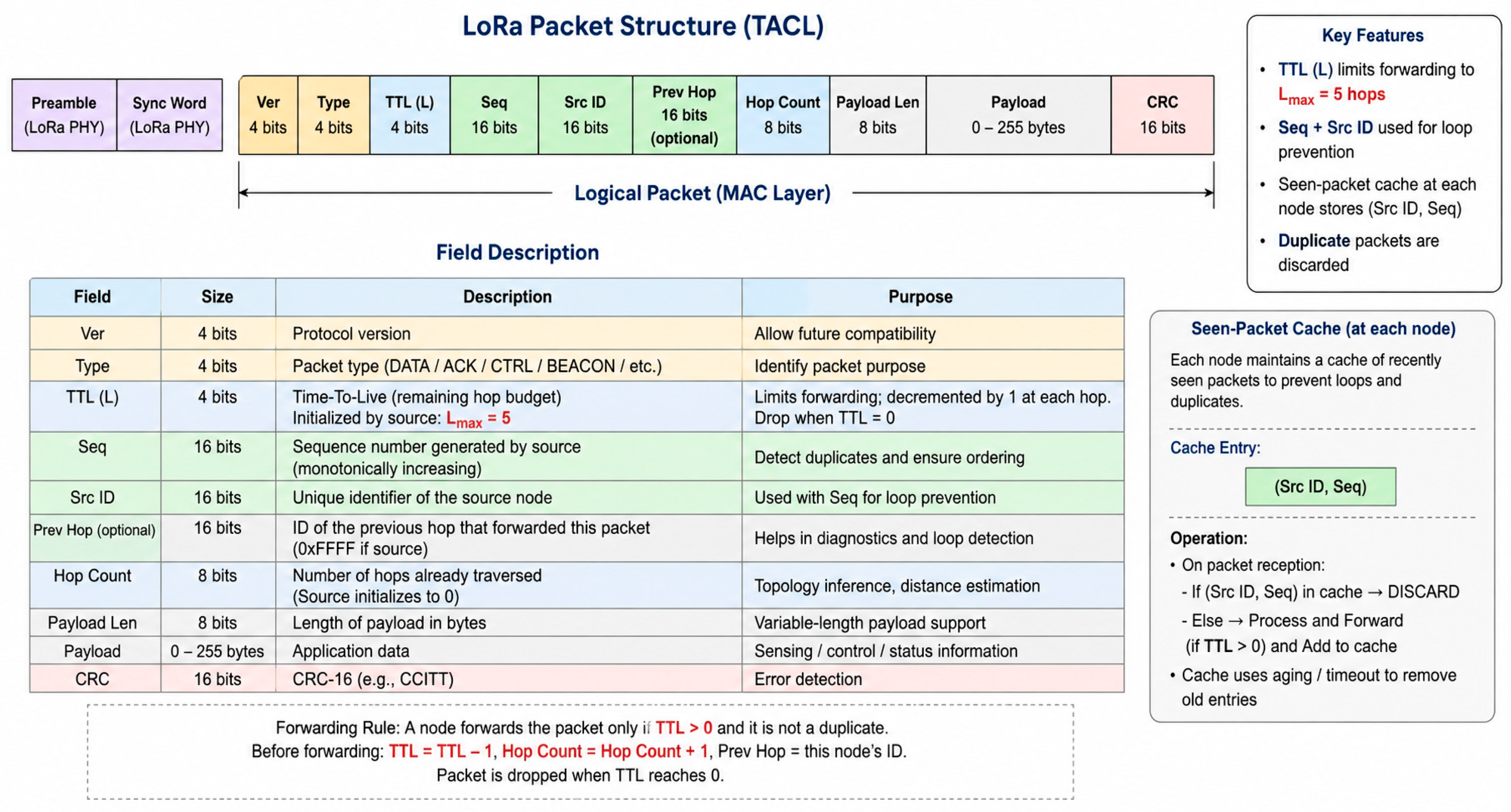
Every node maintains a cache of recently processed packets indexed by : the originating node’s hardware ID paired with its per-packet sequence counter. This pair forms a globally unique packet identity carried unchanged across all hops. On receiving a packet, the node checks the cache, a hit indicates a duplicate arriving via a parallel path and the packet is silently discarded, a miss triggers normal processing and a new cache entry. Entries expire after , bounding memory to approximately 50 entries at peak packet rates while permitting counter reuse. The cache and TTL field are complementary loop prevention mechanisms. The cache suppresses within-episode duplicates arriving via parallel paths. TTL enforces a hard lifetime for packets that outlive their cache entry.
4.8. Complete Protocol Operation
Algorithm 3 integrates all six modules into a unified per-event processing framework with computational complexity
. The overall memory footprint consists of a 16-entry neighbour table, a 160-entry directional voting window
, and a 50-entry seen-packet cache. This lightweight memory architecture fits comfortably within the RP2040 microcontroller’s 264 KB SRAM. Furthermore, the implementation requires no dynamic memory allocation, thereby ensuring deterministic execution and low-overhead operation suitable for resource-constrained embedded systems.
| Algorithm 3 TACL Per-Event Procedure |
Trigger: Packet received from PHY OR source data ready
=== MODULE 1: Neighbour Table Update ===
Extract from header. [Equation (13)] [Equation (14)] Prune entries where === MODULE 2: Directional Labelling === Compare against (last forwarded TTL for this src chain). Update direction label for in majority-vote window . count of distinct committed labels in [Equation (15)] === MODULE 3: Role Classification === Candidate Algorithm 2 if candidate else . if AND . === MODULE 4: Estimation === lookup [Equation (21)] === MODULE 5: SF Diversity Control === Equation (22). if AND : if within (even/odd rule, bounded to role range) [Equation (23)] . === DUPLICATE AND TTL CHECK === if in : DISCARD; return Add to (expire after ). if DISCARD // hop limit reached. === MODULE 6: Forwarding Scheduler === [Equation (24)] Compute time-on-air [Equation (5)] [Equation (20)] [Equation (18)] [Equation (21)]. At Transmit .
Update energy state |
4.9. Protocol Parameter Summary
Table 5 consolidates all TACL design parameters. Asterisked values were tuned through Monte Carlo simulation (
Section 6); all others are analytically derived or sourced from hardware specifications. Similarly,
Figure 2 presents the TACL packet. Packet forwarding is bounded by a TTL parameter
. Each packet carries a sequence number (seq) and source identifier (src) used for loop prevention via a seen-packet cache maintained at every node. The gateway serves exclusively as a network sink, i.e., it receives and logs all delivered packets and periodically transmits beacon frames to provide loose network-wide time reference but never originates or forwards data packets.
6. Conclusions
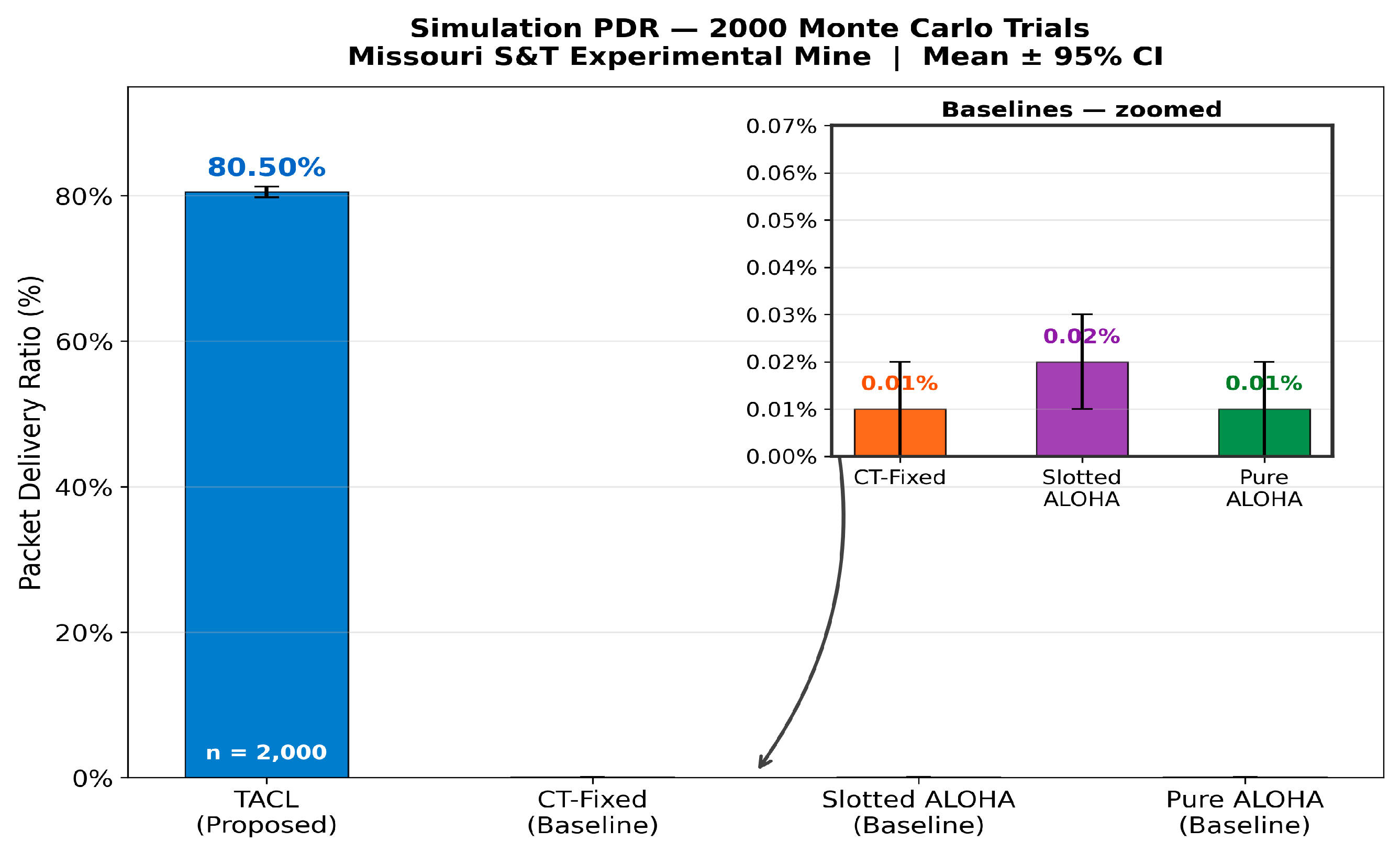
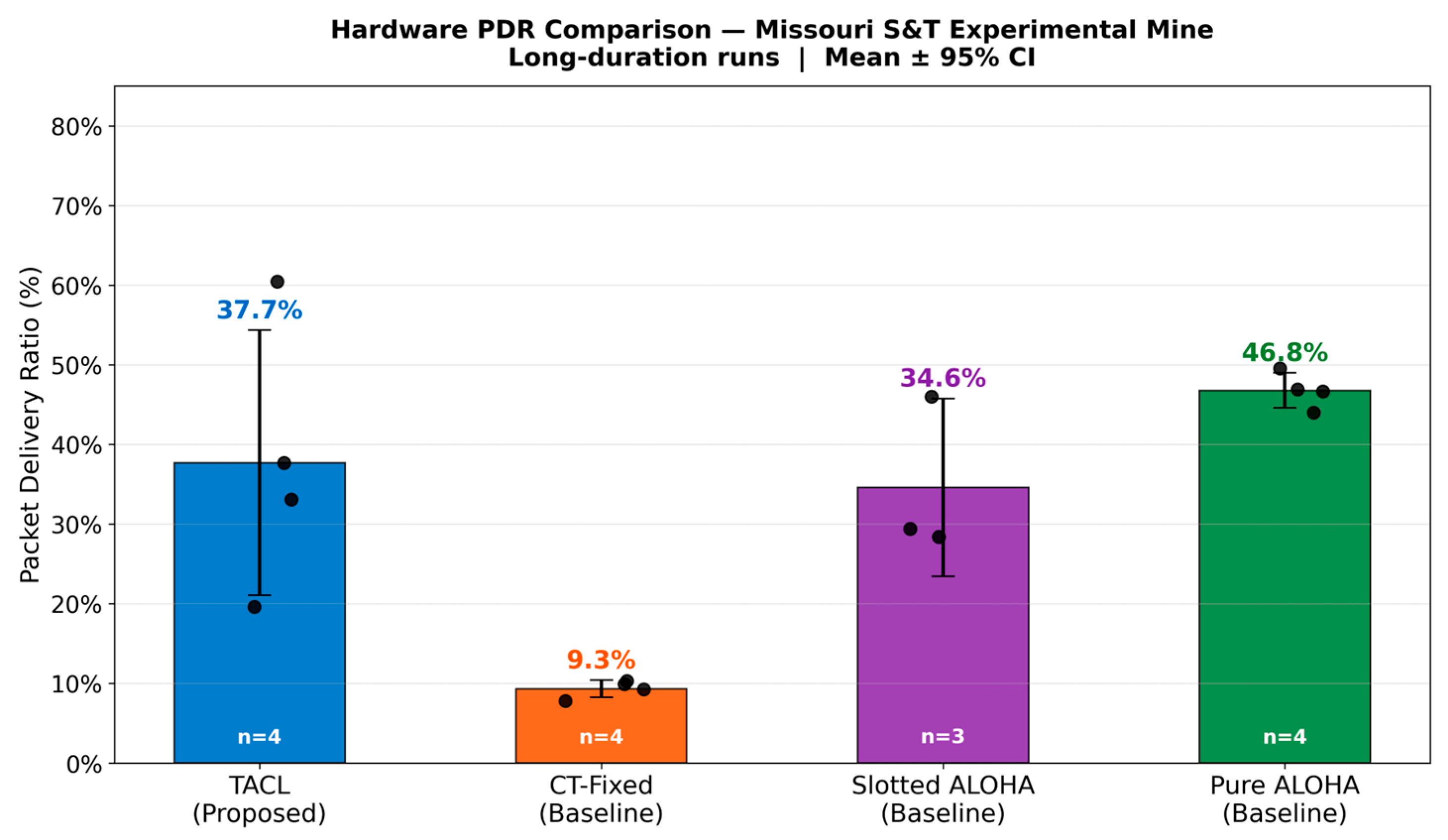
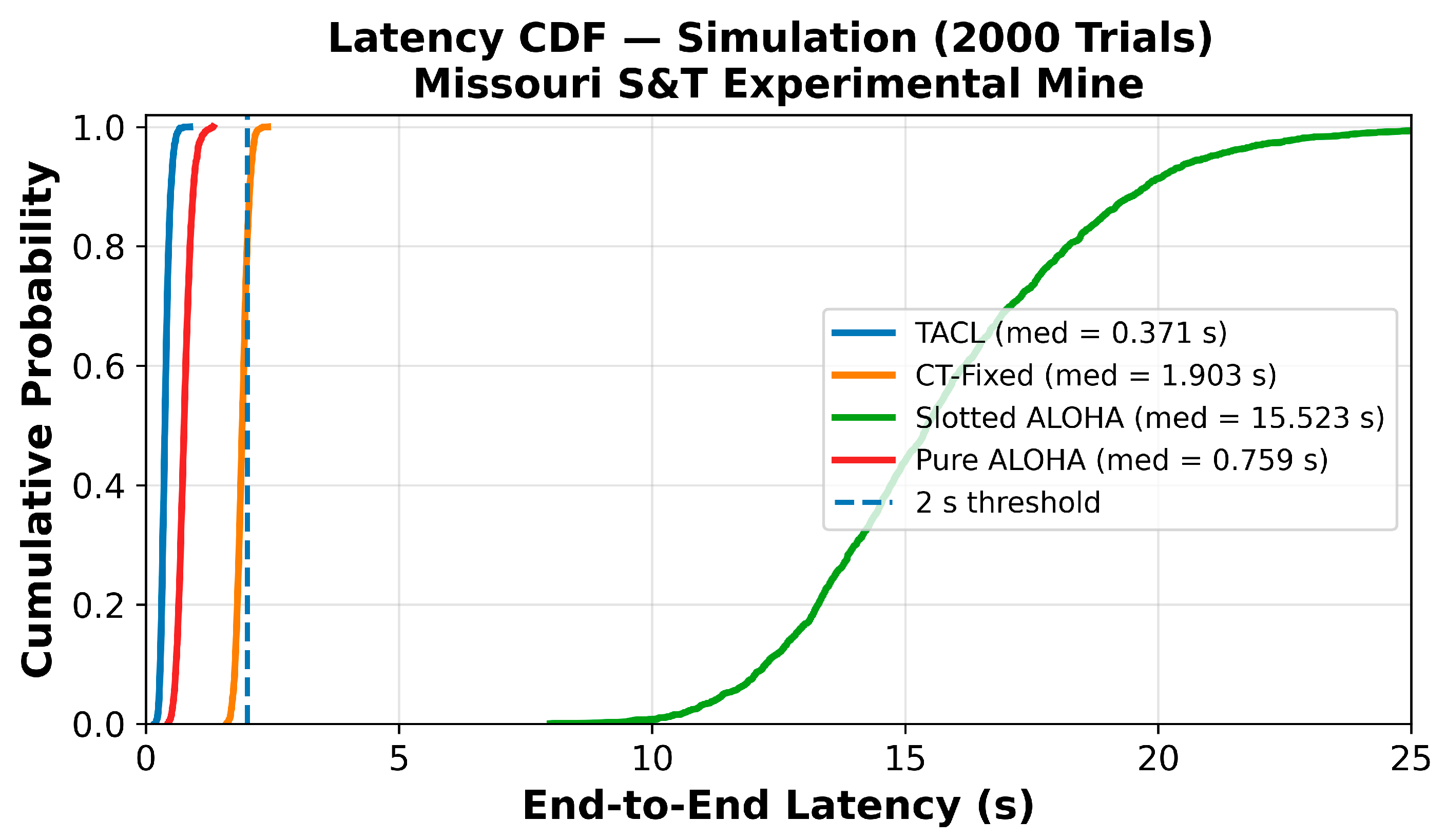
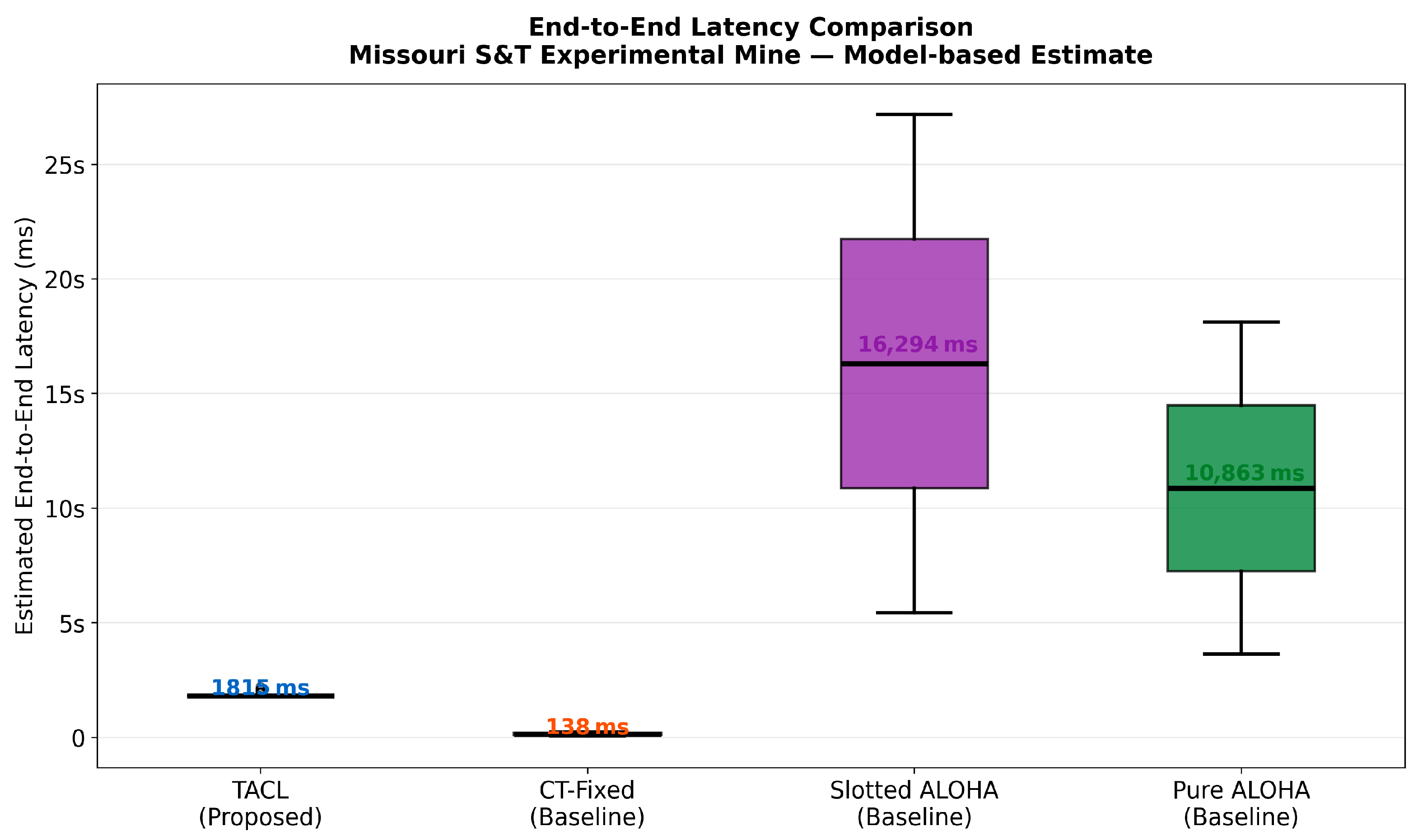
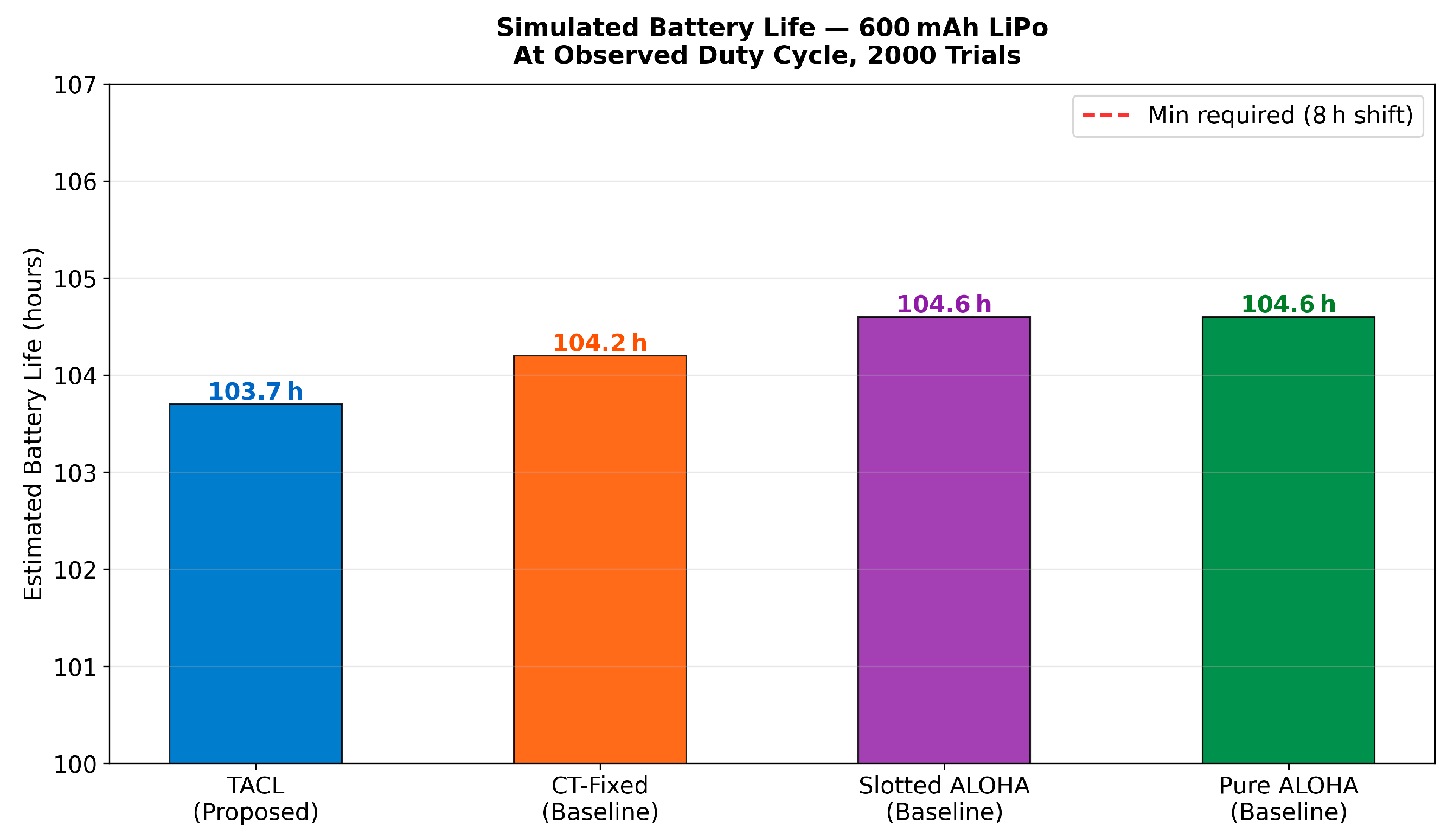
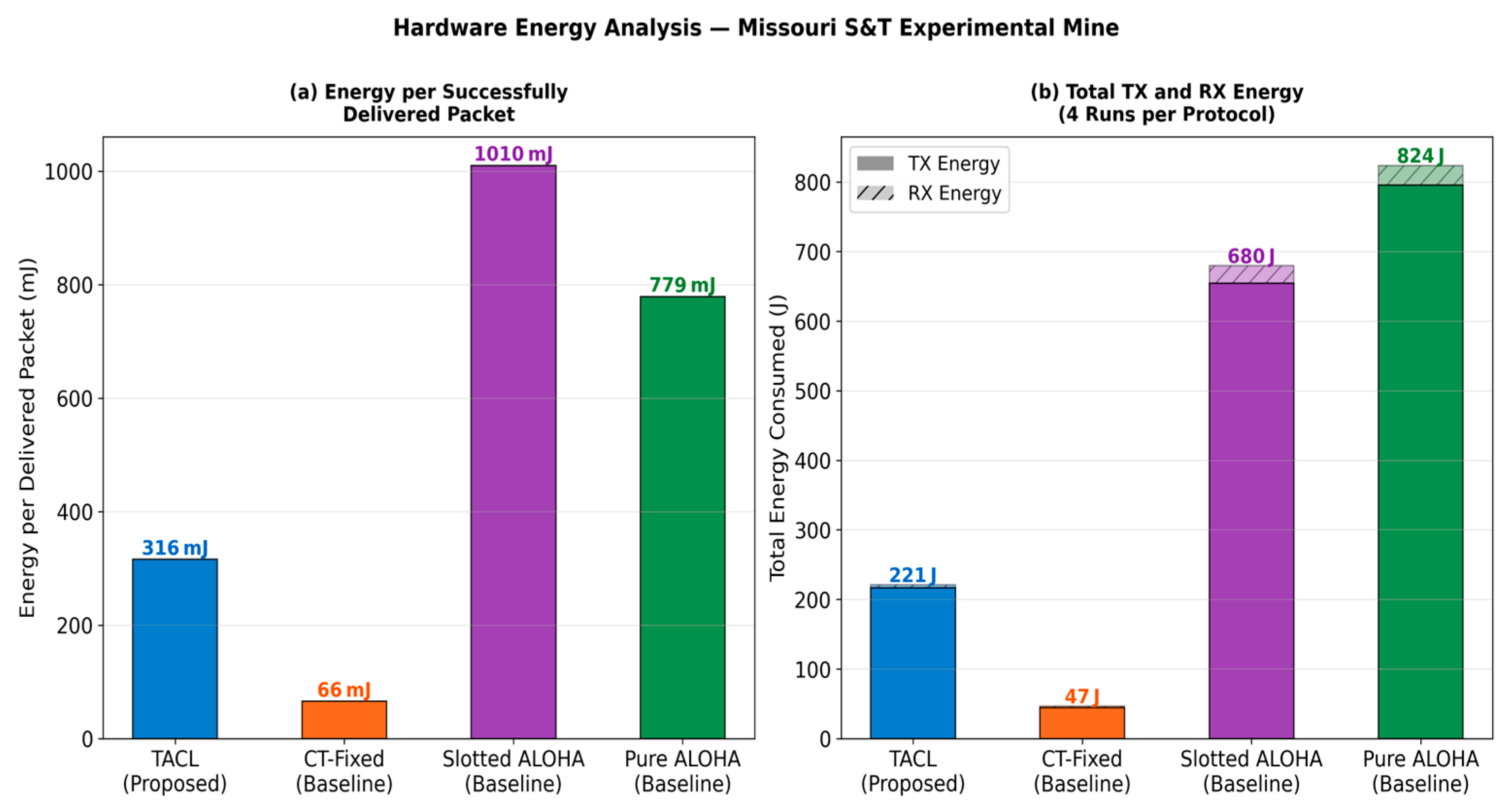
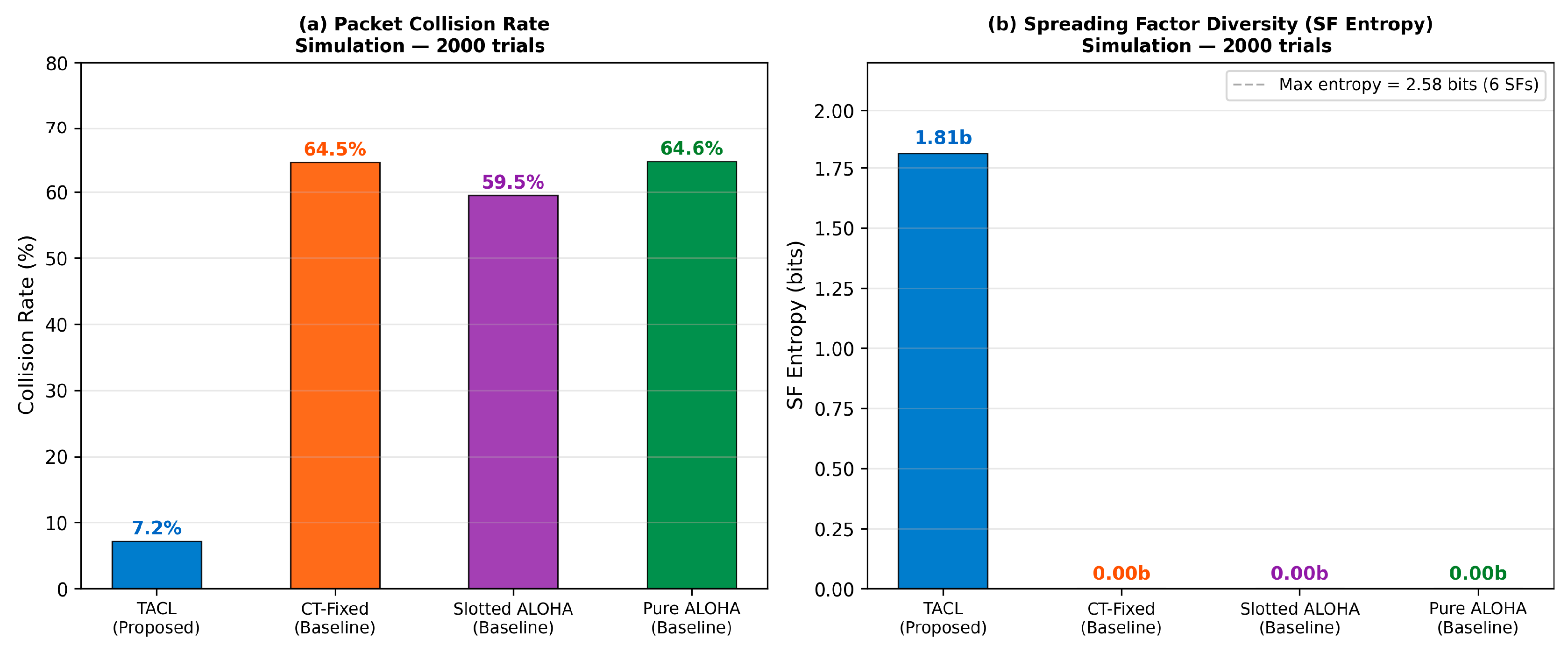
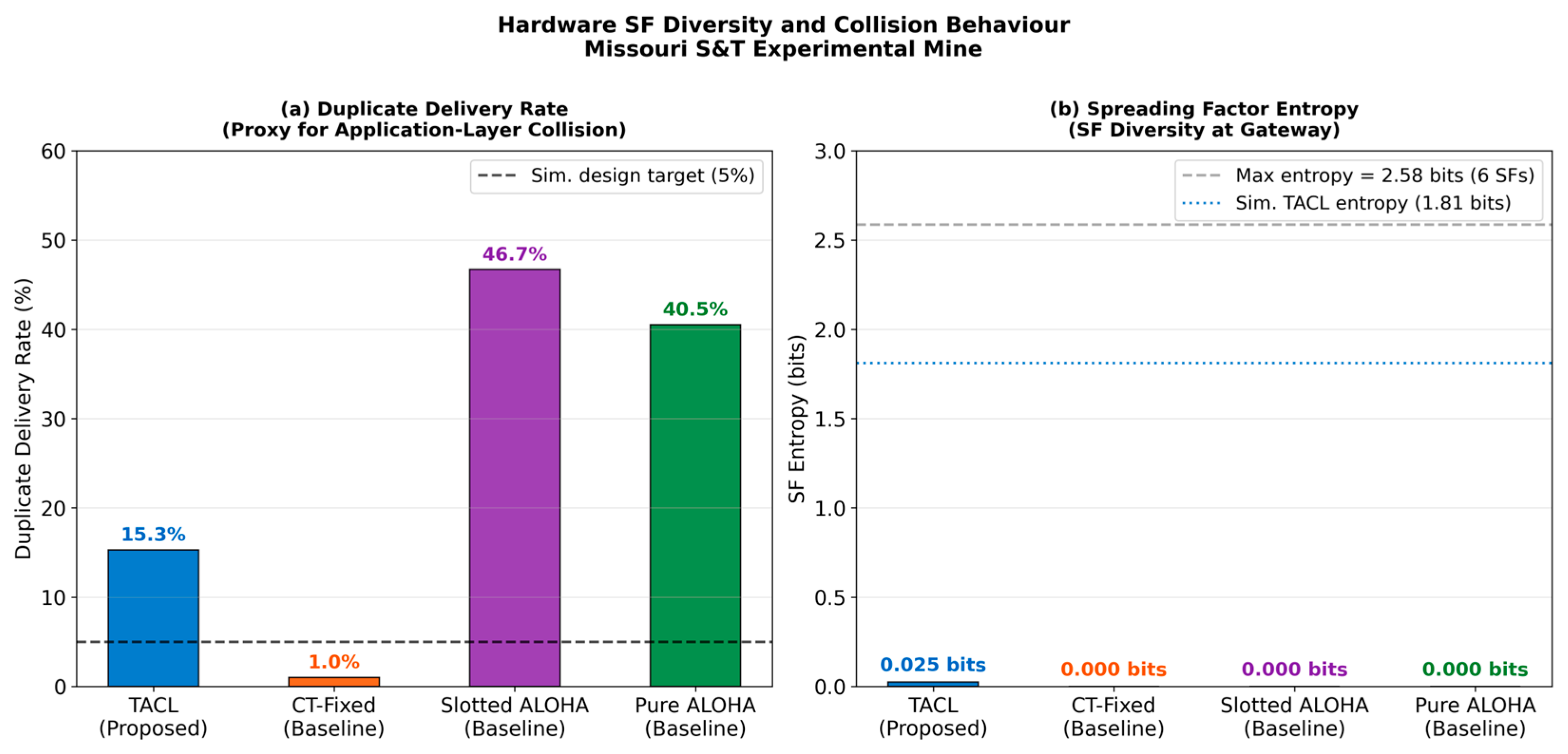
This paper presented TACL, a Topology-Aware Concurrent LoRa mesh protocol for underground mine emergency communications. TACL enables each node to autonomously infer its structural role—dead-end source, linear relay, junction bridge, or shaft backbone—from local RF observations and standard packet header TTL fields alone, without GPS, pre-loaded mine maps, or central coordination. The inferred role resolves the contender estimation problem that has remained open in the prior concurrent transmission literature, drives topology-constrained SF diversity assignment to prevent the SF convergence collapse that degrades capture-effect-based CT under homogeneous underground channel conditions, and selects the forwarding mode matched to each node’s topological position and battery state. Monte Carlo simulation over 2000 trials using measured Missouri S&T Experimental Mine propagation parameters confirmed the central claim of the paper: under worst-case maximum-contention conditions, TACL achieves a PDR of 80.5% (±0.73%) while all three baselines collapse to near-zero: CT-Fixed = 0.01%, Slotted ALOHA = 0.02%, and Pure ALOHA = 0.01%. The simulated SF entropy of 1.81 bits confirmed that TACL’s role-driven SF assignment activates the full SF7–SF12 diversity range across the node population, reducing the per-hop collision rate to 7.2%, closely matching the design target of . Simulated battery life of 103.7 h confirms that the 600 mAh LiPo battery sustains continuous emergency operation well beyond the 8-hour mine shift minimum. Hardware deployment at the Missouri S&T Experimental Mine across 11,605 packet transmission attempts validated TACL’s functional correctness in a real mine environment. TACL achieved a mean per-run PDR of 37.7% (±16.6%), representing a 4.0× improvement over the topology-agnostic CT-Fixed baseline (9.3%), whose tight run-to-run CI of ±1.1% confirmed systematic same-SF collision collapse. TACL’s median end-to-end latency of 1815 ms with a P95 spread of only 128 ms was 84× tighter than the best ALOHA-based protocol, providing the latency predictability essential for emergency distress signalling. Energy per successfully delivered packet was 316 mJ—2.5× lower than Slotted ALOHA (1010 mJ) and 2.5× lower than Pure ALOHA (779 mJ)—despite using SF12, because TACL’s 15.3% duplicate delivery rate was 2.8× lower than the ALOHA protocols’ 40–47%, eliminating the energy wasted on uncoordinated concurrent retransmissions. The combined simulation and hardware evidence establishes that explicit exploitation of underground mine topology is both feasible through distributed role inference and essential for reliable, predictable, and energy-efficient concurrent LoRa mesh operation in post-disaster underground emergency scenarios. TACL requires no infrastructure beyond the mesh nodes themselves, making it immediately deployable after events that destroy conventional communication systems.