1.1. Background
IoT and sensor-network environments typically consist of a large number of resource-constrained devices, such as sensor nodes, edge devices, and aggregation gateways, which operate under limited computational power, memory, bandwidth, and energy budgets. At the same time, these systems often require long-term confidentiality and authenticated key establishment, because they are widely deployed in critical application domains, including smart homes, industrial monitoring, environmental sensing, healthcare systems, and intelligent transportation. Such infrastructures may remain in operation for many years and rely on cryptographic algorithms for long-term protection. In 1976, Diffie and Hellman introduced the first practical key-exchange protocol, now known as the Diffie–Hellman key exchange [
1]. This seminal work established the feasibility of public-key cryptography and fundamentally influenced the design of many subsequent cryptographic schemes and key-establishment protocols. A representative example is the ElGamal encryption scheme, which can be derived from the Diffie–Hellman framework and whose security relies on the hardness of the discrete logarithm problem. Meanwhile, today, widely deployed public-key cryptosystems include RSA, whose security is based on the presumed hardness of the integer factorization problem.
However, in 1994, Shor showed that both integer factorization and discrete logarithms can be solved in polynomial time on a sufficiently powerful quantum computer [
2]. Consequently, if large-scale quantum computers become practical, the security of these conventional schemes would be fundamentally undermined. This threat has motivated the development of post-quantum cryptography (PQC), namely, cryptographic schemes that are believed to remain secure even against adversaries equipped with quantum computers.
Driven by this concern, NIST launched its PQC standardization effort and invited submissions for core public-key primitives, including public-key encryption, key exchange, and digital signatures [
3]. As part of the evaluation process, candidates were required to provide both security self-evaluations and performance data. For encryption and key-establishment mechanisms, security was primarily assessed under standard notions such as Indistinguishability under Chosen-Ciphertext Attack (IND-CCA). This process has significantly accelerated the development and analysis of practical post-quantum schemes, especially lattice-based constructions, which have emerged as some of the most promising candidates for standardization and deployment.
Among the main families of lattice-based cryptography, schemes based on the Learning With Errors (LWE) problem are particularly important. The plain LWE setting offers a conservative foundation, but typically leads to relatively large public keys and ciphertexts; a representative example is Frodo [
4]. To improve efficiency, algebraically structured variants such as Ring-LWE have been introduced [
5], enabling more compact keys and faster polynomial arithmetic. Representative Ring-LWE-based schemes include NewHope [
6] and the Ding key exchange (DKE) [
7]. A further development is Module-LWE, which provides a middle ground between the stronger structure of Ring-LWE and the more conservative but less efficient plain LWE setting. This design space has proved especially attractive in practice, as exemplified by Kyber, a Module-LWE-based IND-CCA-secure key-encapsulation mechanism (KEM) [
8].
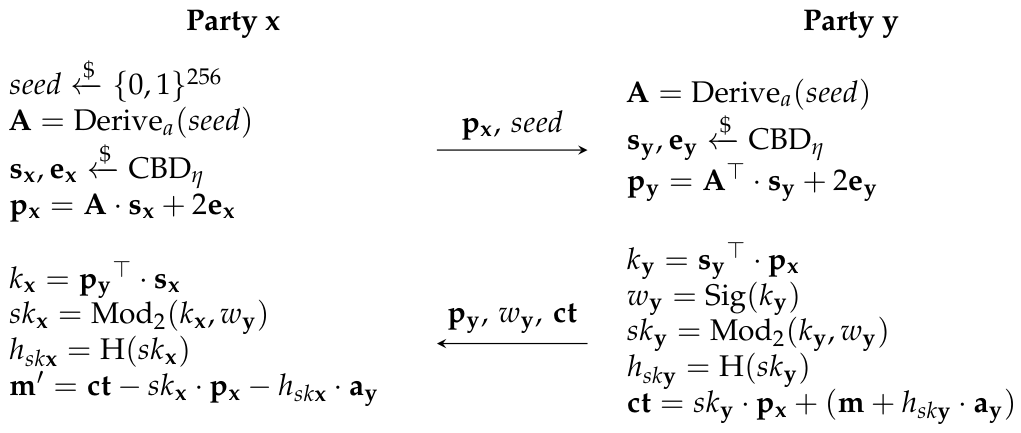
Among these schemes, DKE is the most closely related to our work. DKE is a one-sample Ring-LWE-based key-exchange protocol in which the secret and error vectors are ephemeral; that is, freshly sampled for each session and not reused across different executions. This design avoids the long-term reuse of noisy secret material and supports a simple and efficient key-exchange mechanism in the passive security model. To offset the communication overhead introduced by the ephemeral setting, DKE combines Ring-LWE with a rounding-based reconciliation mechanism through the Round function, thereby achieving a practical trade-off between security and efficiency.
From the viewpoint of modern PQC deployment, however, several issues remain open. First, although Kyber achieves excellent overall efficiency, its concrete parameter sets are closely tied to number-theoretic transform (NTT)-friendly design choices, which limits flexibility in parameter selection. Second, the decryption failure rate reported for Kyber512 is larger than , and decryption failures have long been recognized as a potential attack surface in lattice-based encryption and KEM constructions. Due to the constraints imposed by NTT-friendly parameters, it remains highly challenging to construct parameter sets that simultaneously achieve both a low decryption failure rate and AES-128-bit security. Therefore, it is meaningful to investigate alternative designs that simultaneously provide greater parameter flexibility and a smaller decryption failure rate. In addition, DKE itself provides only passive security for key-exchange, rather than stronger notions such as IND-CPA security for public-key encryption (PKE) or IND-CCA security for KEMs.
These considerations motivate the present work. We revisit the one-sample Ring-LWE key-exchange with rounding and reconciliation proposed by Ding et al. [
7], and extend it in two directions. First, we lift the construction from the Ring-LWE setting to the Module-LWE setting, aiming to retain high efficiency while allowing more flexible parameter choices and reducing reliance on rigid algebraic structure. Second, we show how to transform the resulting rounding-based key-exchange core into a practical IND-CCA KEM through a standard PKE → Fujisaki–Okamoto (FO) transform pipeline. In this way, our work connects an ephemeral one-sample key-exchange paradigm with the security and functionality requirements expected of modern post-quantum KEMs.
Simultaneously, the development of practical post-quantum cryptosystems suitable for IoT and sensor-network settings is an important topic within the scope of post-quantum cryptography for IoT and sensor networks. Recent work has also emphasized the importance and deployment challenges of integrating post-quantum cryptography into networking protocols, connected-device environments (e.g., VANET), and federated machine learning systems [
9,
10,
11,
12]. From this perspective, a post-quantum KEM for IoT-oriented deployment should not only provide strong security guarantees, but also support efficient and robust implementation on constrained platforms. In particular, moderate implementation complexity, efficient polynomial arithmetic, simple sampling procedures, and a low decryption failure probability are desirable for practical deployment in large-scale sensor-network systems.
These requirements directly motivate the design of MoRo-KEM. The proposed MoRo-KEM has several features that make it relevant to secure communication in IoT and sensor-network architectures. First, the Module-LWE setting provides a practical balance between security and efficiency, making it suitable for post-quantum key establishment between sensor nodes, edge devices, and gateways. Second, the use of centered binomial distributions instead of discrete Gaussian sampling, simplifies implementation and is more amenable to constant-time and vectorized software or hardware designs, which is beneficial for resource-constrained devices. Third, the reduced decryption failure probability improves the robustness and reliability of repeated key-establishment procedures. This property is particularly important in large-scale sensing systems, where even rare failures may be amplified by frequent protocol executions among many devices. Therefore, beyond its theoretical contribution, MoRo-KEM is motivated by practical security requirements arising from IoT and sensor-network deployments. These features make the proposed construction a relevant post-quantum key-establishment approach for constrained and large-scale networked environments.
Recent studies have further emphasized both the deployment relevance of post-quantum KEMs in IoT environments [
13,
14] and the need for careful treatment of FO-based decapsulation and decryption-failure behavior in post-quantum KEMs [
15,
16,
17]. Moreover, the 2025 NIST fourth-round status report highlights the continuing standardization and diversification of post-quantum key-establishment mechanisms [
18].