A Study on Condition-Based Maintenance for Wafer Table Edge Degradation in Photolithography Equipment

Highlights
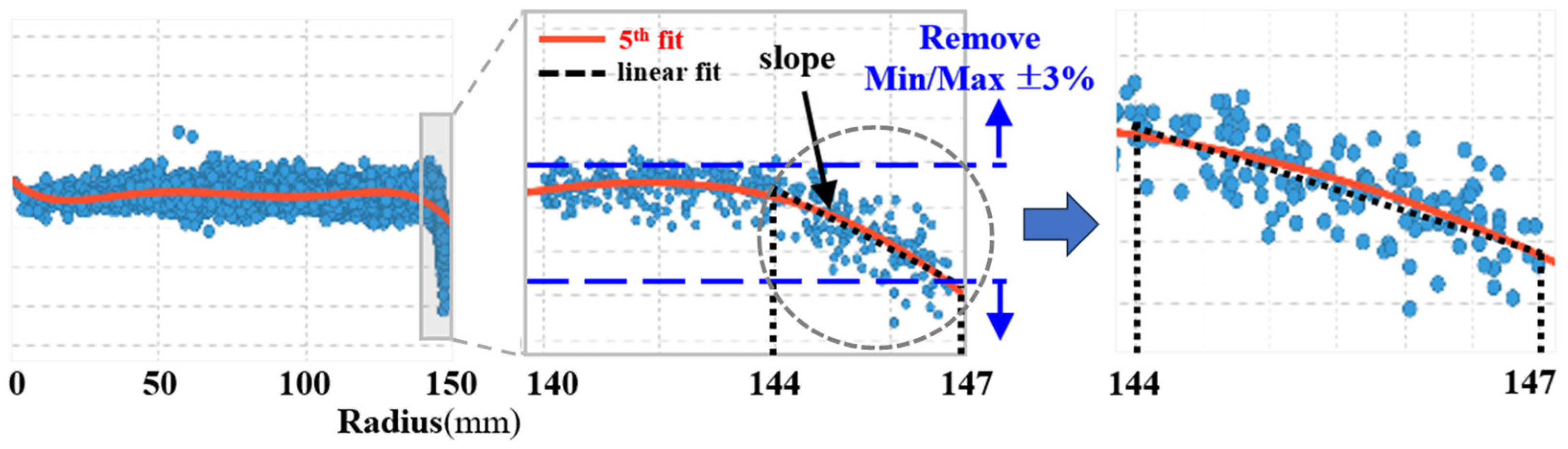
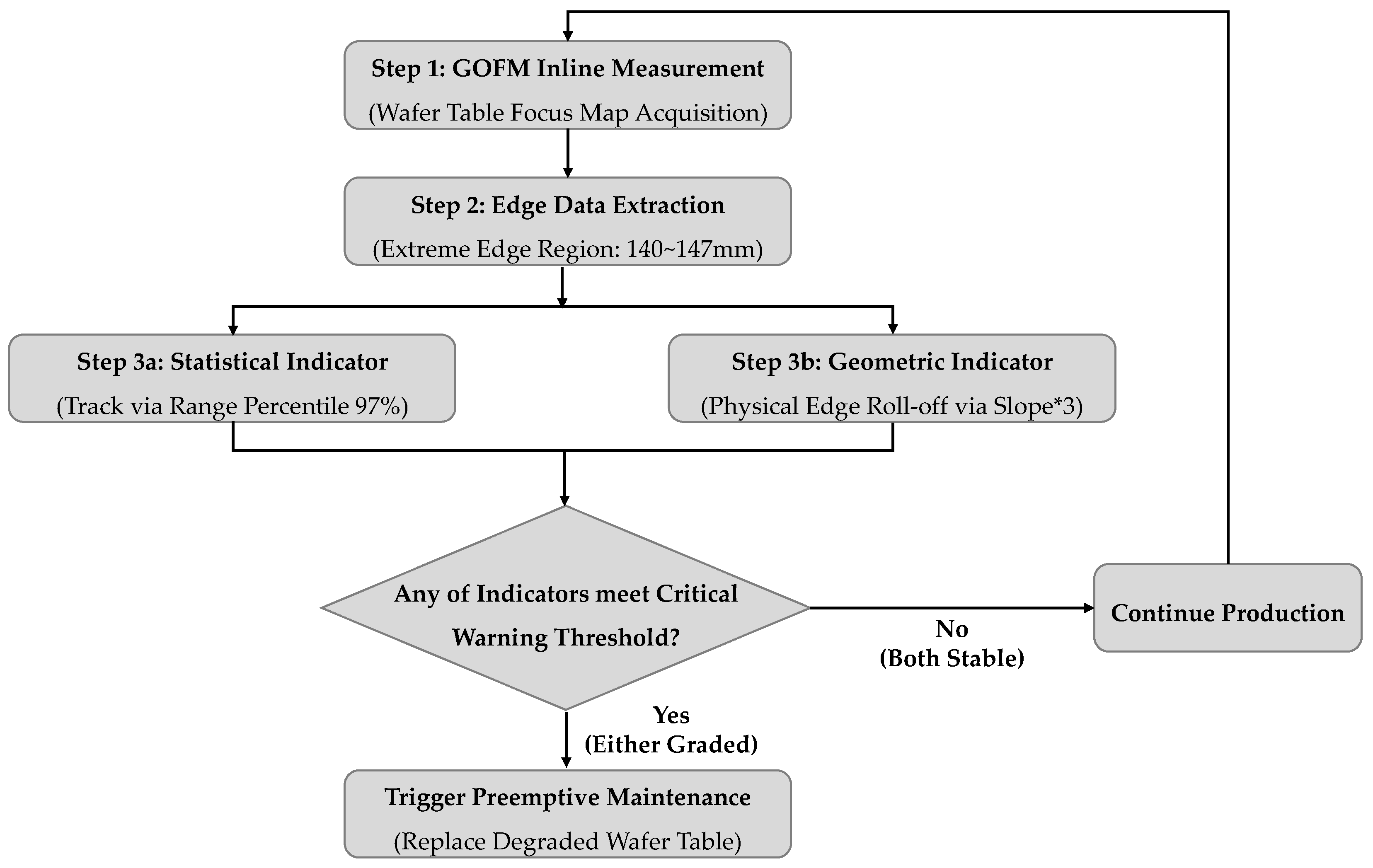
- Edge-Resolved Metrology: A novel monitoring methodology was proposed by utilizing existing Geometry-based Optical Focus Metrology (GOFM) technology. This approach determines the degradation level of the wafer table by isolating the pure focus residual specifically within the extreme outer edge (140–147 mm radius) of 300 mm wafers during photolithography operations.
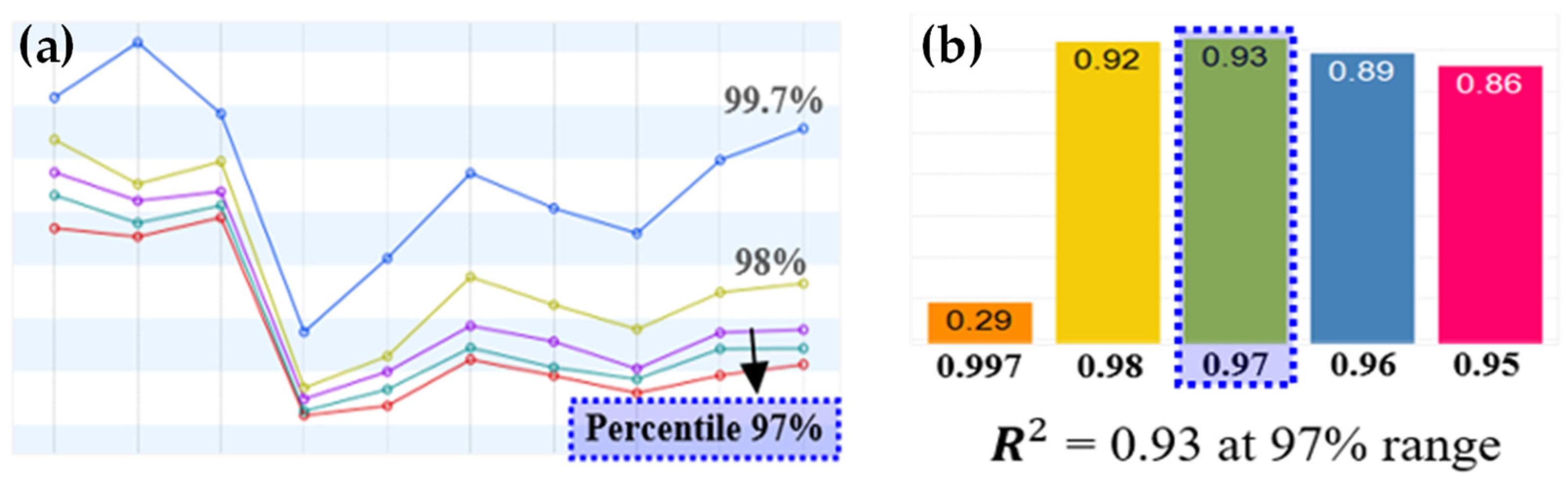
- Dual-Indicator Optimization: A mathematical dual-indicator framework was optimized by integrating the Range Percentile 97% (statistical) and Slope × 3 (geometric). This framework successfully screens out baseline measurement noise to capture actual physical wear.
- Condition-Based Maintenance System: An automated Preventive Maintenance (PM) architecture was constructed based on a simple OR-logic protocol. The system directs immediate maintenance interventions if either indicator reaches its limit.
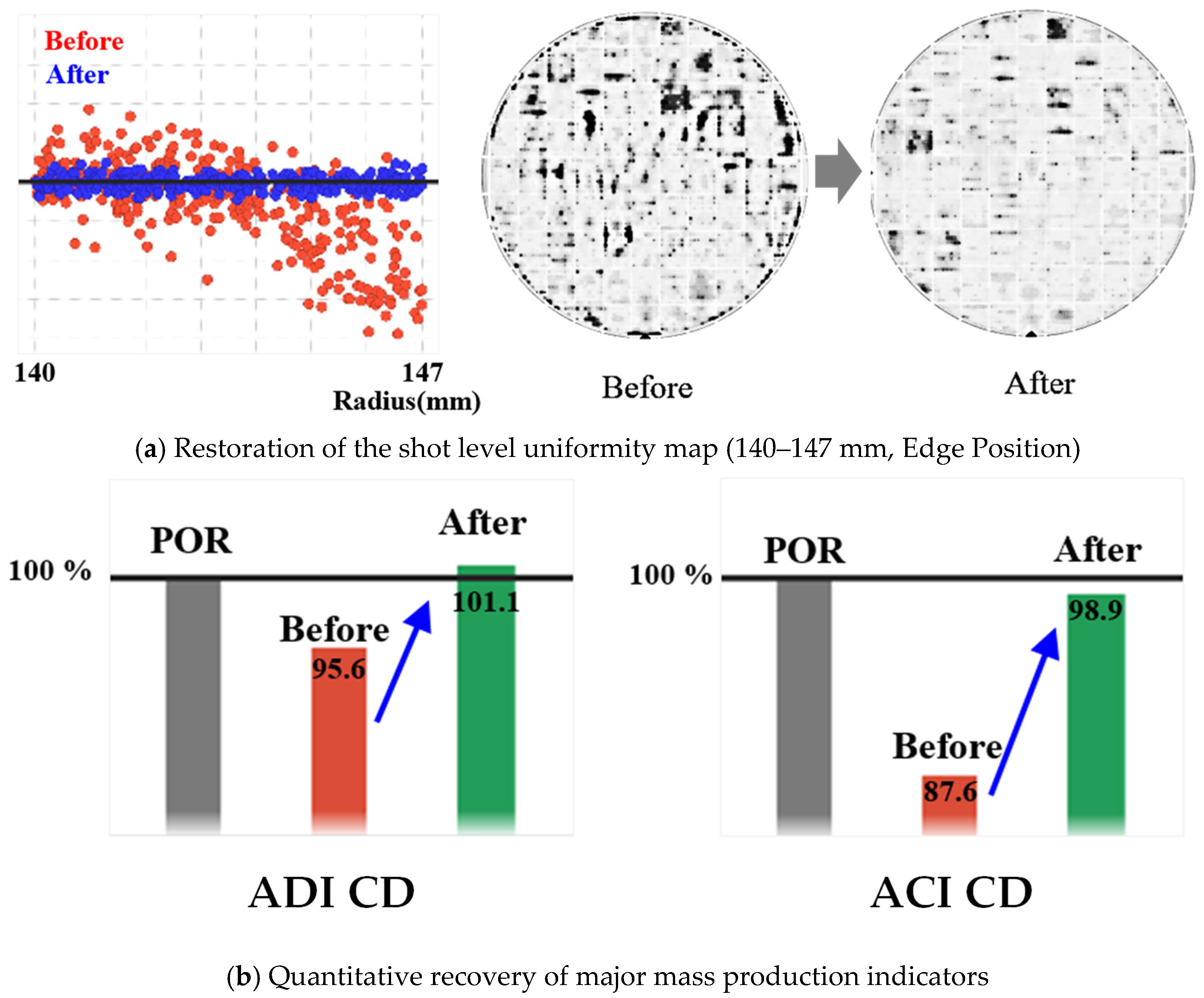
- Yield and Uptime Maximization: Shifting from routine time-based maintenance to a preemptive trigger at the quality-based critical warning threshold fundamentally prevents severe Critical Dimension (CD) anomalies. This direct intervention increases overall tool availability and extreme edge yield.
Abstract
1. Introduction
2. Materials and Methods
2.1. Lithography Tool and Process Conditions
2.2. GOFM and ODMM-Based Focus Metrology
2.3. GOFM Performance Metrics and KPI Definitions
- (1)
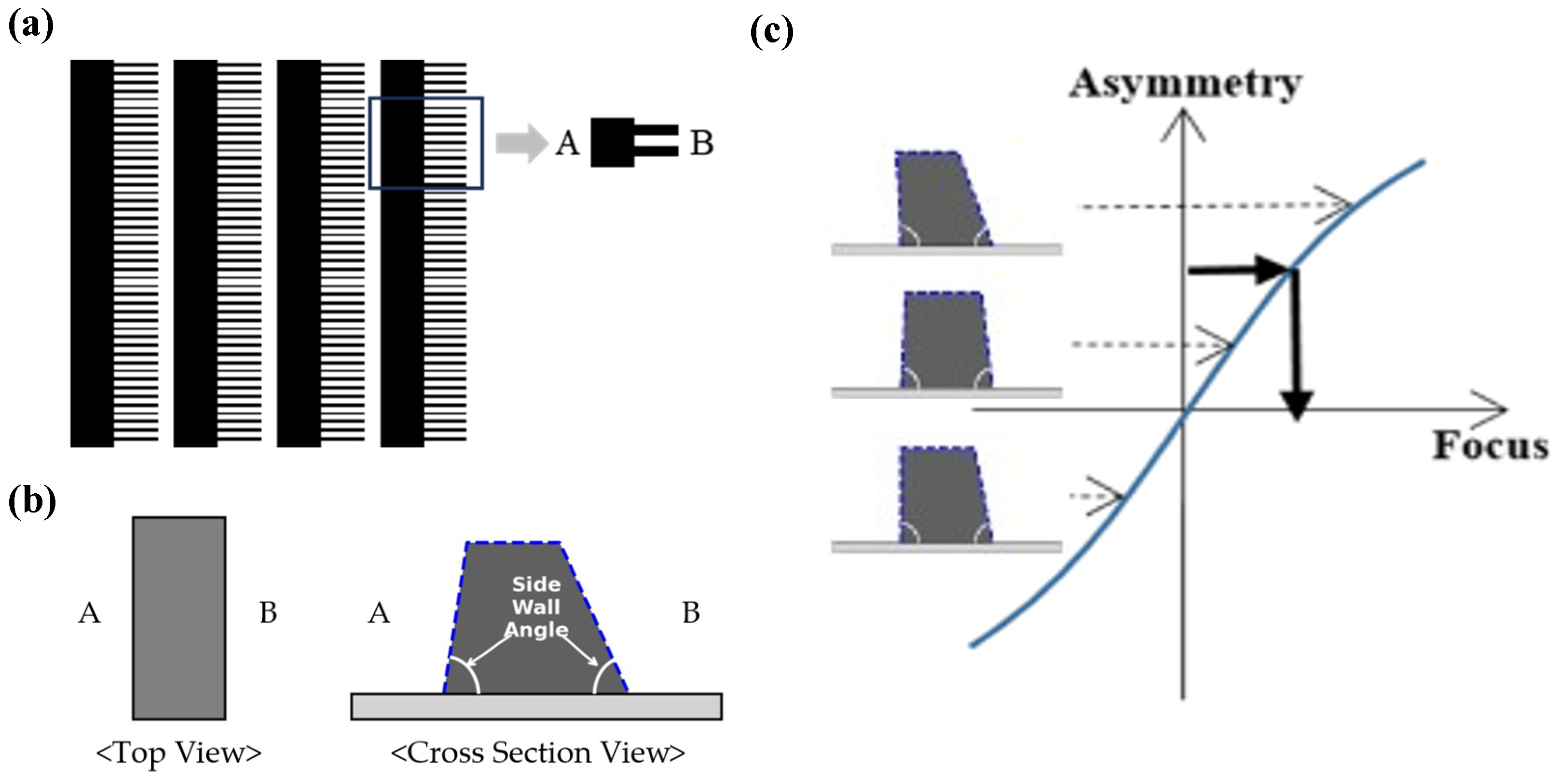
- Focus Capture Range: It was defined as the focus range where the focus and asymmetry maintain a monotonic relationship and are matched 1:1. Experimentally, by optimizing the ODMM pitch condition, it was designed so that the capture range exceeds the minimum operational requirement for high-volume manufacturing, and if it deviates from this range, it was considered an area where focus measurement is impossible.
- (2)
- Set/Get Residual: It was defined as the difference between the input focus offset and the focus value measured by GOFM. After exposing the wafer under various focus split conditions, by measuring the residual distribution of the focus value measured for each condition and the input value, the system was aligned and calibrated so that the set/get residual met the stringent tolerance threshold required for critical layer patterning.
- (3)
- Zero Asymmetry Focus (ZAF): It was defined as the distance from the nominal focus to the focus where asymmetry becomes 0. Since a smaller ZAF value means that the GOFM signal operates more robustly against focus error-inducing factors such as lens aberration, resist height, and process stack change, it was designed and tuned targeting a minimized value below the acceptable process baseline.
- (4)
- Sensitivity/Linearity (R2): It was defined as the sensitivity and linearity indicator (R2) representing how accurately and linearly the measurement signal can track the actual focus variation amount. As the value of this indicator is closer to 1, it means that the measurement reliability and the sensitivity to focus error are excellent, and it was evaluated with the goal of securing an overwhelming linearity compared to the existing method.
2.4. Definition of Wafer Table Focus Residual
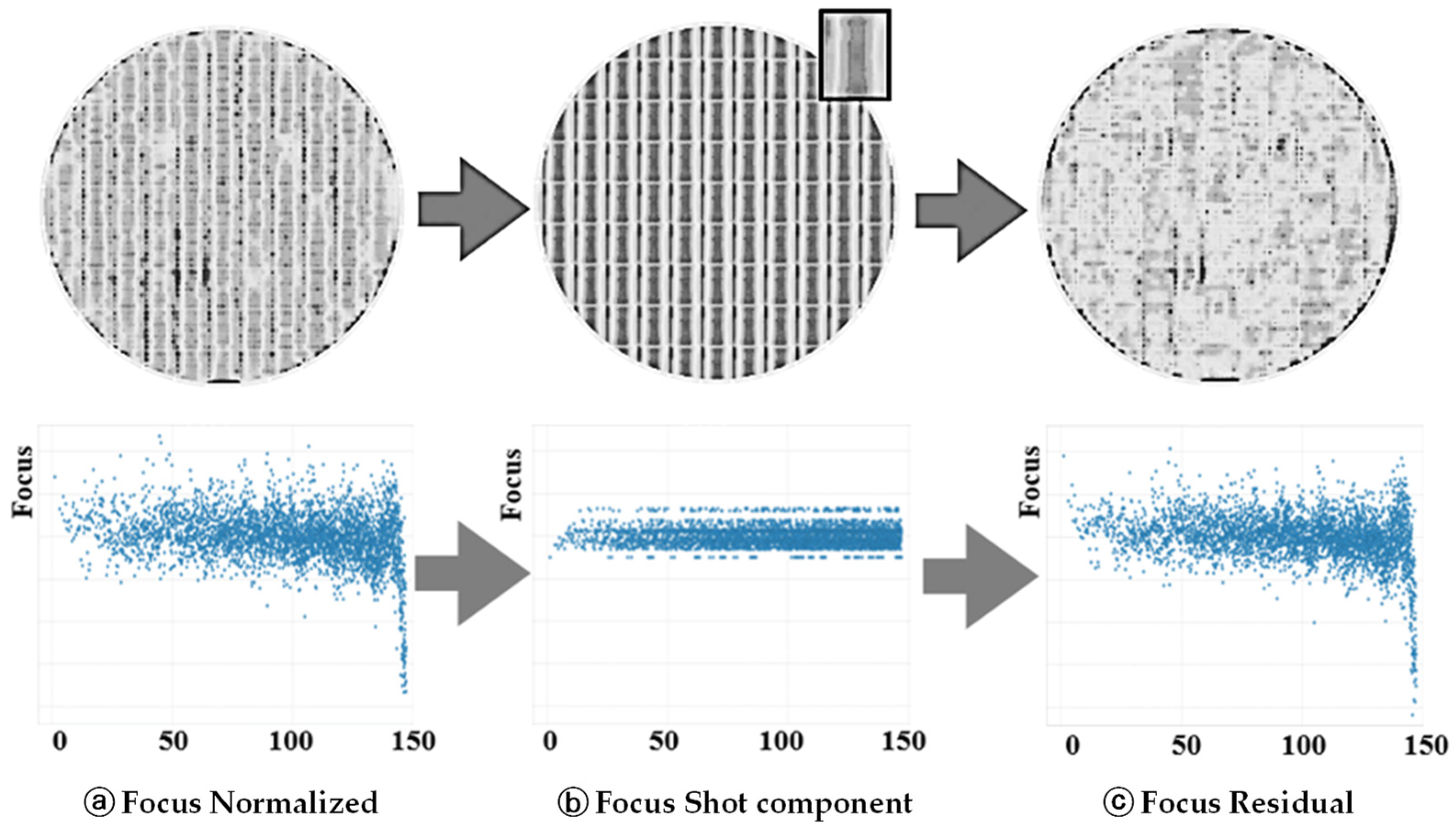
- (a)
- Focus normalized: The initial raw focus map and its radial scatter plot (0–147 mm) containing the focus fluctuations of the entire system.
- (b)
- Focus shot component: modeled extraction and subtraction of systemic focus offsets and global tilt caused by reticle and scanner field leveling.
- (c)
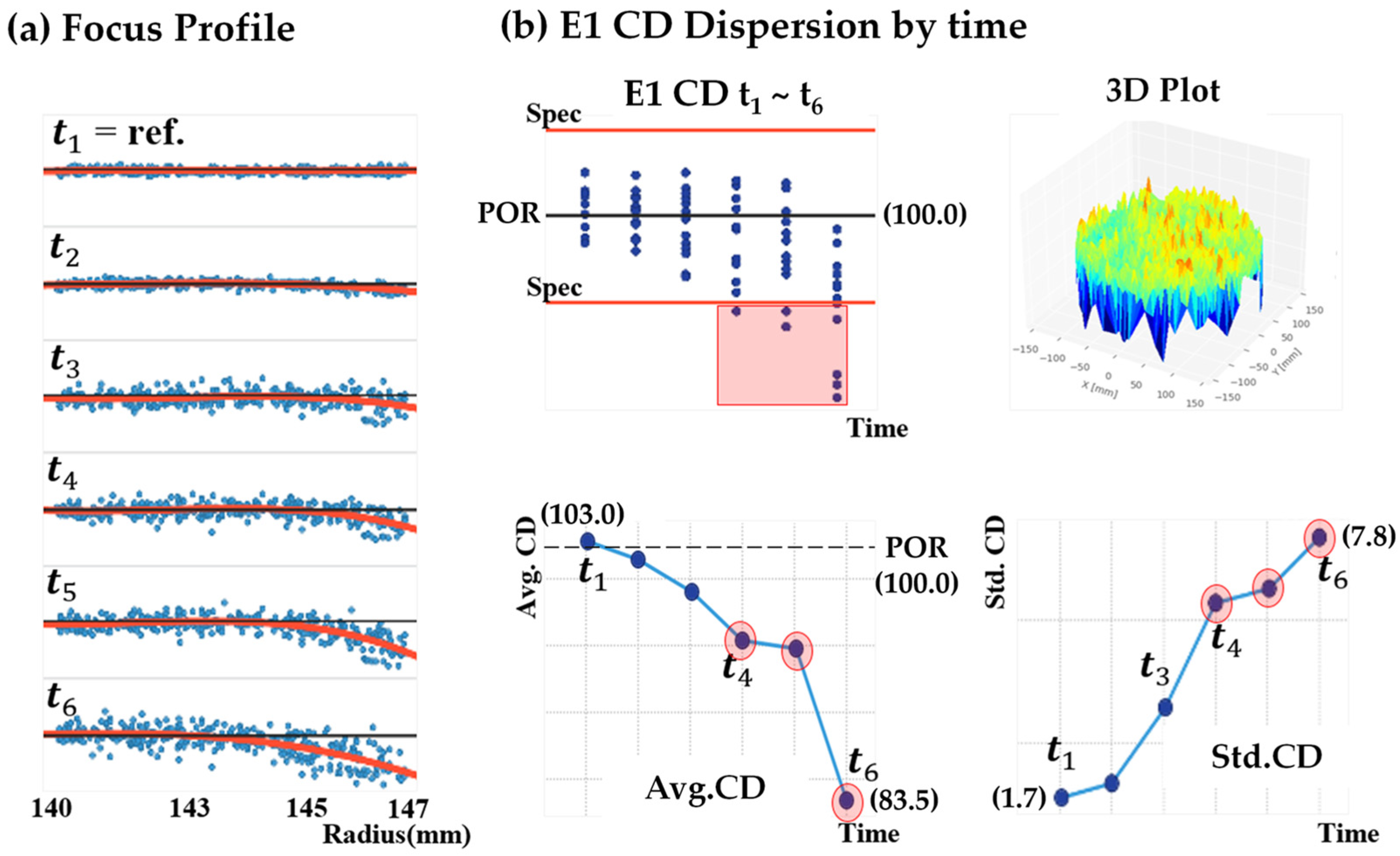
- Focus residual: The corrected focus map and radial scatter profile showing the topographic changes in the wafer table. This residual presents a flat center and a negative defocus at the extreme periphery (140–147 mm).
2.5. Mathematical Modeling of Dual-Edge Defocus Indicators
2.6. Data Collection over Multiple Tools and Time
- (i)
- The long-term drift trajectory of the wear indicator according to the accumulated number of processed wafers and table usage time.
- (ii)
- The physical edge defocus resilience before and after table replacement and whether the initial reference point (POR) of the product CD and yield are recovered.
- (iii)
- The statistical distribution and deviation of mechanical wear patterns appearing across multiple equipment and tables.
3. Results
3.1. Benchmarking GOFM Against Conventional Focus Metrology
3.2. Statistical Optimization and Correlation of Dual-Edge Indicators
3.3. Long-Term Validation in High-Volume Manufacturing (HVM)
3.4. Empirical Framework for Condition-Based Maintenance
4. Discussion and Future Works
4.1. Advancing Edge-Resolved Focus Metrology with GOFM
4.2. Linking Wafer Table Edge Degradation to Wafer Edge Defectivity
4.3. Robustness to Disturbances and Practical Deployment in HVM
4.4. Future Works
5. Conclusions
Author Contributions
Funding
Institutional Review Board Statement
Informed Consent Statement
Data Availability Statement
Conflicts of Interest
Abbreviations
| ArF | Argon Fluoride |
| ACI | After Cleaning Inspection |
| ADI | After Development Inspection |
| CD | Critical Dimension |
| CDU | Critical Dimension Uniformity |
| DBF | Diffraction-Based Focus |
| DoF | Depth of Focus |
| DUV | Deep Ultraviolet |
| eDoF | Exact Depth of Focus |
| ERO | Edge-Roll-Off |
| EUV | Extreme Ultraviolet |
| FDC | Fault Detection and Classification |
| FEM | Focus-Exposure Matrix |
| GOFM | Geometry-Based Optical Focus Metrology |
| HVM | High-Volume Manufacturing |
| KPI | Key Performance Indicator |
| MES | Manufacturing Execution System |
| ML | Machine Learning |
| NA | Numerical Aperture |
| NPW | Non-Production Wafer |
| ODMM | Optical Diffraction Metrology Mark |
| OPC | Optical Proximity Correction |
| PM | Preventive Maintenance |
| POR | Process of Record |
| PR | Photoresist |
| RET | Resolution Enhancement Techniques |
| RUL | Remaining Useful Lifetime |
| SEM | Scanning Electron Microscope |
| SPC | Statistical Process Control |
| SWA | Side Wall Angle |
| ZAF | Zero Asymmetry Focus |
References
- Mack, C.A. Fundamental Principles of Optical Lithography: The Science of Microfabrication; John Wiley & Sons: Chichester, UK, 2007. [Google Scholar] [CrossRef]
- Levinson, H.J. Principles of Lithography, 3rd ed.; SPIE Press: Bellingham, WA, USA, 2010. [Google Scholar] [CrossRef]
- Wong, A.K. Resolution Enhancement Techniques in Optical Lithography; SPIE Press: Bellingham, WA, USA, 2001. [Google Scholar] [CrossRef]
- Erdmann, A. Optical and EUV Lithography: A Modeling Perspective; SPIE Press: Bellingham, WA, USA, 2021. [Google Scholar] [CrossRef]
- Song, J.; Kim, C.-H.; Lee, G. A Study on the Resolution and Depth of Focus of ArF Immersion Photolithography. Micromachines 2022, 13, 1971. [Google Scholar] [CrossRef] [PubMed]
- Yue, L.; Mao, Z.; Wu, Q.; Li, Y.; Li, Y. Physical model-based ArF photoresist formulation development. AIP Adv. 2024, 14, 025343. [Google Scholar] [CrossRef]
- Zhu, Y.; Han, D.; Wu, C.; Deng, S.; Wei, Y. Analysis of Dynamic Stability Control of Light Source in Immersion DUV Lithography. Micromachines 2025, 16, 1207. [Google Scholar] [CrossRef]
- Cao, D.; Dong, H.; Zeng, Z.; Zhang, W.; Li, X.; Yu, H. Thermal Control Systems in Projection Lithography Tools: A Comprehensive Review. Micromachines 2025, 16, 880. [Google Scholar] [CrossRef]
- Hu, H.; Lai, X.; Chao, M.M.; Ullakko, K. Prediction of Wafer Handling-Induced Point Defects in 300 mm Silicon Wafer Manufacturing from Edge Geometric Data. Solid State Phenom. 2023, 345, 181–191. [Google Scholar] [CrossRef]
- Turner, K.T.; Ramond, C.; Sinha, J. Role of wafer geometry in wafer chucking. J. Micro/Nanolith. MEMS MOEMS 2013, 12, 023007. [Google Scholar] [CrossRef]
- Ren, H.; Gronheid, R.; Sah, K.; Bouckou, L.; Cheng, G.; Gao, X.; Tang, W.; Chen, Z.; Zafar, K.; Higgins, C.; et al. Wafer edge defectivity and its correlation to process parameters. In Optical and EUV Nanolithography XXXVIII; SPIE: Bellingham, WA, USA, 2025; Volume 13424, pp. 233–238. [Google Scholar] [CrossRef]
- Ko, B.; Kim, I.H.; Jang, I.J.; Jun, H.; Go, H.; Kim, Y.; Park, C.; Kim, J.S.; Lee, D.H.; van den Broek, B.; et al. Budget analysis on dual layer edge placement error in logic devices. In Metrology, Inspection, and Process Control XXXIX; SPIE: Bellingham, WA, USA, 2025; Volume 13426, pp. 109–119. [Google Scholar] [CrossRef]
- Song, Z.; Ding, K.; Hu, S.; Zhao, S.; Zhang, L.; Jiang, S. Exploration charge effect and wafer backside materials correlation to Diamond-Like Carbon wafer table degradation. In 2023 International Workshop on Advanced Patterning Solutions; IEEE: New York, NY, USA, 2023. [Google Scholar] [CrossRef]
- Ma, S.; Ying, H.; Ng, B.; Tok, M.K. Process Challenges attributing to Lithography Overlay Misalignment: A Case Study on BEOL Lithography Process. In 2025 36th Annual SEMI Advanced Semiconductor Manufacturing Conference; IEEE: New York, NY, USA, 2025. [Google Scholar] [CrossRef]
- Yuan, Z.; Wang, K.; Chen, H.; Long, Y. Research on Improvement of CMP Thickness Uniformity Control on Wafer Edge Defocus Defects. In 2021 China Semiconductor Technology International Conference (CSTIC); IEEE: New York, NY, USA, 2021. [Google Scholar] [CrossRef]
- Cheng, W.; Li, Z.; Wu, X.; Yin, S.; Zhang, B.; Zhang, X. Semiconductor Wafer Flatness and Thickness Measurement Using Frequency Scanning Interferometry Technology. Photonics 2025, 12, 663. [Google Scholar] [CrossRef]
- Kim, Y.S.; Lee, J.; Lee, S.; Maeng, K.; Kim, J.; Kim, I.; Uh, S.; Janda, E.; Patil, A.; Baek, S.; et al. Diffraction-based metrology for dose monitoring and control. In Metrology, Inspection, and Process Control XXXVIII; SPIE: Bellingham, WA, USA, 2024; Volume 12955, pp. 852–858. [Google Scholar] [CrossRef]
- Noyes, B.F., III; Mokaberi, B.; Bolton, D.; Li, C.; Palande, A.; Park, K.; Noot, M.; Kea, M. Applications of on-product diffraction-based focus metrology in logic high volume manufacturing. In Metrology, Inspection, and Process Control for Microlithography XXX; SPIE: Bellingham, WA, USA, 2016; Volume 9778, pp. 908–914. [Google Scholar] [CrossRef]
- Park, K.D.; Park, T.; Hwang, J.H.; Choi, J.P.; Kang, Y.S. Improvement of inter-field CDU by using on-product focus control. In Metrology, Inspection, and Process Control for Microlithography XXVIII; SPIE: Bellingham, WA, USA, 2014; Volume 9050, pp. 220–227. [Google Scholar] [CrossRef]
- Chen, Y.J.; Kim, Y.K.; Hao, X.; Gomez, J.M.; Tian, Y.; Kamalizadeh, F.; Hanson, J.K. Enhanced methodology of focus control and monitoring of scanner tool. In Metrology, Inspection, and Process Control for Microlithography XXXI; SPIE: Bellingham, WA, USA, 2017; Volume 101452, pp. 748–756. [Google Scholar] [CrossRef]
- Hu, J.; Chen, Y.L.; Chen, K.H.; Lee, B.; Tsai, F.; Ke, C.M.; Liao, C.H.; Ngo, D.; Gosali, B.; Tijssen, R.; et al. Improving focus performance at litho using diffraction-based focus metrology. In Metrology, Inspection, and Process Control for Microlithography XXX; SPIE: Bellingham, WA, USA, 2016; Volume 9778, pp. 730–734. [Google Scholar] [CrossRef]
- Hurtado Carreon, A.; Veldhuis, S.C. Practical Application of Condition-Based Monitoring (CBM) Technologies in the Modern Manufacturing Industry: A Review. Processes 2025, 13, 4084. [Google Scholar] [CrossRef]
- Dadfarnia, M.; Sharp, M.; Herrmann, J. Comprehensive evaluations of condition monitoring-based technologies in industrial maintenance: A systematic review. J. Manuf. Syst. 2025, 82, 425–441. [Google Scholar] [CrossRef]
- Cao, H.; Yu, J.; Duan, F. Condition-Based Maintenance in Complex Degradation Systems: A Review of Modeling Evolution, Multi-Component Systems, and Maintenance Strategies. Machines 2025, 13, 714. [Google Scholar] [CrossRef]
- Mun, G.H.; Kim, Y.; Park, Y.; Jang, D.W. Condition-Based Maintenance Plus (CBM+) for Single-Board Computers: Accelerated Testing and Precursor Signal Identification. Appl. Sci. 2025, 15, 11203. [Google Scholar] [CrossRef]
- Phongmoo, S.; Suedumrong, C.; Kuensaen, C.; Sinthavalai, R.; Leksakul, K. Predictive maintenance in semiconductor manufacturing: Comparative analysis of machine learning models for downtime reduction. Comput. Ind. Eng. 2025, 205, 111211. [Google Scholar] [CrossRef]
- Ahmad, A.; Shah, S.A.A.; Yousafzai, S. Predictive Maintenance in Semiconductor Manufacturing Using Machine Learning on Imbalanced Dataset. IJRSI 2025, 12, 170–176. [Google Scholar] [CrossRef]
- Yu, Y.C.; Yang, S.R.; Chuang, S.W.; Chien, J.T.; Lee, C.Y. Pruning Quantized Unsupervised Meta-Learning DegradingNet Solution for Industrial Equipment and Semiconductor Process Anomaly Detection and Prediction. Appl. Sci. 2024, 14, 1708. [Google Scholar] [CrossRef]
- Seeam, M.I.R.; Sheng, V.S. Proactive Statistical Process Control Using AI: A Time Series Forecasting Approach for Semiconductor Manufacturing. arXiv 2025, arXiv:2509.16431. [Google Scholar] [CrossRef]
- Jeganathan, B. Machine Learning and Deep Learning in Wafer Defect Detection: Current State and Future Directions. Curr. J. Appl. Sci. Technol. 2025, 44, 1–14. [Google Scholar] [CrossRef]
- Shinde, P.P.; Pai, P.P.; Adiga, S.P.; Mayya, K.S.; Seo, Y.; Hwang, M.; Go, H.; Park, C. Defect detection in photolithographic patterns using deep learning models trained on synthetic data. Heliyon 2025, 11, e43377. [Google Scholar] [CrossRef]
- Lu, H.; Zhao, B.; Shen, J.; Zhan, H.; Lyu, S.; Lu, Y. Learning to Detect Lithography Defects in SEM Images. In Pattern Recognition (ICPR 2024); Lecture Notes in Computer Science; Springer: Cham, Switzerland, 2025; Volume 15305. [Google Scholar] [CrossRef]
- Yang, Y.; Liu, K.; Gao, Y.; Wang, C.; Cao, L. Advancements and challenges in inverse lithography technology: A review of artificial intellligence-based approaches. Light Sci. Appl. 2025, 14, 250. [Google Scholar] [CrossRef]
- IEEE. International Roadmap for Devices and Systems (IRDS) 2024 Edition: Metrology; IEEE: Piscataway, NJ, USA, 2024. [Google Scholar]
- Liu, Y.; Xu, B.; Geng, Y.A. Multi-Condition Remaining Useful Life Prediction Based on Mixture of Encoders. Entropy 2025, 27, 79. [Google Scholar] [CrossRef]
- Malik, S.; Yochens, J.; Wisner, B.; Kontsos, A. Enhancing real-time remaining useful life prediction with information entropy & uncertainty quantified deep learning models. J. Intell. Mater. Syst. Struct. 2025, 37, 357–372. [Google Scholar] [CrossRef]
- Maas, J.; Ebert, M.; Bhattacharyya, K.; Cramer, H.; Becht, A.; Keij, S.; Plug, R.; Fuchs, A.; Kubis, M. Yieldstar: A New Metrology Platform for Advanced Lithography Control. In 27th European Mask and Lithography Conference; SPIE: Bellingham, WA, USA, 2011; Volume 7985, pp. 146–155. [Google Scholar] [CrossRef]
- Ebert, M.; Cramer, H.; Tel, W.; Kubis, M.; Megens, H. Combined overlay, focus and CD metrology for leading edge lithography. In Optical Microlithography XXIV; SPIE: Bellingham, WA, USA, 2011; Volume 7973, pp. 370–383. [Google Scholar] [CrossRef]
- Kim, G.; Lim, H.; Kwon, S.; Choi, H. Fabrication technology of high-aspect-ratio pillar structures with positive sidewall angles using microlens-assisted photolithography. Jpn. J. Appl. Phys. 2026, 65, 05SP04. [Google Scholar] [CrossRef]
- Kim, Y.K.; Chen, Y.J.; Hao, X.; Samudrala, P.; Gomez, J.M.; Mahoney, M.O.; Kamalizadeh, F.; Hanson, J.K.; Lee, S. Focus control enhancement and on-product focus response analysis methodology. In Metrology, Inspection, and Process Control for Microlithography XXX; SPIE: Bellingham, WA, USA, 2016; Volume 9778, pp. 267–274. [Google Scholar] [CrossRef]
- Cramer, H.; Petra, S.; Auer, B.O.F.; Smilde, H.J.; Wisse, B.; Welch, S.; Kruijswijk, S.; Hinnen, P.; Segers, B.; Leewis, C. Intra-field patterning control using highspeed and small-target optical metrology of CD and focus. In Metrology, Inspection, and Process Control for Microlithography XXIX; SPIE: Bellingham, WA, USA, 2015; Volume 9424, pp. 481–490. [Google Scholar] [CrossRef]
- Steur, M.M.A. Design of an Active Wafer Clamp for Wafer Machines. Ph.D. Thesis, Eindhoven University of Technology, Eindhoven, The Netherlands, 2017. Available online: https://research.tue.nl/en/publications/design-of-an-active-wafer-clamp-for-wafer-machines/ (accessed on 5 February 2026).
- Park, S.; Lee, J.; Lee, S.; Sung, J.; Jung, H.; Lee, H.; Kim, K. Temperature Uniformity Control of 12-Inch Semiconductor Wafer Chuck Using Double-Wall TPMS in Additive Manufacturing. Materials 2025, 18, 211. [Google Scholar] [CrossRef] [PubMed]
- Kim, J.-H.; Koo, Y.; Song, W.; Hong, S.J. On-Wafer Temperature Monitoring Sensor for Condition Monitoring of Repaired Electrostatic Chuck. Electronics 2022, 11, 880. [Google Scholar] [CrossRef]
- He, K.; Zeng, Z. Impact of Phase Defects on the Aerial Image in High NA Extreme Ultraviolet Lithography. Micromachines 2025, 16, 1210. [Google Scholar] [CrossRef]
- Adaloudis, M. Remaining Useful Lifetime (RUL) Estimation for Predictive Maintenance in SemiconductoriManufacturing. 2024. Available online: https://pure.tue.nl/ws/portalfiles/portal/318592528/Master_Thesis_Max_Adaloudis.pdf (accessed on 1 March 2026).



| System & Tooling | Environmental Control (Lot Start to End) |
| Scanner: ASML Advanced DUV Immersion Scanner (ASML, Veldhoven, The Netherlands) | Temperature: Standard Cleanroom Conditions |
| Metrology: ASML Inline Scatterometry Tool (ASML, Veldhoven, The Netherlands) | Pressure: Standard Cleanroom Conditions |
| Optical & Measurement Setup | Material & Process (POR) |
| Illumination: quad pole type | Wafer: 300 mm Bare Si (NPW) |
| NA: 1.35 (Default) | Reticle: ODMM-dedicated |
| Measurement Points: thousands pts @ Full Wafer | Photoresist/Dose: Proprietary HVM |
| Parameter | Mathematical Definition | Value/Condition | Rationale |
|---|---|---|---|
| Edge region of Interest | Filtering edge-specific data from full wafer | ||
| Data preprocessing | Center = 0 nm | Removal of focus offset and centering of residuals | |
| Statistical indicator: Range Percentile | parameter X to be selected | Prevention of data distortion due to Meas. noise, outliers | |
| Geometric indicator: | region: | Quantifying the steepest ERO gradient within the 3 mm |
| n-Order Fit | Recovered Edge Drop | Flat-Region Max Deviation (0–140 mm) | Edge-Region RMSE (140–147 mm) | Decision |
|---|---|---|---|---|
| 3rd-order | 0.730 | 0.252 | 0.150 | Under-fit |
| 4th | 0.871 | 0.289 | 0.072 | Even-order |
| 5th | 0.994 | 0.009 | 0.006 | Optimal |
| 6th | 1.002 | 0.013 | 0.008 | Even-order |
| 7th | 0.991 | 0.019 | 0.006 | Over-fit |
| KPI (from Section 2.3) | eDoF | GOFM | Improvement (Δ) | Acceptance/Target (Baseline) |
|---|---|---|---|---|
| Focus capture range | 1.00 | 1.25 | +25% wider | ≥1.00 |
| Set/get residual | 0.92 | 0.70 | −22% lower | ≤1.00 |
| ZAF (Zero Asymmetry Focus) | N/A | 0.66 | N/A | ≤1.00 |
| Sensitivity/linearity (R2) | 0.9851 | 0.9993 | +0.0142 | 1.0000 |
| Range Percentile | Cut-Off Ratio | Sensitivity to Noise | Trend Distortion in Time-Series | Correlation with Slope × 3 (R2) | Optimization Decision |
|---|---|---|---|---|---|
| 99.7% | 0.30% | High | Severe distortion | 0.76 | Noise-dominated |
| 98.0% | 2.00% | Moderate | Moderate distortion | 0.84 | Unstable trend |
| 97.0% | 3.00% | Low | Stable (less distortion) | 0.93 | Optimal balance |
| 96.0% | 4.00% | Very Low | Signal loss (damped trend) | 0.90 | Over-filtered |
| 95.0% | 5.00% | Very Low | Signal loss (damped trend) | 0.86 | Over-filtered |
Disclaimer/Publisher’s Note: The statements, opinions and data contained in all publications are solely those of the individual author(s) and contributor(s) and not of MDPI and/or the editor(s). MDPI and/or the editor(s) disclaim responsibility for any injury to people or property resulting from any ideas, methods, instructions or products referred to in the content. |
© 2026 by the authors. Licensee MDPI, Basel, Switzerland. This article is an open access article distributed under the terms and conditions of the Creative Commons Attribution (CC BY) license.
Share and Cite
Joo, K.; Lee, K.H.; Jeon, J.W. A Study on Condition-Based Maintenance for Wafer Table Edge Degradation in Photolithography Equipment. Sensors 2026, 26, 3650. https://doi.org/10.3390/s26123650
Joo K, Lee KH, Jeon JW. A Study on Condition-Based Maintenance for Wafer Table Edge Degradation in Photolithography Equipment. Sensors. 2026; 26(12):3650. https://doi.org/10.3390/s26123650
Chicago/Turabian StyleJoo, Kyunghwan, Kwang Hoon Lee, and Jae Wook Jeon. 2026. "A Study on Condition-Based Maintenance for Wafer Table Edge Degradation in Photolithography Equipment" Sensors 26, no. 12: 3650. https://doi.org/10.3390/s26123650
APA StyleJoo, K., Lee, K. H., & Jeon, J. W. (2026). A Study on Condition-Based Maintenance for Wafer Table Edge Degradation in Photolithography Equipment. Sensors, 26(12), 3650. https://doi.org/10.3390/s26123650