Inertial Sensor Reliability and Validity Across a Five-Level Surface Instability Gradation During Single-Leg Standing



Highlights
- Superior Reliability of Inertial Sensors: The inertial sensor unit demonstrated higher internal consistency and faster stabilization (excellent reliability ICC > 0.95 with lower trials) across increasing levels of instability compared to the force-plate.
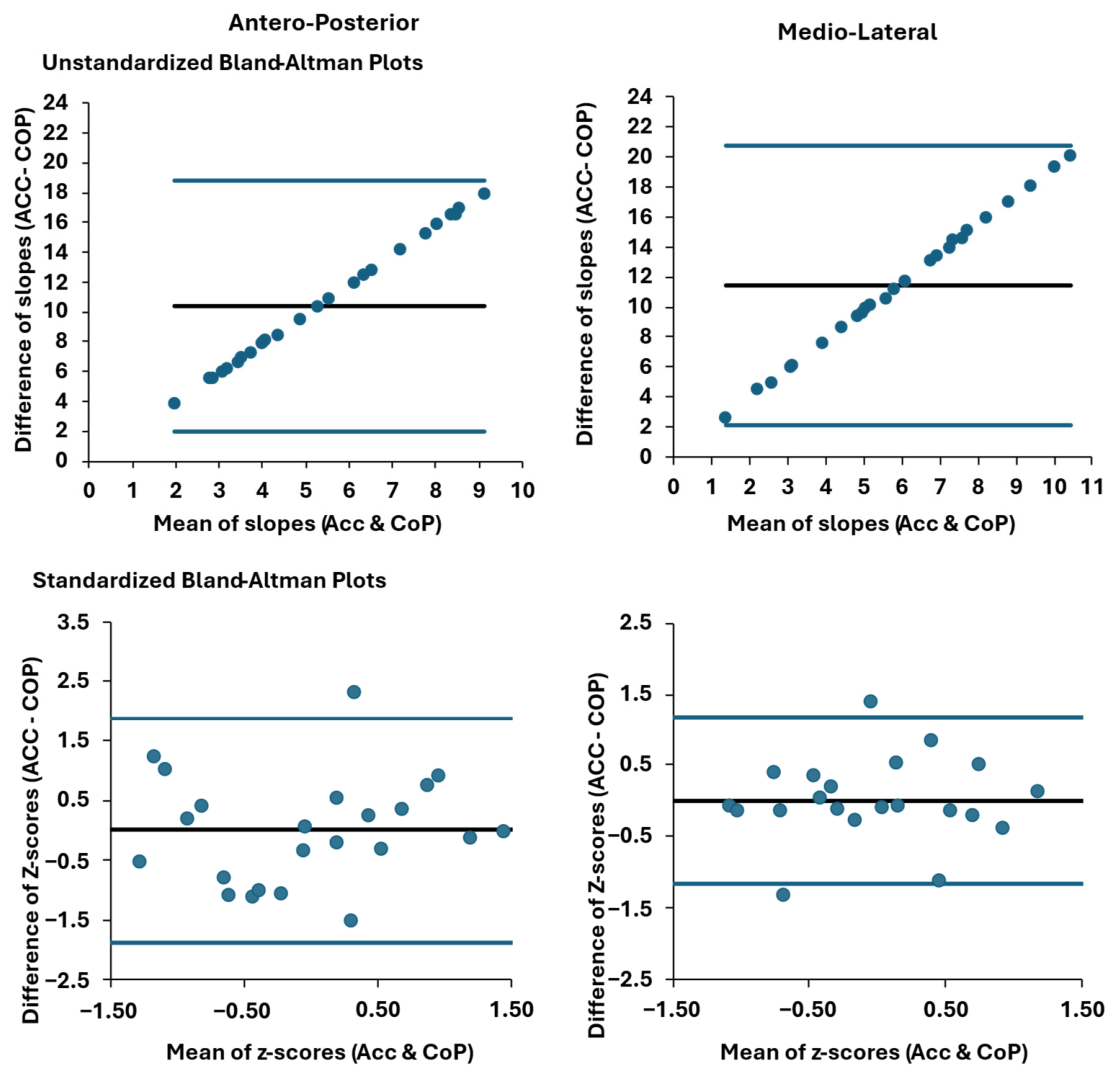
- Identification of Mechanical Decoupling: Analysis of standardized metrics reveals that while inertial sensors and force plates are globally concordant, they capture complementary components of balance (correction effort vs. displacement), particularly during conditions of intensified instability (i.e., BOSU). Both devices agree on the postural challenge graduation (Global Concordance) as well as how stable a specific person is relative to the group (Individual Ranking Agreement).
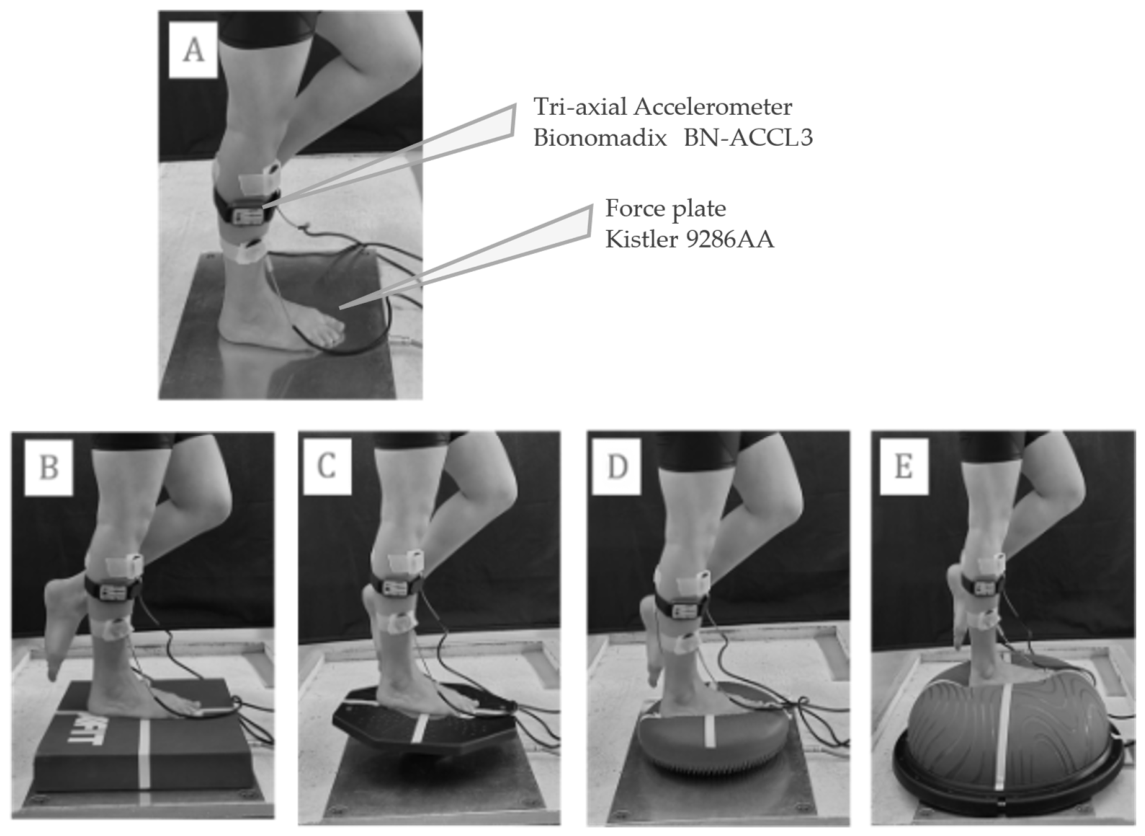
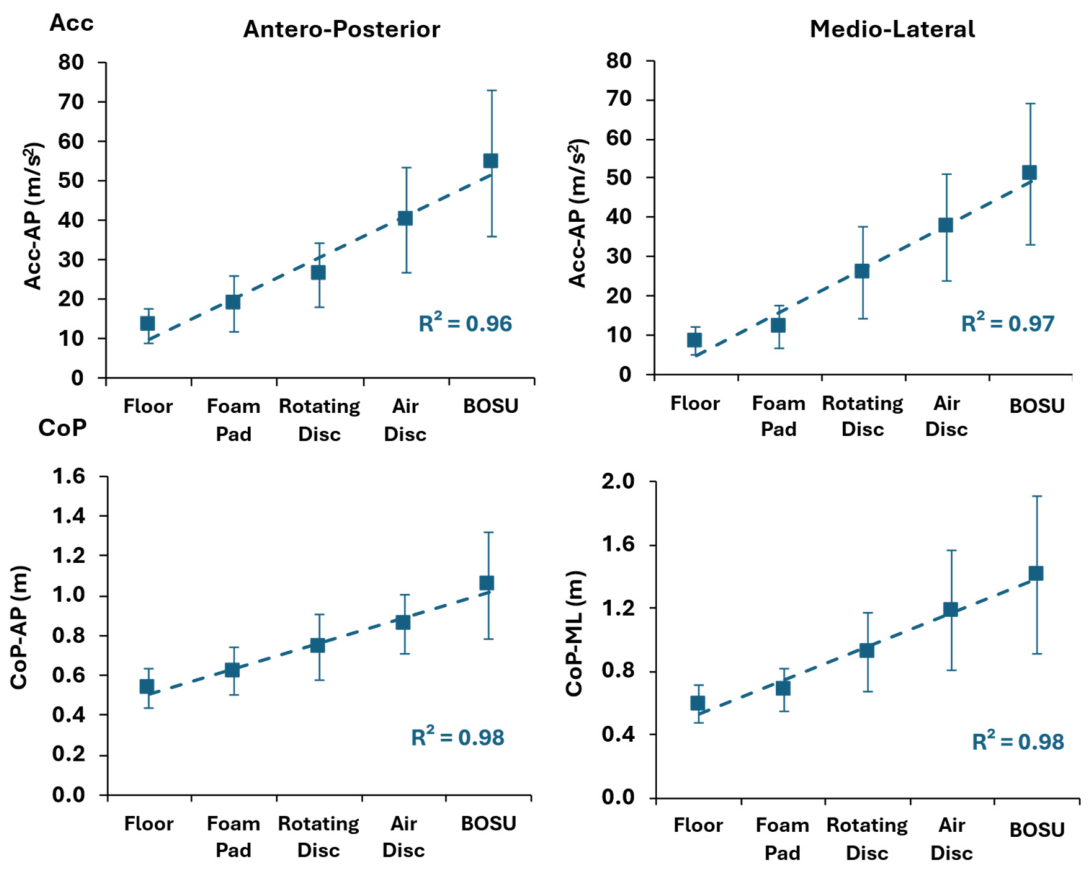
- Validation of a Five-Level Postural Challenge Graduation: The study establishes a reliable and valid surface graduation for single-leg balance, providing a research-based framework for progressive rehabilitation and athletic training.
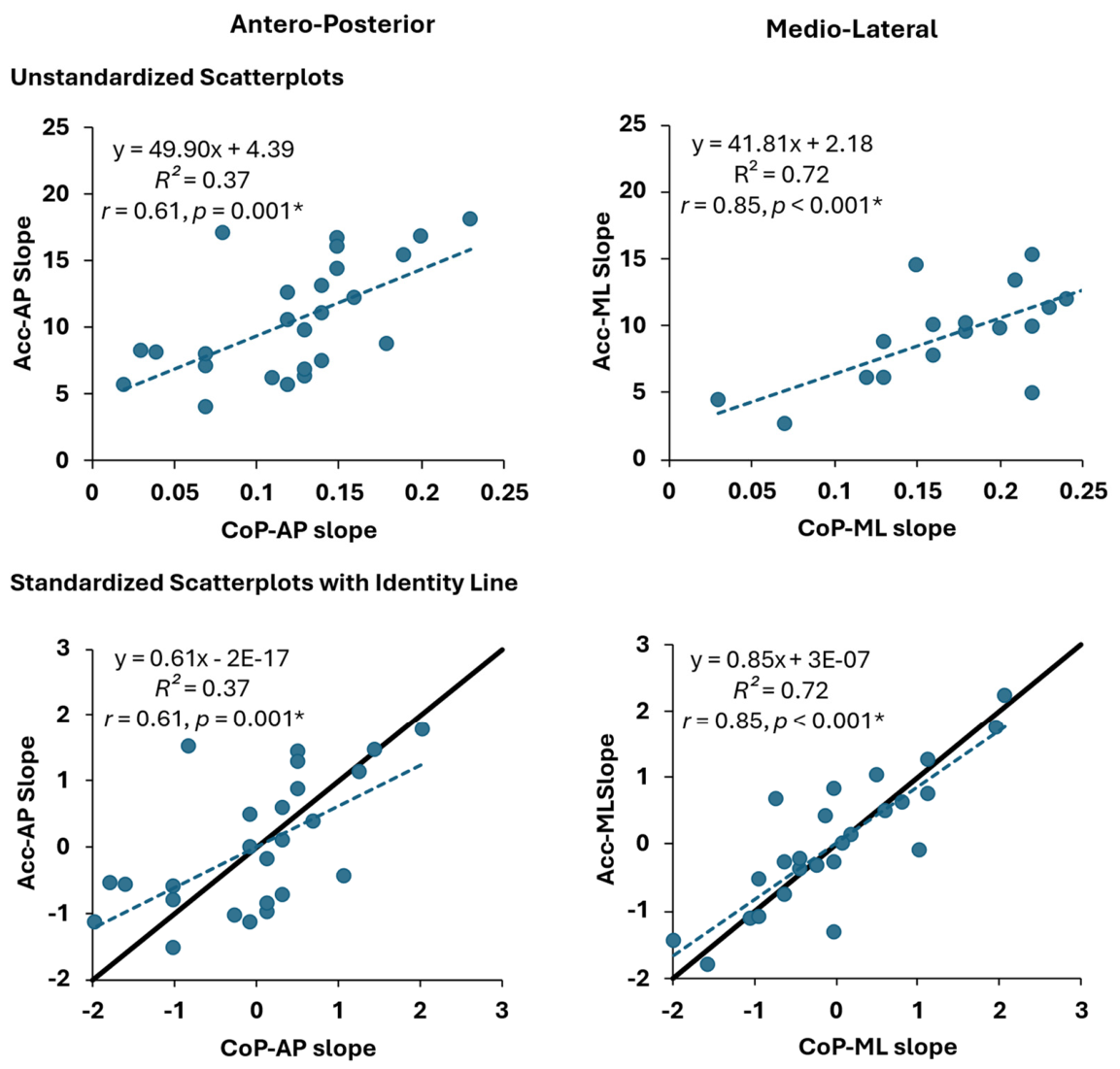
- Global Concordance—Individual Ranking Agreement: Both inertial sensors and the force plate metrics agree on the postural challenge graduation (Global Concordance) as well as on how stable a specific person is relative to the group (Individual Ranking Agreement).
Abstract
1. Introduction
2. Materials and Methods
2.1. Participants
2.2. Experimental Procedure
2.3. Data Collection and Analysis
2.3.1. Inertial Sensor Data
2.3.2. Force Plate Data
2.3.3. Reliability Analysis
2.3.4. Slope Coefficient
2.4. Statistical Analysis
2.4.1. Preliminary Screening
2.4.2. Validation of Postural Challenge Graduation
2.4.3. Concurrent Validity Analysis
- Global Trend Concordance: Bivariate Pearson’s correlations were calculated using unstandardized slope values. This assessed the mutual sensitivity of both devices to track the systematic, global increase in sway magnitude across the surface progression.
- Individual Ranking Agreement: To evaluate device agreement at the individual subject level independent of task intensity, slopes were transformed into standardized z-scores based on the group mean and standard deviation. This z-score transformation was methodologically necessary to eliminate the profound scaling differences between displacement (m) and acceleration (m/s2) units. Without standardization, the shared variance of the progressive surface difficulty would artificially inflate the correlation. Standardizing the metrics isolated the devices’ capacity to rank individual performance consistently.
2.4.4. Method Agreement Analysis
3. Results
3.1. Validation of the Postural Challenge Gradation
3.2. Global Concordance
3.3. Individual Ranking Agreement
4. Discussion
4.1. Reliability and Clinical Utility
4.2. Validity of the Postural Challenge Graduation
4.3. Directional Divergence and Hypothesized Mechanical Decoupling
4.4. Limitations and Future Directions
4.5. Conclusions
Author Contributions
Funding
Institutional Review Board Statement
Informed Consent Statement
Data Availability Statement
Conflicts of Interest
Appendix A
Reliability Analysis—Trial Accumulation
- (a)
- (b)
- (c)
- (d)

| Measure | Trial Accumulation | Number of Trials | ICC (95% CI) | SEM% | MDC95% | CV% |
|---|---|---|---|---|---|---|
| Acc-AP | 1 to 2 | 2 | 0.84 (0.62, 0.93) | 22.60 | 52.73 | 18.91 |
| 1 to 3 | 3 | 0.93 (0.86, 0.97) | 18.21 | 42.49 | 17.12 | |
| 1 to 4 | 4 | 0.96 (0.92, 0.98) | 16.53 | 38.58 | 15.61 | |
| 1 to 5 | 5 | 0.96 (0.93, 0.98) | 17.61 | 41.10 | 17.16 | |
| Acc-ML | 1 to 2 | 2 | 0.85 (0.65, 0.93) | 23.16 | 54.04 | 20.31 |
| 1 to 3 | 3 | 0.93 (0.86, 0.97) | 19.56 | 45.65 | 17.99 | |
| 1 to 4 | 4 | 0.95 (0.91, 0.98) | 17.64 | 41.16 | 16.33 | |
| 1 to 5 | 5 | 0.95 (0.92, 0.98) | 19.59 | 45.71 | 17.70 | |
| CoP-AP | 1 to 2 | 2 | 0.38 (−0.48, 0.74) | 45.92 | 107.16 | 40.07 |
| 1 to 3 | 3 | 0.70 (0.41, 0.86) | 39.41 | 91.96 | 36.37 | |
| 1 to 4 | 4 | 0.76 (0.56, 0.89) | 41.30 | 96.36 | 37.16 | |
| 1 to 5 | 5 | 0.85 (0.72, 0.92) | 38.70 | 90.30 | 34.26 | |
| CoP-ML | 1 to 2 | 2 | 0.79 (0.50, 0.91) | 30.33 | 70.77 | 24.29 |
| 1 to 3 | 3 | 0.87 (0.74, 0.94) | 26.72 | 62.35 | 25.41 | |
| 1 to 4 | 4 | 0.90 (0.82, 0.95) | 26.04 | 60.77 | 22.97 | |
| 1 to 5 | 5 | 0.92 (0.86, 0.96) | 25.95 | 60.56 | 24.22 |
| Median | Min | Max | Skewness | Kurtosis | ||
|---|---|---|---|---|---|---|
| Acc-AP | Floor | 0.087 | −1.738 | 2.137 | 0.351 | 2.549 |
| Foam Pad | −0.110 | −1.684 | 2.985 | 0.948 | 4.342 | |
| Rotating Disc | 0.328 | −1.698 | 1.676 | −0.151 | 1.760 | |
| Air Disc | −0.258 | −1.821 | 2.068 | 0.312 | 2.368 | |
| BOSU | −0.041 | −1.847 | 1.589 | 0.160 | 1.964 | |
| Acc-ML | Floor | −0.250 | −1.278 | 2.586 | 1.117 | 3.478 |
| Foam Pad | −0.314 | −1.156 | 3.304 | 1.697 | 6.005 | |
| Rotating Disc | −0.246 | −1.357 | 2.694 | 1.027 | 3.492 | |
| Air Disc | 0.002 | −1.782 | 2.148 | 0.294 | 2.499 | |
| BOSU | 0.120 | −1.982 | 1.493 | −0.284 | 2.209 | |
| CoP-AP | Floor | 0.117 | −1.901 | 2.337 | 0.247 | 2.574 |
| Foam Pad | −0.017 | −1.595 | 2.061 | 0.333 | 2.471 | |
| Rotating Disc | −0.263 | −1.846 | 2.721 | 0.849 | 3.758 | |
| Air Disc | 0.026 | −1.960 | 2.013 | −0.223 | 2.620 | |
| BOSU | −0.054 | −1.693 | 1.810 | 0.232 | 2.192 | |
| CoP-ML | Floor | −0.021 | −2.075 | 1.949 | 0.138 | 2.506 |
| Foam Pad | 0.030 | −2.079 | 1.914 | −0.183 | 2.447 | |
| Rotating Disc | −0.113 | −1.606 | 2.106 | 0.413 | 2.174 | |
| Air Disc | 0.066 | −2.045 | 2.098 | 0.025 | 2.673 | |
| BOSU | 0.022 | −1.961 | 1.721 | −0.136 | 2.134 |
| Metric | Contrast Type | F (1, 24) | p-Value | Partial η2 |
|---|---|---|---|---|
| Acc_AP | Linear | 152.170 | <0.001 | 0.864 |
| Quadratic | 43.533 | <0.001 | 0.645 | |
| Acc_ML | Linear | 162.938 | <0.001 | 0.872 |
| Quadratic | 12.437 | 0.002 | 0.341 | |
| CoP_AP | Linear | 127.038 | <0.001 | 0.841 |
| Quadratic | 6.094 | 0.21 | 0.202 | |
| CoP_ML | Linear | 78.086 | <0.001 | 0.765 |
| Quadratic | 8.628 | 0.007 | 0.264 |
| Metric | Transition | p Value and Partial η2 of the Surface Pairwise Comparison | Mean Transitional Increase | |||
|---|---|---|---|---|---|---|
| F (1, 24) | p-Value * | Partial η2 | Absolute Unit | Times of 1st Surface (p-Value) ** | ||
| Acc_AP | Floor vs. Foam Pad | 20.15 | 0.002 | 0.46 | +5.603 * | +0.18 |
| Foam Pad vs. Rotating Disc | 30.13 | <0.001 | 0.56 | +7.313 * | +0.20 (p = 0.692) | |
| Rotating Disc vs. Air Disc | 59.89 | <0.001 | 0.71 | +13.968 * | +0.18 (p = 0.698) | |
| Air Disc vs. BOSU | 60.69 | <0.001 | 0.72 | +14.273 * | +0.23 (p = 0.462) | |
| Acc_ML | Floor vs. Foam Pad | 31.63 | <0.001 | 0.57 | +3.712 * | +0.17 |
| Foam Pad vs. Rotating Disc | 54.67 | <0.001 | 0.69 | +13.824 * | +0.37 (p = 0.070) | |
| Rotating Disc vs. Air Disc | 40.87 | <0.001 | 0.63 | +11.463 * | +0.30 (p = 0.627) | |
| Air Disc vs. BOSU | 50.83 | <0.001 | 0.68 | +13.543 * | +0.19 (p = 0.692) | |
| CoP_AP | Floor vs. Foam Pad | 15.24 | <0.001 | 0.39 | +0.084 * | +0.55 |
| Foam Pad vs. Rotating Disc | 26.83 | <0.001 | 0.53 | +0.121 * | +0.65 (p = 0.677) | |
| Rotating Disc vs. Air Disc | 11.42 | <0.001 | 0.32 | +0.113 * | +0.57 (p = 0.747) | |
| Air Disc vs. BOSU | 31.69 | <0.001 | 0.57 | +0.198 * | +0.36 (p = 0.066) | |
| CoP_ML | Floor vs. Foam Pad | 9.79 | <0.001 | 0.29 | +0.084 | +0.78 |
| Foam Pad vs. Rotating Disc | 31.65 | <0.001 | 0.57 | +0.242 * | +0.86 (p = 0.924) | |
| Rotating Disc vs. Air Disc | 27.77 | <0.001 | 0.54 | +0.267 * | +0.32 (p = 0.002) | |
| Air Disc vs. BOSU | 17.55 | 0.003 | 0.42 | +0.224 * | +0.27 (p = 0.421) | |
References
- Abe, Y.; Sugaya, T.; Sakamoto, M. Postural control characteristics during single leg standing of individuals with a history of ankle sprain: Measurements obtained using a gravicorder and head and foot accelerometry. J. Phys. Ther. Sci. 2014, 26, 447–450. [Google Scholar] [CrossRef] [PubMed]
- Pooranawatthanakul, K.; Siriphorn, A. Comparisons of the validity and reliability of two smartphone placements for balance assessment using an accelerometer-based application. Eur. J. Physiother. 2019, 22, 236–242. [Google Scholar] [CrossRef]
- Agostini, V.; Aiello, E.; Fortunato, D.; Knaflitz, M.; Gastaldi, L. A wearable device to assess postural sway. In Proceedings of the 2019 IEEE 23rd International Symposium on Consumer Technologies (ISCT), Ancona, Italy, 19–21 June 2019; pp. 197–200. [Google Scholar] [CrossRef]
- Neville, C.; Ludlow, C.; Rieger, B. Measuring postural stability with an inertial sensor: Validity and sensitivity. Med. Devices Evid. Res. 2015, 8, 447–455. [Google Scholar] [CrossRef]
- Emmanouil, A.; Rousanoglou, E.; Georgaki, A.; Boudolos, K. Concurrent validity of inertially sensed measures during voluntary body sway in silence and while exposed to a rhythmic acoustic stimulus: A pilot study. Digit. Biomark. 2021, 5, 65–73. [Google Scholar] [CrossRef] [PubMed]
- Burghart, M.; Craig, J.J.; Radel, J.; Huisinga, J.M. Reliability and validity of a mobile device application for use in sports-related concussion balance assessment. Curr. Res. Concussion 2017, 4, e1–e6. [Google Scholar] [CrossRef]
- Wantanajittikul, K.; Wiboonsuntharangkoon, C.; Chuatrakoon, B.; Kongsawasdi, S. Application of machine learning to predict trajectory of the center of pressure (COP) path of postural sway using a triaxial inertial sensor. Sci. World J. 2022, 2022, 9483665. [Google Scholar] [CrossRef]
- Quijoux, F.; Vienne-Jumeau, A.; Bertin-Hugault, F.; Zawieja, P.; Lefèvre, M.; Vidal, P.-P.; Ricard, D. Center of pressure displacement characteristics differentiate fall risk in older people: A systematic review with meta-analysis. Ageing Res. Rev. 2020, 62, 101117. [Google Scholar] [CrossRef]
- Mayagoitia, R.E.; Lötters, J.C.; Veltink, P.H.; Hermens, H. Standing balance evaluation using a triaxial accelerometer. Gait Posture 2002, 16, 55–59. [Google Scholar] [CrossRef]
- Mayer, P.; Sebesi, B.; Vadász, K.; Laczkó, J.; Zentai, N.; Balázs, B.; Váczi, M. Kinematics and muscle activity of the lower limb during single-leg stance on the two sides of the Togu Jumper. Front. Physiol. 2023, 14, 1049035. [Google Scholar] [CrossRef]
- Stanek, J.M.; Meyer, J.; Lynall, R. Single-limb-balance difficulty on 4 commonly used rehabilitation devices. J. Sport Rehabil. 2013, 22, 288–295. [Google Scholar] [CrossRef]
- Strøm, M.; Thorborg, K.; Bandholm, T.; Tang, L.; Zebis, M.; Nielsen, K.; Bencke, J. Ankle joint control during single-legged balance using common balance training devices—Implications for rehabilitation strategies. Int. J. Sports Phys. Ther. 2016, 11, 388–399. [Google Scholar]
- Horak, F.B. Postural orientation and equilibrium: What do we need to know about neural control of balance to prevent falls? Age Ageing 2006, 35, ii7–ii11. [Google Scholar] [CrossRef] [PubMed]
- Patel, M.; Fransson, P.A.; Lush, D.; Gomez, S. The effect of foam surface properties on postural stability assessment while standing. Gait Posture 2008, 28, 649–656. [Google Scholar] [CrossRef]
- Cuğ, M.; Duncan, A.; Wikstrom, E.A. Comparative Effects of Different Balance-Training–Progression Styles on Postural Control and Ankle Force Production: A Randomized Controlled Trial. J. Athl. Train. 2016, 51, 101–110. [Google Scholar] [CrossRef] [PubMed]
- Laudner, K.G.; Koschnitzky, M.M. Ankle Muscle Activation When Using the Both Sides Utilized (BOSU) Balance Trainer. J. Strength Cond. Res. 2010, 24, 218–222. [Google Scholar] [CrossRef]
- Riemann, B.L.; Caggiano, G.; Lephart, S.M. Examination of a clinical method of assessing postural control during a functional performance task. J. Sport Rehabil. 1999, 8, 171–183. [Google Scholar] [CrossRef]
- Palmieri, R.M.; Ingersoll, C.D.; Stone, M.B.; Krause, B.A. Center-of-pressure parameters used in the assessment of postural control. J. Sport Rehabil. 2002, 11, 51–66. [Google Scholar] [CrossRef]
- Winter, D.A.; Patla, A.E.; Prince, F.; Ishac, M.; Gielo-Perczak, K. Stiffness control of balance in quiet standing. J. Neurophysiol. 1998, 80, 1211–1221. [Google Scholar] [CrossRef]
- Niswander, W.; Wang, W.; Kontson, K. Optimization of IMU sensor placement for the measurement of lower limb joint kinematics. Sensors 2020, 20, 5993. [Google Scholar] [CrossRef] [PubMed]
- Gouwanda, D.; Gopalai, A.A. Investigating human balance and postural control during bilateral stance on BOSU balance trainer. J. Med. Biol. Eng. 2017, 37, 484–491. [Google Scholar] [CrossRef]
- Portney, L.G.; Watkins, M.P. Foundations of Clinical Research: Applications to Practice, 3rd ed.; Statistical Measures of Reliability; Pearson/Prentice Hall: Upper Saddle River, NJ, USA, 2009; Chapter 26; p. 595. [Google Scholar]
- Fleiss, J.L. The Design and Analysis of Clinical Experiments; Willey: New York, NY, USA, 1986. [Google Scholar]
- Koo, T.K.; Li, M.Y. A guideline of selecting and reporting intraclass correlation coefficients for reliability research. J. Chiropr. Med. 2016, 15, 155–163. [Google Scholar] [CrossRef]
- Pedersen, B.S.; Kristensen, M.T.; Josefsen, C.O.; Lykkegaard, K.L.; Jønsson, L.R.; Pedersen, M.M. Validation of two activity monitors in slow and fast walking hospitalized patients. Rehabil. Res. Pract. 2022, 2022, 9230081. [Google Scholar] [CrossRef] [PubMed]
- Soulard, J.; Vaillant, J.; Balaguier, R.; Vuillerme, N. Spatio-temporal gait parameters obtained from foot-worn inertial sensors are reliable in healthy adults in single- and dual-task conditions. Sci. Rep. 2021, 11, 10229. [Google Scholar] [CrossRef] [PubMed]
- Atkinson, G.; Nevill, A.M. Statistical methods for assessing measurement error (reliability) in variables relevant to sports medicine. Sports Med. 1998, 26, 217–238. [Google Scholar] [CrossRef] [PubMed]
- Hopkins, W.G. Measures of reliability in sports medicine and science. Sports Med. 2000, 30, 1–15. [Google Scholar] [CrossRef]
- Field, A. Discovering Statistics Using IBM SPSS Statistics, 5th ed.; SAGE Publications: London, UK, 2017. [Google Scholar]
- Rosenthal, R.; Rosnow, R.L.; Rubin, D.B. Contrasts and Effect Sizes in Behavioral Research: A Correlational Approach; Cambridge University Press: Cambridge, UK, 2000. [Google Scholar]
- Lakens, D. Calculating and reporting effect sizes to facilitate cumulative science: A practical primer for t-tests and ANOVAs. Front. Psychol. 2013, 4, 863. [Google Scholar] [CrossRef]
- Cohen, J. Statistical Power Analysis for the Behavioral Sciences, 2nd ed.; Routledge: New York, NY, USA, 1988. [Google Scholar] [CrossRef]


Disclaimer/Publisher’s Note: The statements, opinions and data contained in all publications are solely those of the individual author(s) and contributor(s) and not of MDPI and/or the editor(s). MDPI and/or the editor(s) disclaim responsibility for any injury to people or property resulting from any ideas, methods, instructions or products referred to in the content. |
© 2026 by the authors. Licensee MDPI, Basel, Switzerland. This article is an open access article distributed under the terms and conditions of the Creative Commons Attribution (CC BY) license.
Share and Cite
Paderi, F.; Emmanouil, A.; Boudolos, K.; Rousanoglou, E. Inertial Sensor Reliability and Validity Across a Five-Level Surface Instability Gradation During Single-Leg Standing. Sensors 2026, 26, 3575. https://doi.org/10.3390/s26113575
Paderi F, Emmanouil A, Boudolos K, Rousanoglou E. Inertial Sensor Reliability and Validity Across a Five-Level Surface Instability Gradation During Single-Leg Standing. Sensors. 2026; 26(11):3575. https://doi.org/10.3390/s26113575
Chicago/Turabian StylePaderi, Fani, Analina Emmanouil, Konstantinos Boudolos, and Elissavet Rousanoglou. 2026. "Inertial Sensor Reliability and Validity Across a Five-Level Surface Instability Gradation During Single-Leg Standing" Sensors 26, no. 11: 3575. https://doi.org/10.3390/s26113575
APA StylePaderi, F., Emmanouil, A., Boudolos, K., & Rousanoglou, E. (2026). Inertial Sensor Reliability and Validity Across a Five-Level Surface Instability Gradation During Single-Leg Standing. Sensors, 26(11), 3575. https://doi.org/10.3390/s26113575