How Angular Mismatch and Surface Topography in Modular Head–Stem Taper Junctions in Total Hip Replacements Affects Fretting-Corrosion and Motion Under Uni-Axial Loading

 ,
,  ,
, 
Abstract
1. Introduction
2. Materials and Methods
2.1. Samples
2.2. Modular Taper Assembly and Disassembly
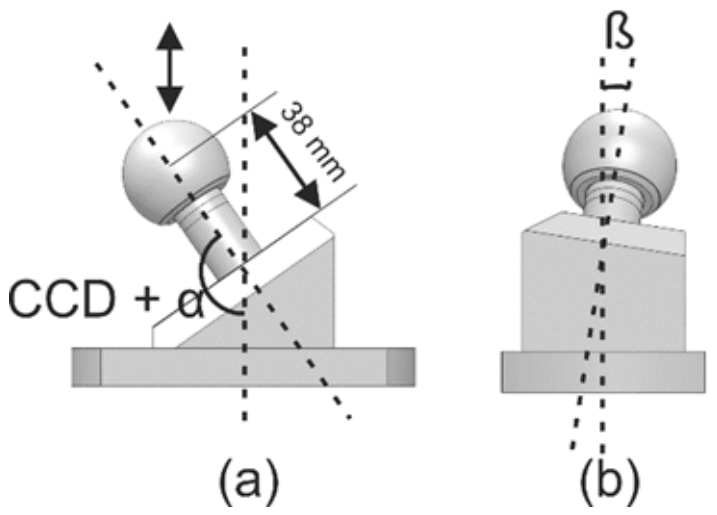
2.3. Uniaxial Dynamic Loading
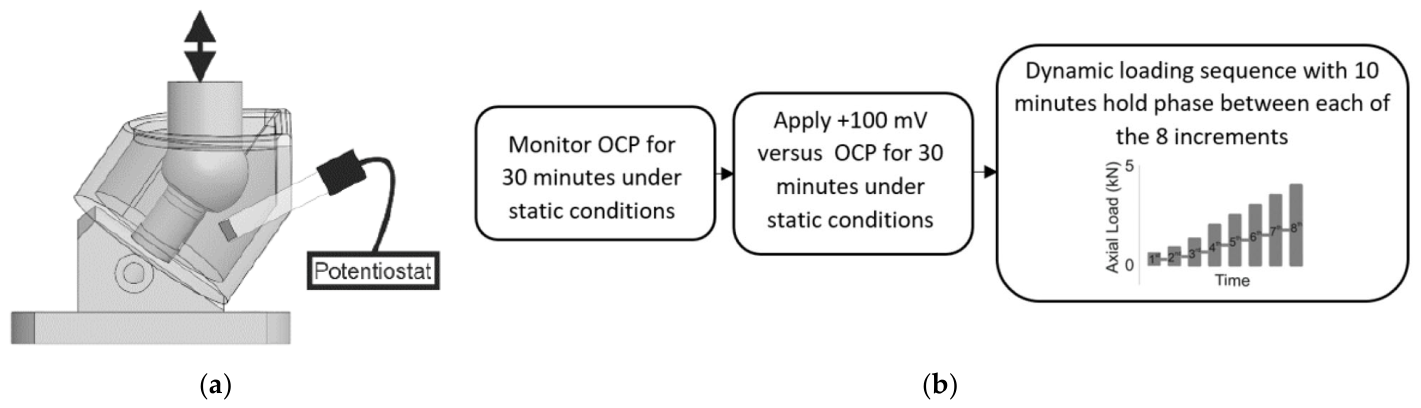
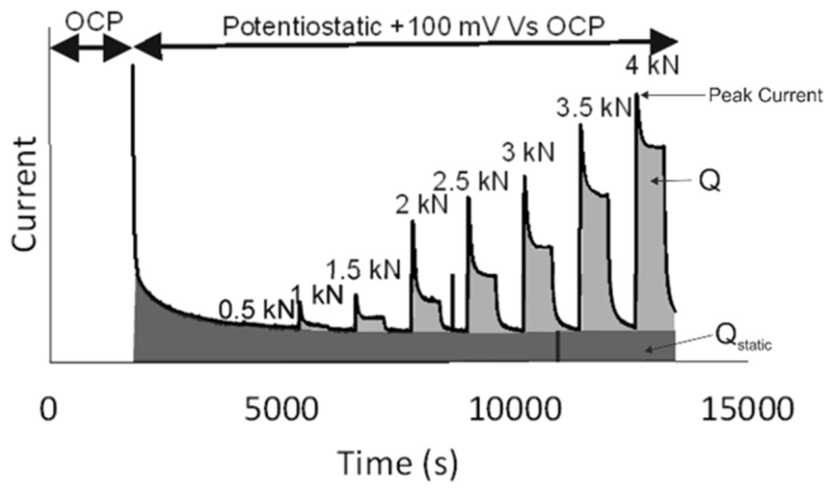
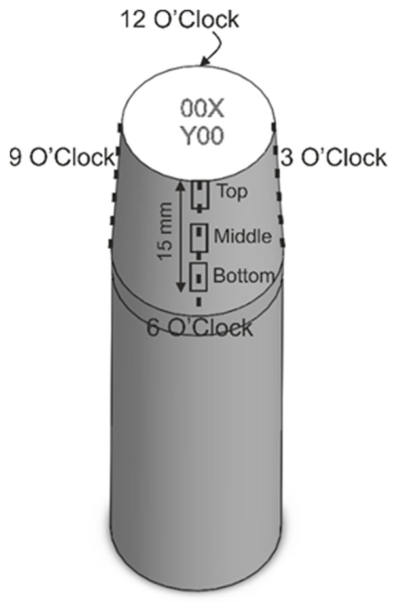
2.4. Fretting Corrosion Protocol
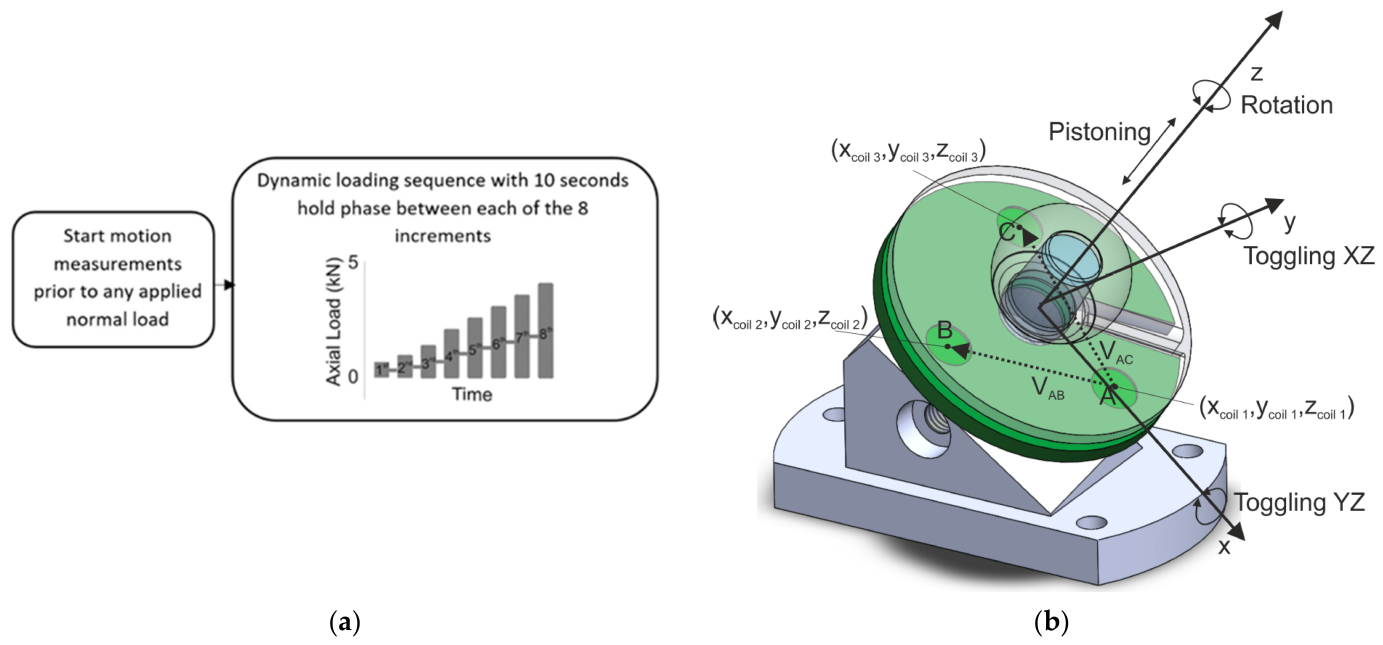
2.5. Motion Arrangement and Protocol
2.6. Surface Analysis
2.7. Statistics
3. Results
3.1. Fretting Corrosion
3.2. Motion
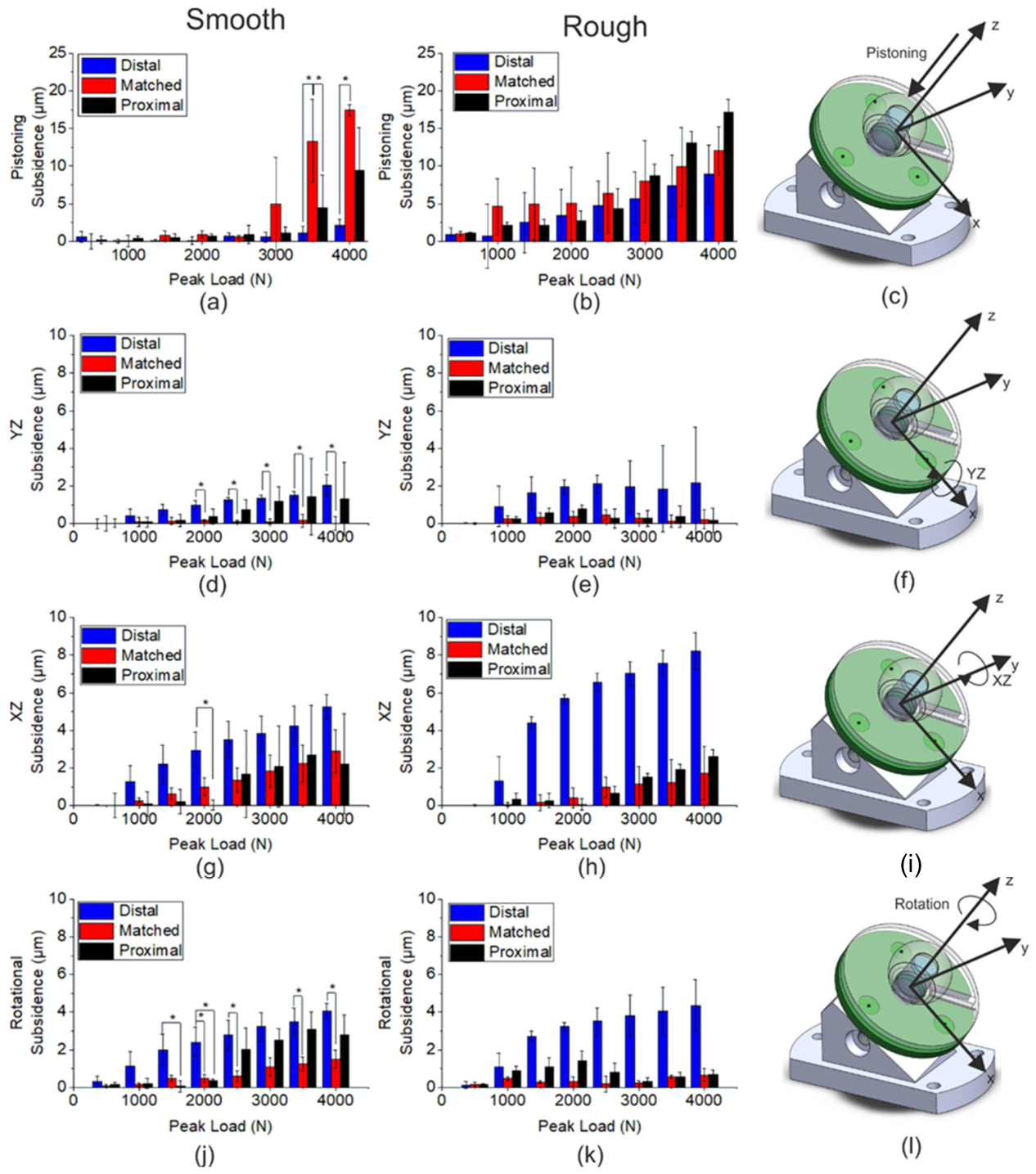
3.2.1. Subsidence
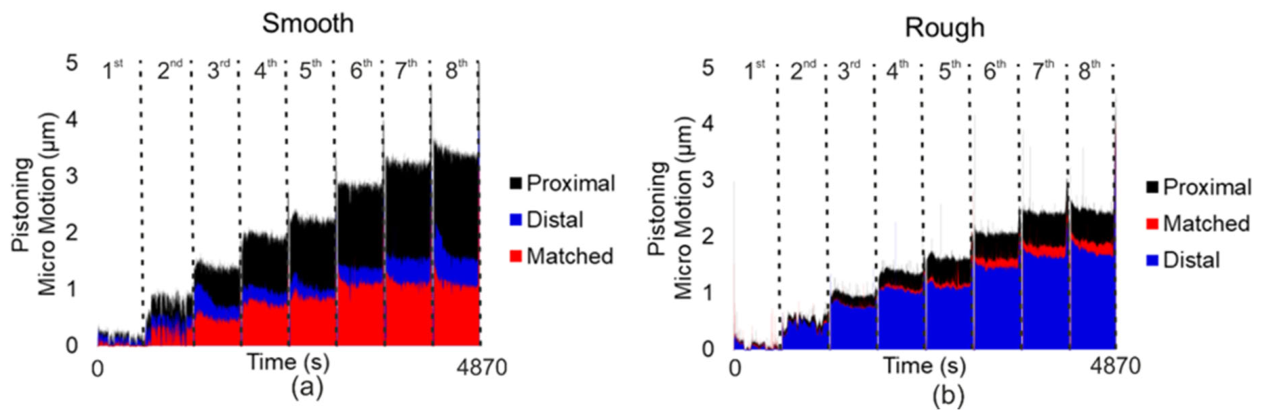
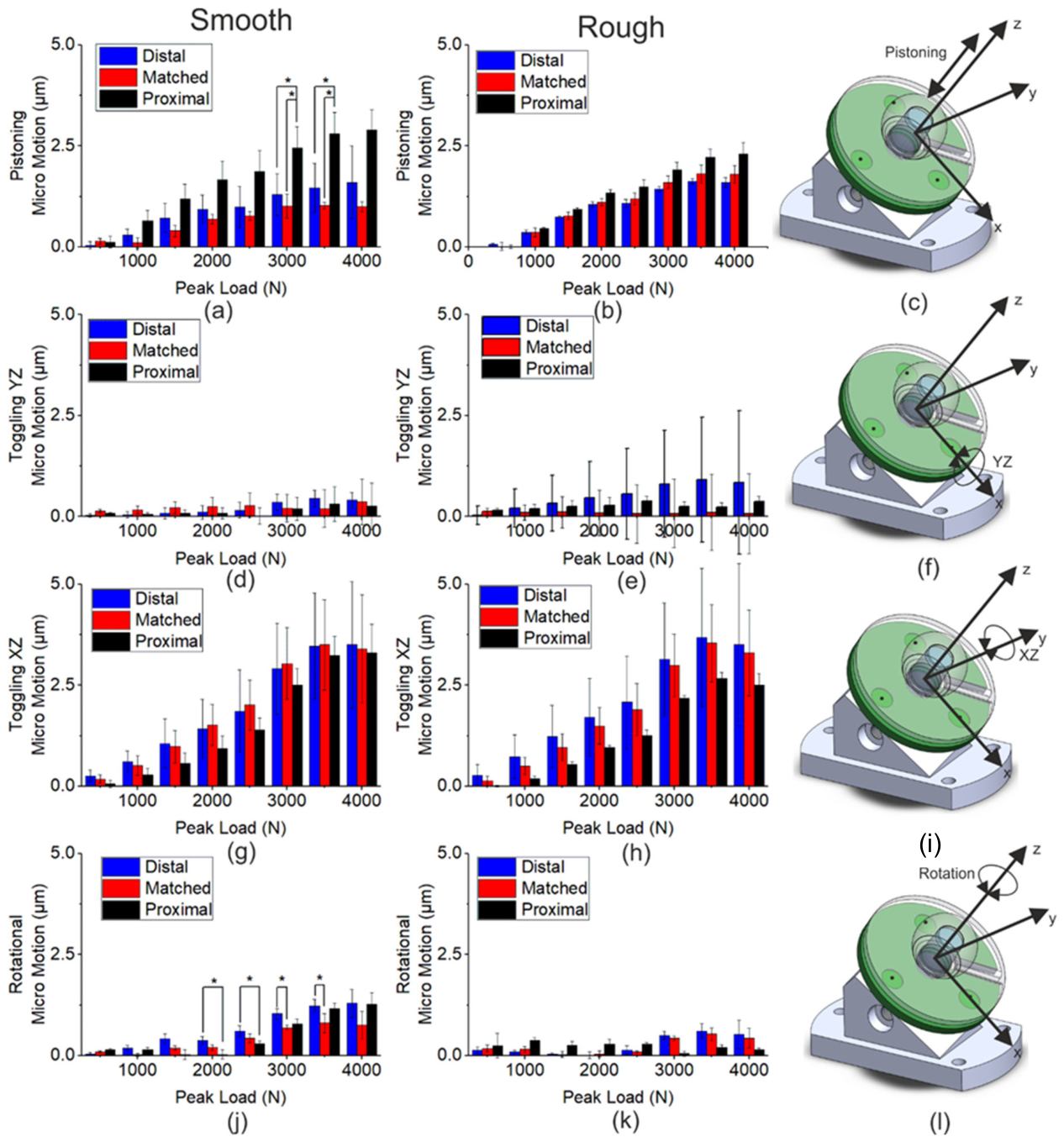
3.2.2. Micro Motion
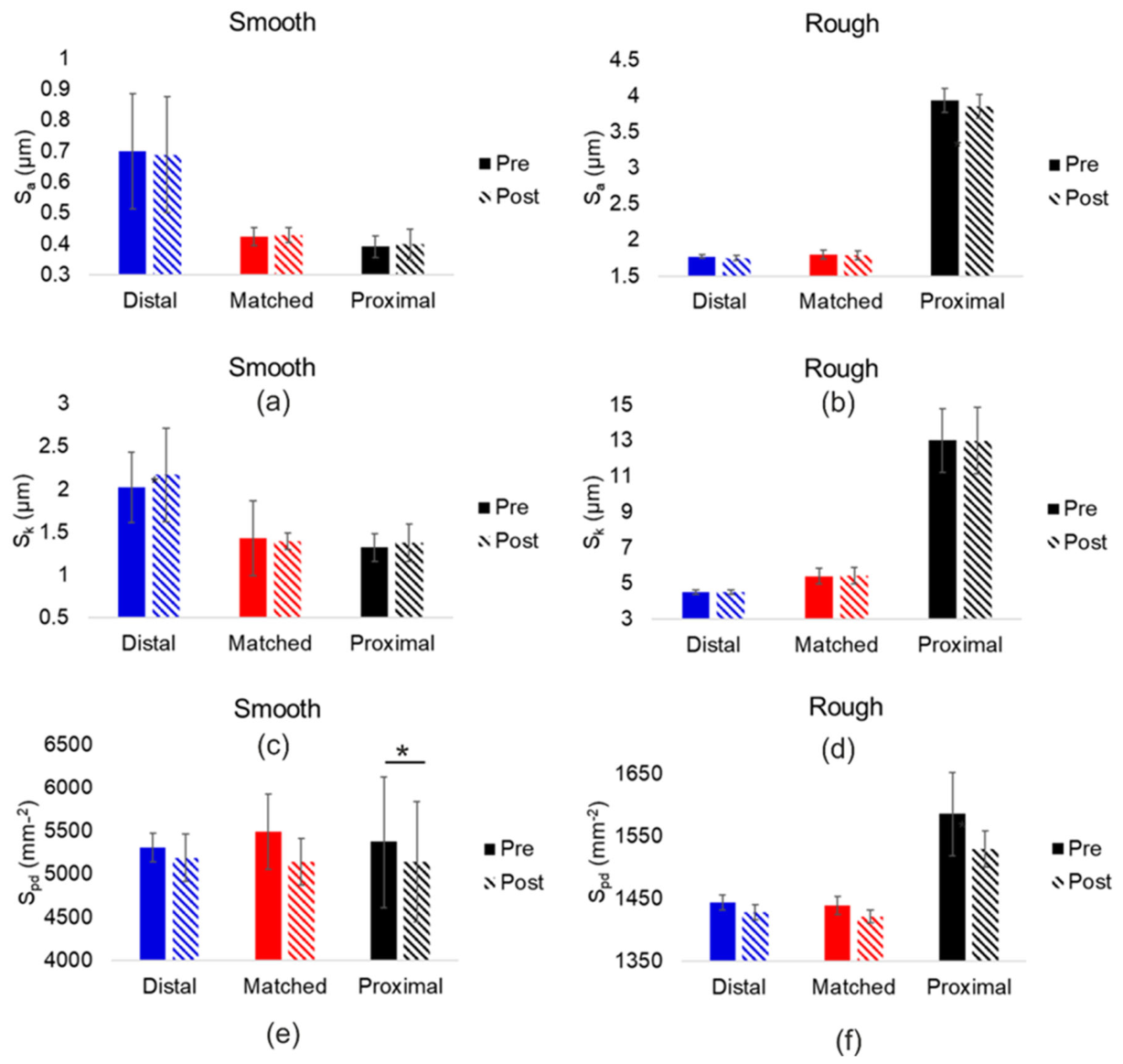
3.3. Surface Analysis Pre and Post Testing
4. Discussion
4.1. The Role of Surface Roughness
4.2. The Role of Angular Mismatch
4.2.1. Implications for Design and Verification
4.2.2. Limitations
5. Conclusions
- Development and implementation of a motion sensing solution capable of capturing motion at the taper interface in three dimensions. Future work will involve measuring motion under more realistic biomechanical loading profiles compared to the uniaxial used currently.
- All the samples in this study presented some level of susceptibility to fretting corrosion indicating that design changes in terms of angular mismatch and surface topography cannot completely remove the issue of taper degradation in THR.
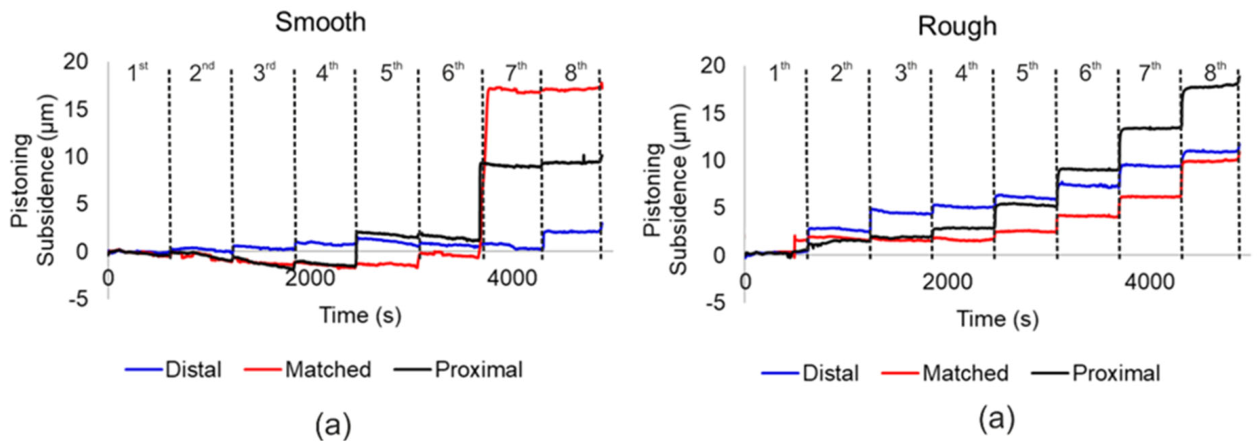
- The samples were still seating. Subsidence, during short-term tests, correlates with fretting corrosion measurements presenting limitations on the medium- to long-term insight afforded by this test methodology.
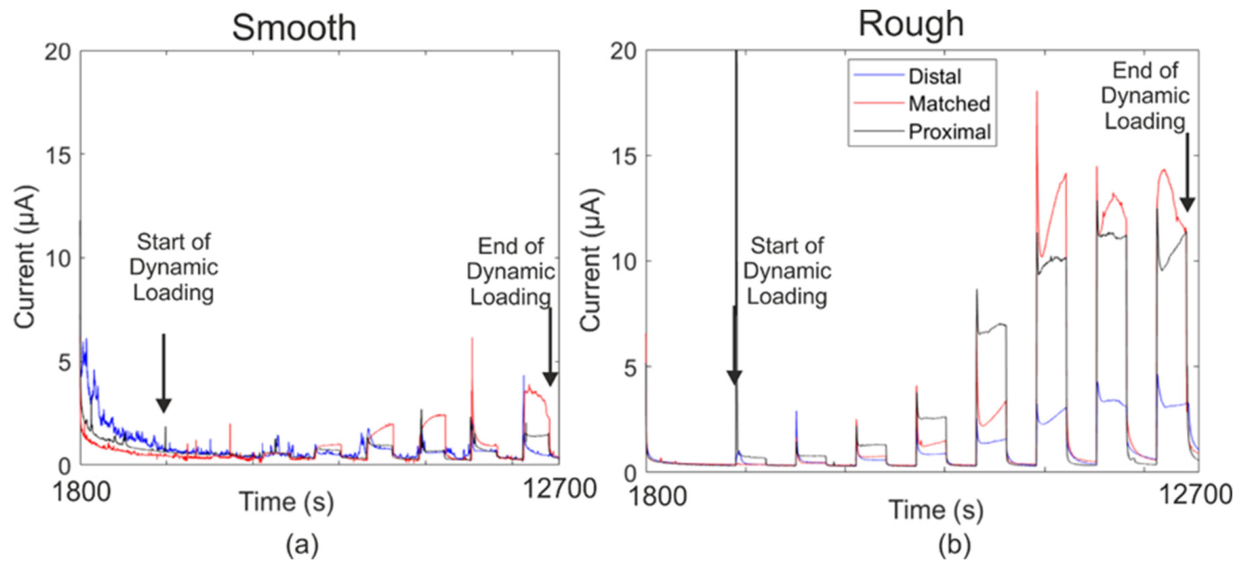
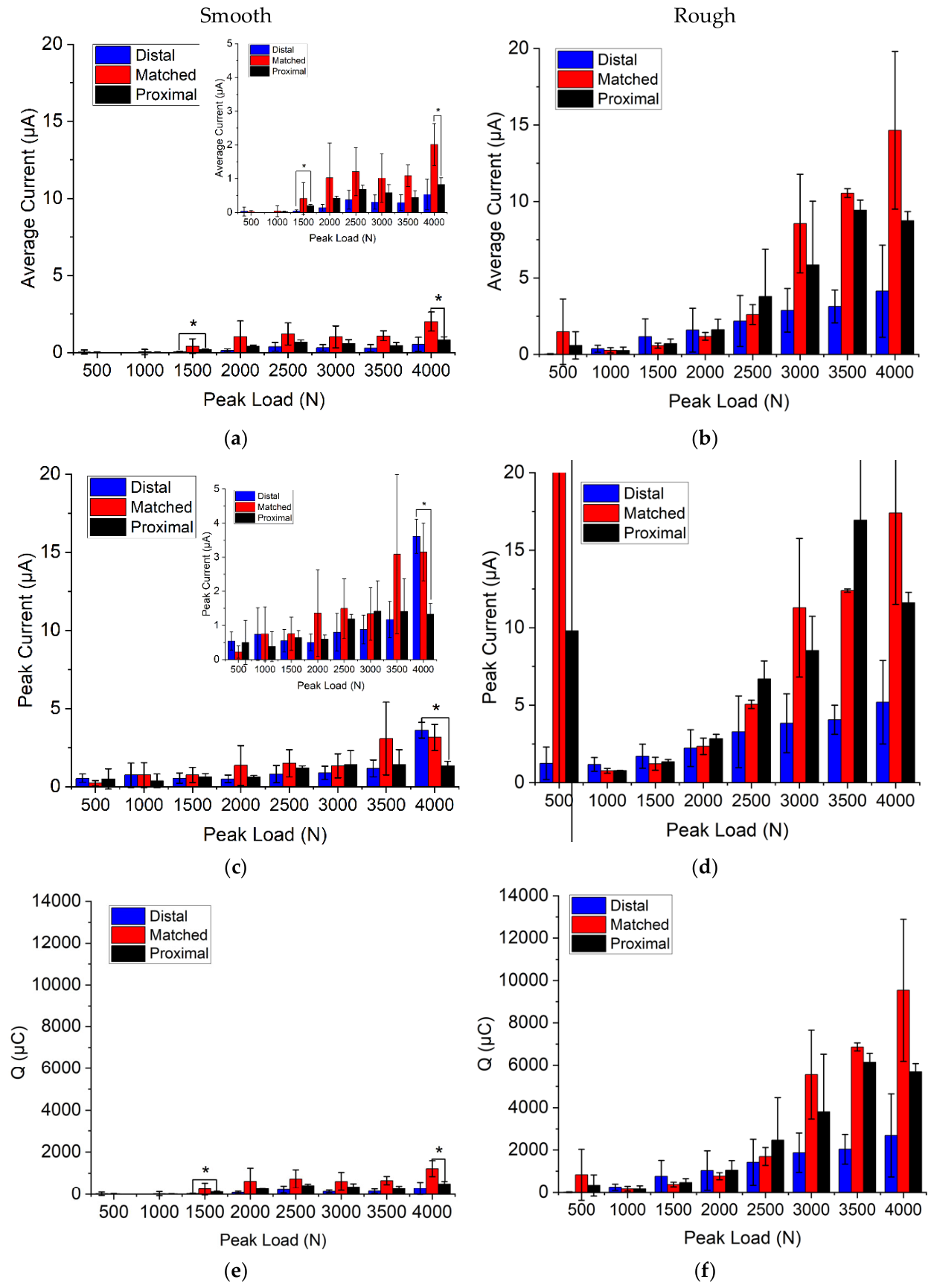
- Results indicate that CoCrMo heads coupled with a male HNSS taper and ‘rough’ threaded interface were more susceptible to fretting corrosion than a non-threaded ‘smooth’ modular taper interfaces.
- The distally engaged head stem couples, i.e., engagement around the opening of the taper interfaces, presented the lowest probable susceptibility to fretting corrosion compared to proximally engaged samples, i.e., engagements concentrated further within the interface.
- The most conforming tapers, the matched engagement samples (0.017 ± 0.004°), presented the highest net corrosion currents suggesting a higher susceptibility to fretting corrosion compared to tapers that present more severe angular mismatch.
- However, the matched samples also presented the least off-axis subsidence and some of the lowest levels of micro motion, suggesting possible implications under more complex loading with greater off-axis dynamic loading vectors.
- An experimental platform utilising clinically relevant samples was developed that enables streamlined assessment (versus current long-term ASTM/ISO testing) and further optimisation of medical device interfaces is proposed.
Supplementary Materials
Author Contributions
Funding
Data Availability Statement
Conflicts of Interest
References
- Hernigou, P.; Queinnec, S.; Flouzat Lachaniette, C.H. One hundred and fifty years of history of the Morse taper: From Stephen A. Morse in 1864 to complications related to modularity in hip arthroplasty. Int. Orthop. 2013, 37, 2081–2088. [Google Scholar] [CrossRef]
- Collier, J.P.; Mayor, M.B.; Williams, I.R.; Surprenant, V.A.; Surprenant, H.P.; Currier, B.H. The Tradeoffs Associated with Modular Hip Prostheses. Clin. Orthop. Relat. Res. 1995, 311, 91–101. [Google Scholar]
- Traina, F.; De Fine, M.; Biondi, F.; Tassinari, E.; Galvani, A.; Toni, A. The influence of the centre of rotation on implant survival using a modular stem hip prosthesis. Int. Orthop. 2009, 33, 1513–1518. [Google Scholar] [CrossRef]
- Goyal, N.; Ho, H.; Fricka, K.B.; Engh, C.A. Do You Have to Remove a Corroded Femoral Stem? J. Arthroplast. 2014, 29, 139–142. [Google Scholar] [CrossRef]
- Garellick, G.; Kärrholm, J.; Rogmark, C.; Herberts, P.; Rolfson, O. Swedish Hip Arthroplasty Register—Annual Report 2017; Ola Rolfson: Göteborg, Sweden, 2017. [Google Scholar]
- Reed, M.; Brittain, R.; Howard, P.; Lawrence, S.; Stonadge, J.; Wilkinson, M.; Wilton, T. 18th Annual Report 2021; NJR: Hemel Hempstead, UK, 2021. [Google Scholar]
- Gilbert, J.L.; Buckley, C.A.; Jacobs, J.J. In vivo corrosion of modular hip prosthesis components in mixed and similar metal combinations. The effect of crevice, stress, motion, and alloy coupling. J. Biomed. Mater. Res. 1993, 27, 1533–1544. [Google Scholar] [CrossRef]
- Brown, S.A.; Flemming, C.A.C.; Kawalec, J.S.; Placko, H.E.; Vassaux, C.; Merritt, K.; Payer, J.H.; Kraay, M.J. Fretting corrosion accelerates crevice corrosion of modular hip tapers. J. Appl. Biomater. 1995, 6, 19–26. [Google Scholar] [CrossRef] [PubMed]
- Goldberg, J.R.; Gilbert, J.L.; Jacobs, J.J.; Bauer, T.W.; Paprosky, W.; Leurgans, S. A Multicenter Retrieval Study of the Taper Interfaces of Modular Hip Prostheses. Clin. Orthop. Relat. Res. 2002, 401, 149–161. [Google Scholar] [CrossRef] [PubMed]
- Rodrigues, D.C.; Urban, R.M.; Jacobs, J.J.; Gilbert, J.L. In vivo severe corrosion and hydrogen embrittlement of retrieved modular body titanium alloy hip-implants. J. Biomed. Mater. Res.—Part B Appl. Biomater. 2009, 88, 206–219. [Google Scholar] [CrossRef]
- Cooper, H.J.; Della Valle, C.J.; Berger, R.A.; Tetreault, M.; Paprosky, W.G.; Sporer, S.M.; Jacobs, J.J. Corrosion at the head-neck taper as a cause for adverse local tissue reactions after total hip arthroplasty. J. Bone Jt. Surg.—Ser. A. 2012, 74, 1655–1661. [Google Scholar] [CrossRef]
- Hall, D.J.; Pourzal, R.; Della Valle, C.J.; Galante, J.O.; Jacobs, J.J.; Urban, R.M. Corrosion of Modular Junctions in Femoral and Acetabular Components for Hip Arthroplasty and Its Local and Systemic Effects. In Modularity and Tapers in Total Joint Replacement Devices; ASTM International: West Conshohocken, PA, USA, 2015; pp. 410–427. [Google Scholar] [CrossRef]
- Jennings, J.M.; Dennis, D.A.; Yang, C.C. Corrosion of the Head-neck Junction After Total Hip. J. Am. Acad. Orthop. Surg. 2016, 24, 349–356. [Google Scholar] [CrossRef]
- Lindgren, J.U.; Brismar, B.H.; Wikstrom, A.C. Adverse reaction to metal release from a modular metal-on-polyethylene hip prosthesis. J. Bone Jt. Surg. Br. 2011, 9393, 1427–1430. [Google Scholar] [CrossRef]
- Morlock, M.M. The Taper Disaster—How Could it Happen? HIP Int. 2015, 25, 339–346. [Google Scholar] [CrossRef]
- European Parliament and of the Council. Regulations (EU) 2017/745 on medical devices. Off. J. Eur. Union. 2017, L 117, 1–228. [Google Scholar]
- Perrigo, O.E. Modern American Lathe Practice; The Norman W. Henley Publishing Co.: New York, NY, USA, 1907. [Google Scholar]
- Colvin, F.H. Turning and Boring Tapers; The Derry-Collard Company: New York, NY, USA, 1903. [Google Scholar]
- BS 4500-5:1988; ISO Limits and Fits: Part 5—Specification for System of Cone Tolerances for Conical Work Pieces From C=1:3 to 1:500 and Lengths from 6mm to 630mm. BSI: London, UK; ISO: Geneva, Switzerland, 1988.
- David, A.; Stephenson, J.S.A. Toolholders and Workholders. In Metal Cutting Theory and Practice, 3rd ed.; Taylor & Francis Group: Abingdon, UK, 2016; pp. 280–332. [Google Scholar]
- NextGenTooling. AT3 Taper Tolerances. Available online: https://www.nextgentooling.com/technical/at3-taper-tolerances (accessed on 2 April 2020).
- Mueller, U.; Braun, S.; Schroeder, S.; Sonntag, R.; Kretzer, J.P. Same Same but Different? 12/14 Stem and Head Tapers in Total Hip Arthroplasty. J. Arthroplast. 2017, 32, 3191–3199. [Google Scholar] [CrossRef]
- Wade, A.; Beadling, A.R.; Neville, A.; De Villiers, D.; Cullum, C.J.; Collins, S.; Bryant, M.G. Geometric Variations of Modular Head-Stem Taper Junctions of Total Hip Replacements. Med. Eng. Phys. 2020, 83, 34–47. [Google Scholar] [CrossRef] [PubMed]
- Werner, P.H.; Etema, H.B.; Wit, F.; Morlock, M.M.; Verheyen, C.C.P.M. Basic principles and uniform terminology for the head-neck juncton in hip replacement. HIP Int. 2015, 25, 115–119. [Google Scholar] [CrossRef] [PubMed]
- Bergmann, G.; Graichen, F.; Rohlmann, A.; Bender, A.; Heinlein, B.; Duda, G.N.; Heller, M.O.; Morlock, M.M. Realistic loads for testing hip implants. Biomed. Mater. Eng. 2010, 20, 65–75. [Google Scholar] [CrossRef]
- Bishop, N.E.; Hothan, A.; Morlock, M.M. High friction moments in large hard-on-hard hip replacement bearings in conditions of poor lubrication. J. Orthop. Res. 2013, 31, 807–813. [Google Scholar] [CrossRef]
- Gilbert, J.L.; Mali, S.A.; Sivan, S. Corrosion of Modular Tapers in Total Joint Replacements: A Critical Assessment of Design, Materials, Surface Structure, Mechanics, Electrochemistry, and Biology. In Modularity and Tapers in Total Joint Replacement Devices; ASTM International: West Conshohocken, PA, USA, 2015; pp. 192–223. [Google Scholar] [CrossRef]
- Munir, S.; Walter, W.L.; Walsh, W.R. Variations in the trunnion surface topography between different commercially available hip replacement stems. J. Orthop. Res. 2015, 33, 98–105. [Google Scholar] [CrossRef]
- Ouellette, E.S.; Mali, S.A.; Kim, J.; Grostefon, J.; Gilbert, J.L. Design, Material, and Seating Load Effects on In Vitro Fretting Corrosion Performance of Modular Head-Neck Tapers. J. Arthroplast. 2019, 34, 991–1002. [Google Scholar] [CrossRef] [PubMed]
- Wight, C.M.; Lanting, B.; Schemitsch, E.H. Evidence based recommendations for reducing head-neck taper connection fretting corrosion in hip replacement prostheses. HIP Int. 2017, 27, 523–531. [Google Scholar] [CrossRef]
- Whittaker, R.K.; Hothi, H.S.; Eskelinen, A.; Blunn, G.W.; Skinner, J.A.; Hart, A.J. Variation in taper surface roughness for a single design effects the wear rate in total hip arthroplasty. J. Orthop. Res. 2017, 35, 1784–1792. [Google Scholar] [CrossRef]
- Brock, T.M.; Sidaginamale, R.; Rushton, S.; Nargol, A.V.; Bowsher, J.G.; Savisaar, C.; Joyce, T.J.; Deehan, D.J.; Lord, J.K.; Langton, D.J. Shorter, rough trunnion surfaces are associated with higher taper wear rates than longer, smooth trunnion surfaces in a contemporary large head metal-on-metal total hip arthroplasty system. J. Orthop. Res. 2015, 33, 1868–1874. [Google Scholar] [CrossRef]
- Hothi, H.S.; Whittaker, R.K.; Meswania, J.M.; Blunn, G.W.; Skinner, J.A.; Hart, A.J. Influence of stem type on material loss at the metal-on-metal pinnacle taper junction. Proc. Inst. Mech. Eng. Part H J. Eng. Med. 2015, 229, 91–97. [Google Scholar] [CrossRef]
- Hothi, H.S.; Eskelinen, A.P.; Berber, R.; Lainiala, O.S.; Moilanen, T.P.; Skinner, J.A.; Hart, A.J. Factors Associated with Trunnionosis in the Metal-on-Metal Pinnacle Hip. J. Arthroplast. 2017, 32, 286–290. [Google Scholar] [CrossRef] [PubMed]
- Arnholt, C.M.; MacDonald, D.W.; Underwood, R.J.; Guyer, E.P.; Rimnac, C.M.; Kurtz, S.M.; Mont, M.A.; Klein, G.R.; Lee, G.C.; Chen, A.F.; et al. Do Stem Taper Microgrooves Influence Taper Corrosion in Total Hip Arthroplasty? A Matched Cohort Retrieval Study. J. Arthroplast. 2017, 32, 1363–1373. [Google Scholar] [CrossRef] [PubMed]
- Arnholt, C.; MacDonald, D.; Higgs, G.; Kraay, M.; Rimnac, C.; Kurtz, S.; Underwood, R.; Chen, A.; Klein, G.; Hamlin, B.; et al. Microgrooved Surface Topography Does Not Influence Fretting Corrosion of Tapers in Total Hip Arthroplasty: Classification and Retrieval Analysis. In Modularity and Tapers in Total Joint Replacement Devices; ASTM International: West Conshohocken, PA, USA, 2015; pp. 99–112. [Google Scholar] [CrossRef]
- Panagiotidou, A.; Meswania, J.; Hua, J.; Muirhead-Allwood, S.; Hart, A.; Blunn, G. Enhanced wear and corrosion in modular tapers in total hip replacement is associated with the contact area and surface topography. J. Orthop. Res. 2013, 31, 2032–2039. [Google Scholar] [CrossRef]
- Bitter, T.; Khan, I.; Marriott, T.; Lovelady, E.; Verdonschot, N.; Janssen, D. The effects of manufacturing tolerances and assembly force on the volumetric wear at the taper junction in modular total hip arthroplasty. Comput. Methods Biomech. Biomed. Eng. 2019, 22, 1061–1072. [Google Scholar] [CrossRef]
- Donaldson, F.E.; Coburn, J.C.; Siegel, K.L. Total hip arthroplasty head-neck contact mechanics: A stochastic investigation of key parameters. J. Biomech. 2014, 47, 1634–1641. [Google Scholar] [CrossRef]
- Fallahnezhad, K.; Oskouei, R.H.; Badnava, H.; Taylor, M. An adaptive finite element simulation of fretting wear damage at the head-neck taper junction of total hip replacement: The role of taper angle mismatch. J. Mech. Behav. Biomed. Mater. 2017, 75, 58–67. [Google Scholar] [CrossRef]
- Raji, H.Y.; Shelton, J.C. Prediction of taper performance using quasi static FE models: The influence of loading, taper clearance and trunnion length. J. Biomed. Mater. Res.—Part B Appl. Biomater. 2019, 107, 138–148. [Google Scholar] [CrossRef]
- ASTM F1875; Standard Practice for Fretting Corrosion Testing of Modular Implant Interfaces: Hip Femoral Head-Bore and Cone Taper Interface 1. ASTM Standards: West Conshohocken, PA, USA, 2009; Volume 98, pp. 1–6.
- ISO 5832-9; Implants for Surgery—Metallic Materials Part 9: Wrought High Nitrogen Stainless Steel. BSI Standards: London, UK, 2019.
- ISO 5832-6; Implants for Surgery—Metallic Materials Implants for Surgery—Metallic Materials Part 6: Wrought Cobalt-Nickel-Chromium-Molybdenum Alloy. ISO: Geneva, Switzerland, 2019.
- ISO 7206-10:2003; Implants for Surgery—Partial and Total Hip Joint Prostheses—Part 10: Determination of Resistance to Static Load of Modular Femoral Heads. ISO: Geneva, Switzerland, 2003.
- Wade, A.; Webster, F.; Beadling, A.R.; Bryant, M.G. Importance of surgical assembly technique on the engagement of 12/14 modular tapers. Proc. Inst. Mech. Eng. Part H J. Eng. Med. 2021, 236, 158–168. [Google Scholar] [CrossRef] [PubMed]
- BS ISO 7206-4:2010+A1:2016; Implants for Surgery—Partial and Total Hip Joint Prostheses Part 4: Determination of Endurance Properties and Performance of Stemmed Femoral Components. BSI: London, UK, 2016.
- Stryker. ACCOLADE® II Femoral Hip Stem—Surgical Technique. Available online: https://bizwan.com/_mydoc/stryker/Hip/003%20Accolade%20II%20Femoral%20Hip%20System%20Surgical%20Technique.pdf (accessed on 25 May 2026).
- BS EN ISO 4288:1998; Geometric Product Specification (GPS)—Surface Texture—Profile Method: Rules and Procedures for the Assessment of Surface Texture. ISO: Geneva, Switzerland, 1998.
- BS ISO 4287; Geometric Product Specification—Surface Texture: Profile Method—Terms, Definitions and Surface Texture Parameters. BSI: London, UK, 1997.
- BS ISO 13565-2:1996; Geometrical Product Specifications (GPS)—Surface Texture: Profile Method; Surfaces Having Stratified Functional Properties—Part 2: Height Characterization Using Linear Material Ratio Curve. BSI: London, UK, 2000.
- ISO 25178-2:2012; Geometrical Product Specifications (GPS)—Surface Texture: Areal Part 2: Terms, Definitions and Surface. ISO: Geneva, Switzerland, 2012.
- Mali, S.A.; Gilbert, J.L. Correlating Fretting Corrosion and Micromotions in Modular Tapers: Test Method Development and Assessment. In Modularity and Tapers in Total Joint Replacement Devices; ASTM International: West Conshohocken, PA, USA, 2015; pp. 259–282. [Google Scholar] [CrossRef]
- Gilbert, J.L.; Zhu, D. A metallic biomaterial tribocorrosion model linking fretting mechanics, currents, and potentials: Model development and experimental comparison. J. Biomed. Mater. Res.—Part B Appl. Biomater. 2020, 108, 3174–3189. [Google Scholar] [CrossRef] [PubMed]
- Ouellette, E.S.; Shenoy, A.A.; Gilbert, J.L. The seating mechanics of head-neck modular tapers in vitro: Load-displacement measurements, moisture, and rate effects. J. Orthop. Res. 2018, 36, 1164–1172. [Google Scholar] [CrossRef]
- Vingsbo, O.; Söderberg, S. On fretting maps. Wear 1988, 126, 131–147. [Google Scholar] [CrossRef]
- Swaminathan, V.; Gilbert, J.L. Fretting corrosion of CoCrMo and Ti6Al4V interfaces. Biomaterials 2012, 33, 5487–5503. [Google Scholar] [CrossRef]
- Witt, F.; Gührs, J.; Morlock, M.M.; Bishop, N.E. Quantification of the contact area at the head-stem taper interface of modular hip prostheses. PLoS ONE 2015, 10, e0135517. [Google Scholar] [CrossRef][Green Version]
- Pierre, D.; Swaminathan, V.; Scholl, L.Y.; TenHuisen, K.; Gilbert, J.L. Effects of Seating Load Magnitude on Incremental Cyclic Fretting Corrosion in 5°40’ Mixed Alloy Modular Taper Junctions. J. Arthroplast. 2018, 33, 1953–1961. [Google Scholar] [CrossRef]





| Sample Group | Angular Mismatch (°) | Male Taper Surface Finish |
|---|---|---|
Smooth Distal | −0.090 ± 0.003 |  |
Smooth Matched | 0.019 ± 0.003 | |
Smooth Proximal | 0.121 ± 0.013 | |
Rough Distal | −0.088 ± 0.004 |  |
Rough Matched | 0.015 ± 0.004 | |
Rough Proximal | 0.115 ± 0.004 |
| Roughness Parameter | Description | Applicable Standard or Paper |
|---|---|---|
| Sa | Arithmetic mean of absolute values from the reference surface for a given sample length. | ISO 4287 [50] |
| Sk | Depth of the roughness core profile. The roughness core profile being the roughness profile excluding protruding peaks and deep valleys. | ISO 13565 [51] |
| Spd | Number of peaks per area, i.e., peak density. | ISO 25178 [52] |
Disclaimer/Publisher’s Note: The statements, opinions and data contained in all publications are solely those of the individual author(s) and contributor(s) and not of MDPI and/or the editor(s). MDPI and/or the editor(s) disclaim responsibility for any injury to people or property resulting from any ideas, methods, instructions or products referred to in the content. |
© 2026 by the authors. Licensee MDPI, Basel, Switzerland. This article is an open access article distributed under the terms and conditions of the Creative Commons Attribution (CC BY) license.
Share and Cite
Wade, A.; Beadling, A.R.; Jones, D.; De Villiers, D.; Cullum, J.; Collins, S.; Bryant, M.G. How Angular Mismatch and Surface Topography in Modular Head–Stem Taper Junctions in Total Hip Replacements Affects Fretting-Corrosion and Motion Under Uni-Axial Loading. Sensors 2026, 26, 3571. https://doi.org/10.3390/s26113571
Wade A, Beadling AR, Jones D, De Villiers D, Cullum J, Collins S, Bryant MG. How Angular Mismatch and Surface Topography in Modular Head–Stem Taper Junctions in Total Hip Replacements Affects Fretting-Corrosion and Motion Under Uni-Axial Loading. Sensors. 2026; 26(11):3571. https://doi.org/10.3390/s26113571
Chicago/Turabian StyleWade, Abigail, Andrew Robert Beadling, Dominic Jones, Danielle De Villiers, Jo Cullum, Simon Collins, and Michael George Bryant. 2026. "How Angular Mismatch and Surface Topography in Modular Head–Stem Taper Junctions in Total Hip Replacements Affects Fretting-Corrosion and Motion Under Uni-Axial Loading" Sensors 26, no. 11: 3571. https://doi.org/10.3390/s26113571
APA StyleWade, A., Beadling, A. R., Jones, D., De Villiers, D., Cullum, J., Collins, S., & Bryant, M. G. (2026). How Angular Mismatch and Surface Topography in Modular Head–Stem Taper Junctions in Total Hip Replacements Affects Fretting-Corrosion and Motion Under Uni-Axial Loading. Sensors, 26(11), 3571. https://doi.org/10.3390/s26113571