1. Introduction
Unmanned aerial vehicles (UAVs) have been increasingly deployed in diverse domains, including surveillance, disaster response, and wireless communications [
1,
2]. In the context of wireless networks, UAVs offer unique advantages over fixed terrestrial infrastructure: they can be rapidly deployed in three-dimensional space, dynamically adjust their positions to establish favorable line-of-sight (LoS) links with ground terminals (GTs), and serve as mobile edge computing (MEC) servers to process computation-intensive tasks on behalf of resource-constrained GTs. This MEC-enabled multi-UAV paradigm is particularly valuable in time-critical scenarios—such as post-disaster search and rescue—where GTs must execute deep learning tasks (e.g., real-time object recognition for locating trapped personnel) under stringent latency constraints but lack sufficient local computing power.
However, realizing efficient MEC-enabled multi-UAV systems requires addressing several tightly coupled challenges that existing works have not jointly resolved. First, UAV–GT communication links in urban or cluttered environments are frequently obstructed by ground obstacles, causing significant path loss variations that depend on the UAV’s instantaneous position relative to each GT [
3,
4]. Second, UAV propulsion energy is strictly limited, and the flight trajectory directly determines both the communication link quality and the energy budget available for computation services [
5]. Third, deep learning tasks possess a unique sequential layer-wise structure: unlike general computation tasks that can be treated as indivisible units, deep neural networks (DNNs) can be partitioned at intermediate layers, enabling partial offloading where the front layers execute locally and the remaining layers execute on the UAV. This Partial Program Offloading (PPO) introduces additional coupling between the offloading ratio, the required uplink data volume (including intermediate results), and the UAV’s computing resource allocation. These interdependencies—trajectory affecting link quality, link quality constraining offloading feasibility, offloading ratio determining computing demands, and computing demands influencing energy consumption—form a complex joint optimization problem that cannot be decomposed into independent subproblems.
Existing research has made progress in individual dimensions of this problem but falls short of addressing the full coupling. In UAV trajectory optimization, prior works have focused on maximizing communication throughput or minimizing propulsion energy without considering MEC task demands [
5,
6,
7,
8]. In MEC-enabled UAV systems, studies have explored task offloading and multi-UAV collaboration [
9,
10,
11], but most adopt binary (full) offloading and single-dimension optimization. Recent Deep Reinforcement Learning (DRL) approaches [
12,
13] have attempted joint optimization but require extensive training (over 10,000 episodes) and lack convergence guarantees, making them unsuitable for time-sensitive missions. Critically, no existing work jointly optimizes UAV trajectories, computing resource allocation, and
partial deep learning task offloading in a multi-UAV setting—the specific gap this paper addresses.
To fill this gap, we formulate a joint optimization problem that minimizes the maximum energy consumption across all UAVs while satisfying the QoS requirements (task completion deadlines) of all GT deep learning tasks. The optimization jointly determines (i) the flight trajectory of each UAV, (ii) the GT-UAV association for task offloading, and (iii) the computing resource allocation at each UAV. The resulting problem is non-convex with multiple coupled constraints. We propose a block coordinate descent (BCD) algorithm combined with successive convex approximation (SCA) to decompose and iteratively solve this problem. The BCD framework is chosen over DRL-based alternatives for three reasons: it provides deterministic convergence guarantees to a stationary point, achieves polynomial-time complexity per iteration without requiring offline training, and converges within approximately 50 iterations (3–5 s wall-clock time), ensuring real-time applicability for time-sensitive UAV missions.
The main contributions of this paper are summarized as follows:
- 1.
We design a Partial Program Offloading (PPO) scheme tailored for deep learning tasks in MEC-enabled multi-UAV systems. Unlike binary offloading, PPO splits DNN tasks at an optimal layer, enabling flexible workload distribution between GTs and UAVs. We formulate a joint optimization problem that couples UAV trajectories, GT–UAV associations, computing resource allocation, and partial offloading ratios under energy and latency constraints.
- 2.
We develop an iterative SCA-BCD algorithm to solve the formulated non-convex problem. The algorithm decomposes the joint problem into three tractable subproblems—GT-UAV association, computing resource allocation, and trajectory optimization—each solved via convex programming in each iteration. We prove that the algorithm converges monotonically to a suboptimal solution within a prescribed accuracy.
- 3.
We validate the proposed algorithm through extensive simulations. The results demonstrate that the joint optimization significantly reduces UAV energy consumption compared to baseline (elliptical trajectory) and TSP-based solutions, while satisfying all GT task latency deadlines. We further show the necessity of partial offloading by demonstrating that binary offloading becomes infeasible under the same resource constraints.
The remainder of this paper is organized as follows.
Section 2 reviews related work on UAV trajectory optimization, MEC task offloading, and DRL-based approaches.
Section 3 presents the system model and problem formulation.
Section 4 details the proposed SCA-BCD solution.
Section 5 provides simulation results and analysis.
Section 6 concludes the paper and discusses future directions.
3. System Model and Problem Formulation
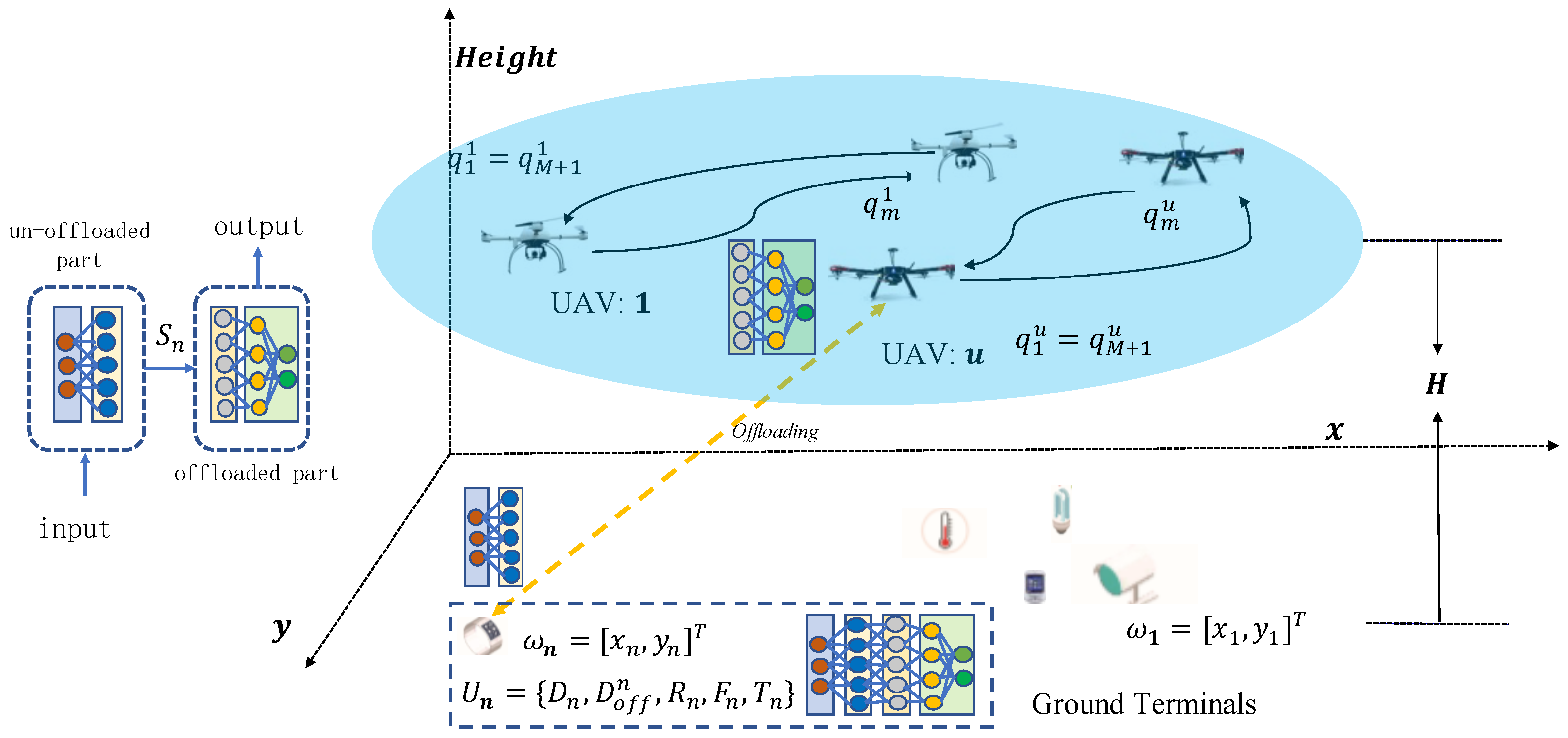
The architecture of MEC-enabled Multi-UAV system is shown in
Figure 1, where
rotary-wing UAVs are deployed to work as MEC servers to serve GTs in the field, and there are
static GTs on the ground with
, with
being the horizontal location of the
n-th GT. In this paper, we consider only rotary-wing UAVs, as they can hover statically in the air to establish stable UAV–GT links—a capability that fixed-wing UAVs lack. We assume that each UAV and GT is equipped with a single omni-directional antenna, and the UAV–GT link operates in half-duplex mode. For clarity, the key notation used throughout this paper is summarized in
Table 2.
3.1. System Model
3.1.1. UAV Trajectory and Flight Model
To model the UAV trajectory, we discretize the mission time into M equal time slots, each of duration . The UAV path is thus represented by waypoints in 3D coordinates: . Here, denotes the waypoint index (i.e., the m-th discrete time slot boundary), H is the fixed flight altitude common to all UAVs, and represents the horizontal coordinate of the u-th UAV at the m-th waypoint. We impose the return constraint to ensure each UAV returns to its initial position after the mission, which is the most common operational requirement. The fixed altitude H is chosen to guarantee obstacle-free straight-and-level flight while maintaining reasonable proximity to GTs.
The maximum horizontal displacement per segment is constrained as
, where
is determined by the product of the segment duration and the maximum horizontal velocity of the UAV. This value is set based on the physical speed limit of the rotary-wing UAV platform (typically 10–20 m/s for commercial multi-rotor UAVs [
5]). With this constraint, the
u-th UAV flies with approximately constant horizontal velocity within each segment, and the distance between the UAV and each GT remains approximately unchanged within each segment. The total number of segments
M must be sufficiently large to satisfy
, where
is a lower bound of the required total UAV flying distance.
Let
denotes the fixed duration that the UAV remains in each line segment. Then, the total mission completion time can be denoted as
. The horizontal flying velocity of the
u-th UAV along the
m-th line segment is thus given by
,
, where
is the maximum horizontal velocity of the UAV in
m-th line segment. With the UAV velocity, for the
u-th rotary-wing UAV, the propulsion energy cost in
m-th line segment can be modeled as
where
and
are constants representing blade profile power (related to rotor friction in hover) and induced power (related to lift generation in hover), respectively.
denotes rotor blade tip speed,
is the mean rotor-induced velocity in hover (linked to lift requirements),
is the fuselage drag ratio (indicating streamline efficiency),
s is rotor solidity (ratio of total blade area to rotor disc area),
is air density, and
G is the rotor disc area. The UAV’s propulsion energy depends on its horizontal velocity in each segment. For simplicity, we ignore acceleration/deceleration energy consumption.
3.1.2. UAV–GT Communication
As discussed before, a UAV–GT link may be blocked by ground obstacles. Thus, during the task offloading through uplink, we have to take the effect of the environment on the occurrence of LoS into consideration. Specifically, adopting an air-to-ground channel model in urban environments, the LoS probability of a UAV–GT link is given as
where
a and
b are constant values that depend on the environment. In this setting, the altitude and antenna heights of the GT are neglected. Specifically, the probability of having LoS for GT
n depends on the altitude of the UAV
H and the horizontal distance between the UAV
u and GT
n at time slot
m denoted as
. Then the pathloss expression of the UAV–GT link becomes
where
A and
C are constants such that
and
;
is the carrier frequency (Hz);
c is the speed of light (m/s); and
and
(in dB) are, respectively, the losses corresponding to the LoS and non-LoS connections depending on the environment. Based on (
3), the instantaneous achievable rate of the
n-th GT’s uplinking to the
u-th UAV in path line
m, can be expressed in bits/second (bps) as
where
denotes the power spectral density of the Additive White Gaussian Noise (AWGN) at the receivers;
P is the transmit power allocated by each GT;
B denotes the total available system bandwidth in Hertz (Hz). It is worth noting that while the UAVs and GTs are equipped with omni-directional antennas, co-channel interference is not explicitly factored into Equation (
4) (i.e., it utilizes an SNR rather than an SINR model). This assumption is predicated on the premise that the system employs Orthogonal Frequency-Division Multiple Access (OFDMA). Under OFDMA, the total available frequency band can be partitioned into multiple orthogonal sub-channels. By allocating non-overlapping sub-channels to adjacent UAVs and GTs, co-channel interference is effectively avoided. Theoretically, if dynamic sub-channel allocation were considered, the bandwidth parameter
B in Equation (
4) would be scaled by a fractional coefficient. However, to maintain focus on the core joint optimization of trajectory, computing resources, and partial offloading, we assume orthogonal sub-channels are pre-allocated and omit the explicit sub-channel allocation modeling in this paper.
Finally, we define the binary GT-UAV association variable
, where the subscript
u indexes the UAV (
) and
n indexes the GT (
). Specifically,
indicates that the
n-th GT is associated with and offloads its deep learning task to the
u-th UAV;
otherwise. Each GT can associate with at most one UAV during the entire mission, i.e.,
which indicates that one GT will associate and offload its deep learning task to one UAV during the whole mission time, as shown in
Figure 1.
3.1.3. Offload Deep Learning Task
We consider that each GT offloads a deep neural network (DNN) task with sequential execution structure to a UAV in this paper. As illustrated in
Figure 1, all the layers of the DNN task will be executed in a strict order, and the execution of the latter layer requires the result of the previous layer as the input. Assume the intermediate results produced by the previous layer are non-trivial and cannot be ignored during offloading. Assume one
n-th GT has an expected deep learning task
during the whole mission time, where
(in Mb) and
(in GHz/Mb) represent the amount of data and the required computing resource of the task, respectively.
denotes the task’s completion deadline.
is the ratio of the size of the task-output data to that of the task-input data. Here, each deep learning task is divided into two parts with different sizes. The first part, with size
, is executed locally at the GT, while the second part, with size
, is offloaded to an UAV for remote execution. Since the second part of the task can be executed only when the intermediate result produced by the first part is obtained, we use
to represent the amount of data of the intermediate result. In addition, assume the task offloading will not take place in the stages of UAV taking off and landing, which is in a relatively short period. Thus, the UAV trajectory in the stages of UAV taking off and landing will not be considered in the system model. We consider each GT offloads a deep neural network (DNN) task—typically common computation-intensive tasks in emergency, field, or remote-service scenarios, such as object recognition (e.g., locating trapped personnel in post-disaster areas via lightweight DNN models)—with a sequential execution structure to the UAV in this paper.
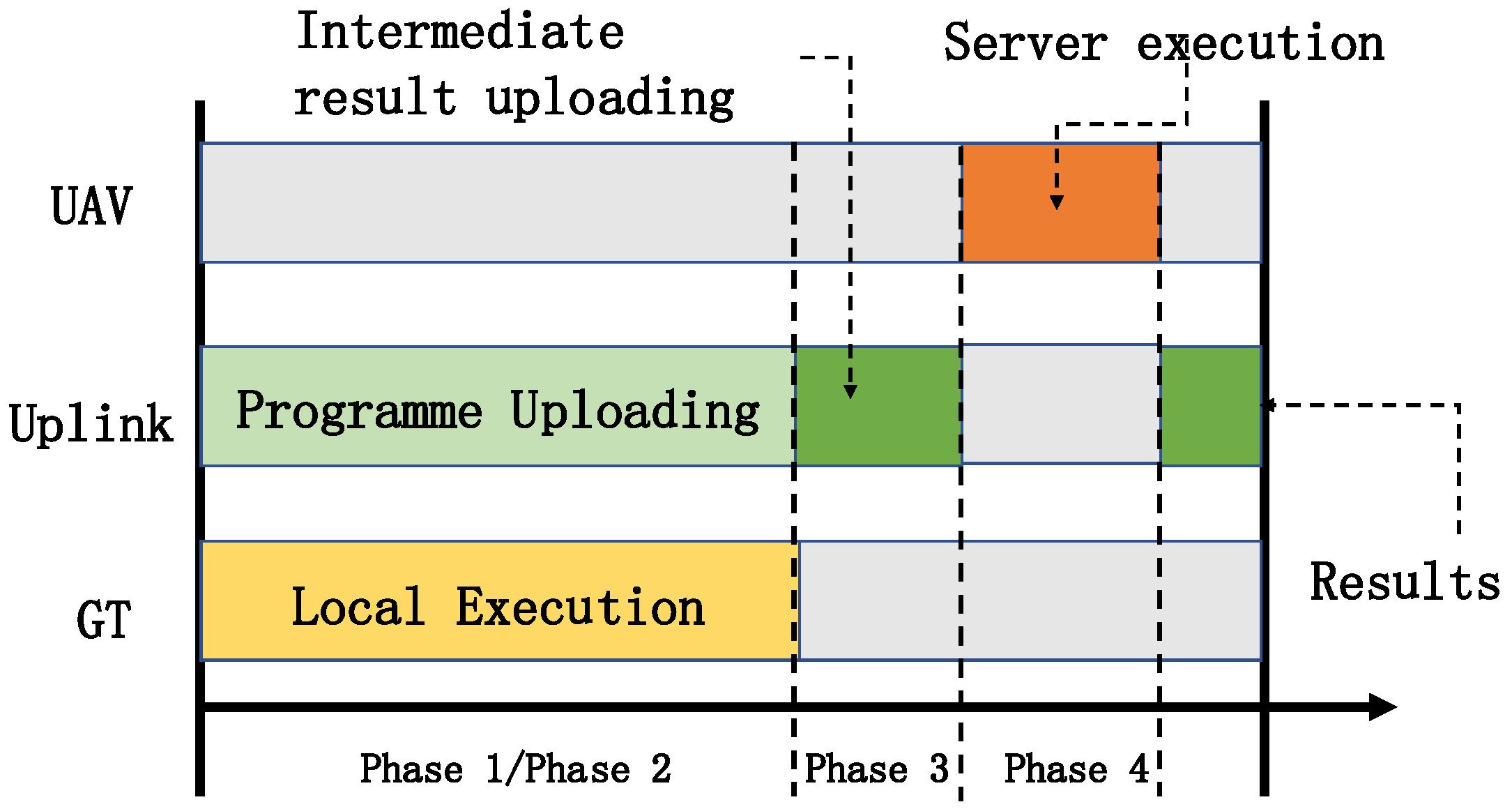
As shown in
Figure 2, this paper follows the Partial Program Offloading (PPO) scheme, which divides the task offloading process from one GT to its associated UAV in four phases: local execution, program uploading, uploading of intermediate results, and UAV server execution. For phase one, local execution, let
in (GHz) denote the processing speed of the computing unit of the
n-th GT. The time taken by the GT to complete the local part of the deep learning task in phase one is given by
According to the PPO scheme, within
, the
n-th GT has to strictly complete phase two, i.e., program uploading, to realize efficient parallel processing. It is worth noting that to avoid redundant transmission and minimize latency, the UAVs are assumed to have pre-cached the standard, static deep learning model backbones. Therefore, the offloaded data
does not encompass the heavy static model architectures. Instead,
strictly represents the task-specific dynamic configurations (e.g., dynamic weights or mission-specific context parameters) required to initialize the remote server execution. Furthermore, the size of
is fundamentally determined by the intrinsic structural characteristics of the specific DNN task and the chosen optimal DNN partition point (split point). Thus, one has
where
is the number of UAV line segments, in which the associated
u-th UAV has to finish receiving the uploaded data from GT.
After phase two, the process moves to phase three, i.e., the
n-th GT offloading the intermediate results
to its associated UAV in a timely manner. Then, on receiving the offloaded data
and intermediate result
, the MEC server on UAV
u starts to execute the second part of the DNN program, which is phase four. Assuming the allocated processing speed by the UAV to
n-th GT is
, the execution time
on UAV can be defined as
We define
as the energy consumption of the UAV on computing task
, which can be formulated as
where
is the effective switched capacitance, and
is the positive constant [
3,
25]. In addition, during the whole UAV mission completion time, one UAV
u only has limited computation capacity
, which can be denoted as
Additionally, consider the whole task latency; the constraint for
n-th GT uploading the intermediate result
to the
u-th UAV should be denoted as
where
, and
is the time allowed for
n-th GT to upload the intermediate result
to the associated
u-th UAV.
After the four phases following the PPO scheme, the associated UAV will transfer the final result to the GT via downlink, as shown in
Figure 2. Because the result data is trivial and the downlink from UAV to GT normally has a high data transfer rate, we ignore the latency caused by the result downlink. To this end, through such a PPO scheme, each GT will have its deep learning task properly handled, with QoS on latency, by itself and together with one associate UAV in the air.
3.2. Problem Formulation
Let
,
, and
, the optimization problem can be modeled as
where
is to minimize the maximum energy consumption of the UAVs while satisfying the QoS requirement of GT tasks on latency. To do so, we need to jointly optimize the UAV trajectory
, GT-UAV association
, and the computing resource allocation
. Here,
is the weighting parameter that balances the propulsion energy and the service (computation) energy; (12b) constrains the total computing capacity of each UAV; (12c) and (12d) enforce the QoS requirement that each task must be completed within its deadline; and (12e)∼(12f) constrain the UAV trajectory in the horizontal dimension. The problem
is non-convex due to the coupling between trajectory variables (in
) and the binary association variables and thus cannot be solved directly in its current form.
3.3. Discussion on Model Assumptions
Before proceeding to the solution, we discuss several modeling assumptions and their justifications:
Orthogonal sub-channel allocation. We assume that orthogonal sub-channels are pre-allocated to avoid co-channel interference among UAV–GT links (cf. Equation (4)). While this simplifies the analysis, we acknowledge that in dense multi-UAV deployments, spectral scarcity and dynamic interference become significant concerns. Incorporating dynamic sub-channel allocation would scale the bandwidth parameter B by a fractional coefficient and introduce additional integer programming variables. We leave this extension to future work, noting that our current framework can accommodate it by treating the sub-channel allocation as an additional block in the BCD iteration.
Neglecting GT antenna heights. The LoS probability model in Equation (2) neglects the antenna heights of GTs. This is justified when the UAV altitude H (200 m in our simulations) is significantly larger than typical GT antenna heights (1–3 m), making the elevation angle approximation highly accurate. In scenarios with substantial GT elevation differences (e.g., multi-story buildings), the model can be extended by replacing H with for each GT n.
Constant velocity within segments. The model assumes approximately constant horizontal velocity within each trajectory segment, which precludes explicit hovering (zero velocity). However, the rotary-wing propulsion model in Equation (1) naturally accounts for hovering energy (the and terms dominate at ). In practice, the optimized trajectory may produce very short segments (small ) that approximate hovering behavior. For scenarios with very high terminal density where sustained hovering is optimal, the constraint (21a) can be relaxed by setting close to 1.
UAV computation capacity. The constraint in Equation (10) represents the maximum sustainable computing frequency of the UAV’s onboard processor. This limit implicitly accounts for thermal dissipation constraints, as the maximum frequency is determined by the processor’s thermal design power (TDP) under the UAV’s cooling conditions. We do not model transient thermal dynamics, which is reasonable for the mission durations considered (minutes to tens of minutes).
4. Proposed Solution
To solve problem , we employ a block coordinate descent algorithm to find the sub-optimal solution in an iterative way. In one iteration, we split into three sub-problems. After a number of iterations, a suboptimal solution for the target problem can be achieved, while the block coordinate descent process reaches a predefined accuracy.
4.1. Optimize GT-UAV Association
Assuming UAV trajectory
and the computational resource allocation
are pre-obtained and fixed, the optimization problem
can be simplified as
which is to optimize the GT-UAV association. In
,
,
,
,
,
are constants, and (12c) and (12d) can be converted to be (13a) and (13b). To obtain the binary
in conjunction with other constraints, we relax the discrete variable to a continuous variable, i.e.,
. Then, as a continuous variable,
represents the likelihood of each GT associating to each individual UAV. To ensure that each GT can select and connect to only one optimal UAV, we take the uplink energy consumption of both GT and UAV together as the criterion to select the optimal UAV out of others in a finer grade. The uplink energy consumption of GT is defined as
where
P is the transmit power allocated by each GT;
is the data transferring time on uplink, which is the same time as the one GT spent on executing the local part of the deep learning task. To this end, problem
can be further redefined as
which can be directly solved by cvx, and obtain sub-optimal
as a series of continuous variables. Then, we convert
back into discrete variables as the GT-UAV association result,
4.2. Optimize the Computational Resource Allocation of UAV
Assume the UAV trajectory
and UAV–GT association
are fixed; the objective problem on
can be simplified as
which is to optimize the computational resource allocation of UAV. In this problem, the execution time
is determined by the amount of computing resources allocated. Therefore, based on (
8), the allocation of
follows the constraint
As a result, problem
can be redefined as
which can be directly solved using the CVX tool.
4.3. Optimize the UAV Trajectory
After obtaining
and
, the optimization process continues to find the UAV trajectories, so as to minimize the UAV propulsion energy. Specifically, the UAV trajectory problem can be simplified to
which is still non-convex and cannot be solved directly.
To release the non-convexity, we convert
to the following form:
where
represents the optimal horizontal velocity that minimizes the propulsion power in the horizontal dimension. The value of
can be referenced in []. For rotary-wing UAVs, determining
directly from
is challenging. Fortunately,
can be efficiently approximated through numerical methods. Assume
serves as a relaxation parameter; then the velocity
v can be varied to be within the range of
to
. Further, to relax the non-convexity of (12c) and (12d) caused by
, we transform
to
where
. Due to
, expression (22) can be represented as
and,
where
,
and
.
It is evident that the formula concerning
above is a non-linear function. To make the problem more trackable, a taylor expansion of
is used with the local point
. Specifically, by substituting the local point into (24), we obtain the following expression by Taylor expansion:
where
Then, (12c) and (12d) can be transformed into the following forms:
In this way, the objective problem (21) can be simplified into a convex Quadratic Constraint Quadratic Programming (QCQP) problem. The new objective problem is:
which can be directly solved using CVX.
4.4. Overall Algorithm Design
Based on previous works, the overall block coordinate descent algorithm can be designed as Algorithm 1. In this algorithm, we set the UAV’s initial trajectory to be an elliptical trajectory and the UAV altitude to be fixed. The elliptical initialization is chosen for three practical reasons: (i)
operational convention—in the absence of strong target guidance, UAVs naturally adopt circular or elliptical loitering patterns (similar to aircraft holding patterns at airports), which represent the most energy-efficient cruise trajectories by avoiding sharp turns and abrupt accelerations; (ii)
fair coverage—an elliptical path provides the most uniform initial coverage probability across all ground terminals, ensuring no GT is systematically disadvantaged at initialization; and (iii)
constraint satisfaction—elliptical trajectories inherently satisfy the return constraint
and velocity limits while remaining smooth and differentiable, guaranteeing feasibility of the initial solution for the subsequent convex optimization steps. We differentiate the initial flight paths of each UAV by assigning different ellipse centers and orientations based on the spatial distribution of GTs.
| Algorithm 1: SCA-BCD Joint Optimization Algorithm |
 |
The algorithm terminates when either the relative change in the objective value falls below the threshold (set to in our simulations), or the maximum number of iterations (set to 100) is reached. Since each subproblem is solved optimally (or to a guaranteed approximation via SCA), the objective value is monotonically non-increasing across iterations. Combined with the lower bound of zero on energy consumption, convergence is guaranteed.
Illustrative Example. Consider a simplified scenario with UAVs and GTs. In iteration , both UAVs start with elliptical trajectories. Step 3 solves the association problem—suppose GT 1 and GT 2 are assigned to UAV 1, and GT 3 to UAV 2. Step 4 allocates computing resources proportionally to each UAV’s assigned workload. Step 5 optimizes trajectories so that UAV 1 moves closer to GT 1 and GT 2, while UAV 2 adjusts toward GT 3. In iteration , with the new trajectories, the association may be refined (e.g., GT 2 might switch to UAV 2 if UAV 2’s new position offers better link quality), resources are reallocated accordingly, and trajectories are further refined. This process repeats until convergence, typically within 30–50 iterations.
The time complexity of Algorithm 1 (the block coordinate descent algorithm) is determined by the convergence iteration count and the complexity of solving its three subproblems per iteration. Let U denote the number of UAVs, N the number of ground terminals (GTs), M the number of discrete trajectory segments per UAV, and K the number of iterations required for convergence. In each iteration, optimizing GT-UAV associations and UAV computational resource allocation both form convex programs with a complexity of . Optimizing UAV trajectories, transformed via successive convex approximation (SCA) into a QCQP yields a complexity of . Thus, the per-iteration worst-case complexity is .
Crucially, while this polynomial complexity exists per iteration, the algorithm strictly converges within a small constant number of iterations (typically ). In our simulations on a standard PC, the average wall-clock time required for overall convergence is merely 3 to 5 s. In stark contrast, Deep Reinforcement Learning (DRL) algorithms widely used in similar domains, such as Deep Deterministic Policy Gradient (DDPG), suffer from severe training bottlenecks. DDPG requires continuous interactions with the environment over tens of thousands of episodes to optimize its actor-critic networks. Even with offline training, adapting DDPG to dynamically changing GT tasks inherently takes hours of wall-clock time. Therefore, our proposed SCA-based framework guarantees a highly computationally efficient and real-time responsive solution suitable for time-sensitive MEC-enabled UAV missions.
5. Simulation
In this section, the proposed optimization algorithm is validated through simulations using the CVX tool in MATLAB. The simulation considers a 500 m × 500 m area with a moderate density of GTs to demonstrate the practicality of the approach. Three UAVs are deployed from the same starting point, and the system parameters are listed in
Table 3.
Parameter Justification. The simulation parameters are chosen based on established references and practical considerations. The path loss parameters (
,
,
dB,
dB) correspond to a suburban environment as specified in the ITU-R urban/suburban channel model widely adopted in UAV communication literature [
3,
28]. The rotary-wing UAV propulsion parameters (
,
,
,
s,
,
G) follow the validated model in [
5], which is calibrated against real flight data of commercial multi-rotor platforms. The UAV altitude of 200 m balances LoS probability (higher altitude improves LoS) against path loss (higher altitude increases distance). The computation energy parameters (
,
) are standard values for CMOS-based processors as established in the MEC literature [
29]. The GT task parameters (data size 1–5 Mb, deadline 60–70 s) represent typical lightweight DNN inference tasks such as object detection models (e.g., YOLOv5-small).
Performance Metrics. We evaluate the following metrics to comprehensively assess the proposed algorithm: (i) UAV propulsion energy consumption—quantifying the flight energy cost, which is the dominant energy component and directly reflects trajectory efficiency; (ii) service energy consumption—measuring the computational energy spent on processing offloaded tasks, reflecting resource allocation efficiency; (iii) computing resource allocation (CDF)—showing the distribution of allocated CPU cycles across UAVs, indicating workload balance; and (iv) uplink data transmission (CDF)—characterizing the communication performance achieved under different trajectory schemes.
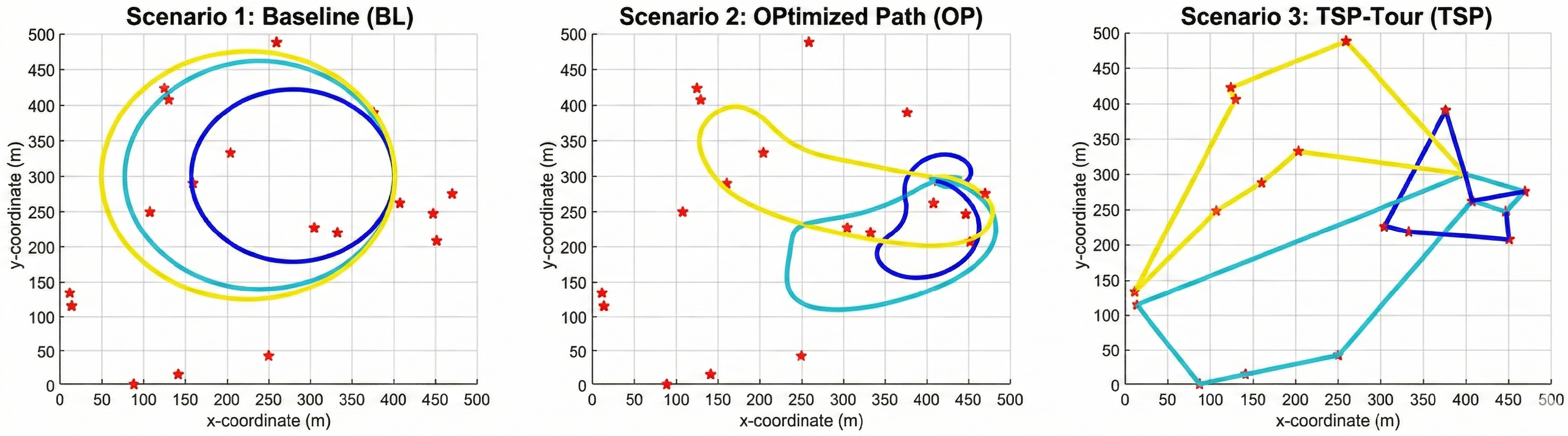
We compare the optimized solution (OP) with the baseline solution (BL) in terms of both quality of service and energy consumption. In the BL setting, the UAV trajectory is adopted as the initial elliptical trajectory of Algorithm 1. For the GT-UAV associations, the strategy in BL is that each UAV selects the GTs with the best link quality based on proximity. Meanwhile, we compare the optimized solution to the Traveling Salesman Problem (TSP) solution, where each UAV flies to the closest position to each of its associated GTs, providing the highest service quality at the cost of increased propulsion energy. The TSP trajectories are determined using the GT-UAV associations established following the same method as in the BL approach, but the TSP method lacks iterative refinement capability. Based on these settings, we present three UAV trajectories in
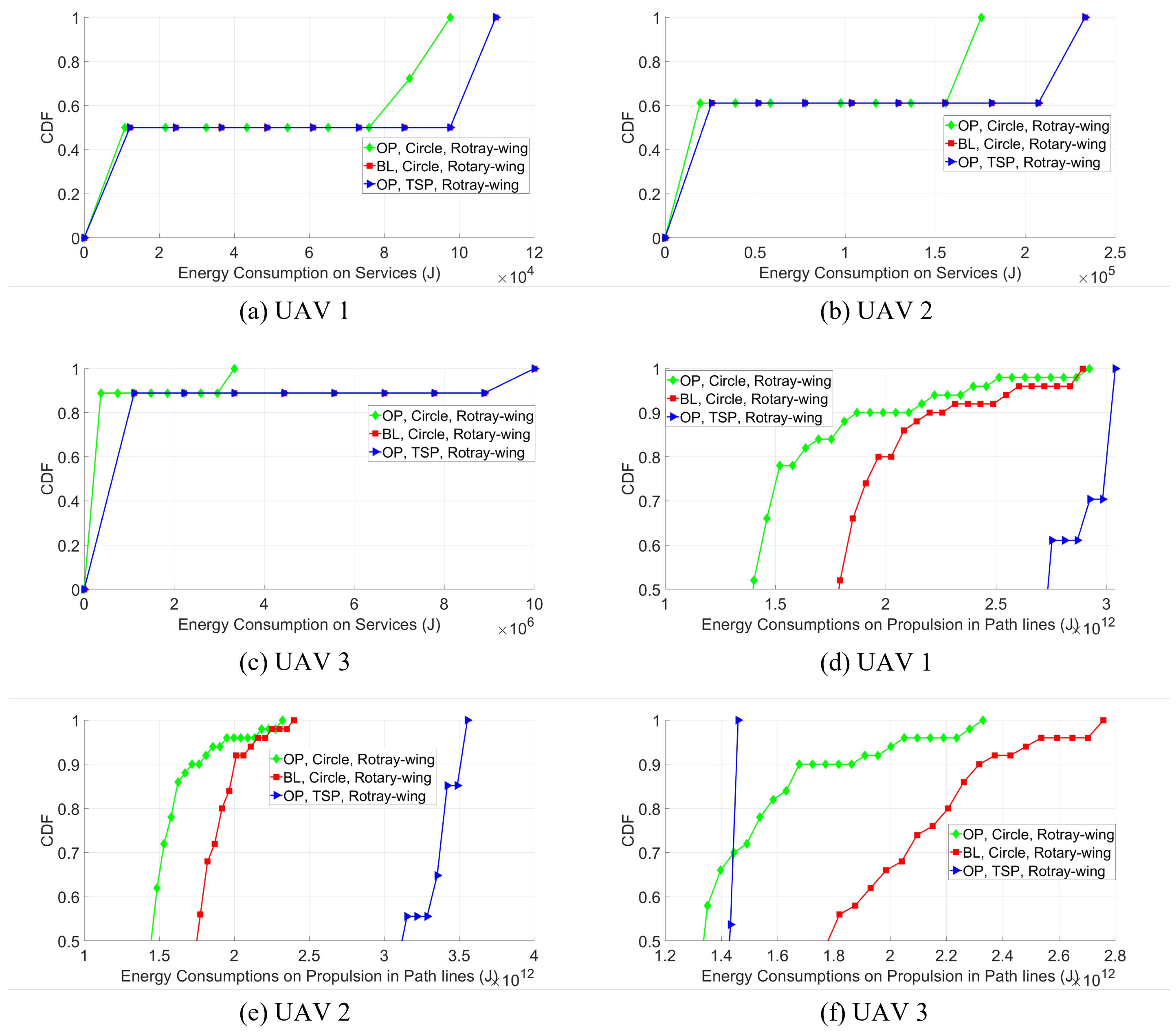
Figure 3, followed by the service and propulsion energy consumption comparisons in
Figure 4 and
Figure 5.
Figure 3 illustrates the trajectories of each UAV under different schemes. Scenario 1 represents the results of a BL solution, where the trajectories of the three UAVs are not identical but all take an elliptical shape, covering a slightly larger range for comparison purposes. Scenario 2 shows the UAV trajectories under the TSP solution. After selecting their associated GTs, each UAV finds the shortest path through these GTs using the TSP solution, starting from the same departure point. The advantage of TSP trajectories lies in minimizing the distance between the UAV and GT. Scenario 3 presents the UAV trajectories led by OP. It is evident that the UAV flight paths are neither too close to the GTs nor too far from them. This optimization approach effectively balances service quality and the energy consumption on UAV propulsion energy and service providing.
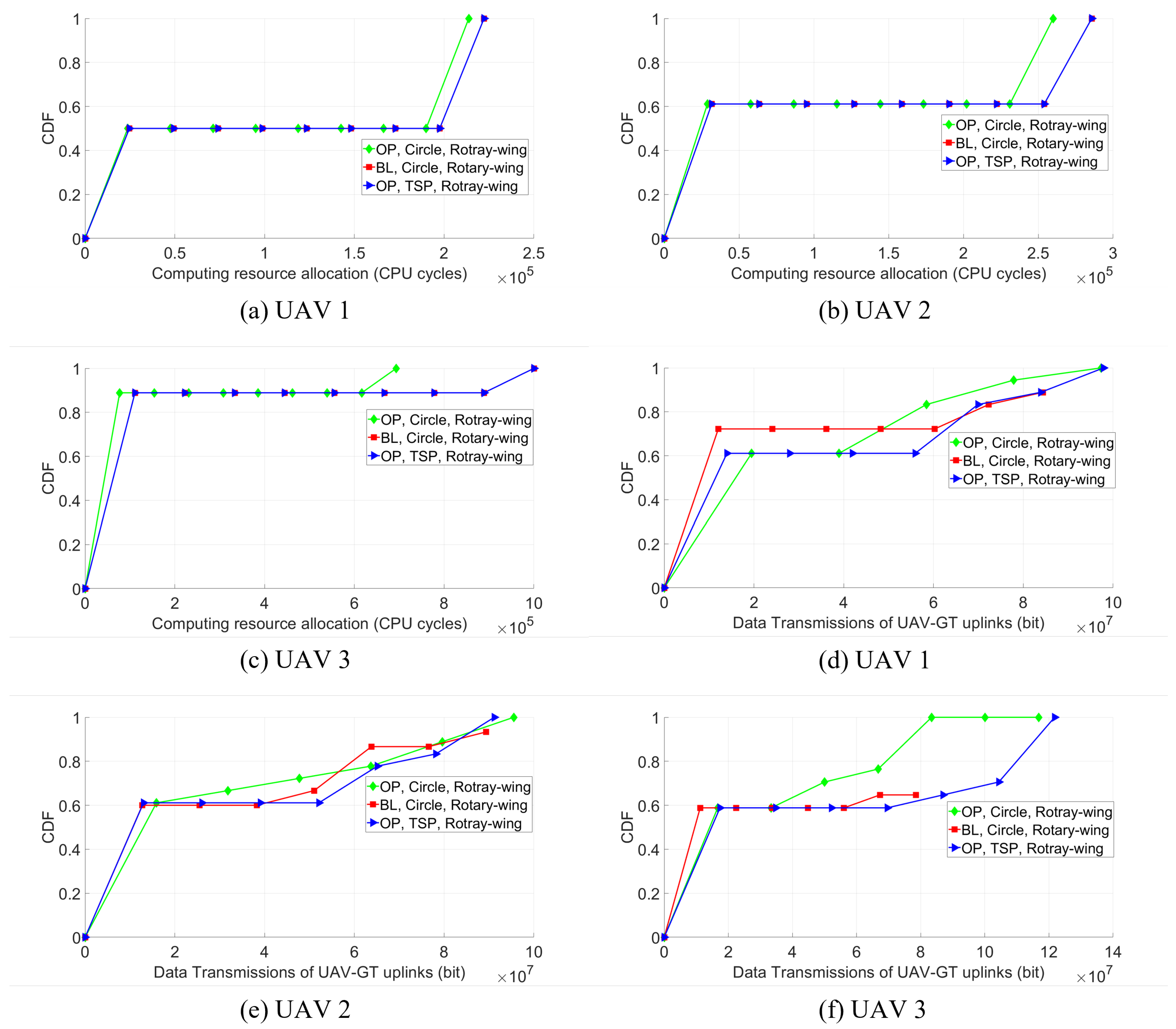
Figure 4 presents the CDF of computing resource allocation in subfigures (a–c) and the CDF of uplink data transmission rates in subfigures (d–f), where each column corresponds to UAV1, UAV2, and UAV3, respectively. As shown in subfigures (a–c), the optimized UAV computing resource allocation is significantly lower than that of TSP and BL schemes. TSP and BL schemes adopt the same set of GT-UAV associations, which are randomly generated and not iteratively optimized. After the GT-UAV association is determined, the total computing resources are evenly allocated directly. Therefore, the images of TSP and BL in
Figure 4a–c are the same. However, the OP iteratively optimizes both the GT-UAV association and computing resource allocation so that the task is completed with minimal computing resource consumption.
Figure 5 shows the service energy consumption in subfigures (a–c) and the propulsion energy consumption in subfigures (d–f), where each column corresponds to UAV1, UAV2, and UAV3, respectively. As shown in subfigures (a–c), under the OP solution, the service energy consumption differs from that of the TSP and BL solutions. Both TSP and BL solutions do not iteratively optimize the GT-UAV associations; they merely make a single selection based on initial trajectories. Moreover, the task load for each GT may vary. In contrast, the OP simultaneously optimize both the GT-UAV associations and the trajectories in an iterative manner, resulting in each UAV in the OP scenario choosing a path that minimizes the energy consumption.
However, under the TSP method, while the UAV’s service energy consumption is lower than that under BL, its propulsion energy consumption is considerably higher. Firstly, the initial trajectories in the BL solution are not optimized and are simply elliptical, leading to relatively higher propulsion energy consumption. This can be observed from
Figure 5d–f, where the optimized trajectories clearly result in lower propulsion energy consumption. However, TSP trajectories tend to be closer to the GTs compared to elliptical trajectories. This means that when linking to a larger number of GTs, the UAV has to fly longer distances, leading to higher energy consumption. However, when the number of GTs to be linked is small and their positions are relatively concentrated, TSP’s energy consumption can be the lowest. For example, in
Figure 5f, the UAV’s energy consumption under the TSP approach is somewhat lower compared to OP and BL, due to the more centralized GT placement. In summary, the optimization solution we proposed is superior to the baseline approach and meets the energy-saving requirements of UAV-enabled Mobile Edge Networks.
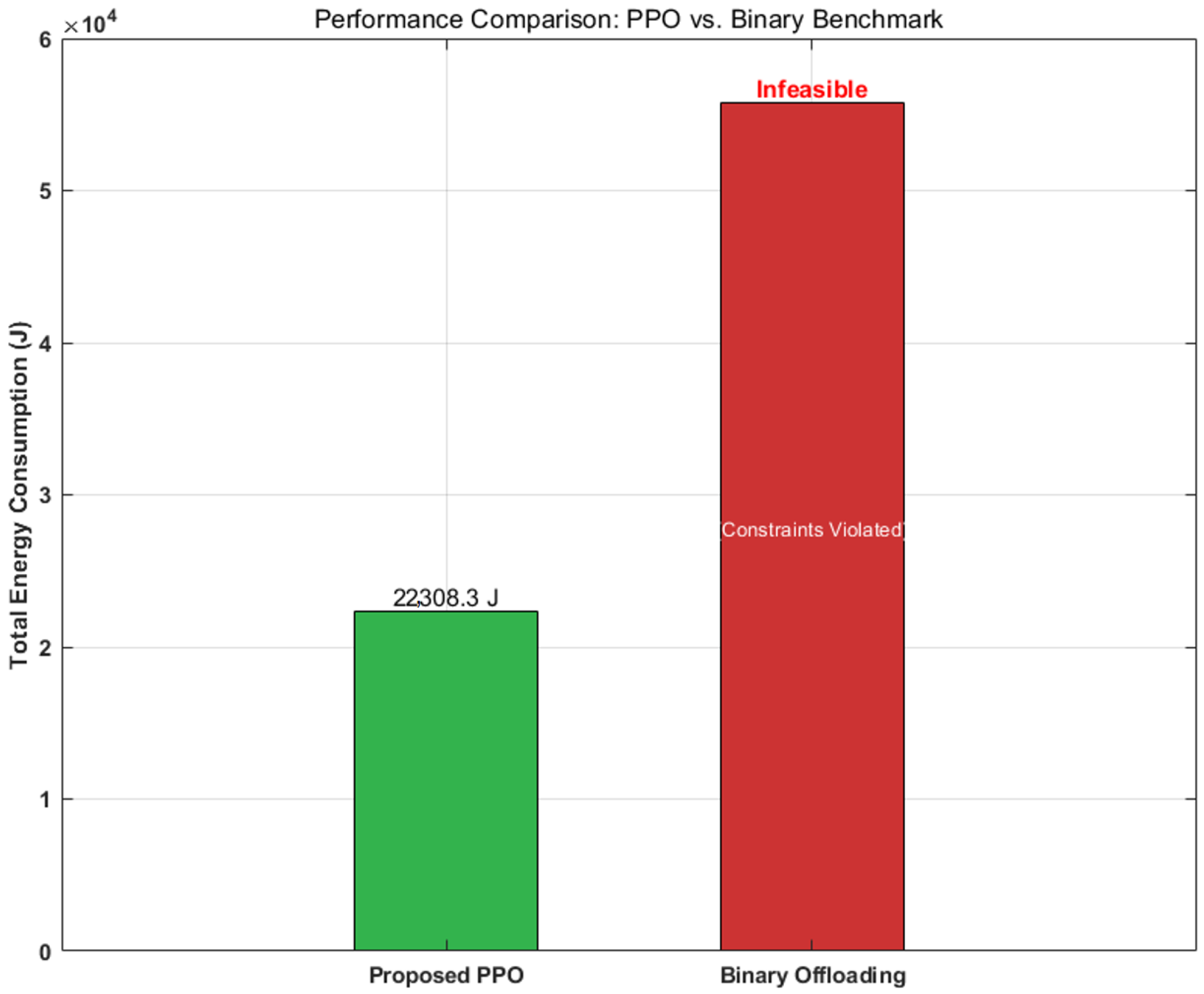
To further validate the necessity and superiority of the proposed Partial Program Offloading (PPO) scheme, we introduce an additional simulation comparing it against a benchmark “Binary Offloading” scheme. In the Binary Offloading scheme, deep learning tasks cannot be partitioned and must be fully offloaded to the remote UAVs (i.e.,
). As shown in
Figure 6, under the identical stringent task latency deadlines and UAV computing capacity constraints, the Binary Offloading scheme fails to find a feasible solution (
Infeasible). The massive volume of transmission data and intensive computation strictly requested by full offloading severely overloads the limited bandwidth and UAV capabilities. In stark contrast, our proposed PPO scheme effectively obtains an optimal solution with a total energy consumption of approximately
J. By dynamically adjusting the offloading ratio based on channel qualities and task requirements, the PPO scheme intelligently balances the local and remote computing burdens, proving its absolute necessity in resource-constrained UAV-MEC systems.
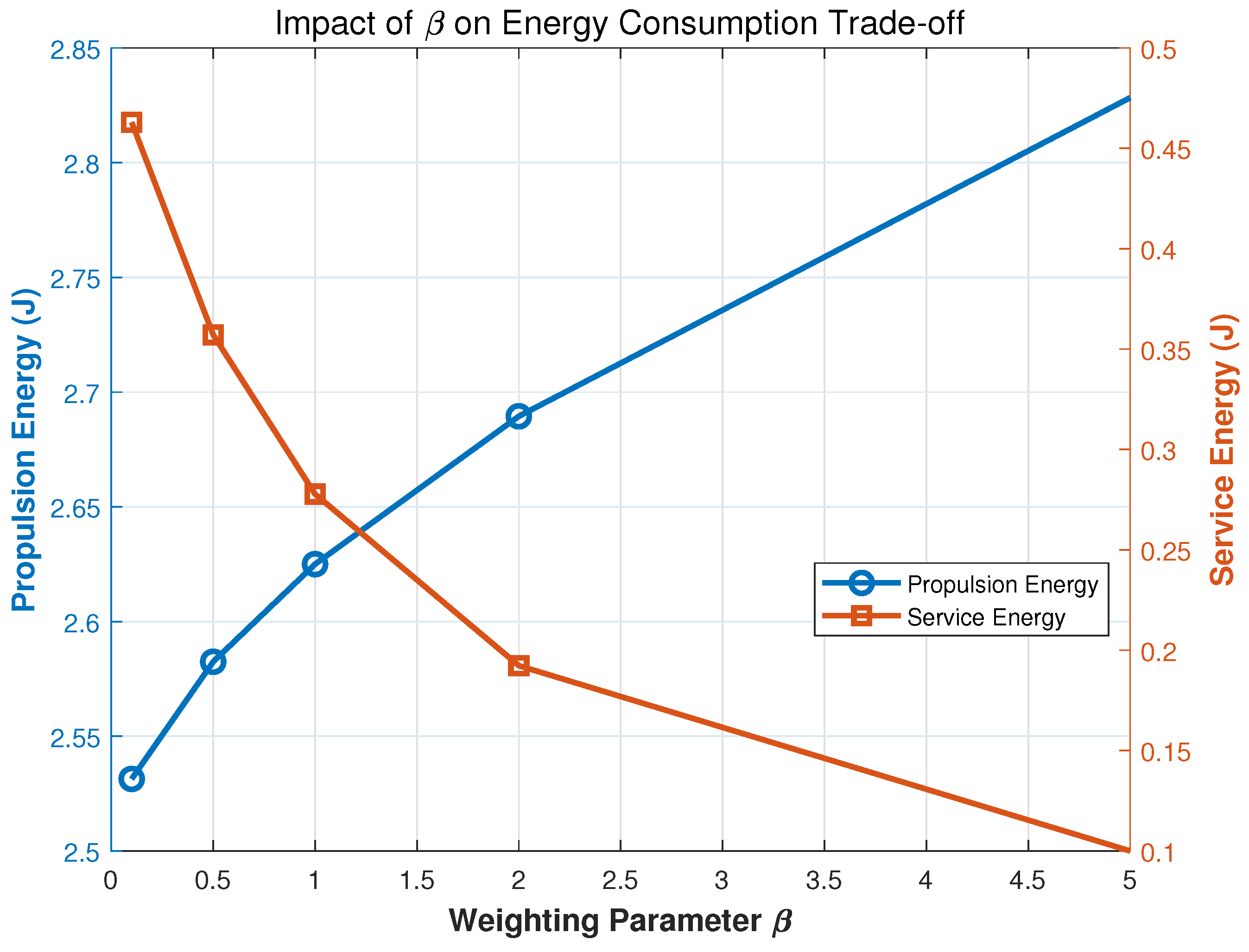
Furthermore, to investigate the impact of the weighting parameter
(defined in the objective function Equation (
12)) on the system performance, we conducted a sensitivity analysis experiment.
serves as a critical lever to balance the UAV propulsion energy and the service energy consumption. As illustrated in
Figure 7, a distinct trade-off curve is observed. When
is relatively small, the optimization algorithm prioritizes minimizing the UAV propulsion energy, resulting in energy-efficient flight trajectories but higher service energy costs. Conversely, as
increases, the system places a heavier penalty on service energy. Consequently, the UAVs adapt their trajectories—often flying closer to the GTs to secure better channel qualities—and optimize resource allocation to drastically reduce the service energy consumption. This reduction comes at the cost of a slight increase in propulsion energy due to the extra maneuvering. This trade-off validates that our proposed joint optimization scheme can flexibly adapt to diverse mission priorities (e.g., prioritizing communication quality vs. extending UAV flight endurance) by simply tuning the parameter
.
Finally, we compared the uplink data transfer rates of GT and UAV. It can be seen from
Figure 4d–f that TSP has the highest speed among the three modes, while OP is very close to BL. Because our main goal is to reduce energy consumption, the existing bit rate is in line with our expectations.
6. Conclusions
In this paper, we investigated the joint optimization of UAV trajectories, computing resource allocation, and partial deep learning task offloading in MEC-enabled multi-UAV systems. We designed a Partial Program Offloading (PPO) scheme that splits DNN tasks at an optimal layer to balance local and remote computation and formulated a min-max energy optimization problem subject to task latency and UAV mobility constraints. To solve this non-convex coupled problem, we proposed an SCA-BCD algorithm that decomposes it into three tractable convex subproblems solved iteratively. Simulation results demonstrated that the proposed approach significantly reduces UAV energy consumption compared to baseline and TSP-based solutions while satisfying all QoS requirements. We further validated the necessity of partial offloading by showing that binary offloading becomes infeasible under identical resource constraints.
Discussion on Security and Trust. While this work focuses on optimizing energy efficiency and QoS, the practical deployment of MEC-enabled multi-UAV systems also requires addressing security concerns. In particular, when GTs offload sensitive deep learning tasks (e.g., surveillance data processing) to UAVs, ensuring that all participating UAVs are properly authenticated and trustworthy is critical. Malicious or compromised UAVs could intercept offloaded data, inject false computation results, or disrupt the cooperative optimization process. Recent works have proposed cross-layer physical-layer authentication techniques for UAV communications [
30], which can complement our optimization framework by providing lightweight UAV identity verification without additional cryptographic overhead. Integrating trust-aware offloading decisions—where GTs preferentially offload to authenticated UAVs—into our BCD framework represents a promising direction for future work.
Future Work. We plan to advance this work in several directions: (i) expanding the experimental scale to evaluate scalability with larger numbers of UAVs and GTs, and conducting a systematic study of how increasing GT density affects the convergence speed of the BCD algorithm—specifically, characterizing the relationship between N and the number of iterations required to reach a prescribed accuracy ; (ii) investigating the trade-off between UAV computation speed (i.e., the allocated CPU frequency ) and total mission energy consumption, with the goal of deriving a Pareto-optimal frontier that guides the selection of the weighting parameter ; (iii) incorporating dynamic sub-channel allocation to address spectral scarcity in dense deployments; (iv) extending the model to support multimodal deep learning tasks (e.g., joint image and speech processing) with heterogeneous split-point selection; (v) incorporating physical heat dissipation limits and thermodynamic constraints of onboard hardware into the resource allocation model; and (vi) investigating hybrid approaches that combine our SCA-BCD framework with Deep Reinforcement Learning for scenarios requiring online adaptation to rapidly changing environments.