Ambient Music Decreases EEG Burst-Suppression Ratio During General Anesthesia in Rats

 , ,
, ,  , ,
, ,  and
and 
Highlights
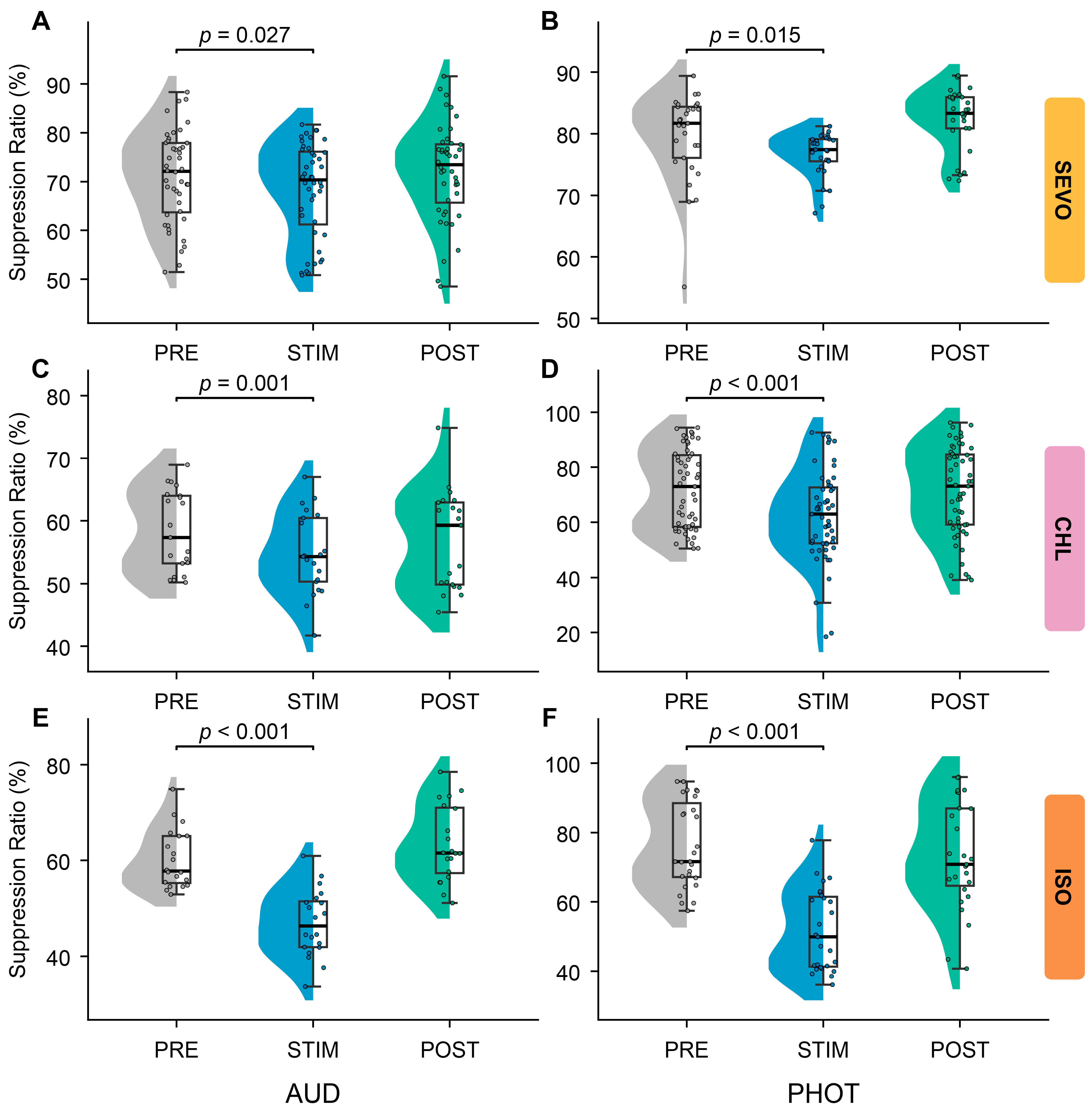
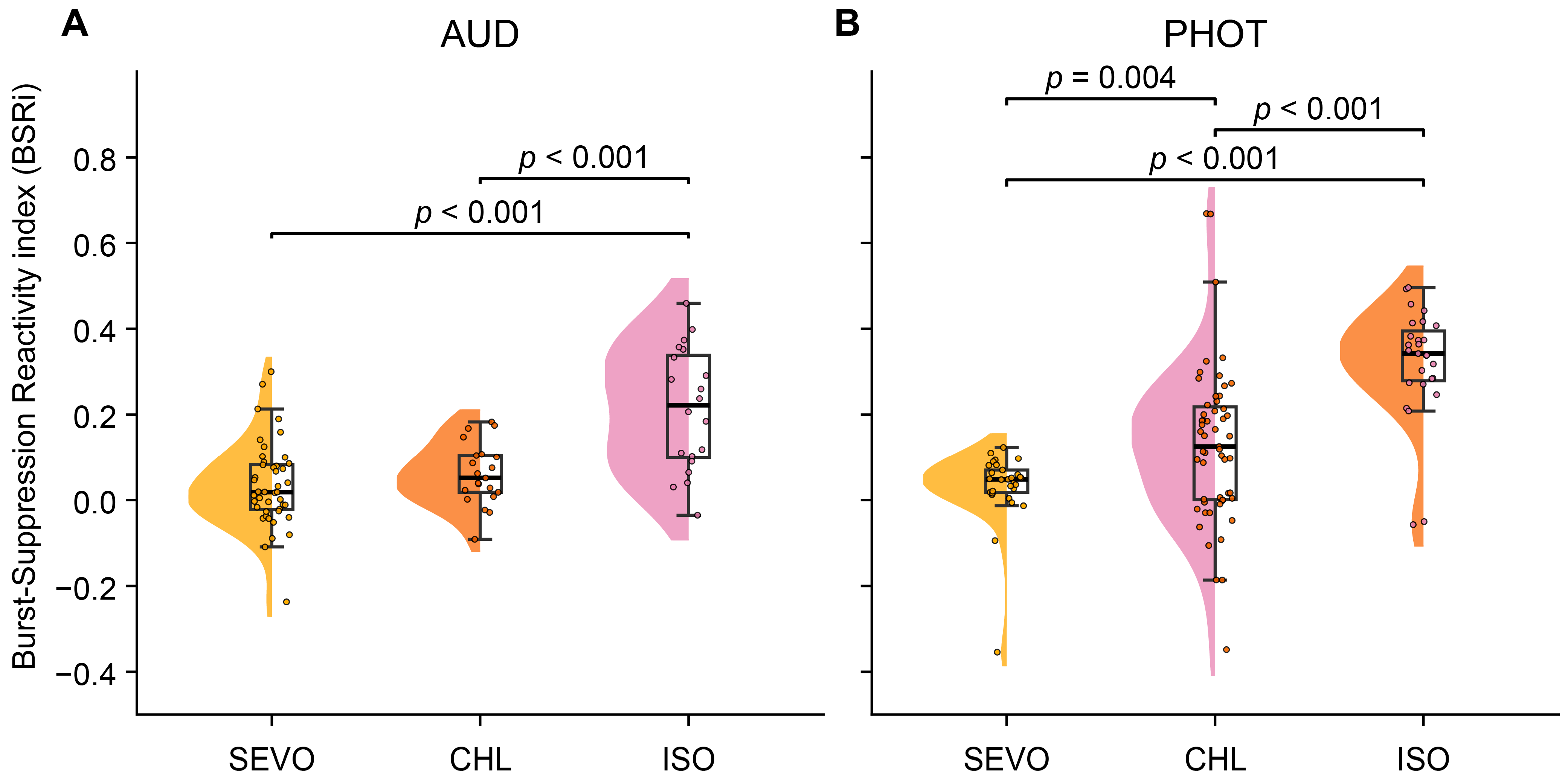
- In rats, ambient sound stimulation transiently decreased suppression ratio during targeted burst-suppression across different anesthetics.
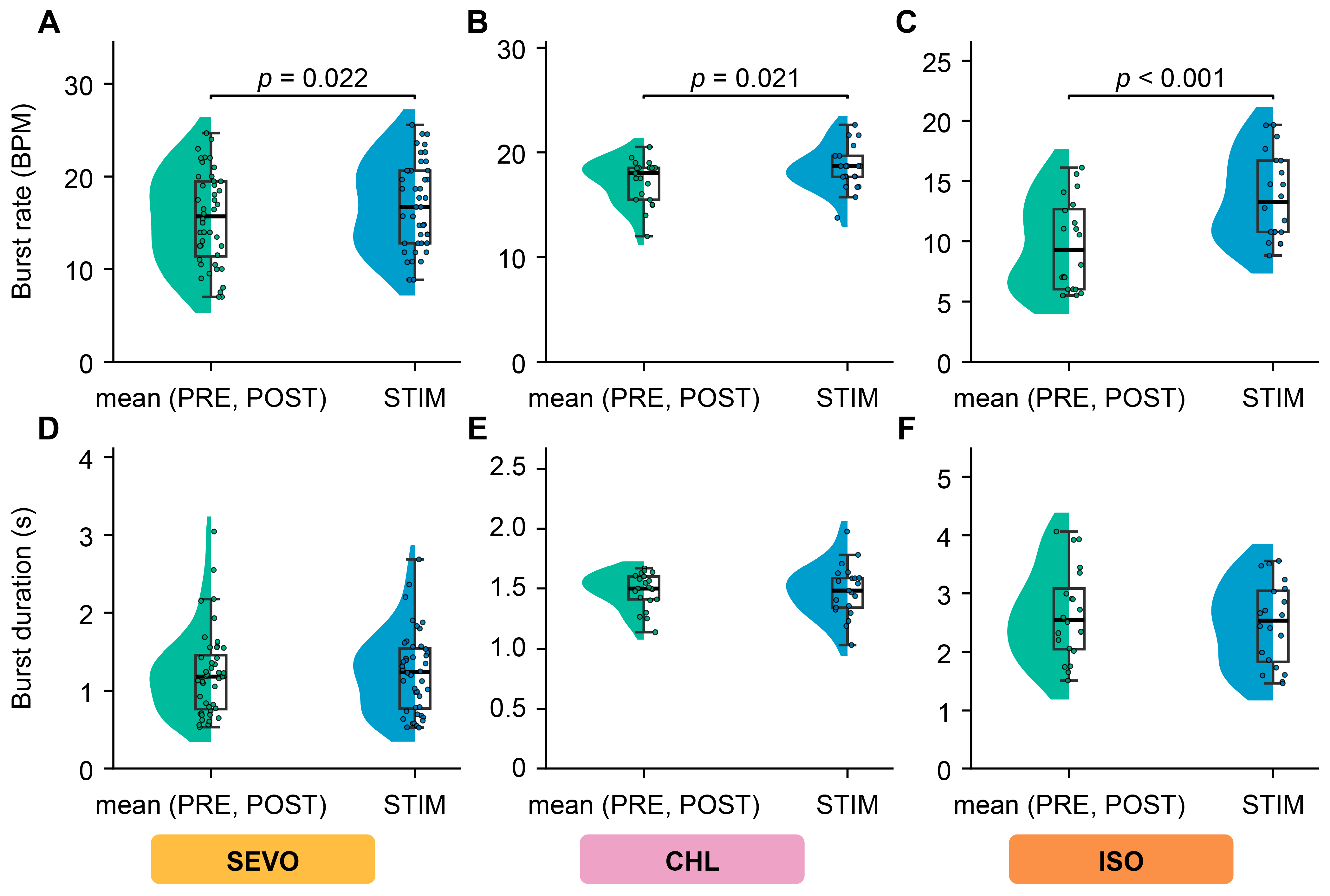
- The reduction in suppression ratio (reactivity) to auditory stimulation was associated with an increased bursting rate comparable to photic stimulation.
- Targeted suppression ratio reflects both anesthetic depth and the level of ambient stimulation.
- Ambient sound in the operating theater or intensive care settings could influence burst-suppression monitoring.
Abstract
1. Introduction
2. Materials and Methods
2.1. Experimental Design
2.2. EEG Electrodes and Surgical Implantation
2.3. EEG Recordings and Anesthetic Protocols
2.4. Stimulation Trials
2.5. Automated Burst-Suppression Analysis and Metric Extraction
2.6. Outcome Measures
2.7. Statistical Analysis
3. Results
3.1. Auditory Stimulation Transiently Decreases the SR
3.2. Auditory Stimulation Increases Burst Count Without Changing Burst Duration
3.3. Auditory Effects Remain Unchanged When Accounting for Individual Animals
3.4. Auditory Stimulation Compared with Visual Stimulation
3.5. Comparison with Photic Stimulation Remained Unchanged When Accounting for Individual Animals
4. Discussion
4.1. SR Detection
4.2. Auditory Stimulation by Ambient Music Transiently Decreases the SR
4.3. Auditory Stimulation Transiently Increases the Burst Rate
4.4. The Auditory Reactivity Was Comparable to Photic Reactivity Across Different Anesthetics
4.5. Methodological Limitations
4.6. Translational Considerations
5. Conclusions
Author Contributions
Funding
Institutional Review Board Statement
Informed Consent Statement
Data Availability Statement
Conflicts of Interest
Abbreviations
| EEG | Electroencephalogram |
| SR | Suppression ratio |
| BSRi | Burst-suppression reactivity index |
| BIS | Bispectral Index |
| AUD | Auditory stimulation |
| PHOT | Photic stimulation |
| SEVO | Sevoflurane |
| CHL | Chloral hydrate |
| ISO | Isoflurane |
| BURST | Burst-sUppression Reviewer-Supervised analysis Tool |
| PRE | Pre-stimulation baseline epoch |
| STIM | Stimulation epoch |
| POST | Post-stimulation recovery epoch |
| BPM | Bursts per minute |
| BD | Burst duration |
| GEEs | Generalized estimating equations |
References
- Hirsch, L.J.; Fong, M.W.K.; Leitinger, M.; LaRoche, S.M.; Beniczky, S.; Abend, N.S.; Lee, J.W.; Wusthoff, C.J.; Hahn, C.D.; Westover, M.B.; et al. American Clinical Neurophysiology Society’s Standardized Critical Care EEG Terminology: 2021 Version. J. Clin. Neurophysiol. 2021, 38, 1–29. [Google Scholar] [CrossRef]
- Ching, S.; Purdon, P.L.; Vijayan, S.; Kopell, N.J.; Brown, E.N. A Neurophysiological-Metabolic Model for Burst Suppression. Proc. Natl. Acad. Sci. USA 2012, 109, 3095–3100. [Google Scholar] [CrossRef]
- Amzica, F. Basic Physiology of Burst-Suppression. Epilepsia 2009, 50, 38–39. [Google Scholar] [CrossRef]
- Bruhn, J.; Bouillon, T.W.; Shafer, S.L. Bispectral Index (BIS) and Burst Suppression: Revealing a Part of the BIS Algorithm. J. Clin. Monit. Comput. 2000, 16, 593–596. [Google Scholar] [CrossRef] [PubMed]
- Morimoto, Y.; Hagihira, S.; Koizumi, Y.; Ishida, K.; Matsumoto, M.; Sakabe, T. The Relationship between Bispectral Index and Electroencephalographic Parameters during Isoflurane Anesthesia. Anesth. Analg. 2004, 98, 1336–1340. [Google Scholar] [CrossRef]
- Purdon, P.L.; Sampson, A.; Pavone, K.J.; Brown, E.N. Clinical Electroencephalography for Anesthesiologists: Part I: Background and Basic Signatures: Part I: Background and Basic Signatures. Anesthesiology 2015, 123, 937–960. [Google Scholar] [CrossRef] [PubMed]
- Schneider, G.; Jordan, D.; Schwarz, G.; Bischoff, P.; Kalkman, C.J.; Kuppe, H.; Rundshagen, I.; Omerovic, A.; Kreuzer, M.; Stockmanns, G.; et al. Monitoring Depth of Anesthesia Utilizing a Combination of Electroencephalographic and Standard Measures. Anesthesiology 2014, 120, 819–828. [Google Scholar] [CrossRef]
- Moldovan, M.; Călin, A.; Kumaraswamy, V.M.; Braver, D.; Simon, M.V. Burst-Suppression Ratio on Electrocorticography Depends on Interelectrode Distance. J. Clin. Neurophysiol. 2016, 33, 127–132. [Google Scholar] [CrossRef]
- Kroeger, D.; Amzica, F. Hypersensitivity of the Anesthesia-Induced Comatose Brain. J. Neurosci. 2007, 27, 10597–10607. [Google Scholar] [CrossRef]
- Călin, A.; Kumaraswamy, V.M.; Braver, D.; Nair, D.G.; Moldovan, M.; Simon, M.V. Intraoperative Somatosensory Evoked Potential Monitoring Decreases EEG Burst Suppression Ratio during Deep General Anesthesia. J. Clin. Neurophysiol. 2014, 31, 133–137. [Google Scholar] [CrossRef] [PubMed]
- Nita, D.A.; Moldovan, M.; Sharma, R.; Avramescu, S.; Otsubo, H.; Hahn, C.D. Burst-Suppression Is Reactive to Photic Stimulation in Comatose Children with Acquired Brain Injury. Clin. Neurophysiol. 2016, 127, 2921–2930. [Google Scholar] [CrossRef]
- Bosanquet, D.C.; Glasbey, J.C.D.; Chavez, R. Making Music in the Operating Theatre. BMJ 2014, 349, g7436. [Google Scholar] [CrossRef]
- Fu, V.X.; Oomens, P.; Merkus, N.; Jeekel, J. The Perception and Attitude toward Noise and Music in the Operating Room: A Systematic Review. J. Surg. Res. 2021, 263, 193–206. [Google Scholar] [CrossRef] [PubMed]
- Plourde, G. Auditory Evoked Potentials. Best Pract. Res. Clin. Anaesthesiol. 2006, 20, 129–139. [Google Scholar] [CrossRef]
- Antunes, L.M.; Golledge, H.D.R.; Roughan, J.V.; Flecknell, P.A. Comparison of Electroencephalogram Activity and Auditory Evoked Responses during Isoflurane and Halothane Anaesthesia in the Rat. Vet. Anaesth. Analg. 2003, 30, 15–23. [Google Scholar] [CrossRef]
- Pâslaru, A.-C.; Călin, A.; Morozan, V.-P.; Stancu, M.; Tofan, L.; Panaitescu, A.M.; Zăgrean, A.-M.; Zăgrean, L.; Moldovan, M. Burst-Suppression EEG Reactivity to Photic Stimulation—A Translational Biomarker in Hypoxic–Ischemic Brain Injury. Biomolecules 2024, 14, 953. [Google Scholar] [CrossRef] [PubMed]
- Wake, N.; Ishizu, K.; Abe, T.; Takahashi, H. Prepulse Inhibition Predicts Subjective Hearing in Rats. Sci. Rep. 2021, 11, 18902. [Google Scholar] [CrossRef] [PubMed]
- Lazic, S.E. The Problem of Pseudoreplication in Neuroscientific Studies: Is It Affecting Your Analysis? BMC Neurosci. 2010, 11, 5. [Google Scholar] [CrossRef]
- Huang, F. When Cluster-Robust Inferences Fail. Educ. Psychol. Meas. 2025, 86, 579–601. [Google Scholar] [CrossRef]
- Lange, K.M.; Sullivan, T.R.; Kasza, J.; Yelland, L.N. Performance of Mixed Effects Models and Generalized Estimating Equations for Continuous Outcomes in Partially Clustered Trials Including Both Independent and Paired Data. Stat. Med. 2024, 43, 4819–4835. [Google Scholar] [CrossRef]
- Brandon Westover, M.; Shafi, M.M.; Ching, S.; Chemali, J.J.; Purdon, P.L.; Cash, S.S.; Brown, E.N. Real-Time Segmentation of Burst Suppression Patterns in Critical Care EEG Monitoring. J. Neurosci. Methods 2013, 219, 131–141. [Google Scholar] [CrossRef]
- Chemali, J.; Ching, S.; Purdon, P.L.; Solt, K.; Brown, E.N. Burst Suppression Probability Algorithms: State-Space Methods for Tracking EEG Burst Suppression. J. Neural Eng. 2013, 10, 056017. [Google Scholar] [CrossRef]
- Markus, M.; Dorenbeck, M.; Röhr, V.; Leroy, S.; Blankertz, B.; Brown, E.N.; Spies, C.; Koch, S. Influence of Anesthetic Agent and Burst Suppression on Postoperative Delirium in Elderly Patients: A Prospective Cohort Study with Automated EEG Analysis. Front. Aging Neurosci. 2025, 17, 1743267. [Google Scholar] [CrossRef] [PubMed]
- Zhu, M.; Xu, M.; Gao, M.; Yu, R.; Bin, G. Robust EEG Characteristics for Predicting Neurological Recovery from Coma after Cardiac Arrest. Sensors 2025, 25, 2332. [Google Scholar] [CrossRef]
- He, J.; Karel, J.M.H.; Janssen, M.L.F.; Gommer, E.D.; Vossen, C.J.; Hortal, E. Predicting Intraoperative Burst Suppression Using Preoperative EEG and Patient Characteristics. Int. J. Neural Syst. 2025, 35, 2550033. [Google Scholar] [CrossRef]
- Moghadam, S.M.; Airaksinen, M.; Nevalainen, P.; Marchi, V.; Hellström-Westas, L.; Stevenson, N.J.; Vanhatalo, S. An Automated Bedside Measure for Monitoring Neonatal Cortical Activity: A Supervised Deep Learning-Based Electroencephalogram Classifier with External Cohort Validation. Lancet Digit. Health 2022, 4, e884–e892. [Google Scholar] [PubMed]
- O’Toole, J.M.; Boylan, G.B.; Lloyd, R.O.; Goulding, R.M.; Vanhatalo, S.; Stevenson, N.J. Detecting Bursts in the EEG of Very and Extremely Premature Infants Using a Multi-Feature Approach. Med. Eng. Phys. 2017, 45, 42–50. [Google Scholar] [CrossRef]
- Aellen, F.M.; Alnes, S.L.; Loosli, F.; Rossetti, A.O.; Zubler, F.; De Lucia, M.; Tzovara, A. Auditory Stimulation and Deep Learning Predict Awakening from Coma after Cardiac Arrest. Brain 2023, 146, 778–788. [Google Scholar] [CrossRef]
- Zheng, W.-L.; Amorim, E.; Jing, J.; Ge, W.; Hong, S.; Wu, O.; Ghassemi, M.; Lee, J.W.; Sivaraju, A.; Pang, T.; et al. Predicting Neurological Outcome in Comatose Patients after Cardiac Arrest with Multiscale Deep Neural Networks. Resuscitation 2021, 169, 86–94. [Google Scholar] [CrossRef]
- Arakaki, X.; Galbraith, G.; Pikov, V.; Fonteh, A.N.; Harrington, M.G. Altered Brainstem Auditory Evoked Potentials in a Rat Central Sensitization Model Are Similar to Those in Migraine. Brain Res. 2014, 1563, 110–121. [Google Scholar] [CrossRef] [PubMed]
- Bohórquez, L.H.; Malmierca, M.S.; Hockley, A. Do Auditory Deviants Evoke Cortical State Changes under Anaesthesia? A Proof-of-Concept Study. Exp. Physiol. 2026, 111, 2148–2162. [Google Scholar] [CrossRef]
- Decker, F.M.; Jelinek, J.; Korb, K.; Fogaing Kamgaing, F.; Alam, M.; Krauss, J.K.; Hermann, E.J.; Schwabe, K. Neural Processing of Auditory Stimuli in Rats: Translational Aspects Using Auditory Oddball Paradigms. Behav. Brain Res. 2025, 482, 115428. [Google Scholar] [CrossRef]
- Lewis, L.D.; Ching, S.; Weiner, V.S.; Peterfreund, R.A.; Eskandar, E.N.; Cash, S.S.; Brown, E.N.; Purdon, P.L. Local Cortical Dynamics of Burst Suppression in the Anaesthetized Brain. Brain 2013, 136, 2727–2737. [Google Scholar] [CrossRef]
- Hudetz, A.G.; Imas, O.A. Burst Activation of the Cerebral Cortex by Flash Stimuli during Isoflurane Anesthesia in Rats. Anesthesiology 2007, 107, 983–991. [Google Scholar] [CrossRef] [PubMed]
- Kenny, J.D.; Westover, M.B.; Ching, S.; Brown, E.N.; Solt, K. Propofol and Sevoflurane Induce Distinct Burst Suppression Patterns in Rats. Front. Syst. Neurosci. 2014, 8, 237. [Google Scholar] [CrossRef]
- Fleischmann, A.; Pilge, S.; Kiel, T.; Kratzer, S.; Schneider, G.; Kreuzer, M. Substance-Specific Differences in Human Electroencephalographic Burst Suppression Patterns. Front. Hum. Neurosci. 2018, 12, 368. [Google Scholar] [CrossRef] [PubMed]
- Takahashi, H.; Nakao, M.; Kaga, K. Multiple Neural Origins of Early Auditory Evoked Potential of Rat. Neuroscience 2007, 148, 845–856. [Google Scholar] [CrossRef]
- Absalom, A.R.; Sutcliffe, N.; Kenny, G.N. Effects of the Auditory Stimuli of an Auditory Evoked Potential System on Levels of Consciousness, and on the Bispectral Index. Br. J. Anaesth. 2001, 87, 778–780. [Google Scholar] [CrossRef]
- Vijn, P.C.; Sneyd, J.R. I.v. Anaesthesia and EEG Burst Suppression in Rats: Bolus Injections and Closed-Loop Infusions. Br. J. Anaesth. 1998, 81, 415–421. [Google Scholar] [CrossRef] [PubMed]
- Shanechi, M.M.; Chemali, J.J.; Liberman, M.; Solt, K.; Brown, E.N. A Brain-Machine Interface for Control of Medically-Induced Coma. PLoS Comput. Biol. 2013, 9, e1003284. [Google Scholar] [CrossRef]
- Absalom, A.R.; Sutcliffe, N.; Kenny, G.N. Closed-Loop Control of Anesthesia Using Bispectral Index: Performance Assessment in Patients Undergoing Major Orthopedic Surgery under Combined General and Regional Anesthesia: Performance Assessment in Patients Undergoing Major Orthopedic Surgery under Combined General and Regional Anesthesia. Anesthesiology 2002, 96, 67–73. [Google Scholar]
- Ching, S.; Liberman, M.Y.; Chemali, J.J.; Westover, M.B.; Kenny, J.D.; Solt, K.; Purdon, P.L.; Brown, E.N. Real-Time Closed-Loop Control in a Rodent Model of Medically Induced Coma Using Burst Suppression. Anesthesiology 2013, 119, 848–860. [Google Scholar] [CrossRef] [PubMed]
- Liberman, M.Y.; Ching, S.; Chemali, J.; Brown, E.N. A Closed-Loop Anesthetic Delivery System for Real-Time Control of Burst Suppression. J. Neural Eng. 2013, 10, 046004. [Google Scholar] [CrossRef] [PubMed]
- Westover, M.B.; Kim, S.-E.; Ching, S.; Purdon, P.L.; Brown, E.N. Robust Control of Burst Suppression for Medical Coma. J. Neural Eng. 2015, 12, 046004. [Google Scholar] [CrossRef]
- Borg, E. Auditory Thresholds in Rats of Different Age and Strain. A Behavioral and Electrophysiological Study. Hear. Res. 1982, 8, 101–115. [Google Scholar] [CrossRef]
- Inaba, H.; Namba, H.; Sotoyama, H.; Narihara, I.; Jodo, E.; Yabe, H.; Eifuku, S.; Nawa, H. Sound Frequency Dependence of Duration Mismatch Negativity Recorded from Awake Rats. Neuropsychopharmacol. Rep. 2020, 40, 96–101. [Google Scholar] [CrossRef] [PubMed]
- Jing, Z.; Pecka, M.; Grothe, B. Ketamine-Xylazine Anesthesia Depth Affects Auditory Neuronal Responses in the Lateral Superior Olive Complex of the Gerbil. J. Neurophysiol. 2021, 126, 1660–1669. [Google Scholar] [CrossRef]



| Stimulus Paradigm | Anesthetic Condition | Included Trials, n | Animals Represented, n |
|---|---|---|---|
| Auditory stimulation (AUD) | Sevoflurane (SEVO) | 44 | 4 |
| Auditory stimulation (AUD) | Chloral hydrate (CHL) | 21 | 3 |
| Auditory stimulation (AUD) | Isoflurane (ISO) | 20 | 2 |
| Photic stimulation (PHOT) | Sevoflurane (SEVO) | 29 | 2 |
| Photic stimulation (PHOT) | Chloral hydrate (CHL) | 55 | 2 |
| Photic stimulation (PHOT) | Isoflurane (ISO) | 27 | 2 |
Disclaimer/Publisher’s Note: The statements, opinions and data contained in all publications are solely those of the individual author(s) and contributor(s) and not of MDPI and/or the editor(s). MDPI and/or the editor(s) disclaim responsibility for any injury to people or property resulting from any ideas, methods, instructions or products referred to in the content. |
© 2026 by the authors. Licensee MDPI, Basel, Switzerland. This article is an open access article distributed under the terms and conditions of the Creative Commons Attribution (CC BY) license.
Share and Cite
Morozan, V.-P.; Stancu, M.; Pâslaru, A.-C.; Pavel, B.; Mocanu, A.; Călin, A.; Zăgrean, L.; Zăgrean, A.-M.; Moldovan, M. Ambient Music Decreases EEG Burst-Suppression Ratio During General Anesthesia in Rats. Sensors 2026, 26, 3527. https://doi.org/10.3390/s26113527
Morozan V-P, Stancu M, Pâslaru A-C, Pavel B, Mocanu A, Călin A, Zăgrean L, Zăgrean A-M, Moldovan M. Ambient Music Decreases EEG Burst-Suppression Ratio During General Anesthesia in Rats. Sensors. 2026; 26(11):3527. https://doi.org/10.3390/s26113527
Chicago/Turabian StyleMorozan, Vlad-Petru, Mihai Stancu, Alexandru-Cătălin Pâslaru, Bogdan Pavel, Alexandra Mocanu, Alexandru Călin, Leon Zăgrean, Ana-Maria Zăgrean, and Mihai Moldovan. 2026. "Ambient Music Decreases EEG Burst-Suppression Ratio During General Anesthesia in Rats" Sensors 26, no. 11: 3527. https://doi.org/10.3390/s26113527
APA StyleMorozan, V.-P., Stancu, M., Pâslaru, A.-C., Pavel, B., Mocanu, A., Călin, A., Zăgrean, L., Zăgrean, A.-M., & Moldovan, M. (2026). Ambient Music Decreases EEG Burst-Suppression Ratio During General Anesthesia in Rats. Sensors, 26(11), 3527. https://doi.org/10.3390/s26113527