Multimodal PCSC Sensors for Real-Time Temperature and Force Detection Using LRTNet



Abstract
1. Introduction
2. Methodology
2.1. Overview of the Research Methodology
2.2. Preparation of the Sensor
- Preparation of CQD Powder: The synthesis method of carbon quantum dots in this work was adapted from relevant literature with appropriate optimization and modification [30,31]. A 40 mL sodium hydroxide solution (1.5 mol/L) is gradually added to 40 mL of acetaldehyde and stirred at room temperature for 2 h. The reaction product undergoes ultrasonic treatment for 30 min, is then neutralized with dilute hydrochloric acid, filtered, and washed three times with deionized water. Finally, the product is dried at 70 °C for 8 h to yield CQD powder.
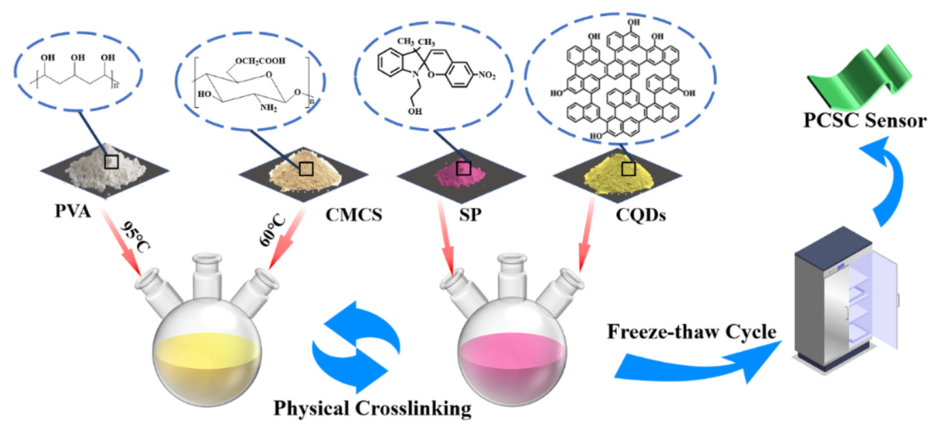
- Preparation of PCSC Hydrogel: 10 g of PVA is dissolved in 80 mL of deionized water and stirred at 95 °C for 1 h to obtain a clear PVA solution, which is left to stand for defoaming. Separately, 2.5 g of CMCS is dissolved in 20 mL of deionized water, stirred at 60 °C for 30 min, and added to the PVA solution to create a PVA/CMCS mixture, which is concentrated to 40 mL by continuous stirring at 60 °C. Next, 3 mg of SP and 75 mg of CQDs are dissolved separately in 10 mL of anhydrous ethanol and subjected to ultrasound for 10 min, resulting in an SP/CQD solution at a ratio of 3:75. Then, 20 mL of the PVA/CMCS mixture is combined with the SP/CQD solution in varying mass ratios. The resulting composite hydrogel solution is stirred at room temperature for 1 h. After degassing, 2.5 mL of the composite solution is injected into a mold using a plastic syringe. The hydrogel undergoes three freeze–thaw cycles by alternately freezing at −30 °C and thawing at room temperature, ultimately forming the PCSC hydrogel samples. In this work, the PCSC hydrogel was prepared based on the method reported for PCS hydrogel, with the additional introduction of carbon quantum dots (CQDs) as a modified composite hydrogel [32,33].
2.3. Algorithm Design
2.3.1. Image Feature Extraction–Lightweight ResNet
- a.
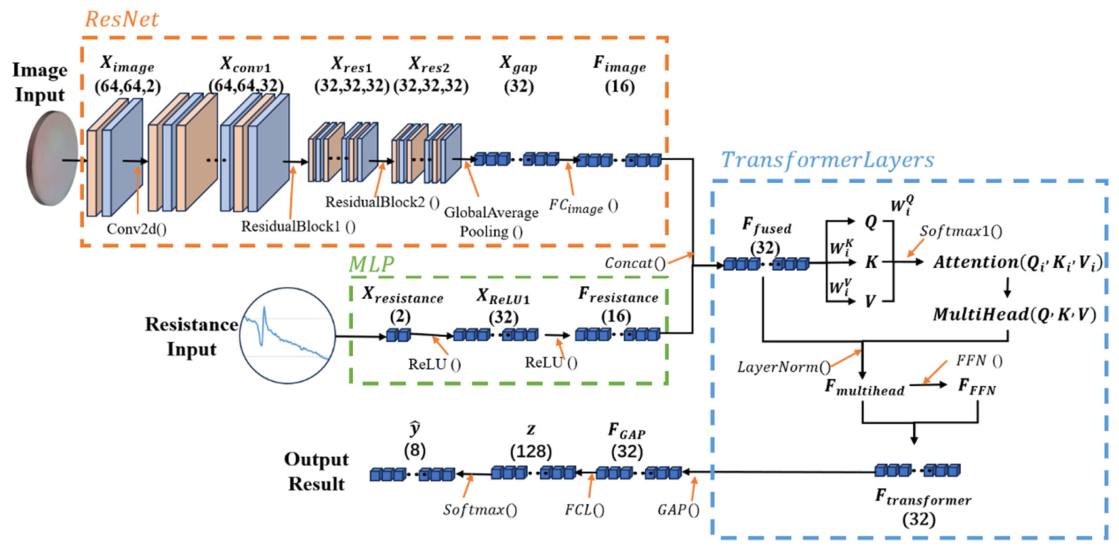
- Input Convolutional Layer: The input image, , first passes through a convolutional layer (Conv1) to extract preliminary features.
- b.
- Residual Block: The residual block is the key module in ResNet, designed to mitigate the vanishing gradient problem in deep networks. Each residual block consists of two convolutional layers, followed by batch normalization (BatchNorm) and ReLU activation.
- c.
- Global Average Pooling Layer: The global average pooling layer reduces the feature map to a scalar, minimizing the number of parameters.
- d.
- Fully Connected Layer: The pooled features are mapped into a 16-dimensional feature vector.
2.3.2. Feature Fusion Layer
3. Experimental Design
3.1. Sensor Performance Testing
3.2. Algorithm Testing and Optimization
3.2.1. Data Collection and Feature Analysis
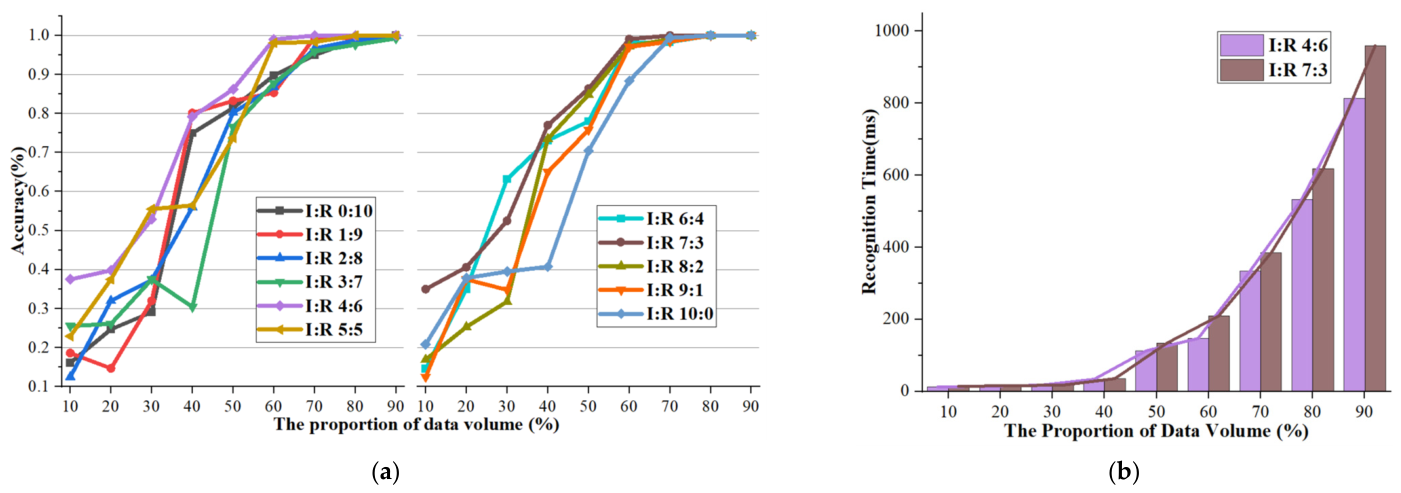
3.2.2. Selection of Weight Ratios for Image and Resistance Data
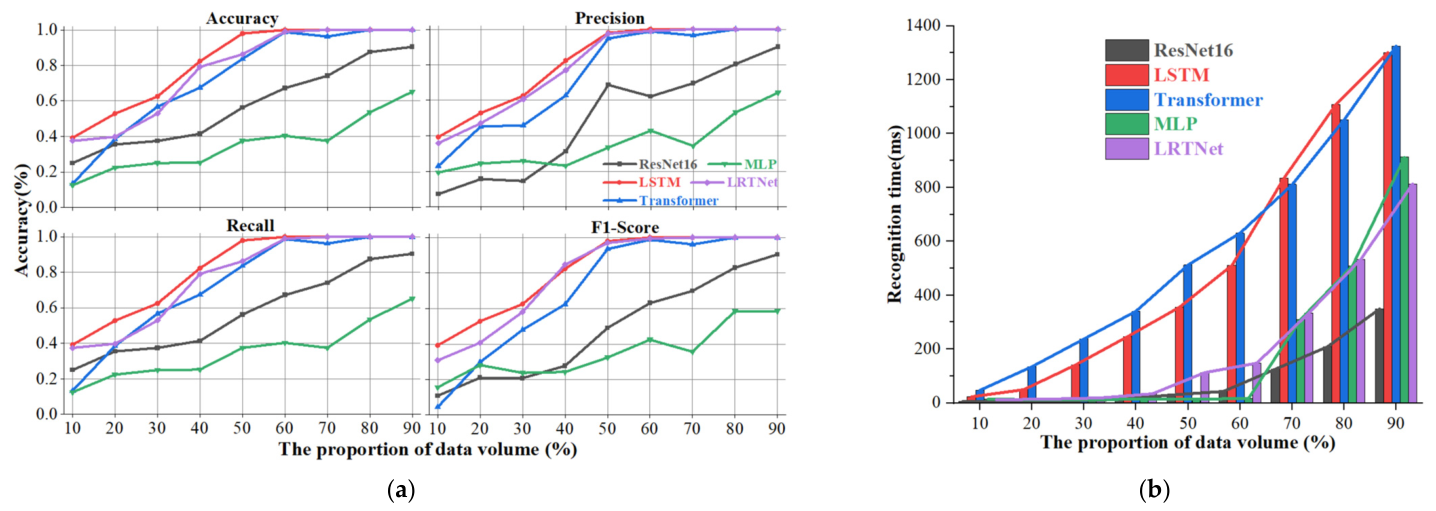
3.2.3. Algorithm Comparison
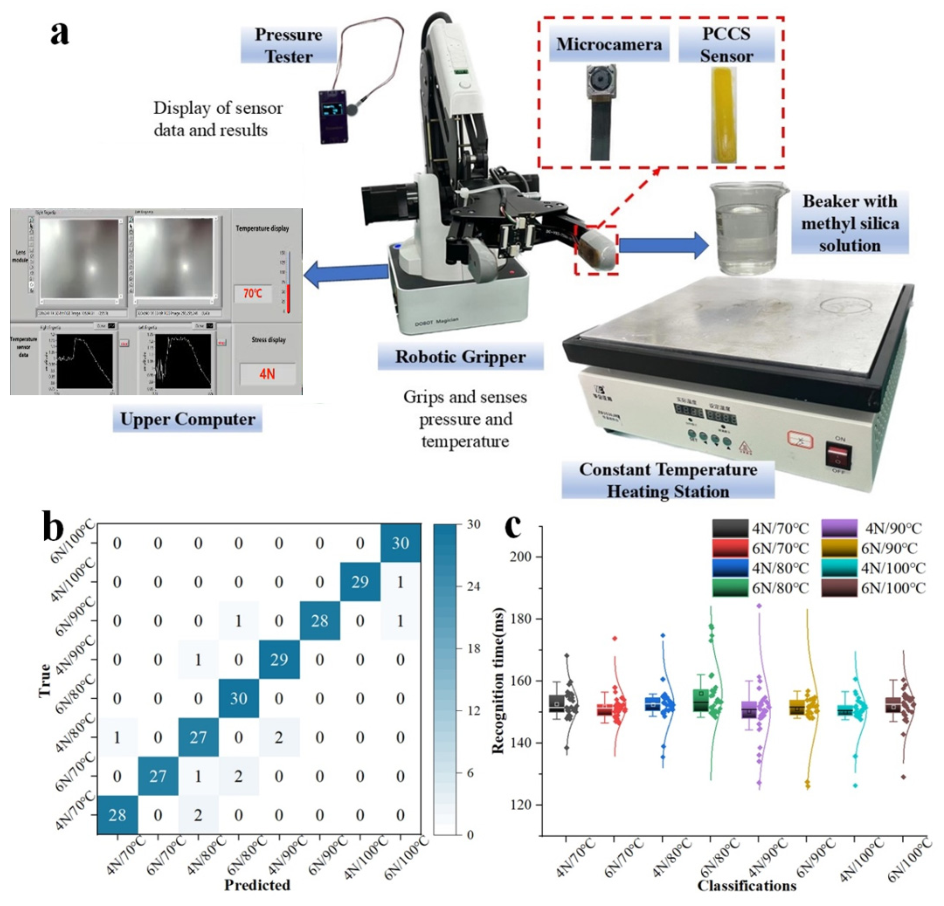
4. Real-Time Recognition Experiment on Robotic Gripper
5. Conclusions
Supplementary Materials
Author Contributions
Funding
Institutional Review Board Statement
Informed Consent Statement
Data Availability Statement
Conflicts of Interest
References
- Xu, S.; Fan, Z.; Yang, S.; Zuo, X.; Guo, Y.; Chen, H.; Pan, L. Highly Flexible, Stretchable, and Self-Powered Strain-Temperature Dual Sensor Based on Free-Standing PEDOT:PSS/Carbon Nanocoils-Poly(vinyl) Alcohol Films. ACS Sens. 2021, 6, 1120–1128. [Google Scholar] [CrossRef]
- Zhang, Q.; Liu, Z.; Wu, J.; Sun, P.; Zhang, H. Design and Performance Analysis of a Hybrid Flexible Pressure Sensor with Wide Linearity and High Sensitivity. Sensors 2025, 26, 238. [Google Scholar] [CrossRef]
- Yin, G.; Tian, C.; Jiang, Q.; Wang, G.; Shao, L.; Li, Q.; Li, Y.; Yu, M. Fabrication and Sensing Characterization of Ionic Polymer-Metal Composite Sensors for Human Motion Monitoring. Sensors 2026, 26, 394. [Google Scholar] [CrossRef]
- He, Y.; Xu, X.; Xiao, S.; Wu, J.; Zhou, P.; Chen, L.; Liu, H. Research Progress and Application of Multimodal Flexible Sensors for Electronic Skin. ACS Sens. 2024, 9, 2275–2293. [Google Scholar] [CrossRef]
- Guo, Y.; Wei, X.; Gao, S.; Yue, W.; Li, Y.; Shen, G. Recent Advances in Carbon Material-Based Multifunctional Sensors and Their Applications in Electronic Skin Systems. Adv. Funct. Mater. 2021, 31, 2104288. [Google Scholar] [CrossRef]
- Zhou, Z.; Liu, K.; Ban, Z.; Yuan, W. Highly adhesive, self-healing, anti-freezing and anti-drying organohydrogel with self-power and mechanoluminescence for multifunctional flexible sensor. Compos. Part A Appl. Sci. Manuf. 2022, 154, 106806. [Google Scholar] [CrossRef]
- Hu, F.; Cheng, L.; Fan, S.; Xue, X.; Liang, Y.; Lu, M.; Wang, W. Chip-level orthometric surface acoustic wave device with AlN/metal/Si multilayer structure for sensing strain at high temperature. Sens. Actuators A Phys. 2022, 333, 113298. [Google Scholar] [CrossRef]
- Zhou, Z.; Guo, K.; Yin, F.; Yue, W.; Li, Y.; Yin, J. The dual-mode sensing of pressure and temperature based on multilayer structured flexible sensors for intelligent monitoring of human physiological information. Compos. Sci. Technol. 2023, 238, 110012. [Google Scholar] [CrossRef]
- Wu, T.; Li, Y.T.; Zhao, L.; Zhang, Y.; Zhang, Z.; Yuan, J.; Wu, Y.; Che, A.; Ma, Y.; Chai, Y.; et al. Recent Progress on Flexible Multimodal Sensors: Decoupling Strategies, Fabrication and Applications. Adv. Mater. 2026, 38, e21375. [Google Scholar] [CrossRef] [PubMed]
- Yin, Y.; Wang, Y.; Li, H.; Xu, J.; Zhang, C.; Li, X.; Cao, J.; Feng, H.; Zhu, G. A flexible dual parameter sensor with hierarchical porous structure for fully decoupled pressure–temperature sensing. Chem. Eng. J. 2022, 430, 133158. [Google Scholar] [CrossRef]
- Kose, U.; Sili, G.; Doken, B.; Saygili, E.S.; Akleman, F.; Kartal, M. A New Hybrid Sensor Design Based on a Patch Antenna with an Enhanced Sensitivity Using Frequency-Selective Surfaces (FSS) in the Microwave Region for Non-Invasive Glucose Concentration Level Monitoring. Electronics 2026, 15, 427. [Google Scholar] [CrossRef]
- Ma, Z.; Zhang, J.; Li, J.; Shi, Y.; Pan, L. Frequency-Enabled Decouplable Dual-Modal Flexible Pressure and Temperature Sensor. IEEE Electron Device Lett. 2020, 41, 1568–1571. [Google Scholar] [CrossRef]
- Fastier-Wooller, J.W.; Dau, V.T.; Dinh, T.; Tran, C.-D.; Dao, D.V. Pressure and temperature sensitive e-skin for in situ robotic applications. Mater. Des. 2021, 208, 109886. [Google Scholar] [CrossRef]
- Fei, W.; Jianwen, C.; Xihua, C.; Xining, L.; Xiaohua, C.; Yutian, Z. Wearable Ionogel-Based Fibers for Strain Sensors with Ultrawide Linear Response and Temperature Sensors Insensitive to Strain. ACS Appl. Mater. Interfaces 2022, 14, 30268–30278. [Google Scholar] [CrossRef]
- Chen, J.; Wen, H.; Zhang, G.; Lei, F.; Feng, Q.; Liu, Y.; Cao, X.; Dong, H. Multifunctional Conductive Hydrogel/Thermochromic Elastomer Hybrid Fibers with a Core-Shell Segmental Configuration for Wearable Strain and Temperature Sensors. ACS Appl. Mater. Interfaces 2020, 12, 7565–7574. [Google Scholar] [CrossRef]
- Han, Y.; Liu, Y.; Liu, Y.; Jiang, D.; Wu, Z.; Jiang, B.; Yan, H.; Toktarbay, Z. High-performance PVA-based hydrogels for ultra-sensitive and durable flexible sensors. Adv. Compos. Hybrid Mater. 2025, 8, 154. [Google Scholar] [CrossRef]
- Lu, Y.; Qu, X.; Wang, S.; Zhao, Y.; Ren, Y.; Zhao, W.; Wang, Q.; Sun, C.; Wang, W.; Dong, X. Ultradurable, freeze-resistant, and healable MXene-based ionic gels for multi-functional electronic skin. Nano Res. 2021, 15, 4421–4430. [Google Scholar] [CrossRef]
- Xiao, S.; He, Y.; Lu, Y.; Niu, X.; Li, Q.; Wu, J.; Luo, D.; Tian, F.; Wan, G.; Liu, H. An ultrasensitive flexible pressure, temperature, and humidity sensor based on structurally adjustable nano-through-hole array films. J. Mater. Chem. C Mater. Opt. Electron. Devices 2023, 11, 13. [Google Scholar] [CrossRef]
- Chun, S.; Kim, J.-S.; Yoo, Y.; Choi, Y.; Jung, S.J.; Jang, D.; Lee, G.; Song, K.-I.; Nam, K.S.; Youn, I.; et al. An artificial neural tactile sensing system. Nat. Electron. 2021, 4, 429–438. [Google Scholar] [CrossRef]
- Wei, X.; Li, H.; Yue, W.; Gao, S.; Chen, Z.; Li, Y.; Shen, G. A high-accuracy, real-time, intelligent material perception system with a machine-learning-motivated pressure-sensitive electronic skin. Matter 2022, 5, 1481–1501. [Google Scholar] [CrossRef]
- Liu, M.; Zhang, Y.; Wang, J.; Qin, N.; Yang, H.; Sun, K.; Hao, J.; Shu, L.; Liu, J.; Chen, Q.; et al. A star-nose-like tactile-olfactory bionic sensing array for robust object recognition in non-visual environments. Nat. Commun. 2022, 13, 79. [Google Scholar] [CrossRef] [PubMed]
- Duan, S.; Wang, B.; Lin, Y.; Li, Y.; Zhu, D.; Wu, J.; Xia, J.; Lei, W.; Wang, B. Waterproof Mechanically Robust Multifunctional Conformal Sensors for Underwater Interactive Human–Machine Interfaces. Adv. Intell. Syst. 2021, 3, 2100056. [Google Scholar] [CrossRef]
- Sun, Z.; Zhu, M.; Zhang, Z.; Chen, Z.; Shi, Q.; Shan, X.; Yeow, R.C.H.; Lee, C. Artificial Intelligence of Things (AIoT) Enabled Virtual Shop Applications Using Self-Powered Sensor Enhanced Soft Robotic Manipulator. Adv. Sci. 2021, 8, e2100230. [Google Scholar] [CrossRef]
- Ding, Z.; Li, W.; Wang, W.; Zhao, Z.; Zhu, Y.; Hou, B.; Zhu, L.; Chen, M.; Che, L. Highly Sensitive Iontronic Pressure Sensor with Side-by-Side Package Based on Alveoli and Arch Structure. Adv. Sci. 2024, 11, e2309407. [Google Scholar] [CrossRef] [PubMed]
- Wu, X.; Yang, X.; Wang, P.; Wang, Z.; Fan, X.; Duan, W.; Yue, Y.; Xie, J.; Liu, Y. Strain-Temperature Dual Sensor Based on Deep Learning Strategy for Human–Computer Interaction Systems. ACS Sens. 2024, 9, 11. [Google Scholar] [CrossRef]
- Duan, S.; Shi, Q.; Wu, J. Multimodal Sensors and ML-Based Data Fusion for Advanced Robots. Adv. Intell. Syst. 2022, 4, 2200213. [Google Scholar] [CrossRef]
- Ick, P.H.; Jin, C.T.; In-Geol, C.; Suk, R.M.; Youngsu, C. Object classification system using temperature variation of smart finger device via machine learning. Sens. Actuators A Phys. 2023, 356, 114338. [Google Scholar] [CrossRef]
- Zhao, P.; Song, Y.; Xie, P.; Zhang, F.; Xie, T.; Liu, G.; Zhao, J.; Han, S.; Zhou, Y. All-Organic Smart Textile Sensor for Deep-Learning-Assisted Multimodal Sensing (Adv. Funct. Mater. 30/2023). Adv. Funct. Mater. 2023, 33, 2301816. [Google Scholar] [CrossRef]
- Mills, J.A.; Hamilton, A.W.; Gillespie, D.I.; Andonovic, I.; Michie, C.; Burnham, K.; Tachtatzis, C. Identifying Defects in Aerospace Composite Sandwich Panels Using High-Definition Distributed Optical Fibre Sensors. Sensors 2020, 20, 6746. [Google Scholar] [CrossRef] [PubMed]
- Mu, Y.; Liu, Y.; Dong, Y.; Liu, J.; Hou, M.; Sun, Y.; Li, Y.; Li, J. Sustainable and multi-stimulus response coal-based carbon quantum dots hydrogel for wearable sensors. Polymer 2026, 350, 129788. [Google Scholar] [CrossRef]
- Li, L.; Li, Y.; Ye, Y.; Guo, R.; Wang, A.; Zou, G.; Hou, H.; Ji, X. Kilogram-scale synthesis and functionalization of carbon dots for superior electrochemical potassium storage. ACS Nano 2021, 15, 6872–6885. [Google Scholar] [CrossRef]
- Liu, J.; Yang, S.; Liu, Q.; Wang, J.; Mu, Y.; Li, Y.; Li, J. Multi-stimulus response AIE fluorescent hydrogel for “Blind box” multistage secure information encryption. Chem. Eng. J. 2024, 500, 157458. [Google Scholar] [CrossRef]
- Liu, Z.; Chen, L.; Zhang, X.; Lu, X.; Peng, M.; Wang, C.; Liu, Y.; Zhang, X. Carboxymethyl chitosan modified double-skeleton hydrogel electrolyte enables high performance for flexible zinc-air batteries. Int. J. Biol. Macromol. 2025, 303, 140678. [Google Scholar] [CrossRef]



| Material | Specification | Manufacturer |
|---|---|---|
| PVA | 87.00–89.00% | Shanghai Aladdin Biochemical Technology Co., Ltd. (Shanghai, China) |
| CMCS | 99% | Shanghai Macklin Biochemical Technology Co., Ltd. (Shanghai, China) |
| SP | 96% | Shanghai Aladdin Biochemical Technology Co., Ltd. (Shanghai, China) |
| Anhydrous ethanol | 99% | Shanghai Aladdin Biochemical Technology Co., Ltd. (Shanghai, China) |
| Sodium hydroxide | 96% | Tianjin Beichen Fangzheng Reagent Factory (Tianjin, China) |
| Hydrochloric acid | Analytical grade | Tianjin Beichen Fangzheng Reagent Factory (Tianjin, China) |
| Acetaldehyde | 40% | Shanghai Macklin Biochemical Technology Co., Ltd. (Shanghai, China) |
| Deionized water | —— | Self-made in laboratory |
| Feature | ARC from 50 °C to 120 °C (%) | ARC from 50 °C to 80 °C (%) | ARC from 80 °C to 120 °C (%) |
|---|---|---|---|
| RGB | 0.57 | 0.19 | 1.14 |
| RGB_R | 2.75 | 0.29 | 4.60 |
| RGB_G | −1.35 | −0.56 | −1.95 |
| RGB_B | 0.10 | −0.32 | 0.41 |
| HSV | 6.83 | 2.24 | 10.28 |
| HSV_H | 21.61 | 22.94 | 20.62 |
| HSV_S | 41.93 | 20.99 | 57.64 |
| HSV_V | 2.54 | 0.05 | 4.40 |
| YCrCb | 0.92 | 0.05 | 1.57 |
| YCrCb_Y | 0.12 | −0.28 | 0.42 |
| YCrCb_Cr | 2.98 | 0.65 | 4.72 |
| YCrCb_Cb | −0.02 | −0.03 | −0.01 |
| Mean | −15.76 | −15.35 | −16.06 |
| Std | −9.46 | −6.22 | −11.88 |
| Min | 6.47 | 2.10 | 9.75 |
| Max | 0.05 | −0.09 | 0.15 |
| Range | 0.21 | 0.19 | 0.22 |
| Slope | −5.89 | 0.26 | −10.51 |
| Algorithm | The Proportion of Data Volume (%) | ||||||||
|---|---|---|---|---|---|---|---|---|---|
| 10% | 20% | 30% | 40% | 50% | 60% | 70% | 80% | 90% | |
| ResNet16 | 0.11 | 0.21 | 0.21 | 0.28 | 0.44 | 0.51 | 0.55 | 0.64 | 0.67 |
| LSTM | 0.21 | 0.35 | 0.30 | 0.51 | 0.58 | 0.64 | 0.60 | 0.60 | 0.60 |
| Transformer | −0.09 | 0.10 | 0.08 | 0.32 | 0.42 | 0.59 | 0.58 | 0.61 | 0.60 |
| MLP | 0.06 | 0.18 | 0.18 | 0.19 | 0.27 | 0.33 | 0.22 | 0.35 | 0.37 |
| LRTNet | 0.23 | 0.31 | 0.42 | 0.62 | 0.67 | 0.75 | 0.72 | 0.70 | 0.68 |
Disclaimer/Publisher’s Note: The statements, opinions and data contained in all publications are solely those of the individual author(s) and contributor(s) and not of MDPI and/or the editor(s). MDPI and/or the editor(s) disclaim responsibility for any injury to people or property resulting from any ideas, methods, instructions or products referred to in the content. |
© 2026 by the authors. Licensee MDPI, Basel, Switzerland. This article is an open access article distributed under the terms and conditions of the Creative Commons Attribution (CC BY) license.
Share and Cite
Gao, Z.; Ren, B.; Han, J.; Li, J.; Liu, J.; Bai, H. Multimodal PCSC Sensors for Real-Time Temperature and Force Detection Using LRTNet. Sensors 2026, 26, 3506. https://doi.org/10.3390/s26113506
Gao Z, Ren B, Han J, Li J, Liu J, Bai H. Multimodal PCSC Sensors for Real-Time Temperature and Force Detection Using LRTNet. Sensors. 2026; 26(11):3506. https://doi.org/10.3390/s26113506
Chicago/Turabian StyleGao, Zhiqiang, Bing Ren, Jing Han, Jie Li, Jing Liu, and Huihui Bai. 2026. "Multimodal PCSC Sensors for Real-Time Temperature and Force Detection Using LRTNet" Sensors 26, no. 11: 3506. https://doi.org/10.3390/s26113506
APA StyleGao, Z., Ren, B., Han, J., Li, J., Liu, J., & Bai, H. (2026). Multimodal PCSC Sensors for Real-Time Temperature and Force Detection Using LRTNet. Sensors, 26(11), 3506. https://doi.org/10.3390/s26113506