Evaluating the Influence of Normalisation Procedures on a Negative Selection Algorithm to Enhance Damage Detection

 ,
,  , ,
, ,  , and
, and 
Abstract
1. Introduction
2. Methodology
3. Case Study
4. Results and Discussion
5. Conclusions
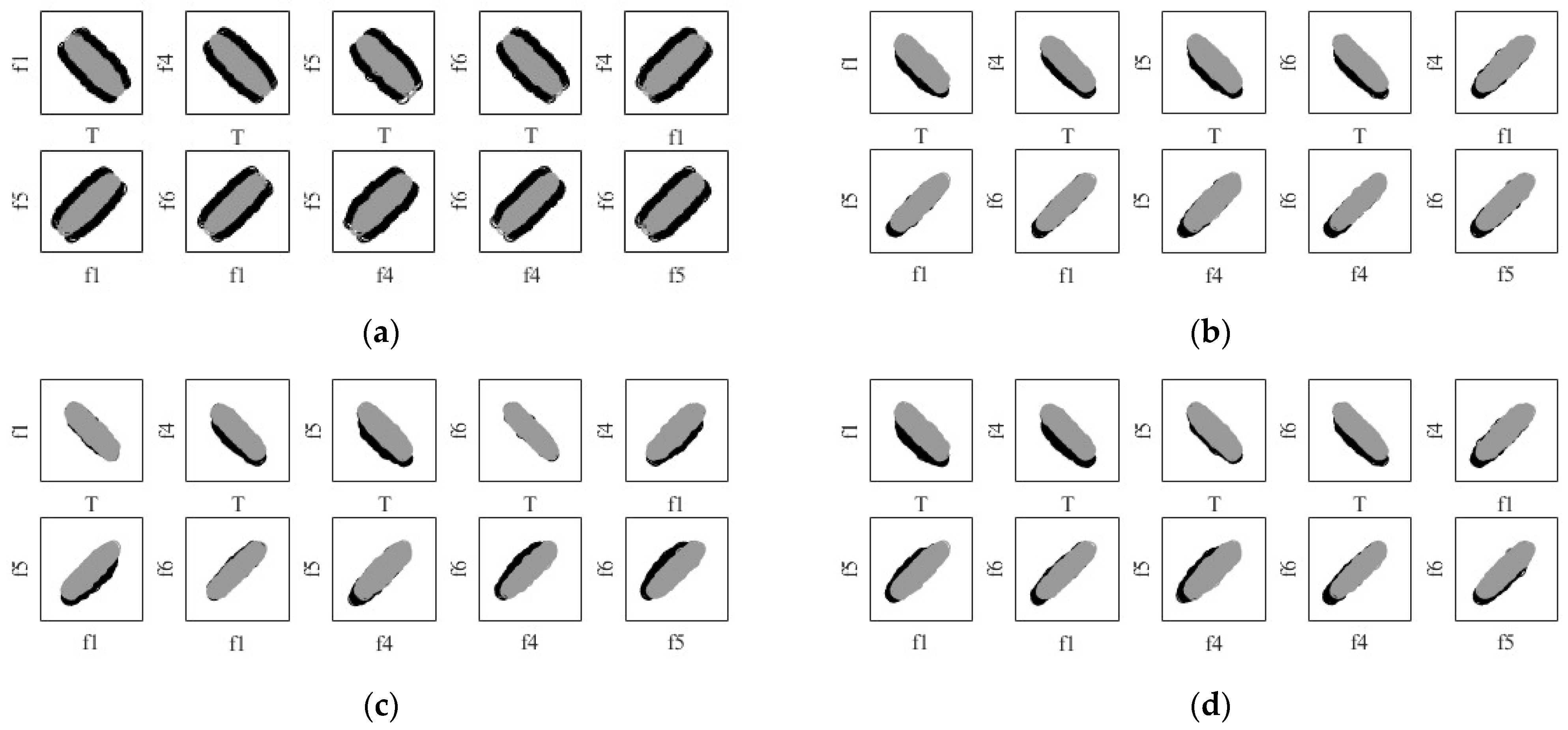
- Not all features are equally sensitive to damage. When feature pairs are used for classification, performance improves if the damage induces different variations in each feature.
- Incorporating nonself samples for parameter tuning improves coverage of the boundary between normal and anomalous behaviour. The proposed strategy for generating artificial nonself samples effectively surrounds the self region. However, it yields suboptimal classifiers compared to the best parameter combinations. This is partly because the tuning procedure produces a single classifier, whereas optimal parameter settings vary with the damage scenario.
- For the case study considered, small detector radii and small/intermediate censoring distances yield higher-performing classifiers, consistent with previous studies involving large and dense training sets. However, this finding should be generalised with caution, as it depends on the characteristics of the training data and should be validated through optimisation on a validation set as in the approach here presented.
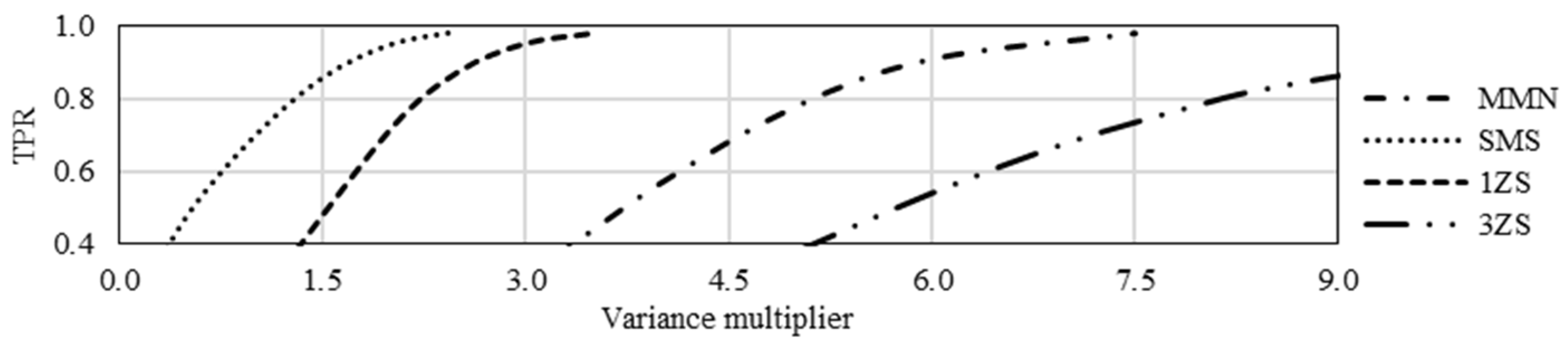
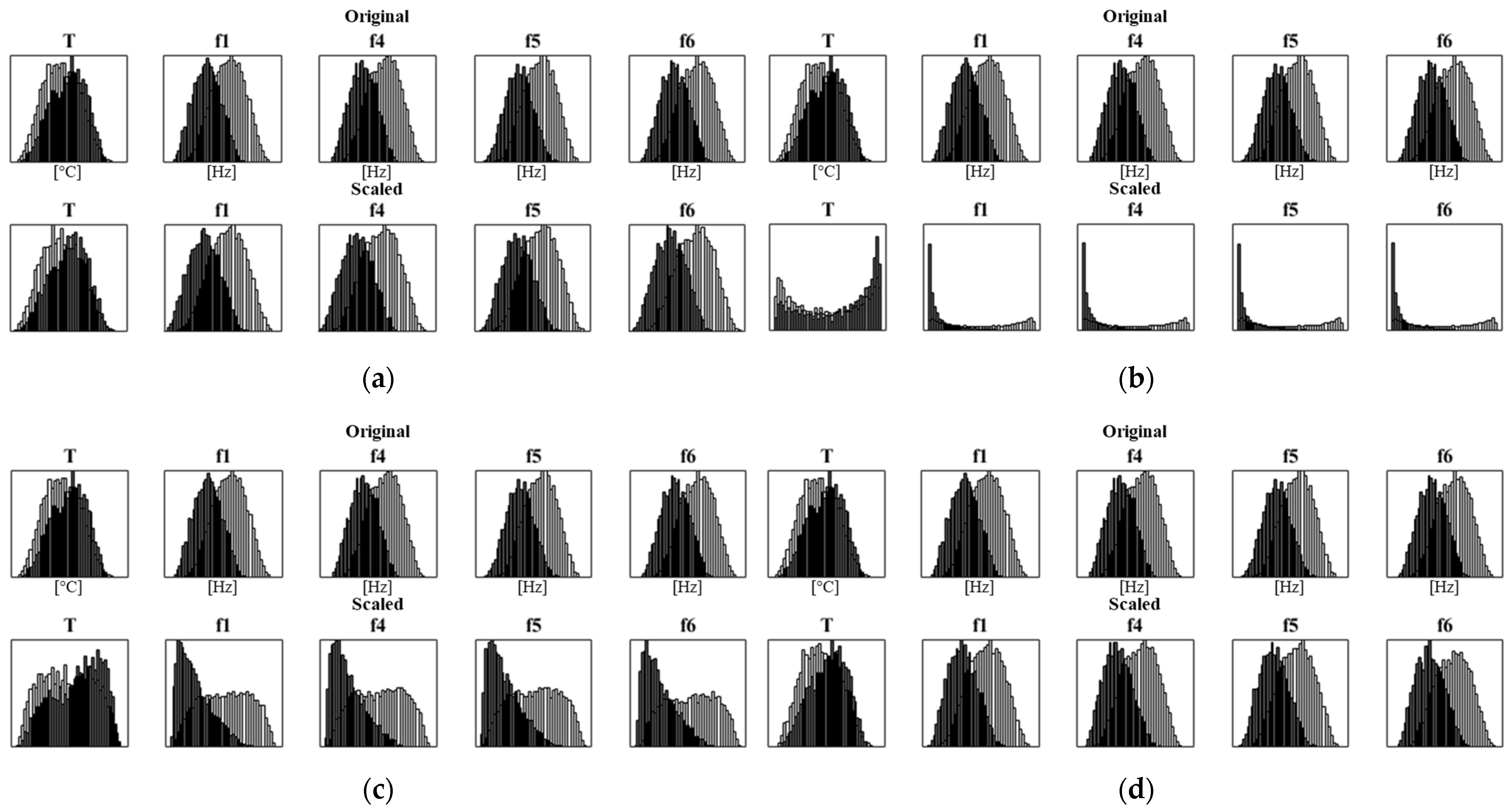
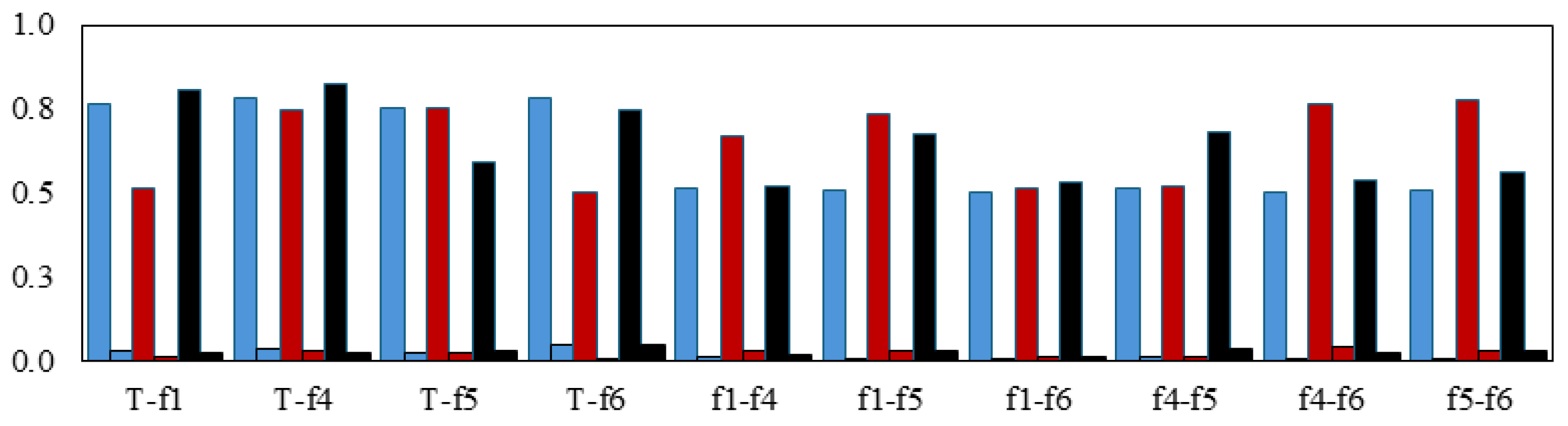
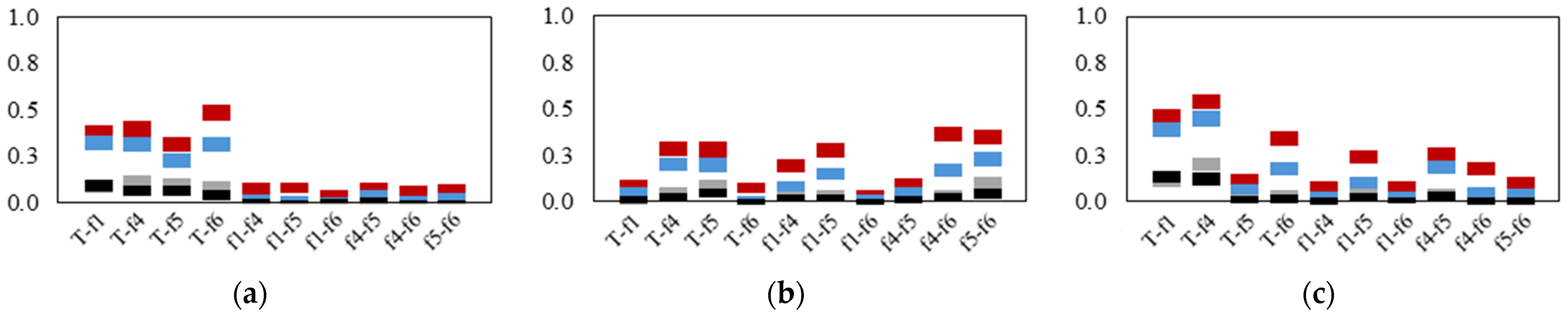
- Feature scaling has a negligible impact on detection performance for large damage extents, where self and nonself distributions are sufficiently distinct. However, it plays a critical role in early warning for small damage extents.
- Scaling methods that amplify deviations from the central tendency of the self distribution are potentially more effective in detecting small damage, particularly when the self distribution exhibits low variance.
Author Contributions
Funding
Data Availability Statement
Conflicts of Interest
References
- Gharehbaghi, V.R.; Noroozinejad Farsangi, E.; Noori, M.; Yang, T.Y.; Li, S.; Nguyen, A.; Málaga-Chuquitaype, C.; Gardoni, P.; Mirjalili, S. A Critical Review on Structural Health Monitoring: Definitions, Methods, and Perspectives. Arch. Comput. Methods Eng. 2022, 29, 2209–2235. [Google Scholar] [CrossRef]
- Ren, Y.; Bareille, O.; Lin, Z.; Huang, X.-R. Review of damage detection techniques in vibration-based structural health monitoring. Int. J. Dyn. Control 2025, 13, 99. [Google Scholar] [CrossRef]
- Farrar, C.R.; Worden, K. An introduction to structural health monitoring. Philos. Trans. R. Soc. Math. Phys. Eng. Sci. 2007, 365, 303–315. [Google Scholar] [CrossRef] [PubMed]
- Karimi, S.; Mirza, O. Damage identification in bridge structures: Review of available methods and case studies. Aust. J. Struct. Eng. 2023, 24, 89–119. [Google Scholar] [CrossRef]
- Zhang, B.; Ren, Y.; He, S.; Gao, Z.; Li, B.; Song, J. A review of methods and applications in structural health monitoring (SHM) for bridges. Measurement 2025, 245, 116575. [Google Scholar] [CrossRef]
- Zar, A.; Hussain, Z.; Akbar, M.; Rabczuk, T.; Lin, Z.; Li, S.; Ahmed, B. Towards vibration-based damage detection of civil engineering structures: Overview, challenges, and future prospects. Int. J. Mech. Mater. Des. 2024, 20, 591–662. [Google Scholar] [CrossRef]
- Argentino, A.; Bono, F.M.; Bernardini, L.; Romano, N.; Cazzulani, G.; Somaschini, C.; Belloli, M.; Cinquemani, S. Automated OMA Through SSI-COV Algorithm of a Warren Truss Railway Bridge Exploiting Free Decay Response. In Proceedings of the 10th International Operational Modal Analysis Conference (IOMAC 2024); Rainieri, C., Gentile, C., Aenlle López, M., Eds.; Springer Nature: Cham, Switzerland, 2024; pp. 600–608. [Google Scholar] [CrossRef]
- Magalhães, F.; Cunha, Á. Explaining operational modal analysis with data from an arch bridge. Mech. Syst. Signal Process. 2011, 25, 1431–1450. [Google Scholar] [CrossRef]
- Scocciolini, D.; Romanazzi, A.; Ponsi, F.; Varzaneh, G.E.; Bassoli, E.; Buratti, N.; Vincenzi, L. Modal testing of a reinforced concrete Gerber-type bridge. Procedia Struct. Integr. 2026, 78, 769–776. [Google Scholar] [CrossRef]
- Rainieri, C.; Fabbrocino, G. Automated output-only dynamic identification of civil engineering structures. Mech. Syst. Signal Process. 2010, 24, 678–695. [Google Scholar] [CrossRef]
- Katam, R.; Pasupuleti, V.D.K.; Kalapatapu, P. A review on structural health monitoring: Past to present. Innov. Infrastruct. Solut. 2023, 8, 248. [Google Scholar] [CrossRef]
- Wang, G.; Ke, J. Literature Review on the Structural Health Monitoring (SHM) of Sustainable Civil Infrastructure: An Analysis of Influencing Factors in the Implementation. Buildings 2024, 14, 402. [Google Scholar] [CrossRef]
- Chaves, E.; Barontini, A.; Mendes, N.; Compán, V.; Lourenço, P.B.; Chaves, E.; Barontini, A.; Mendes, N.; Compán, V.; Lourenço, P.B. Methodologies and Challenges for Optimal Sensor Placement in Historical Masonry Buildings. Sensors 2023, 23, 9304. [Google Scholar] [CrossRef]
- Ostachowicz, W.; Soman, R.; Malinowski, P. Optimization of sensor placement for structural health monitoring: A review. Struct. Health Monit. 2019, 18, 963–988. [Google Scholar] [CrossRef]
- Cross, E.J.; Gibson, S.J.; Jones, M.R.; Pitchforth, D.J.; Zhang, S.; Rogers, T.J. Physics-Informed Machine Learning for Structural Health Monitoring. In Structural Health Monitoring Based on Data Science Techniques; Cury, A., Ribeiro, D., Ubertini, F., Todd, M.D., Eds.; Structural Integrity; Springer International Publishing: Cham, Switzerland, 2022; pp. 347–367. [Google Scholar] [CrossRef]
- Karpatne, A.; Atluri, G.; Faghmous, J.H.; Steinbach, M.; Banerjee, A.; Ganguly, A.; Shekhar, S.; Samatova, N.; Kumar, V. Theory-Guided Data Science: A New Paradigm for Scientific Discovery from Data. IEEE Trans. Knowl. Data Eng. 2017, 29, 2318–2331. [Google Scholar] [CrossRef]
- Haywood-Alexander, M.; Bacsa, K.; Liu, W.; Lai, Z.; Chatzi, E. Physics Enhanced Machine Learning for Monitoring and Twinning. Struct. Health Monit. 2023, 2023. [Google Scholar] [CrossRef]
- Sonbul, O.S.; Rashid, M. Algorithms and Techniques for the Structural Health Monitoring of Bridges: Systematic Literature Review. Sensors 2023, 23, 4230. [Google Scholar] [CrossRef]
- Vanik, M.W.; Beck, J.L.; Au, S.K. Bayesian Probabilistic Approach to Structural Health Monitoring. J. Eng. Mech. 2000, 126, 738–745. [Google Scholar] [CrossRef]
- Arendt, P.D.; Apley, D.W.; Chen, W. Quantification of Model Uncertainty: Calibration, Model Discrepancy, and Identifiability. J. Mech. Des. 2012, 134, 100908. [Google Scholar] [CrossRef]
- Moaveni, B.; Conte, J.P.; Hemez, F.M. Uncertainty and Sensitivity Analysis of Damage Identification Results Obtained Using Finite Element Model Updating. Comput.-Aided Civ. Infrastruct. Eng. 2009, 24, 320–334. [Google Scholar] [CrossRef]
- Farrar, C.R.; Duffey, T.A.; Doebling, S.W.; Nix, D.A. A statistical pattern recognition paradigm for vibration-based structural health monitoring. Struct. Health Monit. 1999, 2000, 764–773. [Google Scholar]
- Cremona, C.; Santos, J. Structural Health Monitoring as a Big-Data Problem. Struct. Eng. Int. 2018, 28, 243–254. [Google Scholar] [CrossRef]
- Barontini, A.; Masciotta, M.G.; Amado-Mendes, P.; Ramos, L.F.; Lourenço, P.B. Negative selection algorithm based methodology for online structural health monitoring. Eng. Struct. 2021, 229, 111662. [Google Scholar] [CrossRef]
- Forrest, S.; Perelson, A.S.; Allen, L.; Cherukuri, R. Self-nonself discrimination in a computer. In Proceedings of the 1994 IEEE Computer Society Symposium on Research in Security and Privacy, Oakland, CA, USA, 16–18 May 1994; pp. 202–212. [Google Scholar] [CrossRef]
- Gonzalez, F.; Dasgupta, D.; Kozma, R. Combining negative selection and classification techniques for anomaly detection. In Proceedings of the 2002 Congress on Evolutionary Computation. CEC’02 (Cat. No.02TH8600), Honolulu, HI, USA, 12–17 May 2002; IEEE: New York, NY, USA, 2002; Volume 1, pp. 705–710. [Google Scholar] [CrossRef]
- Gupta, K.D.; Dasgupta, D. Negative Selection Algorithm Research and Applications in the Last Decade: A Review. IEEE Trans. Artif. Intell. 2022, 3, 110–128. [Google Scholar] [CrossRef]
- Dasgupta, D.; Yu, S.; Nino, F. Recent Advances in Artificial Immune Systems: Models and Applications. Appl. Soft Comput. 2011, 11, 1574–1587. [Google Scholar] [CrossRef]
- Marafini, F.M.; Zini, G.Z.; Barontini, A.B.; Betti, M.B.; Bartoli, G.B.; Mendes, N.M.; Cicirello, A.C. Review and challenges for a realistic numerical SHM benchmark. In Proceedings of the 9th European Congress Computational Methods Applied Sciences and Engineering, Lisboa, Portugal, 3–7 June 2024; Volume Physics-Informed Machine Learning for Structural Health Monitoring: Emerging Trends and Open Issues. [Google Scholar] [CrossRef]
- Eltouny, K.; Gomaa, M.; Liang, X. Unsupervised Learning Methods for Data-Driven Vibration-Based Structural Health Monitoring: A Review. Sensors 2023, 23, 3290. [Google Scholar] [CrossRef] [PubMed]
- Jia, J.; Li, Y. Deep Learning for Structural Health Monitoring: Data, Algorithms, Applications, Challenges, and Trends. Sensors 2023, 23, 8824. [Google Scholar] [CrossRef]
- Liu, J.; Li, Q.; Li, L.; An, S. Structural damage detection and localization via an unsupervised anomaly detection method. Reliab. Eng. Syst. Saf. 2024, 252, 110465. [Google Scholar] [CrossRef]
- Ghazimoghadam, S.; Hosseinzadeh, S.A.A. A novel unsupervised deep learning approach for vibration-based damage diagnosis using a multi-head self-attention LSTM autoencoder. Measurement 2024, 229, 114410. [Google Scholar] [CrossRef]
- Abraham, J.N.; Tran, M.Q.; Jayaraj, J.S.; Matos, J.C.; Valluzzi, M.R.; Dang, S.N. Unsupervised Learning-Based Anomaly Detection for Bridge Structural Health Monitoring: Identifying Deviations from Normal Structural Behaviour. Sensors 2026, 26, 561. [Google Scholar] [CrossRef]
- Kamali, S.; Quqa, S.; Palermo, A.; Marzani, A. Reducing false alarms in structural health monitoring systems by exploiting time information via Binomial Distribution Classifier. Mech. Syst. Signal Process. 2024, 207, 110938. [Google Scholar] [CrossRef]
- Entezami, A.; Sarmadi, H.; Behkamal, B.; Mariani, S. Early warning of structural damage via manifold learning-aided data clustering and non-parametric probabilistic anomaly detection. Mech. Syst. Signal Process. 2025, 224, 111984. [Google Scholar] [CrossRef]
- Ditommaso, R.; Ponzo, F.C. Identifying Damage in Structures: Definition of Thresholds to Minimize False Alarms in SHM Systems. Buildings 2024, 14, 821. [Google Scholar] [CrossRef]
- Surace, C.; Worden, K. Novelty detection in a changing environment: A negative selection approach. Mech. Syst. Signal Process. 2010, 24, 1114–1128. [Google Scholar] [CrossRef]
- de Almeida, E.F.; Chavarette, F.R.; Merizio, I.F.; Gonçalves, A.C. Artificial immune system for fault detection and localization in a composite material plate with temperature variation. J. Braz. Soc. Mech. Sci. Eng. 2024, 46, 717. [Google Scholar] [CrossRef]
- Delo, G.; Mattone, M.; Surace, C.; Worden, K. Novelty detection across a small population of real structures: A negative selection approach. J. Phys. Conf. Ser. 2024, 2647, 192004. [Google Scholar] [CrossRef]
- Li, R.; Mita, A.; Zhou, J. Abnormal state detection of building structures based on symbolic time series analysis and negative selection. Struct. Control Health Monit. 2014, 21, 80–97. [Google Scholar] [CrossRef]
- Shi, A.; Yu, X. Structural damage assessment using artificial immune systems and wavelet decomposition. In Proceedings of the 2017 International Joint Conference on Neural Networks (IJCNN), Anchorage, AK, USA, 14–19 May 2017; pp. 242–247. [Google Scholar] [CrossRef]
- Li, M.; Ren, W.X. Negative Selection Algorithm Using Natural Frequency for Novelty Detection under Temperature Variations. Adv. Mater. Res. 2011, 163–167, 2747–2750. [Google Scholar] [CrossRef]
- Barontini, A.; Perera, R.; Masciotta, M.G.; Amado-Mendes, P.; Ramos, L.; Lourenço, P. Deterministically generated negative selection algorithm for damage detection in civil engineering systems. Eng. Struct. 2019, 197, 109444. [Google Scholar] [CrossRef]
- Barontini, A.; Masciotta, M.G.; Amado-Mendes, P.; Ramos, L.F.; Lourenço, P.B. Improving damage detection by combining multiple classifiers in different feature spaces. Eng. Struct. 2024, 299, 117069. [Google Scholar] [CrossRef]
- Barontini, A.; Masciotta, M.G.; Amado-Mendes, P.; Ramos, L.F.; Lourenço, P.B. Reducing the Training Samples for Damage Detection of Existing Buildings through Self-Space Approximation Techniques. Sensors 2021, 21, 7155. [Google Scholar] [CrossRef]
- Mohamad Mohsin, M.F.; Hamdan, A.R.; Abu Bakar, A. The Effect of Normalization for Real Value Negative Selection Algorithm BT. In Soft Computing Applications and Intelligent Systems: Second International Multi-Conference on Artificial Intelligence Technology, M-CAIT 2013, Shah Alam, Malaysia, 28–29 August 2013; Noah, S.A., Abdullah, A., Arshad, H., Abu Bakar, A., Othman, Z.A., Sahran, S., Omar, N., Othman, Z., Eds.; Springer: Berlin/Heidelberg, Germany, 2013; pp. 194–205. [Google Scholar] [CrossRef]
- Pereira, S.; Magalhães, F.; Gomes, J.P.; Cunha, Á. Modal tracking under large environmental influence. J. Civ. Struct. Health Monit. 2022, 12, 179–190. [Google Scholar] [CrossRef]
- Lydakis, E.; Koss, H.; Brincker, R.; Amador, S.D.R. Data-driven sensor fault diagnosis for vibration-based structural health monitoring under ambient excitation. Measurement 2024, 237, 115232. [Google Scholar] [CrossRef]
- Kullaa, J. Distinguishing between sensor fault, structural damage, and environmental or operational effects in structural health monitoring. Mech. Syst. Signal Process. 2011, 25, 2976–2989. [Google Scholar] [CrossRef]
- Pellegrini, D.; Barontini, A.; Girardi, M.; Lourenço, P.B.; Masciotta, M.G.; Mendes, N.; Padovani, C.; Ramos, L.F. Effects of temperature variations on the modal properties of masonry structures: An experimental-based numerical modelling approach. Structures 2023, 53, 595–613. [Google Scholar] [CrossRef]
- Ji, Z.; Dasgupta, D. Applicability Issues of the Real-valued Negative Selection Algorithms. In Proceedings of the 8th Annual Conference on Genetic and Evolutionary Computation, in GECCO’06; ACM: New York, NY, USA, 2006; pp. 111–118. [Google Scholar] [CrossRef]
- Garrett, S.M. How do we evaluate artificial immune systems? Evol. Comput. 2005, 13, 145–177. [Google Scholar] [CrossRef]
- Stibor, T.; Mohr, P.; Timmis, J.; Eckert, C. Is Negative Selection Appropriate for Anomaly Detection? In Proceedings of the 7th Annual Conference on Genetic and Evolutionary Computation, in GECCO’05; ACM: New York, NY, USA, 2005; pp. 321–328. [Google Scholar] [CrossRef]
- Ji, Z.; Dasgupta, D. Revisiting Negative Selection Algorithms. Evol. Comput. 2007, 15, 223–251. [Google Scholar] [CrossRef]
- Figueiredo, E.; Peres, N.; Moldovan, I.; Nasr, A. Impact of climate change on long-term damage detection for structural health monitoring of bridges. Struct. Health Monit. 2025, 24, 2252–2270. [Google Scholar] [CrossRef]
- Jin, C.; Jang, S.; Sun, X.; Li, J.; Christenson, R. Damage detection of a highway bridge under severe temperature changes using extended Kalman filter trained neural network. J. Civ. Struct. Health Monit. 2016, 6, 545–560. [Google Scholar] [CrossRef]
- Cunha, A.; Caetano, E.; Magalhães, F.; Moutinho, C. Recent perspectives in dynamic testing and monitoring of bridges. Struct. Control Health Monit. 2013, 20, 853–877. [Google Scholar] [CrossRef]
- Mario Azzara, R.; De Roeck, G.; Girardi, M.; Padovani, C.; Pellegrini, D.; Reynders, E. The influence of environmental parameters on the dynamic behaviour of the San Frediano bell tower in Lucca. Eng. Struct. 2018, 156, 175–187. [Google Scholar] [CrossRef]
- Figueiredo, E.; Brownjohn, J. Three decades of statistical pattern recognition paradigm for SHM of bridges. Struct. Health Monit. 2022, 21, 3018–3054. [Google Scholar] [CrossRef]
- Worden, K.; Manson, G.; Fieller, N.R.J. Damage detection using outlier analysis. J. Sound Vib. 2000, 229, 647–667. [Google Scholar] [CrossRef]
- Al Shalabi, L.; Shaaban, Z. Normalization as a Preprocessing Engine for Data Mining and the Approach of Preference Matrix. In Proceedings of the 2006 International Conference on Dependability of Computer Systems, Szklarska Poręba, Poland, 24–28 May 2006; pp. 207–214. [Google Scholar] [CrossRef]
- Pukelsheim, F. The Three Sigma Rule. Am. Stat. 1994, 48, 88–91. [Google Scholar] [CrossRef]
- Li, D.; Liu, S.; Zhang, H. Negative selection algorithm with constant detectors for anomaly detection. Appl. Soft Comput. 2015, 36, 618–632. [Google Scholar] [CrossRef]
- Stibor, T.; Timmis, J. Comments on real-valued negative selection vs. real-valued positive selection and one-class SVM. In Proceedings of the 2007 IEEE Congress on Evolutionary Computation, Singapore, 25–28 September 2007; pp. 3727–3734. [Google Scholar] [CrossRef]
- Stibor, T.; Timmis, J.; Eckert, C. On the use of hyperspheres in artificial immune systems as antibody recognition regions. In Proceedings of the International Conference on Artificial Immune Systems; Springer: Berlin/Heidelberg, Germany, 2006; pp. 215–228. [Google Scholar]
- Ebner, M.; Breunig, H.-G.; Albert, J. On the use of negative selection in an artificial immune system. In Proceedings of the 4th Annual Conference on Genetic and Evolutionary Computation, New York, NY, USA, 9–13 July 2002; pp. 957–964. [Google Scholar]
- Stibor, T.; Timmis, J.; Eckert, C. A comparative study of real-valued negative selection to statistical anomaly detection techniques. In Proceedings of the International Conference on Artificial Immune Systems; Springer: Berlin/Heidelberg, Germany, 2005; pp. 262–275. [Google Scholar]
- Kim, J.; Bentley, P.J. An evaluation of negative selection in an artificial immune system for network intrusion detection. In Proceedings of the 3rd Annual Conference on Genetic and Evolutionary Computation; Morgan Kaufmann Publishers Inc.: San Francisco, CA, USA, 2001; pp. 1330–1337. Available online: https://dl.acm.org/doi/10.5555/2955239.2955467 (accessed on 12 May 2026).
- González, F.A.; Dasgupta, D. Anomaly Detection Using Real-Valued Negative Selection. Genet. Program. Evolvable Mach. 2003, 4, 383–403. [Google Scholar] [CrossRef]
- Khairy, R.S.; Ghazali, R.; Lasisi, A. Real-Valued Negative Selection Algorithms: Ensuring Data Integrity Through Anomaly Detection. In Proceedings of the Advanced Computer and Communication Engineering Technology; Sulaiman, H.A., Othman, M.A., Othman, M.F.I., Rahim, Y.A., Pee, N.C., Eds.; Springer International Publishing: Cham, Switzerland, 2016; pp. 23–32. [Google Scholar] [CrossRef]
- Lasisi, A.; Ghazali, R.; Herawan, T. Comparative Performance Analysis of Negative Selection Algorithm with Immune and Classification Algorithms. In Proceedings of the Recent Advances on Soft Computing and Data Mining; Herawan, T., Ghazali, R., Deris, M.M., Eds.; Springer International Publishing: Cham, Switzerland, 2014; pp. 441–452. [Google Scholar] [CrossRef]
- Barontini, A.; Masciotta, M.-G.; Ramos, L.F.; Amado-Mendes, P.; Lourenço, P.B. Application of a Bio-Inspired Anomaly Detection Algorithm for Unsupervised SHM of a Historic Masonry Church. In Proceedings of the Tenth International Masonry Conference, Milan, Italy, 9–11 July 2018; pp. 2259–2272. [Google Scholar]
- Sokolova, M.; Lapalme, G. A systematic analysis of performance measures for classification tasks. Inf. Process. Manag. 2009, 45, 427–437. [Google Scholar] [CrossRef]
- Youden, W.J. Index for rating diagnostic tests. Cancer 1950, 3, 32–35. [Google Scholar] [CrossRef]
- Caruana, R.; Niculescu-Mizil, A. Data Mining in Metric Space: An Empirical Analysis of Supervised Learning Performance Criteria. In Proceedings of the Tenth ACM SIGKDD International Conference on Knowledge Discovery and Data Mining; Association for Computing Machinery: New York, NY, USA, 2004; pp. 69–78. [Google Scholar] [CrossRef]
- Hormazábal, M.F.; Barontini, A.; Masciotta, M.G.; Oliveira, D.V. A non-parametric algorithm for time-dependent modal analysis of civil structures and infrastructures. Mech. Syst. Signal Process. 2023, 204, 110802. [Google Scholar] [CrossRef]
- Masciotta, M.G.; Barontini, A.; Chaves, E.; Mendes, N.; Brando, G.; Lourenço, P.B. Modal-based multi-criteria optimization of sensor placement techniques for dynamic monitoring of bridges. Int. J. Bridge Eng. Manag. Res. 2025, 2, 214250017–214250021. [Google Scholar] [CrossRef]
- Peeters, B.; De Roeck, G. One-year monitoring of the Z24-Bridge: Environmental effects versus damage events. Earthq. Eng. Struct. Dyn. 2001, 30, 149–171. [Google Scholar] [CrossRef]
- Santos, A.; Figueiredo, E.; Silva, M.; Santos, R.; Sales, C.; Costa, J.C.W.A. Genetic-based EM algorithm to improve the robustness of Gaussian mixture models for damage detection in bridges. Struct. Control Health Monit. 2017, 24, e1886. [Google Scholar] [CrossRef]
- Reynders, E.; Roeck, G.D. Continuous Vibration Monitoring and Progressive Damage Testing on the Z24 Bridge. In Encyclopedia of Structural Health Monitoring; John Wiley & Sons, Ltd.: Hoboken, NJ, USA, 2009. [Google Scholar] [CrossRef]
- Zhou, G.-D.; Yi, T.-H.; Li, H.-N. Sensor Placement Optimization in Structural Health Monitoring Using Cluster-In-Cluster Firefly Algorithm. Adv. Struct. Eng. 2014, 17, 1103–1115. [Google Scholar] [CrossRef]
- Xia, Y.; Chen, B.; Weng, S.; Ni, Y.-Q.; Xu, Y.-L. Temperature effect on vibration properties of civil structures: A literature review and case studies. J. Civ. Struct. Health Monit. 2012, 2, 29–46. [Google Scholar] [CrossRef]
- Cho, K.; Cho, J.-R. Effect of Temperature on the Modal Variability in Short-Span Concrete Bridges. Appl. Sci. 2022, 12, 9757. [Google Scholar] [CrossRef]
- International Federation for Structural Concrete Fib Bulletin 55: Model Code 2010, First Complete Draft—Volume 1; International Federation for Structural Concrete (fib): Lausanne, Switzerland, 2010.
- Sun, L.; Zhou, Y.; Min, Z. Experimental Study on the Effect of Temperature on Modal Frequencies of Bridges. Int. J. Struct. Stab. Dyn. 2018, 18, 1850155. [Google Scholar] [CrossRef]
- Fu, Y.; DeWolf, J.T. Monitoring and Analysis of a Bridge with Partially Restrained Bearings. J. Bridge Eng. 2001, 6, 23–29. [Google Scholar] [CrossRef]
- He, W.-Y.; Li, Z.; Zhou, L.; Ren, W.-X.; Li, Y. The effect of environmental temperature on influence line of concrete beam type bridge. Structures 2023, 48, 1468–1478. [Google Scholar] [CrossRef]
- Moser, P.; Moaveni, B. Environmental effects on the identified natural frequencies of the Dowling Hall Footbridge. Mech. Syst. Signal Process. 2011, 25, 2336–2357. [Google Scholar] [CrossRef]
- Abid, S.R.; Xue, J.; Liu, J.; Tayşi, N.; Liu, Y.; Özakça, M.; Briseghella, B. Temperatures and gradients in concrete Bridges: Experimental, finite element analysis and design. Structures 2022, 37, 960–976. [Google Scholar] [CrossRef]
- Li, B.; Nie, Y.; Zhang, J.; Jian, J.; Gao, H. Temperature field of long-span concrete box girder bridges in cold regions: Testing and analysis. Structures 2024, 61, 105969. [Google Scholar] [CrossRef]
- Li, L.; Chen, B.; Zhou, L.; Xia, Q.; Zhou, Y.; Zhou, X.; Xia, Y. Thermal behaviors of bridges—A literature review. Adv. Struct. Eng. 2023, 26, 985–1010. [Google Scholar] [CrossRef]
- Jiao, Y.; Liu, H.; Wang, X.; Zhang, Y.; Luo, G.; Gong, Y. Temperature Effect on Mechanical Properties and Damage Identification of Concrete Structure. Adv. Mater. Sci. Eng. 2014, 2014, 191360. [Google Scholar] [CrossRef]
- Desjardins, S.L.; Londoño, N.A.; Lau, D.T.; Khoo, H. Real-Time Data Processing, Analysis and Visualization for Structural Monitoring of the Confederation Bridge. Adv. Struct. Eng. 2006, 9, 141–157. [Google Scholar] [CrossRef]
- Lloyd, G.M.; Wang, M.L.; Singh, V. Observed Variations of Mode Frequencies of a Prestressed Concrete Bridge with Temperature. In Condition Monitoring of Materials and Structures; American Society of Civil Engineers: Reston, VA, USA, 2012; pp. 179–189. [Google Scholar] [CrossRef]
- Liu, C.; DeWolf, J.T. Effect of Temperature on Modal Variability of a Curved Concrete Bridge under Ambient Loads. J. Struct. Eng. 2007, 133, 1742–1751. [Google Scholar] [CrossRef]




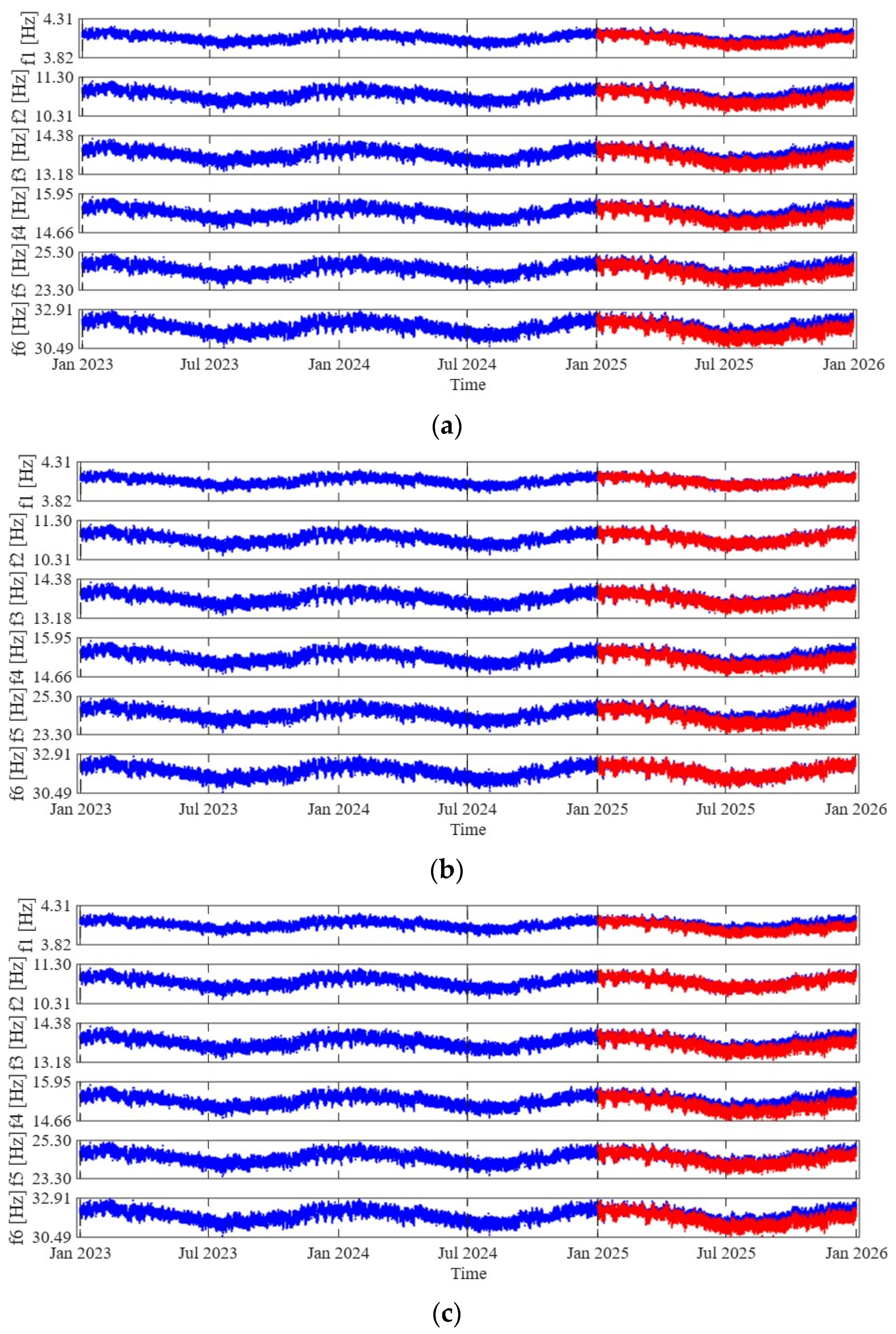








| f1 | Δf1 | f2 | Δf2 | f3 | Δf3 | f4 | Δf4 | f5 | Δf5 | f6 | Δf6 | |
|---|---|---|---|---|---|---|---|---|---|---|---|---|
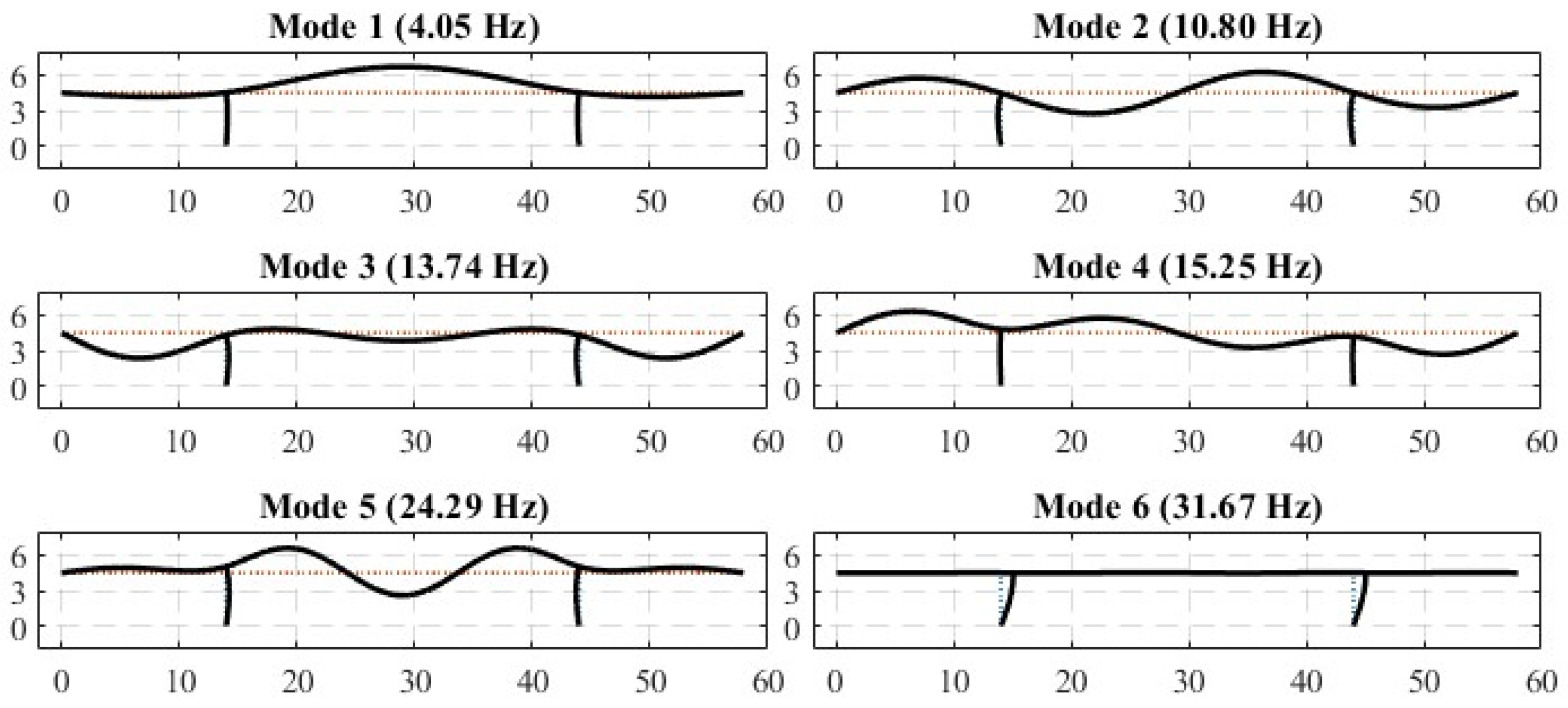
| Reference | 4.05 | – | 10.80 | – | 13.74 | – | 15.25 | – | 24.29 | – | 31.67 | – |
| D1 | 3.99 | 1.5% | 10.64 | 1.5% | 13.53 | 1.5% | 15.02 | 1.5% | 23.92 | 1.5% | 31.19 | 1.5% |
| D2 | 4.04 | 0.4% | 10.78 | 0.2% | 13.64 | 0.7% | 15.02 | 1.5% | 23.86 | 1.8% | 31.66 | 0.0% |
| D3 | 3.97 | 2.0% | 10.78 | 0.2% | 13.54 | 1.4% | 14.96 | 1.9% | 24.08 | 0.8% | 31.20 | 1.5% |
| MMN | SMS | 1ZS | 3ZS | |||||
|---|---|---|---|---|---|---|---|---|
| R | DM | R | DM | R | DM | R | DM | |
| T-f1 | 0.007 | 1.6 | 0.007 | 1.2 | 0.007 | 1.0 | 0.007 | 1.2 |
| T-f4 | 0.018 | 1.2 | 0.007 | 1.4 | 0.004 | 2.0 | 0.007 | 2.0 |
| T-f5 | 0.007 | 1.2 | 0.007 | 1.4 | 0.007 | 1.2 | 0.007 | 1.4 |
| T-f6 | 0.011 | 1.8 | 0.007 | 1.2 | 0.007 | 1.4 | 0.014 | 1.6 |
| f1-f4 | 0.014 | 1.0 | 0.007 | 1.2 | 0.011 | 1.0 | 0.007 | 1.4 |
| f1-f5 | 0.025 | 1.0 | 0.007 | 1.2 | 0.014 | 1.0 | 0.018 | 1.2 |
| f1-f6 | 0.014 | 1.4 | 0.007 | 1.4 | 0.007 | 1.6 | 0.014 | 1.6 |
| f4-f5 | 0.011 | 1.0 | 0.007 | 1.2 | 0.007 | 1.0 | 0.011 | 1.0 |
| f4-f6 | 0.021 | 1.2 | 0.007 | 1.2 | 0.007 | 1.4 | 0.025 | 1.2 |
| f5-f6 | 0.011 | 1.2 | 0.007 | 1.2 | 0.007 | 1.2 | 0.011 | 1.6 |
| T-f1 | T-f4 | T-f5 | T-f6 | f1-f4 | f1-f5 | f1-f6 | f4-f5 | f4-f6 | f5-f6 | |
|---|---|---|---|---|---|---|---|---|---|---|
| MMN | ||||||||||
| Min | 73 | 75 | 74 | 75 | 75 | 76 | 79 | 73 | 75 | 79 |
| Max | 37,813 | 38,086 | 37,825 | 38,094 | 37,931 | 38,138 | 38,220 | 37,900 | 38,264 | 38,122 |
| Optimised | 9037 | 1462 | 9140 | 3934 | 2291 | 722 | 2290 | 3988 | 998 | 4001 |
| SMS | ||||||||||
| Min | 46 | 50 | 45 | 52 | 45 | 49 | 53 | 43 | 48 | 50 |
| Max | 37,660 | 37,558 | 37,619 | 37,525 | 37,260 | 37,086 | 37,062 | 37,247 | 36,920 | 37,240 |
| Optimised | 6893 | 6976 | 6576 | 7324 | 6821 | 7118 | 7144 | 6737 | 7416 | 7043 |
| 1ZS | ||||||||||
| Min | 63 | 65 | 61 | 67 | 62 | 66 | 67 | 59 | 67 | 65 |
| Max | 35,889 | 36,220 | 36,008 | 36,288 | 35,703 | 35,986 | 36,099 | 35,504 | 36,206 | 35,840 |
| Optimised | 8242 | 33,349 | 8045 | 8274 | 3449 | 2034 | 8287 | 8169 | 8324 | 8259 |
| 3ZS | ||||||||||
| Min | 84 | 84 | 83 | 85 | 84 | 84 | 84 | 84 | 84 | 84 |
| Max | 38,687 | 38,891 | 38,680 | 38,902 | 38,684 | 38,803 | 38,929 | 38,616 | 38,937 | 38,809 |
| Optimised | 9552 | 9510 | 9527 | 2377 | 9519 | 1526 | 2385 | 4147 | 749 | 4142 |
Disclaimer/Publisher’s Note: The statements, opinions and data contained in all publications are solely those of the individual author(s) and contributor(s) and not of MDPI and/or the editor(s). MDPI and/or the editor(s) disclaim responsibility for any injury to people or property resulting from any ideas, methods, instructions or products referred to in the content. |
© 2026 by the authors. Licensee MDPI, Basel, Switzerland. This article is an open access article distributed under the terms and conditions of the Creative Commons Attribution (CC BY) license.
Share and Cite
Barontini, A.; Masciotta, M.-G.; Ramos, L.F.; Amado-Mendes, P.; Lourenço, P.B.; Brando, G. Evaluating the Influence of Normalisation Procedures on a Negative Selection Algorithm to Enhance Damage Detection. Sensors 2026, 26, 3492. https://doi.org/10.3390/s26113492
Barontini A, Masciotta M-G, Ramos LF, Amado-Mendes P, Lourenço PB, Brando G. Evaluating the Influence of Normalisation Procedures on a Negative Selection Algorithm to Enhance Damage Detection. Sensors. 2026; 26(11):3492. https://doi.org/10.3390/s26113492
Chicago/Turabian StyleBarontini, Alberto, Maria-Giovanna Masciotta, Luís F. Ramos, Paulo Amado-Mendes, Paulo B. Lourenço, and Giuseppe Brando. 2026. "Evaluating the Influence of Normalisation Procedures on a Negative Selection Algorithm to Enhance Damage Detection" Sensors 26, no. 11: 3492. https://doi.org/10.3390/s26113492
APA StyleBarontini, A., Masciotta, M.-G., Ramos, L. F., Amado-Mendes, P., Lourenço, P. B., & Brando, G. (2026). Evaluating the Influence of Normalisation Procedures on a Negative Selection Algorithm to Enhance Damage Detection. Sensors, 26(11), 3492. https://doi.org/10.3390/s26113492