Intrusion Detection in the Internet of Things: A Comprehensive Review of Techniques, Architectures, Datasets, and Emerging Trends


Abstract
1. Introduction
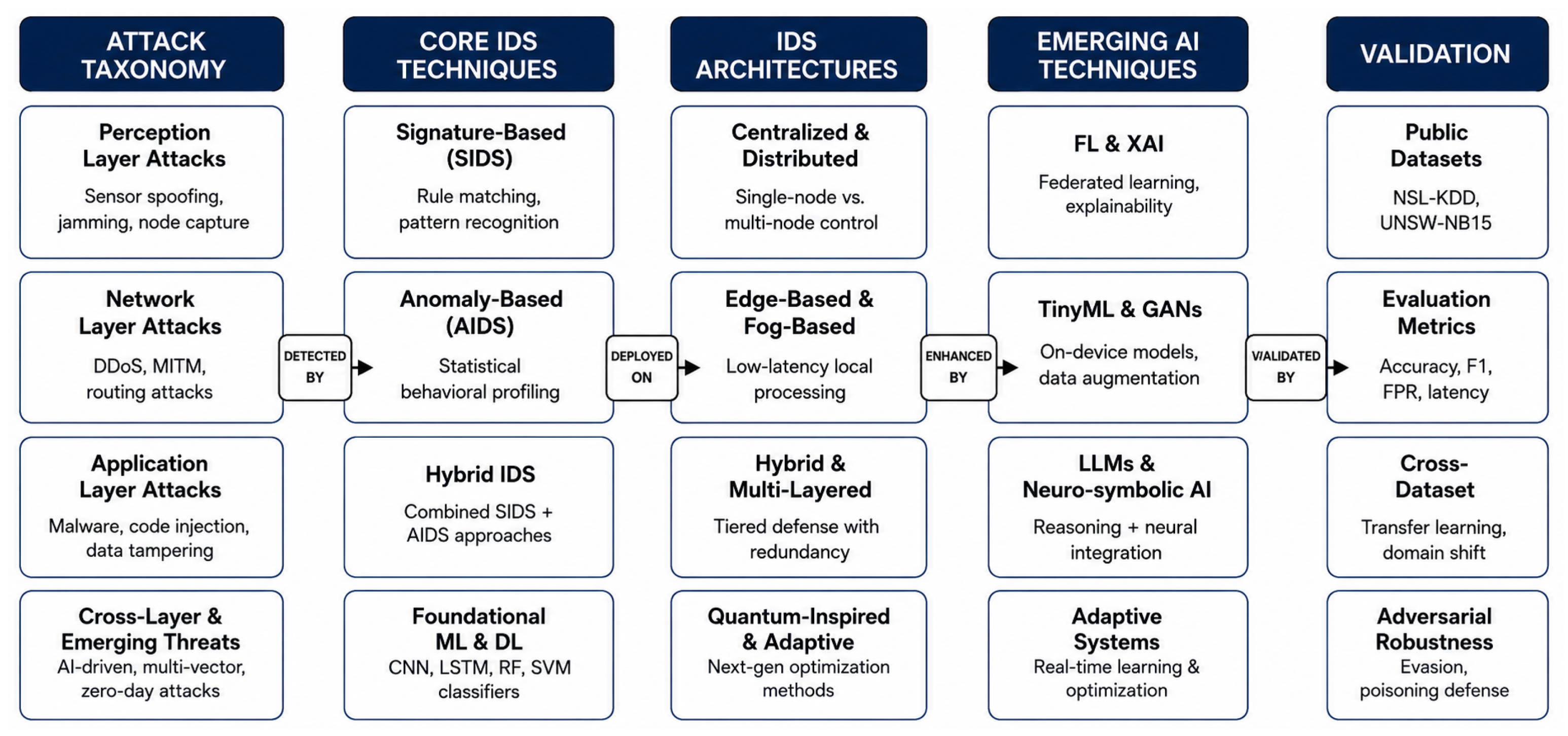
1.1. Motivation, Scope, and Contributions
1.1.1. Integrated Multi-Dimensional Taxonomy
1.1.2. Comprehensive Architectural Trade-Off
1.1.3. Deep Dive into Emerging AI and Robustness
1.1.4. Critique of Validation and Benchmarking
1.1.5. Roadmap for Future Research
1.2. Literature Selection Methodology
- Core ML/DL-based IDS models (summarized in Table 1),
- Emerging techniques such as federated learning, explainable AI, reinforcement learning, and blockchain.
- Datasets and benchmarking practices for IDS evaluation.
2. Taxonomy of IDS-IoT Techniques
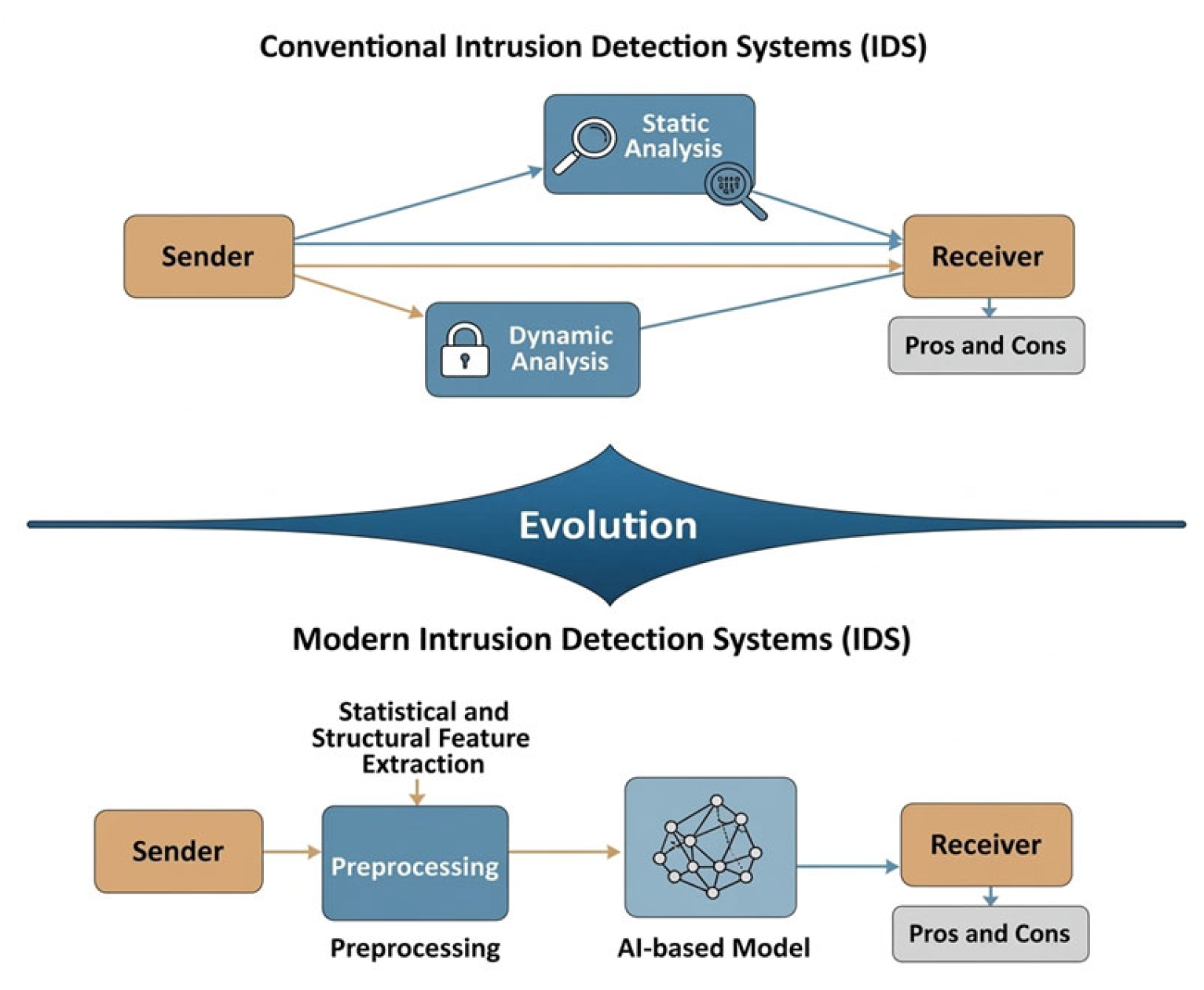
2.1. Classification by Detection Approach
2.1.1. Signature-Based IDS
2.1.2. Anomaly-Based IDS
2.1.3. Hybrid IDS and Emerging Paradigms
2.2. Classification by Learning Technique
2.2.1. Machine Learning Approaches
2.2.2. Deep Learning Approaches
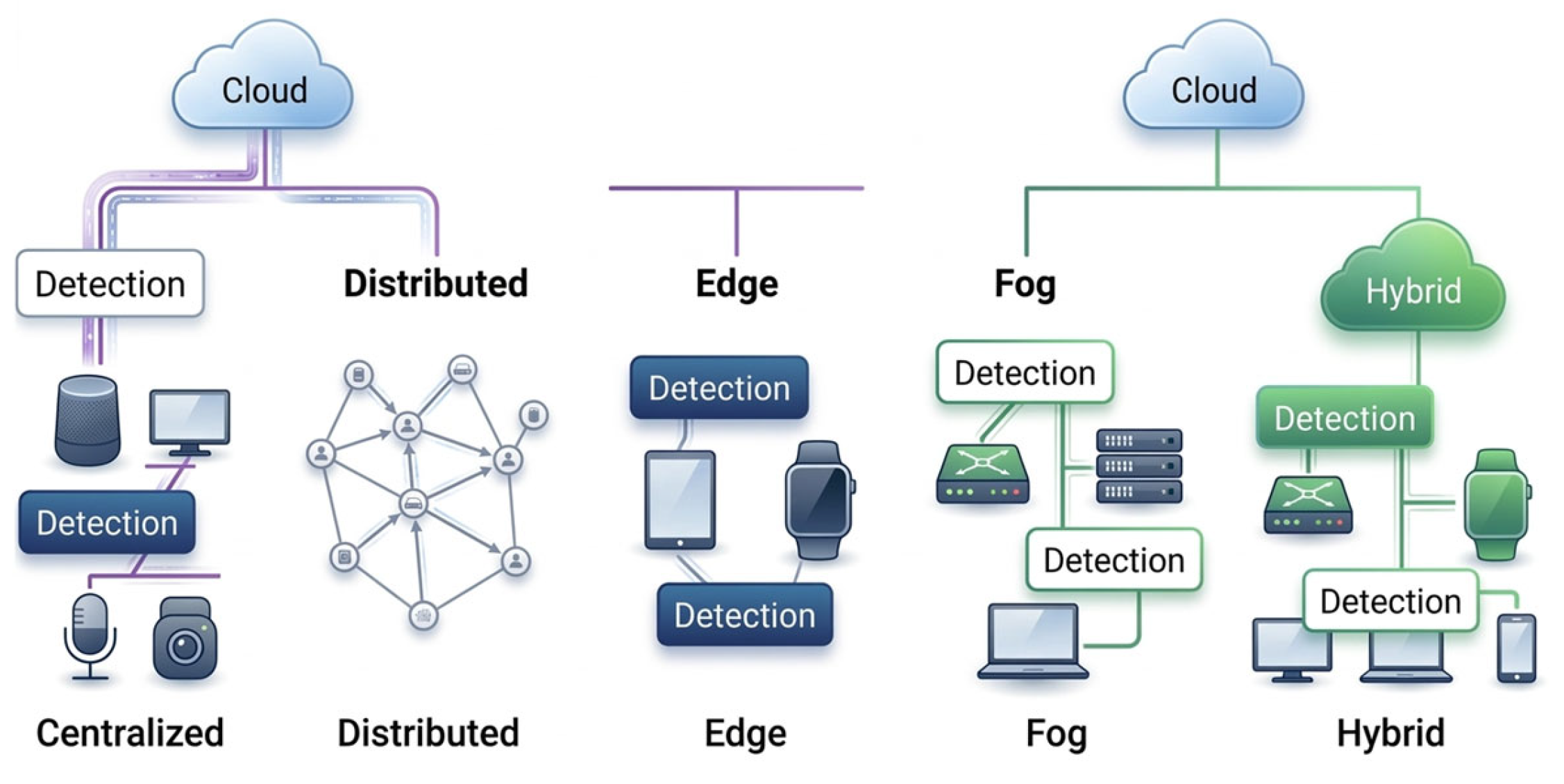
3. IDS Architectures and Deployment Models
3.1. Centralized and Distributed Architectures
3.2. Edge-Based and Fog-Based Architectures
3.3. Hybrid Edge–Fog–Cloud IDS and Deployment Granularity
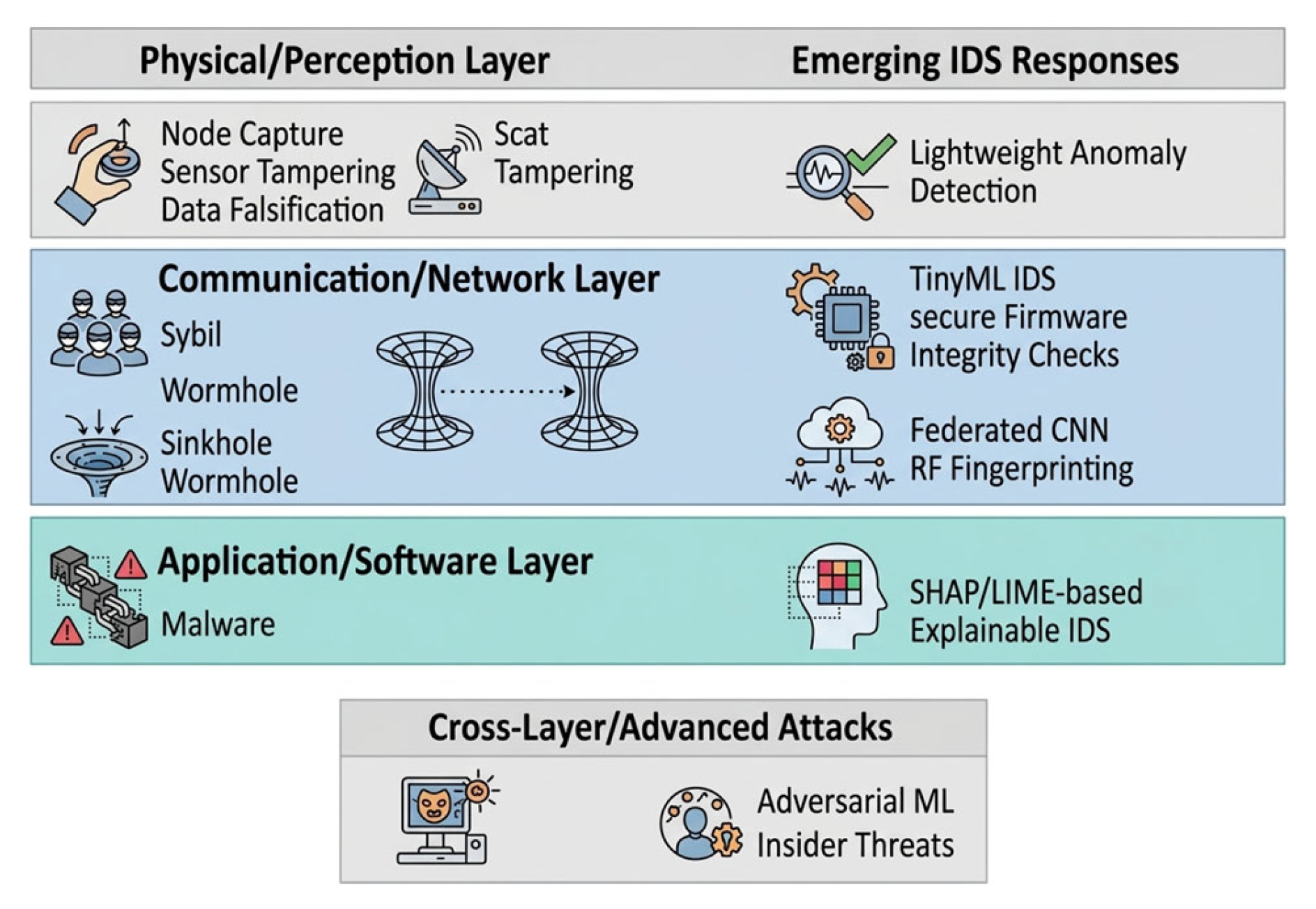
4. Taxonomy of Layer-Wise Attacks and IoT Security
4.1. Perception Layer Attacks
4.2. Network Layer Attacks
4.3. Application Layer and Advanced Threats
4.4. Cross-Layer and Emerging Threats
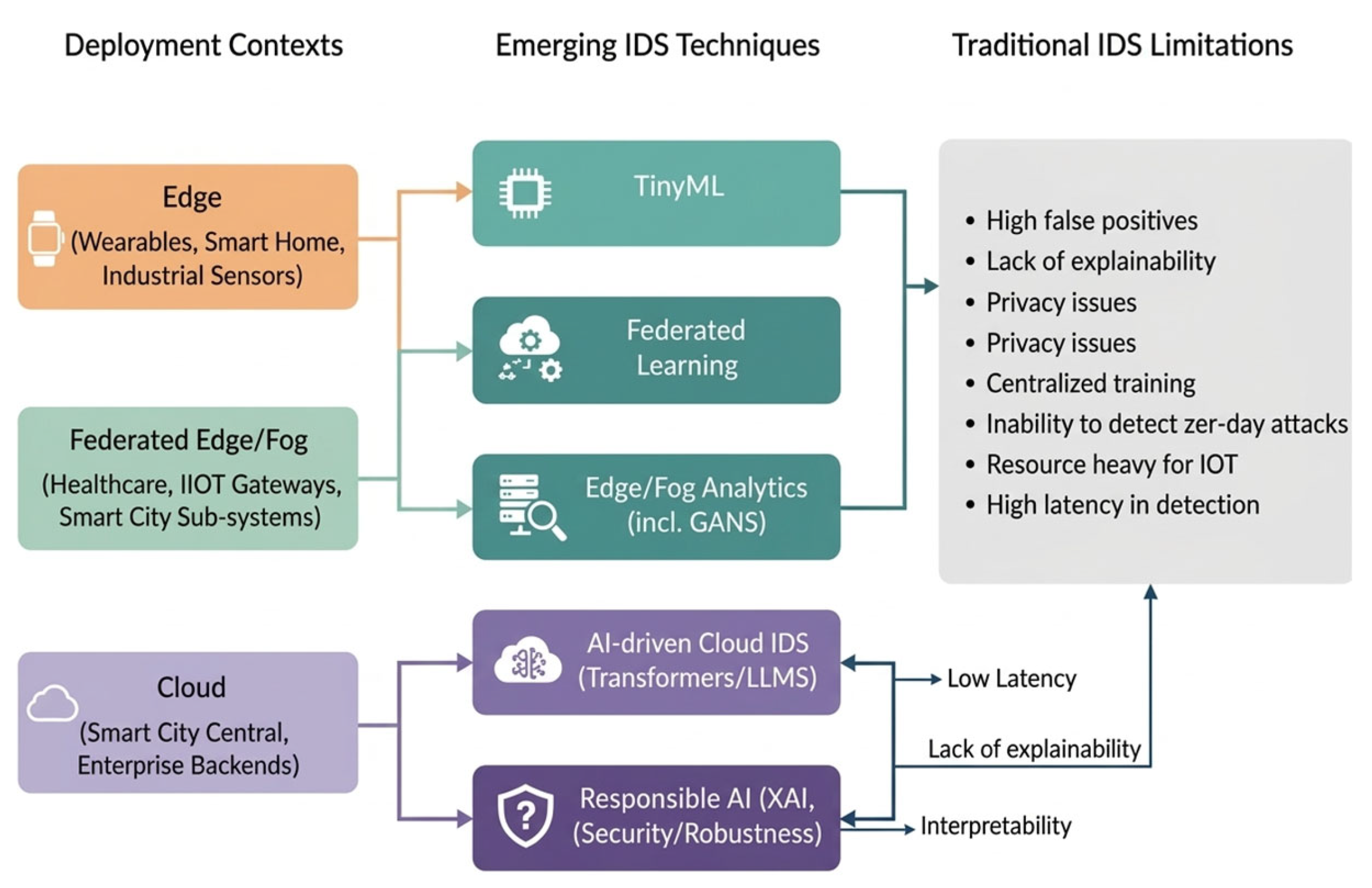
5. Emerging AI Techniques in IoT IDS
5.1. Federated and Explainable AI for Trustworthy IDS
5.1.1. Federated Learning for Privacy-Preserving Detection
5.1.2. Explainable AI for Transparent Decisions
5.1.3. Responsible and Explainable AI by Design
5.2. Resource-Aware and Adversarial Techniques
5.2.1. TinyML for On-Device IDS
5.2.2. Generative Adversarial Networks for Enhanced Robustness
5.3. Advanced Behavioral and Trustworthy AI
5.3.1. LLMs and Transformers for Contextual Intelligence
5.3.2. Neuro-Symbolic AI and Responsible AI for Ethical Security
5.4. Adaptive and Quantum-Inspired Emerging IDS Directions
6. Public Datasets and Validation Methods for Detecting Intrusions in the Internet of Things
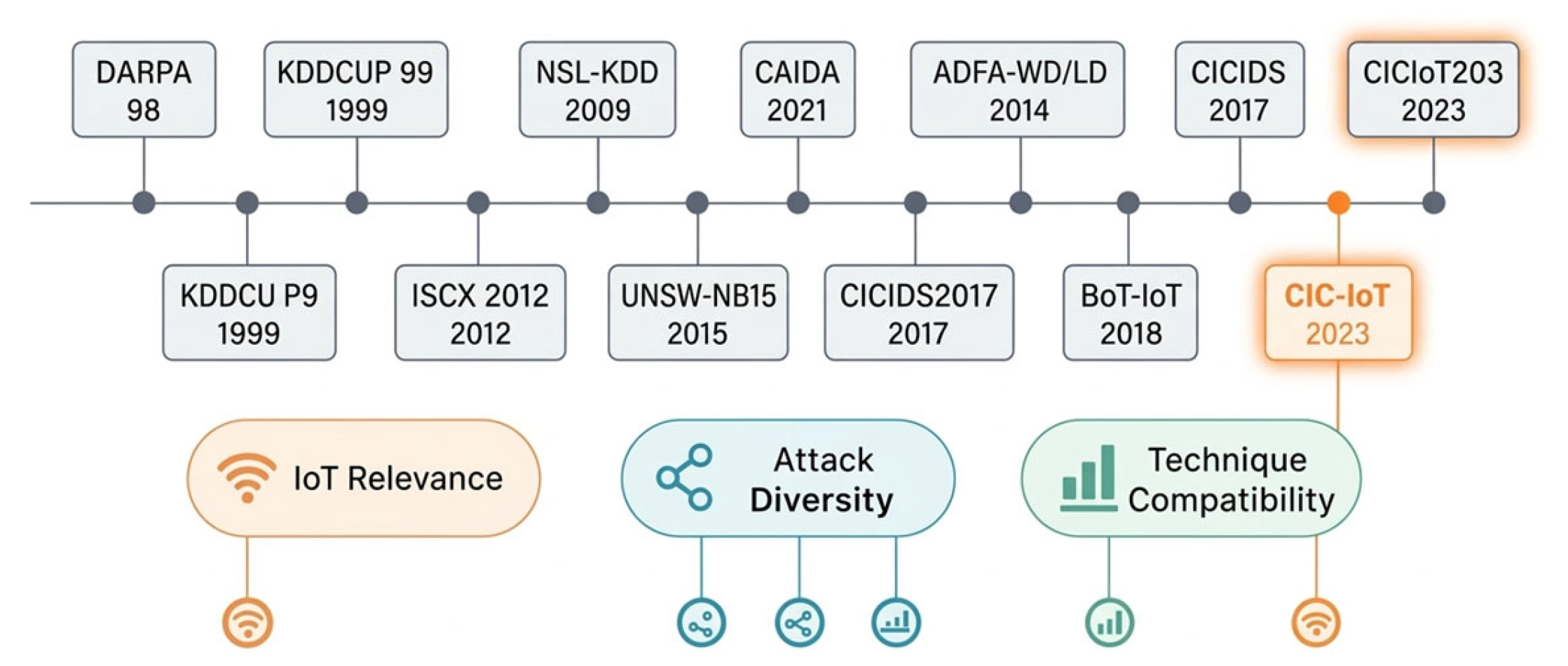
6.1. The Change in Datasets: From Old to IoT-Centric
6.1.1. Legacy Datasets: The Foundation
6.1.2. Modern IoT-Specific Datasets
- BoT-IoT: This dataset focuses specifically on smart home environments and includes common attacks like DDoS, reconnaissance, and data theft. It is widely used for testing lightweight IDS models but is characterized by severe class imbalance, which can pose a challenge during training [159].
- TON-IoT: Offering a more diverse simulation, TON-IoT covers industrial, home, and office settings. Its key strength is its multi-modal nature, combining network traffic with device telemetry and system logs. This makes it ideal for advanced research in federated and transfer learning, though it requires significant preprocessing [160,161]
6.2. Limitations and Gaps in Existing Datasets
6.3. Dataset Realism and Generalization Risk
6.4. Evaluation Metrics and Validation Protocols
6.4.1. Key Evaluation Metrics
- Precision:
- Recall (Sensitivity):
- F1-Score:
- False Positive Rate (FPR):
- Confusion Matrix: In highly imbalanced IoT datasets, reviewing the confusion matrix is critical. Instead of relying on a single accuracy score, it visually breaks down the exact distribution of True Positives, True Negatives, False Positives, and False Negatives, providing essential transparency into an IDS model’s real-world reliability.
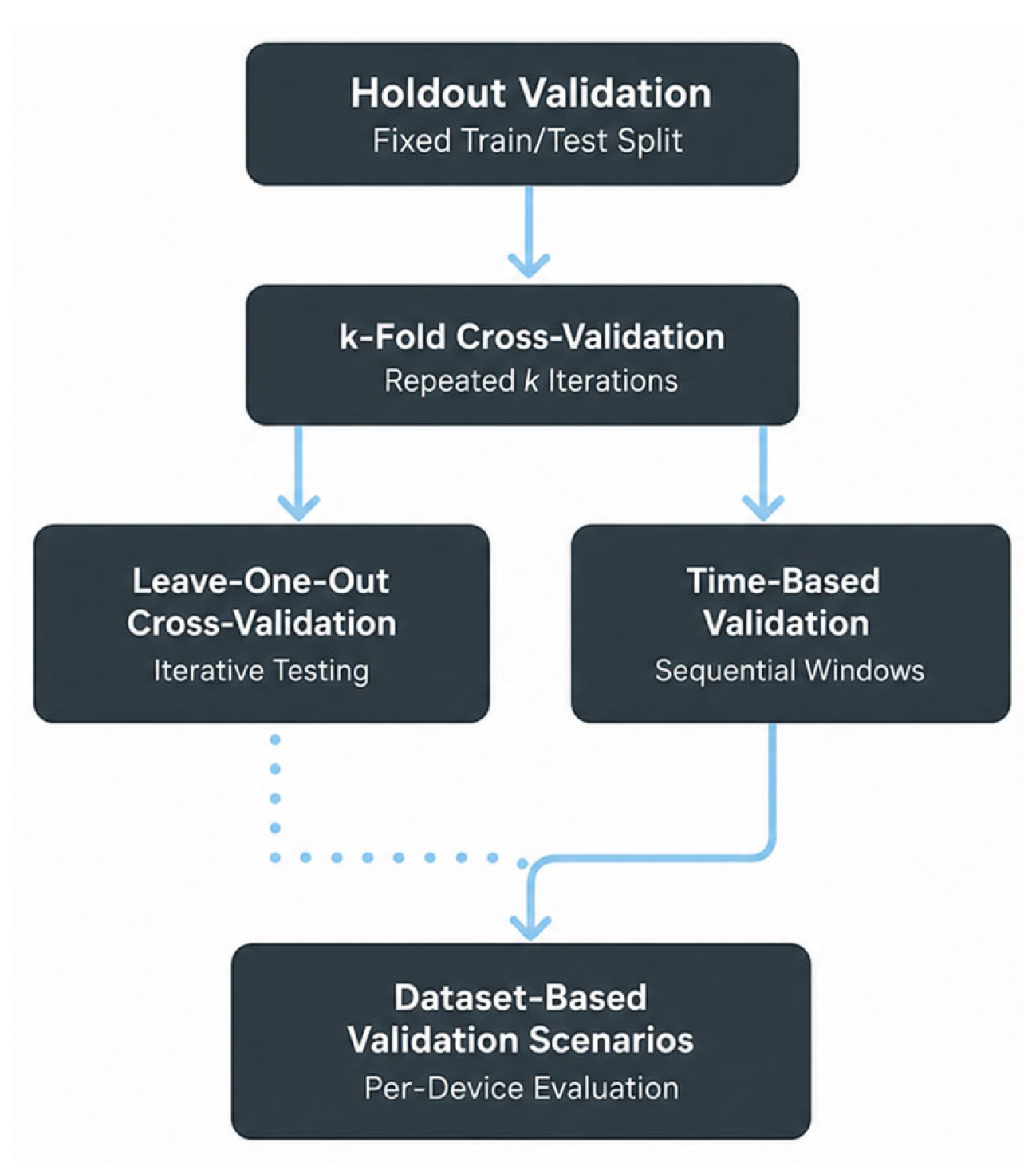
6.4.2. Validation Protocols
- Holdout Validation: Splits the dataset into a training and testing set (e.g., 80:20). It is computationally efficient but can be sensitive to the specific data split.
- Partitions the dataset into k subsets, training on folds and testing on the remaining one, which reduces variance and provides a more robust estimate of performance [167]. The average accuracy across folds is a key indicator:
- Leave-One-Out Cross-Validation (LOOCV): Each instance is used once for testing. It is exhaustive but computationally impractical for large IoT datasets [130].
- Time-Based Validation: A protocol essential for sequential IoT traffic, where the model is trained on past data and tested on future data. Combining these protocols with context-aware metrics is essential for validation and crucial for federated settings, as it evaluates a model’s ability to generalize to new, unseen devices.
6.4.3. Recommended Validation Protocols for Reliable IoT IDS Evaluation
6.5. Recommendations for Next Generation Dataset and Testbed Design
7. Robustness and Generalization of IoT Intrusion Detection Systems
7.1. Cross-Dataset Evaluation and Generalization
7.2. Adversarial Robustness and Evasion Defense
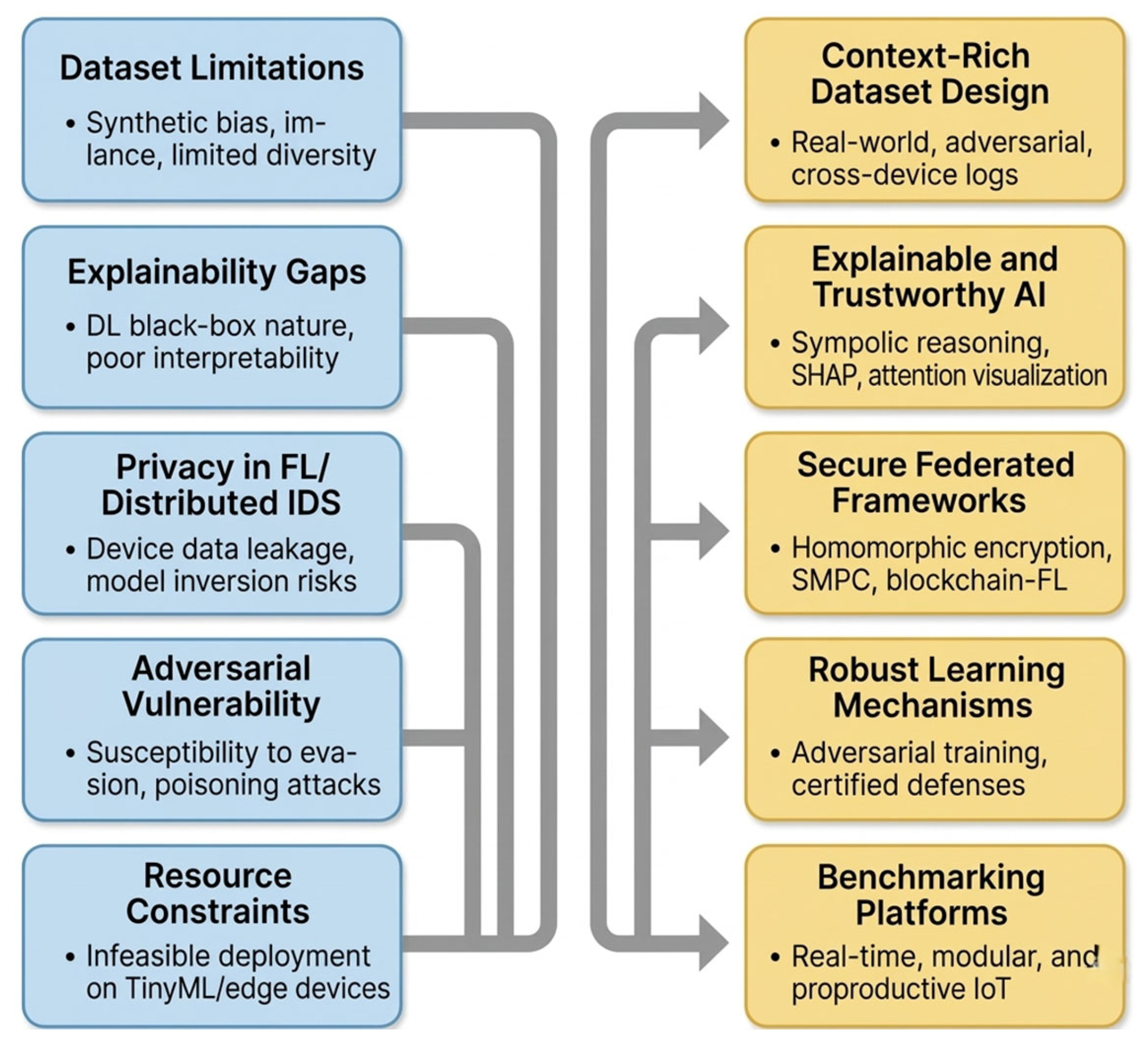
8. Open Challenges and Future Directions
8.1. The Accuracy-Interpretability Trade-Off
8.2. Practical Constraints: Resource, Realism, and Generalization
8.3. Emerging Vulnerabilities and Ethical Governance
8.4. Toward Unified IDS Frameworks Across Domains
9. Conclusions
Author Contributions
Funding
Institutional Review Board Statement
Data Availability Statement
Acknowledgments
Conflicts of Interest
Abbreviation
| Acronym | Full Form |
| IDS | Intrusion Detection System |
| AIDS | Anomaly-based Intrusion Detection System |
| RNN | Recurrent Neural Network |
| CNN | Convolutional Neural Network |
| FL | Federated Learning |
| DFL | Distributed Federated Learning |
| DL | Deep Learning |
| DoS/DDoS | Denial of Service/Distributed Denial of Service |
| DT | Decision Tree |
| GAN | Generative Adversarial Network |
| HIDS | Host-based Intrusion Detection System |
| LLM | Large Language Model |
| IIoT | Industrial Internet of Things |
| IoT | Internet of Things |
| KNN | K-Nearest Neighbors |
| LSTM | Long Short-Term Memory |
| ML | Machine Learning |
| NIDS | Network-based Intrusion Detection System |
| RPL | Routing Protocol for Low-Power and Lossy Networks |
| SIDS | Signature-based Intrusion Detection System |
| SMPC | Secure Multi-Party Computation |
| SVM | Support Vector Machine |
| ICS | Industrial Control Systems |
| RL | Reinforcement Learning |
| GNN | Graph Neural Network |
| AUC | Area Under the Curve |
| FPR | False Positive Rate |
| QML | Quantum Machine Learning |
| PR-AUC | Precision–Recall Area Under the Curve |
| XAI | Explainable Artificial Intelligence |
| TinyML | Tiny Machine Learning |
References
- Ahmad, Z.; Shahid Khan, A.; Shiang, C.; Ahmad, F. Network intrusion detection system: A systematic study of machine learning and deep learning approaches. Trans. Emerg. Telecommun. Technol. 2021, 32, e4150. [Google Scholar] [CrossRef]
- Alem, S.; Espes, D.; Nana, L.; Martin, E.; De Lamotte, F. A novel bi-anomaly-based intrusion detection system approach for industry 4.0. Future Gener. Comput. Syst. 2023, 145, 267–283. [Google Scholar] [CrossRef]
- Aydin, B.; Aydin, H.; Gormus, S. Intrusion detection systems in IoT: A detailed review of threat categories, detection strategies, and future technologies. J. Inf. Secur. Appl. 2025, 95, 104291. [Google Scholar] [CrossRef]
- Benameur, R.; Dahane, A.; Souihi, S.; Mellouk, A. A Novel Federated Learning Based Intrusion Detection System for IoT Networks. In Proceedings of the ICC 2024—IEEE International Conference on Communications, Denver, CO, USA, 9–13 June 2024; pp. 2402–2407. [Google Scholar]
- Berhili, M.; Chaieb, O.; Benabdellah, M. Intrusion Detection Systems in IoT Based on Machine Learning: A state of the art. Procedia Comput. Sci. 2024, 251, 99–107. [Google Scholar] [CrossRef]
- Bout, E.; Loscri, V.; Gallais, A. How Machine Learning Changes the Nature of Cyberattacks on IoT Networks: A Survey. IEEE Commun. Surv. Tutor. 2022, 24, 248–279. [Google Scholar] [CrossRef]
- Elrawy, M.F.; Awad, A.I.; Hamed, H.F.A. Intrusion detection systems for IoT-based smart environments: A survey. J. Cloud Comput. 2018, 7, 21. [Google Scholar] [CrossRef]
- Ferrag, M.A.; Shu, L.; Friha, O.; Yang, X. Cyber Security Intrusion Detection for Agriculture 4.0: Machine Learning-Based Solutions, Datasets, and Future Directions. IEEE/CAA J. Autom. Sin. 2022, 9, 407–436. [Google Scholar] [CrossRef]
- Ferrag, M.A.; Maglaras, L.; Moschoyiannis, S.; Janicke, H. Deep learning for cyber security intrusion detection: Approaches, datasets, and comparative study. J. Inf. Secur. Appl. 2020, 50, 102419. [Google Scholar] [CrossRef]
- Guo, Y. A review of Machine Learning-based zero-day attack detection: Challenges and future directions. Comput. Commun. 2023, 198, 175–185. [Google Scholar] [CrossRef] [PubMed]
- Gyamfi, E.; Jurcut, A. Intrusion Detection in Internet of Things Systems: A Review on Design Approaches Leveraging Multi-Access Edge Computing, Machine Learning, and Datasets. Sensors 2022, 22, 3744. [Google Scholar] [CrossRef]
- Dunmore, A.; Jang-Jaccard, J.; Sabrina, F.; Kwak, J. A Comprehensive Survey of Generative Adversarial Networks (GANs) in Cybersecurity Intrusion Detection. IEEE Access 2023, 11, 76071–76094. [Google Scholar] [CrossRef]
- Alauthman, M.; Aslam, N.; Al-Qerem, A.; Aldweesh, A.; Sureephong, P. Generative Adversarial Networks for Intrusion Detection Systems: A Comprehensive Survey of Applications, Challenges, and Research Directions. Arab. J. Sci. Eng. 2026, 51, 179–203. [Google Scholar] [CrossRef]
- Amuthadevi, C.; Venkatesan, R.; Mythily, M.; Canessane, R.A. TinyML-based intrusion detection systems for sustainable and energy-constrained IoT devices. Results Eng. 2025, 28, 108013. [Google Scholar]
- Alwaisi, Z.; Kumar, T.; Harjula, E.; Soderi, S. Securing constrained IoT systems: A lightweight machine learning approach for anomaly detection and prevention. Internet Things 2024, 28, 101398. [Google Scholar] [CrossRef]
- Neupane, S.; Ables, J.; Anderson, W.; Mittal, S.; Rahimi, S.; Banicescu, I. Explainable Intrusion Detection Systems (X-IDS): A Survey of Current Methods, Challenges, and Opportunities. IEEE Access 2022, 10, 112392–112415. [Google Scholar] [CrossRef]
- Khan, N.; Ahmad, K.; Al Tamimi, A.; Alani, M.M.; Bermak, A.; Khalil, I. Explainable AI-Based Intrusion Detection Systems for Industry 5.0 and Adversarial XAI: A Systematic Review. Information 2025, 16, 1036. [Google Scholar] [CrossRef]
- Chaturvedi, P.; Ahmad, S.; Mewada, A. A Comprehensive Survey on Fog Computing: Architectures, Techniques, Challenges, and Future Directions. Arch. Comput. Methods Eng. 2026. [Google Scholar] [CrossRef]
- Hozouri, A.; Mirzaei, A.; Effatparvar, M. A comprehensive survey on intrusion detection systems with advances in machine learning, deep learning and emerging cybersecurity challenges. Discov. Artif. Intell. 2025, 5, 314. [Google Scholar] [CrossRef]
- Jaffal, N.O.; Alkhanafseh, M.; Mohaisen, D. Large Language Models in Cybersecurity: A Survey of Applications, Vulnerabilities, and Defense Techniques. AI 2025, 6, 216. [Google Scholar] [CrossRef]
- Ogunseyi, T.B.; Thiyagarajan, G.; He, H.; Bist, V.; Du, Z. Performance Analysis of Explainable Deep Learning-Based Intrusion Detection Systems for IoT Networks: A Systematic Review. Sensors 2026, 26, 363. [Google Scholar] [CrossRef]
- Al-Haija, Q.A.; Droos, A. A comprehensive survey on deep learning-based intrusion detection systems in Internet of Things (IoT). Expert Syst. 2025, 42, e13726. [Google Scholar] [CrossRef]
- Mallidi, S.K.R.; Ramisetty, R.R. Advancements in training and deployment strategies for AI-based intrusion detection systems in IoT: A systematic literature review. Discov. Internet Things 2025, 5, 8. [Google Scholar] [CrossRef]
- Ahsan, M.S.; Islam, S.; Shatabda, S. A systematic review of metaheuristics-based and machine learning-driven intrusion detection systems in IoT. Swarm Evol. Comput. 2025, 96, 101984. [Google Scholar] [CrossRef]
- Walling, S.; Lodh, S. An Extensive Review of Machine Learning and Deep Learning techniques on network intrusion detection for IoT. Trans. Emerg. Telecommun. Technol. 2025, 36, e70064. [Google Scholar] [CrossRef]
- Suzan, S.; El Barachi, M.; Li, N. Intrusion Detection on the Internet of Things: A Comprehensive Review and Gap Analysis Toward Real-Time, Lightweight, Adaptive, and Autonomous Security. IoT 2026, 7, 16. [Google Scholar] [CrossRef]
- Chaudhary, D.; Rajasegarar, S.; Pokhrel, S.R. Towards Adapting Federated & Quantum Machine Learning for Network Intrusion Detection: A Survey. arXiv 2025, arXiv:2509.21389. [Google Scholar] [CrossRef]
- Diana, L.; Dini, P.; Paolini, D. Overview on Intrusion Detection Systems for Computers Networking Security. Computers 2025, 14, 87. [Google Scholar] [CrossRef]
- Díaz-Verdejo, J.; Muñoz-Calle, J.; Alonso, A.E.; Alonso, R.E.; Madinabeitia, G. On the Detection Capabilities of Signature-Based Intrusion Detection Systems in the Context of Web Attacks. Appl. Sci. 2022, 12, 852. [Google Scholar] [CrossRef]
- Khraisat, A.; Gondal, I.; Vamplew, P.; Kamruzzaman, J. Survey of intrusion detection systems: Techniques, datasets and challenges. Cybersecurity 2019, 2, 20. [Google Scholar] [CrossRef]
- Khraisat, A.; Alazab, A. A critical review of intrusion detection systems in the internet of things: Techniques, deployment strategy, validation strategy, attacks, public datasets and challenges. Cybersecurity 2021, 4, 18. [Google Scholar] [CrossRef]
- Kumar, L.K.S.; Nethi, S.R.; Uyyala, R.; Vurubindi, P.; Narahari, S.C.; Das, A.K. Anomaly-based intrusion detection on benchmark datasets for network security: A comprehensive evaluation. Sci. Rep. 2026, 16, 8507. [Google Scholar] [CrossRef]
- Khacha, A.; Aliouat, Z.; Harbi, Y.; Gherbi, C.; Saadouni, R.; Harous, S. Landscape of learning techniques for intrusion detection system in IoT: A systematic literature review. Comput. Electr. Eng. 2024, 120, 109725. [Google Scholar] [CrossRef]
- Faruqui, N.; Yousuf, M.A.; Whaiduzzaman, M.; Azad, A.K.M.; Alyami, S.A.; Liò, P.; Kabir, M.A.; Moni, M.A. SafetyMed: A Novel IoMT Intrusion Detection System Using CNN-LSTM Hybridization. Electronics 2023, 12, 3541. [Google Scholar] [CrossRef]
- Hnamte, V.; Nhung-Nguyen, H.; Hussain, J.; Hwa-Kim, Y. A Novel Two-Stage Deep Learning Model for Network Intrusion Detection: LSTM-AE. IEEE Access 2023, 11, 37131–37148. [Google Scholar] [CrossRef]
- Afraji, D.M.A.A.; Lloret, J.; Peñalver, L. An Integrated Hybrid Deep Learning Framework for Intrusion Detection in IoT and IIoT Networks Using CNN-LSTM-GRU Architecture. Computers 2025, 13, 222. [Google Scholar] [CrossRef]
- Nguyen, T.; Janapa Reddi, V. Deep Reinforcement Learning for Cyber Security. IEEE Trans. Neural Netw. Learn. Syst. 2021, 34, 3779–3795. [Google Scholar] [CrossRef] [PubMed]
- Samita. A Review on Intrusion Detection System for IoT based Systems. SN Comput. Sci. 2024, 5, 380. [Google Scholar] [CrossRef]
- Sharma, B.; Sharma, L.; Lal, C.; Roy, S. Explainable artificial intelligence for intrusion detection in IoT networks: A deep learning based approach. Expert Syst. Appl. 2024, 238, 121751. [Google Scholar] [CrossRef]
- Ogunbadejo, M.; Alade, O. Machine Learning Methods for Intrusion Detection: A Comprehensive Survey. Int. J. Sci. Res. Manag. 2025, 13, 2446–2456. [Google Scholar] [CrossRef]
- Bertoli, G.C.; Junior, L.A.P.; Verri, F.A.N.; Santos, A.L.; Saotome, O. Bridging the gap to real-world for network intrusion detection systems with data-centric approach. arXiv 2021, arXiv:2110.13655. [Google Scholar]
- Babu, A.; Bagubali, A. Federated Learning With Sailfish-Optimized Ensemble Models for Anomaly Detection in IoT Edge Computing Environment. IEEE Access 2025, 13, 53171–53187. [Google Scholar] [CrossRef]
- Nguyen, T.D.; Alazab, A.; Khraisat, A.; Jan, T. Feature reduction in federated learning for intrusion detection in IoT networks. Cybersecurity 2026, 9, 102. [Google Scholar] [CrossRef]
- Rey, V.; Sánchez Sánchez, P.M.; Huertas Celdrán, A.; Bovet, G. Federated learning for malware detection in IoT devices. Comput. Netw. 2022, 204, 108693. [Google Scholar] [CrossRef]
- Neto, E.C.P.; Iqbal, S.; Buffett, S.; Sultana, M.; Taylor, A. Deep learning for intrusion detection in emerging technologies: A comprehensive survey and new perspectives. Artif. Intell. Rev. 2025, 58, 340. [Google Scholar] [CrossRef]
- Almuhanna, R.; Dardouri, S. A deep learning/machine learning approach for anomaly based network intrusion detection. Front. Artif. Intell. 2025, 8, 1625891. [Google Scholar] [CrossRef] [PubMed]
- Panneerselvam, N.; Krithiga, S. A novel security framework for densely populated Internet of Things users in pervasive service access. Comput. Commun. 2022, 184, 86–95. [Google Scholar] [CrossRef]
- Lee, J.; Park, K.-H. GAN-Based Imbalanced Data Intrusion Detection System. Pers. Ubiquitous Comput. 2019, 25, 121–128. [Google Scholar] [CrossRef]
- Almasabi, A.M.; Alkhodre, A.B.; Khemakhem, M.; Eassa, F.; Abi Sen, A.A.; Harbaoui, A. Internet of Things-Based Anomaly Detection Hybrid Framework Simulation Integration of Deep Learning and Blockchain. Information 2025, 16, 406. [Google Scholar] [CrossRef]
- Fouad, Y.; Abdelaziz, N.E.; Elshewey, A.M. IoT Traffic Parameter Classification based on Optimized BPSO for Enabling Green Wireless Networks. Eng. Technol. Appl. Sci. Res. 2024, 14, 18929–18934. [Google Scholar] [CrossRef]
- Alayash, W.; Rahrouh, M.; Ibrahim, A.A.; Mohamed, M.H.; Ahmed, S.T.; Albarri, M.H.; Ahmed, M.H. Assessing LSTM and GRU for Multi-Dataset Intrusion Detection in IoT Environments. Stat. Optim. Inf. Comput. 2026, 15, 3155–3173. [Google Scholar] [CrossRef]
- Sadhwani, S.; Khan, M.A.H.; Muthalagu, R.; Pawar, P.M.; Suresh, K. A hybrid BiLSTM-CNN approach for intrusion detection for IoT applications. Sci. Rep. 2025, 16, 155. [Google Scholar] [CrossRef]
- Siam, A.A.; Alazab, M.; Awajan, A.; Faruqui, N. A Comprehensive Review of AI’s Current Impact and Future Prospects in Cybersecurity. IEEE Access 2025, 13, 14029–14050. [Google Scholar] [CrossRef]
- Yao, W.; Hu, L.; Hou, Y.; Li, X. A Lightweight Intelligent Network Intrusion Detection System Using One-Class Autoencoder and Ensemble Learning for IoT. Sensors 2023, 23, 4141. [Google Scholar] [CrossRef]
- Vyas, A.; Lin, P.C.; Hwang, R.H.; Tripathi, M. Privacy-Preserving Federated Learning for Intrusion Detection in IoT Environments: A Survey. IEEE Access 2024, 12, 127018–127050. [Google Scholar] [CrossRef]
- Tseng, S.-M.; Wang, Y.-Q.; Wang, Y.-C. Multi-Class Intrusion Detection Based on Transformer for IoT Networks Using CIC-IoT-2023 Dataset. Future Internet 2024, 16, 284. [Google Scholar] [CrossRef]
- Kaur, I.; Sikka, R. Towards Responsible AI in Cybersecurity: Current Trends, Ethical Considerations, and Best Practices. Natl. Res. J. Inf. Technol. Inf. Sci. 2024, 11, 70–76. [Google Scholar]
- Alabbadi, A.; Bajaber, F. An Intrusion Detection System over the IoT Data Streams Using eXplainable Artificial Intelligence (XAI). Sensors 2025, 25, 847. [Google Scholar] [CrossRef]
- Rahman, M.A.; Asyhari, A.T.; Leong, L.S.; Satrya, G.B.; Tao, M.; Zolkipli, M.F. Scalable machine learning-based intrusion detection system for IoT-enabled smart cities. Sustain. Cities Soc. 2020, 61, 102324. [Google Scholar] [CrossRef]
- Isong, B.; Kgote, O.; Abu-Mahfouz, A. Insights into Modern Intrusion Detection Strategies for Internet of Things Ecosystems. Electronics 2024, 13, 2370. [Google Scholar] [CrossRef]
- Alotaibi, Y.; Ilyas, M. Ensemble-Learning Framework for Intrusion Detection to Enhance Internet of Things’ Devices Security. Sensors 2023, 23, 5568. [Google Scholar] [CrossRef]
- Ali Khan, M.; Rais, R.N.B.; Khalid, O.; Deriche, M. Comparative Analysis of Centralized and Federated Intrusion Detection in IoT-Enabled Cyber-Physical Systems Under Data and Label-Skew. IEEE Access 2025, 13, 160767–160785. [Google Scholar] [CrossRef]
- Aldaej, A.; Ullah, I.; Ahanger, T.A.; Atiquzzaman, M. Ensemble technique of intrusion detection for IoT-edge platform. Sci. Rep. 2024, 14, 11703. [Google Scholar] [CrossRef]
- Qaddos, A.; Yaseen, M.U.; Al-Shamayleh, A.S.; Imran, M.; Akhunzada, A.; Alharthi, S.Z. A novel intrusion detection framework for optimizing IoT security. Sci. Rep. 2024, 14, 21789. [Google Scholar] [CrossRef]
- Ponniah, K.K.; Retnaswamy, B. A novel deep learning based intrusion detection system for the IoT-Cloud platform with blockchain and data encryption mechanisms. J. Intell. Fuzzy Syst. 2023, 45, 11707–11724. [Google Scholar] [CrossRef]
- Alsulami, A.A.; Abu Al-Haija, Q.; Tayeb, A.; Alqahtani, A. An Intrusion Detection and Classification System for IoT Traffic with Improved Data Engineering. Appl. Sci. 2022, 12, 12336. [Google Scholar] [CrossRef]
- Hizal, S.; Cavusoglu, U.; Akgun, D. A novel deep learning-based intrusion detection system for IoT DDoS security. Internet Things 2024, 28, 101336. [Google Scholar] [CrossRef]
- Panopio, A.J.N.; Abushahla, H.A.; Sajun, A.R.; Alawnah, S.; Aloul, F.; Zualkernan, I. From Sensor to Server: Deployable Lightweight ML for IoT Intrusion Detection Across Network Layers. IEEE Internet Things J. 2026, 13, 1. [Google Scholar] [CrossRef]
- N, S.S.; P, P.; Jain, K.; Krishnan, P. Edge AI Bridge: A Micro-Layer Intrusion Detection Architecture for Smart-City IoT Networks. IoT 2026, 7, 33. [Google Scholar] [CrossRef]
- Jangra, N.; Rana, R.P.S. Perception To Application Layer: A Critical Review On Vulnerability Assessment of Iot Device. In Proceedings of the 2024 15th International Conference on Computing Communication and Networking Technologies (ICCCNT), Kamand, India, 24–28 June 2024; pp. 1–11. [Google Scholar]
- Racherla, S.; Sripathi, P.; Faruqui, N.; Kabir, M.A.; Whaiduzzaman, M.; Shah, S.A. Deep-IDS: A Real-Time Intrusion Detector for IoT Nodes Using Deep Learning. IEEE Access 2024, 12, 63584–63597. [Google Scholar] [CrossRef]
- Munshar, H.H.A.; Jemili, F.; Korbaa, O.; Alauthmaan, M. Comprehensive analysis of intrusion detection systems for enhancing security in internet of things environments. Discov. Appl. Sci. 2026, 8, 4. [Google Scholar] [CrossRef]
- Bas, S.; Kaya, K.; Ak, E.; Oguducu, S.G. Adaptive Intrusion Detection for Evolving RPL IoT Attacks Using Incremental Learning. In Proceedings of the 2026 IEEE 23rd Consumer Communications & Networking Conference (CCNC), Las Vegas, NV, USA, 9–12 January 2026; pp. 1–6. [Google Scholar]
- Jader, U.H.; Kurda, R.; Muhamad, S.R. Navigating Cyber Threats: The Role of Machine Learning and Deep Learning in Fifth-Generation Internet of Things Security. ARO-Sci. J. KOYA Univ. 2026, 14, 58–74. [Google Scholar] [CrossRef]
- Rauf, M.H.; Usman, M. Comprehensive Review of Challenges and Solutions for Physical Layer Security in IoT Networks. ICTACT J. Commun. Technol. 2025, 16, 3241–3252. [Google Scholar] [CrossRef]
- Nasereddin, M.; Gelenbe, E. A Survey of the Security of IoT Network Layers. TechRxiv 2025. [Google Scholar] [CrossRef]
- Amamra, A.; Nguyen, V.; Cheung, A.; Acosta, S.; Pham, T.L. Wavelet-Based IoT Device Fingerprinting. Electronics 2026, 15, 786. [Google Scholar] [CrossRef]
- Feng, P.; Li, B.; Han, B.; Ma, Y.; Hu, Y.; Zhao, R. A Scalable Group Authentication Protocol for IoT Based on PUF-Derived Bases in Inner Product Spaces. Cybersecurity 2026, 9, 41. [Google Scholar] [CrossRef]
- Li, J.; Wang, Z. Sybil Attack Detection for Secure IoT-Based Smart Healthcare Environments. J. Inst. Eng. India Ser. B 2024, 105, 1557–1569. [Google Scholar] [CrossRef]
- Zhukabayeva, T.; Zholshiyeva, L.; Mardenov, Y.; Buja, A.; Khan, S.; Alnazzawi, N. Real-Time Detection and Response to Wormhole and Sinkhole Attacks in Wireless Sensor Networks. Technologies 2025, 13, 348. [Google Scholar] [CrossRef]
- Abuagoub, A. Security concerns with IoT routing: A review of attacks, countermeasures, and future prospects. Adv. Internet Things 2024, 14, 67–98. [Google Scholar] [CrossRef]
- Pham Le, P.-H.; Do, Q.N.; Dinh, T.Q.; Pham, H.-T.-N.; Nguyen, L.V. A comparative security analysis of MQTT brokers against DoS attacks. J. Inf. Secur. 2026, 2026, 5. [Google Scholar] [CrossRef]
- Das, R.; Deka, V.; Devi, R.; Dey, A.; Sharma, M.; Taye, G. Advancements in AI-Based Botnet Detection Techniques for IoT Networks: A Comprehensive Survey. In Proceedings of the NIELIT’s International Conference on Communication, Electronics and Digital Technologies; Springer: Singapore, 2026; Volume 1523, pp. 112–128. [Google Scholar]
- Khraisat, A.; Alazab, A.; Singh, S.; Jan, T.; Gomez, A.J. Survey on Federated Learning for Intrusion Detection System: Concept, Architectures, Aggregation Strategies, Challenges, and Future Directions. ACM Comput. Surv. 2024, 57, 7. [Google Scholar] [CrossRef]
- Bilot, T.; Madhoun, N.E.; Agha, K.A.; Zouaoui, A. Graph Neural Networks for Intrusion Detection: A Survey. IEEE Access 2023, 11, 49114–49139. [Google Scholar] [CrossRef]
- Singh, S.; Sharma, M.; Hossain, S.A. Navigating the Threat Landscape of IoT: An Analysis of Attacks. In Innovative Computing and Communication; Springer: Singapore, 2024; pp. 25–48. [Google Scholar]
- Rawat, M.; Singal, G. Surveying Technology Fusion in IoT Networks for IDS: Exploring Datasets, Tools, Challenges, and Research Prospects. ACM Trans. Intell. Syst. Technol. 2025, 16, 107. [Google Scholar] [CrossRef]
- Garg, H.; Dave, M. Securing IoT Devices and Securely Connecting the Dots Using REST API and Middleware. In Proceedings of the 2019 4th International Conference on Internet of Things: Smart Innovation and Usages (IoT-SIU), Ghaziabad, India, 18–19 April 2019; pp. 1–6. [Google Scholar]
- Al-Shurbaji, T.; Anbar, M.; Manickam, S.; Hasbullah, I.H.; Alfriehat, N.; Alabsi, B.A. Deep Learning-Based Intrusion Detection System for Detecting IoT Botnet Attacks: A Review. IEEE Access 2025, 13, 11792–11822. [Google Scholar] [CrossRef]
- Abbas, S.G.; Vaccari, I.; Hussain, F.; Zahid, S.; Fayyaz, U.U.; Shah, G.A. Identifying and Mitigating Phishing Attack Threats in IoT Use Cases Using a Threat Modelling Approach. Sensors 2021, 21, 4816. [Google Scholar] [CrossRef] [PubMed]
- Lightbody, D.; Ngo, D.-M.; Temko, A.; Murphy, C.C.; Popovici, E. Attacks on IoT: Side-Channel Power Acquisition Framework for Intrusion Detection. Future Internet 2023, 15, 187. [Google Scholar] [CrossRef]
- Abdulkareem, S.A.; Foh, C.H.; Shojafar, M.; Carrez, F.; Moessner, K. Network Intrusion Detection: An IoT and Non IoT-Related Survey. IEEE Access 2024, 12, 147167–147191. [Google Scholar] [CrossRef]
- Mohale, V.Z.; Obagbuwa, I.C. Evaluating machine learning-based intrusion detection systems with explainable AI: Enhancing transparency and interpretability. Front. Comput. Sci. 2025, 7, 1520741. [Google Scholar] [CrossRef]
- Hossain, M.J.; Alam, K.; Monir, M.F.; Hoque, M.M.; Ahmed, T. Explainable AI Meets Synthetic Data: A Deep Learning framework for Detecting Network Intrusion in NextG Network Infrastructure. IEEE Access 2025, 13, 114979–115001. [Google Scholar] [CrossRef]
- Al Rawajbeh, M.; Maria Soosai, A.J.; Ramasamy, L.K.; Khan, F. Trustworthy Adaptive AI for Real-Time Intrusion Detection in Industrial IoT Security. IoT 2025, 6, 53. [Google Scholar] [CrossRef]
- Velliyath, S.; Kalaivani, D. Adversarial Challenges in AI-based Intrusion Detection Systems for Cloud Environments: A Comprehensive Review. In Proceedings of the 2025 5th International Conference on Evolutionary Computing and Mobile Sustainable Networks (ICECMSN), Coimbatore, India, 24–26 November 2025; pp. 553–560. [Google Scholar]
- Verkerken, M.; D’hooge, L.; Sudyana, D.; Lin, Y.D.; Wauters, T.; Volckaert, B. A Novel Multi-Stage Approach for Hierarchical Intrusion Detection. IEEE Trans. Netw. Serv. Manag. 2023, 20, 3915–3929. [Google Scholar] [CrossRef]
- Sha, K.; Yang, T.A.; Wei, W.; Davari, S. A Survey of Edge Computing-Based Designs for IoT Security. Digit. Commun. Netw. 2020, 6, 195–202. [Google Scholar] [CrossRef]
- Karunamurthy, A.; Vijayan, K.; Kshirsagar, P.R.; Tan, K.T. An optimal federated learning-based intrusion detection for IoT environment. Sci. Rep. 2025, 15, 8696. [Google Scholar] [CrossRef] [PubMed]
- Khraisat, A.; Alazab, A.; Alazab, M.; Obeidat, A.; Singh, S.; Jan, T. Federated learning for intrusion detection in IoT environments: A privacy-preserving strategy. Discov. Internet Things 2025, 5, 72. [Google Scholar] [CrossRef]
- Albanbay, N.; Tursynbek, Y.; Graffi, K.; Uskenbayeva, R.; Kalpeyeva, Z.; Abilkaiyr, Z. Federated Learning-Based Intrusion Detection in IoT Networks: Performance Evaluation and Data Scaling Study. J. Sens. Actuator Netw. 2025, 14, 78. [Google Scholar] [CrossRef]
- Nguyen, V.T.; Beuran, R. FedMSE: Semi-supervised federated learning approach for IoT network intrusion detection. Comput. Secur. 2025, 151, 104337. [Google Scholar] [CrossRef]
- Abd Elaziz, M.; Fares, I.A.; Dahou, A.; Shrahili, M. Federated learning framework for IoT intrusion detection using tab transformer and nature-inspired hyperparameter optimization. Front. Big Data 2025, 8, 1526480. [Google Scholar] [CrossRef]
- Ali, A.; Husain, M.; Hans, P. Federated learning-enhanced blockchain framework for privacy-preserving intrusion detection in industrial iot. arXiv 2025, arXiv:2505.15376. [Google Scholar]
- Hossain, M.A.; Saif, S.; Islam, M.S. A novel federated learning approach for IoT botnet intrusion detection using SHAP-based knowledge distillation. Complex Intell. Syst. 2025, 11, 422. [Google Scholar] [CrossRef]
- Ndayipfukamiye, T.; Ding, J.; Sarwatt, D.S.; Philipo, A.G.; Ning, H. Adversarial Defense in Cybersecurity: A Systematic Review of GANs for Threat Detection and Mitigation. arXiv 2025, arXiv:2509.20411. [Google Scholar] [CrossRef]
- Diab, A.; Chehade, A.; Ragusa, E.; Gastaldo, P.; Zunino, R.; Baghdadi, A. Intrusion Detection on Resource-Constrained IoT Devices with Hardware-Aware ML and DL. In Proceedings of the 2025 IEEE International Conference on Emerging Trends in Engineering and Computing (ETECOM), Riffa, Bahrain, 29–30 October 2025; pp. 1–6. [Google Scholar]
- Lundqvist, J.; Kirkeluten, T.M.; Hadzic, A.; Pedersen, H.; Holth, J.; Johansson, M.H.; Halkjelsvik, M.P.N. Lightweight Machine Learning Models for Intrusion Detection on IoT Devices. Nor. IKT-Konf. Forsk. Utdanning 2025, 37, 1–21. [Google Scholar] [CrossRef]
- Zhou, Y.; Chen, Y.; Rao, X.; Zhou, Y.; Li, Y.; Hu, C. Leveraging Large Language Models and BERT for Log Parsing and Anomaly Detection. Mathematics 2024, 12, 2758. [Google Scholar] [CrossRef]
- Badhan, P.K. Neuro-symbolic machine learning for lightweight and interpretable IoT edge intrusion detection. Discov. Sens. 2026, 2, 15. [Google Scholar] [CrossRef]
- Almadhor, A.; Alsubai, S.; Hejaili, A.A.; Klai, Z.; Bouallegue, B.; Kovac, U. Designing a neuro-symbolic dual-model architecture for explainable and resilient intrusion detection in IoT networks. Sci. Rep. 2025, 15, 42786. [Google Scholar] [CrossRef] [PubMed]
- Moustafa, N.; Koroniotis, N.; Keshk, M.; Zomaya, A.Y.; Tari, Z. Explainable Intrusion Detection for Cyber Defences in the Internet of Things: Opportunities and Solutions. IEEE Commun. Surv. Tutor. 2023, 25, 1775–1807. [Google Scholar] [CrossRef]
- Alaskar, N.M.; Hussain, M.S.; Almheiri, S.J.; Khan, A.; Adnan, K.M. Big Data-Driven Federated Learning Model for Scalable and Privacy-Preserving Cyber Threat Detection in IoT-Enabled Healthcare Systems. Comput. Mater. Contin. 2026, 87, 1–25. [Google Scholar] [CrossRef]
- Soomro, I.A.; Khan, H.U.R.; Hussain, S.J.; Iqbal, A.; Khalid, W.; Yu, H. SecureDyn-FL: A Robust Privacy-Preserving Federated Learning Framework for Intrusion Detection in IoT Networks. IEEE Trans. Netw. Serv. Manag. 2026, 23, 1742–1765. [Google Scholar] [CrossRef]
- Soomro, I.A.; Rehman, H.; Hussain, S.J.; Latif, S.; Mujlid, H.; Mohsin, S.M. ROCHE: A Robust and End-to-End Privacy-Preserving Federated Learning Framework for Intrusion Detection in Industrial Internet of Things. IEEE Internet Things J. 2025, 12, 52357–52377. [Google Scholar] [CrossRef]
- Alqazzaz, A. SecuFL-IoT: An adaptive privacy-preserving federated learning framework for anomaly detection in smart industrial networks. Sci. Rep. 2026, 16, 4107. [Google Scholar] [CrossRef] [PubMed]
- Chen, C.; Liu, J.; Tan, H.; Li, X.; Wang, K.I.K.; Li, P. Trustworthy federated learning: Privacy, security, and beyond. Knowl. Inf. Syst. 2025, 67, 2321–2356. [Google Scholar] [CrossRef]
- Rani, J.V.; Ali, H.A.S.; Jakka, A. IoT Network Intrusion Detection: An Explainable AI Approach in Cybersecurity. In Proceedings of the 2023 4th International Conference on Communication, Computing and Industry 6.0 (C216), Bangalore, India, 15–16 December 2023; pp. 1–6. [Google Scholar]
- Mohale, V.Z.; Obagbuwa, I.C. A systematic review on the integration of explainable artificial intelligence in intrusion detection systems to enhancing transparency and interpretability in cybersecurity. Front. Artif. Intell. 2025, 8, 1526221. [Google Scholar] [CrossRef]
- Gaspar, D.; Silva, P.; Silva, C. Explainable AI for Intrusion Detection Systems: LIME and SHAP Applicability on Multi-Layer Perceptron. IEEE Access 2024, 12, 30164–30175. [Google Scholar] [CrossRef]
- Keshk, M.; Koroniotis, N.; Pham, N.; Moustafa, N.; Turnbull, B.; Zomaya, A.Y. An explainable deep learning-enabled intrusion detection framework in IoT networks. Inf. Sci. 2023, 639, 119000. [Google Scholar] [CrossRef]
- Sadhwani, S.; Navare, A.; Mohan, A.; Muthalagu, R.; Pawar, P.M. IoT-based intrusion detection system using explainable multi-class deep learning approaches. Comput. Electr. Eng. 2025, 123, 110256. [Google Scholar] [CrossRef]
- Nair, R. Unraveling the Decision-making Process Interpretable Deep Learning IDS for Transportation Network Security. J. Cybersecur. Inf. Manag. 2023, 12, 69–82. [Google Scholar] [CrossRef]
- Ahmad, J.; Latif, S.; Khan, I.U.; Alshehri, M.S.; Khan, M.S.; Alasbali, N. An interpretable deep learning framework for intrusion detection in industrial Internet of Things. Internet Things 2025, 33, 101681. [Google Scholar] [CrossRef]
- Ahakonye, L.A.C.; Nwakanma, C.I.; Lee, J.M.; Kim, D.S. Machine Learning Explainability for Intrusion Detection in the Industrial Internet of Things. IEEE Internet Things Mag. 2024, 7, 68–74. [Google Scholar] [CrossRef]
- Bizzarri, A.; Yu, C.-E.; Jalaian, B.; Riguzzi, F.; Bastian, N.D. Neurosymbolic AI for network intrusion detection systems: A survey. J. Inf. Secur. Appl. 2025, 94, 104205. [Google Scholar] [CrossRef]
- Sontan, A.D.; Samuel, S.V. The intersection of Artificial Intelligence and cybersecurity: Challenges and opportunities. World J. Adv. Res. Rev. 2024, 21, 1720–1736. [Google Scholar] [CrossRef]
- Vivo, S.D.; Obaidat, I.; Dai, D.; Liguori, P. DDoShield-IoT: A Testbed for Simulating and Lightweight Detection of IoT Botnet DDoS Attacks. In Proceedings of the 2024 54th Annual IEEE/IFIP International Conference on Dependable Systems and Networks Workshops (DSN-W), Brisbane, Australia, 24–27 June 2024; pp. 1–8. [Google Scholar]
- Kamal, H.; Mashaly, M. Robust Intrusion Detection System Using an Improved Hybrid Deep Learning Model for Binary and Multi-Class Classification in IoT Networks. Technologies 2025, 13, 102. [Google Scholar] [CrossRef]
- Talukder, M.A.; Islam, M.M.; Uddin, M.A.; Hasan, K.F.; Sharmin, S.; Alyami, S.A. Machine learning-based network intrusion detection for big and imbalanced data using oversampling, stacking feature embedding and feature extraction. J. Big Data 2024, 11, 33. [Google Scholar] [CrossRef]
- Musthafa, M.B.; Huda, S.; Kodera, Y.; Ali, M.A.; Araki, S.; Mwaura, J. Optimizing IoT Intrusion Detection Using Balanced Class Distribution, Feature Selection, and Ensemble Machine Learning Techniques. Sensors 2024, 24, 4293. [Google Scholar] [CrossRef]
- Misrak, S.F.; Melaku, H.M. Lightweight intrusion detection system for IoT with improved feature engineering and advanced dynamic quantization. Discov. Internet Things 2025, 5, 97. [Google Scholar] [CrossRef]
- Heydari, S.; Mahmoud, Q.H. Tiny Machine Learning and On-Device Inference: A Survey of Applications, Challenges, and Future Directions. Sensors 2025, 25, 3191. [Google Scholar] [CrossRef]
- Patil, R.Y.; Bhamare, M.; Patil, Y.H.; Bannore, A. Chapter 13—Securing TinyML in a connected world. In TinyML for Edge Intelligence in IoT and LPWAN Networks; Chaudhari, B.S., Ghorpade, S.N., Zennaro, M., Paškauskas, R., Eds.; Academic Press: Cambridge, MA, USA, 2024; pp. 311–330. [Google Scholar]
- Huckelberry, J.; Zhang, Y.; Sansone, A.; Mickens, J.; Beerel, P.A.; Reddi, V.J. Tinyml security: Exploring vulnerabilities in resource-constrained machine learning systems. arXiv 2024, arXiv:2411.07114. [Google Scholar]
- Li, M.; Laiu, P.; Nichols, J.A.; Huettel, M.; Sikkema, I.; Mathur, M. Cognitive IoT and Edge Computing for Intrusion Detection with Federated TinyML. In Proceedings of the 2025 IEEE World AI IoT Congress (AIIoT), Seattle, WA, USA, 28–30 May 2025; pp. 677–684. [Google Scholar]
- Kantharaju, V.; Suresh, H.; Niranjanamurthy, M.; Ansarullah, S.I.; Amin, F.; Alabrah, A. Machine learning based intrusion detection framework for detecting security attacks in internet of things. Sci. Rep. 2024, 14, 30275. [Google Scholar] [CrossRef]
- Al-Ajlan, M.; Ykhlef, M. A Review of Generative Adversarial Networks for Intrusion Detection Systems: Advances, Challenges, and Future Directions. Comput. Mater. Contin. 2024, 81, 2053–2076. [Google Scholar] [CrossRef]
- Hamouda, D.; Ferrag, M.A.; Benhamida, N.; Seridi, H.; Ghanem, M.C. Revolutionizing intrusion detection in industrial IoT with distributed learning and deep generative techniques. Internet Things 2024, 26, 101149. [Google Scholar] [CrossRef]
- Qu, A.; Shen, Q.; Ahmadi, G. Towards intrusion detection in fog environments using generative adversarial network and long short-term memory network. Comput. Secur. 2024, 145, 104004. [Google Scholar] [CrossRef]
- Gul, S.; Arshad, S.; Saeed, S.M.U.; Akram, A.; Azam, M.A. WGAN-DL-IDS: An Efficient Framework for Intrusion Detection System Using WGAN, Random Forest, and Deep Learning Approaches. Computers 2025, 14, 4. [Google Scholar] [CrossRef]
- Alshehri, M.S.; Saidani, O.; Malwi, W.A.; Asiri, F.; Latif, S.; Khattak, A.A. A Hybrid Wasserstein GAN and Autoencoder Model for Robust Intrusion Detection in IoT. Comput. Model. Eng. Sci. 2025, 143, 3899–3920. [Google Scholar] [CrossRef]
- Zhang, C.; Li, J.; Wang, N.; Zhang, D. Research on Intrusion Detection Method Based on Transformer and CNN-BiLSTM in Internet of Things. Sensors 2025, 25, 2725. [Google Scholar] [CrossRef]
- Yang, Y.; Peng, X. BERT-based network for intrusion detection system. EURASIP J. Inf. Secur. 2025, 2025, 11. [Google Scholar] [CrossRef]
- Wang, Z.; Li, J.; Yang, S.; Luo, X.; Li, D.; Mahmoodi, S. A lightweight IoT intrusion detection model based on improved BERT-of-Theseus. Expert Syst. Appl. 2024, 238, 122045. [Google Scholar] [CrossRef]
- Almadhor, A.; Alsubai, S.; Kryvinska, N.; Hejaili, A.A.; Ayari, M.; Bouallegue, B. Evaluating large transformer models for anomaly detection of resource-constrained IoT devices for intrusion detection system. Sci. Rep. 2025, 15, 37972. [Google Scholar] [CrossRef]
- Yin, Z.; Chen, H.; Ma, H.; Hu, T.; Bai, L. CAEAID: An incremental contrast learning-based intrusion detection framework for IoT networks. Comput. Netw. 2025, 262, 111161. [Google Scholar] [CrossRef]
- Rehman, M.U.; Bahs, H.; Kalakoti, R. Incremental Federated Learning for Intrusion Detection in IoT Networks under Evolving Threat Landscape. arXiv 2026, arXiv:2603.10776. [Google Scholar] [CrossRef]
- Mahdi, Z.S.; Zaki, R.M.; Alzubaidi, L. A Secure and Adaptive Framework for Enhancing Intrusion Detection in IoT Networks Using Incremental Learning and Blockchain. Secur. Priv. 2025, 8, e70071. [Google Scholar] [CrossRef]
- Kumar, R.; Swarnkar, M. QuIDS: A Quantum Support Vector machine-based Intrusion Detection System for IoT networks. J. Netw. Comput. Appl. 2025, 234, 104072. [Google Scholar] [CrossRef]
- Kukliansky, A.; Orescanin, M.; Bollmann, C.; Huffmire, T. Network Anomaly Detection Using Quantum Neural Networks on Noisy Quantum Computers. IEEE Trans. Quantum Eng. 2024, 5, 3100611. [Google Scholar] [CrossRef]
- Aldhaheri, A.; Alwahedi, F.; Ferrag, M.A.; Battah, A. Deep learning for cyber threat detection in IoT networks: A review. Internet Things Cyber-Phys. Syst. 2024, 4, 110–128. [Google Scholar] [CrossRef]
- Ngueajio, M.K.; Washington, G.; Rawat, D.B.; Ngueabou, Y. Intrusion Detection Systems Using Support Vector Machines on the KDDCUP’99 and NSL-KDD Datasets: A Comprehensive Survey. In Intelligent Systems and Applications; Springer: Cham, Switzerland, 2023; pp. 115–132. [Google Scholar]
- Al-Hadhrami, Y.; Hussain, F.K. Real time dataset generation framework for intrusion detection systems in IoT. Future Gener. Comput. Syst. 2020, 108, 414–423. [Google Scholar] [CrossRef]
- Bala, R.; Nagpal, R. A Review on KDD CUP99 and NSL-KDD Dataset. Int. J. Adv. Res. Comput. Sci. 2019, 10, 64–67. [Google Scholar] [CrossRef]
- Divekar, A.; Parekh, M.; Savla, V.; Mishra, R.; Shirole, M. Benchmarking datasets for Anomaly-based Network Intrusion Detection: KDD CUP 99 alternatives. In Proceedings of the 2018 IEEE 3rd International Conference on Computing, Communication and Security (ICCCS), Kathmandu, Nepal, 25–27 October 2018; pp. 1–8. [Google Scholar]
- Ashraf, W.; Masoodi, F.S.; Khanam, A. Dataset for Evaluating Deep Learning-Based Intrusion Detection. In Deep Learning for Intrusion Detection; CRC Press: Boca Raton, FL, USA, 2026; pp. 125–145. [Google Scholar]
- Dickson, A.; Thomas, C. Analysis of UNSW-NB15 Dataset Using Machine Learning Classifiers. In Machine Learning and Metaheuristics Algorithms, and Applications; Springer: Singapore, 2021; pp. 45–62. [Google Scholar]
- Luqman, M.; Zeeshan, M.; Riaz, Q.; Hussain, M.; Tahir, H.; Mazhar, N. Intelligent parameter-based in-network IDS for IoT using UNSW-NB15 and BoT-IoT datasets. J. Frankl. Inst. 2025, 362, 107440. [Google Scholar] [CrossRef]
- Alsaedi, A.; Moustafa, N.; Tari, Z.; Mahmood, A.; Anwar, A. TON_IoT Telemetry Dataset: A New Generation Dataset of IoT and IIoT for Data-Driven Intrusion Detection Systems. IEEE Access 2020, 8, 165130–165150. [Google Scholar] [CrossRef]
- Ismail, S.; Dandan, S.; Qushou, A. Intrusion Detection in IoT and IIoT: Comparing Lightweight Machine Learning Techniques Using TON_IoT, WUSTL-IIOT-2021, and EdgeIIoTset Datasets. IEEE Access 2025, 13, 73468–73485. [Google Scholar] [CrossRef]
- Hajjouz, A.; Avksentieva, E. Optimizing Intrusion Detection for DoS, DDoS, and Mirai Attacks Subtypes Using Hierarchical Feature Selection and CatBoost on the CICIoT2023 Dataset. Data Metadata 2024, 3, 577. [Google Scholar] [CrossRef]
- Meena, G.; Indian, A. IDS-IoT: Intrusion Detection System for the Internet of Things Using Enhanced Long-Short Term Memory. Artif. Intell. Appl. 2025, 3, 1–19. [Google Scholar] [CrossRef]
- Thereza, N.; Ramli, K. Development of Intrusion Detection Models for IoT Networks Utilizing CICIoT2023 Dataset. In Proceedings of the 2023 3rd International Conference on Smart Cities, Automation & Intelligent Computing Systems (ICON-SONICS), Bali, Indonesia, 6–8 December 2023; pp. 66–72. [Google Scholar]
- Alosaimi, S.; Almutairi, S.M. An Intrusion Detection System Using BoT-IoT. Appl. Sci. 2023, 13, 5427. [Google Scholar] [CrossRef]
- Chua, T.-H.; Salam, I. Evaluation of Machine Learning Algorithms in Network-Based Intrusion Detection Using Progressive Dataset. Symmetry 2023, 15, 1251. [Google Scholar] [CrossRef]
- Hossain, M.D.; Mahin, M.J.H.; Khan, M.R.; Akther, M.; Habib, M.A. Hybrid Deep Learning and Ensemble Methods for Dependable IoT Intrusion Detection. In Proceedings of the IEEE 7th International Conference on Sustainable Technologies For Industry 5.0 (STI), Dhaka, Bangladesh, 11–12 December 2025; pp. 1–6. [Google Scholar]
- Schmidt, H.; Sutterfield, G.; Farnell, C. Addressing Cybersecurity Data and Workforce Scarcity with TROY: Testbed for Resilient Operational sYstems. In Proceedings of the IEEE Design Methodologies Conference (DMC), Grenoble, France, 18–20 November 2024; pp. 1–8. [Google Scholar]
- Sharma, H.; Kumar, P.; Sharma, K. Intelligent Time Series Analysis for Intrusion Detection in the Internet of Things: A Generative-Adversarial-Network-Enhanced Convolutional-Neural-Network–Long-Short-Term-Memory Framework Using Signal Features. Intell. Comput. 2025, 4, 0127. [Google Scholar] [CrossRef]
- Putro, I.H.; Ahmad, T.; Ijtihadie, R.M. Enhancing MQTT Intrusion Detection in IoT Using Machine Learning and Feature Engineering. IEEE Open J. Commun. Soc. 2025, 6, 7855–7884. [Google Scholar] [CrossRef]
- Nair, A.R.; Praveen, I. A Stacking-Enhanced Voting Ensemble Model for Network Intrusion Detection and for Security of Internet of Things. In Data Science and Applications; Springer Nature: Cham, Switzerland, 2026; pp. 234–251. [Google Scholar]



| Ref. | Focus of Survey | AI Techniques | IDS Architectures | Deployment Strategies | Datasets & Validation | Emerging Techniques (XAI, FL, TinyML, LLMs) | Full-Scope Coverage |
|---|---|---|---|---|---|---|---|
| [8] | ML/DL in IoT security | ✓ | × | × | Limited | × | × |
| [6] | ML techniques for IoT Cyberattacks | ✓ (ML/DL) | × | × | × | × | × |
| [9,10] | DL for IoT Zero-Day Threat Detection | ✓ (DL) | × | × | Limited | × | × |
| [11] | Edge Computing and ML for IoT IDS | ✓ (ML) | × | ✓ (Edge-based) | ✓ | × | × |
| [12,13] | IDS Using GANs | ✓ (GAN) | × | × | ✓ | ✓ (GAN only) | × |
| [14,15] | Lightweight/TinyML IDS approaches | ✓ (TinyML, ML) | × | ✓ (TinyML focus) | × | ✓ (TinyML) | × |
| [16,17] | XAI in intrusion detection systems | ✓ (XAI, DL) | Partial | × | × | ✓ (XAI) | × |
| [18] | Edge/Fog-based IDS architectures | ✓ (DL/ML) | ✓ (Edge-only) | ✓ | Partial | ✓ (TinyML) | × |
| [19] | ML for IoT Security | ✓ | Partial | × | ✓ | × | × |
| [20] | LLM/Transformer | ✓ LLMs and Transformer-IDS | Partial | ✓ | Partial | ✓ (LLMs, Transformers) | × |
| [21] | Explainable DL IDS for IoT | ✓ (DL, XAI) | Partial | × | ✓ | ✓ (XAI only) | × |
| [22] | Comprehensive survey on DL-based IDS | ✓ (DL) | Partial | Limited | ✓ | × | × |
| [23] | AI IDS training and deployment strategies | ✓ (ML, DL, FL) | ✓ (Edge, Fog, Cloud) | ✓ (Edge, Cloud) | ✓ | (FL, Edge) | Partial |
| [24] | Metaheuristic and ML-driven IDS | ✓ (ML, Metaheuristics) | Partial | × | Partial | ✓ (Optimization) | × |
| [25] | ML/DL NIDS techniques for IoT | ✓ (ML, DL) | Partial | ✓ | ✓ | Limited | × |
| [26] | Adaptive and Lightweight IDS | ✓ (ML, DL) | Partial | ✓ (Edge) | Partial | ✓ (Incremental Learning, TinyML) | × |
| [27] | Quantum Machine Learning for IDS | ✓ (QML) | × | × | Partial | ✓ (QML Only) | × |
| This Review (Proposed) | End-to-End IDS in IoT | ✓ (DL, ML, Hybrid) | ✓ (All: Centralized, Edge, Fog, Hybrid) | ✓ (FL, Cloud, Edge TinyML) | ✓ (10+ datasets, metrics) | ✓ All Techniques including (XAI, FL, TinyML, GANs, LLMs, Transformer, LM, QML) |
| Architecture | Processing Location | Latency | Scalability | Privacy | Typical Techniques |
|---|---|---|---|---|---|
| Centralized | Cloud Server | High | Medium | Low | DL, LLMs, Ensembles |
| Distributed | Multiple Nodes | Medium | High | Medium | Federated Learning, DFL |
| Edge-Based | IoT Devices | Very Low | Medium | High | TinyML, Lightweight CNNs |
| Fog-Based | Fog Gateways | Low | High | Medium | XAI, Neurosymbolic Models |
| Hybrid | Edge + Fog + Cloud | Balanced | Very High | High | Multi-layer IDS, Split Learning |
| Model | Key Strengths | Limitations | IoT Use Cases | Ref |
|---|---|---|---|---|
| FCNN, | Simple, fast for static data | Prone to overfitting | Smart homes, static sensor anomaly | [49,50] |
| RNN (LSTM/GRU) | Temporal modeling, sequence awareness | High training time, vanishing gradients | Wearable health, smart grid logs | [51] |
| CNN | Spatial feature extraction | Needs structured inputs | Traffic flow analysis, ICS | [52] |
| GAN | Synthetic data generation | Training instability | Data augmentation in constrained IoT | [53] |
| Auto-encoder | Compression, anomaly reconstruction | Sensitive to noise and reconstruction tuning | Health IoT, unsupervised anomaly detection | [54] |
| Strategy | Strengths | Limitations | Best-Fit Techniques | Domain Examples |
|---|---|---|---|---|
| On-Device | Real-time detection, | Limited to very small | TinyML, rule-based | Smart home, wearables |
| strong privacy | models | models | ||
| Gateway | Supports mid-size | May become | Fuzzy logic, lightweight | Smart meters, HVAC |
| models, low latency | performance bottleneck | CNN | systems | |
| Fog/Edge | Local processing, reduces | Maintenance overhead, | Autoencoders, LSTM | Industrial IoT, smart |
| bandwidth | hardware costs | factories | ||
| Cloud | Scalable analytics, | Higher latency, privacy | GANs, LLMs | Smart city, intelligent |
| powerful storage | risks | transport | ||
| Federated | Preserves privacy, | Model sync issues, | Federated Learning, | Healthcare, distributed |
| decentralized data | poisoning risks | neuro-symbolic AI | sensors |
| IoT Layer | Example Attacks | IDS Design Implication | Reported Performance | References |
|---|---|---|---|---|
| Perception | Node tampering, fake node injection, replay, jamming | Lightweight on-device anomaly detection, RF fingerprinting, hardware authentication (PUFs) | ~90–94% accuracy on lightweight edge IDS; real-time anomaly detection | [71,77,78] |
| Network | Sinkhole, Sybil, forwarding, wormhole, RPL spoofing, DoS | Graph/topology-aware IDS, flow-based edge/fog detection, Federated edge learning | 95–97% F1-score on TON_IoT; protocol-resilient | [79,80,84,85] |
| Application | Malware, phishing, API abuse, code injection | Application-layer behavioral modeling, log analysis, XAI-based alert explanation | 97–99% accuracy in malware/phishing detection using DL models | [88,89,90,93] |
| Advanced Threats | Adversarial ML, insider, privacy leakage, multi-stage attacks | Adversarial training, temporal/Transformer-based sequence modeling, neuro-symbolic logic | 91–97% detection rate for adversarial and multi-stage attacks | [55,95,97] |
| Technique/Ref | Addressed Limitation | Key Contribution | Dataset & Validation Setting | Reported Performance & Resources |
|---|---|---|---|---|
| Federated Learning (FL) [98,99,100,101,102] | Centralized training risks, data imbalance, and non-IID data. | FedMSE and Chimp-optimized FL improve resilience, reduce data leakage, and minimize model divergence. | N-BaIoT, Smart environments (Holdout/Client-split) | 95.6% to 97.3% accuracy. Reduces bandwidth but faces synchronization lag. |
| FL + Transformers [103] | Long-range pattern detection, privacy. | Enables advanced contextual sequence modeling across distributed nodes. | N-BaIoT, UNSW-NB15, CICIoT2023 | 99%+ accuracy/F1/precision. High computational cost. |
| FL + Blockchain [104] | Trust and tampering in FL Aggregation. | Blockchain-secured FL aggregation ensures tamper resistance. | Distributed IoT IDS (Network split) | 97.3% accuracy; reduces communication cost by 41%. |
| FL + Explainable AI [105] | Black-box ML models, lack of interpretability. | Integrates SHAP with FL to provide transparent, interpretable alerts. | CICIoT2023 (Holdout) | ~88% accuracy. Explanations add computational overhead. |
| GANs for IDS [12,106] | Zero-day attacks, severe class imbalance. | GAN-LSTM generates synthetic minority attacks to train highly resilient models. | Malware/polymorphic setting (Benchmark split) | 98.2% accuracy. Significantly improves rare attack detection. |
| TinyML for Edge IDS [14,107,108] | Resource constraints, high latency, lack of local learning. | Hardware-aware TinyML enables direct local inference, reducing cloud dependency. | Edge IDS setting (Device-level testing) | 99.50% accuracy, 99.45% F1, 4.5 s computation time. Extremely low memory footprint. |
| Transformers/LLMs [56,109] | Weak natural language reasoning for logs, RNN limits. | IoT-BERT and LLMs improve semantic understanding of telemetry and log data. | Telemetry/Log data (Sequence-based evaluation) | Superior long-dependency anomaly detection and interpretable alerts. High compute requirement. |
| Neurosymbolic and Responsible AI [110,111,112] | Poor policy alignment, ethical bias, lack of explanations. | Combines neural and symbolic graphs (SymbolNet-ID) for fair, auditable governance. | IoT security policy-aware settings (Conceptual/Prototype) | Multi-layer explainability and policy compliance. Added reasoning overhead. |
| IDS Design Phase | Responsible/XAI Requirement | References |
|---|---|---|
| Dataset Collection and Preprocessing | Bias control, privacy preservation, class balancing, anonymization. | [9,130,131] |
| Model Training and Validation | Fairness checks, adversarial robustness, accuracy-explainability trade-offs. | [21,94,96] |
| Deployment and Alert Generation | SHAP/LIME integration, explanation latency, and resource constraints (TinyML). | [14,21,120,132] |
| Federated and Update Cycles | Secure aggregation, poisoned-update detection, and privacy-preservation. | [55,114,117] |
| Ref | GAN Variant | Target Threat/Use Case | Performance/Highlight |
|---|---|---|---|
| [139] | FederatedcGAN (WGAN-GP) | Detects zero-day and adversarial attacks in IIoT | Achieved ~10% higher accuracy than FedID |
| [137] | SAPGAN (Self-Attention Progressive GAN) | Detects IoT attacks (DDoS, RTSP brute force, camera flood) | improves accuracy by up to ~27% and reduces computation time |
| [142] | WGAN-AE (Hybrid Wasserstein GAN + Autoencoder) | Detects IoT attacks with high accuracy | accuracy (~97%), PR-AUC up to 99.8%, low memory (~60 kB) |
| Study/Model | Focus | Performance Outcome |
|---|---|---|
| [146]—LTM-based IDS (BERT, DistilBERT, RoBERTa) | IoT attack classification | achieves low loss and strong generalization, enabling real-time detection |
| [144]—BERT-GRU IDS | Network traffic as text for intrusion detection | improves accuracy and detection of complex attack patterns |
| [145]—BT-TPF (Distilled Transformer-ViT + Poolformer) | Lightweight IoT intrusion detection | achieves > 99% accuracy with ~90% parameter reduction |
| Model Type | Strengths | Limitations |
|---|---|---|
| Symbolic-only IDS | Time-series anomaly detection | Inflexible to novel attacks, hardcoded logic |
| Neural-only IDS | Good at detecting novel patterns, data-driven | Opaque decisions, needs large data, prone to bias |
| Neuro-symbolic IDS | Combines learning and logic, explainable alerts | Complex to build, needs both data + expert Knowledge |
| Principle | Implementation in IDS | Challenges |
|---|---|---|
| Fairness | Dataset balancing, demographic parity auditing | Dynamic IoT context, hidden bias |
| Explainability | SHAP, LIME, rule-based outputs, visual dashboards | Added compute load, limited edge interpretability |
| Accountability | Logging, traceability, human In the loop alerts | Policy enforcement, legal ambiguity |
| Privacy | Federated Learning, SMPC, local inference, differential privacy | Trade-offs with detection accuracy |
| Technique | Pros | Cons |
|---|---|---|
| Signature-Based IDS | Efficient at detecting known attacks, with low resource consumption | Cannot detect novel attacks, requires constant updates |
| Anomaly-Based IDS | Detects unknown threats, adaptable | Added compute load, limited edge interpretability |
| XAI | Improved interpretability, higher accountability | Additional computational overhead |
| Federated Learning | Privacy-preserving, scalable | Vulnerable to model poisoning, Communication overhead |
| TinyML | Low resource usage, real-time detection | Limited model complexity, deployment challenges |
| GANs | Enhanced training data, improved robustness | Training instability, computationally intensive |
| SMPC | Privacy-preserving enables collaboration | High computational cost, limited scalability |
| Adaptability Issue | Suitable Approach | Remaining Risk |
|---|---|---|
| Concept drift [147,148] | Drift-aware incremental learning. | False adaptation if drift is missed. |
| Zero-day attacks [10,73] | Continual learning with new data. | Label scarcity; delayed ground truth. |
| Non-IID traffic [62,116,148] | Incremental federated learning. | Client drift and synchronization lag. |
| Forgetting attacks [148] | Replay memory, knowledge Distillation. | High memory and computing overhead. |
| Poisoned updates [104,115] | Secure aggregation, blockchain Validation. | Added communication costs. |
| Dataset Category and Properties | Data Type/Size | Key Characteristics and Attack Types | Inherent Limitations and Validation Best Practices |
|---|---|---|---|
| Legacy Benchmarks DARPA 98, KDDCUP 99, NSL-KDD [153,154,155] | Type: Non-IoT/ Tabular and TCP Dump Size: Medium to Very Large | Attack Types: DoS, R2L, U2R, Basic/Derived attacks. Strengths: Structured benchmarks, widely cited, improved KDD versions. | Limitations: Synthetic data, completely Lacks IoT traffic, redundant, and outdated threats. Risk/Practice: Extreme risk. Models will fail in modern IoT. Discontinue for active evaluation; use as historical baselines. |
| General NIDS (Enterprise and Flow) ISCX 2012, ADFA, UNSW-NB15, CICIDS2017, CAIDA [41,156,158,168] | Type: Non-to-Partial IoT/PCAP, Flow, Syscalls Size: Moderate to Very Large | Attack Types: HTTP/SSH/FTP, Zero-day exploits, 9-classes, DDoS, Multi-class. Strengths: Detailed labeling, real traffic scale, DL/FL-compatible. | Limitations: Enterprise-focused, no device-specific labeling, not tailored for IoT, high resource demand. Risk/Practice: High risk for IoT constraints. Use only as supplementary data for general network anomaly detection. |
| First-Gen IoT BoT-IoT (2018) [159,165] | Type: IoT-Centric/PCAP + Flow Size: Very Large | Attack Types: 4+ attacks (Botnet DoS/DDoS, Reconnaissance, Data Exfiltration). Strengths: Specifically designed For early IoT threat detection. | Limitations: Relies on simulated traffic generation and suffers from severe class imbalance. Risk/Practice: High risk. Accuracy metrics are easily inflated. Enforce imbalance-aware metrics (macro-F1) and stratified cross-validation. |
| Multimodal IoT TON-IoT (2020) [160,161] | Type: IoT and IIoT/Telemetry + Logs Size: Very Large | Attack Types: 20+ attacks (Ransomware, MITM, Password Cracking, etc.). Strengths: Provides rich, Multi-modal IoT data sources. | Limitations: Requires heavy preprocessing to adequately fuse network flows, telemetry, and OS logs. Risk/Practice: Moderate risk. Preprocessing variability leads to inconsistent benchmarking. Ideal for evaluating cross-environment models. |
| Advanced IoT CICIoT2023 (2023) [162,163,164] | Type: Modern IoT PCAP + NetFlows Size: Large | Attack Types: Modern + adversarial (Mirai/BashLite, RPL/ARP Spoofing, Replay). Strengths: Offers the latest, highly realistic adversarial Representation for IoT. | Limitations: Memory-intensive with a massive memory footprint; computationally expensive to train for edge deployment. Risk/Practice: Low detection risk but high deployment risk. Mandate time-aware (temporal) and cross-device splits. |
| Validation Protocol | Purpose (Addressing Evaluation Flaws) | Recommended Action and Metrics |
|---|---|---|
| Cross-Dataset [41,154,163] | Tests generalization; prevents dataset-specific overfitting. | Train on one dataset, test on another (e.g., BoT-IoT → TON_IoT). |
| Time-Aware [23,147,148] | Evaluates robustness against concept drift and evolving attacks. | Use strict chronological train/test splits; avoid random holdout. |
| Device-Level [25,41] | Checks reliability across heterogeneous, unseen IoT nodes. | Apply leave-one-device-out testing. |
| Stratified/Macro-F1 [9,130,131] | Prevents misleading accuracy in highly imbalanced datasets. | Use stratified splits; strictly report Macro-F1 and per-class F1. |
| FPR and AUC-ROC [34,160] | High FPR renders an IDS unusable due to alert fatigue. | Always report FPR with Precision/Recall. Use PR-AUC for rare attacks. |
| Resource Metrics [68,69,132] | Ensures edge/TinyML deployment is practically feasible. | Report inference latency, memory footprint, and CPU/energy overhead. |
| Challenge | Description | Why It Matters | Opportunities/Solutions |
|---|---|---|---|
| Interpretability vs. Accuracy | High-performing models are often black-box [112,124,125] | Reduces trust, hinders compliance in critical domains | Use of XAI (e.g., SHAP, LIME); neuro-symbolic AI |
| Power and Memory Constraints | IoT nodes have limited computational and energy resources [14,107] | Limits the deployment of complex models | TinyML, model compression, edge fog hybrid strategies |
| Dataset Realism and Generalization | Existing datasets may be synthetic, outdated, or imbalanced | Models fail to generalize to real-world traffic [164] | GAN-generated datasets, data augmentation, federated learning [169] |
| Security of ML Models | Models are vulnerable to adversarial and poisoning attacks [96,106] | IDS itself becomes a security liability | Adversarial training, secure FL aggregation, model watermarking |
| Cross-Device Synchronization | Inconsistent clocks/formats across IoT nodes | Hinders distributed model performance | Robust FL protocols, scalable architectures, time-agnostic modeling |
| Regulatory and Ethical Concerns | Transparency and fairness are mandated by GDPR/AI laws [57] | Risk of legal non-compliance, bias | Responsible AI toolkits, auditable IDS, and explainable decision making |
| Fragmented Frameworks Across Domains | Domain-specific IDS hinders interoperability [102,161] | Increases cost and system complexity | Unified modular frameworks, domain adaptation, transfer learning |
Disclaimer/Publisher’s Note: The statements, opinions and data contained in all publications are solely those of the individual author(s) and contributor(s) and not of MDPI and/or the editor(s). MDPI and/or the editor(s) disclaim responsibility for any injury to people or property resulting from any ideas, methods, instructions or products referred to in the content. |
© 2026 by the authors. Licensee MDPI, Basel, Switzerland. This article is an open access article distributed under the terms and conditions of the Creative Commons Attribution (CC BY) license.
Share and Cite
Komal, A.; Li, S. Intrusion Detection in the Internet of Things: A Comprehensive Review of Techniques, Architectures, Datasets, and Emerging Trends. Sensors 2026, 26, 3405. https://doi.org/10.3390/s26113405
Komal A, Li S. Intrusion Detection in the Internet of Things: A Comprehensive Review of Techniques, Architectures, Datasets, and Emerging Trends. Sensors. 2026; 26(11):3405. https://doi.org/10.3390/s26113405
Chicago/Turabian StyleKomal, Asma, and Shuaiyong Li. 2026. "Intrusion Detection in the Internet of Things: A Comprehensive Review of Techniques, Architectures, Datasets, and Emerging Trends" Sensors 26, no. 11: 3405. https://doi.org/10.3390/s26113405
APA StyleKomal, A., & Li, S. (2026). Intrusion Detection in the Internet of Things: A Comprehensive Review of Techniques, Architectures, Datasets, and Emerging Trends. Sensors, 26(11), 3405. https://doi.org/10.3390/s26113405