Wireless Ultrasonic Sensing for Fatigue Crack Propagation and Life Prediction in Thin Plate Structures


Abstract
1. Introduction
2. Experimental Setups
2.1. Analysis of the Influence of Probe Placement on Test Results
2.2. Experimental Preparation and Scheme Design
3. Results and Discussion
3.1. Validation of Fatigue Test Data and Fracture Morphology Analysis
3.2. Fractographic Analysis
3.3. Crack Growth Rate Analysis
3.4. Discussion of the Ultrasonic Measurement Results
3.5. Determination of the Fatigue Crack Opening Force
3.6. Pattern of Amplitude Variation in Signals Collected Wirelessly
4. Model for Fatigue Loading Cycles and Envelope Amplitudes of the Ultrasonic Signals
4.1. Model for the Crack Length and Number of Fatigue Loading Cycles
4.2. Relationship Between the Crack Length and Transmission Coefficient
4.3. Model for the Envelope Amplitude and Fatigue Loading Cycles
5. Conclusions
- (1)
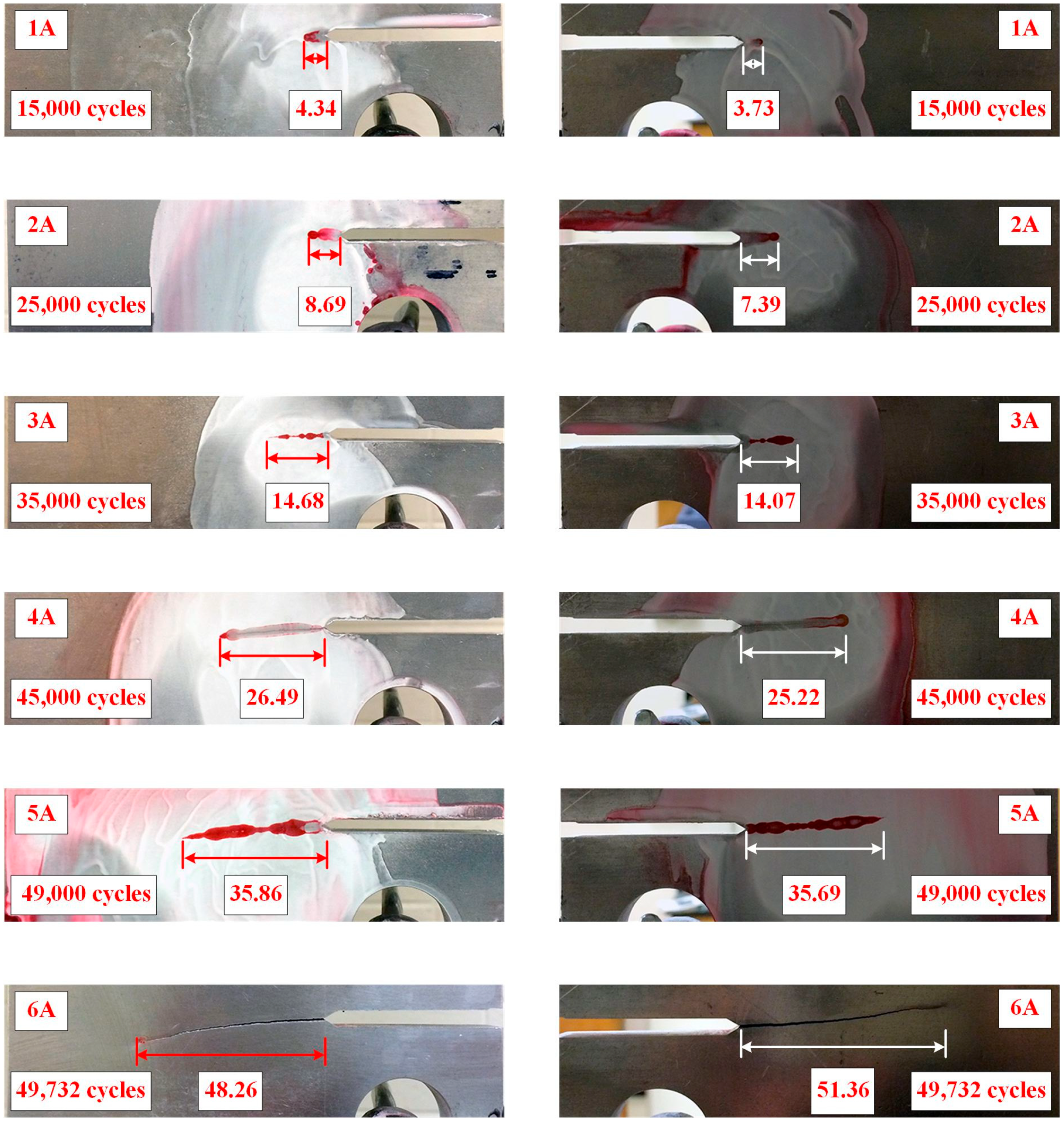
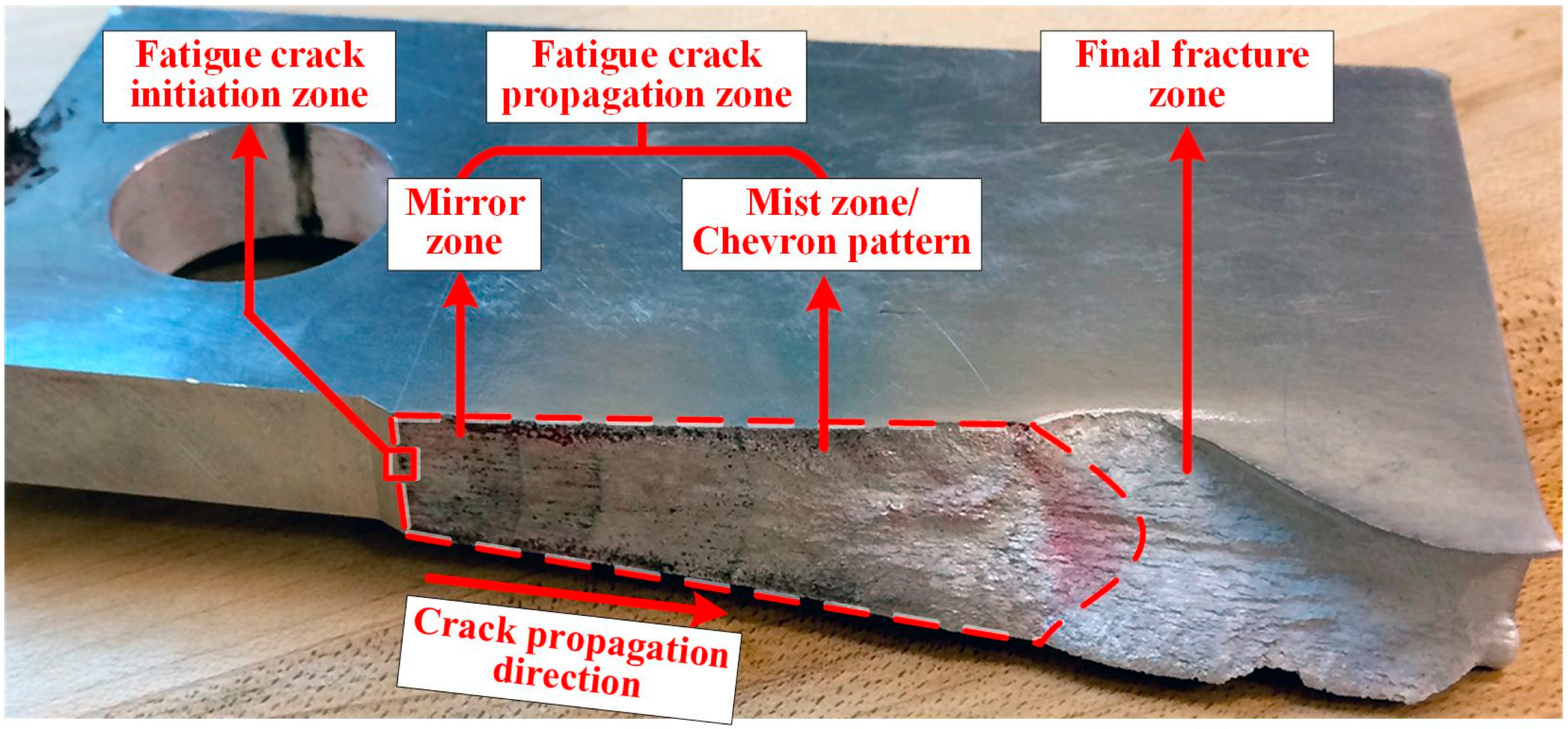
- The experimentally measured fatigue crack data were validated in accordance with the ASTM standard. Different stages in the fatigue crack propagation process were identified through morphological analysis, and the reasons for the significant characteristics observed in each stage were discussed.
- (2)
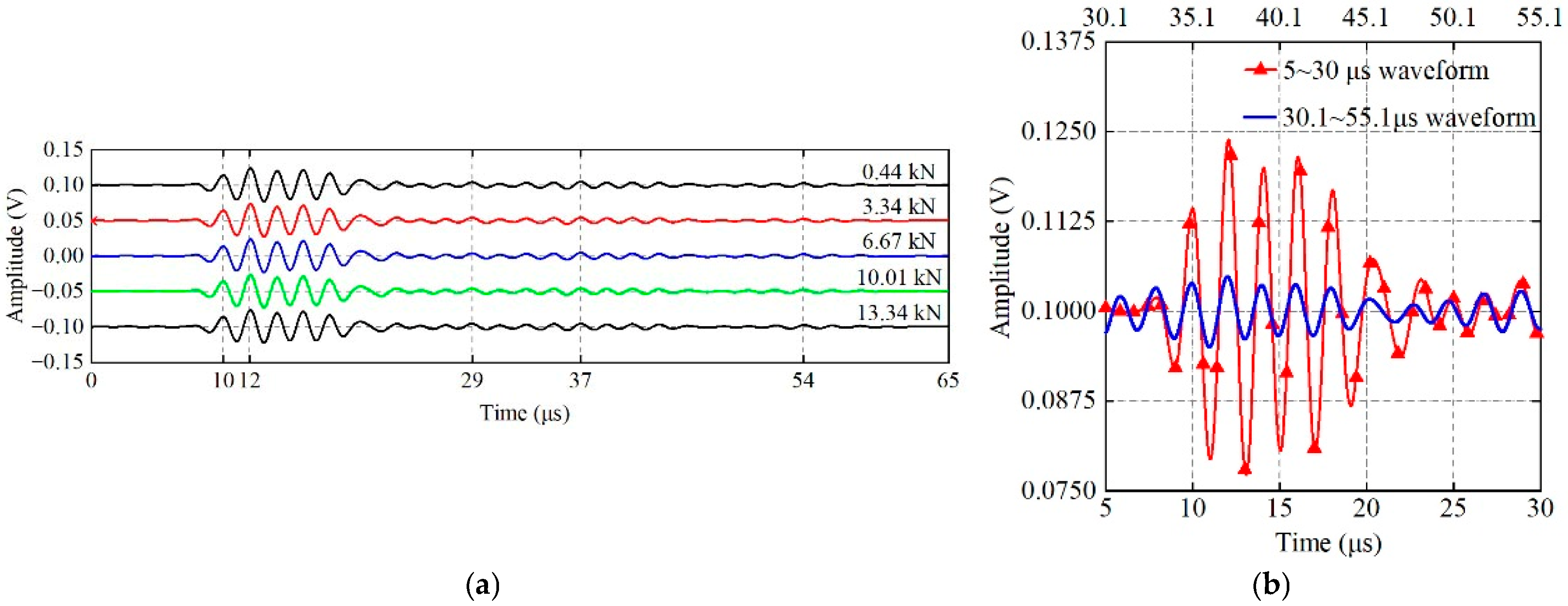
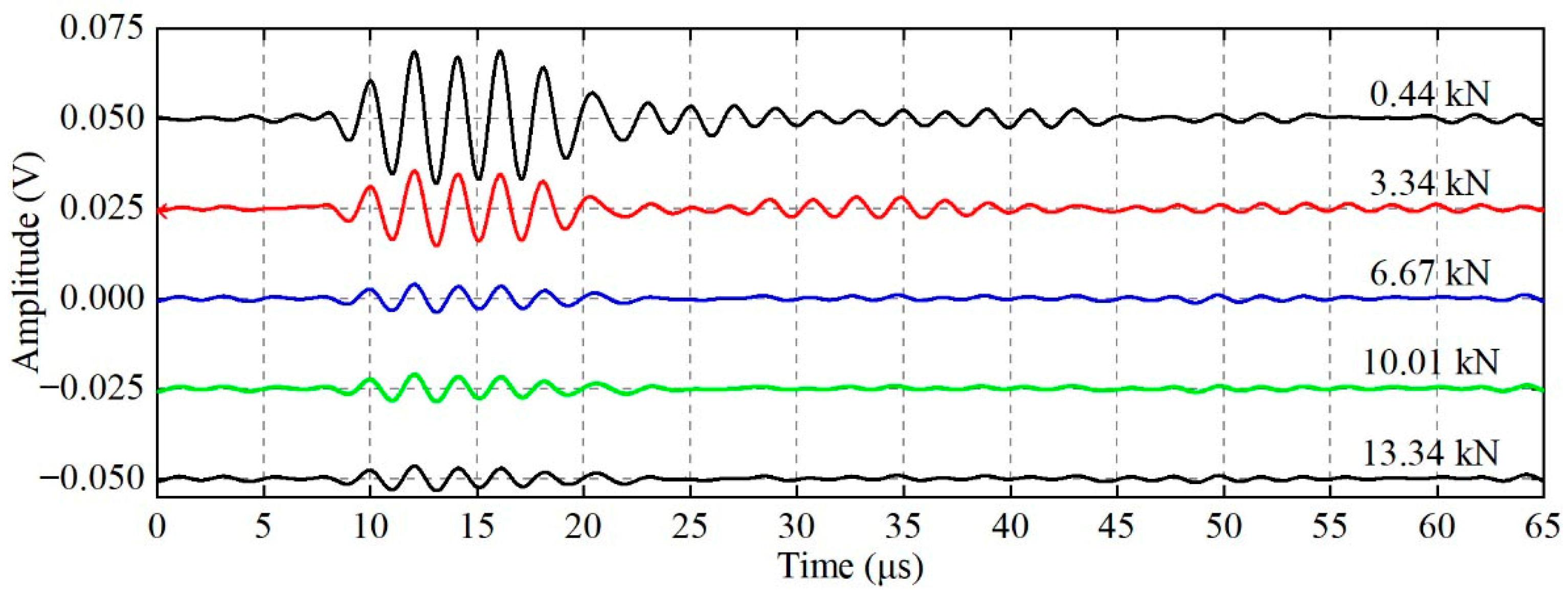
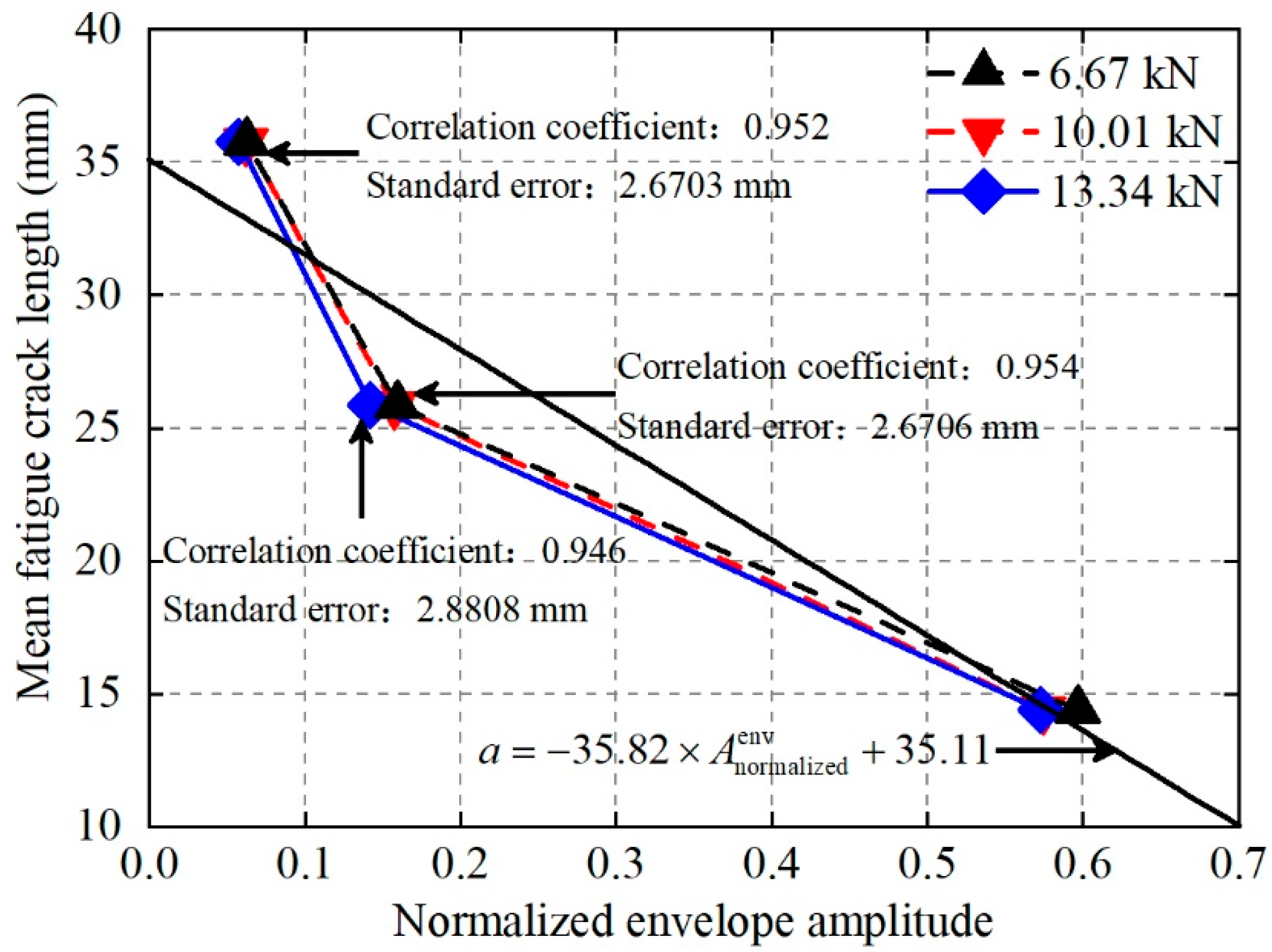
- Waveform-based analysis revealed a strong consistency between the crack opening and closing states and the corresponding amplitude variations in the waveform. Furthermore, the relationship between crack length and the transmission coefficient of ultrasonic signals collected via the wireless system was determined.
- (3)
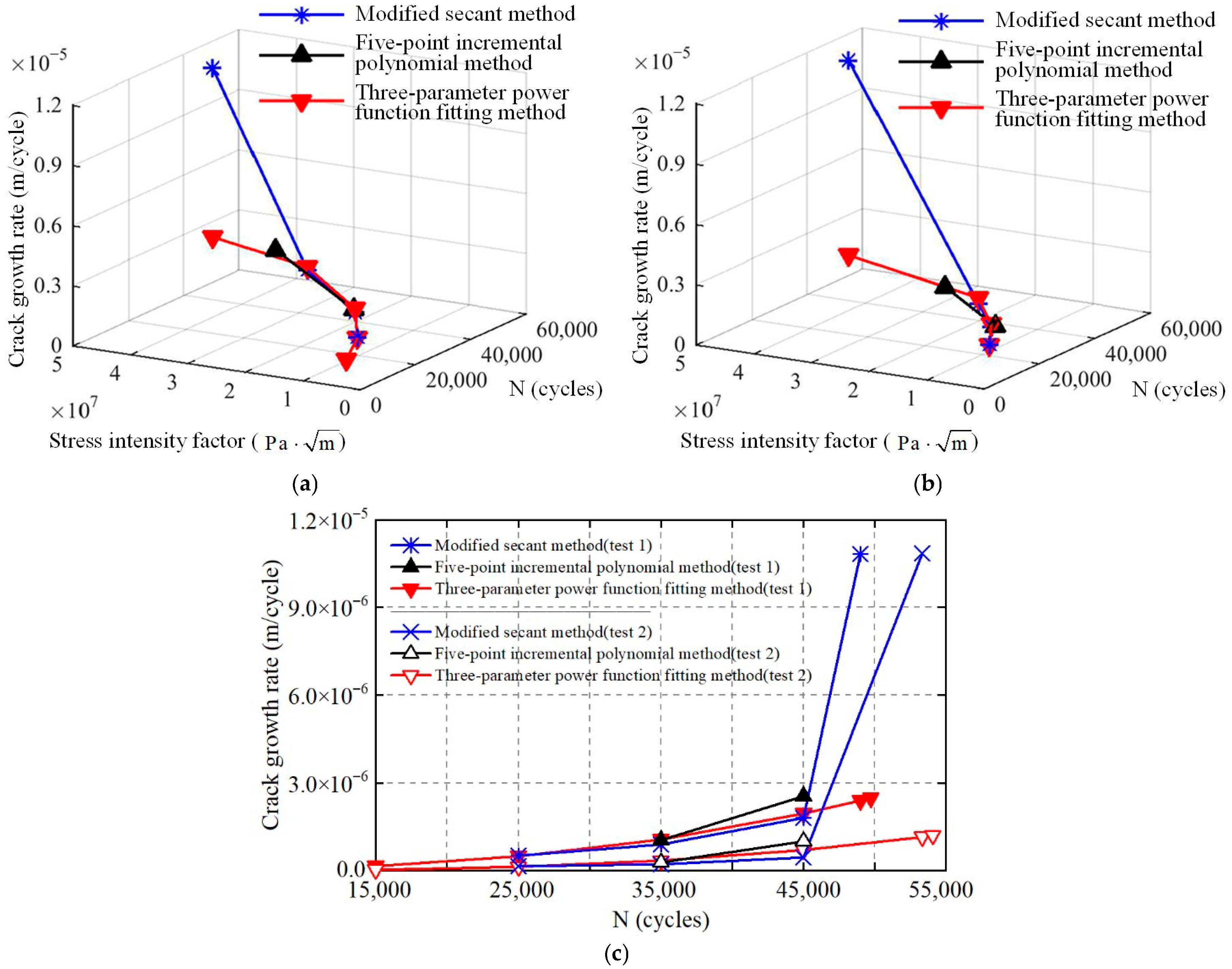
- The modified secant method together with the five-point incremental polynomial method were used to establish the da/dN-ΔK relationship for the compact-tension specimen. On this basis, and in accordance with Paris’s law and Miner’s rule, the association of crack length with loading cycles was formulated.
- (4)
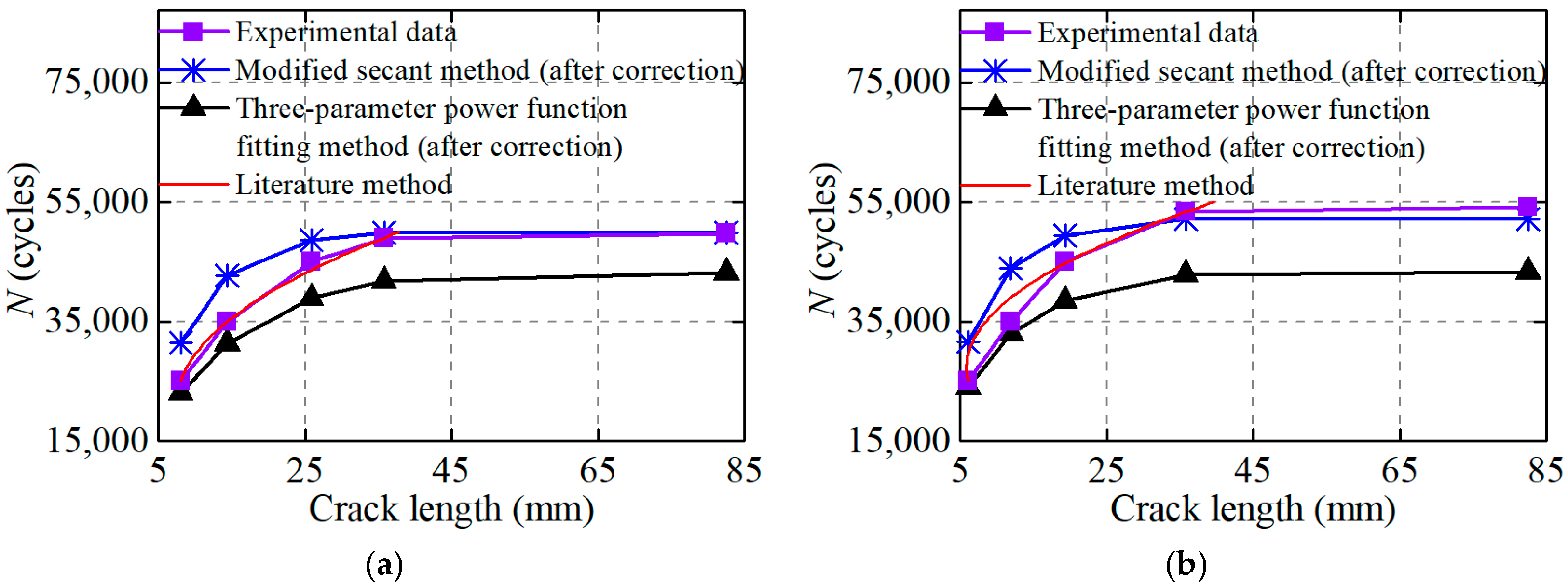
- A fatigue crack propagation model for the C(T) specimen was constructed utilizing signals from a wireless ultrasonic sensing system through two distinct approaches. Compared with the experimental results, the model derived from the five-point incremental polynomial method exhibited good consistency in terms of curve trends, and the modified secant method model showed an even closer correspondence with the experimental results.
Author Contributions
Funding
Institutional Review Board Statement
Informed Consent Statement
Data Availability Statement
Conflicts of Interest
Abbreviations
| C(T) specimen | compact tension specimen |
| SIF | stress intensity factor |
| NDT | nondestructive testing |
| ASTM | American Society for Testing and Materials |
| CMOD | crack mouth opening displacement |
References
- Russo, F.; Mertz, D.R.; Frank, K.H.; Wilson, K.E. Design and Evaluation of Steel Bridges for Fatigue and Fracture; FHWA-NHI-16-016; National Highway Institute: Arlington, VA, USA, 2016. [Google Scholar]
- Kong, X.X.; Li, J. Vision-Based Fatigue Crack Detection of Steel Structures Using Video Feature Tracking. Comput.-Aided Civ. Infrastruct. Eng. 2018, 33, 783–799. [Google Scholar] [CrossRef]
- Jang, J.; Liu, P.P.; Kwon, O.; Choi, J.; Ma, Z.X.; Sohn, H. Reference-free fatigue crack detection using deep long short-term memory network (DLSTM) and nonlinear ultrasonic modulation. NDT E Int. 2023, 137, 102828. [Google Scholar] [CrossRef]
- Liu, P.P.; Jang, J.H.; Yang, S.Y.; Sohn, H. Fatigue crack detection using dual laser induced nonlinear ultrasonic modulation. Opt. Lasers Eng. 2018, 110, 420–430. [Google Scholar] [CrossRef]
- Sun, M.Z.; Zhang, S.Z.; Zhang, G.D.; Li, X.B.; Kundu, T. Detection and evaluation of fatigue cracks using a nonlinear ultrasonic sideband peak count technique with a pulse-echo experimental method. J. Sound Vib. 2024, 583, 118429. [Google Scholar] [CrossRef]
- Papadimitriou, C.; Fritzen, C.P.; Kraemer, P.; Ntotsios, E. Fatigue predictions in entire body of metallic structures from a limited number of vibration sensors using Kalman filtering. Struct. Control Health Monit. 2011, 18, 554–573. [Google Scholar] [CrossRef]
- Albert. Die Bergwerks-Verwaltung des Hannoverschen Ober-Harzes in den Jahren 1831–1836; De Gruyter: Berlin, Germany; Boston, MA, USA, 1837. [Google Scholar] [CrossRef]
- Wöhler, A. Bericht über die Versuche, welche auf der Königl. Niederschlesisch-Märkischen Eisenbahn mit Apparaten zum Messen der Biegung und Verdrehung von Eisenbahnwagen-Achsen während der Fahrt angestellt wurden. Z. Bauwes. 1858, 8, 641–652. [Google Scholar]
- Paris, P.; Erdogan, F. A critical analysis of crack propagation laws. J. Basic Eng. 1963, 85, 528–533. [Google Scholar] [CrossRef]
- Elber, W. Fatigue Crack Propagation: Some Effects of Crack Closure on the Mechanism of Fatigue Crack Propagation Under Cyclic Tension Loading. Ph.D. Dissertation, UNSW Sydney, Sydney, Australia, 1968. [Google Scholar]
- Fleck, N.A. An Investigation of Fatigue Crack Closure. Ph.D. Dissertation, University of Cambridge, Cambridge, UK, 1983. [Google Scholar]
- Blom, A.F.; Holm, D.K. An experimental and numerical study of crack closure. Eng. Fract. Mech. 1985, 22, 997–1011. [Google Scholar] [CrossRef]
- Lenets, Y.N.; Peralta, A.; Miller, R.; Neumann, J. Influence of geometry and test method on fatigue crack propagation behavior of a Ni-base jet engine alloy. In Turbo Expo: Power for Land, Sea, and Air; American Society of Mechanical Engineers: New York, NY, USA, 2015; Volume 56765, p. V07AT28A005. [Google Scholar] [CrossRef]
- Hohenwarter, A.; Leitner, T.; Pippan, R. Fatigue Crack Propagation Across the Multiple Length Scales of Technically Relevant Metallic Materials. Annu. Rev. Mater. Res. 2024, 54, 223–246. [Google Scholar] [CrossRef]
- Jono, M.; Song, J.H.; Mikami, S.; Ohgaki, M. Fatigue crack growth and crack closure behavior of structural materials. Zair./J. Soc. Mater. Sci. Jpn. 1984, 33, 468–474. [Google Scholar] [CrossRef]
- Ravi-Chandar, K.; Knauss, W.G. An experimental investigation into dynamic fracture: III. On steady-state crack propagation and crack branching. Int. J. Fract. 1984, 26, 141–154. [Google Scholar] [CrossRef]
- Prabowo, A.R.; Sohn, J.M.; Putranto, T. Crashworthiness performance of stiffened bottom tank structure subjected to impact loading conditions: Ship-rock interaction. Curved Layer. Struct. 2019, 6, 245–258. [Google Scholar] [CrossRef]
- Kõrgesaar, M.; Putranto, T.; Jelovica, J. Equivalent single layer approach for predicting ultimate strength of stiffened panel under different load combinations. In Advances in the Analysis and Design of Marine Structures; CRC Press: Boca Raton, FL, USA, 2023; pp. 347–354. [Google Scholar]
- Taher, S.A.; Li, J.; Jeong, J.-H.; Laflamme, S.; Jo, H.; Bennett, C.; Collins, W.N.; Downey, A.R. Structural health monitoring of fatigue cracks for steel bridges with wireless large-area strain sensors. Sensors 2022, 22, 5076. [Google Scholar] [CrossRef]
- García-Martín, J.; Gómez-Gil, J.; Vázquez-Sánchez, E. Non-destructive techniques based on eddy current testing. Sensors 2011, 11, 2525–2565. [Google Scholar] [CrossRef]
- Gebauer, J.; Šofer, P.; Jurek, M.; Wagnerová, R.; Czebe, J. Machine Vision-Based Fatigue Crack Propagation System. Sensors 2022, 22, 6852. [Google Scholar] [CrossRef]
- Doyle, P.; Scala, C. Crack depth measurement by ultrasonics: A review. Ultrasonics 1978, 16, 164–170. [Google Scholar] [CrossRef]
- Lim, H.J.; Kim, Y.; Koo, G.; Yang, S.; Sohn, H.; Bae, I.H.; Jang, J.H. Development and field application of a nonlinear ultrasonic modulation technique for fatigue crack detection without reference data from an intact condition. Smart Mater. Struct. 2016, 25, 095055. [Google Scholar] [CrossRef]
- Guo, J.; Zeng, X.; Liu, Q.; Qing, X. Lamb Wave-Based Damage Localization and Quantification in Composites Using Probabilistic Imaging Algorithm and Statistical Method. Sensors 2022, 22, 4810. [Google Scholar] [CrossRef]
- Ben, B.S.; Ben, B.A.; Vikram, K.A.; Yang, S.H. Damage identification in composite materials using ultrasonic based Lamb wave method. Measurement 2013, 46, 904–912. [Google Scholar] [CrossRef]
- Achenbach, J.; Gautesen, A. Geometrical theory of diffraction for three-D elastodynamics. J. Acoust. Soc. Am. 1977, 61, 413–421. [Google Scholar] [CrossRef]
- Staszewski, W.J. Structural health monitoring using guided ultrasonic waves. In Advances in Smart Technologies in Structural Engineering; Springer: Berlin/Heidelberg, Germany, 2004; pp. 117–162. [Google Scholar]
- Chen, S.; Dong, X.J.; Kim, J.Y.; Wu, S.X.; Wang, Y. Design and performance validation of a compact wireless ultrasonic device for localized damage detection. Adv. Struct. Eng. 2016, 19, 270–282. [Google Scholar] [CrossRef]
- Ohara, Y.; Oshiumi, T.; Wu, X.; Uchimoto, T.; Takagi, T.; Tsuji, T.; Mihara, T. High-Selectivity imaging of the closed fatigue crack due to thermal environment using surface-acoustic-wave phased array (SAW PA). Ultrasonics 2022, 119, 106629. [Google Scholar] [CrossRef]
- Rose, J.L. Ultrasonic Guided Waves in Solid Media; Cambridge University Press: Cambridge, UK, 1999. [Google Scholar] [CrossRef]
- ASTM E647-24; Standard Test Method for Measurement of Fatigue Crack Growth Rates. ASTM: West Conshohocken, PA, USA, 2024. [CrossRef]
- Schijve, J. The significance of fractography for investigations of fatigue crack growth under variable-amplitude loading. Fatigue Fract. Eng. Mater. Struct. 1999, 22, 87–99. [Google Scholar] [CrossRef]
- Virkler, D.A.; Hillberry, B.; Goel, P.K. The statistical nature of fatigue crack propagation. J. Eng. Mater. Technol. 1979, 101, 148–153. [Google Scholar] [CrossRef]
- Wei, R.; Wei, W.; Miller, G. Effect of measurement precision and data processing procedures on variability in fatigue crack growth rate data. J. Test. Eval. 1979, 7, 90–95. [Google Scholar] [CrossRef]
- Anderson, T.L.; Anderson, T.L. Fracture Mechanics: Fundamentals and Applications; CRC Press: Boca Raton, FL, USA, 2005. [Google Scholar]
- Golan, S.; Adler, L.; Cook, K.; Nanstad, R.; Bolland, T. Ultrasonic diffraction technique for characterization of fatigue cracks. J. Nondestruct. Eval. 1980, 1, 11–19. [Google Scholar] [CrossRef]
- Chen, S.; Zhou, G.; Zhao, H.; Huang, D.; Chen, Y. Fatigue crack propagation evaluation for thin plate structures using a wireless ultrasonic sensing device. Struct. Control Health Monit. 2022, 29, e2888. [Google Scholar] [CrossRef]
- Solanki, K.; Daniewicz, S.R.; Newman, J.C. Finite element modeling of plasticity-induced crack closure with emphasis on geometry and mesh refinement effects. Eng. Fract. Mech. 2003, 70, 1475–1489. [Google Scholar] [CrossRef]
- Beden, S.M.; Abdullah, S.; Ariffin, A.K. Review of fatigue crack propagation models for metallic components. Eur. J. Sci. Res. 2009, 28, 364–397. [Google Scholar]
- Shahani, A.R.; Moayeri Kashani, H. Assessment of equivalent initial flaw size estimation methods in fatigue life prediction using compact tension specimen tests. Eng. Fract. Mech. 2013, 99, 48–61. [Google Scholar] [CrossRef]





| Step Number | Loading Type | Description | Purpose |
|---|---|---|---|
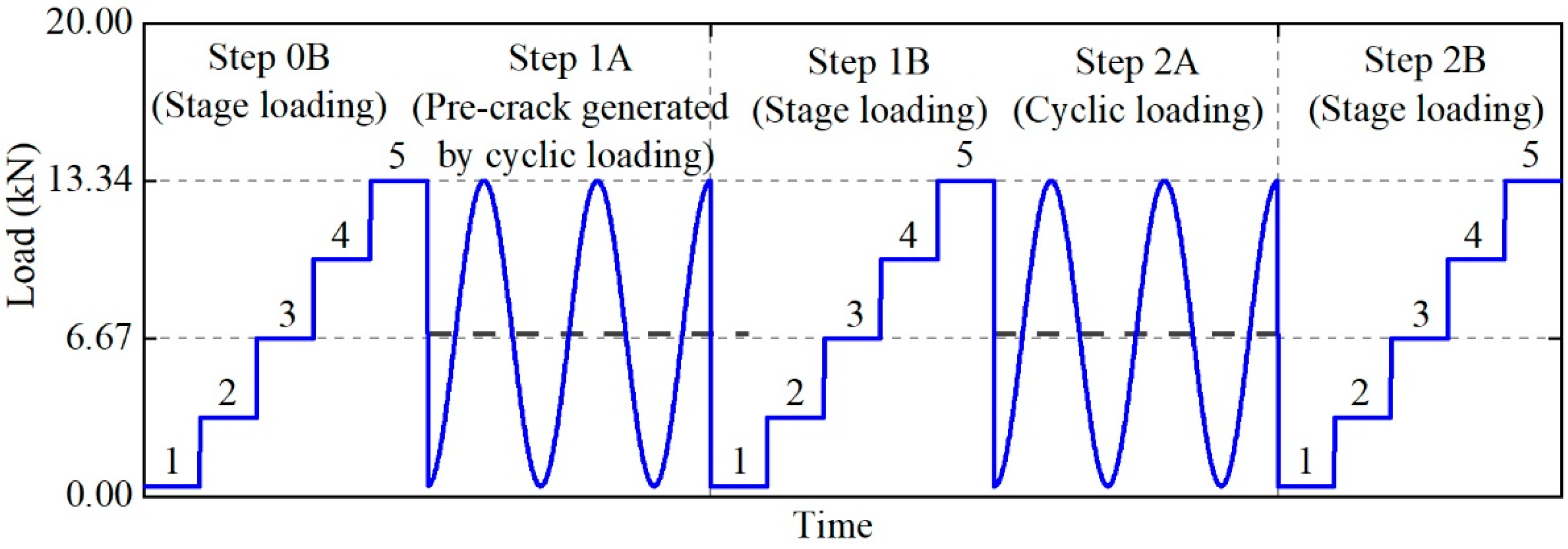
| 0B | Multistage static | From 0.44 kN to 13.34 kN, loading in 5 steps. The second level of load is 3.34 kN, and each subsequent stage of load increases compared with the previous level of 3.34 kN. | Benchmark ultrasonic measurement |
| 1A | Cyclic loading | 5 Hz sinusoidal load with a loading range from 0.44 kN to 13.34 kN; 15,000 cycles. | Crack prefabrication |
| 1B | Multistage static | From 0.44 kN to 13.34 kN, loading in 5 steps. The second level of load is 3.34 kN, and each subsequent stage of load increases compared with the previous level of 3.34 kN. | Ultrasonic measurement |
| 2A | Cyclic loading | 5 Hz sinusoidal load with a loading range from 0.44 kN to 13.34 kN; 10,000 cycles. | Crack propagation |
| 2B | Multistage static | Same as 1B | Ultrasonic measurement |
| 3A | Cyclic loading | Same as 2A | Crack propagation |
| 3B | Multistage static | Same as 2B | Ultrasonic measurement |
| Test Number | Fitting Method | Before Correction | After Correction | ||||
|---|---|---|---|---|---|---|---|
| C | m | Correlation Coefficient with Growth Rate | Ceff | meff | Correlation Coefficient with Growth Rate | ||
| 1 | Modified secant method | −47.24 | 2.1127 | 0.9769 | −24.67 | 2.8419 | 0.9786 |
| Five-point incremental polynomial method | −33.86 | 1.2719 | 0.9999 | −15.98 | 1.5215 | 0.9999 | |
| 2 | Modified secant method | −51.52 | 0.9340 | 0.9634 | −25.25 | 2.9431 | 0.9984 |
| Five-point incremental polynomial method | −37.46 | 0.0357 | 0.9999 | −18.83 | 1.9671 | 0.9999 | |
| Scenario Index | Fitting Parameters in a = a1T + a2 | Individual RMSE Calculated from the Test Data for Different Tensile Loads (mm) | Average RMSE (mm) | |||
|---|---|---|---|---|---|---|
| a1 | a2 | Tensile Load at 6.67 kN | Tensile Load at 10.01 kN | Tensile Load at 13.34 kN | ||
| 1 | −35.83 | 35.22 | 2.6704 | 2.6706 | 2.8808 | 2.7406 |
| 2 | −37.48 | 35.26 | 2.7149 | 2.629 | 2.8409 | 2.7283 |
| 3 | −36.66 | 34.78 | 2.7356 | 2.6485 | 2.8221 | 2.7354 |
| 4 | −36.63 | 35.18 | 2.6812 | 2.6399 | 2.852 | 2.7244 |
| 5 | −37.07 | 35.02 | 2.7208 | 2.634 | 2.8267 | 2.7272 |
| 6 | −36.24 | 34.95 | 2.6866 | 2.6434 | 2.8372 | 2.7224 |
| 7 | −36.91 | 35.21 | 2.6867 | 2.6309 | 2.8429 | 2.7202 |
| Test Number | Tensile Load Level (kN) | Fitting Method | Predict Fatigue Life (Cycles) | Standard Error (Cycles) | Correlation Coefficient |
|---|---|---|---|---|---|
| 1 | 6.67 | Modified secant method | 45,907 | 3447 | 0.994 |
| Five-point incremental polynomial method | 43,303 | 5367 | 0.998 | ||
| 10.01 | Modified secant method | 45,908 | 3444 | 0.994 | |
| Five-point incremental polynomial method | 43,304 | 5361 | 0.998 | ||
| 13.34 | Modified secant method | 45,916 | 3420 | 0.993 | |
| Five-point incremental polynomial method | 43,324 | 5303 | 0.997 | ||
| 2 | 6.67 | Modified secant method | 52,444 | 2273 | 0.994 |
| Five-point incremental polynomial method | 46,948 | 5669 | 0.999 | ||
| 10.01 | Modified secant method | 52,452 | 2264 | 0.994 | |
| Five-point incremental polynomial method | 46,966 | 5635 | 0.999 | ||
| 13.34 | Modified secant method | 52,452 | 2258 | 0.994 | |
| Five-point incremental polynomial method | 46,967 | 5636 | 0.999 |
Disclaimer/Publisher’s Note: The statements, opinions and data contained in all publications are solely those of the individual author(s) and contributor(s) and not of MDPI and/or the editor(s). MDPI and/or the editor(s) disclaim responsibility for any injury to people or property resulting from any ideas, methods, instructions or products referred to in the content. |
© 2026 by the authors. Licensee MDPI, Basel, Switzerland. This article is an open access article distributed under the terms and conditions of the Creative Commons Attribution (CC BY) license.
Share and Cite
Chen, S.; Du, J.; Liu, M.; Peng, Q.; Mi, J. Wireless Ultrasonic Sensing for Fatigue Crack Propagation and Life Prediction in Thin Plate Structures. Sensors 2026, 26, 3357. https://doi.org/10.3390/s26113357
Chen S, Du J, Liu M, Peng Q, Mi J. Wireless Ultrasonic Sensing for Fatigue Crack Propagation and Life Prediction in Thin Plate Structures. Sensors. 2026; 26(11):3357. https://doi.org/10.3390/s26113357
Chicago/Turabian StyleChen, Shuo, Jiahang Du, Minsheng Liu, Qiuyu Peng, and Jiayi Mi. 2026. "Wireless Ultrasonic Sensing for Fatigue Crack Propagation and Life Prediction in Thin Plate Structures" Sensors 26, no. 11: 3357. https://doi.org/10.3390/s26113357
APA StyleChen, S., Du, J., Liu, M., Peng, Q., & Mi, J. (2026). Wireless Ultrasonic Sensing for Fatigue Crack Propagation and Life Prediction in Thin Plate Structures. Sensors, 26(11), 3357. https://doi.org/10.3390/s26113357