Sensing Technologies and Physiological Parameters for Real-Time Driver Drowsiness Detection: A Comprehensive Review


Abstract
1. Introduction
2. Review Methodology
2.1. Literature Sources and Search Strategy
2.2. Timeframe of the Review
2.3. Inclusion Criteria
- Addressed driver drowsiness or fatigue detection in road-driving contexts.
- Employed mechanical, physiological, optical, or multimodal sensor systems.
- Focused on real-time or near-real-time monitoring.
- Were published in peer-reviewed journals or well-established international conference proceedings.
- Written in English.
2.4. Exclusion Criteria
- Focused exclusively on fatigue in non-driving contexts (e.g., office work, clinical sleep studies without vehicle relevance, or aviation-only studies).
- Did not involve sensor-based data acquisition or analysis.
- Were editorial papers, opinion articles, or conceptual discussions lacking technical or experimental validation.
- Lacked sufficient methodological detail regarding signal acquisition, processing, or system implementation.
2.5. Study Selection and Analysis
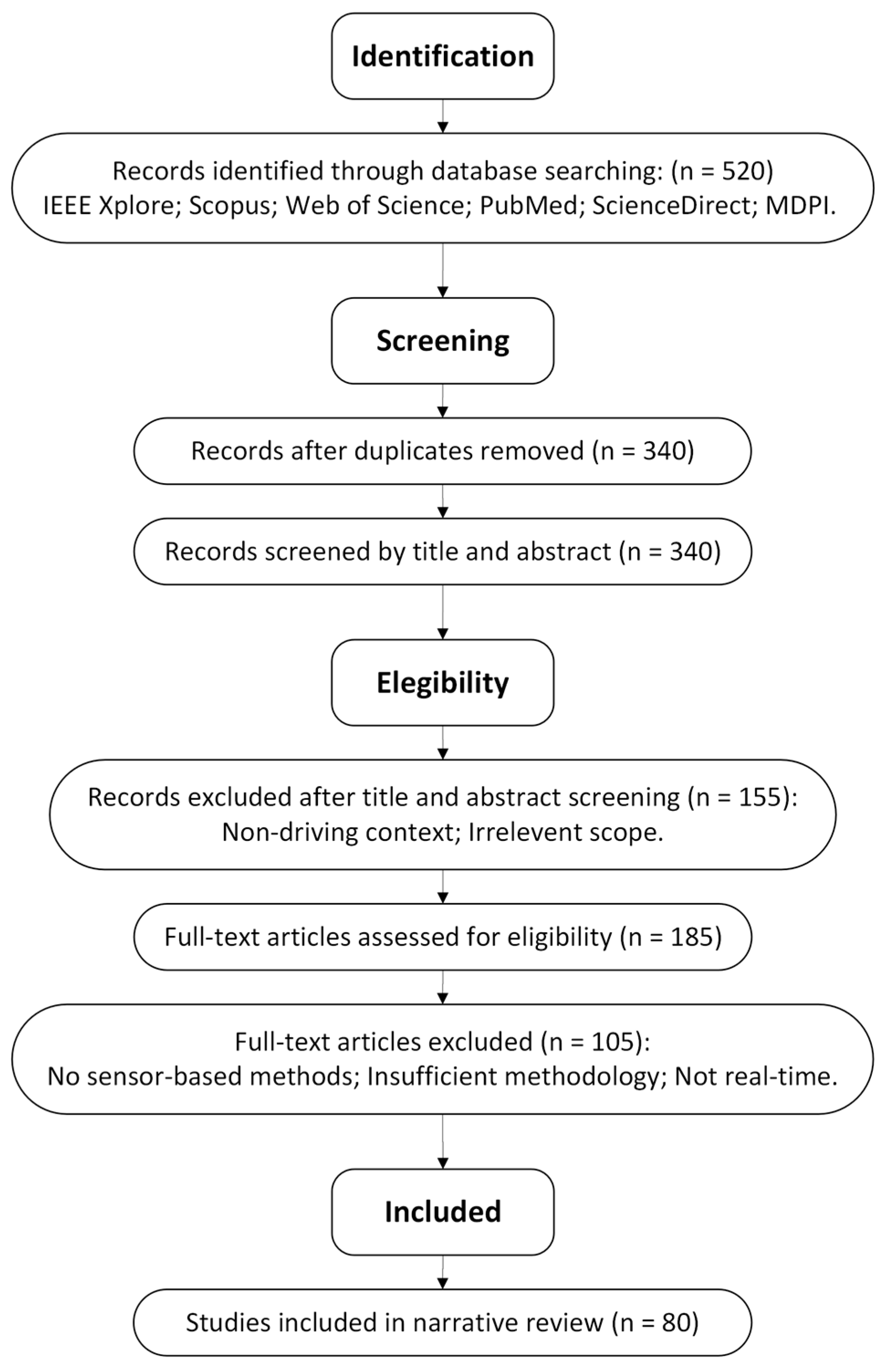
2.6. Literature Search and Selection Process
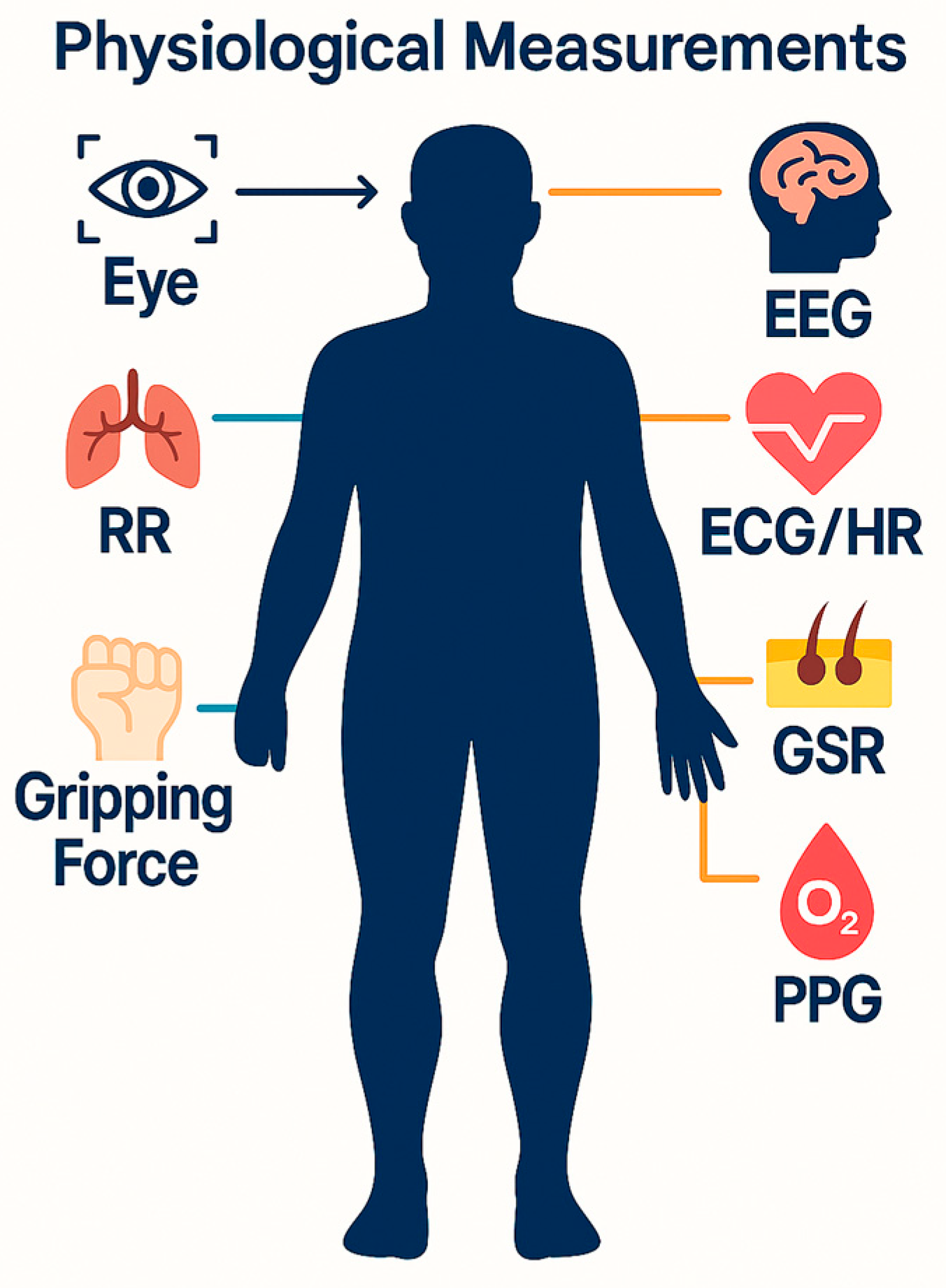
3. Mechanical Parameters
3.1. Respiratory Rate
3.2. Eye Blinking
3.3. Camera
3.4. Gripping Force
4. Physiological Parameters
4.1. Electroencephalogram (EEG)
4.1.1. EEG Electrode and Headset
4.1.2. In-Ear EEG
4.2. Galvanic Skin Response (GSR)
4.3. Photoplethysmography (PPG)
4.4. Electrocardiogram (ECG) & Heart Rate
4.5. Temperature
5. Future Perspectives and Emerging Non-Invasive Optical Monitoring Technologies
6. Comparative Overview of Reviewed Techniques
7. Conclusions
Author Contributions
Funding
Institutional Review Board Statement
Informed Consent Statement
Data Availability Statement
Acknowledgments
Conflicts of Interest
Abbreviations
| CNN | Convolutional Neural Network |
| ECG | Electrocardiogram |
| EDA | Electrodermal Activity |
| EEG | Electroencephalogram |
| EOG | Electrooculogram |
| FSR | Force Sensitive Resistor |
| GSR | Galvanic Skin Response |
| HR | Heart Rate |
| HRV | Heart Rate Variability |
| IR | Infrared |
| ISPA | Iris–Sclera Pattern Analysis |
| PAT | Pulse Arrival Time |
| PERCLOS | Percentage of Eye Closure |
| PPG | Photoplethysmography |
| ReLU | Rectified Linear Unit |
| ReLU-RP | Rectified Linear Unit–Recurrence Plot |
| SC | Skin Conductance |
References
- Jaulkar, S.; Parihar, A. Different types of injury associated with road traffic accidents. Multidiscip. Rev. 2025, 8, 111. [Google Scholar] [CrossRef]
- World Health Organization. Decade of Action for Road Safety 2021–2030. Available online: https://www.who.int/teams/social-determinants-of-health/safety-and-mobility/decade-of-action-for-road-safety-2021-2030 (accessed on 4 December 2021).
- Choudhary, A.; Garg, R.D.; Jain, S.S.; Khan, A.B.; Akhtar, K. Impact of traffic and road infrastructural design variables on road user safety: A systematic literature review. Int. J. Crashworth. 2024, 29, 583–596. [Google Scholar] [CrossRef]
- Ahmed, S.; Hossain, M.A.; Ray, S.K.; Bhuiyan, M.M.I.; Sabuj, S.R. A study on road accident prediction and contributing factors using explainable machine learning models: Analysis and performance. Transp. Res. Interdiscip. Perspect. 2023, 19, 100814. [Google Scholar] [CrossRef]
- Hamid, A.A.; Ishak, N.S.; Roslan, M.F.; Abdullah, K.H.; Ahmad, M. Tackling human error in road crashes: An evidence-based review of causes and effective mitigation strategies. J. Metr. Stud. Soc. Sci. 2023, 2, 1–9. Available online: https://ejournal.papanda.org/index.php/jmsss/article/view/398 (accessed on 23 February 2026).
- Wang, J.; Ma, S.; Jiao, P.; Ji, L.; Sun, X.; Lu, H. Analyzing the risk factors of traffic accident severity using a combination of random forest and association rules. Appl. Sci. 2023, 13, 8559. [Google Scholar] [CrossRef]
- Ashqar, T.I.; Al Masaeid, H.R.; Eshtayeh, S.J.; Hammad, I.H.A. Factors affecting crash severity in roundabouts: A comprehensive analysis in the Jordanian context. Transp. Eng. 2024, 17, 100239. [Google Scholar] [CrossRef]
- National Highway Traffic Safety Administration (NHTSA). Drowsy Driving 2015. 2017. Available online: https://crashstats.nhtsa.dot.gov/Api/Public/ViewPublication/812446 (accessed on 14 January 2026).
- Freitas, A.; Almeida, R.; Gonçalves, H.; Conceição, G.; Freitas, A. Monitoring fatigue and drowsiness in motor vehicle occupants using electrocardiogram and heart rate: A systematic review. Transp. Res. Part F Traffic Psychol. Behav. 2024, 103, 586–607. [Google Scholar] [CrossRef]
- Makhmudov, D.; Tursunov, M.; Xu, X.; Feng, N.; Yang, Y.; Islam, I.; Chen, C.; Fang, F. Real-time fatigue detection algorithms using machine learning for yawning and eye state. Sensors 2024, 24, 7810. [Google Scholar] [CrossRef]
- Joag, V.; Moosani, I.; Bhosale, T. Road mishap prevention using driver state detection. In Intelligent Computing and Big Data Analytics; Patil, M., Ed.; Communications in Computer and Information Science; Springer Nature Switzerland: Cham, Switzerland, 2024; Volume 2234, pp. 27–41. [Google Scholar] [CrossRef]
- Kamboj, M.; Kadian, K.; Dwivedi, V.; Wary, A.; Ojha, S. Advanced detection techniques for driver drowsiness: A comprehensive review of machine learning, deep learning, and physiological approaches. Multimed. Tools Appl. 2024, 83, 90619–90682. [Google Scholar] [CrossRef]
- Abd El Nabi, S.; El Shafai, W.; El Rabaie, E.-S.M.; Ramadan, K.F.; Abd El Samie, F.E.; Mohsen, S. Machine learning and deep learning techniques for driver fatigue and drowsiness detection: A review. Multimed. Tools Appl. 2024, 83, 9441–9477. [Google Scholar] [CrossRef]
- Nagineni, S.; Sivashankar, B.; Sumathi, P.; Maurya, O.P. Physiological and physical sensors for stress level, drowsiness detection, and behaviour analysis. IEEE Trans. Consum. Electron. 2024, 70, 656–668. [Google Scholar] [CrossRef]
- Fonseca, T.; Ferreira, S. Drowsiness detection in drivers: A systematic review of deep learning-based models. Appl. Sci. 2025, 15, 9018. [Google Scholar] [CrossRef]
- Petridou, E.; Moustaki, M. Human factors in the causation of road traffic crashes. Eur. J. Epidemiol. 2000, 16, 819–826. [Google Scholar] [CrossRef]
- Meghit, C.; Reguig, F.B. Design and Simulation of a Device for Measuring the Galvanic Skin Response. Master’s Thesis, Abou Bekr Belkaïd University of Tlemcen, Tlemcen, Algeria, 2020. [Google Scholar]
- Wolkoff, P.; Nøjgaard, J.K.; Troiano, P.; Piccoli, B. Eye complaints in the office environment: Precorneal tear film integrity influenced by eye blinking efficiency. Occup. Environ. Med. 2005, 62, 4–12. [Google Scholar] [CrossRef]
- Hill, B.; Annesley, S.H. Monitoring respiratory rate in adults. Br. J. Nurs. 2020, 29, 12–16. [Google Scholar] [CrossRef]
- Guede Fernández, F.; Fernández Chimeno, M.; Ramos Castro, J.; García González, M.A. Driver drowsiness detection based on respiratory signal analysis. IEEE Access 2019, 7, 81826–81838. [Google Scholar] [CrossRef]
- Siddiqui, H.U.R.; Saleem, A.A.; Brown, R.; Bademci, B.; Lee, E.; Rustam, F.; Dudley, S. Non-invasive driver drowsiness detection system. Sensors 2021, 21, 4833. [Google Scholar] [CrossRef]
- Solaz, J.; Laparra-Hernández, J.; Bande, D.; Rodríguez, N.; Veleff, S.; Gerpe, J.; Medina, E. Drowsiness detection based on the analysis of breathing rate obtained from real-time image recognition. Transp. Res. Procedia 2016, 14, 3867–3876. [Google Scholar] [CrossRef]
- Heart and Respiration In-Car Embedded Nonintrusive Sensors (HARKEN). CORDIS European Commission. Available online: https://cordis.europa.eu/project/id/314087/reporting (accessed on 10 March 2026).
- Warnecke, J.M.; Lasenby, J.; Deserno, T.M. Robust in-vehicle respiratory rate detection using multimodal signal fusion. Sci. Rep. 2023, 13, 20435. [Google Scholar] [CrossRef]
- Abusharha, A.A. Changes in blink rate and ocular symptoms during different reading tasks. Clin. Optom. 2017, 9, 133–138. [Google Scholar] [CrossRef]
- Pasaribu, N.T.B.; Prijono, A.; Ratnadewi, R.; Adhie, R.P.; Felix, J. Drowsiness detection according to the number of blinking eyes specified from eye aspect ratio value modification. In Proceedings of the 1st International Conference on Life, Innovation, Change and Knowledge (ICLICK 2018); Advances in Social Science, Education and Humanities Research; Atlantis Press: Paris, France, 2019; pp. 171–174. [Google Scholar] [CrossRef][Green Version]
- Wang, J.; Chai, W.; Venkatachalapathy, A.; Tan, K.L.; Haghighat, A.; Velipasalar, S.; Adu-Gyamfi, Y.; Sharma, A. A survey on driver behavior analysis from in-vehicle cameras. IEEE Trans. Intell. Transp. Syst. 2021, 23, 10186–10209. [Google Scholar] [CrossRef]
- Lee, D.; Oh, S.; Heo, S.; Hahn, M. Drowsy driving detection based on the driver’s head movement using infrared sensors. In Proceedings of the 2008 Second International Symposium on Universal Communication (ISUC); IEEE: Osaka, Japan, 2008; pp. 231–236. [Google Scholar] [CrossRef]
- Win, O. Real Time Eye Blinking and Yawning Detection. Int. J. Trend Sci. Res. Dev. 2019, 3, 2460–2463. Available online: https://www.ijtsrd.com/engineering/electrical-engineering/28004/real-time-eye-blinking-and-yawning-detection/ohnmar-win (accessed on 23 January 2026).
- Babaeian, M.; Bhardwaj, N.; Esquivel, B.; Mozumdar, M. Real time driver drowsiness detection using a logistic-regression-based machine learning algorithm. In Proceedings of the 2016 IEEE Green Energy and Systems Conference (IGSEC); IEEE: Long Beach, CA, USA, 2016; pp. 1–6. [Google Scholar] [CrossRef]
- Hachisuka, S.; Ishida, K.; Enya, T.; Kamijo, M. Facial expression measurement for detecting driver drowsiness. In Engineering Psychology and Cognitive Ergonomics (EPCE 2011); Harris, D., Ed.; Lecture Notes in Computer Science; Springer: Berlin/Heidelberg, Germany, 2011; Volume 6781, pp. 135–142. [Google Scholar] [CrossRef]
- Panicker, M.N.A. Open-eye detection using iris-sclera pattern analysis for driver drowsiness detection. Sadhana 2017, 42, 1835–1849. [Google Scholar] [CrossRef]
- Bergasa, L.M.; Nuevo, J.; Sotelo, M.A.; Barea, R.; López, M.E. Real-time system for monitoring driver vigilance. IEEE Trans. Intell. Transp. Syst. 2006, 7, 63–77. [Google Scholar] [CrossRef]
- Dinges, D.F.; Grace, R. PERCLOS: A Valid Psychophysiological Measure of Alertness as Assessed by Psychomotor Vigilance; Tech. Rep. FHWA MCRT 98 006; Federal Highway Administration: Washington, DC, USA, 1998. [CrossRef]
- Laganà, F.; Olivieri, R.; Stuppia, E.; Barile, G.; Ferri, G.; Pullano, S.A. Air-Coupled Ultrasound Systems for Biomedical Applications: Advances in Sensors, Electronic Interfaces and Signal Processing Strategies. Sensors 2026, 26, 1692. [Google Scholar] [CrossRef]
- Arlotto, P.; Grimaldi, M.; Naeck, R.; Ginoux, J.M. An ultrasonic contactless sensor for breathing monitoring. Sensors 2014, 14, 15371–15386. [Google Scholar] [CrossRef] [PubMed]
- Chieh, T.C.; Mustafa, M.; Hussain, A.; Zahedi, E. Driver fatigue detection using steering grip force. In Proceedings of the Student Conference on Research and Development (SCOReD 2003); IEEE: Putrajaya, Malaysia, 2003. [Google Scholar] [CrossRef]
- Eksioglu, M.; Kızılaslan, K. Steering-wheel grip force characteristics of drivers as a function of gender, speed, and road condition. Int. J. Ind. Ergon. 2008, 38, 354–361. [Google Scholar] [CrossRef]
- Lee, K.; Hyun, S.-A.; Oah, S. Detecting driver fatigue by steering wheel grip force. Int. J. Contents 2016, 12, 44–48. [Google Scholar] [CrossRef]
- Li, F.; Wang, X.-W.; Lu, B.-L. Detection of driving fatigue based on grip force on the steering wheel with wavelet transformation and support vector machine. In Neural Information Processing; Lecture Notes in Computer Science; Springer: Berlin/Heidelberg, Germany, 2013; Volume 8228, pp. 141–148. [Google Scholar] [CrossRef]
- Jung, S.J.; Shin, H.S.; Chung, W.Y. Driver fatigue and drowsiness monitoring system with embedded electrocardiogram sensor on steering wheel. IET Intell. Transp. Syst. 2014, 8, 43–50. [Google Scholar] [CrossRef]
- Svensson, U. Blink Behaviour Based Drowsiness Detection: Method Development and Validation. Master’s Thesis, Statens Väg- och Transport for sknings institut, Linköping, Sweden, 2004. [Google Scholar]
- Amidei, A.; Pavan, P.; Rabbeni, R.; Tagliavini, G. Unobtrusive multimodal monitoring of physiological signals for driver state analysis. IEEE Sens. J. 2025, 25, 7809–7818. [Google Scholar] [CrossRef]
- Babusiak, B.; Hajducik, A.; Medvecky, S.; Lukac, M.; Klarak, J. Design of smart steering wheel for unobtrusive health and drowsiness monitoring. Sensors 2021, 21, 5285. [Google Scholar] [CrossRef]
- Zhu, M.; Chen, J.; Li, H.; Liang, F.; Han, L.; Zhang, Z. Vehicle driver drowsiness detection method using wearable EEG based on convolution neural network. Neural Comput. Appl. 2021, 33, 13965–13980. [Google Scholar] [CrossRef]
- Lee, B.-G.; Chung, W.-Y.; Li, G.; Fook, F.S.; Kim, J. Mobile healthcare for automatic driving sleep-onset detection using wavelet-based EEG and respiration signals. Sensors 2014, 14, 17915–17936. [Google Scholar] [CrossRef]
- Houshmand, S.; Kazemi, R.; Salmanzadeh, H. A novel convolutional neural network method for subject-independent driver drowsiness detection based on single-channel data and EEG alpha spindles. Proc. Inst. Mech. Eng. Part H 2021, 235, 1069–1078. [Google Scholar] [CrossRef]
- Chaabene, S.; Bouaziz, B.; Boudaya, A.; Hökelmann, A.; Ammar, A.; Chaari, L. Convolutional neural network for drowsiness detection using EEG signals. Sensors 2021, 21, 1734. [Google Scholar] [CrossRef]
- Li, G.; Chung, W.Y. Estimation of eye closure degree using EEG sensors and its application in driver drowsiness detection. Sensors 2014, 14, 17491–17515. [Google Scholar] [CrossRef]
- Lin, C.-T.; Ko, L.-W.; Chang, M.-H.; Duann, J.-R.; Chen, J.-Y.; Su, T.-P.; Jung, T.-P. Review of Wireless and Wearable Electroencephalogram Systems and Brain-Computer Interfaces—A Mini-Review. Gerontology 2010, 56, 112–119. [Google Scholar] [CrossRef] [PubMed]
- Renvitha, P.; Swathika, R.; Paul, I.J.L.; Sasirekha, S.; Oviyaa, M. Arduino-based real-time drowsiness and fatigue detection for bikers using helmet. In Proceedings of the 2nd International Conference on Innovative Mechanisms for Industry Applications (ICIMIA), Bangalore, India, 5–7 March 2020; pp. 1–6. [Google Scholar] [CrossRef]
- Alqurashi, Y.D.; Wang, L.; Alshurafa, N.; Gaylord, S.; Quan, S.F.; Patel, S. A novel in-ear sensor to determine sleep latency during the Multiple Sleep Latency Test in healthy adults with and without sleep restriction. Nat. Sci. Sleep 2018, 10, 385–396. [Google Scholar] [CrossRef]
- Goverdovsky, V.; Looney, D.; Kidmose, P.; Mandic, D.P. Hearables: Multimodal Physiological In Ear Sensing. Sci. Rep. 2017, 7, 6948. [Google Scholar] [CrossRef] [PubMed]
- Nakamura, T.; Alqurashi, Y.D.; Morrell, M.J.; Mandic, D.P. Automatic detection of drowsiness using in-ear EEG. In Proceedings of the International Joint Conference on Neural Networks (IJCNN), Rio de Janeiro, Brazil, 8–13 July 2018; pp. 1–6. [Google Scholar] [CrossRef]
- Goverdovsky, V.; Looney, D.; Kidmose, P.; Mandic, D.P. In-ear EEG from viscoelastic generic earpieces: Robust and unobtrusive 24/7 monitoring. IEEE Sens. J. 2016, 16, 271–277. [Google Scholar] [CrossRef]
- Li, G.; Chung, W.-Y. Electroencephalogram-Based Approaches for Driver Drowsiness Detection and Management: A Review. Sensors 2022, 22, 1100. [Google Scholar] [CrossRef]
- Jap, B.T.; Lal, S.; Fischer, P.; Bekiaris, E. Using EEG Spectral Components to Assess Algorithms for Detecting Fatigue. Expert Syst. Appl. 2009, 36, 2352–2359. [Google Scholar] [CrossRef]
- Zhang, X.; Li, J.; Liu, Y.; Zhang, Z.; Wang, Z.; Luo, D.; Zhou, X.; Zhu, M.; Salman, W.; Hu, G.; et al. Design of a Fatigue Detection System for High-Speed Trains Based on Driver Vigilance Using a Wireless Wearable EEG. Sensors 2017, 17, 486. [Google Scholar] [CrossRef] [PubMed]
- Li, G.; Lee, B.-L.; Chung, W.-Y. Smartwatch-Based Wearable EEG System for Driver Drowsiness Detection. IEEE Sens. J. 2015, 15, 7169–7180. [Google Scholar] [CrossRef]
- Anatomy of the Skin. Stanford Children’s Health. Available online: https://www.stanfordchildrens.org/en/topic/default?id=anatomy-of-the-skin-85-P01336 (accessed on 24 December 2025).
- All You Need To Know: Galvanic Skin Response (GSR). Future Proof Insights, April 2021. Available online: https://www.futureproofinsights.ie/2021/04/08/all-you-need-to-know-galvanic-skin-response-gsr/ (accessed on 1 November 2025).
- Momose, H.; Morimitsu, N.; Ikeda, E.; Kanai, S.; Sakaguchi, M.; Ohhashi, T. Eyes closing and drowsiness in human subjects decrease baseline galvanic skin response and active palmar sweating: Relationship between galvanic skin and palmar perspiration responses. Front. Physiol. 2020, 11, 558047. [Google Scholar] [CrossRef] [PubMed]
- Sharma, M.K.; Bundele, M.M. Design and analysis of performance of K means algorithm for cognitive fatigue detection in vehicular drivers using skin conductance signal. In Proceedings of the 2015 2nd International Conference on Computing for Sustainable Global Development (INDIACom), New Delhi, India, 11–13 March 2015; pp. 707–712. Available online: https://ieeexplore.ieee.org/document/7100341 (accessed on 23 December 2025).
- EDA–Electrodermal Activity (GSR). iMotions. Available online: https://imotions.com/biosensor/gsr-galvanic-skin-response-eda-electrodermal-activity/ (accessed on 6 February 2025).
- STEER: Wearable Device That Will Not Let You Fall Asleep. Kickstarter. Available online: https://www.kickstarter.com/projects/creativemode/steer-you-will-never-fall-asleep-while-driving (accessed on 9 March 2026).
- Amidei, P.G.F.; Scarpiniti, M.; Costa, P.; Puleo, P.; Avella, A. Validating photoplethysmography (PPG) data for driver drowsiness detection. In Proceedings of the IEEE International Workshop on Metrology for Automotive (MetroAutomotive), Bologna, Italy, 1–2 June 2021; pp. 1–6. [Google Scholar]
- Oxygen Levels, Pulse Oximeters, and COVID-19. Minnesota Department of Health. Available online: https://www.health.state.mn.us/diseases/coronavirus/pulseoximeter.html (accessed on 16 February 2025).
- The Need for Supplemental Oxygen. UCSF Health. Available online: https://www.ucsfhealth.org/health-articles/the-need-for-supplemental-oxygen (accessed on 16 February 2025).
- Ju, J.H.; Park, Y.J.; Park, J.; Lee, B.G.; Lee, J.; Lee, J.Y. Real-Time Driver’s Biological Signal Monitoring System. Sens. Mater. 2015, 27, 51–59. Available online: https://www.researchgate.net/publication/281951643_Real-Time_Driver’s_Biological_Signal_Monitoring_System (accessed on 21 May 2026).
- Majumder, S.; Verma, A.K.; Wang, C.; Mohamud, A.; Archer, L.; Tavakolian, K.; Wilson, N. Using photoplethysmography-based features as indicators of drowsiness: Preliminary results. In Proceedings of the Design of Medical Devices Conference, Minneapolis, MN, USA, 15–18 April 2019. [Google Scholar] [CrossRef]
- Lee, H.; Lee, J.; Shin, M. Using wearable ECG/PPG sensors for driver drowsiness detection based on distinguishable pattern of recurrence plots. Electronics 2019, 8, 192. [Google Scholar] [CrossRef]
- Sidikova, M.; Martinek, R.; Kawala-Sterniuk, A.; Ladrova, M.; Jaros, R.; Danys, L.; Simonik, P. Vital Sign Monitoring in Car Seats Based on Electrocardiography, Ballistocardiography and Seismocardiography: A Review. Sensors 2020, 20, 5699. [Google Scholar] [CrossRef]
- Aspuru, J.; Ochoa-Brust, A.; Félix, R.A.; Mata-López, W.; Mena, L.J.; Ostos, R.; Martínez-Peláez, R. Segmentation of the ECG Signal by Means of a Linear Regression Algorithm. Sensors 2019, 19, 775. [Google Scholar] [CrossRef]
- Saini, R.S.V.; Saini, S. Driver Drowsiness Detection System and Techniques: A Review. Int. J. Comput. Sci. Inf. Technol. (IJCSIT) 2014, 5, 4245–4249. [Google Scholar]
- Geoffroy, G.; Chaari, L.; Tourneret, J.-Y.; Wendt, H. Drowsiness detection using joint EEG–ECG data with deep learning. In Proceedings of the European Signal Processing Conference (EUSIPCO), Dublin, Ireland, 23–27 August 2021; pp. 1–5. [Google Scholar] [CrossRef]
- Nasirzadeh, F.; Karmakar, C.; Habib, A.; Neelangal, K.B.; Mir, M.; Lee, S.; Arnel, T. Continuous monitoring of body temperature for objective detection of health and safety risks in construction sites: An analysis of the accuracy and comfort of off the shelf wearable sensors. Heliyon 2024, 10, e26947. [Google Scholar] [CrossRef] [PubMed]
- Zhang, B.; Pu, J.; Hu, T.; Zeng, J.; Zhang, H.; Chen, Z.; Ji, X.; Yue, S.; Li, L.Z.; Li, T. AI-powered nonlinear optical imaging reveals protein spatial homogenization as an indicator of impaired bone quality in type 2 diabetes. Opto-Electron. Adv. 2026, 9, 250312. [Google Scholar] [CrossRef]
- Li, T.; Gong, H.; Luo, Q. Visualization of light propagation in visible Chinese human head for functional near infrared spectroscopy. J. Biomed. Opt. 2011, 16, 045001. [Google Scholar] [CrossRef]
- Li, T.; Gong, H.; Luo, Q. MCVM: Monte Carlo modeling of photon migration in voxelized media. J. Innov. Opt. Health Sci. 2010, 3, 91–102. [Google Scholar] [CrossRef]



| Physiological Signals | Normal State | Drowsy State |
|---|---|---|
| Heart rate [16] | 89.8 ± 5.6 bpm | 81.5 ± 9.2 bpm |
| GSR [17] | 2–20 µS | <2 µS |
| Eye blink duration [18] | 0.1–0.4 s | 0.5–0.65 s |
| Techniques/Evaluation Characteristics | Seatbelt | Camera |
|---|---|---|
| Real-Time | Yes | Yes |
| Attached | Yes | No |
| Cost | Medium | High |
| Restriction of Driver Movement | Low | Low |
| Stand-Alone | Low | High |
| Techniques/Evaluation Characteristics | Camera | Infra-Red |
|---|---|---|
| Real-Time | Yes | Yes |
| Attached | No | Yes |
| Cost | High | Medium |
| Restriction of Driver Movement | Low | High |
| Stand-Alone | High | High |
| Techniques/Evaluation Characteristics | Camera |
|---|---|
| Real-Time | Yes |
| Attached | No |
| Cost | High |
| Restriction of Driver Movement | Low |
| Stand-Alone | High |
| Techniques/Evaluation Characteristics | Force Sensitive Resistor (FSR) |
|---|---|
| Real-Time | Yes |
| Attached | Yes |
| Cost | Low |
| Restriction of Driver Movement | Low |
| Stand-Alone | Low |
| Techniques/Evaluation Characteristics | Headset | In-Ear |
|---|---|---|
| Real-Time | Yes | Yes |
| Attached | Yes | Yes |
| Cost | High | Low |
| Restriction of Driver Movement | High | Medium |
| Stand-Alone | High | Medium |
| Techniques/Evaluation Characteristics | Galvanic Skin Response (GSR) |
|---|---|
| Real-Time | Yes |
| Attached | Yes |
| Cost | Medium |
| Restriction of Driver Movement | Medium |
| Stand-Alone | High |
| Techniques/Evaluation Characteristics | Pulse Oximetry |
|---|---|
| Real-Time | Yes |
| Attached | Yes |
| Cost | Low |
| Restriction of Driver Movement | High |
| Stand-Alone | Low |
| Techniques/Evaluation Characteristics | ECG Seatbelt |
|---|---|
| Real-Time | Yes |
| Attached | Yes |
| Cost | Low |
| Restriction of Driver Movement | Low |
| Stand-Alone | Low |
| Measured Parameter | Location Site | Advantages | Limitations | |
|---|---|---|---|---|
| Respiration rate | Breathing rate | Chest | Easy to implement | Sensitive to movement artifact. |
| Eye Blinking | Eye closure | Limited distance from eye | Fast response | Placement of the sensor is critical |
| Video Camera | Facial expression | Dashboard camera set | Non-intrusive, instant response | Expensive, require high processing capacity, sensitive to environment. |
| Gripping Force | Pressure | Hand grip | Economical | Delayed response |
| EEG | Brain activity | Scalp | Good Robustness | Intrusive, complicated setup |
| GSR | Skin conductance | Palm/sole | Non-intrusive, fast response | Needs steady direct contact |
| PPG | Arterial oxygen saturation | Tip of the finger/ear | Continuous monitoring | Affected by ambient light. |
| ECG | Heart activity | Chest | Accurate indication | Sensitive to movement artifact. |
| Heart Rate | Beats rate | Chest/wrist | Easy to implement | Variation depending on the driver’s emotional state. |
Disclaimer/Publisher’s Note: The statements, opinions and data contained in all publications are solely those of the individual author(s) and contributor(s) and not of MDPI and/or the editor(s). MDPI and/or the editor(s) disclaim responsibility for any injury to people or property resulting from any ideas, methods, instructions or products referred to in the content. |
© 2026 by the authors. Licensee MDPI, Basel, Switzerland. This article is an open access article distributed under the terms and conditions of the Creative Commons Attribution (CC BY) license.
Share and Cite
El Sahmarany, L.; Alkhaldi, M.; Alzahrani, S.I. Sensing Technologies and Physiological Parameters for Real-Time Driver Drowsiness Detection: A Comprehensive Review. Sensors 2026, 26, 3333. https://doi.org/10.3390/s26113333
El Sahmarany L, Alkhaldi M, Alzahrani SI. Sensing Technologies and Physiological Parameters for Real-Time Driver Drowsiness Detection: A Comprehensive Review. Sensors. 2026; 26(11):3333. https://doi.org/10.3390/s26113333
Chicago/Turabian StyleEl Sahmarany, Lola, Maryam Alkhaldi, and Saleh I. Alzahrani. 2026. "Sensing Technologies and Physiological Parameters for Real-Time Driver Drowsiness Detection: A Comprehensive Review" Sensors 26, no. 11: 3333. https://doi.org/10.3390/s26113333
APA StyleEl Sahmarany, L., Alkhaldi, M., & Alzahrani, S. I. (2026). Sensing Technologies and Physiological Parameters for Real-Time Driver Drowsiness Detection: A Comprehensive Review. Sensors, 26(11), 3333. https://doi.org/10.3390/s26113333