Ergonomic Risk Assessment of Professional Dance Using Motion Capture with Ergonomic Evaluation by the Rapid Entire Body Assessment (REBA)

 , ,
, , 

Abstract
1. Introduction
2. Materials and Methods
2.1. Subjects
2.2. Measurement: Xsens MVN Link
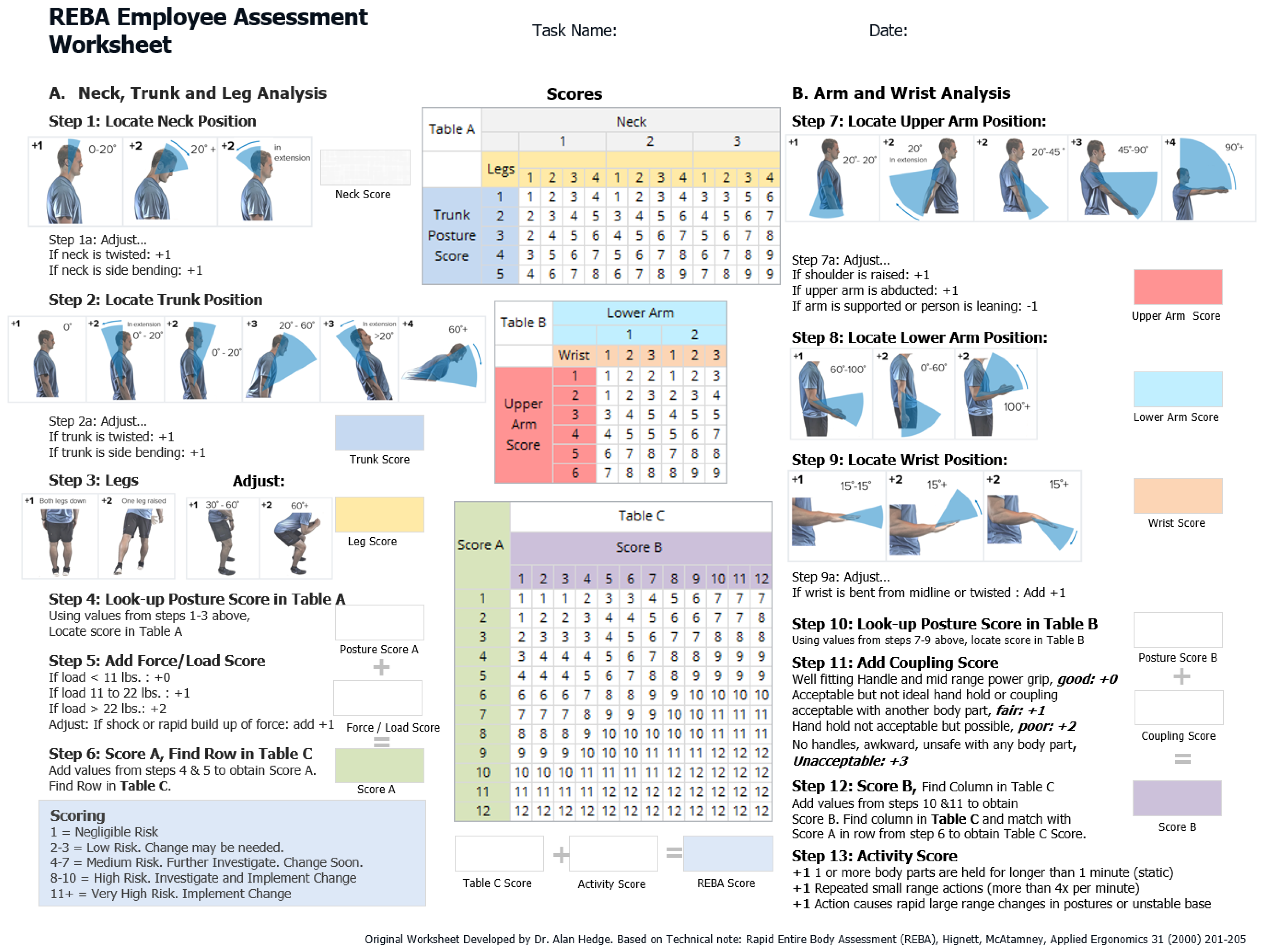
2.3. Rapid Entire Body Assessment (REBA)
2.4. Conception of Classic Training
2.5. Study Procedure
2.6. Methodological Evaluation
2.7. Statistical Evaluation
3. Results
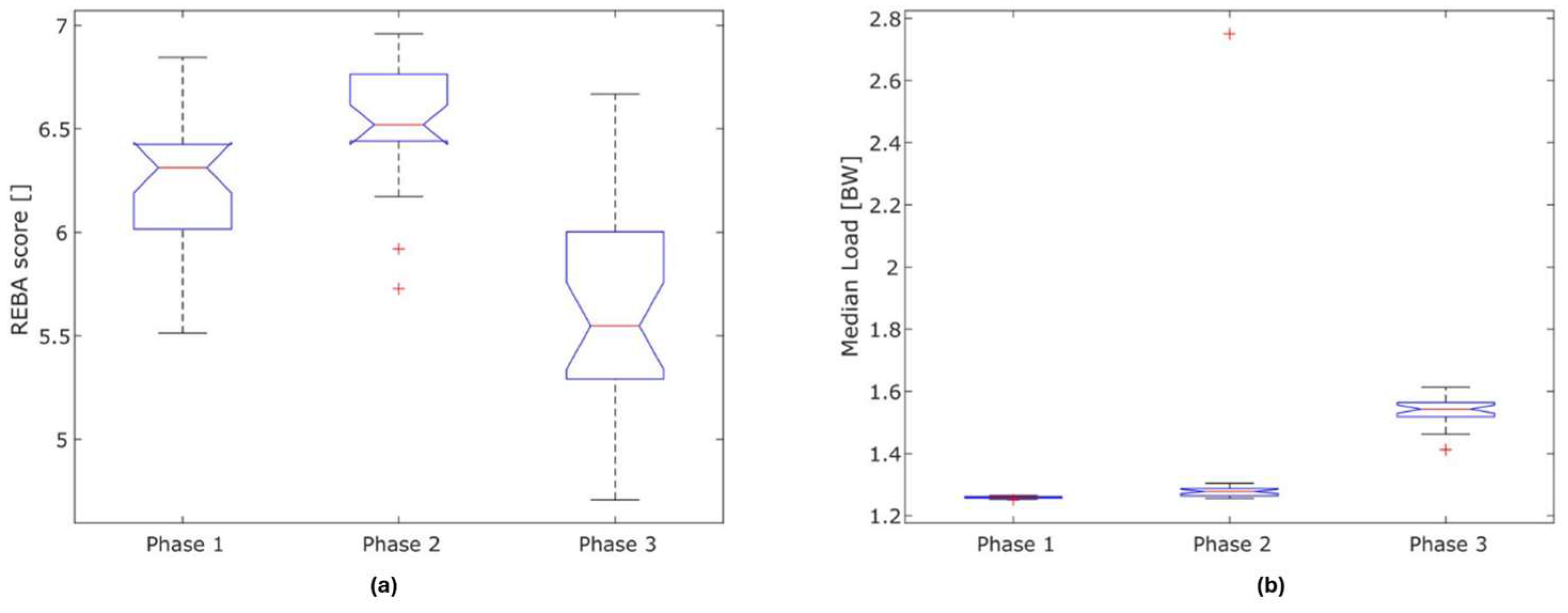
3.1. Total REBA Score and Load
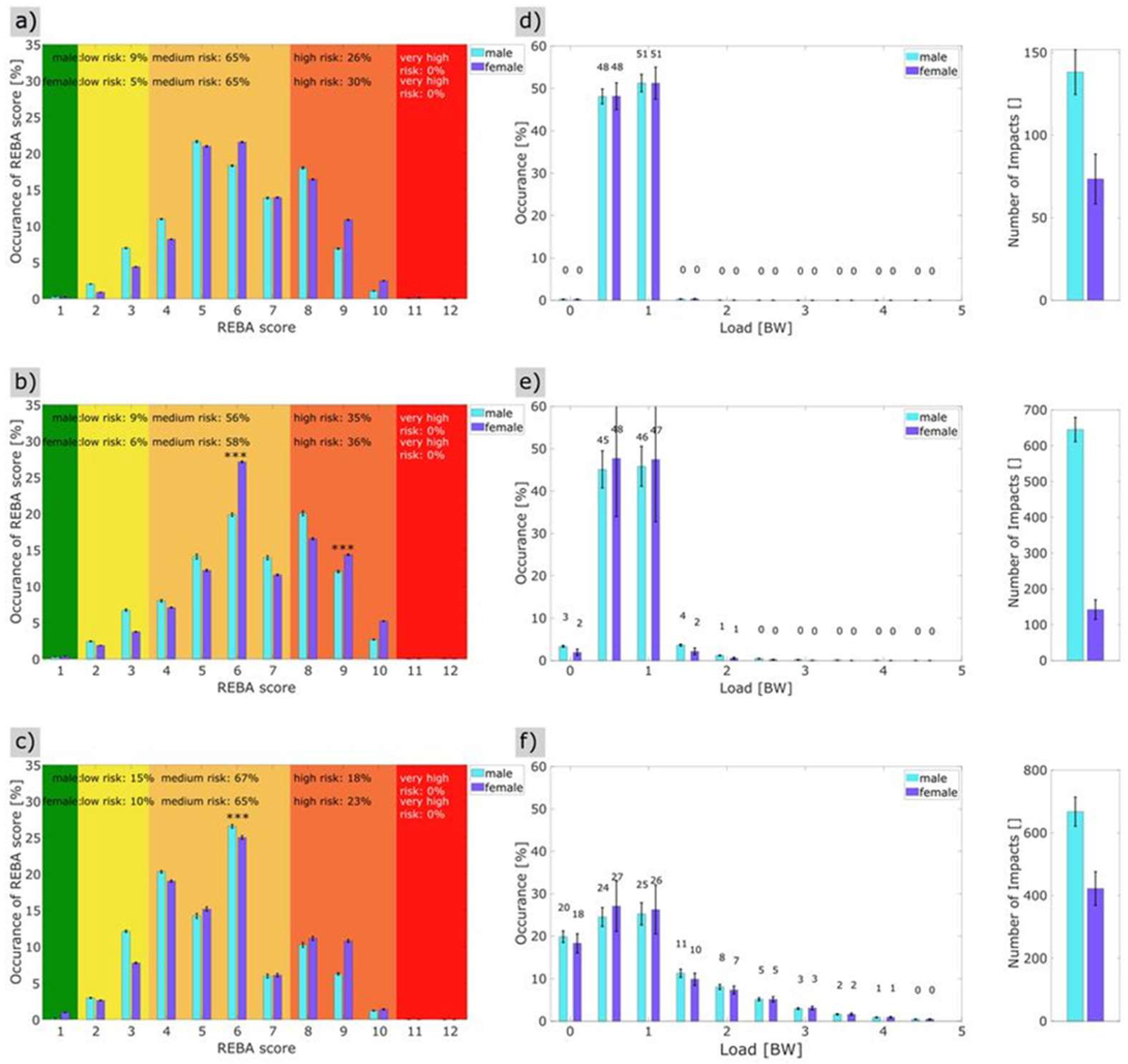
3.2. Phase-Specific REBA Score and Load Taking Gender into Account
3.2.1. Phase 1 (Barre)
3.2.2. Phase 2 (Centre Work, Jumps Excluded)
3.2.3. Phase 3 (Jumps)
4. Discussion
Limitations of the Study
5. Conclusions
Supplementary Materials
Author Contributions
Funding
Institutional Review Board Statement
Informed Consent Statement
Data Availability Statement
Conflicts of Interest
References
- Allen, N.; Nevill, A.; Brooks, J.; Koutedakis, Y.; Wyon, M. Ballet injuries: Injury incidence and severity over 1 year. J. Orthop. Sports Phys. Ther. 2012, 42, 781–790. [Google Scholar] [CrossRef]
- Almasi, T.; Exner-Grave, E.; Groneberg, D.A.; Wanke, E.M. usculoskeletal Eligibility for Professional Dance: Prerequisites—Special Considerations—Examinations. Sportverletz. Sportschaden 2019, 33, 192–202. [Google Scholar] [CrossRef]
- Schantz, P.G.; Astrand, P.O. Physiological characteristics of classical ballet. Med. Sci. Sports Exerc. 1984, 16, 472–476. [Google Scholar] [CrossRef]
- Bundesanstalt für Arbeitsschutz und Arbeitsmedizin. Belastungsarten. Available online: https://www.baua.de/DE/Themen/Praevention/Koerperliche-Gesundheit/Gesundheit-und-koerperliche-Belastung/Belastungsarten (accessed on 2 June 2025).
- Hopper, L.S.; Alderson, J.A.; Elliott, B.C.; Ackland, T.R. Dance floor force reduction influences ankle loads in dancers during drop landings. J. Sci. Med. Sport 2015, 18, 480–485. [Google Scholar] [CrossRef]
- Wanke, E.M. Rahmenempfehlungen zur Prävention von Verletzungen im Professionellen Bühnentanz; Deutsche Gesetzliche Unfallversicherung e.V. (DGUV): Berlin, Germany, 2013. [Google Scholar]
- Wanke, E.M.; Arendt, M.; Mill, H.; Groneberg, D.A. Occupational accidents in professional dance with focus on gender differences. J. Occup. Med. Toxicol. 2013, 8, 35. [Google Scholar] [CrossRef]
- Rinonapoli, G.; Graziani, M.; Ceccarini, P.; Razzano, C.; Manfreda, F.; Caraffa, A. Epidemiology of injuries connected with dance: A critical review on epidemiology. Med. Glas. 2020, 17, 256–264. [Google Scholar] [CrossRef] [PubMed]
- Li, F.; Adrien, N.; He, Y. Biomechanical Risks Associated with Foot and Ankle Injuries in Ballet Dancers: A Systematic Review. Int. J. Environ. Res. Public Health 2022, 19, 4916. [Google Scholar] [CrossRef] [PubMed]
- Fuller, M.; Moyle, G.M.; Hunt, A.P.; Minett, G.M. Ballet and Contemporary Dance Injuries When Transitioning to Full-Time Training or Professional Level Dance: A Systematic Review. J. Danc. Med. Sci. 2019, 23, 112–125. [Google Scholar] [CrossRef]
- McAtamney, L.; Nigel Corlett, E. RULA: A survey method for the investigation of work-related upper limb disorders. Appl. Ergon. 1993, 24, 91–99. [Google Scholar] [CrossRef]
- Hita-Gutiérrez, M.; Gómez-Galán, M.; Díaz-Pérez, M.; Callejón-Ferre, Á.-J. An Overview of REBA Method Applications in the World. Int. J. Environ. Res. Public Health 2020, 17, 2635. [Google Scholar] [CrossRef] [PubMed]
- Joshi, M.; Deshpande, V. A systematic review of comparative studies on ergonomic assessment techniques. Int. J. Ind. Ergon. 2019, 74, 102865. [Google Scholar] [CrossRef]
- Baklouti, S.; Chaker, A.; Rezgui, T.; Sahbani, A.; Bennour, S.; Laribi, M.A. A Novel IMU-Based System for Work-Related Musculoskeletal Disorders Risk Assessment. Sensors 2024, 24, 3419. [Google Scholar] [CrossRef] [PubMed]
- Maurer-Grubinger, C.; Holzgreve, F.; Fraeulin, L.; Betz, W.; Erbe, C.; Brueggmann, D.; Wanke, E.M.; Nienhaus, A.; Groneberg, D.A.; Ohlendorf, D. Combining Ergonomic Risk Assessment (RULA) with Inertial Motion Capture Technology in Dentistry-Using the Benefits from Two Worlds. Sensors 2021, 21, 4077. [Google Scholar] [CrossRef]
- Feige, S.; Holzgreve, F.; Fraeulin, L.; Maurer-Grubinger, C.; Betz, W.; Erbe, C.; Nienhaus, A.; Groneberg, D.A.; Ohlendorf, D. Ergonomic Analysis of Dental Work in Different Oral Quadrants: A Motion Capture Preliminary Study among Endodontists. Bioengineering 2024, 11, 400. [Google Scholar] [CrossRef]
- Weitbrecht, M.; Holzgreve, F.; Fraeulin, L.; Haenel, J.; Betz, W.; Erbe, C.; Maurer-Grubinger, C.; Wanke, E.M.; Brueggmann, D.; Nienhaus, A.; et al. Ergonomic Risk Assessment of Oral and Maxillofacial Surgeons—RULA Applied to Objective Kinematic Data. Hum. Factors 2023, 65, 1655–1673. [Google Scholar] [CrossRef]
- Holzgreve, F.; Fraeulin, L.; Maurer-Grubinger, C.; Betz, W.; Erbe, C.; Weis, T.; Janssen, K.; Schulte, L.; de Boer, A.; Nienhaus, A.; et al. Effects of Resistance Training as a Behavioural Preventive Measure on Musculoskeletal Complaints, Maximum Strength and Ergonomic Risk in Dentists and Dental Assistants. Sensors 2022, 22, 8069. [Google Scholar] [CrossRef]
- Holzgreve, F.; Fraeulin, L.; Betz, W.; Erbe, C.; Wanke, E.M.; Brüggmann, D.; Nienhaus, A.; Groneberg, D.A.; Maurer-Grubinger, C.; Ohlendorf, D. A RULA-Based Comparison of the Ergonomic Risk of Typical Working Procedures for Dentists and Dental Assistants of General Dentistry, Endodontology, Oral and Maxillofacial Surgery, and Orthodontics. Sensors 2022, 22, 805. [Google Scholar] [CrossRef]
- Blume, K.S.; Holzgreve, F.; Fraeulin, L.; Erbe, C.; Betz, W.; Wanke, E.M.; Brueggmann, D.; Nienhaus, A.; Maurer-Grubinger, C.; Groneberg, D.A.; et al. Ergonomic Risk Assessment of Dental Students-RULA Applied to Objective Kinematic Data. Int. J. Environ. Res. Public Health 2021, 18, 10550. [Google Scholar] [CrossRef]
- Huang, C.; Kim, W.; Zhang, Y.; Xiong, S. Development and Validation of a Wearable Inertial Sensors-Based Automated System for Assessing Work-Related Musculoskeletal Disorders in the Workspace. Int. J. Environ. Res. Public Health 2020, 17, 6050. [Google Scholar] [CrossRef]
- Tanthuwapathom, R.; Manupibul, U.; Jarumethitanont, W.; Limroongreungrat, W.; Ongwattanakul, S.; Charoensuk, W. Reliability of sitting posture between physical therapist video-based evaluation and SMART IMU system using rapid upper limb assessment (RULA). Sci. Rep. 2025, 15, 1441. [Google Scholar] [CrossRef] [PubMed]
- Law, M.J.J.; Ripin, Z.M.; Hamid, I.J.A.; Law, K.S.; Karunagaran, J.; Abdul Halim, N.S.S.; Ridzwan, M.I.Z. Comprehensive risk assessment of the patient transfer task using the walking belt and floor lift. Disabil. Rehabil. Assist. Technol. 2025, 20, 1505–1513. [Google Scholar] [CrossRef]
- García-Luna, M.A.; Ruiz-Fernández, D.; Tortosa-Martínez, J.; Manchado, C.; García-Jaén, M.; Cortell-Tormo, J.M. Transparency as a Means to Analyse the Impact of Inertial Sensors on Users during the Occupational Ergonomic Assessment: A Systematic Review. Sensors 2024, 24, 298. [Google Scholar] [CrossRef]
- Panhale, V.P.; Walankar, P.P.; Sridhar, A. Analysis of Postural Risk and Pain Assessment in Bharatanatyam Dancers. Indian J. Occup. Environ. Med. 2020, 24, 66–71. [Google Scholar] [CrossRef] [PubMed]
- Zelck, S.; Verwulgen, S.; Denteneer, L.; Vanden Bossche, H.; Scataglini, S. Combining a Wearable IMU Mocap System with REBA and RULA for Ergonomic Assessment of Container Lashing Teams. In Proceedings of the 21st Congress of the International Ergonomics Association, Online, 13–18 June 2021; Springer: Cham, Switzerland, 2021. [Google Scholar]
- Veirs, K.P.; Fagg, A.H.; Haleem, A.M.; Jeffries, L.M.; Randall, K.; Sisson, S.B.; Dionne, C.P. Applications of Biomechanical Foot Models to Evaluate Dance Movements Using Three-Dimensional Motion Capture: A Review of the Literature. J. Danc. Med. Sci. 2022, 26, 69–86. [Google Scholar] [CrossRef] [PubMed]
- Xsens. MVN User Manual; Xsens: Enschede, The Netherlands, 2017. [Google Scholar]
- Mavor, M.P.; Ross, G.B.; Clouthier, A.L.; Karakolis, T.; Graham, R.B. Validation of an IMU Suit for Military-Based Tasks. Sensors 2020, 20, 4280. [Google Scholar] [CrossRef] [PubMed]
- van der Straaten, R.; Bruijnes, A.; Vanwanseele, B.; Jonkers, I.; De Baets, L.; Timmermans, A. Reliability and Agreement of 3D Trunk and Lower Extremity Movement Analysis by Means of Inertial Sensor Technology for Unipodal and Bipodal Tasks. Sensors 2019, 19, 141. [Google Scholar] [CrossRef]
- Robert-Lachaine, X.; Mecheri, H.; Larue, C.; Plamondon, A. Validation of inertial measurement units with an optoelectronic system for whole-body motion analysis. Med. Biol. Eng. Comput. 2017, 55, 609–619. [Google Scholar] [CrossRef]
- Fang, Z.; Woodford, S.; Senanayake, D.; Ackland, D. Conversion of Upper-Limb Inertial Measurement Unit Data to Joint Angles: A Systematic Review. Sensors 2023, 23, 6535. [Google Scholar] [CrossRef]
- Ancillao, A.; Tedesco, S.; Barton, J.; O’Flynn, B. Indirect Measurement of Ground Reaction Forces and Moments by Means of Wearable Inertial Sensors: A Systematic Review. Sensors 2018, 18, 2564. [Google Scholar] [CrossRef]
- Hignett, S.; McAtamney, L. Rapid entire body assessment (REBA). Appl. Ergon. 2000, 31, 201–205. [Google Scholar] [CrossRef]
- Morrison, A.K.; Kumar, S.; Amin, A.; Urban, M.; Kleinman, B. An Ergonomic Risk Assessment of Ophthalmology Residents Using the Rapid Entire Body Assessment (REBA) Scale. Cureus 2024, 16, e53698. [Google Scholar] [CrossRef]
- Cohen, J.L.; Segal, K.R.; Witriol, I.; McArdle, W.D. Cardiorespiratory responses to ballet exercise and the VO2max of elite ballet dancers. Med. Sci. Sports Exerc. 1982, 14, 212–217. [Google Scholar] [CrossRef]
- Jeffries, A.C.; Wallace, L.; Coutts, A.J.; Cohen, A.M.; McCall, A.; Impellizzeri, F.M. Injury, Illness, and Training Load in a Professional Contemporary Dance Company: A Prospective Study. J. Athl. Train. 2020, 55, 967–976. [Google Scholar] [CrossRef]
- Koutedakis, Y.; Jamurtas, A. The dancer as a performing athlete: Physiological considerations. Sports Med. 2004, 34, 651–661. [Google Scholar] [CrossRef]
- Huwyler, J. Tanzmedizin: Anatomische Grundlagen und Gesunde Bewegung; Hogrefe AG: Bern, Switzerland, 2005. [Google Scholar]
- Rodrigues-Krause, J.; Dos Santos Cunha, G.; Alberton, C.L.; Follmer, B.; Krause, M.; Reischak-Oliveira, A. Oxygen consumption and heart rate responses to isolated ballet exercise sets. J. Danc. Med. Sci. 2014, 18, 99–105. [Google Scholar] [CrossRef] [PubMed]
- Sutton, K.M.; Bullock, J.M. Anterior cruciate ligament rupture: Differences between males and females. J. Am. Acad. Orthop. Surg. 2013, 21, 41–50. [Google Scholar] [CrossRef]
- Larwa, J.; Stoy, C.; Chafetz, R.S.; Boniello, M.; Franklin, C. Stiff Landings, Core Stability, and Dynamic Knee Valgus: A Systematic Review on Documented Anterior Cruciate Ligament Ruptures in Male and Female Athletes. Int. J. Environ. Res. Public Health 2021, 18, 3826. [Google Scholar] [CrossRef] [PubMed]
- Mancino, F.; Kayani, B.; Gabr, A.; Fontalis, A.; Plastow, R.; Haddad, F.S. Anterior cruciate ligament injuries in female athletes: Risk factors and strategies for prevention. Bone Jt. Open 2024, 5, 94–100. [Google Scholar] [CrossRef] [PubMed]
- Kenny, S.J.; Whittaker, J.L.; Emery, C.A. Risk factors for musculoskeletal injury in preprofessional dancers: A systematic review. Br. J. Sports Med. 2016, 50, 997–1003. [Google Scholar] [CrossRef]
- Prus, D.; Mijatovic, D.; Hadzic, V.; Ostojic, D.; Versic, S.; Zenic, N.; Jezdimirovic, T.; Drid, P.; Zaletel, P. (Low) Energy Availability and Its Association with Injury Occurrence in Competitive Dance: Cross-Sectional Analysis in Female Dancers. Medicina 2022, 58, 853. [Google Scholar] [CrossRef]
- Pappas, E.; Kremenic, I.; Liederbach, M.; Orishimo, K.F.; Hagins, M. Time to stability differences between male and female dancers after landing from a jump on flat and inclined floors. Clin. J. Sport Med. 2011, 21, 325–329. [Google Scholar] [CrossRef]
- Twitchett, E.A.; Angioi, M.; Koutedakis, Y.; Wyon, M. Do increases in selected fitness parameters affect the aesthetic aspects of classical ballet performance? Med. Probl. Perform. Artist. 2011, 26, 35–38. [Google Scholar] [CrossRef]
- Premelč, J.; Vučković, G.; James, N.; Dimitriou, L. A Retrospective Investigation on Age and Gender Differences of Injuries in DanceSport. Int. J. Environ. Res. Public Health 2019, 16, 4164. [Google Scholar] [CrossRef] [PubMed]
- Huang, P.Y.; Lin, C.W.; Jankaew, A.; Lin, C.F. Relationship of Extrinsic Risk Factors to Lower Extremity Injury in Collegiate Ballet Dancers. Front. Bioeng. Biotechnol. 2022, 10, 878448. [Google Scholar] [CrossRef] [PubMed]
- Wanke, E.M.; Mill, H.; Arendt, M.; Wanke, A.; Koch, F.; Groneberg, D.A. Occupational accidents in professional dancers with regard to different professional dance styles. Work 2014, 49, 597–606. [Google Scholar] [CrossRef]
- Bickle, C.; Deighan, M.; Theis, N. The effect of pointe shoe deterioration on foot and ankle kinematics and kinetics in professional ballet dancers. Hum. Mov. Sci. 2018, 60, 72–77. [Google Scholar] [CrossRef]
- Morton, J. Musical theatre: The hazards of the performer’s workplace. Med. Probl. Perform. Artist. 2015, 30, 1–7. [Google Scholar] [CrossRef] [PubMed]



| REBA Score | Level of MSD Risk |
|---|---|
| 1 | negligible, no action required |
| 2–3 | low risk, change may be needed |
| 4–7 | medium risk, further investigation, change soon |
| 8–10 | high risk, investigate and implement change |
| 11+ | very high risk, implement change |
| Sequence of Movements, a Generic term for the Core Elements | Number of Cycles | Number of Executions for Weighted Calculations | Time of the Loads in Seconds | |
|---|---|---|---|---|
| Phase 1 barre: Supported movement sequences were performed one after the other with the right or left leg as the free leg. High static component. | ||||
| 1a. | Plié (right) | 64 + 8 (balance) | 1× | 150 s |
| 1b. | Plié (left) | 64 + 8 (balance) | 1× | 150 s |
| 2a. | Ronds de jambe à terre with port de bras (right) | 36 + 16 (balance) | 1× | 135 s |
| 2b. | Ronds de jambe à terre with port de bras (left) | 36 + 16 (balance) | 1× | 135 s |
| 3. | Battement frappé (right and left) | 32 × 2 (right and left) | 1× | 25 s × 2 |
| 4. | Adagio with battement fondu, ronds de jambe en l’air, developpé (right and left) | 32 × 2 (right and left) | 1× | 70 s × 2 |
| 5. | Grand battement with grand battement en cloche (right and left) | 32 × 2 (right and left) + 8 (balance) | 1× | 37 s × 2 |
| Phase 2 centre: Movement sequences in free space, which, due to their static component, were similar to the movement sequences at the barre (e.g., adagio) as well as pirouettes. | ||||
| 6. | Port de bras and adagio (right and left) | 32 × 2 (right and left) | 1× | 72 s × 2 |
| 7a. | Pirouette sequence (right) closed pirouettes and open pirouettes | 32 | 3× | 26 s × 3 |
| 7b. | Pirouette sequence I (left) see above | 32 | 3× | 26 s × 3 |
| Phase 3 jumps/allegro: Jumps in place (petit allegro, allegro, grand allegro, batterie). | ||||
| 8. | Warm-up (right and left) | 16 × 2 (right and left) | 1× | 13 s × 2 |
| 9. | Jetés/glissades, jeté, assemblé u.a. (right and left) | 16 × 2 (right and left) | 3× | 12 s × 2 × 3 |
| 10. | Batterie combination (right and left) | 16 × 2 (right and left) | 2× | 13 s × 2 × 2 |
| 11a. | Grand allegro (z. B. Sissonnes, grand jeté en tournant) (right) | 16 | 4× | 17 s × 4 |
| 11b. | Grand allegro (z. B. Sissonnes, grand jeté en tournant) (left) | 16 | 4× | 17 s × 4 |
| 12. | Warm-up (pointe shoes) right and left | 16 × 2 (right and left) | 1× | 16 s × 2 |
| 13a u. b. | En mange pirouettes (f) demi pointe (right + left, a) and pointe (right, b) | 8 × 2 (right and left) | 2× | 10 s × 3 |
| 14 | Grand allegro en manege (m) | 8 | 1× | 10 s |
| Total duration of training | 1358 s (m) 1410 s (f) | |||
| Steps | Parameters | Defined Movement According to the REBA Worksheet | Implemented in MATLAB |
|---|---|---|---|
| 1 | Movement of the neck (flexion and extension) | Forward head tilt
|
|
| 1a | Rotation of the head, lateral tilt of the head |
|
|
| 2 | Movement of the trunk (flexion/extension) | The movement of the trunk is also assessed in terms of the degree of flexion, extension and rotation.
|
|
| 2a | Deviation of the trunk from
|
| |
| 3 | Movement of the leg |
| The ‘footContact’ parameter is used to determine whether neither leg, one leg or both legs are in contact with the ground.
|
| 4 | Look up the posture score for the upper body and legs | REBA Table A | Similar to REBA worksheet |
| 5 | Force and load | Force evaluation
|
>10 BW ⇨ +2 |
| 6 | Addition of 4 and 5 | Similar to REBA worksheet | |
| 7 | Movement of the upper arm (flexion/extension) |
|
|
| 7a | Movement of the upper arm with additional rotation, abduction or support |
|
|
| 8 | Movement of the forearm |
|
|
| 9 | Movement of the wrist |
|
|
| 9a | Rotation of the wrist | The wrist score is supplemented if the joint bends or twists away from the midline ⇨ +1 |
>+10° ⇨ +1
>+45° ⇨ +1 |
| 10 | Looking up the posture score for arms | REBA Table B | Similar to REBA worksheet |
| 11 | Evaluation of the handle (coupling value) | Add coupling point score
| Not taken into account, as no devices are held. |
| 12 | Looking up the posture assessment | REBA Table C | Similar to REBA worksheet |
| 13 | Activity scores | Activity scores—these take into account
|
|
| REBA score | Sum of 12 and 13 | Similar to REBA worksheet |
| REBA Score | Wilcoxon–Mann–Whitney U Test (Bonferroni–Holm Corrected Limit: 0.0042) | Cliff’s Delta δ Effect Size |
|---|---|---|
| 1 | MWU = −1.484 (p = 0.138) | −0.333 |
| 2 | MWU = 0.731 (p = 0.465) | 0.167 |
| 3 | MWU = 2.148 (p = 0.032) | 0.480 |
| 4 | MWU = 1.173 (p = 0.241) | 0.265 |
| 5 | MWU = 0.863 (p = 0.388) | 0.196 |
| 6 | MWU = −2.989 (p = 0.003) | −0.667 |
| 7 | MWU = −0.066 (p = 0.947) | −0.020 |
| 8 | MWU = 0.155 (p = 0.877) | 0.039 |
| 9 | MWU = −3.343 (p = 0.001) | −0.745 |
| 10 | MWU = −2.236 (p = 0.025) | −0.500 |
| 11 | MWU = −1.749 (p = 0.080) | −0.333 |
| 12 | MWU = −0.770 (p = 0.441) | −0.059 |
| REBA Score | Phase 1 | Phase 2 | Phase 3 | |||
|---|---|---|---|---|---|---|
| Wilcoxon Mann–Whitney U Test (Bonferroni–Holm korrigiertes Limit: 0.0042) | ||||||
| MWU test | Cliff’s delta δ | Cliff’s delta δ | Cliff’s delta δ | |||
| 1 | MWU = −0.673 (p = 0.501) | 0.156 | MWU = 1.339 (p = 0.180) | −0.305 | MWU = 0.243 (p = 0.808) | −0.042 |
| 2 | MWU = −2.577 (p = 0.010) | 0.583 | MWU = 0.282 (p = 0.778) | −0.070 | MWU = −0.766 (p = 0.444) | 0.177 |
| 3 | MWU = −1.787 (p = 0.074) | 0.406 | MWU = −1.129 (p = 0.259) | 0.262 | MWU = −2.252 (p = 0.024) | 0.510 |
| 4 | MWU = −1.741 (p = 0.082) | 0.396 | MWU = 1.411 (p = 0.158) | −0.326 | MWU = −1.230 (p = 0.219) | 0.281 |
| 5 | MWU = −0.998 (p = 0.318) | 0.229 | MWU = 0.988 (p = 0.323) | −0.230 | MWU = −0.859 (p = 0.390) | 0.198 |
| 6 | MWU = 1.834 (p = 0.067) | −0.417 | MWU = 3.857 (p < 0.001) | −0.882 | MWU = −3.923 (p = 0.000) | 0.885 |
| 7 | MWU = −0.070 (p = 0.944) | 0.021 | MWU = 0.612 (p = 0.541) | −0.144 | MWU = −1.323 (p = 0.186) | 0.302 |
| 8 | MWU = −0.766 (p = 0.444) | 0.177 | MWU = 0.941 (p = 0.347) | −0.219 | MWU = −1.137 (p = 0.255) | 0.260 |
| 9 | MWU = 2.762 (p = 0.006) | −0.625 | MWU = 3.434 (p < 0.001) | −0.786 | MWU = 1.648 (p = 0.099) | −0.375 |
| 10 | MWU = 1.787 (p = 0.074) | −0.406 | MWU = 2.540 (p = 0.011) | −0.583 | MWU = 0.070 (p = 0.944) | −0.021 |
| 11 | MWU = 1.539 (p = 0.124) | −0.292 | MWU = 0.731 (p = 0.465) | −0.059 | No loadings | |
| 12 | No loadings | MWU = 0.731 (p = 0.465) | −0.059 | No loadings | ||
| REBA Scores | |||||
|---|---|---|---|---|---|
| Group Comparison A, B | Lower Limit | A-B | Upper Limit | p-Value | |
| Phase 1 | Phase 2 | −35.30 | −19.70 | −4.10 | 0.007 |
| Phase 1 | Phase 3 | 7.60 | 23.20 | 38.90 | 0.001 |
| Phase 2 | Phase 3 | 27.40 | 43.00 | 58.60 | <0.001 |
| Load | |||||
| Group Comparison A, B | Lower Limit | A-B | Upper Limit | p-Value | |
| Phase 1 | Phase 2 | −38.30 | −22.70 | −7.10 | 0.001 |
| Phase 1 | Phase 3 | −67.50 | −51.90 | −36.30 | <0.001 |
| Phase 2 | Phase 3 | −44.80 | −29.10 | −13.50 | <0.001 |
| Phase | Training Content | REBA 1 | REBA 2–3 | REBA 4–7 | REBA 8–10 | REBA 11 | Average REBA Score |
MWU
(p) | Cliff’s Delta δ |
|---|---|---|---|---|---|---|---|---|---|
| Phase 1 | Plié | 1% (m) 0% (w) | 7% (m) 4% (w) | 61% (m) 60% (w) | 31% (m) 36% (w) | 0% | 6.33 (m) 6.70 (w) | −3.17 (0.002) | −0.513 |
| Ronds de jambe à terre with port de bras | 1% (m) 0% (w) | 12% (m) 8% (w) | 66% (m) 68% (w) | 21% (m) 24% (w) | 0% | 5.63 (m) 6.11 (w) | −2.34 (0.02) | −0.370 | |
| Battement frappé | 0% | 7% (m) 5% (w) | 84% (m) 85% (w) | 9% (m) 10%(w) | 0% | 5.25 (m) 5.49 (w) | −0.86 (0.39) | −0.198 | |
| Adagio with battement fondu, ronds de jambe en l’air, developpé | 0% | 10% (m) 5% (w) | 58% (m) 55% (w) | 32% (m) 40% (w) | 0% | 6.56 (m) 7.04 (w) | −3.10 (0.002) | −0.733 | |
| Grand battement with grand battement en cloche | 0% | 4% (m) 3% (w) | 70% (m) 70% (w) | 26% (m) 27% (w) | 0% | 6.22 (m) 6.33 (w) | −1.20 (0.23) | −0.285 | |
| Phase 2 | Port de bras and Adagio | 1% (m) 0% (w) | 10% (m) 5% (w) | 50% (m) 55% (w) | 39% (m) 40% (w) | 0% | 6.24 (m) 6.75 (w) | −3.52 (<0.001) | −0.784 |
| Pirouette sequence (right) closed pirouettes and open | 0% | 10% (m) 5% (w) | 63% (m) 63% (w) | 28% (m) 32% (w) | 0% | 6.39 (m) 6.44 (w) | −1.79 (0.07) | −0.291 | |
| Warm up (point shoes) right and left | 1% | 11% (w) | 71% (w) | 17% (w) | 0% | not applicable | not applicable | ||
| Phase 3 | Warm-up jumps | 0% | 27% (m) 20% (w) | 70% (m) 77% (w) | 3% (m) 3% (w) | 0% | 4.38 (m) 4.30 (w) | −0.53 (0.59) | −0.125 |
| Jetés/glissades, jeté, assemblé etc. | 0% (m) 1% (w) | 20% (m) 12% (w) | 69% (m) 68% (w) | 11% (m) 19% (w) | 0% | 5.17 (m) 5.52 (w) | −2.13 (0.03) | −0.471 | |
| Batterie combination | 0% | 12% (m) 8% (w) | 71% (m) 70% (w) | 17% (m) 23% (w) | 0% | 5.46 (m) 5.93 (w) | −1.37 (0.17) | −0.312 | |
| Grand allegro (e.g., Sissonnes, grand jeté en tournant) | 1% (m) 3% (w) | 11% (m) 9% (w) | 58% (m) 58% (w) | 30% (m) 30% (w) | 0% | 6.3 (m) 6.15 (w) | 0.25 (0.81) | 0.048 | |
| En manege (m) Piques en diagonale (w) | 0% 0% | 10% 5% | 76% 72% | 14% 23% | 0% 0% | not applicable not applicable | not applicable not applicable |
Disclaimer/Publisher’s Note: The statements, opinions and data contained in all publications are solely those of the individual author(s) and contributor(s) and not of MDPI and/or the editor(s). MDPI and/or the editor(s) disclaim responsibility for any injury to people or property resulting from any ideas, methods, instructions or products referred to in the content. |
© 2025 by the authors. Licensee MDPI, Basel, Switzerland. This article is an open access article distributed under the terms and conditions of the Creative Commons Attribution (CC BY) license.
Share and Cite
Fehringer, V.; Maurer-Grubinger, C.; Holzgreve, F.; Ohlendorf, D.; Wanke, E.M. Ergonomic Risk Assessment of Professional Dance Using Motion Capture with Ergonomic Evaluation by the Rapid Entire Body Assessment (REBA). Sensors 2026, 26, 70. https://doi.org/10.3390/s26010070
Fehringer V, Maurer-Grubinger C, Holzgreve F, Ohlendorf D, Wanke EM. Ergonomic Risk Assessment of Professional Dance Using Motion Capture with Ergonomic Evaluation by the Rapid Entire Body Assessment (REBA). Sensors. 2026; 26(1):70. https://doi.org/10.3390/s26010070
Chicago/Turabian StyleFehringer, Verena, Christian Maurer-Grubinger, Fabian Holzgreve, Daniela Ohlendorf, and Eileen M. Wanke. 2026. "Ergonomic Risk Assessment of Professional Dance Using Motion Capture with Ergonomic Evaluation by the Rapid Entire Body Assessment (REBA)" Sensors 26, no. 1: 70. https://doi.org/10.3390/s26010070
APA StyleFehringer, V., Maurer-Grubinger, C., Holzgreve, F., Ohlendorf, D., & Wanke, E. M. (2026). Ergonomic Risk Assessment of Professional Dance Using Motion Capture with Ergonomic Evaluation by the Rapid Entire Body Assessment (REBA). Sensors, 26(1), 70. https://doi.org/10.3390/s26010070