Article

Laboratory Evaluation of ARMIE, a Portable SPS30-Based Low-Cost Sensor Node for PM2.5 Monitoring


by
Asbjørn Kloppenborg
1,*,
Louise B. Frederickson
2,
Rasmus Ø. Nielsen
1,3,
Clive E. Sabel
4,
Tue Skallgaard
1,
Jakob Löndahl
5,
Jose G. C. Laurent
6 and
Torben Sigsgaard
1
1
Department of Public Health, Aarhus University, 8000 Aarhus C, Denmark
2
Department of Environmental Science, Aarhus University, 4000 Roskilde, Denmark
3
Research Unit for General Practice in Aarhus, 8000 Aarhus C, Denmark
4
School of Geography, Earth and Environmental Sciences, University of Plymouth, Plymouth PL4 8AA, UK
5
Division of Ergonomics and Aerosol Technology, Lund University, 22100 Lund, Sweden
6
Department of Environmental and Occupational Health and Justice, Rutgers School of Public Health, Piscataway, NJ 08854, USA
*
Author to whom correspondence should be addressed.
Sensors 2026, 26(1), 280; https://doi.org/10.3390/s26010280
Submission received: 6 November 2025 / Revised: 18 December 2025 / Accepted: 23 December 2025 / Published: 2 January 2026
(This article belongs to the Section Environmental Sensing)

Abstract

Background: Low-cost particulate matter sensors have enabled new opportunities for exposure monitoring but require evaluation before application in epidemiological studies. This study assessed the performance of the SPS30 sensor integrated into the ARMIE portable monitoring sensor-node under controlled laboratory conditions. Methods: Sensors were co-located with two comparison instruments—the optical DustTrak photometer and the combined Scanning Mobility Particle Sizer (SMPS) and Aerodynamic Particle Sizer (APS)—across multiple aerosol sources, including candle burning, cooking, cigarette smoke, and clean air, under both regular and high-humidity conditions. Calibration performance was evaluated using leave-one-sensor-out and leave-one-source-out approaches. Results: The ARMIE node demonstrated strong agreement with the DustTrak (r = 0.93–0.98) and maintained linear response characteristics across emission types. Calibration reduced mean errors and narrowed the limits of agreement. Agreement with the SMPS + APS was moderate (r = 0.74–0.94) and characterized by systematic underestimation at higher concentrations. Conclusions: Overall, the ARMIE node achieved high correlation with the DustTrak, demonstrating that low-cost optical sensors can reliably capture temporal variability in particle concentrations relative to mid-cost photometers.

1. Introduction

Air pollution remains a leading environmental determinant of premature morbidity and mortality worldwide. Fine particulate matter (PM2.5; particles 2.5 μm in diameter and smaller) alone accounts for millions of deaths annually and is a major contributor to the global burden of disease [1]. Epidemiological studies consistently link short-term fluctuations in PM2.5 to acute events, such as myocardial infarction and arrhythmias, which can occur within hours of exposure peaks [2]. However, most exposure assessments rely on fixed-site monitors, which may underestimate individual risk due to spatial and temporal heterogeneity of urban air pollution [3].
Individual exposure often diverges from ambient concentrations across microenvironments and daily activities [4]. Commuting, cooking, and burning candles or using e-cigarettes can produce disproportionately high personal exposures despite low background levels [5,6]. Because acute cardiovascular responses can occur within hours of exposure peaks, temporal resolution may be as important as spatial coverage in capturing risk-relevant fluctuations. This ambient–personal exposure misclassification may bias risk estimates by diminishing the importance of short-term exposure peaks. Therefore, high-resolution personal monitoring is essential to capture the true pattern and history of air pollution exposures [7].
Low-cost optical particulate matter (PM) sensors provide a practical means for direct personal exposure measurement, enabling a shift from sparse fixed-site monitoring to high-density networks and personal monitoring [8,9]. While reference instruments are accurate, their cost and size limit their use in large-scale deployments [10]. In contrast, low-cost optical PM sensors (e.g., Sensirion SPS30) correlate well with reference devices under controlled conditions, although accuracy depends on aerosol characteristics and humidity [11,12,13]. Recent syntheses highlight a need for calibration and contextual validation that is widespread across the field. A comprehensive review of 51 studies from 14 countries found that while low-cost optical sensors have expanded air-quality monitoring capacity, their performance remains highly dependent on humidity, aerosol type, and calibration strategy [14].
Building on these broader evaluations, previous studies have assessed specific low-cost PM sensors—including the Sensirion SPS30—using standard laboratory aerosols such as sodium chloride (NaCl), Arizona Road Dust (ARD), and polyalphaolefin (PAO) oil droplets [11]. These studies have provided important insights into linearity, bias, and inter-sensor variability but offer limited evidence on performance in the complex aerosol mixtures typical of indoor environments. Only a small number of studies have examined emissions from candles [15], one of the most common sources of indoor fine particles, and evaluations involving cooking-generated aerosols remain notably scarce despite their central role in indoor exposure [14]. Available chamber studies indicate that low-cost sensors can detect cooking events but frequently underestimate mass concentrations, particularly for ultrafine-rich emissions [16]. Even in field settings, sensors performing well outdoors may miss or mischaracterize indoor exposure peaks arising from routine household activities [17].
Thus, while the validation literature has expanded, realistic indoor emission sources, including cooking, candles, and cigarette smoke, remain underrepresented. This gap limits the interpretability of low-cost sensor data in environments where personal exposure predominantly occurs.
This article introduces and evaluates ARMIE (ARhythmia, Myocardial Infarction & the Environment), a portable air quality monitor integrating the SPS30 optical particle PM sensor (Sensirion AG, Stäfa, Switzerland) alongside communication, power, and data-logging components.
The objective of the study was to (1) characterize the ARMIE nodes’ technical design and detection principles, (2) assess the accuracy of raw PM2.5 readings relative to a co-located comparison and higher-grade instruments across different emission sources and environmental conditions, using controlled chamber experiments with aerosols from cooking, candles, and cigarette smoke, and (3) evaluate calibration strategies to improve measurement agreement under varying conditions.

2. Materials and Methods

2.1. Instruments

Three types of instruments were used in this study: a low-cost PM sensor (ARMIE), a mid-cost optical instrument, and advanced reference monitors. Each instrument type is described in more detail below. This collocated approach, which utilizes advanced reference monitors for determining particle mobility and aerodynamic size distributions, along with an established standard optical instrument for mass estimation, aligns with established evaluation principles described in the Environmental Protection Agency (EPA) Air Sensor Toolbox [18] and other recent sensor evaluation frameworks.

2.1.1. Low-Cost Sensor Node: The ARMIE Node

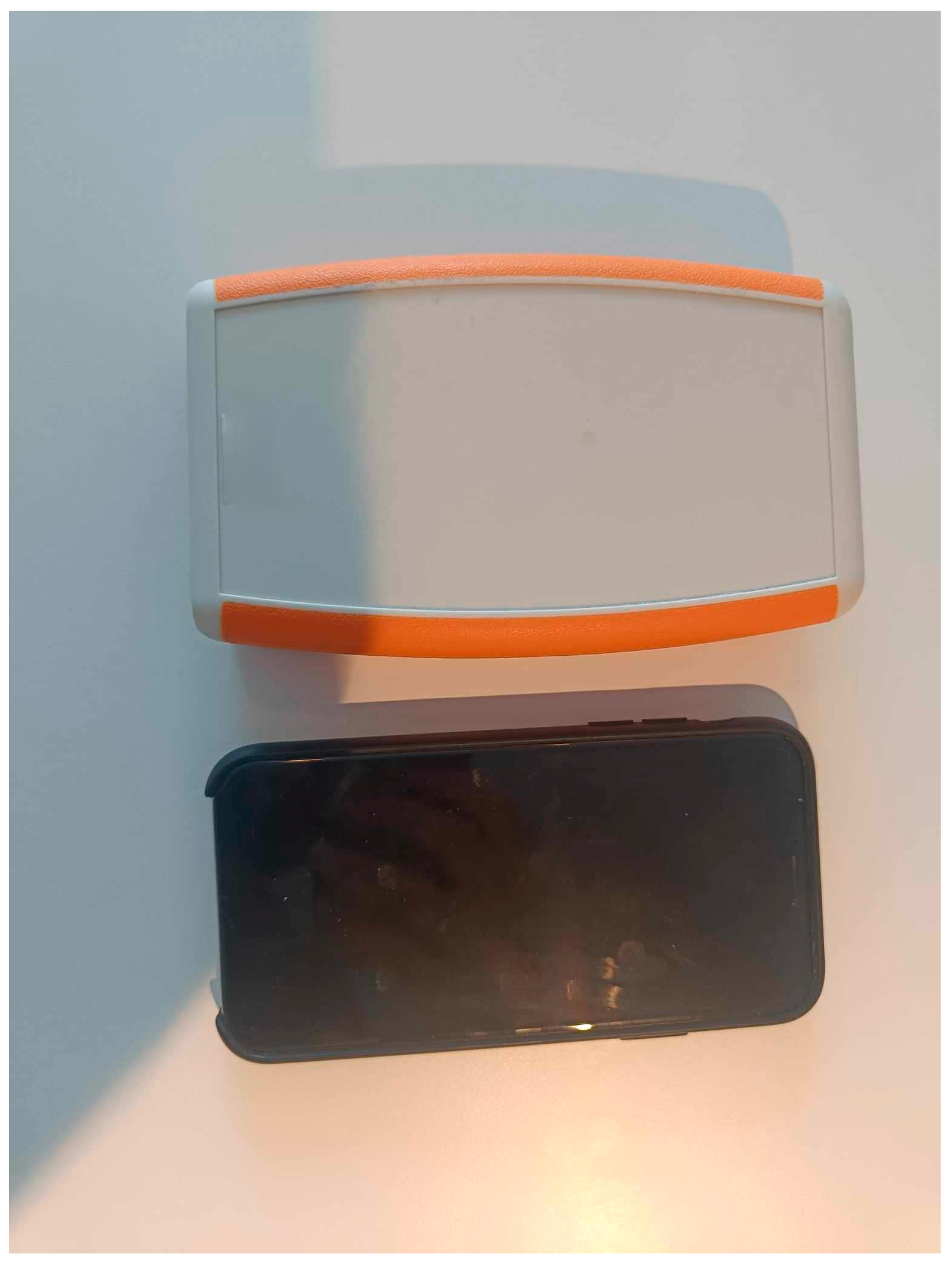
The ARMIE node is a portable air-monitoring device assembled by the Department of Public Health, Aarhus University, Denmark, in collaboration with Devlabs ApS, specifically designed for personal exposure monitoring studies. The unit measures 14.5 cm × 8.5 cm × 3.5 cm (height × width × depth), weighs approximately 275 g, and is designed to be worn with a shoulder strap that positions the sensor near the hip during use. A picture of the ARMIE node is found in Appendix D, Figure A9. The ARMIE node incorporates a Sensirion SPS30 optical particulate matter sensor to provide real-time PM2.5 measurements. Because optical PM sensors have well-documented limitations in accurately detecting coarse-mode particles (PM10), as they cannot reliably size them and they can be lost through settling and impaction, this study focuses exclusively on PM2.5 [19,20]. Additional environmental and contextual data are captured by the Sensirion SHTC3 sensor (temperature and relative humidity (RH)). A Quectel BG86 module enables cellular and wireless connectivity for geolocation (GPS) and data transmission. The ARMIE node records data at a five-minute interval, with each logged value representing the one-minute average from an active sampling period conducted within that interval. In line with its intended application, the ARMIE node is designed primarily for assessing indoor personal exposure patterns, where pollutant levels are strongly influenced by individual behaviors and microenvironmental conditions. An overview of all the individual sensors incorporated in the ARMIE node is listed in Appendix A, Table A1.

2.1.2. Mid-Cost Instrument: DustTrak

A TSI DustTrak DRX (Model 8533, TSI Inc., Shoreview, MN, USA) was included as a mid-cost, optical real-time aerosol monitor. While not a regulatory reference instrument, DustTrak is widely used in field validation studies of low-cost sensors. Its inclusion ensured methodological consistency with prior literature and provided an additional comparator that bridges laboratory-grade reference instruments with real-time, field-deployable measurements. DustTrak logged 1-min mean PM2.5 measurements.

2.1.3. Reference Instruments: Scanning Mobility Particle Sizer

A TSI Scanning Mobility Particle Sizer (SMPS), with a Differential Mobility Analyser (DMA, model 3081, TSI Inc., Minnesota, USA) and a Condensation Particle Counter (CPC, model 3775, TSI Inc., Minnesota, USA), was used to characterize submicron particles based on electrical mobility. The SMPS was set to measure particles in the range 0.015 to 0.66 µm; however, to ensure comparability with the optical instruments, data < 0.3 µm were excluded from further analyses. For larger particles, a TSI Aerodynamic Particle Sizer (APS, Model 3321, TSI Inc., Minnesota, USA) provided aerodynamic diameters from 0.8 to 20 µm. SMPS scan time was set to 125 s, and the APS was sampled at an interval of 20 s. Data from the SMPS and APS were extracted using the TSI Aerosol Instrument Manager software (AIM, version 10.3.1.0). Particles larger than 2.5 µm were removed in the analysis when comparing with the PM2.5 size fraction.
Size-resolved number concentrations from the SMPS (0.3–0.66 µm) and APS (0.8–2.5 µm) were converted to mass concentrations under a unit-density, spherical-particle assumption. For the SMPS, mass distributions were exported directly from TSI Aerosol Instrument Manager using a particle density of 1.0 g cm3 and a dynamic shape factor χ = 1.0. For the APS, mass concentrations were calculated from the number size distributions by applying the same density (1.0 g cm3) and spherical-particle assumption. These conversions yield a quasi-PM2.5 mass metric that is suitable for relative comparison with the optical instruments, but they do not account for source-specific differences in particle composition or effective density.
Together, the SMPS and APS provided reference data covering 0.3–0.66 µm (SMPS) and 0.8–2.5 µm (APS), leaving a narrow gap between 0.66 and 0.8 µm where neither instrument operated. The choice of SMPS and APS reflects their status as widely accepted reference technologies in aerosol science. The SMPS is considered the most accurate instrument for submicron size distributions, while the APS provides aerodynamic diameters that are directly relevant for inhalation health and PM mass metrics.

2.2. Experimental Setup

Experiments were conducted in a climate-controlled chamber located at the Aerosol and Climate Laboratory, Lund University, Sweden. The chamber had internal surfaces of stainless steel to minimize electrostatic deposition and emissions from volatile materials. It had a total volume of approximately 24 m3 (2.4 m × 3.6 m × 2.85 m) plus a ventilated airlock to avoid contamination from the outside. It could operate at temperatures from 5 °C to 50 °C and RH levels between 20% and 80%. Ventilation rates were adjustable, with inlet airflow ranging from 0 to 80 L/s or 0–12 air changes per hour (ACH). The chamber is equipped with integrated measurements for temperature, RH, and airflow, and these parameters are continuously displayed on a digital monitoring panel. A ceiling-mounted climate fan provides continuous air mixing and supports the stabilization of temperature and RH during experiments. The incoming air is conditioned through a multi-stage filtration and treatment system, including a pre-filter, a carbon filter, and a High-Efficiency Particulate Air (HEPA) filter, as well as a pre-heater and an acoustic silencer. Both the SMPS and APS were equipped with silica dryers during high-humidity experiments. Although volumetric flow rates were controlled, airflow velocities inside the chamber were not measured directly, and therefore, Reynolds numbers could not be determined. However, the chamber flow regime was designed to maintain well-mixed conditions.

2.3. Aerosol Generation

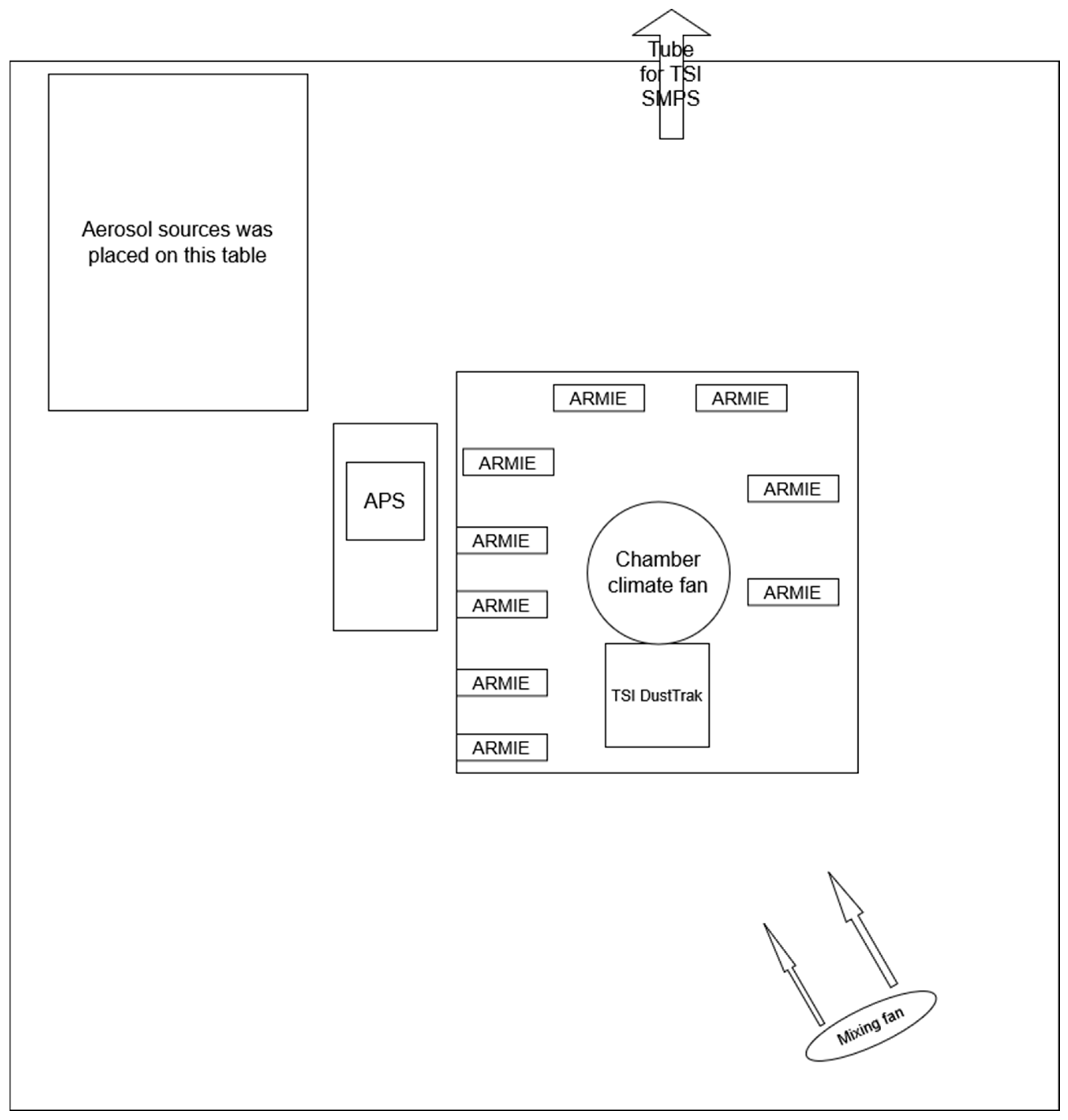
Aerosols were generated within the chamber using candles, cooking activities, and cigarette smoke (details for each source are provided below). The ARMIE node is intended for personal exposure monitoring within a cohort of patients with implantable cardioverter-defibrillators (ICDs). Therefore, cigarette smoke was also included as an evaluation source. Tobacco combustion is a frequent indoor emission and a major risk factor for cardiac events in this patient group. To ensure homogeneous particle distribution, a fan was placed inside the chamber to facilitate air mixing. All aerosol generation occurred entirely within the enclosed chamber under controlled conditions. A schematic of the chamber showing the location of the instruments and fan is provided in Appendix D.

2.3.1. Clean Air

For clean air measurements, the chamber was flushed with filtered air. Filtration for clean air measurements utilized the pre-, carbon, and HEPA filter system.

2.3.2. Candles

Four candles were lit, extinguished, and then relit, after which they remained burning for 10 min. Throughout the experiment, the environmental chamber was maintained at 20 °C, 40% RH, and an air flow rate of 5 L/s (0.75 ACH). The procedure was repeated under high-humidity conditions at 20 °C with RH levels of 70–80%.

2.3.3. Cooking

Cooking-generated particles were generated by preparing pancakes using a Trangia gas burner and an IKEA non-stick pan, with pancake batter prepared according to a standard recipe. The environmental chamber was maintained at 20 °C, 40% RH, and an air flow rate of 5 L/s. During the 10-min cooking period, the airflow rate was increased to 20 L/s1 (3 ACH) to maintain acceptable CO2 concentrations inside the chamber while laboratory personnel were present to generate the aerosols. This procedure was repeated at 20 °C under high-humidity conditions (70–80% RH).

2.3.4. Cigarettes

A Prince Rounded Taste cigarette was lit to generate aerosols inside the chamber. To prevent self-extinguishing, the cigarette was connected to a flow rate equal to 3 L/min that provided a brief suction pulse (approximately 3 s) every minute to maintain combustion. This procedure produced a stable side-stream aerosol without imposing a formal ISO puffing regime. Aerosol generation was conducted at 20 °C and 40% relative humidity, with the chamber ventilation rate increased to 30 L/s1 (4.5 ACH) to prevent odor accumulation. The experiment was not conducted under high-humidity conditions due to odor constraints.

2.4. Data Processing and Calibration Methods

To enable direct comparison across all instrument types, all data streams were synchronized using time stamps rounded to the nearest five-minute interval. All data were aggregated to five-minute means to match the sampling resolution of the low-cost sensors. For each five-minute interval, the arithmetic mean of all comparison instruments (for PM2.5 and relative humidity) was calculated.

2.4.1. Performance Evaluation Metrics

For the evaluation of the ARMIE node performance, we focused on four evaluation metrics: the Pearson linear correlation coefficient (r), relative percent error, and mean error with corresponding upper and lower limits of agreement (LoA). These metrics were selected because they collectively capture key aspects of sensor performance relevant for calibration and validation. Tables in Appendix A are expanded to include mean absolute error (MAE) and root mean squared error (RMSE).
The correlation coefficient quantifies the strength of the linear association between the sensor readings and the reference instrument, reflecting the sensor’s ability to reproduce the temporal variability in particle concentrations. Relative percent error indicates the proportional error deviation between the sensor and reference measurements. Mean error and the limits of agreement (LoA) describe systematic and random deviations, respectively, providing information on both accuracy and precision across the full measurement range.
The evaluation was not designed to assess regulatory compliance with EPA or OSHA performance standards. However, the co-location methodology, use of reference-grade instruments for mass, and comparison of raw and calibrated sensor outputs follow principles consistent with current EPA Air Sensor Toolbox guidance for evaluating the performance of low-cost particle sensors [18].

2.4.2. Calibration Models

For each comparison instrument, two models were evaluated. The first model evaluated the raw PM2.5 readings from the ARMIE node. The second model evaluated corrected ARMIE readings corrected with a multiple linear regression model that incorporated the PM2.5 readings and RH readings from the ARMIE node as independent variables.
The multiple linear regression calibration model used the following formula:
P M 2.5 ,       r e f   = a 0 + a 1 × A R M I E   P M 2.5 + a 2 × R H + a 3 × ( A R M I E   P M 2.5 × R H )
where the intercept ( a 0 ), sensitivity ( a 1 ), and the correction coefficient ( a 2 and a 3 ) are determined separately for each sensor in the leave-one-sensor out approach and for each source in the leave-one-source out approach.
Model performance was evaluated using two different cross-validation strategies. In the leave-one-sensor-out approach, data from one sensor node at a time were excluded during model training and subsequently used for independent testing. In the leave-one-source-out approach, all data corresponding to a specific exposure source (e.g., cooking, candles, cigarettes, or clean air) were withheld during model training, and the model was evaluated on the source that was left out.
Personal deployments of low-cost PM sensors are expected to occur across heterogeneous and partially unobserved indoor microenvironments, introducing variability that cannot be fully captured by environment-specific calibration models. Although more flexible or non-linear calibration approaches may improve fit within a given dataset, such models risk overfitting to source- or setting-specific characteristics and may perform poorly when applied across individuals and homes. Accordingly, we applied parsimonious parametric calibration models prioritizing interpretability and robustness across conditions.

2.4.3. Sensitivity Analyses

We conducted a sensitivity analysis with the same approach as the main analysis. This analysis only included data if ARMIE node PM2.5 readings were below 50 µg/m3 and above 5 µg/m3. All tables and figures for this analysis are presented in Appendix B.

3. Results

3.1. Data Overview

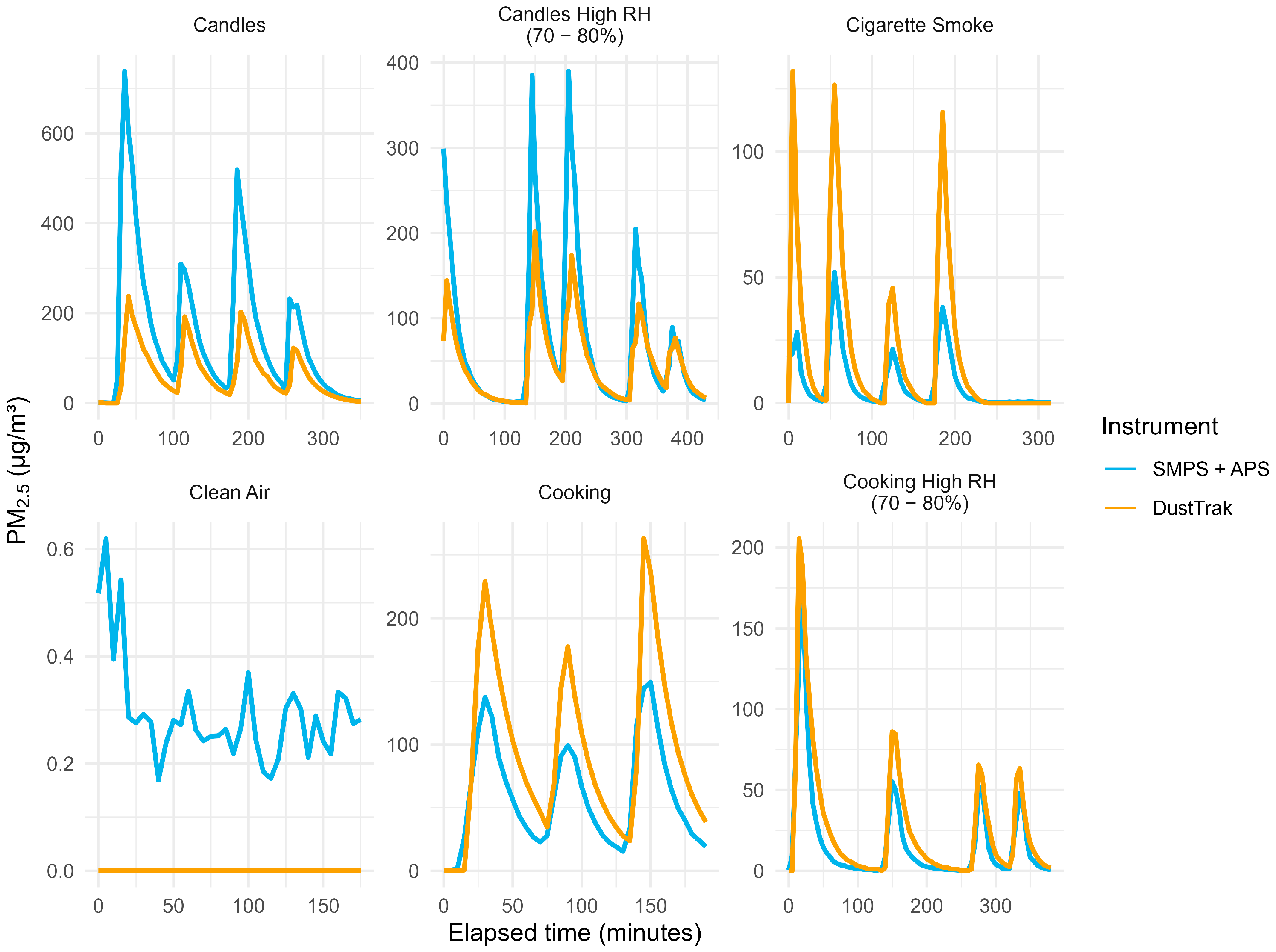
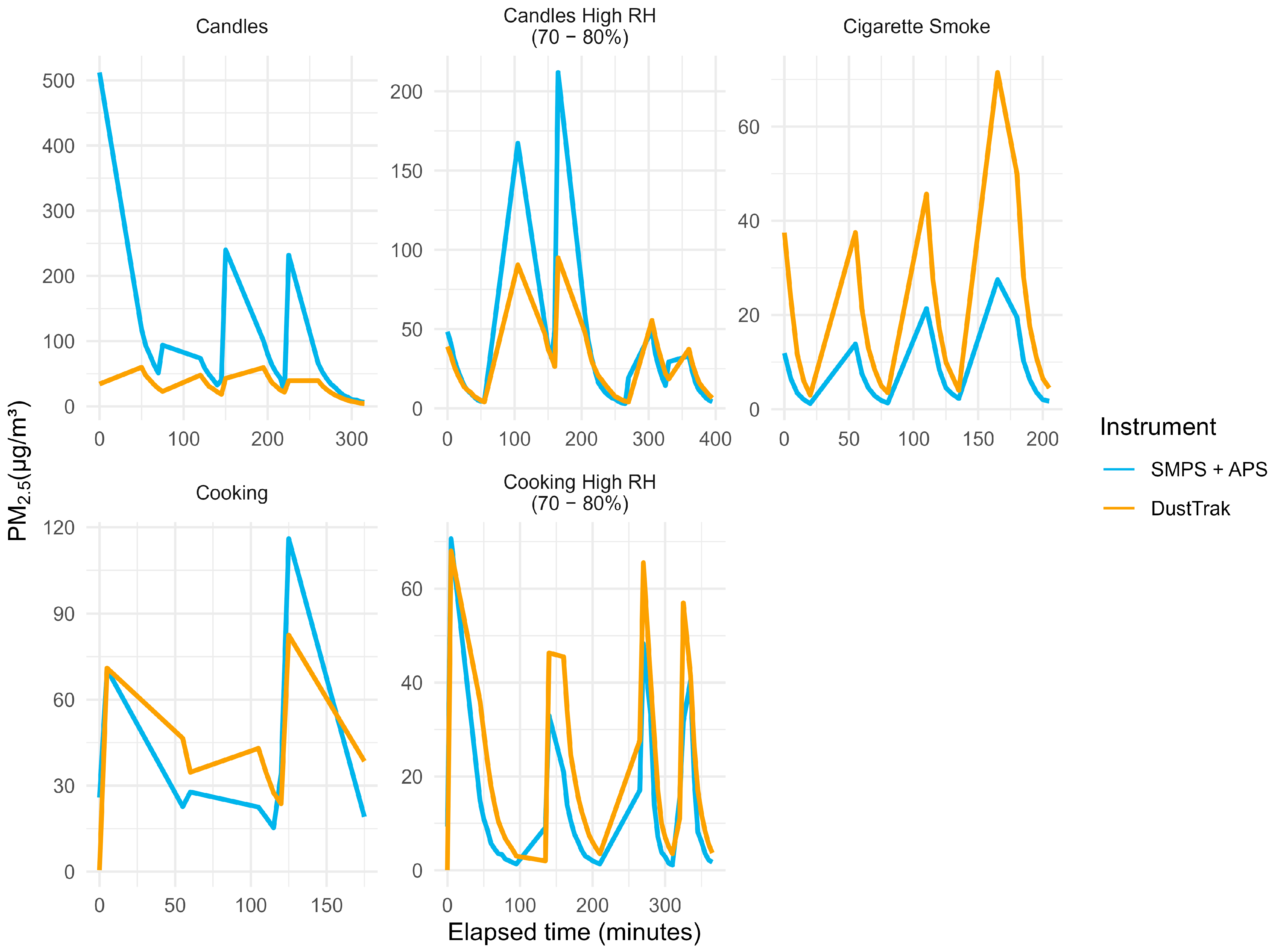
Figure 1 illustrates PM2.5 mass concentrations over time for each aerosol source generated in the climate-controlled chamber.
As found in Table 1, particle concentrations varied widely by source. Candle burning produced the highest particle levels, with median mass concentrations of 110 µg/m3 (SMPS + APS) and 59 µg/m3 (DustTrak). Cooking emissions reached median values around 57 µg/m3, while cigarette smoke and high-RH cooking generated substantially lower levels (<30 µg/m3). Number concentrations followed the same pattern, highest for candles and lowest for cigarette smoke. Overall, candles generated the most intense and variable aerosol loads, with humidity consistently reducing measured mass across all sources.
An overview of the measurement time per sensor and source type is provided in Appendix A, Table A2. Data completeness was below 100% for all sensors, primarily due to intermittent connectivity losses.

3.2. Leave-One-Sensor-Out

The performance evaluation metrics from the leave-one-sensor-out calibration are presented in Table 2. All Metrics are generated after excluding all observations where comparison instrument PM2.5 readings < 5 µg/m3. Thereby, these metrics do not include any data from the clean air.
Across all ARMIE nodes, performance was highly consistent when evaluated against the DustTrak but considerably weaker when compared with the SMPS + APS. When benchmarked against the DustTrak, the ARMIE node showed uniformly high correlations (r = 0.95), confirming strong linearity. Calibration reduced the mean error from 9.25 µg/m3 to −1.11 µg/m3 and slightly narrowed the limits of agreement (from −30.45 to 48.95 µg/m3 uncalibrated to −34.08 to 31.86 µg/m3 calibrated). However, the mean relative error increased from 340% to 527% following calibration.
In comparison with the SMPS + APS, the ARMIE node showed weaker agreement overall. Correlations were low (r = 0.51−0.52), and mean errors ranged from −6.22 to −12.72 µg/m3, with broad limits of agreement (−202.6 to +177.16 µg/m3). Calibration produced only minor improvements: slight increases in correlation, modest reductions in mean error, and less skewed LoA. However, the mean relative error increased from 53% to 73% after calibration.
For an expanded table of Table 1, including MAE and RMSE based on parameters for each of the 9 sensors, see Appendix A, Table A3.
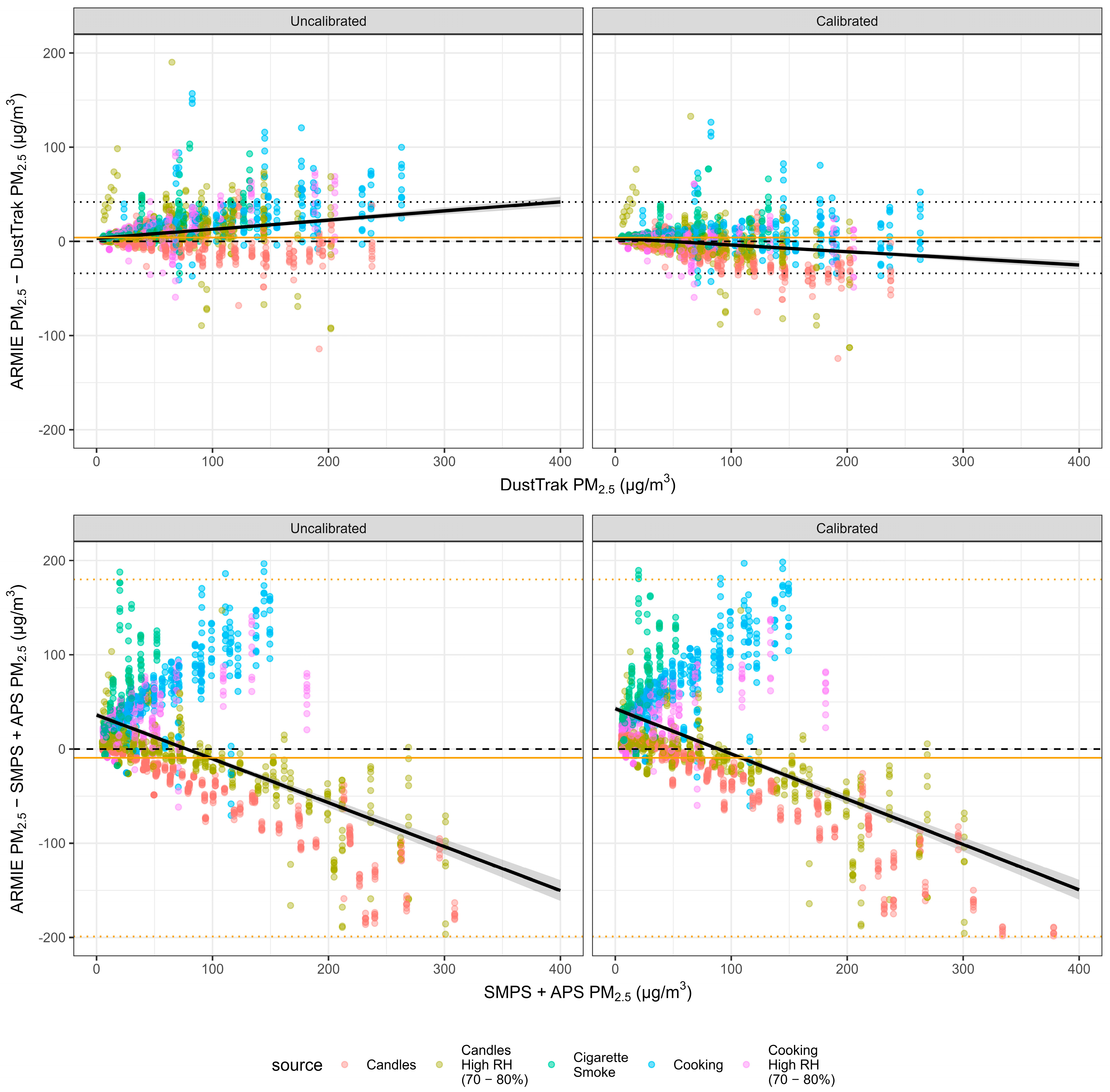
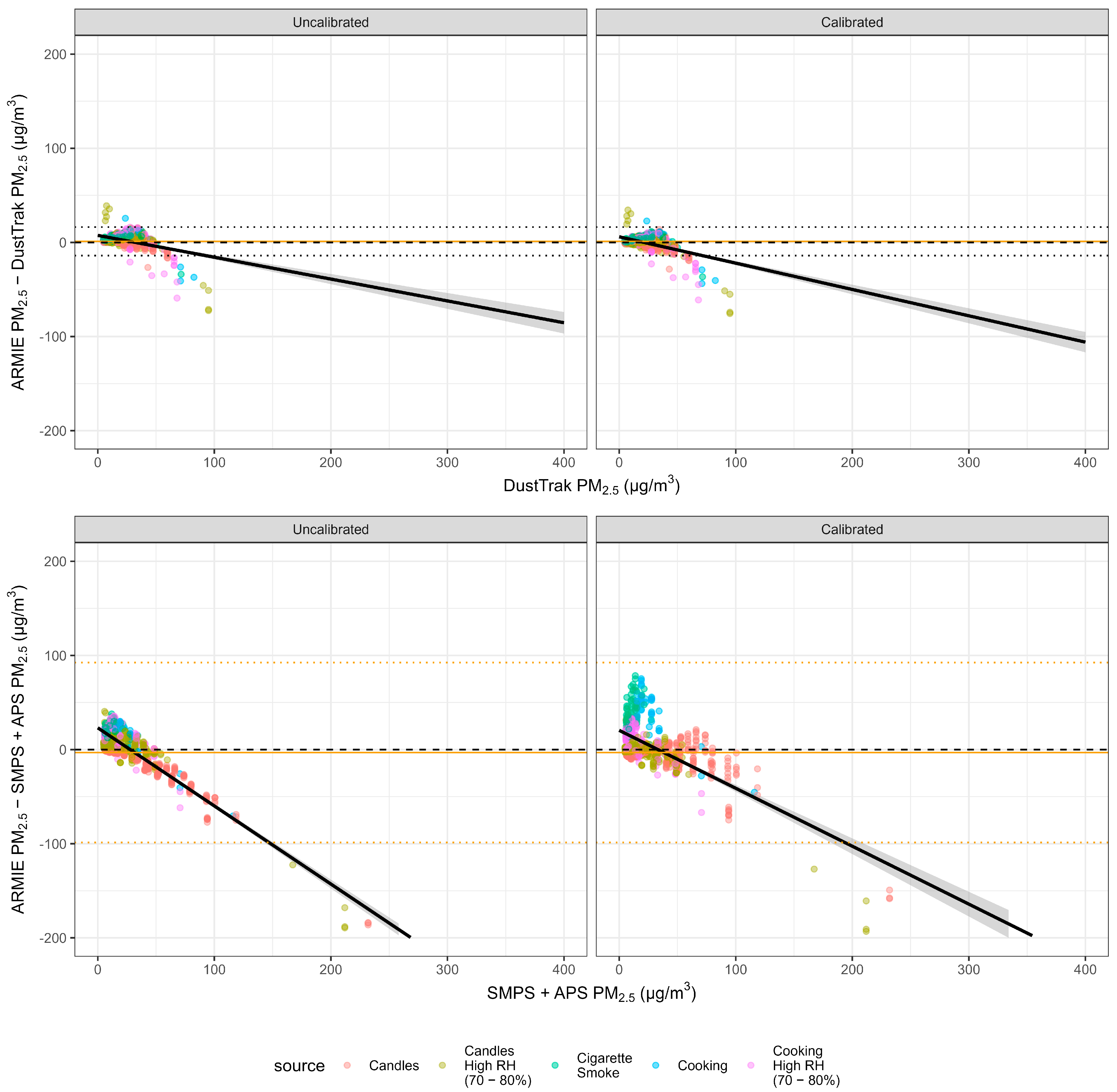
Figure 2 presents Bland-Altman plots showing the difference between ARMIE and reference PM2.5 measurements across all observations. Each point is color-coded by source. The orange dashed line indicates the mean error, with 95% limits of agreement shown as dotted orange lines. A linear regression line (black) summarizes the trend in measurement error across the concentration range. Calibration produced a visible shift in the error trend for the DustTrak comparison: from a positive slope in the uncalibrated data to a negative slope after calibration, indicating a correction of systematic overestimation. Appendix A, Figure A1 shows corresponding scatterplots faceted by emission source.
Figure 2 shows heteroscedasticity across comparison instruments as well as calibrated and uncalibrated data. Figure 2 shows distinct source-dependent patterns in the residuals. Candle emissions, which are dominated by soot aggregates with low scattering efficiency, tend to be underestimated by the ARMIE node when compared with the SMPS + APS reference. In contrast, aerosols produced by cooking and cigarette smoke consist mainly of organic particles generated at lower combustion temperatures, which exhibit stronger light-scattering properties. These aerosols therefore lead to an overestimation by the ARMIE node relative to the SMPS + APS reference.
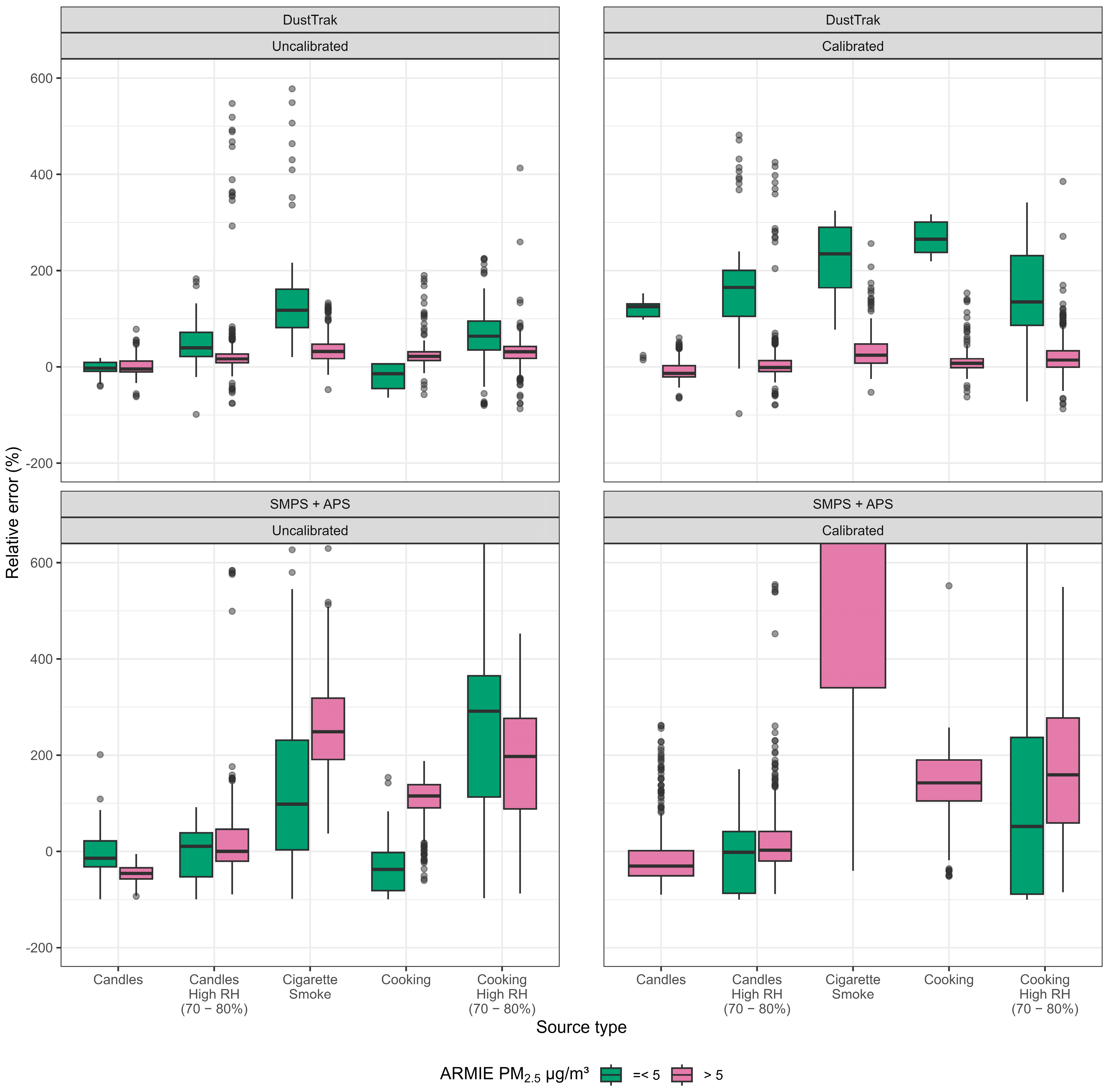
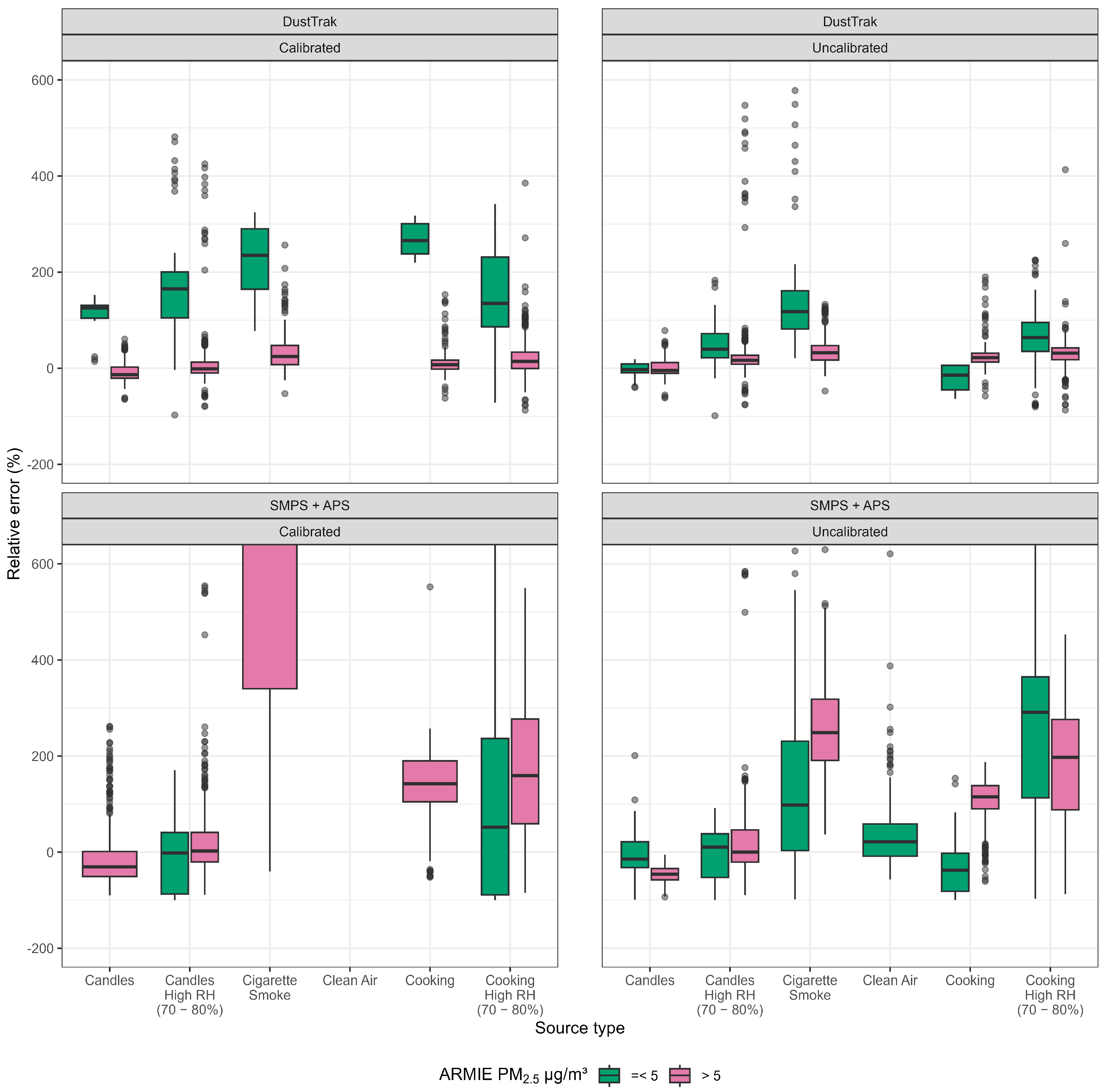
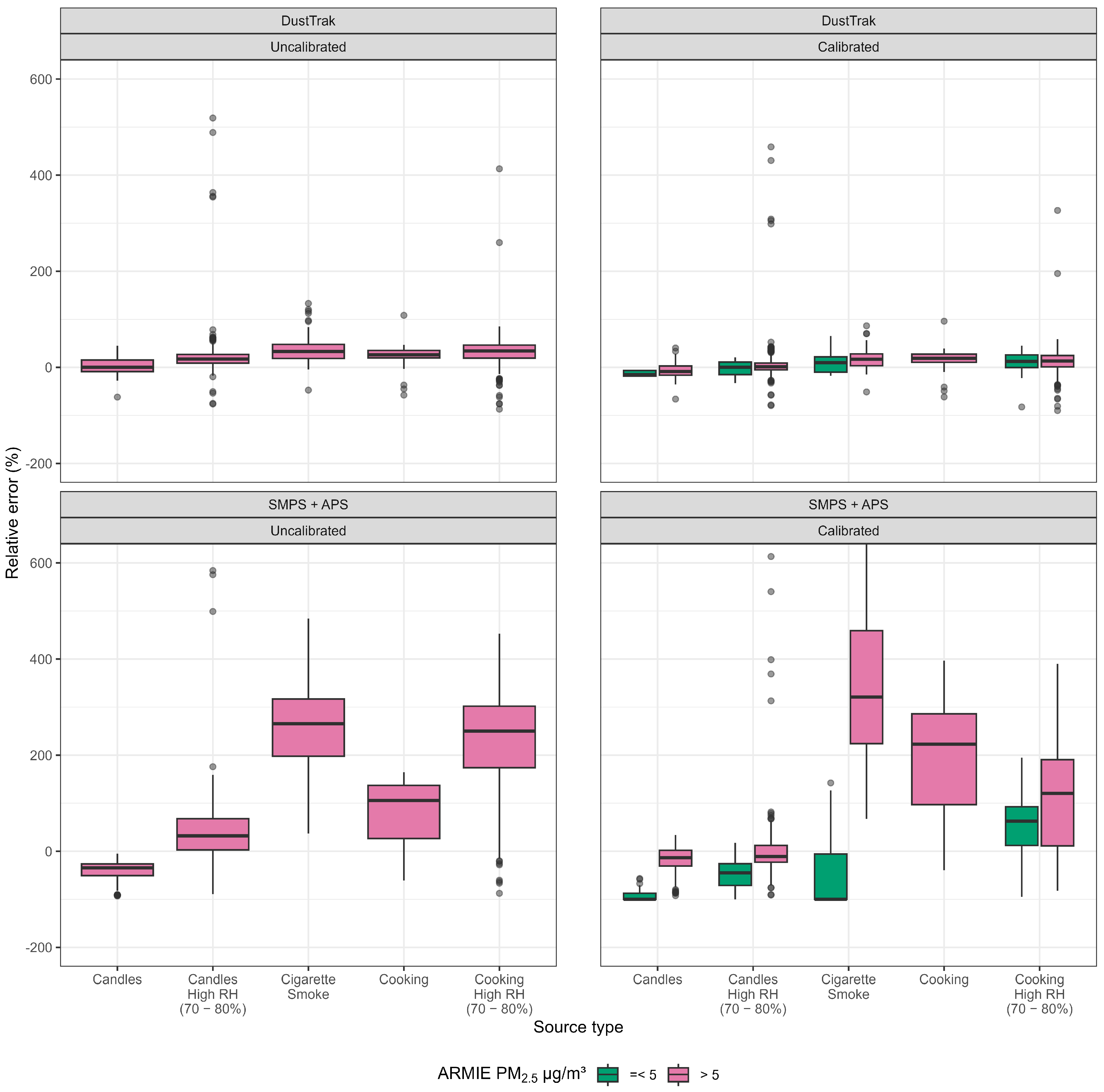
Relative errors were large for both the DustTrak and SMPS + APS comparisons. Figure 3 provides a graphical inspection of this pattern, showing that the most extreme relative errors originate primarily from observations with ARMIE PM2.5 readings ≤ 5 µg/m3. When stratified by concentration range, relative error distributions were markedly inflated in the low-concentration group, regardless of calibration status or reference instrument. At higher concentrations (>5 µg/m3), relative errors were substantially lower. For source-specific relative errors across individual observations, see Appendix A, Figure A2.
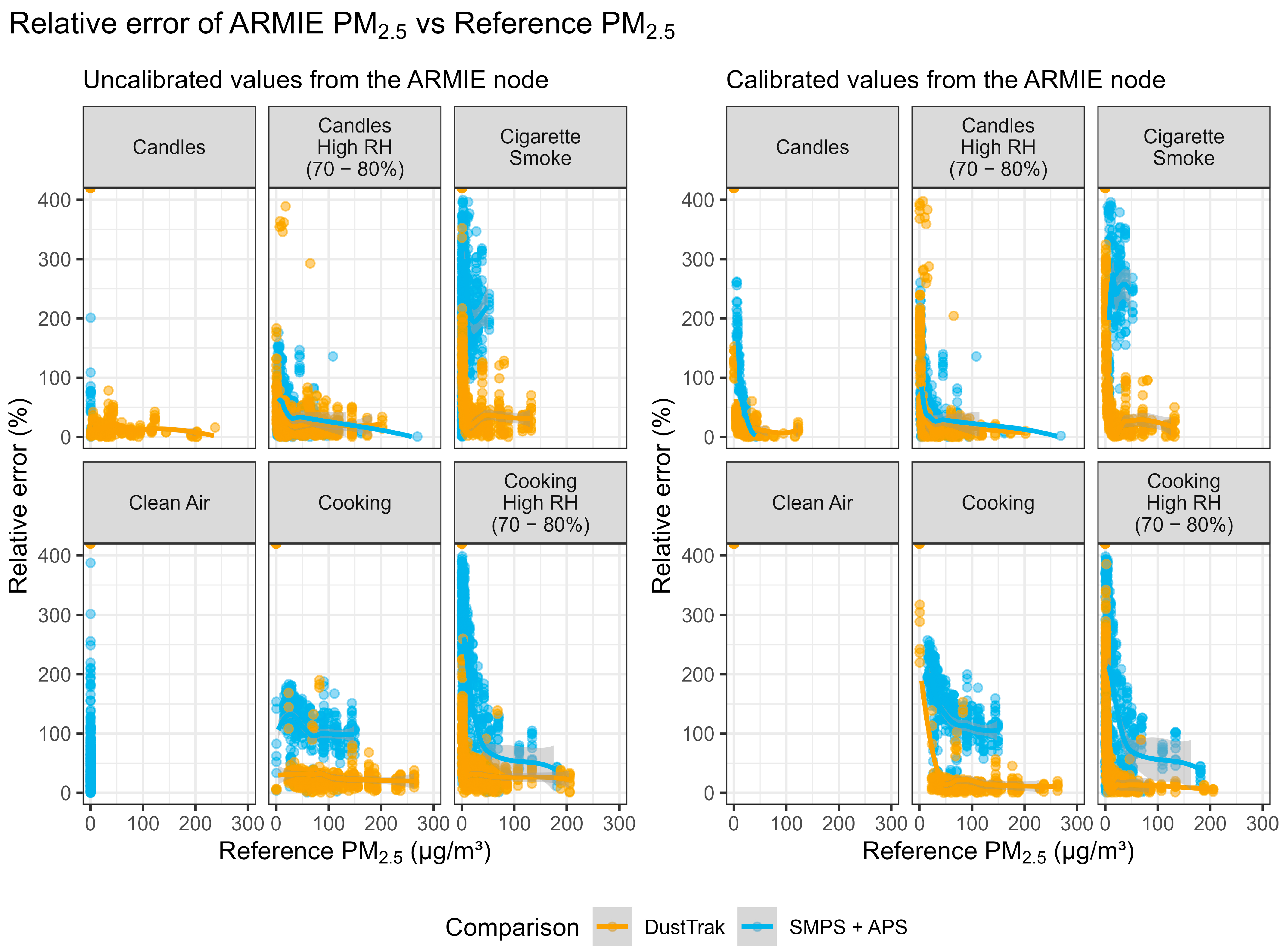
Figure 3 shows a stable relative error when the ARMIE readings < 5 ug/m3 are excluded. A scatterplot with relative error on the Y-axis and the reference PM2.5 on the x-axis is found in Appendix A Figure A2.

3.3. Leave-One-Source-Out

The performance evaluation metrics from the leave-one-source-out calibration are presented in Table 2. All Metrics are generated after excluding all observations where comparison instrument PM2.5 readings < 5 µg/m. Thereby, these metrics do not include any data from the clean air. Across all emission sources, the ARMIE node maintain consistently strong agreement compared to the DustTrak, while larger discrepancies were observed when compared to the SMPS + APS. For the DustTrak, correlations remained high (r = 0.93–0.98) across all aerosol types, confirming stable linearity of response under variable emission conditions. Calibration generally reduced systematic bias, also under elevated relative humidity, shifting most mean errors toward zero and tightening the limits of agreement, albeit not for the candles source.
In contrast, comparisons with the SMPS + APS showed moderate correlations (r = 0.78–0.92) and consistently higher mean errors than those observed for the DustTrak. Even after calibration, mean errors remained substantial (changing from −96.24 to −130.83 µg/m3 for candles and from 62.33 to 160.89 µg/m3 for cooking), and the span between lower and upper limits of agreement ranged broadly between −408 and 368 µg/m. All performance metrics comparing the ARMIE node with DustTrak are presented in Table 3, whereas comparisons with SMPS + APS are presented in Table 4. For MAE and RMSE, please refer to Appendix A Table A4.
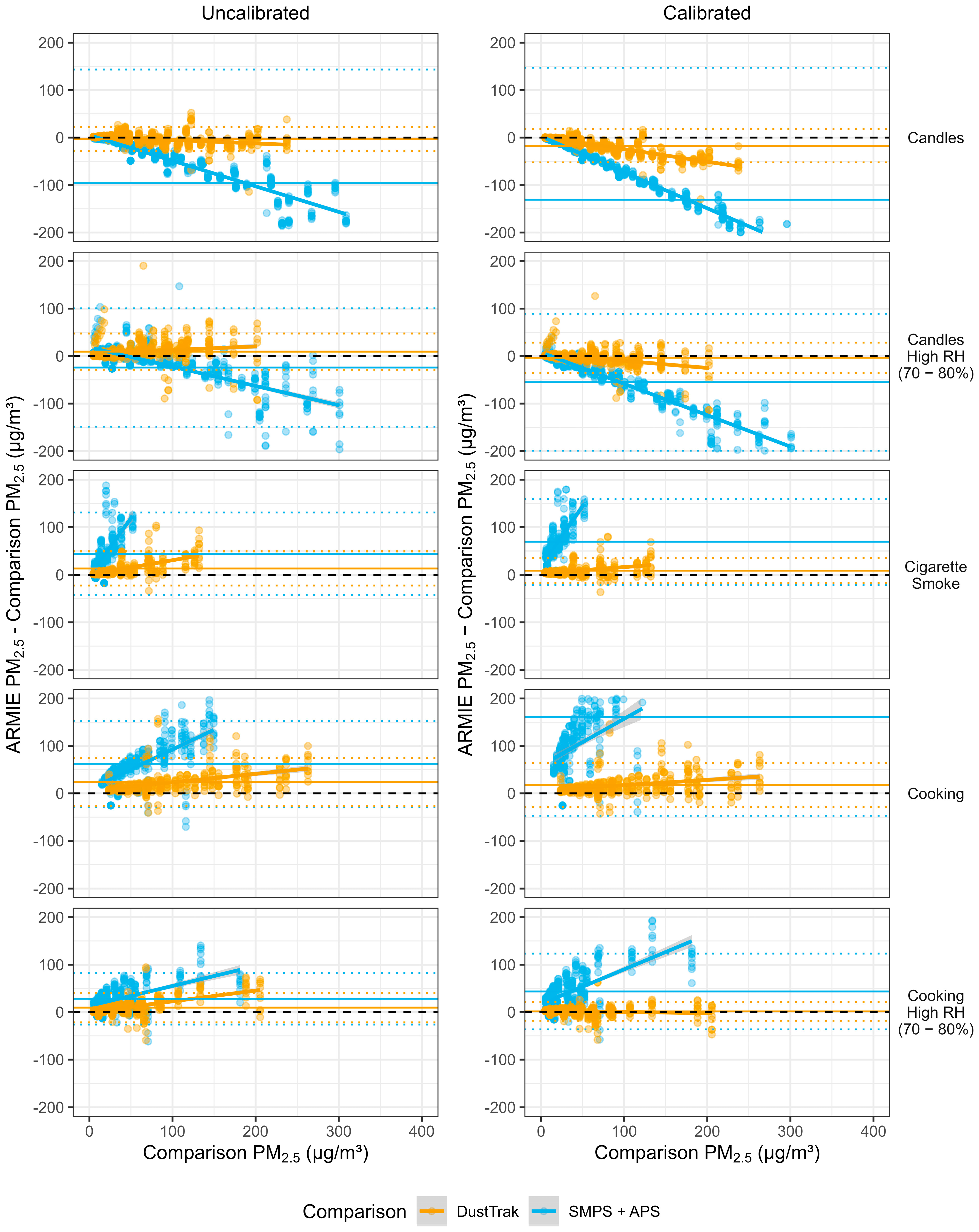
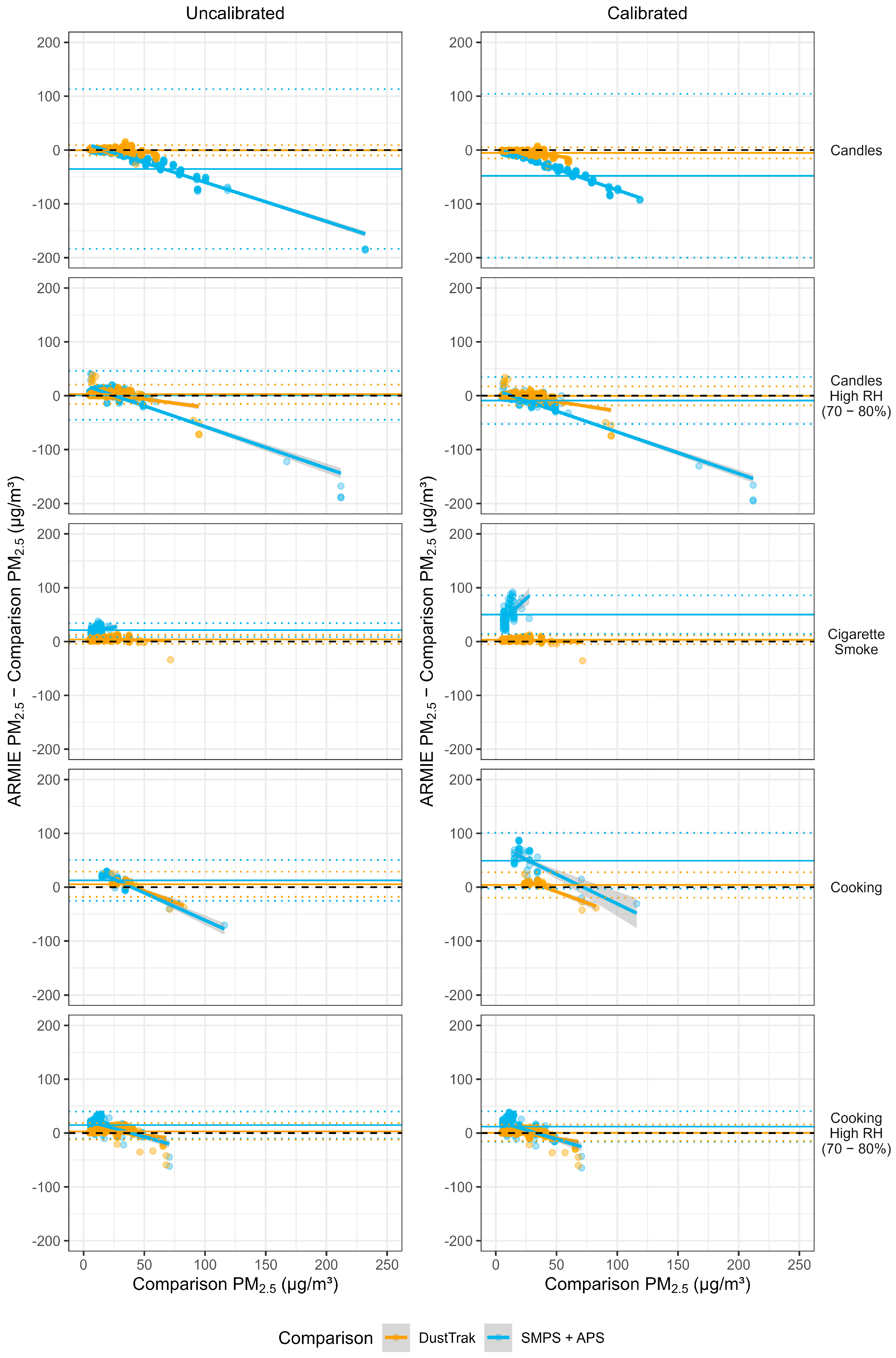
Figure 4 presents Bland-Altman plots stratified by emission source, comparing ARMIE PM2.5 readings with the DustTrak and SMPS + APS across calibration states. Each point represents a single observation, and the panels show how measurement error varies by source and reference instrument. Orange and blue dashed lines denote the mean error and 95% limits of agreement for the DustTrak and SMPS + APS, respectively. A linear regression line is included to illustrate the trend in measurement error across the concentration range.
Comparison with DustTrak revealed source-specific trends in the slope of the error line. For candle emissions, calibration increased the negative slope, while for candles under high relative humidity, the slope shifted from positive to negative—indicating a correction of systematic overestimation. For cooking and cooking under high RH, the slope visibly flattened, suggesting reduced proportional bias after calibration. In contrast, for cigarette smoke, the slope remained largely unchanged. When compared to the SMPS + APS, the slope after calibration steepened for most sources, reflecting persistent over- and underestimation at higher concentrations.
Figure 4 shows heteroscedasticity across comparison instruments, aerosol sources, as well as calibrated and uncalibrated data.

4. Discussion

4.1. Overall Sensor Performance and Calibration Outcomes

The validation experiments showed that ARMIE nodes tracked the DustTrak reference with high correlation (r > 0.93) across all emission sources, consistent with earlier laboratory studies [11,12]. This performance pattern aligns with previous SPS30 evaluations conducted in indoor or residential environments, where strong linear agreement with optical reference instruments has also been observed [11,12,21].
Correlation with SMPS + APS was weaker (r = 0.51–0.92), likely due to differences in detection principles and the complexity of real-world aerosols such as cooking or cigarette smoke. Unlike the ARMIE node and DustTrak, which both rely on light scattering, the SMPS and APS generate number-based size distributions using distinct classification methods, limiting direct comparability. Prior evaluations have similarly reported that SPS30 performance deteriorates when compared against mobility- or aerodynamic-based reference system [13].
Leave-one-source-out analyses confirmed that calibration performance declined when a source was withheld from training. Against the DustTrak, calibration reduced mean error, but LoA remained similar. Against SMPS + APS, calibration effects were inconsistent, with several sources showing increased error and broader LoA, suggesting limited generalizability across particle types.
In contrast, the leave-one-sensor-out approach, which included all sources during training, yielded improved performance across most metrics, particularly when using the DustTrak. Mean relative error remained high in both setups due to instability at low concentrations.
A sensitivity analysis restricted to ARMIE PM2.5 readings between 50 and 5 µg/m3 showed improved agreement when calibrated with DustTrak (mean error −5.26 µg/m3; LoA −15.38 to 4.86 µg/m3), indicating that the ARMIE node performs best in the moderate exposure range relevant to epidemiological research. Finally, strong inter-sensor consistency supports their deployment in larger networks, although modest variation in calibration coefficients underscores the value of batch-wise correction or harmonization procedures.

4.2. Exposure Assessment in Environmental Epidemiology

In the context of particulate matter exposure assessment, a high correlation between low-cost sensors and reference instruments does not imply agreement in absolute concentrations. As Altman and Bland [22] argued, correlation captures linear strength of the association, not equivalence, and can be misleading when used in isolation. For epidemiological applications, the critical concern is whether measured values reflect true exposures with sufficient accuracy to inform individual risk classification. Limits of agreement (LoA) provide a more appropriate basis for this assessment, as they define the interval within which 95% of individual differences are expected to lie [23,24]. For example, the LoA between the calibrated ARMIE and the DustTrak (−34.04 to 31.86 µg/m3) implies that a sensor must report at least 49.04 µg/m3 before one can be 97.5% confident that the DustTrak readings of PM2.5 concentration exceed the WHO-recommended daily average of 15 µg/m3 [25]. Conversely, a sensor reading below 15 µg/m3 does not guarantee that DustTrak readings of PM2.5 concentration are below this threshold; achieving 97.5% confidence would require a physically implausible negative reading of −17.2 µg/m3 (15–31.86). In a sensitivity analysis restricted to moderate concentrations (ARMIE PM2.5 readings between 5 and 50 µg/m3), the mean error was −0.43 µg/m3 for uncalibrated and −5.26 µg/m3 for calibrated sensors, with LoA of −10.02 to 9.16 µg/m3 and −15.38 to 4.86 µg/m3, respectively. This implies that a calibrated ARMIE node would need to report at least 30.18 µg/m3 (15 + 15.18) before one can be 97.5% confident that the DustTrak readings of PM2.5 concentration exceed the WHO guideline of 15 µg/m3.
Such high assurance thresholds are not rare. As shown by Omelekhina et al. [6], indoor PM2.5 concentrations above 30 µg/m3 are frequently observed during everyday activities such as cooking, burning candles, and using e-cigarettes.
Moreover, heteroscedasticity was evident in the Bland-Altman plots, with measurement error increasing at higher concentrations. Since the calculation of LoA assumes constant variance across the measurement range, this violation limits its interpretability, particularly at the upper end of the distribution, where classification error may be greatest.

4.3. Hygroscopic Growth

Low-cost optical particle sensors are strongly influenced by relative humidity, as water can be absorbed by particles and lead to hygroscopic growth. This process often leads to an overestimation of PM2.5 mass concentrations [17].
In the ARMIE node, this limitation may be amplified because the SHTC3 sensor that measures temperature and RH is mounted inside the printed circuit board enclosure rather than sampling the inlet air directly. Consequently, the measured RH may not be representative of the true ambient RH, leading to a misclassification between the conditions driving hygroscopic particle growth and those used for calibration.
Previous studies suggest that the SPS30 sensor implemented in the ARMIE node is less affected by RH than several other low-cost optical particle sensors, though overestimation remains a relevant concern, particularly above 70–80% RH [11,12]. In our controlled chamber experiments, RH was set to target levels of 40% and 80%, but substantial fluctuations occurred, particularly during cooking events and under high-humidity scenarios. This variability highlights the practical challenge of maintaining stable RH conditions in source-specific experiments and underscores the importance of incorporating humidity adjustment strategies into calibration models. Calibration approaches addressing hygroscopic growth have been examined in previous studies. Ref. [26] reported that optical particle counter measurements under RH conditions above 60% should be corrected, and [27] similarly found RH to influence measurement bias. For the intended use of the ARMIE node, the target population is expected to spend more than 90% of the monitoring period indoors, where RH typically remains below these thresholds. Consequently, RH-related corrections would have minimal impact on the overall exposure estimates.

4.4. Reproducibility

The controlled chamber experiments revealed notable variation in the peak PM2.5 concentrations between repeated trials using the same emission source. This variability underscores that absolute reproducibility of concentration profiles is difficult to achieve, even under carefully standardized laboratory conditions. Importantly, this mirrors the inherent heterogeneity of real-world indoor exposures. Cooking events, for instance, generate emissions that vary substantially with food type, cooking oil, and ventilation, leading to order-of-magnitude differences in particle number and mass concentrations [28]. Similarly, comprehensive in situ work in Swedish residences has shown that indoor particle levels are strongly dominated by variable indoor sources such as cooking, candle burning, and e-cigarette use, with indoor concentrations often exceeding outdoor levels by factors of five or more [6].
In this context, the modest variability observed between nominally identical chamber trials should not be regarded as a limitation but rather as a proxy for real-world variability. Real-world household exposures are influenced by factors as diverse as the composition of a candle wick, the use of an exhaust hood, or the style of meal preparation. These sources of stochasticity mean that personal exposure can rarely be reduced to a single “true” emission profile. For sensor validation aimed at personal exposure monitoring, the central objective is therefore not to reproduce identical concentration peaks, but to evaluate sensor performance under conditions representative of the environments in which participants are exposed.

4.5. Temporal Resolution and Data Alignment

A key limitation of this evaluation is the mismatch in temporal resolution between the ARMIE nodes and the higher-grade and reference instruments. The ARMIE node reports one value every five minutes, whereas SMPS reports every 125 s, the DustTrak every minute, and the APS every ten seconds. For analysis, all data were averaged to match the five-minute resolution of the ARMIE node. However, the ARMIE node does not measure continuously within each interval; it samples for one minute every five minutes, and the units were not synchronized to measure at the same time. This unavoidably smoothed sharp peaks and occasionally shifted their timing. Similar challenges with averaging and synchronization have been described in other evaluations of low-cost sensors [21].

4.6. Challenges in Comparing PM2.5 Across Instruments

A major challenge in this evaluation stems from the differing physical principles each instrument applies when classifying particle size. The SMPS reports mobility diameters, the APS aerodynamic diameters, while both the ARMIE node and DustTrak report optical diameters. These size definitions are not directly comparable, as they depend differently on particle morphology, density, and refractive index. Converting between them requires assumptions about particle shape and density that can shift derived mass concentrations substantially—in some cases by a factor of three to five, especially in the accumulation and coarse modes.
Ref. [29] demonstrated these discrepancies in a direct comparison of SMPS, APS, fast mobility particle sizers (FMPS), and electrical low-pressure impactors (ELPI). While reasonable agreement was observed in the mid-size range, substantial divergence occurred at both the ultrafine (<50 nm) and coarse (>1 µm) ends of the distribution. In the present study, such definitional mismatches likely contributed to the weaker agreement between the ARMIE node and the combined SMPS + APS reference. By contrast, DustTrak shares an optical measurement principle with the ARMIE node, allowing for more coherent mass estimates without the need to reconcile fundamentally different size metrics.
These limitations underscore that the reference PM2.5 derived from merged size distributions is not absolute, but highly conditional on conversion assumptions. These discrepancies are also visible in Figure 1, where the degree of divergence between the DustTrak and the SMPS + APS varies across emission sources, reflecting the different physical measurement principles of the instruments and the source-specific composition and size distribution of the generated aerosols. As such, evaluation studies relying on hybrid SMPS + APS systems must account for this uncertainty when benchmarking optical sensors. This is consistent with previous findings that even reference-grade optical instruments such as the DustTrak can show substantial deviations under varying aerosol types unless specifically calibrated [30], and that strong correlation in temporal trends does not imply agreement in absolute mass concentration [31].

4.7. Assumptions in SMPS + APS Number to Mass Conversion

An important methodological limitation is that the particle mass concentrations derived from the SMPS and APS relied on simplified number–to–mass conversions using a unit density (1.0 g cm−3) and a spherical particle shape factor. These assumptions do not capture the true effective densities of the source aerosols and therefore introduce uncertainty in the absolute mass estimates.

4.8. Absence of Gravimetric Reference Measurements

A further limitation is that no filter-based gravimetric measurements were collected during the chamber experiments. As a result, the mass concentrations derived from the SMPS and APS cannot be corrected to a traceable gravimetric standard. This restricts the interpretation of the SMPS + APS data to relative comparisons rather than absolute mass validation.

4.9. Sampling Frequency

Another limitation of this evaluation was inconsistent data uploading from the ARMIE nodes, resulting in variation in the number of observations across sources and devices. For example, during the candle experiments, most sensors provided 36–39 observations, while sensor 196 only logged 14, and sensor 199 logged 15. Similar gaps were observed across other sources, with the problem most pronounced in the cooking experiments, where some sensors recorded as few as 16 observations. These irregularities reduce comparability between sensors and may introduce bias if performance metrics are calculated from unequal sample sizes. The chamber setup itself may have contributed, as the experiments were conducted in steel chambers with weakened signal transmission, which increased the risk of failed uploads. For a full overview of data completeness, see Appendix A, Table A2.

4.10. Perspectives

Epidemiologic studies have long relied on fixed-site monitors as proxies for personal exposure. Yet, these ambient data often misrepresent the concentrations to which participants are exposed, particularly when indoor emissions dominate daily life. While such exposure misclassification is well known, it has not prevented the discovery of robust health associations.
Our findings show that low-cost sensors such as the ARMIE node perform with high correlation when compared with mid-cost instruments like the DustTrak. This convergence signals a methodological shift, where personal exposure monitoring with validated, low-cost devices has become feasible. For several epidemiological questions, particularly those relying on within-person contrasts over time, the ability to capture exposure variability and timing may be as important as accuracy with a reference instrument. Rather than striving only for accuracy, emphasis should now turn to representativeness, capturing how everyday environments drive the variability in personal exposure. With low-cost sensors, Public Health research can focus on how personal fluctuations in PM2.5 may impact the risk of disease.

5. Conclusions

In this study, we demonstrated that the ARMIE nodes exhibit strong linear correlations with an optical reference instrument (DustTrak) across a range of realistic indoor emission sources, consistent with previous evaluations of low-cost optical PM2.5 sensors. However, agreement analysis demonstrated that correlation alone is insufficient for characterizing measurement accuracy in exposure assessment. Bland-Altman analyses showed substantial disagreement at the observation level, including concentration-dependent error and heteroscedasticity, with increasing error at increasing PM2.5 levels.
Using raw (uncalibrated) measurements, the ARMIE node tracked temporal variability well relative to the DustTrak (r ≈ 0.95) but showed some disagreement reflected in the mean error (9.25 µg/m3) and LoA (−30.45 to 48.95 µg/m3). In contrast, correlation with SMPS + APS was substantially weaker (r ≈ 0.51; mean error = −12.72 µg/m3; LoA = −202.60 to 177.16 µg/m3), reflecting differences in measurement principles and mass derivation assumptions.
A linear calibration model including relative humidity reduced mean error when compared with DustTrak (mean error −1.11 µg/m3) and modestly narrowed LoA (−34.08 to 31.85 µg/m3), but did not eliminate heteroscedasticity or the source-dependent discrepancies. Compared with SMPS + APS concentrations, calibration yielded only marginal changes in correlation and LoA and did not resolve the large source-dependent discrepancies, indicating limited transferability of a single global correction across particle composition and size distribution.
These findings underscore that calibration of low-cost PM sensors should be treated as source- and condition-dependent, and future deployments should prioritize (i) calibration strategies matched to expected aerosol mixtures and RH regimes, and (ii) analytical frameworks that propagate measurement uncertainty (e.g., LoA-informed thresholds or measurement-error models) rather than relying on correlation metrics alone.
Taken together, these results show that ARMIE node data are best interpreted as providing reliable information on relative within-person variation and exposure timing in indoor environments, while absolute mass concentrations remain conditional on aerosol type, humidity, and the chosen reference framework.

Author Contributions

Conceptualization: T.S. (Torben Sigsgaard) and A.K. Methodology: J.L. and A.K. Software: T.S. (Tue Skallgaard). Validation: T.S. (Tue Skallgaard) and A.K.; Formal analysis: A.K. Investigation: T.S. (Tue Skallgaard) and J.L., A.K. Resources: J.L., Division of Ergonomics and Aerosol Technology, Lund University, Lund, Sweden. Data curation: A.K. Writing—original draft preparation: A.K. Writing—review and editing: R.Ø.N., L.B.F., J.L., T.S. (Torben Sigsgaard), T.S. (Tue Skallgaard), J.G.C.L. and C.E.S. Visualization: A.K. and L.B.F. Supervision: T.S. (Torben Sigsgaard), R.Ø.N. and J.G.C.L. Project administration: A.K. Funding acquisition: C.E.S., T.S. (Torben Sigsgaard) and A.K. All authors have read and agreed to the published version of the manuscript.

Funding

Asbjørn Kloppenborg, Torben Sigsgaard, Clive Sabel, Louise B. Frederickson, and Tue Skallgaard were supported by BERTHA—the Danish Big Data Centre for Environment and Health—funded by the Novo Nordisk Foundation Challenge Program (grant NNF17OC0027864). All work related to assembling and software programming for the ARMIE node was supported by ARMIE—Arhythmia, Myocardial Infarction & the Environment—funded by Karen Elise Jensens Fond. (Granted Karen Elise Jensens Fond 29-06-21). All chamber resources and laboratory expenses associated with the experimental work conducted were supported by the Swedish Research Council FORMAS (Grant Nos. 2021-02382 and 2024-01765).

Data Availability Statement

The original data, as well as all code used to generate the results in this study, are openly available at the GitHub (Git version 2.50.1.windows.1) repository “ARMIELabEval” https://github.com/Kloppenborg/ARMIELabEval.git (accessed on 22 December 2025).

Acknowledgments

The authors would like to acknowledge Devlabs APS for assembling the ARMIE node and Lund University, Department of Design Science, for the use of laboratory equipment. Generative AI tools, specifically OpenAI’s ChatGPT 5.1, were utilized in this research to assist in code generation as well as proofreading text to optimize grammar and the none-native English of the main author. The AI outputs have been rigorously verified for accuracy, and their use has been disclosed in compliance with the University’s guidelines. The researchers take full responsibility for all outputs.

Conflicts of Interest

The authors declare no conflicts of interest.

Abbreviations

The following abbreviations are used in this manuscript:
SMPSScanning Mobility Particle Sizer
APSAerodynamic Particle Sizer
PM2.5Particulate Matter from Aerosols <2.5 µm
ARMIEARhythmia, Myocardial Infarction & the Environment
ICDImplantable Cardioverter-Defibrillators
ACHAir Changes Per Hour
HEPAHigh-Efficiency Particulate Air
RHRelative Humidity
LoALimits of Agreement
MAEMean Absolute Error
RMSERoot Mean Squared Error
EPAEnvironmental Protection Agency
NIOSHNational Institute for Occupational Safety and Health

Appendix A

Description of the ARMIE Node

An overview of the individual sensors inside the ARMIE node is listed in Table A1. The node incorporates a Sensirion SPS30 optical particulate matter sensor to provide real-time PM2.5 measurements, and a Quectel BG86 module that enables cellular and wireless connectivity for geolocation (GPS) and data transmission. The ARMIE node logs data with a five-minute time resolution, but the SPS30 does not measure continuously within each interval; it samples for one minute in each five-minute period. Additional environmental and contextual data are captured by the SHTC3 sensor (temperature and relative humidity), LIS2DH12TH accelerometer, and a VEML6040A30G sensor for light intensity. The SHTC3 and VEML6040A30G sensors are mounted on the printed circuit board inside the enclosed housing. Consequently, measurements from these sensors reflect internal node conditions and do not represent ambient temperature, relative humidity, or light levels.
The SPS30 inlet is exposed to ambient air through an opening in the node housing, and the airflow is maintained by an internal fan. The sensor can report concentrations in the range of 1–1000 µg/m3. The sensor incorporates contamination-resistant design features and a self-cleaning mechanism, which enhances long-term stability and reduces maintenance requirements.
Table A1. Individual low-cost sensors and units in the ARMIE node.
UnitManufacturerType
SPS30Sensirion, Stäfa, SwitzerlandOptical PM sensor
Quectel BG86Quectel, Shanghai, ChinaGPS, data transmission
SHTC3Sensirion, Stäfa, SwitzerlandTemperature and relative humidity sensors
LIS2DH12THSTMicroelectronics, Geneva, SwitzerlandAccelerometer
VEML6040A30GVishay Intertechnology, Pennsylvania, United StatesLight sensor
Table A2. Observations per sensor per source.
CandlesCandles
(High RH)
CigaretteClean AirCookingCooking
(High RH)
SensorTotal
Sensor 1
2780643539771322
Sensor 2
7176643639772363
Sensor 3
7170643639773357
Sensor 4
4078643639774334
Sensor 5
7179643639775366
Sensor 6
7165643639776352
Sensor 7
7165643639777352
Sensor 8
7178643639778365
Sensor 9
7178643639779365
Table A3. Performance metrics for ARMIE PM2.5 readings compared with DustTrak and SMPS + APS using the leave-one-sensor-out approach.
Comparison InstrumentMethodrMAE (µg/m3)RMSEMean Relative Error (%)Mean Error (µg/m3)LoA Low (µg/m3)LoA High (µg/m3)
1
DustTrak Calibrated 0.98 7.4 11.1 5.5 0.1 −21.7 21.9
DustTrak Uncalibrated 0.98 13.7 19.8 20.7 11.0 −21.3 43.3
SMPS + APS Calibrated 0.53 45.9 74.0 83.5 10.7 −133.2 154.5
SMPS + APS Uncalibrated 0.54 44.2 71.9 65.9 5.3 −135.7 146.3
2
DustTrak Calibrated 0.94 11.2 20.2 3.4 −6.1 −44.0 31.8
DustTrak Uncalibrated 0.94 13.8 20.8 19.0 4.0 −36.1 44.1
SMPS + APS Calibrated 0.50 60.1 101.8 65.7 −16.0 −213.5 181.5
SMPS + APS Uncalibrated 0.49 60.8 103.5 48.6 −21.5 −220.5 177.4
3
DustTrak Calibrated 0.95 9.9 19.2 20.9 4.1 −32.8 41.1
DustTrak Uncalibrated 0.94 16.1 27.9 36.4 14.4 −32.6 61.3
SMPS + APS Calibrated 0.53 61.0 100.8 94.8 −2.8 −200.7 195.2
SMPS + APS Uncalibrated 0.52 60.8 102.0 69.4 −10.8 −210.1 188.5
4
DustTrak Calibrated 0.95 9.3 19.2 −5.2 −6.7 −42.0 28.5
DustTrak Uncalibrated 0.94 12.3 20.1 9.5 4.2 −34.4 42.8
SMPS + APS Calibrated 0.54 53.2 90.2 58.8 −8.1 −184.7 168.5
SMPS + APS Uncalibrated 0.53 52.4 91.0 44.1 −12.6 −189.7 164.5
5
DustTrak Calibrated 0.95 9.2 16.2 3.7 −2.0 −33.6 29.7
DustTrak Uncalibrated 0.95 12.3 21.3 19.2 9.4 −28.3 47.0
SMPS + APS Calibrated 0.52 56.6 98.9 59.2 −10.7 −203.8 182.3
SMPS + APS Uncalibrated 0.51 57.4 100.1 47.8 −14.8 −209.2 179.6
6
DustTrak Calibrated 0.95 9.9 17.4 −1.4 −3.7 −37.2 29.7
DustTrak Uncalibrated 0.95 9.4 20.4 12.2 6.1 −32.1 44.4
SMPS + APS Calibrated 0.52 54.7 98.1 57.9 −9.9 −201.7 181.8
SMPS + APS Uncalibrated 0.52 55.1 99.4 41.6 −15.4 −208.3 177.6
7
DustTrak Calibrated 0.96 10.6 14.8 9.1 0.6 −28.4 29.6
DustTrak Uncalibrated 0.96 14.1 21.2 22.4 10.6 −25.6 46.7
SMPS + APS Calibrated 0.52 63.1 101.8 79.7 −7.6 −207.1 191.8
SMPS + APS Uncalibrated 0.51 63.6 103.4 52.5 −16.1 −216.8 184.5
8
DustTrak Calibrated 0.97 10.5 15.1 10.6 2.7 −26.4 31.9
DustTrak Uncalibrated 0.96 16.4 24.0 24.1 12.8 −27.0 52.6
SMPS + APS Calibrated 0.53 59.1 98.9 80.8 −3.9 −198.0 190.2
SMPS + APS Uncalibrated 0.52 59.2 100.2 55.2 −12.2 −207.6 183.2
9
DustTrak Calibrated 0.96 9.8 16.0 7.5 0.7 −30.7 32.1
DustTrak Uncalibrated 0.95 13.1 23.1 21.1 10.7 −29.7 51.0
SMPS + APS Calibrated 0.52 58.8 97.9 76.3 −5.0 −196.9 187.0
SMPS + APS Uncalibrated 0.51 59.1 99.4 49.1 −13.4 −206.8 179.9
Performance metrics for ARMIE PM2.5 compared with SMPS + APS and DustTrak, stratified by sensor node and calibration method. Uncalibrated values refer to raw ARMIE PM2.5 measurements. Calibrated values were obtained using a linear regression model including ARMIE PM2.5 and RH as predictors. PM2.5 from SMPS + APS was derived by combining measurements from a TSI Scanning Mobility Particle Sizer (SMPS; 0.3–0.66 µm) and a TSI Aerodynamic Particle Sizer (APS; 0.8–2.5 µm). LoA denotes Bland-Altman limits of agreement, correlation coefficient (r), mean absolute error (MAE), root mean squared error (RMSE), and limits of agreement (LoA). Observations with reference PM2.5 < 5 µg/m3 were excluded prior to metric calculation.
Table A4. Performance metrics for ARMIE PM2.5 readings compared with DustTrak and SMPS + APS using the leave-one-source-out approach.
Comparison InstrumentMethodrMAE (µg/m3)RMSE (µg/m3)Mean Relative Error (%)Mean Error (µg/m3)LoA Low (µg/m3)LoA High (µg/m3)
Candles
DustTrak Calibrated 0.98 17.9 24.8 −20.4 −17.3 −52.2 17.6
DustTrak Uncalibrated 0.98 8.5 13.0 −0.2 −3.0 −27.9 22.0
SMPS + APS Calibrated 0.76 130.8 192.9 −70.9 −130.8 −408.8 147.2
SMPS + APS Uncalibrated 0.78 96.2 155.5 −47.1 −96.2 −335.9 143.4
Candles High RH (70–80%)
DustTrak Calibrated 0.93 8.4 16.5 4.1 −3.3 −35.0 28.4
DustTrak Uncalibrated 0.93 12.4 21.6 26.6 9.5 −28.6 47.6
SMPS + APS Calibrated 0.81 56.2 91.8 −37.7 −55.0 −199.2 89.2
SMPS + APS Uncalibrated 0.78 34.9 67.9 16.2 −24.1 −148.7 100.5
Cigarette Smoke
DustTrak Calibrated 0.96 10.1 16.1 32.1 8.9 −17.6 35.3
DustTrak Uncalibrated 0.96 13.9 22.7 33.5 13.4 −22.5 49.3
SMPS + APS Calibrated 0.78 69.4 83.2 396.7 69.4 −20.9 159.7
SMPS + APS Uncalibrated 0.78 47.2 62.5 211.5 44.3 −42.3 130.9
Cooking
DustTrak Calibrated 0.95 20.0 29.6 19.5 17.9 −28.3 64.1
DustTrak Uncalibrated 0.96 25.4 35.4 25.5 24.3 −26.4 74.9
SMPS + APS Calibrated 0.90 162.3 192.6 267.7 160.9 −47.1 368.9
SMPS + APS Uncalibrated 0.92 65.0 77.6 104.5 62.3 −28.3 152.9
Cooking High RH (70–80%)
DustTrak Calibrated 0.97 6.4 10.1 15.5 1.6 −18.1 21.2
DustTrak Uncalibrated 0.97 11.8 18.6 25.5 9.6 −21.6 40.8
SMPS + APS Calibrated 0.91 45.7 59.6 164.7 43.5 −36.3 123.4
SMPS + APS Uncalibrated 0.92 30.9 39.6 117.1 28.3 −26.1 82.8
Performance metrics for ARMIE PM2.5 compared with SMPS + APS and DustTrak, stratified by source type and calibration method. Uncalibrated values refer to raw ARMIE PM2.5 measurements. Calibrated values were obtained using a linear regression model including ARMIE PM2.5 and RH as predictors. PM2.5 from SMPS + APS was derived by combining measurements from a TSI Scanning Mobility Particle Sizer (SMPS; 0.3–0.66 µm) and a TSI Aerodynamic Particle Sizer (APS; 0.8–2.5 µm). LoA denotes Bland-Altman limits of agreement, correlation coefficient (r), mean absolute error (MAE), root mean squared error (RMSE), and limits of agreement (LoA). Observations with reference PM2.5 < 5 µg/m3 were excluded prior to metric calculation.
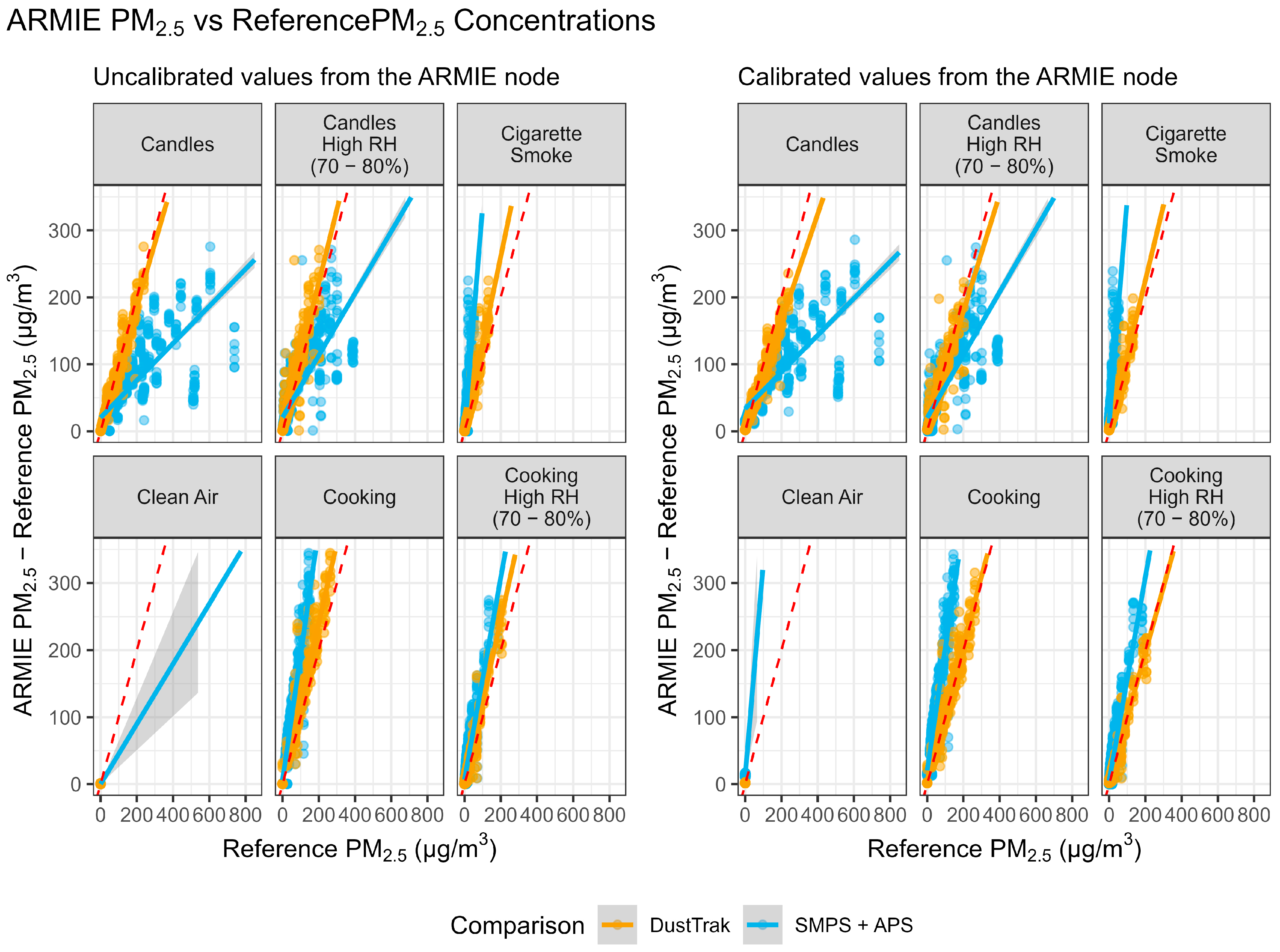
Figure A1. Scatter plot with absolute errors. Scatterplots of ARMIE PM2.5 against DustTrak and SMPS + APS concentrations. The red dashed line indicates the 1:1 line of perfect agreement. The left side panel shows uncalibrated ARMIE sensor PM2.5 measurements. The right-side panel shows values of calibrated data.
Sensors 26 00280 g0a1
Figure A2. Scatter plot with relative errors. Scatterplots of relative error between ARMIE PM2.5 against DustTrak and SMPS + APS concentrations. The left side panel shows uncalibrated ARMIE sensor PM2.5 measurements. The right-side panel shows values of calibrated data.
Sensors 26 00280 g0a2
Figure A3. Distribution of relative error by source and PM2.5 concentration range. Box-and-whisker plots with dots showing relative error (%) of ARMIE PM2.5 by emission source and calibration status compared with reference instruments. Calibrated values were obtained using a linear regression model including ARMIE PM2.5 and RH as predictors. The top panels show comparisons with the TSI DustTrak, and the bottom panels show comparisons with PM2.5 derived from a TSI Scanning Mobility Particle Sizer (SMPS; 0.3–0.66 µm) combined with a TSI Aerodynamic Particle Sizer (APS; 0.8–2.5 µm). Boxplots are stratified by concentration range (PM2.5 ≤ 5 µg/m3 vs. > 5 µg/m3). Note: A total of 1.270 observations were excluded from the plot because their relative error values fell outside the defined axis range.
Sensors 26 00280 g0a3

Appendix B

This document presents the sensitivity analysis, in which all figures and tables are based exclusively on observations where ARMIE-measured PM2.5 concentrations were below 50 µg/m3. The analytical workflow, calibration approach, and statistical procedures are otherwise identical to those described in the Methods section of the main article.
Figure A4. Time series of PM2.5 mass concentrations for each source. Time series of PM2.5 mass concentrations for each source. DustTrak refers to measurements from the TSI DustTrak DRX. SMPS + APS denotes mass concentrations derived from the TSI Scanning Mobility Particle Sizer (0.3–0.66 µm) combined with the TSI Aerodynamic Particle Sizer (0.8–2.5 µm). Obs: scales on axis vary.
Sensors 26 00280 g0a4
Table A5. Descriptive statistics of particle concentrations measured during chamber experiments across aerosol sources.
InstrumentMedianMeanSDMinMax
Candles
SMPS + APS (#/cm3) 1006 1351 1728 149 10,719
SMPS + APS (µg/m3) 49 63 82 7 512
DustTrak (µg/m3) 27 28 13 5 60
Candles High RH (70–80%)
SMPS + APS (#/cm3) 453 596 613 117 4835
SMPS + APS (µg/m3) 19 24 27 5 212
DustTrak (µg/m3) 21 23 14 6 95
Cigarette Smoke
SMPS + APS (#/cm3) 137 168 92 101 823
SMPS + APS (µg/m3) 8 11 4 6 28
DustTrak (µg/m3) 24 27 10 17 72
Cooking
SMPS + APS (#/cm3) 409 604 499 303 3055
SMPS + APS (µg/m3) 19 27 18 15 116
DustTrak (µg/m3) 35 35 12 24 82
Cooking High RH (70–80%)
SMPS + APS (#/cm3) 206 281 236 109 1717
SMPS + APS (µg/m3) 11 16 13 6 71
DustTrak (µg/m3) 26 28 13 11 68
SMPS + APS refers to the use of a TSI Scanning Mobility Particle Sizer to measure particles between 0.3 and 0.66 µm, and a TSI Aerosol Particle Sizer to measure particles between 0.8 and 2.5 µm. # denotes particle number concentration.
Table A6. Performance metrics for ARMIE PM2.5 readings compared with DustTrak and SMPS + APS using the leave-one-sensor-out validation approach.
Comparison
Instrument
MethodrMean Relative Error (%)Mean Error (µg/m3)LoA Low (µg/m3)LoA High (µg/m3)
DustTrak Calibrated 0.85 5.89 −0.16 −15.11 14.79
DustTrak Uncalibrated 0.85 20.88 2.38 −12.58 17.35
SMPS + APS Calibrated 0.39 59.88 −0.88 −95.55 93.78
SMPS + APS Uncalibrated 0.33 57.81 −5 −102.44 92.44
Metrics are aggregated across nine ARMIE nodes. Uncalibrated values refer to raw ARMIE PM2.5 measurements. Calibrated values were obtained using a linear regression model including ARMIE PM2.5 and RH as predictors. PM2.5 from SMPS + APS was derived by combining measurements from a TSI Scanning Mobility Particle Sizer (SMPS; 0.3–0.66 µm) and a TSI Aerodynamic Particle Sizer (APS; 0.8–2.5 µm). LoA denotes Bland-Altman limits of agreement. Observations with reference PM2.5 < 5 µg/m3 were excluded prior to metric calculation.
Figure A5. Bland-Altman plot based on the leave-one-sensor-out approach from sensitivity analyses. Bland-Altman plots comparing ARMIE PM2.5 with reference instruments. Panels on the left show uncalibrated data; panels on the right show calibrated data. Calibrated values were obtained using a linear regression model including ARMIE PM2.5 and RH as predictors. Orange bold lines denote mean error, and orange dotted lines indicate the 95% Bland-Altman limits of agreement. Comparisons are shown separately for the TSI DustTrak and for PM2.5 derived from a TSI Scanning Mobility Particle Sizer (SMPS; 0.3–0.66 µm) combined with a TSI Aerodynamic Particle Sizer (APS; 0.8–2.5 µm). Note: 207 observations were excluded because their error values fell outside the displayed axis range.
Sensors 26 00280 g0a5
Figure A6. Distribution of Relative Error of ARMIE PM2.5 readings by Source and calibration status from sensitivity analyses. Box-and-whisker plots with dots showing relative error (%) of ARMIE PM2.5 by emission source and calibration status compared with reference instruments. Calibrated values were obtained using a linear regression model including ARMIE PM2.5 and RH as predictors. The top panels show comparisons with the TSI DustTrak, and the bottom panels show comparisons with PM2.5 derived from a TSI Scanning Mobility Particle Sizer (SMPS; 0.3–0.66 µm) combined with a TSI Aerodynamic Particle Sizer (APS; 0.8–2.5 µm). Boxplots are stratified by concentration range (PM2.5 ≤ 5 µg/m3 vs. >5 µg/m3).
Sensors 26 00280 g0a6
Table A7. Performance metrics based on the leave-one-source-out approach.
Comparison
Instrument
MethodrMean Relative Error (%)Mean Error (µg/m3)LoA Low (µg/m3)LoA High (µg/m3)
Candles
DustTrak Calibrated 0.93 −18.65 −5.26 −15.38 4.86
DustTrak Uncalibrated 0.93 2.49 −0.43 −10.02 9.16
SMPS + APS Calibrated 0.53 −72.72 −47.18 −197.93 103.57
SMPS + APS Uncalibrated 0.52 −39.32 −35.21 −183.5 113.09
Candles High RH (70–80%)
DustTrak Calibrated 0.79 5.7 −0.18 −17.84 17.48
DustTrak Uncalibrated 0.78 24.18 2.63 −15.22 20.49
SMPS + APS Calibrated 0.53 −20.15 −4.16 −49.08 40.77
SMPS + APS Uncalibrated 0.49 37.42 0.65 −44.72 46.02
Cigarette Smoke
DustTrak Calibrated 0.93 30.91 3.47 −4.77 11.72
DustTrak Uncalibrated 0.93 30.76 3.98 −4.41 12.37
SMPS + APS Calibrated 0.63 488.18 46.22 26.56 65.87
SMPS + APS Uncalibrated 0.69 222.83 21.25 8.37 34.13
Cooking
DustTrak Calibrated 0.33 15.02 2.97 −20.42 26.36
DustTrak Uncalibrated 0.33 22.43 5.42 −18.01 28.85
SMPS + APS Calibrated −0.07 175.69 34.04 −8.17 76.26
SMPS + APS Uncalibrated −0.04 78.87 12.63 −25.32 50.59
Cooking High RH (70–80%)
DustTrak Calibrated 0.82 6.73 0.3 −14.96 15.57
DustTrak Uncalibrated 0.83 27.23 3.12 −12.25 18.5
SMPS + APS Calibrated 0.4 157.87 17.02 −19.45 53.49
SMPS + APS Uncalibrated 0.41 158.21 14.78 −10.42 39.98
Metrics were generated using a leave-one-source-out approach. Uncalibrated values refer to raw ARMIE PM2.5 measurements. PM2.5 concentrations from SMPS + APS were derived by combining measurements from a TSI Scanning Mobility Particle Sizer (SMPS; 0.3–0.66 µm) and a TSI Aerodynamic Particle Sizer (APS; 0.8–2.5 µm). Calibrated values were obtained using a linear regression model including ARMIE PM2.5 and RH as predictors. LoA denotes Bland-Altman limits of agreement. Observations with reference PM2.5 < 5 µg/m3 were excluded before metric calculation.
Figure A7. Bland-Altman plot based on the leave-one-source-out approach from sensitivity analyses. Bland-Altman plots comparing ARMIE PM2.5 with PM2.5 derived from a TSI Scanning Mobility Particle Sizer (SMPS; 0.3–0.66 µm) combined with a TSI Aerodynamic Particle Sizer (APS; 0.8–2.5 µm). Panels on the left show uncalibrated data; panels on the right show calibrated data. Calibrated values were obtained using a linear regression model including ARMIE PM2.5 and RH as predictors. Bold lines denote mean error and dotted lines indicate the 95% Bland-Altman limits of agreement.
Sensors 26 00280 g0a7

Appendix C

Formulas for Computed Metrics

Error (per observation):
e i = x i y i
Mean Error:
M E = 1 n i = ! n e i = x ¯ y ¯
Limits of Agreement (LoA):
L o A l o w = M E 1.96 × S D   ;   L o A h i g h = M E + 1.96 × S D
Relative Error (RE):
R E = e r r o r y ¯ × 100
Correlation coefficient (r):
R = i = 1 n x i x ¯ y i y ¯ i = 1 n ( x i x ¯ ) 2 × i = 1 n ( y i y ¯ ) 2
Coefficient of determination (R2):
R 2 = R 2
Mean Absolute Error (MAE):
M A E = 1 n i = 1 n | e i |
Root Mean Squared Error (RMSE):
R M S E = 1 n i = 1 n e i 2

Appendix D

Appendix D.1. Schematic of Chamber

Figure A8. Schematic of chamber. Schematic of the controlled environmental chamber. Air circulation is maintained by a ceiling-mounted climate fan that draws air upward and redistributes it through the plenum above the inner ceiling, directing airflow downward along the chamber walls to ensure uniform mixing.
Sensors 26 00280 g0a8

Appendix D.2. Photograph of the ARMIE Node

Figure A9. Picture of the ARMIE. Picture of the ARMIE node placed next to an iPhone X.
Sensors 26 00280 g0a9

References

  1. Hay, S.I.; Ong, K.L.; Santomauro, D.F.; Bhoomadevi, A.; Aalipour, M.A.; Aalruz, H.; Ababneh, H.S.; Abaraogu, U.O.; Abate, B.B.; Abbafati, C.; et al. Burden of 375 diseases and injuries, risk-attributable burden of 88 risk factors, and healthy life expectancy in 204 countries and territories, including 660 subnational locations, 1990–2023: A systematic analysis for the Global Burden of Disease Study 2023. Lancet 2025, 406, 1873–1922. [Google Scholar] [CrossRef] [PubMed]
  2. Lederer, A.M.; Fredriksen, P.M.; Nkeh-Chungag, B.N.; Everson, F.; Strijdom, H.; de Boever, P.; Goswami, N. Cardiovascular Effects of Air Pollution: Current Evidence from Animal and Human Studies. Am. J. Physiol. Heart Circ. Physiol. 2021, 320, H1417–H1439. [Google Scholar] [CrossRef] [PubMed]
  3. Farhadi, Z.; Abulghasem Gorgi, H.; Shabaninejad, H.; Aghajani Delavar, M.; Torani, S. Association between PM(2.5) and risk of hospitalization for myocardial infarction: A systematic review and a meta-analysis. BMC Public Health 2020, 20, 314. [Google Scholar] [CrossRef] [PubMed]
  4. Chatzidiakou, L.; Krause, A.; Popoola, O.A.M.; Di Antonio, A.; Kellaway, M.; Han, Y.; Squires, F.A.; Wang, T.; Zhang, H.; Wang, Q.; et al. Characterising low-cost sensors in highly portable platforms to quantify personal exposure in diverse environments. Atmos. Meas. Tech. 2019, 12, 4643–4657. [Google Scholar] [CrossRef]
  5. Marquet, O.; Tello-Barsocchini, J.; Couto-Trigo, D.; Gómez-Varo, I.; Maciejewska, M. Comparison of static and dynamic exposures to air pollution, noise, and greenness among seniors living in compact-city environments. Int. J. Health Geogr. 2023, 22, 3. [Google Scholar] [CrossRef]
  6. Omelekhina, Y.; Eriksson, A.; Canonaco, F.; Prevot, A.; Nilsson, P.; Isaxon, C.; Pagels, J.; Wierzbicka, A. Cooking and electronic cigarettes leading to large differences between indoor and outdoor particle composition and concentration measured by aerosol mass spectrometry. Environ. Sci. Process. Impacts 2020, 22, 1382–1396. [Google Scholar] [CrossRef]
  7. Larkin, A.; Hystad, P. Towards Personal Exposures: How Technology Is Changing Air Pollution and Health Research. Curr. Environ. Health Rep. 2017, 4, 463–471. [Google Scholar] [CrossRef]
  8. Morawska, L.; Thai, P.K.; Liu, X.; Asumadu-Sakyi, A.; Ayoko, G.; Bartonova, A.; Bedini, A.; Chai, F.; Christensen, B.; Dunbabin, M.; et al. Applications of low-cost sensing technologies for air quality monitoring and exposure assessment: How far have they gone? Environ. Int. 2018, 116, 286–299. [Google Scholar] [CrossRef]
  9. Karagulian, F.; Barbiere, M.; Kotsev, A.; Spinelle, L.; Gerboles, M.; Lagler, F.; Redon, N.; Crunaire, S.; Borowiak, A. Review of the Performance of Low-Cost Sensors for Air Quality Monitoring. Atmosphere 2019, 10, 506. [Google Scholar] [CrossRef]
  10. Park, Y.M.; Sousan, S.; Streuber, D.; Zhao, K. GeoAir—A Novel Portable, GPS-Enabled, Low-Cost Air-Pollution Sensor: Design Strategies to Facilitate Citizen Science Research and Geospatial Assessments of Personal Exposure. Sensors 2021, 21, 3761. [Google Scholar] [CrossRef]
  11. Sousan, S.; Regmi, S.; Park, Y.M. Laboratory Evaluation of Low-Cost Optical Particle Counters for Environmental and Occupational Exposures. Sensors 2021, 21, 4146. [Google Scholar] [CrossRef]
  12. Streuber, D.; Park, Y.M.; Sousan, S. Laboratory and Field Evaluations of the GeoAir2 Air Quality Monitor for Use in Indoor Environments. Aerosol Air Qual. Res. 2022, 22, 220119. [Google Scholar] [CrossRef]
  13. Tryner, J.; Mehaffy, J.; Miller-Lionberg, D.; Volckens, J. Effects of aerosol type and simulated aging on performance of low-cost PM sensors. J. Aerosol Sci. 2020, 150, 105654. [Google Scholar] [CrossRef]
  14. Raysoni, A.U.; Pinakana, S.D.; Mendez, E.; Wladyka, D.; Sepielak, K.; Temby, O. A Review of Literature on the Usage of Low-Cost Sensors to Measure Particulate Matter. Earth 2023, 4, 168–186. [Google Scholar] [CrossRef]
  15. Bulot, F.M.J.; Russell, H.S.; Rezaei, M.; Johnson, M.S.; Ossont, S.J.; Morris, A.K.R.; Basford, P.J.; Easton, N.H.C.; Mitchell, H.L.; Foster, G.L.; et al. Laboratory Comparison of Low-Cost Particulate Matter Sensors to Measure Transient Events of Pollution. Sensors 2020, 20, 2219. [Google Scholar] [CrossRef] [PubMed]
  16. Demanega, I.; Mujan, I.; Singer, B.C.; Anđelković, A.S.; Babich, F.; Licina, D. Performance assessment of low-cost environmental monitors and single sensors under variable indoor air quality and thermal conditions. Build. Environ. 2021, 187, 107415. [Google Scholar] [CrossRef]
  17. Wang, P.; Xu, F.; Gui, H.; Wang, H.; Chen, D.-R. Effect of relative humidity on the performance of five cost-effective PM sensors. Aerosol Sci. Technol. 2021, 55, 957–974. [Google Scholar] [CrossRef]
  18. United States Environmental Protection Aaencv. Performance Testing Protocols, Metrics, and Target Values for Fine Particulate Matter Air Sensors; United States Environmental Protection Aaencv: Washington, DC, USA, 2021.
  19. Gautam, P.; Ramirez, A.; Bair, S.; Arnott, W.P.; Chow, J.C.; Watson, J.G.; Moosmüller, H.; Wang, X. Sizing Accuracy of Low-Cost Optical Particle Sensors Under Controlled Laboratory Conditions. Atmosphere 2025, 16, 502. [Google Scholar] [CrossRef]
  20. Molina Rueda, E.; Carter, E.; L’Orange, C.; Quinn, C.; Volckens, J. Size-Resolved Field Performance of Low-Cost Sensors for Particulate Matter Air Pollution. Environ. Sci. Technol. Lett. 2023, 10, 247–253. [Google Scholar] [CrossRef]
  21. Crilley, L.R.; Shaw, M.; Pound, R.; Kramer, L.J.; Price, R.; Young, S.; Lewis, A.C.; Pope, F.D. Evaluation of a low-cost optical particle counter (Alphasense OPC-N2) for ambient air monitoring. Atmos. Meas. Tech. 2018, 11, 709–720. [Google Scholar] [CrossRef]
  22. Altman, D.G.; Bland, J.M. Measurement in Medicine: The Analysis of Method Comparison Studies. J. R. Stat. Soc. Ser. D 1983, 32, 307–317. [Google Scholar] [CrossRef]
  23. Giavarina, D. Understanding Bland Altman analysis. Biochem. Med. 2015, 25, 141–151. [Google Scholar] [CrossRef] [PubMed]
  24. Mansournia, M.A.; Waters, R.; Nazemipour, M.; Bland, M.; Altman, D.G. Bland-Altman methods for comparing methods of measurement and response to criticisms. Global Epidemiol. 2021, 3, 100045. [Google Scholar] [CrossRef] [PubMed]
  25. WTO. What are the WHO Air Quality Guidelines? 2021. Available online: https://www.who.int/news-room/feature-stories/detail/what-are-the-who-air-quality-guidelines (accessed on 29 October 2025).
  26. Crilley, L.R.; Singh, A.; Kramer, L.J.; Shaw, M.D.; Alam, M.S.; Apte, J.S.; Bloss, W.J.; Ruiz, L.H.; Fu, P.; Fu, W.; et al. Effect of aerosol composition on the performance of low-cost optical particle counter correction factors. Atmos. Meas. Tech. 2020, 13, 1181–1193. [Google Scholar] [CrossRef]
  27. Liu, H.-Y.; Schneider, P.; Haugen, R.; Vogt, M. Performance Assessment of a Low-Cost PM2.5 Sensor for a near Four-Month Period in Oslo, Norway. Atmosphere 2019, 10, 41. [Google Scholar] [CrossRef]
  28. Faber, P.; Drewnick, F.; Bierl, R.; Borrmann, S. Complementary online aerosol mass spectrometry and offline FT-IR spectroscopy measurements: Prospects and challenges for the analysis of anthropogenic aerosol particle emissions. Atmos. Environ. 2017, 166, 92–98. [Google Scholar] [CrossRef]
  29. Price, H.D.; Stahlmecke, B.; Arthur, R.; Kaminski, H.; Lindermann, J.; Däuber, E.; Asbach, C.; Kuhlbusch, T.A.J.; BéruBé, K.A.; Jones, T.P. Comparison of instruments for particle number size distribution measurements in air quality monitoring. J. Aerosol Sci. 2014, 76, 48–55. [Google Scholar] [CrossRef]
  30. Javed, W.; Guo, B. Performance Evaluation of Real-time DustTrak Monitors for Outdoor Particulate Mass Measurements in a Desert Environment. Aerosol Air Qual. Res. 2021, 21, 200631–200639. [Google Scholar] [CrossRef]
  31. Susz, A.; Pratte, P.; Goujon-Ginglinger, C. Real-time Monitoring of Suspended Particulate Matter in Indoor Air: Validation and Application of a Light-scattering Sensor. Aerosol Air Qual. Res. 2020, 20, 2384–2395. [Google Scholar] [CrossRef]
Figure 1. Time series of PM2.5 mass concentrations for each source. Time series of PM2.5 mass concentrations by emission source. DustTrak refers to measurements from the TSI DustTrak. SMPS + APS denotes PM2.5 mass concentrations derived from a TSI Scanning Mobility Particle Sizer (SMPS; 0.3–0.66 µm) combined with a TSI Aerodynamic Particle Sizer (APS; 0.8–2.5 µm). Note: axis scales vary between panels.
Sensors 26 00280 g001
Figure 2. Bland-Altman plot based on the leave-one-sensor-out approach. Bland-Altman plots comparing ARMIE PM2.5 with reference instruments. Panels on the left show uncalibrated data; panels on the right show calibrated data. Calibrated values were obtained using a linear regression model including ARMIE PM2.5 and RH as predictors. Bold lines denote mean error, and dotted lines indicate the 95% Bland-Altman limits of agreement. Comparisons are shown separately for the TSI DustTrak and for PM2.5 derived from a TSI Scanning Mobility Particle Sizer (SMPS; 0.3–0.66 µm) combined with a TSI Aerodynamic Particle Sizer (APS; 0.8–2.5 µm). Note: 207 observations were excluded because their error values fell outside the displayed axis range.
Sensors 26 00280 g002
Figure 3. Distribution of relative error of ARMIE PM2.5 readings by source and calibration status. Box-and-whisker plots with dots showing relative error (%) of ARMIE PM2.5 by emission source and calibration status compared with reference instruments. Calibrated values were obtained using a linear regression model including ARMIE PM2.5 and RH as predictors. The top panels show comparisons with the TSI DustTrak, and the bottom panels show comparisons with PM2.5 derived from a TSI Scanning Mobility Particle Sizer (SMPS; 0.3–0.66 µm) combined with a TSI Aerodynamic Particle Sizer (APS; 0.8–2.5 µm). Boxplots are stratified by concentration range (PM2.5 ≤ 5 µg/m3 vs. >5 µg/m3). Note: 624 observations were excluded because their relative error values fell outside the displayed axis range.
Sensors 26 00280 g003
Figure 4. Bland-Altman plot based on the leave-one-source-out approach. Bland-Altman plots comparing ARMIE PM2.5 with PM2.5 derived from a TSI Scanning Mobility Particle Sizer (SMPS; 0.3–0.66 µm) combined with a TSI Aerodynamic Particle Sizer (APS; 0.8–2.5 µm). Panels on the left show uncalibrated data; panels on the right show calibrated data. Calibrated values were obtained using a linear regression model including ARMIE PM2.5 and RH as predictors. Bold lines denote mean error, and dotted lines indicate the 95% Bland-Altman limits of agreement. Note: 207 observations were excluded because their error values fell outside the displayed axis range.
Sensors 26 00280 g004
Table 1. Descriptive statistics of particle counts and concentrations measured during chamber experiments stratified by aerosol sources and RH conditions.
SourceRH
Condition
InstrumentMedianMeanSDMinMax
CandlesNormalSMPS + APS (#/cm3)21883529341414916,339
SMPS + APS (µg/m3)1101701617739
DustTrak (µg/m3)5973575238
High RH (70–80%)SMPS + APS (#/cm3)1169200820491178774
SMPS + APS (µg/m3)4992965390
DustTrak (µg/m3)4858456202
Cigarette smokeNormalSMPS + APS (#/cm3)306383246101863
SMPS + APS (µg/m3)202112652
DustTrak (µg/m3)48583517132
CookingNormalSMPS + APS (#/cm3)103612237393033055
SMPS + APS (µg/m3)57654015149
DustTrak (µg/m3)851056424263
High RH (70–80%)SMPS + APS (#/cm3)4025414641092070
SMPS + APS (µg/m3)2637386181
DustTrak (µg/m3)44564511206
PM2.5 concentrations derived from SMPS + APS were obtained by combining measurements from a TSI Scanning Mobility Particle Sizer (SMPS; 0.3–0.66 µm) and a TSI Aerodynamic Particle Sizer (APS; 0.8–2.5 µm). Observations with DustTrak or SMPS + APS reference PM2.5 < 5 µg/m3 were excluded before calculation of descriptive statistics. # denotes particle number concentration.
Table 2. Performance metrics for ARMIE PM2.5 readings compared with DustTrak and SMPS + APS using the leave-one-sensor-out validation approach.
Comparison InstrumentMethodMean Relative Error (%)Mean Error (µg/m3)LoA Low (µg/m3)LoA High (µg/m3)r
DustTrakCalibrated6.12−1.11−34.0831.860.95
Uncalibrated20.639.25−30.4548.950.95
SMPS + APSCalibrated72.86−6.22−195.19182.740.52
Uncalibrated52.51−12.72−202.60177.160.51
Metrics are aggregated across nine ARMIE nodes. Uncalibrated values refer to raw ARMIE PM2.5 measurements. Calibrated values were obtained using a linear regression model including ARMIE PM2.5 and RH as predictors. PM2.5 from SMPS + APS was derived by combining measurements from a TSI Scanning Mobility Particle Sizer (SMPS; 0.3–0.66 µm) and a TSI Aerodynamic Particle Sizer (APS; 0.8–2.5 µm). LoA denotes Bland-Altman limits of agreement. Observations with reference PM2.5 < 5 µg/m3 were excluded prior to metric calculation.
Table 3. Performance of ARMIE PM2.5 concentrations compared with DustTrak using a leave-one-source-out validation approach.
SourceRH
Condition
MethodMean Relative Error (%)Mean Error (µg/m3)LoA Low (µg/m3)LoA High (µg/m3)r
CandlesNormalCalibrated−20.39−17.33−52.2417.580.98
Uncalibrated−0.18−2.96−27.8921.980.98
High RH (70–80%)Calibrated4.09−3.32−35.0328.390.93
Uncalibrated26.619.49−28.6347.610.93
Cigarette smokeNormalCalibrated32.098.86−17.6335.350.96
Uncalibrated33.4613.42−22.4749.320.96
CookingNormalCalibrated19.4617.91−28.3364.150.95
Uncalibrated25.4824.26−26.3874.900.96
High RH (70–80%)Calibrated15.541.58−18.0521.210.97
Uncalibrated25.509.57−21.6040.750.97
Metrics were generated using a leave-one-source-out approach. Uncalibrated values refer to raw ARMIE PM2.5 measurements. Calibrated values were obtained using a linear regression model including ARMIE PM2.5 and RH as predictors. LoA denotes Bland-Altman limits of agreement. Observations with reference PM2.5 < 5 µg/m3 were excluded before metric calculation.
Table 4. Performance of ARMIE PM2.5 concentrations compared with SMPS + APS using a leave-one-source-out validation approach.
SourceRH
Condition
MethodMean Relative Error (%)Mean Error (µg/m3)LoA Low (µg/m3)LoA High (µg/m3)r
CandlesNormalCalibrated−70.97−130.83−408.84147.190.76
Uncalibrated−47.14−96.24−335.85143.380.78
High RH (70–80%)Calibrated−37.67−55.02−199.2189.170.81
Uncalibrated16.16−24.06−148.66100.540.78
Cigarette smokeNormalCalibrated396.6969.37−20.93159.670.78
Uncalibrated211.5044.27−42.34130.880.78
CookingNormalCalibrated267.73160.89−47.09368.860.90
Uncalibrated104.4762.33−28.27152.920.92
High RH (70–80%)Calibrated164.7343.53−36.30123.370.91
Uncalibrated117.1128.31−26.1282.750.92
PM2.5 concentrations from SMPS + APS were derived by combining measurements from a TSI Scanning Mobility Particle Sizer (SMPS; 0.3–0.66 µm) and a TSI Aerodynamic Particle Sizer (APS; 0.8–2.5 µm). Calibrated values were obtained using a linear regression model including ARMIE PM2.5 and RH as predictors. LoA denotes Bland-Altman limits of agreement. Observations with reference PM2.5 < 5 µg/m3 were excluded before metric calculation.
Disclaimer/Publisher’s Note: The statements, opinions and data contained in all publications are solely those of the individual author(s) and contributor(s) and not of MDPI and/or the editor(s). MDPI and/or the editor(s) disclaim responsibility for any injury to people or property resulting from any ideas, methods, instructions or products referred to in the content.