A Multi-Fish Tracking and Behavior Modeling Framework for High-Density Cage Aquaculture

 , , ,
, , ,
Abstract
1. Introduction
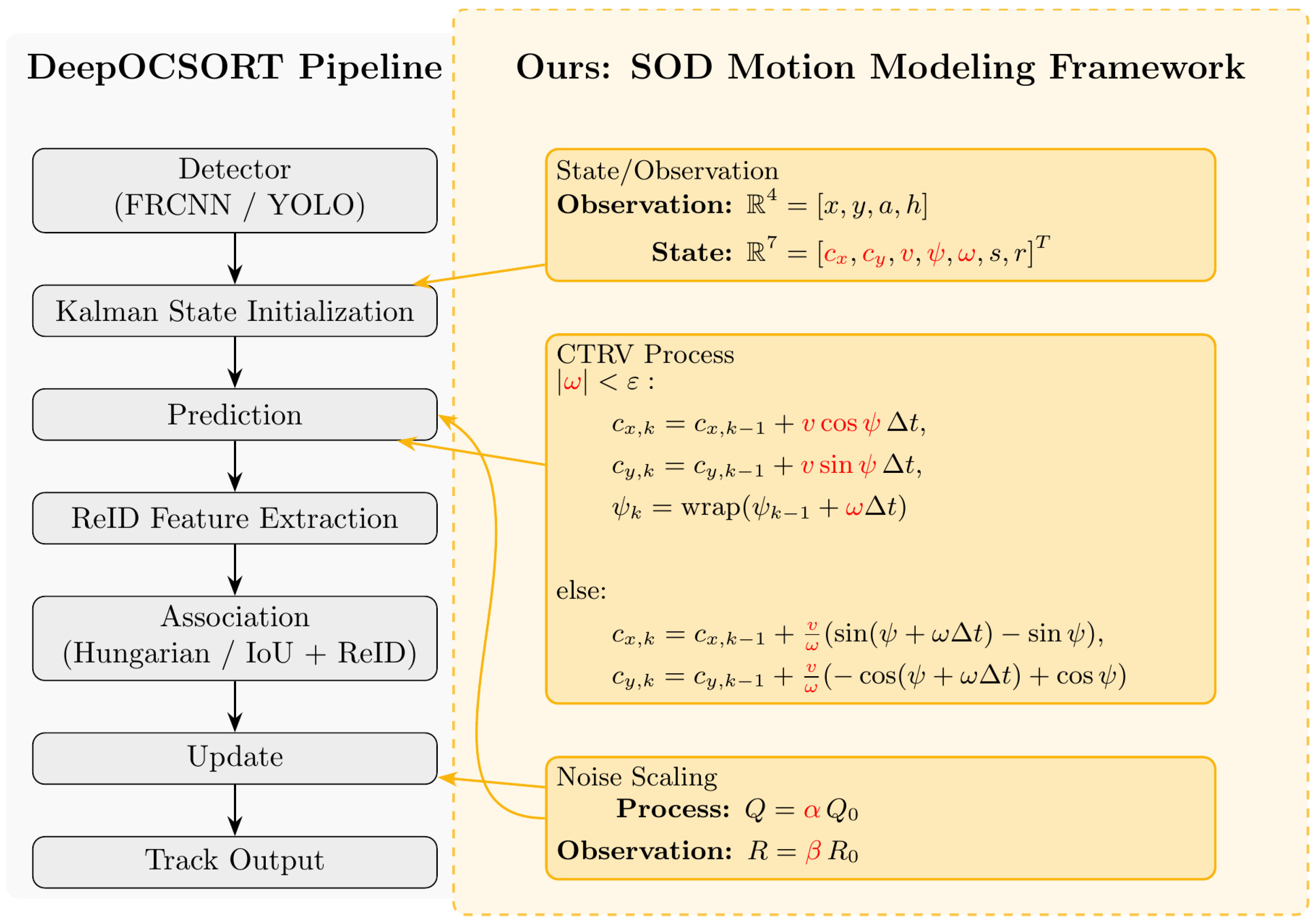
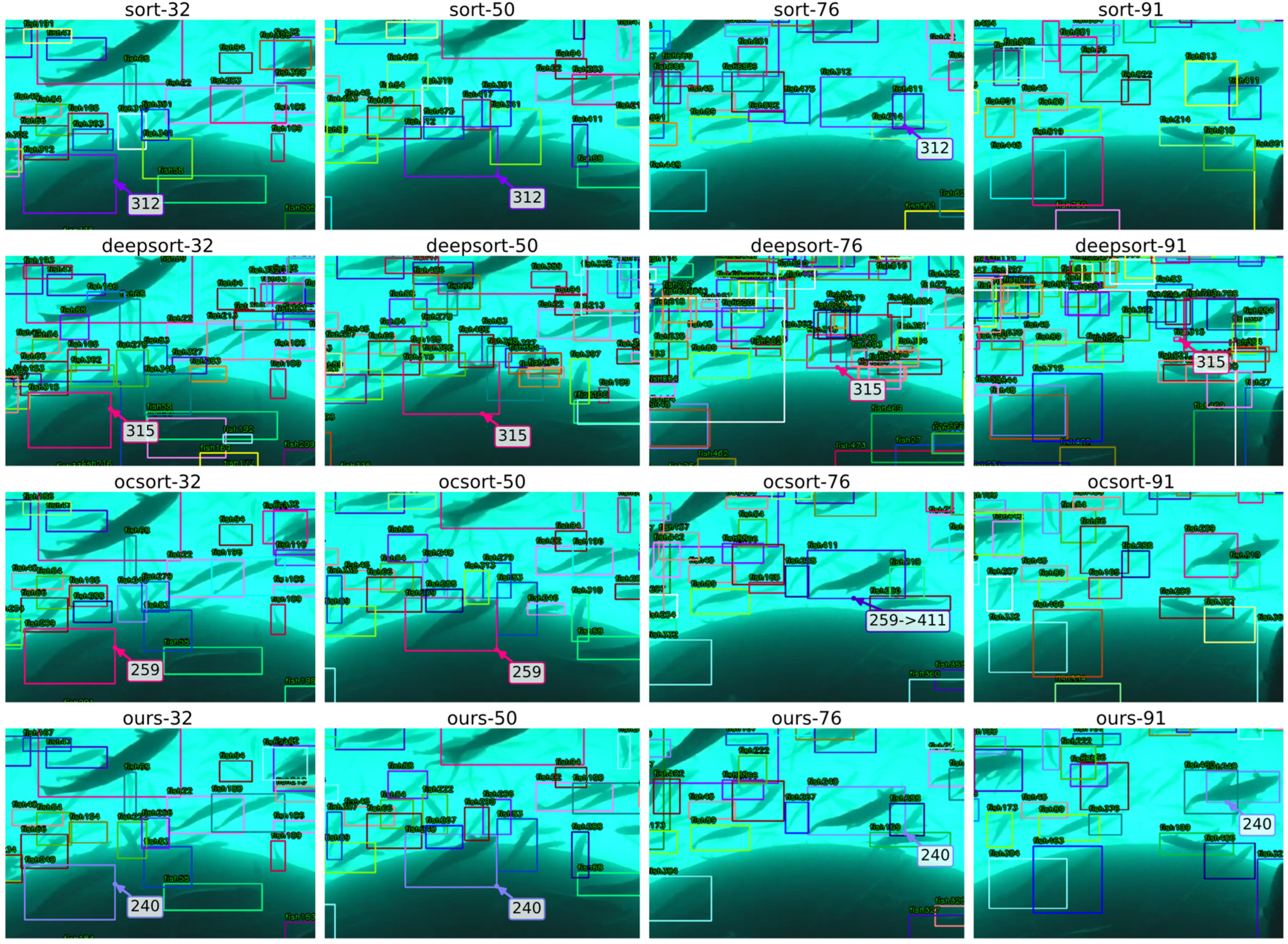
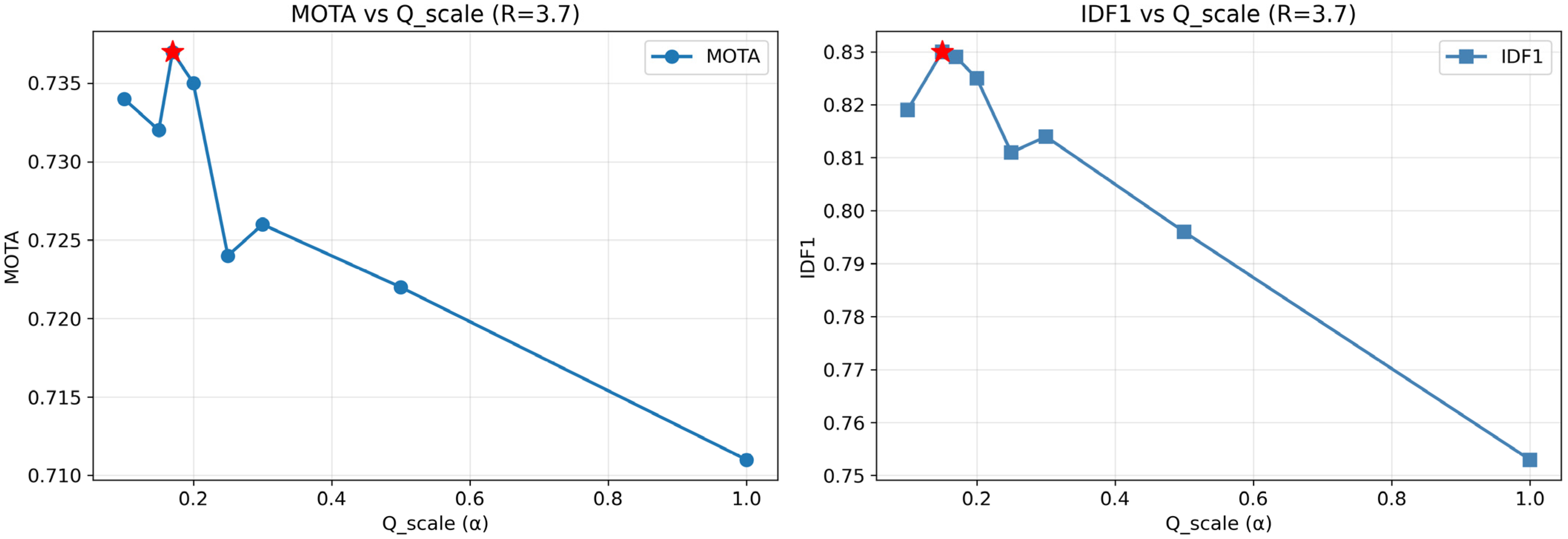
- To address the challenge of identity consistency in high-density underwater environments with homogeneous fish appearance, we propose the SOD-SORT framework that integrates a constant turn-rate and velocity (CTRV)-based Extended Kalman Filter into DeepOCSORT, demonstrating that principled integration of advanced motion models with appearance features through systematic parameter optimization achieves superior identity consistency (IDF1: 0.829, IDs reduced by 13% vs. baseline).
- To enable practical behavior analysis from variable-length trajectories, we introduce a novel statistical quantization method that converts motion trajectories into fixed-length feature vectors using k-order raw moments and central moments (up to third order), capturing key characteristics including position distribution, velocity patterns, and trajectory asymmetry.
- To provide a comprehensive evaluation under challenging aquaculture conditions, we construct a unified testing protocol across both public datasets (Fish4Knowledge) and real deep-sea cage videos (Deep Blue I), demonstrating that trajectory continuity and quality directly impact downstream behavior modeling performance.
2. Related Work
2.1. The Development of Underwater Fish Object Tracking Algorithms
2.2. Fish Trajectory Modeling Methods and Developments
3. Materials
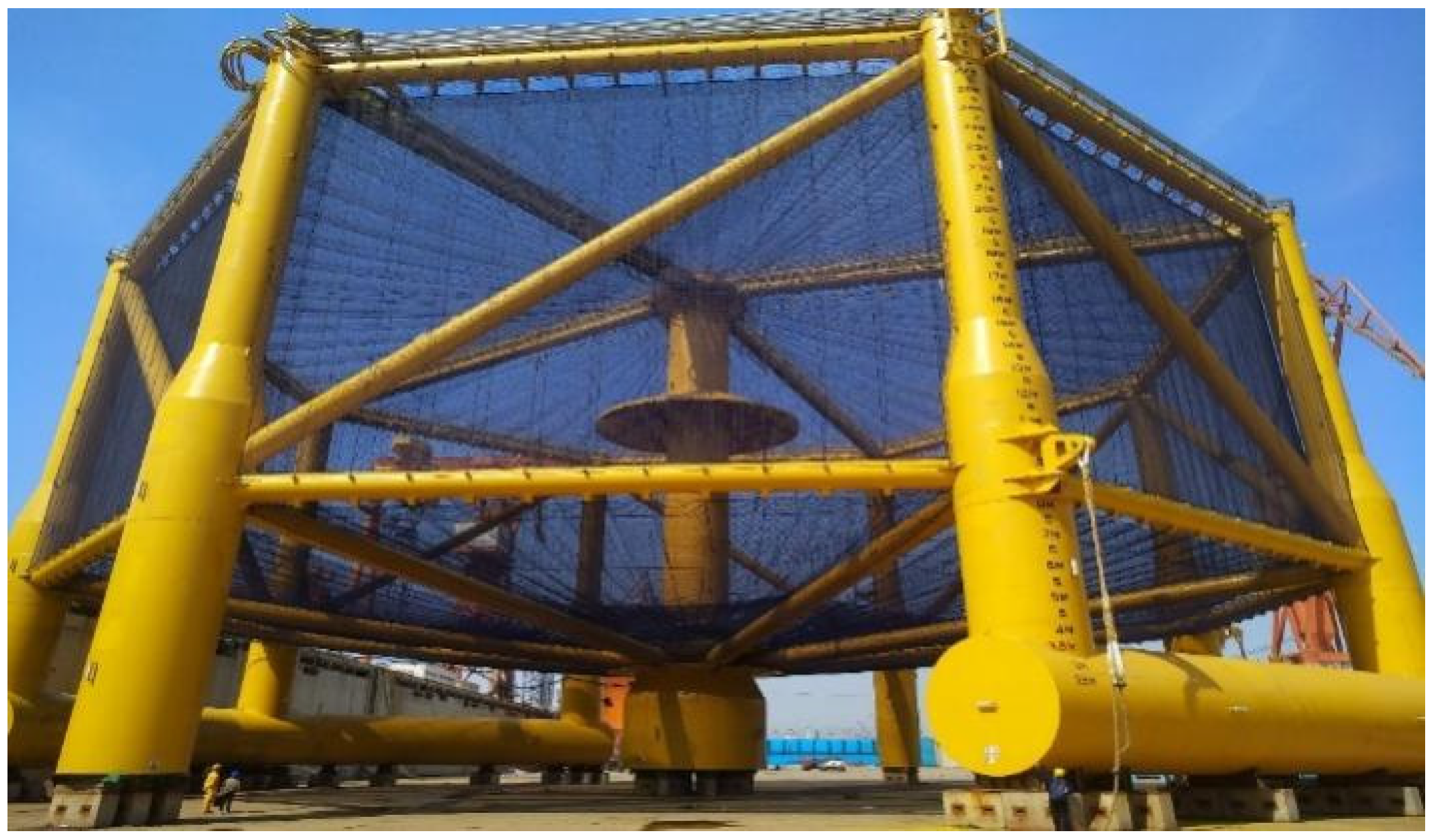
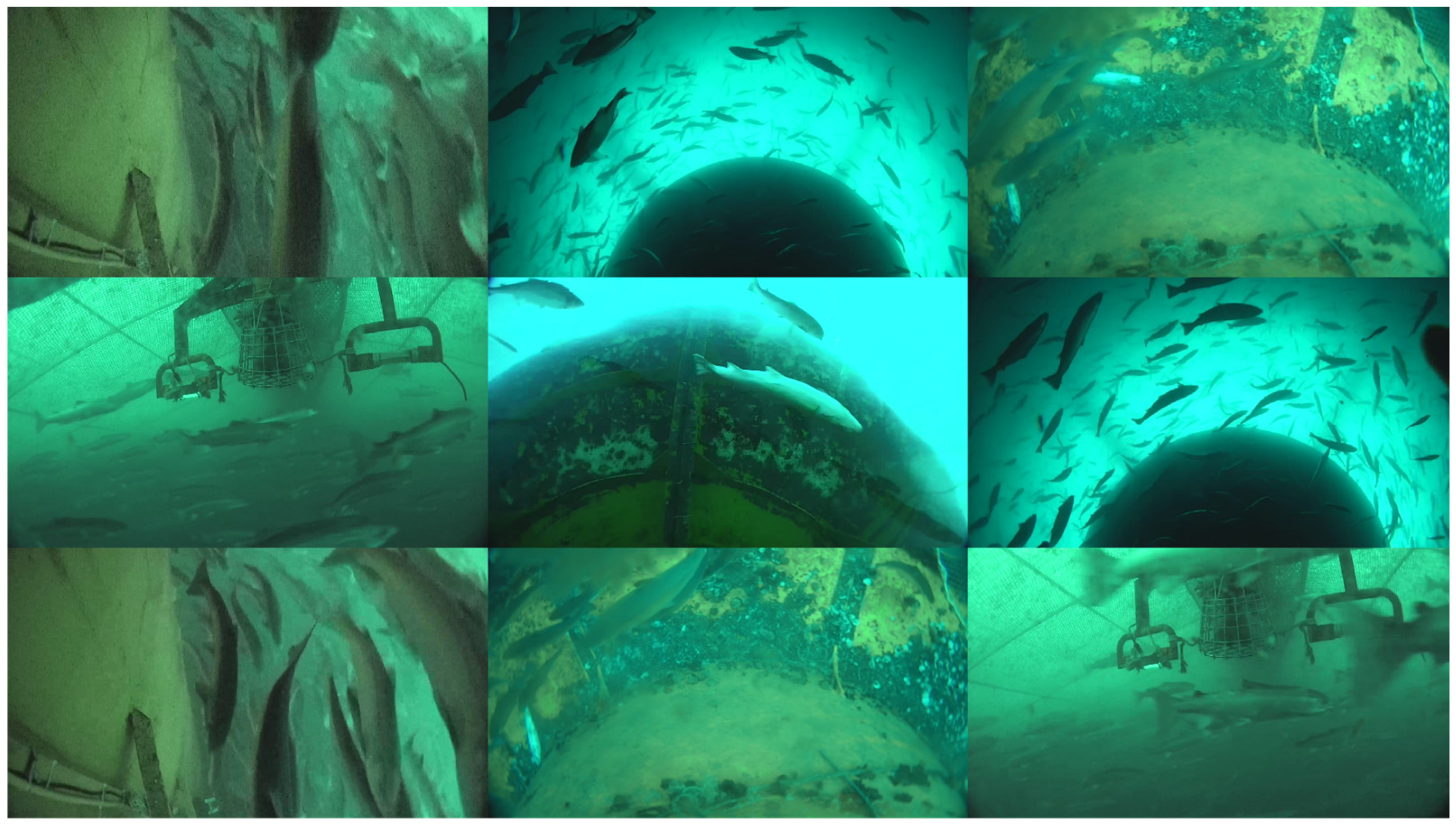
3.1. Industrial Aquaculture Cage Dataset
3.2. Fish4Knowledge
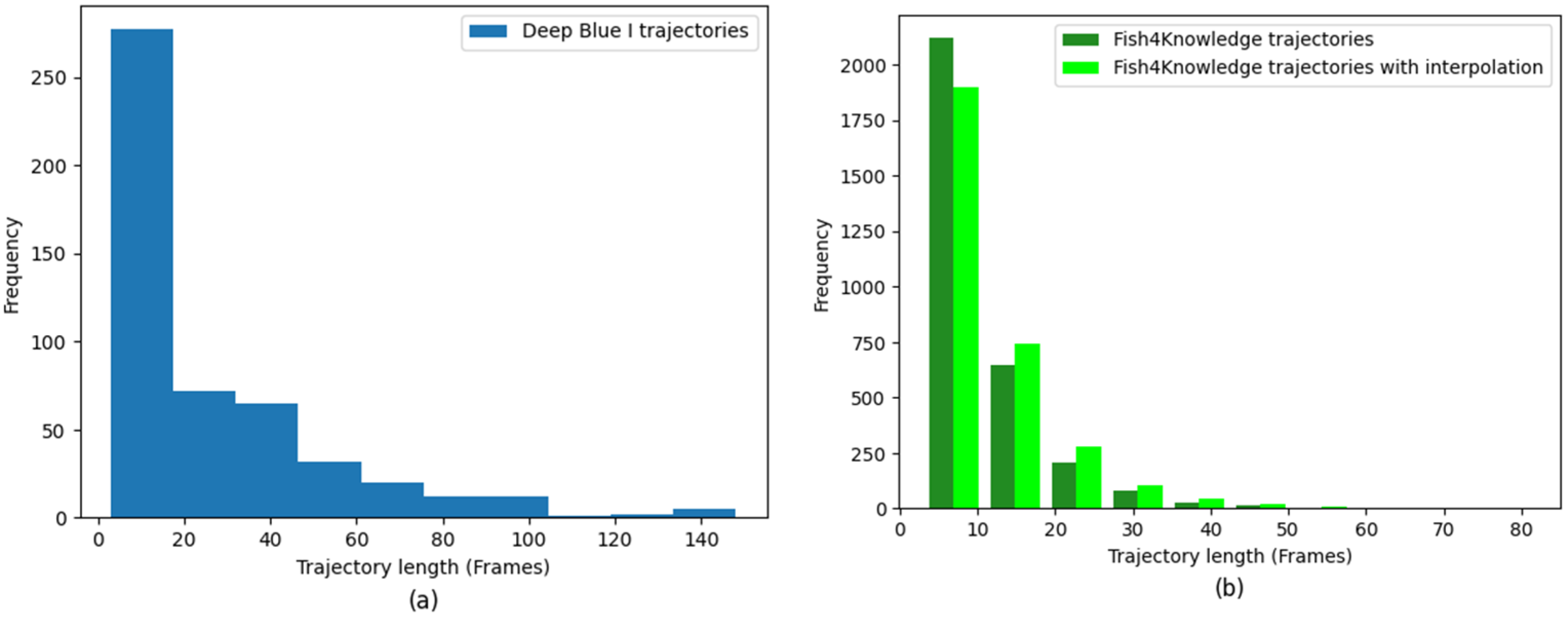
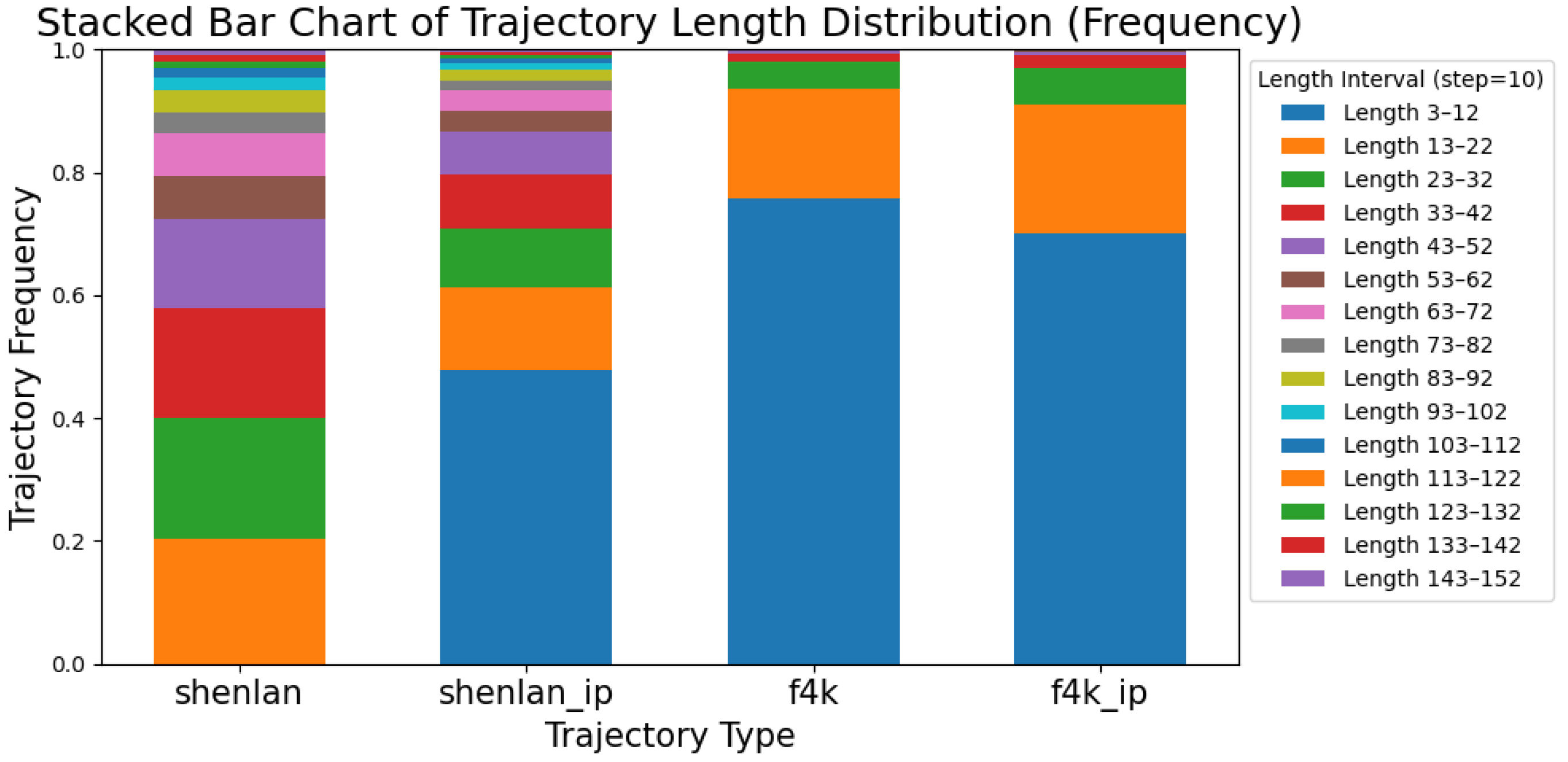
3.3. Dataset Exploration and Trajectory Statistics
4. Improved Method in This Study
4.1. Framework Overview
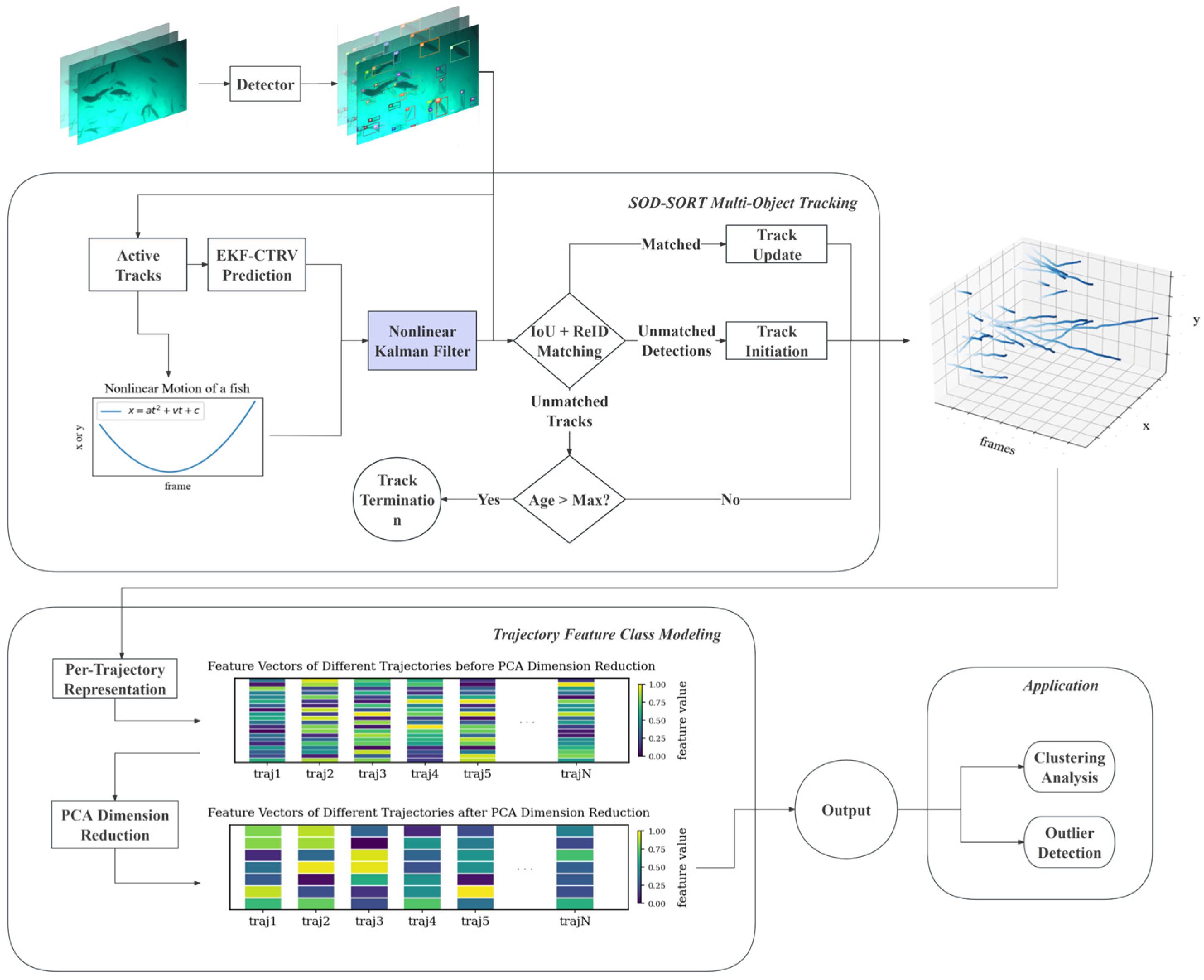
4.2. SOD-SORT Multi-Object Tracking Module
4.2.1. SOD Plugin Framework
- SOD-EKF-CTRV (main method): internal state , observation ; discrete propagation is divided into two cases— straight line approximation and circular arc; heading angle normalized ; are used as random walk terms.
- Implementation: Replace the Kalman Filter in the DeepOCSORT host with the EKF-CTRV. Use discrete step lengths per frame with a uniform (25 fps is used only for time-window conversion and visualization). The complete pseudo-code for the prediction-update cycle and association procedure is provided in Appendix D.
- SOD-LKF (Second-Order, Ablation): Extended to second-order dynamics with acceleration components, using explicit constant acceleration state transitions and observation matrices , ; used as a control to illustrate the differences with the main method (more sensitive short-term curvature modeling and weaker anti-occlusion reconnection).
4.2.2. Motion-Appearance Harmonization Strategy
4.3. Trajectory Feature Class Modeling
4.3.1. Variable-Length Feature to Fixed-Length Conversion
- Curvature-related features: Apply the above conversion to both and sequences, yielding 12 fixed-length features.
- Center distance feature: Apply the conversion to the sequence, yielding 6 fixed-length features.
- Curvature characteristics: Apply the conversion to the sequence, yielding 6 fixed-length features.
4.3.2. Trajectory Preprocessing
5. Result
5.1. Evaluation Setup and Metrics
5.1.1. Evaluation Protocol
- Ground Truth: 100 consecutive frames manually annotated using darklabel from a shenlan underwater video, including bounding box positions and identity labels for individual fish.
- Detection Input: Unified YOLOv8m detection results are used as input for all trackers to eliminate the influence of detector variance.
- Association Method: Intra-frame Hungarian matching based on Intersection over Union (IoU).
- IoU Threshold: 0.5 for matching detection boxes to ground truth trajectories.
- Evaluation Metrics: Traditional MOT metrics computed using the py-motmetrics library [47], including IDF1 (identity F1-score), MOTA (Multiple Object Tracking Accuracy), IDs (identity switches), FM (fragmentations), FP (false positives), FN (false negatives), and timing metrics (FPS).
5.1.2. Performance Metrics and Evaluation Priorities
- IDF1 (ID F1-Score): The harmonic mean of identification precision (IDP) and identification recall (IDR), measuring how well predicted trajectories match ground truth identities over time. Higher values indicate better identity preservation.
- IDs (Identity Switches): The total number of times a ground truth trajectory is assigned a different predicted ID, directly measuring identity fragmentation.
- MOTA (Multiple Object Tracking Accuracy): A comprehensive metric combining false positives (FP), false negatives (FN), and identity switches (IDs):
- MOTP (Multiple Object Tracking Precision): The average IoU between matched detection-ground truth pairs, measuring localization accuracy.
- FP (False Positives): The total number of predicted detections that cannot be matched to any ground truth object, indicating spurious or phantom tracks.
- FN (False Negatives): The total number of ground truth objects that are not matched by any prediction, indicating missed detections or lost tracks.
- FM (Fragmentations): The number of times a ground truth trajectory is interrupted (i.e., a track temporarily loses association and then recovers), measuring temporal discontinuity.
5.2. Model Comparison
5.3. Ablation Experiments
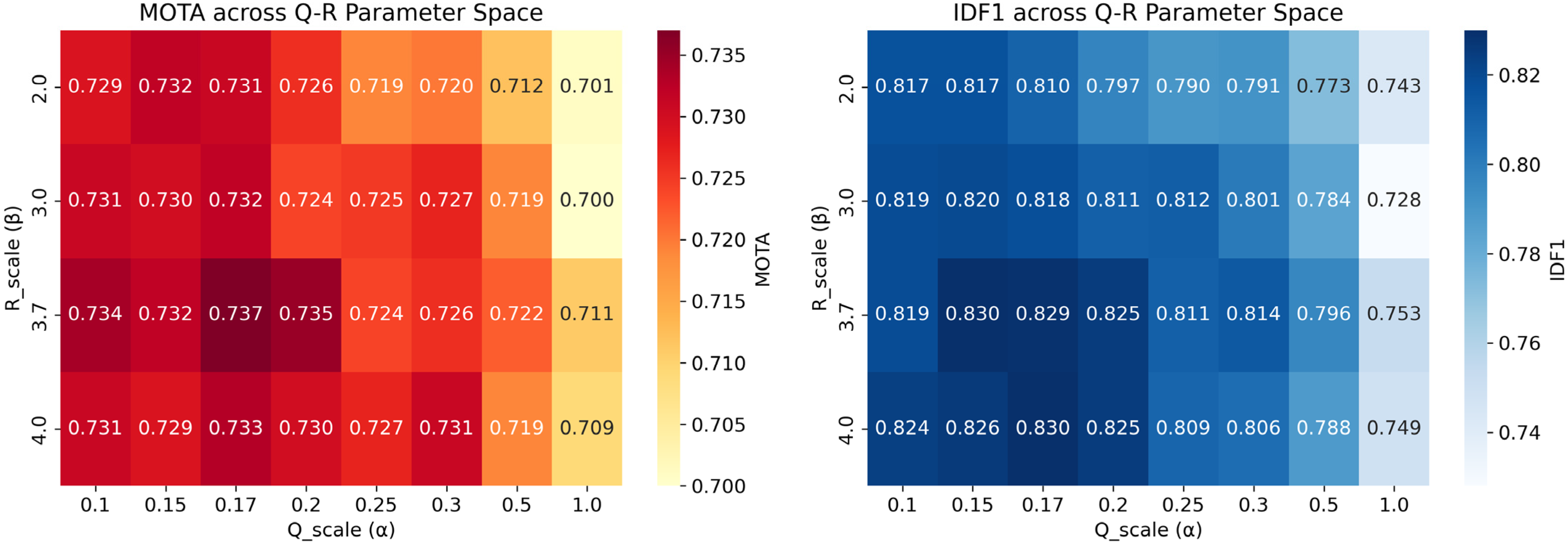
5.4. Sensitivity Analysis
5.5. Fish4Knowledge Verification Results
5.6. Case Study: Modeling Fish Schools from Deep Blue I Cage Videos
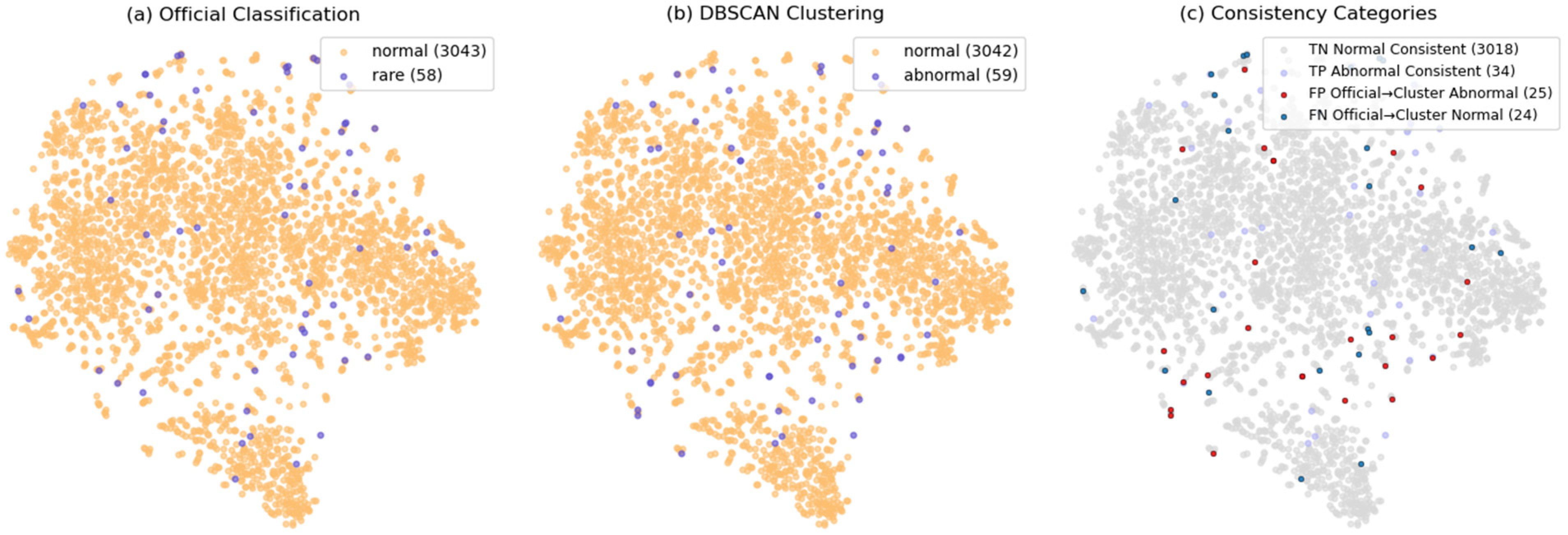
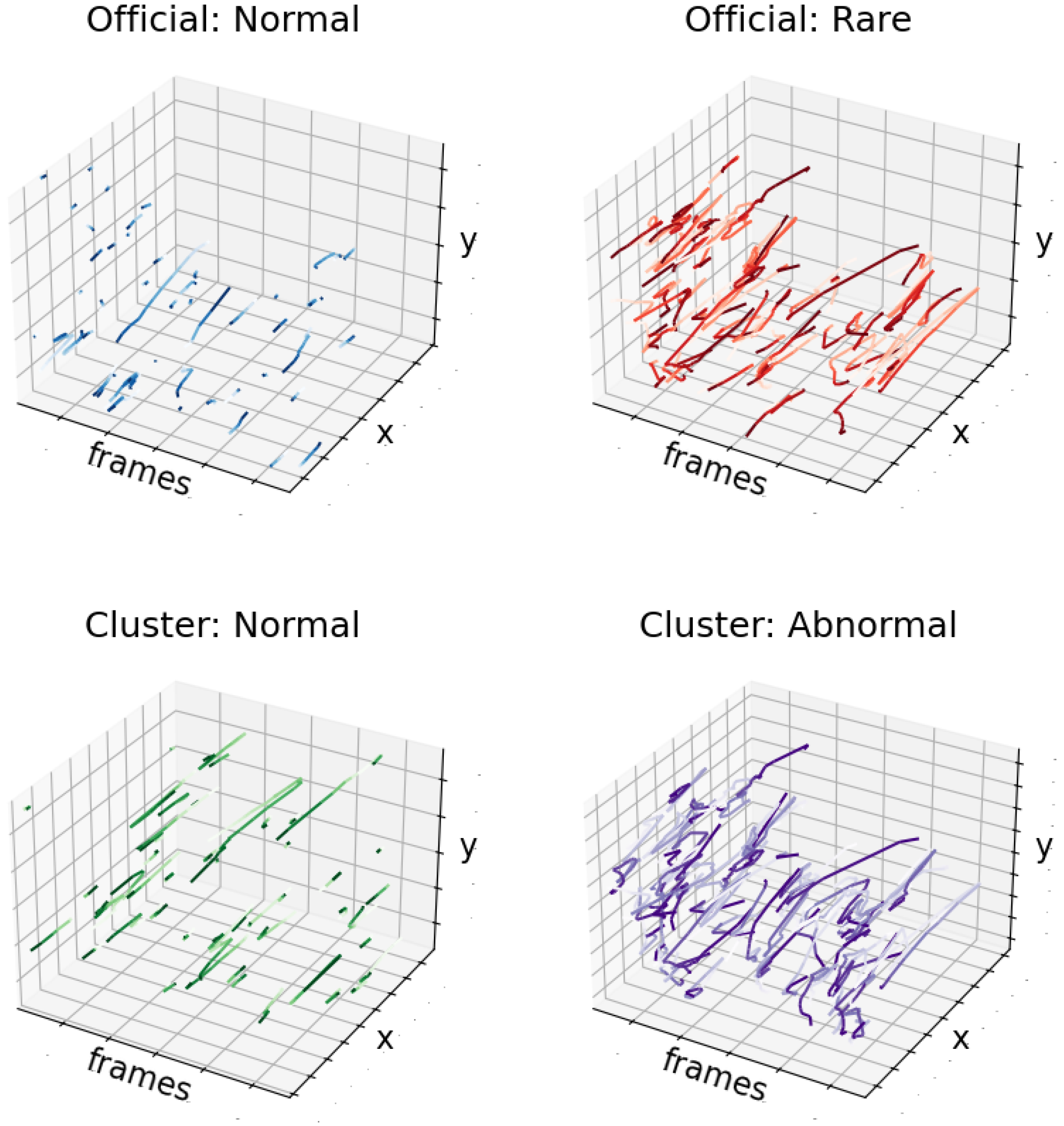
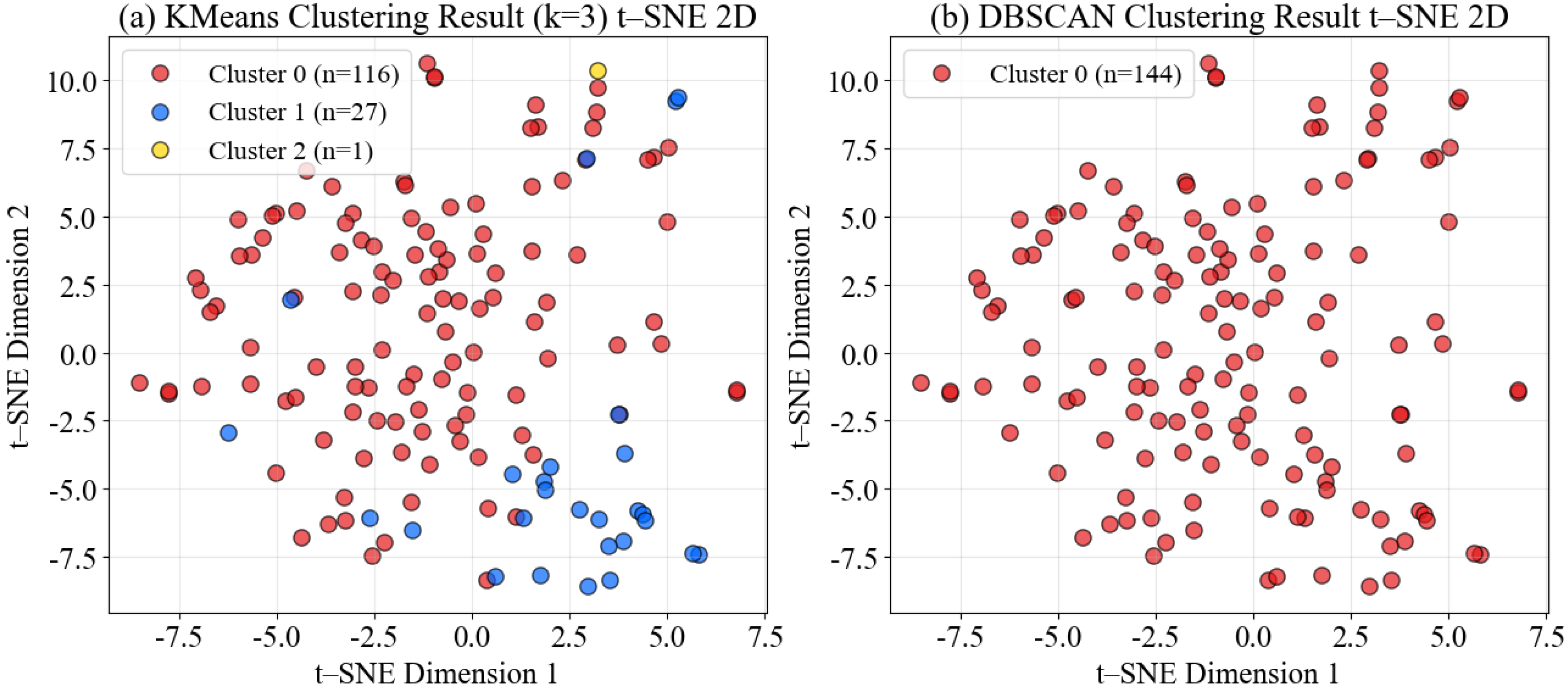
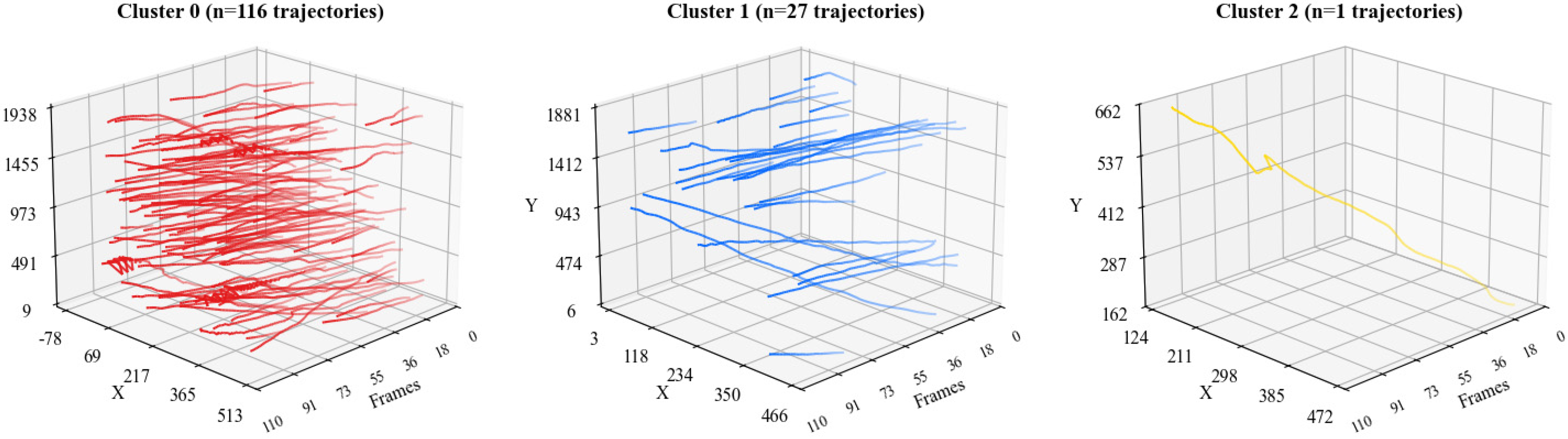
5.6.1. Clustering Analysis and Visualization
- Health-related issues: Disease onset, parasitic infection, or physiological stress;
- Environmental stressors: Localized hypoxia, temperature shock, or water quality problems;
- Equipment malfunctions: Cage net entanglement or structural hazards;
- Behavioral disturbances: Predator presence (seal intrusion) triggering panic responses.
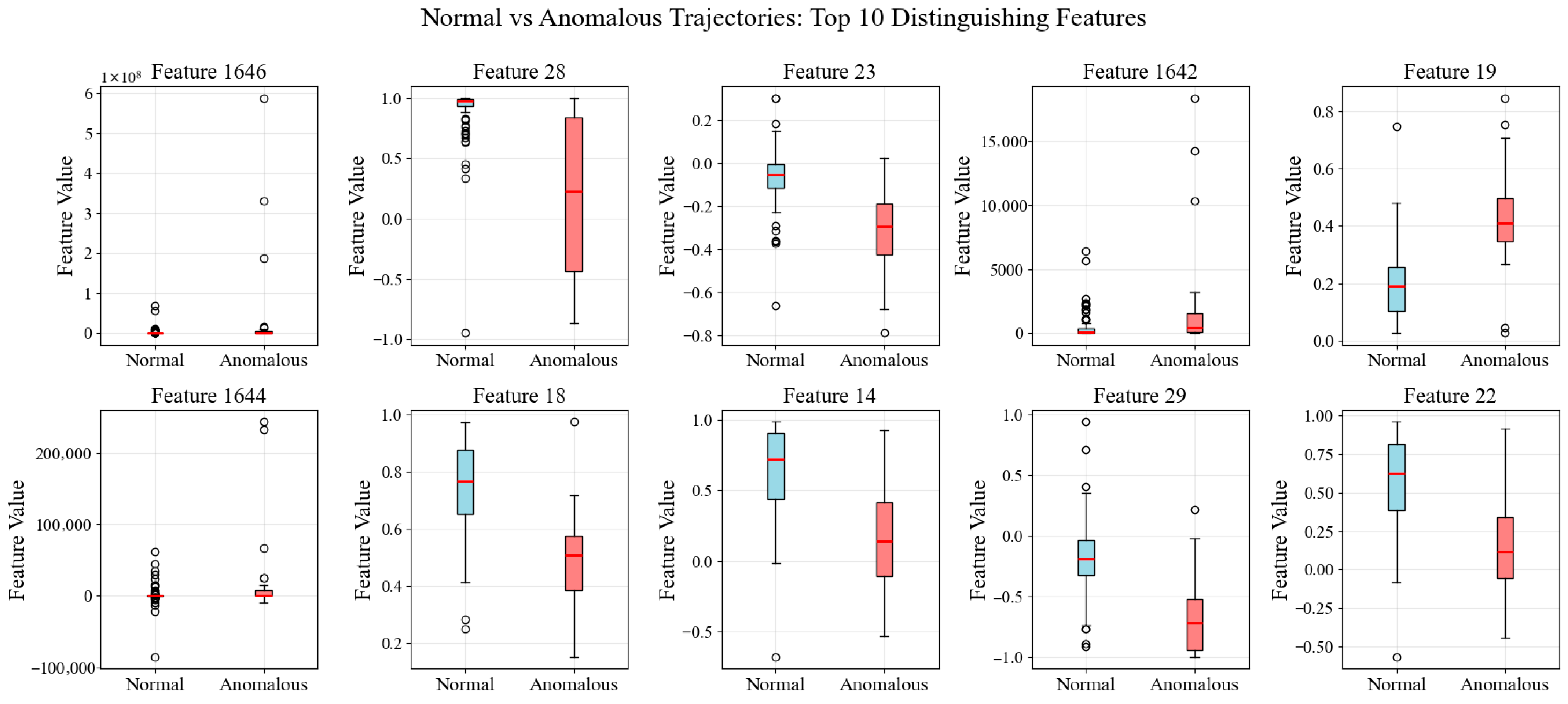
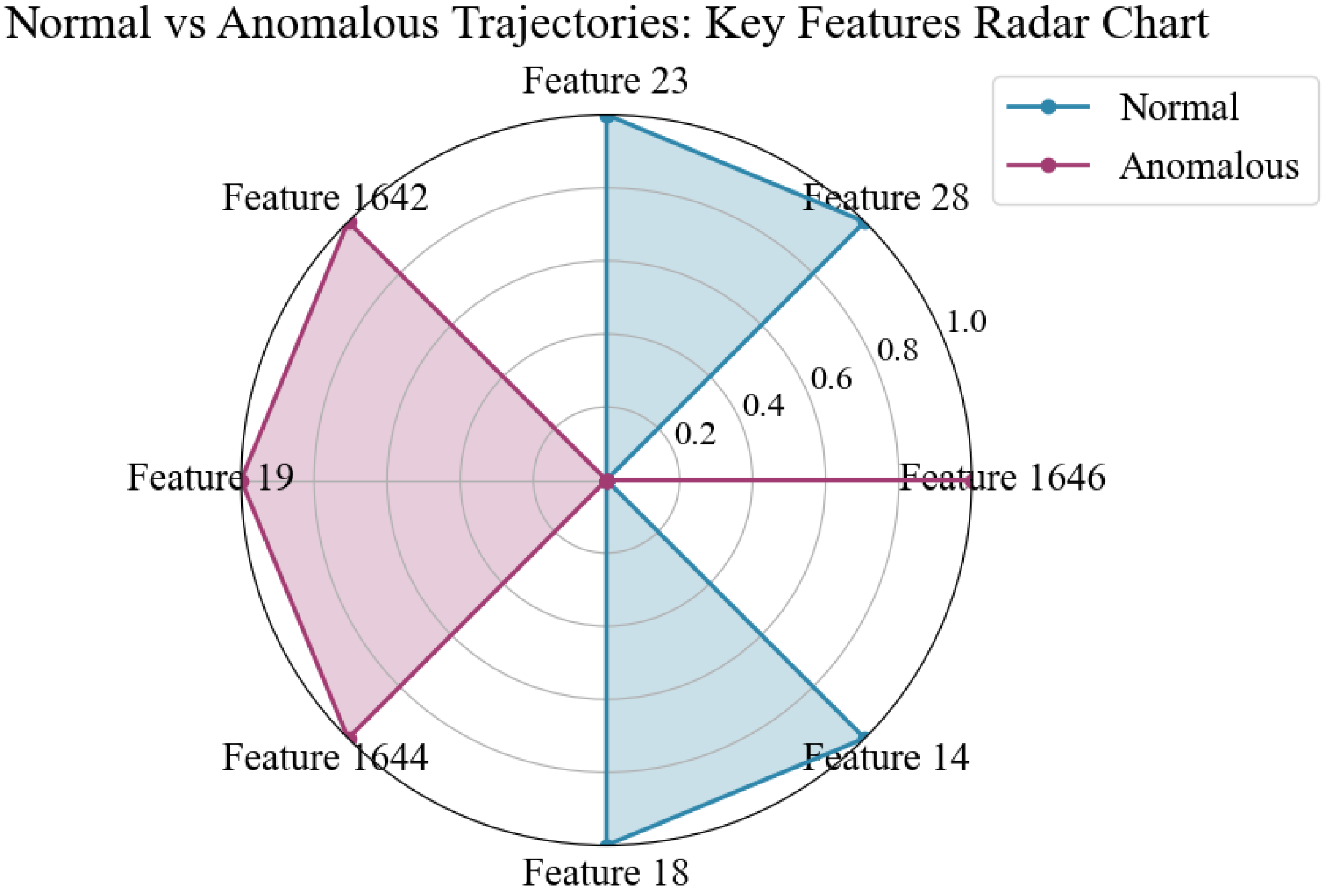
5.6.2. Anomaly Detection
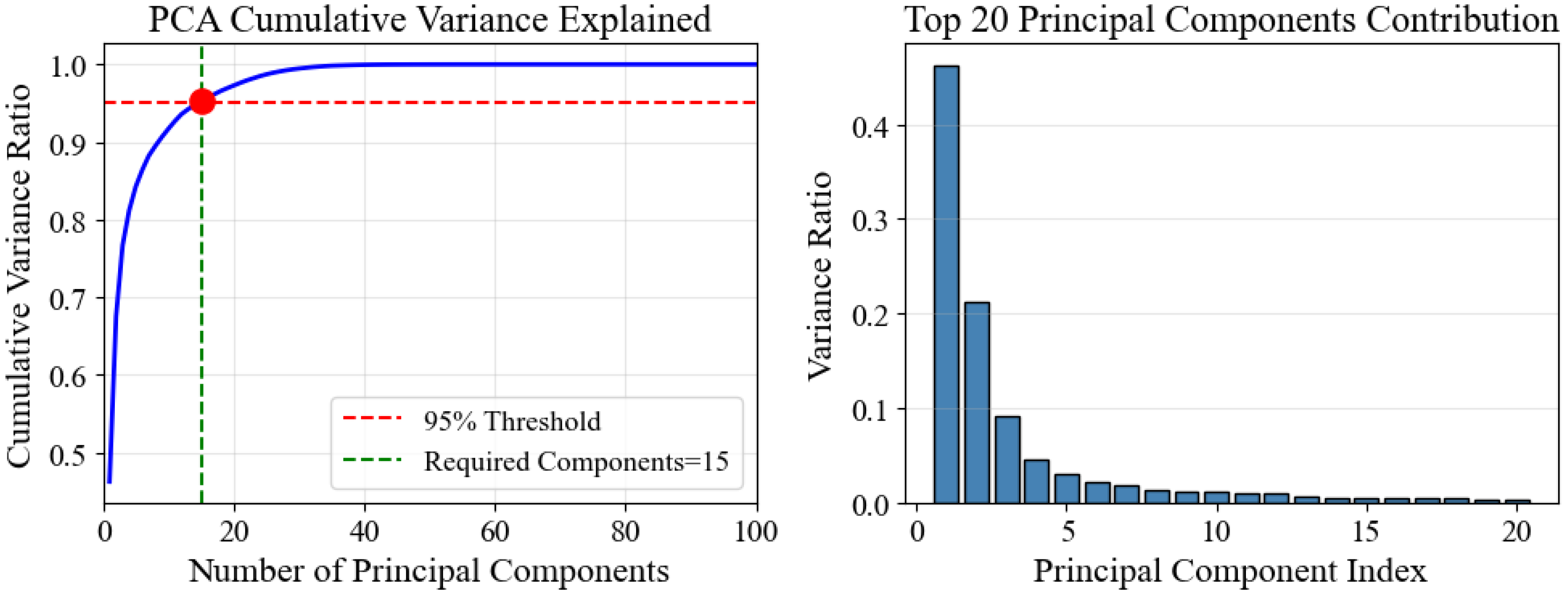
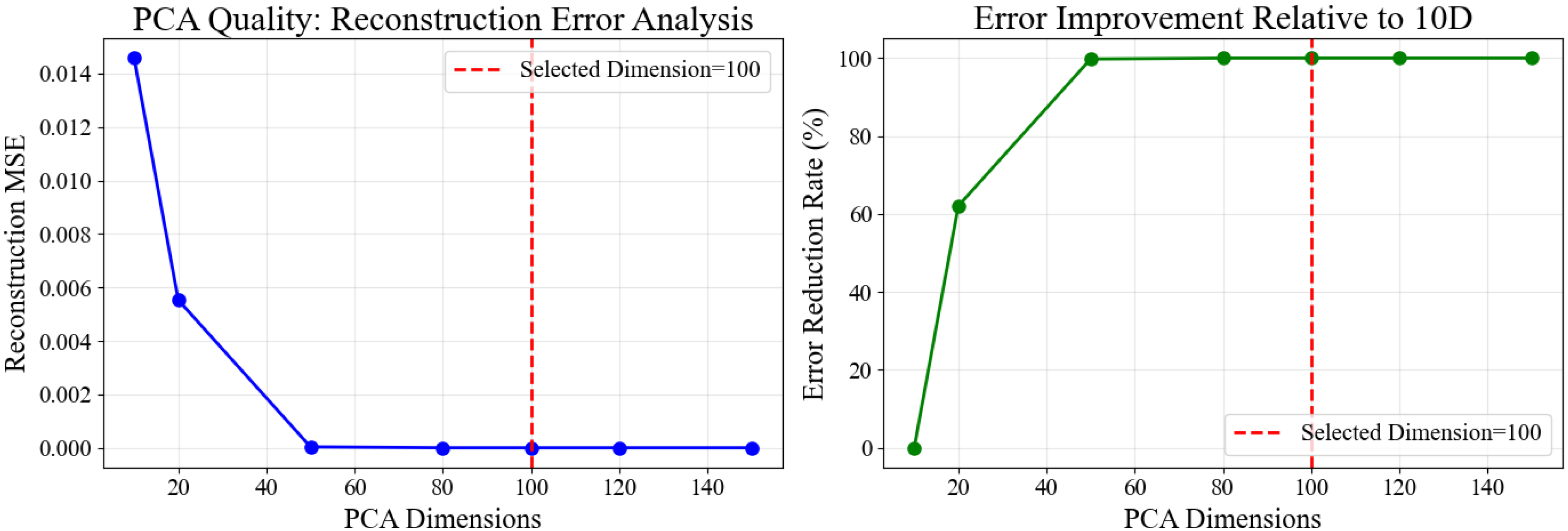
5.6.3. Feature Importance and Dimensionality Reduction Quality
- PC1 (variance: ~47%): Dominated by low-index features (36, 136, 236, 336, 437, 537, 737, 637, 837, 37) with highly uniform loadings (~0.095), spaced at regular intervals of 100. This pattern suggests these features represent a time-series sequence of basic kinematic properties (e.g., velocity or acceleration profiles). The uniformity of loadings indicates that all time points contribute equally, capturing the overall temporal pattern of movement rather than specific critical moments. This component represents the global rhythm and periodicity of swimming behavior, discriminating between rhythmic cruising versus irregular wandering patterns.
- PC2 (variance: ~22%): Weighted heavily on high-index features (943, 841, 1041, 1043, 741, 1141) in the range 741–1141, combined with low-index features (41, 141, 641, 241) in the range 41–641. The uniform loadings (~0.100–0.101) across these disparate ranges suggest this component captures a combination of high-order spatial features (e.g., higher-order moments, CSS features) and basic kinematic features. This component likely represents the complexity of trajectory geometry, separating smooth, simple paths from complex, convoluted trajectories with irregular curvature.
- PC3 (variance: ~ 9%): Dominated by extremely low-index features (10, 12, 11, 8) with the highest loadings (0.187–0.190), combined with very high-index features (1643, 1647, 1646, 1642) in the range 1642–1647 with moderate loadings (~0.170). The extremely low indices typically correspond to the most fundamental trajectory properties (e.g., total length, initial position, overall direction), while the highest indices often represent the most complex derived features (e.g., high-order curvature statistics). This component captures the contrast between basic spatial extent and fine-scale geometric details, likely representing the scale and spatial distribution of swimming activity—discriminating between large-ranging, expansive movements versus localized, confined swimming patterns.
- PCA Contribution: Sum of absolute loadings across all 100 PCs.
- Anomaly Discrimination: Normalized difference between normal and anomalous group means.
- Statistical Significance: Inverse of p-value from t-tests (with a ceiling for numerical stability).
6. Discussion
6.1. Implications and Limitations
6.2. Future Research Directions
- Multimodal sensor fusion: Combining multiple sources of information, such as video data, acoustic sensors, and water-quality monitoring data, enhances the comprehensiveness and accuracy of behavioral analysis. For example, it can correlate changes in fish behavior with changes in environmental parameters such as temperature and dissolved oxygen.
- Group behavior analysis: Expand from individual trajectory analysis to the study of group behavior patterns, including fish density, synchronization, leader-follower relationships, and related indicators, to identify abnormal behavior at the group level.
- Long-term behavioral patterns: Develop methods to capture daily, weekly, and seasonal behavioral changes, and explore long-term associations among environmental factors, physiological states, and behavioral patterns.
- Intelligent Farming Decision Support System: Combine behavioral analysis results with farming management decisions to develop an intelligent decision support system that automates and precisely manages farming operations, such as feed placement and water quality regulation.
- 3D tracking and depth perception: Develop stereo vision or depth-sensing approaches to capture full 3D trajectories, enabling more accurate modeling of vertical movement, spatial utilization, and inter-fish distances in cage environments.
7. Summary
Author Contributions
Funding
Institutional Review Board Statement
Informed Consent Statement
Data Availability Statement
Conflicts of Interest
Appendix A. Complete Tracking Metrics

| Tracker | IDF1 | IDP | IDR | Rcll | Prcn | MT | PT | ML | FP | FN | IDs | FM | MOTA | MOTP |
|---|---|---|---|---|---|---|---|---|---|---|---|---|---|---|
| sort | 0.447 | 0.536 | 0.38 | 0.447 | 0.636 | 37 | 82 | 9 | 4623 | 9990 | 157 | 147 | 0.183 | 0.129 |
| sort + sod | 0.442 | 0.532 | 0.376 | 0.442 | 0.631 | 36 | 83 | 9 | 4667 | 10093 | 158 | 155 | 0.175 | 0.176 |
| deepsort | 0.31 | 0.258 | 0.385 | 0.471 | 0.317 | 40 | 83 | 5 | 18379 | 9564 | 204 | 94 | −0.557 | 0.195 |
| deepsort + sod | 0.31 | 0.258 | 0.385 | 0.471 | 0.317 | 40 | 83 | 5 | 18379 | 9564 | 204 | 94 | −0.557 | 0.195 |
| ocsort | 0.479 | 0.569 | 0.411 | 0.447 | 0.625 | 37 | 82 | 9 | 4860 | 9993 | 127 | 171 | 0.171 | 0.134 |
| ours | 0.829 | 0.847 | 0.811 | 0.858 | 0.897 | 83 | 42 | 3 | 1006 | 1333 | 93 | 50 | 0.737 | 0.141 |
| Configuration | IDF1 | IDP | IDR | Rcll | Prcn | MT | PT | ML | FP | FN | IDs | FM | MOTA | MOTP | Runtime(s) |
|---|---|---|---|---|---|---|---|---|---|---|---|---|---|---|---|
| Full (SOD-SORT) | 0.829 | 0.847 | 0.811 | 0.858 | 0.897 | 83 | 42 | 3 | 1006 | 1333 | 93 | 50 | 0.737 | 0.141 | 5.3 |
| -A: Remove CTRV-EKF | 0.769 | 0.797 | 0.743 | 0.821 | 0.881 | 78 | 46 | 4 | 1124 | 1649 | 172 | 62 | 0.695 | 0.142 | 6.1 |
| -A,B: Baseline DeepOCSORT | 0.822 | 0.839 | 0.805 | 0.855 | 0.893 | 82 | 43 | 3 | 984 | 1335 | 107 | 48 | 0.737 | 0.141 | 6.3 |
Appendix B. Additional Trajectory Visualizations


Appendix C. CTRV Jacobians (Summary)
Appendix C.1. State Transition Function (Two Cases)
Appendix C.2. Transition Jacobian : Straight-Line Limit ()
Appendix C.3. Transition Jacobian : Turning ( )
Appendix C.4. Observation Function and Jacobian (Selection Matrix)
Appendix C.5. Numerical Considerations
- Angle handling: ; Jacobian is computed with unwrapped .
- Small angular velocity: when , use the straight-line limit to avoid divergence; is of order .
- Stability: maintain symmetry and a minimum eigenvalue lower bound for the covariance matrix ; use eigendecomposition truncation or diagonal perturbation when necessary.
Appendix D. KF/EKF and Association Pseudocode (Aligned with DeepOCSORT)
| for each frame t: # Prediction ; # Gating (DeepOCSORT): IoU-based threshold gating (optional BYTE second matching) Construct IoU cost/similarity and apply threshold filtering to form candidate match set # Assignment (DeepOCSORT built-in) matches = assign_with_iou_then_optional_byte() # Update for (trk, det) in matches: K = |
| x = |
| P = # Unmatched handling: create new, age, remove |
Appendix E. Kalman Filter Foundation
Appendix F. Trajectory Feature Extraction
Appendix F.1. Fixed-Length Features
- Average speed and average acceleration
- 2.
- Moment & Central-Moment
- 3.
- Vicinity
- 4.
- Stay Point
Appendix F.2. Variable-Length Features
References
- FAO. The State of World Fisheries and Aquaculture 2024; FAO: Rome, Italy, 2024. [Google Scholar] [CrossRef]
- Tian, Z.; Qu, P.; Li, J.; Sun, Y.; Li, G.; Liang, Z.; Zhang, W. A survey of deep learning-based low-light image enhancement. Sensors 2023, 23, 7763. [Google Scholar] [CrossRef]
- Li, G.; Yao, Z.; Hu, Y.; Lian, A.; Yuan, T.; Pang, G.; Huang, X. Deep Learning-Based Fish Detection Using Above-Water Infrared Camera for Deep-Sea Aquaculture: A Comparison Study. Sensors 2024, 24, 2430. [Google Scholar] [CrossRef]
- Wang, Y.; Chen, Z.; Yan, G.; Zhang, J.; Hu, B. Underwater Image Enhancement Based on Luminance Reconstruction by Multi-Resolution Fusion of RGB Channels. Sensors 2024, 24, 5776. [Google Scholar] [CrossRef]
- Wojke, N.; Bewley, A.; Paulus, D. Simple online and realtime tracking with a deep association metric. In Proceedings of the 2017 IEEE International Conference on Image Processing (ICIP), Beijing, China, 17–20 September 2017; pp. 3645–3649. [Google Scholar]
- Aharon, N.; Orfaig, R.; Bobrovsky, B.-Z. BoT-SORT: Robust associations multi-pedestrian tracking. arXiv 2022, arXiv:2206.14651. [Google Scholar] [CrossRef]
- Zhang, Y.; Sun, P.; Jiang, Y.; Yu, D.; Weng, F.; Yuan, Z.; Luo, P.; Liu, W.; Wang, X. Bytetrack: Multi-object tracking by associating every detection box. In Proceedings of the European Conference on Computer Vision, Tel Aviv, Israel, 24–28 October 2022; pp. 1–21. [Google Scholar]
- Bar-Shalom, Y.; Li, X.R.; Kirubarajan, T. Estimation with Applications to Tracking and Navigation: Theory Algorithms and Software; John Wiley & Sons: Hoboken, NJ, USA, 2001. [Google Scholar]
- Guan, Z.; Wang, Z.; Zhang, G.; Li, L.; Zhang, M.; Shi, Z.; Jiang, N. Multi-object tracking review: Retrospective and emerging trend. Artif. Intell. Rev. 2025, 58, 235. [Google Scholar] [CrossRef]
- Peddina, K.; Mandava, A.K. An optimized deep network-based fish tracking and classification from underwater images. Multimed. Tools Appl. 2025, 84, 15249–15269. [Google Scholar] [CrossRef]
- Zouin, B.; Zahir, J.; Baletaud, F.; Vigliola, L.; Villon, S. Improving CNN fish detection and classification with tracking. Appl. Sci. 2024, 14, 10122. [Google Scholar] [CrossRef]
- Liu, Y.; Li, B.; Liu, D.; Duan, Q. Adaptive spatial aggregation and viewpoint alignment for three-dimensional online multiple fish tracking. Comput. Electron. Agric. 2025, 236, 110408. [Google Scholar] [CrossRef]
- Pedersen, M.; Lehotský, D.; Nikolov, I.; Moeslund, T.B. Brackishmot: The brackish multi-object tracking dataset. In Proceedings of the Scandinavian Conference on Image Analysis, Sirkka, Finland, 18–21 April 2023; pp. 17–33. [Google Scholar]
- Bernardin, K.; Stiefelhagen, R. Evaluating multiple object tracking performance: The clear mot metrics. EURASIP J. Image Video Process. 2008, 2008, 246309. [Google Scholar] [CrossRef]
- Ristani, E.; Solera, F.; Zou, R.; Cucchiara, R.; Tomasi, C. Performance measures and a data set for multi-target, multi-camera tracking. In Proceedings of the European Conference on Computer Vision, Amsterdam, The Netherlands, 8–16 October 2016; pp. 17–35. [Google Scholar]
- Luiten, J.; Osep, A.; Dendorfer, P.; Torr, P.; Geiger, A.; Leal-Taixé, L.; Leibe, B. Hota: A higher order metric for evaluating multi-object tracking. Int. J. Comput. Vis. 2021, 129, 548–578. [Google Scholar] [CrossRef] [PubMed]
- Bewley, A.; Ge, Z.; Ott, L.; Ramos, F.; Upcroft, B. Simple online and realtime tracking. In Proceedings of the 2016 IEEE International Conference on Image Processing (ICIP), Phoenix, AZ, USA, 25–28 September 2016; pp. 3464–3468. [Google Scholar]
- Ye, M.; Shen, J.; Lin, G.; Xiang, T.; Shao, L.; Hoi, S.C. Deep learning for person re-identification: A survey and outlook. IEEE Trans. Pattern Anal. Mach. Intell. 2021, 44, 2872–2893. [Google Scholar] [CrossRef]
- Hochreiter, S.; Schmidhuber, J. Long short-term memory. Neural Comput. 1997, 9, 1735–1780. [Google Scholar] [CrossRef]
- Vaswani, A.; Shazeer, N.; Parmar, N.; Uszkoreit, J.; Jones, L.; Gomez, A.N.; Kaiser, Ł.; Polosukhin, I. Attention is all you need. In Advances in Neural Information Processing Systems, Proceedings of the 31st Conference on Neural Information Processing Systems (NIPS 2017), Long Beach, CA, USA, 4–9 December 2017; Curran Associates Inc.: Red Hook, NY, USA, 2017; Volume 30. [Google Scholar]
- Wang, Z.; Zheng, L.; Liu, Y.; Li, Y.; Wang, S. Towards real-time multi-object tracking. In Proceedings of the European Conference on Computer Vision, Glasgow, UK, 23–28 August 2020; pp. 107–122. [Google Scholar]
- Mei, Y.; Yan, N.; Qin, H.; Yang, T.; Chen, Y. SiamFCA: A new fish single object tracking method based on siamese network with coordinate attention in aquaculture. Comput. Electron. Agric. 2024, 216, 108542. [Google Scholar] [CrossRef]
- Spampinato, C.; Chen-Burger, Y.-H.; Nadarajan, G.; Fisher, R.B. Detecting, tracking and counting fish in low quality unconstrained underwater videos. In Proceedings of the International Conference on Computer Vision Theory and Applications, Funchal, Portugal, 22–25 January 2008; pp. 514–519. [Google Scholar]
- Beyan, C.; Fisher, R.B. Detecting abnormal fish trajectories using clustered and labeled data. In Proceedings of the 2013 IEEE International Conference on Image Processing, Melbourne, Australia, 15–18 September 2013; pp. 1476–1480. [Google Scholar]
- Carmody, K.G.; Mariano, A.; Kerstetter, D. A principal component analysis of vertical temperature profiles for tracking movements of large pelagic fishes. Aquat. Sci. Technol. 2017, 5, 33. [Google Scholar] [CrossRef]
- Shreesha, S.; Pai, M.M.; Verma, U.; Pai, R.M. Fish tracking and continual behavioral pattern clustering using novel Sillago Sihama Vid (SSVid). IEEE Access 2023, 11, 29400–29416. [Google Scholar] [CrossRef]
- Abinaya, N.; Susan, D. Tracking of Fish School in Aquaculture with Weighted Clustering Technique Using Kalman Filter. In Proceedings of the International Conference on Automation, Signal Processing, Instrumentation and Control, Singapore, 27–28 February 2020; pp. 2381–2390. [Google Scholar]
- Kandimalla, V.; Richard, M.; Smith, F.; Quirion, J.; Torgo, L.; Whidden, C. Automated detection, classification and counting of fish in fish passages with deep learning. Front. Mar. Sci. 2022, 8, 823173. [Google Scholar] [CrossRef]
- Jäger, J.; Wolff, V.; Fricke-Neuderth, K.; Mothes, O.; Denzler, J. Visual fish tracking: Combining a two-stage graph approach with CNN-features. In Proceedings of the OCEANS 2017-Aberdeen, Aberdeen, UK, 19–22 June 2017; pp. 1–6. [Google Scholar]
- Wang, S.H.; Zhao, J.W.; Chen, Y.Q. Robust tracking of fish schools using CNN for head identification. Multimed. Tools Appl. 2017, 76, 23679–23697. [Google Scholar] [CrossRef]
- Palconit, M.G.B.; Almero, V.J.D.; Rosales, M.A.; Sybingco, E.; Bandala, A.A.; Vicerra, R.R.P.; Dadios, E.P. Towards tracking: Investigation of genetic algorithm and LSTM as fish trajectory predictors in turbid water. In Proceedings of the 2020 IEEE Region 10 Conference (TENCON), Osaka, Japan, 16–19 November 2020; pp. 744–749. [Google Scholar]
- Wang, S.H.; Zhao, J.; Liu, X.; Qian, Z.-M.; Liu, Y.; Chen, Y.Q. 3D tracking swimming fish school with learned kinematic model using LSTM network. In Proceedings of the 2017 IEEE International Conference on Acoustics, Speech and Signal Processing (ICASSP), New Orleans, LA, USA, 5–9 March 2017; pp. 1068–1072. [Google Scholar]
- Li, W.; Liu, Y.; Wang, W.; Li, Z.; Yue, J. TFMFT: Transformer-based multiple fish tracking. Comput. Electron. Agric. 2024, 217, 108600. [Google Scholar] [CrossRef]
- Huang, J.; Yu, X.; Chen, X.; An, D.; Zhou, Y.; Wei, Y. Recognizing fish behavior in aquaculture with graph convolutional network. Aquac. Eng. 2022, 98, 102246. [Google Scholar] [CrossRef]
- Gong, L.; Hu, Z.; Zhou, X. A few samples underwater fish tracking method based on semi-supervised and attention mechanism. In Proceedings of the 2022 6th International Conference on Robotics, Control and Automation (ICRCA), Xiamen, China, 26–28 February 2022; pp. 18–22. [Google Scholar]
- Saberioon, M.; Cisar, P. Automated multiple fish tracking in three-dimension using a structured light sensor. Comput. Electron. Agric. 2016, 121, 215–221. [Google Scholar] [CrossRef]
- Zhu, Y.; Ju, X.; Chen, Y. Offshore cage aquaculture of China: Current situation, problems and countermeasures. Chin. Fish. Econ 2017, 35, 72–78. [Google Scholar]
- Mai, K.; Xu, H.; Xue, C.; Gu, W.; Zhang, W.; Li, Z.; Yu, B. Study on strategies for developing offshore as the new spaces for mariculture in China. Strateg. Study Chin. Acad. Eng. 2016, 18, 90–95. [Google Scholar]
- Cai, J.; Zhang, Y.; Li, J. General technology research of 100 thousand ton deep sea aquaculture platform. Ship Eng. 2017, 39, 198–203. [Google Scholar]
- Fish4Knowledge Homepage. Available online: https://homepages.inf.ed.ac.uk/rbf/Fish4Knowledge/ (accessed on 21 August 2025).
- Fish4Knowledge Video Sample Download Page. Available online: https://groups.inf.ed.ac.uk/vision/DATASETS/FISH4KNOWLEDGE/WEBSITE/F4KDATASAMPLES/INTERFACE/DATASAMPLES/search.php (accessed on 1 October 2025).
- Fish4Knowledge Overview. Available online: https://groups.inf.ed.ac.uk/vision/DATASETS/FISH4KNOWLEDGE/WEBSITE/overview.htm (accessed on 1 October 2025).
- Fish Recognition Ground-Truth Data. Available online: https://homepages.inf.ed.ac.uk/rbf/Fish4Knowledge/GROUNDTRUTH/RECOG/ (accessed on 1 October 2025).
- Fish Trajectory Ground Truth Dataset. Available online: https://homepages.inf.ed.ac.uk/rbf/Fish4Knowledge/GROUNDTRUTH/BEHAVIOR/ (accessed on 1 October 2025).
- Jocher, G.; Jing, Q.; Ayush, C. Ultralytics YOLOv8, version 8.0.0; Ultralytics: Frederick, MD, USA, 2023. [Google Scholar] [CrossRef]
- Maggiolino, G.; Ahmad, A.; Cao, J.; Kitani, K. Deep oc-sort: Multi-pedestrian tracking by adaptive re-identification. In Proceedings of the 2023 IEEE International Conference on Image Processing (ICIP), Kuala Lumpur, Malaysia, 8–11 October 2023; pp. 3025–3029. [Google Scholar]
- Heindl, C. Py-motmetrics: Metrics for Multiple Object Tracker (MOT) Benchmarking; Zenodo: Geneva, Switzerland, 2022. [Google Scholar] [CrossRef]
- Qin, Z.; Wang, L.; Zhou, S.; Fu, P.; Hua, G.; Tang, W. Towards generalizable multi-object tracking. In Proceedings of the Proceedings of the IEEE/CVF Conference on Computer Vision and Pattern Recognition, Seattle, WA, USA, 16–20 June 2024; pp. 18995–19004. [Google Scholar]
- Kalman, R.E. A New Approach to Linear Filtering and Prediction Problems. J. Basic Eng. 1960, 82, 35–45. [Google Scholar] [CrossRef]
- Li, Q.; Zheng, Y.; Xie, X.; Chen, Y.; Liu, W.; Ma, W.-Y. Mining user similarity based on location history. In Proceedings of the 16th ACM SIGSPATIAL International Conference on Advances in Geographic Information Systems, Irvine, CA, USA, 5–7 November 2008; pp. 1–10. [Google Scholar]


| Tracker | IDF1 | MOTA | IDs | FM | FP | FN | FPS |
|---|---|---|---|---|---|---|---|
| SORT | 0.447 | 0.183 | 157 | 147 | 4623 | 9990 | 86.9 |
| SORT + SOD | 0.442 | 0.175 | 158 | 155 | 4667 | 10,093 | 71.3 |
| DEEPSORT | 0.31 | 0.179 | 366 | 0 | 5421 | 9063 | 40.1 |
| DEEPSORT + SOD | 0.456 | 0.131 | 701 | 0 | 5953 | 9063 | 39.7 |
| OCSORT | 0.479 | 0.171 | 127 | 171 | 4860 | 9993 | 44.7 |
| OCSORT + SOD | 0.521 | 0.198 | 113 | 163 | 4712 | 9781 | 41.2 |
| ByteTrack | 0.429 | 0.348 | 963 | 59 | 4824 | 233 | 227.8 |
| GENERALTRACK | 0.482 | 0.168 | 122 | 58 | 5012 | 9909 | 21.5 |
| StrongSORT++ | 0.688 | 0.416 | 108 | 197 | 3517 | 1769 | 5.2 |
| DeepOCSORT | 0.822 | 0.737 | 107 | 48 | 984 | 1335 | 6.3 |
| SOD-SORT (OURS) | 0.829 | 0.737 | 93 | 50 | 1006 | 1333 | 5.3 |
| Configuration | IDF1 ↑ | MOTA ↑ | IDs ↓ | FM | FP | FN |
|---|---|---|---|---|---|---|
| Full (SOD-SORT) | 0.829 | 0.737 | 93 | 50 | 1006 | 1333 |
| -A: Remove param optimization | 0.702 | 0.694 | 172 | 87 | 1279 | 1374 |
| -A,B: Baseline DeepOCSORT | 0.822 | 0.737 | 107 | 48 | 984 | 1335 |
| Q_Scale () | R_Scale () | MOTA↑ | IDF1↑ | IDs↓ |
|---|---|---|---|---|
| 0.17 | 3.7 | 0.737 | 0.829 | 93 |
| 0.2 | 3.7 | 0.735 | 0.825 | 97 |
| 0.1 | 3.7 | 0.734 | 0.819 | 93 |
| 0.17 | 4 | 0.733 | 0.83 | 97 |
| 0.15 | 2 | 0.732 | 0.817 | 103 |
| Accuracy | Precision | Recall | f1 | f0.5 | f2 | Auc |
|---|---|---|---|---|---|---|
| 0.981 | 0.992 | 0.988 | 0.990 | 0.991 | 0.989 | 0.787 |
| Rank | PC1 Feature | Loading | PC2 Feature | Loading | PC3 Feature | Loading |
|---|---|---|---|---|---|---|
| 1 | 36 | 0.095 | 943 | 0.101 | 10 | 0.19 |
| 2 | 136 | 0.095 | 841 | 0.101 | 12 | 0.189 |
| 3 | 236 | 0.095 | 1041 | 0.101 | 11 | 0.187 |
| 4 | 336 | 0.095 | 1043 | 0.101 | 1643 | 0.184 |
| 5 | 437 | 0.095 | 741 | 0.101 | 1647 | 0.171 |
| 6 | 537 | 0.095 | 1141 | 0.101 | 8 | 0.17 |
| 7 | 737 | 0.095 | 41 | 0.1 | 1646 | 0.17 |
| 8 | 637 | 0.095 | 141 | 0.1 | 1642 | 0.169 |
| 9 | 837 | 0.095 | 641 | 0.1 | 32 | 0.165 |
| 10 | 37 | 0.095 | 241 | 0.1 | 132 | 0.163 |
Disclaimer/Publisher’s Note: The statements, opinions and data contained in all publications are solely those of the individual author(s) and contributor(s) and not of MDPI and/or the editor(s). MDPI and/or the editor(s) disclaim responsibility for any injury to people or property resulting from any ideas, methods, instructions or products referred to in the content. |
© 2025 by the authors. Licensee MDPI, Basel, Switzerland. This article is an open access article distributed under the terms and conditions of the Creative Commons Attribution (CC BY) license.
Share and Cite
Xiao, X.; Liu, T.; He, S.; Li, P.; Gu, Y.; Li, P.; Dong, J. A Multi-Fish Tracking and Behavior Modeling Framework for High-Density Cage Aquaculture. Sensors 2026, 26, 256. https://doi.org/10.3390/s26010256
Xiao X, Liu T, He S, Li P, Gu Y, Li P, Dong J. A Multi-Fish Tracking and Behavior Modeling Framework for High-Density Cage Aquaculture. Sensors. 2026; 26(1):256. https://doi.org/10.3390/s26010256
Chicago/Turabian StyleXiao, Xinyao, Tao Liu, Shuangyan He, Peiliang Li, Yanzhen Gu, Pixue Li, and Jiang Dong. 2026. "A Multi-Fish Tracking and Behavior Modeling Framework for High-Density Cage Aquaculture" Sensors 26, no. 1: 256. https://doi.org/10.3390/s26010256
APA StyleXiao, X., Liu, T., He, S., Li, P., Gu, Y., Li, P., & Dong, J. (2026). A Multi-Fish Tracking and Behavior Modeling Framework for High-Density Cage Aquaculture. Sensors, 26(1), 256. https://doi.org/10.3390/s26010256