Article

Essential Tremor Severity Assessment Using Handwriting Analysis and Machine Learning

by
Jose Ignacio Sánchez Méndez
1,2,*,
Elsa Fernandez
2,3,
Alberto Bergareche
4 and
Karmele Lopez-de-Ipina
2,5,6,*
1
NTT DATA EU & LATAM USA Branch Inc., 4100 North Fairfax Drive, Suite 810, Arlington, TX 22203, USA
2
EleKin Research Group, University of the Basque Country (EHU), 20018 Donostia, Spain
3
Department of Computational Science and Artificial Intelligence, University of the Basque Country (EHU), 20018 Donostia, Spain
4
Movement Disorders Unit, Department of Neurology, University Hospital Donostia, Paseo Doctor Begiristain, 109, 20014 Donostia, Spain
5
Department of Systems Engineering and Automation, University of the Basque Country (EHU), 20018 Donostia, Spain
6
Department of Psychiatry, University of Cambridge, Herchel Smith Building Forvie Site Robinson Way Cambridge, Cambridge CB2 0SZ, UK
*
Authors to whom correspondence should be addressed.
Sensors 2026, 26(1), 244; https://doi.org/10.3390/s26010244
Submission received: 25 November 2025 / Revised: 19 December 2025 / Accepted: 26 December 2025 / Published: 31 December 2025
(This article belongs to the Special Issue Advanced Non-Invasive Sensors: Methods and Applications—2nd Edition)

Abstract

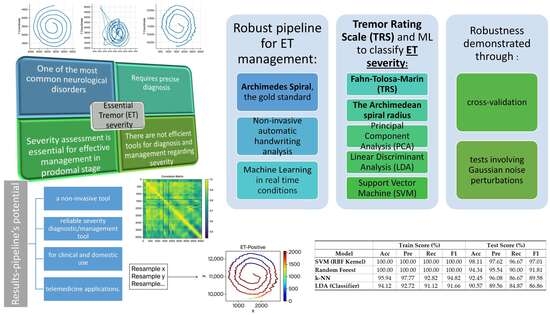
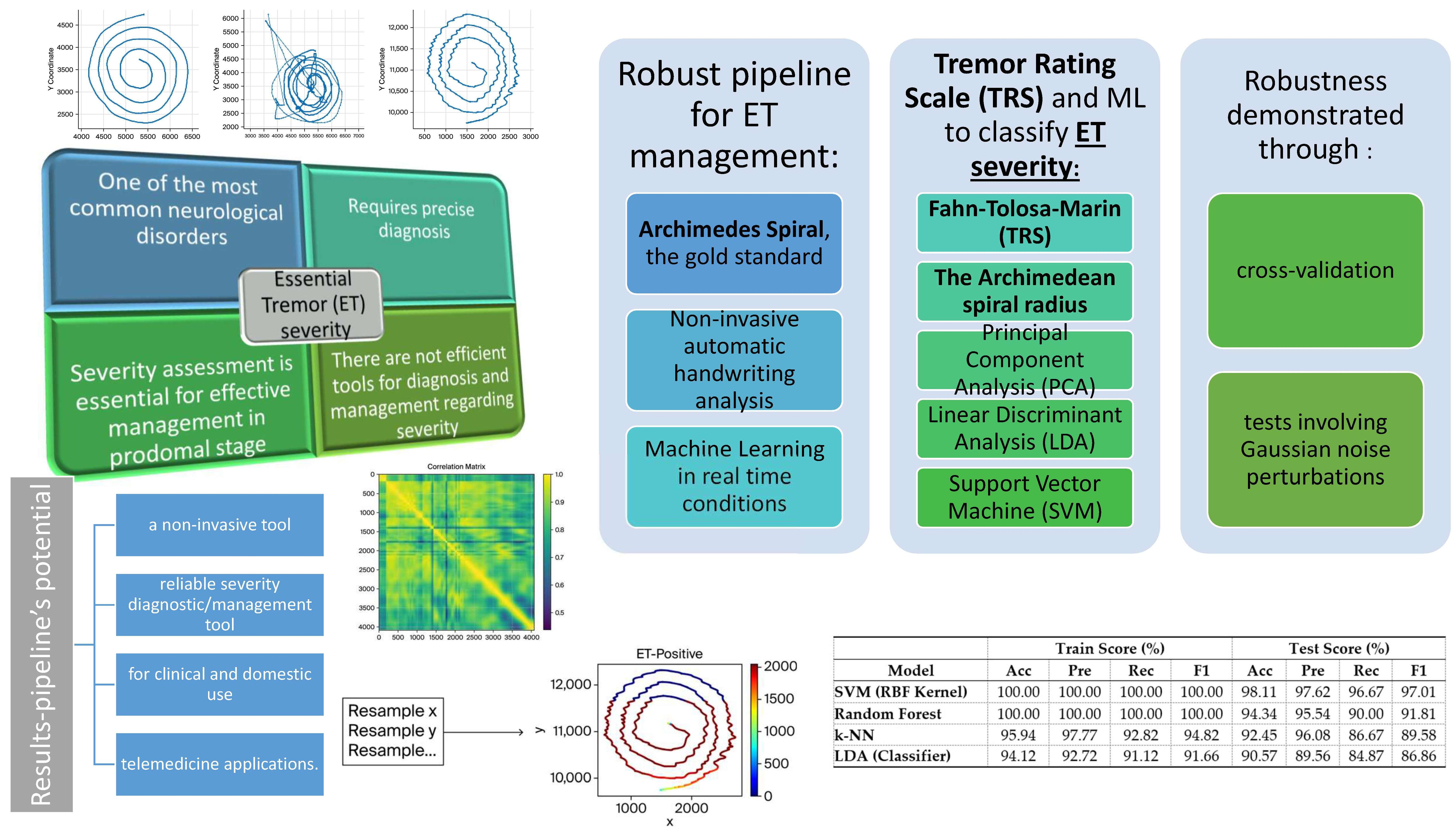
Background: Essential tremor (ET) is among the most common neurological disorders, requiring precise diagnosis and severity assessment for personalized and effective management. Methods: This study explores an innovative approach to evaluate ET severity using the gold-standard Archimedes spiral test. The family-based dataset covers the entire range of tremor severity, from very mild (level 1) to advanced stages, offering a valuable resource for studying early diagnosis and tracking disease progression. The proposed method introduces a machine learning pipeline that combines Principal Component Analysis (PCA), linear discriminant analysis (LDA), and support vector machines (SVMs) to classify ET severity based on Archimedean spiral radius data. Results: By incorporating the Fahn–Tolosa–Marin Tremor Rating Scale (FMT-TRS), the pipeline effectively distinguishes between tremor presence and severity. Its robustness was demonstrated through rigorous cross-validation and tests involving Gaussian noise perturbations. Conclusions: These results underscore the machine learning-based pipeline’s potential as a non-invasive and trustworthy diagnostic tool for clinical use and telemedicine applications. Moreover, the combination of geometric features, FMT-TRS scores, clinically oriented evaluation metrics, and classical statistical and machine learning models offers a robust, interpretable, explainable, and clinically meaningful analytical framework.
Keywords: classification algorithms; essential tremor; personalized medicine; handwriting analysis; linear discriminant analysis; machine learning; principal component analysis; support vector machines classification algorithms; essential tremor; personalized medicine; handwriting analysis; linear discriminant analysis; machine learning; principal component analysis; support vector machines
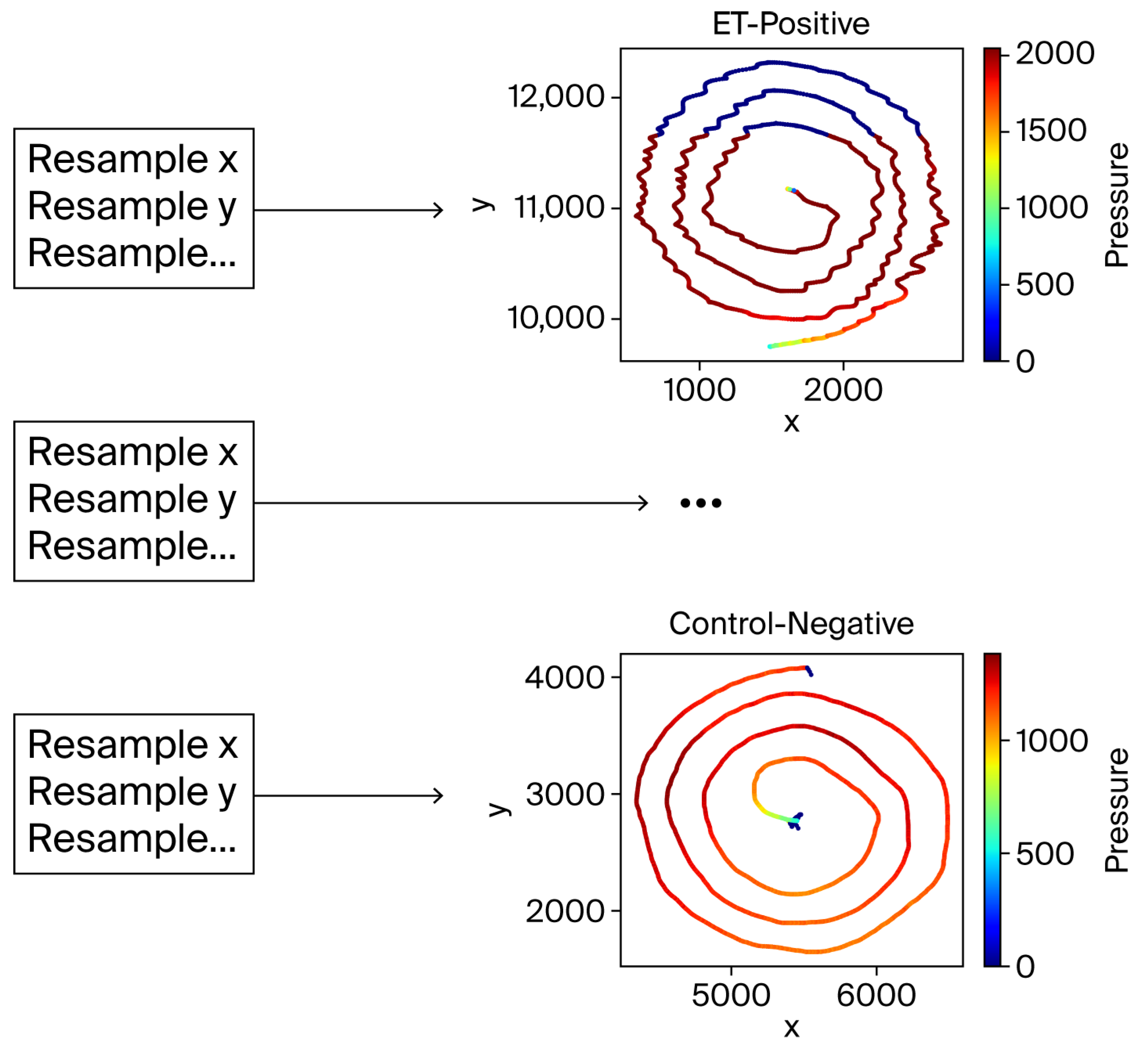
Graphical Abstract