Article

Precision Controllable Reversible Watermarking Algorithm for Oblique Photography 3D Models

1
Faculty of Geomatics, Lanzhou Jiaotong University, Lanzhou 730070, China
2
National-Local Joint Engineering Research Center of Technologies and Application for National Geographic State Monitoring, Lanzhou 730070, China
3
Key Laboratory of Science and Technology in Surveying & Mapping, Lanzhou 730070, China
*
Author to whom correspondence should be addressed.
Sensors 2026, 26(1), 243; https://doi.org/10.3390/s26010243
Submission received: 6 December 2025 / Revised: 26 December 2025 / Accepted: 29 December 2025 / Published: 30 December 2025
(This article belongs to the Section Sensing and Imaging)

Abstract

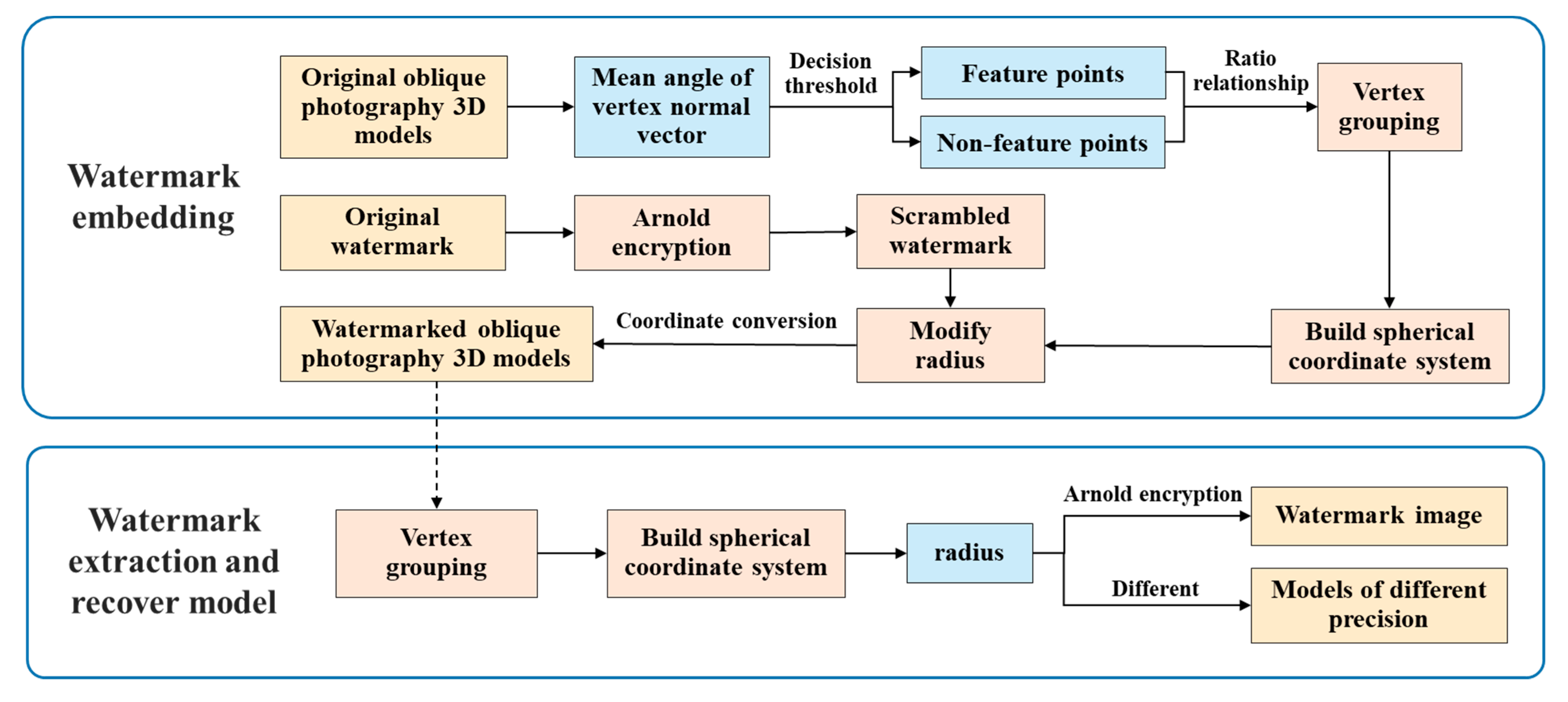
Most oblique photography 3D model watermarking algorithms only support limited data recovery or fail to restore the original model, falling short of meeting diverse user needs. Consequently, this study introduces a novel reversible watermarking scheme specifically tailored for oblique photographic 3D models, which is designed to adjust the accuracy of model recovery freely. Firstly, considering the global stability of the oblique photography 3D model, the feature points are extracted by utilizing the mean angle between vertex normals. Secondly, a mapping is established based on the ratio of distances between feature points and non-feature points. Then, the vertices are grouped, with each group consisting of one feature point and several non-feature points. Finally, by using the feature point as the origin, a spherical coordinate system is constructed for each group. The watermark information is embedded by modifying the radius in the spherical coordinate system. In the process of extracting watermarks, watermarks can be extracted from different radius ranges, thereby achieving a controllable error in model recovery. Experimental results demonstrate that this approach exhibits significant advantages in reversibility and controllable restoration accuracy, achieving error-free extraction under both translation and rotation attacks. Compared to existing algorithms, it achieves average improvements of 0.121 and 0.298 under cropping and simplification attacks, respectively, showcasing enhanced robustness. This enables it to meet better diverse user demands for watermarking and model restoration in oblique photography 3D models.
Keywords: precision controlled; reversible watermarking; 3D models; oblique photography; robustness precision controlled; reversible watermarking; 3D models; oblique photography; robustness