Correlation Between Instrumented Timed Up and Go Test Performance and Muscle Strength in Knee and Hip Osteoarthritis: An Exploratory, Cross-Sectional Study

 , , , , , and
Highlights
- iTUG parameters demonstrated weak-to-moderate correlations with quadriceps and hamstring strength in knee osteoarthritis, and moderate-to-strong correlations in hip osteoarthritis.
- Vertical push-off power, walk duration, and total iTUG duration showed the strongest associations in hip osteoarthritis population.
- The iTUG test could provide a simple and accessible estimation of lower-limb muscle strength when isokinetic evaluation is not available.
- The classic stopwatch-based TUG may offer comparable clinical insights to iTUG-derived metrics, supporting its use in daily rehabilitation settings.
Abstract
1. Introduction
2. Methods
2.1. Study Design
2.2. Ethical and Regulatory Aspects
2.3. Setting
2.4. Participants
2.5. Procedures
2.5.1. Muscle Strength Measurement
2.5.2. Instrumented TUG
2.6. Data Sources and Measurement
- -
- Western Ontario and McMaster Universities Osteoarthritis Index (WOMAC): Questionnaire used for KOA. This 24-item questionnaire calculates three subscale scores for pain, stiffness and physical function. Participants rate their difficulty with each item on a Likert scale. The total score ranges from 0 (no symptoms) to 96 (major disability in daily life) [26].
- -
- Knee Injury and Osteoarthritis Outcome Score (KOOS): administered to participants with KOA only. This 42 items questionnaire, which can be grouped into 5 sub-categories assessing symptoms, pain, function, activity and quality of life. The standardized score ranges from 0 to 100. A score of 100 reflects the best possible outcome, and 0 the worst [27].
- -
- Hip Disability and Osteoarthritis Outcome Score (HOOS): The HOOS was completed by patients with HOA. It comprises 40 items, with 5 sub-scores for pain, symptoms, daily activities, sporting activities and quality of life. Responses are rated on a Likert scale. A standardized score ranging from 0 (extreme problems) to 100 (no problems) is calculated separately for each sub-score.
- -
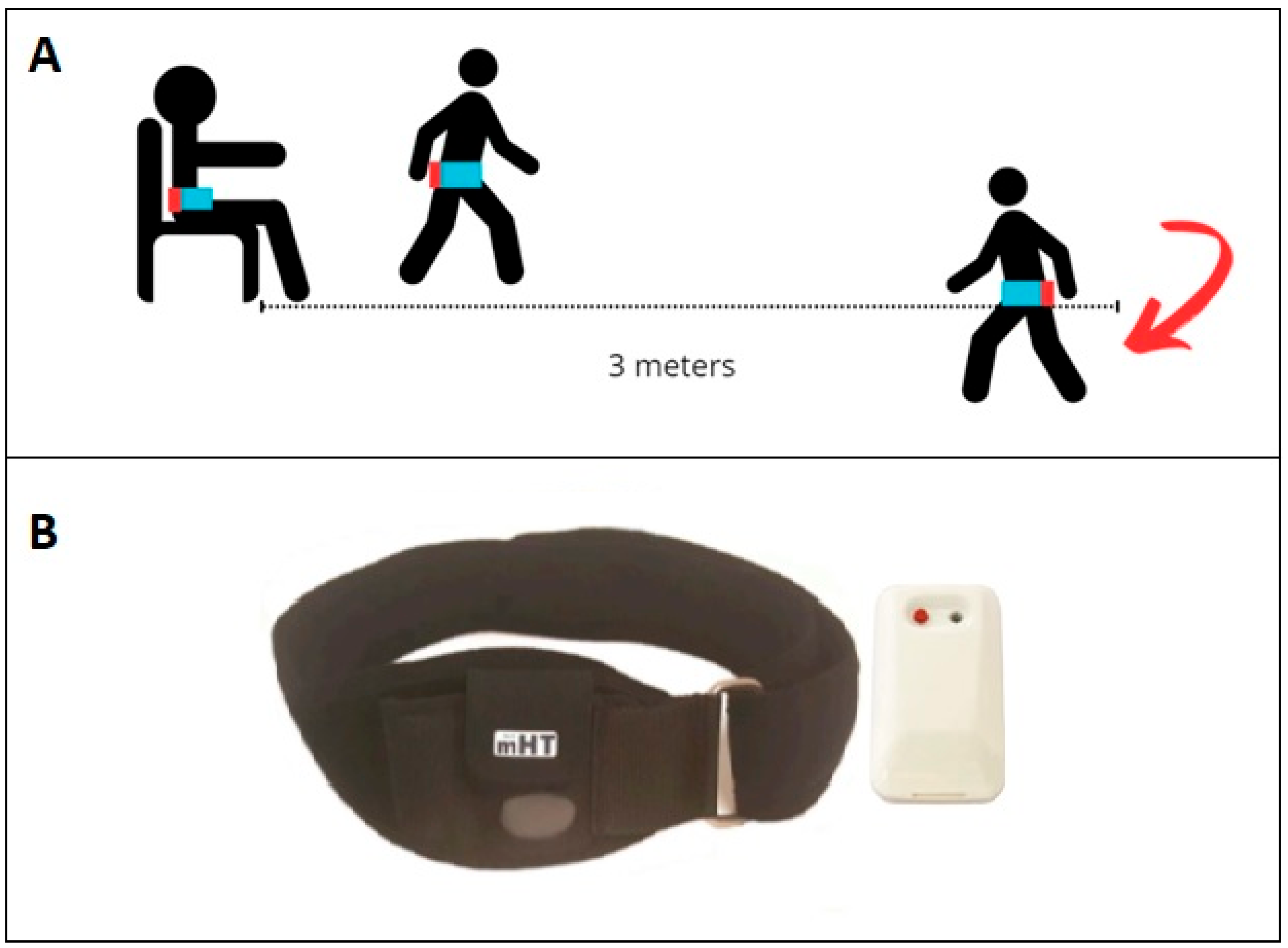
- Total iTUG duration [s], which represents the time interval between the algorithm-detected onset of the sit-to-stand phase and the return to the seated position at the end of the test. This value is roughly equivalent to the traditional TUG duration, with the difference that the identification of the onset, duration, and end of the test is based on the device’s algorithm rather than the examiner’s use of a stopwatch.
- -
- Walk duration including the half-turn [s] refers to the time interval between the algorithm-detected end of the sit-to-stand phase, when the subject begins to walk, and the return toward the chair, including the half-turn. The endpoint is defined as the start of the turn in which the subject initiates sitting.
- -
- Root Mean Square (RMS) of vertical acceleration during sit-to-walk [m/s2] is the RMS of the acceleration signal in the vertical direction during the sit-to-walk phase. It provides a measure of the overall amplitude of acceleration over time and reflects how dynamic the lower-limb effort is during sit-to-walk [24].
- -
- Range of the vertical angular velocity during sit-to-walk [°/s] is the difference between the maximum and minimum angular velocity around the vertical axis measured during the sit-to-walk phase. It quantifies how much the pelvis rotates around vertical axis.
- -
- RMS of the vertical angular velocity during sit-to-walk [°/s] is the RMS of the angular velocity around the vertical axis measured during the sit-to-walk phase. It reflects the overall magnitude or intensity of rotational movement of the pelvis.
- -
- Vertical push-off power during sit-to-walk [Nm] is an indirect, inertia-based estimate of the power generated during the sit-to-walk phase. It is derived from vertical acceleration data and is intended to reflect the ability of the lower limbs to generate muscular power during the postural transition from sitting to standing [17].
Bias
2.7. Sample Size
2.8. Statistical Methods
3. Results
3.1. Participants
3.2. Main Results
3.2.1. Patients with Knee Osteoarthritis
3.2.2. Patients with Hip Osteoarthritis
4. Discussion
Limitations
5. Conclusions
Supplementary Materials
Author Contributions
Funding
Institutional Review Board Statement
Informed Consent Statement
Data Availability Statement
Acknowledgments
Conflicts of Interest
Abbreviations
| BMI | Body Mass Index |
| HOOS | Hip Disability and Osteoarthritis Outcome Score |
| IMUs | Inertial Measurement Units |
| iTUG | Instrumented Timed Up and Go test |
| KOOS | Knee Injury and Osteoarthritis Outcome Score |
| OA | Osteoarthritis |
| RMS | Root Mean Square |
| SD | Standard Deviation |
| STROBE | Strengthening the Reporting of Observational Studies in Epidemiology |
| TUG | Timed Up and Go test |
| WOMAC | Western Ontario and McMaster Universities Osteoarthritis Index |
References
- Cieza, A.; Causey, K.; Kamenov, K.; Hanson, S.W.; Chatterji, S.; Vos, T. Global estimates of the need for rehabilitation based on the Global Burden of Disease study 2019: A systematic analysis for the Global Burden of Disease Study 2019. Lancet 2021, 396, 2006–2017. [Google Scholar] [CrossRef]
- Cleveland, R.J.; Nelson, A.E.; Callahan, L.F. Knee and hip osteoarthritis as predictors of premature death: A review of the evidence. Clin. Exp. Rheumatol. 2019, 37, 24–30. [Google Scholar]
- Alnahdi, A.H.; Zeni, J.A.; Snyder-Mackler, L. Muscle Impairments in Patients with Knee Osteoarthritis. Sports Health 2012, 4, 284–292. [Google Scholar] [CrossRef]
- Burgess, L.C.; Taylor, P.; Wainwright, T.W.; Swain, I.D. Strength and endurance deficits in adults with moderate-to-severe hip osteoarthritis, compared to healthy, older adults. Disabil. Rehabil. 2022, 44, 5563–5570. [Google Scholar] [CrossRef]
- Chamorro, C.; Armijo-Olivo, S.; De la Fuente, C.; Fuentes, J.; Javier Chirosa, L. Absolute Reliability and Concurrent Validity of Hand Held Dynamometry and Isokinetic Dynamometry in the Hip, Knee and Ankle Joint: Systematic Review and Meta-analysis. Open Med. Wars. Pol. 2017, 12, 359–375. [Google Scholar] [CrossRef]
- Mentiplay, B.F.; Clark, R.A. Modified conventional gait model versus cluster tracking: Test-retest reliability, agreement and impact of inverse kinematics with joint constraints on kinematic and kinetic data. Gait Posture 2018, 64, 75–83. [Google Scholar] [CrossRef]
- Hafsteinsdóttir, T.B.; Rensink, M.; Schuurmans, M. Clinimetric properties of the Timed Up and Go Test for patients with stroke: A systematic review. Top. Stroke Rehabil. 2014, 21, 197–210. [Google Scholar] [CrossRef]
- Dobson, F.; Hinman, R.S.; Hall, M.; Terwee, C.B.; Roos, E.M.; Bennell, K.L. Measurement properties of performance-based measures to assess physical function in hip and knee osteoarthritis: A systematic review. Osteoarthr. Cartil. 2012, 20, 1548–1562. [Google Scholar] [CrossRef]
- Reynaud, V.; Verdilos, A.; Pereira, B.; Boisgard, S.; Costes, F.; Coudeyre, E. Core Outcome Measurement Instruments for Clinical Trials of Total Knee Arthroplasty: A Systematic Review. J. Clin. Med. 2020, 9, 2439. [Google Scholar] [CrossRef]
- Horak, F.; King, L.; Mancini, M. Role of Body-Worn Movement Monitor Technology for Balance and Gait Rehabilitation. Phys. Ther. 2015, 95, 461–470. [Google Scholar] [CrossRef]
- Salarian, A.; Horak, F.B.; Zampieri, C.; Carlson-Kuhta, P.; Nutt, J.G.; Aminian, K. iTUG, a Sensitive and Reliable Measure of Mobility. IEEE Trans. Neural Syst. Rehabil. Eng. 2010, 18, 303–310. [Google Scholar] [CrossRef]
- Greene, B.R.; Kenny, R.A. Assessment of cognitive decline through quantitative analysis of the timed up and go test. IEEE Trans. Biomed. Eng. 2012, 59, 988–995. [Google Scholar] [CrossRef]
- Sample, R.B.; Kinney, A.L.; Jackson, K.; Diestelkamp, W.; Bigelow, K.E. Identification of key outcome measures when using the instrumented timed up and go and/or posturography for fall screening. Gait Posture 2017, 57, 168–171. [Google Scholar] [CrossRef]
- Gerhardy, T.; Gordt, K.; Jansen, C.P.; Schwenk, M. Towards Using the Instrumented Timed Up-and-Go Test for Screening of Sensory System Performance for Balance Control in Older Adults. Sensors 2019, 19, 622. [Google Scholar] [CrossRef]
- Yaguchi, H.; Honda, K.; Sekiguchi, Y.; Huang, C.; Fukushi, K.; Wang, Z.; Nakahara, K.; Kamimura, M.; Aki, T.; Ogura, K.; et al. Differences in kinematic parameters during gait between the patients with knee osteoarthritis and healthy controls using an insole with a single inertial measurement unit: A case-control study. Clin. Biomech. Bristol. Avon. 2024, 112, 106191. [Google Scholar] [CrossRef]
- Ibara, T.; Anan, M.; Karashima, R.; Hada, K.; Shinkoda, K.; Kawashima, M.; Takahashi, M. Coordination Pattern of the Thigh, Pelvic, and Lumbar Movements During the Gait of Patients with Hip Osteoarthritis. J. Healthc. Eng. 2020, 2020, 9545825. [Google Scholar] [CrossRef]
- Zijlstra, W.; Bisseling, R.W.; Schlumbohm, S.; Baldus, H. A Body-Fixed-Sensor-Based Analysis of Power During Sit-to-Stand Movements. Gait Posture 2010, 31, 272–278. [Google Scholar] [CrossRef]
- Galán-Mercant, A.; Cuesta-Vargas, A.I. Differences in trunk accelerometry between frail and non-frail elderly persons in functional tasks. BMC Res. Notes 2014, 7, 100. [Google Scholar] [CrossRef]
- von Elm, E.; Altman, D.G.; Egger, M.; Pocock, S.J.; Gøtzsche, P.C.; Vandenbroucke, J.P. The Strengthening the Reporting of Observational Studies in Epidemiology (STROBE) statement: Guidelines for reporting observational studies. PLoS Med. 2007, 4, e296. [Google Scholar] [CrossRef]
- Édouard, P.; Degache, F. Guide D’isocinétisme: L’évaluation Isocinétique des Concepts aux Conditions Sportives et Pathologiques/PASCAL Édouard et Francis Degache; Elsevier Masson: Issy-les-Moulineaux, France, 2016; Available online: https://bibliotheque.univ-catholille.fr/Default/doc/SYRACUSE/361196/guide-d-isocinetisme-l-evaluation-isocinetique-des-concepts-aux-conditions-sportives-et-pathologique (accessed on 9 February 2024).
- Hogrel, J.Y.; Payan, C.A.; Ollivier, G.; Tanant, V.; Attarian, S.; Couillandre, A.; Dupeyron, A.; Lacomblez, L.; Doppler, V.; Meininger, V.; et al. Development of a French Isometric Strength Normative Database for Adults Using Quantitative Muscle Testing. Arch. Phys. Med. Rehabil. 2007, 88, 1289–1297. [Google Scholar] [CrossRef]
- Podsiadlo, D.; Richardson, S. The Timed “Up & Go”: A Test of Basic Functional Mobility for Frail Elderly Persons. J. Am. Geriatr. Soc. 1991, 39, 142–148. [Google Scholar] [CrossRef]
- Mellone, S.; Tacconi, C.; Chiari, L. Validity of a Smartphone-based instrumented Timed Up and Go. Gait Posture 2012, 36, 163–165. [Google Scholar] [CrossRef]
- Palmerini, L.; Mellone, S.; Avanzolini, G.; Valzania, F.; Chiari, L. Quantification of motor impairment in Parkinson’s disease using an instrumented timed up and go test. IEEE Trans. Neural Syst. Rehabil. Eng. 2013, 21, 664–673. [Google Scholar] [CrossRef]
- El-Gohary, M.; Pearson, S.; McNames, J.; Mancini, M.; Horak, F.; Mellone, S.; Chiari, L. Continuous monitoring of turning in patients with movement disability. Sensors 2013, 14, 356–369. [Google Scholar] [CrossRef]
- Stucki, G.; Sangha, O.; Stucki, S.; Michel, B.A.; Tyndall, A.; Dick, W.; Theiler, R. Comparison of the WOMAC (Western Ontario and McMaster Universities) osteoarthritis index and a self-report format of the self-administered Lequesne–Algofunctional index in patients with knee and hip osteoarthritis. Osteoarthr. Cartil. 1998, 6, 79–86. [Google Scholar] [CrossRef]
- Roos, E.M.; Lohmander, L.S. The Knee injury and Osteoarthritis Outcome Score (KOOS): From joint injury to osteoarthritis. Health Qual. Life Outcomes 2003, 1, 64. [Google Scholar] [CrossRef]
- Millor, N.; Lecumberri, P.; Gomez, M.; Martinez-Ramirez, A.; Izquierdo, M. Kinematic parameters to evaluate functional performance of sit-to-stand and stand-to-sit transitions using motion sensor devices: A systematic review. IEEE Trans. Neural Syst. Rehabil. Eng. 2014, 22, 926–936. [Google Scholar] [CrossRef]
- Patel, M.; Pavic, A.; Goodwin, V.A. Wearable inertial sensors to measure gait and posture characteristic differences in older adult fallers and non-fallers: A scoping review. Gait Posture 2020, 76, 110–121. [Google Scholar] [CrossRef]
- Roos, E.M.; Grønne, D.T.; Thorlund, J.B.; Skou, S.T. Knee and hip osteoarthritis are more alike than different in baseline characteristics and outcomes: A longitudinal study of 32,599 patients participating in supervised education and exercise therapy. Osteoarthr. Cartil. 2022, 30, 681–688. [Google Scholar] [CrossRef]
- Judd, D.L.; Thomas, A.C.; Dayton, M.R.; Stevens-Lapsley, J.E. Strength and functional deficits in individuals with hip osteoarthritis compared to healthy, older adults. Disabil. Rehabil. 2014, 36, 307–312. [Google Scholar] [CrossRef]
- Nüesch, C.; Ismailidis, P.; Koch, D.; Pagenstert, G.; Ilchmann, T.; Eckardt, A.; Stoffel, K.; Egloff, C.; Mündermann, A. Assessing Site Specificity of Osteoarthritic Gait Kinematics with Wearable Sensors and Their Association with Patient Reported Outcome Measures (PROMs): Knee Versus Hip Osteoarthritis. Sensors 2021, 21, 5363. [Google Scholar] [CrossRef]
- Komiyama, K.; Hamai, S.; Hara, D.; Ikebe, S.; Higaki, H.; Yoshimoto, K.; Shiomoto, K.; Gondo, H.; Wang, Y.; Nakashima, Y. Dynamic hip kinematics during squatting before and after total hip arthroplasty. J. Orthop. Surg. 2018, 13, 162. [Google Scholar] [CrossRef]
- Foldager, F.; Jørgensen, P.B.; Tønning, L.U.; Petersen, E.T.; Jakobsen, S.S.; Vainorius, D.; Homilius, M.; Hansen, T.B.; Stilling, M.; Mechlenburg, I. The relationship between muscle power, functional performance, accelerometer-based measurement of physical activity and patient-reported outcomes in patients with hip osteoarthritis: A cross-sectional study. Musculoskelet. Sci. Pract. 2022, 62, 102678. [Google Scholar] [CrossRef]
- Sørensen, B.; Aagaard, P.; Couppé, C.; Suetta, C.; Johannsen, F.E.; Magnusson, S.P. Stair climb muscle power is associated with gait speed, sit-to-stand performance, patient-reported outcomes and objective measures of mechanical muscle function in individuals with knee osteoarthritis—Secondary analysis from an RCT. Musculoskelet. Sci. Pract. 2025, 77, 103332. [Google Scholar] [CrossRef]
- Martinez, B.P.; Gomes, I.B.; de Oliveira, C.S.; Ramos, I.R.; Rocha, M.D.M.; Júnior, L.A.F.; Camelier, F.W.R.; Camelier, A.A. Accuracy of the Timed Up and Go test for predicting sarcopenia in elderly hospitalized patients. Clinics 2015, 70, 369–372. [Google Scholar] [CrossRef]


| Variables | Knee Osteoarthritis (n = 36) | Hip Osteoarthritis (n = 21) |
|---|---|---|
| Sex: Female/male, n (%) | 20 (55.6%)/16 (44.4%) | 11 (52.4%)/10 (47.6%) |
| Age (years), mean (SD) | 66.1 (7.8) | 64.6 (12.1) |
| Height (cm), mean (SD) | 165.4 (8.4) | 164.4 (9.1) |
| Weight (kg), mean (SD) | 87.4 (20.3) | 81.0 (16.9) |
| BMI (kg/m2), mean (SD) | 31.9 (6.7) | 29.9 (5.4) |
| Type of residence: Flat/house, n (%) | 8 (22.2%)/28 (77.8%) | 5 (23.8%)/16 (76.2%) |
| Pathology, n (%) | ||
| Osteoarthritis pre-chirurgical stage | 31 (54.4%) | 18 (31.6%) |
| Osteoarthritis medical stage | 5 (8.8%) | 3 (5.2%) |
| Timed Up and Go test (seconds), mean (SD) | 11.6 (3.0) | 11.6 (4.0) |
| KOOS, mean (SD) | ||
| Symptoms | 46.0 (15.5) | |
| Pain | 47.8 (15.6) | |
| Function | 49.8 (15.2) | |
| Activities | 16.3 (18.6) | |
| Quality of life | 26.4 (19.2) | |
| WOMAC score, mean (SD) | ||
| Pain | 49.2 (16.8) | |
| Stiffness | 39.1 (19.5) | |
| Function | 47.7 (16.5) | |
| HOOS, mean (SD) | ||
| Symptoms | 41.4 (19.7) | |
| Pain | 41.9 (15.0) | |
| Daily activities | 44.2 (18.4) | |
| Sporting activities | 25.0 (21.5) | |
| Quality of life | 23.2 (18.7) | |
| iTUG Parameters | Side | Muscle Strength | Correlation Coefficient |
|---|---|---|---|
| Root Mean Square of the Vertical Acceleration during Sit-to-Walk [m/s2] | Asymptomatic | Quadriceps | −0.124 [−0.435; 0.214] p = 0.472 |
| Hamstring | −0.195 [−0.492; 0.143] p = 0.254 | ||
| Affected | Quadriceps | −0.044 [−0.367; 0.289] p = 0.800 | |
| Hamstring | −0.129 [−0.439; 0.208] p = 0.452 | ||
| Range of the Vertical Angular Velocity during Sit-to-Walk [°/s] | Asymptomatic | Quadriceps | 0.028 [−0.303; 0.353] p = 0.870 |
| Hamstring | 0.108 [−0.228; 0.422] p = 0.529 | ||
| Affected | Quadriceps | 0.016 [−0.314; 0.342] p = 0.928 | |
| Hamstring | −0.095 [−0.411; 0.241] p = 0.581 | ||
| Root Mean Square of the Vertical Angular Velocity during Sit-to-Walk [°/s] | Asymptomatic | Quadriceps | 0.063 [−0.271; 0.384] p = 0.713 |
| Hamstring | 0.181 [−0.157; 0.481] p = 0.291 | ||
| Affected | Quadriceps | 0.128 [−0.21; 0.438] p = 0.458 | |
| Hamstring | 0.042 [−0.29; 0.366] p = 0.807 | ||
| Vertical Push-Off Power during Sit-to-Walk [Nm] | Asymptomatic | Quadriceps | −0.516 [−0.722; −0.225] p = 0.001 |
| Hamstring | −0.476 [−0.696; −0.175] p = 0.003 | ||
| Affected | Quadriceps | −0.456 [−0.682; −0.150] p = 0.005 | |
| Hamstring | −0.396 [−0.641; −0.077] p = 0.017 | ||
| Walk Duration including the half-turn [s] | Asymptomatic | Quadriceps | −0.398 [−0.642; −0.079] p = 0.016 |
| Hamstring | −0.279 [−0.557; 0.054] p = 0.099 | ||
| Affected | Quadriceps | −0.404 [−0.647; −0.088] p = 0.014 | |
| Hamstring | −0.215 [−0.507; 0.123] p = 0.209 | ||
| Total Duration [s] | Asymptomatic | Quadriceps | −0.409 [−0.65; −0.093] p = 0.013 |
| Hamstring | −0.310 [−0.579; 0.021] p = 0.066 | ||
| Affected | Quadriceps | −0.410 [−0.651; −0.094] p = 0.013 | |
| Hamstring | −0.251 [−0.536; 0.084] p = 0.139 | ||
 | |||
| iTUG Parameters | Side | Muscle Strength | Correlation Coefficient |
|---|---|---|---|
| Root Mean Square of the Vertical Acceleration during Sit-to-Walk [m/s2] | Asymptomatic | Quadriceps | −0.421 [−0.750; 0.075] p = 0.092 |
| Hamstring | −0.230 [−0.640; 0.282] p = 0.374 | ||
| Affected | Quadriceps | −0.537 [−0.809; −0.076] p = 0.026 | |
| Hamstring | −0.253 [−0.654; 0.259] p = 0.327 | ||
| Range of the Vertical Angular Velocity during Sit-to-Walk [°/s] | Asymptomatic | Quadriceps | 0.235 [−0.277; 0.643] p = 0.363 |
| Hamstring | 0.311 [−0.199; 0.689] p = 0.223 | ||
| Affected | Quadriceps | 0.453 [−0.035; 0.767] p = 0.068 | |
| Hamstring | 0.250 [−0.262; 0.652] p = 0.333 | ||
| Root Mean Square of the Vertical Angular Velocity during Sit-to-Walk [°/s] | Asymptomatic | Quadriceps | 0.328 [−0.181; 0.699] p = 0.198 |
| Hamstring | 0.360 [−0.146; 0.717] p = 0.155 | ||
| Affected | Quadriceps | 0.593 [0.157; 0.836] p = 0.012 | |
| Hamstring | 0.309 [−0.202; 0.687] p = 0.228 | ||
| Vertical Push-Off Power during Sit-to-Walk [Nm] | Asymptomatic | Quadriceps | −0.725 [−0.894; −0.376] p = 0.001 |
| Hamstring | −0.623 [−0.849; −0.202] p = 0.008 | ||
| Affected | Quadriceps | −0.843 [−0.942; −0.609] p < 0.001 | |
| Hamstring | −0.711 [−0.888; −0.350] p = 0.001 | ||
| Walk Duration including the half-turn [s] | Asymptomatic | Quadriceps | −0.641 [−0.857; −0.232] p = 0.006 |
| Hamstring | −0.592 [−0.835; −0.155] p = 0.012 | ||
| Affected | Quadriceps | −0.718 [−0.891; −0.363] p = 0.001 | |
| Hamstring | −0.718 [−0.891; −0.363] p = 0.001 | ||
| Total Duration [s] | Asymptomatic | Quadriceps | −0.701 [−0.884; −0.332] p = 0.002 |
| Hamstring | −0.564 [−0.822; −0.114] p = 0.018 | ||
| Affected | Quadriceps | −0.819 [−0.932; −0.557] p < 0.001 | |
| Hamstring | −0.684 [−0.876; −0.303] p = 0.002 | ||
 | |||
Disclaimer/Publisher’s Note: The statements, opinions and data contained in all publications are solely those of the individual author(s) and contributor(s) and not of MDPI and/or the editor(s). MDPI and/or the editor(s) disclaim responsibility for any injury to people or property resulting from any ideas, methods, instructions or products referred to in the content. |
© 2025 by the authors. Licensee MDPI, Basel, Switzerland. This article is an open access article distributed under the terms and conditions of the Creative Commons Attribution (CC BY) license.
Share and Cite
Pelletier Visa, M.; Dobija, L.; Verdilos, A.; Mullez, A.; Reynaud, V.; Gignoux, P.; Costes, F.; Coudeyre, E. Correlation Between Instrumented Timed Up and Go Test Performance and Muscle Strength in Knee and Hip Osteoarthritis: An Exploratory, Cross-Sectional Study. Sensors 2026, 26, 142. https://doi.org/10.3390/s26010142
Pelletier Visa M, Dobija L, Verdilos A, Mullez A, Reynaud V, Gignoux P, Costes F, Coudeyre E. Correlation Between Instrumented Timed Up and Go Test Performance and Muscle Strength in Knee and Hip Osteoarthritis: An Exploratory, Cross-Sectional Study. Sensors. 2026; 26(1):142. https://doi.org/10.3390/s26010142
Chicago/Turabian StylePelletier Visa, Mathilde, Lech Dobija, Anargyros Verdilos, Aurélien Mullez, Vivien Reynaud, Paul Gignoux, Frederic Costes, and Emmanuel Coudeyre. 2026. "Correlation Between Instrumented Timed Up and Go Test Performance and Muscle Strength in Knee and Hip Osteoarthritis: An Exploratory, Cross-Sectional Study" Sensors 26, no. 1: 142. https://doi.org/10.3390/s26010142
APA StylePelletier Visa, M., Dobija, L., Verdilos, A., Mullez, A., Reynaud, V., Gignoux, P., Costes, F., & Coudeyre, E. (2026). Correlation Between Instrumented Timed Up and Go Test Performance and Muscle Strength in Knee and Hip Osteoarthritis: An Exploratory, Cross-Sectional Study. Sensors, 26(1), 142. https://doi.org/10.3390/s26010142