E-MASS: Electromagnetic Mechanism for Active Shifting of the Centre of Gravity in Quadrotors Under Drive Fault


Abstract
1. Introduction
1.1. Related Work
1.2. Contributions
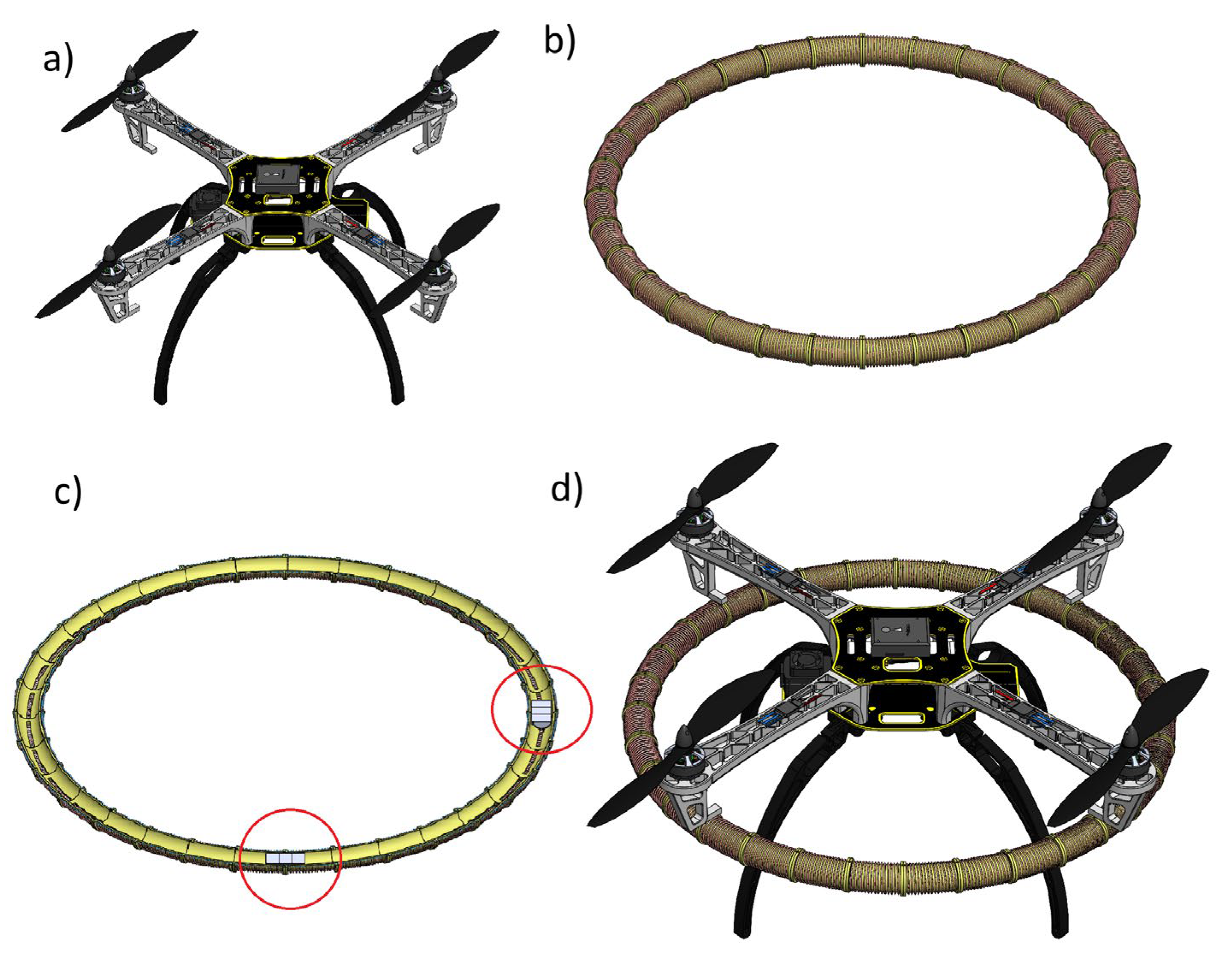
- A novel electromagnetic CoG shifting mechanism for quadrotors—the proposed system employs fixed coils and a permanent magnet mass sliding inside a cylindrical guide, enabling controlled CoG displacement through current modulation. To the best of our knowledge, no prior work has applied such an electromagnetic architecture to improve quadrotor safety and controllability under actuator malfunction.
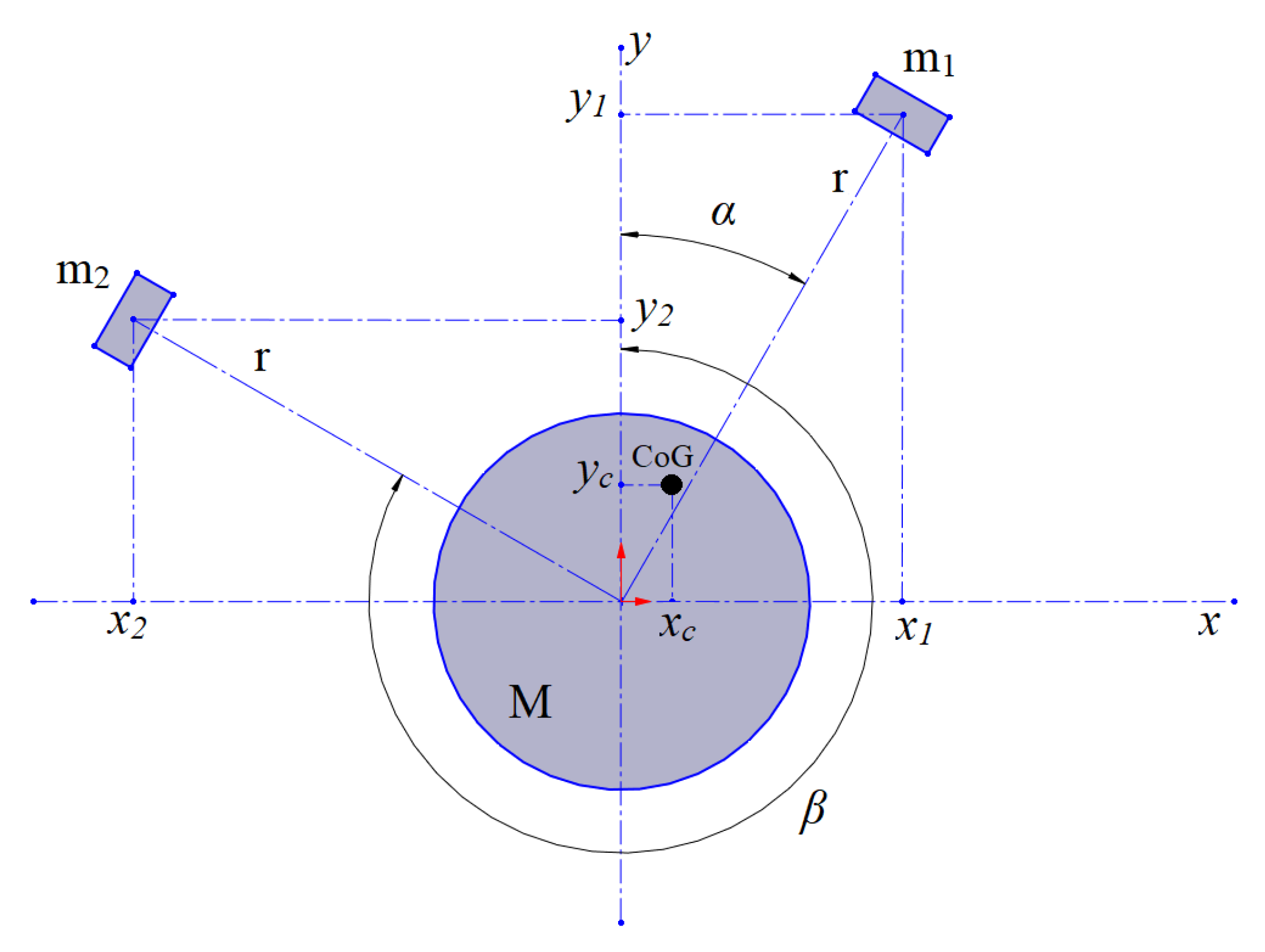
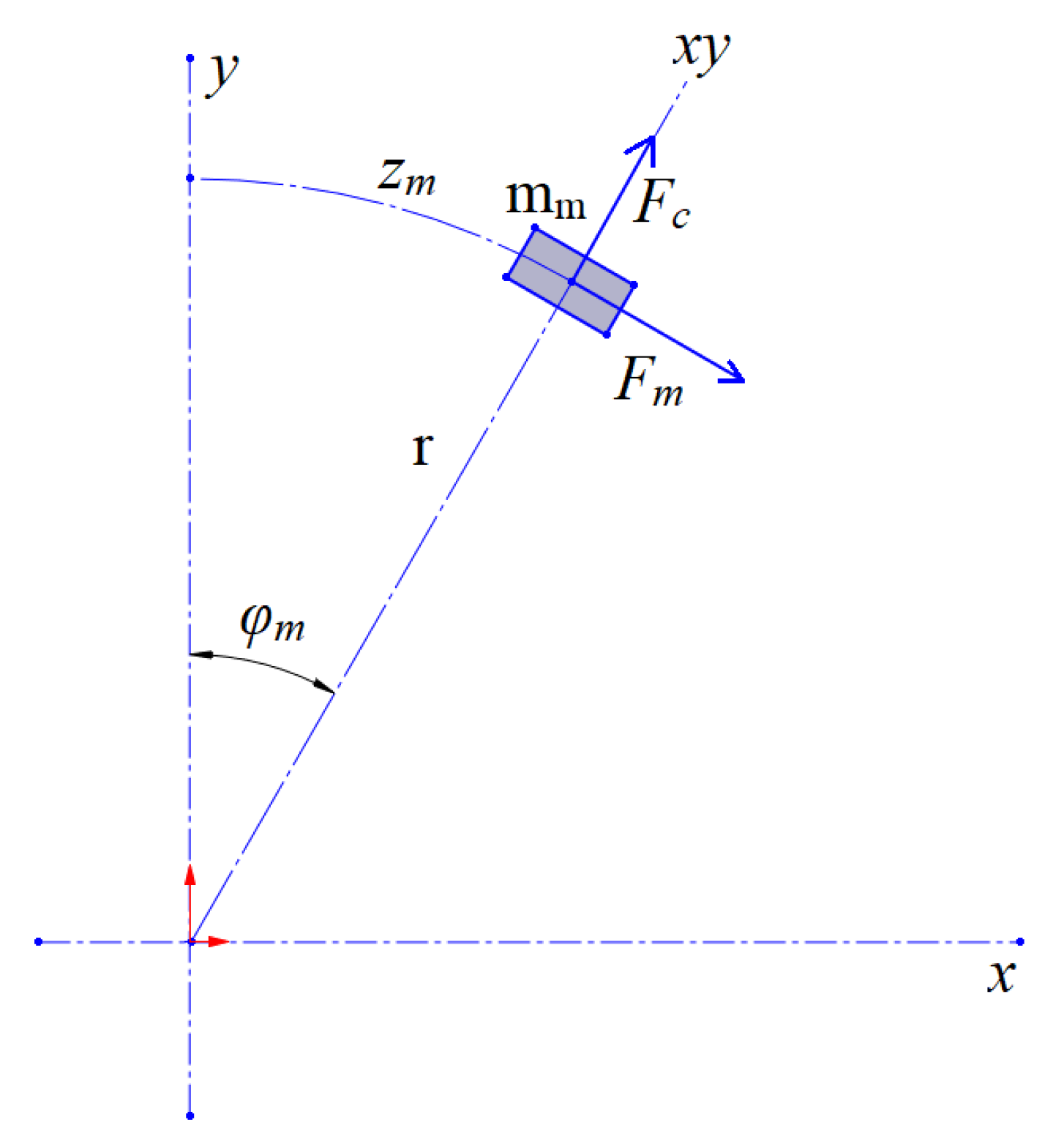
- Comprehensive modelling of the geometric, mechanical, and electromagnetic behaviour—numerical calculations of the electromagnetic interactions between the coils and the permanent magnets are performed to determine feasible force ranges, achievable accelerations, and expected positional dynamics.
- Demonstration of significant CoG shifting capability and its impact on controllability—the work demonstrates that the achievable CoG displacement can be tuned through design parameters such as mass distribution, coil geometry, and current amplitude.
- Dynamic performance assessment of the CoG actuation mechanism—the study identifies key parameters affecting response time and outlines how increased current input and adjusted controller gains may improve the mechanism’s dynamics, offering guidance for future optimisation.
2. The Concept
2.1. Mechanical Part
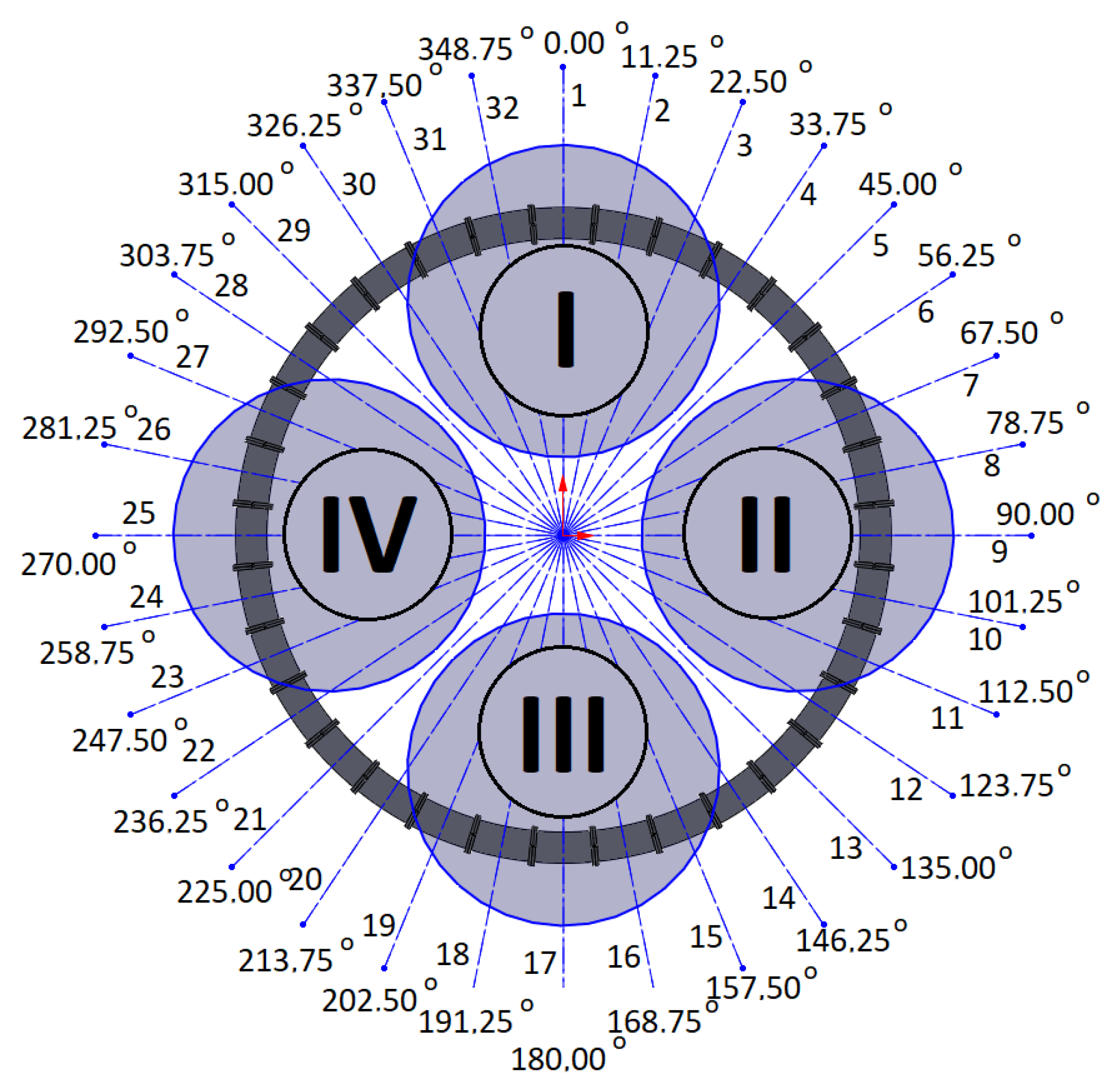
2.2. Electromagnetic Part
3. Simulation Model
3.1. Numerical Analysis of the System
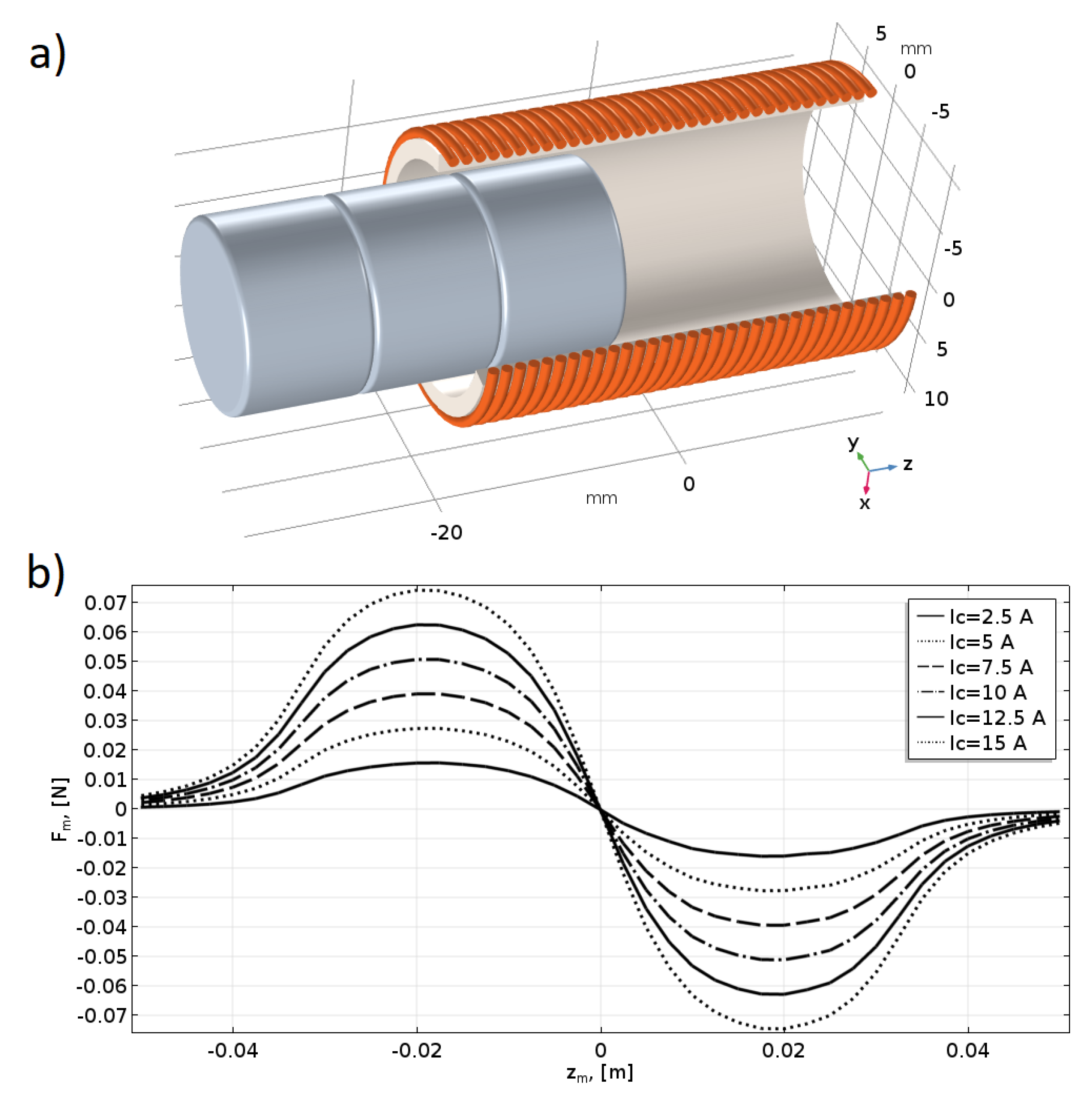
3.1.1. Magnetic Driving Force
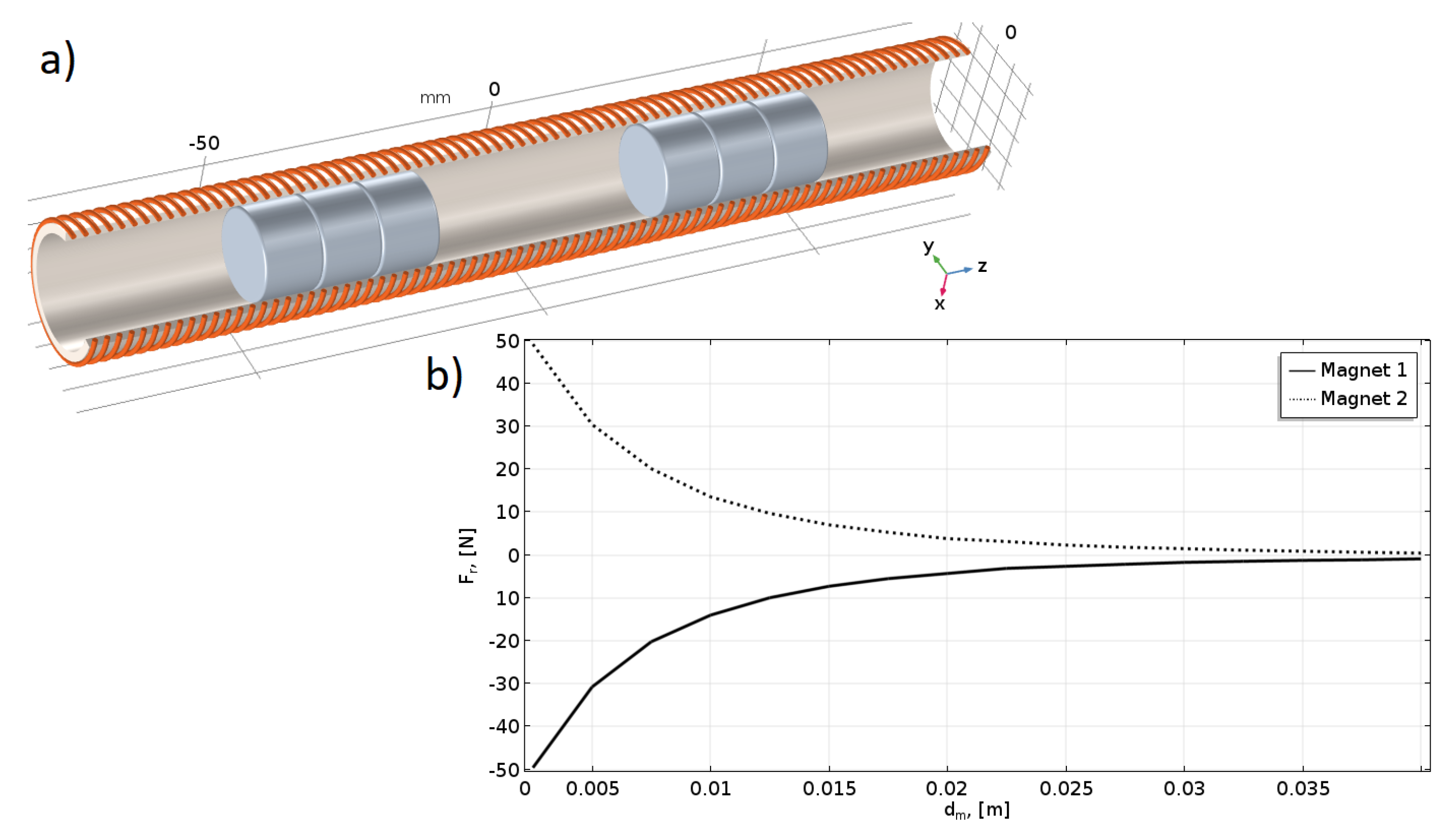
3.1.2. Magnets’ Repulsive Force
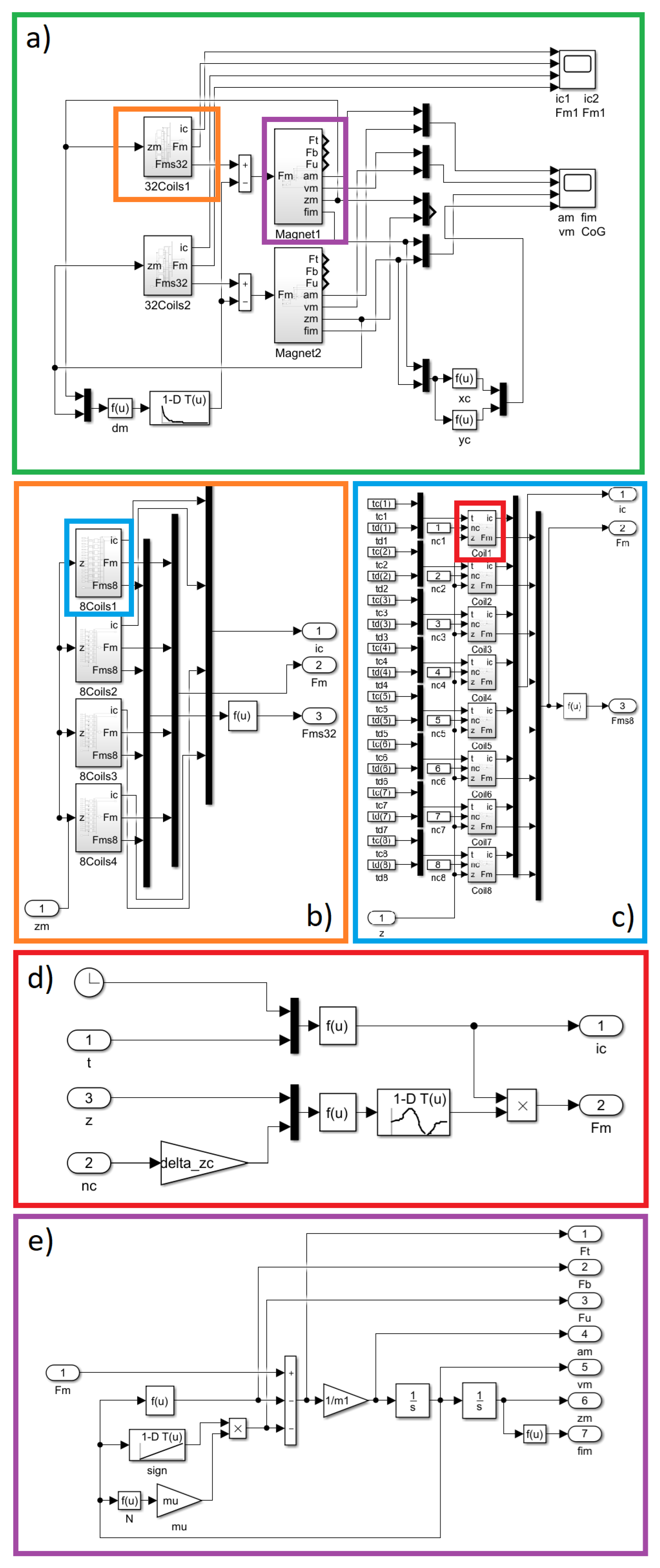
3.2. The Structure of the Model
3.3. Initial Tests
3.3.1. Test of the Single Coil Drive
3.3.2. Test of the Single-Coil Braking
3.3.3. Test of the Sequence of Coils
3.4. Motor Malfunction Tests
3.4.1. The Malfunction of the First Motor
3.4.2. The Malfunction of the Second Motor
3.4.3. The Malfunction of the Third Motor
3.4.4. The Malfunction of the Fourth Motor
4. Discussion
5. Conclusions
6. The Future Work
Author Contributions
Funding
Institutional Review Board Statement
Informed Consent Statement
Data Availability Statement
Conflicts of Interest
References
- Ambroziak, L.; Ołdziej, D.; Koszewnik, A. Multirotor Motor Failure Detection with Piezo Sensor. Sensors 2023, 23, 1048. [Google Scholar] [CrossRef] [PubMed]
- Ambrożkiewicz, B.; Dzienis, P.; Ambroziak, L.; Koszewnik, A.; Syta, A.; Ołdziej, D.; Pakrashi, V. Diagnostics of unmanned aerial vehicle with recurrence based approach of piezo-element voltage signals. Sci. Rep. 2024, 14, 17211. [Google Scholar] [CrossRef] [PubMed]
- Koszewnik, A.; Ambroziak, L.; Ołdziej, D.; Dzienis, P.; Ambrożkiewicz, B.; Syta, A.; Bouattour, G.; Kanoun, O. Nonlinear recurrence analysis of piezo sensor placement for unmanned aerial vehicle motor failure diagnosis. Sci. Rep. 2024, 14, 8289. [Google Scholar] [CrossRef] [PubMed]
- Ambroziak, L.; Simha, A.; Pawluszewicz, E.; Kotta, U.; Bozko, A.; Kondratiuk, M. Motor failure tolerant control system with self diagnostics for unmanned multirotors. In Proceedings of the 2019 24th International Conference on Methods and Models in Automation and Robotics, MMAR 2019, Miedzyzdroje, Poland, 26–29 August 2019; Institute of Electrical and Electronics Engineers Inc.: New York, NY, USA, 2019; pp. 422–427. [Google Scholar] [CrossRef]
- Yadav, P.K.; Kalirajan, K. Dynamic model of a MAV with COG shifting mechanism. In IFAC Proceedings Volumes (IFAC-PapersOnline); IFAC Secretariat: Laxenburg, Austria, 2014; pp. 380–385. [Google Scholar] [CrossRef]
- Merheb, A.R.; Noura, H.; Bateman, F. A novel emergency controller for quadrotor UAVs. In Proceedings of the 2014 IEEE Conference on Control Applications, CCA. Part of 2014 IEEE Multi-conference on Systems and Control, MSC 2014, Juan Les Antibes, France, 8–10 October 2014; Institute of Electrical and Electronics Engineers Inc.: New York, NY, USA, 2014; pp. 747–752. [Google Scholar] [CrossRef]
- Fresk, E.; Wuthier, D.; Nikolakopoulos, G. Generalized center of gravity compensation for multirotors with application to aerial manipulation. In Proceedings of the IEEE International Conference on Intelligent Robots and Systems, Vancouver, BC, Canada, 24–28 September 2017; Institute of Electrical and Electronics Engineers Inc.: New York, NY, USA, 2017; pp. 4424–4429. [Google Scholar] [CrossRef]
- Alakhras, A.; Sattar, I.H.; Alvi, M.; Qanbar, M.W.; Jaradat, M.A.; Alkaddour, M. The Design of a Lightweight Cable Aerial Manipulator with a CoG Compensation Mechanism for Construction Inspection Purposes. Appl. Sci. 2022, 12, 1173. [Google Scholar] [CrossRef]
- Jia, J.; Guo, K.; Wang, C.; Shen, N.; Jia, W.; Yu, X. Flight Control for Quadrotor Safety in the Presence of CoG Shift and Loss of Motor Efficiency. In Proceedings of the 2022 International Conference on Unmanned Aircraft Systems, ICUAS 2022, Dubrovnik, Croatia, 21–24 June 2022; Institute of Electrical and Electronics Engineers Inc.: New York, NY, USA, 2022; pp. 245–254. [Google Scholar] [CrossRef]
- Siddhardha, K. A novel quad-rotor configuration capable of attitude control through center of gravity variation. In Proceedings of the 2018 Indian Control Conference, ICC 2018—Proceedings, Kanpur, India, 4–6 January 2018; pp. 346–351. [Google Scholar] [CrossRef]
- Haus, T.; Orsag, M.; Bogdan, S. Design considerations for a large quadrotor with moving mass control. In Proceedings of the 2016 International Conference on Unmanned Aircraft Systems, ICUAS 2016, Arlington, VA, USA, 7–10 June 2016; Institute of Electrical and Electronics Engineers Inc.: New York, NY, USA, 2016; pp. 1327–1334. [Google Scholar] [CrossRef]
- Abuzayed, I.; Itani, A.R.; Ahmed, A.; Alkharaz, M.; Jaradat, M.A.; Romdhane, L. Design of lightweight aerial manipulator with a cog compensation mechanism. In Proceedings of the 2020 Advances in Science and Engineering Technology International Conferences, ASET 2020, Dubai, United Arab Emirates, 4 February–9 April 2020; Institute of Electrical and Electronics Engineers Inc.: New York, NY, USA, 2020. [Google Scholar] [CrossRef]
- Chaisena, K.; Nenchoo, B.; Tantrairatn, S. Automatic Balancing System in Quadcopter with Change in Center of Gravity. In Proceedings of the IOP Conference Series: Materials Science and Engineering, Pattaya, Thailand, 10–13 December 2019; Institute of Physics Publishing: Bristol, UK, 2020. [Google Scholar] [CrossRef]
- Kemper, M.; Fatikow, S. Impact of center of gravity in quadrotor helicopter controller design. In IFAC Proceedings Volumes (IFAC-PapersOnline); IFAC Secretariat: Laxenburg, Austria, 2006; pp. 157–162. [Google Scholar] [CrossRef]
- Kondratiuk, M.; Gosiewsk, Z. Simulation Model of an Electromagnetic Multi-Coil Launcher for Micro Aerial Vehicles. In Solid State Phenomena; Trans Tech Publications Ltd.: Baech, Switzerland, 2013; pp. 406–411. [Google Scholar] [CrossRef]
- Kondratiuk, M.; Gosiewski, Z. Laboratory stand of an electromagnetic multi-coil launcher for micro aerial vehicles. In Solid State Phenomena; Trans Tech Publications Ltd.: Baech, Switzerland, 2013; pp. 334–339. [Google Scholar] [CrossRef]
- Fazal, I.; Karsiti, M.N.; Rao, K.S.R.; Zulkifli, S.A. Modeling and simulation of moving iron linear generator (MILG). Appl. Mech. Mater. 2012, 110, 2464–2468. [Google Scholar] [CrossRef]
- Gandhi, R.V.; Adhyaru, D.M.; Kasundra, J. Modeling of current and voltage controlled electromagnetic levitation system based on novel approximation of coil inductance. In Proceedings of the Proceedings—2018 4th International Conference on Control, Automation and Robotics, ICCAR 2018, Auckland, New Zealand, 20–23 April 2018; Institute of Electrical and Electronics Engineers Inc.: New York, NY, USA, 2018; pp. 212–217. [Google Scholar] [CrossRef]
- He, F.; Zheng, Y.; Wang, Q.; Li, H. Electromagnetic Force Control System of Solenoidal Coil. In Proceedings of the Chinese Control Conference, CCC, Wuhan, China, 25–27 July 2018; IEEE Computer Society: Los Alamitos, CA, USA, 2018; pp. 8525–8530. [Google Scholar] [CrossRef]
- Yuan, L.; Guan, X.; Guan, S.; Shi, D.; Shi, J. Research on Influence Factors of Armature Levitation Force in Single-Stage Electromagnetic Induction Coil Launcher. IEEE Trans. Plasma Sci. 2025, 53, 2428–2439. [Google Scholar] [CrossRef]
- Fazal, I.; Karsiti, M.N.; Zulkifli, S.A.; Ibrahim, T.; Rao, K.S.R. Modeling and simulation of a moving-coil linear generator. In Proceedings of the 2010 International Conference on Intelligent and Advanced Systems, ICIAS 2010, Manila, Philippines, 15–17 June 2010. [Google Scholar] [CrossRef]
- Santini, E.; Teodori, S. Modeling, FEM analysis and dynamic simulation of a moving coil loudspeaker. In Proceedings of the 2014 International Symposium on Power Electronics, Electrical Drives, Automation and Motion, SPEEDAM 2014, Ischia, Italy, 18–20 June 2014; IEEE Computer Society: Los Alamitos, CA, USA, 2014; pp. 1306–1312. [Google Scholar] [CrossRef]
- Kondratiuk, M.; Ambroziak, L. Concept of the magnetic launcher for medium class unmanned aerial vehicles designed on the basis of numerical calculations. J. Theor. Appl. Mech. 2016, 54, 163–177. [Google Scholar] [CrossRef]



| Parameter | Value |
|---|---|
| radius of mechanism (r) | 2 cm |
| number of coils | 32 |
| average length of coil | 39.27 mm |
| coil’s inner diameter | 20 mm |
| coil’s number of turns | 46 |
| material of the coil’s wire | copper |
| diameter of the coil’s wire | 0.85 mm |
| tube’s inner diameter | 17 mm |
| magnet’s diameter | 15 mm |
| magnet’s length | 30 mm |
| magnet’s remanent induction | 1.19 T |
| magnet’s mass (mm) | 40 g |
| mass of coils and tube | 0.5 kg |
| mass of drone (with battery pack) | 2 kg |
| mass of non-moving parts (M) | 2.5 kg |
| Motor Malfunction | φd1 Value | φd2 Value |
|---|---|---|
| first | 157.5° | 202.5° |
| second | 247.5° | 292.5° |
| third | 22.5° | 337.5° |
| fourth | 67.5° | 112.5° |
Disclaimer/Publisher’s Note: The statements, opinions and data contained in all publications are solely those of the individual author(s) and contributor(s) and not of MDPI and/or the editor(s). MDPI and/or the editor(s) disclaim responsibility for any injury to people or property resulting from any ideas, methods, instructions or products referred to in the content. |
© 2025 by the authors. Licensee MDPI, Basel, Switzerland. This article is an open access article distributed under the terms and conditions of the Creative Commons Attribution (CC BY) license (https://creativecommons.org/licenses/by/4.0/).
Share and Cite
Kondratiuk, M.; Ambroziak, L.; Majka, A.; Venkatesha Prasad, R.R. E-MASS: Electromagnetic Mechanism for Active Shifting of the Centre of Gravity in Quadrotors Under Drive Fault. Sensors 2025, 25, 7679. https://doi.org/10.3390/s25247679
Kondratiuk M, Ambroziak L, Majka A, Venkatesha Prasad RR. E-MASS: Electromagnetic Mechanism for Active Shifting of the Centre of Gravity in Quadrotors Under Drive Fault. Sensors. 2025; 25(24):7679. https://doi.org/10.3390/s25247679
Chicago/Turabian StyleKondratiuk, Mirosław, Leszek Ambroziak, Andrzej Majka, and Ranga Rao Venkatesha Prasad. 2025. "E-MASS: Electromagnetic Mechanism for Active Shifting of the Centre of Gravity in Quadrotors Under Drive Fault" Sensors 25, no. 24: 7679. https://doi.org/10.3390/s25247679
APA StyleKondratiuk, M., Ambroziak, L., Majka, A., & Venkatesha Prasad, R. R. (2025). E-MASS: Electromagnetic Mechanism for Active Shifting of the Centre of Gravity in Quadrotors Under Drive Fault. Sensors, 25(24), 7679. https://doi.org/10.3390/s25247679