Enhanced YOLOv8n-Based Three-Module Lightweight Helmet Detection System




Abstract
1. Introduction
- A lightweight architecture utilizing coordinate attention (CA) was developed to enhance long-range spatial modeling and decrease deployment computational costs.
- A lightweight decoupled detection head was constructed utilizing a Partial Convolution detector (PCD). This minimizes redundant convolution operations and facilitates extraction from complex and dynamic architectural environments.
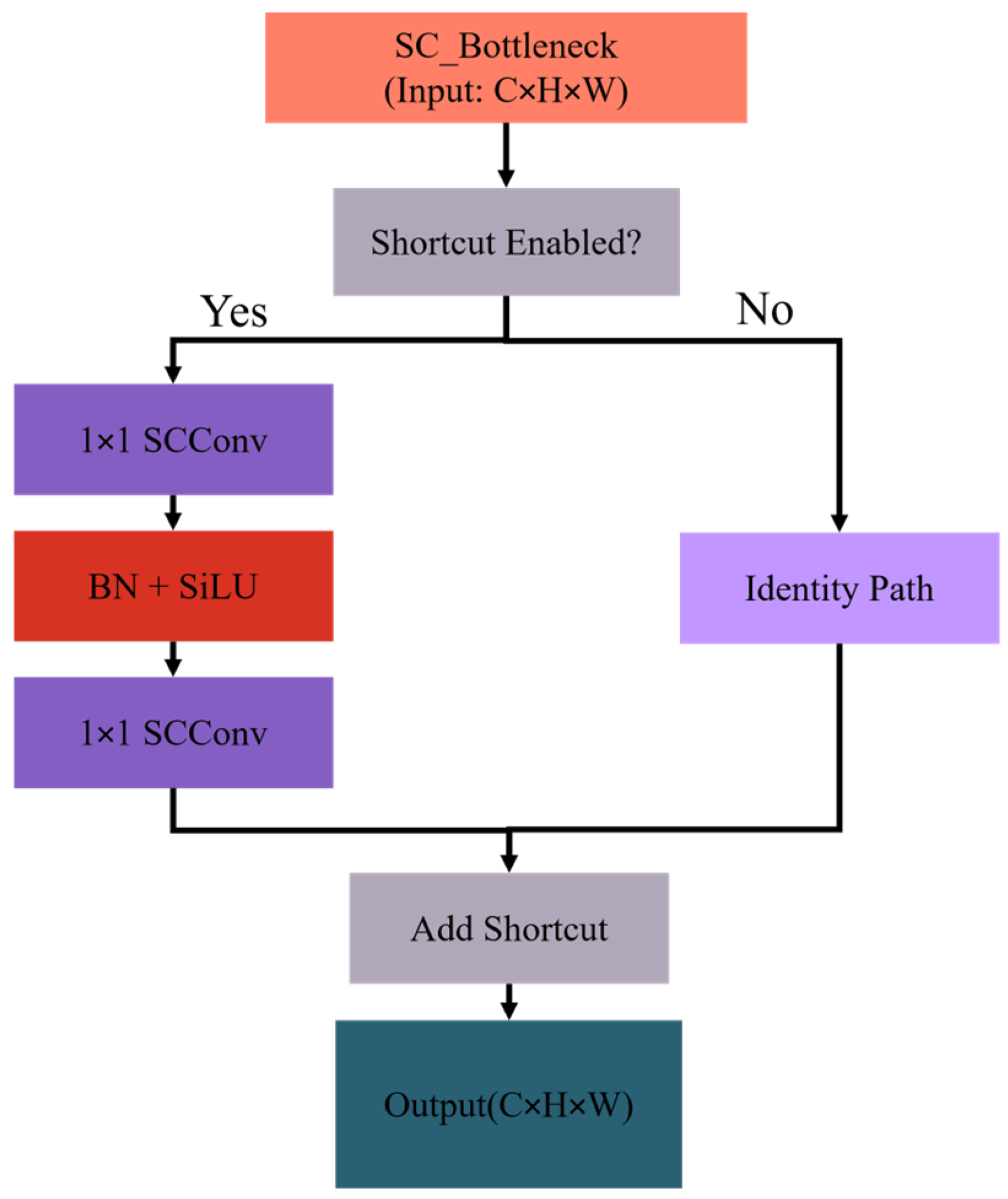
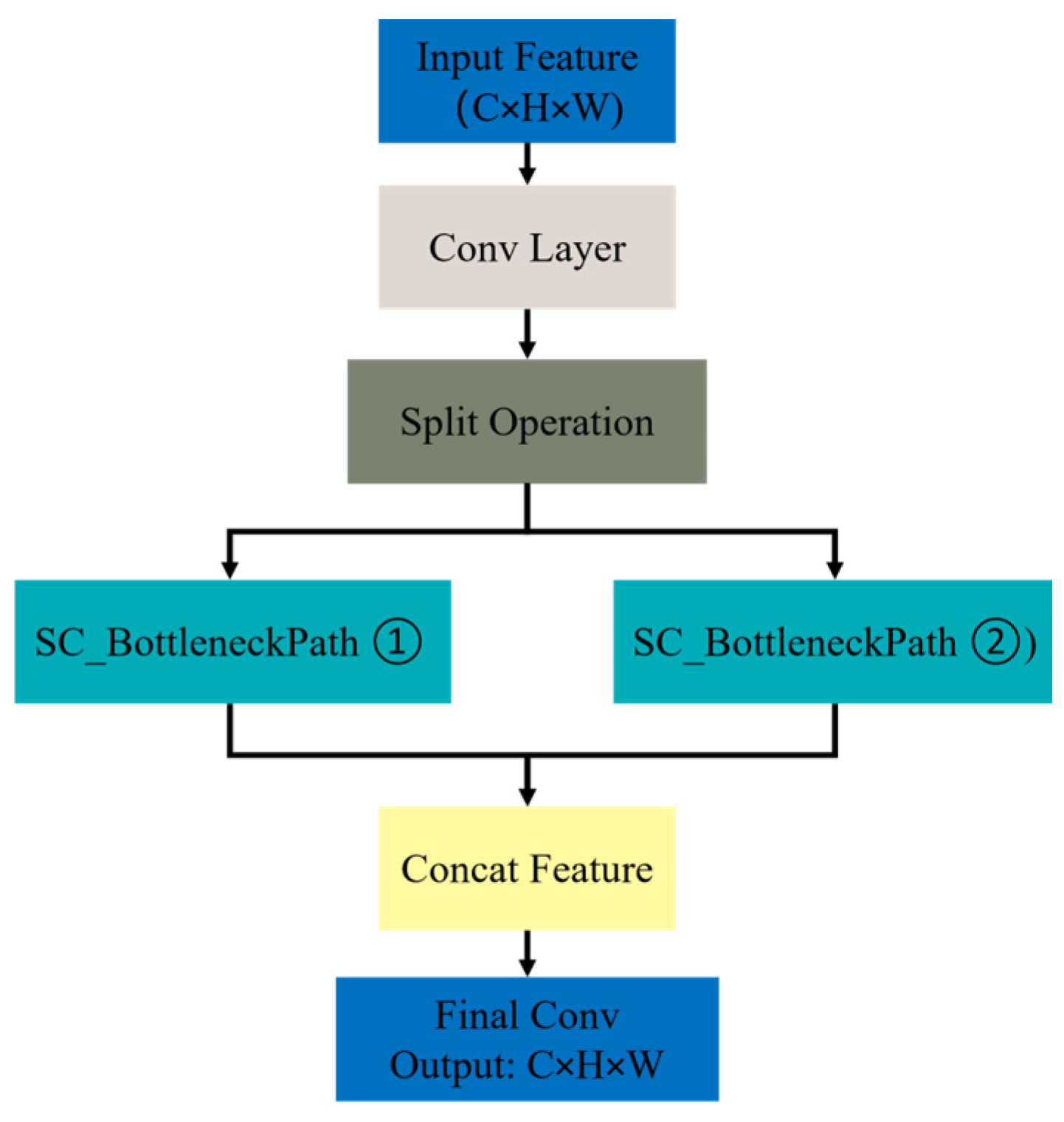
- The C2f-SCConv structural module systematically substitutes standard bottleneck modules with SC_bottleneck path units, optimizing feature modeling and improving the learning capacity of cross-level feature diversity across spatial dimensions.
2. Related Research
3. Optimization Mode of the YOLOv8n Algorithm
3.1. YOLOv8n Network
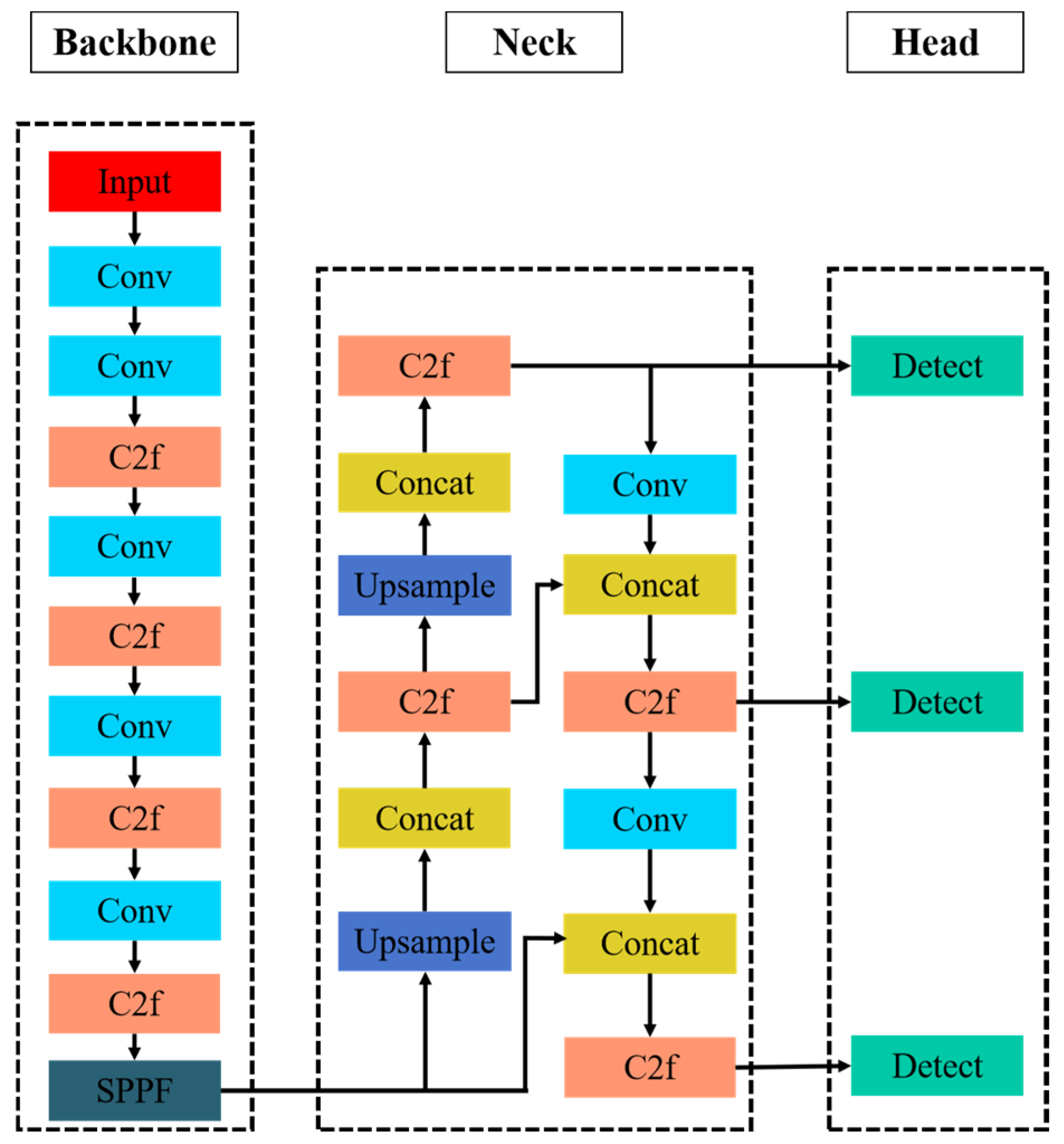
- Input: Preprocessing and augmenting helmet-wearing photos improve the model’s flexibility to different settings.
- Backbone: The backbone optimizes structures using CSP (Convolutional Self-Projection). CBS, C2f, and SPPF modules make up most of it. YOLOv8 received the SPPF module from YOLOv5. This Spatial Pyramid Pooling (SPPF) module transforms feature maps of varying sizes into uniformly sized feature vectors, thereby fusing local and global information for better feature representation [22].
- Neck: The network utilizes multi-scale features derived from the backbone to improve the model’s ability to detect objects of different sizes. It maintains the FPN and PAN architecture to enhance multi-scale feature interaction, thereby constructing a feature pyramid that transmits semantic and localization information across layers.
- Head: A head that is not connected to the body replaces the head that is attached. Separate network branches for each of the main subtasks of object detection—classification and bounding box regression—are an improvement [23]. This method of separating tasks reduces conflicts between classification and localization during feature learning, which leads to task-specific representations. We stopped using IoU-based matching and fixed-ratio single-sample allocation methods to divide positive and negative samples. Instead, we use the Task-Aligned Assigner. The Intersection over Union (IoU) between predicted and ground-truth boxes, along with the classification confidence score, is used to dynamically assign the correct labels and regression targets to each anchor or predicted box. This improved, flexible allocation method makes it easier to identify and select high-quality, informative samples, while reducing the impact of low-quality or confusing data. As a result, it dramatically improves sample matching stability.
3.2. YOLOv8n-L Architecture Network
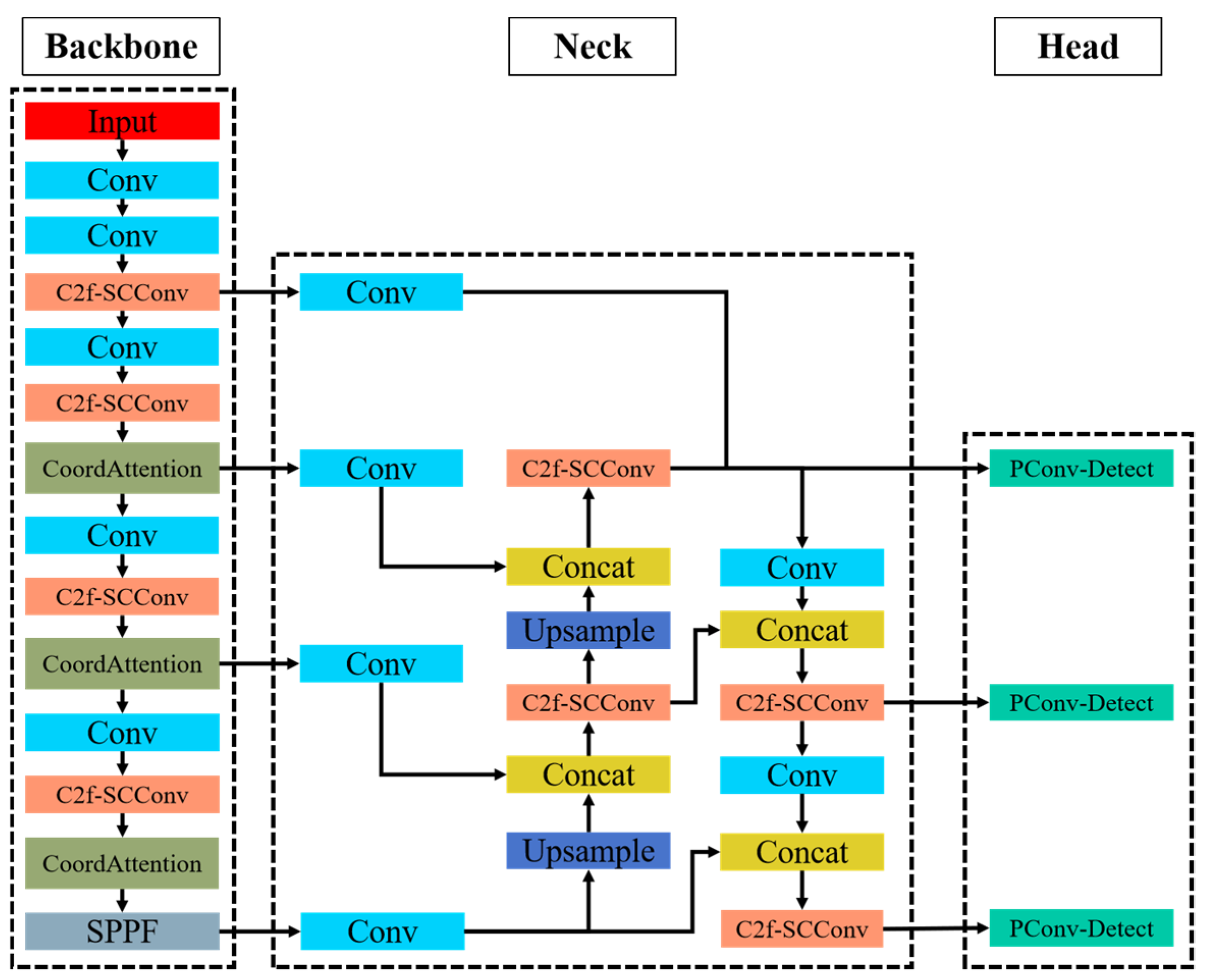
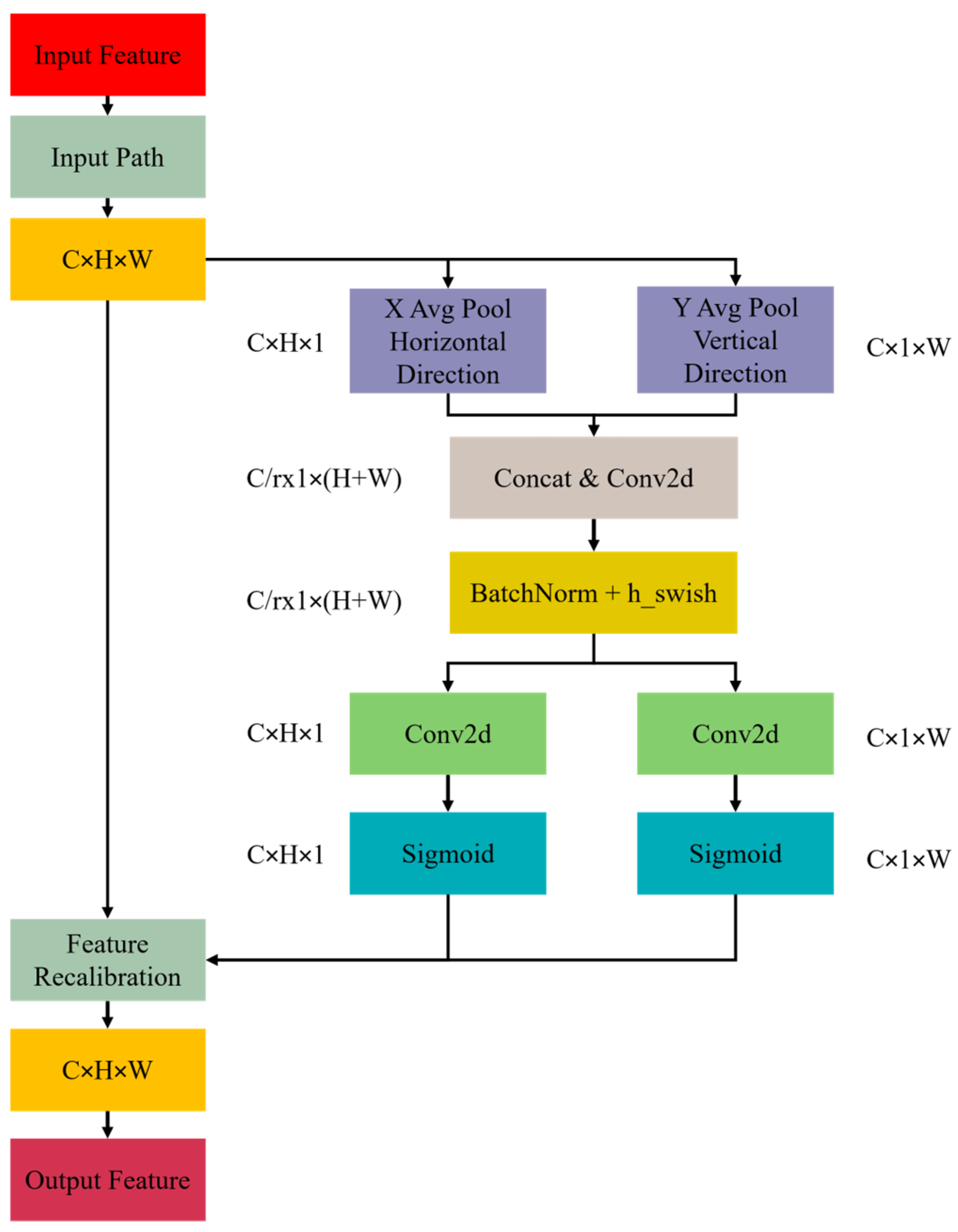
- Putting CoordAttention into the backbone network after the C2f module. This method accurately maps the spatial distribution of areas where people wear helmets by decomposing spatial coordinates to simulate channel linkages and flexibly model long-range spatial dependencies. This architecture significantly improves the model’s ability to focus on target areas by reducing background noise, thereby enhancing feature discrimination and localization accuracy, even in high-noise environments.
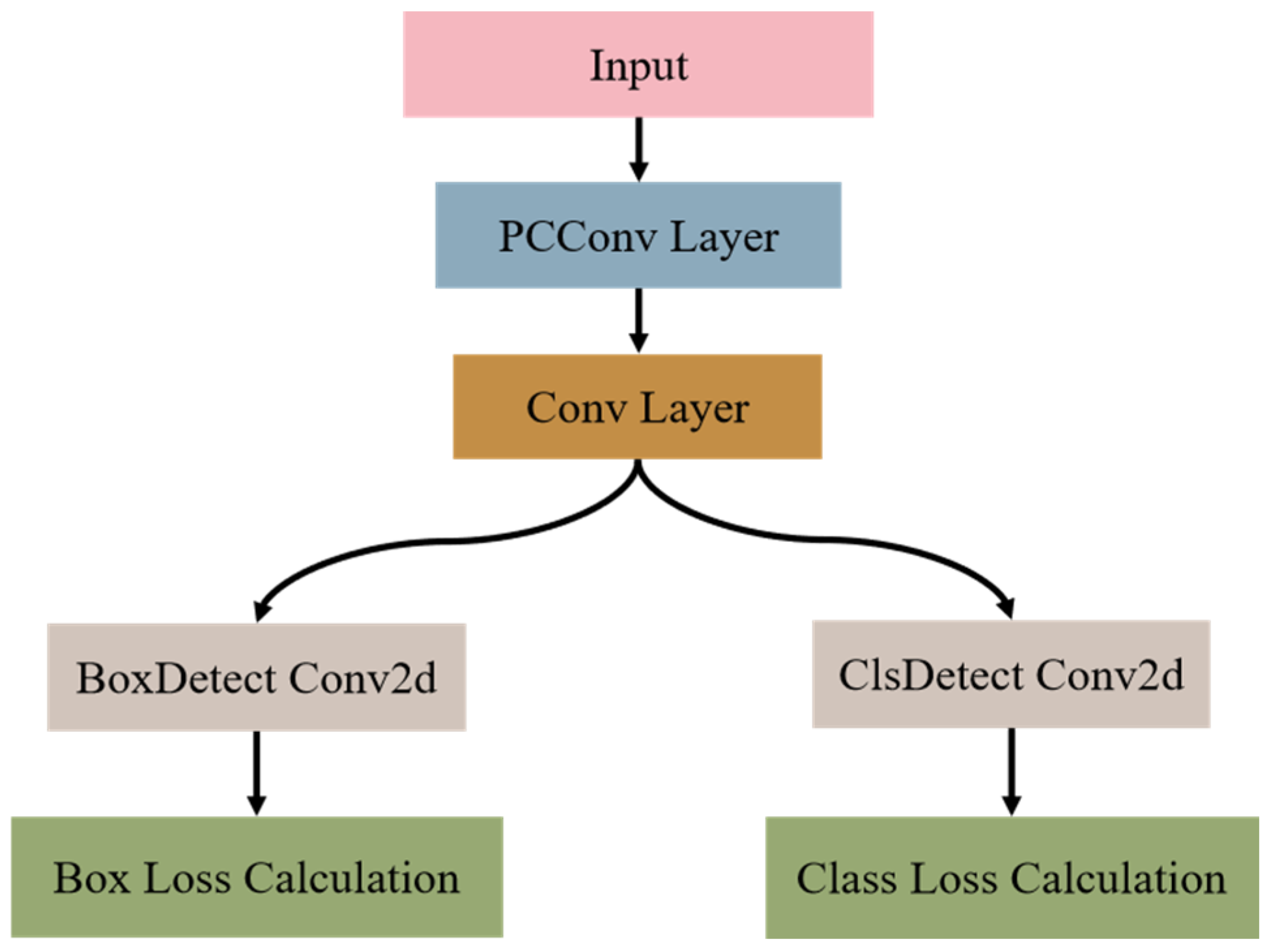
- We suggest replacing the coupled detection structure in the original YOLOv8n with PConv-Detect, a lightweight decoupled detection head based on Partial Convolution. This will make the model simpler and speed up computation. This architecture reduces the number of parameters and the computational cost, and eliminates task-specific optimization. It also makes resource allocation easier by separating classification and localization.
- The C2f-SCConv module is developed by incorporating Spatial and Channel Reconstruction Convolution (SCConv). During feature fusion, this module employs a dynamic redundancy-compression mechanism to select high-contribution features and suppress low-information redundant features autonomously. Its benefits include reduced redundant computations, fewer parameters, greater robustness to small objects and occlusions, and stronger feature extraction for local details and occluded objects. Figure 3 illustrates the enhanced YOLOv8n-L network architecture.
3.3. Coordinate Attention
3.4. Constructing Partial Convolution Detection
3.5. Construction of C2f-SCConv
4. Results
4.1. Experimental Setting
4.2. Data Collection, Annotation, and Processing
4.3. Model Testing and Evaluation Metrics
4.4. Ablation Experiment
4.5. Comparative Experiment
4.6. Comparative Analysis of Monitoring Effectiveness
5. Limitations and Future Work
6. Conclusions
Author Contributions
Funding
Institutional Review Board Statement
Informed Consent Statement
Data Availability Statement
Acknowledgments
Conflicts of Interest
References
- Zhang, C.; Du, Y.; Xiao, X.; Gu, Y. GE-YOLO: A lightweight object detection method for helmet wearing state. Signal Image Video Process. 2025, 19, 411. [Google Scholar] [CrossRef]
- Tan, S.; Lu, G.; Jiang, Z.; Huang, L. Improved YOLOv5 Network Model and Application in Safety Helmet Detection. In Proceedings of the 2021 IEEE International Conference on Intelligence and Safety for Robotics (ISR), Tokoname, Japan, 4–6 March 2021; pp. 330–333. [Google Scholar]
- Crnjanski, J.; Krstić, M.; Totović, A.; Pleros, N.; Gvozdić, D. Adaptive sigmoid-like and PReLU activation functions for all-optical perceptron. Opt. Lett. 2021, 46, 2003–2006. [Google Scholar] [CrossRef]
- Patel, K.; Patel, V.; Prajapati, V.; Chauhan, D.; Haji, A.; Degadwala, S. Safety Helmet Detection Using YOLO V8. In Proceedings of the 2023 3rd International Conference on Pervasive Computing and Social Networking (ICPCSN), Salem, India, 19–20 June 2023; pp. 22–26. [Google Scholar]
- Paramonov, K.; Zhong, J.X.; Michieli, U.; Moon, J.; Ozay, M. Swiss DINO: Efficient and Versatile Vision Framework for On-device Personal Object Search. In Proceedings of the 2024 IEEE/RSJ International Conference on Intelligent Robots and Systems (IROS), Abu Dhabi, United Arab Emirates, 14–18 October 2024; pp. 2564–2571. [Google Scholar]
- Padmini, V.L.; Kishore, G.K.; Durgamalleswarao, P.; Sree, P.T. Real Time Automatic Detection of Motorcyclists With and Without a Safety Helmet. In Proceedings of the 2020 International Conference on Smart Electronics and Communication (ICOSEC), Trichy, India, 10–12 September 2020; pp. 1251–1256. [Google Scholar]
- Elhanashi, A.; Dini, P.; Saponara, S.; Zheng, Q. TeleStroke: Real-time stroke detection with federated learning and YOLOv8 on edge devices. J. Real-Time Image Process. 2024, 21, 121. [Google Scholar] [CrossRef]
- Waranusast, R.; Bundon, N.; Timtong, V.; Tangnoi, C.; Pattanathaburt, P. Machine vision techniques for motorcycle safety helmet detection. In Proceedings of the 2013 28th International Conference on Image and Vision Computing New Zealand (IVCNZ 2013), Wellington, New Zealand, 27–29 November 2013; pp. 35–40. [Google Scholar]
- Fang, Q.; Li, H.; Luo, X.; Ding, L.; Luo, H.; Rose, T.M.; An, W. Detecting non-hardhat-use by a deep learning method from far-field surveillance videos. Autom. Constr. 2018, 85, 1–9. [Google Scholar] [CrossRef]
- Sridhar, P.; Jagadeeswari, M.; Sri, S.H.; Akshaya, N.; Haritha, J. Helmet Violation Detection using YOLO v2 Deep Learning Framework. In Proceedings of the 2022 6th International Conference on Trends in Electronics and Informatics (ICOEI), Tirunelveli, India, 28–30 April 2022; pp. 1207–1212. [Google Scholar]
- Nath, N.D.; Behzadan, A.H.; Paal, S.G. Deep learning for site safety: Real-time detection of personal protective equipment. Autom. Constr. 2020, 112, 103085. [Google Scholar] [CrossRef]
- Benyang, D.; Xiaochun, L.; Miao, Y. Safety helmet detection method based on YOLO v4. In Proceedings of the 2020 16th International Conference on Computational Intelligence and Security (CIS), Guangxi, China, 27–30 November 2020; pp. 155–158. [Google Scholar]
- Gao, T.; Wushouer, M.; Tuerhong, G. DMS-YOLOv5: A Decoupled Multi-Scale YOLOv5 Method for Small Object Detection. Appl. Sci. 2023, 13, 6124. [Google Scholar] [CrossRef]
- Sun, C.; Zhang, S.; Qu, P.; Wu, X.; Feng, P.; Tao, Z.; Zhang, J.; Wang, Y. MCA-YOLOV5-Light: A Faster, Stronger and Lighter Algorithm for Helmet-Wearing Detection. Appl. Sci. 2022, 12, 9697. [Google Scholar] [CrossRef]
- Xiaoqiang, S.; Shibo, L.; Xin, L.; Yongde, Y.; Zewen, Y.; Hao, L.; Zhiyue, L. FM-YOLOv7: An improved detection method for mine personnel helmet. J. Electron. Imaging 2023, 32, 033013. [Google Scholar] [CrossRef]
- Yung, N.D.T.; Wong, W.K.; Juwono, F.H.; Sim, Z.A. Safety Helmet Detection Using Deep Learning: Implementation and Comparative Study Using YOLOv5, YOLOv6, and YOLOv7. In Proceedings of the 2022 International Conference on Green Energy, Computing and Sustainable Technology (GECOST), Miri Sarawak, Malaysia, 26–28 October 2022; pp. 164–170. [Google Scholar]
- Jung, D.-Y.; Oh, Y.-J.; Kim, N.-H. A Study on GAN-Based Car Body Part Defect Detection Process and Comparative Analysis of YOLO v7 and YOLO v8 Object Detection Performance. Electronics 2024, 13, 2598. [Google Scholar] [CrossRef]
- Fan, Z.; Wu, Y.; Liu, W.; Chen, M.; Qiu, Z. LG-YOLOv8: A Lightweight Safety Helmet Detection Algorithm Combined with Feature Enhancement. Appl. Sci. 2024, 14, 10141. [Google Scholar] [CrossRef]
- Luo, Y.; Ci, Y.; Jiang, S.; Wei, X. A novel lightweight real-time traffic sign detection method based on an embedded device and YOLOv8. J. Real-Time Image Process. 2024, 21, 24. [Google Scholar] [CrossRef]
- Liu, L.; Guo, Z.; Liu, Z.; Zhang, Y.; Cai, R.; Hu, X.; Yang, R.; Wang, G. Multi-Task Intelligent Monitoring of Construction Safety Based on Computer Vision. Buildings 2024, 14, 2429. [Google Scholar] [CrossRef]
- Lin, B. Safety Helmet Detection Based on Improved YOLOv8. IEEE Access 2024, 12, 28260–28272. [Google Scholar] [CrossRef]
- Talaat, F.M.; ZainEldin, H. An improved fire detection approach based on YOLO-v8 for smart cities. Neural Comput. Appl. 2023, 35, 20939–20954. [Google Scholar] [CrossRef]
- Song, X.; Zhang, T.; Yi, W. An improved YOLOv8 safety helmet wearing detection network. Sci. Rep. 2024, 14, 17550. [Google Scholar] [CrossRef]
- Zhang, L.; Sun, Z.; Tao, H.; Wang, M.; Yi, W. Research on Mine-Personnel Helmet Detection Based on Multi-Strategy-Improved YOLOv11. Sensors 2025, 25, 170. [Google Scholar] [CrossRef] [PubMed]
- Hayat, A.; Morgado-Dias, F. Deep Learning-Based Automatic Safety Helmet Detection System for Construction Safety. Appl. Sci. 2022, 12, 8268. [Google Scholar] [CrossRef]
- Fang, W.; Love, P.E.D.; Luo, H.; Ding, L. Computer vision for behaviour-based safety in construction: A review and future directions. Adv. Eng. Inform. 2020, 43, 100980. [Google Scholar] [CrossRef]
- Li, H.; Wu, D.; Zhang, W.; Xiao, C. YOLO-PL: Helmet wearing detection algorithm based on improved YOLOv4. Digit. Signal Process. 2024, 144, 104283. [Google Scholar] [CrossRef]
- He, L.; Zhou, Y.; Liu, L.; Ma, J. Research and Application of YOLOv11-Based Object Segmentation in Intelligent Recognition at Construction Sites. Buildings 2024, 14, 3777. [Google Scholar] [CrossRef]
- Fu, Z.; Ling, J.; Yuan, X.; Li, H.; Li, H.; Li, Y. Yolov8n-FADS: A Study for Enhancing Miners’ Helmet Detection Accuracy in Complex Underground Environments. Sensors 2024, 24, 3767. [Google Scholar] [CrossRef]
- Liang, H.; Seo, S. Automatic Detection of Construction Workers’ Helmet Wear Based on Lightweight Deep Learning. Appl. Sci. 2022, 12, 10369. [Google Scholar] [CrossRef]
- Padilla, R.; Netto, S.L.; Silva, E.A.B.d. A Survey on Performance Metrics for Object-Detection Algorithms. In Proceedings of the 2020 International Conference on Systems, Signals and Image Processing (IWSSIP), Niteroi, Brazil, 1–3 July 2020; pp. 237–242. [Google Scholar]
- LeCun, Y.; Bengio, Y.; Hinton, G. Deep learning. Nature 2015, 521, 436–444. [Google Scholar] [CrossRef] [PubMed]
- Kim, D.; Xiong, S. Enhancing Worker Safety: Real-Time Automated Detection of Personal Protective Equipment to Prevent Falls from Heights at Construction Sites Using Improved YOLOv8 and Edge Devices. J. Constr. Eng. Manag. 2025, 151, 04024187. [Google Scholar] [CrossRef]



| Method | mAP/% | FLOPS/G | Params/M | Model Size/MB | P/% | R/% |
|---|---|---|---|---|---|---|
| YOLOv8n | 93.9 | 8.3 | 3.03 | 5.98 | 91.6 | 86.8 |
| A | 95.2 | 8.3 | 3.23 | 6.39 | 92.4 | 87.8 |
| B | 94.1 | 4.1 | 1.98 | 3.81 | 91.8 | 87.5 |
| C | 95.3 | 8.1 | 3.2 | 6.02 | 92.8 | 87.6 |
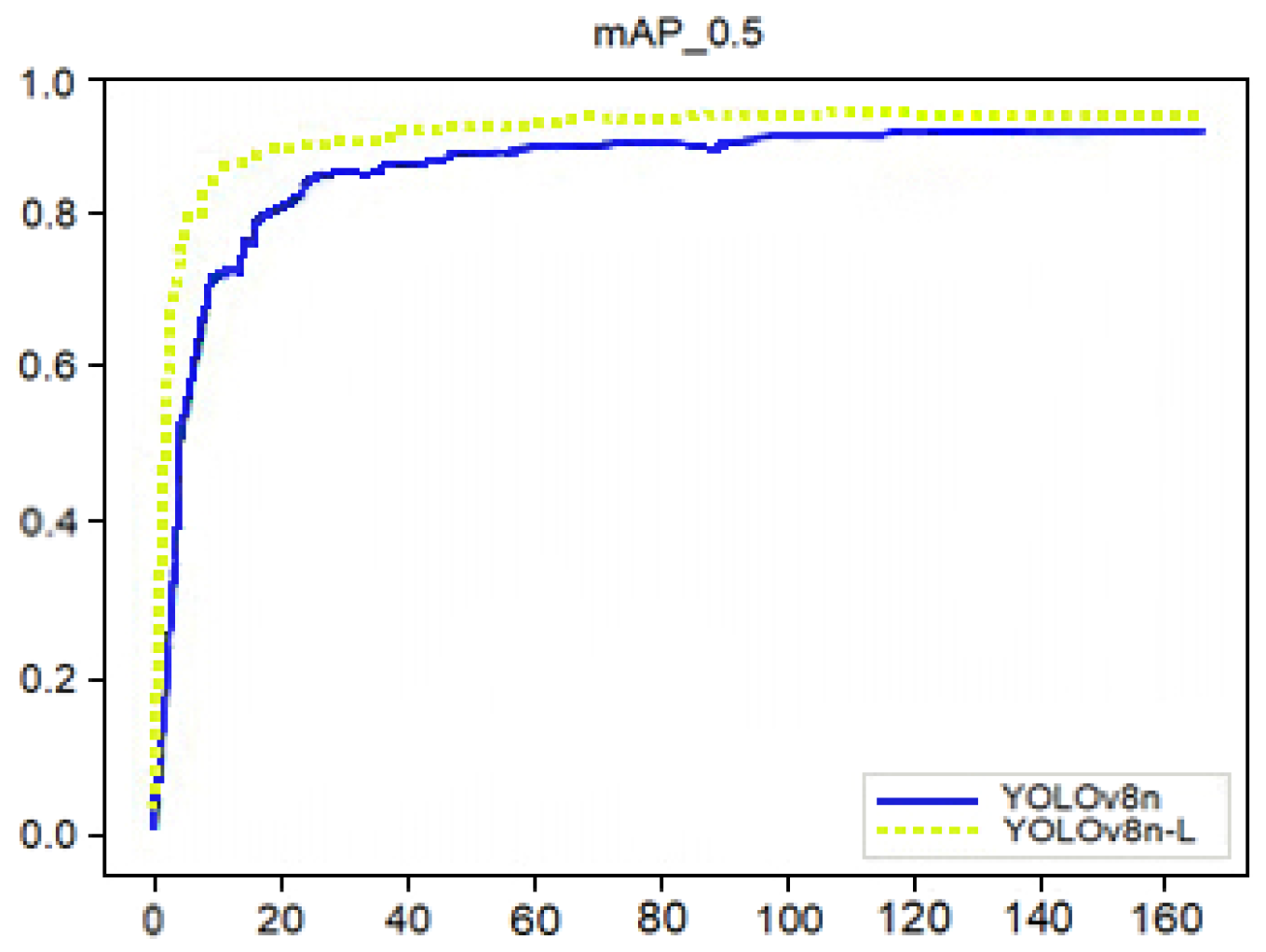
| YOLOv8n-L | 94.4 | 4.2 | 1.94 | 3.77 | 92.2 | 87.4 |
| Method | mAP_0.5/% | FPS | Params/M | Model Size/MB |
|---|---|---|---|---|
| YOLOX | 93.2 | 110 | 16.4 | 16.2 |
| SSD | 83.6 | 92 | 97.7 | 108.2 |
| YOLOv5s | 91.2 | 121 | 14.5 | 14.12 |
| Faster-RCNN | 90.8 | 85 | 106 | 184.8 |
| YOLOv8 | 93.1 | 128 | 16 | 7.21 |
| YOLOv8n | 93.9 | 135 | 3.03 | 5.98 |
| YOLOv8s | 93.5 | 139 | 12.7 | 7.27 |
| YOLOv8n-L | 94.4 | 152 | 1.94 | 3.77 |
| YOLOv11 | 96.3 | 208 | 2.98 | 5.08 |
Disclaimer/Publisher’s Note: The statements, opinions and data contained in all publications are solely those of the individual author(s) and contributor(s) and not of MDPI and/or the editor(s). MDPI and/or the editor(s) disclaim responsibility for any injury to people or property resulting from any ideas, methods, instructions or products referred to in the content. |
© 2025 by the authors. Licensee MDPI, Basel, Switzerland. This article is an open access article distributed under the terms and conditions of the Creative Commons Attribution (CC BY) license (https://creativecommons.org/licenses/by/4.0/).
Share and Cite
Zuo, X.; Dai, Y.; Yu, C.; Gang, W. Enhanced YOLOv8n-Based Three-Module Lightweight Helmet Detection System. Sensors 2025, 25, 7664. https://doi.org/10.3390/s25247664
Zuo X, Dai Y, Yu C, Gang W. Enhanced YOLOv8n-Based Three-Module Lightweight Helmet Detection System. Sensors. 2025; 25(24):7664. https://doi.org/10.3390/s25247664
Chicago/Turabian StyleZuo, Xinyu, Yiqing Dai, Chao Yu, and Wang Gang. 2025. "Enhanced YOLOv8n-Based Three-Module Lightweight Helmet Detection System" Sensors 25, no. 24: 7664. https://doi.org/10.3390/s25247664
APA StyleZuo, X., Dai, Y., Yu, C., & Gang, W. (2025). Enhanced YOLOv8n-Based Three-Module Lightweight Helmet Detection System. Sensors, 25(24), 7664. https://doi.org/10.3390/s25247664