3.1.1. Knowledge Graph Database Construction
The effectiveness of the KG construction determines its applicability, making correct construction particularly critical. The process of building a KG primarily involves the following aspects.
Data Sources: The KG is composed of a schema layer and a data layer. The schema layer corresponds to ontologies, while the data layer corresponds to instances. As abstract concepts, ontologies are used to describe relationships, rules, and classifications among various entities. These ontologies are stored in ontology models, which include elements such as jamming pattern categories. The data layer is formed through knowledge extraction and is mapped to the ontology model, representing concrete instances of the ontologies [
6]. In the data layer, knowledge is represented in the form of triples: “entity (attribute)–relation (attribute)–entity (attribute)”.
The primary data of the KG comprise common jamming signals, common jamming strategies, the characteristics and attributes of jamming patterns, and the decision-making parameters of jamming strategies.
Knowledge Extraction: Given the relatively small scale of data in the field of communication anti-jamming, anti-jamming knowledge—including jamming patterns, jamming characteristics, jamming pattern attributes, anti-jamming strategies, and decision parameters—is manually extracted from unstructured data such as literature and research reports. The following entities can be identified:
Regarding jamming patterns, the entities include a single-tone jamming signal, multi-tone jamming signal, partial-band jamming signal, wideband barrage jamming signal, tracking jamming signal, sweep jamming signal, and high-speed collision jamming signal, among others. Regarding anti-jamming strategies, the following can be obtained: dynamic power adaptation, dynamic frequency-hopping set adaptation, dynamic dwell-time adaptation, dynamic modulation and coding parameter adaptation, and an increased hopping rate.
Relationship extraction: Relationship extraction involves extracting semantic relationships between entities from textual data and representing them in a structured form. Since our goal is to improve the accuracy and speed of anti-jamming decision-making by constructing a KG related to communication anti-jamming, the correspondence between jamming patterns, jamming characteristics, and anti-jamming strategies is crucial. Establishing correct correspondences enables the selection of optimal anti-jamming strategies during decision-making. The relationship template between jamming patterns and anti-jamming strategies is “Jamming Pattern—Anti-Jamming Strategy is— Anti-Jamming Strategy”.
Attribute extraction: Attribute extraction involves retrieving attribute information of entities from data such as text. Attribute extraction, together with entity extraction and relationship extraction, constitutes the core of knowledge extraction. In this study, manual extraction methods are primarily used.
Using the template of “Jamming Pattern— Has Attribute—Jamming Pattern Attribute”, results such as “Wideband Barrage Jamming—Has Attribute—Jamming Power” can be obtained.
Knowledge Representation: Since this study employs a manual approach for knowledge extraction, it avoids the ambiguity and redundancy issues that may arise from using machine learning-based extraction methods. Therefore, the knowledge fusion step can be omitted.
This study primarily uses the Resource Description Framework (RDF) to represent the KG. The RDF proposes a simple binary relational model to represent semantic relationships between entities, using a collection of triples to describe entities and their relations. Triples are used to express relationships between entities or to specify the attribute values of a particular entity.
Knowledge Storage: Neo4j uses the Cypher query language, which features a concise and intuitive syntax. Cypher not only allows for expressive representation of complex graphs but also enables efficient querying. By searching for paths between nodes, it is possible to retrieve information about all nodes related to a specific node. Even with large volumes of data, Neo4j can perform queries rapidly, which aligns with our goal of making quick decisions in response to jamming signals.
Given the substantial amount of data involved in constructing the KG, Python 3.8.18 is used to input pre-written statements into the Neo4j 5.26.0 software, facilitating easier maintenance in later stages.
For instance, to establish a relationship between nodes—for example, indicating that “Dynamic power adaptation” is a strategy applicable to “Single-tone jamming”—the statement CREATE (jam1)-[:hasAntiJammingStrategy]->(strategy2) can be used to create this connection.
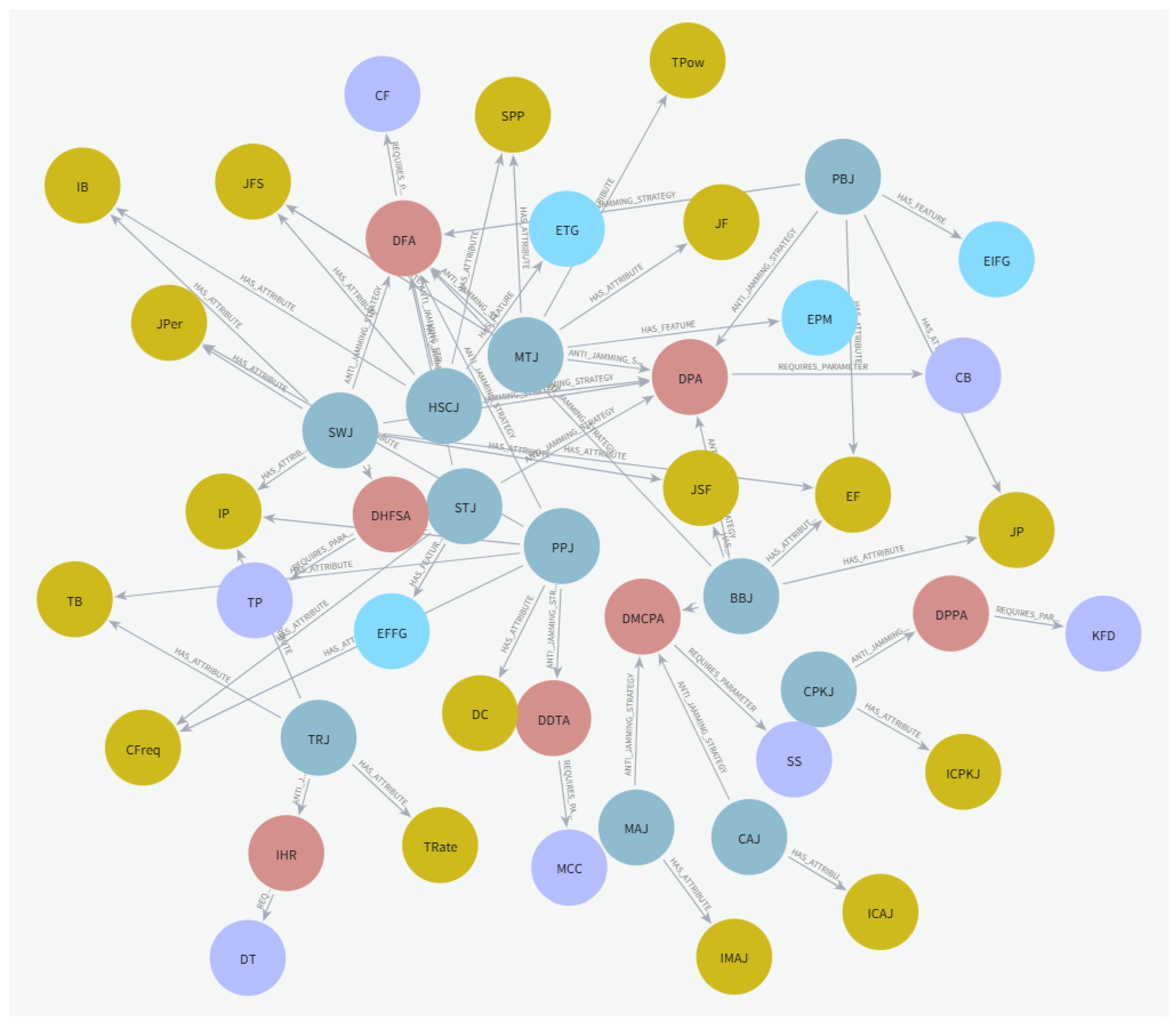
Finally, we constructed an anti-jamming KG as depicted in
Figure 3. It encompasses five node types: jamming patterns, jamming characteristics, jamming pattern attributes, anti-jamming strategies, and decision parameters. The graph includes four corresponding relationships: between jamming patterns and jamming characteristics, between jamming patterns and jamming pattern attributes, between jamming patterns and anti-jamming strategies, and between anti-jamming strategies and decision parameters. To enhance the visualization clarity of the knowledge graph, abbreviated labels were employed for all nodes and relationships. All abbreviations were designed to be unique and semantically meaningful.
Table 1 provides the complete abbreviation mapping used throughout this study.
With the KG constructed, we now describe how it supports rapid anti-jamming decision-making in both known and unknown jamming scenarios.
3.1.2. Decision-Making
When the jamming pattern is known, the corresponding anti-jamming strategy can be directly retrieved, since information such as jamming patterns and their corresponding countermeasures is already stored in the KG. By using the jamming pattern as the head entity and the anti-jamming strategy as the relation, the appropriate strategy can be efficiently identified, enabling rapid decision-making and ensuring real-time responsiveness.
In cases where the jamming pattern is unknown and, thus, no corresponding head entity exists for direct retrieval, the time-frequency characteristics of the jamming signal are first extracted to determine its category. The corresponding anti-jamming strategy is then derived based on this classification, completing the decision-making process.
We primarily identify jamming signals by assessing the existence of characteristics such as power margin, frequency gap, and time gap.
Power Margin: To determine whether a power margin exists, it is necessary to calculate the jamming-to-signal ratio (JSR), as shown in Equation (
1):
where
denotes the power of the jamming signal and
represents the received power of the target communication signal at the receiver. When the JSR is greater than 0 dB, the jamming signal can effectively interfere with the communication signal; otherwise, effective jamming cannot be achieved. This condition is referred to as the effective interference-to-signal ratio threshold [
16]. If the jamming power meets or exceeds this threshold, no power margin exists; otherwise, a power margin is present.
Frequency Gaps: To determine the presence of an instantaneous frequency gap, it is necessary to calculate both the frequency gap between the interfering signals and the frequency gap between the starting frequency of the communication band and the first interfering signal. The largest frequency gap among these is then identified. If the largest frequency gap is not smaller than the instantaneous bandwidth of the communication signal, an instantaneous frequency gap is considered to exist. Conversely, if the largest frequency gap is smaller than the instantaneous bandwidth of the communication signal, no instantaneous frequency gap exists.
If all frequency gaps are not smaller than the instantaneous bandwidth of the communication signal—that is, even the smallest frequency gap is no less than the instantaneous bandwidth—then a full-time instantaneous frequency gap is considered to exist. Otherwise, no full-time frequency gap exists. The formula for calculating the frequency gaps between interfering signals is shown in Equation (
2) below.
denotes the frequency gap, indicates the center frequency of the interfering signal, and denotes the bandwidth of the jamming signal.
Time Gaps: To determine the presence of a time gap, the following condition must be satisfied: if, during a specific time period, no interfering signal is present or the JSR is sufficiently low—indicating the existence of a power margin—then the communication signal remains unaffected by interference, confirming the presence of a time gap.
Upon determination of the anti-jamming strategy, it is necessary to define the corresponding decision parameters. The parameters for anti-jamming decisions are essentially the time-frequency parameters that ensure normal communication.
The anti-jamming strategies incorporated in the KG constructed in this study include dynamic frequency adaptation, dynamic power adaptation, dynamic modulation and coding parameter adaptation, increased hopping rate, dynamic frequency-hopping set adaptation, dynamic dwell-time adaptation, and dynamic protocol parameter adaptation. Therefore, this paper focuses only on the decision parameters corresponding to these strategies.
Time-domain decision parameters: For dynamic dwell time adaptation, the decision parameter is the dwell time. The parameter selection method involves maintaining radio silence during time slots affected by interference and resuming communication during interference-free slots.
Frequency-domain decision parameters: Frequency-domain anti-jamming strategies include dynamic frequency-hopping set adaptation and dynamic frequency adaptation.
For dynamic frequency adaptation, the decision parameter is the available communication frequency band. If the gap meets the bandwidth requirements of the communication system, it can be selected as the operational frequency band for dynamic frequency adaptation.
For dynamic frequency-hopping set adaptation, the decision parameters are the frequency-hopping set and the dwell time. After calculating instantaneous frequency gaps, for each dwell time, the instantaneous frequency gaps that satisfy the communication bandwidth requirements are identified. These are then organized into a frequency-hopping pattern, which serves as the frequency-hopping set for this strategy. For example, in the case of linear sweep jamming, unaffected frequency gaps may be selected as available bands, which are then divided into a frequency-hopping set according to the communication bandwidth.
Power-domain and modulation/coding decision parameters: In practical applications, it is necessary to first select the modulation order and channel coding rate based on requirements, then determine the reliable transmission power threshold. Therefore, these two parameters are studied together.
The modulation order and channel coding rate are determined based on communication requirements: The lowest-order modulation and minimum channel coding rate are used for minimal power consumption, while the highest-order modulation and maximum channel coding rate are adopted for the maximum transmission rate.
The transmission power must be greater than the sum of the jamming signal power and the signal-to-interference ratio threshold required by the receiver under the chosen modulation and coding scheme.
Decision parameter for increased hopping-rate strategy: The decision parameter is the hopping rate. In practice, this often involves selecting from predefined fixed levels. The decision method involves increasing the hopping rate when tracking jamming is detected.
Decision parameter for dynamic protocol parameter adaptation: The decision parameter is the keyframe transmission delay. Similarly, this parameter typically has predefined fixed levels in actual applications. The decision method involves adjusting the transmission delay of key frames—either increasing or decreasing it by one level—when key frames of the carrier sense a multiple-access protocol.