1. Introduction
The rapid advancement of wireless communication technologies has led to a significant increase in both the number of users and the traffic load within communication systems. To provide high-quality data services to mobile users, ensuring adequate network coverage is essential. Relay technology, which employs relay nodes to receive and forward signals, can extend communication range and enhance users’ signal reception quality [
1]. Decode-and-Forward (DF) and Amplify-and-Forward (AF) are two of the most prevalent relaying schemes in this domain. However, these conventional active relay technologies fundamentally rely on active components, including carrier signal generators, analog-to-digital converters, and power amplifiers [
2], resulting in substantial hardware complexity and significant power consumption. Intelligent Reflecting Surfaces (IRSs) consist of numerous passive reflecting elements. Each element can dynamically adjust its reflection coefficient under the control of an IRS controller. As a low-cost, flexibly deployable, and fully passive device, IRS can be applied in various domains such as physical-layer security [
3,
4,
5,
6], enhancement of wireless data transmission [
7,
8], and Integrated Sensing and Communication (ISAC) [
9,
10,
11]. Therefore, IRS is regarded as a revolutionary technology in wireless communications. It offers new design paradigms for signal forwarding and relaying.
Although there has been considerable theoretical and practical research on IRS, their limited signal processing capabilities and passive nature make them more susceptible to channel fading. Moreover, practical implementations of IRS encounter constraints such as limited operating frequency bands [
12] and insufficient dynamic adjustment capabilities [
13]. Consequently, some research efforts have shifted toward integrated designs that combine IRS with relay techniques. The authors of [
14] investigated an IRS-assisted two-way Amplify-and-Forward relaying system. In their design, one IRS is deployed between the transmitter and the relay node, while another is positioned between the relay and the receiver to enhance signal transmission. By optimizing the phase shift matrices of both IRSs, the signals forwarded by the relay and those transmitted from the source are constructively superimposed in phase at the destination receiver. This effectively reduces the bit-error rate (BER).
In [
15], the authors proposed an Unmanned Aerial Vehicle (UAV)-aided communication scheme that jointly employs an active relay and an IRS. In this study, the UAV is equipped with a multi-antenna AF relay and an IRS consisting of multiple passive reflecting elements. The relay and IRS can operate both independently and collaboratively to forward signals. Through joint optimization of the UAV’s trajectory, the IRS reflection coefficients, and the relay beamforming parameters, the achievable data rate at the target receiver is maximized.
Despite the studies in [
14,
15] that integrate IRS with relays, they primarily treat the passive IRS as a supplementary tool to enhance the performance of active relays. They do not consider the option to flexibly replace active relays with IRS (i.e., the adaptive selection between relay and IRS). In fact, both relay and IRS have their own advantages and disadvantages regarding energy efficiency, hardware and computational complexity, and coverage. The ability to adaptively replace active relays with passive IRS based on dynamic wireless channel conditions holds significant research importance. This approach can reduce power consumption or enhance data transmission under fixed power constraints, thus improving communication performance from the source to the destination node. Therefore, this paper proposes a dual-mode relay (DMR) capable of dynamically switching between an active relaying mode and a passive IRS reflection mode. The DMR consists of multiple dual-mode relay units (DMRUs). Each DMRU can flexibly switch between active relaying and passive IRS reflection based on wireless channel conditions. Multiple DMRUs cooperatively process the incident signal in a composite manner to relay data information. Furthermore, under a transmit power constraint, we design a DMR-based Adaptive Transmission (DMRAT) scheme. This scheme evaluates all possible DMR operational modes. For each mode, it jointly optimizes the beamforming matrix at the transmitter and the operational parameters of the DMRUs. These DMRUs can operate in either active or passive mode using an Alternating Optimization (AO) algorithm, with the goal of improving the data rate at the receiver.
The rest of this paper is organized as follows.
Section 2 describes the system model, while
Section 3 presents the design of DMRAT.
Section 4 evaluates the performance of the proposed method. Finally, we conclude this paper in
Section 5.
Throughout this paper, we will use the following notations. The set of complex numbers is denoted as , while vectors and matrices are represented by lower-case and upper-case bold letters. and represent matrix transpose and conjugate transpose, respectively. denotes the absolute value of a complex number.
2. System Model
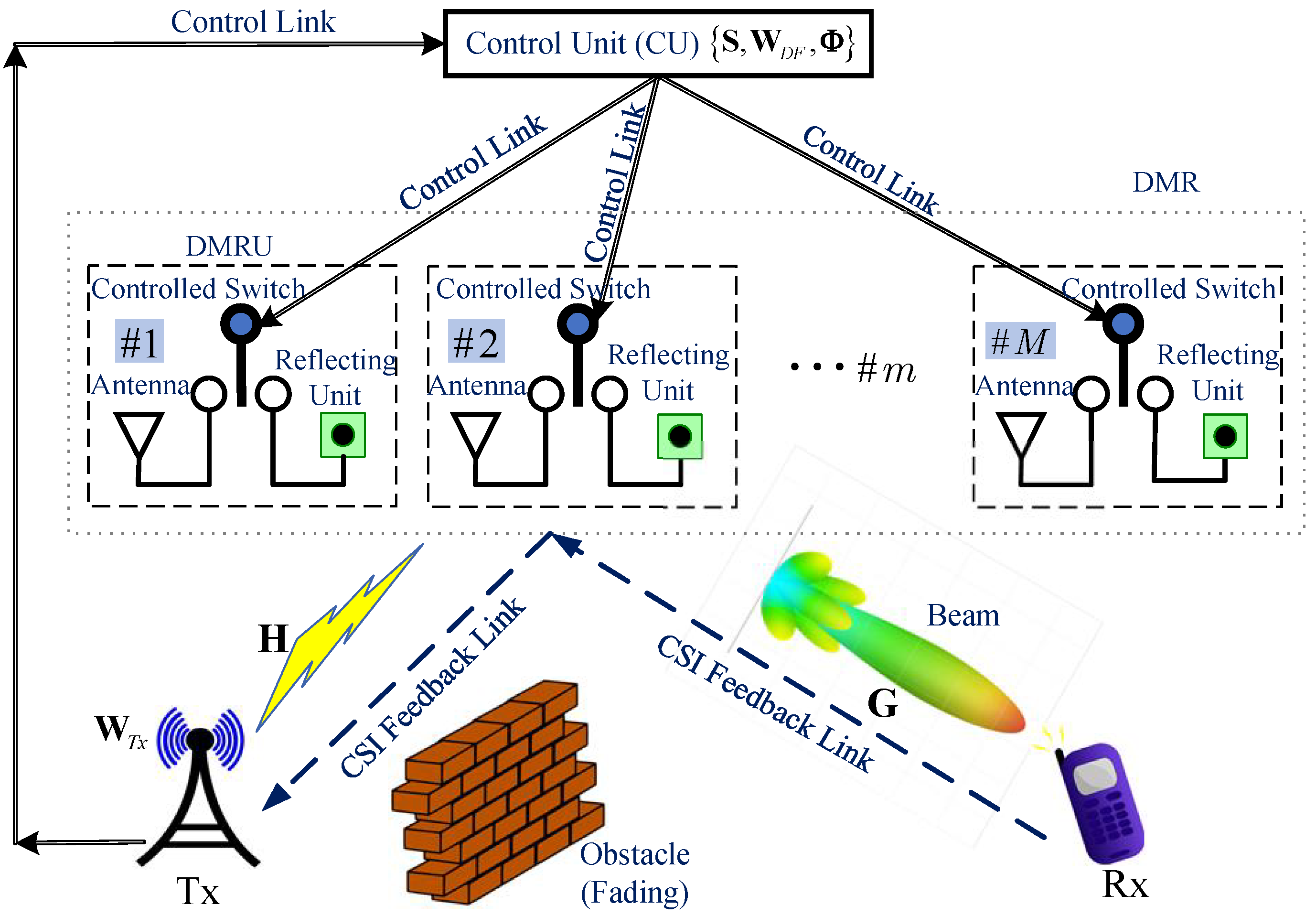
We consider a communication system consisting of one transmitter (Tx), one receiver (Rx), and a dual-mode relay (DMR), as illustrated in
Figure 1. The Tx is equipped with
antennas and transmits with power
, while the Rx has
antennas. Due to obstacles or severe channel fading between the Tx and Rx, no direct link satisfying the transmission quality requirement is available [
16]. The DMR consists of
DMRUs, each capable of dynamically switching between active relaying and passive IRS reflection modes for signal forwarding, under the control of a control unit (CU) co-located with the Tx. When a DMRU operates in active relaying mode, it functions as a full-duplex DF relay. The total transmit power consumed by the DMR is denoted as
. Assuming that the signal processing delays for both DF relaying and passive IRS reflection are negligible, the signals actively forwarded and passively reflected by all DMRUs can arrive at the Rx simultaneously. While practical DF relaying incurs higher processing latency than IRS reflection, synchronization can be achieved by employing IRS architectures with controllable time delays [
17] or using active instantaneous relay [
18,
19]. One can minimize the delay differences between the signal components transmitted via the IRS reflection path and the active relaying path to an acceptable level, validating the synchronization assumption made in our system.
Prior to communication, the Tx broadcasts a pilot signal with all DMRUs of the DMR operating in passive IRS reflection mode. The Rx estimates the Channel State Information (CSI) [
20] between itself and both the IRS and the Tx, denoted as
and
in
Figure 1. For instance, both
and
can be acquired using the tensor-based estimation scheme [
21], which requires
pilot symbols. Subsequently, the Rx feeds the estimated CSI back to the Tx via the DMR-assisted reflecting link [
22]. The Tx then transmits the data
. The Tx precodes
using the beamforming matrix
and then map the pre-processed output to the
transmit antennas for transmission. The channels between the Tx and the DMR, and between the DMR and the Rx, are represented by
and
, respectively. We employ a spatially uncorrelated Rayleigh flat fading channel model to characterize these channels, where the elements are independent and identically distributed complex Gaussian random variables with zero mean and unit variance. Both
and
exhibit quasi-static flat fading [
23] characteristics.
3. Design of DMRAT
This section presents the design of the DMRAT under the constraint of the total transmit power at both the Tx and the DMR. For simplicity, we assume , where M is a positive integer.
3.1. Basic Signal Processing in the DMR
In practical applications, when the channel quality from the Tx to the Rx via the IRS is sufficiently good, the DF relay may not be necessary. In such cases, using only IRS reflection can provide the Rx with adequate signal reception quality. Conversely, when the channel condition is poor, using IRS reflection alone may not be sufficient to ensure good reception quality at the Rx. Therefore, it is necessary to set some DRMUs to active relaying mode to compensate for channel fading, albeit at the cost of some transmit power. To reduce the power consumption of the DMR, the Tx can configure a subset of the DMRUs to operate in IRS mode. As a result, some DMRUs operate in DF relaying mode, while others function in passive IRS reflection mode. The Rx then receives a composite signal constructed from multiple signal components originating from the DMRUs operating in these two distinct modes. To control the operating modes of the M DMRUs in the DMR, we define a mode selection matrix , where each element () indicates whether the m-th DMRU operates in DF relaying mode or IRS reflection mode.
Let
denote the
m-th DMRU. We define
as the set of DMRUs operating in DF relaying mode and
as the set of DMRUs operating in IRS reflection mode.
holds, where
represents the entire set of DMRUs. For each
, the mode indicator is set as
; conversely, for
,
. Under the control of the mode selection matrix
, the received signal at the Rx can be expressed as:
The first term on the right-hand side (RHS) of Equation (1) represents the signal forwarded by the DMRUs operating in the DF relaying mode, while the second term corresponds to the signal reflected by the DMRUs operating in the IRS reflection mode. denotes the beamforming matrix for the DMRUs in , where is the m-th column vector of . represents the Additive White Gaussian Noise (AWGN) vector, whose elements have zero mean and variance . The reflection coefficient matrix of the DMRUs in is represented as , where and denote the phase coefficient and amplitude coefficient, respectively, of the m-th DMRU operating in IRS mode. represents the beamforming matrix at the Tx. The matrices and (where is the identity matrix and ⊕ denotes element-wise modulo-2 addition) are applied to and , respectively, to select the operating mode of each DMRU. When , the matrix sets the m-th row elements of to zero; when , sets the m-th reflection coefficient in to zero, i.e., .
Under the total transmit power constraint
, we let
for example. The subsequent analysis can be applied to other power allocations. The Rx employs a filtering matrix
for post-processing the received signal
, where
is the filter vector corresponding to the desired data
. The estimated signal can be expressed as
. The data rate at the Rx is calculated as [
24]:
where
and
are the
m-th row vectors of the equivalent channel matrices
and
, respectively. The matrix
represents the channel between the Rx and the DMRUs operating in DF relaying mode, while
represents the channel associated with the DMRUs operating in IRS mode.
3.2. Design of DMR’s Operating Parameters
To maximize the data rate
under the total power constraint
, it is essential to optimize the mode selection matrix
and jointly design the beamforming matrices
,
, and the reflection coefficient matrix
. To achieve this object, we first derive the optimal
,
, and
that maximize
for a fixed
, leading to the optimization problem expressed in Equation (3):
We assume that both and are entirely allocated to the data transmission of the target Tx–Rx pair, and that the processing at the Tx and the DF relaying mode DMRUs does not introduce additional gain to the transmitted signal; i.e., and hold. Subsequently, for a given total transmit power , we configure different mode selection matrices and employ the AO algorithm to solve the optimization problem given in Equation (3). The main idea of the algorithm is as follows. First, initialize and design both and accordingly. Then, based on the determined and , optimize . Subsequently, with the newly obtained , redesign and . This process iterates until the improvement in falls below a predefined threshold, or the number of iterations exceeds a preset maximum value, at which point the algorithm terminates. Thus, for a given , we can compute a set of , , and that maximizes . In what follows, we will elaborate on the method for computing the DMR’s operating parameters using AO under a fixed .
3.2.1. Design of Beamforming at the Tx and DMR
First, we initialize
(i.e., set
and
), and apply Zero-Forcing Beamforming (ZFBF) [
25] to design
and
. This method effectively eliminates mutual interference among multiple concurrent signals, thereby improving data transmission performance. Under this initialization, Equation (3) can be rewritten as:
We use
to denote the
m-th column vector of the matrix
, and
to represent the
m-th column vector of
. Here, the inverse exists when the effective channel matrices are full-rank (i.e., all DMRUs operate in the same mode). In hybrid operating modes where the matrices become rank-deficient, the inverse notation
should be replaced by the Moore-Penrose pseudo-inverse
, which provides the minimum-norm solution. Then, the
m-th column of the precoding matrix
, denoted as
, can be obtained as:
where
represents the Frobenius norm of a vector or matrix. Similarly, the
m-th column of
can be calculated as:
3.2.2. Design of the IRS’s Reflection Coefficient Matrix
After computing
and
, Equation (4) becomes:
Based on the definition of
and Equation (2), when
, the selection matrix
sets the
m-th row of
to zero, resulting in
. Conversely, when
, the operation
sets the
m-th main diagonal element of
to zero (i.e.,
), which implies
. Substituting
and
into Equation (2) leads to:
where
. Note that the first term on the RHS of Equation (8) does not contain the unknown parameter
. Therefore, only the second term on the RHS of Equation (8) needs to be optimized. Consequently, Equation (7) can be equivalently expressed as:
We can derive:
where
denotes the element at the
m-th row and
m-th column of a matrix. Given that
and
, we can have:
Substituting
into Equation (11) and simplifying, we obtain:
Since
is a symmetric matrix, the following equation holds:
As a result,
can be simplified as:
According to Jensen’s inequality, we have:
Note that
reaches its maximum value if and only if all non-zero main diagonal elements of
in Equation (16) are equal; this condition can also maximize
. Suppose that after optimizing
, all non-zero main diagonal elements of
become
, achieving the maximum
. It is observed that when
, all non-zero main diagonal elements of
are exactly
; therefore, the condition
can be used as a constraint for optimizing
. Furthermore, using the property of diagonal matrices, we have:
Thus, to maximize
, it is necessary to solve for
such that the following equation holds:
The computation procedure is detailed as follows. By expanding
in
, we can rewrite
as:
Here,
is the
m-th row vector of
, and
. According to Equation (19), we get:
where
is defined as
.
Left-multiplying both sides of Equation (20) by the left pseudo-inverse of
, defined as
, and then right-multiplying by the right pseudo-inverse of
, expressed as
, we obtain:
Expanding the term on the left-hand side (LHS) of Equation (21), and noting that all matrices on the RHS are known without containing any unknown parameters, we can calculate the RHS of Equation (21) and denote the result as
. Thus, we have:
where
(
indicate the relative position of
within
) is a diagonal matrix whose non-zero main diagonal elements are equal (denoted as
). Since
, the main diagonal elements of
satisfy
. Therefore, the corresponding
of
must also satisfy
. By defining
, the condition
is satisfied. From Equation (22), we can derive
, which allows us to establish a set of equations for the unknown variables
and
as follows:
where
. When
,
is a real number; otherwise,
is complex. Equation (23) comprises a total of
independent equations with
unknowns, thus leading to infinitely many solutions. The general solution of Equation (23) for the unknown variables
can be expressed as:
where
. To obtain a particular solution, we can assign an arbitrary value to any one of
(e.g.,
); afterwards, the values of the remaining
for
can be computed using Equation (24).
Subsequently, and are recalculated under the current optimized . Using these updated beamforming matrices, is then re-optimized. This process continues iteratively until the improvement in — defined as the difference between and obtained in the l-th and -th iterations — falls below a predefined threshold , or until the iteration count l reaches the maximum value . The selection of influences the algorithm’s performance and efficiency: a value too large may cause premature termination, resulting in suboptimal data rate performance, while a value too small can yield better optimization at the expense of prolonged convergence. In this work, is chosen based on simulation studies. To summarize, we present the AO procedure for jointly determining , , and in Algorithm 1.
| Algorithm 1 AO-based Joint Optimization of , , and |
- 1:
Initialize: Set iteration counter , max iterations , threshold , and . - 2:
Compute and using Equation (3), and calculate using Equation (2). - 3:
Update . - 4:
Solve for based on and using Equation (24). - 5:
Calculate and based on using Equation (3). - 6:
Calculate based on , , and using Equation (2). - 7:
If and , repeat Steps 3–7; otherwise, proceed to Step 8. - 8:
Output:, , and . The algorithm ends.
|
3.2.3. Selection of DMR Operating Mode
For the DMR operating mode selection matrix , since the DMR contains M DMRUs and has a total of distinct operating modes, it is necessary to perform joint optimization of , , and using the AO technique for each possible to maximize . Then, by comparing across different configurations, the configuration that yields the highest is selected.
3.2.4. Complexity Analysis of DMRAT
The computational complexity of the proposed DMRAT scheme consists of two parts:
(1) Complexity of the AO algorithm: In each iteration of Algorithm 1, the dominant calculations involve the inversion and multiplication of M-dimensional matrices to update the beamforming and reflection matrices. The complexity of these operations is approximately . Assuming an average of iterations for the algorithm to converge, the complexity of the AO algorithm can be expressed as .
(2) Complexity of mode selection: As described in
Section 3.2.3, the DMR comprises
M units, resulting in a total of
possible mode combinations. Consequently, the DMRAT scheme needs to perform AO optimization for each candidate mode to maximize the data rate, which incurs additional computational complexity.
Based on the above analysis, the total computational complexity is approximately . It can be seen that the complexity scales exponentially with M, making the practical application of DMRAT challenging. To address the scalability of DMRAT for larger practical systems, machine learning (ML) techniques can be incorporated. For instance, one could train a neural network offline to predict the optimal mode based on channel inputs, allowing exhaustive search processes to be replaced by low-complexity online inference, significantly reducing the computational burden.
4. Evaluation
This section employs MATLAB2025a simulation to evaluate the performance of the DMRAT scheme. The total transmit power is set to , with . Note that when all DMRUs operate in IRS passive reflection mode, , and accordingly we configure . We define the transmit power normalized by noise power as dB, and set dB for the simulation. We use Monte Carlo simulation with 1500 independent trials. In each trial, the channels and are generated randomly.
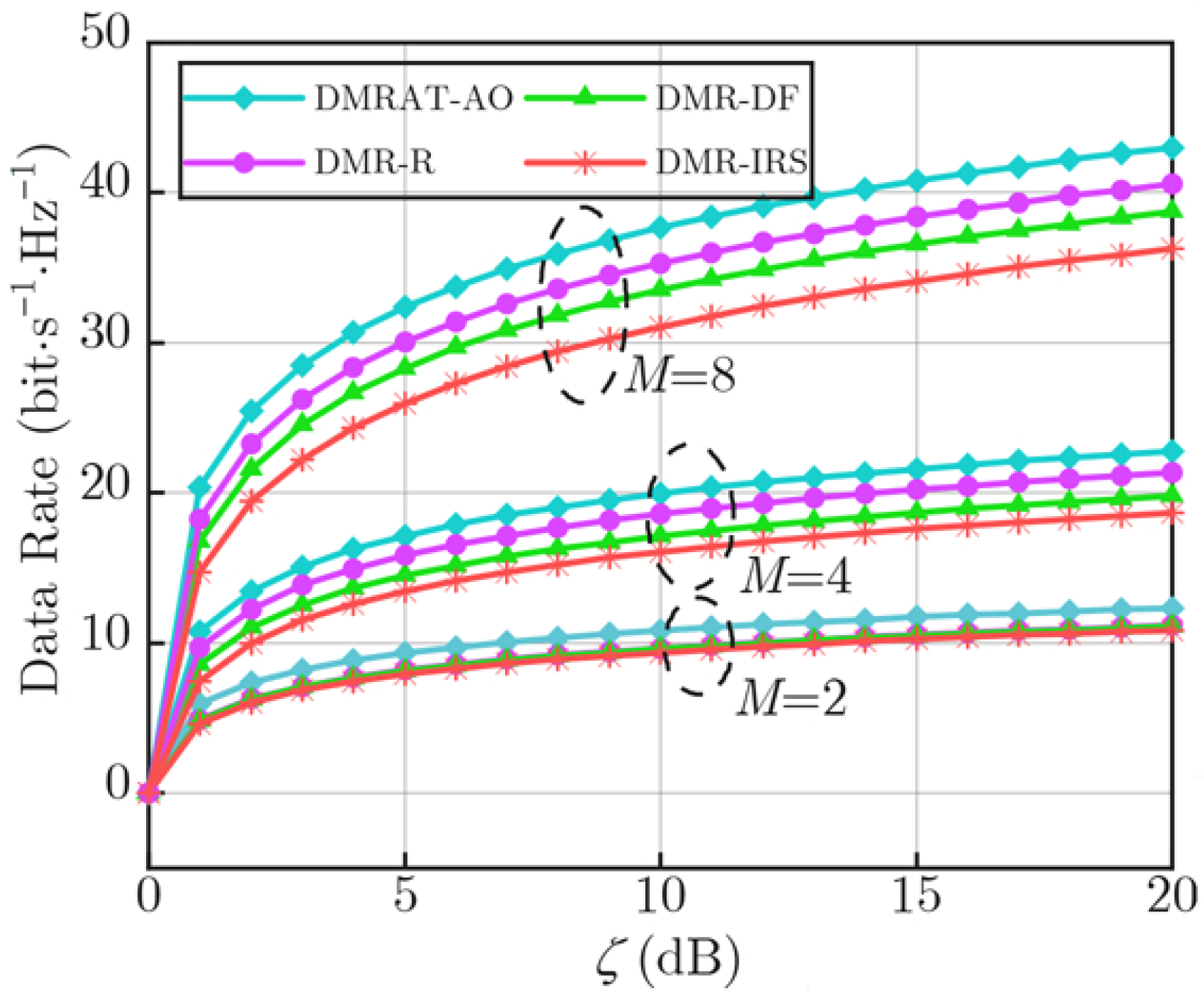
Figure 2 illustrates the variation in the data rate performance at the Rx along with
for different values of
M. We denote the proposed DMRAT using AO as DMRAT-AO, and compare it with three other schemes: Fixed IRS (where all DMRUs adopt passive IRS reflection mode [
24]), Fixed DF relay (where all DMRUs adopt DF relaying mode [
26]), and DMRAT-R (where all DMRUs randomly adopt either passive IRS reflection mode or DF relaying mode). As the figure shows, the data rates of all methods increase with the growth of
M. This is due to the improved signal processing gain provided by multiple antennas. For a fixed
M, DMRAT-AO outperforms the other three methods in the achievable data rate. This is because DMRAT-AO utilizes AO to jointly optimize the operating parameters of both the Tx and the DMR, selecting the optimal operating mode for the DMR to maximize the data rate at the Rx. The Fixed DF relay scheme employs the DF relaying mode to decode and forward the signal transmitted by the Tx, effectively compensating for channel fading through the consumption of transmit power. Moreover, in this study we assume that the DF relay can decode the signal from the Tx without errors; hence, the rate performance of the Fixed DF relay scheme is influenced solely by the channel between the DMR and the Rx. In other words, under the total transmit power constraint
, the Fixed DF relay scheme allocates half of
to the Tx, ensuring reliable communication from the Tx to the DMR. In contrast, the Fixed IRS scheme allocates all transmit power to the Tx, and its data rate performance at the Rx is cooperatively affected by the channel fading between the Tx and DMR, as well as the DMR and Rx. Poor quality in either of these two links will degrade the data rate of Fixed IRS. Therefore, given the same
, the Fixed DF relay scheme significantly outperforms the Fixed IRS scheme, which exhibits the poorest rate performance. DMRAT-R randomly selects the operating mode of each DMRU. When channel conditions are poor, inappropriate selection of the IRS mode may lead to reduced data rate at the Rx. As a result, the rate performance of DMRAT-R is inferior to that of the Fixed DF relay scheme. To summarize, DMRAT-AO outperforms all other schemes by dynamically exploring a broader solution space that includes all operational modes. By intelligently allocating DMRUs to either passive reflection or active relaying based on channel conditions, DMRAT-AO leverages the advantages of both modes. This approach enables mode selection gain, particularly in scenarios where a single fixed mode is not optimal. As a result, DMRAT-AO maximizes the Rx’s data rate and in dynamic communication environments.
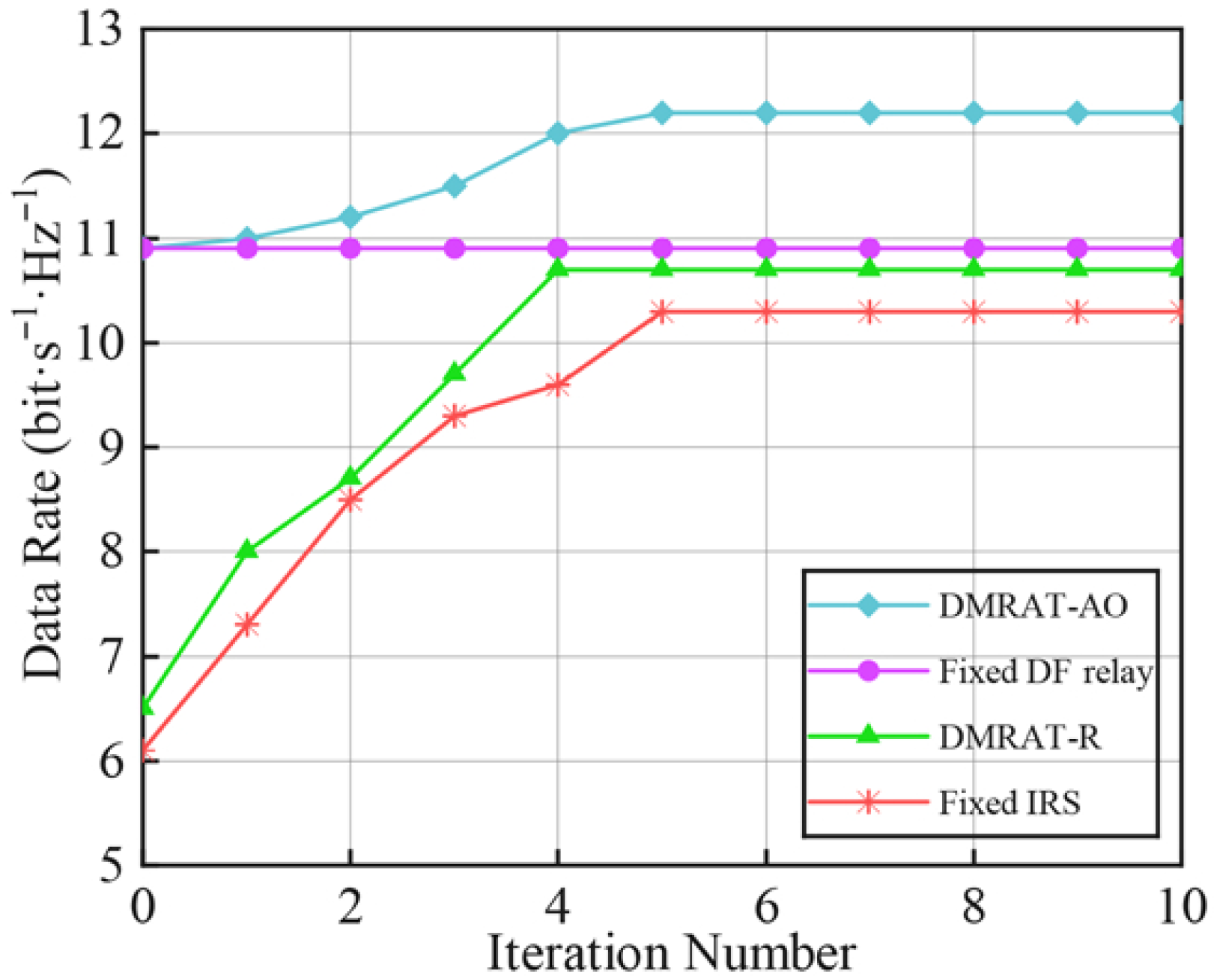
Figure 3 shows the data rate at the Rx versus the number of iterations under
for different DMR operating modes. When all DMRUs operate in DF relaying mode, only ZFBF is required to design
and
, without needing to compute
or apply AO. Therefore, the data rate achieved by the Fixed DF relay scheme remains unchanged as the number of iterations increases. In contrast, the data rate of DMRAT-AO gradually increases during the first five iterations, consistently outperforming the other methods, and converges after approximately five iterations. The data rate of Fixed IRS stabilizes after five iterations, while that of DMRAT-R ceases to improve after four iterations. This is because DMRAT-AO uses AO to select the DMR operating mode that maximizes the data rate at the Rx, resulting in superior performance. Additionally, at the initial iteration (i.e.,
), since DMRAT-AO sets initial operating state of the DMR to the Fixed DF relay scheme, the data rates of DMRAT-AO and the Fixed DF relay scheme are identical when
.
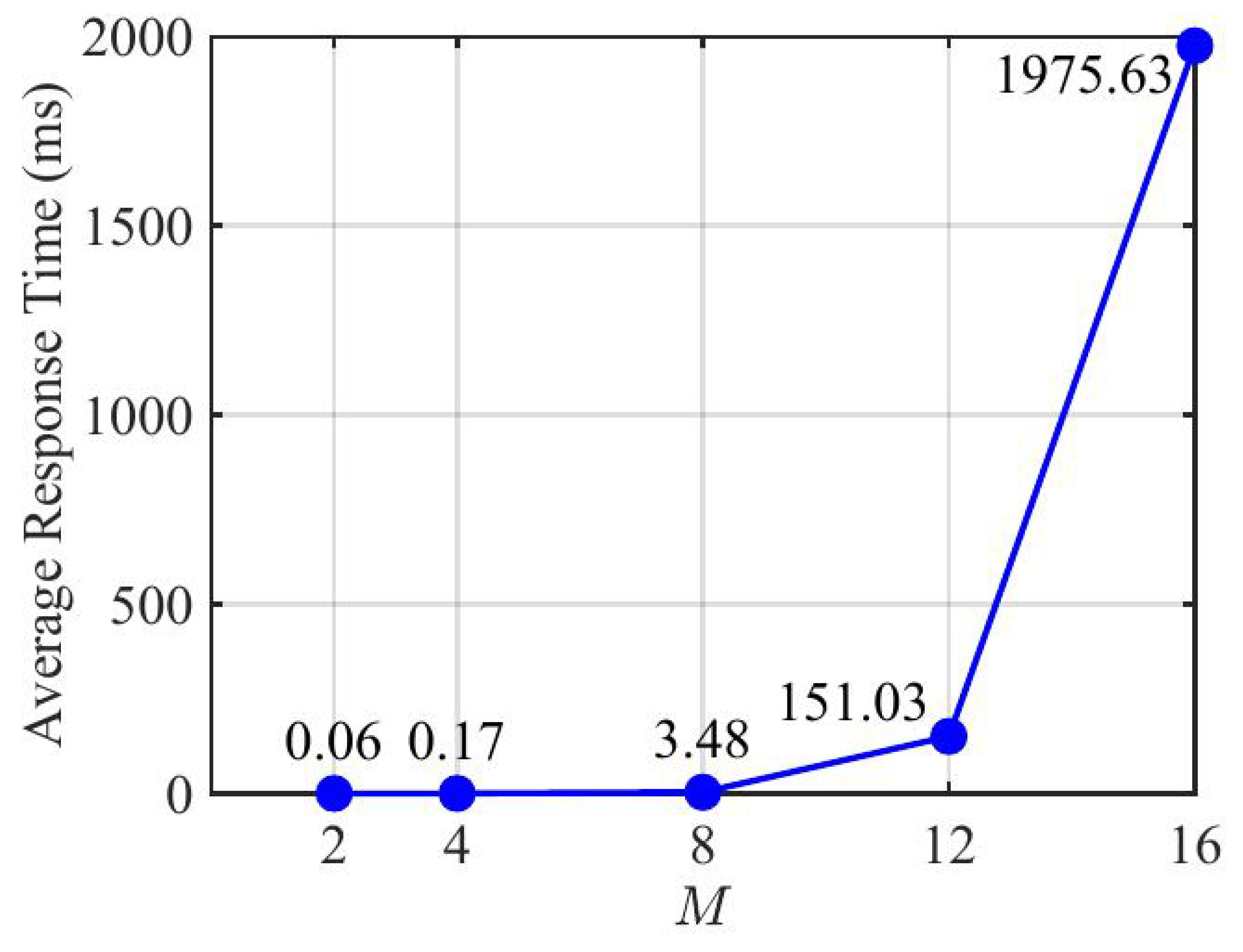
To further evaluate the computational overhead of the proposed DMRAT-AO scheme, we illustrate the average response time in
Figure 4 under
. The experiment was conducted on a computer with an Intel Core i5-1240P processor (1.70 GHz), DDR4 16 GB (3200 MHz), and a Windows 11 operating system. As the figure shows, the average response time exhibits a substantial increase with the growth of
M. This aligns with the complexity analysis in
Section 3.2.4. The results indicate that, for small to medium values of
M, the processing latency of DMRAT-AO remains within an acceptable millisecond range. For larger values of
M, ML techniques can be incorporated to reduce the latency. Since our primary focus is on the theoretical design of the dual-mode switching mechanism and the potential improvements in data rates enabled by our scheme, the investigation of complexity reduction using ML is left for future study.
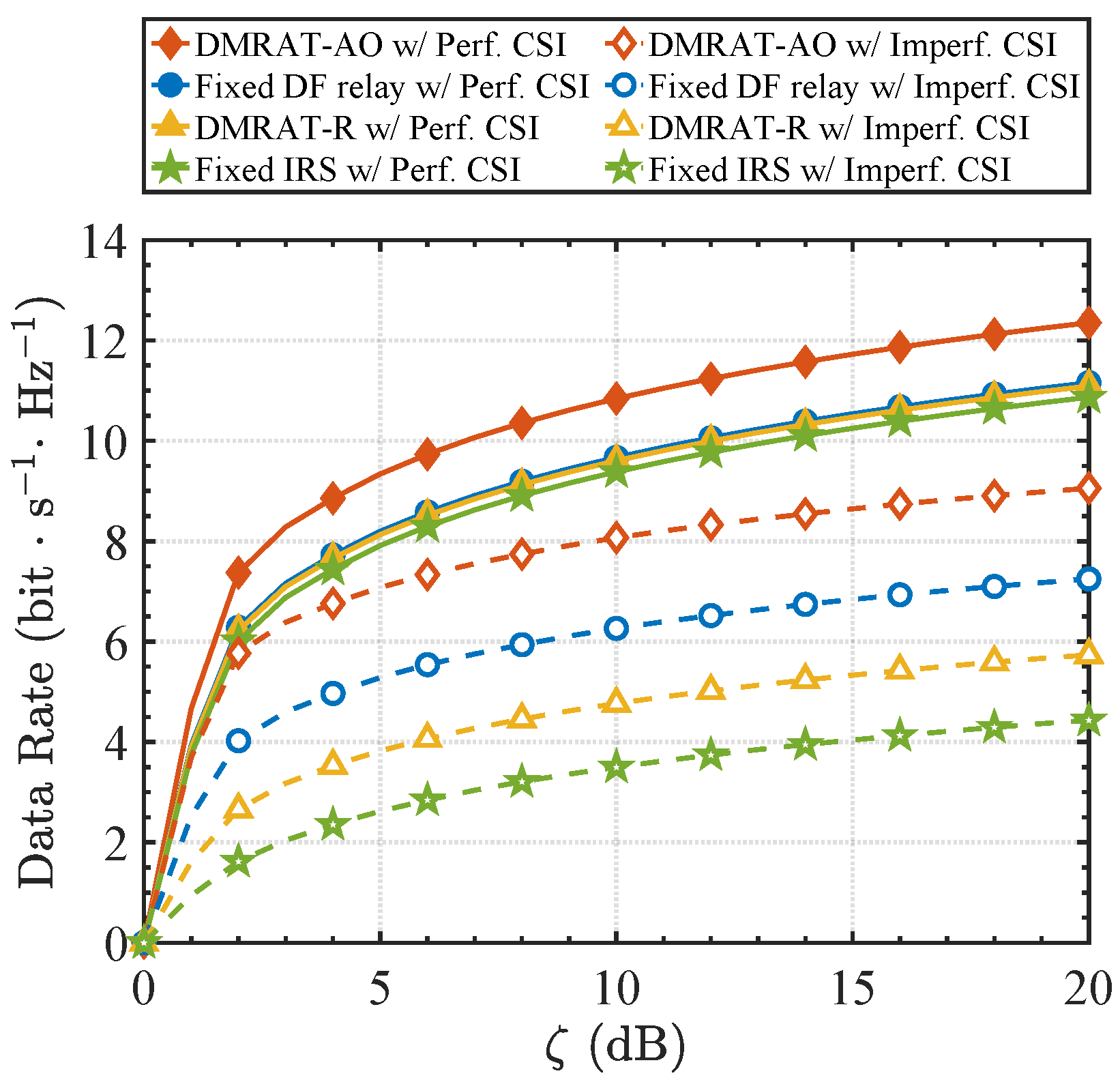
The above analysis is based on the assumption of perfect CSI. However, in practical wireless systems, obtaining accurate CSI is often challenging due to factors such as channel estimation errors, quantization effects, and feedback delays. It is therefore crucial to investigate the impact of CSI imperfections on the achievable performance of the proposed scheme. To model the CSI uncertainty, we adopt the widely used additive error model, where the estimated channel matrix
is given by [
27]:
where
and
denote accurate and inaccurate channel matrices, respectively. The coefficient
indicates the degree of CSI imperfection and
means perfect CSI. The matrix
is an
complex diagonal Gaussian matrix with zero mean and unit variance, where
and
are the numbers of antennas equipped with the receiver and transmitter of a MIMO link.
We applied this model (presented in Equation (
25)) to both the Tx-DMR channel (
) and the DMR-Rx channel (
), and conducted additional simulations under
[
27,
28].
Figure 5 illustrates the achievable data rate versus
for different methods under
, comparing both perfect CSI (
, solid lines) and imperfect CSI (
, dashed lines) conditions. As
Figure 5 shows, all schemes experience performance degradation due to CSI inaccuracies. However, the proposed DMRAT-AO still maintains a significant performance advantage in the imperfect CSI scenario, demonstrating the inherent robustness of its adaptive switching mechanism. Specifically, the Fixed IRS scheme exhibits high sensitivity to CSI errors and suffers from severe performance degradation. This vulnerability arises because its passive beamforming gain relies on precise phase alignment within the cascaded Tx-DMR-Rx channel. Under imperfect CSI, estimation errors from both links become coupled and amplified, resulting in substantial phase mismatches and performance losses. In contrast, the Fixed DF relay scheme demonstrates greater robustness. By utilizing the decode-and-forward mechanism, the DF relaying mode physically decouples the cascaded channel into two independent single-hop links. Although its end-to-end rate is constrained by the bottleneck link (i.e., the minimum rate of the two hops), this decoupling limits the influence of estimation errors to each single hop, effectively preventing the error accumulation and amplification that is inherent to the cascaded IRS link. Regarding the proposed DMRAT-AO, its capability to optimally select the DMR’s operation mode allows it to adaptively switch to the more robust DF mode when CSI inaccuracies severely impair the rate performance of the IRS mode. Consequently, DMRAT-AO can achieve the highest data rate under imperfect CSI compared to the other schemes.