Engaging Older Adults to Guide the Development of Passive Home Health Monitoring to Support Aging in Place

 , , , ,
Highlights
- Older adults have an interest in and willingness to have home installed image free sensors in their homes to monitor health. Their willingness was amplified with changes to their living arrangements, health status, and experience with others having a health event that required getting help.
- Newly retired participants were generally younger and more frequent technology users. Thus, they were more knowledgeable about and accepting of incorporating our proposed sensors in their homes.
- The study underscores the importance of involving potential users in technology development to create effective and acceptable solutions for aging in place.
- To be accepted, home health monitoring systems must be cost-conscious, privacy preserving and flexible enough to accommodate individuals at different life phases and comfort levels, with different home environments and support systems.
Abstract
1. Introduction
2. Materials and Methods
3. Results
3.1. Survey Results
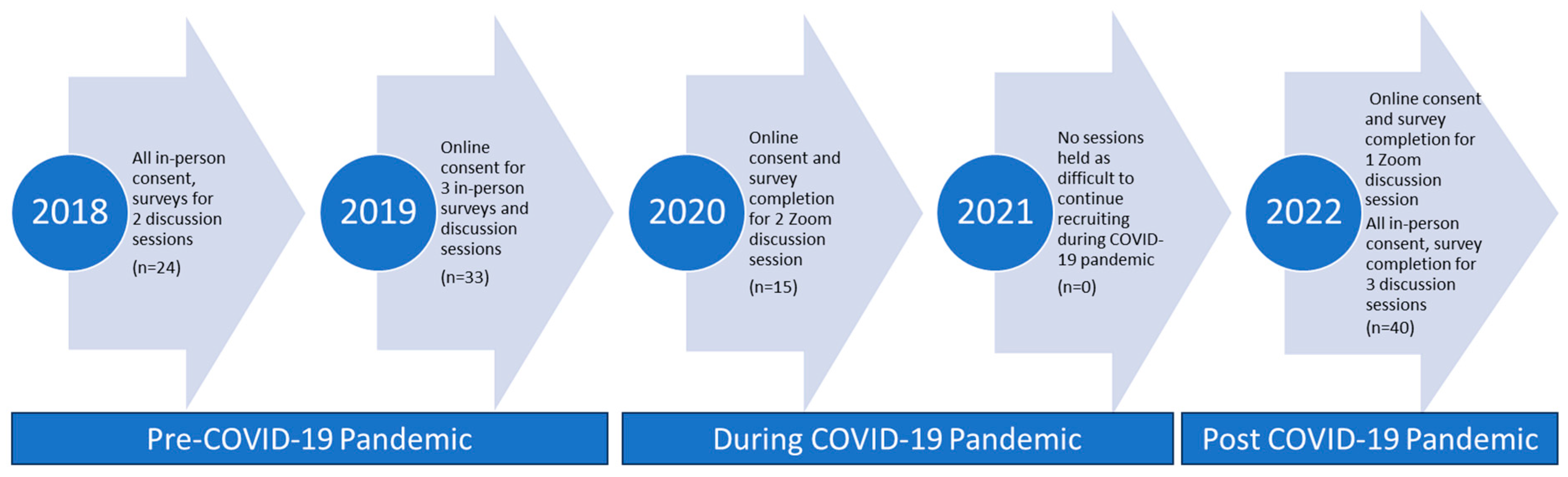
3.1.1. Demographics (Table 1 and Figure 1)

| (N = 112) | |
|---|---|
| Participant Demographics | n (%) |
| Recruitment site | |
| 55+ apartment complex in an urban setting | 24 (21) |
| General community in a suburban setting | 68 (61) |
| Independent living complex in a rural continuous care community | 20 (18) |
| Age | |
| 50–59 | 1 (1) |
| 60–69 | 26 (24) |
| 70–79 | 50 (46) |
| 80+ | 32 (29) |
| missing | 3 |
| Female Gender | 57 (53) |
| Education | |
| <College | 24 (22) |
| College graduate missing | 83 (78) 5 |
| Living arrangements | |
| Live alone | 20 (19) |
| Live with someone | 73 (68) |
| Live in a group setting missing | 14 (13) 5 |
| Home technology use | n (%) |
| Have technology access at home | |
| Basic cellphone (e.g., flip phone) | 48 (54) |
| Smartphone (e.g., Apple iPhone, Samsung Galaxy) | 93 (89) |
| Tablet (e.g., iPad, Samsung) | 67 (67) |
| Computer (desktop or laptop) | 88 (85) |
| Cable/satellite access (e.g., Spectrum, Verizon) | 88 (87) |
| Text messaging on your cellphone | 96 (92) |
| Video conferencing (e.g., Zoom) | 78 (75) |
| Internet access via WiFi (wireless) | 93 (89) |
| Home health monitoring (e.g., BP machine) (n = 44) * | 28 (64) |
| Wearable health devices (e.g., fitbit, apple watch) (n = 42) * | 13 (31) |
| Falls detection monitoring * | 6 (14) |
| Very comfortable with technology use | |
| Making or receiving a call on your cellphone | 90 (88) |
| Using your tablet (e.g., iPad, Samsung) | 32 (71) |
| Using your computer (desktop or laptop) | 33 (75) |
| Using an app on smartphone, tablet or computer | 34 (74) |
| Text messaging on your cellphone | 40 (87) |
| Video conferencing | 30 (67) |
| Connecting to the internet | 80 (82) |
| Home health monitoring devices * | 22 (48) |
| Wearable health devices * | 15 (33) |
| Falls detection monitoring * | 5 (11) |
| Telehealth * | 11 (26) |

3.1.2. Sensor Preferences
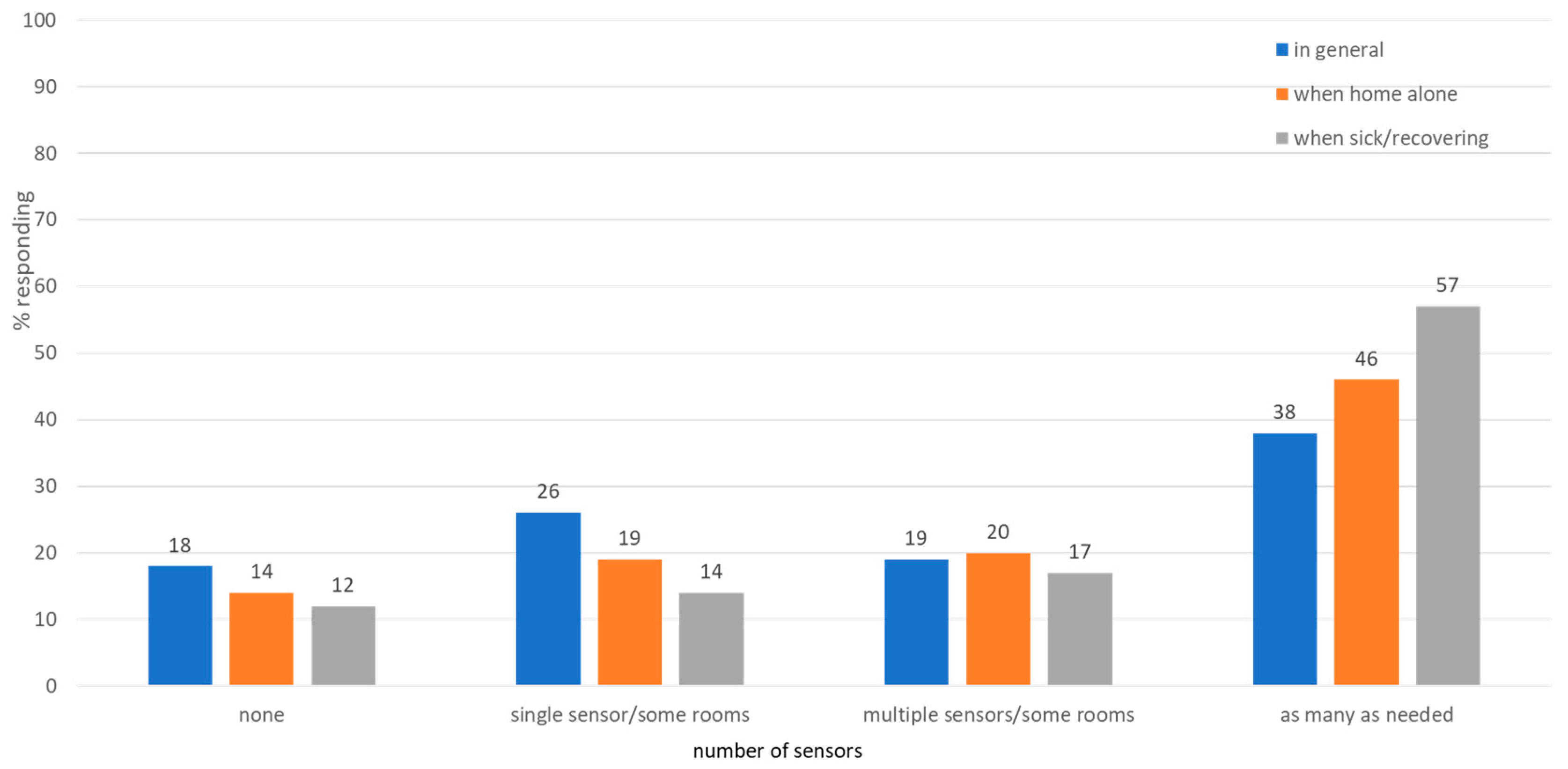
3.1.3. Comfort with Home Installed Sensors by Number of Sensors and Individual Health Status (Figure 2 and Table 2)

| Health Status | Odds Ratio (OR) * | 95% Confidence Interval | p-Value |
|---|---|---|---|
| Sick vs. Home alone | 1.52 | 1.13–2.04 | 0.006 |
| Sick vs. in general | 2.21 | 1.52–3.21 | <0.001 |
| Home alone vs. in general | 1.46 | 1.09–1.95 | 0.012 |
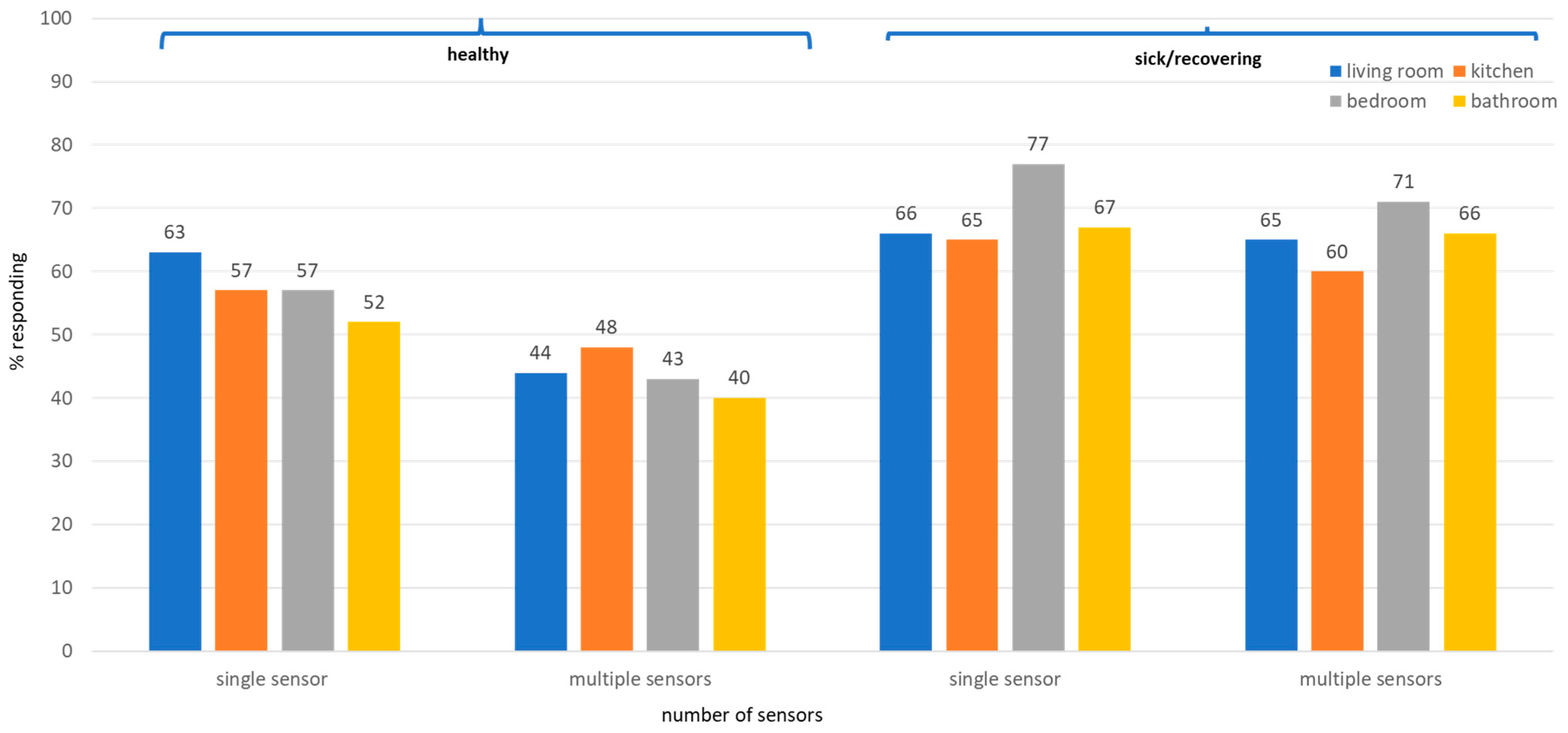
3.1.4. Comfort with the Location for Home-Installed Sensors by Health Status and Number of Sensors (Figure 3 and Table 3)

| Location Within the Home | Preference for Single vs. Multiple Sensors | Odds Ratio * | 95% Confidence Interval | p-Value |
|---|---|---|---|---|
| Living room | ||||
| When sick | Multiple vs. single sensor | 0.95 | 0.62–1.46 | 0.805 |
| When sick vs. healthy | Multiple sensors | 2.65 | 1.67–4.20 | <0.0001 |
| When sick vs. healthy | Single sensors | 1.14 | 0.71–1.84 | 0.591 |
| When healthy | Multiple vs. single sensor | 0.41 | 0.26–0.63 | <0.0001 |
| Kitchen | ||||
| When sick | Multiple vs. single sensor | 0.75 | 0.52–1.08 | 0.124 |
| When sick vs. healthy | Multiple sensors | 1.75 | 1.12–2.71 | 0.013 |
| When sick vs. healthy | Single sensors | 1.41 | 0.99–2.01 | 0.056 |
| When healthy | Multiple vs. single sensor | 0.60 | 0.40–0.92 | 0.019 |
| Bedroom | ||||
| When sick | Multiple vs. single sensor | 0.62 | 0.39–0.99 | 0.047 |
| When sick vs. healthy | Multiple sensors | 3.66 | 2.29–5.84 | <0.0001 |
| When sick vs. healthy | Single sensors | 3.09 | 1.85–5.16 | <0.0001 |
| When healthy | Multiple vs. single sensor | 0.52 | 0.34–0.79 | 0.0023 |
| Bathroom | ||||
| When sick | Multiple vs. single sensor | 0.92 | 0.60–1.42 | 0.71 |
| When sick vs. healthy | Multiple sensors | 3.41 | 2.22–5.24 | <0.0001 |
| When sick vs. healthy | Single sensors | 2.09 | 1.38–3.17 | 0.0005 |
| When healthy | Multiple vs. single sensor | 0.57 | 0.39–0.83 | 0.0033 |
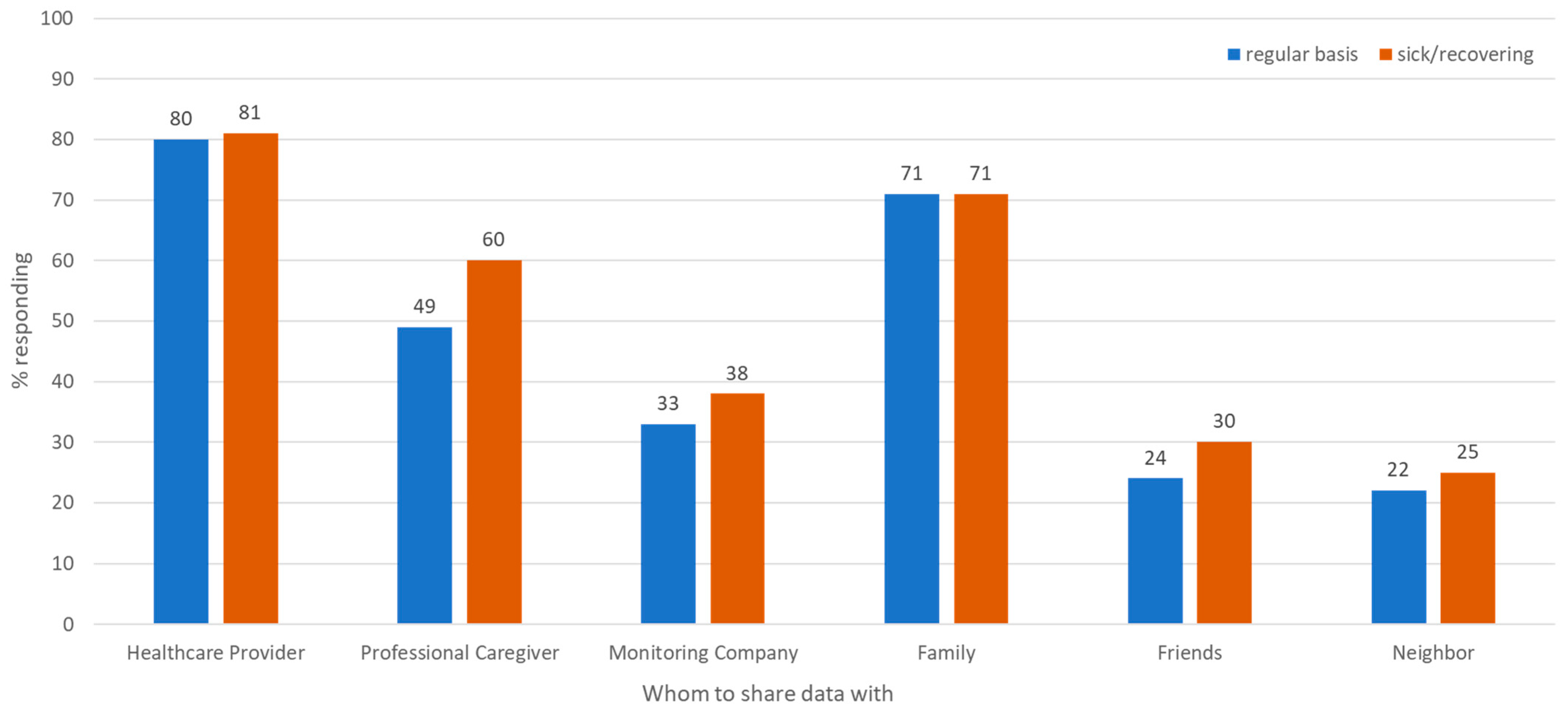
3.1.5. Data Sharing (Figure 4 and Table 4)

| With Whom to Share Sensor Data | Odds Ratio (OR) * | 95% Confidence Interval | p-Value |
|---|---|---|---|
| Healthcare Provider | 1.00 | 0.67–1.00 | 0.989 |
| Professional Caregiver | 1.67 | 1.21–2.30 | 0.0017 |
| Monitoring Company | 1.34 | 1.03–1.74 | 0.030 |
| Family | 1.00 | 0.69–1.46 | 1.00 |
| Friends | 1.42 | 0.98–2.05 | 0.061 |
| Neighbors | 1.23 | 0.86–1.74 | 0.256 |
3.2. Summary of Discussion Session Findings—Themes Identified from the Discussions
3.2.1. Theme #1: Challenges to Aging in Place
3.2.2. Major Theme #2: Home Monitoring Concerns and Questions
3.2.3. Major Theme #3: Caregiver Concerns
4. Discussion
4.1. Principal Discoveries
4.2. Comparison with Prior Work
4.2.1. Theme #1-Challenges to Aging in Place
4.2.2. Theme #2-Home Monitoring Concerns and Questions
4.2.3. Theme #3 Caregiver Concerns
4.3. Limitations
4.4. Relevance to Future Technology Design and Adoption for Use by Older Adults
5. Conclusions
Supplementary Materials
Author Contributions
Funding
Institutional Review Board Statement
Informed Consent Statement
Data Availability Statement
Acknowledgments
Conflicts of Interest
References
- Administration on Aging. 2023 Profile of Older Americans; Administration for Community Living, Ed.; US Department of Health and Human Services: Washington, DC, USA, 2024.
- US Census Bureau. 2023 National Population Projection Tables: Main Series. 2023. Available online: https://www.census.gov/data/tables/2023/demo/popproj/2023-summary-tables.html (accessed on 25 November 2025).
- Binette, J.; Farago, F. 2024 Home and Community Preference Survey: A National Survey of Adults Age 18-Plus; AARP Research: Washington, DC, USA, 2024. [Google Scholar]
- Malani, P.; Kullgren, J.; Solway, E.; Robinson-Lane, S.; Singer, D.; Kirch, M.; Smith, E. National Poll on Healthy Aging: Older Adults’ Preparedness to Age in Place; Michigan Publishing: Ann Arbor, MI, USA, 2022. [Google Scholar] [CrossRef]
- Institute of Medicine. Retooling for an Aging America: Building the Health Care Workforce; The National Academies Press: Washington, DC, USA, 2008; p. 316. [Google Scholar]
- Wince-Smith, D. Bracing For The Silver Tsunami; Forbes: Jersey City, NJ, USA, 2022. [Google Scholar]
- Sullivan, T. Silver Tsunami is Coming to Healthcare: Time to Prepare; Health Care IT News: Chicago, IL, USA, 2019; Available online: https://www.healthcareitnews.com/news/silver-tsunami-coming-healthcare-time-prepare (accessed on 25 November 2025).
- Meola, A. The Aging US Population is Creating many Problems—Especially Regarding Elderly Healthcare Issues; Business Insider Inc.: New York, NY, USA, 2021. [Google Scholar]
- Weeks, L.E.; Warner, G.; Nesto, S.; Rushton, H.; Ledoux, K.; Hiebert, B.; Donelle, L. How does passive remote monitoring technology affect perceived outcomes for older adults, their family and friend caregivers, and the healthcare system? Gerontechnology 2022, 21, 1–13. [Google Scholar] [CrossRef]
- Weeks, L.E.; Warner, G.; Chen, Y.T.; Hiebert, B.; Richard, E.; Ledoux, K.; Donelle, L. Family and friend caregiver satisfaction and utility of passive remote monitoring technology utilized by frail home care clients. Gerontechnology 2024, 23, 1–9. [Google Scholar] [CrossRef]
- Wilkowska, W.; Offermann, J.; Spinsante, S.; Poli, A.; Ziefle, M. Analyzing technology acceptance and perception of privacy in ambient assisted living for using sensor-based technologies. PLoS ONE 2022, 17, e0269642. [Google Scholar] [CrossRef]
- Offermann, J.; Wilkowska, W.; Poli, A.; Spinsante, S.; Ziefle, M. Acceptance and Preferences of Using Ambient Sensor-Based Lifelogging Technologies in Home Environments. Sensors 2021, 21, 8297. [Google Scholar] [CrossRef]
- Ginsberg, K.H.; Babbott, K.; Serlachius, A. Exploring Participants’ Experiences of Digital Health Interventions With Qualitative Methods: Guidance for Researchers. J. Med. Internet Res. 2024, 26, e62761. [Google Scholar] [CrossRef] [PubMed]
- Chadwick, H.; Laverty, L.; Finnigan, R.; Elias, R.; Farrington, K.; Caskey, F.J.; van der Veer, S.N. Engagement With Digital Health Technologies Among Older People Living in Socially Deprived Areas: Qualitative Study of Influencing Factors. JMIR Form. Res. 2024, 8, e60483. [Google Scholar] [CrossRef] [PubMed]
- Chan, A.; Cai, J.; Qian, L.; Coutts, B.; Phan, S.; Gregson, G.; Lipsett, M.; Rincón, A.M.R. In-Home Positioning for Remote Home Health Monitoring in Older Adults: Systematic Review. JMIR Aging 2024, 7, e57320. [Google Scholar] [CrossRef]
- Liu, M.; Elbadry, M.; Hua, Y.; Xie, Z.; Baral, S.; Park, I.; Ye, F. Proteus: An easily managed home-based health monitoring infrastructure. IEEE Internet Things J. 2025, 12, 1125–1136. [Google Scholar] [CrossRef]
- Alizadeh, M.; Shaker, G.; De Almeida, J.C.M.; Morita, P.P.; Safavi-Naeini, S. Remote monitoring of human vital signs using mm-wave FMCW radar. IEEE Access 2019, 7, 54958–54968. [Google Scholar] [CrossRef]
- Padhan, S.; Mohapatra, A.; Ramasamy, S.K.; Agrawal, S. Artificial Intelligence (AI) and Robotics in Elderly Healthcare: Enabling Independence and Quality of Life. Cureus 2023, 15, e42905. [Google Scholar] [CrossRef]
- Wiles, J.L.; Leibing, A.; Guberman, N.; Reeve, J.; Allen, R.E.S. The meaning of “aging in place” to older people. Gerontologist 2012, 52, 357–366. [Google Scholar] [CrossRef]
- Levitt, R. Aging in Place: Facilitating Choice and Independence. Evidence Matters; Office of Policy Development and Research, Department of Housing and Urban Development: Washington, DC, USA, 2013. Available online: https://archives.huduser.gov/portal/periodicals/em/fall13/highlight1.html (accessed on 25 November 2025).
- Hammar, I.O.; Dahlin-Ivanoff, S.; Wilhelmson, K.; Eklund, K. Self-determination among community-dwelling older persons: Explanatory factors. Scand. J. Occup. Ther. 2016, 23, 198–206. [Google Scholar] [CrossRef]
- Waites, C. Examining the perceptions, preferences, and practices that influence healthy aging for African American older adults: An ecological perspective. J. Appl. Gerontol. 2013, 32, 855–875. [Google Scholar] [CrossRef]
- Lee, E.; Han, S.; Chung, Y. Internet use of consumers aged 40 and over: Factors that influence full adoption. Soc. Behav. Personal. Int. J. 2014, 42, 1563–1574. [Google Scholar] [CrossRef]
- Kakulla, B. 2025 Empowering Independence with Technology Among Adults Age 50-Plus. In AARP/CTA Research; AARP: Washington, DC, USA, 2025; Available online: https://www.aarp.org/pri/topics/technology/internet-media-devices/aging-technology-agetech/?msockid=3489c394942f615124e0d6099536609e (accessed on 25 November 2025).
- Wang, K.H.; Chen, G.; Chen, H.-G. Understanding technology adoption behavior by older adults. Soc. Behav. Personal. Int. J. 2018, 46, 801–814. [Google Scholar] [CrossRef]
- Grindrod, K.A. Assessing the Usability and Usefulness of Wearable Activity Trackers with Adults over Age 50: A Mixed Methods Evaluation. In Proceedings of the Medicine 2014 Summit & World Congress, Maui, HI, USA, 9–11 June 2014; Available online: https://www.medicine20congress.org/index.php/med/med2014/paper/view/2447.html (accessed on 25 November 2025).
- Farivar, S.; Abouzahra, M.; Ghasemaghaei, M. Wearable device adoption among older adults: A mixed-methods study. Int. J. Inf. Manag. 2020, 55, 102209. [Google Scholar] [CrossRef]
- Domingos, C.; Costa, P.; Santos, N.C.; Pêgo, J.M. Usability, Acceptability, and Satisfaction of a Wearable Activity Tracker in Older Adults: Observational Study in a Real-Life Context in Northern Portugal. J. Med. Internet Res. 2022, 24, e26652. [Google Scholar] [CrossRef]
- Creaser, A.V.; Hall, J.; Costa, S.; Bingham, D.D.; Clemes, S.A. Exploring Families’ Acceptance of Wearable Activity Trackers: A Mixed-Methods Study. Int. J. Environ. Res. Public Health 2022, 19, 3472. [Google Scholar] [CrossRef] [PubMed]
- Kakulla, B. AARP 2025 Tech Trends and Adults 50-Plus; AARP: Washington, DC, USA, 2025; Available online: https://www.aarp.org/content/dam/aarp/research/topics/technology/internet-media-devices/2025-technology-trends-older-adults.doi.10.26419-2fres.00891.001.pdf (accessed on 25 November 2025).
- Vrančić, A.; Zadravec, H.; Orehovački, T. The Role of Smart Homes in Providing Care for Older Adults: A Systematic Literature Review from 2010 to 2023. Smart Cities 2024, 7, 1502–1550. [Google Scholar] [CrossRef]
- Wang, S.; Bolling, K.; Mao, W.; Reichstadt, J.; Jeste, D.; Kim, H.-C.; Nebeker, C. Technology to Support Aging in Place: Older Adults’ Perspectives. Healthcare 2019, 7, 60. [Google Scholar] [CrossRef]
- Faverio, M. Share of Those 65 and Older Who Are Tech Users Has Grown in the Past Decade; Pew Research Center: Washington, DC, USA, 2022; Available online: https://www.pewresearch.org/short-reads/2022/01/13/share-of-those-65-and-older-who-are-tech-users-has-grown-in-the-past-decade/ (accessed on 25 November 2025).
- Read, E.A.; Gagnon, D.A.; Donelle, L.; Ledoux, K.; Warner, G.; Hiebert, B.; Sharma, R. Stakeholder Perspectives on In-home Passive Remote Monitoring to Support Aging in Place in the Province of New Brunswick, Canada: Rapid Qualitative Investigation. JMIR Aging 2022, 5, e31486. [Google Scholar] [CrossRef]
- Ntsweng, O.; Kodyš, M.; Ong, Z.Q.; Zhou, F.; de Marassé-Enouf, A.; Sadek, I.; Aloulou, H.; Tan, S.S.-L.; Mokhtari, M. Lessons Learned From the Integration of Ambient Assisted Living Technologies in Older Adults’ Care: Longitudinal Mixed Methods Study. JMIR Rehabil. Assist. Technol. 2025, 12, e57989. [Google Scholar] [CrossRef]
- Offerman, J.; Fristedt, S.; Schmidt, S.M.; Lofqvist, C.; Iwarsson, S. Attitudes related to technology for active and healthy aging in a national multigenerational survey. Nat. Aging 2023, 3, 617–625. [Google Scholar] [CrossRef]
- LeBaron, V. Challenges and opportunities in designing and deploying remote health monitoring technology for older adults with cancer. Innov. Aging 2022, 6, igac057. [Google Scholar] [CrossRef]
- Du Preez, V.; De La Harpe, R. Engaging Aging Individuals in the Design of Technologies and Services to Support Health and Well-Being: Constructivist Grounded Theory Study. JMIR Aging 2019, 2, e12393. [Google Scholar] [CrossRef]
- Tiersen, F.; Batey, P.; Harrison, M.J.C.; Naar, L.; Serban, A.I.; Daniels, S.J.C.; Calvo, R.A. Smart Home Sensing and Monitoring in Households With Dementia: User-Centered Design Approach. JMIR Aging 2021, 4, e27047. [Google Scholar] [CrossRef]
- Kim, D.; Bian, H.; Chang, C.K.; Dong, L.; Margrett, J. In-Home Monitoring Technology for Aging in Place: Scoping Review. Interact. J. Med. Res. 2022, 11, e39005. [Google Scholar] [CrossRef]
- Facchinetti, G.; Petrucci, G.; Albanesi, B.; De Marinis, M.G.; Piredda, M. Can smart home technologies help older adults manage their chronic condition? A systematic literature review. Int. J. Environ. Res. Public Health 2023, 20, 1205. [Google Scholar] [CrossRef]
- Chan, A.; Cohen, R.; Robinson, K.-M.; Bhardwaj, D.; Gregson, G.; Jutai, J.W.; Millar, J.; Rincón, A.R.; Fekr, A.R. Evidence and User Considerations of Home Health Monitoring for Older Adults: Scoping Review. JMIR Aging 2022, 5, e40079. [Google Scholar] [CrossRef]
- Peek, S.T.M.; Wouters, E.J.M.; van Hoof, J.; Luijkx, K.G.; Boeije, H.R.; Vrijhoef, H.J.M. Factors influencing acceptance of technology for aging in place: A systematic review. Int. J. Med. Inform. 2014, 83, 235–248. [Google Scholar] [CrossRef]
- Kocjan, G.Z.; Špes, T.; Svetina, M.; Plohl, N.; Smrke, U.; Mlakar, I.; Musil, B. Assistive digital technology to promote quality of life and independent living for older adults through improved self-regulation: A scoping review. Behav. Inf. Technol. 2023, 42, 2832–2851. [Google Scholar] [CrossRef]
- Zhu, J.; Shi, K.; Yang, C.; Niu, Y.; Zeng, Y.; Zhang, N.; Liu, T.; Chu, C.H. Ethical issues of smart home--based elderly care: A scoping review. J. Nurs. Manag. 2022, 30, 3686–3699. [Google Scholar] [CrossRef]
- Choi, Y.K.; Thompson, H.J.; Demiris, G. Internet-of-Things Smart Home Technology to Support Aging-in-Place: Older Adults’ Perceptions and Attitudes. J. Gerontol. Nurs. 2021, 47, 15–21. [Google Scholar] [CrossRef]
- Boise, L.; Wild, K.; Mattek, N.; Ruhl, M.; Dodge, H.; Kaye, J. Willingness of older adults to share data and privacy concerns after exposure to unobtrusive in-home monitoring. Gerontechnology 2013, 11, 428–435. [Google Scholar] [CrossRef]
- Dermody, G.; Fritz, R.; Glass, C.; Dunham, M.; Whitehead, L. Factors influencing community-dwelling older adults’ readiness to adopt smart home technology: A qualitative exploratory study. J. Adv. Nurs. 2021, 77, 4847–4861. [Google Scholar] [CrossRef]
- Demiris, G.; Hensel, B.K.; Skubic, M.; Rantz, M. Senior residents’ perceived need of and preferences for “smart home” sensor technologies. Int. J. Technol. Assess. Health Care 2008, 24, 120–124. [Google Scholar] [CrossRef]
- Cho, M.S.; Kwon, M.Y. Factors Associated with Aging in Place among Community-Dwelling Older Adults in Korea: Findings from a National Survey. Int. J. Environ. Res. Public Health 2023, 20, 2740. [Google Scholar] [CrossRef]
- Moxley, J.; Sharit, J.; Czaja, S.J. The Factors Influencing Older Adults’ Decisions Surrounding Adoption of Technology: Quantitative Experimental Study. JMIR Aging 2022, 5, e39890. [Google Scholar] [CrossRef]
- Reyes, E.P.G.; Kelly, R.; Buchanan, G.; Waycott, J. Understanding Older Adults’ Experiences With Technologies for Health Self-management: Interview Study. JMIR Aging 2023, 6, e43197. [Google Scholar] [CrossRef]
- Sixsmith, A.; Horst, B.; Simeonov, D.; Mihailidis, A. Older people’s use of digital technology during the COVID-19 pandemic. Bull. Sci. Technol. Soc. 2022, 42, 19–24. [Google Scholar] [CrossRef]
- Harris, M.T.; Rogers, W.A. Developing a Healthcare Technology Acceptance Model (H-TAM) for Older Adults with Hypertension. Ageing Soc. 2023, 43, 814–834. [Google Scholar] [CrossRef]
- Perdana, A.; Mokhtar, I.A. Seniors’ adoption of digital devices and virtual event platforms in Singapore during COVID-19. Technol. Soc. 2022, 68, 101817. [Google Scholar] [CrossRef]
- Bin Noon, G.; Hanjahanja-Phiri, T.; Dave, H.; Fadrique, L.; Teague, J.; Morita, P.P. Exploring the Role of Active Assisted Living in the Continuum of Care for Older Adults: Thematic Analysis. JMIR Aging 2023, 6, e40606. [Google Scholar] [CrossRef]
- Wild, K.; Boise, L.; Lundell, J.; Foucek, A. Unobtrusive In-Home Monitoring of Cognitive and Physical Health: Reactions and Perceptions of Older Adults. J. Appl. Gerontol. 2008, 27, 181–200. [Google Scholar] [CrossRef]
- Mitzner, T.L.; Boron, J.B.; Fausset, C.B.; Adams, A.E.; Charness, N.; Czaja, S.J.; Dijkstra, K.; Fisk, A.D.; Rogers, W.A.; Sharit, J. Older adults talk technology: Technology usage and attitudes. Comput. Hum. Behav. 2010, 26, 1710–1721. [Google Scholar] [CrossRef]
- Lindquist, L.A.; Ramirez-Zohfeld, V.; Forcucci, C.; Sunkara, P.; Cameron, K.A. Overcoming Reluctance to Accept Home-Based Support from an Older Adult Perspective. J. Am. Geriatr. Soc. 2018, 66, 1796–1799. [Google Scholar] [CrossRef]
- Kim, B.; Ghasemi, P.; Stolee, P.; Lee, J. Clinicians and Older Adults’ Perceptions of the Utility of Patient-Generated Health Data in Caring for Older Adults: Exploratory Mixed Methods Study. JMIR Aging 2021, 4, e29788. [Google Scholar] [CrossRef]
- Azodo, I.; Williams, R.; Sheikh, A.; Cresswell, K. Opportunities and Challenges Surrounding the Use of Data From Wearable Sensor Devices in Health Care: Qualitative Interview Study. J. Med. Internet Res. 2020, 22, e19542. [Google Scholar] [CrossRef]
- Pirzada, P.; Wilde, A.; Doherty, G.H.; Harris-Birtill, D. Ethics and acceptance of smart homes for older adults. Inf. Health Soc. Care 2022, 47, 10–37. [Google Scholar] [CrossRef]
- Daly, J.R.; Depp, C.; A Graham, S.; Jeste, D.V.; Kim, H.-C.; Lee, E.E.; Nebeker, C. Health Impacts of the Stay-at-Home Order on Community-Dwelling Older Adults and How Technologies May Help: Focus Group Study. JMIR Aging 2021, 4, e25779. [Google Scholar] [CrossRef]
- Afilalo, J.; Kim, S.; O’bRien, S.; Brennan, J.M.; Edwards, F.H.; Mack, M.J.; McClurken, J.B.; Cleveland, J.C.; Smith, P.K.; Shahian, D.M.; et al. Gait Speed and Operative Mortality in Older Adults Following Cardiac Surgery. JAMA Cardiol. 2016, 1, 314–321. [Google Scholar] [CrossRef]
- Lee, S.; Ory, M.G.; Dahlke, D.V.; Smith, M.L. Technology Use Among Older Adults and Their Caregivers: Cross-Sectional Survey Study. JMIR Aging 2024, 7, e50759. [Google Scholar] [CrossRef]
- Kim, S.; Chow, B.C.; Park, S.; Liu, H. The Usage of Digital Health Technology Among Older Adults in Hong Kong and the Role of Technology Readiness and eHealth Literacy: Path Analysis. J. Med. Internet Res. 2023, 25, e41915. [Google Scholar] [CrossRef]
- Wang, J. Mobile and Connected Health Technologies for Older Adults Aging in Place. J. Gerontol. Nurs. 2018, 44, 3–5. [Google Scholar] [CrossRef]
- Peek, S.T.M.; Wouters, E.J.; Luijkx, K.G.; Vrijhoef, H.J. What it Takes to Successfully Implement Technology for Aging in Place: Focus Groups With Stakeholders. J. Med. Internet Res. 2016, 18, e98. [Google Scholar] [CrossRef]
- Tablets for every problem. New technology for old age. The Economist. 6 July 2017. Available online: https://www.economist.com/news/special-report/21724747-latest-technology-even-more-beneficial-old-young-new (accessed on 25 November 2025).
- Peek, S.T.; Luijkx, K.G.; Rijnaard, M.D.; Nieboer, M.E.; van der Voort, C.S.; Aarts, S.; van Hoof, J.; Vrijhoef, H.J.; Wouters, E.J. Older Adults’ Reasons for Using Technology while Aging in Place. Gerontology 2016, 62, 226–237. [Google Scholar] [CrossRef]
- Camp, N.; Johnston, J.; Lewis, M.G.C.; Zecca, M.; Di Nuovo, A.; Hunter, K.; Magistro, D. Perceptions of In-home Monitoring Technology for Activities of Daily Living: Semistructured Interview Study With Community-Dwelling Older Adults. JMIR Aging 2022, 5, e33714. [Google Scholar] [CrossRef]
- Anton, S.D.; Woods, A.J.; Ashizawa, T.; Barb, D.; Buford, T.W.; Carter, C.S.; Clark, D.J.; Cohen, R.A.; Corbett, D.B.; Cruz-Almeida, Y.; et al. Successful aging: Advancing the science of physical independence in older adults. Ageing Res. Rev. 2015, 24 Pt B, 304–327. [Google Scholar] [CrossRef]
- McMurray, J.; Strudwick, G.; Forchuk, C.; Morse, A.; Lachance, J.; Baskaran, A.; Allison, L.; Booth, R. The Importance of Trust in the Adoption and Use of Intelligent Assistive Technology by Older Adults to Support Aging in Place: Scoping Review Protocol. JMIR Res. Protoc. 2017, 6, e218. [Google Scholar] [CrossRef]
- Schroeder, T.; Dodds, L.; Georgiou, A.; Gewald, H.; Siette, J. Older Adults and New Technology: Mapping Review of the Factors Associated With Older Adults’ Intention to Adopt Digital Technologies. JMIR Aging 2023, 6, e44564. [Google Scholar] [CrossRef]
- Portz, J.D.; Fruhauf, C.; Bull, S.; Boxer, R.S.; Bekelman, D.B.; Casillas, A.; Gleason, K.; Bayliss, E.A. “Call a Teenager… That’s What I Do!”—Grandchildren Help Older Adults Use New Technologies: Qualitative Study. JMIR Aging 2019, 2, e13713. [Google Scholar] [CrossRef]
- Abdelrahman, N.G.; Haque, R.; Polverento, M.E.; Wendling, A.; Goetz, C.M.; Arnetz, B.B. Brain health: Attitudes towards technology adoption in older adults. Healthcare 2020, 9, 23. [Google Scholar] [CrossRef]
- Tham, N.A.Q.; Brady, A.-M.; Ziefle, M.; Dinsmore, J. Barriers and Facilitators to Older Adults’ Acceptance of Camera-Based Active and Assisted Living Technologies: A Scoping Review. Innov. Aging 2025, 9, igae100. [Google Scholar] [CrossRef]
- Ziefle, M.; Rocker, C.; Holzinger, A. Medical technology in smart homes: Exploring the user’s perspective on privacy, intimacy and trust. In Proceedings of the 2011 IEEE 35th Annual Computer Software and Applications Conference Workshops, Munich, Germany, 18–22 July 2011; pp. 410–415. [Google Scholar] [CrossRef]
- Piau, A.; Steinmeyer, Z.; Mattek, N.; Lindauer, A.; Sharma, N.; Bouranis, N.; Wild, K.; Kaye, J. Caregiving in Older Adults; Experiences and Attitudes toward Smart Technologies. J. Clin. Med. 2023, 12, 1789. [Google Scholar] [CrossRef]
- Crotty, B.H.; Walker, J.; Dierks, M.; Lipsitz, L.; O’bRien, J.; Fischer, S.; Slack, W.V.; Safran, C. Information Sharing Preferences of Older Patients and Their Families. JAMA Intern. Med. 2015, 175, 1492–1497. [Google Scholar] [CrossRef] [PubMed]
- Wang, J.; Fu, Y.; Lou, V.; Tan, S.; Chui, E. A systematic review of factors influencing attitudes towards and intention to use the long-distance caregiving technologies for older adults. Int. J. Med. Inf. 2021, 153, 104536. [Google Scholar] [CrossRef] [PubMed]
- Rantz, M.; Skubic, M.; Abbott, C.; Galambos, C.; Popescu, M.; Keller, J.; Stone, E.; Back, J.; Miller, S.J.; Petroski, G.F. Automated In-Home Fall Risk Assessment and Detection Sensor System for Elders. Gerontologist 2015, 55 (Suppl. 1), S78–S87. [Google Scholar] [CrossRef]
- Rantz, M.J.; Skubic, M.; Miller, S.J. Using sensor technology to augment traditional healthcare. Conf. Proc. IEEE Eng. Med. Biol. Soc. 2009, 2009, 6159–6162. [Google Scholar]
- Rantz, M.J.; Skubic, M.; Miller, S.J.; Galambos, C.; Alexander, G.; Keller, J.; Popescu, M. Sensor technology to support Aging in Place. J. Am. Med. Dir. Assoc. 2013, 14, 386–391. [Google Scholar] [CrossRef]
- Health Innovation Technology (HITLAB). Caregivers & Technology: What They Want and Need. A Guide for Innovators—Research from A Nationally Representative Sample of America’s 40 Million Caregivers. Research conducted for Project Catalyst; AARP Research: Washington, DC, USA, 2016; Available online: https://imph.org/wp-content/uploads/Caregivers-and-Technology-AARP-2016.pdf (accessed on 25 November 2025).
- Egan, K.J.; Clark, P.; Deen, Z.; Dutu, C.P.; Wilson, G.; McCann, L.; Lennon, M.; Maguire, R. Understanding current needs and future expectations of informal caregivers for technology to support health and well-being: National survey study. JMIR Aging 2022, 5, e15413. [Google Scholar] [CrossRef]
- Thilo, F.J.; Hahn, S.; Halfens, R.J.; Heckemann, B.; Schols, J.M. Facilitating the use of personal safety alerting device with older adults: The views, experiences and roles of relatives and health care professionals. Geriatr. Nurs. 2021, 42, 935–942. [Google Scholar] [CrossRef] [PubMed]
- Paolillo, E.W.; Lee, S.Y.; VandeBunte, A.; Djukic, N.; Fonseca, C.; Kramer, J.H.; Casaletto, K.B. Wearable Use in an Observational Study Among Older Adults: Adherence, Feasibility, and Effects of Clinicodemographic Factors. Front. Digit. Health 2022, 4, 884208. [Google Scholar] [CrossRef] [PubMed]
- Moore, K.; O’Shea, E.; Kenny, L.; Barton, J.; Tedesco, S.; Sica, M.; Crowe, C.; Alamäki, A.; Condell, J.; Nordström, A.; et al. Older Adults’ Experiences With Using Wearable Devices: Qualitative Systematic Review and Meta-synthesis. JMIR Mhealth Uhealth 2021, 9, e23832. [Google Scholar] [CrossRef] [PubMed]
| Major Theme | Subtheme | Key Findings and Participant Concerns |
|---|---|---|
| Theme 1: Challenges to aging in place | Assistance Needed |
|
| Facing Isolation or Loneliness |
| |
| Theme 2: Home monitoring concerns and questions | Privacy |
|
| Burden |
| |
| Theme 3: Caregiver concerns | Caregiver/ Life Balance |
|
| Safety |
|
Disclaimer/Publisher’s Note: The statements, opinions and data contained in all publications are solely those of the individual author(s) and contributor(s) and not of MDPI and/or the editor(s). MDPI and/or the editor(s) disclaim responsibility for any injury to people or property resulting from any ideas, methods, instructions or products referred to in the content. |
© 2025 by the authors. Licensee MDPI, Basel, Switzerland. This article is an open access article distributed under the terms and conditions of the Creative Commons Attribution (CC BY) license (https://creativecommons.org/licenses/by/4.0/).
Share and Cite
Schoenfeld, E.R.; Trimboli, T.; Schwartz, K.; Ayisi-Boahene, G.; Bruckenthal, P.; Zadok, E.; Horwitz, S.; Ye, F. Engaging Older Adults to Guide the Development of Passive Home Health Monitoring to Support Aging in Place. Sensors 2025, 25, 7413. https://doi.org/10.3390/s25247413
Schoenfeld ER, Trimboli T, Schwartz K, Ayisi-Boahene G, Bruckenthal P, Zadok E, Horwitz S, Ye F. Engaging Older Adults to Guide the Development of Passive Home Health Monitoring to Support Aging in Place. Sensors. 2025; 25(24):7413. https://doi.org/10.3390/s25247413
Chicago/Turabian StyleSchoenfeld, Elinor Randi, Tracy Trimboli, Kaylyn Schwartz, Givenchy Ayisi-Boahene, Patricia Bruckenthal, Erez Zadok, Shelley Horwitz, and Fan Ye. 2025. "Engaging Older Adults to Guide the Development of Passive Home Health Monitoring to Support Aging in Place" Sensors 25, no. 24: 7413. https://doi.org/10.3390/s25247413
APA StyleSchoenfeld, E. R., Trimboli, T., Schwartz, K., Ayisi-Boahene, G., Bruckenthal, P., Zadok, E., Horwitz, S., & Ye, F. (2025). Engaging Older Adults to Guide the Development of Passive Home Health Monitoring to Support Aging in Place. Sensors, 25(24), 7413. https://doi.org/10.3390/s25247413