

Computer Model Based on an Asynchronous BLE 5.0 IMU Sensor Network for Biomechanical Applications

 ,
,  , , and
Highlights
- Inertial Measurement Unit network using a hybrid asynchronous architecture with real-time data acquisition.
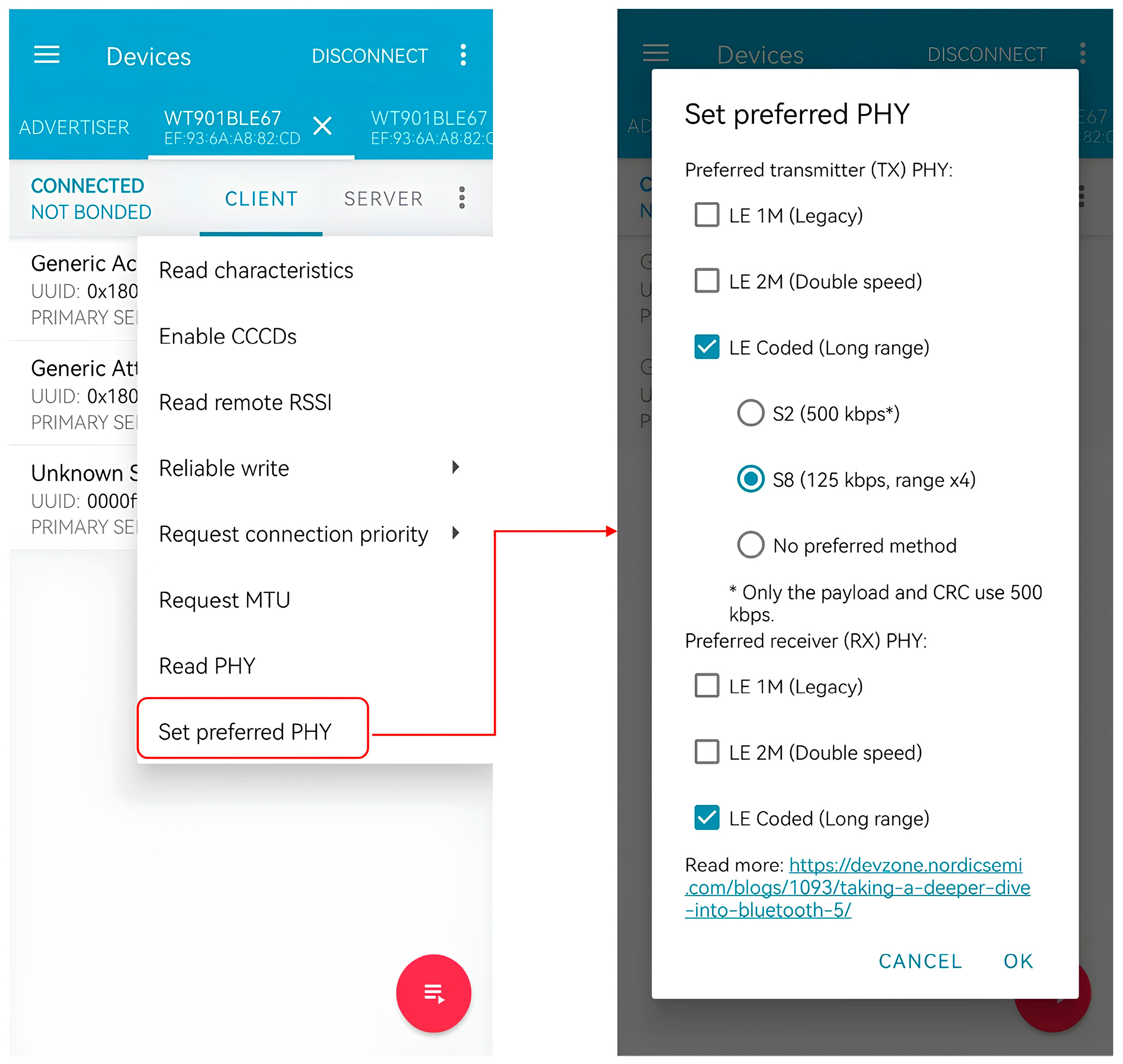
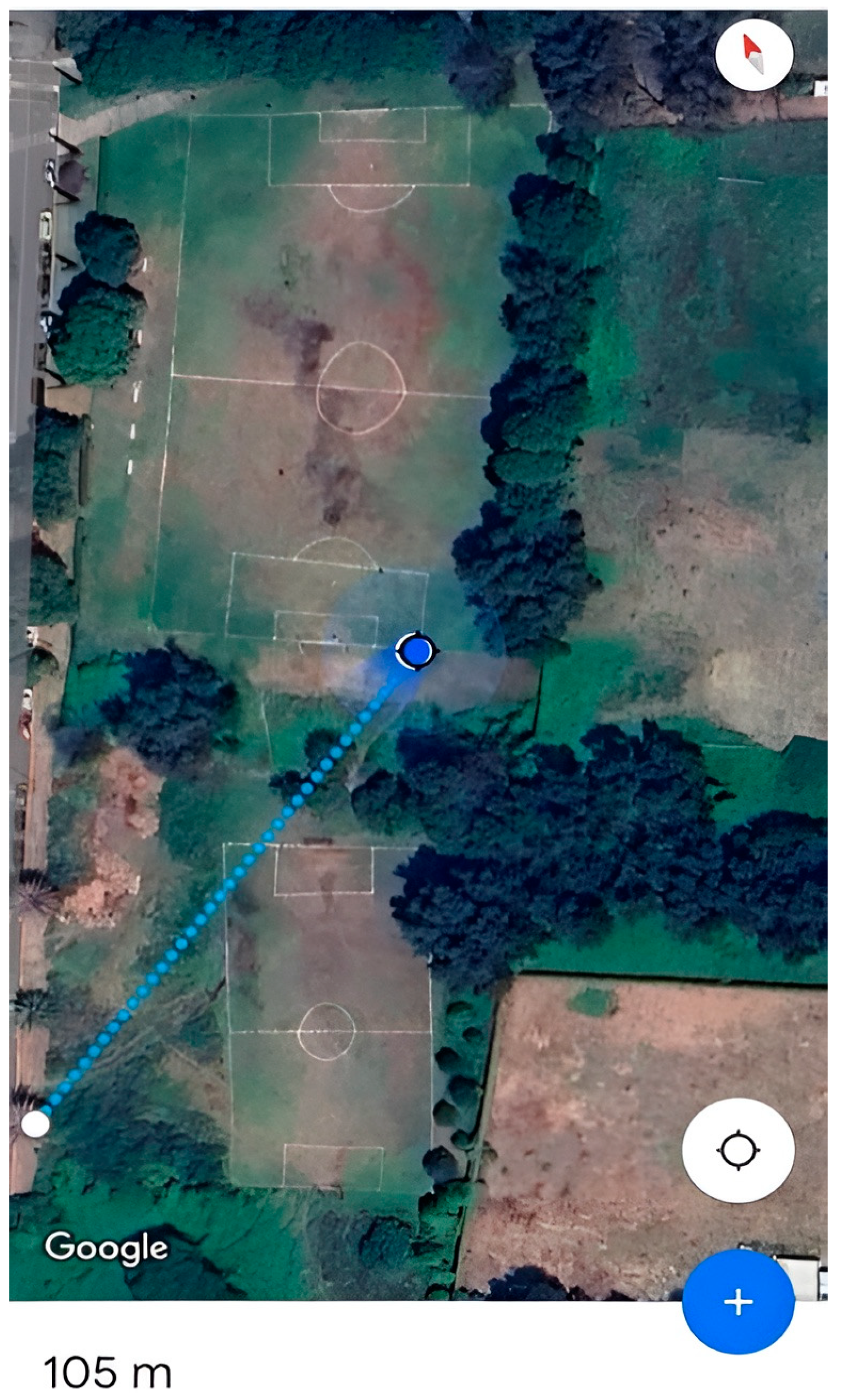
- BLE 5.0 communication with a net throughput of 1.4 Mbps and a range of 105 m.
- Fuzzy inference models using the RULA method, converting biomechanical data into a risk of injury score.
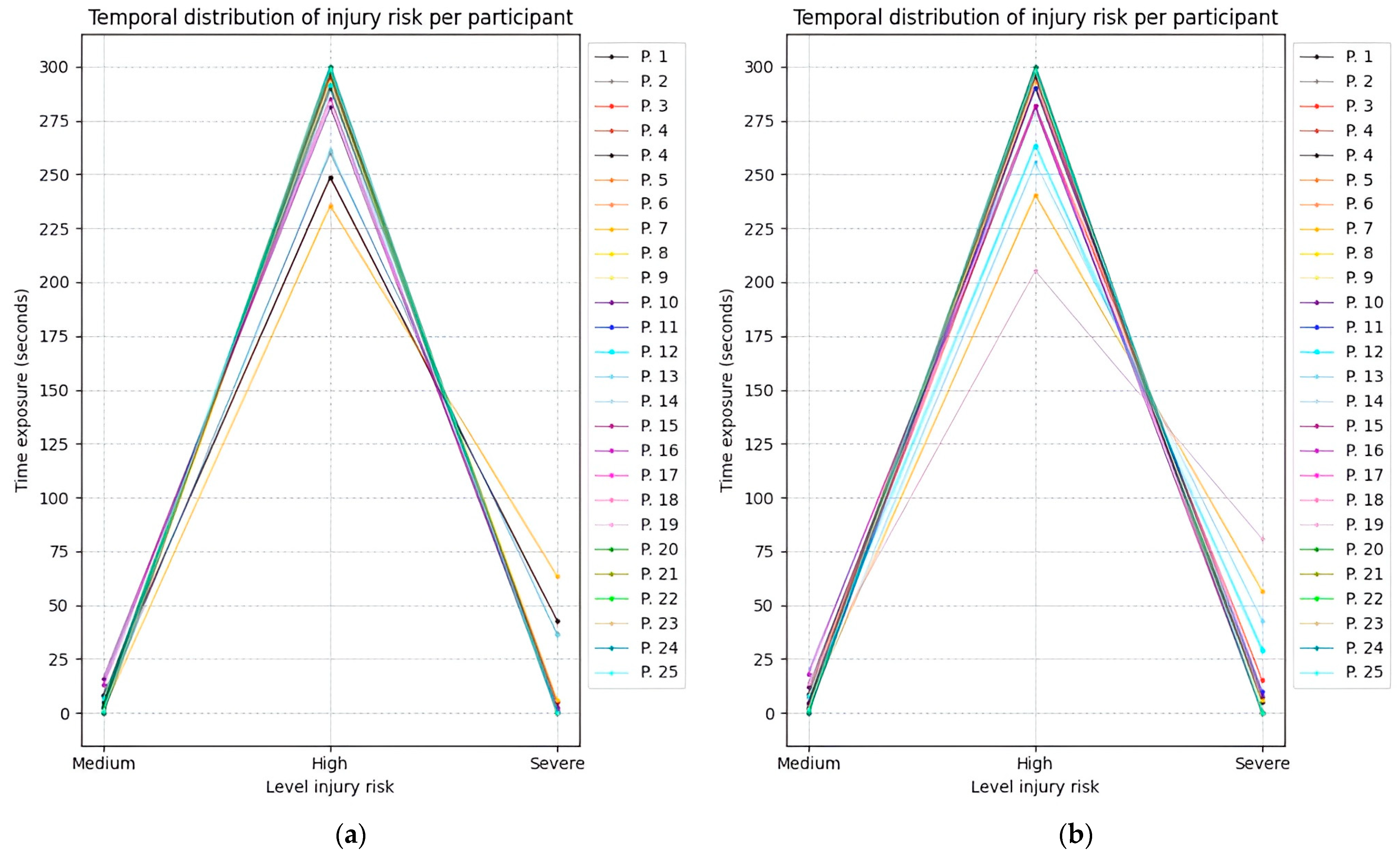
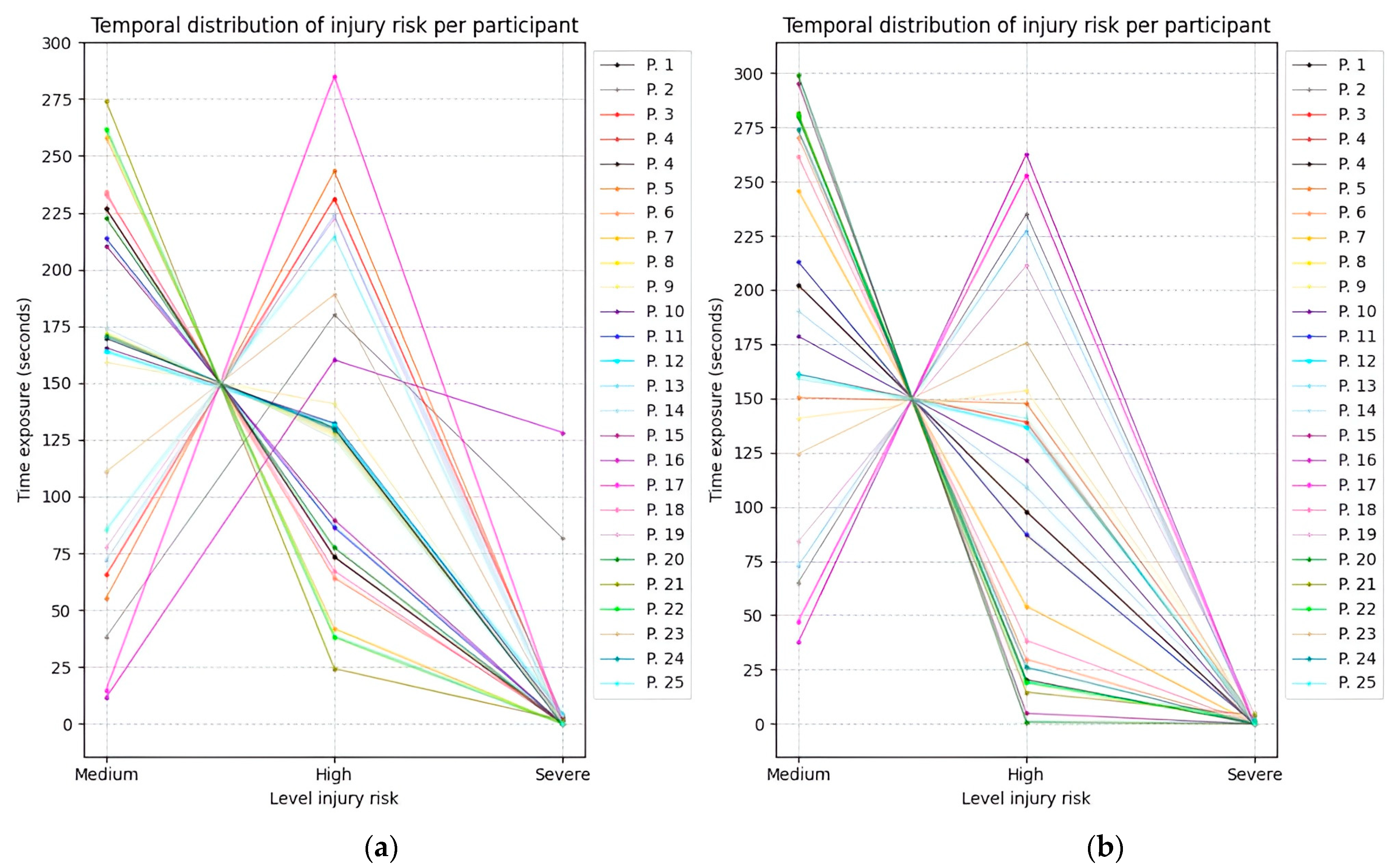
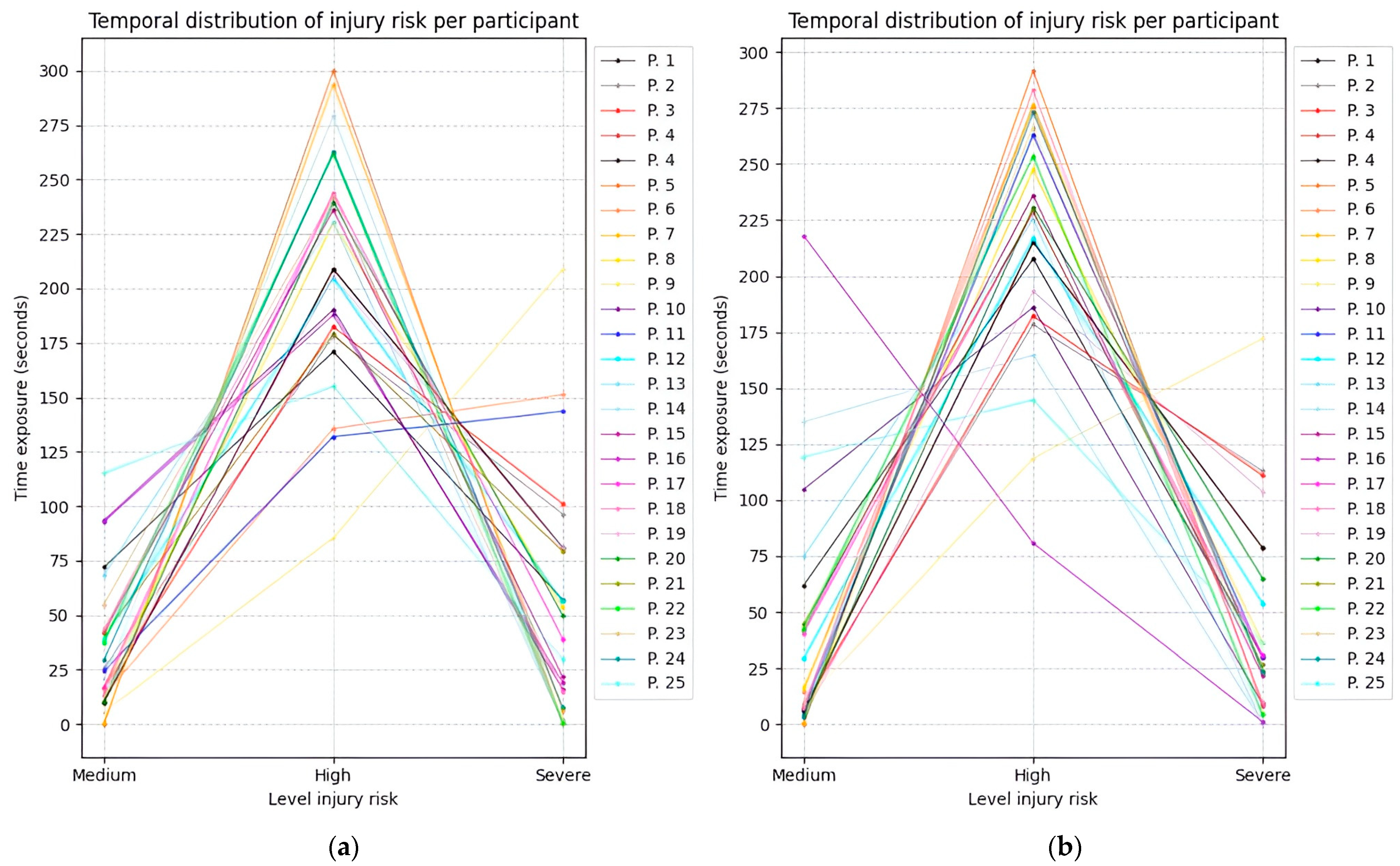
- Models that quantify the temporal distribution of injury risk.
- The validated BLE 5.0 asynchronous network provides the robustness and scalability needed to replace restrictive, high-cost systems, enabling reliable data acquisition for complex motion analysis.
- The fuzzy RULA model addresses subjectivity and discretization issues in the traditional approach, offering an objective, higher-resolution metric suitable for real-time monitoring and informed decision-making.
- Quantifying exposure time provides a key metric for occupational health, enabling the deployment of personalized interventions and data-driven preventive strategies.
Abstract
1. Introduction
- A fully implemented wireless multi-IMU architecture based on asynchronous BLE 5.0 acquisition—addressing a widely acknowledged gap in multi-sensor scalability and synchronization for upper-limb biomechanics.
- A reproducible communication framework, developed in Python (using the Bleak and asyncio libraries) and seamlessly integrated with a user-friendly LabVIEW interface to facilitate real-time visualization, analysis, and system deployment by clinicians and researchers.
- Experimental evaluation of critical performance metrics, including transmission throughput and signal integrity—providing objective benchmarks that are seldom reported in existing commercial or research-grade systems.
- A validated case study demonstrating clinical applicability, where real IMU data were used to develop a fuzzy inference system grounded in the Rapid Upper Limb Assessment (RULA). The resulting model offers interpretable, explainable outputs suitable for physiotherapists and ergonomic risk analysts, enhancing trust and facilitating future adoption.
2. Materials and Methods
2.1. Technical Devices
2.2. Sensor Characteristics and Attributes
2.3. Software Architecture and Communication Framework
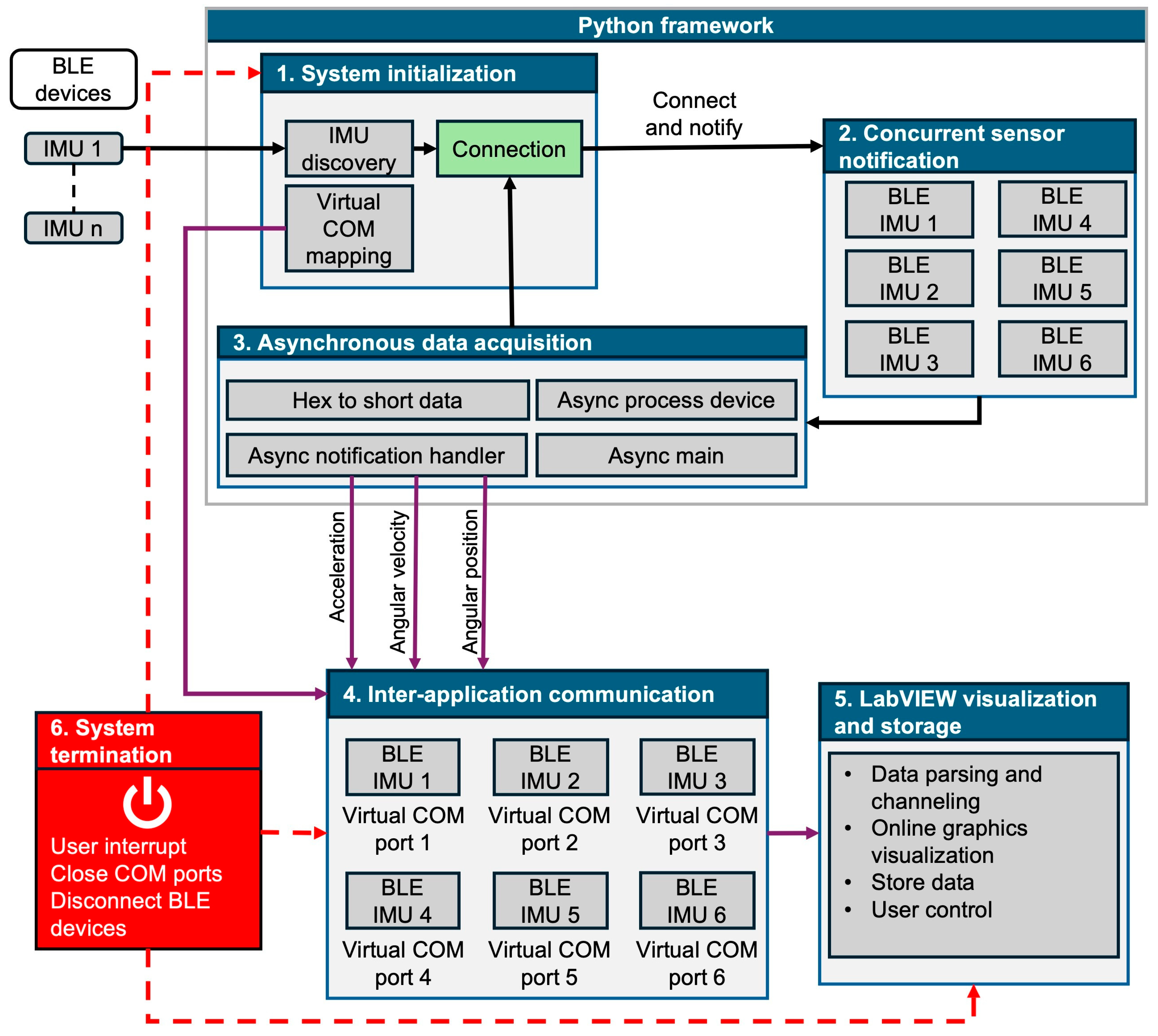
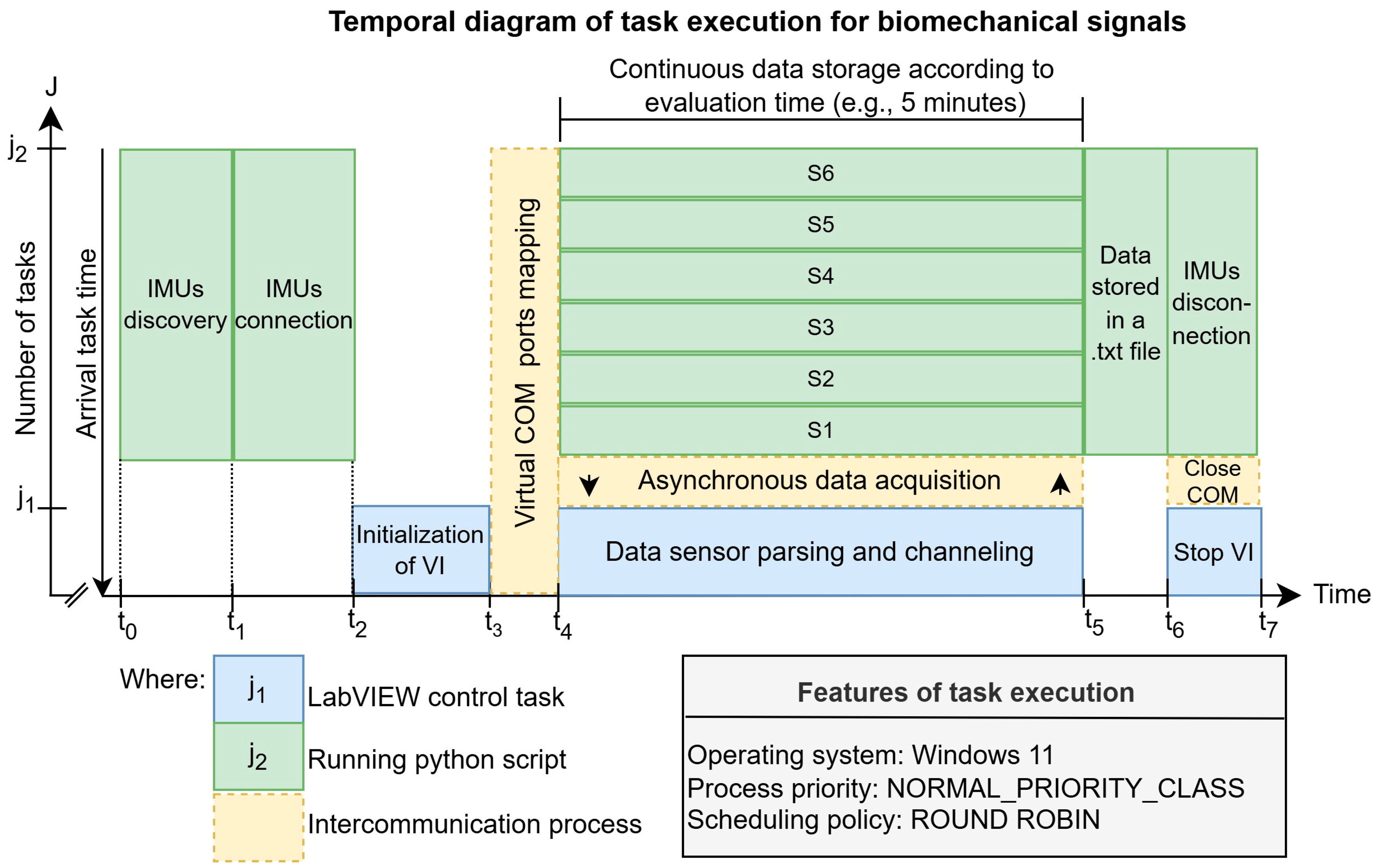
- Initialization
- Subscription to GATT notifications
- Asynchronous processing of received packets
- Transmission of data via emulated virtual ports to an interface
- Signal monitoring and data storage for post-processing
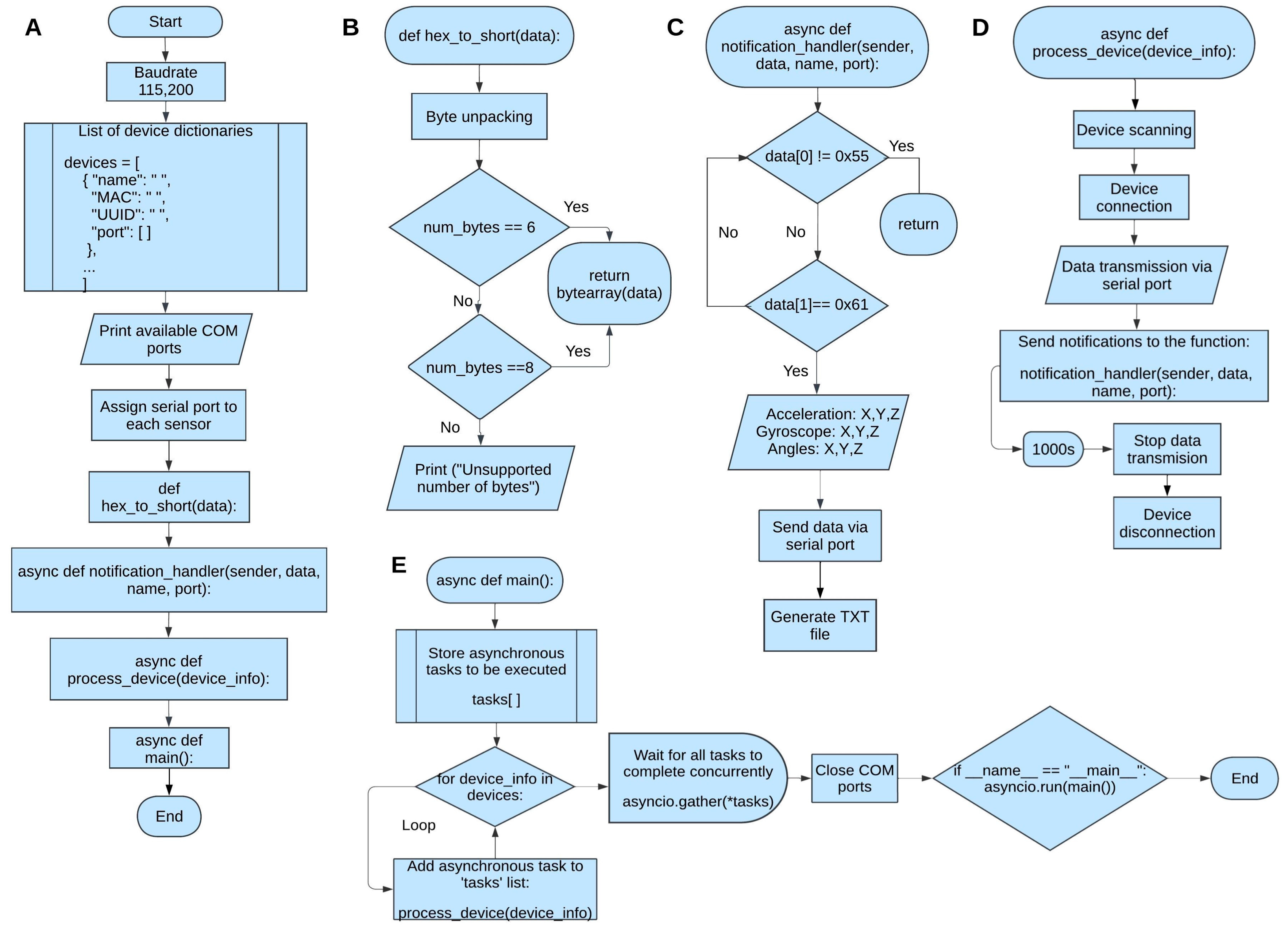
- Main Execution: This part of the diagram involves importing the necessary libraries, configuring the data transmission rate, and creating a list of device dictionaries for connection. The Communication (COM) ports are initialized and assigned to distinct sensors, ensuring proper execution of subsequent functions.
- Data Unpacking Function: This function is the first to run in the script. It unpacks the data received from the sensors, which arrive as a hexadecimal array. Depending on whether the sensor is transmitting only the variable values—acceleration, angular velocity, and angular position—six or eight bytes may be received. When eight bytes are received, the extra two bytes correspond to quaternion data.
- Asynchronous Notification Handler: This asynchronous function manages sensor notifications concurrently, handling multiple variables from multiple sensors simultaneously. Its input arguments are “sender,” containing the sensor’s MAC address; “data,” containing the unpacked hexadecimal sensor data; “sensor_name,” the name of the sensor; and “port_name,” the number of the port associated with the sensor. Once the data are acquired, the function separates the bytes according to the variables they correspond to, performs the necessary conversions, and obtains the hexadecimal values of the three main variables (acceleration, angular velocity, and angular position). The results are presented in a tabular format on the terminal, concurrently transmitted through the serial port, and also archived in a text file.
- Sensor Connection Function: Like the function described in C, this function must also be handled asynchronously. It receives the argument “device_info,” which contains all the information stored in the sensor list and dictionary. The main objective of this function is to locate the previously mapped sensor(s). Once found, the sensors are defined as clients and connected via an exception handler. Using an anonymous or lambda function, all data extracted from the sensor are sent to the “notification_handler” function until execution is interrupted or the sensor(s) are disconnected.
- Main Function: The “main” function is also executed asynchronously, as it stores in “device_info” the information from each sensor’s “devices” list and sends it concurrently to the “process_device” function. It runs the asyncio event loop until all tasks (*tasks) are completed and closes all ports once execution is finished.
- Asynchronous Acquisition: Reception of data packets from the IMUs.
- Processing and Routing: Parsing and formatting of the data to ensure a uniform data structure prior to storage.
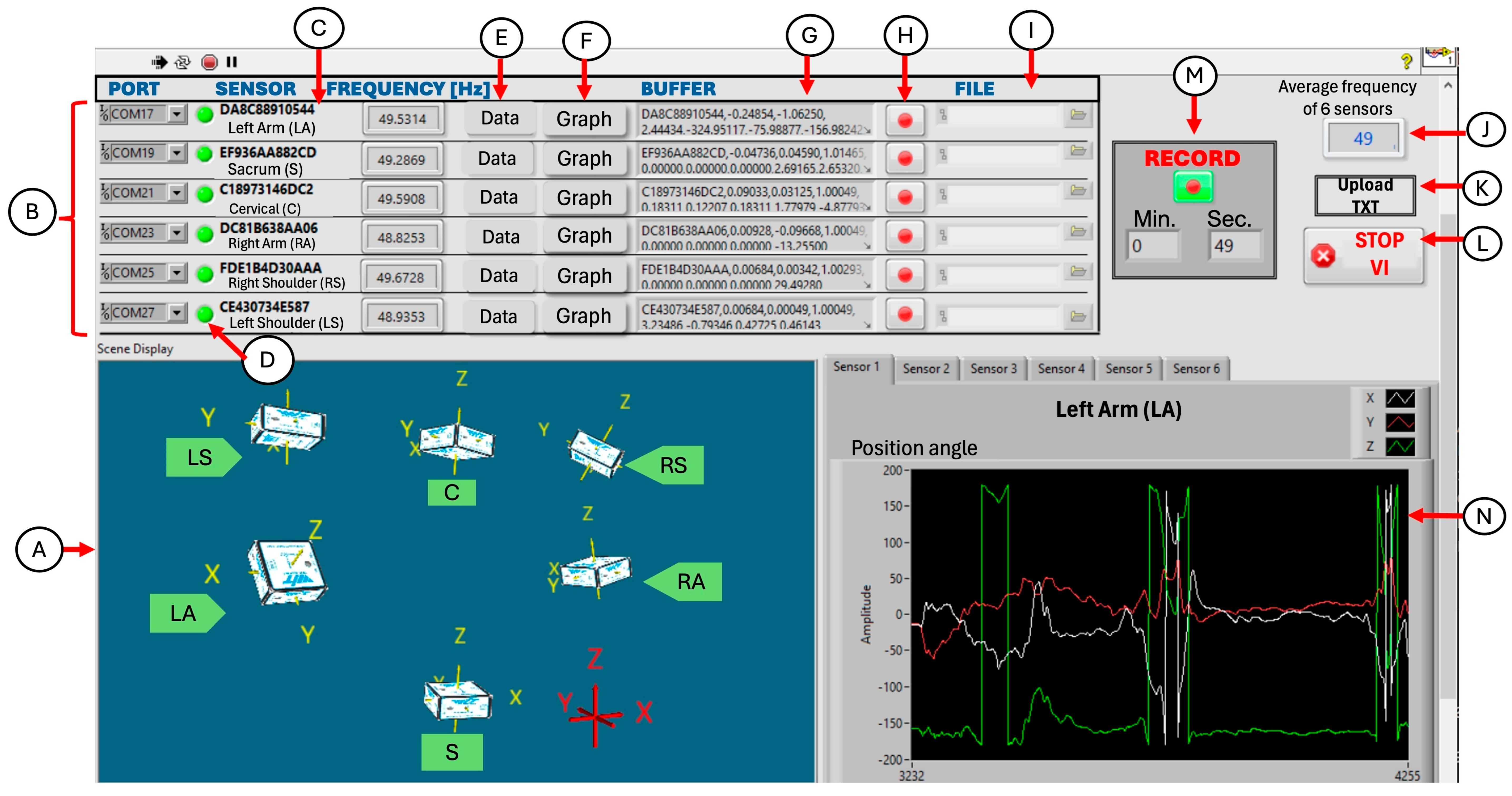
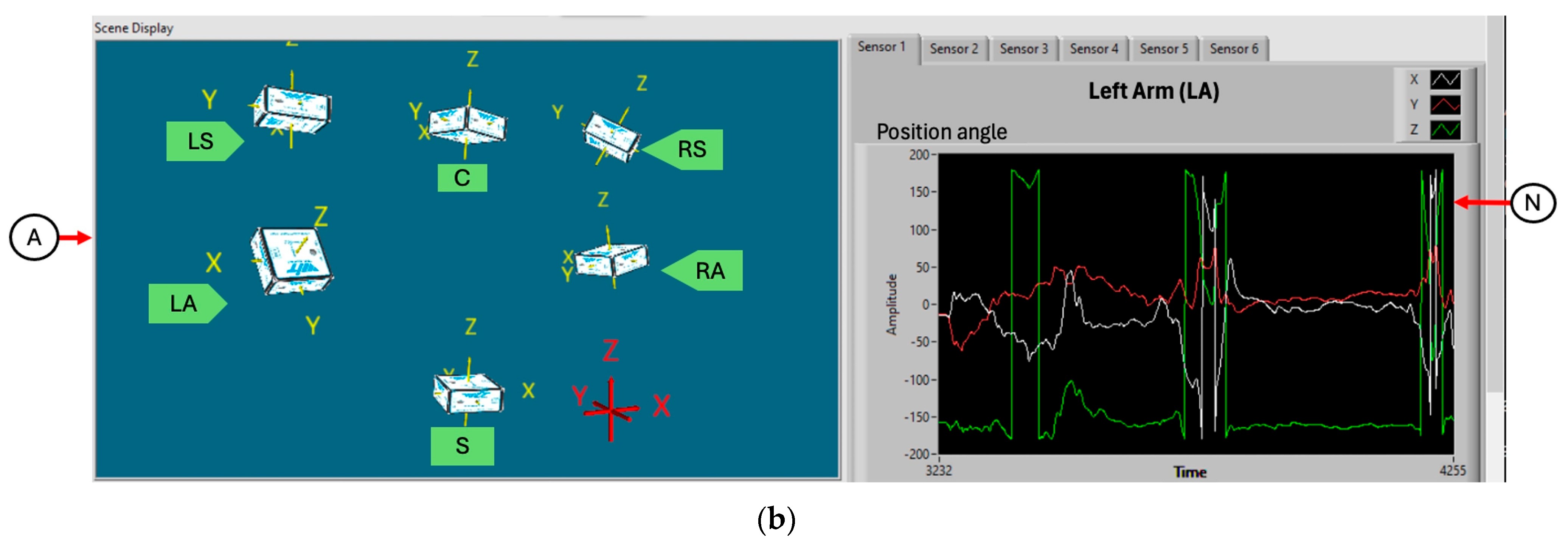
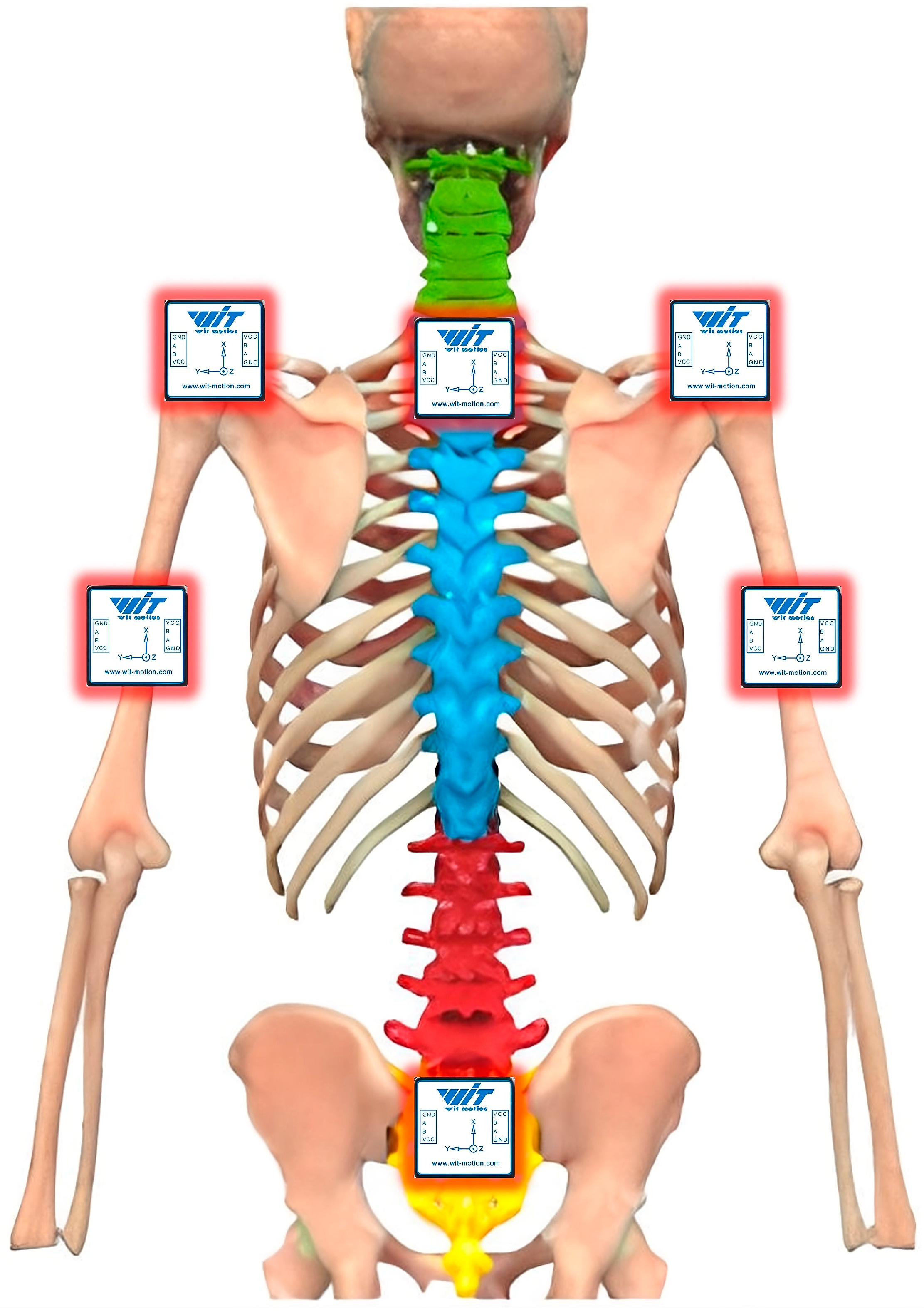
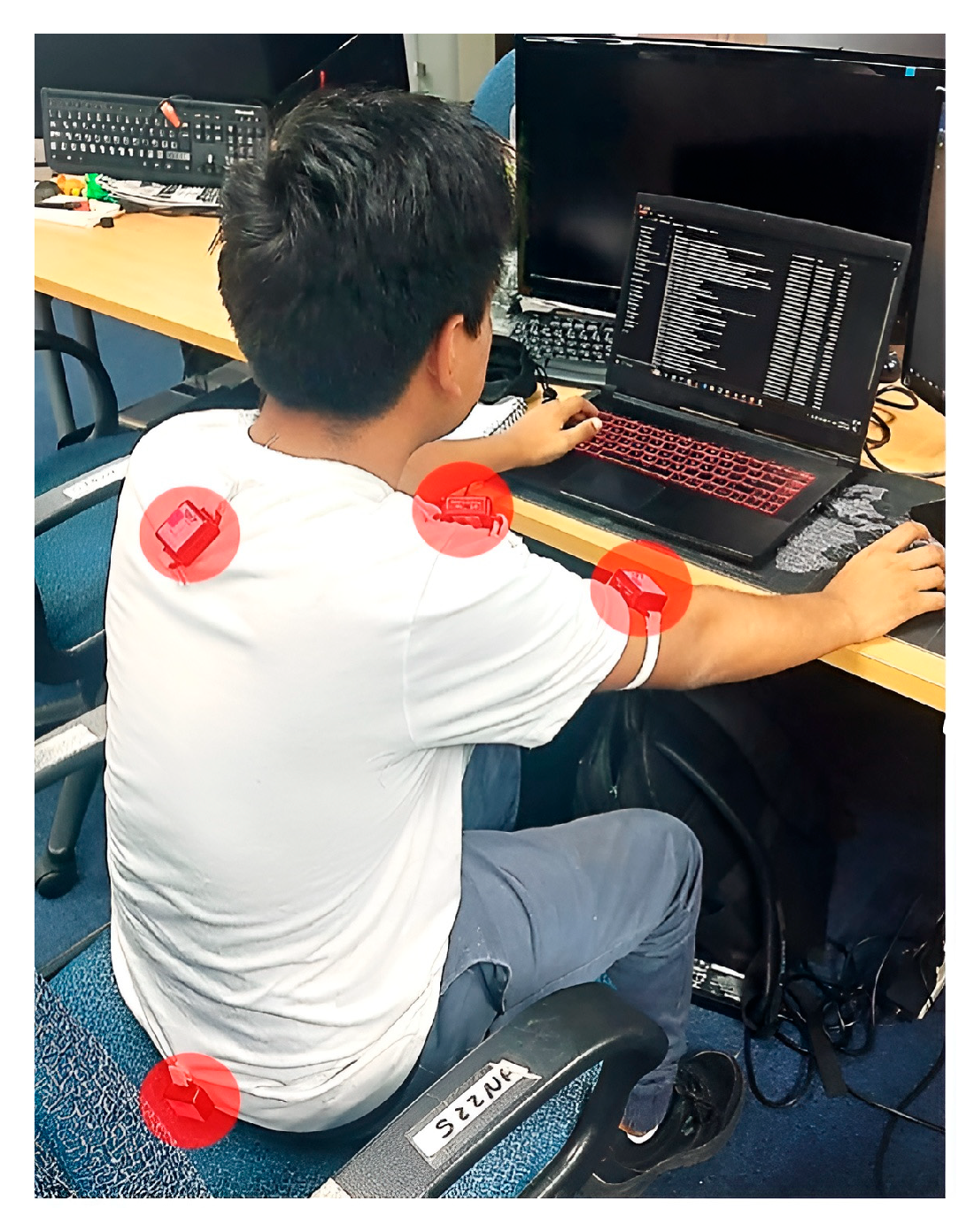
- 3D Visualization of the IMUs: The labels indicate the placement of each sensor on the upper limb as follows: LA—Left Arm, LS—Left Shoulder, C—Cervical Vertebra, S—Sacrum, RS—Right Shoulder, RA—Right Arm.
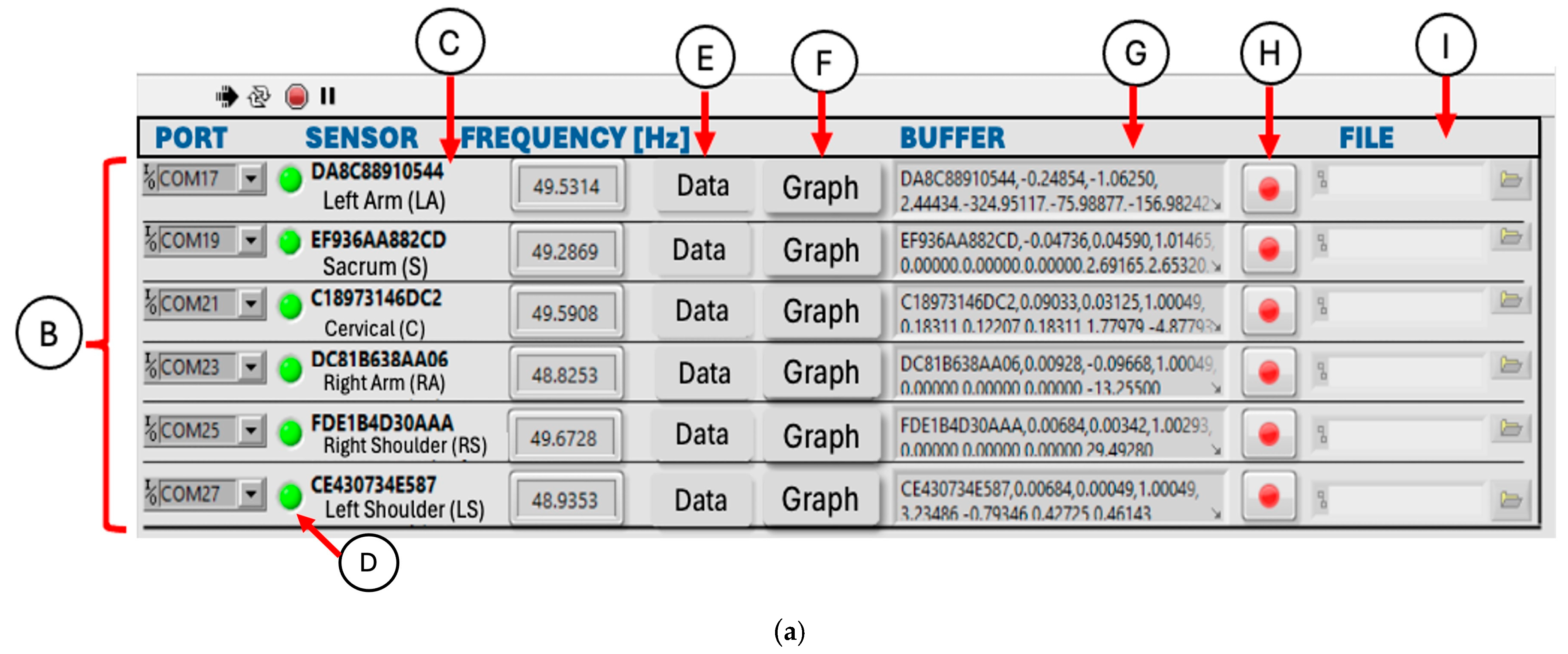
- COM Port: The COM port used by the Python script to receive data from each sensor.
- Sensor Name and Assigned Upper Limb Location
- Connection Status Indicator: Indicates whether the sensor is currently connected.
- Data Button: Opens a window that displays sensor data in tables.
- Graphics Button: Launches a window for online visualization of the acquired signal plots.
- Data Buffer: Shows the incoming data stream from each sensor, enabling monitoring of the received byte packets.
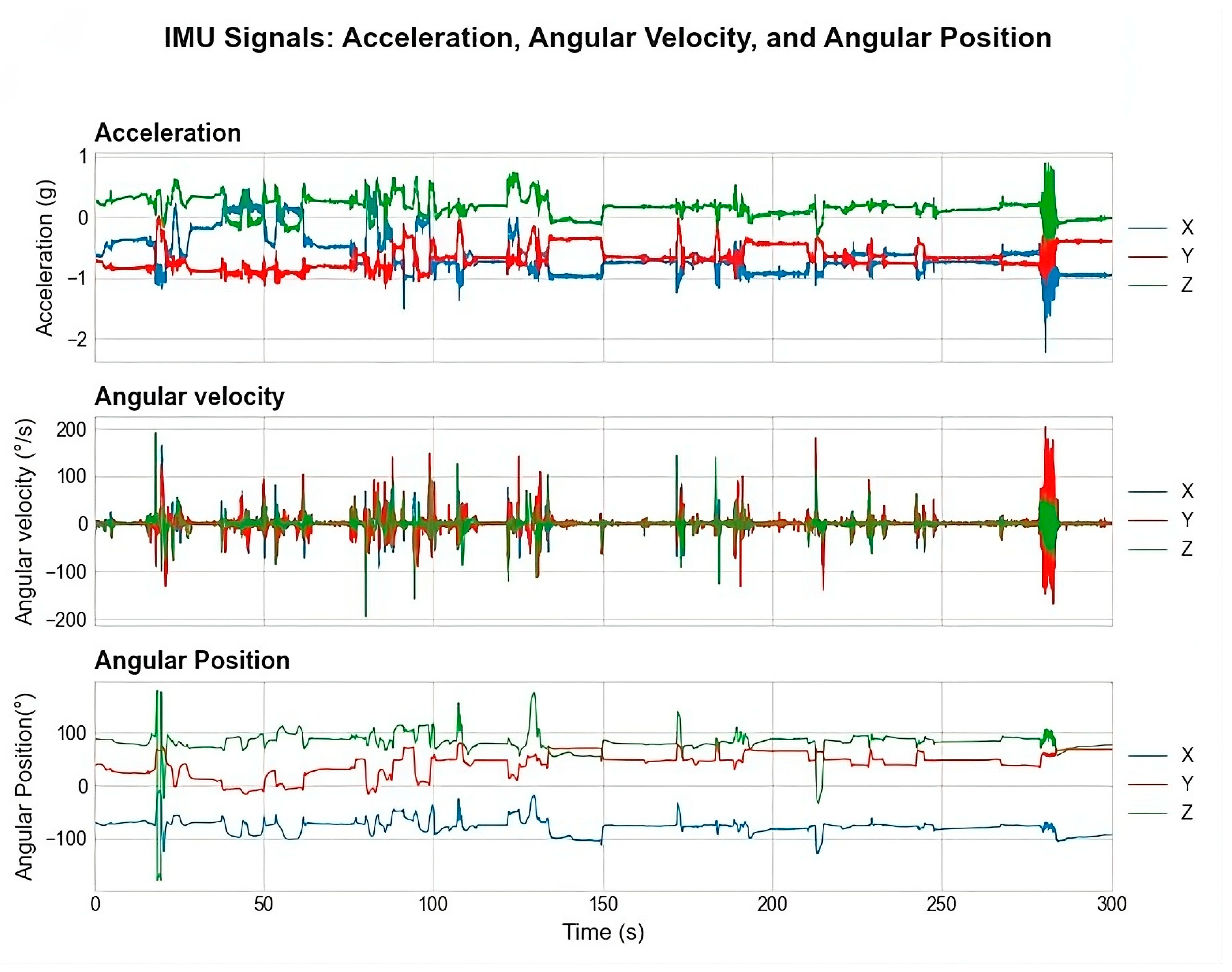
- Data Storage Button: Initiates independent storage of signal data from each sensor in a text file. The file captures the three variables from each IMU, along with their respective components (X, Y, Z), as depicted in Figure 7, and serves as the dataset used for subsequent post-processing.
- File Path Selector: Enables the user to specify the destination .txt file for data storage.
- Average Sampling Frequency: The average sampling rate across all six sensors.
- Upload TXT: Allows loading a previously stored signal for graphical visualization.
- Stop VI: Stops the data acquisition process and intercommunication.
- Start All-Sensors Storage Button: Triggers simultaneous storage of data from all sensors and presents a timer indicating the duration of the ongoing acquisition.
- Online Sensor Plots: Displays real-time angular position signals from all six sensors.

2.4. Post-Processing and Case Study
- Before sensor placement, calibration was performed using the manufacturer’s software, allowing sampling frequencies to be set from 0.1 Hz to 200 Hz.
- Sensors were placed at their corresponding locations using a shirt, which includes adaptations for securing the IMUs.
- Each IMU was mapped to its designated emulated virtual port.
- The LabVIEW interface was launched, enabling data from each sensor to be received via the Python script.
- The connectivity and data transmission of each sensor were confirmed, and it was verified that the sensors operated at the designated sampling frequency.
- Sensor signals were saved in text files, capturing acceleration (X, Y, Z), angular velocity (X, Y, Z), and positional angle (X, Y, Z) data.
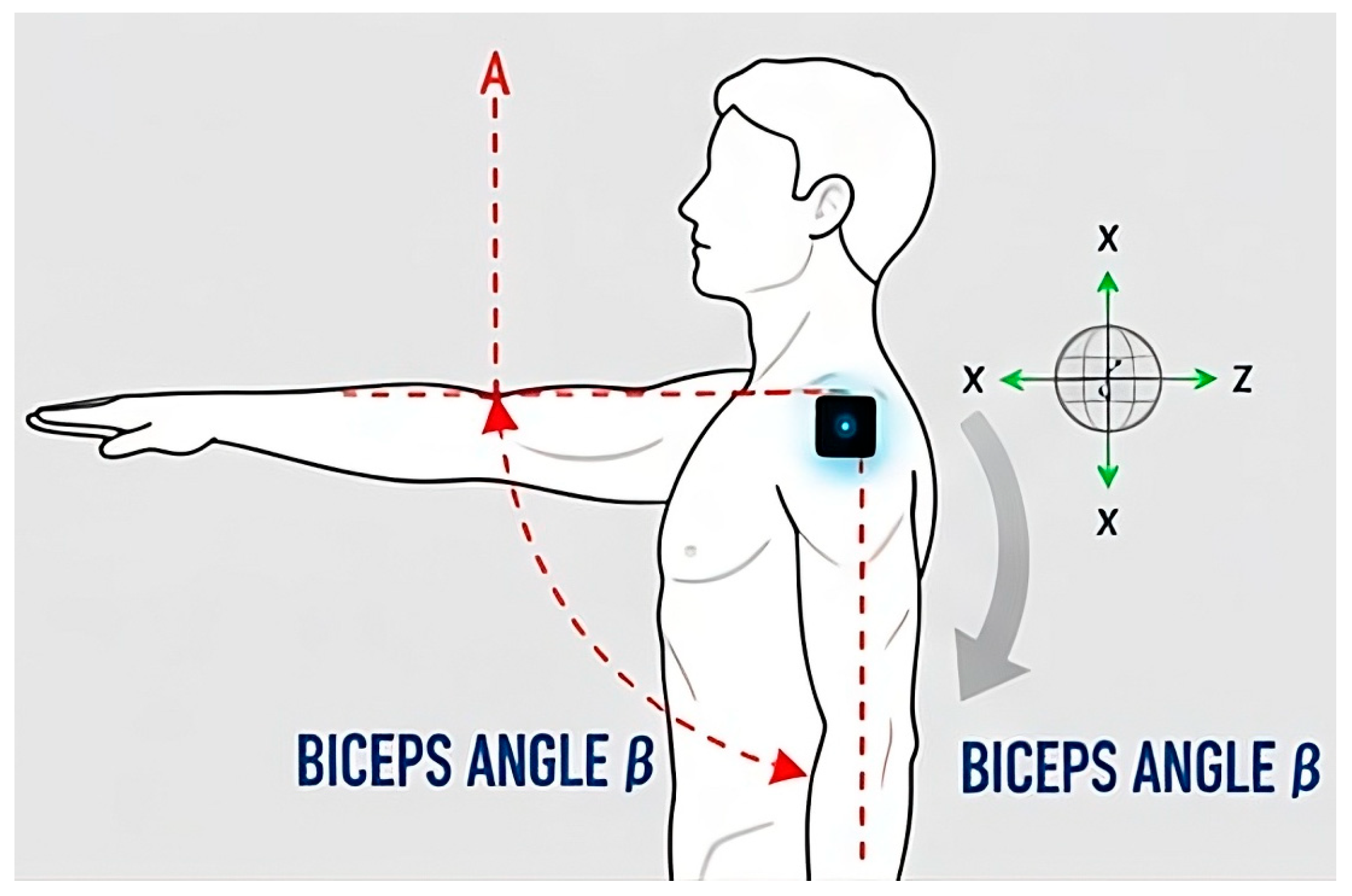
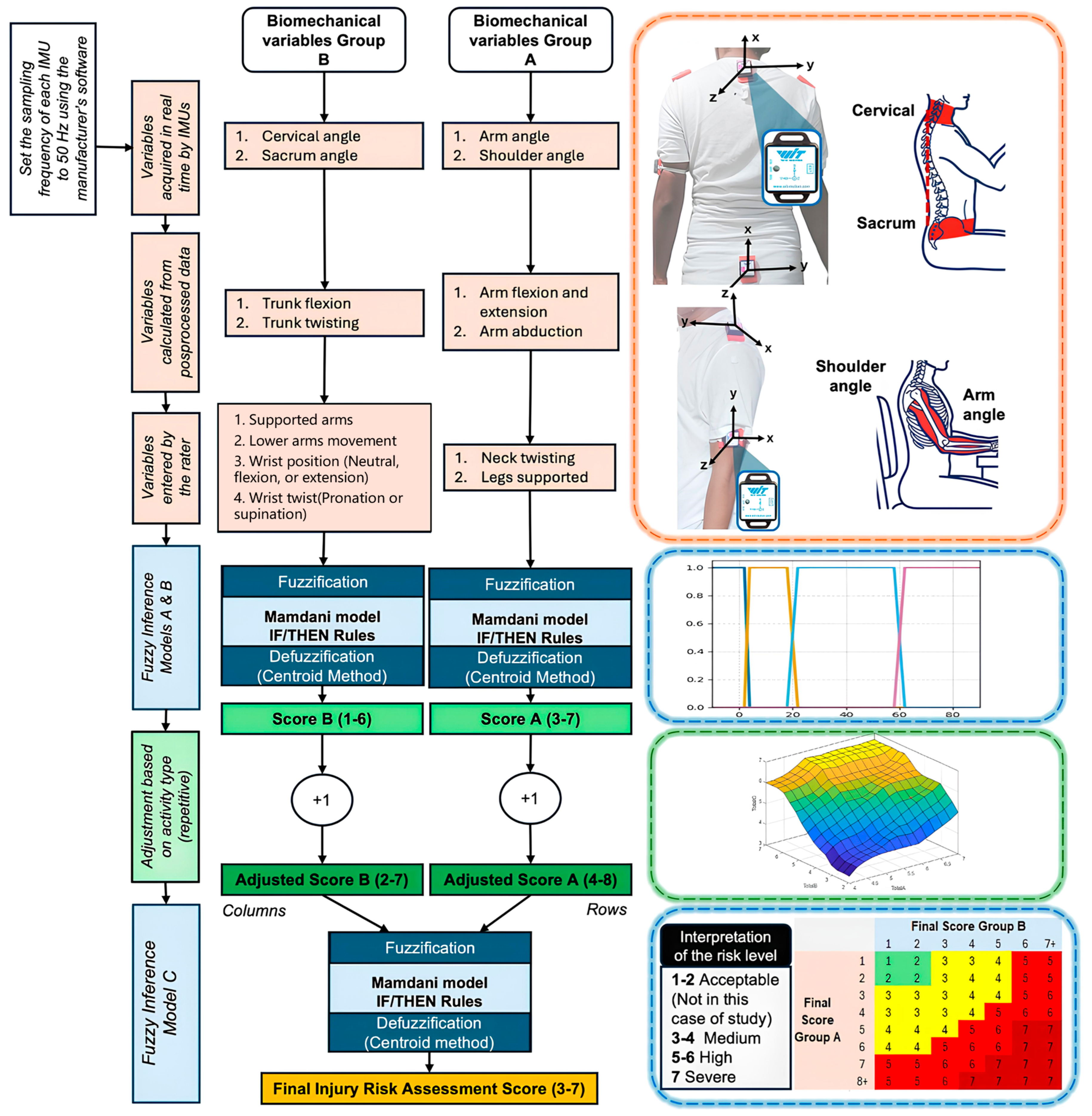
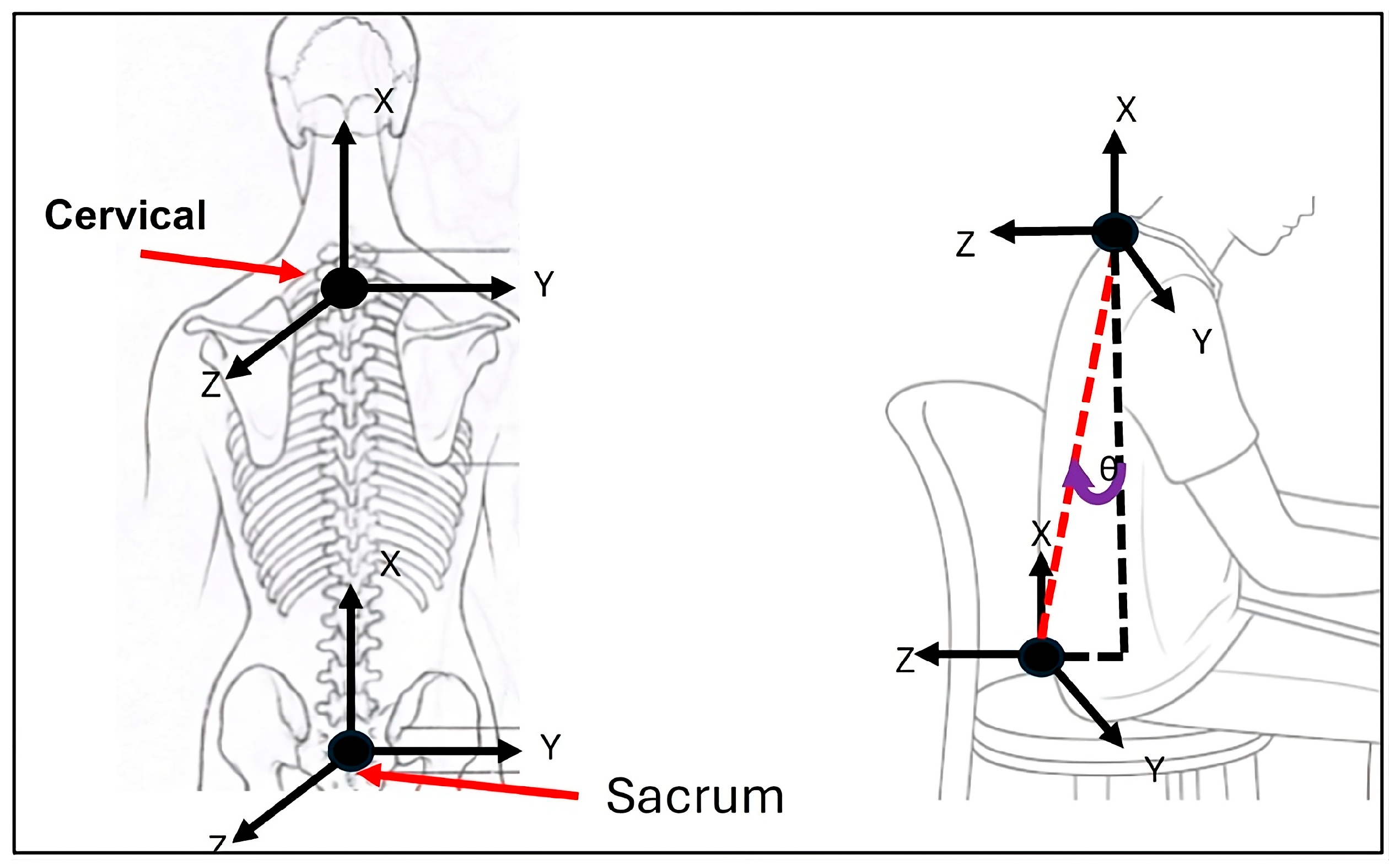
- During post-processing, datasets were aligned to ensure uniform length (15,000 data points), followed by component analysis to compute the movement angles of the upper-limb segments—arm flexion, extension, and abduction—along with trunk tilt and rotation.
- The acquired data were assessed using a Fuzzy Inference System implemented in Simulink.
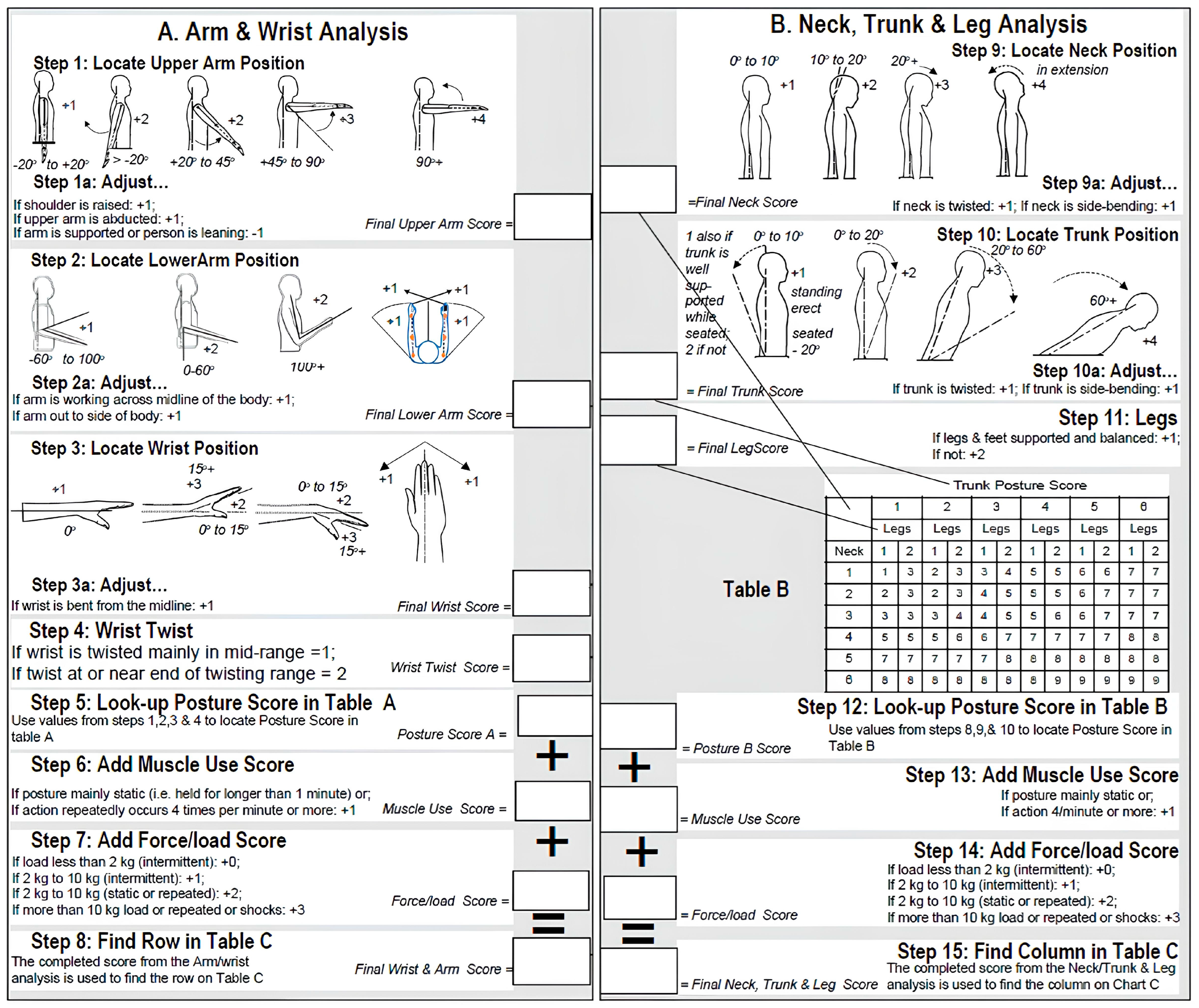
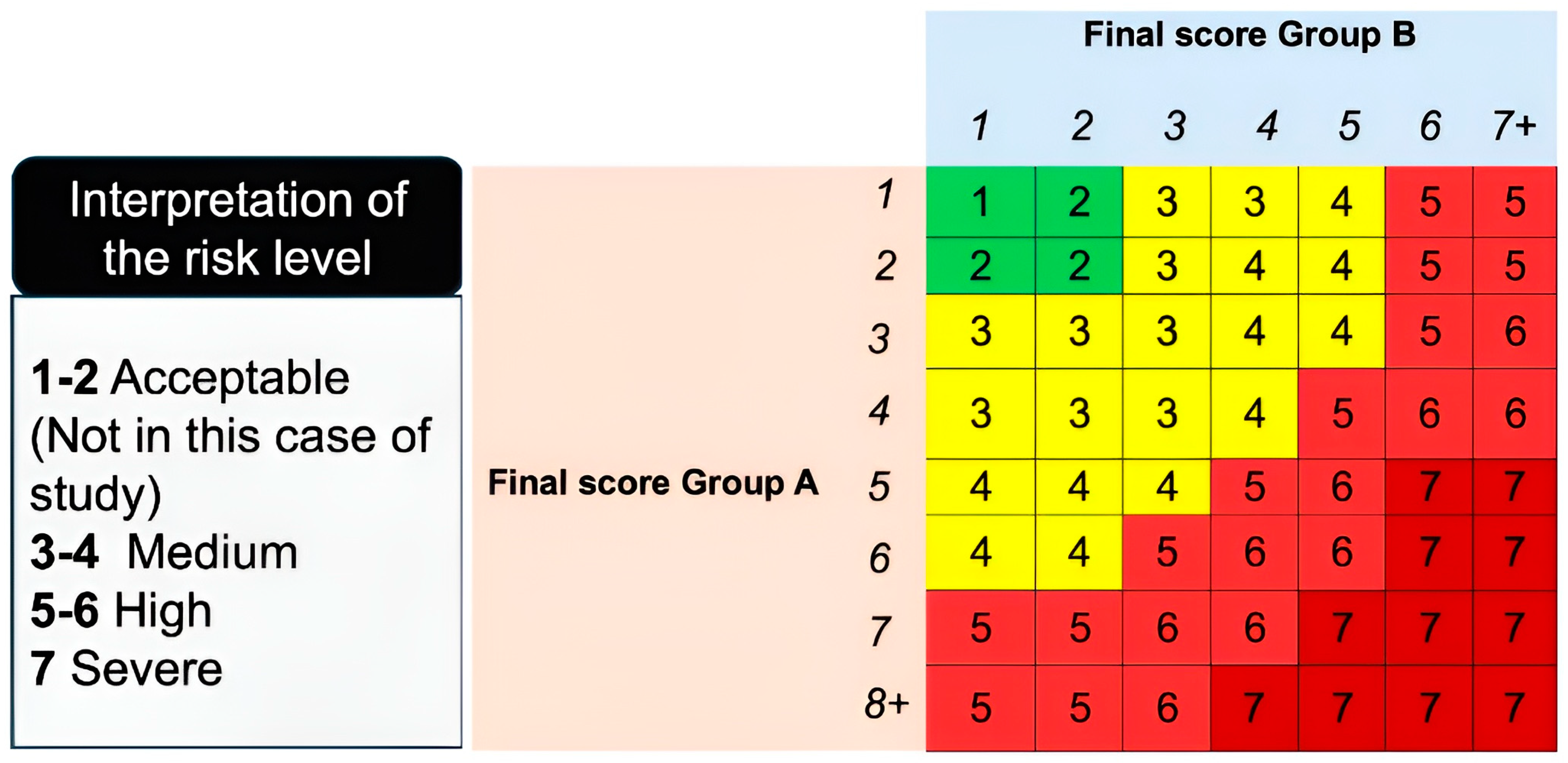
- Injury risk levels were evaluated using the RULA method.
- The evaluator provided recommendations based on expert knowledge.
2.5. Biomechanical Component Analysis
2.6. Fuzzy Inference Models
3. Results
3.1. Technical Evaluation of the Network
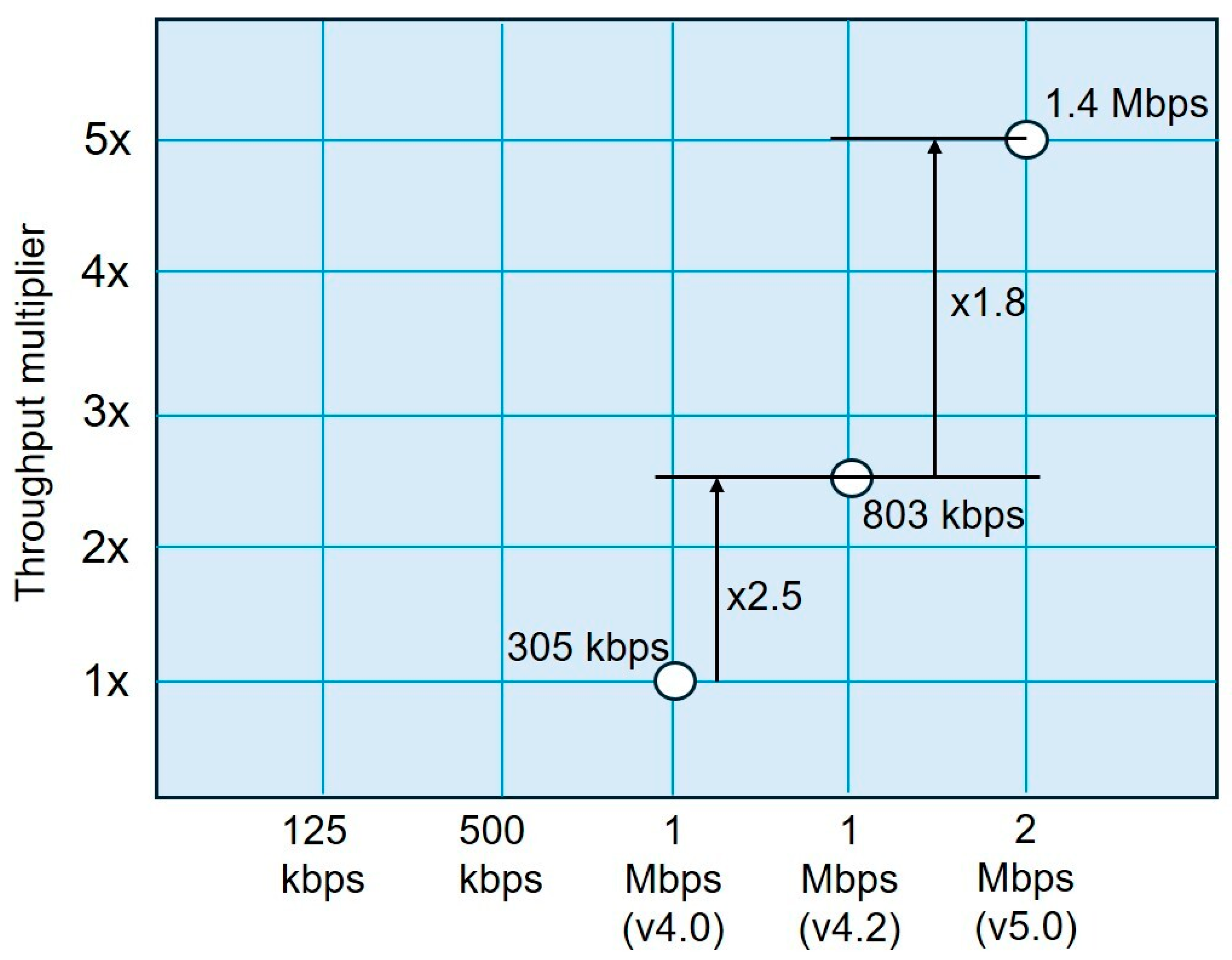
- Comparison between BLE 4.0 and BLE 5.0 specifications.
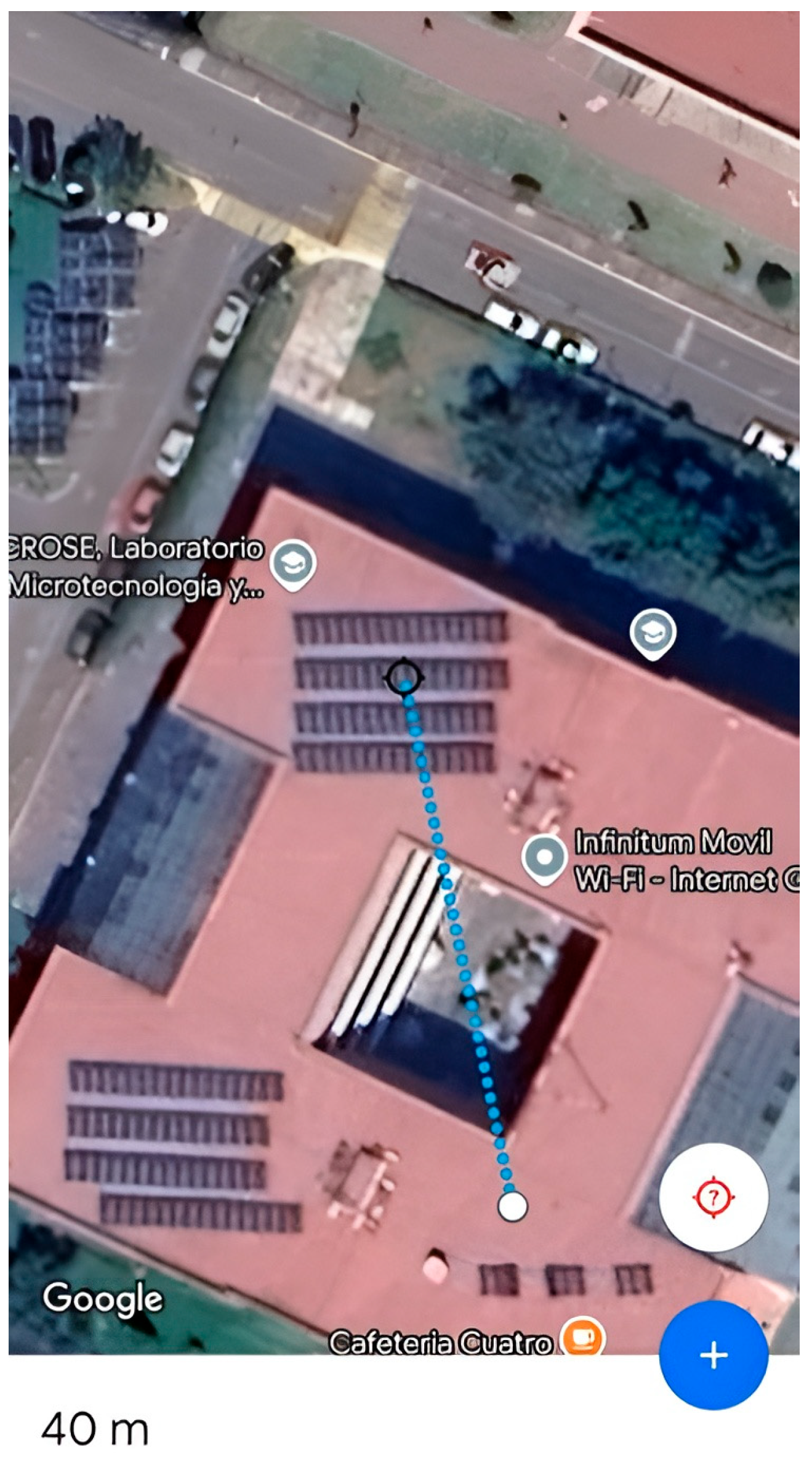
- Measurement of range in indoor and outdoor environments.
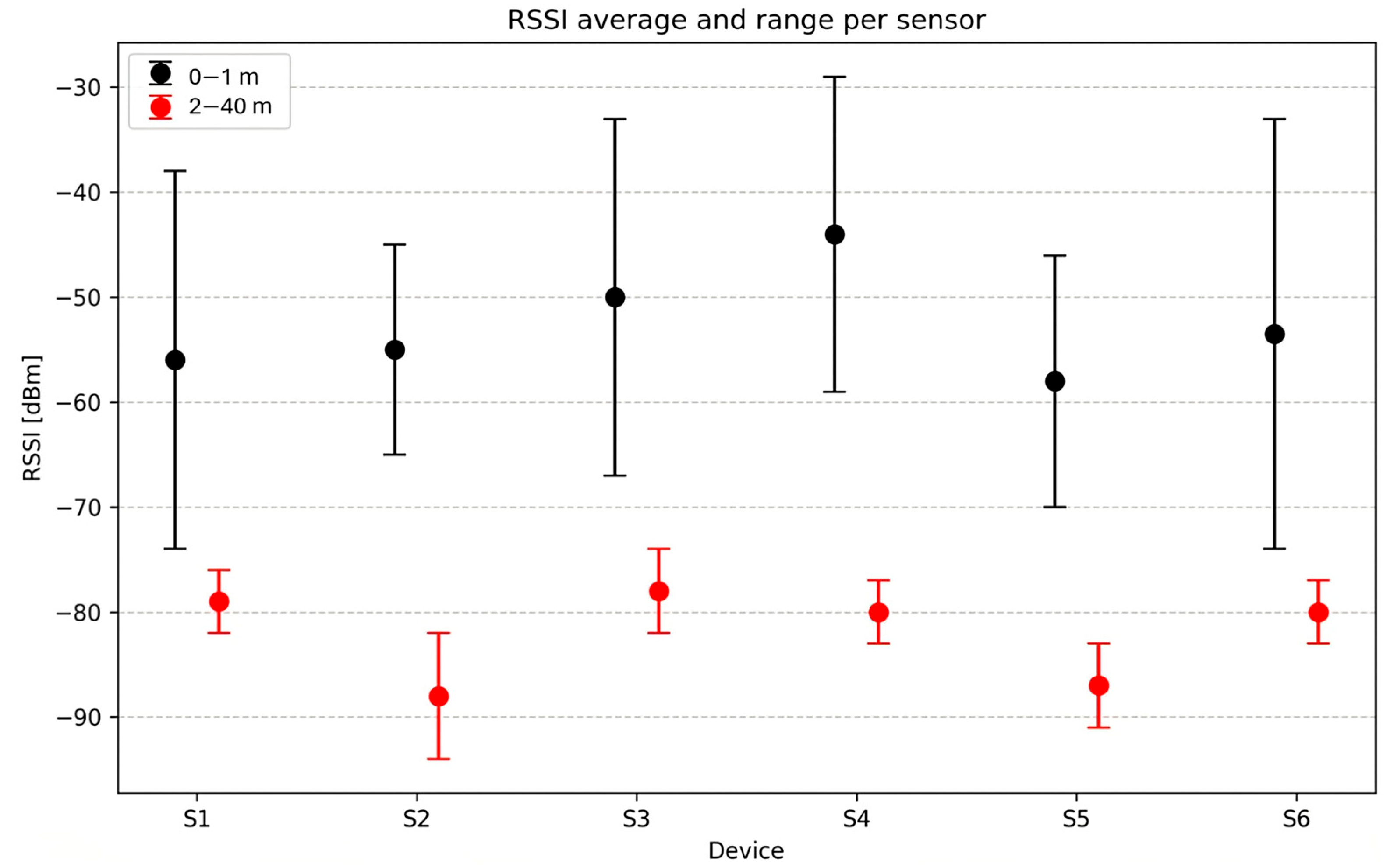
- Analysis of the Received Signal Strength Indicator (RSSI) at different distances.
- Estimation of transmission speed with varying numbers of sensors and sampling frequencies.
- Determination of the maximum number of sensors that can be connected simultaneously.
3.1.1. Range
3.1.2. Transmission Speed and Received Signal Strength
3.1.3. Comparative Statistical Evaluation of Sensor Performance
3.1.4. Data Loss and Sensor Network Efficiency
3.2. Biomechanical Evaluation of the Upper Limb in 25 Participants
3.2.1. Trial Conditions
3.2.2. Injury Risk Assessment Results for the 25 Participants by the FIS
3.2.3. Injury Risk Assessment Results of 25 Participants by Three Experts Against the FIS
4. Discussion
5. Conclusions
- A fully implemented wireless multi-IMU architecture leveraging asynchronous BLE 5.0 acquisition, addressing a critical technological gap in scalable upper-limb motion analysis.
- A Python-based communication framework (Bleak + asyncio) seamlessly integrated with LabVIEW for intuitive data handling and user interaction.
- Comprehensive experimental evaluation of key performance metrics—including transmission stability and signal integrity—providing objective evidence rarely reported in comparable multi-sensor studies.
- Demonstration of clinical applicability through a case study using a fuzzy inference system grounded in the Rapid Upper Limb Assessment (RULA), yielding interpretable and explainable outputs that support adoption by physiotherapists and ergonomic-risk evaluators.
Author Contributions
Funding
Institutional Review Board Statement
Informed Consent Statement
Data Availability Statement
Acknowledgments
Conflicts of Interest
Abbreviations
| BLE | Bluetooth Low Energy |
| IMU | Inertial Measurement Unit |
| RULA | Rapid Upper Limb Assessment |
| FIS | Fuzzy Inference System |
| IoT | Internet of Things |
| EMG | Electromyography |
| WHO | World Health Organization |
| GBD | Global Burden Disease |
| YLD | Years Live With Disability |
| AHRS | Attitude and Heading Reference System |
| MAC | Media Access Control |
| GATT | Generic Attribute Profile |
| UUID | Universal Unique Identifier |
| COM | Communication |
| RSSI | Received Signal Strength Indicator |
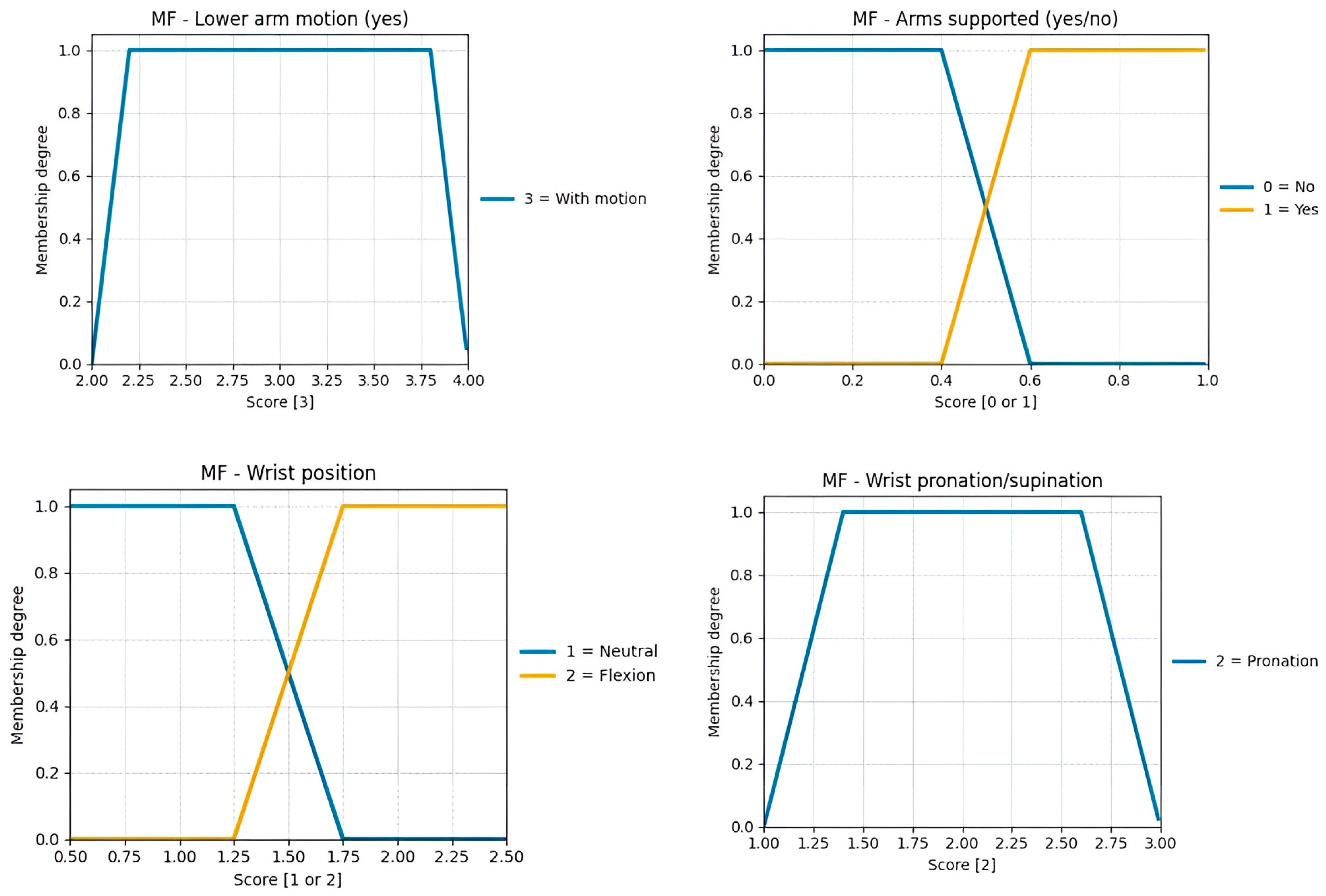
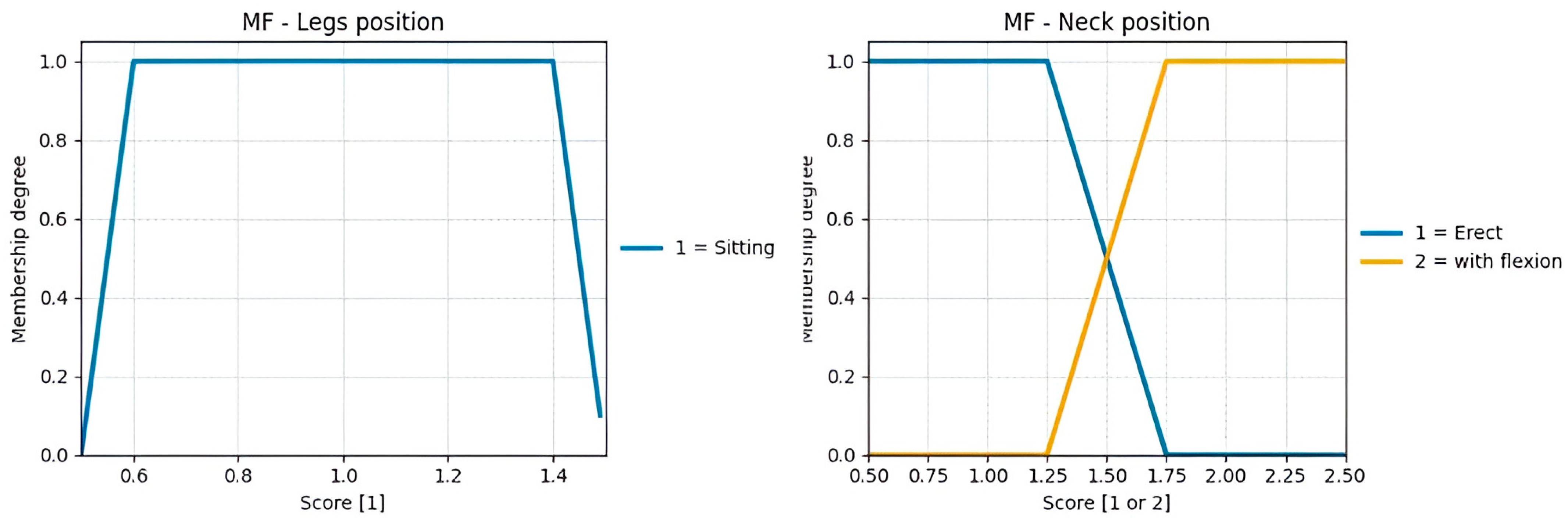
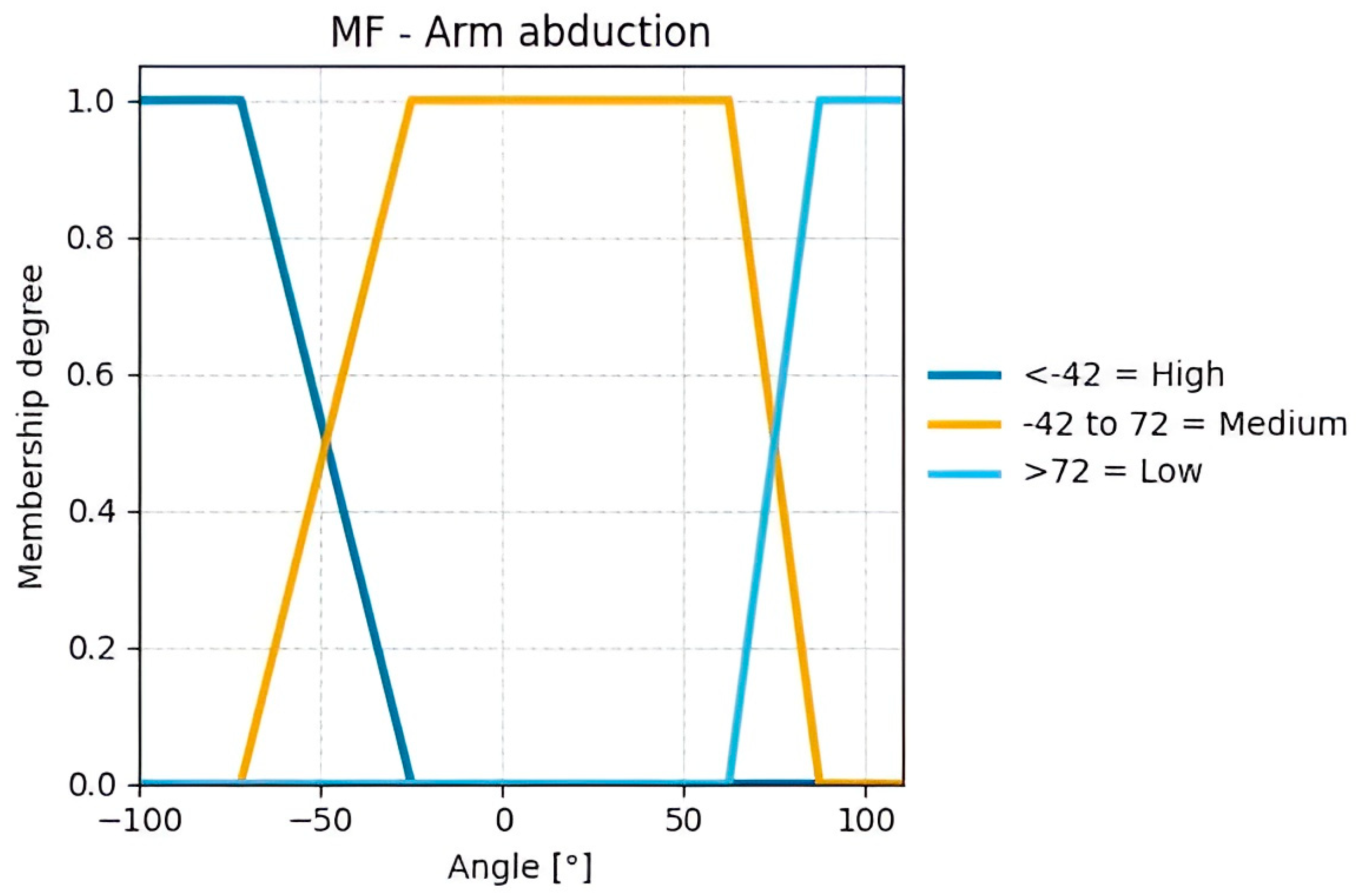
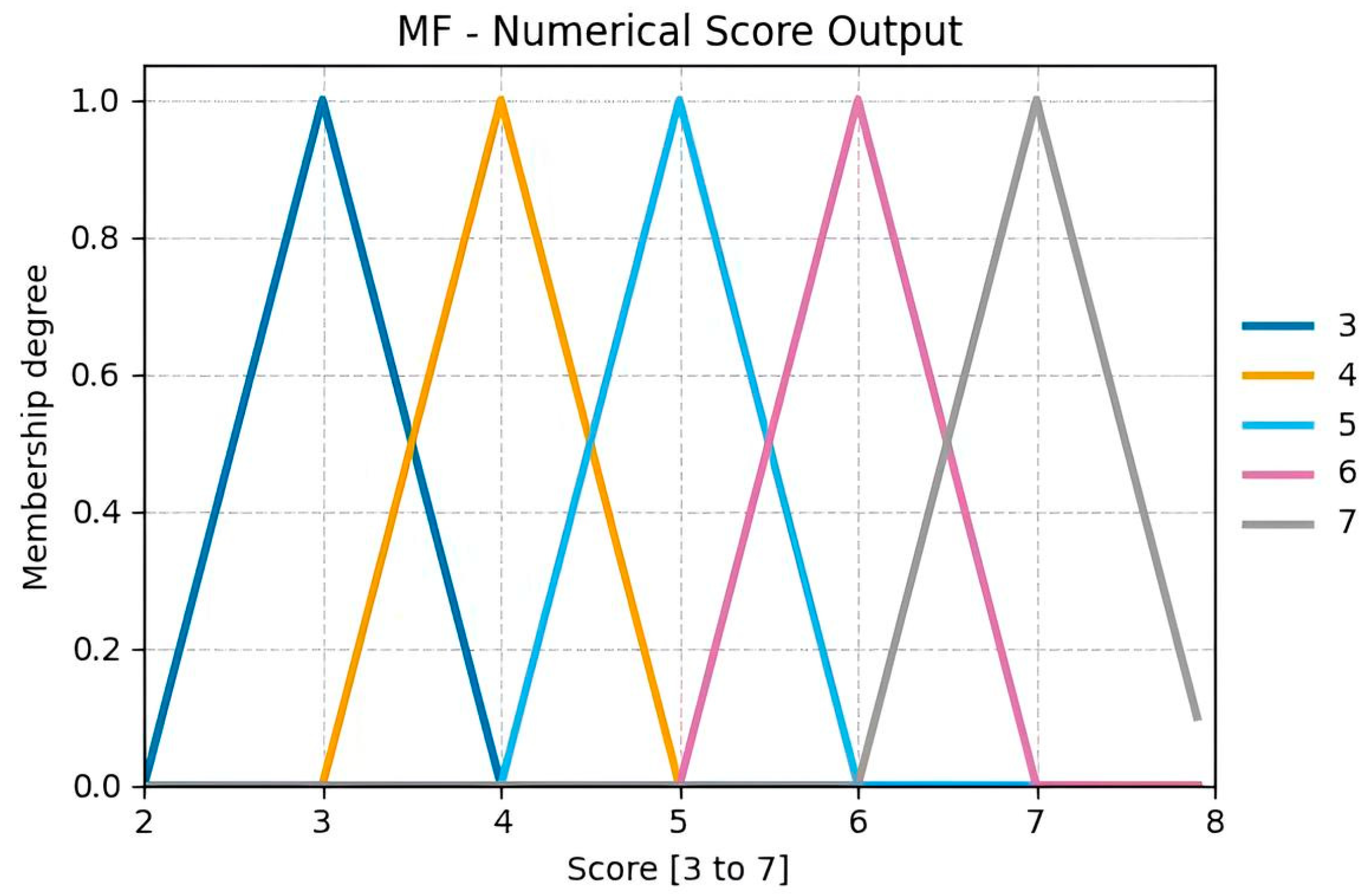
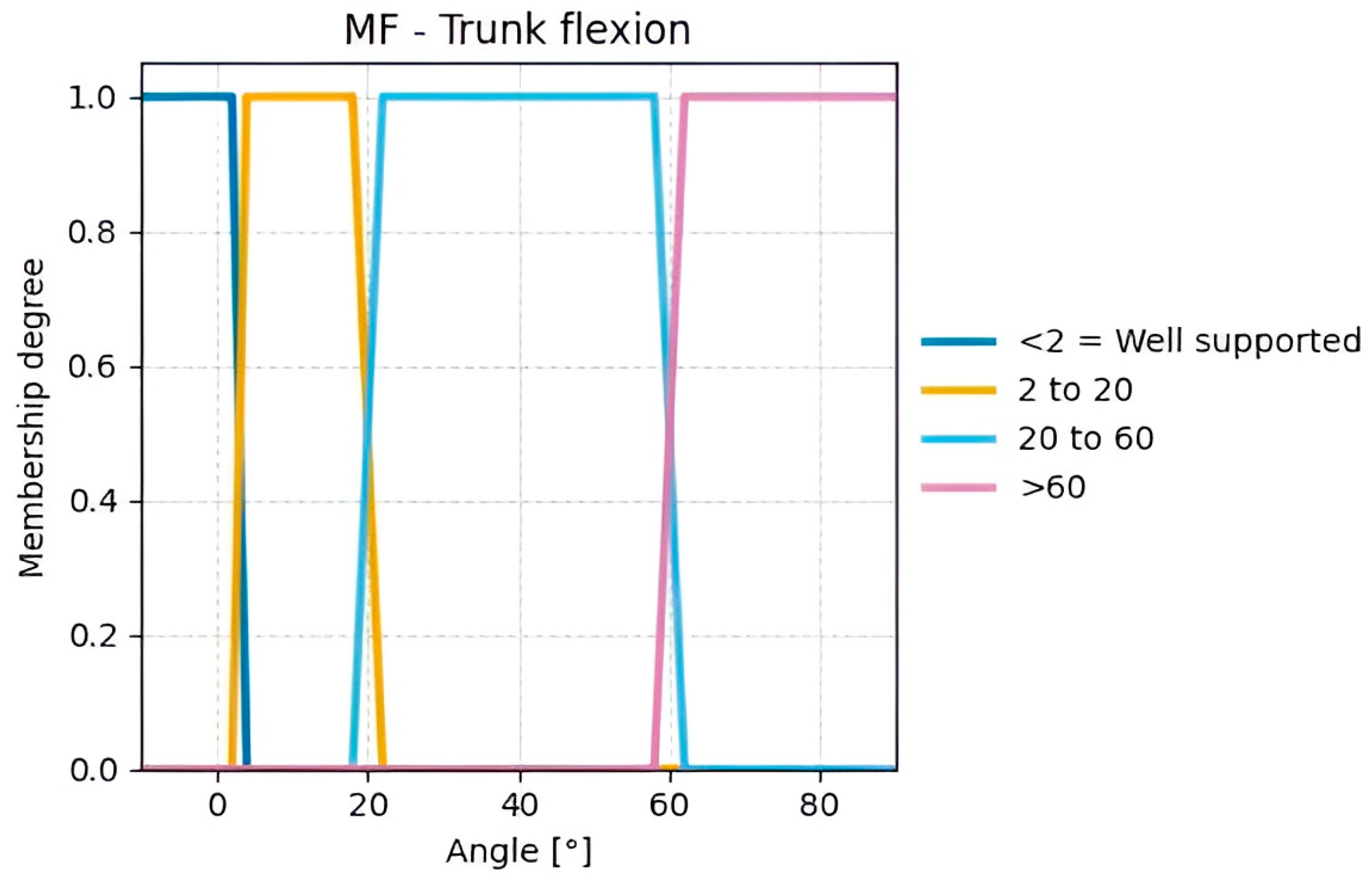
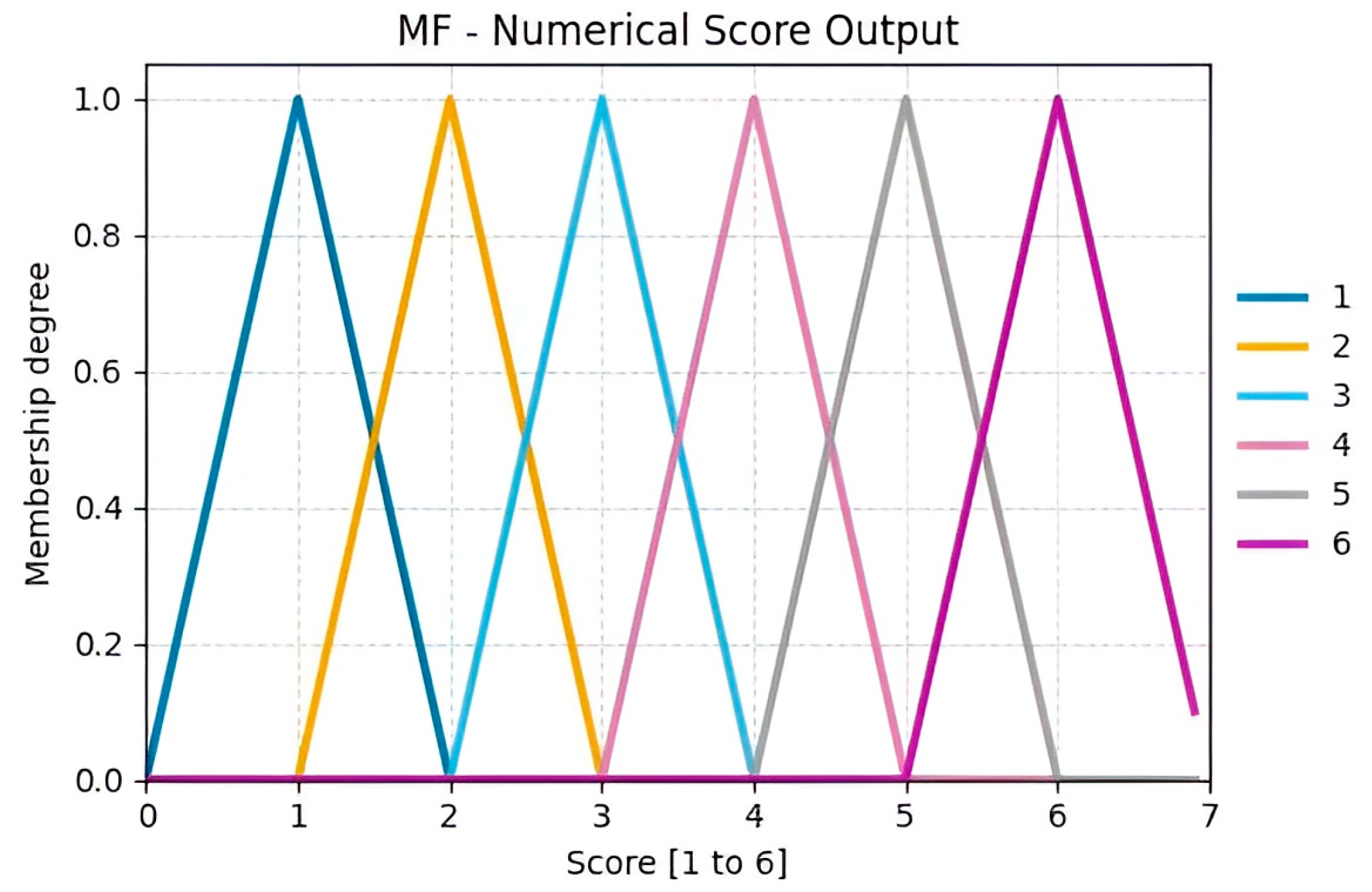
Appendix A. Membership Functions and Some Examples of Rules Designed for the Fuzzy Inference System




| Group | Rule | Description |
|---|---|---|
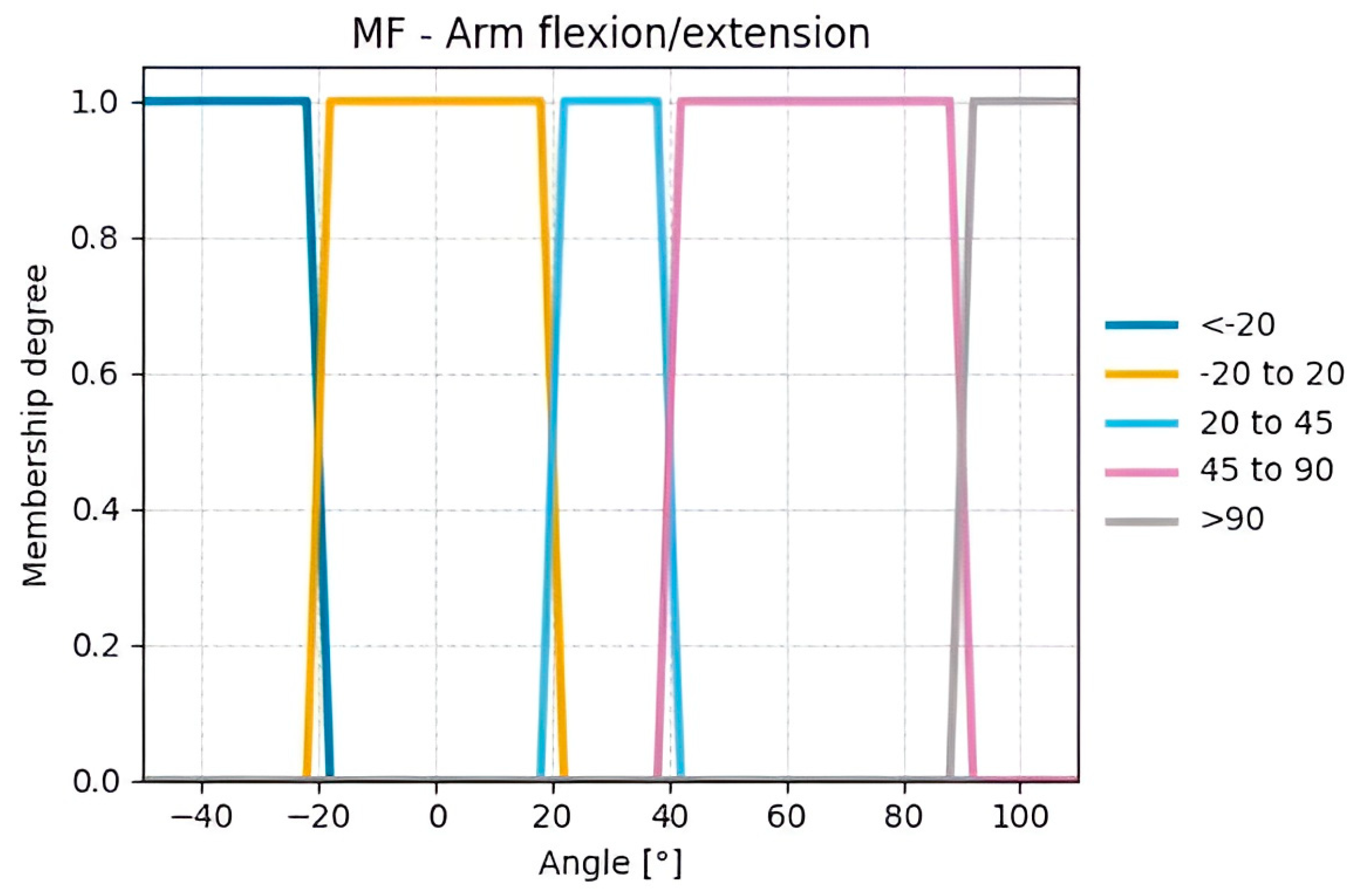
| A | 1 | IF Arm Flexion/Extension is <−20 and Arm Abduction is Low and Supported arms is 0 and Lower arm movement is 3 and Wrist position is 1 and Wrist twist is 2, THEN Numerical output for group A is 4 |
| 2 | IF Arm Flexion/Extension is <−20 and Arm Abduction is Medium and Supported arms is 0 and Lower arm movement is 3 and Wrist position is 1 and Wrist twist is 2, THEN Numerical output for group A is 4 | |
| 3 | IF Arm Flexion/Extension is <−20 and Arm Abduction is High and Supported arms is 0 and Lower arm movement is 3 and Wrist position is 1 and Wrist twist is 2, THEN Numerical output for group A is 4 | |
| 4 | IF Arm Flexion/Extension is <−20 and Arm Abduction is Low and Supported arms is 1 and Lower arm movement is 3 and Wrist position is 1 and Wrist twist is 2, THEN Numerical output for group A is 3 | |
| 5 | IF Arm Flexion/Extension is <−20 and Arm Abduction is Medium and Supported arms is 1 and Lower arm movement is 3 and Wrist position is 1 and Wrist twist is 2, THEN Numerical output for group A is 4 | |
| 6 | IF Arm Flexion/Extension is <−20 and Arm Abduction is High and Supported arms is 1 and Lower arm movement is 3 and Wrist position is 1 and Wrist twist is 2, THEN Numerical output for group A is 4 | |
| 7 | IF Arm Flexion/Extension is −20 to 20 and Arm Abduction is Low and Supported arms is 0 and Lower arm movement is 3 and Wrist position is 1 and Wrist twist is 2, THEN Numerical output for group A is 3 | |
| 8 | IF Arm Flexion/Extension is −20 to 20 and Arm Abduction is Medium and Supported arms is 0 and Lower arm movement is 3 and Wrist position is 1 and Wrist twist is 2, THEN Numerical output for group A is 4 | |
| 9 | IF Arm Flexion/Extension is −20 to 20 and Arm Abduction is High and Supported arms is 0 and Lower arm movement is 3 and Wrist position is 1 and Wrist twist is 2, THEN Numerical output for group A is 4 | |
| 10 | IF Arm Flexion/Extension is −20 to 20 and Arm Abduction is Medium and Supported arms is 1 and Lower arm movement is 3 and Wrist position is 1 and Wrist twist is 2, THEN Numerical output for group A is 3 | |
| 11 | IF Arm Flexion/Extension is −20 to 20 and Arm Abduction is High and Supported arms is 1 and Lower arm movement is 3 and Wrist position is 1 and Wrist twist is 2, THEN Numerical output for group A is 3 | |
| 12 | IF Arm Flexion/Extension is 20 to 45 and Arm Abduction is Low and Supported arms is 0 and Lower arm movement is 3 and Wrist position is 1 and Wrist twist is 2, THEN Numerical output for group A is 4 | |
| 13 | IF Arm Flexion/Extension is 20 to 45 and Arm Abduction is Medium and Supported arms is 0 and Lower arm movement is 3 and Wrist position is 1 and Wrist twist is 2, THEN Numerical output for group A is 4 | |
| 14 | IF Arm Flexion/Extension is 20 to 45 and Arm Abduction is High and Supported arms is 0 and Lower arm movement is 3 and Wrist position is 1 and Wrist twist is 2, THEN Numerical output for group A is 4 | |
| 15 | IF Arm Flexion/Extension is 20 to 45 and Arm Abduction is Low and Supported arms is 1 and Lower arm movement is 3 and Wrist position is 1 and Wrist twist is 2, THEN Numerical output for group A is 3 | |
| 16 | IF Arm Flexion/Extension is 20 to 45 and Arm Abduction is Medium and Supported arms is 1 and Lower arm movement is 3 and Wrist position is 1 and Wrist twist is 2, THEN Numerical output for group A is 4 | |
| 17 | IF Arm Flexion/Extension is 20 to 45 and Arm Abduction is High and Supported arms is 1 and Lower arm movement is 3 and Wrist position is 1 and Wrist twist is 2, THEN Numerical output for group A is 4 | |
| 18 | IF Arm Flexion/Extension is 45 to 90 and Arm Abduction is Low and Supported arms is 0 and Lower arm movement is 3 and Wrist position is 1 and Wrist twist is 2, THEN Numerical output for group A is 4 | |
| 19 | IF Arm Flexion/Extension is 45 to 90 and Arm Abduction is Medium and Supported arms is 0 and Lower arm movement is 3 and Wrist position is 1 and Wrist twist is 2, THEN Numerical output for group A is 4 | |
| 20 | IF Arm Flexion/Extension is 45 to 90 and Arm Abduction is High and Supported arms is 0 and Lower arm movement is 3 and Wrist position is 1 and Wrist twist is 2, THEN Numerical output for group A is 4 | |
| 21 | IF Arm Flexion/Extension is 45 to 90 and Arm Abduction is Low and Supported arms is 1 and Lower arm movement is 3 and Wrist position is 1 and Wrist twist is 2, THEN Numerical output for group A is 4 | |
| 22 | IF Arm Flexion/Extension is 45 to 90 and Arm Abduction is Medium and Supported arms is 1 and Lower arm movement is 3 and Wrist position is 1 and Wrist twist is 2, THEN Numerical output for group A is 4 | |
| 23 | IF Arm Flexion/Extension is 45 to 90 and Arm Abduction is High and Supported arms is 1 and Lower arm movement is 3 and Wrist position is 1 and Wrist twist is 2, THEN Numerical output for group A is 4 | |
| 24 | IF Arm Flexion/Extension is >+90 and Arm Abduction is Low and Supported arms is 0 and Lower arm movement is 3 and Wrist position is 1 and Wrist twist is 2, THEN Numerical output for group A is 4 | |
| 25 | IF Arm Flexion/Extension is >+90 and Arm Abduction is Medium and Supported arms is 0 and Lower arm movement is 3 and Wrist position is 1 and Wrist twist is 2, THEN Numerical output for group A is 6 | |
| 26 | IF Arm Flexion/Extension is >+90 and Arm Abduction is High and Supported arms is 0 and Lower arm movement is 3 and Wrist position is 1 and Wrist twist is 2, THEN Numerical output for group A is 6 | |
| 27 | IF Arm Flexion/Extension is >+90 and Arm Abduction is Low and Supported arms is 1 and Lower arm movement is 3 and Wrist position is 1 and Wrist twist is 2, THEN Numerical output for group A is 4 | |
| 28 | IF Arm Flexion/Extension is >+90 and Arm Abduction is Medium and Supported arms is 1 and Lower arm movement is 3 and Wrist position is 1 and Wrist twist is 2, THEN Numerical output for group A is 4 | |
| 29 | IF Arm Flexion/Extension is >+90 and Arm Abduction is High and Supported arms is 1 and Lower arm movement is 3 and Wrist position is 1 and Wrist twist is 2, THEN Numerical output for group A is 4 | |
| 30 | IF Arm Flexion/Extension is <−20 and Arm Abduction is Low and Supported arms is 0 and Lower arm movement is 3 and Wrist position is 2 and Wrist twist is 2, THEN Numerical output for group A is 4 | |
| 31 | IF Arm Flexion/Extension is <−20 and Arm Abduction is Medium and Supported arms is 0 and Lower arm movement is 3 and Wrist position is 2 and Wrist twist is 2, THEN Numerical output for group A is 4 | |
| 32 | IF Arm Flexion/Extension is <−20 and Arm Abduction is High and Supported arms is 0 and Lower arm movement is 3 and Wrist position is 2 and Wrist twist is 2, THEN Numerical output for group A is 4 | |
| 33 | IF Arm Flexion/Extension is <−20 and Arm Abduction is Low and Supported arms is 1 and Lower arm movement is 3 and Wrist position is 2 and Wrist twist is 2, THEN Numerical output for group A is 3 | |
| 34 | IF Arm Flexion/Extension is <−20 and Arm Abduction is Medium and Supported arms is 1 and Lower arm movement is 3 and Wrist position is 2 and Wrist twist is 2, THEN Numerical output for group A is 4 | |
| 35 | IF Arm Flexion/Extension is <−20 and Arm Abduction is High and Supported arms is 1 and Lower arm movement is 3 and Wrist position is 2 and Wrist twist is 2, THEN Numerical output for group A is 4 | |
| 36 | IF Arm Flexion/Extension is −20 to 20 and Arm Abduction is Low and Supported arms is 0 and Lower arm movement is 3 and Wrist position is 2 and Wrist twist is 2, THEN Numerical output for group A is 3 | |
| 37 | IF Arm Flexion/Extension is −20 to 20 and Arm Abduction is Medium and Supported arms is 0 and Lower arm movement is 3 and Wrist position is 2 and Wrist twist is 2, THEN Numerical output for group A is 4 | |
| 38 | IF Arm Flexion/Extension is −20 to 20 and Arm Abduction is High and Supported arms is 0 and Lower arm movement is 3 and Wrist position is 2 and Wrist twist is 2, THEN Numerical output for group A is 4 | |
| 39 | IF Arm Flexion/Extension is −20 to 20 and Arm Abduction is Medium and Supported arms is 1 and Lower arm movement is 3 and Wrist position is 2 and Wrist twist is 2, THEN Numerical output for group A is 3 | |
| 40 | IF Arm Flexion/Extension is −20 to 20 and Arm Abduction is High and Supported arms is 1 and Lower arm movement is 3 and Wrist position is 2 and Wrist twist is 2, THEN Numerical output for group A is 5 | |
| 41 | IF Arm Flexion/Extension is 20 to 45 and Arm Abduction is Low and Supported arms is 0 and Lower arm movement is 3 and Wrist position is 2 and Wrist twist is 2, THEN Numerical output for group A is 4 | |
| 42 | IF Arm Flexion/Extension is 20 to 45 and Arm Abduction is Medium and Supported arms is 0 and Lower arm movement is 3 and Wrist position is 2 and Wrist twist is 2, THEN Numerical output for group A is 4 | |
| 43 | IF Arm Flexion/Extension is 20 to 45 and Arm Abduction is High and Supported arms is 0 and Lower arm movement is 3 and Wrist position is 2 and Wrist twist is 2, THEN Numerical output for group A is 4 | |
| 44 | IF Arm Flexion/Extension is 20 to 45 and Arm Abduction is Low and Supported arms is 1 and Lower arm movement is 3 and Wrist position is 2 and Wrist twist is 2, THEN Numerical output for group A is 3 | |
| 45 | IF Arm Flexion/Extension is 20 to 45 and Arm Abduction is Medium and Supported arms is 1 and Lower arm movement is 3 and Wrist position is 2 and Wrist twist is 2, THEN Numerical output for group A is 4 | |
| 46 | IF Arm Flexion/Extension is 20 to 45 and Arm Abduction is High and Supported arms is 1 and Lower arm movement is 3 and Wrist position is 2 and Wrist twist is 2, THEN Numerical output for group A is 4 | |
| 47 | IF Arm Flexion/Extension is 45 to 90 and Arm Abduction is Low and Supported arms is 0 and Lower arm movement is 3 and Wrist position is 2 and Wrist twist is 2, THEN Numerical output for group A is 4 | |
| 48 | IF Arm Flexion/Extension is 45 to 90 and Arm Abduction is Medium and Supported arms is 0 and Lower arm movement is 3 and Wrist position is 2 and Wrist twist is 2, THEN Numerical output for group A is 5 | |
| 49 | IF Arm Flexion/Extension is 45 to 90 and Arm Abduction is High and Supported arms is 0 and Lower arm movement is 3 and Wrist position is 2 and Wrist twist is 2, THEN Numerical output for group A is 5 | |
| 50 | IF Arm Flexion/Extension is 45 to 90 and Arm Abduction is Low and Supported arms is 1 and Lower arm movement is 3 and Wrist position is 2 and Wrist twist is 2, THEN Numerical output for group A is 4 | |
| 51 | IF Arm Flexion/Extension is 45 to 90 and Arm Abduction is Medium and Supported arms is 1 and Lower arm movement is 3 and Wrist position is 2 and Wrist twist is 2, THEN Numerical output for group A is 4 | |
| 52 | IF Arm Flexion/Extension is 45 to 90 and Arm Abduction is High and Supported arms is 1 and Lower arm movement is 3 and Wrist position is 2 and Wrist twist is 2, THEN Numerical output for group A is 4 | |
| 53 | IF Arm Flexion/Extension is >+90 and Arm Abduction is Low and Supported arms is 0 and Lower arm movement is 3 and Wrist position is 2 and Wrist twist is 2, THEN Numerical output for group A is 5 | |
| 54 | IF Arm Flexion/Extension is >+90 and Arm Abduction is Medium and Supported arms is 0 and Lower arm movement is 3 and Wrist position is 2 and Wrist twist is 2, THEN Numerical output for group A is 7 | |
| 55 | IF Arm Flexion/Extension is >+90 and Arm Abduction is High and Supported arms is 0 and Lower arm movement is 3 and Wrist position is 2 and Wrist twist is 2, THEN Numerical output for group A is 7 | |
| 56 | IF Arm Flexion/Extension is >+90 and Arm Abduction is Low and Supported arms is 1 and Lower arm movement is 3 and Wrist position is 2 and Wrist twist is 2, THEN Numerical output for group A is 4 | |
| 57 | IF Arm Flexion/Extension is >+90 and Arm Abduction is Medium and Supported arms is 1 and Lower arm movement is 3 and Wrist position is 2 and Wrist twist is 2, THEN Numerical output for group A is 5 | |
| 58 | IF Arm Flexion/Extension is >+90 and Arm Abduction is High and Supported arms is 1 and Lower arm movement is 3 and Wrist position is 2 and Wrist twist is 2, THEN Numerical output for group A is 5 | |
| B | 1 | IF Neck is 1 and Trunk flexion is Well supported, and Trunk twisting is No twist and Legs is Sitting, THEN Numerical output for group B is 1 |
| 2 | IF Neck is 1 and Trunk flexion is 2 to 20, and Trunk twisting is No twist and Legs is Sitting, THEN Numerical output for group B is 2 | |
| 3 | IF Neck is 1 and Trunk flexion is 20 and 60, and Trunk twisting is No twist and Legs is Sitting, THEN Numerical output for group B is 3 | |
| 4 | IF Neck is 1 and Trunk flexion is >60, and Trunk twisting is No twist and Legs is Sitting, THEN Numerical output for group B is 5 | |
| 5 | IF Neck is 1 and Trunk flexion is Well supported, and Trunk twisting is Left twist and Legs is Sitting, THEN Numerical output for group B is 2 | |
| 6 | IF Neck is 1 and Trunk flexion is 2 to 20, and Trunk twisting is Left twist and Legs is Sitting, THEN Numerical output for group B is 3 | |
| 7 | IF Neck is 1 and Trunk flexion is 20 and 60, and Trunk twisting is Left twist and Legs is Sitting, THEN Numerical output for group B is 5 | |
| 8 | IF Neck is 1 and Trunk flexion is >60, and Trunk twisting is Left twist and Legs is Sitting, THEN Numerical output for group B is 6 | |
| 9 | IF Neck is 1 and Trunk flexion Well supported, and Trunk twisting is Right twist and Legs is Sitting, THEN Numerical output for group B is 2 | |
| 10 | IF Neck is 1 and Trunk flexion is 2 to 20, and Trunk twisting is Right twist and Legs is Sitting, THEN Numerical output for group B is 3 | |
| 11 | IF Neck is 1 and Trunk flexion is 20 and 60, and Trunk twisting is Right twist and Legs is Sitting, THEN Numerical output for group B is 5 | |
| 12 | IF Neck is 1 and Trunk flexion is >60, and Trunk twisting is Right twist and Legs is Sitting, THEN Numerical output for group B is 6 | |
| 13 | IF Neck is 2 and Trunk flexion is 2 to 20, and Trunk twisting is No twist and Legs is Sitting, THEN Numerical output for group B is 2 | |
| 14 | IF Neck is 2 and Trunk flexion is 2 to 20, and Trunk twisting is Right twist and Legs is Sitting, THEN Numerical output for group B is 3 | |
| 15 | IF Neck is 2 and Trunk flexion is 20 and 60, and Trunk twisting is No twist and Legs is Sitting, THEN Numerical output for group B is 4 | |
| 16 | IF Neck is 2 and Trunk flexion is >60, and Trunk twisting is No twist and Legs is Sitting, THEN Numerical output for group B is 5 | |
| 17 | IF Neck is 2 and Trunk flexion is Well supported, and Trunk twisting is Left twist and Legs is Sitting, THEN Numerical output for group B is 2 | |
| 18 | IF Neck is 2 and Trunk flexion is 2 to 20, and Trunk twisting is Left twist and Legs is Sitting, THEN Numerical output for group B is 4 | |
| 19 | IF Neck is 2 and Trunk flexion 20 and 60, and Trunk twisting is Left twist and Legs is Sitting, THEN Numerical output for group B is 5 | |
| 20 | IF Neck is 2 and Trunk flexion is >60, and Trunk twisting is Left twist and Legs is Sitting, THEN Numerical output for group B is 6 | |
| 21 | IF Neck is 2 and Trunk flexion is Well supported, and Trunk twisting is Right twist and Legs is Sitting, THEN Numerical output for group B is 2 | |
| 22 | IF Neck is 2 and Trunk flexion is 2 to 20, and Trunk twisting is Right twist and Legs is Sitting, THEN Numerical output for group B is 4 | |
| 23 | IF Neck is 2 and Trunk flexion 20 and 60, and Trunk twisting is Right twist and Legs is Sitting, THEN Numerical output for group B is 5 | |
| 24 | IF Neck is 2 and Trunk flexion is >60, and Trunk twisting is Right twist and Legs is Sitting, THEN Numerical output for group B is 6 | |
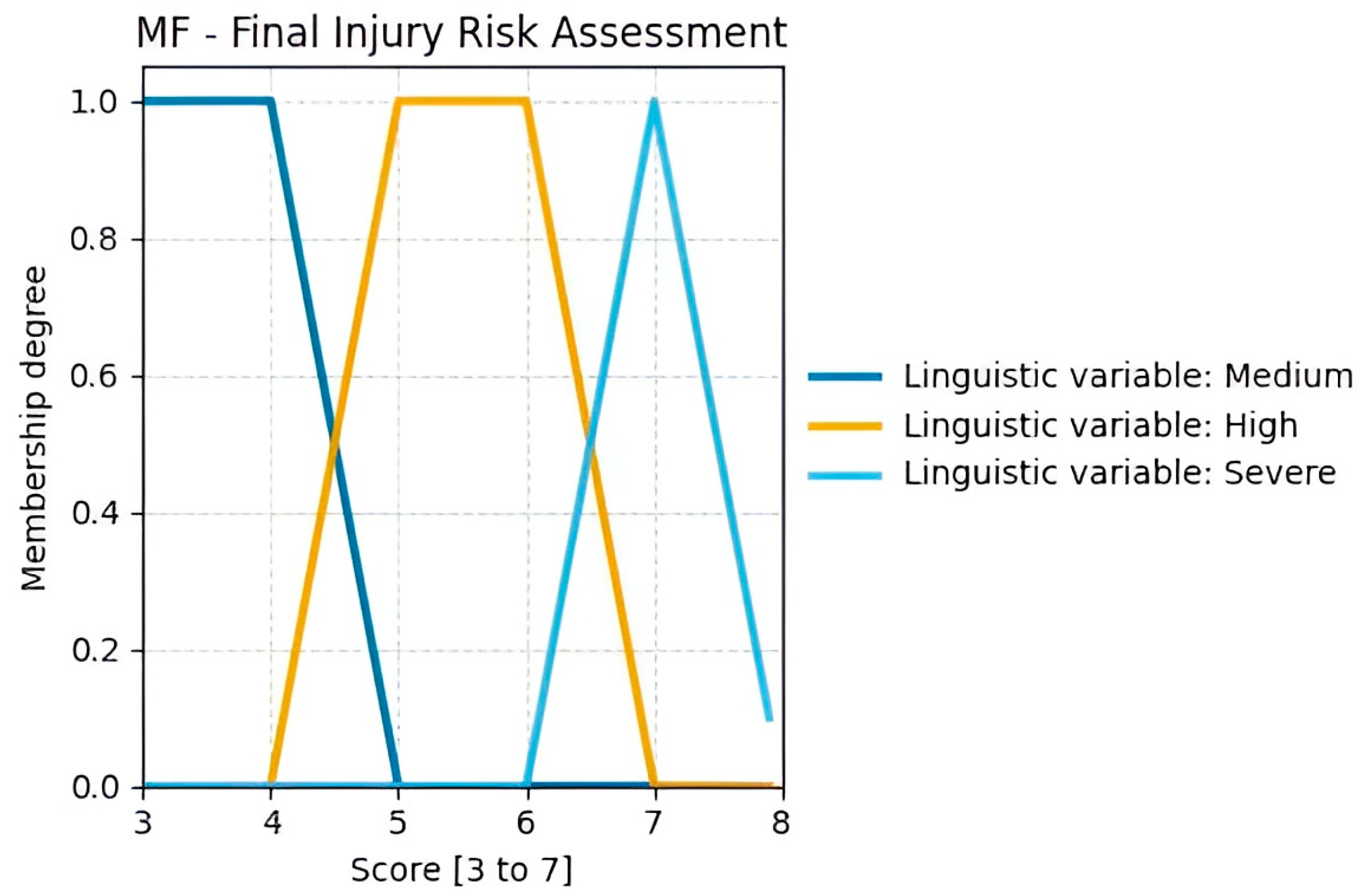
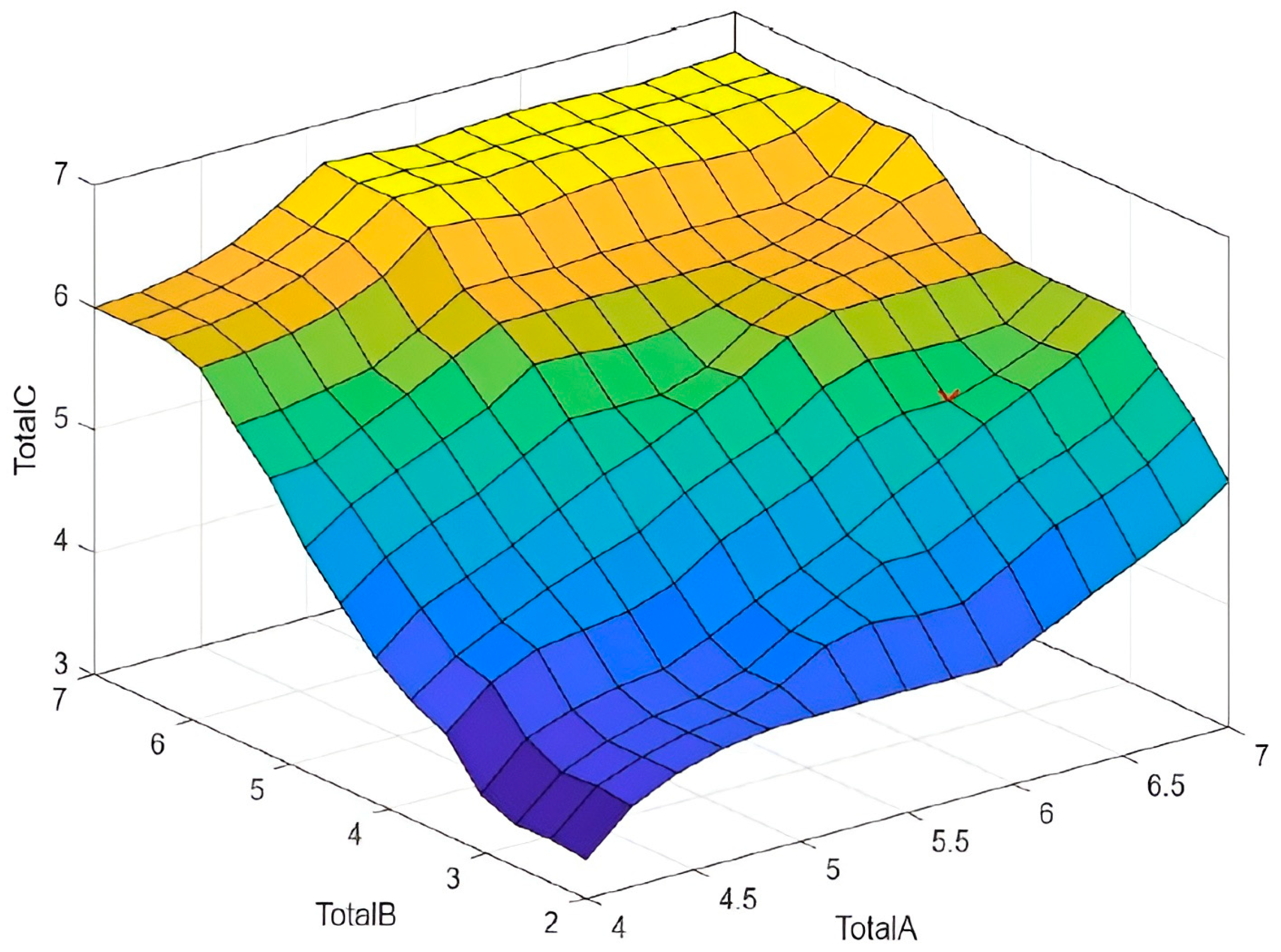
| C | 1 | IF Total score for group A is 4 and Total score for group B is 4, THEN Final injury risk assessment is Medium |
| 2 | IF Total score for group A is 4 and Total score for group B is 5, THEN Final injury risk assessment is High | |
| 3 | IF Total score for group A is 5 and Total score for group B is 2, THEN Final injury risk assessment is Medium | |
| 4 | IF Total score for group A is 5 and Total score for group B is 3, THEN Final injury risk assessment is Medium | |
| 5 | IF Total score for group A is 5 and Total score for group B is 4, THEN Final injury risk assessment is High | |
| 6 | IF Total score for group A is 5 and Total score for group B is 6, THEN Final injury risk assessment is Severe | |
| 7 | IF Total score for group A is 5 and Total score for group B is 7, THEN Final injury risk assessment is Severe | |
| 8 | IF Total score for group A is 6 and Total score for group B is 2, THEN Final injury risk assessment is Medium | |
| 9 | IF Total score for group A is 6 and Total score for group B is 3, THEN Final injury risk assessment is High | |
| 10 | IF Total score for group A is 6 and Total score for group B is 6, THEN Final injury risk assessment is Severe | |
| 11 | IF Total score for group A is 6 and Total score for group B is 7, THEN Final injury risk assessment is Severe | |
| 12 | IF Total score for group A is 7 and Total score for group B is 2, THEN Final injury risk assessment is High | |
| 13 | IF Total score for group A is 7 and Total score for group B is 5, THEN Final injury risk assessment is Severe | |
| 14 | IF Total score for group A is 7 and Total score for group B is 6, THEN Final injury risk assessment is Severe | |
| 15 | IF Total score for group A is 7 and Total score for group B is 7, THEN Final injury risk assessment is Severe | |
| 16 | IF Total score for group A is 5 and Total score for group B is 5, THEN Final injury risk assessment is High | |
| 17 | IF Total score for group A is 6 and Total score for group B is 4, THEN Final injury risk assessment is High | |
| 18 | IF Total score for group A is 6 and Total score for group B is 5, THEN Final injury risk assessment is High | |
| 19 | IF Total score for group A is 7 and Total score for group B is 3, THEN Final injury risk assessment is High | |
| 20 | IF Total score for group A is 7 and Total score for group B is 4, THEN Final injury risk assessment is High | |
| 21 | IF Total score for group A is 4 and Total score for group B is 2, THEN Final injury risk assessment is Medium | |
| 22 | IF Total score for group A is 4 and Total score for group B is 3, THEN Final injury risk assessment is Medium | |
| 23 | IF Total score for group A is 4 and Total score for group B is 6, THEN Final injury risk assessment is High | |
| 24 | IF Total score for group A is 4 and Total score for group B is 7, THEN Final injury risk assessment is High |
| Participant | Upper Limb Injury Risk Assessment | |||||||
|---|---|---|---|---|---|---|---|---|
| Right Side | Left Side | |||||||
| Experiment | Rater | Experiment | Rater | |||||
| 1 | 2 | 3 | 1 | 2 | 3 | |||
| 1 | M | M | H | Expert 1 | M | H | H | Expert 1 |
| M | H | H | Expert 2 | M | H | H | Expert 2 | |
| M | H | H | Expert 3 | M | H | H | Expert 3 | |
| M | H | H | FIS | M | H | H | FIS | |
| 2 | H | H | H | Expert 1 | H | S | H | Expert 1 |
| H | H | H | Expert 2 | H | H | H | Expert 2 | |
| S | S | H | Expert 3 | S | H | H | Expert 3 | |
| H | H | H | FIS | H | H | H | FIS | |
| 3 | M | H | S | Expert 1 | H | H | H | Expert 1 |
| M | H | H | Expert 2 | H | H | H | Expert 2 | |
| M | H | H | Expert 3 | H | H | H | Expert 3 | |
| M | H | H | FIS | H | H | H | FIS | |
| 4 | M | H | H | Expert 1 | M | H | H | Expert 1 |
| M | H | H | Expert 2 | M | H | H | Expert 2 | |
| M | H | H | Expert 3 | M | H | H | Expert 3 | |
| M | H | H | FIS | M | H | H | FIS | |
| 5 | M | H | H | Expert 1 | H | H | H | Expert 1 |
| M | H | H | Expert 2 | H | H | H | Expert 2 | |
| M | H | H | Expert 3 | M | H | H | Expert 3 | |
| M | H | H | FIS | H | H | H | FIS | |
| 6 | M | H | H | Expert 1 | M | S | H | Expert 1 |
| M | H | H | Expert 2 | M | S | H | Expert 2 | |
| M | H | H | Expert 3 | M | S | H | Expert 3 | |
| M | H | H | FIS | M | S | H | FIS | |
| 7 | M | H | H | Expert 1 | M | H | H | Expert 1 |
| M | H | H | Expert 2 | M | H | H | Expert 2 | |
| M | H | H | Expert 3 | M | H | H | Expert 3 | |
| M | H | H | FIS | M | H | H | FIS | |
| 8 | M | H | H | Expert 1 | M | H | H | Expert 1 |
| M | H | H | Expert 2 | M | H | H | Expert 2 | |
| M | H | H | Expert 3 | M | H | H | Expert 3 | |
| M | H | H | FIS | M | H | H | FIS | |
| 9 | M | S | H | Expert 1 | H | H | H | Expert 1 |
| M | S | H | Expert 2 | H | S | H | Expert 2 | |
| H | S | H | Expert 3 | M | S | H | Expert 3 | |
| H | S | H | FIS | M | S | H | FIS | |
| 10 | M | H | H | Expert 1 | H | H | M | Expert 1 |
| M | H | H | Expert 2 | M | M | M | Expert 2 | |
| M | H | H | Expert 3 | M | H | M | Expert 3 | |
| M | H | H | FIS | M | H | H | FIS | |
| 11 | M | H | H | Expert 1 | M | S | H | Expert 1 |
| M | H | H | Expert 2 | M | S | H | Expert 2 | |
| M | H | H | Expert 3 | M | H | H | Expert 3 | |
| M | H | H | FIS | M | S | H | FIS | |
| 12 | M | H | H | Expert 1 | H | H | H | Expert 1 |
| M | H | H | Expert 2 | M | H | H | Expert 2 | |
| M | H | H | Expert 3 | M | H | H | Expert 3 | |
| M | H | H | FIS | M | H | H | FIS | |
| 13 | H | H | H | Expert 1 | H | H | H | Expert 1 |
| H | H | H | Expert 2 | H | H | H | Expert 2 | |
| M | H | H | Expert 3 | H | H | H | Expert 3 | |
| H | H | H | FIS | H | H | H | FIS | |
| 14 | M | H | M | Expert 1 | M | H | H | Expert 1 |
| M | H | M | Expert 2 | H | H | H | Expert 2 | |
| M | H | M | Expert 3 | M | H | H | Expert 3 | |
| M | H | H | FIS | M | H | H | FIS | |
| 15 | M | H | H | Expert 1 | M | H | H | Expert 1 |
| M | H | H | Expert 2 | M | H | H | Expert 2 | |
| M | H | H | Expert 3 | M | H | H | Expert 3 | |
| M | H | H | FIS | M | H | H | FIS | |
| 16 | S | M | S | Expert 1 | H | M | H | Expert 1 |
| H | M | S | Expert 2 | S | H | S | Expert 2 | |
| H | M | S | Expert 3 | H | H | H | Expert 3 | |
| H | M | H | FIS | H | H | H | FIS | |
| 17 | H | H | H | Expert 1 | H | H | H | Expert 1 |
| H | H | H | Expert 2 | H | H | H | Expert 2 | |
| H | H | H | Expert 3 | H | H | H | Expert 3 | |
| H | H | H | FIS | H | H | H | FIS | |
| 18 | M | H | H | Expert 1 | M | H | H | Expert 1 |
| M | H | H | Expert 2 | M | H | H | Expert 2 | |
| M | H | H | Expert 3 | M | H | H | Expert 3 | |
| M | H | H | FIS | M | H | H | FIS | |
| 19 | H | H | M | Expert 1 | H | H | H | Expert 1 |
| H | S | H | Expert 2 | H | H | H | Expert 2 | |
| M | H | H | Expert 3 | H | H | H | Expert 3 | |
| H | H | H | FIS | H | H | H | FIS | |
| 20 | M | H | H | Expert 1 | M | H | H | Expert 1 |
| M | H | H | Expert 2 | M | H | H | Expert 2 | |
| M | H | H | Expert 3 | M | H | H | Expert 3 | |
| M | H | H | FIS | M | H | H | FIS | |
| 21 | M | H | H | Expert 1 | M | H | H | Expert 1 |
| M | H | H | Expert 2 | M | H | H | Expert 2 | |
| M | H | H | Expert 3 | M | H | H | Expert 3 | |
| M | H | H | FIS | M | H | H | FIS | |
| 22 | M | H | H | Expert 1 | M | H | H | Expert 1 |
| M | H | H | Expert 2 | M | H | H | Expert 2 | |
| M | H | H | Expert 3 | M | H | H | Expert 3 | |
| M | H | H | FIS | M | H | H | FIS | |
| 23 | M | H | S | Expert 1 | M | H | H | Expert 1 |
| M | H | S | Expert 2 | H | H | H | Expert 2 | |
| M | H | S | Expert 3 | M | H | H | Expert 3 | |
| H | H | H | FIS | H | H | H | FIS | |
| 24 | M | H | H | Expert 1 | M | H | H | Expert 1 |
| M | H | H | Expert 2 | M | H | H | Expert 2 | |
| M | H | H | Expert 3 | H | H | H | Expert 3 | |
| M | H | H | FIS | M | H | H | FIS | |
| 25 | M | H | H | Expert 1 | H | M | H | Expert 1 |
| M | H | H | Expert 2 | H | M | H | Expert 2 | |
| M | M | H | Expert 3 | H | M | H | Expert 3 | |
| M | H | H | FIS | H | H | H | FIS | |
References
- Xuan, J.; Zhu, T.; Peng, G.; Sun, F.; Dong, D. A Review on the Inertial Measurement Unit Array of Microelectromechanical Systems. Sensors 2024, 24, 7140. [Google Scholar] [CrossRef]
- Samatas, G.G.; Pachidis, T.P. Inertial Measurement Units (IMUs) in Mobile Robots over the Last Five Years: A Review. Designs 2022, 6, 17. [Google Scholar] [CrossRef]
- Veijalainen, P.; Charalambous, T.; Wichman, R. Feasibility of Bluetooth Low Energy for motion capturing with Inertial Measurement Units. J. Netw. Comput. Appl. 2023, 213, 103566. [Google Scholar] [CrossRef]
- Sanchez-Perez, L.A.; Sanchez-Fernandez, L.P.; Shaout, A.; Martinez-Hernandez, J.M.; Alvarez-Noriega, M.J. Rest tremor quantification based on fuzzy inference systems and wearable sensors. Int. J. Med. Inform. 2018, 114, 6–17. [Google Scholar] [CrossRef] [PubMed]
- Legaria-Santiago, V.K.; Sánchez-Fernández, L.P.; Sánchez-Pérez, L.A.; Garza-Rodríguez, A. Computer models evaluating hand tremors in Parkinson’s disease patients. Comput. Biol. Med. 2022, 140, 105059. [Google Scholar] [CrossRef] [PubMed]
- Sánchez-Fernández, L.P.; Sánchez-Pérez, L.A.; Concha-Gómez, P.D.; Shaout, A. Kinetic tremor analysis using wearable sensors and fuzzy inference systems in Parkinson’s disease. Biomed. Signal Process. Control. 2023, 84, 104748. [Google Scholar] [CrossRef]
- Ornelas-Vences, C.; Sánchez-Fernández, L.P.; Sánchez-Pérez, L.A.; Martínez-Hernández, J.M. Computer model for leg agility quantification and assessment for Parkinson’s disease patients. Med. Biol. Eng. Comput. 2019, 57, 463–476. [Google Scholar] [CrossRef]
- Rokoko. Available online: https://www.rokoko.com/ (accessed on 25 April 2025).
- Xsens. Available online: https://www.movella.com/products/xsens (accessed on 25 April 2025).
- Witmotion. Available online: https://www.witmotion-sensor.com (accessed on 25 April 2025).
- Fontecoba, A.S.; Fernández-Arruti, P.; Dafonte, C.; Nóvoa, F.J. Interception of BLE Communications in Wearables: An Application Case. In Proceedings of the International Conference on Ubiquitous Computing & Ambient Intelligence (UCAmI 2022); Springer: Cham, Switzerland, 2022; pp. 1019–1030. [Google Scholar] [CrossRef]
- Cho, K.; Park, G.; Cho, W.; Seo, J.; Han, K. Performance analysis of device discovery of Bluetooth Low Energy (BLE) networks. Comput. Commun. 2016, 81, 72–85. [Google Scholar] [CrossRef]
- Mohamed, K.S. Bluetooth 5.0 Modem Design for IoT Devices, 1st ed.; Springer International Publishing: Cham, Switzerland, 2022. [Google Scholar] [CrossRef]
- Jenschke, T.L.; de Amorim, M.D.; Fdida, S. Nearby connections strategies: Features, usage, and empirical performance evaluation. Internet Things 2023, 23, 100895. [Google Scholar] [CrossRef]
- Huang, Y.-J.; Chang, C.-S.; Wu, Y.-C.; Han, C.-C.; Cheng, Y.-Y.; Chen, H.-M. Development of Wearable Devices for Collecting Digital Rehabilitation/Fitness Data from Lower Limbs. Sensors 2024, 24, 1935. [Google Scholar] [CrossRef]
- David, J.P.; Schick, D.; Rapp, L.; Schick, J.; Glaser, M. SensAA—Design and Verification of a Cloud-Based Wearable Biomechanical Data Acquisition System. Sensors 2024, 24, 2405. [Google Scholar] [CrossRef]
- Baijot, M.; Puers, R.; Kraft, M. Monitoring Lower Back Activity in Daily Life Using Small Unintrusive Sensors and Wearable Electronics in the Context of Rheumatic and Musculoskeletal Diseases. Sensors 2021, 21, 6362. [Google Scholar] [CrossRef]
- Gu, C.; Lin, W.; He, X.; Zhang, L.; Zhang, M. IMU-based motion capture system for rehabilitation applications: A systematic review. Biomim. Intell. Robot. 2023, 3, 100097. [Google Scholar] [CrossRef]
- Dorschky, E.; Nitschke, M.; Mayer, M.; Weygers, I.; Gassner, H.; Seel, T.; Eskofier, B.M.; Koelewijn, A.D. Comparing sparse inertial sensor setups for sagittal-plane walking and running reconstructions. Front. Bioeng. Biotechnol. 2025, 13, 1507162. [Google Scholar] [CrossRef] [PubMed]
- Gorges, T.; Merz, C.; Friedl, F.; Sandau, I. Comparative analysis of inertial measurement units and markerless video motion capture systems for assessing rotational parameters in snowboard freestyle. Meas. Sens. 2025, 39, 101872. [Google Scholar] [CrossRef]
- Zhang, H.; Moctar, S.M.S.; Boudaoud, S.; Rida, I. A comprehensive review of sEMG-IMU sensor fusion for upper limb movements pattern recognition. Inf. Fusion 2026, 125, 103422. [Google Scholar] [CrossRef]
- Poitras, I.; Dupuis, F.; Bielmann, M.; Campeau-Lecours, A.; Mercier, C.; Bouyer, L.J.; Roy, J.-S. Validity and Reliability of Wearable Sensors for Joint Angle Estimation: A Systematic Review. Sensors 2019, 19, 1555. [Google Scholar] [CrossRef]
- Goreham, J.A.; MacLean, K.F.E.; Ladouceur, M. The validation of a low-cost inertial measurement unit system to quantify simple and complex upper-limb joint angles. J. Biomech. 2022, 134, 111000. [Google Scholar] [CrossRef]
- Zhu, J.; Ye, Z.; Liu, R.; Liu, J. Inertial measurement units (IMUs) for biomechanical analysis in sport: A review of applications, challenges and future directions. Sens. Rev. 2025. [Google Scholar] [CrossRef]
- Höglund, G.; Grip, H.; Öhberg, F. The importance of inertial measurement unit placement in assessing upper limb motion. Med. Eng. Phys. 2021, 92, 1–9. [Google Scholar] [CrossRef]
- Ferrari, A.J.; Santomauro, D.F.; Aali, A.; Abate, Y.H.; Abbafati, C.; Abbastabar, H.; ElHafeez, S.A.; Abdelmasseh, M.; Abd-Elsalam, S.; Abdollahi, A.; et al. Global incidence, prevalence, years lived with disability (YLDs), disability-adjusted life-years (DALYs), and healthy life expectancy (HALE) for 371 diseases and injuries in 204 countries and territories and 811 subnational locations, 1990–2021: A systematic analysis for the Global Burden of Disease Study 2021. Lancet 2024, 403, 2133–2161. [Google Scholar] [CrossRef]
- Jara, H.V.; Orejuela, I.Z.; Baydal-Bertomeu, J.M. Study of the ergonomic risk in operators of an assembly line using the RULA method in real working conditions through the application of a commercial sensor. Mater. Today Proc. 2022, 49, 122–128. [Google Scholar] [CrossRef]
- Kar, M.B.; Aruna, M.; Kunar, B.M. Fuzzy Logic-Based Rapid Upper Limb Assessment: A Novel Approach to Evaluate the Postural Risk of Dumper Operators. J. Inst. Eng. Ser. C 2023, 104, 1047–1055. [Google Scholar] [CrossRef]
- Madgwick, S.O.H.; Harrison, A.J.L.; Vaidyanathan, R. Estimation of IMU and MARG orientation using a gradient descent algorithm. In Proceedings of the 2011 IEEE International Conference on Rehabilitation Robotics, Zurich, Switzerland, 29 June–1 July 2011; pp. 1–7. [Google Scholar] [CrossRef]
- Nordic Semiconductor. nRF5282 Product Overview. Available online: https://nav.nordicsemi.com/search?location=products&query=nrf5282 (accessed on 22 September 2025).
- Sivertsen, E. Taking a Deeper Dive into Bluetooth 5. Nordic DevZone Blogs, 7 April 2017. Available online: https://devzone.nordicsemi.com/nordic/nordic-blog/b/blog/posts/taking-a-deeper-dive-into-bluetooth-5 (accessed on 22 September 2025).
- Android Developers. Bluetooth Low Energy Overview, Android Developers. 2024. Available online: https://developer.android.com/develop/connectivity/bluetooth/ble/ble-overview?hl=es-419 (accessed on 22 September 2025).
- Blidh, H. Bleak Documentation. 2025. Available online: https://bleak.readthedocs.io/en/latest/ (accessed on 22 September 2025).
- González-Baldovinos, D.L.; Guevara-López, P.; Cano-Rosas, J.L.; Valdez-Martínez, J.S.; López-Chau, A. Response Times Reconstructor Based on Mathematical Expectation Quotient for a High Priority Task over RT-Linux. Mathematics 2022, 10, 134. [Google Scholar] [CrossRef]
- Dias, P.; Matta, A.; Pilastri, A.; Matos, L.M.; Cortez, P. RTSIMU: Real-Time Simulation tool for IMU sensors. Softw. Impacts 2023, 17, 100522. [Google Scholar] [CrossRef]
- Wu, G.; Van Der Helm, F.C.T.; Veeger, H.E.J.; Makhsous, M.; Van Roy, P.; Anglin, C.; Nagels, J.; Karduna, A.R.; McQuade, K.; Wang, X.; et al. ISB Recommendation on Definitions of Joint Coordinate Systems of Various Joints for the Reporting of Human Joint Motion—Part II: Shoulder, Elbow, Wrist and Hand. J. Biomech. 2005, 38, 981–992. [Google Scholar] [CrossRef] [PubMed]
- Bai, L. Time-Frequency Analysis of Upper Limb Motion Based on Inertial Sensors. In Proceedings of the 2021 32nd Irish Signals and Systems Conference (ISSC), Athlone, Ireland, 10–11 June 2021; pp. 1–6. [Google Scholar] [CrossRef]
- Tang, H.-Y.; Tan, S.-H.; Su, T.-Y.; Chiang, C.-J.; Chen, H.-H. Upper Body Posture Recognition Using Inertial Sensors and Recurrent Neural Networks. Appl. Sci. 2021, 11, 12101. [Google Scholar] [CrossRef]
- Payton, C.J.; Burden, A. (Eds.) Biomechanical Evaluation of Movement in Sport and Exercise, 2nd ed.; Routledge: Abingdon, UK; New York, NY, USA, 2018. [Google Scholar] [CrossRef]
- Zhou, L.; Fischer, E.; Tunca, C.; Brahms, C.M.; Ersoy, C.; Granacher, U.; Arnrich, B. How We Found Our IMU: Guidelines to IMU Selection and a Comparison of Seven IMUs for Pervasive Healthcare Applications. Sensors 2020, 20, 4090. [Google Scholar] [CrossRef]
- Kobsar, D.; Charlton, J.M.; Tse, C.T.F.; Esculier, J.-F.; Graffos, A.; Krowchuk, N.M.; Thatcher, D.; Hunt, M.A. Validity and reliability of wearable inertial sensors in healthy adult walking: A systematic review and meta-analysis. J. Neuroeng. Rehabil. 2020, 17, 62. [Google Scholar] [CrossRef]
- Digo, E.; Gastaldi, L.; Antonelli, M.; Pastorelli, S.; Cereatti, A.; Caruso, M. Real-time estimation of upper limbs kinematics with IMUs during typical industrial gestures. Procedia Comput. Sci. 2022, 200, 1041–1047. [Google Scholar] [CrossRef]
- Mamdani, E.H.; Assilian, S. An experiment in linguistic synthesis with a fuzzy logic controller. Int. J. Man-Mach. Stud. 1975, 7, 1–13. [Google Scholar] [CrossRef]
- Zadeh, L.A. A Rationale for Fuzzy Control. J. Dyn. Syst. Meas. Control 1972, 94, 3–4. [Google Scholar] [CrossRef]
- Ross, T.J. Fuzzy Logic with Engineering Applications; John Wiley: Hoboken, NJ, USA, 2010. [Google Scholar]
- McAtamney, L.; Corlett, E.N. RULA: A survey method for the investigation of work-related upper limb disorders. Appl. Ergon. 1993, 24, 91–99. [Google Scholar] [CrossRef] [PubMed]
- Understanding Bluetooth RSSI Measurements. MOKOBlue, 21 January 2022. Available online: https://www.mokoblue.com/es/measures-of-bluetooth-rssi/ (accessed on 23 September 2025).
- Kruskal, W.H.; Wallis, W.A. Use of Ranks in One-Criterion Variance Analysis. J. Am. Stat. Assoc. 1952, 47, 583–621. [Google Scholar] [CrossRef]
- Dunn, O.J. Multiple Comparisons among Means. J. Am. Stat. Assoc. 1961, 56, 52–64. [Google Scholar] [CrossRef]
- Graham, R.B.; Dupeyron, A.; van Dieën, J.H. Between-day reliability of IMU-derived spine control metrics in patients with low back pain. J. Biomech. 2020, 113, 110080. [Google Scholar] [CrossRef]
- Zhang, M.; Li, H.; Ge, T.; Meng, Z.; Gao, N.; Zhang, Z. Integrated Sensing and Computing for Wearable Human Activity Recognition with MEMS IMU and BLE Network. Meas. Sci. Rev. 2022, 22, 193–201. [Google Scholar] [CrossRef]
- Tosi, J.; Taffoni, F.; Santacatterina, M.; Sannino, R.; Formica, D. Performance Evaluation of Bluetooth Low Energy: A Systematic Review. Sensors 2017, 17, 2898. [Google Scholar] [CrossRef]
- Fleiss, J.L.; Levin, B.; Paik, M.C. Statistical Methods for Rates and Proportions; John Wiley: Hoboken, NJ, USA, 2003. [Google Scholar]
- Sánchez-Fernández, L.P.; Garza-Rodríguez, A.; Sánchez-Pérez, L.A.; Martínez-Hernández, J.M. A Computer Method for Pronation-Supination Assessment in Parkinson’s Disease Based on Latent Space Representations of Biomechanical Indicators. Bioengineering 2023, 10, 588. [Google Scholar] [CrossRef]
- Xiang, L.; Gu, Y.; Gao, Z.; Yu, P.; Shim, V.; Wang, A.; Fernandez, J. Integrating an LSTM framework for predicting ankle joint biomechanics during gait using inertial sensors. Comput. Biol. Med. 2024, 170, 108016. [Google Scholar] [CrossRef]
- Sánchez-Fernández, L.P. Biomechanics of Parkinson’s Disease with Systems Based on Expert Knowledge and Machine Learning: A Scoping Review. Computation 2024, 12, 230. [Google Scholar] [CrossRef]
- Razak, H.R.B.A.; Chua, N.; Lai, K.W. Quantification of 3D Kinematic Measurements for Knee Flexion and Tibial Rotation Using an IMU-Based Sensor and Ultrasound Imaging System: A Cadaveric Study. Sensors 2025, 25, 4211. [Google Scholar] [CrossRef] [PubMed]
- McNames, J.; Shah, V.V.; Casey, H.L.; Sowalsky, K.L.; El-Gohary, M.; Safarpour, D.; Carlson-Kuhta, P.; Schmahmann, J.D.; Rosenthal, L.S.; Perlman, S.; et al. Development and validation of a composite digital balance score for spinocerebellar ataxia: A prospective study. Lancet Digit. Health 2025, 7, 100905. [Google Scholar] [CrossRef]
- Kulkarni, R.A.; Banerjee, R.; Wang, V.Z.; Oliart, M.; Rampulla, V.; Das, P.; Koontz, A.M. Validation of Inertial Measurement Units for Measuring Lower-Extremity Kinematics During Squat–Pivot and Stoop–Twist Lifting Tasks. Sensors 2025, 25, 5673. [Google Scholar] [CrossRef] [PubMed]






| Device | MAC Address | GATT UUID (Write) | GATT UUID (Read) |
|---|---|---|---|
| S1 | DA:8C:88:91:05:44 | 0000ff34-0000-1000-8000-00805f9a34fb | 0000ffe9-0000-1000-8000-00805f9a34fb |
| S2 | EF:93:6A:A8:82:CD | 0000ff34-0000-1000-8000-00805f9a34fb | 0000ffe9-0000-1000-8000-00805f9a34fb |
| S3 | C1:89:73:14:6D:C2 | 0000ff34-0000-1000-8000-00805f9a34fb | 0000ffe9-0000-1000-8000-00805f9a34fb |
| S4 | DC:81:B6:38:AA:06 | 0000ff34-0000-1000-8000-00805f9a34fb | 0000ffe9-0000-1000-8000-00805f9a34fb |
| S5 | FD:E1:B4:D3:0A:AA | 0000ff34-0000-1000-8000-00805f9a34fb | 0000ffe9-0000-1000-8000-00805f9a34fb |
| S6 | CE:43:07:34:E5:87 | 0000ff34-0000-1000-8000-00805f9a34fb | 0000ffe9-0000-1000-8000-00805f9a34fb |
| Parameter | BLE 4.0 | BLE 5.0 |
|---|---|---|
| Technical data transmission speed | 1 Mbps | 2 Mbps |
| Net throughput | 803 kbps | 1.4 Mbps |
| Maximum indoor range with obstacles | 10 m | 40 m (Real value measured) |
| Outdoor line-of-sight range | 50 m | 105 m (Real value measured) |
| Compatibility | Only the 4.0 version | With all BLE 5.0 versions, including 4.0 |
| Parameter | Line of Sight (LOS) | Non-Line of Sight (NLOS) | ||
|---|---|---|---|---|
| Range | Near | Far | Near | Far |
| PHY | 1 M/L | 1 M/LR | 1 M/L | 1 M/LR |
| Connection interval | 20 ms | |||
| Notification Payload | 20 B | |||
| Theoretical per-IMU Throughput | 8 kpbs | |||
| Aggregate theoretical (6 IMUs) | 48 kbps | |||
| Measured per-IMU Throughput | 7.9 kbps | 7.6 kbps | 7.9 kbps | 7.2 kbps |
| Device | MAC Address | RSSI [dBm] (0–1 m) | RSSI [dBm] (2–40 m) |
|---|---|---|---|
| S1 | DA:8C:88:91:05:44 | (−38, −74) | (−76, −82) |
| S2 | EF:93:6A:A8:82:CD | (−45, −65) | (−82, −94) |
| S3 | C1:89:73:14:6D:C2 | (−33, −67) | (−74, −82) |
| S4 | DC:81:B6:38:AA:06 | (−29, −59) | (−77, −83) |
| S5 | FD:E1:B4:D3:0A:AA | (−46, −70) | (−83, −91) |
| S6 | CE:43:07:34:E5:87 | (−33, −74) | (−77, −83) |
| Parameter | IMU 1 | IMU 2 | IMU 3 | IMU 4 | IMU 5 | IMU 6 |
|---|---|---|---|---|---|---|
| Mean | 14,858.3 | 14,558.76 | 15,286.64 | 15,286.84 | 15,285.64 | 15,556.3 |
| Standard Deviation | 1209.63 | 1297.15 | 751.45 | 861.19 | 1014.03 | 617.47 |
| Variance | 1,463,196.24 | 1,682,600.35 | 564,673.571 | 741,656.042 | 1,028,257.73 | 381,264.831 |
| Lower value | 11,311.5 | 11,752.5 | 13,920 | 11,215.5 | 11,059.5 | 14,893.5 |
| Upper value | 17,413.5 | 17,104.5 | 18,211.5 | 17,470.5 | 17,458.5 | 174,66 |
| Range | 6102 | 5352 | 4291.5 | 6255 | 6399 | 2572.5 |
| Coefficient of Variation | 8.14% | 8.91% | 4.86% | 5.63% | 6.63% | 3.97% |
| Bias | −141.7 | −441.24 | 465.86 | 286.84 | 286.64 | 556.3 |
| Mean percentage error | −0.94% | −2.94 | 3.11% | 1.91% | 1.91% | 3.71% |
| Device A | Device B | p-Uncorrected | p-Corrected |
|---|---|---|---|
| S1 | S2 | 0.145702 | 1 |
| S1 | S3 | 0.000309 | 0.0046 |
| S1 | S4 | 0.013532 | 0.2029 |
| S1 | S5 | 0.020086 | 0.3013 |
| S1 | S6 | 0.000016 | 0.00025 |
| S2 | S3 | 0.0000005 | 0.0000081 |
| S2 | S4 | 0.000082 | 0.00123 |
| S2 | S5 | 0.000189 | 0.00284 |
| S2 | S6 | 0.000000013 | 0.000000203 |
| S3 | S4 | 0.177019 | 1 |
| S3 | S5 | 0.220740 | 1 |
| S3 | S6 | 0.421936 | 1 |
| S4 | S5 | 0.998963 | 1 |
| S4 | S6 | 0.0292 | 0.43801 |
| S5 | S6 | 0.0510 | 0.76574 |
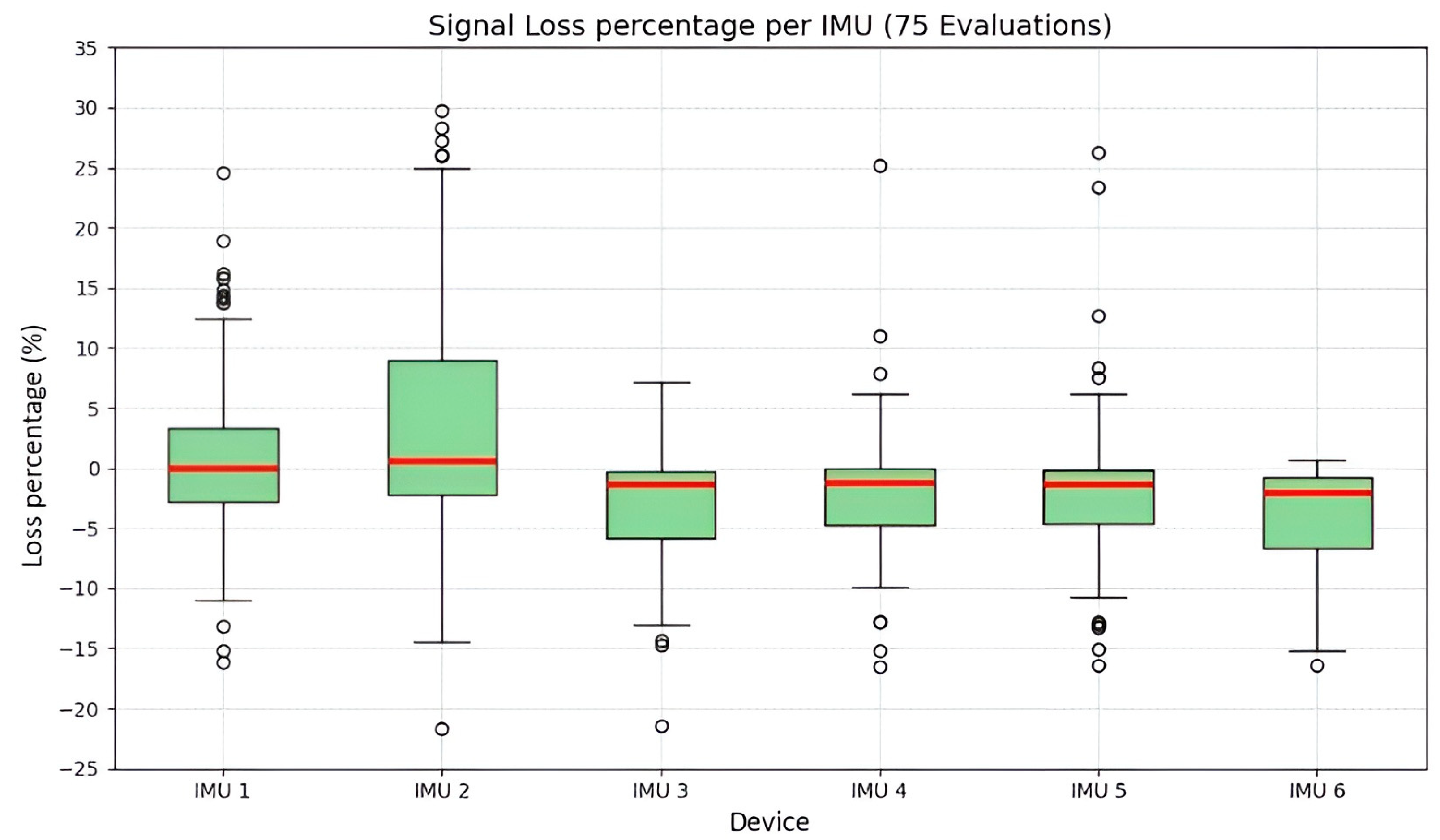
| Device | Mean [%] | Median (Quartile 2) [%] | Interquartile Range (IQR) [%] |
|---|---|---|---|
| IMU 1 | 0.94 | −0.09 | 6.16 |
| IMU 2 | 4.02 | 0.56 | 11.25 |
| IMU 3 | −3.10 | −1.37 | 5.46 |
| IMU 4 | −1.91 | −1.27 | 4.66 |
| IMU 5 | −1.91 | −1.41 | 4.40 |
| IMU 6 | −3.70 | −2.05 | 5.94 |
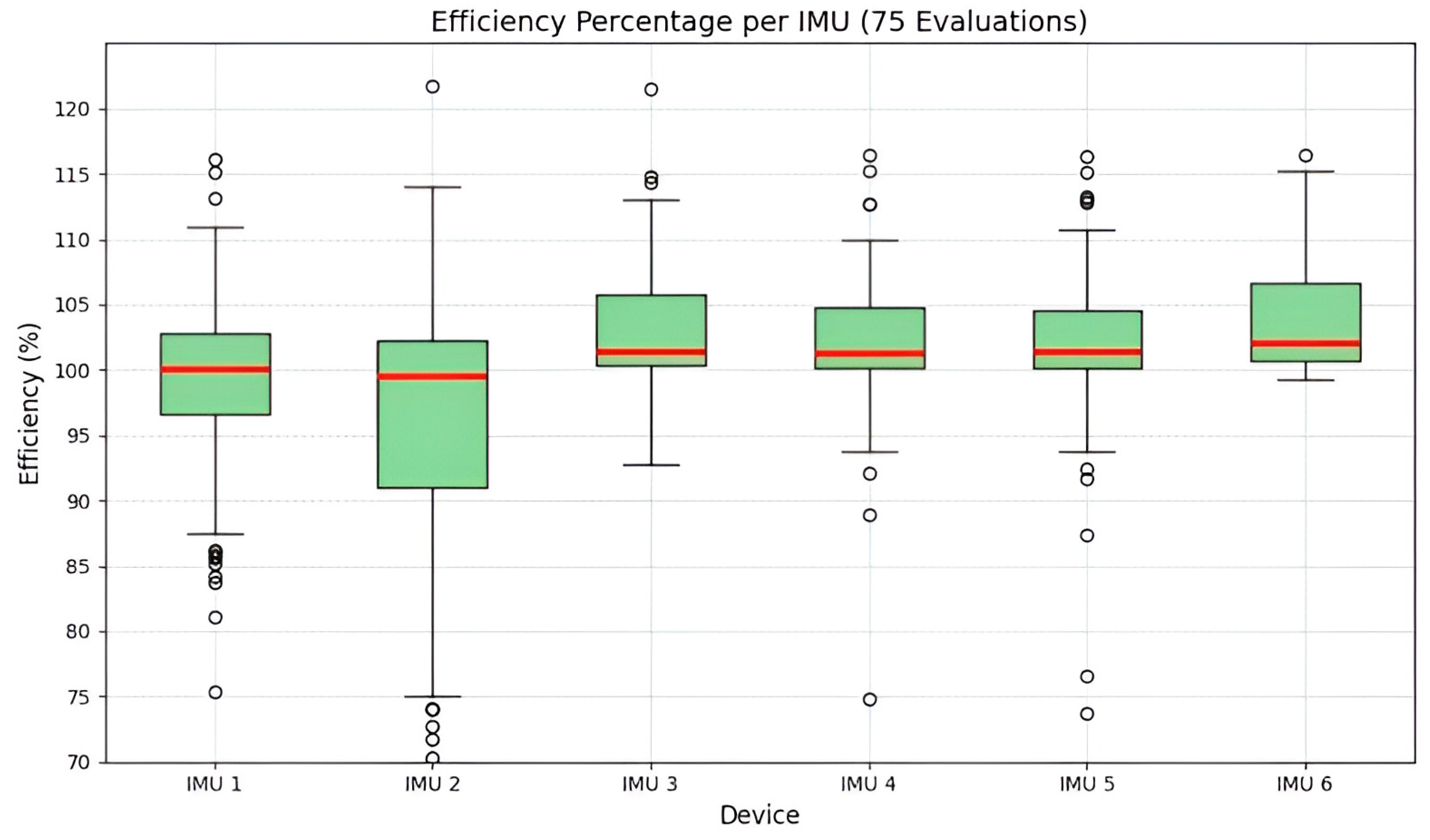
| Device | Mean [%] | Median (Quartile 2) [%] | Interquartile Range (IQR) [%] |
|---|---|---|---|
| IMU 1 | 99.05 | 100.09 | 6.16 |
| IMU 2 | 95.97 | 99.44 | 11.25 |
| IMU 3 | 103.11 | 101.37 | 5.46 |
| IMU 4 | 101.93 | 101.27 | 4.56 |
| IMU 5 | 101.91 | 101.41 | 4.40 |
| IMU 6 | 103.71 | 102.05 | 5.94 |
| Inclusion Criteria | Exclusion Criteria |
|---|---|
| Age: 20–40 years Sex: Male/Female Handedness: Right-handed Sedentary occupation: ≥6 h sitting per day Physical health: No acute musculoskeletal pain in the last 48–72 h. | Non-sedentary individuals History of neurological injuries, musculoskeletal or balance disorders. Inability to follow the experimental instructions or maintain sitting posture. |
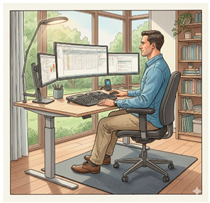
| Experiment 1. Upright Posture While Performing Routine Tasks at Their Computer. | Experiment 2. Slouched Posture, as They Would Normally Adopt After Some Time Due to Discomfort or an Inadequate Chair. | Experiment 3. Reclined Posture, with The Back Leaning Backward and Weight Supported on the Lower Back and Cervical Region. |
|---|---|---|
 |  |  |
| Upper Limb Side | Medium Injury Risk [s] | High Injury Risk [s] | Severe Injury Risk [s] |
|---|---|---|---|
| Left | 153.6 | 137.2 | 9.21 |
| Right | 181.15 | 11.7 | 0.8 |
| Upper Limb Side | Medium Injury Risk [s] | High Injury Risk [s] | Severe Injury Risk [s] |
|---|---|---|---|
| Left | 36.19 | 211.1 | 52.74 |
| Right | 40.42 | 218.73 | 40.77 |
| Upper Limb Side | Medium Injury Risk [s] | High Injury Risk [s] | Severe Injury Risk [s] |
|---|---|---|---|
| Left | 3.1 | 288.65 | 8.19 |
| Right | 5.23 | 284.59 | 10.2 |
| Participant | Upper Limb Injury Risk Assessment | |||||||
|---|---|---|---|---|---|---|---|---|
| Right Side | Left Side | |||||||
| Experiment | Rater | Experiment | Rater | |||||
| 1 | 2 | 3 | 1 | 2 | 3 | |||
| 1 | M | M | H | Expert 1 | M | H | H | Expert 1 |
| M | H | H | Expert 2 | M | H | H | Expert 2 | |
| M | H | H | Expert 3 | M | H | H | Expert 3 | |
| M | H | H | FIS | M | H | H | FIS | |
| 2 | H | H | H | Expert 1 | H | S | H | Expert 1 |
| H | H | H | Expert 2 | H | H | H | Expert 2 | |
| S | S | H | Expert 3 | S | H | H | Expert 3 | |
| H | H | H | FIS | H | H | H | FIS | |
| 3 | M | H | S | Expert 1 | H | H | H | Expert 1 |
| M | H | H | Expert 2 | H | H | H | Expert 2 | |
| M | H | H | Expert 3 | H | H | H | Expert 3 | |
| M | H | H | FIS | H | H | H | FIS | |
| 4 | M | H | H | Expert 1 | M | H | H | Expert 1 |
| M | H | H | Expert 2 | M | H | H | Expert 2 | |
| M | H | H | Expert 3 | M | H | H | Expert 3 | |
| M | H | H | FIS | M | H | H | FIS | |
| Posture | Right Side | Left Side |
|---|---|---|
| 1 | 0.58 | 0.6 |
| 2 | 0.63 | 0.57 |
| 3 | 0.75 | 0.78 |
| Author | Year | IMUs | Technology | Frequency | Bluetooth Version |
|---|---|---|---|---|---|
| Graham R. [50] | 2020 | 2 | HIKOB Fox IMU | 100 Hz | - |
| Tang H. et al. [38] | 2021 | 9 | NGIMU BY x-io Technologies | 50 Hz | - |
| Höglund G. et al. [25] | 2021 | 7 | MoLab, AnyMo AB | 100 Hz | - |
| Veijalainen P. et al. [3] | 2022 | 1 | STMicroelectronics LSM9DS1 | 50 Hz | 5.0 |
| Goreham J. et al. [23] | 2022 | 5 | Notch | 40 Hz | - |
| Digo E. et al. [42] | 2022 | 3 | Xsens MTx | 50 Hz | - |
| Zhang M. et al. [51] | 2022 | 3 | MPU6050 | 100 Hz | 5.0 |
| Sánchez-Fernández L. et al. [6] | 2023 | 6 | - | 50 Hz | - |
| Sánchez-Fernández L. et al. [54] | 2023 | 3 | - | 50 Hz | - |
| Xiang L. et al. [55] | 2024 | 2 | IMeasureU | 100 Hz | - |
| Sánchez-Fernández L. et al. [56] | 2024 | 6 | - | 50 Hz | - |
| Razak H. et al. [57] | 2025 | 2 | Xsens DOTS + Ultrasound (Gator system) | 60 Hz | 5.0 |
| J. McNames et al. [58] | 2025 | 6 | Opal system | 128 Hz | Proprietary ultra-low power 2.4 GHz radio |
| R. A. Kulkarni et al. [59] | 2025 | 9 | Noraxon Ultium Motion | 100 Hz | Proprietary wireless protocol |
Disclaimer/Publisher’s Note: The statements, opinions and data contained in all publications are solely those of the individual author(s) and contributor(s) and not of MDPI and/or the editor(s). MDPI and/or the editor(s) disclaim responsibility for any injury to people or property resulting from any ideas, methods, instructions or products referred to in the content. |
© 2025 by the authors. Licensee MDPI, Basel, Switzerland. This article is an open access article distributed under the terms and conditions of the Creative Commons Attribution (CC BY) license (https://creativecommons.org/licenses/by/4.0/).
Share and Cite
Mora-Sánchez, J.A.; Sánchez-Fernández, L.P.; González-Baldovinos, D.L.; Zagaceta-Álvarez, M.T.; Orantes-Jiménez, S.D. Computer Model Based on an Asynchronous BLE 5.0 IMU Sensor Network for Biomechanical Applications. Sensors 2025, 25, 7271. https://doi.org/10.3390/s25237271
Mora-Sánchez JA, Sánchez-Fernández LP, González-Baldovinos DL, Zagaceta-Álvarez MT, Orantes-Jiménez SD. Computer Model Based on an Asynchronous BLE 5.0 IMU Sensor Network for Biomechanical Applications. Sensors. 2025; 25(23):7271. https://doi.org/10.3390/s25237271
Chicago/Turabian StyleMora-Sánchez, Juan Antonio, Luis Pastor Sánchez-Fernández, Diana Lizet González-Baldovinos, María Teresa Zagaceta-Álvarez, and Sandra Dinora Orantes-Jiménez. 2025. "Computer Model Based on an Asynchronous BLE 5.0 IMU Sensor Network for Biomechanical Applications" Sensors 25, no. 23: 7271. https://doi.org/10.3390/s25237271
APA StyleMora-Sánchez, J. A., Sánchez-Fernández, L. P., González-Baldovinos, D. L., Zagaceta-Álvarez, M. T., & Orantes-Jiménez, S. D. (2025). Computer Model Based on an Asynchronous BLE 5.0 IMU Sensor Network for Biomechanical Applications. Sensors, 25(23), 7271. https://doi.org/10.3390/s25237271