Minimum Platoon Set to Implement Vehicle Platoons in the Internet of Vehicles Environment


Abstract
1. Introduction
- (1)
- We create the Minimum Platoon Set by integrating all the essential platoon-related attributes or data and functions. This Minimum Platoon Set not only fulfills the minimum requirements but also satisfies all essential elements.
- (2)
- We demonstrate the application, universality, and effectiveness of the Minimum Platoon Set through algorithmic implementations and scenario-based validations.
2. The Minimum Platoon Set
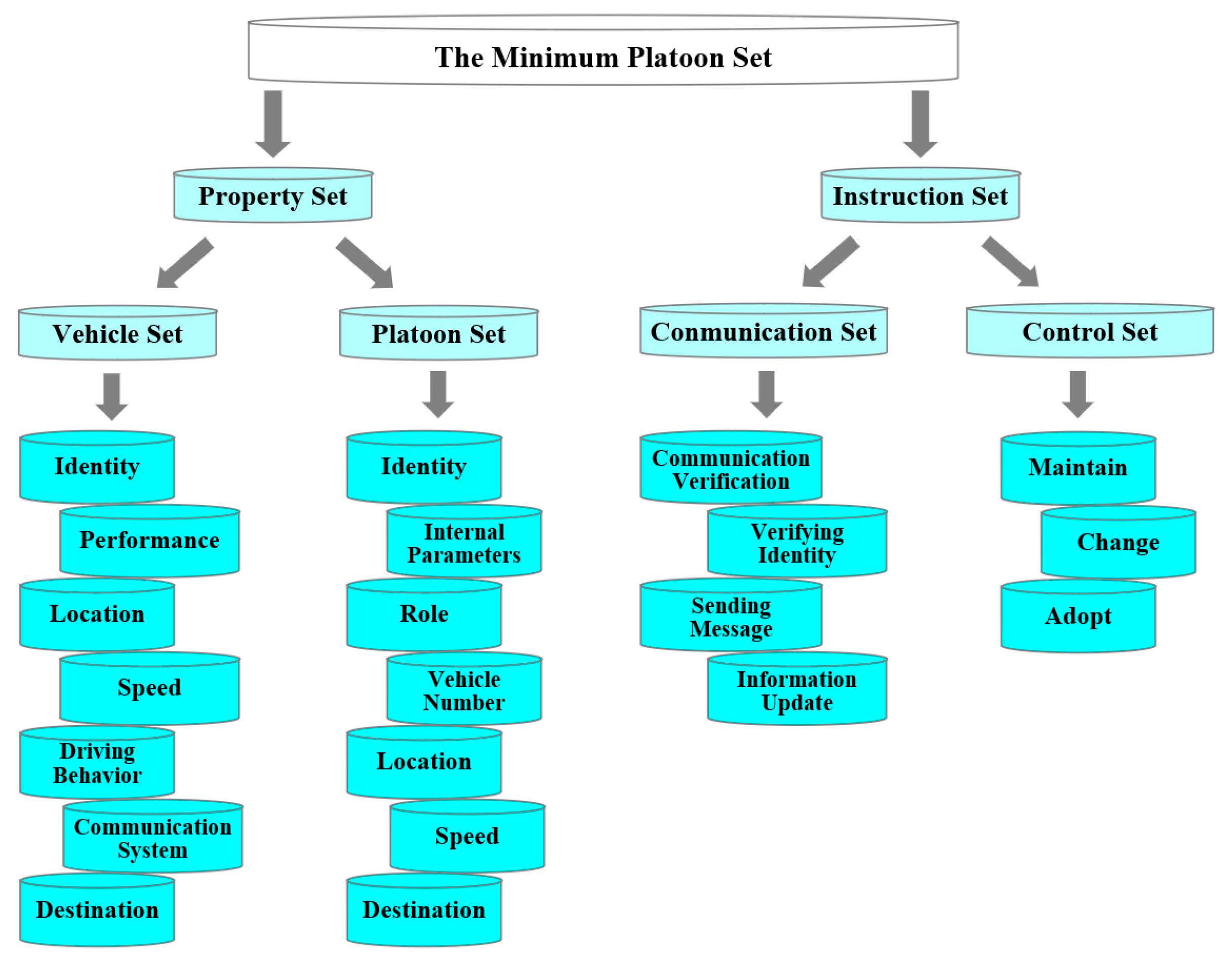
2.1. Vehicle Platoon Property Set
- (1)
- VID (Vehicle ID): The vehicle ID is the unique identifier for connected vehicles accessing the internet. Each vehicle is assigned only one ID, emphasizing the uniqueness of its identity.
- (2)
- VP (Vehicle Performance): The vehicle performance refers to the performance parameters of a vehicle, including maximum acceleration (MA), maximum deceleration (MD), maximum speed (MS), and maximum allowed climbing grade (MG). The detailed specification of VP = [MA, MD, MS, MG].
- (3)
- VL (Vehicle Location): The vehicle location denotes the vehicle’s position on the road, specified by longitude and latitude coordinates. This information is one of the factors influencing the vehicle’s role in the platoon. For the specific vehicle role determination algorithm, see Section 3.
- (4)
- VS (Vehicle Speed): The vehicle speed represents the real-time velocity of a vehicle, which is used for speed synchronization and dynamic adjustments within the vehicle platoon.
- (5)
- MDB (Microscopic Driving Behavior): Microscopic driving behavior encompasses the detailed decisions and maneuvers performed by an individual vehicle during road operation, specifically including acceleration, deceleration, lane changing, and following behaviors.
- (6)
- VCS (Vehicle Communication System): The vehicle communication system represents a vehicle’s capability to communicate with other vehicles and determines whether the vehicle can join or create a platoon. Notably, transmission delay time is a critical performance metric.
- (7)
- VD (Vehicle Destination): The vehicle destination encompasses not only the ultimate destination but also all intermediate routes the vehicle is expected to traverse. Vehicles sharing common route segments can form a platoon. VD influences the choice of control strategy; see Section 3.
- (1)
- PID (Platoon ID): The platoon ID is a unique identifier with a temporary lifespan. It can be assigned in two ways: either by the platoon control center or generated by the platoon leader during platoon formation. Once created, the platoon leader broadcasts it to all platoon followers.
- (2)
- PIP (Platoon Internal Parameters): The platoon internal parameters include the platoon parameter setting (e.g., time headway or space headway). These parameters are subject to multiple constraints depending on operational conditions.
- (3)
- PR (Platoon Role): The platoon role specifies the function a vehicle performs within the platoon. Each vehicle assumes only one role in the platoon, either as the platoon leader or a platoon follower.
- (4)
- PVN (Platoon Vehicle Number): The platoon vehicle number includes two components: the maximum allowable number of vehicles in a platoon (PMN) and the real-time vehicle number in the platoon (RVN). Since the vehicle count is not updated in seconds or milliseconds, it is considered static data. The format of PVN is represented as PVN = [PMN, RVN].
- (5)
- PL (Platoon Location): The platoon location represents the driving position of the platoon, specified by the latitude and longitude coordinates of the platoon leader on the road map. The platoon has two types of location coordinates: absolute coordinates relative to the map (where it can be treated as a point particle) and relative positions within the platoon, with the platoon leader as the reference point. Therefore, each vehicle maintains relative horizontal and longitudinal position data.
- (6)
- PS (Platoon Speed): The platoon speed is defined as a set that encompasses all types of velocities within the platoon or individual vehicles. It consists of two components: first, the platoon’s real-time speed (PRS), acceleration (PAS), and speed limit (PSL); and second, the speed (VS) and acceleration (VAS) of each individual vehicle. The platoon speed limit (PSL) is defined as the minimum speed limit (VSL) among all vehicles in the platoon, ensuring uniform operation. The platoon’s speed characteristics are represented as: PS = [PAS, PSL, PRS], where max-PRS = min{max (VS)}, max-PAS = min{max (VAS)}, and PSL = min(VSL).
- (7)
- PD (Platoon Destination): The current adjacent destination node of the platoon is represented by PD (Platoon Destination). When the platoon arrives at this node, the next adjacent destination will be updated accordingly. Therefore, PD is classified as a dynamic attribute; however, it does not require real-time updating (e.g., at the millisecond level). Instead, it is event-driven, being updated only when the platoon reaches its designated destination node.
2.2. Vehicle Platoon Instruction Set
- (1)
- CV (Communication Verification): The communication verification serves as a fundamental mechanism that enables vehicles or platoons to execute operational instructions. When the vehicles or platoons are “in communication,” they are able to perform coordinated actions for operational transformation. The core functionality of communication verification can be updated at millisecond intervals, ensuring rapid responsiveness in dynamic environments.
- (2)
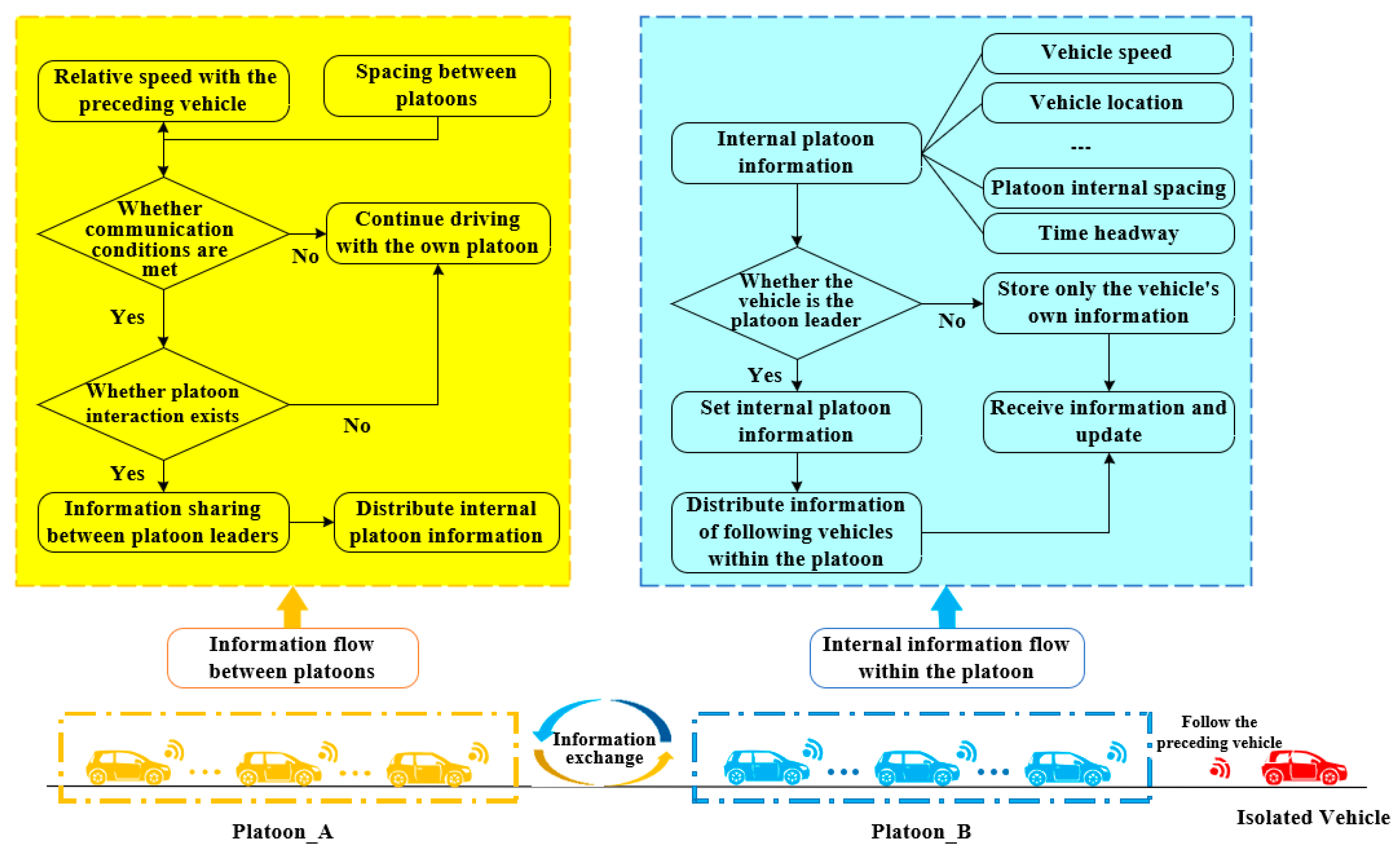
- VI (Verifying Identity): For vehicles, two aspects need to be confirmed. The first is whether the vehicle is the executor when instructions are being transmitted. The second is to determine its role within the platoon (whether it is a platoon leader or a platoon follower). For the platoon, instruction VI is used to select the executor.
- (3)
- SM (Sending the Message): Use the SM instruction to facilitate information transmission. The transmitted information comprises basic property data and instruction data. For instance, the platoon leader transmits a message to the fourth platoon follower, containing the property data “platoon velocity is 60” and the instruction data “maintain.”
- (4)
- IU (Information Update): Within a platoon, information is managed at two levels. The platoon leader maintains the comprehensive data for the entire platoon, while each platoon member retains its own local data. The platoon’s cluster heads update the overall platoon status by incorporating new information shared by other platoon leaders during merge and split operations. Additionally, platoon followers can locally update relevant dynamic data, based either on their direct perceptions or on instructions from the platoon leader (e.g., when cluster head assignments change).
- (5)
- Maintain: When vehicles execute this instruction, their state remains unchanged.
- (6)
- Change: When vehicles execute this instruction, at least one of their states (position, condition, or both) changes.
- (7)
- Adopt: When the platoon selects a formation (or changes platoon parameters) or when the platoon’s status changes, the platoon executes this instruction.
2.3. Using Format of the Vehicle Platoon Set
2.4. Supplementary Information
2.5. Justification of Minimality and Sufficiency
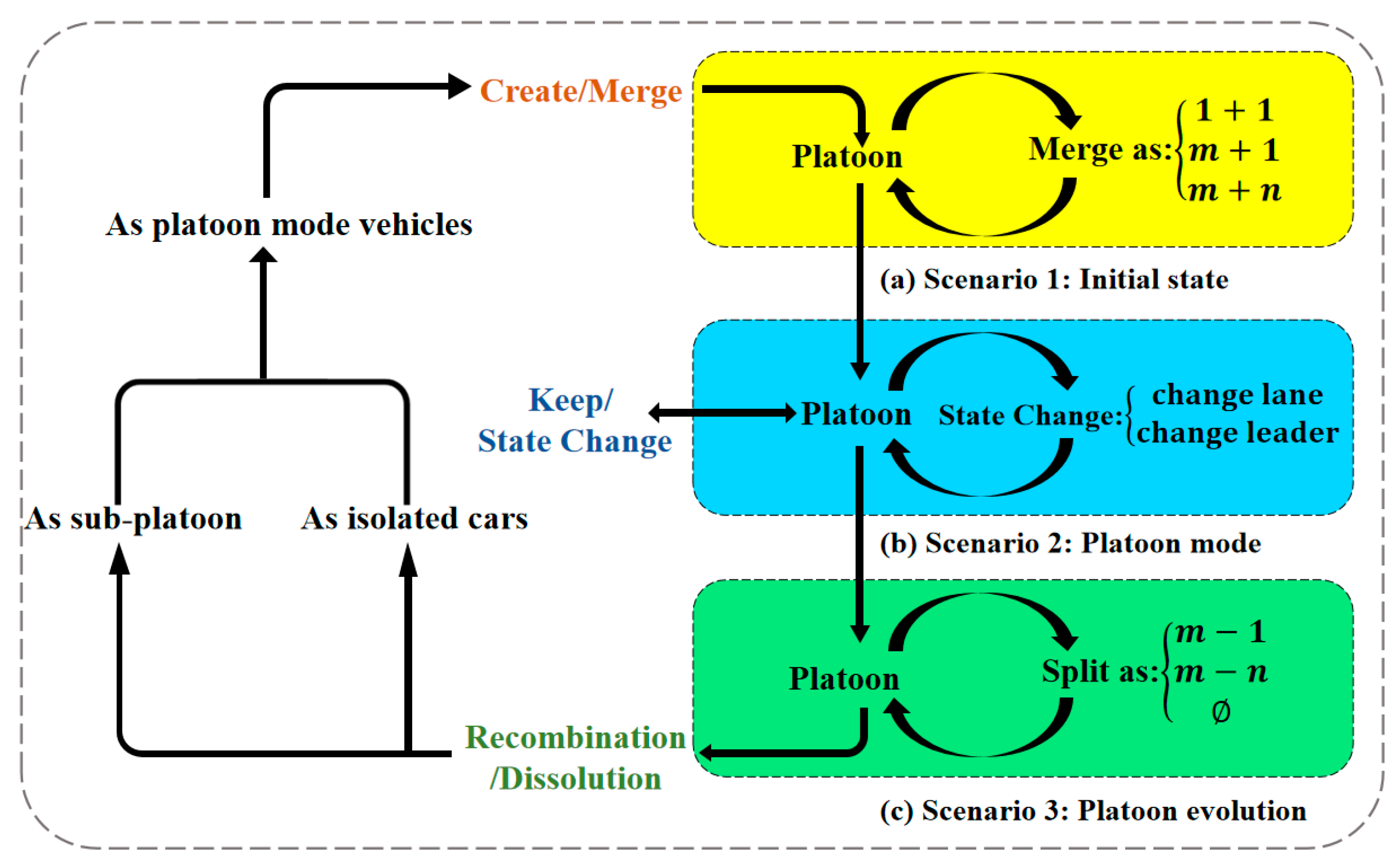
3. Platoon Complete Life Cycle Dynamic Evolution Scenario Demonstration
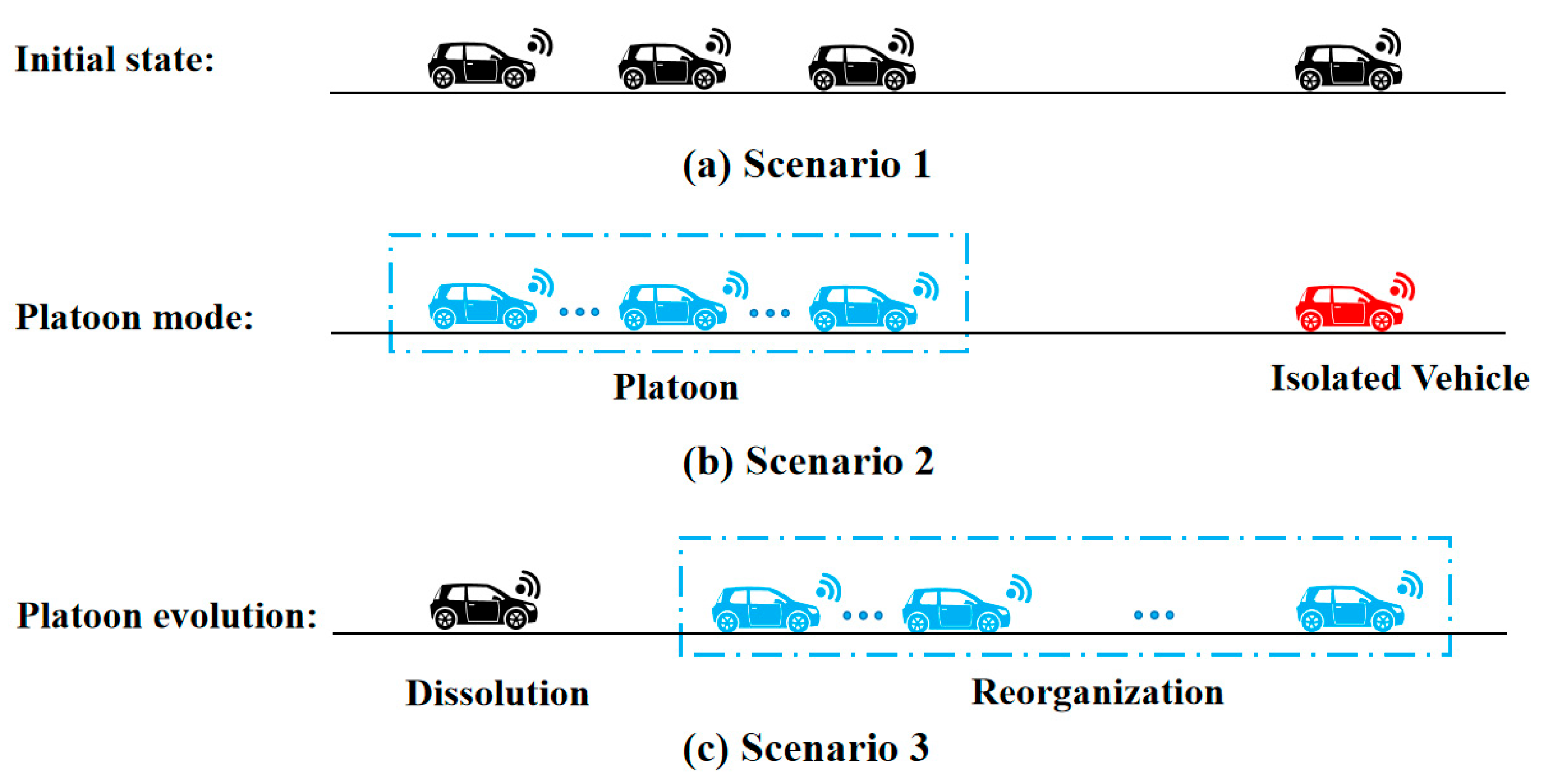
3.1. Timeline: The Complete Life Cycle Scenarios
- (1)
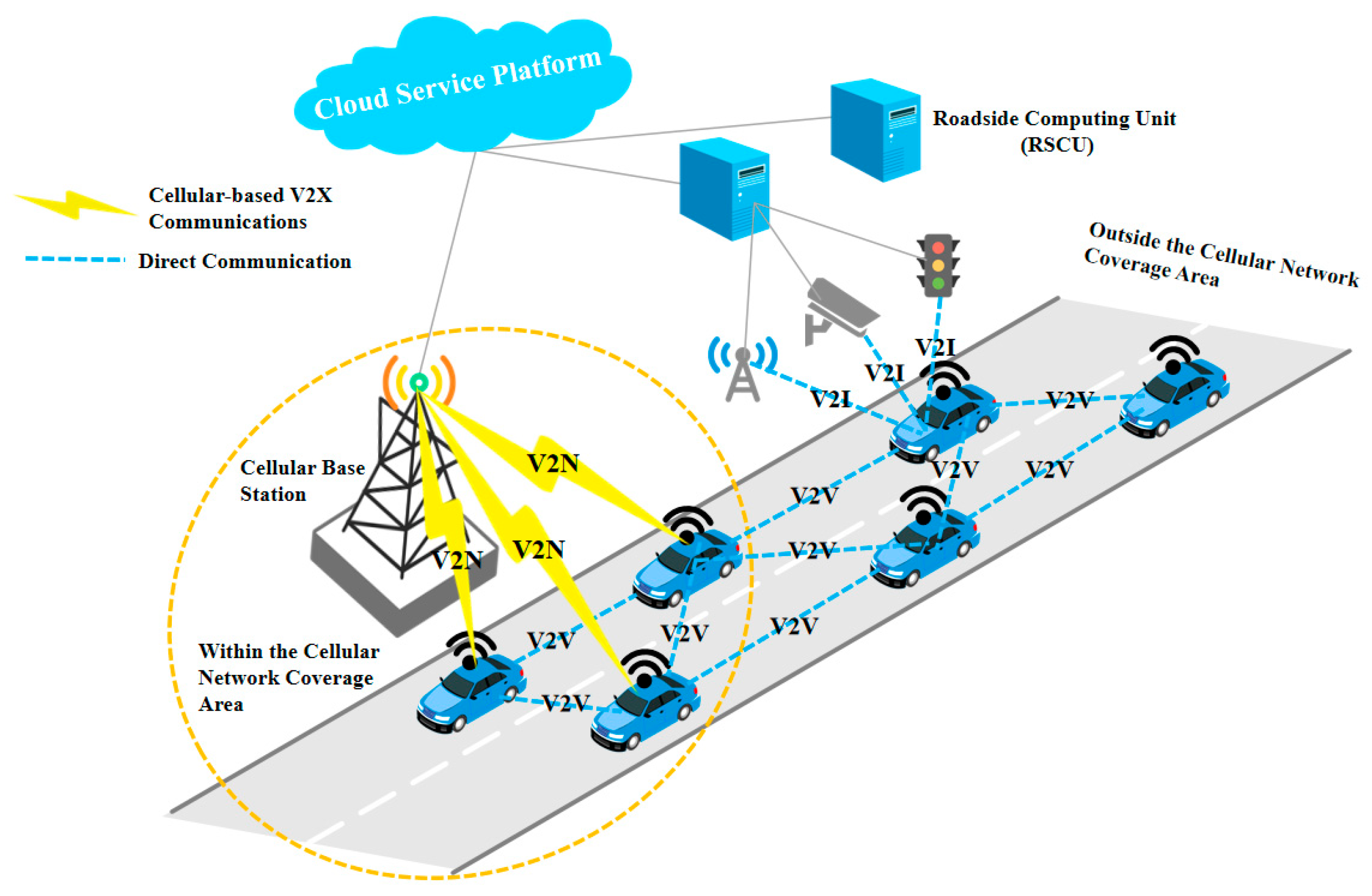
- Vehicles are equipped with Cooperative Adaptive Cruise Control (CACC) functions and can communicate with each other through Vehicular Ad hoc Networks (VANETs) or Roadside Systems (RSSs) with vehicle-to-infrastructure communications.
- (2)
- No dedicated lane exists for vehicle platooning on the road.
- (3)
- All platoons are spontaneously formed on the road, and vehicles in the platoons are not required to have a common destination, ensuring greater applicability.
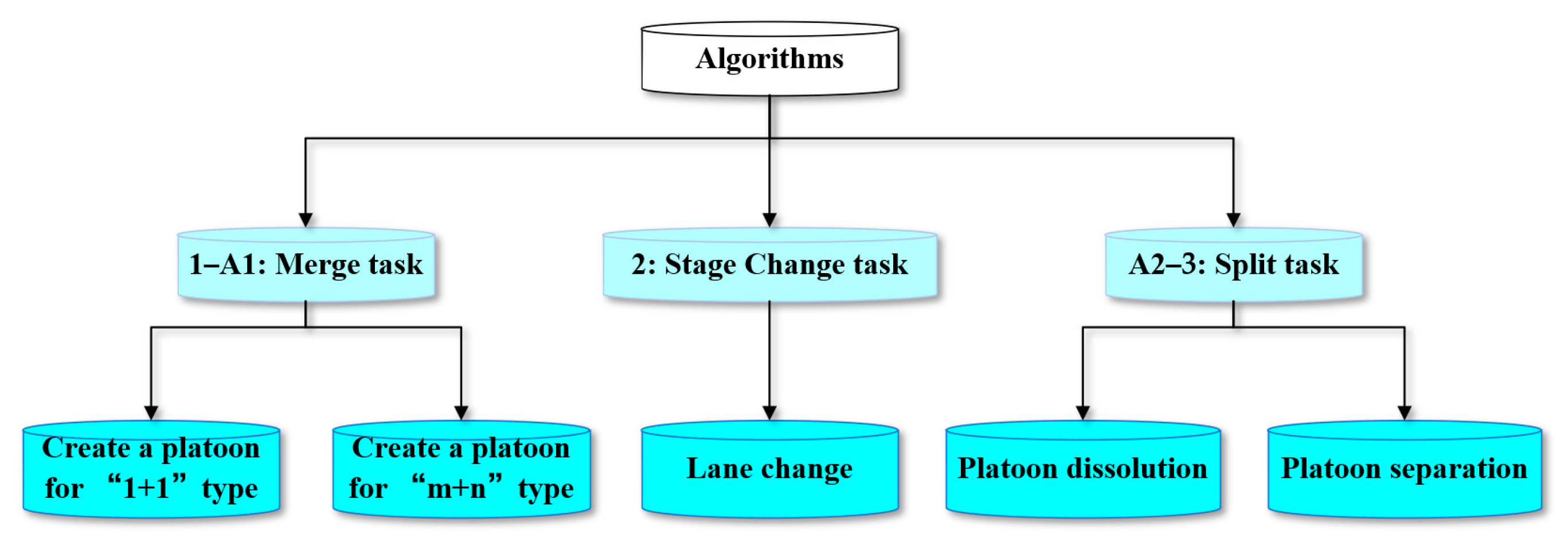
3.2. Taskline: Use Tasks to Achieve Scenario Transformation
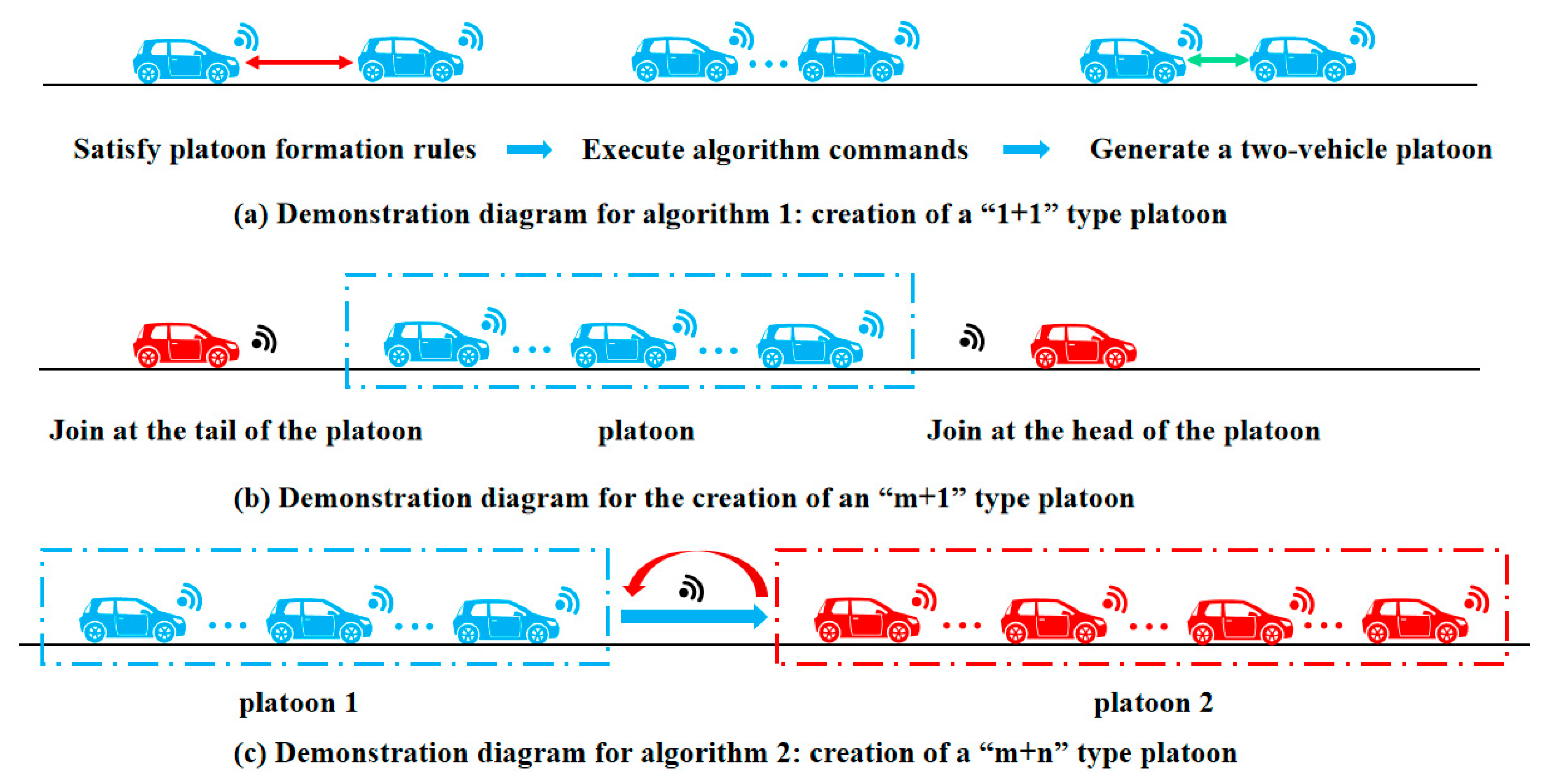
3.3. Algorithm: Protocol Criteria in Platoon Transformation
| Algorithm 1: Create a platoon for the “1+1” type |
 |
| Algorithm 2: Lane change |
 |
| Algorithm 3: Platoon separation |
 |
4. The Application of Minimum Platoon Set in Two Scenarios
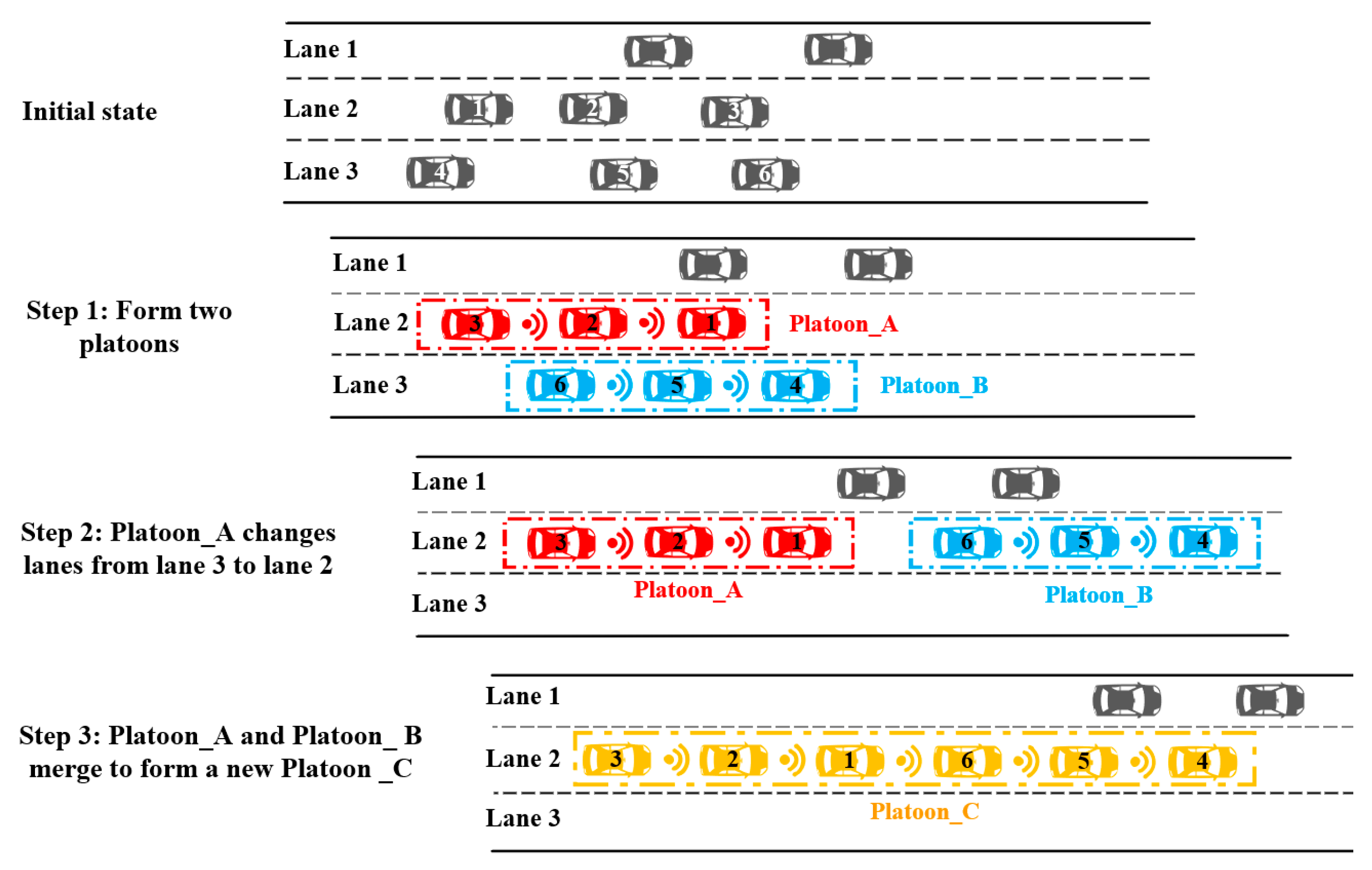
4.1. Scenario 1: Basic Freeway Section
- (1)
- The six vehicles on lanes 2 and 3 have distinct and unique vehicle codes, which are simplified here as 1, 2, 3, 4, 5, and 6.
- (2)
- Assume that all vehicles are equipped with the same Vehicle Communication System (VCS), exhibit similar Microscopic Driving Behavior (MDB), and have the same Vehicle Performance (VP).
- (3)
- All vehicles have predetermined destinations to ensure that vehicles will travel a certain distance as a platoon, namely, , and .
- (4)
- The speeds of vehicles 1 to 6 are 88, 76, 111, 90, 102, and 100 km/h, respectively. The positions of the vehicles are denoted as and .
- (5)
- The platoon set has been created, and the platoon obtains its unique ID (PID) from the roadside system, simplifying Platoon_A and Platoon_B.
- (6)
- The Platoon Internal Parameter (PIP) is set by the platoon leader; for example, the headway is 0.5 s, and so on.
- (7)
- Platoon Role (PR) includes the platoon leader and platoon follower. Assume that Vehicle_1 plays the role of platoon leader of Platoon_A, Vehicle_4 plays the role of platoon leader of Platoon_B, and the rest of the vehicles act as platoon followers. Therefore, Platoon_A’s PR is (1; 2, 3), while Platoon_B’s PR is (4; 5, 6), indicating the roles of the platoon leader and followers within each platoon.
- (8)
- The Platoon Vehicle Number (PVN) is composed of the Platoon Maximum Vehicle Number (PMN) and the Real-time Vehicle Number (RVN). For instance, Platoon_A has a PMN of 8 and an RVN of 3, resulting in a PVN of (8, 3). Similarly, Platoon_B has a PMN of 8 and an RVN of 3, with its PVN also being (8, 3).
- (9)
- The platoon position is determined by the platoon leader. Assume that Platoon_A has the position of , and Platoon_B has the position of .
- (10)
- The Platoon Speed (PS) is composed of the Platoon Acceleration Speed (PAS), Platoon Speed Limit (PSL), and Platoon Real-time Speed (PRS). The platoon’s speed characteristics are represented as: PS = [PAS, PSL, PRS]. In this scenario, the PS of Platoon_A is [2 m/s2, 160 km/h, 90 km/h], and the PS of Platoon_B is [2 m/s2, 160 km/h, 100 km/h].
- (11)
- The platoon destination is not the destination of each vehicle; it is set to guide the platoon and is generally updated in the weaving area or service area.
| Algorithm 4: A algorithm in the basic road section |
 |
4.2. Scenario 2: In an Intersection
- (1)
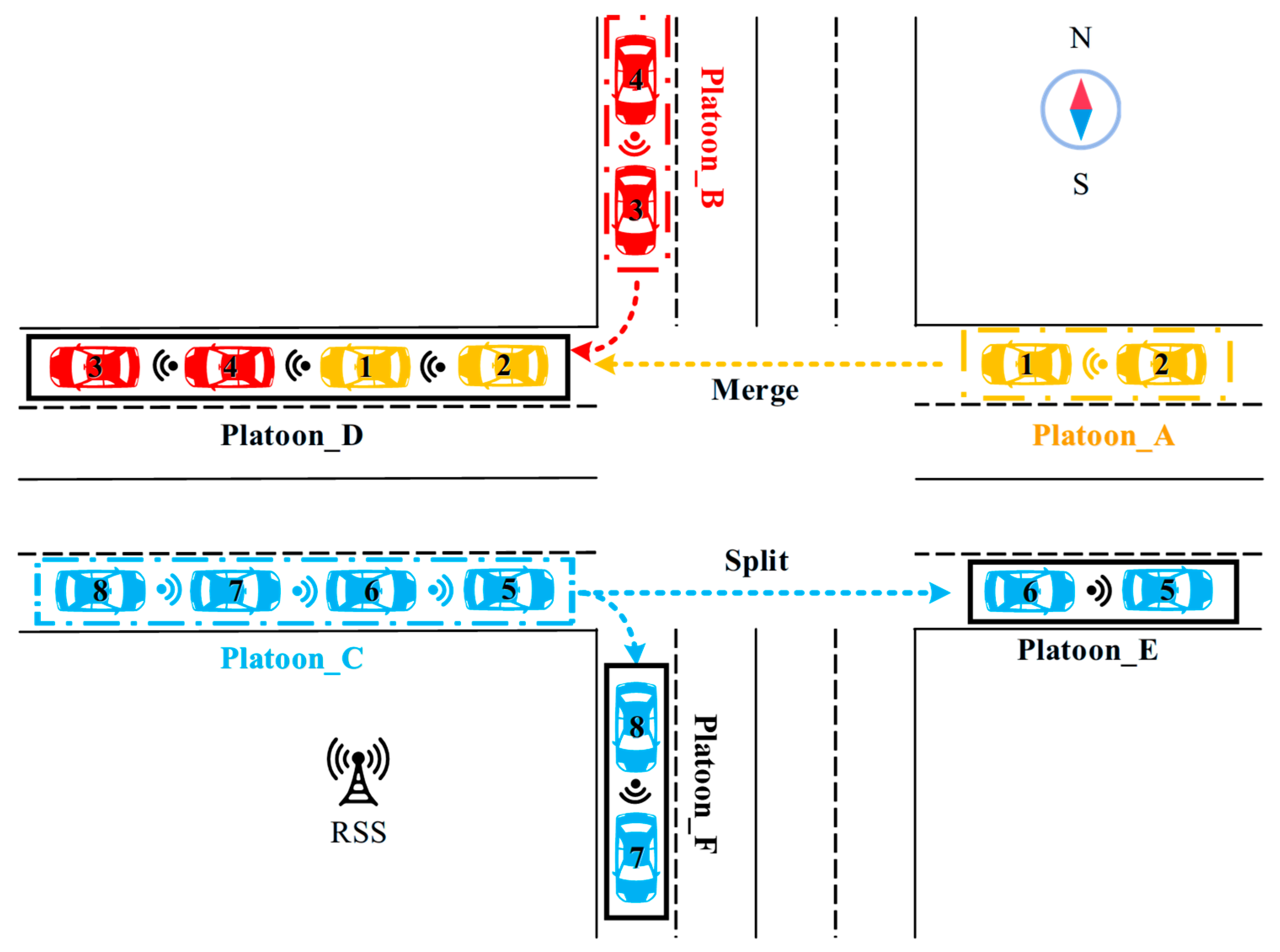
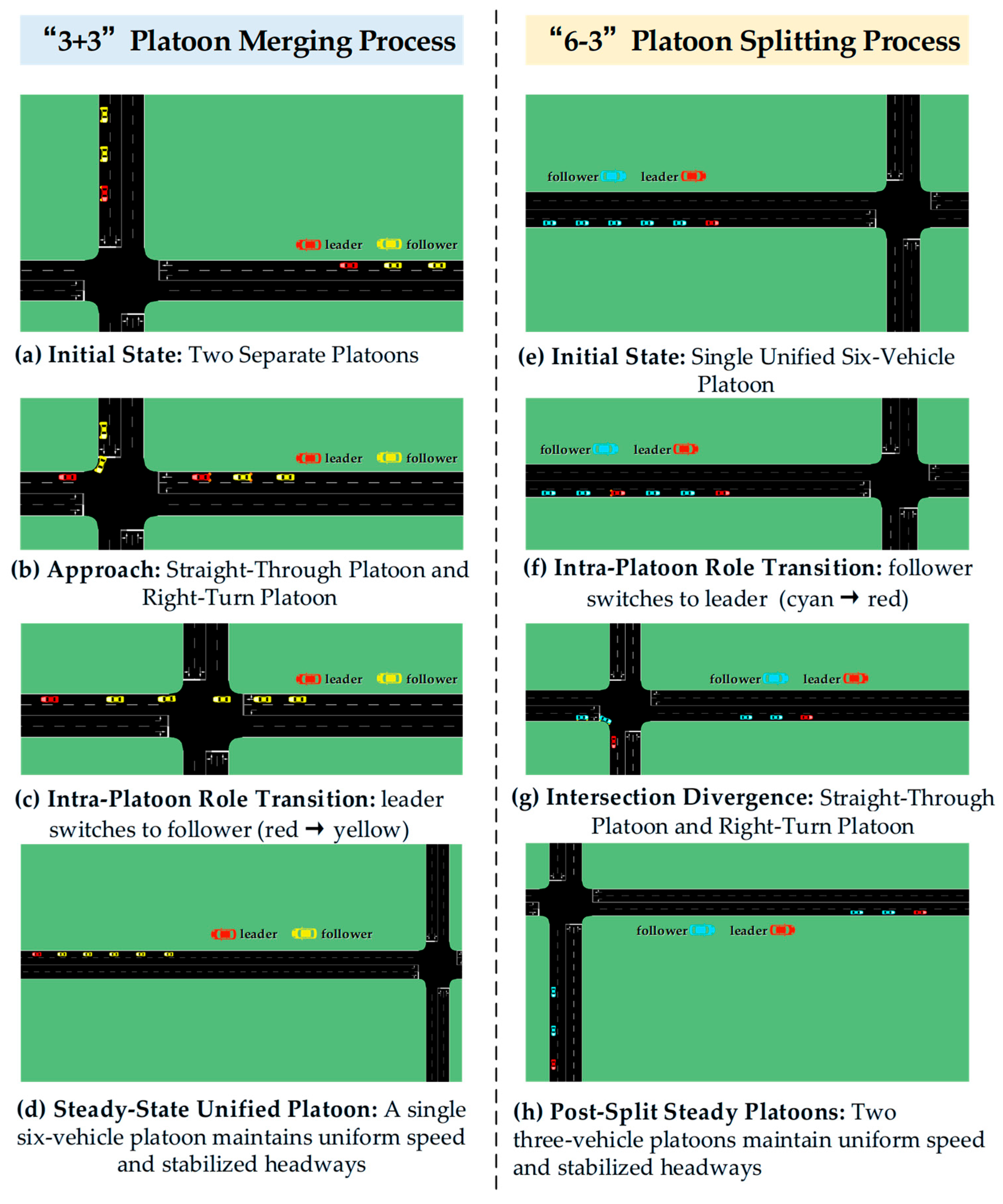
- At the east approach, there are two isolated vehicles with unique IDs (simplified as 1 and 2) and Vehicle Communication System (VCS). The Microscopic Driving Behavior (MDB) is obtained from the Road Side System (RSS), which provides lane-changing or car-following strategies. The speeds of the two vehicles are 48 km/h and 55 km/h, respectively (not exceeding the road speed limit). It is assumed that both vehicles intend to travel straight through the intersection, thus having the same Vehicle Destination (VD). In summary, Vehicle_1 = [1, VP, , 48, MDB, VCS, ] and Vehicle_2 = [2, VP, , 55, MDB, VCS, ].
- (2)
- Two vehicles form Platoon_A, with a 2-m space headway, where Vehicle_1 serves as the platoon leader, so the Platoon Role (PR) of Platoon_A is (1; 2). The Platoon Maximum Vehicle Number (PMN) is assumed to be 8, and the Real-time Vehicle Number (RVN) is 2, so the Platoon Vehicle Number (PVN) of Platoon_A is (8, 2). The intersection speed limit is 50 km/h. Therefore, Platoon_A = [A, 2, (1; 2), (8, 2), , 50, ].
| Algorithm 5: A comprehensive algorithm in the intersection |
 |
4.3. Experimental Validation
5. Conclusions and Future Directions
Author Contributions
Funding
Institutional Review Board Statement
Informed Consent Statement
Data Availability Statement
Conflicts of Interest
Appendix A
| Algorithm A1: Create a platoon for the “m + n” type |
 |
Appendix B
| Algorithm A2: Platoon dissolution |
 |
References
- Balador, A.; Bazzi, A.; Hernandez-Jayo, U.; de la Iglesia, I.; Ahmadvand, H. A survey on vehicular communication for cooperative truck platooning application. Veh. Commun. 2022, 35, 100460. [Google Scholar] [CrossRef]
- Wang, Y.; Ning, W.; Zhang, S.; Yu, H.; Cen, H.; Wang, S. Architecture and key terminal technologies of 5G-based internet of vehicles. Comput. Electr. Eng. 2021, 95, 107430. [Google Scholar] [CrossRef]
- Oughton, E.J.; Lehr, W.; Katsaros, K.; Selinis, I.; Bubley, D.; Kusuma, J. Revisiting Wireless Internet Connectivity: 5G vs Wi-Fi 6. Telecommun. Policy 2021, 45, 102127. [Google Scholar] [CrossRef]
- Zhang, H.; Lu, X. Vehicle communication network in intelligent transportation system based on Internet of Things. Comput. Commun. 2020, 160, 799–806. [Google Scholar] [CrossRef]
- Yi, H. A secure blockchain system for Internet of Vehicles based on 6G-enabled Network in Box. Comput. Commun. 2022, 186, 45–50. [Google Scholar] [CrossRef]
- Song, M.; Chen, F.; Ma, X. Organization of autonomous truck platoon considering energy saving and pavement fatigue. Transp. Res. Part D Transp. Environ. 2021, 90, 102667. [Google Scholar] [CrossRef]
- Li, Y.; Tang, C.; Li, K.; He, X.; Peeta, S.; Wang, Y. Consensus-Based Cooperative Control for Multi-Platoon Under the Connected Vehicles Environment. J. Intell. Transp. Syst. 2019, 20, 2220–2229. [Google Scholar] [CrossRef]
- Lakshmanan, V.K.; Sciarretta, A.; el Ganaoui-Mourlan, O. Cooperative Eco-Driving of Electric Vehicle Platoons for Energy Efficiency and String Stability. IFAC-PapersOnLine 2021, 54, 133–139. [Google Scholar] [CrossRef]
- Bhoopalam, A.K.; Agatz, N.; Zuidwijk, R. Planning of truck platoons: A literature review and directions for future research. Transp. Res. Part B Methodol. 2018, 107, 212–228. [Google Scholar] [CrossRef]
- Javed, M.A.; Muram, F.U.; Punnekkat, S.; Hansson, H. Safe and secure platooning of Automated Guided Vehicles in Industry 4.0. J. Syst. Archit. 2021, 121, 102309. [Google Scholar] [CrossRef]
- Ma, K.; Wang, H.; Ruan, T. Analysis of road capacity and pollutant emissions: Impacts of Connected and automated vehicle platoons on traffic flow. Phys. A 2021, 583, 126301. [Google Scholar] [CrossRef]
- Maiti, S.; Winter, S.; Kulik, L.; Sarkar, S. Ad-hoc platoon formation and dissolution strategies for multi-lane highways. J. Intell. Transp. Syst. 2023, 27, 161–173. [Google Scholar] [CrossRef]
- Liu, R.; Ren, Y.; Yu, H.; Li, Z.; Jiang, H. Connected and automated vehicle platoon maintenance under communication failures. Veh. Commun. 2022, 35, 100467. [Google Scholar] [CrossRef]
- Milanés, V.; Shladover, S.E. Modeling cooperative and autonomous adaptive cruise control dynamic responses using experimental data. Transport. Res. Part C Emerg. Technol. 2014, 48, 285–300. [Google Scholar] [CrossRef]
- Quadri, C.; Mancuso, V.; Marsan, M.A.; Rossi, G.P. Edge-based platoon control. Comput. Commun. 2022, 181, 17–31. [Google Scholar] [CrossRef]
- Scholte, W.J.; Zegelaar, P.W.A.; Nijmeijer, H. A control strategy for merging a single vehicle into a platoon at highway on-ramps. Transp. Res. Part C Emerg. Technol. 2022, 136, 103511. [Google Scholar] [CrossRef]
- Timmerman, R.W.; Boon, M.A.A. Platoon forming algorithms for intelligent street intersections. Transp. A Transp. Sci. 2021, 17, 278–307. [Google Scholar] [CrossRef]
- Luo, Q.; Li, J.; Zhang, H. Drag coefficient modeling of heterogeneous connected platooning vehicles via BP neural network and PSO algorithm. Neurocomputing 2022, 484, 117–127. [Google Scholar] [CrossRef]
- Feng, Y.; He, D.; Guan, Y. Composite Platoon Trajectory Planning Strategy for Intersection Throughput Maximization. IEEE Trans. Veh. Technol. 2019, 68, 6305–6319. [Google Scholar] [CrossRef]
- Wu, Y.; Wang, D.Z.W.; Zhu, F. Influence of CAVs platooning on intersection capacity under mixed traffic. Phys. A 2022, 593, 126989. [Google Scholar] [CrossRef]
- Shiomi, Y.; Yoshii, T.; Kitamura, R. Platoon-based traffic flow model for estimating breakdown probability at single-lane expressway bottlenecks. Transp. Res. Part B Methodol. 2011, 45, 1314–1330. [Google Scholar] [CrossRef]
- Firoozi, R.; Zhang, X.; Borrelli, F. Formation and reconfiguration of tight multi-lane platoons. Control Eng. Pract. 2021, 108, 104714. [Google Scholar] [CrossRef]
- Mu, C.; Du, L.; Zhao, X. Event triggered rolling horizon based systematical trajectory planning for merging platoons at mainline-ramp intersection. Transp. Res. Part C Emerg. Technol. 2021, 125, 103006. [Google Scholar] [CrossRef]
- Alam, A.; Gattami, A.; Johansson, K.H.; Tomlin, C.J. Guaranteeing safety for heavy duty vehicle platooning: Safe set computations and experimental evaluations. Control Eng. Pract. 2014, 24, 33–41. [Google Scholar] [CrossRef]
- Maiti, S.; Winter, S.; Kulik, L. A conceptualization of vehicle platoons and platoon operations. Transp. Res. Part C Emerg. Technol. 2017, 80, 1–19. [Google Scholar] [CrossRef]
- Xin, Q.; Fu, R.; Ukkusuri, S.V. Safe and sub-optimal CAV platoon longitudinal control protocol accounting for state constraints and uncertain vehicle dynamics. J. Franklin Inst. 2022, 359, 7866–7892. [Google Scholar] [CrossRef]
- Xiong, X.; Sha, J.; Jin, L. Optimizing coordinated vehicle platooning: An analytical approach based on stochastic dynamic programming. Transp. Res. Part B Methodol. 2021, 150, 482–502. [Google Scholar] [CrossRef]
- Bergenhem, C.; Huang, Q.; Benmimoun, A.; Robinson, T. Challenges of platooning on public motorways. In Proceedings of the 17th World Congress on Intelligent Transport Systems, Busan, South Korea, 25–29 October 2010; pp. 1–12. [Google Scholar]
- Atmaca, U.I.; Maple, C.; Epiphaniou, G.; Dianati, M. A privacy-preserving route planning scheme for the Internet of Vehicles. Ad Hoc Networks 2021, 123, 102680. [Google Scholar] [CrossRef]
- Abolfazli, E.; Besselink, B.; Charalambous, T. Reducing time headway in platoons under the MPF topology in the presence of communication delays. IFAC-PapersOnLine 2020, 53, 15267–15274. [Google Scholar] [CrossRef]
- Bang, I.; Kim, J.H.; Kim, T. Physical-layer security enhancement using artificial noise for D2D communication in vehicular platooning networks. ICT Express 2022, 8, 600–605. [Google Scholar] [CrossRef]
- Davis, L.C. Optimal merging into a high-speed lane dedicated to connected autonomous vehicles. Phys. A 2020, 555, 124743. [Google Scholar] [CrossRef]
- Chen, C.; Wang, J.; Xu, Q.; Wang, J.; Li, K. Mixed platoon control of automated and human-driven vehicles at a signalized intersection: Dynamical analysis and optimal control. Transp. Res. Part C Emerg. Technol. 2021, 127, 103138. [Google Scholar] [CrossRef]



| Permission | CV | VI | SM | IU | Maintain | Change | Adopt |
|---|---|---|---|---|---|---|---|
| Follower | ○ | Verify | To leader | ○ | * | * | * |
| Leader | ○ | Assignment | To followers | ○ | ○ | ○ | ○ |
| Information Sharing | VID | VP | VL | VS | MDB | VCS | VD |
|---|---|---|---|---|---|---|---|
| To platoon leader | √ | √ | √ | √ | √ | √ | √ |
| To another follower | √ | × | √ | × | × | √ | × |
| Update Cycle | PID | PIP | PR | PVN | PL | PS | PD |
|---|---|---|---|---|---|---|---|
| Real-time | F | F | F | F | T | T | F |
| State change | T | T | T | T | F | F | T |
| Ref. | Research Field (Type) | Main Elements/Function | Mapping of Property Set | Explanation |
|---|---|---|---|---|
| [14] | CACC (Cooperative Adaptive Cruise Control) | Lead vehicle/ Preceding vehicle | In the platoon set (Platoon Role) | Referring to the same thing. |
| [16] | Platoon control strategy | Speed/Acceleration/Distance/Time gap | In the platoon set (Platoon Internal Parameters/Platoon Speed) | It is extracted and summarized in this article. |
| [26] | Platoon control strategy | Platoon length/ Platoon speed/ Platoon acceleration/ Platoon gap | In the platoon set (Platoon Vehicle Number/Platoon Internal Parameters/Platoon Speed) | A property that can be substituted or derived. |
| [15] | Platoon control strategy | OBU (On-Board Unit)/CACC (Cooperative Adaptive Cruise Control) | In both the platoon and vehicle sets | Synthetic properties or formulas can be calculated and deduced by two sets. |
| [27] | Stochastic platooning strategy | Coordination strategy/ Optimal policy | In both the platoon and vehicle sets | Synthetic properties or formulas can be calculated and deduced by two sets. |
| [19,23] | Research on the specific scenario | Platoon attribute matrix/Trajectory | In vehicle set | “Time step” is added to the instruction set. |
| [18] | Platoon model/algorithm | Vehicle model/Platoon Configurations | In vehicle set (Vehicle Performance/Vehicle Location) | A parameter about model fit is not an essential element of the functional implementation of the vehicle platoon. |
| Ref. | Core Functionality | Classification | Involved Instruction | Achievement |
|---|---|---|---|---|
| [28] | Creation/Join/Maintain/Dissolution | Control set | All | Y |
| [29] | Route planning system | Communication set | All | Y |
| [30] | MPF Topology | Communication set | All | Y |
| [31] | D2D transmission | Communication set | SM (Sending the Message) and IU (Information Update) | Y |
| [32] | Platoon merge on-ramp | Control set | All | Y |
| [33] | Platoon mode in an intersection | Control set | All | Y |
| [12] | Platoon formation and dissolution in multi-lane highways | Control set | All | Y |
| Information Element | Essential Function(s) Requiring This Element | Consequence of Removal |
|---|---|---|
| VID | Vehicle identification in all operations | Cannot distinguish individual vehicles |
| VP | Leader selection, performance matching | Cannot assess compatibility or assign roles |
| VL | Spatial relationship determination, formation feasibility | Cannot determine relative positions or proximity |
| VS | Speed synchronization, platoon stability | Cannot coordinate velocities |
| MDB | Behavior prediction, safety assessment | Cannot anticipate vehicle actions |
| VCS | Communication capability verification | Cannot establish information exchange |
| VD | Route compatibility verification | Cannot ensure shared trajectory segments |
| PID | Platoon identity in multi-platoon scenarios | Cannot distinguish between platoons |
| PIP | Intra-platoon control parameters | Cannot maintain formation consistency |
| PR | Role assignment and authority management | Cannot organize hierarchical structure |
| PVN | Capacity constraint verification | Cannot prevent overloading |
| PL | Platoon positioning and navigation | Cannot locate platoon as an entity |
| PS | Platoon-level speed coordination | Cannot manage collective motion |
| PD | Destination-based platoon planning | Cannot plan route-dependent operations |
| Parameter | Value | Parameter | Value |
|---|---|---|---|
| Vehicle length | 5 m | Maximum acceleration | 3.0 m/s2 |
| Maximum space headway | 15 m | Maximum deceleration | 3.5 m/s2 |
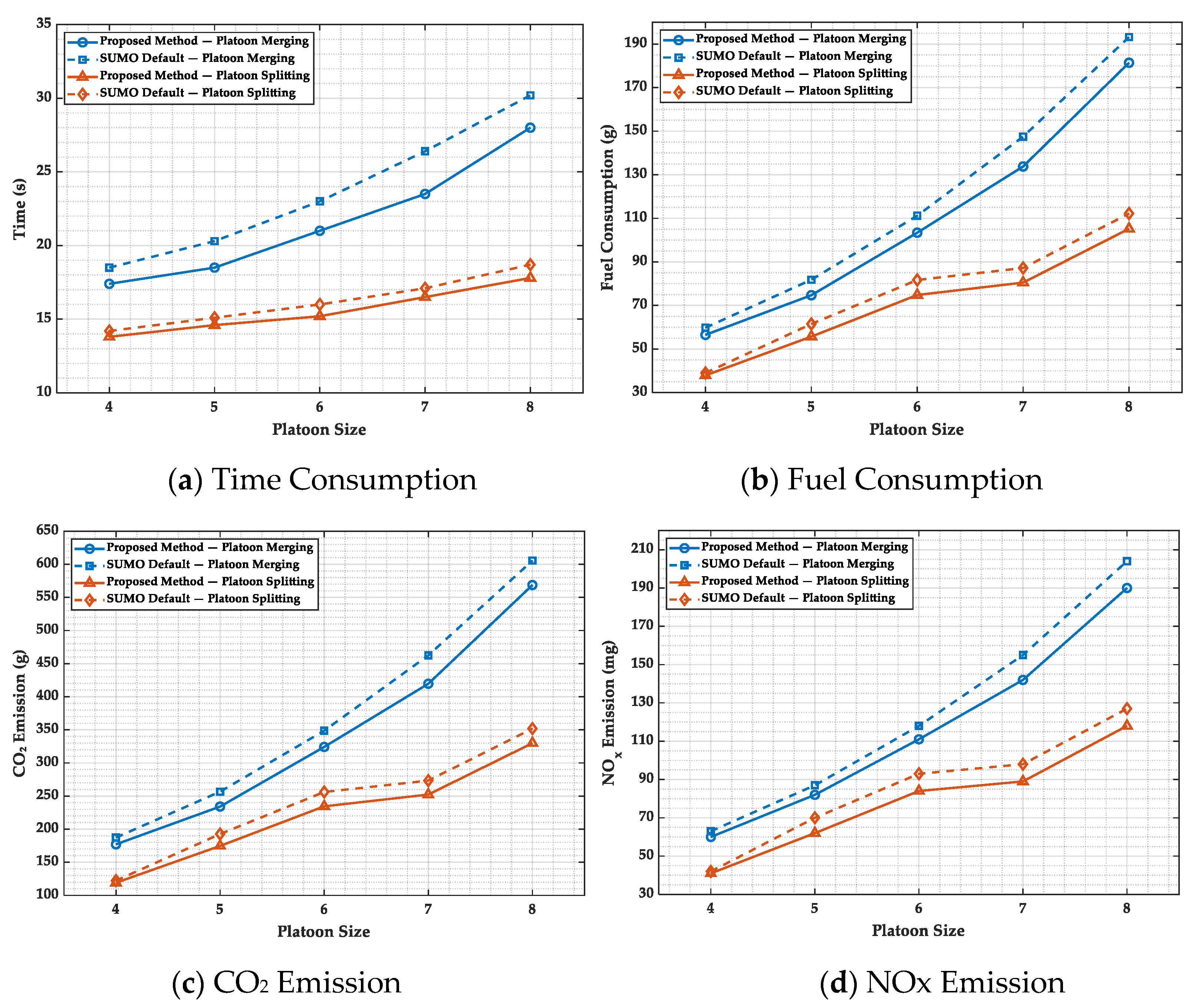
| Minimum time headway | 0.5 s | Maximum platoon size | 8 Vehicles |
| Minimum safe distance | 2.5 m | Maximum speed | 13 m/s |
| Platoon Size | Platoon Merging | Platoon Splitting |
|---|---|---|
| 4 | 2 + 2 | 4 − 2 |
| 5 | 2 + 3 | 5 − 2 |
| 6 | 3 + 3 | 6 − 3 |
| 7 | 3 + 4 | 7 − 3 |
| 8 | 4 + 4 | 8 − 4 |
Disclaimer/Publisher’s Note: The statements, opinions and data contained in all publications are solely those of the individual author(s) and contributor(s) and not of MDPI and/or the editor(s). MDPI and/or the editor(s) disclaim responsibility for any injury to people or property resulting from any ideas, methods, instructions or products referred to in the content. |
© 2025 by the authors. Licensee MDPI, Basel, Switzerland. This article is an open access article distributed under the terms and conditions of the Creative Commons Attribution (CC BY) license (https://creativecommons.org/licenses/by/4.0/).
Share and Cite
Li, H.; Liu, X.; Han, Z. Minimum Platoon Set to Implement Vehicle Platoons in the Internet of Vehicles Environment. Sensors 2025, 25, 7066. https://doi.org/10.3390/s25227066
Li H, Liu X, Han Z. Minimum Platoon Set to Implement Vehicle Platoons in the Internet of Vehicles Environment. Sensors. 2025; 25(22):7066. https://doi.org/10.3390/s25227066
Chicago/Turabian StyleLi, Haijian, Xing Liu, and Zonglin Han. 2025. "Minimum Platoon Set to Implement Vehicle Platoons in the Internet of Vehicles Environment" Sensors 25, no. 22: 7066. https://doi.org/10.3390/s25227066
APA StyleLi, H., Liu, X., & Han, Z. (2025). Minimum Platoon Set to Implement Vehicle Platoons in the Internet of Vehicles Environment. Sensors, 25(22), 7066. https://doi.org/10.3390/s25227066