1. Introduction
The proliferation of Unmanned Aerial Vehicles (UAVs) in multi-agent systems has unlocked new possibilities across a wide range of applications, including environmental monitoring, disaster response, precision agriculture, and intelligent logistics [
1,
2,
3,
4,
5]. The use of heterogeneous UAVs—teams composed of agents with diverse capabilities (e.g., some equipped for sensing, others for carrying out specific actions)—offers enhanced flexibility, robustness, and efficiency compared to homogeneous swarms [
6,
7,
8,
9]. However, effectively coordinating these heterogeneous assets to perform complex, multi-stage missions in dynamic environments remains a significant challenge. The core of this challenge lies in solving the dynamic task allocation problem: assigning the right agent to the right task at the right time to maximize overall mission success [
10,
11,
12,
13,
14]. To manage the complexity of these missions, researchers often model them as a sequence of dependent sub-tasks, frequently termed a “Task Execution Chain” [
15,
16].
Current research on UAV task allocation often falls into two primary categories, each with inherent limitations in addressing complex, multi-stage missions.
The first category focuses on solving single-stage assignment problems, treating sensing and effecting as isolated sub-problems. For instance, significant work has been performed on optimizing sensor coverage [
17] or assigning effector UAVs to specific targets [
18,
19,
20]. While these methods are effective for their designated tasks, they inherently fail to optimize the end-to-end mission workflow. They overlook the critical dependencies between stages—for example, how an initial, high-quality sensor assignment can dramatically increase the probability of success for a subsequent effector action. This compartmentalized approach prevents the system from achieving true synergistic collaboration.
The second category employs general-purpose optimization algorithms—such as genetic algorithms [
12,
21,
22], particle swarm optimization, or reinforcement learning [
23,
24,
25,
26,
27]—to solve the allocation problem holistically. Although powerful, these approaches often treat the problem as a “black box.” They lack a tailored conceptual structure that explicitly models the multi-stage dependencies and synergistic effects between heterogeneous agents. Consequently, the potential for emergent collaboration is handled implicitly rather than being a core component of the problem formulation, often leading to computationally expensive searches and sub-optimal resource allocation.
This review of the state of the art reveals a critical gap: the absence of a unified, hierarchical framework that can systematically model the entire mission workflow and translate high-level strategic goals into an optimized, low-level operational plan. This paper bridges this gap by proposing a novel hierarchical framework. We refine and formalize the general concept of a “Task Execution Chain” into our structured Mission Chain (MC), which serves as the strategic backbone for modeling and optimizing. Our framework decomposes a mission into a three-level hierarchy: the Mission Chain (MC), which defines the overall strategic workflow; the Execution Path (EP), representing a specific combination of agents capable of completing the mission for a single target; and the Execution Task (ET), which represents the fundamental action performed by an individual agent, such as ‘sensor S1 tracks target T2’ or ‘effector E3 services target T2’. This structure provides a clear and scalable way to manage mission complexity.
The primary contributions of this work are threefold:
1. The introduction of a formal hierarchical framework (MC-EP-ET) that systematically models complex, multi-stage tasks, providing a structured and scalable foundation for coordinating heterogeneous UAV teams.
2. The formulation of a Sensor–Effector–Target Assignment (S-ETA) model, a novel mathematical programming approach that captures the unique challenge of assigning specialized sensor and effector agents to maximize total expected mission value [
28,
29].
3. The development of an efficient Marginal Return-Based Heuristic Algorithm (MRBHA), specifically designed to solve the S-ETA problem by quantitatively evaluating and capitalizing on the synergistic contributions of each potential sensor–effector–target triad.
Collectively, these contributions provide an end-to-end solution that bridges the gap between high-level mission strategy and low-level agent execution, enabling a more intelligent and synergistic allocation of resources than previously achievable with disconnected or black-box methods.
The remainder of this paper is organized as follows.
Section 2 introduces the complete hierarchical framework, from the Mission Chain to the Solution Space.
Section 3 conceptualizes the operational scenario and defines the abstract problem.
Section 4 details the S-ETA mathematical programming model and its constraints.
Section 5 presents the proposed MRBHA in detail.
Section 6 describes the experimental setup, presents the assignment and comparative results, and provides an in-depth analysis of the algorithm’s performance. Finally,
Section 7 provides concluding remarks and discusses future research directions.
2. The Hierarchical Mission Chain Framework
This section introduces a conceptual framework for modeling complex, multi-stage autonomous missions. Inspired by the need for structured coordination in multi-agent systems, our work systematically defines and standardizes a hierarchical “Mission Chain” concept. We analyze the core components and logical connections at each level of this hierarchy using structured methods. The result is a unified theoretical framework for addressing dynamic targets in complex operational environments. This framework provides essential theoretical support for enhancing the synergistic performance of multi-agent systems and improving the robustness of automated decision-making.
2.1. The Mission Chain
Definition 1: Mission Chain (MC). A Mission Chain is a logical sequence of phases required to successfully service a single target. Mathematically, it is defined as an ordered set of mission tasks (
):
In this equation, represents the Mission Chain, denotes the ith operational phase, and n is the total number of sequential phases required to complete the mission for that target.
As demonstrated in
Figure 1, the structure of a Mission Chain is adaptable to specific application requirements. For example, a time-critical search-and-rescue mission might employ a concise six-phase sequence: (1) area search, (2) point of interest localization, (3) object classification, (4) task prioritization, (5) action execution (e.g., payload delivery), and (6) outcome verification. In contrast, a persistent environmental monitoring mission might utilize a more extensive eight-phase protocol, including continuous surveillance, anomaly detection, data collection, and long-term tracking. This tailored approach allows the framework to accommodate diverse mission objectives and environmental constraints through modular phase adjustments.
The probability
of a successful mission for a given
MC is the product of the success probabilities of its constituent phases:
In this equation, represents the probability of success for phase . The MC structure is inherently sequential, requiring each phase to be completed successfully before the next can be initiated.
It is assumed here that the success of each mission phase is a probabilistically independent event. This is a common simplification for initial framework development to ensure model tractability. Future extensions could incorporate conditional probabilities to model dependencies between phases.
2.2. The Execution Path
Definition 2: Execution Path (EP). An Execution Path is a specific instantiation of a Mission Chain, where each phase of the chain is assigned to a concrete set of agents. While the Mission Chain defines what needs to be done, the Execution Path defines who does it and how. It maps the abstract sequence of tasks to specific system resources (agents, sensors, effectors) over time. Its mathematical definition is a sequence of pairs:
where
is a pair representing that mission phase
is executed by the agent set
.
is the set of one or more agents (e.g., UAVs, ground stations) assigned to phase
. Agents can be platforms, personnel, or equipment. T represents the single, specific target being addressed by the entire Execution Path.
To make the distinction intuitive, one can use a simple analogy: if the Mission Chain (MC) is a generic recipe for baking a cake (e.g., “mix ingredients, bake, frost”), then an Execution Path (EP) is that specific recipe being carried out by a particular person using specific tools (e.g., “Chef John uses a KitchenAid mixer, bakes in a Bosch oven, and frosts with a Wilton spatula”). The MC is the ‘what,’ and the EP is the ‘who’ and ‘how.’
A schematic diagram illustrating the Execution Path concept is presented in
Figure 2. The diagram shows how a single Mission Chain (top bar) can be realized by different combinations of available agents (left box). The green path represents a potential primary EP, utilizing a preferred set of agents. The gray paths represent alternative EPs, which provide system redundancy and adaptability by assigning tasks to other available agents. Each node on a path signifies a specific agent performing a specific phase of the mission, visually mapping the collaborative workflow from start to finish.
The probability of successful execution for a given EP, denoted as
is the product of the conditional success probabilities for each phase:
where
is the probability of successfully completing phase
with the assigned agent set
for target T. The analysis of an EP’s viability involves several key factors:
(1) Probabilistic Success: The overall success of an EP is inherently probabilistic, depending on the reliability and performance of the assigned agents in each phase.
(2) Resource Allocation: Each EP represents a unique allocation of the system’s finite resources. The optimization goal is often to find the EP with the highest probability of success for a given resource cost.
(3) Temporal Constraints: An EP is only viable if the cumulative time to execute all its phases meets the mission’s temporal requirements, especially for time-sensitive targets.
(4) Coordination and Communication: A valid EP requires robust communication links between agents to facilitate information flow, such as passing target coordinates from a sensor agent to an effector agent.
2.3. The Task Network
Definition 3: Task Network (TN). A Task Network represents the complete set of all viable Execution Paths for servicing a single target. It encapsulates the system’s total collaborative capacity and all possible ways to address one specific target, given the available resources. The mathematical definition is:
where
is the Task Network for a specific target T and m is the total number of unique, valid EPs available for that target.
A TN can be conceptualized as a network composed of all feasible EPs for a given target. This construct allows for a systematic analysis of different collaborative strategies, enabling the selection of the most efficient path based on criteria such as success probability or resource cost. As illustrated in
Figure 3, the Task Network for a target is formed by the connections between all relevant system assets. In this example, S1 and S2 are sensor platforms, E1, E2, and E3 are effector platforms, C1 is a communication node, and D1 is a decision-making module. The entire web of connections represents the TN, while a single path through it (e.g., from a sensor to an effector to the target T1) constitutes one EP.
2.4. The Mission Plan
Definition 4: Mission Plan (MP). A Mission Plan is a specific, conflict-free set of Execution Paths selected to service multiple targets simultaneously. According to this definition, its mathematical notation can be expressed as:
where
represents the specific Execution Path chosen to service target T
i and s is the total number of targets being serviced in the plan.
An
MP represents a comprehensive course of action for the entire system. It enables agents to reuse resources across different Execution Paths, thereby leveraging synergistic benefits. As shown in
Figure 4, an MP composed of three distinct Execution Paths is presented. These paths are used to handle targets T1, T2, and T3, respectively. The figure illustrates how multiple platforms can be involved in different EPs. For instance, the communication platform C1 and decision-making platform D1 support all three paths, while sensor S1 contributes to the EPs for both T1 and T2, demonstrating efficient resource sharing.
The process of constructing a valid MP involves the following key steps:
(1) Resolving Resource Conflicts: Ensure that no agent is assigned to more than one task simultaneously, or that any resource sharing is explicitly managed.
(2) Determining Temporal Relationships: When resources are reused across different EPs, establish the sequential order in which tasks should be performed to respect operational constraints.
2.5. The Solution Space
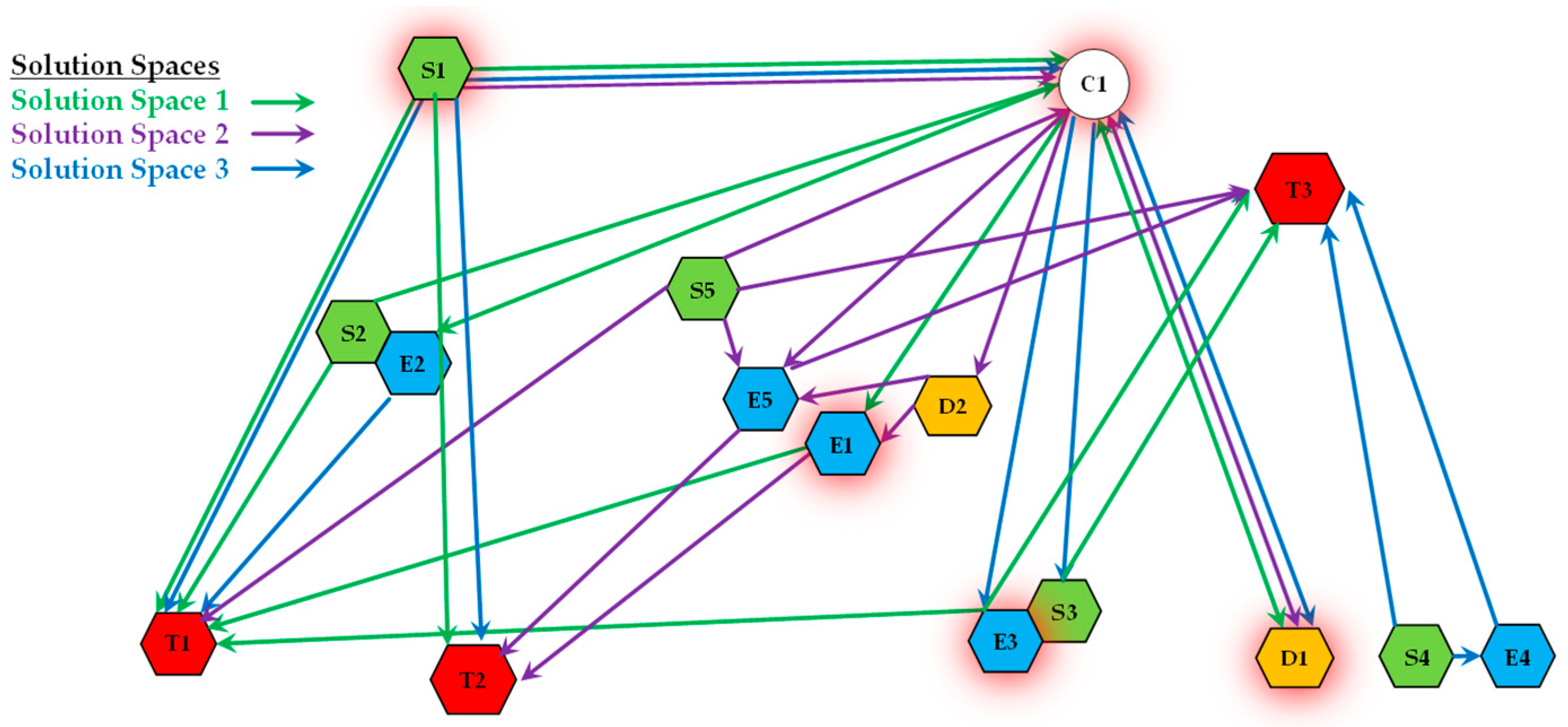
Definition 5: Solution Space (SS). The Solution Space is the collection of all feasible Mission Plans in a given operational environment. It represents the entirety of the system’s potential strategies for addressing all identified targets. The Solution Space can be formally expressed as:
where
represents the Solution Space, and
denotes the ith feasible Mission Plan. In some cases, if the missions are independent and do not share resources, the overall Solution Space can be viewed as the union of several independent sub-spaces:
Figure 5 provides a visual representation of a Solution Space. In this diagram, nodes represent operational resources (e.g., sensors, effector agents) and targets. The paths in different colors (e.g., red, green, blue) each represent a distinct Mission Plan for accomplishing a set of tasks. Critically, we can observe that some resource nodes are shared by multiple paths (i.e., multiple MPs). This visualization clearly illustrates the core concept of a Solution Space: a complex web of overlapping and interconnected mission plans that draw from a common pool of resources.
2.6. System-of-Systems Operational Webs
Definition 6: System-of-Systems Operational Webs (SoSOWs). A System-of-Systems Operational Web is the collection of all Solution Spaces from multiple, potentially independent, operational systems that are coordinated at a higher level. An SoSOW facilitates the optimal allocation of resources across different systems to achieve broader, collaborative objectives. It enables the integration of diverse systems, assets, and resources within a large-scale operational environment. The mathematical definition is expressed as:
where
denotes the Solution Space for operational subsystem
i.
Building a System-of-Systems Operational Web involves the following key principles:
(1) Integration of Multiple Solution Spaces: Integrating dispersed Solution Spaces from heterogeneous systems to form a unified and interconnected operational network.
(2) Cross-Domain Synergy: Ensuring that resources and capabilities from multiple operational domains (e.g., aerial, ground, maritime) can be synergized to achieve complex, multi-domain objectives.
(3) High-Level Resource Optimization: Optimizing the allocation of high-value or shared resources across different systems to support the efficient operation of the entire System-of-Systems.
In summary, the complete hierarchical framework developed in this paper is shown in
Figure 6.
3. Operational Scenario Conceptualization
3.1. Scenario Description
To validate our proposed framework, we define a dynamic multi-agent tasking scenario, as conceptually illustrated in
Figure 7. In this scenario, a heterogeneous fleet of Unmanned Aerial Vehicles (UAVs) is deployed to monitor a designated operational area. The objective is to detect, identify, and respond to a series of time-sensitive events or tasks that appear dynamically within this area.
The UAV fleet consists of two specialized types of agents:
(1) Sensor Agents (S): Reconnaissance UAVs (e.g., RUAS) equipped with advanced sensors to perform search, localization, and tracking of emergent tasks.
(2) Effector Agents (E): UAVs equipped to perform a specific action to “service” a task. This action could be delivering an emergency payload, collecting a specific data sample, or neutralizing a localized hazard.
The operational environment also contains critical infrastructure, including the following:
(1) Decision-Making Nodes (D): Ground stations or command modules responsible for processing sensor data and running optimization algorithms to generate Mission Plans.
(2) Communication Infrastructure (C): A network of relays and satellites ensuring robust data links between all agents and nodes.
(3) Tasks/Targets (T): Time-sensitive events that require servicing, each with an associated priority or value.
This scenario represents a classic dynamic Sensor–Effector–Target Assignment (SETA) problem, where the core challenge is to optimally allocate sensor and effector resources to maximize the total value of completed tasks in real-time.
It is important to clarify the platform context for this scenario. While the hierarchical framework itself is platform-agnostic, the S-ETA mathematical model and the assumptions underlying our simulation (e.g., agents being readily assignable to tasks without complex trajectory constraints) are most directly applicable to multirotor UAV platforms. These platforms, such as quadcopters or hexacopters, possess the ability to hover, perform vertical take-offs and landings (VTOL), and exhibit high maneuverability within a constrained operational area. This makes them well-suited for the dynamic “stop-and-stare” sensing and precise effector tasks modeled in our problem, whereas fixed-wing platforms would introduce additional complexities like minimum airspeed and turning radii that are considered outside the scope of this particular study.
3.2. Network Representation of the Scenario
The operational scenario can be modeled as a dynamic graph, as shown in
Figure 8. Each entity—sensor, effector, decision node, communication link, and target—is represented as a node in the network. The edges between nodes represent potential interactions, such as information flow, command-and-control relationships, or resource dependencies.
For example, a sensor node S can be connected to a target node T to represent a detection or tracking action. An effector node E connects to a target node T to represent a task servicing action. Both S and E nodes are connected to decision D and communication C nodes, which are essential for coordinated operations. The goal of the system is to form effective Execution Paths (e.g., S→D→E→T) that constitute a globally optimal Mission Plan within the Solution Space.
3.3. Abstract Problem Formulation
Assuming the decision-making (D) and communication (C) infrastructure provides real-time support, the core problem simplifies to forming Mission Chains by optimally matching sensor agents to targets and effector agents to the same targets.
Therefore, the operational concept is abstracted in
Figure 9. A fleet of S sensor agents is tasked with discovering and tracking T dynamic targets. Guided by the information provided by the sensors, the system must then assign E effector agents to service these targets. The agents are distributed throughout the operational area. The fundamental challenge is to solve this Sensor–Effector–Target Assignment problem to maximize mission effectiveness. For simplicity in our model, we will henceforth refer to the reconnaissance platforms as sensors and the task-servicing platforms as effectors.
4. The S-ETA Mathematical Programming Model
Given the time-sensitive nature of the tasks and the narrow window of opportunity for execution, a centralized assignment approach is adopted. Each incoming target has an associated value, and multiple sensors and effector agents can be assigned to a single target. However, each sensor can only track a single target at a time, and each effector agent can only service a single target at a time.
Denote the sensor–target assignment scheme (STA scheme) as , where is the STA variable (, ) for the th sensor and the th target, and if the th sensor is assigned to the th target, and otherwise.
Denote
to denote the (Effector Agent -target assignment scheme) ETA scheme, where
is the ETA variable (
) with respect to the
th Effector Agent and the
th target, and
if the
th Effector Agent is assigned to the
th target, otherwise
. For clarity, a comprehensive list of all symbols and their descriptions is provided in
Appendix A (
Table A1).
Based on the definitions above, the S-ETA optimization problem is formally stated as follows:
The objective function, derived from Equation (10), seeks to maximize the sum of expected values across all targets. The constraints are defined as follows: Constraint (C1) and (C2) ensure that each sensor and effector agent are assigned to at most one target. Constraints (C3) and (C4), limit the maximum number of agents that can be cooperatively assigned to a single target based on its priority (vk). Finally, (C5) defines the decision variables as binary.
The formulation of our objective function relies on an OR fusion rule for calculating group success probability (i.e., one minus the product of individual failure probabilities). This choice is fundamentally motivated by the operational nature of the tasks in our scenario. A mission phase, such as tracking or servicing a target, is typically deemed successful if at least one of the assigned agents succeeds. For instance, a target is considered successfully tracked if just one sensor maintains a stable track lock, and it is considered serviced if at least one effector successfully completes its action.
An alternative AND fusion rule, which would require all assigned agents to succeed simultaneously (), would be overly restrictive and unrealistic for this application. It would fail to model the redundancy and collaborative enhancement that multi-agent assignment is intended to provide. Similarly, a majority rule would not be appropriate, as it would undervalue the critical contribution of a single, highly capable agent whose individual success should be sufficient to complete the task. Therefore, the OR fusion rule most accurately reflects the desired collaborative outcome in our S-ETA problem.
5. The Proposed MRBHA
5.1. Supporting Decision Matrix
In a dynamic multi-agent system, sensor and effector agents can be flexibly combined to form Execution Paths. A key challenge is representing the assignment of a sensor–effector–target triad. To facilitate this, we introduce a three-dimensional ternary matrix as an auxiliary decision matrix.
Here,
if the specific triad (sensor i, effector j, target k) is selected for an Execution Path, and
otherwise. This matrix provides a granular view of the complete assignment plan. The original binary decision matrices, Y (sensor–target) and Z (effector–target), can be directly derived from X, as shown in Equation (11).
Equation (11) illustrates how the binary assignment matrices are derived from X. Specifically, is set to 1 if sensor i is assigned to target k as part of any triad (i.e., for any effector j). Similarly, is set to 1 if effector agent j is assigned to target k (with any sensor i).
5.2. Constraint Processing
To ensure that the generated solutions adhere to the resource constraints, we introduce several auxiliary variables to track resource utilization. To manage constraints (C1) and (C2), which limit each agent to one task, we use the usage count vectors N
s and N
e. To manage constraints (C3) and (C4), which limit the number of agents per target, we use the target assignment count vectors
and
. These variables are formally defined in Equation (12).
During the iterative allocation process, these constraint variables guide the algorithm according to the following rules:
(1) Once a sensor i is assigned (i.e., when ), it is removed from the set of available sensors for subsequent assignments.
(2) Similarly, once an effector agent j is assigned (i.e., when ), it is removed from the set of available effectors.
(3) Once a target k reaches its maximum sensor capacity (i.e., when ), it is no longer considered for further sensor assignments.
(4) Once a target k reaches its maximum effector capacity (i.e., when ), it is no longer considered for further effector assignments.
5.3. Marginal Return Calculation
To solve the S-ETA mathematical programming model, this paper adopts the concept of “marginal return,” a principle borrowed from economics. In this context, the marginal return of a sensor–effector–target triad is the additional increase to the objective function (Total Expected Value) gained by adding that single assignment to the current plan.
The marginal return for every potential triad is calculated and stored in a matrix
. The element
represents the marginal return of adding the specific triad
to the current allocation scheme. It is computed as shown in Equation (13):
where the terms are defined as follows:
represents the current expected value of servicing target k before the new triad is added.
represents the potential new expected value of servicing target k after the triad (i, j, k) is included.
is the marginal return, calculated as the difference between the potential and current expected values.
is the probability that the group of sensors currently assigned to target k fails to achieve successful tracking.
is the probability that the group of effector agents currently assigned to target k fails to service it successfully.
The pseudo-code of the designed algorithm is presented in Algorithm 1.
| Algorithm 1 MRBHA |
Input: S, E, T, V, P, Q, mk, nk
Output: X, Y, Z, J(Y, Z)
1: // Initialization
2: X, Y, Z ← Initialize with zeros
3: Ns, Ne, NTS, NTE ← Initialize with zeros
4: for each target k ∈ T do
5: Pmis(k) ← 1
6: Qmis(k) ← 1
7: end for
8: CandidateTriples ← Generate all possible (i, j, k) triads
9: // Main Iterative Loop
10: while CandidateTriples is not empty do
11: max δ ← -∞
12: besttriad ← null
13: // Calculate marginal return for all currently valid candidates
14: for each triad (i, j, k) in CandidateTriples do
15: δijk ← CalculateMarginalReturn(i, j, k, Pmis, Qmis, V, P, Q)
16: if δijk > maxδ then
17: maxδ ← δijk
18: besttriad ← (i, j, k)
19: end if
20: end for
21: // If no beneficial assignment is found, terminate
22: if max δ ≤ 0 then
23: break
24: end if
25: // Update state with the best found triad (i*, j*, k*)
26: (i, j, k) ← besttriad
27: X(i, j, k) ← 1; Y(i, k) ← 1; Z(j, k) ← 1
28: Ns(i) ← 1; Ne(j) ← 1; NTS(k)++; NTE(k)++
29: Update Pmis(k) and Qmis(k)
30: // Prune the candidate list: remove all newly infeasible triads
31: Remove all triads from CandidateTriples containing sensor i* or effector j*
32: if NTS(k) ≥ mk then
33: Remove all triads from CandidateTriples containing target k* for sensor assignment
34: end if
35: if NTE(k) ≥ nk then
36: Remove all triads from CandidateTriples containing target k* for effector assignment
37: end if
38: end while
39: // Final Calculation
40: J(Y, Z) ← CalculateTotalExpectedValue(Y, Z, V, P, Q)
41: return X, Y, Z, J(Y, Z) |
5.4. Theoretical Analysis
To provide a more rigorous foundation for the proposed MRBHA, this section discusses its key theoretical properties, including computational complexity, convergence, and optimality guarantees.
5.4.1. Computational Complexity
The computational complexity of MRBHA is primarily driven by the main iterative loop (lines 10–38 in Algorithm 1). Let S, E, and T denote the number of sensors, effectors, and targets, respectively.
The initial number of candidate triads is .
In each iteration, the algorithm must calculate the marginal return for all remaining valid triads. In the worst case, this is .
The loop executes at most times, as at least one sensor and one effector are removed from the available pool in each successful assignment iteration.
Therefore, the worst-case computational complexity of MRBHA is approximately . This pseudo-polynomial complexity makes the algorithm computationally efficient and tractable for the moderately sized problems typical in real-time UAV operations, where exact methods would be infeasible.
5.4.2. Convergence
As a greedy heuristic operating on a finite set of discrete choices, MRBHA is guaranteed to converge. The algorithm terminates under one of two conditions:
Since each iteration removes at least one sensor and one effector from the candidate pool, the total number of iterations is finite and bounded by . The objective function is monotonically non-decreasing, ensuring stable progression toward a final solution.
5.4.3. Optimality Guarantees
MRBHA is a heuristic algorithm designed to find high-quality solutions in polynomial time, and as such, it does not provide a formal guarantee of finding the global optimum. The S-ETA problem is a complex combinatorial optimization problem, and finding a provably optimal solution would require exhaustive search methods that are computationally intractable for non-trivial problem sizes.
However, the algorithm’s design, based on the principle of maximizing marginal return, is a powerful greedy strategy. By always selecting the assignment that provides the greatest immediate increase to the Total Expected Value, MRBHA is structured to rapidly navigate the solution space toward regions of high quality. While it may converge to a local optimum, its holistic evaluation of the sensor–effector–target triad at each step is specifically designed to capture synergistic effects that simpler greedy methods would miss, thereby producing solutions that are empirically shown to be near-optimal and substantially better than standard baselines.
6. Computational Experiments and Analysis
6.1. Experimental Scenario Setup
(1) Generation of Target Value Vector: For the simulation scenario, a target value vector was generated to represent the priority of each target. To simulate a dynamic operational environment where target importance can vary, a random function was used to assign these values.
Table 1 lists the generated target values used in the experiment.
(2) Generation of sensor capability matrix
P,
where
and
are predefined constants,
, reflecting the lower and upper limits of the sensor performance, respectively, and
is the random number generation coefficient,
; taking
,
, the resulting sensor capability matrix is shown in
Table 2.
For example,
Table 2 indicates that the probability of sensor S1 successfully detecting and tracking target T1 is 0.93, while its probability for target T2 is 0.86. Similarly, the probability for sensor S2 to successfully detect and track target T6 is 0.85.
It is important to note that the sensor capability value, pik, serves as a comprehensive metric for the functional relevance of sensor i to target k. This probability is not merely a measure of detection; it is intended to be a composite score that can encapsulate a variety of factors, including the sensor’s modality (e.g., EO/IR, SAR), its resolution, its tolerance to environmental conditions, and its specific suitability for the target type. In a real-world application, these values would be derived from sensor specifications and empirical performance data, effectively providing the “weightage” that reflects each sensor’s importance to mission success.
(3) Generation of the Effector Effectiveness Matrix
Q.
where
and
are predefined constants,
, reflecting the lower and upper limits of Effector Agent performance, respectively, are taken as
,
. The generated effector agent effectiveness matrix is shown in
Table 3.
Table 3 indicates that, for example, the probability that effector agent E1 is effective against target T1 is 0.81, its probability against target T2 is 0.94, and the probability that effector agent E2 is effective against target T6 is 0.82.
(4) Generation of
and
: The number of sensors and effector agents assigned to a single target is set to one, two, or three depending on the value or priority (v
k) of that target, as shown in Equations (16) and (17), respectively.
The maximum number of sensors and effector agents corresponding to different targets according to Equation (16) and Equation (17) is shown in
Table 4.
Table 4 provides an example of these constraints. For instance, for target T1, the maximum number of assignable sensors is two, and the maximum number of assignable effector agents is two. For target T2, these limits are three for both sensors and effectors.
6.2. Assignment Results and Analysis
The corresponding data can be derived as follows,
Table 5 shows the sensor–target matching matrix
Y, and
Table 6 shows the effector agent–target matching matrix
Z.
In order to visualize the sensor–effector agent–target matching scheme more, the relevant allocation diagram is made, as shown in
Figure 10.
Therefore, the optimal Mission Plan for incoming targets is shown in
Table 8.
The final assignment plan, derived from the algorithm, is visualized in
Figure 10. The solution successfully allocates resources to all six targets. For example, to service target T1, the plan assigns sensor agents S5 and S6, along with effector agents E4 and E7. This collaborative assignment strategy is applied across all targets to maximize the overall mission objective. Notably, sensor agent S9 remains unallocated, indicating efficient resource utilization based on the calculated marginal returns.
6.3. Comparative Analysis
To rigorously evaluate the performance of the proposed Marginal Return-Based Heuristic Algorithm (MRBHA), we conducted a comparative analysis against two baseline algorithms under the same experimental conditions described in
Section 6.1.
Baseline 1: Random Assignment (RA): This algorithm randomly assigns available sensor–effector–target triads until resource constraints are met. It serves as a lower-bound benchmark to demonstrate the value of an intelligent allocation strategy.
Baseline 2: Simple Greedy (SG): This algorithm decouples the assignment process. It first greedily assigns the best available sensor to each target based on the highest tracking probability (). Then, it greedily assigns the best available effector to each target based on the highest servicing probability (). This method does not consider the synergistic, marginal return of the complete triad.
The performance of each algorithm was evaluated based on two key metrics:
Total Expected Value (): The primary objective function value, indicating the overall quality and effectiveness of the assignment plan. A higher value is better.
Computation Time (s): The time required for the algorithm to produce a solution, measuring its computational efficiency. A lower value is better, especially for dynamic scenarios.
The Performance comparison of different algorithms in terms of Total Expected Value (left axis) and Computation Time (right axis). The specific results are shown in
Table 9 and
Figure 11.
The proposed MRBHA significantly outperforms both baseline methods. The experimental results clearly demonstrate the superiority of the proposed MRBHA.
Effectiveness: MRBHA achieved a Total Expected Value of 275.4, which is approximately 14% higher than the Simple Greedy algorithm and 77% higher than Random Assignment. This significant improvement validates the core hypothesis of this paper: that optimizing based on the marginal return of the complete sensor–effector–target triad yields substantially better solutions than decoupled or random approaches. The SG algorithm, while better than random, fails to capture the synergistic effects, leading to sub-optimal global solutions.
Efficiency: A key finding is that MRBHA achieves its superior solution quality with remarkable computational efficiency. Despite its more sophisticated, holistic decision-making process compared to the baseline methods, it produced the optimal assignment in just 0.15 s. This demonstrates that the algorithm’s pseudo-polynomial complexity is highly practical for real-world scenarios. The minor increase in Computation Time over the much simpler greedy and random methods is an exceptionally small price to pay for the substantial (14−77%) gain in mission effectiveness. This result confirms that MRBHA strikes an excellent balance, providing near-optimal solutions without sacrificing the computational feasibility required for dynamic, time-sensitive environments.
In summary, the comparative analysis confirms that our proposed MRBHA provides a highly effective and efficient solution to the S-ETA problem, striking an excellent balance between solution optimality and computational speed.
The underlying reason for MRBHA’s superior performance lies in its core design philosophy. Unlike the SG algorithm, which makes locally optimal choices for sensors and effectors in isolation, MRBHA evaluates the holistic, synergistic contribution of the entire sensor–effector–target triad. By calculating the marginal return, it quantifies the precise value added by each potential assignment to the global objective function. This allows it to identify and prioritize assignments that may seem sub-optimal in one stage (e.g., a slightly weaker sensor) but unlock a disproportionately high value in a subsequent stage (e.g., enabling a highly effective effector), an emergent synergy that simpler greedy methods are blind to.
6.4. Scalability Analysis
To evaluate the scalability and robustness of the proposed MRBHA, an additional experiment was conducted on a large-scale mission scenario. This scenario was designed to test the algorithm’s performance under a significantly higher computational load, reflecting more complex operational environments.
The large-scale scenario was configured with 50 targets (T = 50), 30 sensor agents (S = 30), and 20 effector agents (E = 20). All capability matrices and value vectors were randomly generated following the same distributions described in
Section 6.1. The MRBHA, Simple Greedy (SG), and Random Assignment (RA) algorithms were all executed on this larger problem set. The performance results are summarized in
Table 10 and
Figure 12.
The results from the large-scale experiment further validate the superiority and robustness of the MRBHA.
1. Sustained Performance Advantage: In the more complex scenario, MRBHA not only maintained its performance lead but arguably demonstrated its synergistic advantage more clearly. It outperformed the SG algorithm by approximately 15.4% and the RA algorithm by 87.3%, showing that its ability to capture holistic triad value becomes even more critical as the number of combinatorial possibilities increases.
2. Practical Computational Time: While the Computation Time for MRBHA increased to 2.82 s, this remains well within a practical range for near-real-time, event-triggered re-planning. For strategic and operational-level decision-making, a response time of a few seconds to generate a globally aware, high-quality solution is highly acceptable. This confirms that the algorithm scales effectively, providing a robust solution without becoming computationally prohibitive.
6.5. Discussion on Practical Implications
While our simulations with randomly generated data effectively validate the algorithmic advantages of the proposed framework, transitioning to a real-world deployment as depicted in
Figure 7 presents several practical challenges. A key requirement would be that the population of the capability matrices (P and Q) and target values (V) use high-fidelity, real-world data derived from field tests, sensor specifications, and real-time intelligence, rather than statistical distributions.
Furthermore, our current model simplifies certain operational complexities, most notably the explicit modeling of temporal dynamics. The S-ETA formulation presented here is a static, or “snapshot-based,” optimization that assumes assignments can be made near-instantaneously without considering factors such as UAV travel time to targets, the duration of sensing or effecting tasks, or specific mission deadlines. This was a deliberate modeling choice to first isolate and solve the core challenge of synergistic, multi-stage resource allocation. However, for real-world deployment, integrating these spatio-temporal constraints is critical. Other factors not explicitly modeled, such as communication latency, battery constraints, and environmental dynamics (e.g., wind, obstacles), would also need to be integrated for robust performance.
Another aspect of dynamism relates to how the system adapts to real-time changes in the operational environment—or, as the reviewer aptly puts it, changes in the “graph.” This includes events like the sudden appearance of new high-priority targets, the loss of a UAV, or the degradation of a communication link. Our proposed approach addresses this form of dynamism through event-triggered re-planning. The high computational efficiency of the MRBHA (producing a solution in 0.15 s in our tests) is a critical feature in this context. It is not designed to run only once, but to be executed rapidly whenever a significant event occurs, generating a new, globally aware assignment plan for the updated set of agents and tasks.
A note on advanced baseline comparisons is also warranted. While this study used greedy and random algorithms as foundational benchmarks, we acknowledge the existence of more advanced approaches like multi-agent reinforcement learning (MARL) and distributed optimization. The choice to develop a centralized heuristic was deliberate for this problem context. MARL approaches, while powerful, often require extensive offline training, face challenges with sample efficiency, and may struggle to generalize scenarios with dynamically changing numbers of agents and targets. Distributed algorithms are highly effective in decentralized systems with limited communication but may converge to sub-optimal solutions from a global perspective. Our MRBHA, by contrast, is a training-free, centralized method designed to find high-quality, globally aware solutions with very low computational overhead, making it particularly suitable for scenarios where a central decision-making node is available and rapid re-planning is paramount.
7. Conclusions
In this paper, we introduced and validated a novel hierarchical framework and a Marginal Return-Based Heuristic Algorithm (MRBHA) to address the complex Sensor–Effector–Target Assignment problem in heterogeneous UAV networks. Our principal finding is that by explicitly modeling the multi-stage mission workflow and capturing the synergistic effects between agents, our system achieves significant performance gains over traditional, decoupled approaches. The experimental results quantitatively confirmed this, showing that the MRBHA yielded a total mission value approximately 14% higher than a simple greedy strategy and 77% higher than random assignment.
This work demonstrates that a structured, hierarchical approach is not merely a conceptual exercise but a practical tool for unlocking superior performance in multi-agent systems. The computational efficiency of the MRBHA further suggests its suitability for dynamic, time-sensitive operational environments.
A primary direction for future research will be to extend the framework to explicitly incorporate spatio-temporal dynamics. This involves integrating constraints such as UAV travel time, task execution durations, and target deadlines directly into the optimization model, transforming the problem into a dynamic vehicle routing and scheduling challenge. Furthermore, developing event-triggered re-planning mechanisms to enhance the framework’s adaptability in uncertain environments remains a promising direction. Validating the proposed system through hardware-in-the-loop simulations will also be a crucial step towards real-world application.
Furthermore, a comprehensive comparative study against advanced state-of-the-art benchmarks, including multi-agent reinforcement learning (MARL) and distributed optimization algorithms (e.g., Consensus-Based Bundle Algorithm), is a key priority for future work. This will allow for a more nuanced understanding of the trade-offs between our heuristic’s computational efficiency and the potential performance gains of more complex, learning-based or decentralized methods.
Author Contributions
Conceptualization, A.G., Z.Z., A.W., R.Y., L.L. and Q.L.; methodology, A.G. and R.Y.; validation, Z.Z., A.W., Q.L., R.Y. and A.G.; formal analysis, A.G., R.Y. and Z.Z.; investigation, A.G., Z.Z., A.W., R.Y., L.L. and Q.L.; resources, Z.Z., A.W., R.Y., L.L. and Q.L.; writing—original draft preparation, A.G.; writing—review and editing, R.Y. and Z.Z.; visualization, A.G.; supervision, R.Y. and Z.Z.; project administration, Z.Z., L.L., R.Y., A.W. and Q.L.; funding acquisition, R.Y. All authors have read and agreed to the published version of the manuscript.
Funding
This work was supported by the Xi’an Young Talent Support Program (0959202513098).
Data Availability Statement
The data presented in this study are available within the article. The simulation experiments were conducted based on the parameters and models described herein.
Conflicts of Interest
The authors declare no conflicts of interest.
Appendix A
Table A1.
Description of symbols.
Table A1.
Description of symbols.
| Sensor-target assignment matrix, if the th sensor is assigned to the th target, then , otherwise , |
| Effector Agent -target assignment matrix, if Effector Agent is assigned to target then , otherwise , |
| successfully servicing the th target |
| Probability of success of a sensor that detects, localizes and tracks the kth target |
| Probability that the selected Effector Agent is effective against the th target. |
| Sensor capability matrix, where denotes the probability of sensor th successfully detecting target th |
| Effector effectiveness matrix, , represents the probability that the jth Effector Agent will be effective against the kth target. |
| Total expected value of the targets serviced by the assignment plan |
| Target value vector, where represents the priority or value of the kth target. |
| Maximum number of sensors that can be assigned to the kth target at one time |
| Maximum number of Effector s that can be assigned to the kth target at any one time |
| Sensor- Effector -Target Assignment Matrix, if the ith sensor and jth Effector are assigned to the kth target, then , otherwise |
| Vector of sensor usage counts to record how often each sensor was called in the actual configuration |
| Vector of Effector Agent usage counts to record how often each Effector Agent is called in the actual configuration |
| Used to record the number of sensors assigned to each target in the actual distribution plan |
| Used to record the number of Effector Agent s allocated to each target in the actual distribution plan |
| Marginal return value of the kth objective after adding the additional allocation triad to the allocation scheme |
| Vector of expected value of t servicing for each target after the previous allocation, denotes the expected value of the kth target serviced after the previous allocation |
| Matrix of expected value of servicing for each sensor-Effector Agent -target triad after allocation, represents the expected value of the kth target serviced after adding triad to the allocation scheme |
| Probability that all sensors assigned to the kth target fail to track it stably |
| Probability that the group of effector agents assigned to the kth target fails to service it successfully. |
References
- Guan, S.; Zhu, Z.; Wang, G. A Review on UAV-Based Remote Sensing Technologies for Construction and Civil Applications. Drones 2022, 6, 117. [Google Scholar] [CrossRef]
- Zhang, F.; Guo, A.; Hu, Z.; Liang, Y. A novel image fusion method based on UAV and Sentinel-2 for environmental monitoring. Sci. Rep. 2025, 15, 27256. [Google Scholar] [CrossRef]
- Chowdhury, S.; Shahvari, O.; Marufuzzaman, M.; Li, X.; Bian, L. Drone Routing and Optimization for Post-Disaster Inspection. Comput. Ind. Eng. 2021, 159, 107495. [Google Scholar] [CrossRef]
- Rafal, P.; Kacper, W. UAV application for precision agriculture. Aircr. Eng. Aerosp. Tech. 2019, 91, 257–263. [Google Scholar] [CrossRef]
- Kong, F.; Li, J.; Jiang, B.; Wang, H.; Song, H. Trajectory optimization for drone logistics delivery via attention-based pointer network. IEEE Trans. Intell. Transp. Syst. 2022, 24, 4519–4531. [Google Scholar] [CrossRef]
- Zhen, Z.; Wen, L.; Wang, B.; Hu, Z.; Zhang, D. Improved contract network protocol algorithm based cooperative target allocation of heterogeneous UAV swarm. Aerosp. Sci. Technol. 2021, 119, 107054. [Google Scholar] [CrossRef]
- Khelifa, R.; Hamza, T.; Fatma, B. Fuzzy task assignment in heterogeneous distributed multi-robot system. Artif. Intell. Rev. 2025, 58, 14. [Google Scholar] [CrossRef]
- Madridano, A.; Al-Kaff, A.; Martin, D.; Escalera, A.D.L. Trajectory planning for multi-robot systems: Methods and applications. Expert Syst. Appl 2021, 173, 114660. [Google Scholar] [CrossRef]
- Gunaratne, K.; Thibbotuwawa, A.; Vasegaard, A.E.; Nielsen, P.; Perera, H.N. Unmanned aerial vehicle adaptation to facilitate healthcare supply chains in low-income countries. Drones 2022, 6, 321. [Google Scholar] [CrossRef]
- Binyamin, S.S.; Slama, S.B. Multi-Agent Systems for Resource Allocation and Scheduling in a Smart Grid. Sensors 2022, 22, 8099. [Google Scholar] [CrossRef]
- Macarthur, K.S.; Stranders, R.; Ramchurn, S.D.; Jennings, N.R. A Distributed Anytime Algorithm for Dynamic Task Allocation in Multi-Agent Systems. In Proceedings of the Twenty-Fifth AAAI Conference on Artificial Intelligence (AAAI’11), San Francisco, CA, USA, 7–11 August 2011. [Google Scholar]
- Wu, X.; Yin, Y.; Xu, L.; Wu, X.; Meng, F.; Zhen, R. MULTI-UAV Task Allocation Based on Improved Genetic Algorithm. IEEE Access 2021, 9, 100369–100379. [Google Scholar] [CrossRef]
- Yan, S.; Feng, J.; Pan, F. A distributed task allocation method for multi-UAV systems in communication-constrained environments. Drones 2024, 8, 342. [Google Scholar] [CrossRef]
- Qamar, R.A.; Sarfraz, M.; Rahman, A.; Ghauri, S.A. Multi-criterion multi-UAV task allocation under dynamic conditions. J. King Saud Univ., Comput. Inf. Sci. 2023, 35, 101734. [Google Scholar] [CrossRef]
- Cao, Y.; Qi, F.; Jing, Y.; Zhu, M.; Lei, T.; Li, Z.; Xia, J.; Wang, J.; Lu, G. Mission chain driven unmanned aerial vehicle swarms cooperation for the search and rescue of outdoor injured human targets. Drones 2022, 6, 138. [Google Scholar] [CrossRef]
- Chen, Y.; Yang, Y.; Wu, Y.; Huang, J.; Zhao, L. Joint Trajectory Optimization and Resource Allocation in UAV-MEC Systems: A Lyapunov-Assisted DRL Approach. IEEE Trans. Serv. Comput. 2025, 18, 854–867. [Google Scholar] [CrossRef]
- Chen, H.X.; Nan, Y.; Yang, Y. Multi-UAV Reconnaissance Task Assignment for Heterogeneous Targets Based on Modified Symbiotic Organisms Search Algorithm. Sensors 2019, 19, 734. [Google Scholar] [CrossRef]
- Zhu, M.; Du, X.; Zhang, X.; Luo, H.; Wang, G. Multi-UAV Rapid-Assessment Task-Assignment Problem in a Post-Earthquake Scenario. IEEE Access 2019, 7, 74542–74557. [Google Scholar] [CrossRef]
- Zhixin, Z.; Jie, C.; Bin, X.; Li, L.; Jiao, K.; Zheng, Y. Learning Scalable Task Assignment with Imperative-Priori Conflict Resolution in Multi-UAV Adversarial Swarm Defense Problem. J. Syst. Sci. Complex. 2024, 37, 369–388. [Google Scholar] [CrossRef]
- Zhang, M.; Wu, X.; Li, J.; Wang, X.; Shen, L. Integrated design of cooperative area coverage and target tracking with multi-UAV system. J. Intell. Robot. Syst. 2023, 108, 77. [Google Scholar] [CrossRef]
- Guo, H.; Tong, X.; Sun, Y.; Cheng, J.; Yuan, C.; Bai, Y.; Li, H.; Guo, C. Two-stage heuristic genetic optimization algorithm for multi-UAV logistics task allocation. Int. J. Mach. Learn. Cybern. 2025. [Google Scholar] [CrossRef]
- Yan, F.; Chu, J.; Hu, J.; Zhu, X. Cooperative task allocation with simultaneous arrival and resource constraint for multi-UAV using a genetic algorithm. Expert Syst. Appl. 2024, 245, 123023. [Google Scholar] [CrossRef]
- Cao, Z.; Chen, G. Enhanced deep reinforcement learning for integrated navigation in multi-UAV systems. Chin. J. Aeronaut. 2025, 38, 103497. [Google Scholar] [CrossRef]
- Liu, Y.; Liu, Z.; Wang, G.; Yan, C.; Wang, X.; Huang, Z. Flexible multi-UAV formation control via integrating deep reinforcement learning and affine transformations. Aerosp. Sci. Technol. 2025, 157, 109812. [Google Scholar] [CrossRef]
- Fan, M.; Liu, H.; Wu, G.; Gunawan, A.; Sartoretti, G. Multi-UAV reconnaissance mission planning via deep reinforcement learning with simulated annealing. Swarm Evol. Comput. 2025, 93, 101858. [Google Scholar] [CrossRef]
- Liu, D.; Dou, L.; Zhang, R.; Zhang, X.; Zong, Q. Multi-agent reinforcement learning-based coordinated dynamic task allocation for heterogenous UAVs. IEEE Trans. Veh. Technol. 2022, 72, 4372–4383. [Google Scholar] [CrossRef]
- Li, Y.; Feng, L.; Yang, Y.; Li, W. GAN-powered heterogeneous multi-agent reinforcement learning for UAV-assisted task offloading. Ad Hoc Netw. 2024, 153, 103341. [Google Scholar] [CrossRef]
- Zhu, H. Group Role Assignment with Constraints (GRA+): A New Category of Assignment Problems. IEEE Trans. Syst. Man. Cybern. 2023, 53, 1670–1683. [Google Scholar] [CrossRef]
- Liu, H.; Shao, Z.; Zhou, Q.; Tu, J.; Zhu, S. Task Allocation Algorithm for Heterogeneous UAV Swarm with Temporal Task Chains. Drones 2025, 9, 574. [Google Scholar] [CrossRef]
Figure 1.
Example phase structures for different types of Mission Chains.
Figure 1.
Example phase structures for different types of Mission Chains.
Figure 2.
Schematic diagram of primary and alternative EPs for a Mission Chain.
Figure 2.
Schematic diagram of primary and alternative EPs for a Mission Chain.
Figure 3.
A conceptual diagram of a TN for a single target.
Figure 3.
A conceptual diagram of a TN for a single target.
Figure 4.
A schematic of an MP coordinating multiple EPs.
Figure 4.
A schematic of an MP coordinating multiple EPs.
Figure 5.
Schematic diagram of a Solution Space.
Figure 5.
Schematic diagram of a Solution Space.
Figure 6.
The complete hierarchical framework.
Figure 6.
The complete hierarchical framework.
Figure 7.
Schematic diagram of operational environment scenario.
Figure 7.
Schematic diagram of operational environment scenario.
Figure 8.
Network representation of the operational scenario.
Figure 8.
Network representation of the operational scenario.
Figure 9.
Abstract problem conceptualization.
Figure 9.
Abstract problem conceptualization.
Figure 10.
Visualization of the final assignment scheme.
Figure 10.
Visualization of the final assignment scheme.
Figure 11.
Comparison of Total Expected Value achieved by different algorithms.
Figure 11.
Comparison of Total Expected Value achieved by different algorithms.
Figure 12.
Comparison of Computation Time in the large-scale scenario.
Figure 12.
Comparison of Computation Time in the large-scale scenario.
Table 1.
Generated target values.
Table 1.
Generated target values.
| | T1 | T2 | T3 | T4 | T5 | T6 |
|---|
| V | 83 | 96 | 42 | 14 | 50 | 35 |
Table 2.
Sensor capability matrix.
Table 2.
Sensor capability matrix.
| | T1 | T2 | T3 | T4 | T5 | T6 |
|---|
| S1 | 0.93 | 0.86 | 0.96 | 0.9 | 0.87 | 0.9 |
| S2 | 0.89 | 0.93 | 0.91 | 0.9 | 0.96 | 0.85 |
| S3 | 0.87 | 0.9 | 0.93 | 0.9 | 0.91 | 0.9 |
| S4 | 0.94 | 0.95 | 0.85 | 0.88 | 0.86 | 0.96 |
| S5 | 0.89 | 0.87 | 0.93 | 0.88 | 0.92 | 0.88 |
| S6 | 0.95 | 0.87 | 0.9 | 0.93 | 0.95 | 0.88 |
| S7 | 0.93 | 0.85 | 0.95 | 0.95 | 0.89 | 0.95 |
| S8 | 0.91 | 0.92 | 0.93 | 0.93 | 0.9 | 0.88 |
| S9 | 0.87 | 0.9 | 0.96 | 0.9 | 0.95 | 0.9 |
| S10 | 0.89 | 0.94 | 0.92 | 0.86 | 0.86 | 0.89 |
Table 3.
Effector agent effectiveness matrix.
Table 3.
Effector agent effectiveness matrix.
| | T1 | T2 | T3 | T4 | T5 | T6 |
|---|
| E1 | 0.81 | 0.94 | 0.89 | 0.83 | 0.86 | 0.94 |
| E2 | 0.83 | 0.91 | 0.81 | 0.87 | 0.86 | 0.82 |
| E3 | 0.82 | 0.89 | 0.86 | 0.91 | 0.83 | 0.87 |
| E4 | 0.95 | 0.89 | 0.85 | 0.84 | 0.96 | 0.82 |
| E5 | 0.8 | 0.93 | 0.9 | 0.84 | 0.8 | 0.96 |
| E6 | 0.97 | 0.98 | 0.82 | 0.9 | 0.88 | 0.9 |
| E7 | 0.94 | 0.87 | 0.86 | 0.9 | 0.87 | 0.9 |
| E8 | 0.85 | 0.89 | 0.96 | 0.84 | 0.93 | 0.86 |
Table 4.
Maximum number of assignable agents per target.
Table 4.
Maximum number of assignable agents per target.
| | T1 | T2 | T3 | T4 | T5 | T6 |
|---|
| S | 2 | 3 | 1 | 1 | 1 | 1 |
| E | 2 | 3 | 1 | 1 | 1 | 1 |
Table 5.
Sensor–target matching matrix Y.
Table 5.
Sensor–target matching matrix Y.
| | T1 | T2 | T3 | T4 | T5 | T6 |
|---|
| S1 | 0 | 0 | 1 | 0 | 0 | 0 |
| S2 | 0 | 0 | 0 | 0 | 1 | 0 |
| S3 | 0 | 1 | 0 | 0 | 0 | 0 |
| S4 | 0 | 1 | 0 | 0 | 0 | 0 |
| S5 | 1 | 0 | 0 | 0 | 0 | 0 |
| S6 | 1 | 0 | 0 | 0 | 0 | 0 |
| S7 | 0 | 0 | 0 | 0 | 0 | 1 |
| S8 | 0 | 0 | 0 | 1 | 0 | 0 |
| S9 | 0 | 0 | 0 | 0 | 0 | 0 |
| S10 | 0 | 1 | 0 | 0 | 0 | 0 |
Table 6.
Effector agent–target matching matrix Z.
Table 6.
Effector agent–target matching matrix Z.
| | T1 | T2 | T3 | T4 | T5 | T6 |
|---|
| E1 | 0 | 0 | 0 | 0 | 0 | 1 |
| E2 | 0 | 1 | 0 | 0 | 0 | 0 |
| E3 | 0 | 0 | 0 | 1 | 0 | 0 |
| E4 | 1 | 0 | 0 | 0 | 0 | 0 |
| E5 | 0 | 0 | 1 | 0 | 0 | 0 |
| E6 | 0 | 1 | 0 | 0 | 0 | 0 |
| E7 | 1 | 0 | 0 | 0 | 0 | 0 |
| E8 | 0 | 0 | 0 | 0 | 1 | 0 |
Table 7.
Final assignment scheme.
Table 7.
Final assignment scheme.
| | T1 | T2 | T3 | T4 | T5 | T6 |
|---|
| S | S5, S6 | S3, S4, S10 | S1 | S8 | S2 | S7 |
| E | E4, E7 | E2, E6 | E5 | E3 | E8 | E1 |
Table 8.
Summary of the optimal assignment plan.
Table 8.
Summary of the optimal assignment plan.
| Target | Assigned Sensor | Assigned Effector |
|---|
| T1 | 5, 6 | 4, 7 |
| T2 | 3, 4, 10 | 2, 6 |
| T3 | 1 | 5 |
| T4 | 8 | 3 |
| T5 | 2 | 8 |
| T6 | 7 | 1 |
Table 9.
Performance comparison of different algorithms.
Table 9.
Performance comparison of different algorithms.
| Algorithm | Total Expected Value (J(Y,Z)) | Computation Time (s) |
|---|
| MRBHA (Proposed) | 275.4 | 0.15 |
| Simple Greedy (SG) | 241.8 | 0.08 |
| Random Assignment (RA) | 155.2 | 0.05 |
Table 10.
Performance comparison in a large-scale scenario.
Table 10.
Performance comparison in a large-scale scenario.
| Algorithm | Total Expected Value (J(Y,Z)) | Computation Time (s) |
|---|
| MRBHA (Proposed) | 1255.4 | 2.82 |
| Simple Greedy (SG) | 1088.2 | 1.51 |
| Random Assignment (RA) | 670.1 | 0.93 |
| Disclaimer/Publisher’s Note: The statements, opinions and data contained in all publications are solely those of the individual author(s) and contributor(s) and not of MDPI and/or the editor(s). MDPI and/or the editor(s) disclaim responsibility for any injury to people or property resulting from any ideas, methods, instructions or products referred to in the content. |
© 2025 by the authors. Licensee MDPI, Basel, Switzerland. This article is an open access article distributed under the terms and conditions of the Creative Commons Attribution (CC BY) license (https://creativecommons.org/licenses/by/4.0/).